“Lightning talk” in the Big Data Europe (BDE) workshop on “Big data for food, agriculture and forestry: opportunities and challenges” taking place on 22.9.2015 in Paris by Elizabeth Arnaud of Bioversity International.
CIAT: Big Datafor Climate
Smart Agriculture
CIAT analysis large, real-world data sets from annual survey
on rice to produce recommendations much more quickly.
1. Harvest results of annual surveys and agronomic experiments
from National Private Companies
2. Get Planting times for specific sites and seasonal forecasts
3. pairing historical records with state-of-the-art seasonal
forecasts
4. Analyses with advanced algorithms from biology, robotics and
neurosciences
5. Searches for weather patterns in previous years and checked
which varieties did best in those years
Result: Identify the most productive rice varieties and
planting times for specific sites and seasonal forecasts.
Recommendations could potentially boost yields by 1 to 3
tons per hectare.
3.
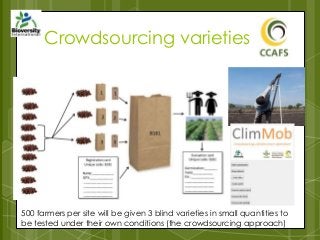
Crowdsourcing varieties
500 farmersper site will be given 3 blind varieties in small quantities to
be tested under their own conditions (the crowdsourcing approach)
4.
CGIAR Big Data
Large amounts of data accumulated by
CGIAR Centers to be published as Open
Data Highthrouput production of data:
Highthrouput Genotyping
Highthrouput Phenotyping
Remote Sensing data
Citizen Sciences ( Crowd Sourcing)
Open Data-Open Access Strategy for CGIAR
5.
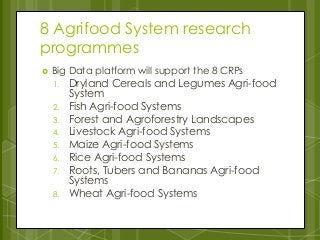
8 Agrifood Systemresearch
programmes
Big Data platform will support the 8 CRPs
1. Dryland Cereals and Legumes Agri-food
System
2. Fish Agri-food Systems
3. Forest and Agroforestry Landscapes
4. Livestock Agri-food Systems
5. Maize Agri-food Systems
6. Rice Agri-food Systems
7. Roots, Tubers and Bananas Agri-food
Systems
8. Wheat Agri-food Systems
6.
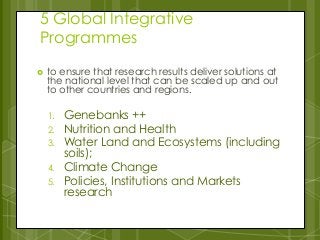
5 Global Integrative
Programmes
to ensure that research results deliver solutions at
the national level that can be scaled up and out
to other countries and regions.
1. Genebanks ++
2. Nutrition and Health
3. Water Land and Ecosystems (including
soils);
4. Climate Change
5. Policies, Institutions and Markets
research
7.
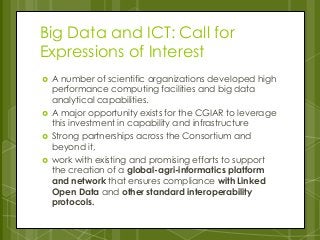
Big Data andICT: Call for
Expressions of Interest
A number of scientific organizations developed high
performance computing facilities and big data
analytical capabilities.
A major opportunity exists for the CGIAR to leverage
this investment in capability and infrastructure
Strong partnerships across the Consortium and
beyond it,
work with existing and promising efforts to support
the creation of a global-agri-informatics platform
and network that ensures compliance with Linked
Open Data and other standard interoperability
protocols.
8.
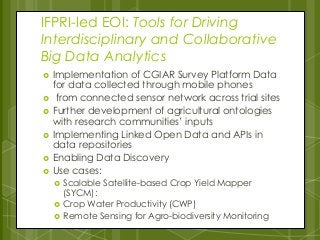
IFPRI-led EOI: Toolsfor Driving
Interdisciplinary and Collaborative
Big Data Analytics
Implementation of CGIAR Survey Platform Data
for data collected through mobile phones
from connected sensor network across trial sites
Further development of agricultural ontologies
with research communities’ inputs
Implementing Linked Open Data and APIs in
data repositories
Enabling Data Discovery
Use cases:
Scalable Satellite-based Crop Yield Mapper
(SYCM):
Crop Water Productivity (CWP)
Remote Sensing for Agro-biodiversity Monitoring
9.
Call for Pre-proposalsfor
CGIAR Research Programmes
http://www.cgiar.org/our-
strategy/second-call-for-cgiar-research-
programs/crp-2nd-call-pre-proposal-
submissions/
Editor's Notes
#4 Citizen science
Parallel to the mother and baby trials, 500 farmers per site will be given 3 blind varieties in small quantities to be tested under their own conditions (the crowdsourcing approach) and will be asked to evaluate the material and provide feedback on their preferences, they will become citizen scientists. Data and
feedback will be collected by ERMCSD with the engagement of extension services after receiving appropriate training by Bioversity. The feedback will be collected using a simple questionnaire using mobile phones/tablets for immediate submissions to the data manager. This data will be linked to a global portal developed by Bioversity and CIAT to upscale the approach and will be analyzed using ClimMob software developed by Bioversity (van Etten, 2014).


![[DSC Europe 25] Maria Kokiasmenos - AI Governance US Perspective.pptx](https://cdn.slidesharecdn.com/ss_thumbnails/eszqnbzlsqa2vch6dmci-6-251215095918-6fcdf45f-thumbnail.jpg?width=640&height=640&fit=bounds)


![[DSC Europe 25] Ivan Peric - Intelligence Swarm Logic and Techno-Functional M...](https://cdn.slidesharecdn.com/ss_thumbnails/7my7c97fsduiccadgavw-2-251212103249-5a03f7c6-thumbnail.jpg?width=640&height=640&fit=bounds)

![[DSC Europe 25] Dobrica Cosic - From Electrons to Innovation: How Granular Da...](https://cdn.slidesharecdn.com/ss_thumbnails/h4qk69zereaumbceubgr-dobrica-cosic-from-electrons-to-innovation-how-granular-data-and-analytics-are--251218085301-b982fb14-thumbnail.jpg?width=640&height=640&fit=bounds)


![[DSC Europe 25] Kaja Kandare - LLM as a judge.pptx](https://cdn.slidesharecdn.com/ss_thumbnails/arxyccaxsdsd1ba99wjw-7-251212104007-2b4e3f64-thumbnail.jpg?width=640&height=640&fit=bounds)


![[DSC Europe 25] Tatevik Maytesyan - How to actually use AI in marketing: gett...](https://cdn.slidesharecdn.com/ss_thumbnails/tjo626lsqdgfntbgl2mw-4-251216103155-e36cd239-thumbnail.jpg?width=640&height=640&fit=bounds)

