Implementing the Media
         Fragments URI
          Specification
Raphaël Troncy <raphael.troncy@eurecom.fr>,
Davy Van Deursen, Erik Mannens
Silvia Pfeiffer,
Yves Lafon
Use Case
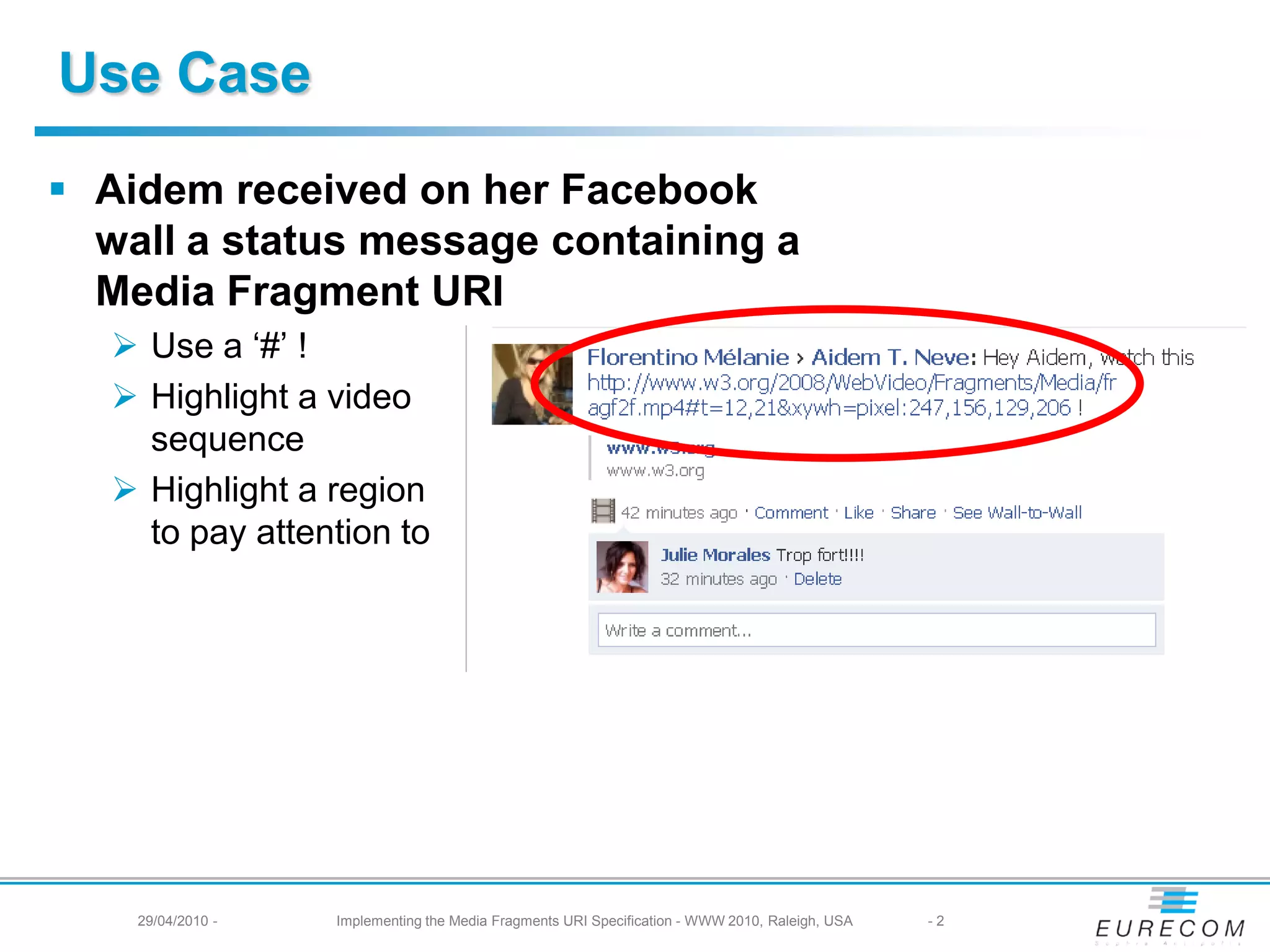
 Aidem received on her Facebook
  wall a status message containing a
  Media Fragment URI
    Use a ‘#’ !
    Highlight a video
     sequence
    Highlight a region
     to pay attention to


    29/04/2010 -   Implementing the Media Fragments URI Specification - WWW 2010, Raleigh, USA   -2
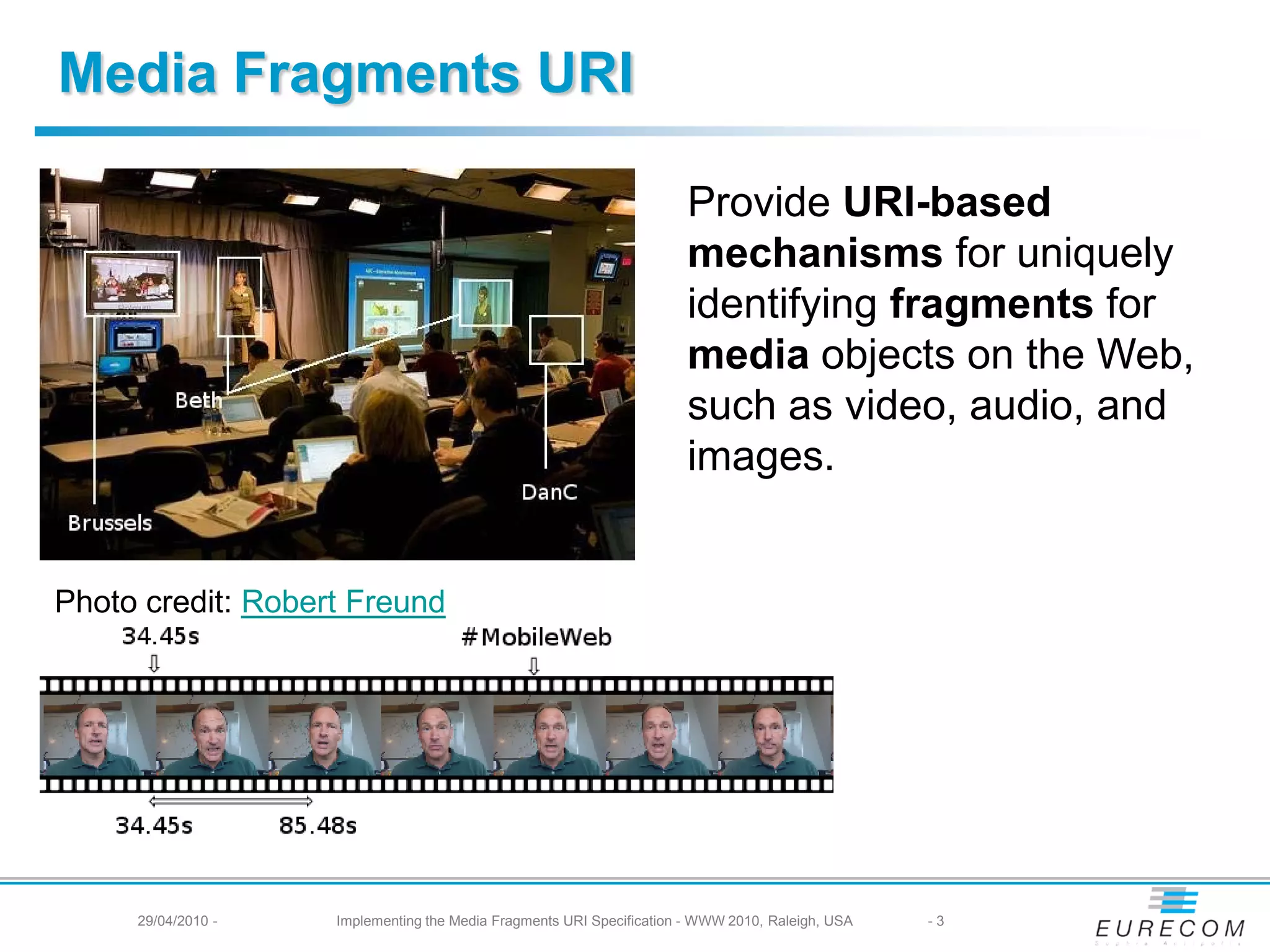
Media Fragments URI

                                                                      Provide URI-based
                                                                      mechanisms for uniquely
                                                                      identifying fragments for
                                                                      media objects on the Web,
                                                                      such as video, audio, and
                                                                      images.


Photo credit: Robert Freund


     29/04/2010 -   Implementing the Media Fragments URI Specification - WWW 2010, Raleigh, USA   -3
Requirements
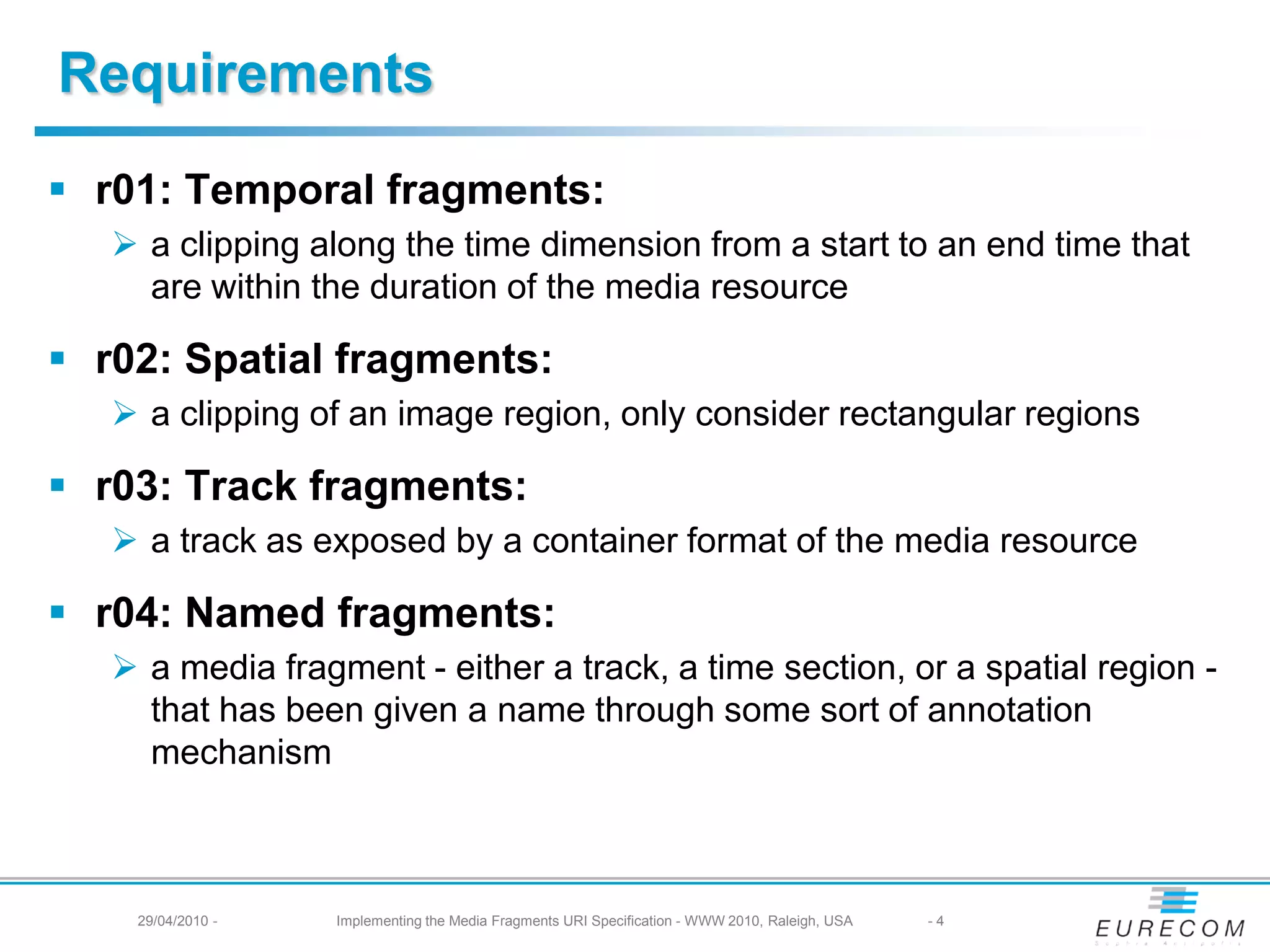
 r01: Temporal fragments:
    a clipping along the time dimension from a start to an end time that
     are within the duration of the media resource

 r02: Spatial fragments:
    a clipping of an image region, only consider rectangular regions

 r03: Track fragments:
    a track as exposed by a container format of the media resource

 r04: Named fragments:
    a media fragment - either a track, a time section, or a spatial region -
     that has been given a name through some sort of annotation
     mechanism


    29/04/2010 -   Implementing the Media Fragments URI Specification - WWW 2010, Raleigh, USA   -4
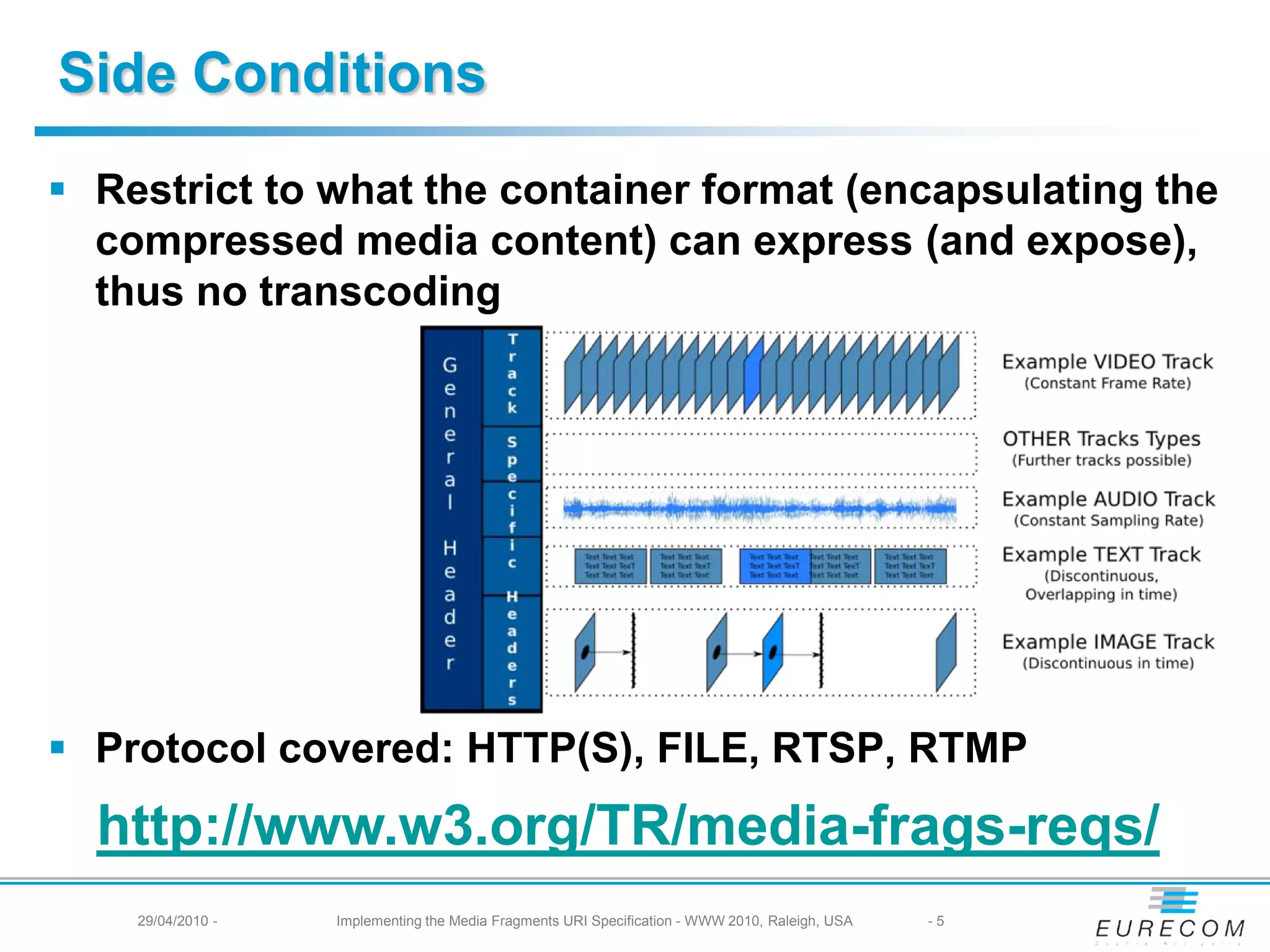
Side Conditions
 Restrict to what the container format (encapsulating the
  compressed media content) can express (and expose),
  thus no transcoding


 Protocol covered: HTTP(S), FILE, RTSP, RTMP
  http://www.w3.org/TR/media-frags-reqs/
    29/04/2010 -   Implementing the Media Fragments URI Specification - WWW 2010, Raleigh, USA   -5
Media Fragments processing

 General principle:
   Smart UA will strip out the fragment definition and
    encode it into custom http headers ...
   (Media) Servers will handle the request, slice the media
    content and serve just the fragment while old ones will
    serve the whole resource

 Four recipes proposed


   29/04/2010 -   Implementing the Media Fragments URI Specification - WWW 2010, Raleigh, USA   -6
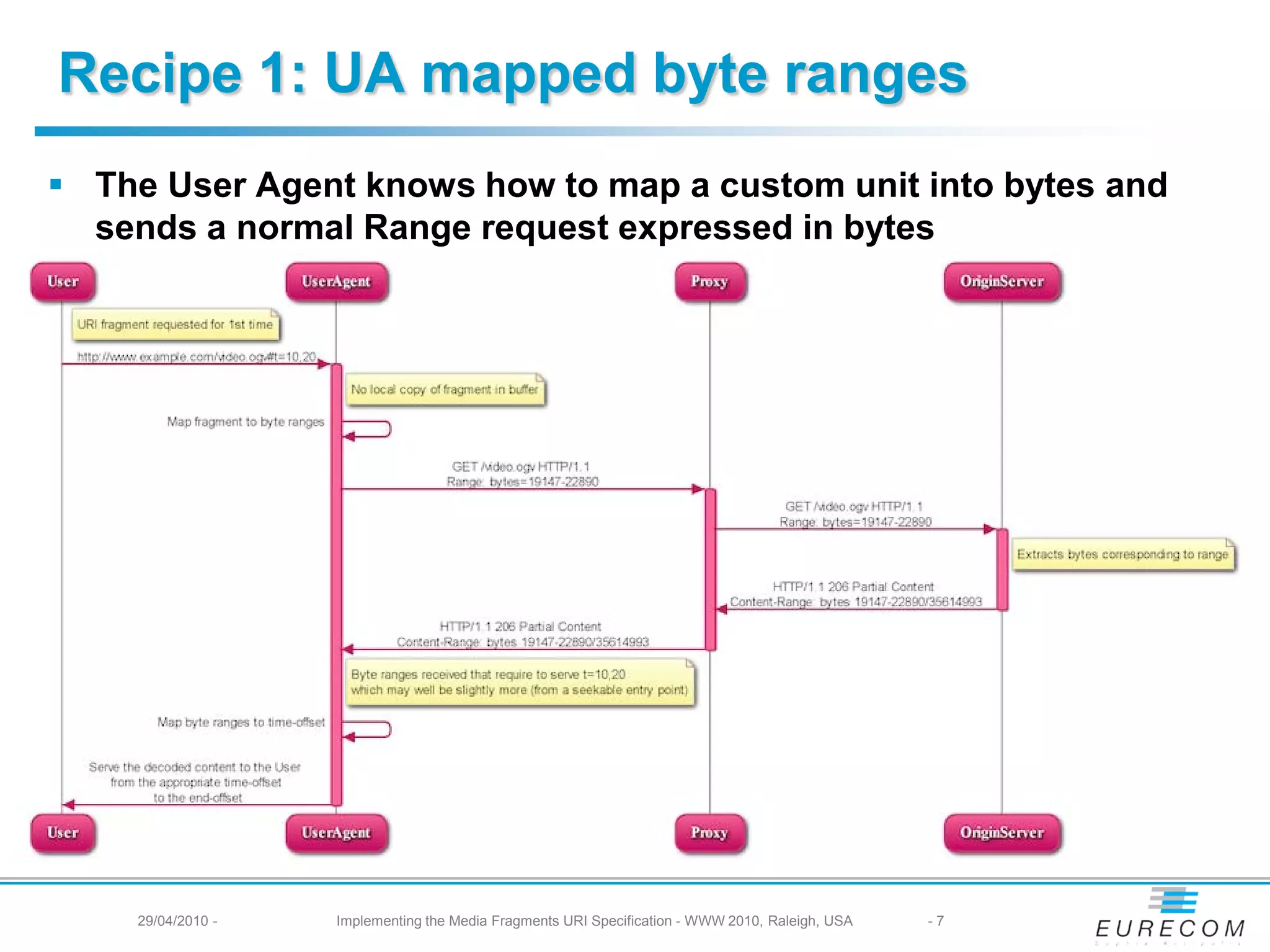
Recipe 1: UA mapped byte ranges
 The User Agent knows how to map a custom unit into bytes and
  sends a normal Range request expressed in bytes


    29/04/2010 -   Implementing the Media Fragments URI Specification - WWW 2010, Raleigh, USA   -7
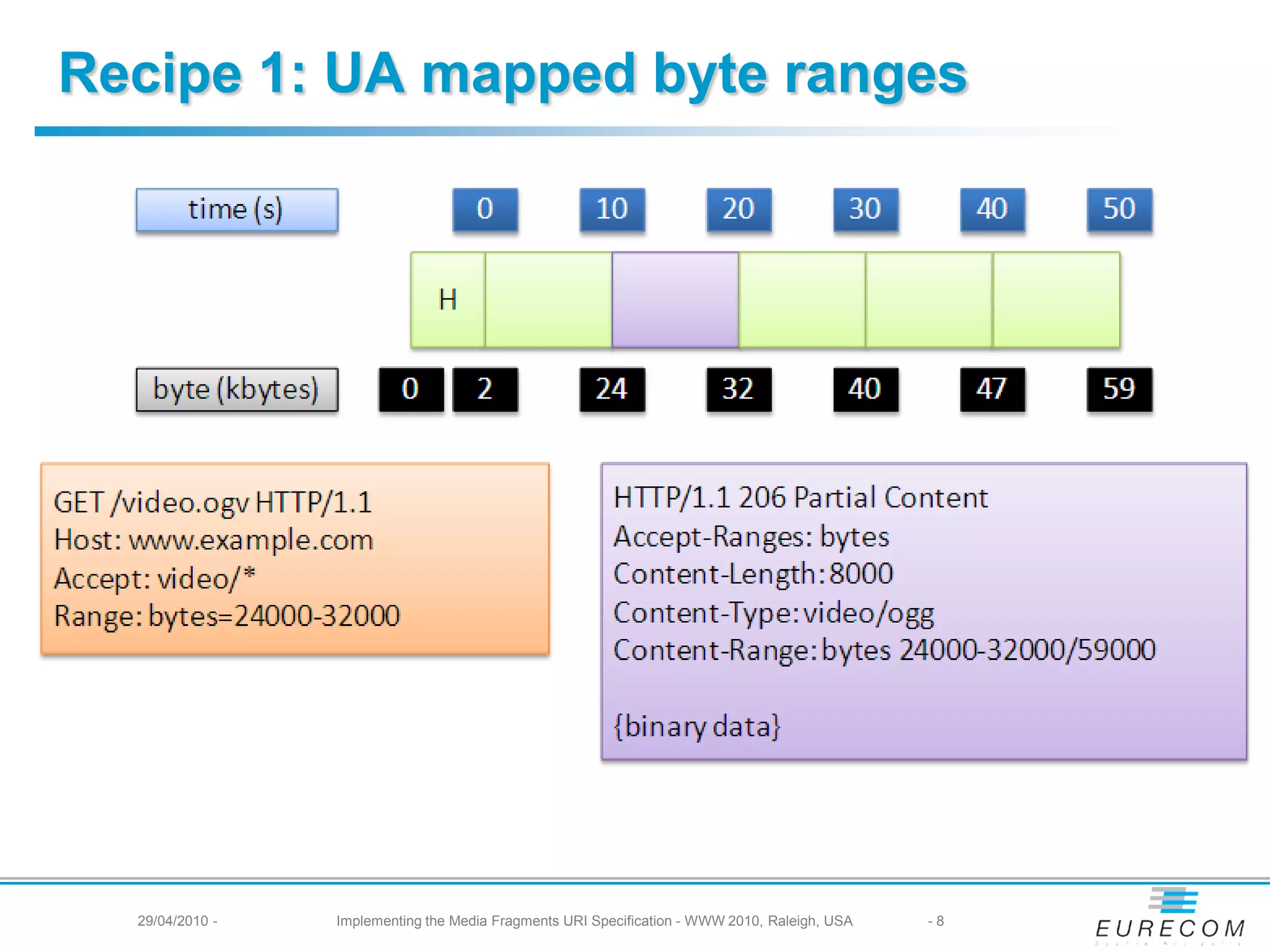
Recipe 1: UA mapped byte ranges


  29/04/2010 -   Implementing the Media Fragments URI Specification - WWW 2010, Raleigh, USA   -8
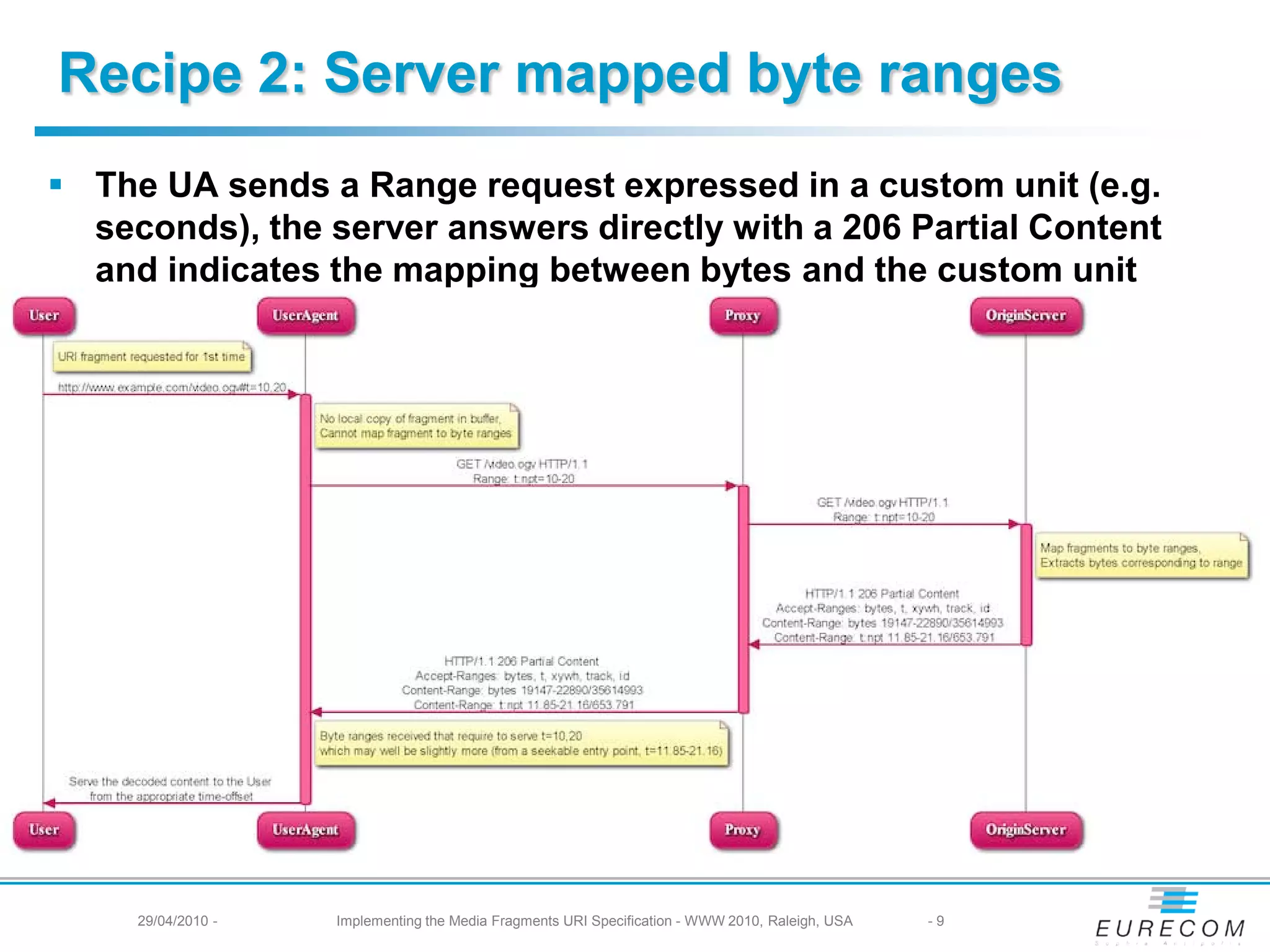
Recipe 2: Server mapped byte ranges
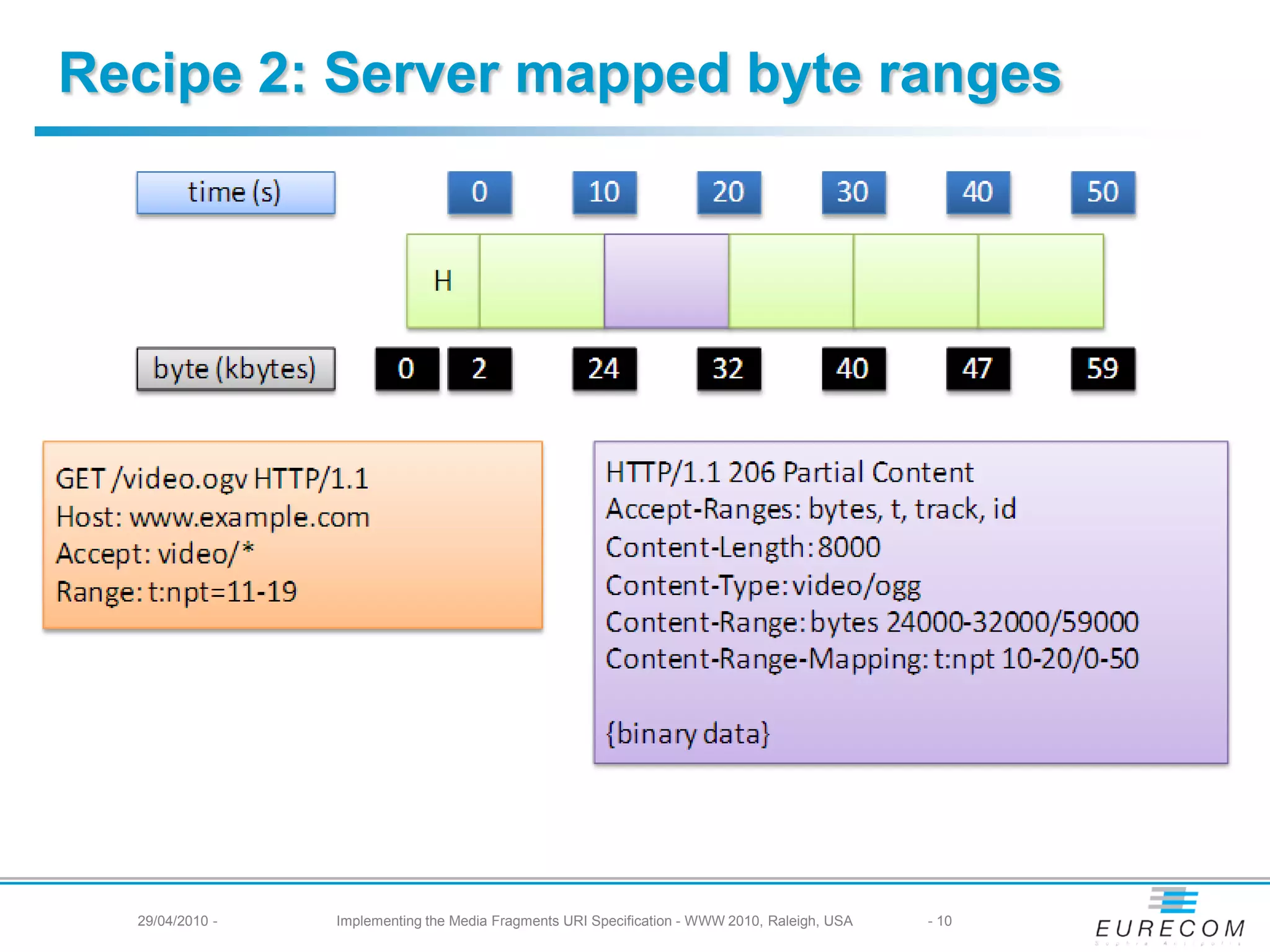
 The UA sends a Range request expressed in a custom unit (e.g.
  seconds), the server answers directly with a 206 Partial Content
  and indicates the mapping between bytes and the custom unit


     29/04/2010 -   Implementing the Media Fragments URI Specification - WWW 2010, Raleigh, USA   -9
Recipe 2: Server mapped byte ranges


  29/04/2010 -   Implementing the Media Fragments URI Specification - WWW 2010, Raleigh, USA   - 10
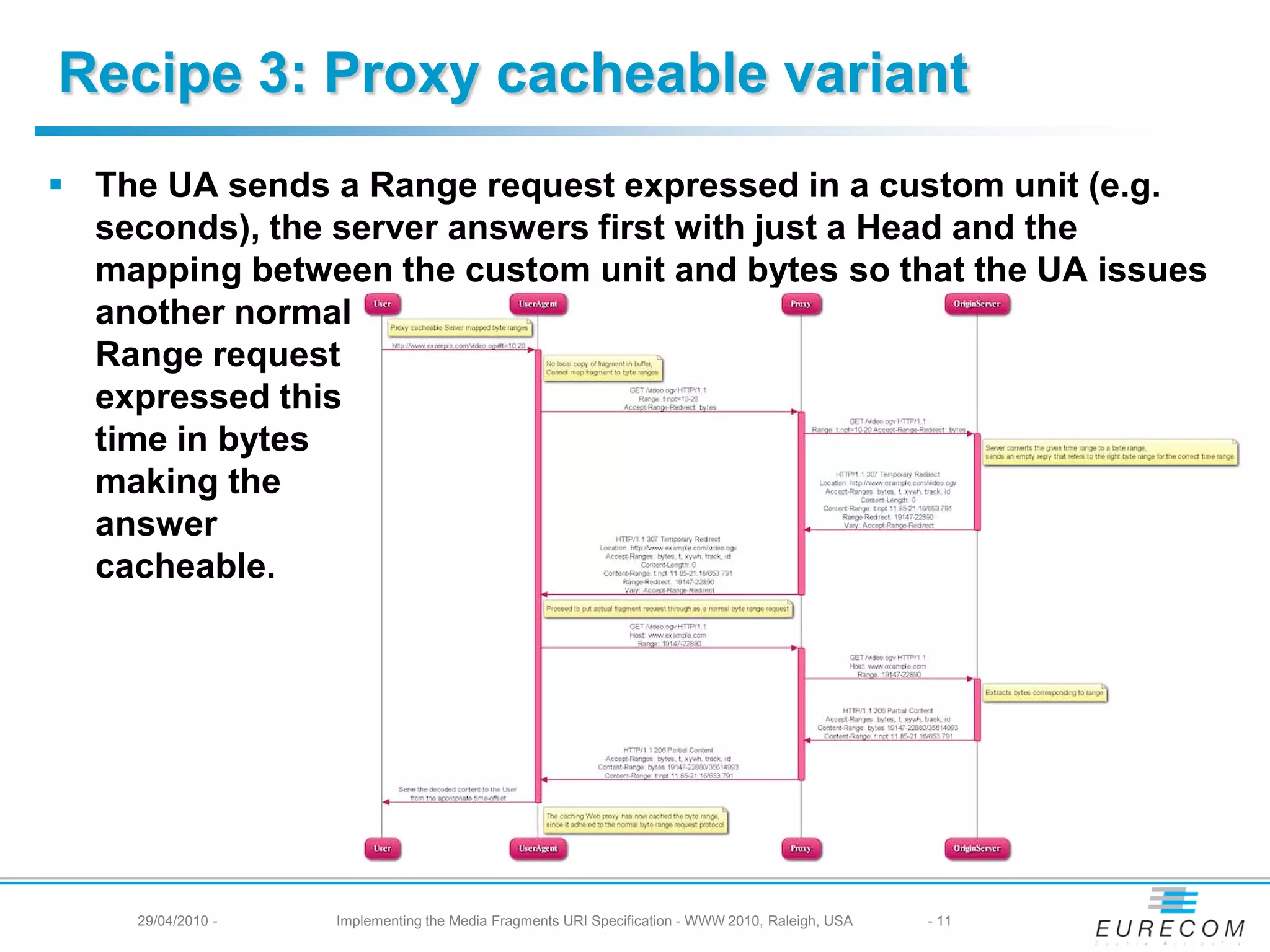
Recipe 3: Proxy cacheable variant
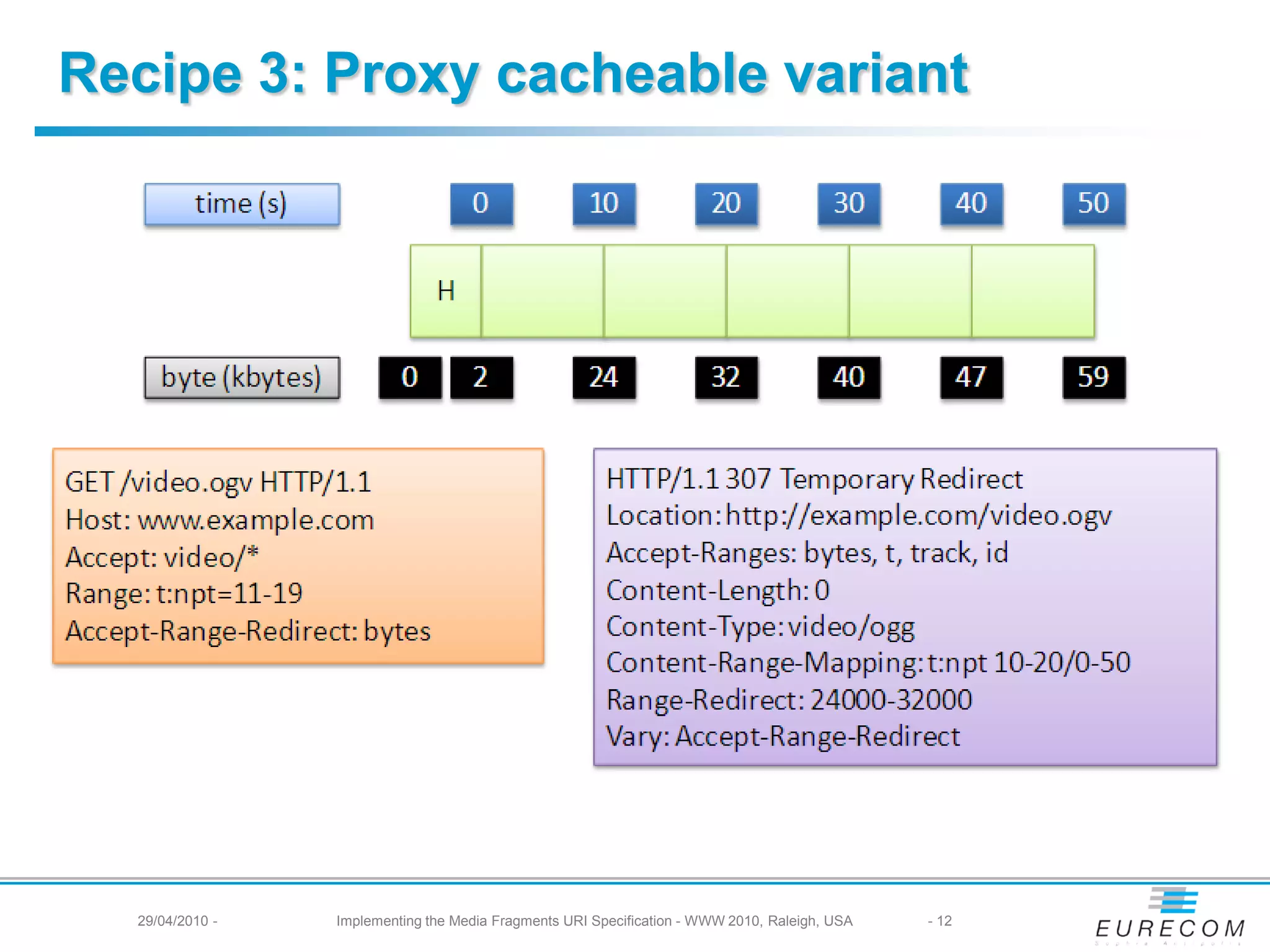
 The UA sends a Range request expressed in a custom unit (e.g.
  seconds), the server answers first with just a Head and the
  mapping between the custom unit and bytes so that the UA issues
  another normal
  Range request
  expressed this
  time in bytes
  making the
  answer
  cacheable.


     29/04/2010 -   Implementing the Media Fragments URI Specification - WWW 2010, Raleigh, USA   - 11
Recipe 3: Proxy cacheable variant


  29/04/2010 -   Implementing the Media Fragments URI Specification - WWW 2010, Raleigh, USA   - 12
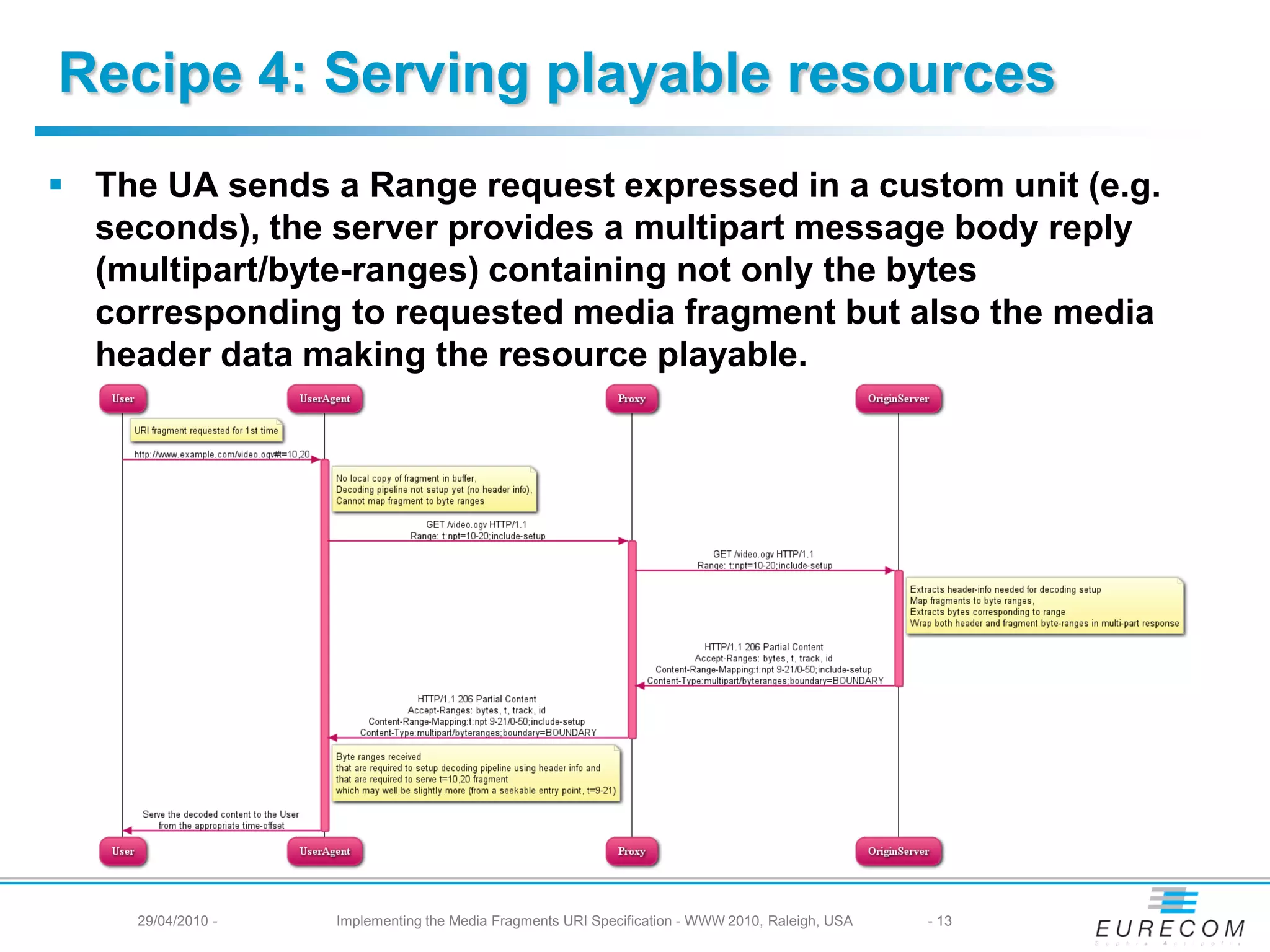
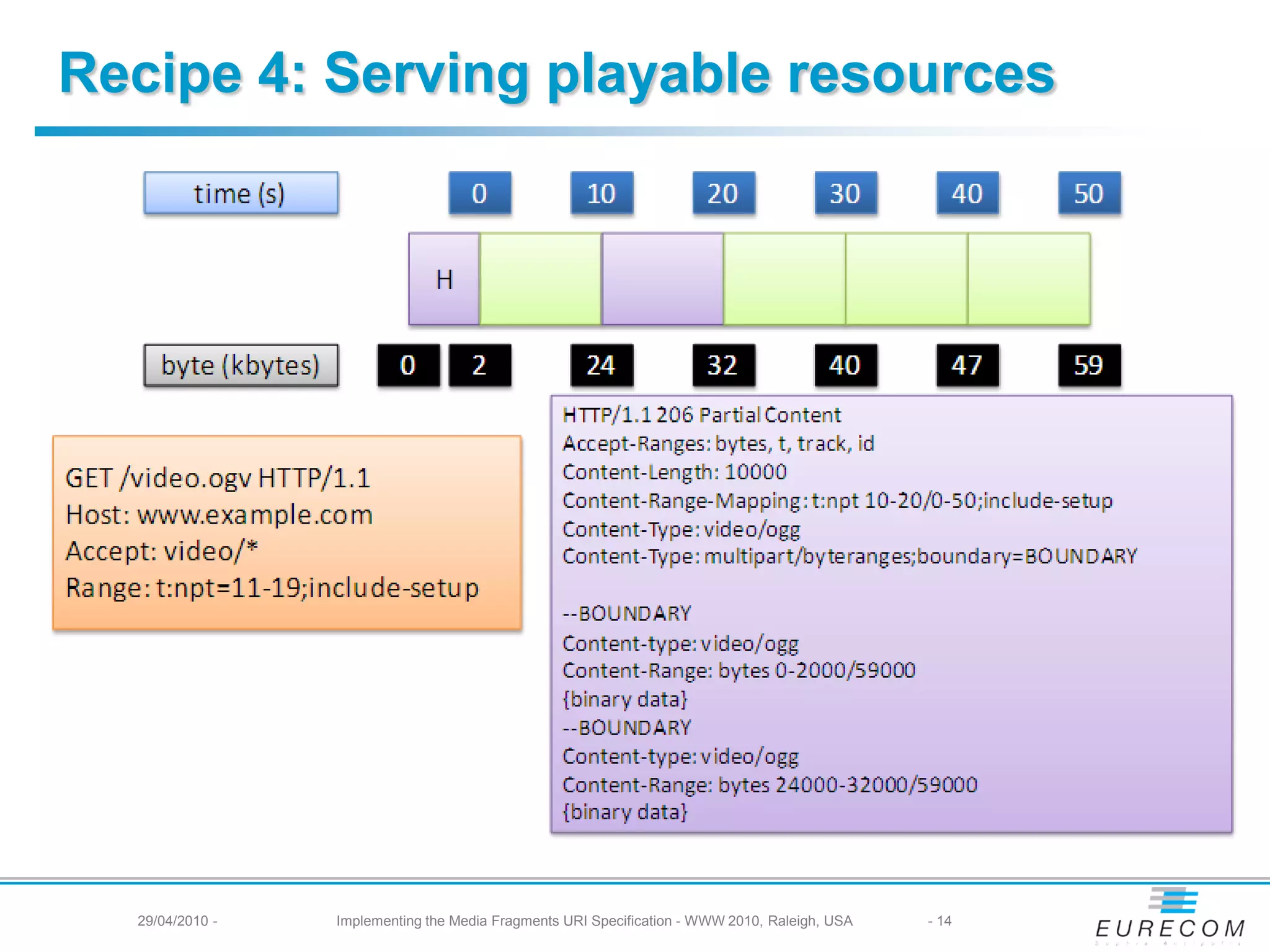
Recipe 4: Serving playable resources
 The UA sends a Range request expressed in a custom unit (e.g.
  seconds), the server provides a multipart message body reply
  (multipart/byte-ranges) containing not only the bytes
  corresponding to requested media fragment but also the media
  header data making the resource playable.


     29/04/2010 -   Implementing the Media Fragments URI Specification - WWW 2010, Raleigh, USA   - 13
Recipe 4: Serving playable resources


  29/04/2010 -   Implementing the Media Fragments URI Specification - WWW 2010, Raleigh, USA   - 14
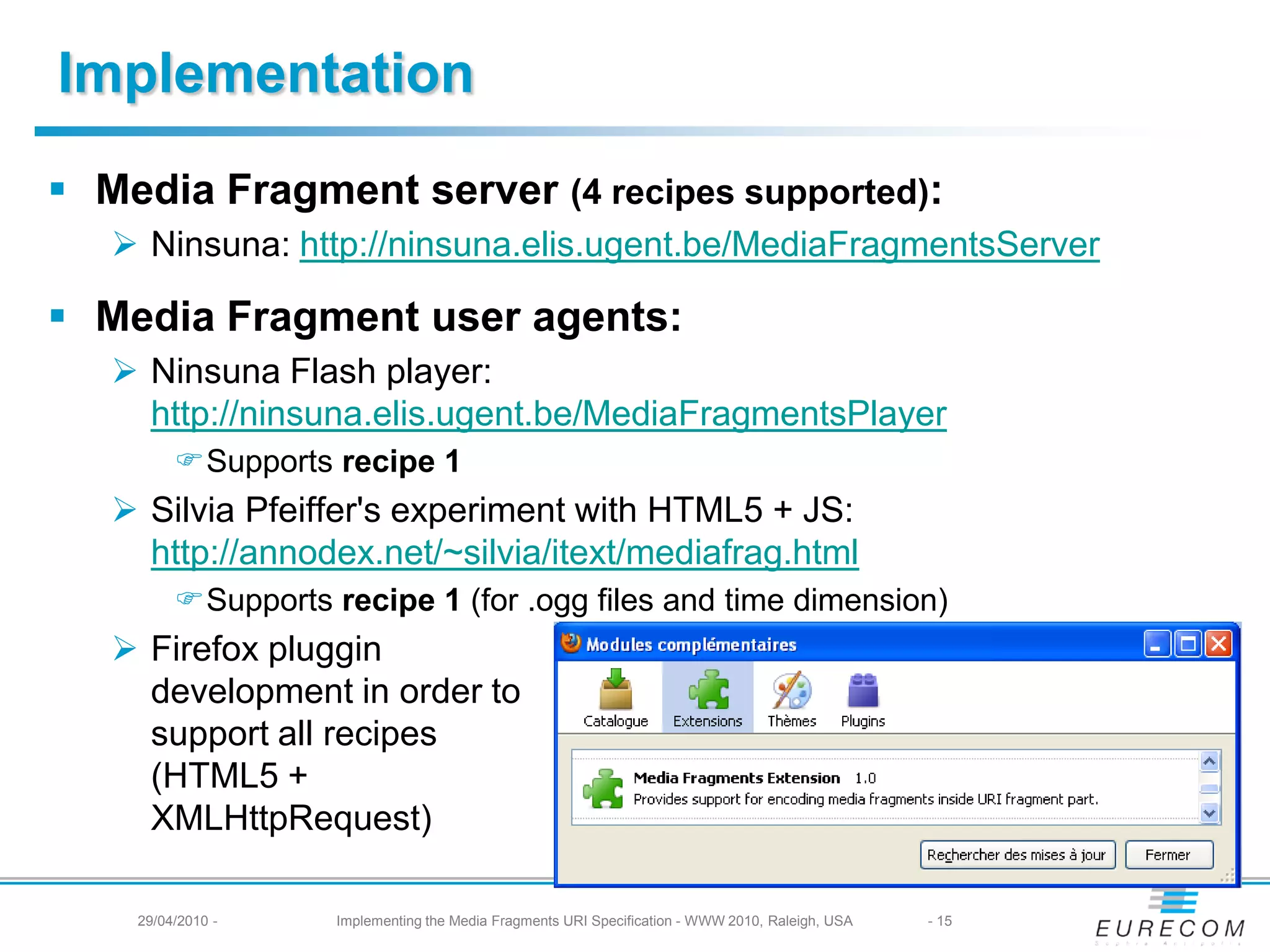
Implementation
 Media Fragment server (4 recipes supported):
    Ninsuna: http://ninsuna.elis.ugent.be/MediaFragmentsServer

 Media Fragment user agents:
    Ninsuna Flash player:
     http://ninsuna.elis.ugent.be/MediaFragmentsPlayer
         Supports recipe 1
    Silvia Pfeiffer's experiment with HTML5 + JS:
     http://annodex.net/~silvia/itext/mediafrag.html
         Supports recipe 1 (for .ogg files and time dimension)
    Firefox pluggin
     development in order to
     support all recipes
     (HTML5 +
     XMLHttpRequest)

    29/04/2010 -    Implementing the Media Fragments URI Specification - WWW 2010, Raleigh, USA   - 15
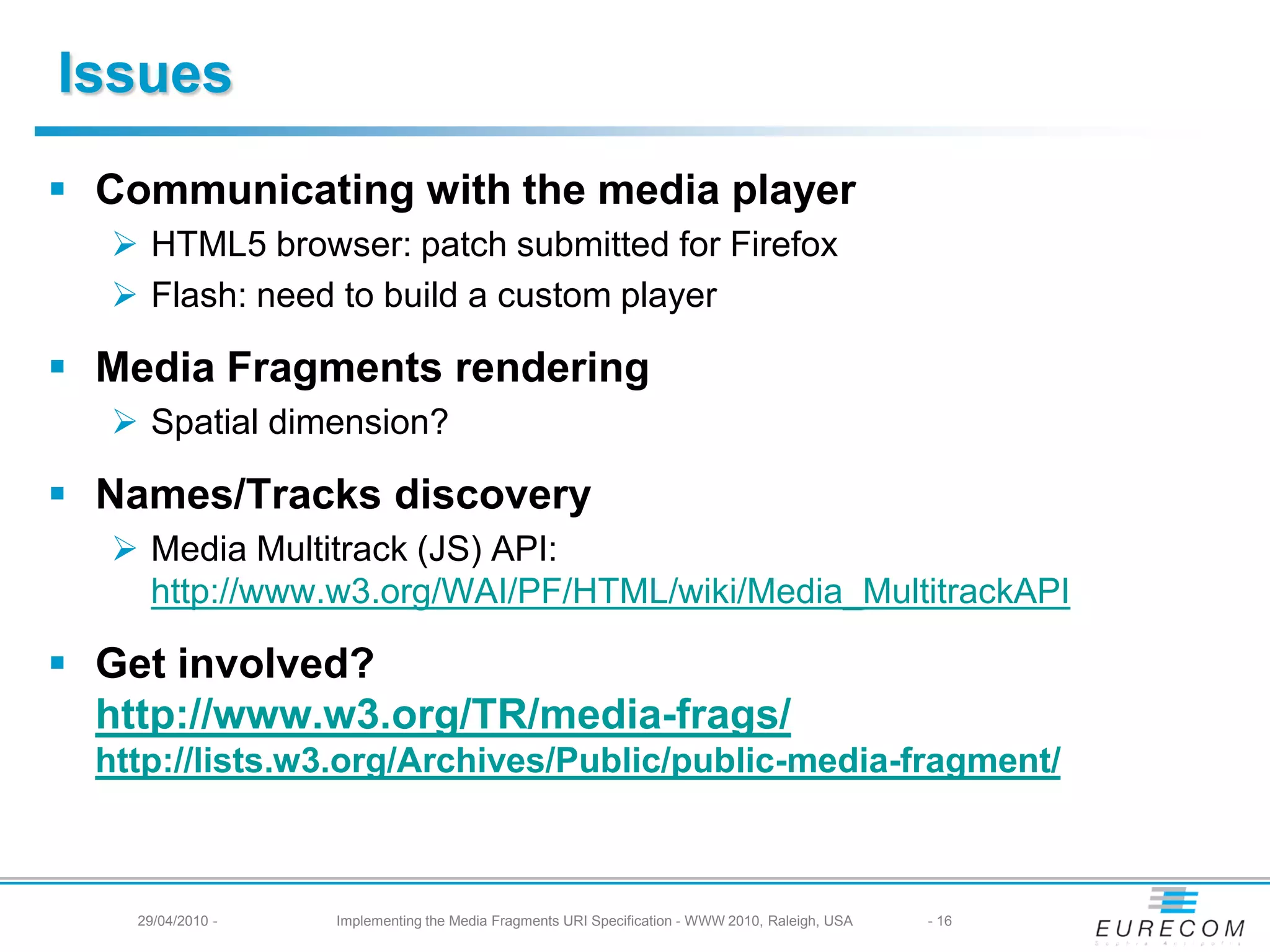
Issues
 Communicating with the media player
   HTML5 browser: patch submitted for Firefox
   Flash: need to build a custom player

 Media Fragments rendering
   Spatial dimension?

 Names/Tracks discovery
   Media Multitrack (JS) API:
    http://www.w3.org/WAI/PF/HTML/wiki/Media_MultitrackAPI

 Get involved?
  http://www.w3.org/TR/media-frags/
  http://lists.w3.org/Archives/Public/public-media-fragment/


    29/04/2010 -   Implementing the Media Fragments URI Specification - WWW 2010, Raleigh, USA   - 16

Implementing the Media Fragments URI Specification

  • 1.
    Implementing the Media Fragments URI Specification Raphaël Troncy <raphael.troncy@eurecom.fr>, Davy Van Deursen, Erik Mannens Silvia Pfeiffer, Yves Lafon
  • 2.
    Use Case  Aidemreceived on her Facebook wall a status message containing a Media Fragment URI  Use a ‘#’ !  Highlight a video sequence  Highlight a region to pay attention to 29/04/2010 - Implementing the Media Fragments URI Specification - WWW 2010, Raleigh, USA -2
  • 3.
    Media Fragments URI Provide URI-based mechanisms for uniquely identifying fragments for media objects on the Web, such as video, audio, and images. Photo credit: Robert Freund 29/04/2010 - Implementing the Media Fragments URI Specification - WWW 2010, Raleigh, USA -3
  • 4.
    Requirements  r01: Temporalfragments:  a clipping along the time dimension from a start to an end time that are within the duration of the media resource  r02: Spatial fragments:  a clipping of an image region, only consider rectangular regions  r03: Track fragments:  a track as exposed by a container format of the media resource  r04: Named fragments:  a media fragment - either a track, a time section, or a spatial region - that has been given a name through some sort of annotation mechanism 29/04/2010 - Implementing the Media Fragments URI Specification - WWW 2010, Raleigh, USA -4
  • 5.
    Side Conditions  Restrictto what the container format (encapsulating the compressed media content) can express (and expose), thus no transcoding  Protocol covered: HTTP(S), FILE, RTSP, RTMP http://www.w3.org/TR/media-frags-reqs/ 29/04/2010 - Implementing the Media Fragments URI Specification - WWW 2010, Raleigh, USA -5
  • 6.
    Media Fragments processing General principle:  Smart UA will strip out the fragment definition and encode it into custom http headers ...  (Media) Servers will handle the request, slice the media content and serve just the fragment while old ones will serve the whole resource  Four recipes proposed 29/04/2010 - Implementing the Media Fragments URI Specification - WWW 2010, Raleigh, USA -6
  • 7.
    Recipe 1: UAmapped byte ranges  The User Agent knows how to map a custom unit into bytes and sends a normal Range request expressed in bytes 29/04/2010 - Implementing the Media Fragments URI Specification - WWW 2010, Raleigh, USA -7
  • 8.
    Recipe 1: UAmapped byte ranges 29/04/2010 - Implementing the Media Fragments URI Specification - WWW 2010, Raleigh, USA -8
  • 9.
    Recipe 2: Servermapped byte ranges  The UA sends a Range request expressed in a custom unit (e.g. seconds), the server answers directly with a 206 Partial Content and indicates the mapping between bytes and the custom unit 29/04/2010 - Implementing the Media Fragments URI Specification - WWW 2010, Raleigh, USA -9
  • 10.
    Recipe 2: Servermapped byte ranges 29/04/2010 - Implementing the Media Fragments URI Specification - WWW 2010, Raleigh, USA - 10
  • 11.
    Recipe 3: Proxycacheable variant  The UA sends a Range request expressed in a custom unit (e.g. seconds), the server answers first with just a Head and the mapping between the custom unit and bytes so that the UA issues another normal Range request expressed this time in bytes making the answer cacheable. 29/04/2010 - Implementing the Media Fragments URI Specification - WWW 2010, Raleigh, USA - 11
  • 12.
    Recipe 3: Proxycacheable variant 29/04/2010 - Implementing the Media Fragments URI Specification - WWW 2010, Raleigh, USA - 12
  • 13.
    Recipe 4: Servingplayable resources  The UA sends a Range request expressed in a custom unit (e.g. seconds), the server provides a multipart message body reply (multipart/byte-ranges) containing not only the bytes corresponding to requested media fragment but also the media header data making the resource playable. 29/04/2010 - Implementing the Media Fragments URI Specification - WWW 2010, Raleigh, USA - 13
  • 14.
    Recipe 4: Servingplayable resources 29/04/2010 - Implementing the Media Fragments URI Specification - WWW 2010, Raleigh, USA - 14
  • 15.
    Implementation  Media Fragmentserver (4 recipes supported):  Ninsuna: http://ninsuna.elis.ugent.be/MediaFragmentsServer  Media Fragment user agents:  Ninsuna Flash player: http://ninsuna.elis.ugent.be/MediaFragmentsPlayer Supports recipe 1  Silvia Pfeiffer's experiment with HTML5 + JS: http://annodex.net/~silvia/itext/mediafrag.html Supports recipe 1 (for .ogg files and time dimension)  Firefox pluggin development in order to support all recipes (HTML5 + XMLHttpRequest) 29/04/2010 - Implementing the Media Fragments URI Specification - WWW 2010, Raleigh, USA - 15
  • 16.
    Issues  Communicating withthe media player  HTML5 browser: patch submitted for Firefox  Flash: need to build a custom player  Media Fragments rendering  Spatial dimension?  Names/Tracks discovery  Media Multitrack (JS) API: http://www.w3.org/WAI/PF/HTML/wiki/Media_MultitrackAPI  Get involved? http://www.w3.org/TR/media-frags/ http://lists.w3.org/Archives/Public/public-media-fragment/ 29/04/2010 - Implementing the Media Fragments URI Specification - WWW 2010, Raleigh, USA - 16