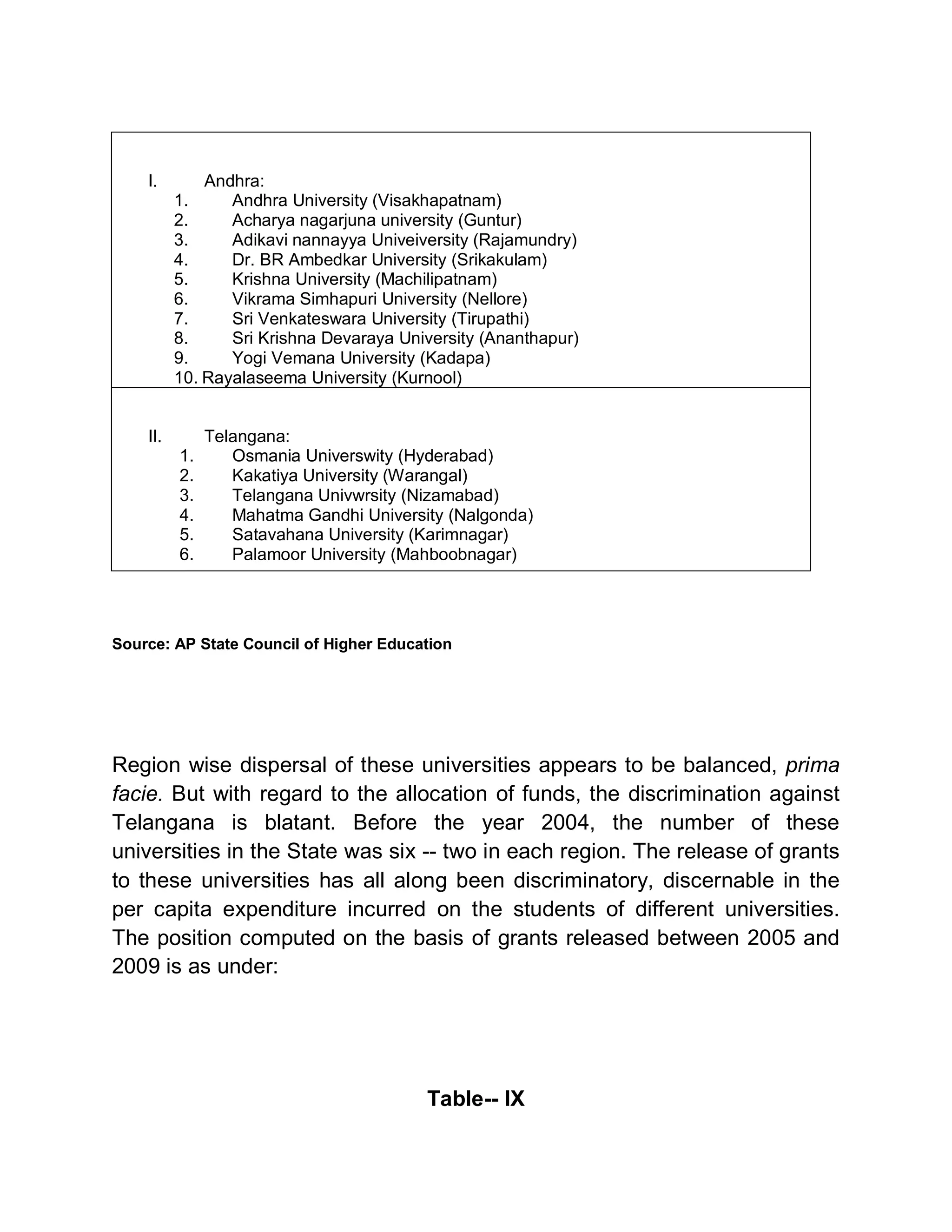
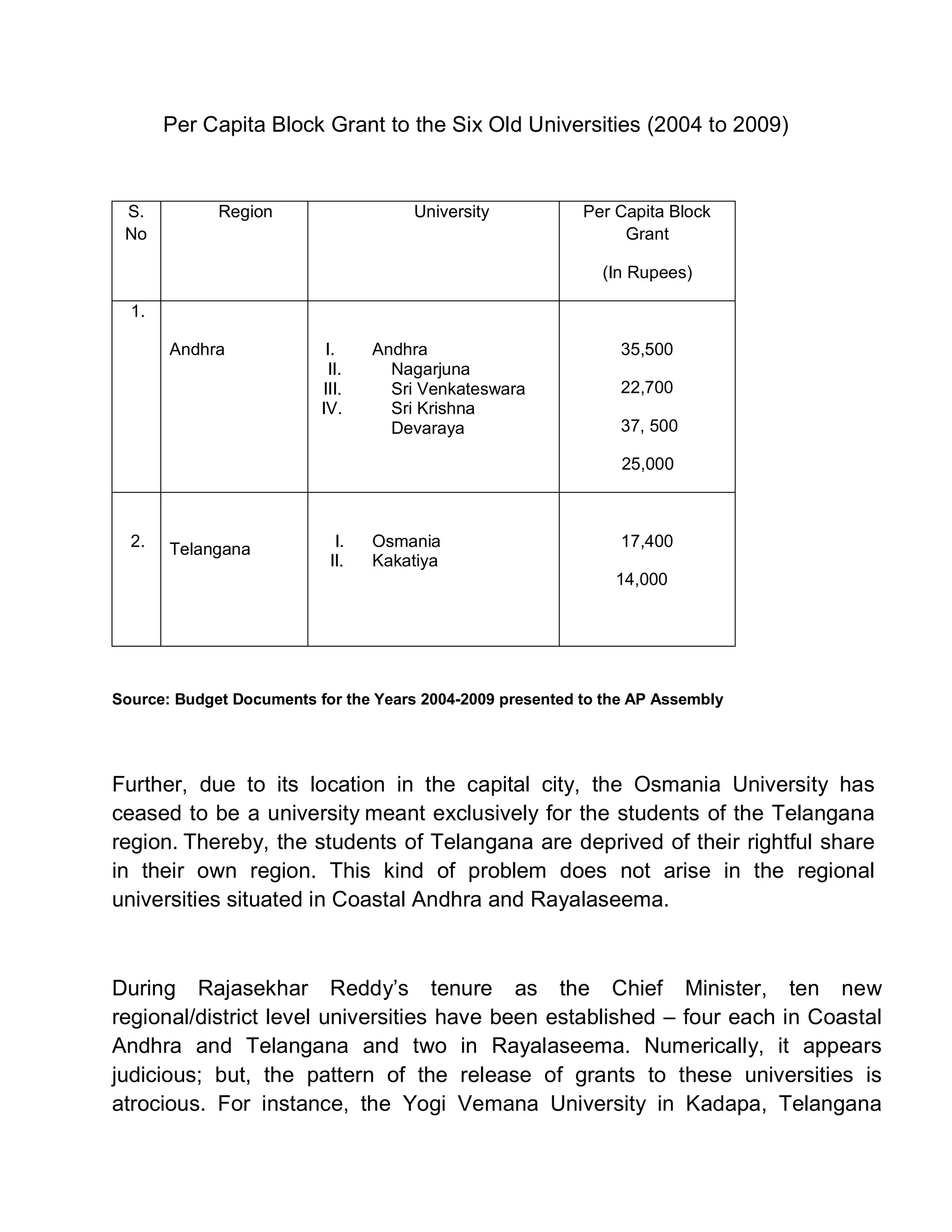
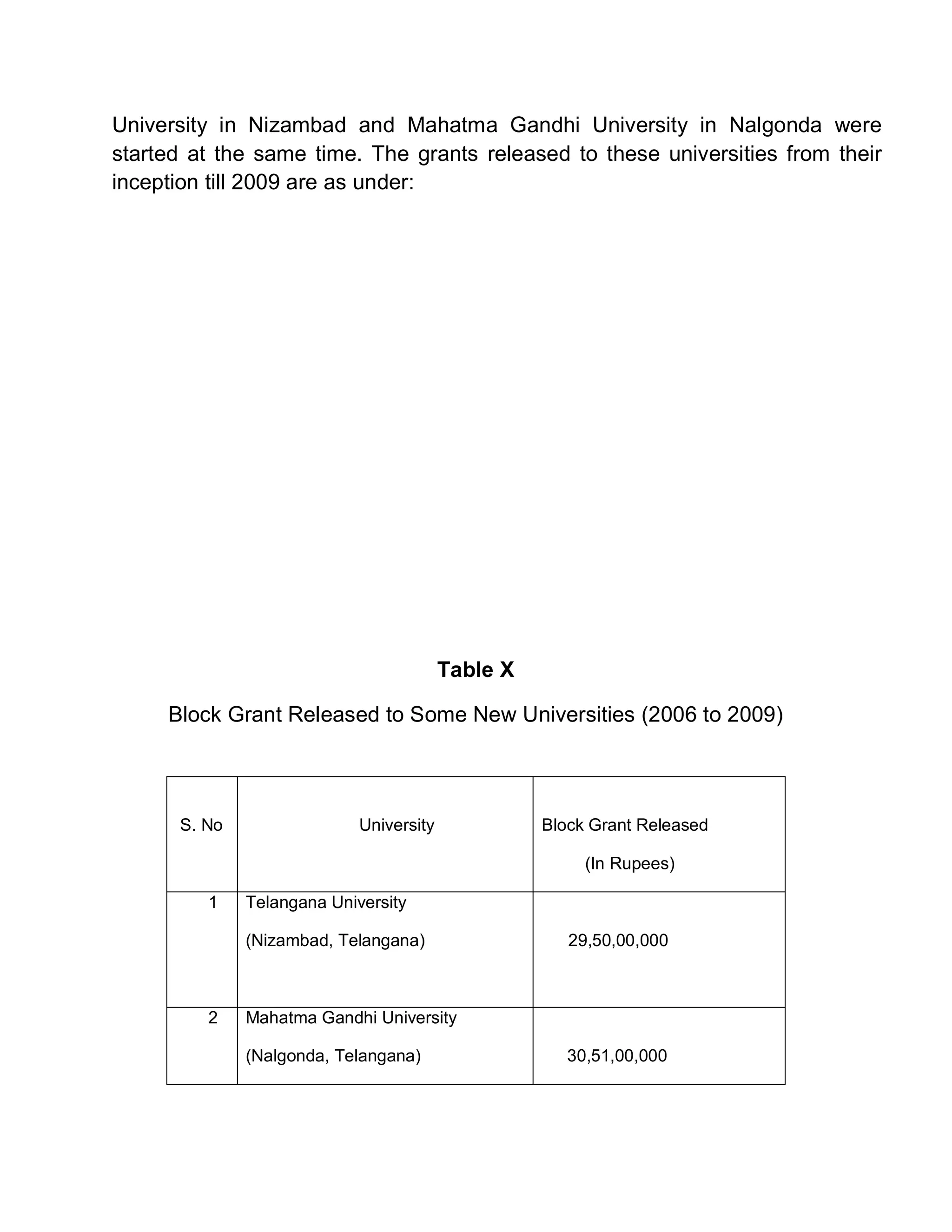
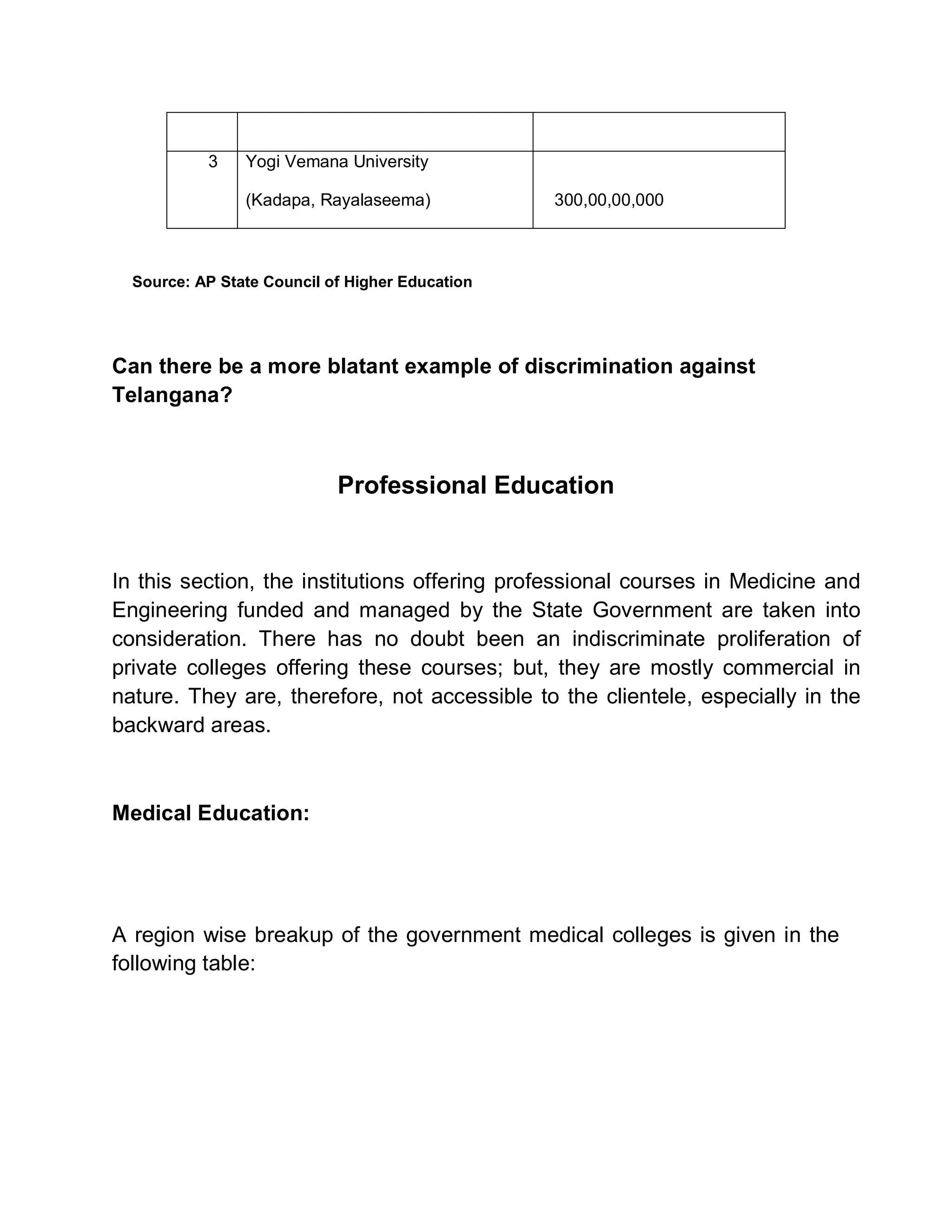
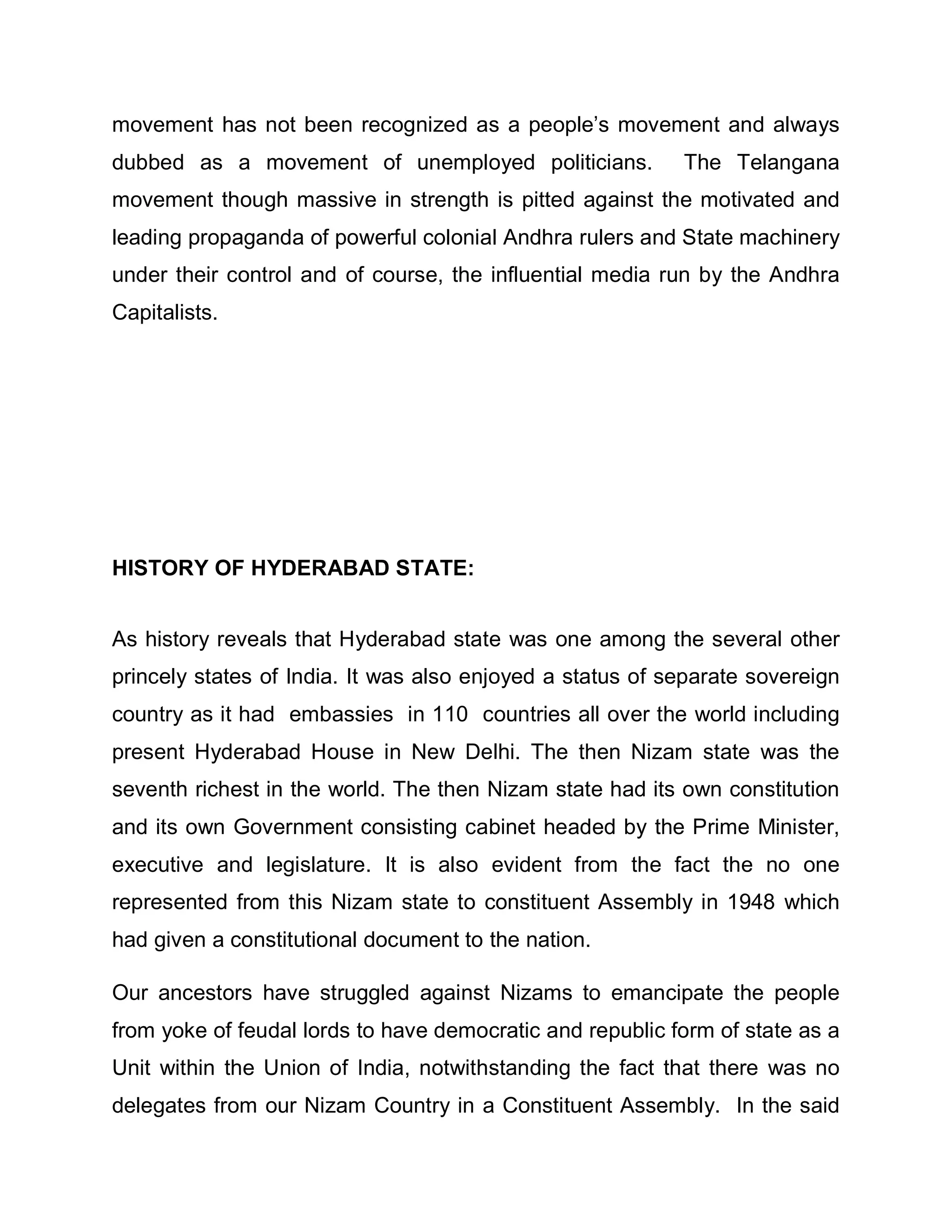
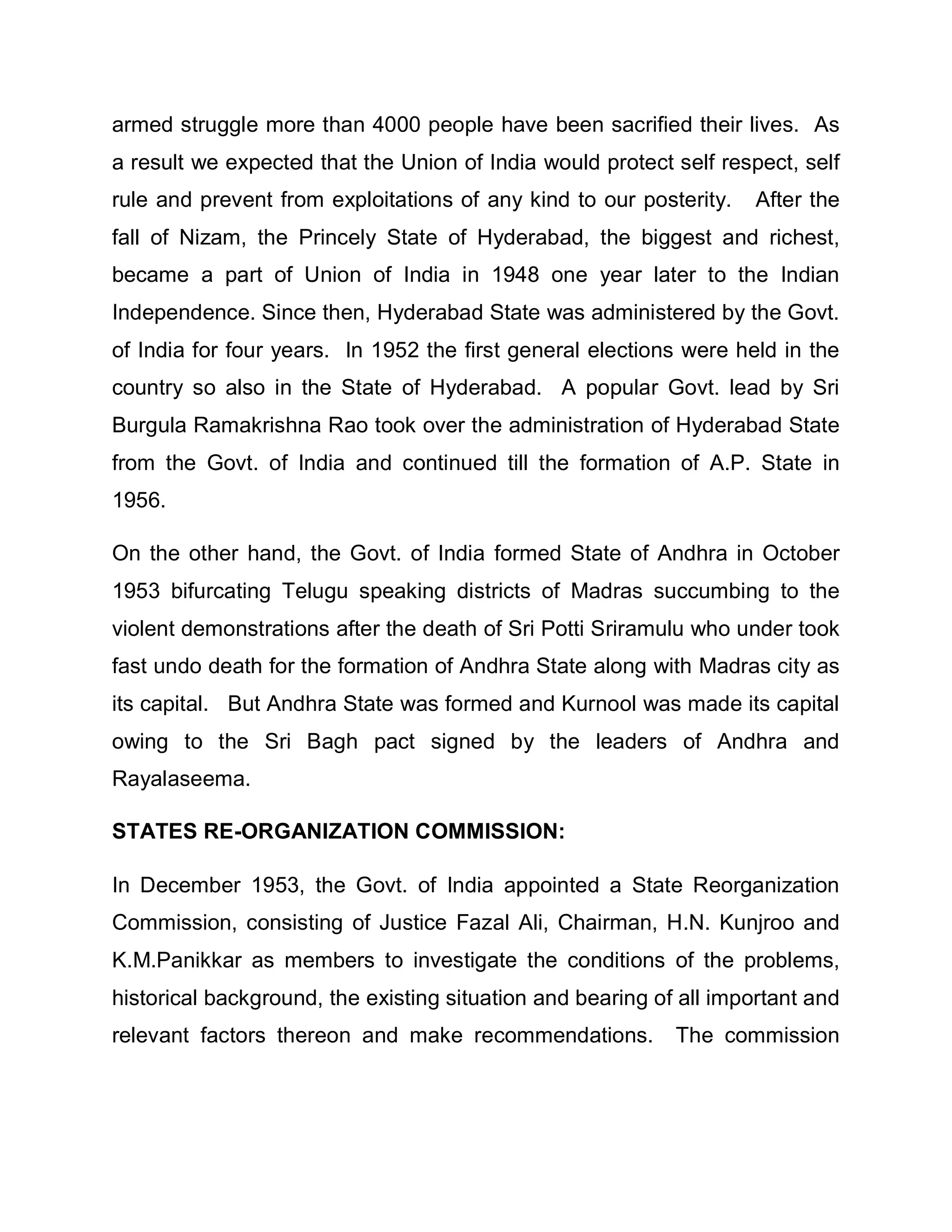
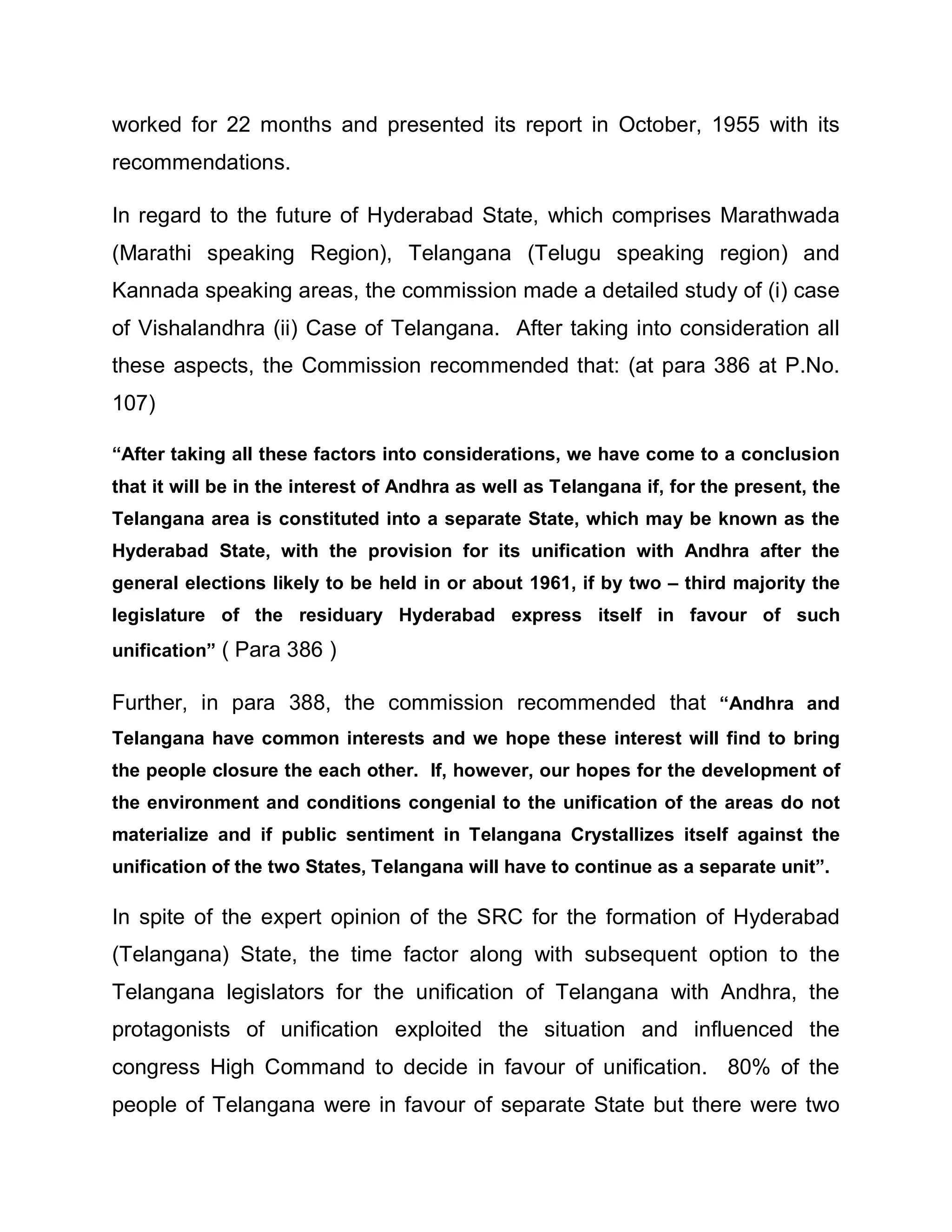
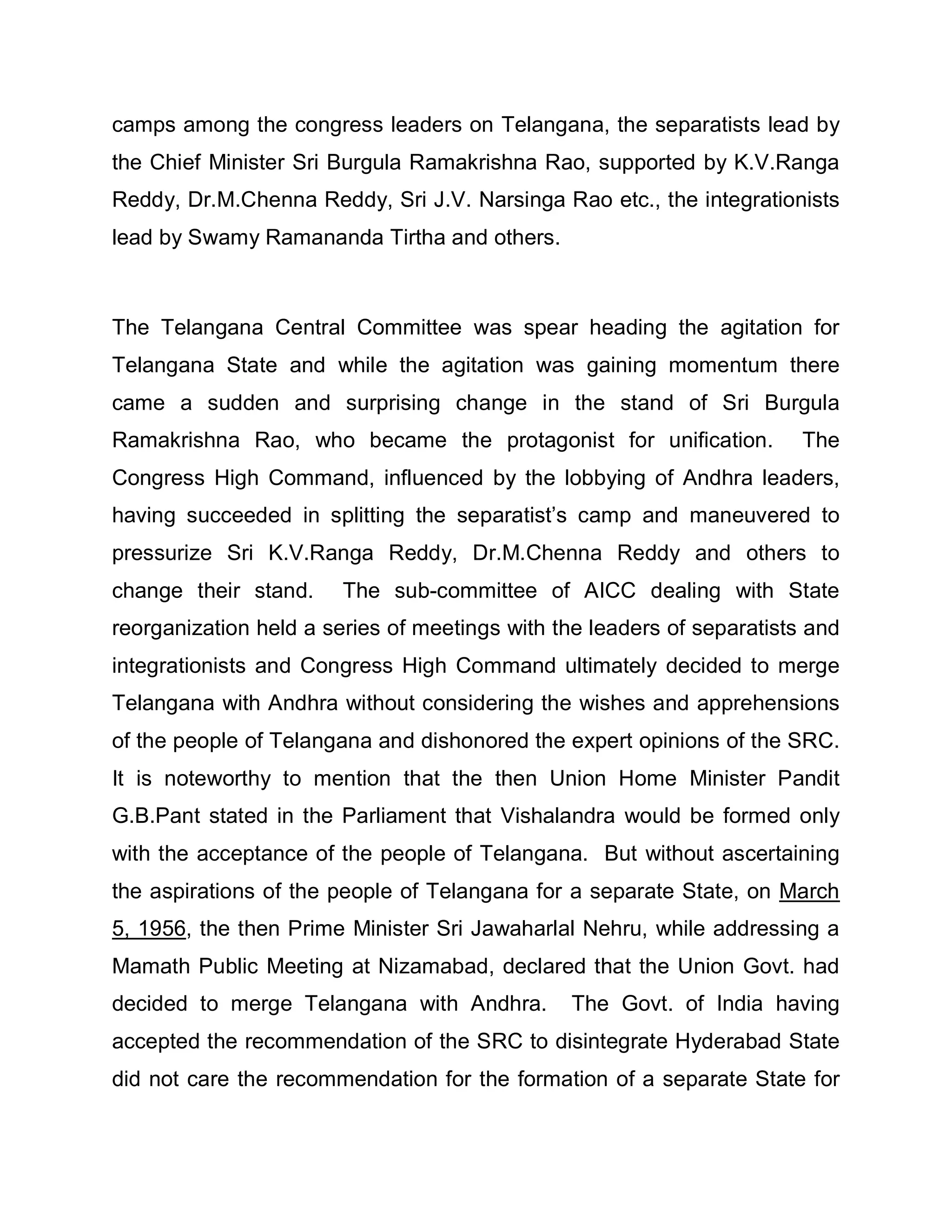
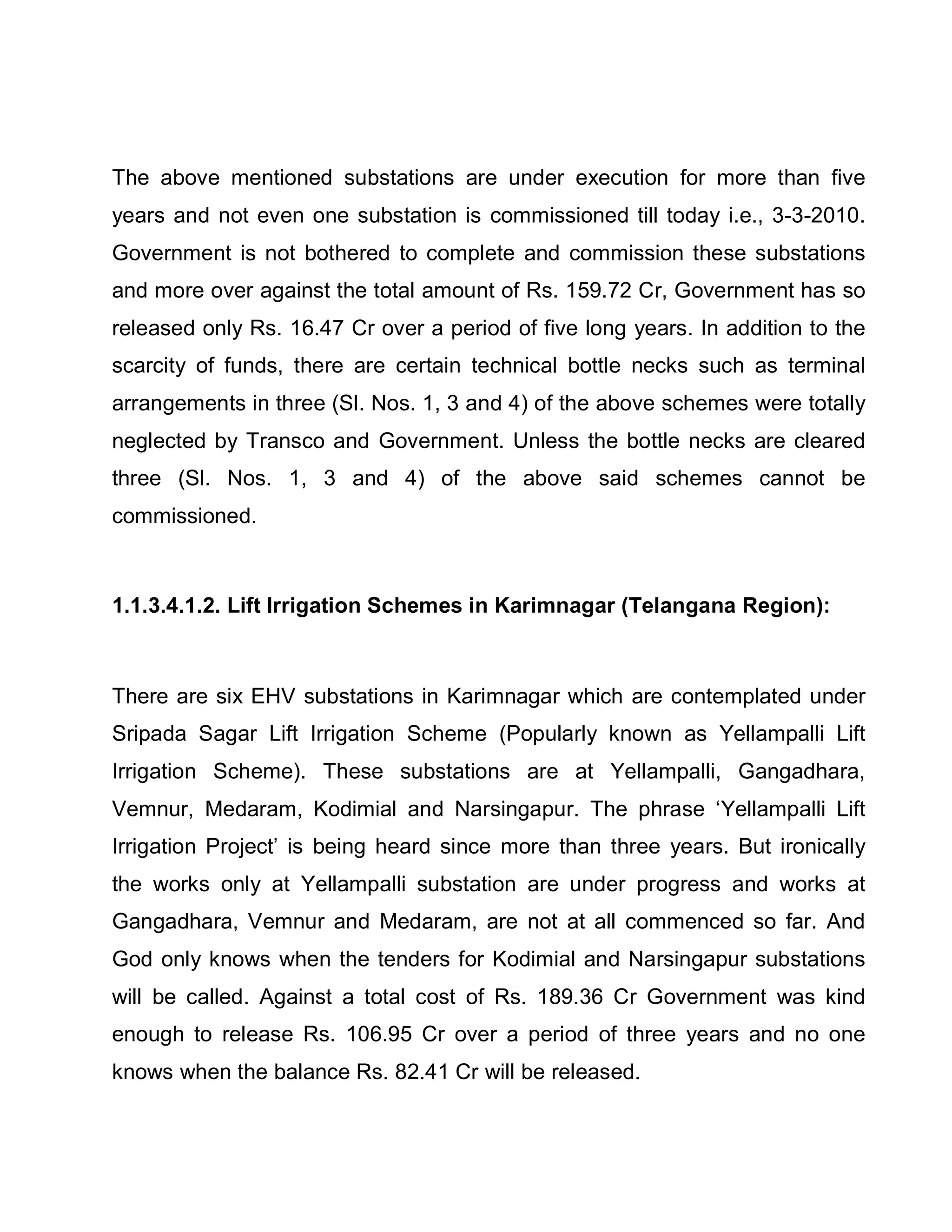
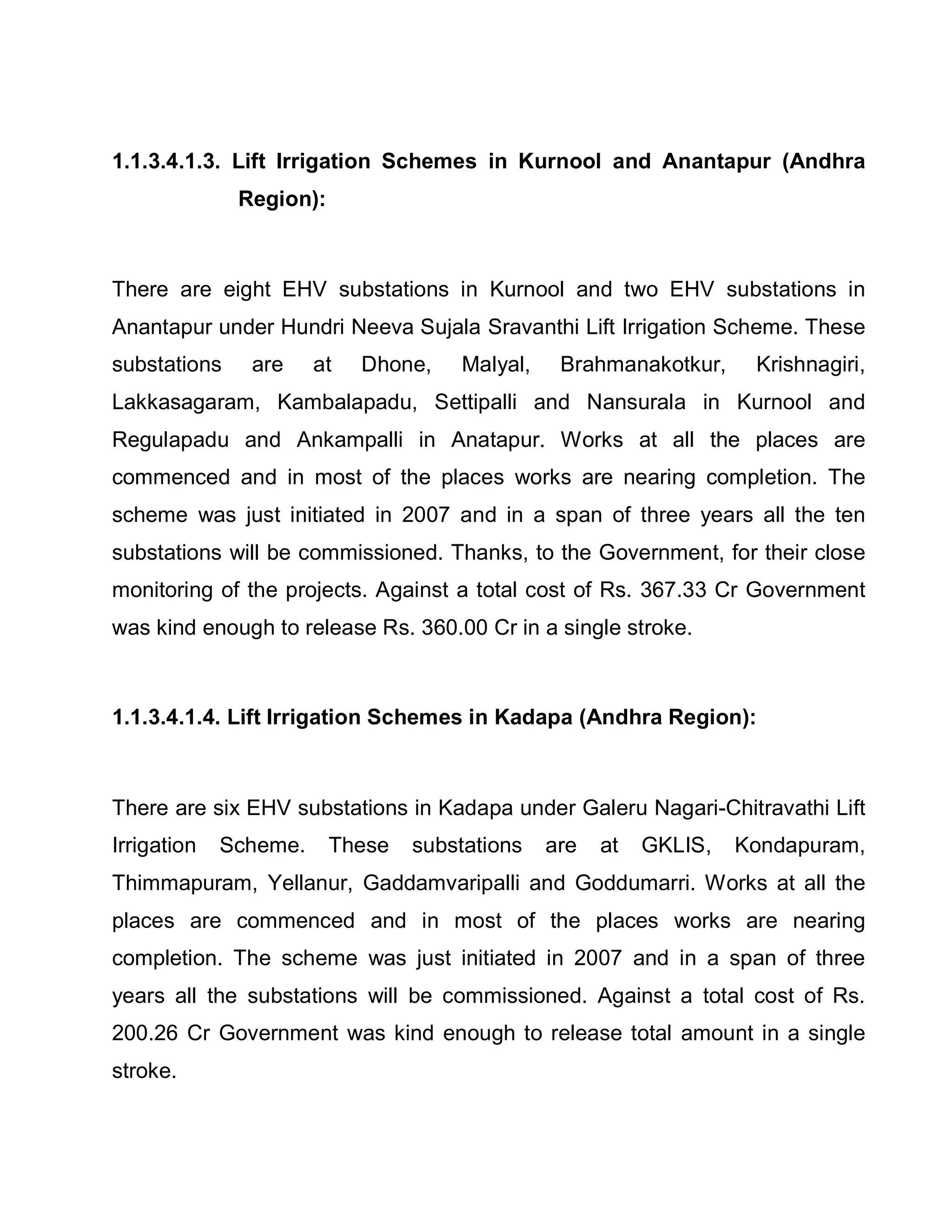
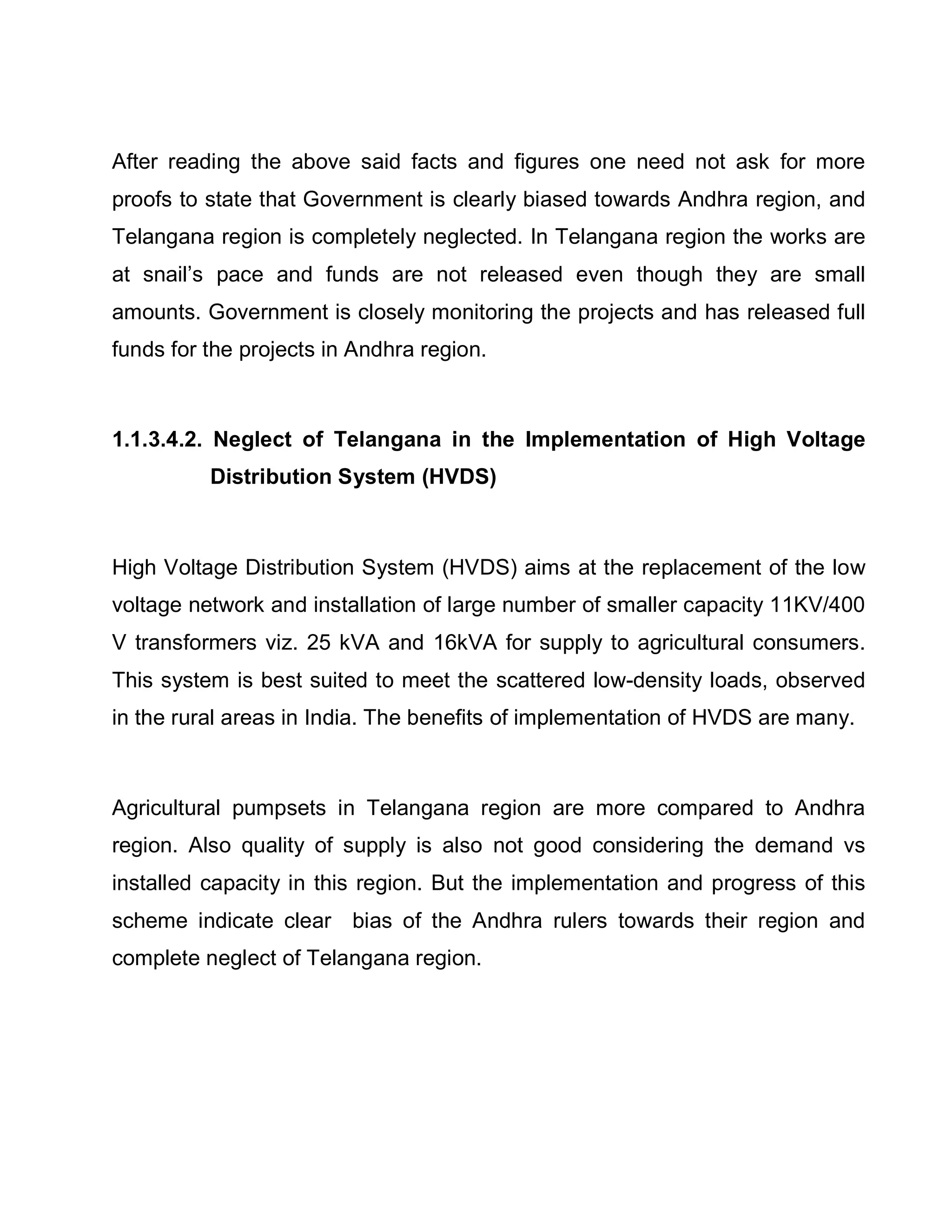
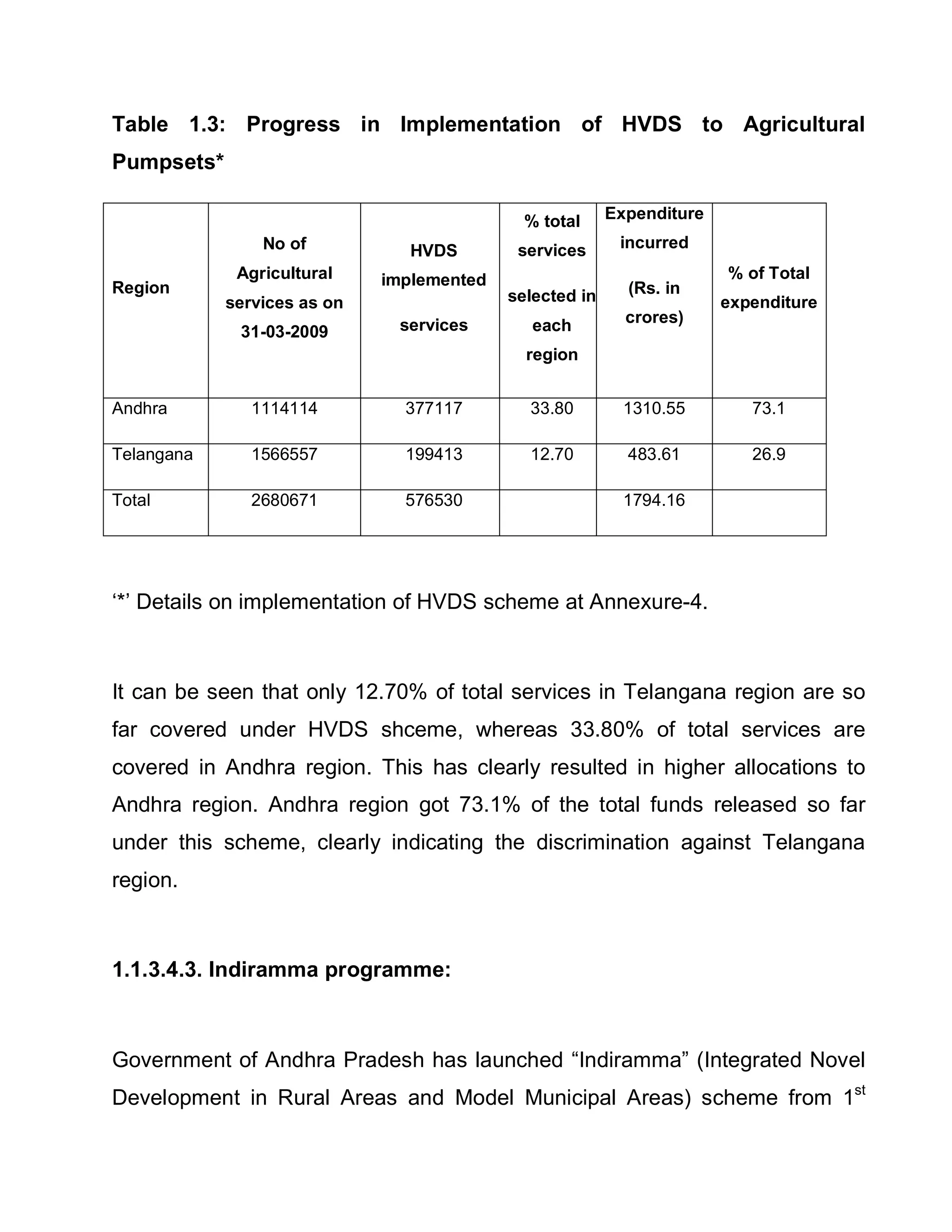
To
Shri Vinod K. Duggal
Member Secretary
Committee for Consultations on
the Situation in Andhra Pradesh
Government of India
Room No.248, Vigyan Bhavan Annexe
Moulana Azad Road
New Delhi 110011


Dear Shri Duggal ji,

Kindly find enclosed detailed notes regarding the five and a half decade
long demand and struggle of the people of Telangana for the formation of
their own State. It is in response to the public notice issued by the
Committee inviting views and suggestions on the issues involved.

Our views and suggestions are presented in four volumes.They are:

Volume ± I Consists of Historical Perspective, Income and Expenditure,
                 Education, The Capital City, Judiciary, Language and
                 culture, FAQs and Answers;
Volume ± II      Deals with Irrigation;
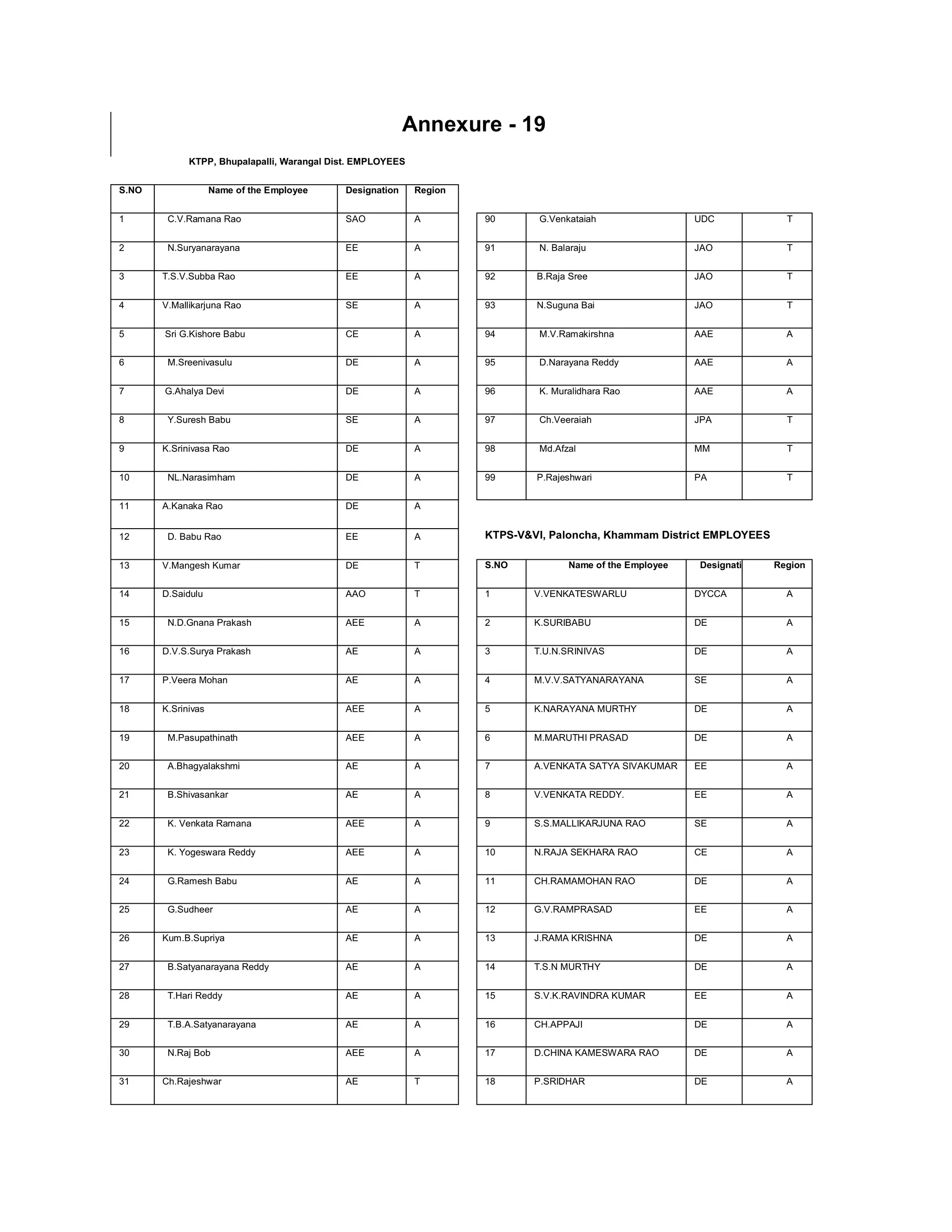
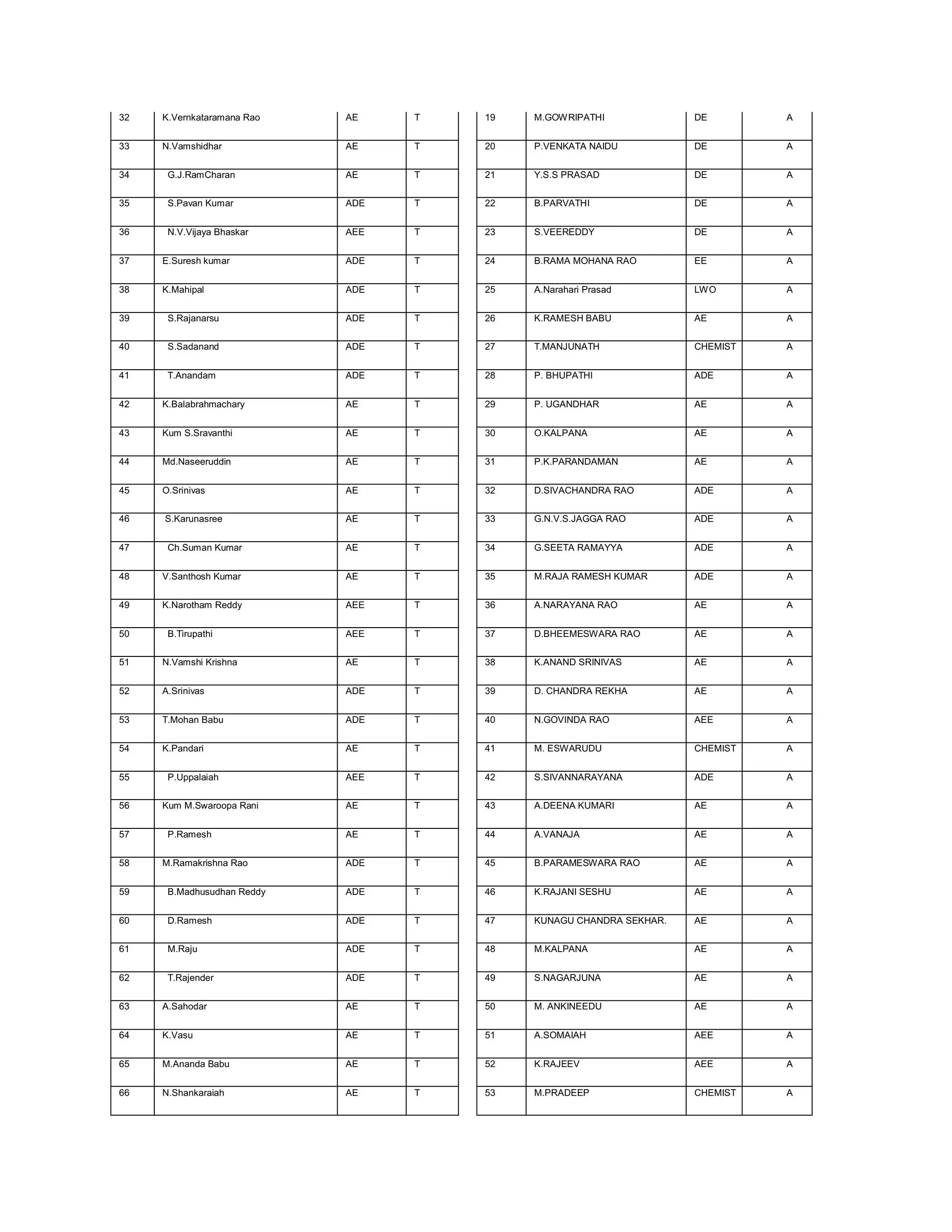
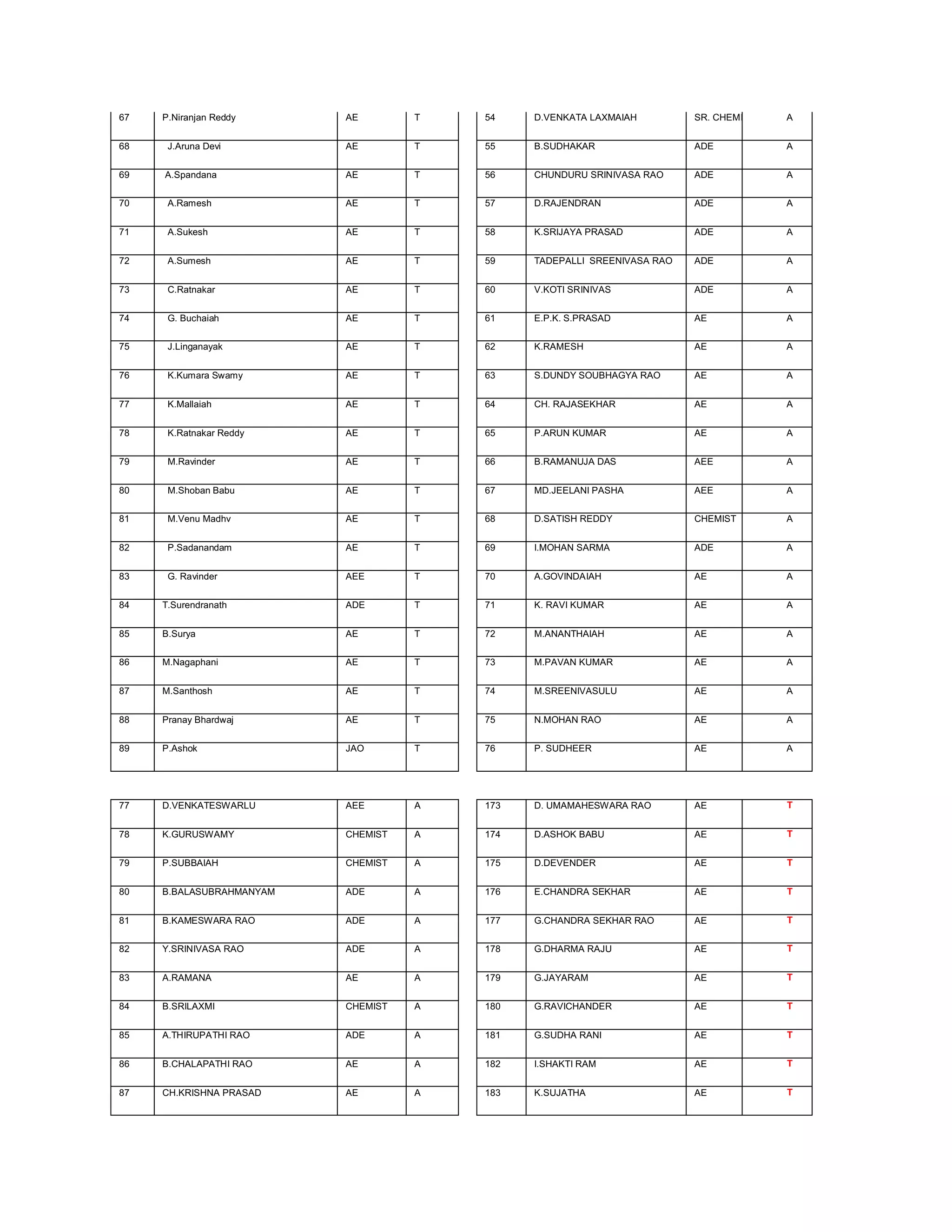
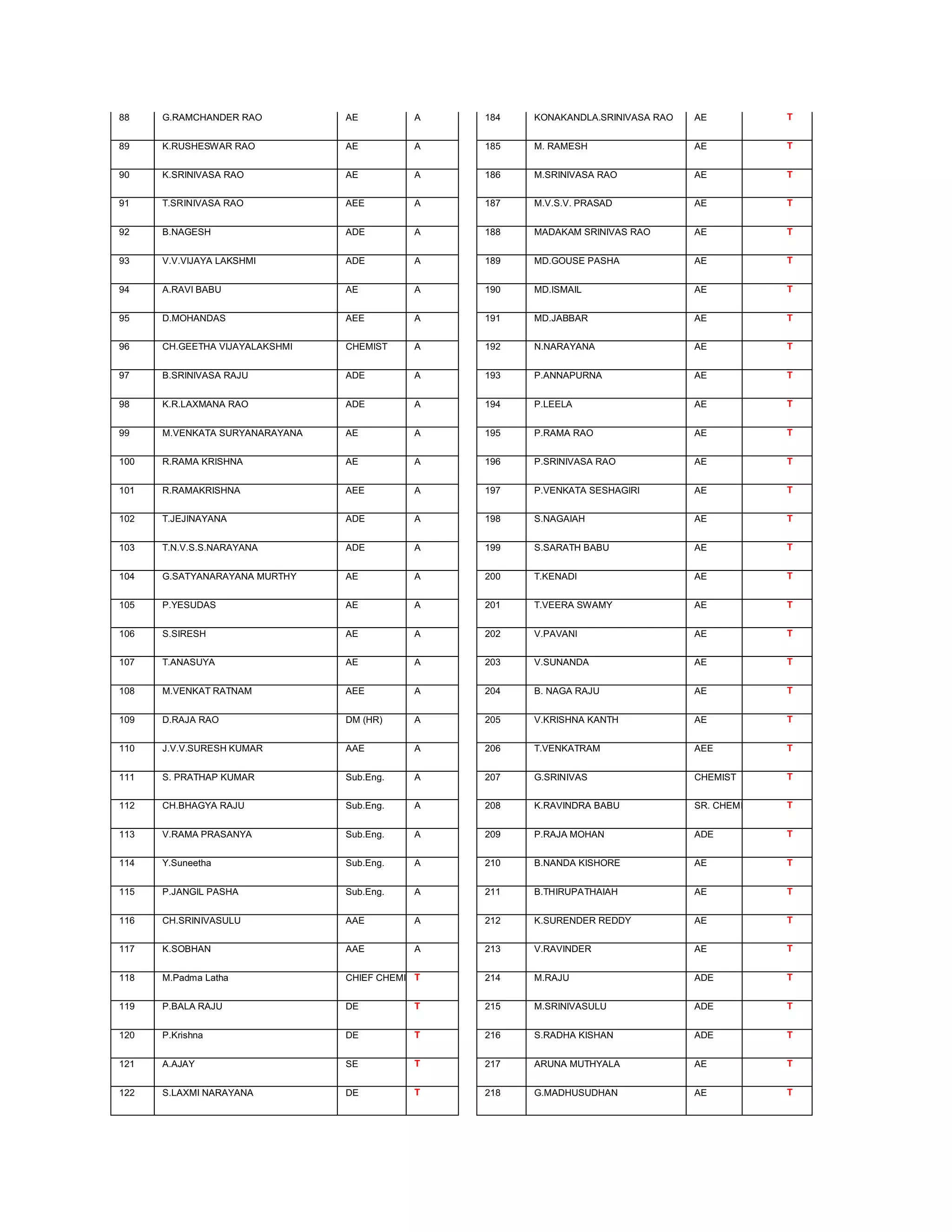
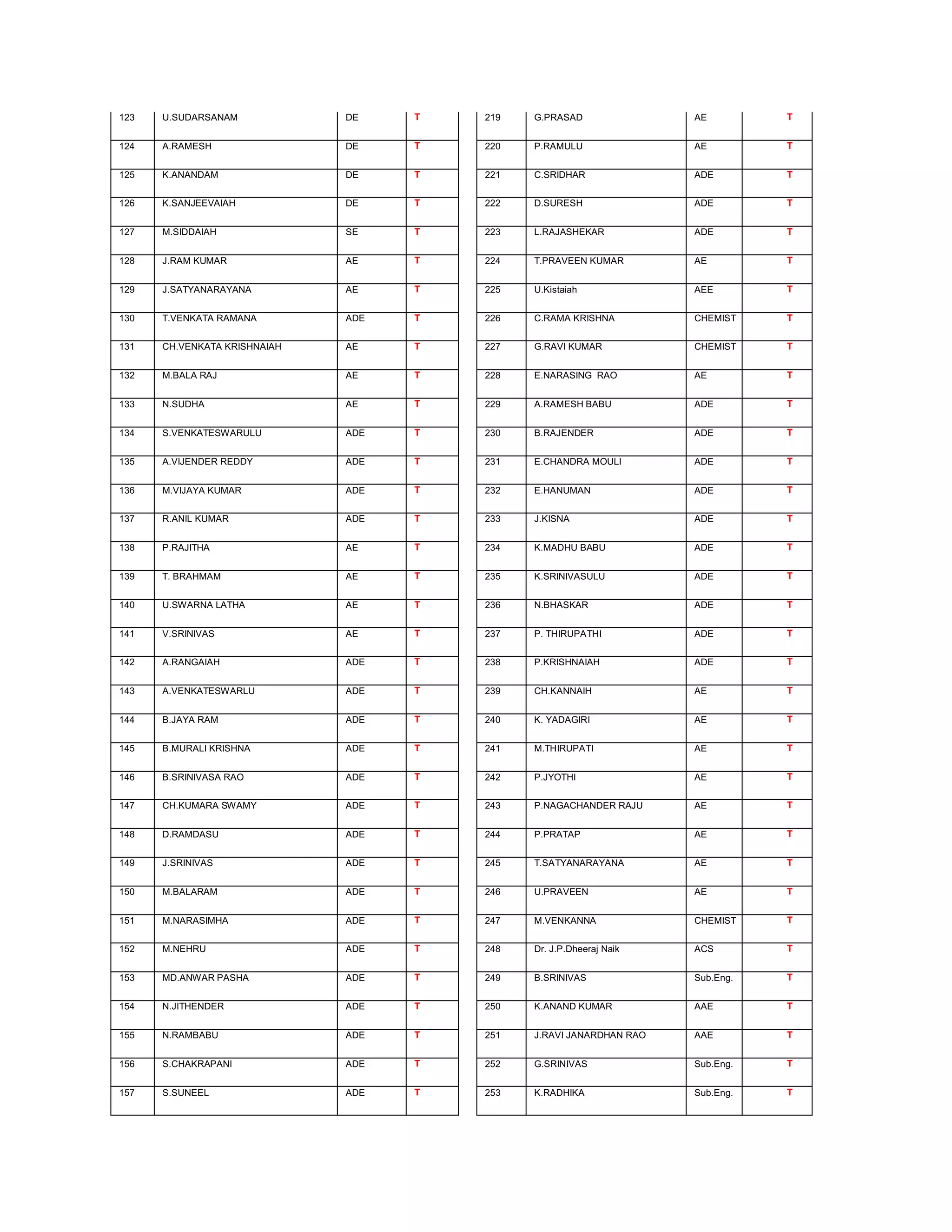
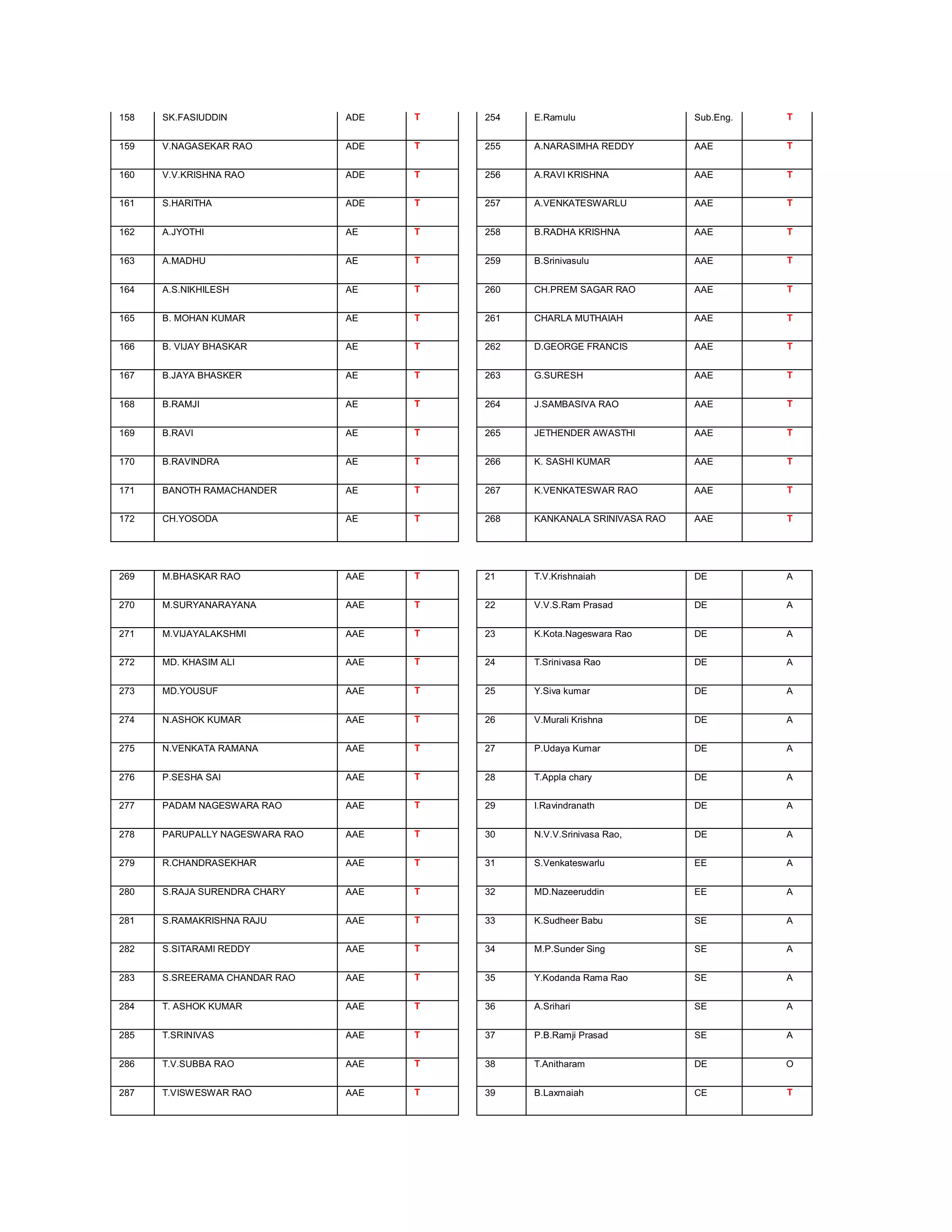
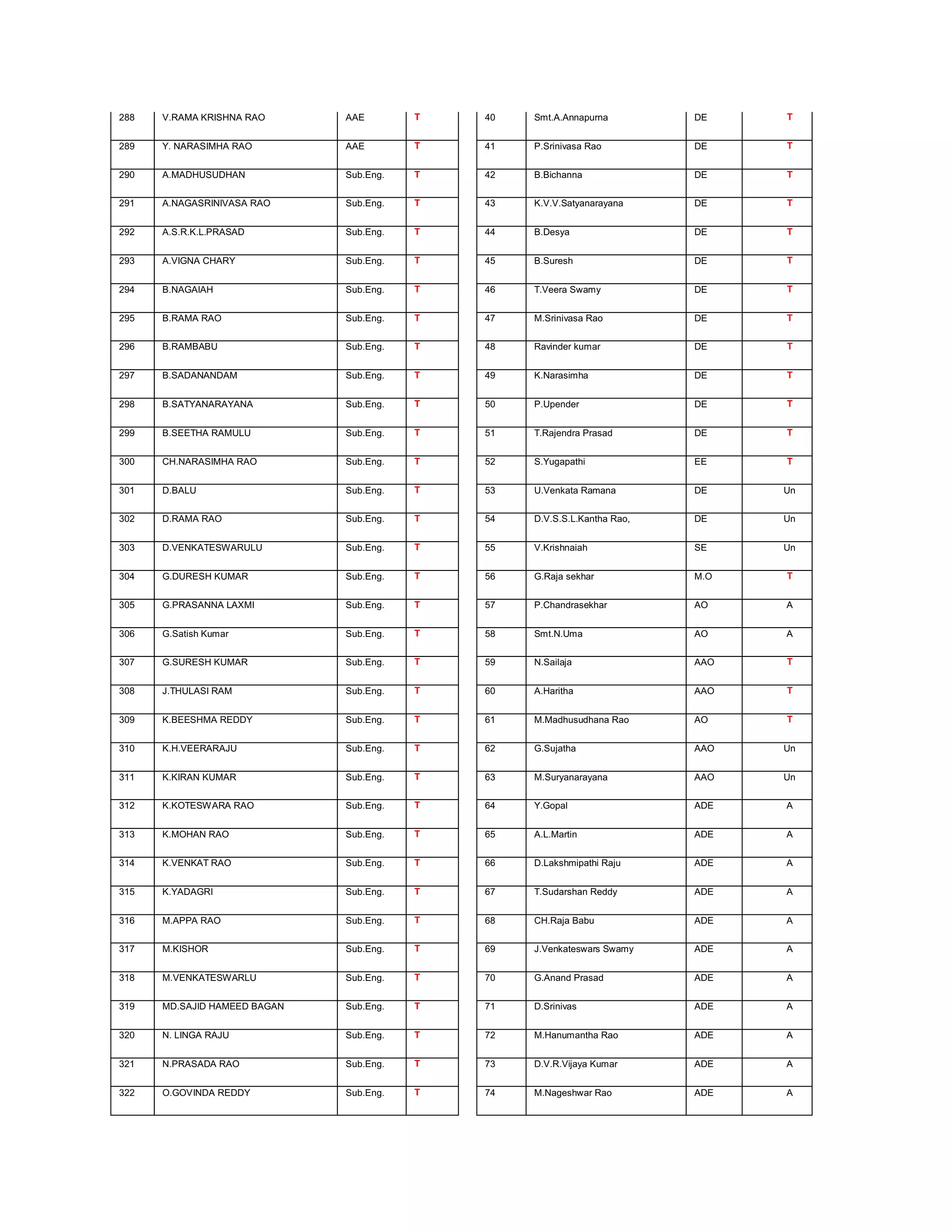
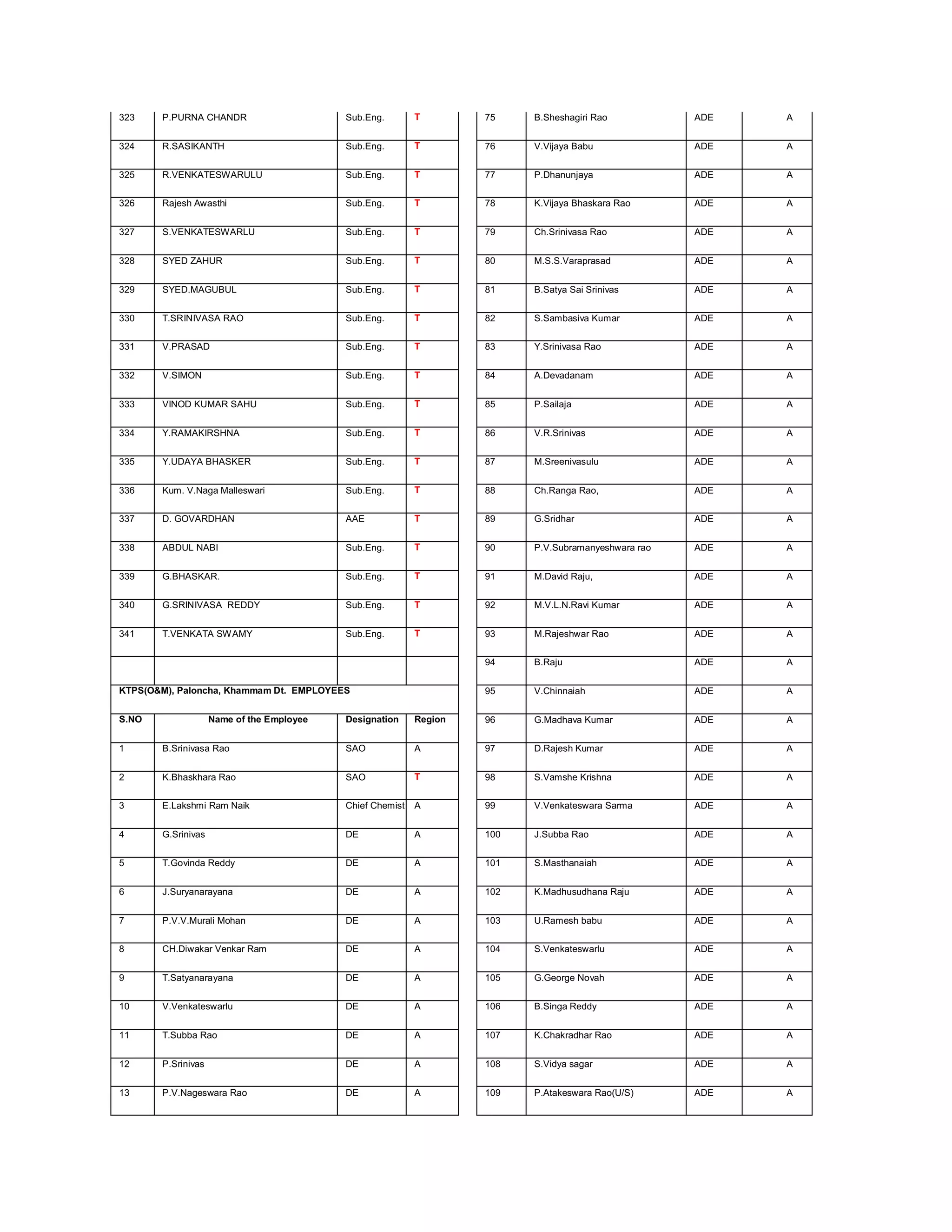
Volume ± III     Explains the Employment scenario; and
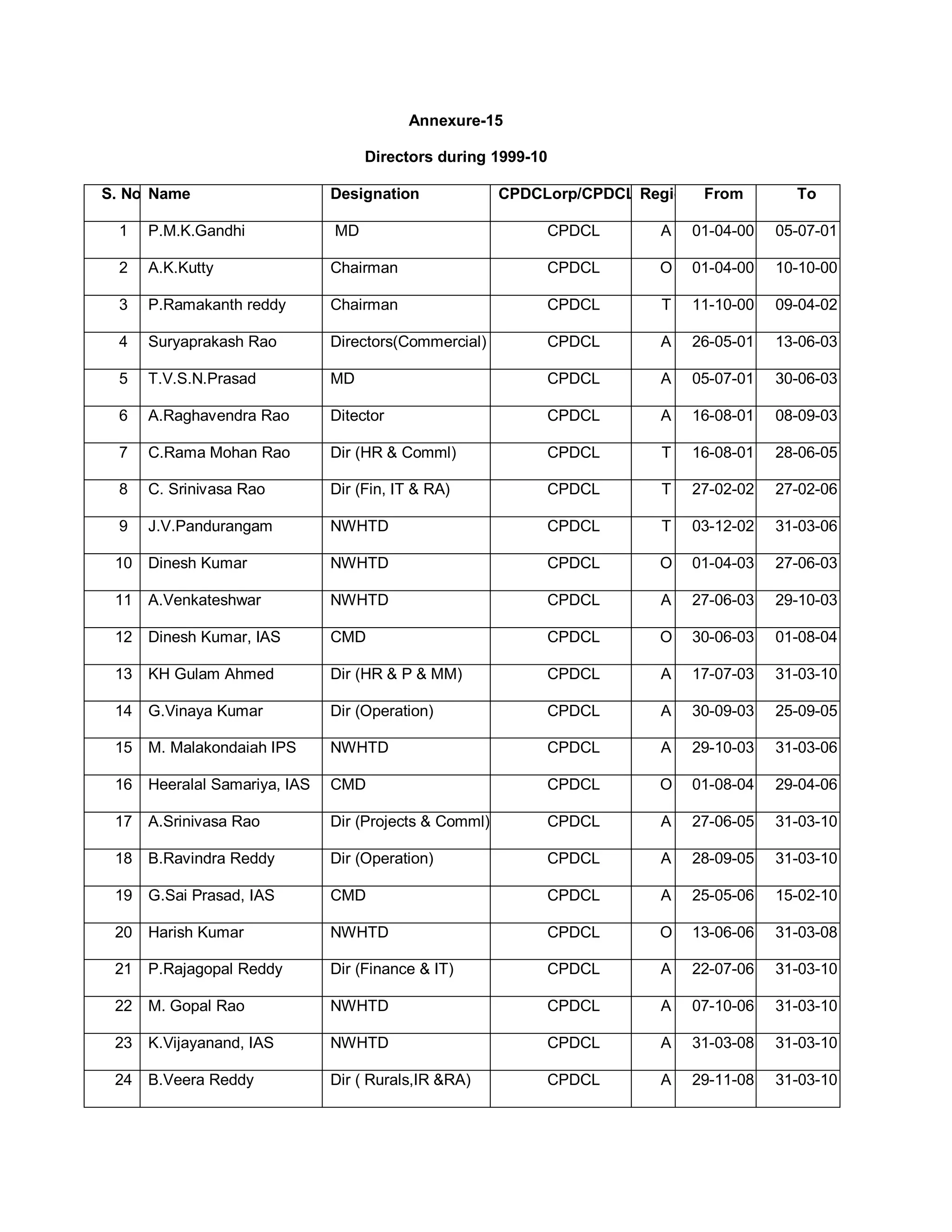
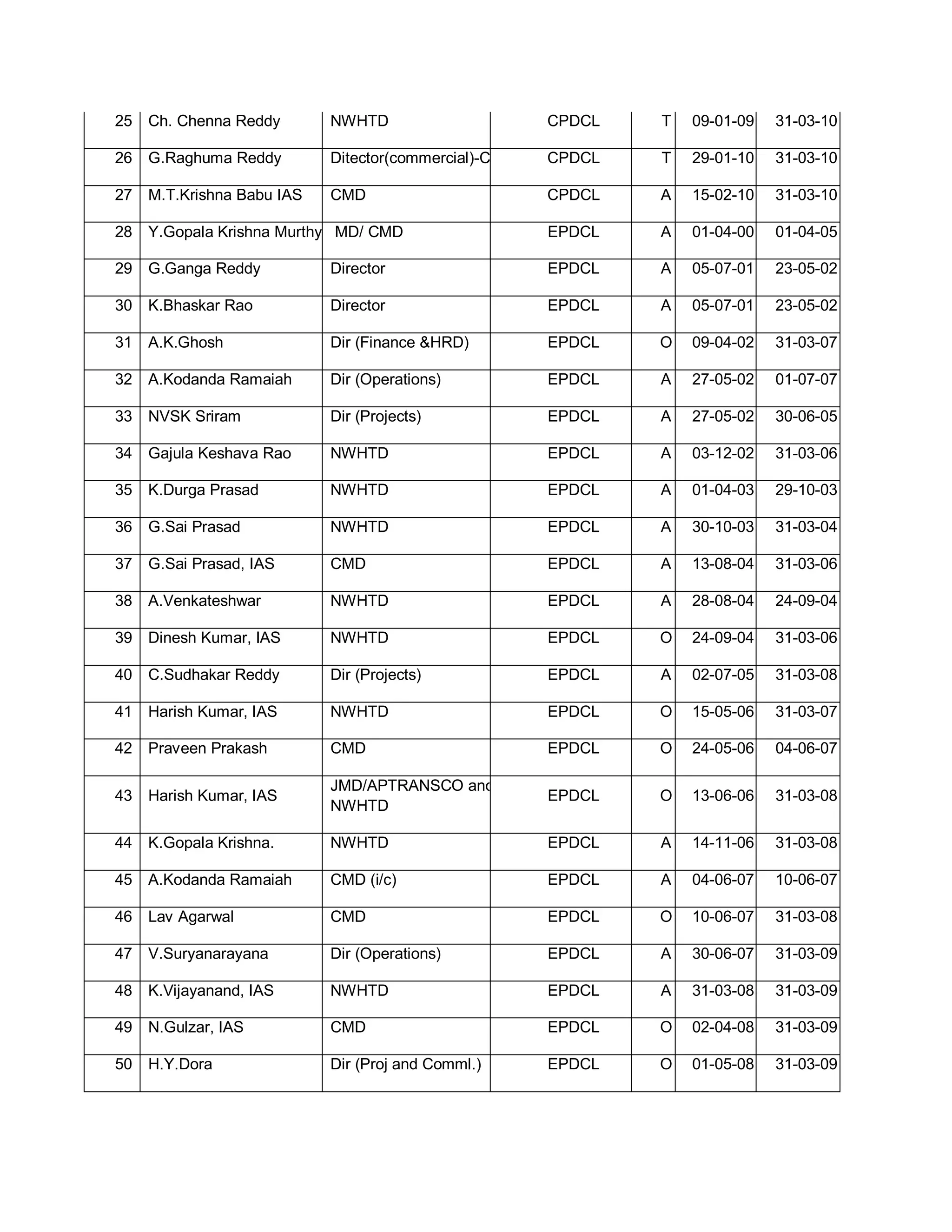
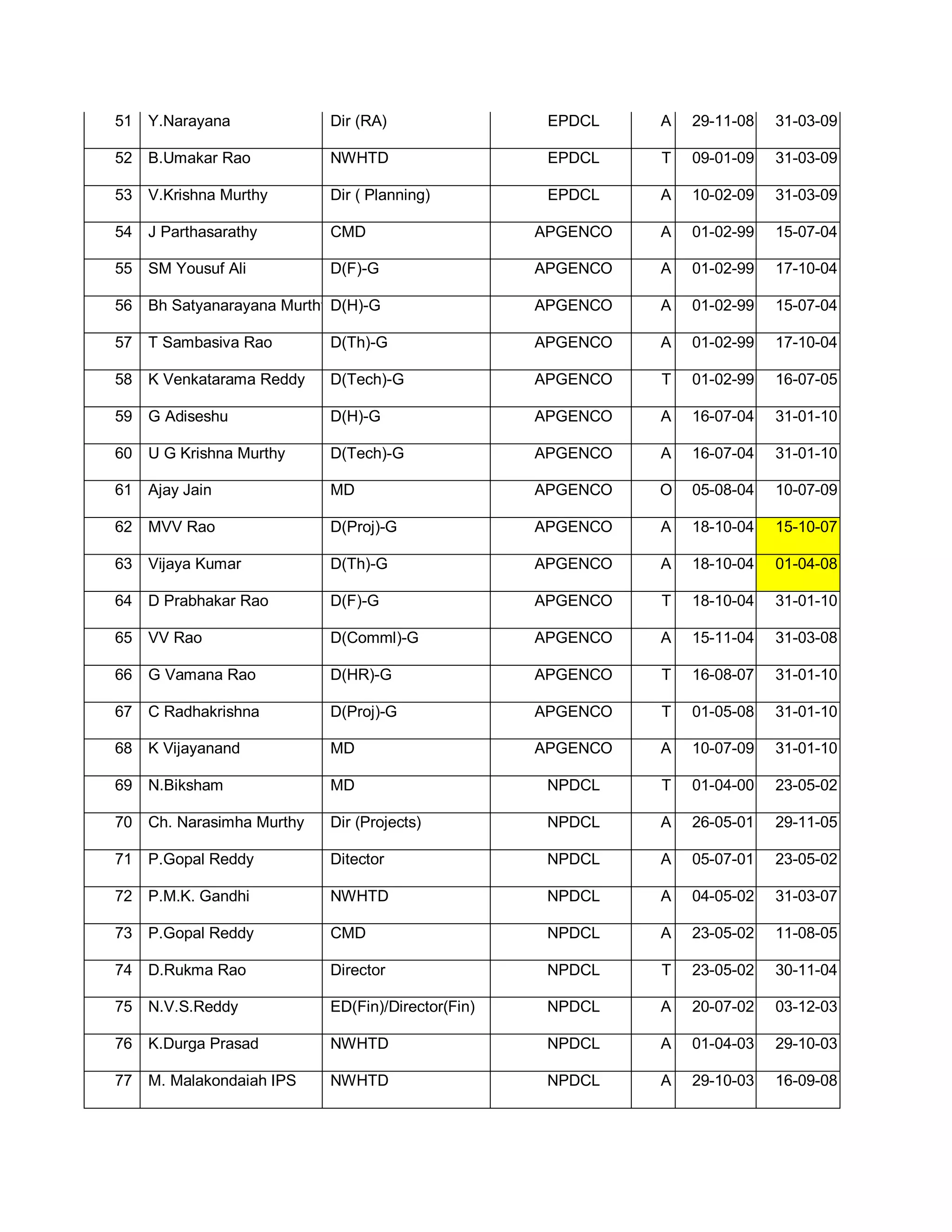
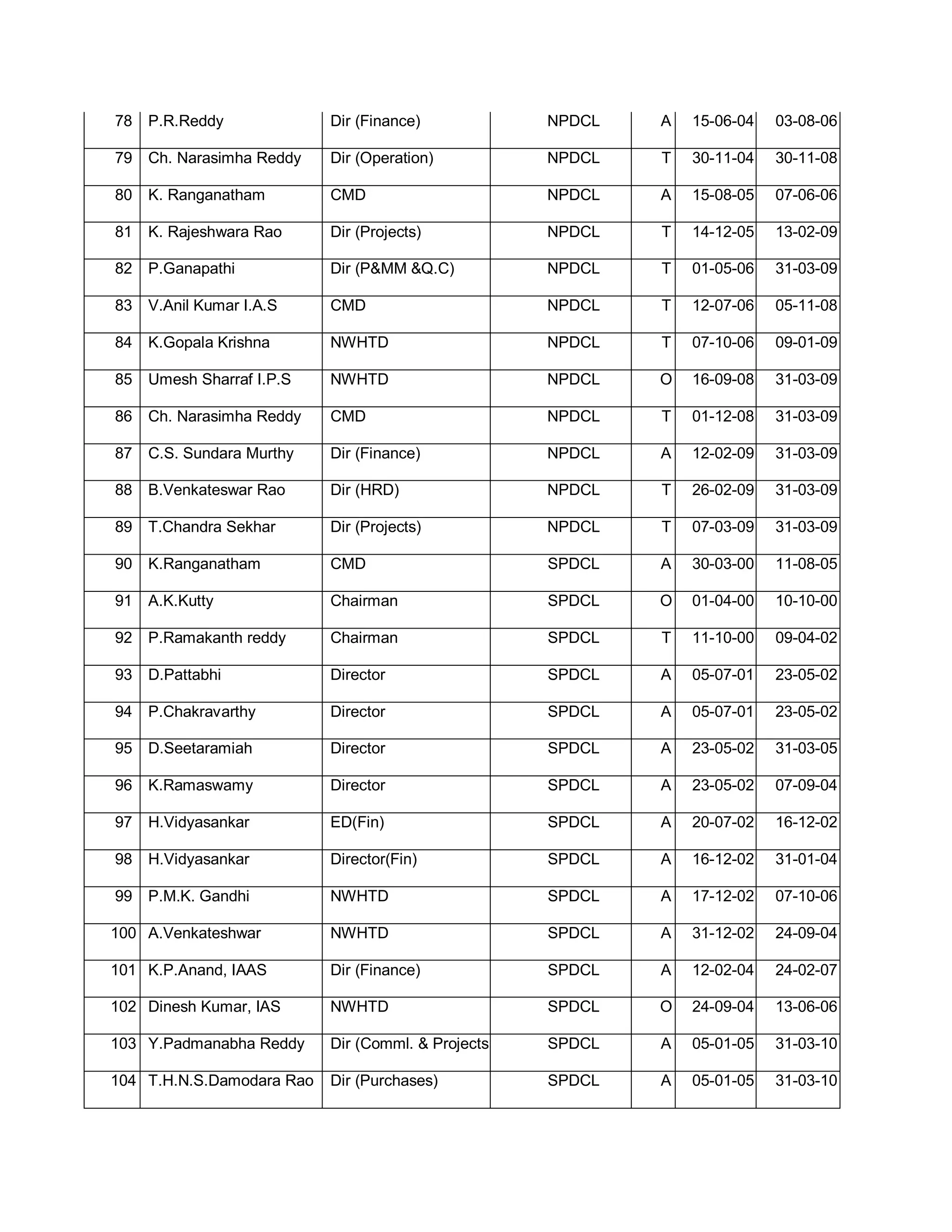
Volume ± IV      Concerns the situation regarding the Power Sector.
I am making this submission on behalf of the Telangana Rashtra Samithi
(TRS). The Notes are self explanatory. I hope they will receive the due
attention of the Committee. It may not be out of place to bring to the notice
of the Committee that the Telangana Rashtra Samithi (TRS) has been
championing the cause of Telangana for the last one decade.

A Conditional Merger:

I would like to bring to the kind notice of the Committee that the demand of
the people of Telangana for a separate state is not a new development. It
was voiced much before the formation of Andhra Pradesh and continues to
be raised even thereafter. The reason for the reluctance of people for the
merger of Telangana with Andhra then was the fear of exploitation, neglect
and injustice in the enlarged state of Andhra Pradesh. And the reason for
their resistance now to continue in the existing set up is the actual
experience of exploitation, neglect and injustice.


The merger of Telangana with Andhra took place against the wishes of the
people of the region and contrary to a categorical recommendation of the
States Reorganisation Commission, besides the reluctance of the Prime
Minister of the time Jawaharlal Nehru.


The merger was the result of manipulative politics. It was, however, not
unconditional, nor was it considered eternal. It was facilitated by a number
of solemn promises made and constitutional safeguards given to the
people of Telangana as a protective umbrella against the possible
exploitation. These promises were made a number of times, but none of
them was ever honoured. In the process, Telangana became a victim of
broken promises.

Promises Broken:

The Gentlemen¶s Agreement of 1956, which was an assurance of fair
play given to the people of Telangana to facilitate the formation of Andhra
Pradesh, was scuttled the very same day on which the State was born, by
the very same ³Gentlemen´ who were signatories to the agreement.


The All Party Accord of January 1969 arrived at a meeting of the leaders
of all the political parties in the State, convened by the then Chief Minister
Brahmananda Reddy, was shelved in less than six months time.


The Eight Point Formula and the Five Point Formula announced by the
Prime Minister of the time, Indira Gandhi in 1969, were not even given a
fair trial.


The historic verdict of the Supreme Court of India validating the Mulki
Rules was got annulled by the Parliament, succumbing to the pressure of
anti Telangana lobby of Andhra -- something unheard of in a democratic
polity!


The Six Point Formula, a diluted form of safeguards, was foisted on the
people as an alternative. Even this formula has been, and continues to be,
violated with impunity, robbing the people of Telangana of whatever little
was left in the name of safeguards.
The root cause for the failure of all these exercises was that, they were
attempts to treat only the symptoms and not the malady. Consequently, the
exploitation of the region and its people continued -- and still continues ±
unabated, under the patronage of Andhra political leadership. In this
process the so called concept of Telugu Brotherhood has become
irrelevant, placing the people of Telangana in an extremely unenviable
position.


Deprived of their legitimate share in the fruits of development,
marginalized in the political process and administrative setup,
belittled on the social, cultural and linguistic fronts, the natives are
virtually reduced to the status of second-rate citizens in their own
homeland.


Multiple Dimensions of the Issue:


It is to be realized that the demand for Telangana State is not a mere
political slogan; it has an economic angle; it has socio-cultural and linguistic
dimensions; it is blended with a feeling of self respect and the desire for
self rule. The continuous subjugation of the people of this region in every
sphere of their lives has turned their hazy fears at the time of the merger
into strong emotions and sentiments.


The plight of the people of Telangana in their own homeland is manifold.
They are narrated briefly hereunder:
i.     The natural and financial resources of the region are plundered and
       diverted for the development of the other regions. They include river
       waters, coal, mineral wealth and revenue income of Telangana.
       Consequently, this region is lagging behind the other regions in the
       realm of economic development;


ii.    There is a deepening crisis in the Agricultural sector causing ever
       increasing suicides of farmers;


iii.   Artisan class is in distress. Suicides of weavers and village
       craftsmen are increasing year by year;


iv.    The distress in the rural areas is causing unabated migration of
       labour, abandoning their houses and families;


v.     The longest stretch of flow of the Krishna River is in the
       Mahboobnagar District. Yet the district is converted almost into a
       desert;


vi.    The largest masonry dam of the country, Nagarjuna Sagar, is in
       Nalgonda District. But the people of the district do not get even
       drinking water free from fluoride. As a result, several lakhs of people,
       besides animals, have become, and continue to become, victims of
       fluorosis ± crippled and disabled for the whole life;
vii.   Dalits of this region do not     get the benefit of a variety welfare
       schemes commensurate with the ratio of their population vis-à-vis the
       population of Dalits in the other region;


viii. The condition of Tribals in the agency areas of the region is
       miserable. A large number of them perish every year because of
       seasonal diseases, in the absence of even minimum medical facilities
       in those areas. The abject poverty of Tribals is such that they cannot
       even afford to bring up their children. Consequently, infant sale by the
       Tribals is becoming more and more rampant. The percentage of
       population of Tribals is more in Telangana than in the other regions of
       the State. As the reservations and incentives meant for them are on
       the basis of percentage of their population in the entire State, their
       quota in Telangana gets reduced. Tribals constitute about 12% of
       total population in the Telangana region, but State¶s average for
       reservations to Tribals in employment and Educational institutions is
       only 6%.


ix.    The Muslim minority of the region has lost its preeminence which it
       enjoyed in the past. It is a totally neglected section of the people in
       matters    of   education,   employment,     economic     development,
       participation in the polity and language and culture. Low literacy rate
       among the Muslims is getting further compounded by an abnormally
       high rate of dropouts at the school level. It is as high as 90% as
       confessed by the Minister for Minority Welfare of the State. The
       Muslim Community is made to suffer perennially with a feeling of
       insecurity, neglect and deprivation.
x.    On the industrial front quite a few major industries inherited from the
      erstwhile Hyderabad State are either closed down or sold out. To
      mention a few: the Azamjahi Mills in Warangal, the largest textile mill
      of the times in Asia, has been closed down; the Nizam¶s Sugar
      Factory in Bodhan, the largest Sugar mill of the times in Asia, has
      been sold out to Andhra investors at a throw away price; the Sirsilk
      Factory in Sirpur, Spinning Mills of Antargaon, DBR Mills, Allwyn
      Factory, Republic Forge, Glass Factory have been abandoned. The
      Fertiliser Factory at Ramagundem and IDPL in Hyderabad have also
      been liquidated. The level of employment in the Singareni Collieries is
      being pruned year after year.


      The industrial development that has taken place in and around the
      capital city has not benefited the Telangana in any way. The land,
      water and power and other infrastructure facilities, made available to
      these industries belong entirely to Telangana; yet the migrants from
      the other regions are given more than 95% of the jobs. No major
      industry worth its name has been set up in any of the districts of the
      Telangana region as compared to the establishment of several
      industries   in   Visakhapatnam,   Vijayawada,    Kakinada,    Nellore,
      Tirupathi, Kadapa and Kurnool in the other regions.


xi.   On the political front, the leadership of Telangana is completely
      marginalized. It is not allowed to grow, and even if it does, is not
      allowed to sustain itself. Even the stalwarts like PV Narasimha Rao
      and M Chenna Reddy could not survive as chief ministers for more
      than a few months. It is reflected in the tenures of the three chief
ministers from Telangana -- PV Narasimha Rao, M Chenna Reddy
       and T Anjaiah. In the 54 year long history of the State, all of them put
       together held that position hardly for six years, that too in four
       installments. About the stature of the present day political leadership
       of Telangana, irrespective of the parties, the less said, the better.


xii.   The socio-cultural identity of Telangana, its traditions, customs,
       dialect and idiom are always heckled at, hurting the self respect of the
       people. The electronic and print media and the cinema industry have
       been playing a significant role in belittling the people of Telangana
       and their identity.


Deprivations       of   legitimate   share   in   the   fruits   of   development,
marginalization in the political process and humiliation on socio-cultural
front have reduced the people of Telangana to being second rate citizens
in their own homeland. They have to literally beg for their rightful shares
whether it is regarding development or polity. These problems can be
addressed only when the people of the region are liberated from the
present exploitative set up and have power to shape their own destinies,
i.e., self rule.


A Vertical Division:

The Committee must be aware that in the wake of ongoing movement,
especially after 9th December 2009, all the sections of the society are
vertically divided region-wise. Ministers are not in a position to work in
unison. Members of Parliament, State Legislature or local bodies are
unable to sit together. The bureaucracy also is a divided lot. The gulf
between the people of the two regions is widened and has become
unbridgeable. Inter regional mobility of people; including the people¶s
representatives has, become hazardous.


It is needless to underscore that the unity between two regions of the State
can never be a unilateral concept. It can happen only with mutual
confidence, respect, willingness and bilateral consent. It can never be
imposed unilaterally by force on the unwilling party. If it is forced, it will
have far reaching consequences.

An Inescapable Necessity:

The remedy, and the only one, therefore, lies in bifurcation of the
State of Andhra Pradesh and the restoration of status quo ante that
existed before 1st November 1956. The sooner it is done the better!


With Warm Regards,


                                              Yours sincerely,


                                         (K. Chandrasekhar Rao)
                                                    President


               DEMAND FOR TELANGANA STATE
                   Genesis, Spread and Continuance
A Historical Perspective
The people of Telangana are once again restive, reiterating their demand
for a separate state. The demand of the people of this region for a separate
state is not a new development. It was voiced much before the formation of
Andhra Pradesh and continues to be raised even thereafter.

The reason for the opposition of people of Telangana to join Visalandhra
(metamorphosed to Andhra Pradesh) was fear of neglect, injustice and
exploitation in the enlarged state. It had manifested itself several times,
including the agitation of 1952 when quite a few young lives were lost. It is
referred to as the Non-Mulki Agitation. And the reason for their refusal to
continue in the present state is the actual experience of becoming victims
of neglect, injustice and exploitation. This resistance, intermittent yet
sustained, took and continues to take several forms including the upheaval
of 1968-69 when nearly four hundred people, mostly students, were killed
in the reign of terror unleashed by the state government of the time.

It should be noted in this context that the State of Andhra Pradesh was
formed not only ignoring the wishes of the people of Telangana but also
against a categorical recommendation of the States reorganization
Commission. Further, it was contrary to the expressed views of the tallest
leader of the time, Jawaharlal Nehru, who ridiculed the demand for
Visalandhra as an idea bearing a µtaint of expansionist imperialism¶.
(Indian Express, 17 October, 1953). The forced merger of Telangana with
Andhra to form the present state of Andhra Pradesh on 1st November 1956
was, therefore, an outcome of manipulative politics.

The States Reorganization Commission (SRC) set up by the Government
of India in early 50s to examine the question of reorganization of states of
the country was not in favour of merging the Telangana region with the
then Andhra state. After a very careful examination of the issues involved
the SRC recommended:

     .. It will be in the interest of Andhra as well as Telangana if, for the
     present, the Telangana area is constituted into a separate state
which may be known as the Hyderabad state, with provision for its
      unification with Andhra after the general elections likely to be held in
      or about 1961, if by two-thirds majority the legislature of the
      residuary Hyderabad state expresses itself in favour of such
      unification.
                                                     (SRC Report: Para 386)


The Commission further recommended:

      Andhra and Telangana have common interests and we hope these
      interests will tend to bring the people closer to each other. If,
      however, our hopes for the development of the environment and
      conditions congenial to the unification of the areas do not
      materialize and if public sentiment in Telangana crystallizes itself
      against the unification of the two states, Telangana will have to
      continue as a separate unit.
                                                  (SRC Report: Para 388)


The Commission came to this conclusion after a dispassionate assessment
of feelings of the people of Telangana and the fears entertained by them.
Elaborating the reasons for recommending statehood for the Telangana
region the Commission observed:

      i.    One of the principal causes of opposition to Visalandhra also
      seems to be the apprehensions felt by the educationally backward
      people of Telangana that they may be swamped and exploited by the
      more advanced people of the Coastal areas...The real fear of the
      people of Telangana is that if they join Andhra they will be unequally
      placed in relation to the people of Andhra and in this partnership the
      major partner will derive all the advantages immediately while
      Telangana itself may be converted into a colony by the enterprising
      Andhras´.
                                           (SRC Report: Para 378)


And

      ii.   When plans for future development are taken into account,
      Telangana fears that the claims of this area may not receive
adequate consideration in Vishalandhra. ... Telangana, therefore,
     does not wish to lose its present independent rights in relation to the
     utilization of the waters of the Krishna and the Godavari.
                                                     (SRC Report: Para 377)
Further,

     iii.   The existing Andhra state has faced a financial problem of
     some magnitude ever since it was created; and in comparison with
     Telangana, the existing Andhra state has a low per capita revenue.
     Telangana, on the other hand, is much less likely to be faced with
     financial embarrassment« Whatever the explanation may be « the
     result of the unification will be to exchange some settled sources of
     revenue, out of which development schemes may be Financed, for
     financial uncertainty similar to that with which Andhra is now faced.
     Telangana claims to be progressive and from an administrative point
     of view, unification, it is contended, is not likely to confer any benefit
     on this area.

                                              (SRC Report: para 376)


It is also necessary, in this context, to note that the SRC cautioned the
nation against the dangers involved in reorganizing the Indian states solely
on linguistic considerations. One of the rational criteria recommended by
the Commission, while reorganizing the states, was:

     «to reject the theory of µone language one state¶ which is neither
     justified on grounds of linguistic homogeneity, because there can be
     more than one state speaking the same language without offending
     the linguistic principle, nor practicable, since different language
     groups, including the vast Hindi speaking population of the Indian
     Union, cannot always be consolidated to form distinct linguistic
     units´.
                                                   (SRC Report: para 163)
These categorical recommendations made by the States Reorganization
Commission (SRC), elaborating the rationale underlying its conclusions,
and a clearly expressed opinion of the tallest leader of the time ±
Jawaharlal Nehru ± evidently reflected the hopes and aspirations of the
people of Telangana. Consequently, there was a strong wave of jubilation
among the people of the region.

But, the political leadership of Andhra State could not digest it as it was
longing for the formation of Visalandhra; it was almost crestfallen. The
primary concern of Andhra leadership was to bail out the infant Andhra
State from the deep troubles confronting it from the day one of its
separation from the erstwhile composite State of Madras on 01-10-1953.
Their eyes were, therefore, on the resource-rich Telangana without which it
was impossible for the then Andhra State to sustain itself. The panic that
pervaded the Andhra State could be gauged by the reactions and
observations of several top-ranking political leaders of the Andhra State
and the media, besides the opinions expressed by the Pradesh Congress
Committee, the Chamber of Commerce and the deliberations of the
Legislative Assembly of the Andhra State. A few of them (translated from
Telugu) are reproduced hereunder:

       I.       Reactions on the Recommendations of the SRC
            Ayyadevara Kaleswara Rao:

     ³If the formation of Visalandhra is postponed, it will never happen. It
     is dangerous to wait for six years. The desire for separate Telangana
     will be further strengthened, and then they will not agree for
     Visalandhra. It will be impossible to get two-thirds majority in the
     Assembly at that time.´
                                           (Andhra Patrika: 02-11-1955)

Kasu Brahmananda Reddy:
     ³Creating separate Telangana state and then waiting for five years is
     not a good idea. The necessity of getting two-thirds majority in the
     assembly is incomprehensible. Why should we wait till the 1961
     Elections are over?´
                                         (Andhra Patrika: 02-11-1955)


Neelam Sanjeeva Reddy:
     ³If not now, Visalandhra can never be formed.´
(Andhra Patrika: 04-11-1955)
Vavilala Gopalakrishnayya:

     ³If Visalandhra is not formed now, it might become
     impossible later.´
                                         (Andhra Patrika: 06-11-1955)
Kala Venkata Rao:
     ³If it is feared that the lands in Telangana will be usurped by
     Andhras, a law can be made to prevent that.´

                                        (Andhra Patrika: 14-11-1955)

Andhra State Congress Committee:

     ³People of Telangana need not be apprehensive about any troubles
     or losses if they join Visalandhra. There will not be any laxity in
     ensuring their development and progress.´

                                     (Andhra Patrika: 03-11-1955)

Comments made in Andhra Patrika:

     ³There is no answer to the question raised by the leaders of
     Telangana that if Telangana will not get any additional benefits
     by joining Visalandhra, why should it join at all?

     Benefits to Andhra if Visalandhra is formed:

     i)     A ready-made, well-developed capital city;


     ii)    Advantages on social and cultural fronts;


     iii)   Development of transport and communication facilities; and,


     iv)    Development of irrigation projects in Krishna and Godavari
            basins by mobilizing resources from 20 districts of Visalandhra,
            instead of 8 districts of Andhra.´ (Andhra Patrika: 04-11-1955)
Resolutions passed in the Andhra State Assembly:

On 25-11-1955, the then Chief Minister of erstwhile Andhra State,
Bezawada Gopala Reddy, introduced a resolution in the State Assembly,
which was unanimously approved. The summary of the resolution is as
under:

  - We deem it our special responsibility to develop the Telangana
    Region;


  - We safeguard the rights of the region in the realms of employment
    and education proportionate to the population of the region


  - We ensure to them a fair share in the fruits of development in all
    other spheres;


  - All the resources that rightfully belong to the Telangana region will be
    utilized for the benefit of only the people of that region;


  -   We will be very generous towards them;


  - The people of Telangana have not asked us for any of these
    assurances; and,


  - All these assurances are given by all the political parties unanimously
    in the assembly.


II. Financial Problems of the Andhra State

Andhra Patrika:
      The financial condition of the Andhra State is not at all satisfactory;
      nor is it likely to improve in future. There is no likelihood of paying
      salaries to the government employees by the end of March (1955).
(Andhra Patrika: 03-12-1954)

     There is a huge deficit in the revenue of the State. It is not at all
     possible to take up any new projects.
                                               (Andhra Patrika: 09-02-1956)

     Now there is no possibility of using revenue receipts for
     developmental works; nor is there any likelihood of it even in the
     coming five years. Floating loans for developmental works has
     become impossible.
                                               (Andhra Patrika: 06-07-1955)

Bezawada Gopala Reddy:
     ³Out of 22 crore rupees of revenue receipts, administrative
     expenditure alone is eating away 20 crores.´

                           (Statement in Andhra Assembly: 15-09-1954)

     ³Regular payment of monthly salaries to the teachers too has
     become a difficult exercise.´
                                               (Andhra Patrika: 01-10-1953)

Neelam Sanjeeva Reddy:
     ³Now we are dragging on with a deficit of 18 crore rupees. We are
     not in a position to pay salaries to the staff unless the central
     government comes to our rescue.´
                           (Statement is Andhra Assembly: 05-11-1953)

     ³Wherever we go, the farmers are asking for irrigation and electricity
     facilities. Where can we fetch them from?´
                           (Statement is Andhra Assembly: 25-02-1954)

     ³Andhra Government had to borrow 6 crore rupees in the very first
     year of its inception.´


                                (Statement is Andhra Assembly: 25-01-1956)

M. Bhaktavatsalam (Finance Minister of Madras):
     ³The sales tax receipts of the Andhra region are very negligible.´
(Statement is Madras Assembly: 31-01-1953)


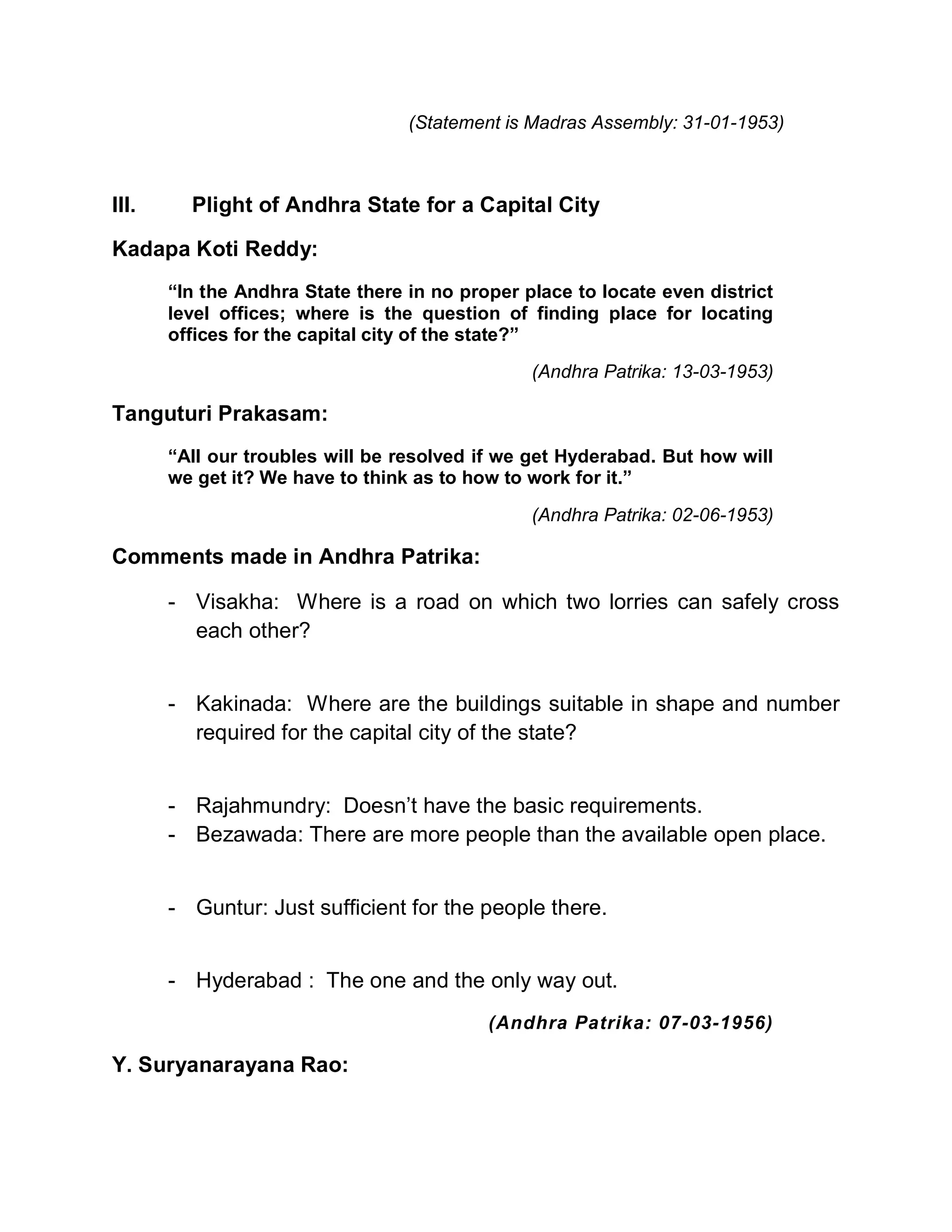
III.     Plight of Andhra State for a Capital City

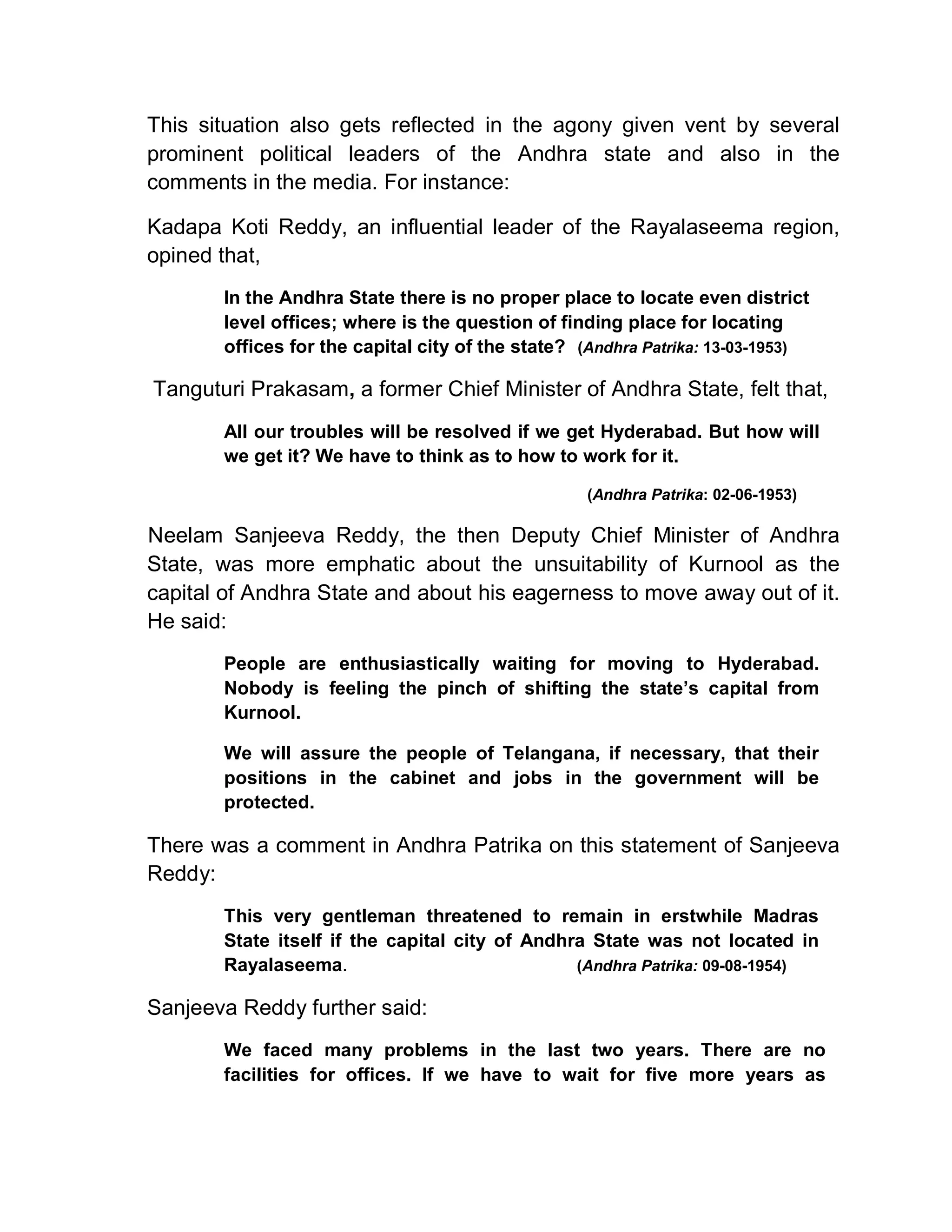
Kadapa Koti Reddy:
       ³In the Andhra State there in no proper place to locate even district
       level offices; where is the question of finding place for locating
       offices for the capital city of the state?´
                                                (Andhra Patrika: 13-03-1953)

Tanguturi Prakasam:
       ³All our troubles will be resolved if we get Hyderabad. But how will
       we get it? We have to think as to how to work for it.´

                                                (Andhra Patrika: 02-06-1953)

Comments made in Andhra Patrika:

       - Visakha: Where is a road on which two lorries can safely cross
         each other?


       - Kakinada: Where are the buildings suitable in shape and number
         required for the capital city of the state?


       - Rajahmundry: Doesn¶t have the basic requirements.
       - Bezawada: There are more people than the available open place.


       - Guntur: Just sufficient for the people there.


       - Hyderabad : The one and the only way out.
                                           (Andhra Patrika: 07-03-1956)

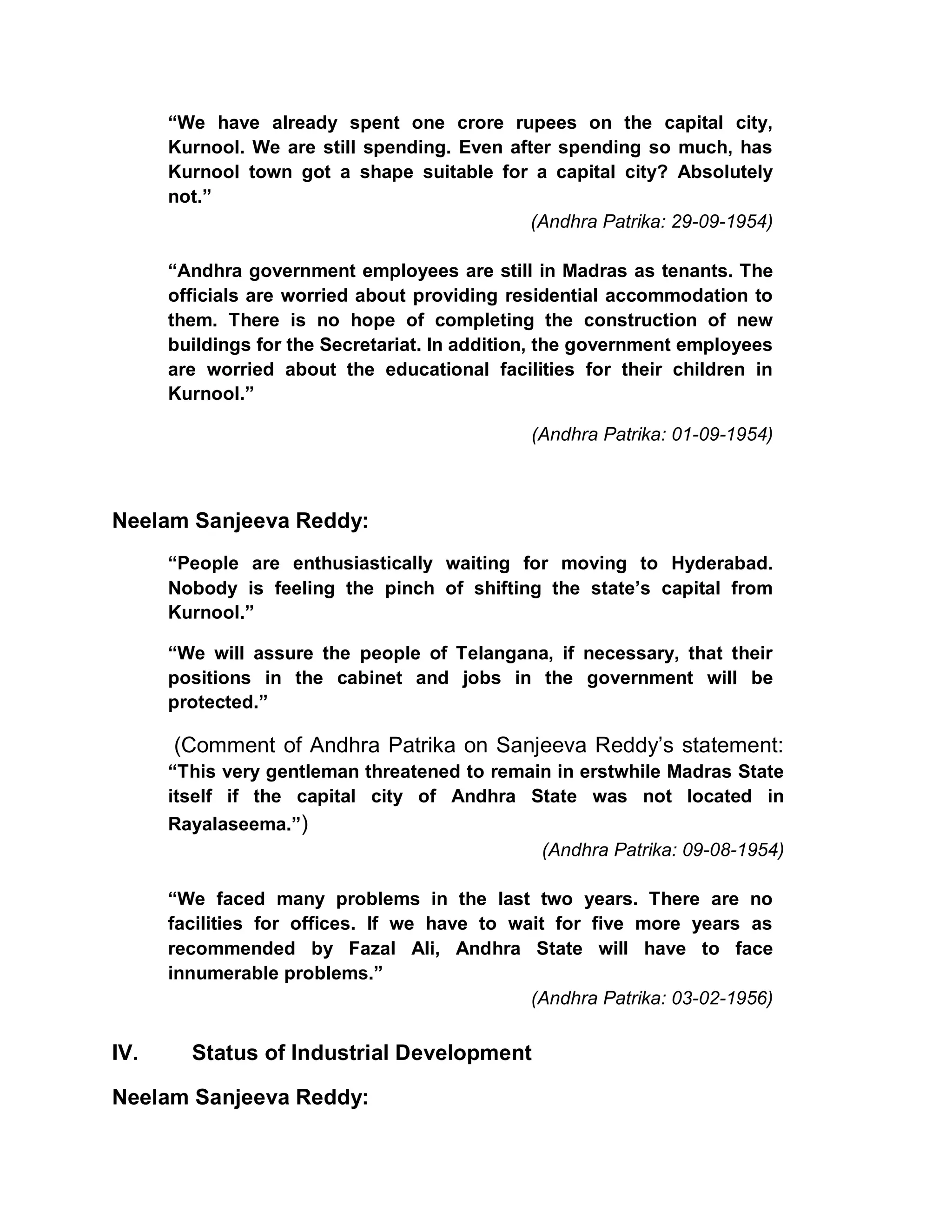
Y. Suryanarayana Rao:
³We have already spent one crore rupees on the capital city,
      Kurnool. We are still spending. Even after spending so much, has
      Kurnool town got a shape suitable for a capital city? Absolutely
      not.´
                                              (Andhra Patrika: 29-09-1954)

      ³Andhra government employees are still in Madras as tenants. The
      officials are worried about providing residential accommodation to
      them. There is no hope of completing the construction of new
      buildings for the Secretariat. In addition, the government employees
      are worried about the educational facilities for their children in
      Kurnool.´

                                              (Andhra Patrika: 01-09-1954)


Neelam Sanjeeva Reddy:
      ³People are enthusiastically waiting for moving to Hyderabad.
      Nobody is feeling the pinch of shifting the state¶s capital from
      Kurnool.´

      ³We will assure the people of Telangana, if necessary, that their
      positions in the cabinet and jobs in the government will be
      protected.´

      (Comment of Andhra Patrika on Sanjeeva Reddy¶s statement:
      ³This very gentleman threatened to remain in erstwhile Madras State
      itself if the capital city of Andhra State was not located in
      Rayalaseema.´)
                                              (Andhra Patrika: 09-08-1954)

      ³We faced many problems in the last two years. There are no
      facilities for offices. If we have to wait for five more years as
      recommended by Fazal Ali, Andhra State will have to face
      innumerable problems.´
                                              (Andhra Patrika: 03-02-1956)

IV.     Status of Industrial Development

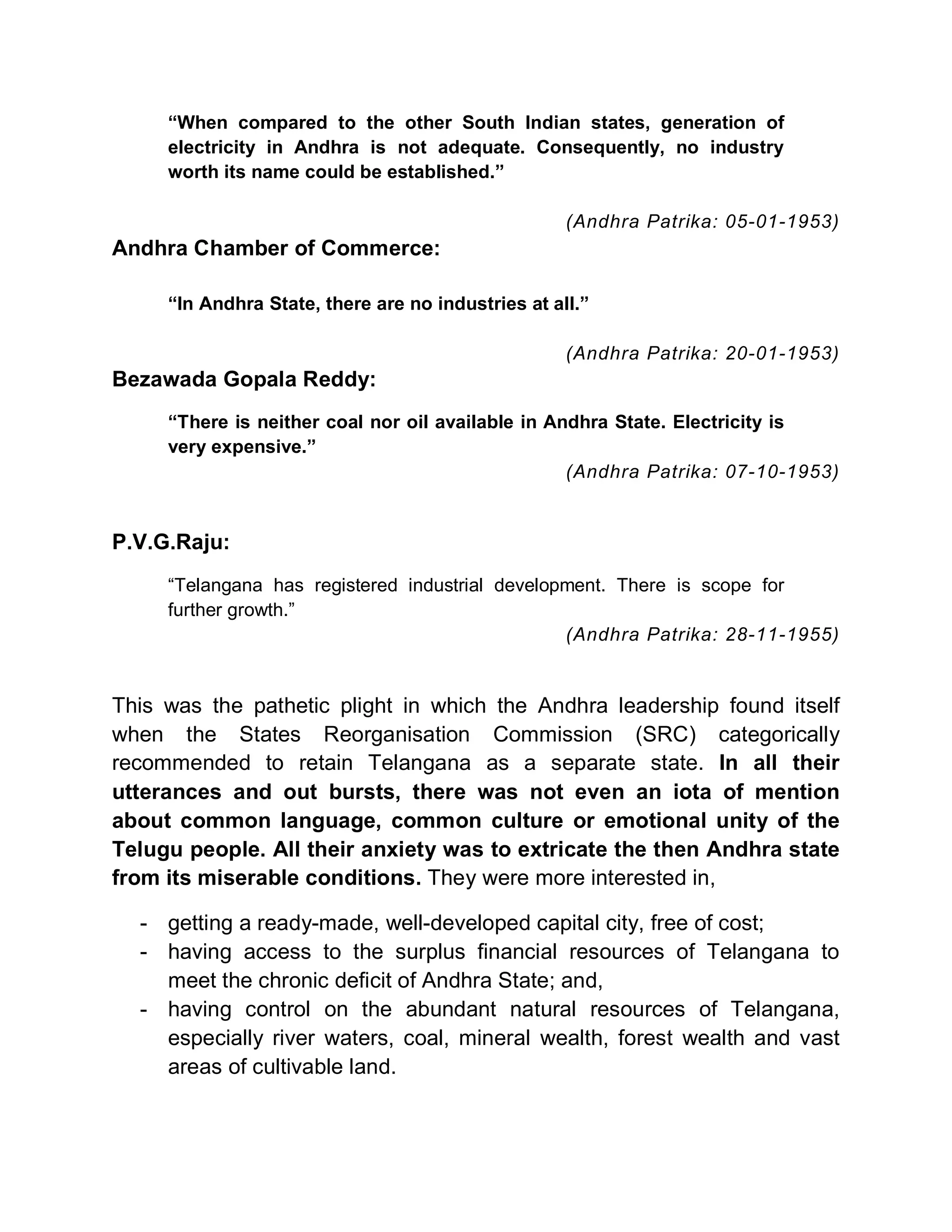
Neelam Sanjeeva Reddy:
³When compared to the other South Indian states, generation of
     electricity in Andhra is not adequate. Consequently, no industry
     worth its name could be established.´

                                                    (Andhra Patrika: 05-01-1953)
Andhra Chamber of Commerce:

     ³In Andhra State, there are no industries at all.´

                                                    (Andhra Patrika: 20-01-1953)
Bezawada Gopala Reddy:
     ³There is neither coal nor oil available in Andhra State. Electricity is
     very expensive.´
                                                   (Andhra Patrika: 07-10-1953)


P.V.G.Raju:
     ³Telangana has registered industrial development. There is scope for
     further growth.´
                                                 (Andhra Patrika: 28-11-1955)


This was the pathetic plight in which the Andhra leadership found itself
when the States Reorganisation Commission (SRC) categorically
recommended to retain Telangana as a separate state. In all their
utterances and out bursts, there was not even an iota of mention
about common language, common culture or emotional unity of the
Telugu people. All their anxiety was to extricate the then Andhra state
from its miserable conditions. They were more interested in,

  - getting a ready-made, well-developed capital city, free of cost;
  - having access to the surplus financial resources of Telangana to
    meet the chronic deficit of Andhra State; and,
  - having control on the abundant natural resources of Telangana,
    especially river waters, coal, mineral wealth, forest wealth and vast
    areas of cultivable land.
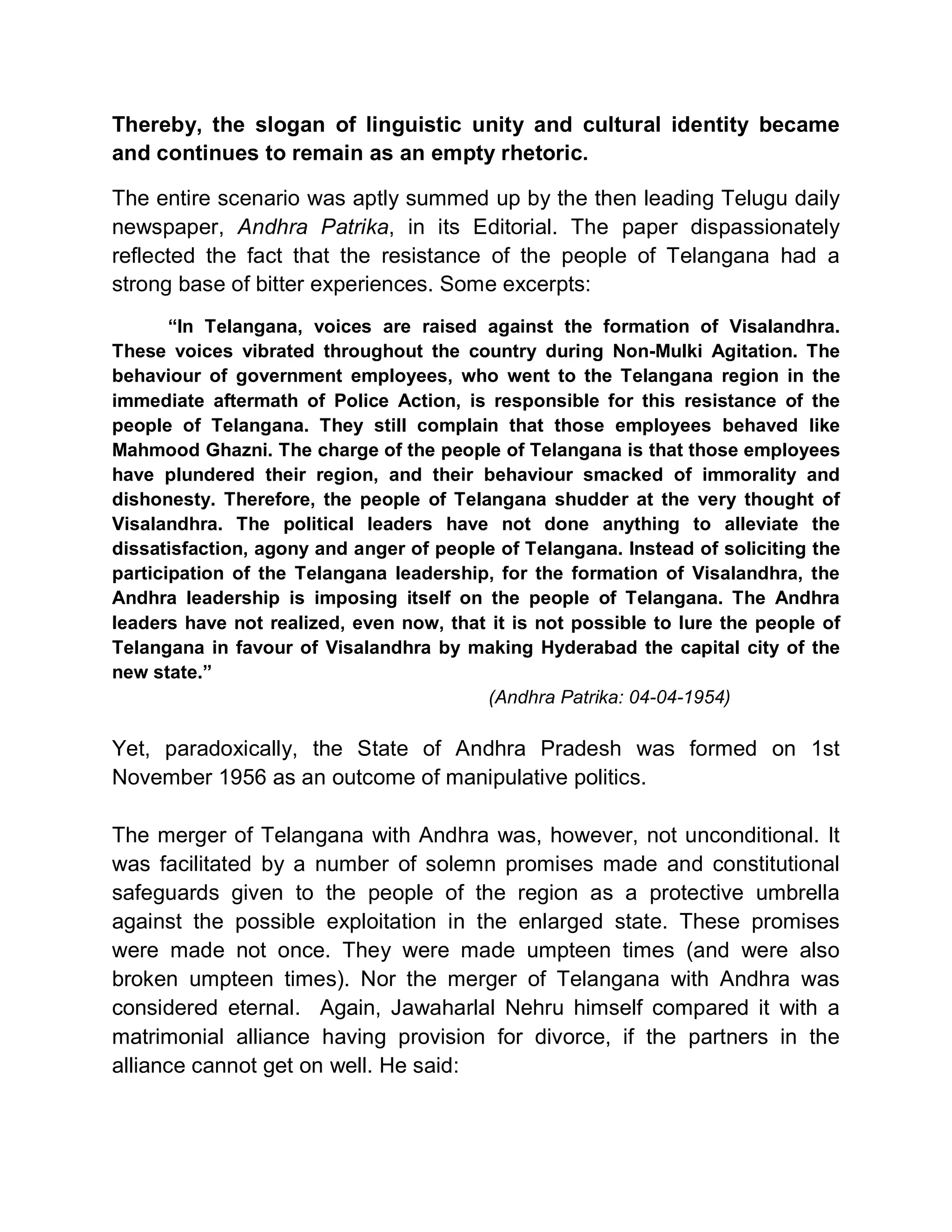
Thereby, the slogan of linguistic unity and cultural identity became
and continues to remain as an empty rhetoric.

The entire scenario was aptly summed up by the then leading Telugu daily
newspaper, Andhra Patrika, in its Editorial. The paper dispassionately
reflected the fact that the resistance of the people of Telangana had a
strong base of bitter experiences. Some excerpts:
       ³In Telangana, voices are raised against the formation of Visalandhra.
These voices vibrated throughout the country during Non-Mulki Agitation. The
behaviour of government employees, who went to the Telangana region in the
immediate aftermath of Police Action, is responsible for this resistance of the
people of Telangana. They still complain that those employees behaved like
Mahmood Ghazni. The charge of the people of Telangana is that those employees
have plundered their region, and their behaviour smacked of immorality and
dishonesty. Therefore, the people of Telangana shudder at the very thought of
Visalandhra. The political leaders have not done anything to alleviate the
dissatisfaction, agony and anger of people of Telangana. Instead of soliciting the
participation of the Telangana leadership, for the formation of Visalandhra, the
Andhra leadership is imposing itself on the people of Telangana. The Andhra
leaders have not realized, even now, that it is not possible to lure the people of
Telangana in favour of Visalandhra by making Hyderabad the capital city of the
new state.´
                                         (Andhra Patrika: 04-04-1954)

Yet, paradoxically, the State of Andhra Pradesh was formed on 1st
November 1956 as an outcome of manipulative politics.

The merger of Telangana with Andhra was, however, not unconditional. It
was facilitated by a number of solemn promises made and constitutional
safeguards given to the people of the region as a protective umbrella
against the possible exploitation in the enlarged state. These promises
were made not once. They were made umpteen times (and were also
broken umpteen times). Nor the merger of Telangana with Andhra was
considered eternal. Again, Jawaharlal Nehru himself compared it with a
matrimonial alliance having provision for divorce, if the partners in the
alliance cannot get on well. He said:
³An innocent girl (Telangana) is being married to a mischievous boy (Andhra). If it
works, it works. If it doesn¶t, they can take divorce.´

                                                (The Deccan Chronicle: 06-03-1956)

As feared, nothing could prevent the successive governments from
exploiting this region in every sphere ± economic, political, administrative,
cultural and linguistic.

Promises Broken:

The Gentlemen¶s Agreement of 1956, which was an assurance of fair
play given to the people of Telangana to facilitate the formation of Andhra
Pradesh, was scuttled the very same day on which the state was born, by
the very same ³Gentlemen´ who were signatories to the agreement. The
result was a massive revolt of the people of the region in 1968-69
demanding separation of Telangana from the State of Andhra Pradesh. It
has come to be known as Jai Telangana Movement. The governments of
the time in the State and at the Centre then woke up and tried (or
pretended) to undo the damage done to the region.

The first step taken in that direction was the All Party Accord of January
1969 arrived at a meeting of the leaders of all the political parties in the
State, convened by the then Chief Minister Brahmananda Reddy. But it
was shelved in less than six months time.

Thereafter, a couple of packages were announced by the Prime Minister of
the time, Indira Gandhi, styled as Eight Point Formula and Five Point
Formula. When the modalities of giving effect to these packages were
being worked out, the Supreme Court of India gave a historic judgment
validating, what were then known as, Mulki Rules. This judgment upheld
the rule of reserving employment and educational opportunities available in
Telangana exclusively for the residents of this region. But the political elite
of Andhra region did not digest these corrective measures. The result was
another agitation for a separate state, and this time for a separate Andhra
state. It is referred to as Jai Andhra Movement. The leaders of Jai Andhra
Movement demanded either scrapping of all the safeguards given to the
people of Telangana including the judgment of Supreme Court of India on
the validity of Mulki Rules, or bifurcating Andhra Pradesh into Andhra and
Telangana states. It may not be out of place to recall that Venkaiah Naidu
and Chandrababu Naidu, among others, were in the forefront of Jai Andhra
Movement.

The Government of India yielded to the pressure of political might and
money power of the majority region and nullified, by an act of Parliament,
almost all the safeguards given to the people of Telangana including the
annulment of judgment of the highest judicial authority of the country on
Mulki Rules.

As an alternative, the so-called Six Point Formula, a diluted form of
safeguards, was foisted on the people. Even this formula has been, and
continues to be, violated with impunity, robbing the people of Telangana of
whatever little was left in the name of safeguards.

All these exercises ultimately turned out to be futile as they were, at best,
attempts to treat the symptoms rather than the malady. Consequently, the
exploitation of the region and its people continued (and still continues)
unabated under the patronage of political leadership, irrespective of the
region it hailed from and irrespective of the party it belonged to. In this
process the so called concept of Telugu Brotherhood has become
irrelevant, placing the people of Telangana in an extremely unenviable
position.

Deprived of their legitimate share in the fruits of development,
marginalized in the political process and administrative setup,
belittled on the cultural and linguistic fronts they are virtually reduced
to the status of second-rate citizens in their own homeland.

Therefore, the demand for a separate state continues to persist.

Telangana on UPA Agenda (2004)
When the UPA Government came to power at the national level after the
general elections held in 2004, the following commitment was made in its
Common Minimum Programme (CMP) regarding the formation of
Telangana State:

The demand for formation of Telangana State to be considered at an
appropriate time after consultations and consensus.

It had the approval of all the 13 constituent parties of the UPA Government,
besides the four parties of the Left Front, supporting the Government from
outside.

This item was mentioned by the President of India in his address to the
joint session of Parliament held on 7th June 2004.

In order to initiate the follow-up action for arriving at consensus in this
regard, a sub-committee of the UPA was constituted under the
Chairmanship of Pranab Mukerjee. Consequently, Pranab Mukherjee wrote
letters to all the political parties having representation in the Parliament,
seeking their opinion on the formation of Telangana State. The responses
received from different political parties clearly indicate an overwhelming
support for the formation of Telangana State. A brief analysis is given
hereunder:

Parties of the UPA Government:

Thirteen Parties constituted the UPA Government when it came to power.
They were: Congress Party, RJD, DMK, NCP, PMK, JMM, TRS, Lok
Janshakthi Party, MDMK, Republican Party of India, J&K People¶s
Democratic Party, Indian Union Muslim League and Kerala Congress. Out
of them, 11 parties gave letters supporting the formation of Telangana
State. The DMK extended its support orally, at the official meeting of the
UPA held in August 2006. The Congress maintained that as the entire
exercise was being carried on at its instance, a formal letter from its side
was not necessary.

Friendly Parties:
There were 11 parties, besides one independent member, supporting the
UPA Government from outside. They were: CPI(M), CPI, RSP, Forward
Block, Janata Dal (S), Rashtriya Lok Dal, Sikkim Democratic Front,
Samajwadi Party, BSP, SJP (R), and MIM. Out them, seven parties,
besides one independent member, gave letters in support of Telangana
State. They were: BSP, CPI, Forward Block, Rashtriya Lok Dal, Janata
Dal(S), Sikkim Democratic Front, SJP(R). The stand taken by the
Samajwadi Party is not known. The CPI (M) maintained that as a matter of
principle, it was against the disintegration of linguistic states. But, it stated
that it would not come in the way of formation of Telangana State. The
Party made it abundantly clear at a meeting held on 22nd August 2006, with
the representatives of Congress High Command.


Opposition Parties:

There were 14 parties in the opposition, besides 3 independents. They
were: BJP, Shiv Sena, BJD., Janata Dal (U), Shiromani Akali Dal, TDP,
AITC, AGP, National Conference, Indian Federal Democratic Party,
Mizoram National Front, Nagaland People¶s Front, Nati0nal Loktantrik Party
and Bharatiya NavShakti Party. Out of them, 8 parties gave their consent
supporting the formation of Telangana State. They were: BJP, TDP
Shiromani Akali Dal, JD (U), Indian National Democratic Party, Mizoram
National Front, Nagaland People¶s Front and Bharatiya Navshakti Party.
Further, Shiv Sena, BJD, AGP, National Conference, besides 3
independents, orally promised to support the proposal.

Others:

All the five former Prime Ministers responded favourably on this score.
While V.P. Singh (now late) and I.K. Gujral wrote in their personal capacity,
H .D. Deve Gouda and Chandra Shekhar (now late) wrote on behalf of the
parties they represented. Atal Bihari Vajpayee was in any case a party to
the BJP¶s commitment.
In addition, two more parties, having representation only in the Rajya
Sabha, also extended their support. They were: Swatantra Bharat Paksha
and Republican Party of India (G).

It is abundantly clear that the consensus arrived at, in favour of formation
of Telangana State was not only very wide but was also overwhelming. If
the UPA does not consider it as consensus, then what else could it be, and
what more is it searching for?

The UPA Government did not honour its commitment made to the people
of Telangana. Consequently, the Telangana Rashtra Samithi (TRS) had to
withdraw from the UPA.

2009 General Elections and Thereafter:

During the 2009 general elections the Congress Party did not forge any
alliance with the TRS; but it was categorical in assuring the people of
Telangana that it was committed to the formation of Telangana State and
that it was the only national party capable of fulfilling the promise. Further,
most of the parties in the State, i.e., TDP, BJP, CPI and Prajarajyam also
were very categorical in supporting the proposal for the formation of
Telangana State. The TRS in any way has only one point programme. The
MIM, though silent, was not against the proposal. The CPI (M) maintained
that it would not come in the way if the state was formed. This commitment
made by almost all the political parties in the State made the people of
Telangana to believe that the formation of Telangana State was a certainty,
no matter which party or whichever combination of parties came to power.
As a result, all these parties put together, swept the poll overwhelmingly.
Therefore, the number of seats won by TRS ceased to be the sole criterion
for the formation of the Telangana State. Yet, the governments in the State
as well as the Centre tried to distort the electoral verdict. Under these
circumstances K. Chandrasekhar Rao had to undertake a fast unto death
from 29th November 2009, in the Gandhian and democratic mode of
protest.

This mode of protest evoked a massive response from the nook and corner
of Telangana region. In order to find a solution, the Government of India
asked the Chief Minister of Andhra Pradesh to obtain the opinion of the
Congress Legislature Party on the one hand and of all the political parties
of the State on the other. The Chief Minister went through this exercise on
7th December 2009. The Congress Legislature Party unanimously resolved
to authorise the Congress High Command in the matter and assured to
abide by any decision taken by it. At the All Party Meeting convened the
same day, all the major political parties promised to support the proposal
for the formation of Telangana State and accused the Congress Party and
the State Government for delaying the process. These parties include TDP,
BJP, PRP, CPI, and naturally TRS. The MIM wanted a couple of days time
to make its stand clear. The one member Loksatta Party was ambivalent.
The CPI (M) reiterated its known stand. The minutes of these meetings
were sent to the Government of India by the Chief Minister. There was also
a prolonged debate in both the houses of Parliament underscoring the
need and desirability of resolving the issue immediately.

In this backdrop, on 9th December 2009, the Union Home Minister, P.
Chidambaram, announced, on behalf of Government of India, that the
process of formation of Telangana State would be initiated and an
appropriate resolution would be moved in the State Assembly. He also
requested Chandrasekhar Rao to give up his fast unto death.
Consequently, Rao gave up his fast amidst a wave of jubilation throughout
Telangana.

But, surprisingly, and also shockingly, the leaders of Congress Party, TDP
and PRP, hailing from the Andhra and Rayalaseema regions went back on
their commitment made in the official meetings to support the formation of
Telangana State. Some of them who are known for their vested interests in
the real estate business and investments in the corporate sector instigated
openly the students and the youth of the Andhra and Rayalaseema regions
to oppose the proposal for the formation of Telangana State. There was a
large scale violence and massive destruction of property in those regions.
The role played by even some of the members of Parliament and the
Legislative Assembly belonging to the Congress Party is well known.
During that period there was total peace and tranquility in the Telangana
region. In that scenario the Union Home Minister made another statement
on 23rd December 2009 that the Government of India would initiate a wide
range of consultations before initiating the process of the formation of
Telangana State. This had naturally created an impression that the issue of
formation of Telangana State was once again put in the cold storage. And
naturally there was another wave of protest and agitation.

In this context it is to be noted that in dealing with identical situations of
unrest in two different regions of the State, the State Government and the
law and order machinery behaved differently. It was very lenient and
considerate in dealing with situation in the Andhra and Rayalaseema areas,
while it has been, and continues to be, ruthless and repressive in dealing
with an identical situation in the Telangana region. Even the commitment
made by the Home Minister of India regarding the withdrawal of cases
registered against the Telangana activists from 29th of November onwards
is yet to be honoured by the State Government.

Under these circumstances, the latest clarification given by the Union
Home Minister on 31st December 2009 has rekindled some hope among
the people of Telangana. Yet, the people continue to have quite a few
apprehensions. Therefore, it has become inevitable to complete the
process of formation of Telangana State without any further loss of time.

Now it is abundantly clear that all the sections of society in the two regions
are vertically divided. Members of Parliament, Members of Legislative
Assembly, Members of Legislative Council, Ministers and Representatives
of Local Bodies of all the parties are divided into two camps. It should be
realised that the continuance of unified State of Andhra Pradesh has
become untenable. It will be possible only if people of both the regions
agree to it willingly. The unity cannot be imposed unilaterally.

What is to be understood is that the formation of Telangana State
means restoration of status quo ante as it existed on 31st October
1956. The geographical boundaries and the territorial jurisdiction of
the two regions were clearly demarcated and defined in the
documents prepared at the time of merger of Telangana with Andhra.
No new exercise is required on this score.
INCOME AND EXPENDITURE
Telangana is a victim of plunder of its financial resources in the integrated
state of Andhra Pradesh.

On the eve of formation of Andhra Pradesh itself, Telangana was a surplus
area with regard to its Revenue Income and Expenditure, where as Andhra
was a deficit state.

Underscoring the dangers involved in the amalgamation of a surplus area
with a deficit state, the States¶ Reorganization Commission recommended
continuance of Telangana as a separate state.

Yet, the amalgamation took place because of the manipulative politics; but
it was not unconditional.

One of the conditions of merger of Telangana with Andhra was not to allow
diversion of Telangana¶s surplus income for the benefit of the other region.
But this condition, like several others, was observed more in its breach all
through.

Consequently, Telangana is lagging behind the other region in all spheres
of its development.

Whenever the question of formation of Telangana State comes up for
discussion ± and also consideration ± attempts are deliberately made to
create an impression that Telangana may not be a viable state. It is a
travesty of truth. The fact is that the financial viability of the very state of
Andhra Pradesh is dependent on the contribution of Telangana to the
State¶s exchequer. It might sound incredible, yet it is an indisputable reality.
Therefore, a glance at the pages of the past history, juxtaposing it with the
present day realities, becomes necessary.

The Backdrop:

When the idea of forming the erstwhile Andhra state, segregating the
Andhra area from the then composite state of Madras, was mooted, quite a
few doubts were raised about the viability of that state. Dr. BR Ambedkar
himself observed:

            Is the proposed Andhra State a viable State? Mr. Justice
            Wanchoo had very candidly admitted that the annual
            revenue deficit of the proposed Andhra State will be of the
            magnitude of Rs. 5 crores. Is it possible for the proposed
            Andhra state to reduce this gap either by increase of
            taxation or decrease in expenditure? The Andhras must
            face this question. Is the Centre going to take the
            responsibility of meeting this deficit? If so, will this
            responsibility be continued to the proposed Andhra state
            or will it be extended to all similar cases? These are
            questions which are to be considered.

Elaborating further the inadequacies of the proposed Andhra state and the
difficulties it was bound to face, Dr. Ambedkar said:

            ³Andhra is Sahara and there are no oases in it´.
                                 Source: Writings and Speeches of Dr. BR Ambedkar (Vol)


Yet, Andhra State was formed on 1st October 1953 with Kurnool town as the
capital. On the eve of formation of the state a debate took place in the
Madras Assembly about, among other things, the financial position of the
proposed Andhra state. Participating in the debate, M. Bhaktavatsalam, the
then Finance Minister of the erstwhile composite state of Madras made the
following statement on the floor of the Assembly on 13 March 1953:


The sales tax receipts of the Andhra region are very negligible:

As expected and explicitly expressed, the financial troubles for the newly
formed Andhra state started right from the day of its inception! It is
discernible   from   the   statements   made     by   panic-stricken   political
functionaries of the state government and the analyses made in the media.
To cite a few examples:

Neelam Sanjeeva Reddy, the then Deputy Chief Minister of Andhra state,
expressed his agony about the financial problems of the state on the floor of
the State Assembly as under:

     Wherever we go, the farmers are asking for irrigation and
     electricity facilities. Where can we fetch them from?
     (25-02-1954)


     Now we are dragging on with a deficit of 18 crore rupees. We
     are not in a position to pay salaries to the staff unless the
     central    government      comes       to     our     rescue.
     (05-11-1953)

     Andhra Government had to borrow 6 crore rupees in the very
     first year of its inception.  (25-01-1956)

     Bezawada Gopala Reddy, the then Chief Minister of the Andhra
state, too expressed anxiety over the financial plight of the new state in the
following words:
Out of 22 crore rupees of revenue receipts, administrative
     expenditure alone is eating away 20 crores.
     (Andhra Assembly 15-09-1954)


He expressed similar concern outside the assembly also:


     Regular payment of monthly salaries to the teachers too has
     become a difficult exercise.

                                     (Andhra Patrika: 01-10-1953)

     On the ongoing debate about the innumerable problems confronting
the then Andhra state, a reputed Telugu daily of those times, Andhra
Patrika, made these comments:

     The financial condition of the Andhra State is not at all
     satisfactory; nor is it likely to improve in future. There is no
     likelihood of paying salaries to the government employees by
     the end of March (1955). ...

                                                         (03-12-1954)


     There is a huge deficit in the revenue of the State. It is not at
     all possible to take up any new projects.

                                                (09-02-1956)


     Now there is no possibility of using revenue receipts for
     developmental works; nor is there any likelihood of it even in
     the coming five years. Floating loans for developmental
     works has become impossible.

                                                (06-07-1955)
It was at that time the Government of India had set up the States
Reorganisation Commission (SRC) in order to examine the question of
reorganising the Indian states and make recommendations there for. The
SRC, in its report, categorically and unequivocally recommended retention
of Telangana as a separate state. In this context the SRC elaborately listed
out the reasons for making this recommendation. With regard to the
financial soundness of the Telangana region vis-à-vis the chronic financial
deficit and uncertainty of the then Andhra state, the SRC made the
following observation:

      The existing Andhra state has faced a financial problem of
      some magnitude ever since it was created; and in comparison
      with Telan- gana, the existing Andhra state has low per capita
      revenue. Telangana, on the other hand, is much less likely to
      be faced with financial embarrassment« Whatever the
      explanation may be « the result of the unification will be to
      exchange some settled sources of revenue, out of which
      development schemes may be financed, for financial
      uncertainty similar to that with which Andhra is now faced.
      Telangana claims to be progressive and from an
      administrative point of view, unification, it is contended, is not
      likely   to    confer     any     benefit      on    this    area.
      (Para 376)


Such was the pathetic plight of the erstwhile Andhra state! It was a real
hand to mouth struggle in the areas of finance and development. For
coming out of such a mess, all hopes of Andhra leaders were pinned down
on the formation of Visalandhra (the present Andhra Pradesh). But the SRC
was not in favour of unsettling the financial stability of Telangana for bailing
out the then Andhra state from its chronic financial instability.

A Conditional Merger:
Then, the Andhra leadership indulged in lobbying and manipulative politics.
Innumerable promises of protecting the interests of Telangana were made
in the event of its merger with the Andhra state. The national leadership
succumbed to the pressure of the Andhra leaders and gave green signal for
the merger of surplus Telangana with the deficit Andhra, subject to
providing several statutory safeguards to the people of Telangana. It was
made abundantly clear that the merger was neither unconditional nor would
it be eternal. The political leaders of Telangana (not the people) trusted the
national leadership and entered into an agreement which has come to be
known as the Gentlemen¶s Agreement. One of the important clauses of
that Agreement was to prohibit the diversion of Telangana revenue
surpluses to meet the deficit of Andhra region. The relevant clause reads as
follows:


      The expenditure of the Central and General Administration of
      the State should be borne proportionately by the two regions
      and the balance of income from Telangana should be reserved
      for expenditure on the development of Telangana area.

Violation of Conditions:

But the violation of this clause, along with several other clauses of the
Gentlemen¶s Agreement, started from the very first day of the formation of
Andhra Pradesh by the very same gentlemen who inked their signatures on
the Agreement. These violations included, among other, the diversion of the
revenue surpluses of Telangana to meet the deficit of Andhra region.
Regarding the quantum of Telangana revenues diverted to the Andhra
area, it was established by the enquiries instituted by the Government of
India and the State Government that between 1.11.1956 (i.e. the day of
formation of the State) and 31.03.1957, spanning a period of just five
months, more than 41% of the Telangana revenue income was diverted to
the Andhra region (See Table II) to meet its insurmountable financial
problems. And this illegal and unethical diversion did not stop with those
five months; it continued unabated. This became one of the principal
reasons for the revolt of people of Telangana in 1968-69 and reiteration of
their demand for separation of Telangana from the forced merger with
Andhra.

Telangana Surpluses ± Pre 1969 Scenario:

Consequently, the governments of the time at the Centre and in the State
were compelled to assess the quantum of Telangana surpluses diverted to
Andhra region for the period from 01.11.1956 to 31.03.1968. The first
exercise on this count was done by K. Lalit, an Officer on Special Duty,
deputed by the Comptroller and Auditor General of India (referred to as
Lalit Committee). Subsequently, the Prime Minister of the time, Indira
Gandhi, constituted a high power committee under the chairmanship of
Vashishth Bhargava, a sitting judge of the Supreme Court of India (referred
to as Bhargava Committee) to have a further look into the matter. Both the
committees came to more or less the same conclusions. With some
variations in computing the figures here and there, both the committees
clearly established that the surplus revenues of Telangana were transferred
constantly and continuously to meet the revenue deficit of Andhra area. A
glance at the figures culled out from the reports of these two committees
gives an idea as to the extent of damage done to Telangana region in the
integrated state of Andhra Pradesh. It could be seen in the following two
tables:

                               Table - I
            Revenue Receipts of Andhra and Telangana
                  from 1-11-1956 to 31-3-1968
                                                          (Rs. In Lakhs)
% of                  % of                        % of
S.No.      Year     Andhra             Telangana                  Total
                               Total                 Total                       Total

  1      1956 - 57 1,450.01    57.00   1,093.88      43.00    2,543.89            100
  2      1957 - 58 3,987.84    63.98   2,244.79      36.02    6,232.63            100
  3      1958 - 59 4,085.05    60.50   2,667.18      39.50    6,752.23            100
  4      1959 - 60 4,743.30    57.88   3,451.10      42.12    8,194.40            100
  5      1960 - 61 5,176.53    60.69   3,352.36      39.31    8,528.89            100
  6      1961 - 62 4,766.00    55.57   3,810.83      44.43    8,576.83            100
  7      1962 - 63 6,027.51    57.22   4,506.55      42.78    10,534.06           100
  8      1963 - 64 7,567.08    59.78   5,091.79      40.22    12,658.87           100
  9      1964 - 65 7,780.57    59.14   5,375.91      40.86    13,156.48           100
 10      1965 - 66 7,769.37    56.07   6,087.29      43.93    13,856.66           100
 11      1966 - 67 8,681.33    55.21   7,044.00      44.79    15,725.33           100
 12      1967 - 68 9,866.16    59.48   6,720.47      40.52    16,586.63           100
        Total      71,900.75   58.29   51,446.15     41.71   123,346.90           100


Source : Report on the Quantum of Telangana Surpluses (Kumar Lalith Report) Govt. of
A.P.,1969

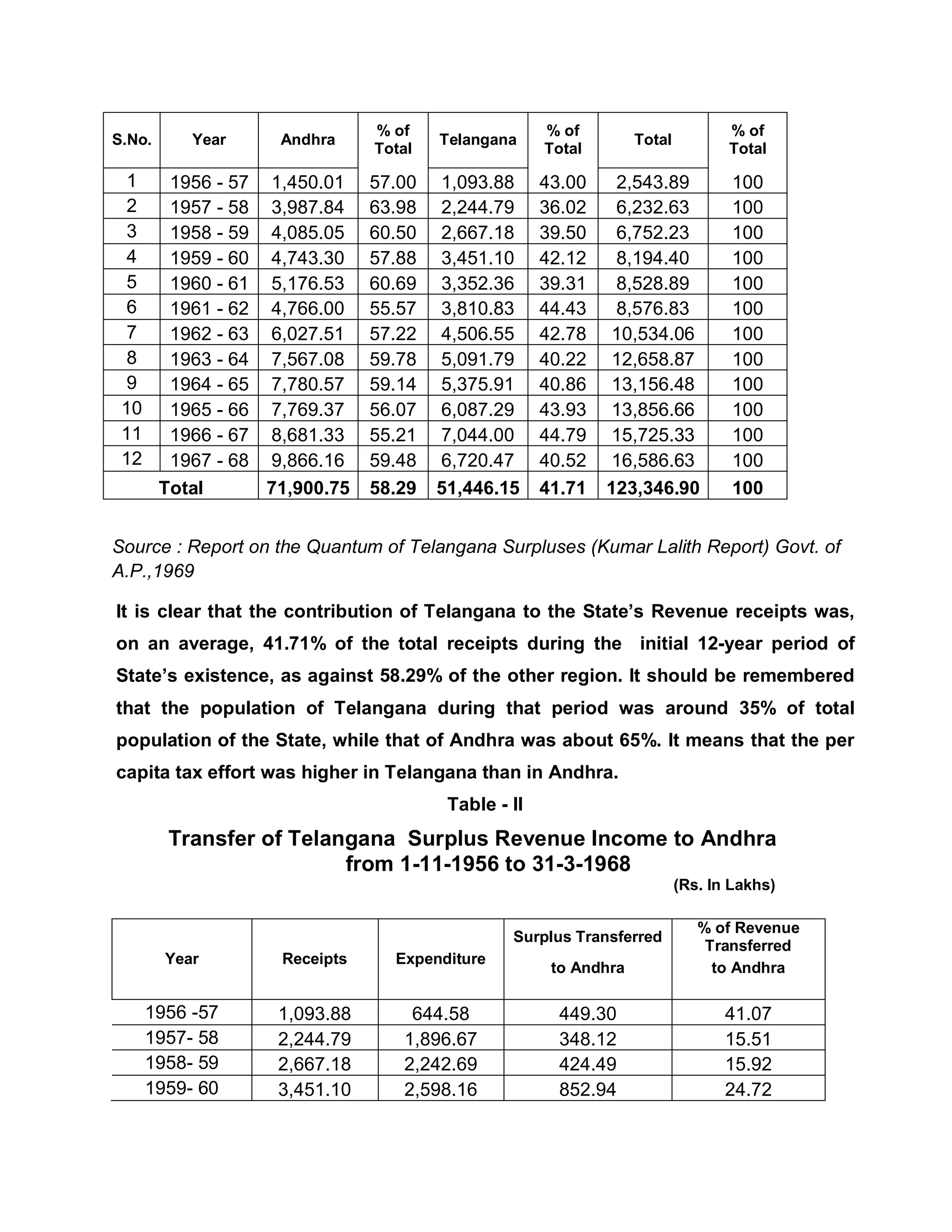
It is clear that the contribution of Telangana to the State¶s Revenue receipts was,
on an average, 41.71% of the total receipts during the initial 12-year period of
State¶s existence, as against 58.29% of the other region. It should be remembered
that the population of Telangana during that period was around 35% of total
population of the State, while that of Andhra was about 65%. It means that the per
capita tax effort was higher in Telangana than in Andhra.
                                        Table - II
         Transfer of Telangana Surplus Revenue Income to Andhra
                          from 1-11-1956 to 31-3-1968
                                                                          (Rs. In Lakhs)

                                                                             % of Revenue
                                                Surplus Transferred
                                                                              Transferred
        Year        Receipts     Expenditure
                                                      to Andhra                to Andhra

      1956 -57      1,093.88       644.58              449.30                    41.07
      1957- 58      2,244.79      1,896.67             348.12                    15.51
      1958- 59      2,667.18      2,242.69             424.49                    15.92
      1959- 60      3,451.10      2,598.16             852.94                    24.72
1960- 61       3,352.36      3,000.34           352.02             10.50
    1961- 62       3,810.83      3,381.37           429.46             11.27
    1962- 63       4,506.55      3,837.69           668.86             14.84
    1963- 64       5,091.79      4,228.95           862.84             16.95
    1964- 65       5,375.91      4,764.70           611.21             11.37
    1965- 66       6,087.29      5,555.39           531.90              8.74
    1966- 67       7,044.00      6,376.45           667.55              9.48
    1967- 68       6,720.47      6,526.31           194.16              2.89
     Total         51,446.15     45,053.30         6,392.85            12.43

Source : Report on the Quantum of Telangana Surpluses (Kumar Lalith Report) Govt. of
A.P., 1969


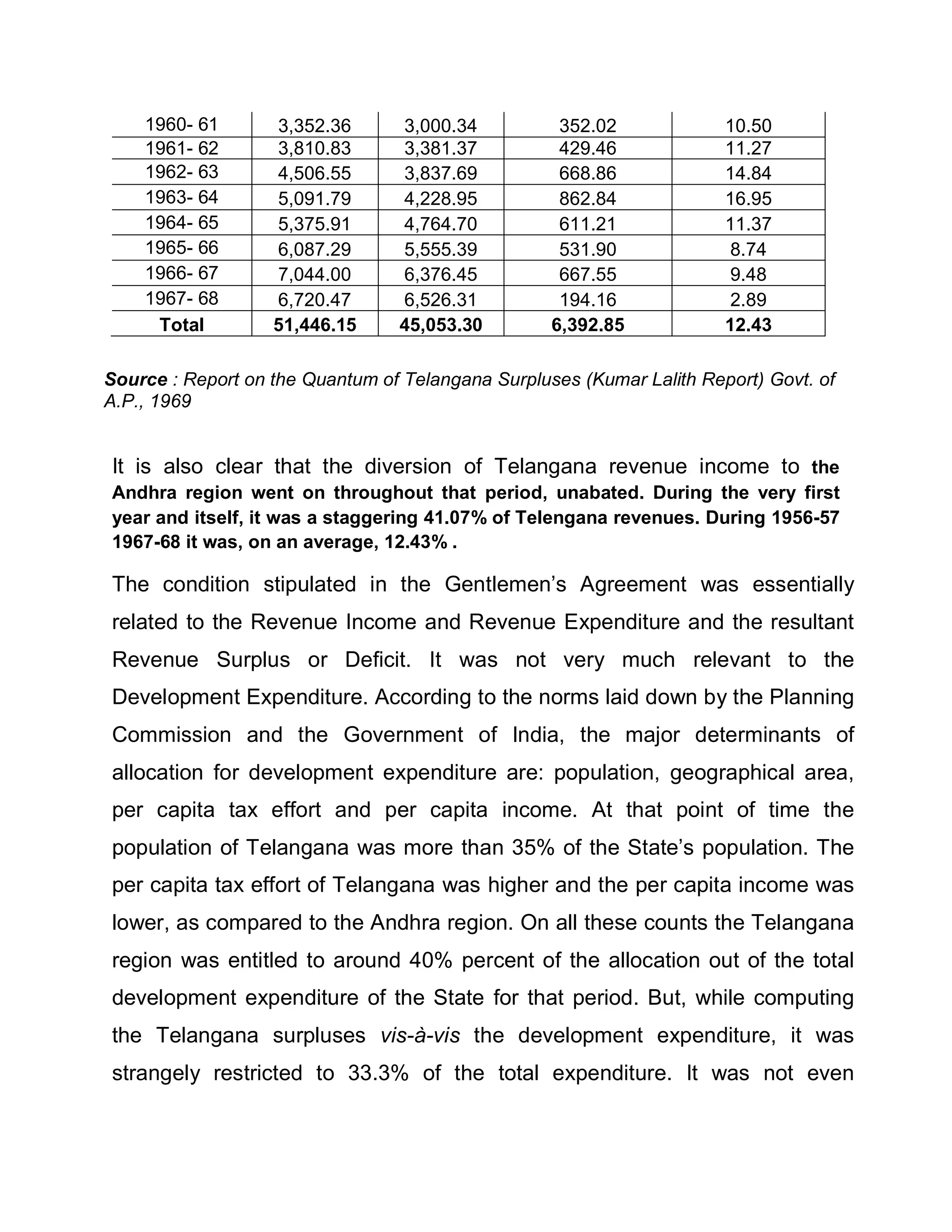
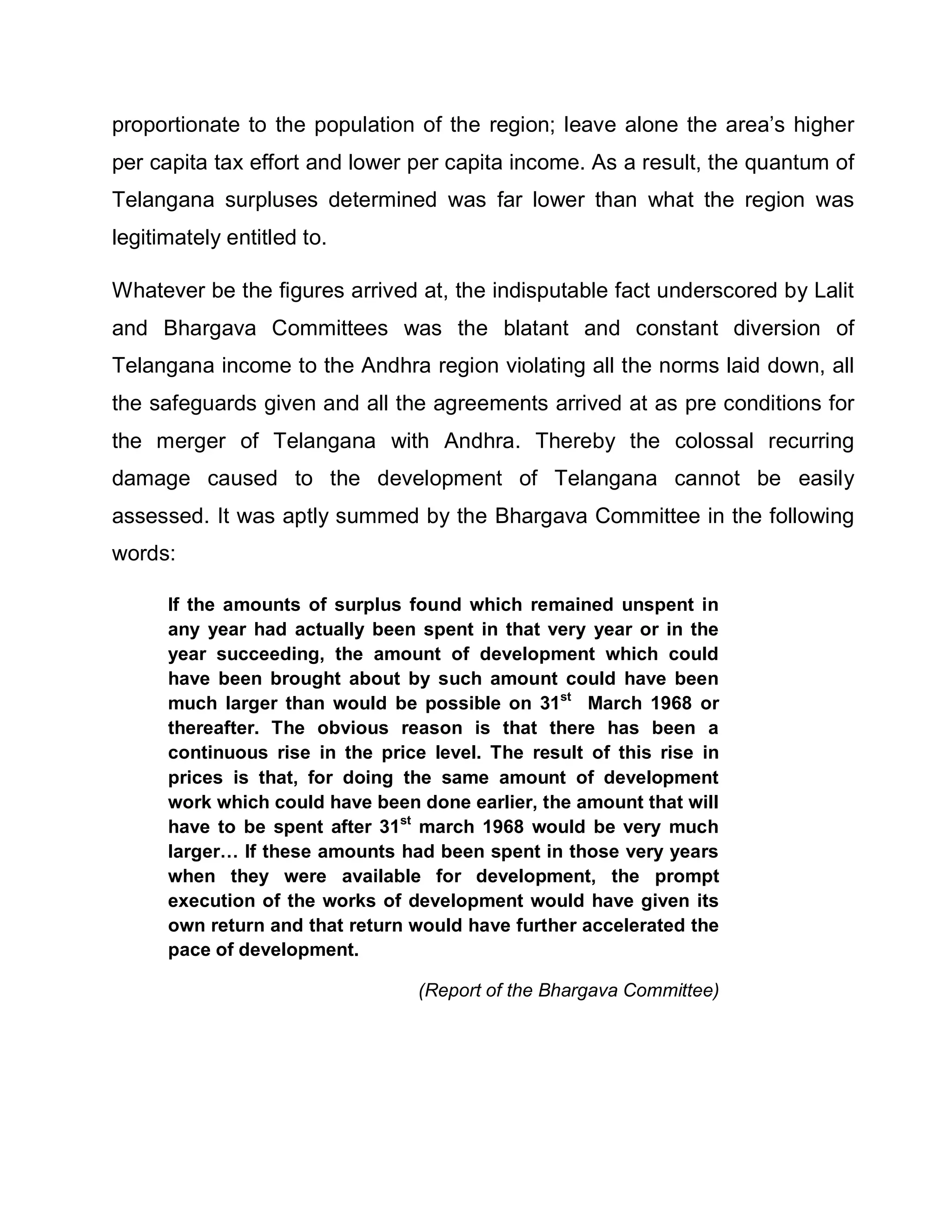
It is also clear that the diversion of Telangana revenue income to the
Andhra region went on throughout that period, unabated. During the very first
year and itself, it was a staggering 41.07% of Telengana revenues. During 1956-57
1967-68 it was, on an average, 12.43% .

The condition stipulated in the Gentlemen¶s Agreement was essentially
related to the Revenue Income and Revenue Expenditure and the resultant
Revenue Surplus or Deficit. It was not very much relevant to the
Development Expenditure. According to the norms laid down by the Planning
Commission and the Government of India, the major determinants of
allocation for development expenditure are: population, geographical area,
per capita tax effort and per capita income. At that point of time the
population of Telangana was more than 35% of the State¶s population. The
per capita tax effort of Telangana was higher and the per capita income was
lower, as compared to the Andhra region. On all these counts the Telangana
region was entitled to around 40% percent of the allocation out of the total
development expenditure of the State for that period. But, while computing
the Telangana surpluses vis-à-vis the development expenditure, it was
strangely restricted to 33.3% of the total expenditure. It was not even
proportionate to the population of the region; leave alone the area¶s higher
per capita tax effort and lower per capita income. As a result, the quantum of
Telangana surpluses determined was far lower than what the region was
legitimately entitled to.

Whatever be the figures arrived at, the indisputable fact underscored by Lalit
and Bhargava Committees was the blatant and constant diversion of
Telangana income to the Andhra region violating all the norms laid down, all
the safeguards given and all the agreements arrived at as pre conditions for
the merger of Telangana with Andhra. Thereby the colossal recurring
damage caused to the development of Telangana cannot be easily
assessed. It was aptly summed by the Bhargava Committee in the following
words:

      If the amounts of surplus found which remained unspent in
      any year had actually been spent in that very year or in the
      year succeeding, the amount of development which could
      have been brought about by such amount could have been
      much larger than would be possible on 31st March 1968 or
      thereafter. The obvious reason is that there has been a
      continuous rise in the price level. The result of this rise in
      prices is that, for doing the same amount of development
      work which could have been done earlier, the amount that will
      have to be spent after 31st march 1968 would be very much
      larger« If these amounts had been spent in those very years
      when they were available for development, the prompt
      execution of the works of development would have given its
      own return and that return would have further accelerated the
      pace of development.

                                  (Report of the Bhargava Committee)
These observations of the Bhargava Committee get reflected in various
spheres of development that has taken place in the Andhra region at the
expense of the Telangana region. For instance:

i)    By the time the state of Andhra Pradesh was formed, two major
irrigation projects of Andhra area namely, the Godavari barrage at
Dhavaleswaram and the Krishna barrage at Vijayawada were dilapidated
and needed immediate renovation and reconstruction. The then Andhra state
was totally bankrupt and was completely helpless to take up those works.
The merger of Telangana became a boon for the Andhra region. The surplus
revenues of Telangana came handy to the Andhra bosses of the new state.
These two projects which were almost dead were not only reconstructed but
the ayacut was also substantially increased. These two projects put together
now irrigate more than 25 lakh acres in karif and nearly half of it in rabi.

ii)   Had those surpluses of Telangana region been spent on the Sriram
Sagar Project, at least half of the Telangana region would have become
prosperous ± perhaps more than the now affluent delta region. The
construction of Sriram Sagar Project was deliberately kept in abeyance to
facilitate the diversion of Telangana surplus revenues to the Andhra region. It
is now more than four decades that the work on this project was initiated; but
not even half of it is completed. Out of 20 lakh acres of ayacut proposed to be
brought under this project, not even 5 lakh acres get irrigation facilities, that
too for one crop, even to this day.

Will the powers that be able to assess the recurring and cumulative loss caused to
Telangana on this score?

Who will be able to determine the quantum of compensation and who will pay it to
undo the colossal damage done to the region and its people?
Telangana Surpluses ± The Post 1969 Scenario:


The experience of the people of Telangana in the integrated state of Andhra
Pradesh was so bitter, during the initial twelve year period itself. In order to
prevent the recurrence of similar experience regarding the income and
expenditure of the Telangana region, it was reiterated that all the details of
the income and expenditure for Andhra and Telangana regions should be
shown separately in the annual budget of the State. It was followed for a
couple of years; but was given up abruptly without any valid reasons. As a
result, the Andhra bosses got a free hand to do anything to deprive
Telangana of its rightful share in the financial allocations. And everything
went on unnoticed, and is still going on clandestinely. It has not stopped at
that. On the contrary, the Andhra leadership has been arguing, day-in and
day-out, that the Telangana region is getting a lion¶s share in the financial
allocations while the other regions are foregoing their rightful share.
Ironically, and also sadly, the Telangana leadership never dared to question
this untenable claim of the Andhra leadership; obviously for its own survival.
As a result, the damage caused today to the Telangana region from 1970
onwards is much more than the damage done during the preceding spell of
12 to 14 years. The fact, even to this day, is that the financial resources
which legitimately belong to Telangana are being diverted for the
development of other regions. In the absence of related details in the budget
statements and lack of transparency in the functioning of the State
Government, one has to decipher the details from a variety of other
documents.
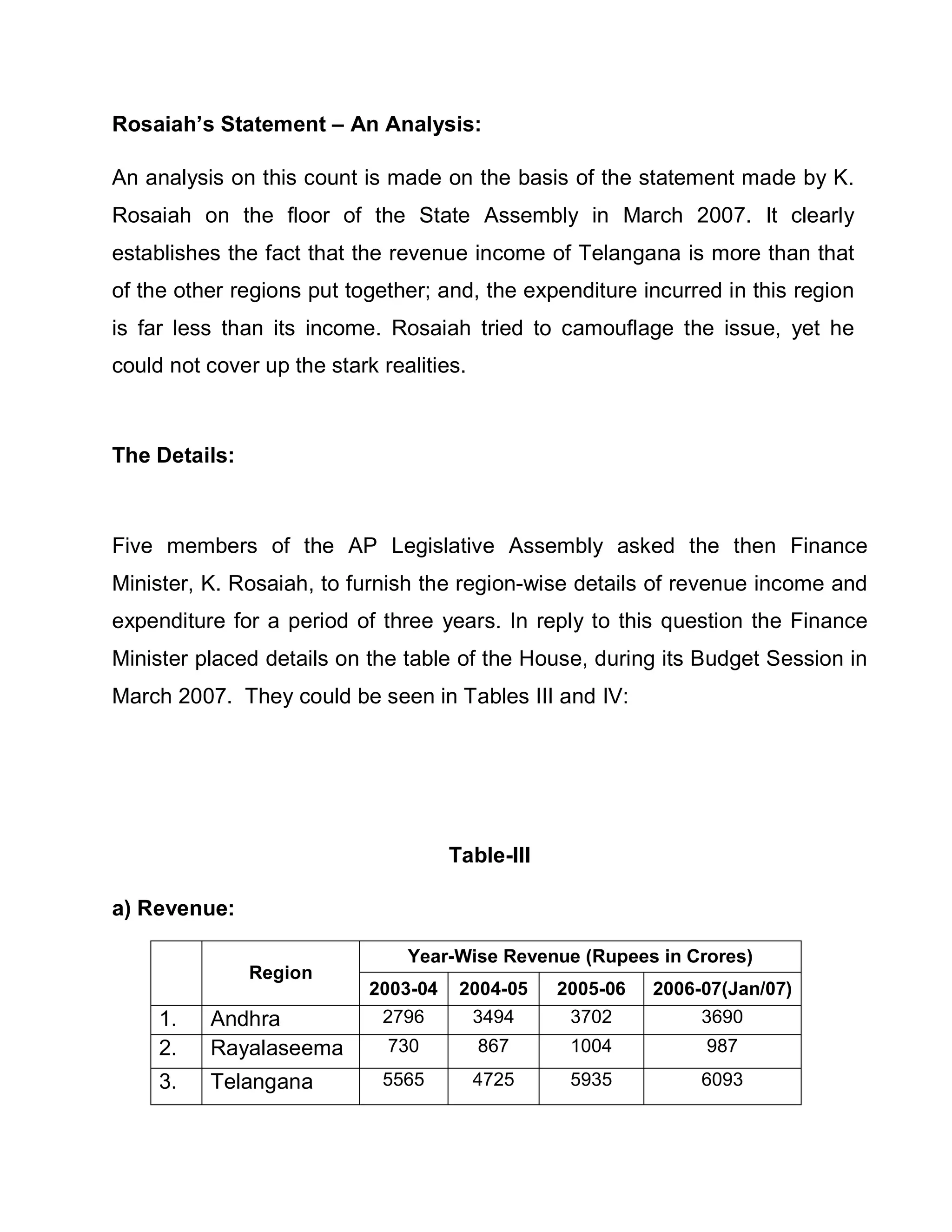
Rosaiah¶s Statement ± An Analysis:

An analysis on this count is made on the basis of the statement made by K.
Rosaiah on the floor of the State Assembly in March 2007. It clearly
establishes the fact that the revenue income of Telangana is more than that
of the other regions put together; and, the expenditure incurred in this region
is far less than its income. Rosaiah tried to camouflage the issue, yet he
could not cover up the stark realities.


The Details:


Five members of the AP Legislative Assembly asked the then Finance
Minister, K. Rosaiah, to furnish the region-wise details of revenue income and
expenditure for a period of three years. In reply to this question the Finance
Minister placed details on the table of the House, during its Budget Session in
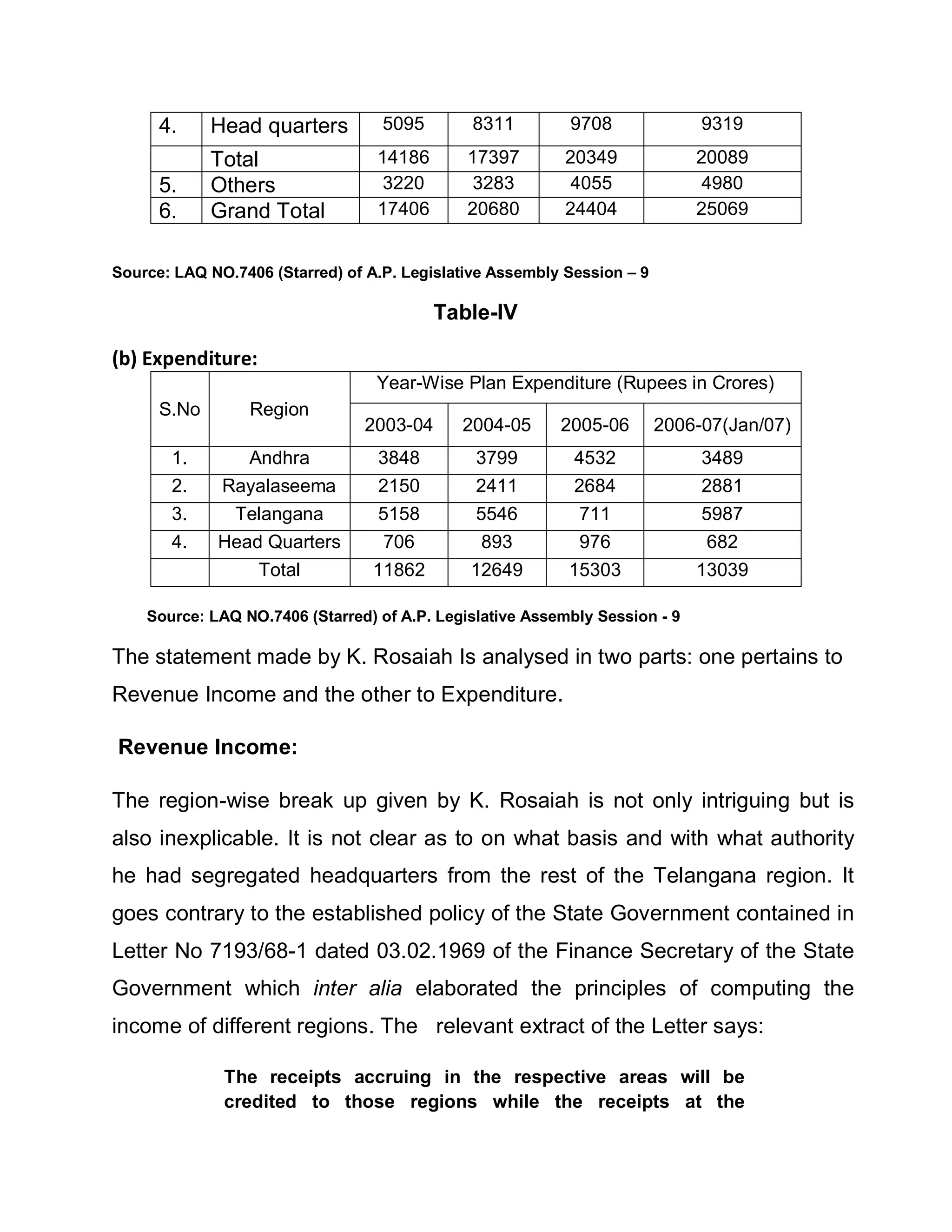
March 2007. They could be seen in Tables III and IV:


                                      Table-III

a) Revenue:

                                Year-Wise Revenue (Rupees in Crores)
               Region
                            2003-04    2004-05    2005-06   2006-07(Jan/07)
     1.   Andhra             2796       3494       3702          3690
     2.   Rayalaseema         730         867      1004          987
     3.   Telangana          5565         4725     5935          6093
4.     Head quarters         5095        8311        9708               9319
             Total                14186       17397        20349             20089
      5.     Others                3220        3283         4055              4980
      6.     Grand Total          17406       20680        24404             25069


Source: LAQ NO.7406 (Starred) of A.P. Legislative Assembly Session ± 9

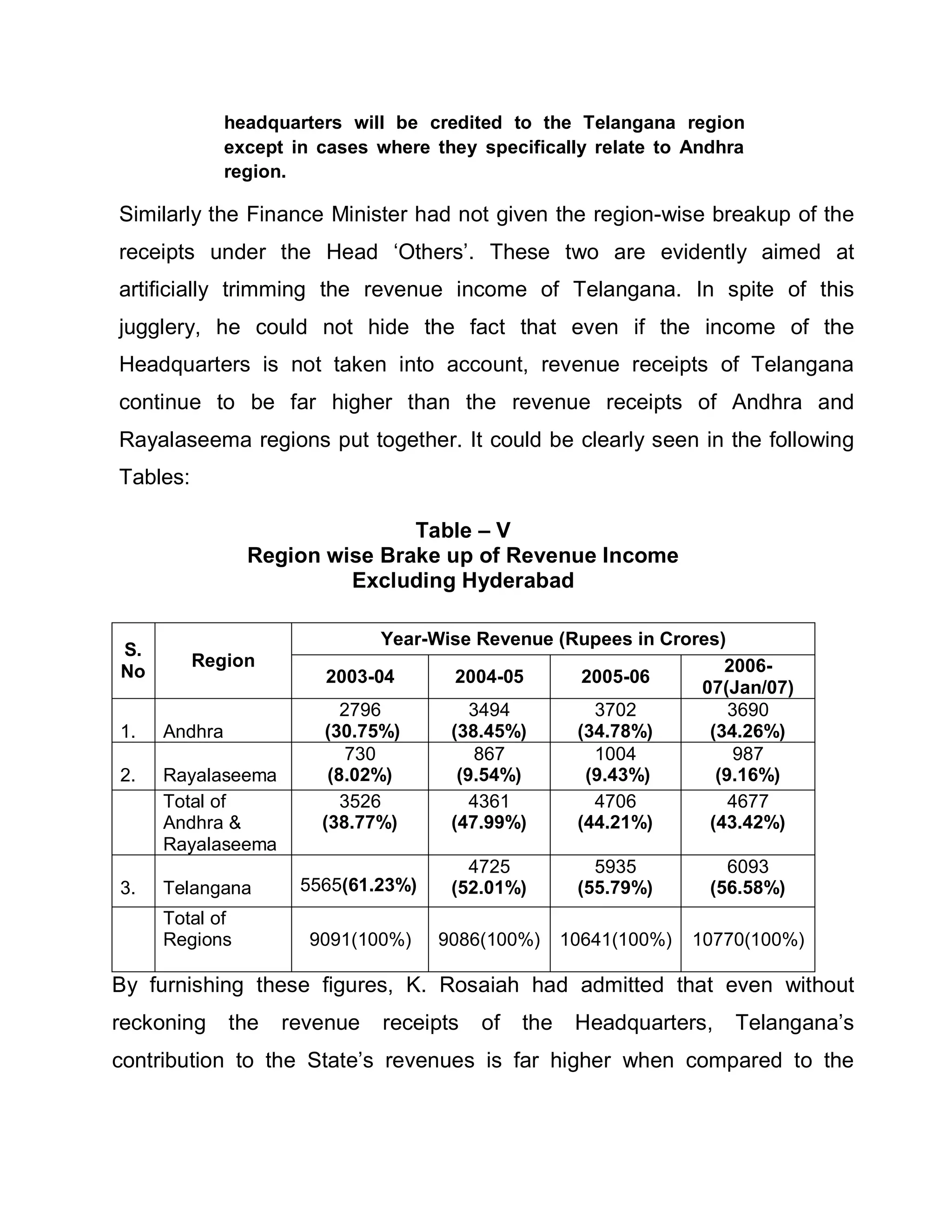
                                          Table-IV

(b) Expenditure:
                                  Year-Wise Plan Expenditure (Rupees in Crores)
      S.No       Region
                                2003-04      2004-05      2005-06        2006-07(Jan/07)
       1.       Andhra             3848        3799         4532              3489
       2.    Rayalaseema           2150        2411         2684              2881
       3.     Telangana            5158        5546          711              5987
       4.    Head Quarters          706         893          976               682
                 Total            11862       12649        15303             13039

    Source: LAQ NO.7406 (Starred) of A.P. Legislative Assembly Session - 9

The statement made by K. Rosaiah Is analysed in two parts: one pertains to
Revenue Income and the other to Expenditure.

Revenue Income:

The region-wise break up given by K. Rosaiah is not only intriguing but is
also inexplicable. It is not clear as to on what basis and with what authority
he had segregated headquarters from the rest of the Telangana region. It
goes contrary to the established policy of the State Government contained in
Letter No 7193/68-1 dated 03.02.1969 of the Finance Secretary of the State
Government which inter alia elaborated the principles of computing the
income of different regions. The relevant extract of the Letter says:

              The receipts accruing in the respective areas will be
              credited to those regions while the receipts at the
headquarters will be credited to the Telangana region
              except in cases where they specifically relate to Andhra
              region.

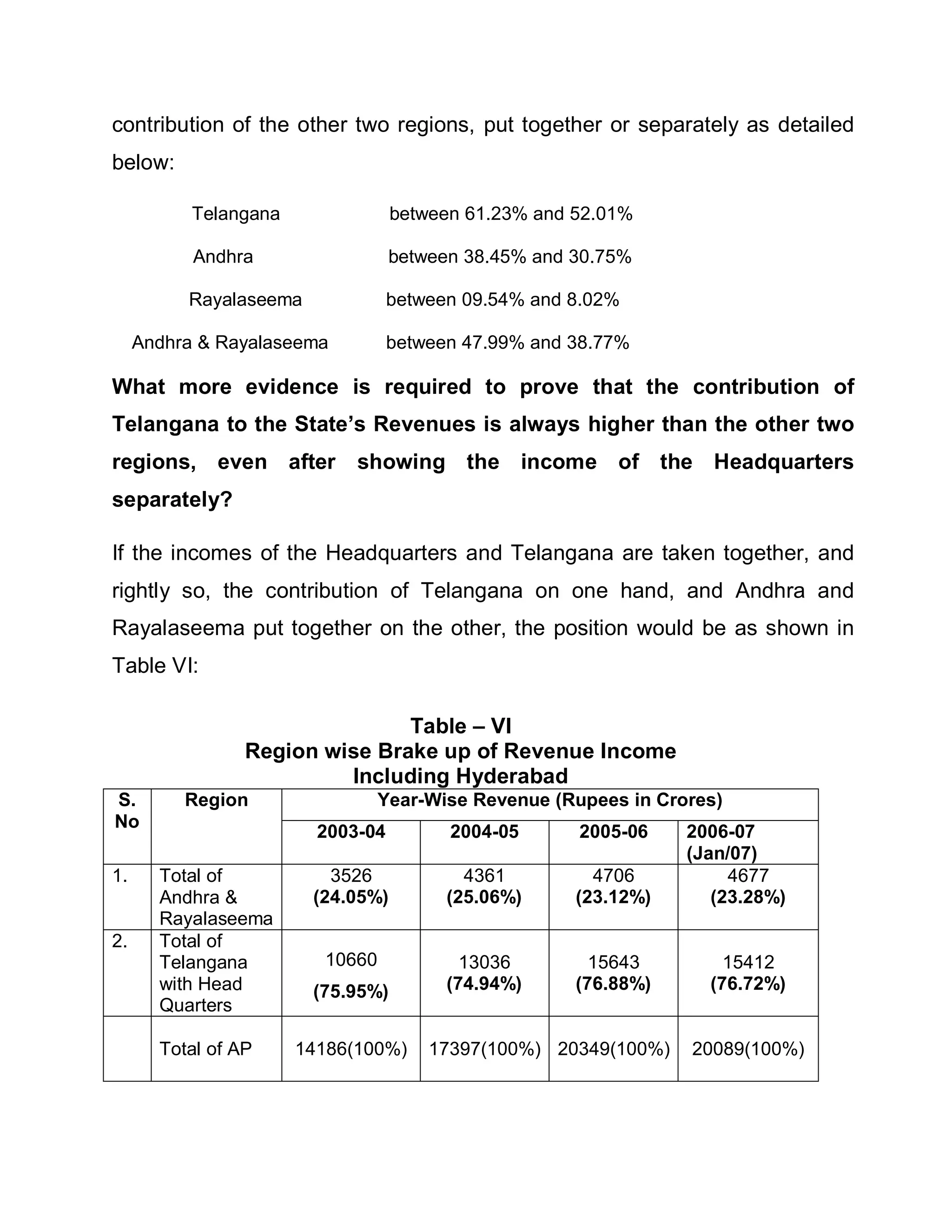
Similarly the Finance Minister had not given the region-wise breakup of the
receipts under the Head µOthers¶. These two are evidently aimed at
artificially trimming the revenue income of Telangana. In spite of this
jugglery, he could not hide the fact that even if the income of the
Headquarters is not taken into account, revenue receipts of Telangana
continue to be far higher than the revenue receipts of Andhra and
Rayalaseema regions put together. It could be clearly seen in the following
Tables:

                               Table ± V
                Region wise Brake up of Revenue Income
                         Excluding Hyderabad

                                Year-Wise Revenue (Rupees in Crores)
S.
          Region                                                    2006-
No                       2003-04        2004-05      2005-06
                                                                 07(Jan/07)
                           2796           3494        3702           3690
1.   Andhra             (30.75%)       (38.45%)     (34.78%)      (34.26%)
                            730            867        1004            987
2.   Rayalaseema         (8.02%)        (9.54%)      (9.43%)       (9.16%)
     Total of              3526           4361        4706           4677
     Andhra &           (38.77%)       (47.99%)     (44.21%)      (43.42%)
     Rayalaseema
                                        4725            5935          6093
3.   Telangana        5565(61.23%)    (52.01%)        (55.79%)      (56.58%)
     Total of
     Regions           9091(100%)    9086(100%)      10641(100%)   10770(100%)

By furnishing these figures, K. Rosaiah had admitted that even without
reckoning     the   revenue    receipts   of   the    Headquarters,    Telangana¶s
contribution to the State¶s revenues is far higher when compared to the
contribution of the other two regions, put together or separately as detailed
below:

           Telangana               between 61.23% and 52.01%

           Andhra                  between 38.45% and 30.75%

          Rayalaseema              between 09.54% and 8.02%

     Andhra & Rayalaseema          between 47.99% and 38.77%

What more evidence is required to prove that the contribution of
Telangana to the State¶s Revenues is always higher than the other two
regions, even after          showing the income of the Headquarters
separately?

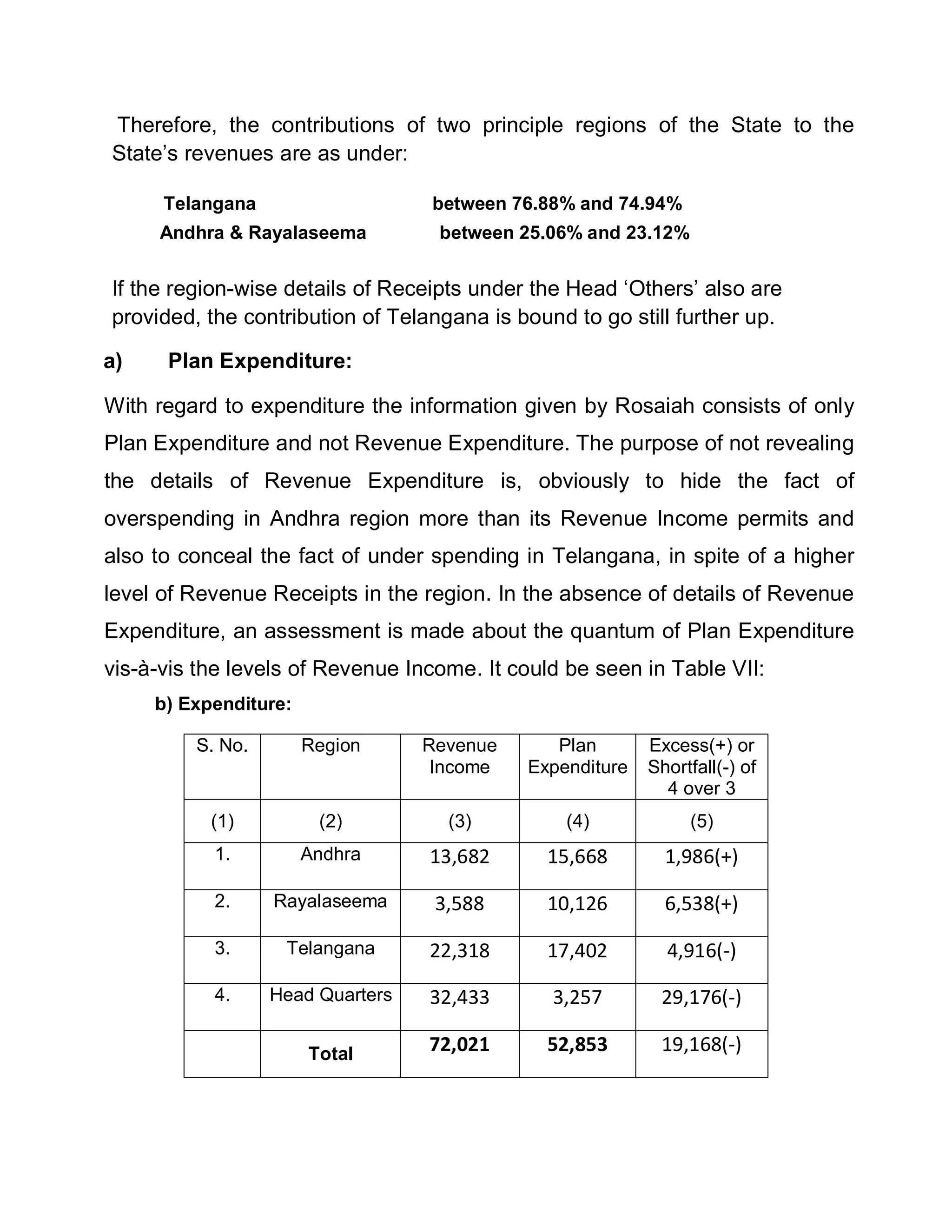
If the incomes of the Headquarters and Telangana are taken together, and
rightly so, the contribution of Telangana on one hand, and Andhra and
Rayalaseema put together on the other, the position would be as shown in
Table VI:

                                Table ± VI
                 Region wise Brake up of Revenue Income
                          Including Hyderabad
S.        Region                 Year-Wise Revenue (Rupees in Crores)
No
                         2003-04         2004-05      2005-06    2006-07
                                                                 (Jan/07)
1.     Total of           3526             4361         4706          4677
       Andhra &         (24.05%)         (25.06%)     (23.12%)      (23.28%)
       Rayalaseema
2.     Total of
       Telangana         10660             13036        15643        15412
       with Head        (75.95%)         (74.94%)     (76.88%)     (76.72%)
       Quarters

       Total of AP     14186(100%)     17397(100%) 20349(100%)   20089(100%)
Therefore, the contributions of two principle regions of the State to the
State¶s revenues are as under:

      Telangana                   between 76.88% and 74.94%
     Andhra & Rayalaseema          between 25.06% and 23.12%


If the region-wise details of Receipts under the Head µOthers¶ also are
provided, the contribution of Telangana is bound to go still further up.

a)    Plan Expenditure:

With regard to expenditure the information given by Rosaiah consists of only
Plan Expenditure and not Revenue Expenditure. The purpose of not revealing
the details of Revenue Expenditure is, obviously to hide the fact of
overspending in Andhra region more than its Revenue Income permits and
also to conceal the fact of under spending in Telangana, in spite of a higher
level of Revenue Receipts in the region. In the absence of details of Revenue
Expenditure, an assessment is made about the quantum of Plan Expenditure
vis-à-vis the levels of Revenue Income. It could be seen in Table VII:
     b) Expenditure:

         S. No.        Region     Revenue      Plan       Excess(+) or
                                   Income   Expenditure   Shortfall(-) of
                                                            4 over 3
           (1)          (2)         (3)         (4)            (5)
           1.          Andhra     13,682      15,668        1,986(+)

           2.     Rayalaseema      3,588      10,126        6,538(+)

           3.      Telangana      22,318      17,402        4,916(-)

           4.     Head Quarters   32,433       3,257       29,176(-)

                       Total      72,021      52,853       19,168(-)
Source: LAQ NO.7406 (Starred) of A.P. Legislative Assembly Session ± 9

The points to be noted here are:

i.     During the period chosen by Rosaiah, Plan Expenditure in Andhra and
       Rayalaseema is far in excess of the Revenue Income of those
       regions.

       Where that money has come from?

ii.    During the same period, the Plan Expenditure in Telangana is far less
       than what the Revenue Income of the region facilitates.

       Where that money has gone?

iii.   The Plan Expenditure in the Headquarters, for the said period is far,
       far below its Revenue Income.

       What has happened to that huge component of Revenue Income?
       In which region and for what purpose it was spent?

Answers to these questions will show as to which region is denied of its
rightful share and which region is the beneficiary.

       What about the Income from the sale of Telangana lands?

Another important factor which does not figure in the statement of Rosaiah is
the income, running into several thousands of crores of rupees, accruing
through the indiscriminate sale of Telangana lands, especially in and around
the city of Hyderabad. It is the common knowledge that a substantial part of
these receipts was spent, and also is being spent on the development
projects in the other regions.

Telangana¶s Contribution to State¶s Exchequer:

In this context the primary reasons for higher contributions of Telangana to
the revenue income of the State need to be perused.
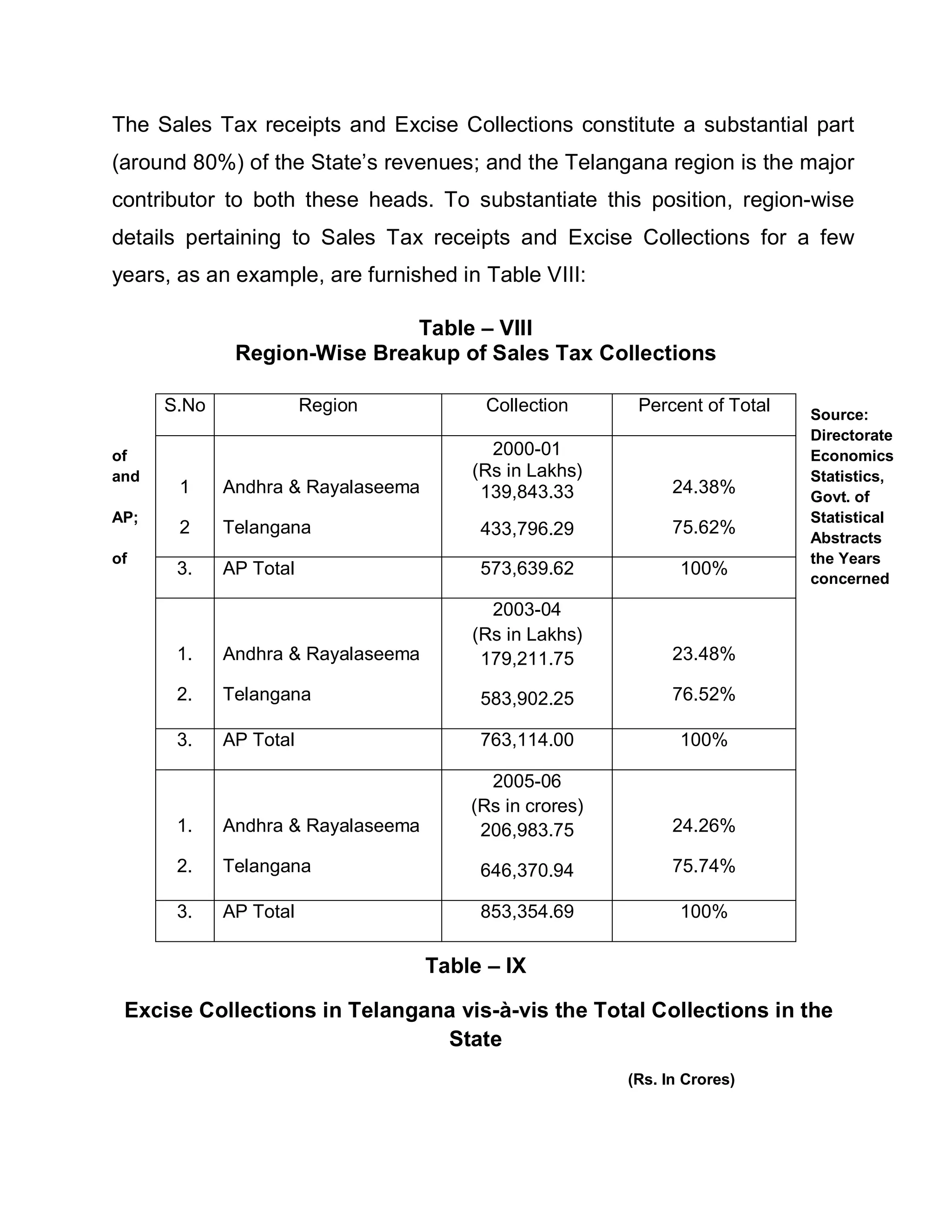
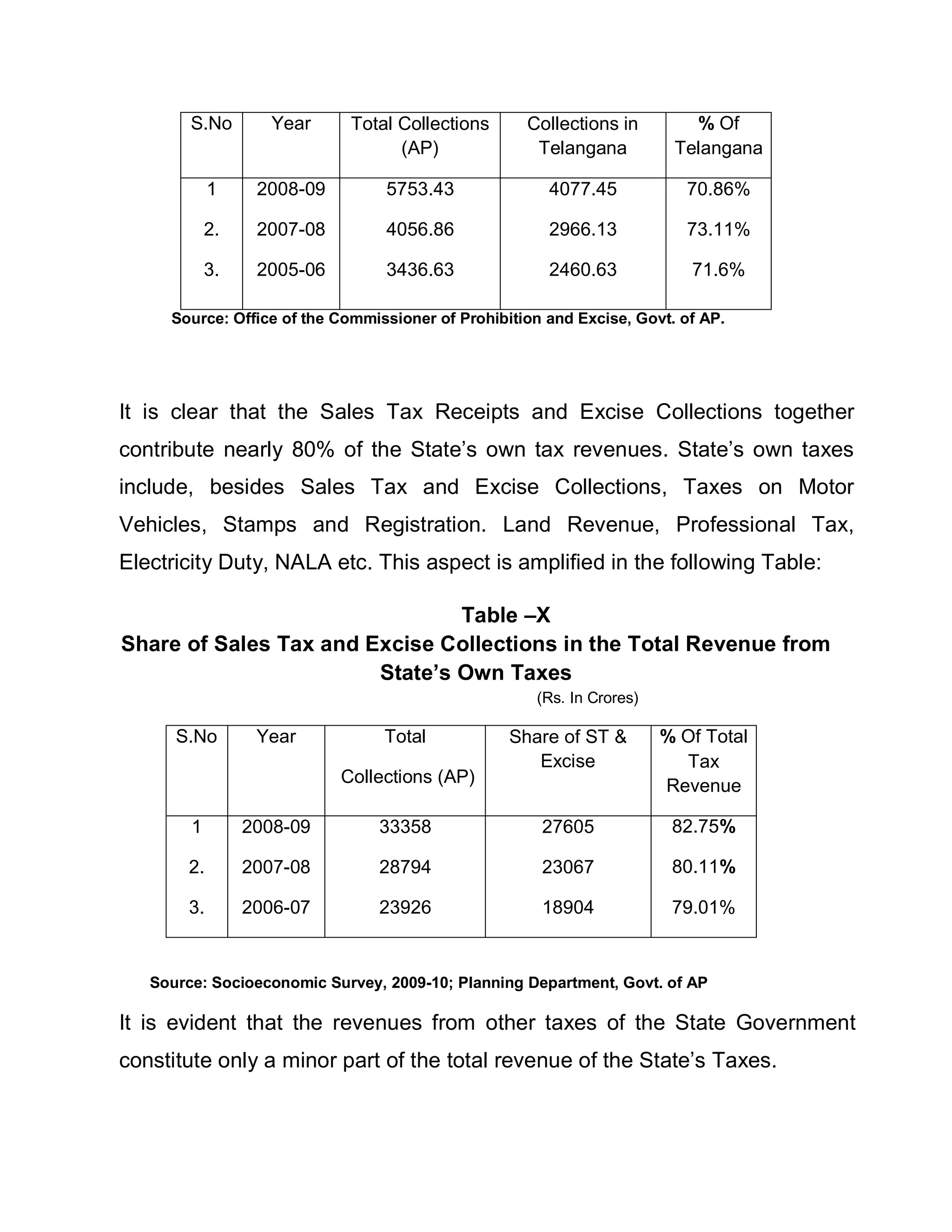
The Sales Tax receipts and Excise Collections constitute a substantial part
(around 80%) of the State¶s revenues; and the Telangana region is the major
contributor to both these heads. To substantiate this position, region-wise
details pertaining to Sales Tax receipts and Excise Collections for a few
years, as an example, are furnished in Table VIII:

                              Table ± VIII
              Region-Wise Breakup of Sales Tax Collections

      S.No              Region            Collection      Percent of Total   Source:
                                                                             Directorate
of                                        2000-01                            Economics
and                                     (Rs in Lakhs)                        Statistics,
       1     Andhra & Rayalaseema        139,843.33            24.38%        Govt. of
AP;                                                                          Statistical
       2     Telangana                   433,796.29            75.62%
                                                                             Abstracts
of                                                                           the Years
       3.    AP Total                    573,639.62             100%
                                                                             concerned

                                          2003-04
                                        (Rs in Lakhs)
       1.    Andhra & Rayalaseema        179,211.75            23.48%

       2.    Telangana                   583,902.25            76.52%

       3.    AP Total                    763,114.00             100%

                                          2005-06
                                        (Rs in crores)
       1.    Andhra & Rayalaseema        206,983.75            24.26%

       2.    Telangana                   646,370.94            75.74%

       3.    AP Total                    853,354.69             100%

                                    Table ± IX

 Excise Collections in Telangana vis-à-vis the Total Collections in the
                               State
                                                         (Rs. In Crores)
S.No        Year     Total Collections      Collections in        % Of
                                   (AP)              Telangana          Telangana

            1     2008-09        5753.43               4077.45            70.86%

            2.    2007-08        4056.86               2966.13            73.11%

            3.    2005-06        3436.63               2460.63            71.6%

     Source: Office of the Commissioner of Prohibition and Excise, Govt. of AP.


It is clear that the Sales Tax Receipts and Excise Collections together
contribute nearly 80% of the State¶s own tax revenues. State¶s own taxes
include, besides Sales Tax and Excise Collections, Taxes on Motor
Vehicles, Stamps and Registration. Land Revenue, Professional Tax,
Electricity Duty, NALA etc. This aspect is amplified in the following Table:

                                Table ±X
Share of Sales Tax and Excise Collections in the Total Revenue from
                        State¶s Own Taxes
                                                     (Rs. In Crores)

      S.No        Year           Total            Share of ST &        % Of Total
                                                     Excise              Tax
                            Collections (AP)                           Revenue

        1        2008-09        33358                 27605             82.75%

       2.        2007-08        28794                 23067             80.11%

       3.        2006-07        23926                 18904             79.01%


   Source: Socioeconomic Survey, 2009-10; Planning Department, Govt. of AP

It is evident that the revenues from other taxes of the State Government
constitute only a minor part of the total revenue of the State¶s Taxes.
In addition to the State¶s own tax and the non-tax revenues, there will be a
flow of resources from the Central Government.         These flows include,
among others, devolution of share in the central taxes and grants based on
the recommendations of the Finance Commission, grants and assistance
from the Planning Commission, funds for externally aided and centrally
sponsored schemes.

While determining the state¶s share in central taxes and grants-in-aid, the
Finance Commission gives sufficient weightage to the backward regions
within the state. Therefore, Telangana is entitled to a higher share in these
revenues as well.

All these factors clearly establish that around ¾ th of Revenue income from
the State¶s own tax revenues and non-tax resources is contributed by the
Telangana region. Regarding the share of Telangana in the flow of
resources from the Central Government, it cannot be in any case less than
50% if the norms laid down by the Finance Commission and Planning
Commission are scrupulously adhered to. The sum and substance of this
entire scenario is that the contribution of Telangana to the State¶s exchequer
is more than the contribution of Andhra and Rayalaseema put together.

Expenditure on Telangana:

But the vital question to be answered is as to what proportion of these
resources is spent for the Telangana region? There was a possibility of
assessing this aspect until early 1970s because of the condition to show the
details of region-wise income and expenditure, separately, in the annual
budgets of the State. The State Government abruptly and arbitrarily
abandoned this practice for the reasons that are so obvious. Therefore, a
different methodology needs to be adopted to make an assessment.

Under the alternative method, evaluation can be made not necessarily on
the basis of actual expenditure incurred, but also on the basis of targets
achieved in physical terms. For instance, in the field of canal irrigation it
could be a region-wise breakup of the extent of area getting irrigation
facilities through that canal system under major and minor irrigation projects
built and maintained by the Government. By any logic the ratios of land
under canal irrigation between the regions will also reflect the ratios of
expenditure as well. Similarly, the proportion of expenditure can be
evaluated by the number of units on which the government spends, such as
the number of teachers working in the institutions managed and aided by
the government, the number of students studying or number of seats
available in government funded educational institutions. In some cases
figures relating to actual expenditure incurred can be culled out from the
orders of the government issued periodically or sporadically to release funds
for various activities of the government.

By adopting this methodology an assessment is made to arrive at the ratios
of expenditure between Andhra and Telangana regions in certain vital
spheres of State¶s activity. In this context it is to be kept in view that the
population of Telangana is about 41% of the State¶s total population.
Geographically it covers 41.67 % of the total area of the State. The region¶s
contribution to the State¶s exchequer is substantially more than that of the
other regions.
a) Canal Irrigation:

The Directorate of Economics and Statistics publishes, every year, the
details regarding the area irrigated by different sources. Canal Irrigation is a
major segment and the entire expenditure of constructing major and
medium irrigation projects together with the canals and also their
maintenance is borne by the government. Spending on irrigation projects is
always a major component of the government¶s expenditure. It is needless
to say that distributive justice among the regions should be ensured in this
regard. But the facts and figures published by the Government itself are
appalling. During the year 2007-08 a total of 16, 10,000 hectares were
irrigated under canal system. Out of this the area irrigated in Telangana was
2, 22,000 hectares, i.e., a mere 13.79%. Even during the best of times, it
was, at the most, 18%.


Does it not mean that out of the total expenditure incurred on major
and medium irrigation projects, Telangana accounts for less than 1/5 th
of it?


b) Social Welfare:

The government spends huge amounts on social welfare programmes. Most
of these programmes are regulated through the white ration cards issued to
the people who are below the poverty line. The schemes include provision of
subsidized rice, kerosene, sugar, housing, pensions, medicare (Aarogyasri)
and so on. The white ration card has thereby become an important
identification card for availing of the benefit of these schemes. Now the
question is: What should be the number of cards issued in a region? It
should naturally be related to the population of the area and poverty levels
therein. The population of Telangana area is about 41%. Therefore the
number of white ration cards issued in the region should be at least 41% of
the total number of cards issued in the state, if not more, because of relative
poverty factor in the region. But the number of white ration cards issued has
all along been around 36-37%, according to the figures published by the
Government. Consequently, the loss to the poor people of the region could
be seen hereunder:

     i)       White ration cards   36-37%

     ii)      Subsidized Rice      37%

     iii) Housing (Indiramma Houses) 33.85%
     Sources: Socioeconomic Survey, 2009-10;   Planning   Department,   Govt.   of   AP
     Directorate of Economics and Statistics


Medicare (Rajiv Aarogyasri) Figures are easily not available: but situation
cannot be different as it also is dependent on the white ration cards.


c)         Education:


i)         Collegiate Education:


It is well known that the salary component paid to the teaching and
supporting staff of these institutions constitutes more than 90% of the total
expenditure. The region-wise details of staff working in such institutions and
thereby the extent of expenditure incurred on them culled out from the
official statistics for the year 2007-08 are given hereunder:
Table ±XI

          Number of Teachers in Government and Aided Degree Colleges


   S.
                 Region              No. of Teachers           Actual %           Entitlement %
   No

           Andhra                          8828                 70.5                59.31
   1.
    2.     Telangana                       3709                 29.50                40.69

    3.       Andhra Pradesh               12,537                 100                  100


Source: Statistical Abstract, 2008; Directorate of Economics and Statistics, AP


A look at the quantum of Grant-in Aid released by the State Government to
Private-Aided Colleges for the year 2008-09 throws some more light in this
regard. It could be seen in the following Table:

                                          Table ±XII

     Grant-in-Aid Released to Private Aided Degree Colleges (2008-09)

                                         Grant-in-Aid(in      Actual %      Entitlement %
     S. No.            Region
                                           Rupees)

     1.        Andhra                     1,521,445,289         75.25               59.31

     2.        Telangana                  49,89,60,900          24.75               40.69

               Andhra Pradesh            202,14,05,189           100                 100


Source: Commissionerate of Collegiate Education, Govt. of Andhra Pradesh


This disparity has been there ever since the formation of Andhra Pradesh.
ii)          University Education:


There are six (old) universities with regional jurisdictions offering facilities of
general education. The disparities with regard to Per Capita Block Grant
could be seen in the following Table:

                                        Table ±XIII

            Per Capita Block Grant to the Six Old Universities (2004 to 2009)


                                                                   Per Capita
      S.                                                          Block Grant
                Region                 University
      No
                                                                  (In Rupees)
             Andhra          I.    Andhra                                35,500

      1.                    II.    Nagarjuna                              22,700

                            III.   Sri Venkateswara                       37,500

                            IV.    Sri Krishna Devaraya                   25,000

                                                                          30,175
                                   Avarage per capita
        2                   i.       Osmania                              17,400
             Telangana
                            ii.      Kakatiya                             14,000

                                   Average per capita                     15,700

Source: Budget Documents for the Years 2004-2009 presented to the AP Assembly


This has been going on for the last five decades.


iii.)        Professional Education:
Cost-wise professional education, especially in the areas of Medicine
    and Engineering is the most expensive component of the system. Every
    additional seat enormously adds to the expenditure. The region-wise
    expenditure naturally depends upon the number of seats available in every
    region. Therefore, a perusal of region-wise breakup of seats in these courses
    also connotes the ratio of expenditure. Tables XIV presents this picture.

                                            Table ±XIV

                     Disparities in Facilities of Professional Education

                                                    No. of Seats
S.                   Total   Andhra       % of     Entitle Telangana   % of    Entitlement
       Courses
No.                  (AP)                 Total     ment               Total        %
                                                     %

                     18,00
1      Medicine          0       1200 66.67         59.31       600    33.33         40.69


       Engineeri
2      ng            3,760       2,625 69.82        59.31      1,135   30.18         40.69


    Source: AP State Council of Higher Education


    This has been the scenario, all through, not withstanding constant protests,
    agitations going on in the State, demanding the separation of Telangana
    from Andhra Pradesh.

      d) Crop Insurance:
                                             Table XV

                   Crop Insurance Fund Allocation for the year 2008 - 09
                                                                        (Rs. In Lakhs)

             SNo.                Region               Amount Released          %
1.       Andhra & Rayalaseema                       77,897.33           97.23

              2.       Telangana                                   2,223.14            2.77

                                           Total                  80120.47              100


     Source: Agricultural Insurance corporation of India
This discrimination is persistent; in fact, the Telangana region should get a
major share of this fund as the region is more prone to frequent crop
failures. What is important to underscore here is the audacity of the State
Government to pursue its blatantly discriminative policies even in the midst
of an intensified agitation in Telangana.
                                           Table XVI

                                NABARD Funds 2008 ± 09
                                                                              (Rs. In Lakhs)

                                                           Amount Allocated           %
           S. No.               Region
              1.       Andhra & Rayalaseema                         12,236.42         93.79

              2.       Telangana                                        809.72         6.21

                                 Total                              13,046.14           100

     Source: G.O. Rt. No. 1845 dated 11-12-2009 of PR & RD Department, Govt. of A.P.

e)    Agricultural Loans:

                                             Table XVII

             Long Terms Loans by AP Co-operative Bank (2006 - 07)
                                                                     (Rs. In Lakhs)
   Total            Andhra    % of       Entitlement        Telangana     % of        Entitlement
 Loan (AP)          Share     Total           %               Share       Total            %
 13,797.96         10376.25   75.20        59.31             3421.71      24.80         40.69


                                           Table XVIII
Short Terms Loans by AP Co-operative Bank (2006 - 07)
                                                          (Rs. In Lakhs)
   Total Loan      Andhra        % of Entitlemen    Telangana   % of Entitlement
      (AP)          Share        Total    t%          Share     Total     %
    314172.21     217354.41      69.18      59.31    96817.80   30.82       40.69

Source: AP State Co-operative Bank Ltd.

The cooperative sector of the State also is following the footsteps of the
State Government in denying the Telangana region and its farming
community their rightful share even with regard to repayable loans.

Conclusion:


These are only the samples. The situation is not different in other sectors as
well. The net result is that the Telangana region is contributing more
revenues to the State¶s exchequer than the other regions; and, in turn, its
getting far less than what it is entitled to in the realm of expenditure. It has
been going on for more than half a century, causing immeasurable damage
to the economy and people of the region. To epitomize it in one phrase the
region has been ³plundered´. It is nevertheless, not an unexpected
development. The SRC itself was prophetic by observing,


        One of the principal causes of opposition to Visalandhra also
        seems to be the apprehensions felt by the educationally
        backward people of Telangana that they may be swamped and
        exploited by the more advanced people of the Coastal
        areas...The real fear of the people of Telangana is that if they
        join Andhra they will be unequally placed in relation to the
        people of Andhra and in this partnership the major partner will
        derive all the advantages immediately while Telangana itself
        may be converted into a colony by the enterprising Andhras´.
                                         (SRC Report: Para 378)
What had happened later to Telangana because of its merger
with Andhra is precisely what was predicted by the SRC!


Now the questions before are:

  i.) Will the powers that be willing to assess the recurring and cumulative
     loss caused to Telangana in the integrated state of Andhra Pradesh?

  ii.) Will they be able to determine the quantum of compensation to undo
     the damage done to the region and its people?

  iii.) Who will pay the compensation?

  iv.) Would it be possible to correct the situation and prevent its recurrence
     within the integrated state of Andhra Pradesh?


The only answer to these questions and the only remedy to all the
maladies is restoration of status quo ante that existed prior to
1.11.1956, i.e., FORMATION OF TELANGANA STATE.


                              Education

Development of education affects and, in turn gets affected, by the pace of
economic development. There is a bidirectional linkage. In this process, low
rate of literacy and economic backwardness sustain each other. This is
precisely the problem of Telangana.
The forced coexistence of Telangana with Andhra for more than half a
century has thrown the region into a very unenviable position in the
realm of literacy not only within the regions in the State, but also
across the states in the country .


At the time of formation of Andhra Pradesh, it was assured that disparities
in the levels of development in different regions of the state, including the
field of education, would be removed in five to ten years of time. But even
after five and a half decades, the literacy rate in the Telangana region
continues to be lowest in the State. The region-wise details are given in the
following table:


                                    Table-- I

                       Literacy Rates (2001 Census)


                                                  Literacy Rate (%)

                       Region           Persons        Males          Females
         S. No


           1.          Andhra             62.90        72.00           53.50


           2..       Telangana            57.70        68.40           46.80


                   Andhra Pradesh         60.40        70.30            50.40
Source: Census of India, 2001


It is to be further noted that if the capital city with a literacy rate of 78.80 is
not taken into account, the literacy rate of nine districts of Telangana is less
compared to North Coastal Andhra and Rayalaseema, said to be the most
backward areas of the State.


In this scenario the Telangana region ranks 32 among the 35 States
(including 7 Union Territories) at the national level.


With regard to the literacy of the Scheduled Castes and the Scheduled
Tribes of the region, the position is much worse, as is evident from the
following figures:


                                      Table-- II

         Literacy Rates of Scheduled Castes and Scheduled Tribes


  S.No         Region           Category                Literacy Rate (%)


                                           Persons     Males                Females
1.                                   SCs    47.60          66.60        42.50
      1.
                     Andhra

                                     STs    38.40          47.40        29.30


                                     SCs    47.10          58.30        35.60

      2.           Telangana

                                     STs    33.30          44.50        21.60


                                     SCs    63.50          63.50        43.40

      Andhra Pradesh

                                     STs    37.00          47.70        26.10


     Source: Census of India, 2001


     The main reason for the prevalence of low literary rate in Telangana is the
     result of uneven distribution of educational facilities in different regions of
     the State. The important factor to be kept in view in this regard is the
     percentage of population spread over the regions of the State, i.e., 41.58%
     in Coastal Andhra, 17.73% in Rayalaseema and 40.69% in Telangana.
     This is necessary to assess the adequacy or otherwise of the facilities of
     education created vis-a-vis the size of the population and the levels of
     literacy achieved. The removal of regional disparities would be possible
     only when the government takes special care in providing the necessary
     facilities. But it has not happened in the case of Telangana.


     A perusal of the statistics published and released every year by the
     Directorate of Economics and Statistics of the State Government makes
     startling revelations. Between 1956 and 2001, spanning a period of 45
     years, at no point of time the enrollment of students at the primary school
level ± a crucial stage ± was more than 32-33 percent. It should have been
at least 40.69 percent of the total enrollment in the state. Though from the
year 2001 onwards, there has been some improvement with regard to
enrollment in this region, the higher dropout rate here is nullifying the end
result. The region-wise dropout rates relating to classes I-V registered
during the year 2007-08 are as follows:

                                        Table-- III

                      Dropout Rates (Classes I-V), 2007-08


                    S. No              Region              Dropout Rate
                                                               (%)

                          1        Coastal Andhra              23.69

                          2         Rayalaseema                13.41

                          3           Telangana                62.90


                                   Andhra Pradesh               100


     Source: Statistical Abstract, 2008; Directorate of Economics and Statistics, AP


One of the major factors for the highest dropout rate in Telangana is the
poverty of the parents, which is the consequence of economic
backwardness of the region.


                              Collegiate Education
The situation prevailing in the sphere of collegiate education (Degree and
Junior Colleges) is also more or less the same as at the primary school
level. It becomes evident from the number of teachers working in these
colleges, managed by the State Government and the private aided colleges
receiving grant-in-aid from the government. It is well known that the salary
component paid to the teaching and supporting staff of these institutions
constitutes more than 90% of the total expenditure incurred by the
government on these institutions. The region wise details of staff working in
such institutions, and thereby the extent of expenditure incurred on them,
culled out from the official statistics for the year 2007-08 are given
hereunder:

Degree Colleges:


                                          Table--IV

      Number of Teachers in Government and Aided Degree Colleges


     S. No         Region            No. of Teachers        Actual %       Entitlement %

                   Andhra                 8828                70.5           59.31
       2.
                 Telangana                3709               29.50           40.69
       3.


              Andhra Pradesh             12,537               100                 100


Source: Statistical Abstract, 2008; Directorate of Economics and Statistics, AP


These figures make it abundantly clear that only 29.50% of the expenditure
is incurred on the Telangana region against its entitlement of a minimum of
40.69%. Obviously a disproportionately higher allocation is made to the
   other regions.


   Further, a look at the quantum of grant-in-aid released by the State
   Government to the private aided colleges for the year 2008-09 throws
   some more light on the discriminatory policies of the State Government. It
   could be seen in the following table:


                                            Table-- V

           Grant-in-Aid Released to Private Aided Degree Colleges (2008-09)


                       Region               Grant-in-Aid        Actual %    Entitlement %
      S. No.
                                            (in Rupees)

      3.               Andhra              1,521,445,289          75.25        59.31

     4.              Telangana              49,89,60,900          24.75        40.69

                   Andhra Pradesh          202,14,05,189           100          100


Source: Commissionaraite of Collegiate Education, Govt. of Andhra Pradesh


   Further details to be noted are:
i.         The nine Telangana districts (excluding the capital city) account
                for Rs. 17,05,51,900, i.e. just 8.41% of the total grant released
                for the entire state.
     ii.        In Coastal Andhra, just two districts (Krishna and Guntur) get
                Rs. 61, 42,47,000 i.e., 30.38% of the total grant meant for the
                23 districts of the State.


Junior Colleges:


The position obtaining in the Government and Government aided Junior
Colleges also is more or less the same. In the case of Government Junior
Colleges, the staffing pattern is balanced at the moment. But it is offset by
the staffing pattern of the Aided Private Junior Colleges which is very much
disadvantageous to Telangana. The details are given in Table VI:


                                     Table--VI

 Number of Posts of Teachers in Government and Aided Junior Colleges


      S. No           Region         No. of Posts   Actual %   Entitlement %

                      Andhra

          1.        Government          4588        49.57         59.31

                       Aided            1578        79.98

                     Telangana
           2.
                    Government          4668        50.43         40.69

                       Aided             395        20.02

                   Andhra Pradesh
Government                 9256   100            100

                      Aided                   1973   100


Source: Board of Intermediate Education, AP


A peripheral look at these figures creates an impression that with regard to
number of posts of teachers in Government Junior Colleges, Telangana is
in a better position. But the fact is that more than half of these posts are
kept vacant with the possibility of abolishing them altogether. This policy is
being pursued silently but effectively in a phased manner. It is happening
in Andhra area also to some extent. But it is being compensated by
admitting to grant-in-aid a large number of posts in Private Aided Colleges.
Whereas, in Telangana area the number of posts admitted to grant-in-aid
is a staggering 20%.


                                    Universities


There are two categories of universities in the State funded by the State
Government.


  i.             Universities with state-wide jurisdiction ± 17 in number.

  ii. Universities with jurisdiction restricted to specific region or district ±
      16 in number.


                                       Table-- VII

                     Universities with State-wide Jurisdiction
1.      Coastal Andhra:


              1. NTR University of Health Sciences (Vijayawada)
              2. AP Horticultural University (West Godavari)
              3. Jawaharlal Nehru Technological University, JNTU, (Kakinada)
              4. AP University of Law (Visakhapatnam)
              5. Dravidian University (Kuppam)
              6. Sri Padmavathi Women¶s University (Tirupathi)
              7. SV Institute of Medical Sciences, SVIMS (Tirupathi)
              8. SV Vedic University (Tirupathi)
              9. SV University of Veterinary Sciences (Tirupathi)
              10. Jawaharlal Nehru Technological University, JNTU, (Ananthapur)
              11. Rajiv Gandhi University of Knowledge and Technology, RGUKT
                  (Idupulapaya)


                        2.      Telangana:


              1.   Acharya NG Ranga Agricultural University
              2.   Dr. BR Ambedkar Open University
              3.   Potti Sriramulu Telugu University
              4.   Jawaharlal Nehru Technological University, JNTU
              5.   Nizam¶s Institute of Medical Sciences
              6.   Jawaharlal Nehru University of Architecture and Fine Arts
                              (Telangana, 9 districts NONE)


          Source: AP State Council of Higher Education.

In this context, there are quite a few intriguing facts to be noted:


  i.   The JNTU was actually established in Warangal (Telangana); but
       was subsequently shifted to Hyderabad under the pretext of locating
       all state level universities of the State in the capital city. It was done
       by the then Congress Government.


   ii. The Open University was originally launched on the northern banks of
       Nagarjuna Sagar in Nalgonda district (Telangana); but was shifted
       within two months to Hyderabad, again, on the same pretext. And this
       was done by the NTR led TDP government.
iii. The same NTR started the University of Health Sciences in
     Vijayawada (Coastal Andhra) and the Women¶s University in
     Tirupathi (Rayalaseema), conveniently forgetting the convention of
     locating the state level universities in the capital city.


iv. NTR¶s successor and son-in-law Chandrababu Naidu followed his
    footsteps and located the Dravidian University in a remote village
    Kuppam and SVIMS in Tirupathi -- both in the Rayalaseema region.


v. Rajasekhar Reddy continued this practice without any reason or
   restraint and went on the spree of establishing state level universities
   mostly in Rayalaseema and Andhra regions. They are:


   a)   Horticulture University in West Godavari District (Coastal Andhra)
   b)   Law University in Visakhapatnam (Coastal Andhra)
   c)   University of Veterinary Sciences in Tirupathi (Rayalseema)
   d)   Vedic University in Tirupathi (Rayalseema)
   e)   RGUKT in Idupulapaya, a village in Kadapa (Rayalseema)


vi. State level universities situated in the capital city have a few
    noteworthy dimensions:


   a) When JNTU was shifted from Warangal to Hyderabad, it was
      endowed with the facility of having two constituent colleges, one in
      Kakinada (Coastal Andhra) and the other in Ananthpur
      (Rayalaseema), but none in Telangana. Recently, JNTU has been
      trifurcated by upgrading the campuses at Kakinada and
      Ananthapur into full-fledged universities and truncating the
      jurisdiction of the parent university in the capital city. But the nine
      districts of Telangana do not have a JNTU like the other two
      regions.


   b) The story of Agricultural University is much more difficult to
      comprehend. All the courses offered by this university were once
      an integral part of Osmania University. Therefore, all the seats
were available mostly, if not exclusively, to the students of
       Telangana. After the formation of Andhra Pradesh, all the
       departments of this discipline were taken away from the Osmania
       University to form the present state level agricultural university. As
       a result, the students of Telangana are left with a mere 36% of the
       seats. It has not stopped at that. The establishment of the
       University of Veterinary Sciences at Tirupathi (Rayalaseema) and
       horticultural University in West Godavari (Andhra) caused
       considerable erosion in the significance of the parent agricultural
       university, which, in fact, is an offshoot of Osmania University.


vii.   Location of a university in a district place facilitates and contributes
       to the development of that area. For instance, the University of
       Health Sciences in Vijayawada and SVIMS in Tirupathi have
       improved the medical facilities in and around those towns, besides
       providing employment opportunities to the locals. Similarly, the
       Dravidian University has considerably changed the face of
       Kuppam, a small svillage in the Rayalaseema region. Likewise
       four state level universities, besides one regional university, have
       made Tirupathi town compete with the capital city itself in the field
       of higher education.


viii. Discrimination in the appointment of vice chancellors and
      recruitment of staff in these state level universities is more
      pronounced. At present (2010) hardly three of the seventeen vice
      chancellors hail from the Telangana region. With regard to the
      recruitment of staff, none from Telangana gets entry into the
      universities situated in the Andhra and Rayalaseema regions;
      whereas the gates of all such universities located in Hyderabad
      are open to everyone. Here, the doctrine of ³Might is Right´ works;
      and, in the process, the Telangana component of staff gets
      restricted to hardly 10% of the total staff.


                                Table-- VIII

          Universities with Regional/District Level Jurisdiction
I.        Andhra:
          1.     Andhra University (Visakhapatnam)
          2.     Acharya nagarjuna university (Guntur)
          3.     Adikavi nannayya Univeiversity (Rajamundry)
          4.     Dr. BR Ambedkar University (Srikakulam)
          5.     Krishna University (Machilipatnam)
          6.     Vikrama Simhapuri University (Nellore)
          7.     Sri Venkateswara University (Tirupathi)
          8.     Sri Krishna Devaraya University (Ananthapur)
          9.     Yogi Vemana University (Kadapa)
          10. Rayalaseema University (Kurnool)


    II.        Telangana:
          1.      Osmania Universwity (Hyderabad)
          2.      Kakatiya University (Warangal)
          3.      Telangana Univwrsity (Nizamabad)
          4.      Mahatma Gandhi University (Nalgonda)
          5.      Satavahana University (Karimnagar)
          6.      Palamoor University (Mahboobnagar)


Source: AP State Council of Higher Education


Region wise dispersal of these universities appears to be balanced, prima
facie. But with regard to the allocation of funds, the discrimination against
Telangana is blatant. Before the year 2004, the number of these
universities in the State was six -- two in each region. The release of grants
to these universities has all along been discriminatory, discernable in the
per capita expenditure incurred on the students of different universities.
The position computed on the basis of grants released between 2005 and
2009 is as under:


                                         Table-- IX
Per Capita Block Grant to the Six Old Universities (2004 to 2009)


 S.          Region                   University           Per Capita Block
 No                                                             Grant

                                                             (In Rupees)

  1.

       Andhra              I.    Andhra                         35,500
                           II.     Nagarjuna
                          III.     Sri Venkateswara             22,700
                          IV.      Sri Krishna
                                   Devaraya                     37, 500

                                                                25,000


  2.   Telangana            I.   Osmania                        17,400
                           II.   Kakatiya
                                                               14,000


Source: Budget Documents for the Years 2004-2009 presented to the AP Assembly


Further, due to its location in the capital city, the Osmania University has
ceased to be a university meant exclusively for the students of the Telangana
region. Thereby, the students of Telangana are deprived of their rightful share
in their own region. This kind of problem does not arise in the regional
universities situated in Coastal Andhra and Rayalaseema.


During Rajasekhar Reddy¶s tenure as the Chief Minister, ten new
regional/district level universities have been established ± four each in Coastal
Andhra and Telangana and two in Rayalaseema. Numerically, it appears
judicious; but, the pattern of the release of grants to these universities is
atrocious. For instance, the Yogi Vemana University in Kadapa, Telangana
University in Nizambad and Mahatma Gandhi University in Nalgonda were
started at the same time. The grants released to these universities from their
inception till 2009 are as under:


                                         Table X

     Block Grant Released to Some New Universities (2006 to 2009)


      S. No                 University             Block Grant Released

                                                        (In Rupees)

         1    Telangana University

              (Nizambad, Telangana)                   29,50,00,000


         2    Mahatma Gandhi University

              (Nalgonda, Telangana)                   30,51,00,000
3    Yogi Vemana University

                (Kadapa, Rayalaseema)            300,00,00,000


  Source: AP State Council of Higher Education


Can there be a more blatant example of discrimination against
Telangana?


                            Professional Education


In this section, the institutions offering professional courses in Medicine and
Engineering funded and managed by the State Government are taken into
consideration. There has no doubt been an indiscriminate proliferation of
private colleges offering these courses; but, they are mostly commercial in
nature. They are, therefore, not accessible to the clientele, especially in the
backward areas.


Medical Education:


A region wise breakup of the government medical colleges is given in the
following table:
Table E-XI

                        Government Medical Colleges


                                  Region                            No.of Seats


I.   Andhra:


1.   Andhra Medical College (Visakhapatnam)
2.   Rangaraya Medical College (Kakinada)                                150
3.   Guntur Medical College (Guntur)
4.                              Ragiv Gandhi Institute of medical        150
                                Sciences       (Srikakulam)
5.   Siddhartha Medical College (Vijayawada)                             150
6.   Sri Venkateswara Medical College (Tirupathi)
7.   Government Medical College (Kurnool)                                100
8.   Government Medical College (Ananthapur)
9.   Ragiv Gandhi Institute of Medical Sciences (Cudappa)
                                                                         100

                                                                         150

                                                                         150

                                                                         100

                                                                         150

                                              Total Seats               1200

                                        % of Total Seats                66.67

                                        % of Entitlement                59.31
II.    Telangana:


   1.     Osmania Medical College (Hyderabad)
   2.     Gandhi Medical College (Hyderabad)                        200
   3.     Kakatiya Medical College (Warangal)
   4.     Ragiv Gandhi Institute of medical Sciences (Adilabad)     150

                                                                    150
                                                                    100


                                                 Total Seats        600

                                            % of Total Seats        33.33

                                            % of Entitlement        40.69

                                                  A.P. Total        1800


Source: AP State Council of Higher Education.


It clarifies that the distribution of these colleges is not in proportion to either
the number of districts or the population of a region. While the four districts
of Rayalaseema, have four colleges, the Telangana region comprising ten
districts has, paradoxically, the same number of colleges. Thus while the
Rayalaseema with a population of 17. 73% has access to 30.55% of total
seats; the Telangana with a population of 40.69% has to satisfy itself with
only 33.33% of the total seats.


It is also to be noted that out of 600 seats available in the Telangana colleges,
350 seats are available in the capital city in the two colleges established by the
erstwhile Hyderabad Government. After the formation of Andhra Pradesh, these
seats ceased to be the exclusive prerogative of the natives of Telangana. Such
a problem does not exist in the Andhra and Rayalaseema regions.


                                         Table XII
Government Dental Colleges


    Region                                         No. of   Actual %
                                                                       Entitlement %
                                                   Seats


     i.                 Andhra:


           a. Government Dental College               40
              (Vijayawada)


           b. Government Dental College              100
              (Cudappa)


                                           Total     140     77.78          59.31

     ii.      Telangana:


           a. Government Dental College               40     22.22          40.69
              (Hyderabad)


               Andhra Pradesh Total                  180                     100


 Source: AP State Council of Higher Education.


The discrimination is so glaring, that it hardly needs any explanation.
Technical Education:


The region wise dispersal of institutions offering Engineering and Technical
 education is given in the following table:


                                        Table-- XIII

                Colleges of Engineering and Technology: Public Sector


                                      Region                            No. of
                                                                         Seats

      I.           Andhra:                                              410
           1.  Andhra University Engineering College (Visakhapatnam)
           2.    JNTU (Kakinada)                                       250
           3.    JNTU College of Engineering (Vijayanagaram)
           4.    JNTU ( Ananthapur)                                    300
           5.    JNTU College of Engineering (Pulivendula)
           6.   School of Engineering and Technology, Women¶s            300
               University (Tirupathi)
           7.    SV University College of Engineering (Tirupathi)        300
           8.    SKD College of Engineering (Ananthapur)
           9.  Yogi Vemana University College of                         240
               Engineering(Poddatur)
           10.   College of Agricultural Engineering (Ananthapur )
11.    College of Food Sciences and Technology (Pulivendula)
            12.   Dairy Technology Programme (Tirupathi)
                                                                                     260

                                                                                     180

                                                                                     300


                                                                                      45

                                                                                      20

                                                                                      20

                                                                       Total         2625

                                                            % of Total Seats         69.82

                                                           Entitlement %             59.31

      II.    Telangana:
      1.     JNTU ( Hyderabad)
      2.     Osmania University College of Engineering (Hyderabad)                   290
      3.     Osmania University College of Technology (Hyderabad)
      4.     Kakatiya University College of Engineering (Kothagudem)                 320
      5.     JNTU College of Engineering (Karimnagar)
      6.     Dairy Technology Programme ( Kamaraddy)                                 100

                                                                                     105

                                                                                     300

                                                                                      20

                                                                       Total         1135

                                                            % of Total Seats         30.18

                                                           Entitlement %             40.69

                                                                        A.P. Total   3760


Source: AP State Council of Higher Education.
Note: As in the case of Medical Education the allocation of seats in the
Engineering colleges is also glaringly disproportionate. While 44.29% of
seats are available for 17.73% of population in Rayalaseema, the 40.69%
of Telangana population has access to only 30.18% of seats in Engineering
colleges. Further, out of 1135 seats available in Telangana, 710 are
concentrated in the capital city alone. As explained earlier, these seats in
the capital city ceased to be available exclusively for the Telangana
clientele.


Admission to State Level Institutions -- Injustice to Telangana:


Admission of students to various state level universities and institutions is
regulated on the basis of allocation of seats made to three areas in the
State demarcated for this purpose. They are: Andhra University area
covering the Coastal Andhra region, excluding Nellore district; SV
University area consisting of the Rayalaseema region plus Nellore district;
and, Osmania University area comprising the entire Telangana region.
Therefore, Telangana¶s rightful share in all these institutions should be
40.69% of the total number of seats available. But, ironically, it is restricted
to only 36%; and it has been going on for decades.


The questions that arise out of this scenario are:


Can anyone assess and compensate the loss caused all these years
to the youth of Telangana in the field of education, especially higher
and professional education?


What would be its impact if this unjust and irrational formula
continues to be operational even in the years to come?
THE CAPITAL CITY
The legendary city of Hyderabad has a glorious past, spanning a period
of nearly five centuries. It was the capital city of the erstwhile
Hyderabad State of which the Telangana region was a major
component. The blood and sweat of the people of this region have, over
generations, gone into the effort of building this great city. It naturally
continued to be the capital of the Hyderabad State after its liberation
from the feudal regime in 1948. It was by then itself the fifth largest city
of India endowed with all magnificent infrastructure facilities and other
amenities required for the capital of a state.

The Grandeur of Hyderabad:

On the eve of conditional merger of Telangana with Andhra, Hyderabad
was a centre of national attraction with a vast net work of well
conceived, well planned, well developed and well maintained structures
and institutions. They include --

Buildings required for running the business of the government such as
the Raj Bhavan, Legislative Assembly, Legislative Council, Secretariat,
High Court, offices of Heads of Departments, residential acco-
mmodation for judges, ministers, legislators, officers, government
employees and so on;

Premier institutions of health care like Osmania Hospital, Gandhi
Hospital, Nilofer Hospital, Quarantine Hospital, Cancer Hospital, ENT
Hospital, Maternity Hospital, Hospital for Chest Diseases, Hospital for
Mental Diseases, NIMS, Ayurvedic Hospital, Unani Hospital,
Homeopathic Hospital etc.;

Prestigious educational institutions such as Osmania University,
Nizam¶s College, Women¶s College, Saifabad College, Secunderabad
College, City College, Osmania Medical College, Gandhi Medical
College, Ayurvedic Medical College, Unani Medical College,
Homeopathic Medical College, Dental College, College of Physical
Education besides a large number of Government High Schools and
the like;

Civic amenities like protected water supply round the clock,
underground drainage system, shopping complexes in Abids,
Pattarghatti, Sultan Bazaar and Electricity Board;

Recreational facilities and places of tourist importance like Public
Gardens, Tank Bund, Gandipet, Golconda Fort, Mecca Masjid,
Charminar, Qutubshahi Tombs, a large number of palaces, Salarjung
Museum, to mention a few;

A well developed rail, road and air transport system, including the
Secunderabad Railway Station, Nampally, Railway Station, Kachiguda
Railway Station, Begumpet Airport, Road Transport Corporation, well
maintained cement and black top roads.

Such was the pride of Hyderabad ± the heart and soul of
Telangana.

The Pathetic Plight of Andhra:

On the contrary, the erstwhile Andhra state, formed on 1st October
1953, was in a pathetic plight without a suitable capital. It would be
appropriate to recall the observation of Dr. BR Ambedkar in this regard:
       The new Andhra State has no fixed capital. I might incidentally say
       that I have never heard of the creation of a state without a capital.
       Mr. Rajagopalachari [the then Chief Minister of Madras State] will
       not show the government of the proposed Andhra state the
       courtesy of allowing it to stay in Madras city even for one night«
       The new government is left to choose its own habitat and construct
       thereon its own hutments to transact the business. What place can
       we choose? With what can it construct its hutments? Andhra is
       Sahara and there are no oases in it. If it chooses some place in this
       Sahara, it is bound to shift its quarters to a more salubrious place.

       Source: Writings and Speeches of Dr. BR Ambedkar, Vol. I
This situation also gets reflected in the agony given vent by several
prominent political leaders of the Andhra state and also in the
comments in the media. For instance:

Kadapa Koti Reddy, an influential leader of the Rayalaseema region,
opined that,
       In the Andhra State there is no proper place to locate even district
       level offices; where is the question of finding place for locating
       offices for the capital city of the state? (Andhra Patrika: 13-03-1953)

Tanguturi Prakasam, a former Chief Minister of Andhra State, felt that,
       All our troubles will be resolved if we get Hyderabad. But how will
       we get it? We have to think as to how to work for it.

                                                   (Andhra Patrika: 02-06-1953)

Neelam Sanjeeva Reddy, the then Deputy Chief Minister of Andhra
State, was more emphatic about the unsuitability of Kurnool as the
capital of Andhra State and about his eagerness to move away out of it.
He said:
       People are enthusiastically waiting for moving to Hyderabad.
       Nobody is feeling the pinch of shifting the state¶s capital from
       Kurnool.

       We will assure the people of Telangana, if necessary, that their
       positions in the cabinet and jobs in the government will be
       protected.

There was a comment in Andhra Patrika on this statement of Sanjeeva
Reddy:
       This very gentleman threatened to remain in erstwhile Madras
       State itself if the capital city of Andhra State was not located in
       Rayalaseema.                             (Andhra Patrika: 09-08-1954)

Sanjeeva Reddy further said:
       We faced many problems in the last two years. There are no
       facilities for offices. If we have to wait for five more years as
recommended by Fazal Ali, Andhra State will have to face
       innumerable problems.

                                            (Andhra Patrika: 03-02-1956)

Y. Suryanarayana Rao, a prominent congress leader of those days,
aired similar views by observing,
       We have already spent one crore rupees on the capital city,
       Kurnool. We are still spending. Even after spending so much, has
       Kurnool town got a shape suitable for a capital city? Absolutely
       not.                                       (Andhra Patrika: 29-09-1954)

       Andhra government employees are still in Madras as tenants. The
       officials are worried about providing residential accommodation to
       them. There is no hope of completing the construction of new
       buildings for the Secretariat. In addition, the government
       employees are worried about the educational facilities for their
       children in Kurnool.                       (Andhra Patrika: 01-09-1954)

In addition to the observations made by the political leaders, the
comments made in the media too are very much revealing. For
instance, Andhra Patrika, a leading Telugu daily of the times was
categorical in pointing out the absence of even a single suitable place
in Andhra for locating its capital city. It observed -
   -   Visakha: Where is a road on which two lorries can safely cross each
       other?

   -   Kakinada: Where are the buildings suitable in shape and number
       required for the capital city of the state?

   -   Rajahmundry: Doesn¶t have the basic requirements.


   -   Bezawada: There are more people than the available open place.


   -   Guntur: Just sufficient for the people there.


   -   Hyderabad: The one and the only way out.

                                             (Andhra Patrika: 07-03-1956)
Further, the States Reorganisation Commission also was conscious of
all these facts. It may be recalled that the SRC recommended retention
of Telangana as a separate state, listing out a variety of reasons there
for. Referring to the arguments put forth by the votaries of Visalandhra,
the Commission observed,
       This will also solve the difficult and vexing problem of finding a
       permanent capital for Andhra, for the twin cities of Hyderabad and
       Secunderabad are very well suited to be the capital of
       Vishalandhra.
                                              (SRC Report: Para 371)

Such was the pathetic plight of Andhra which the present political
leadership of that area pretends to forget!

Distortion of Facts:
While these are the facts of history on record, an impression is sought
to be created by a section of Andhra leadership that the development
of the city of Hyderabad took place only after it became the capital city
of Andhra Pradesh.

Can there be a bigger false and absurd claim than this?

The fact is that the plight of erstwhile Andhra state in locating its capital
city was mitigated only because of the formation of Andhra Pradesh
and giving this fabulous city to it, literally on a silver platter, absolutely
free of cost.

The development that has taken place in and around the capital city
after the formation of Andhra Pradesh is natural and is comparable to
the development that has taken place in other major cities of the
country. It is to be realized that at the time of formation of Andhra
Pradesh, Hyderabad was the fifth largest city in the country and even
now, it continues to be in the same position. On the other hand, the
growth of Visakhapatnam has been far higher and faster than the
growth of Hyderabad. Quite often, the per capita income of
Visakhapatnam surpasses the per capita income of Hyderabad.

False Claims:
A section of Andhra leadership and big business argue that the city of
Hyderabad has been developed by investing here most of the revenue
income of the Andhra area. It is therefore to be established as to who
has invested here and which money it is. In this regard expenditure
incurred by the State Government in the government sector and the
investments made by the private sector have to be looked into
separately.

Regarding Government¶s spending, is there any evidence of diverting
Andhra area¶s revenue income for spending in the capital city? The
facts are quite to the contrary. It was initially established in 1969, by
the Lalit and Bhargava Committees, constituted by the Government, to
look specifically into this question. Further, the details of region-wise
Income and Expenditure furnished to the State Assembly by the then
Finance Minister, K. Rosaiah, in March 2007, reestablished this fact.

Further, whatever developmental expenditure is incurred in
Hyderabad, it is always reckoned as a part and parcel of the
expenditure on Telangana. If the relative positions among the regions
regarding the developmental expenditure are to be evaluated, then
why not the details of expenditure incurred on all the sectors in all the
regions be looked into? Why talk only about Hyderabad?

Coming to the private investment in Hyderabad, it is not any new
development that has taken place after the formation of Andhra
Pradesh. Hyderabad has always been the hub of economic activity for
ages, attracting investments from all parts of the country. There are
Gujarathees, Maharashtrians, Punjabees, Bengalees, kannadigas,
Malayalees, Tamilians, Kayasthas, and also Andhras. All of them came
and settled down here, much before the formation of Andhra Pradesh.
This trend continued even after the formation of Andhra Pradesh. To
facilitate their business, they were given quite a few incentives,
including vast areas of land, which entirely belong to Telangana,
almost free of cost. They have flourished and made fortunes because
of the concessions and facilities provided here. They can always
continue their business in Hyderabad, under the law of the land, as in
any other part of the country. Therefore, the argument that the city of
Hyderabad owes its premier position to the contribution of Andhra
region is fallacious.
The votaries of united state of Andhra Pradesh very often exhibit their
antipathy towards Telangana by suggesting segregation of Hyderabad
city from the rest of Telangana under the untenable pretext that the city
was developed by them. They want Hyderabad to be made a joint
capital in the event of bifurcation of the state or make it a union
territory. It is a fantastic nonsense, to say the least. In this context the
questions that need to be answered are:

What is the purpose of a capital city?

Is it for the convenience of the people or comforts of the political
elite or profits of the businessmen?

If the primary objective is to ensure the convenience of the people,
how will a common man from Andhra come to the capital city, situated
outside the territory of his own state? From any direction the distance
between Hyderabad and the Andhra State is not less than 250
kilometers. Where is the corridor to travel through this distance? In the
event of any disturbance or emergency, will not the capital city become
inaccessible to the citizens of Andhra area? Then why create such an
anomalous and hazardous situation for the common citizens of Andhra
area? The aspect relating to the comforts of political elite does not
need any discussion. They will be quite comfortable and happy
wherever they are.

Now the main argument centers round the business men. They include
real estate brokers, big business mafia and the sharks of corporate
houses. Is it the interest of these sections that the capital city of a
state is meant for?

Dr. BR Ambedkar¶s Views

It may not be out of place to recall that a similar claim was put forth by
the Gujaratees on the Bombay city when the erstwhile Bilingual
Bombay State was bifurcated into the present Maharashtra and
Gujarat States. No less a person than Dr. Ambedkar ridiculed the idea
by saying that the investors have, no doubt, a right to set up their
business in any part of the country; but by doing so, they cannot
become owners of that place. He described them as ³mortgagees´.
This logic naturally applies to any business house, anywhere in the
country, including Hyderabad.

Dr. Ambedkar further asked that if the Bombay city was made a
separate state or union territory, where from would it get water and
power supply? Will not this logic be applicable to Hyderabad city as
well?

He further argued that before entertaining any idea of making Bombay
a union territory, one should think of first conferring such status on
Madras and Calcutta. The same argument is valid for Hyderabad too.

Cultural Onslaught:

The strategy of Andhra leaders and investors to grab the city of
Hyderabad is twofold: one, putting forth fictitious claims on the
development of Hyderabad city, for which they are not responsible;
and, two, erasing the cultural identity and symbols of heritage forcibly
foisting on Hyderabad the symbols of their region.

The identity of Telangana -- its history, culture, language, polity etc.- is
eroded because of the deliberate and constant Andhra onslaughts.

One finds, at important places, innumerable statues of only Andhra
personalities like N.T. Rama Rao, Kasu Brahmananda Reddy,
Damodaram Sanjeevaiah, Puchalapalli Sundaraiah, Neelam Sanjeeva
Reddy, Jalagam Vengal Rao etc.. Strangely statues of some more
persons who never had anything to do with Hyderabad or Telangana,
or even Andhra Pradesh for that matter, are a plenty. They include
Tanguturi Prakasam, Potti Sri Ramulu, Alluri Sitarama Raju,
Tripuraneni Ramaswamy Chowdary, Raghupati Venkataratnam Naidu,
L. V. Prasad, Kattamanchi Ramalinga Reddy etc.

Re-christening places and institutions as Sanjeeva Reddy Nagar,
Vengal Rao Nagar, Potti Sri Ramulu Nagar, Sanjeevaiah Park,
Brahmananda Reddy Park, Sundaraiah Park, NTR stadium, NTR
Ghat, Neelam Sanjeeva Reddy Sagar, Potti Sri Ramulu Telugu
University, N.G. Ranga Agricultural University, besides naming
structures after Ayyadevara Kaleshwar Rao, Balayogi, Vijaya Bhaskara
Reddy is yet another example.
The ruling classes never cared to remember the Telangana stalwarts
    like K. V. Ranga Reddy, Dasarathi Krishnamacharya, Vattikota Alwar
    Swamy, Komuram Bhim, Ravi Narayana Reddy, Turrebaz Khan,
    Shoebulla Khan, Baddam Yella Reddy, Arutla Kamala Devi, Kaloji
    Narayan Rao and a host of others. Even Burgula Ramakrishna Rao,
    who was primarily responsible for the merger of Telangana with
    Andhra state, was also forgotten for a long time. The ongoing debate
    on Telangana seems to have influenced the State Government to erect
    his statue recently -- 35 long years after his death. But the place
    chosen for that is not commensurate with the stature of Burgula and
    his contribution to the State.

    These are the facts of history, geography and polity clubbed with
    the emotions and sentiments of the people of Telangana!

    People of this region, therefore, will never tolerate even the very
    idea of separating Hyderabad from the rest of Telangana. It will
    turn out to be an eternal source of friction and unrest with
    unpredictable consequences.


                             Judiciary


It might sound incredible; but it is a stark reality, that is, with the
formation of Andhra Pradesh the Telangana Segment of judiciary too
had become a victim of injustice and discrimination. And it continues
to be so, even to this day, in some form or the other.


Seniority of Judges made topsy-turvy
With the merger of Telangana with Andhra, the High Courts of the two
erstwhile states were naturally amalgamated. But the modus operandi of
this amalgamation was formulated in such a way that all the senior most
judges of the High Court of Hyderabad (Telangana) were made juniors to
the junior most judges of the High Court of former Andhra State. Several
senior judges like Justice Qamar Hussain, Justice Manohar Pershad, Jutice
Mohmmed Ansari and Justice P. Jagan Mohan Reddy who were appointed
as the judges of High Court of Hyderabad (Telangana) between 1942 and
1952 were arbitrarily made juniors to the junior most judges of the Andhra
High Court like justice N. D. Krishna Rao and justice Satyanarayana Raju
who were appointed only after 1954 ± one of them a few months before the
formation of Andhra Pradesh on 1st November 1956. This glaringly unjust
decision was challenged by Srikishan, a senior barrister from Telangana,
but it was not even allowed to be heard. Consequently, seniors became
juniors and vice versa - all to the disadvantage of senior judges hailing from
the Telangana region. As natural fallout of this discrimination, junior judges
of Andhra could become Chief Justices of Andhra Pradesh High Court and
judges of Supreme Court of India, whereas several senior judges of
Telangana had to retire without getting such opportunities in their careers.
In this process, the Chief Justice of erstwhile High Court of Hyderabad,
Justice Sripathi Rao, lost his position and was unceremoniously transferred
to the High Court of Bombay as an ordinary judge.


Injustice Percolates down the System:
Such unjust and discriminatory policies continue to plague the composition
of the Bench of the High Court of Andhra Pradesh. During the last 54
years a total number of 167 judges, belonging to Andhra Pradesh, were
appointed to the High Court of Andhra Pradesh.        Out of them only 44
belong to the Telangana region against 123 to the other regions.


This imbalance in the composition of the High Court of Andhra Pradesh
and the resultant domination of Andhra Judges is affecting the system at
the lower levels as well.    In selecting and appointing district judges,
subordinate judges and munsif magistrates, senior judges of the High Court
have a decisive say. As the Andhra component of judges has a firm grip
on the system, Telangana aspirants for these positions do not get their
legitimate share. The details are shown in the following Table.
Positions in the Administration of Justice in A. P.

                             A Region wise Brakeup

                                                             Persons From
                                 TOTAL     Persons from
             Positions                                       ANDHRA &
                                Number     TELANGANA
                                                            RAYALASEMA

                                          No one from
                                          Telangana has
                                          been appointed
Advocate General                   1      since the               1
                                          formation of AP
                                          State

                                          No one from
                                          Telangana has
                                          been appointed
                                          since the
                                          formation of AP
                                   1      State                   1

Public Prosecutor


Addl. Advocates General            3              1               2

Addl. Public Prosecutors           3              1               2

Registrar general                  1              -               1

Government Pleaders                36             8              28

Asst. Govt. Pleaders               62            13              49

Standing Counsels                 250            20              230

Registrars                         6              -               6

Joint Registrars                   2              1               1

Deputy Registrars                  5              3               2

Assistant Registrars               32             5              27
District Judges                 260            30              230

Senior Civil Judges             200            30              170

Junior Civil Judges             430            50              380

Section Officers                112            20              92

Deputy Section Officers         62             15              47

Asst. Section officers          90             25              65

Court Masters                   134            40              94

Jr. Assistant examiners         269            40              229

Computer Operator               18                 -           18

Attenders (High Court)          607            250             357


This is the kind of glaring injustice inflicted on the Telangana component of
administration of justice. Further, the story does not stop with the
appointment of judges. It pervades the entire system of administration of
justice in Andhra Pradesh.

Post of Advocate General-Permanent Denial to Telangana:


It appears to be unbelievable; but it is a fact.


Right from the formation of the state of Andhra Pradesh to this day,
no one from the Telangana region has been appointed as the
Advocate General of High Court of Andhra Pradesh.
This issue was represented to all the successive chief ministers of the
state, but no one cared to give any serious thought to it. On the contrary,
one of the former chief ministers, Y. S. Rajashekara Reddy, went to
the extent of commenting that only those who enjoy the confidence of
the government will be appointed to the position of Advocate General
of the state. Can there be a bigger insult to the practitioners of law of
Telangana?


It would be necessary to know in this context that the Telangana region
offered a galaxy of legal luminaries to the nation. They include judges of
the Supreme Court of India, Chief Justices of High Courts of several other
states, pivotal positions in the Law Commission of India and International
Court of Justice.   Further, a distinguished lawyer-turned political leader
from Telangana could become the Union Law Minister. None of them,
while they were practicing lawyers, was found suitable, ironically enough, to
be appointed as the Advocate General of Andhra Pradesh.                They
enjoyed the confidence of the nation but not of the Chief Ministers of
Andhra Pradesh.


Ramifications of Injustice to Judiciary:
This blatantly discriminatory anti-Telangana attitude of the successive Chief
Ministers has many ramifications.    The Advocate General plays a crucial
and decisive role in appointing government pleaders, assistant government
pleaders, public prosecutors etc.     Thereby, more than 75% of such
positions are always held by non-Telangana lawyers.        Similarly, no one
from Telangana is appointed, so far as the chair person of AP State
Administrative Tribunal and State Consumers Forum.          Likewise, when
teams of advocates to appear before the River Water Dispute Tribunal are
appointed, mostly, if not solely, persons belonging to Andhra area are
picked. For instance, a team of advocates appointed to argue the case of
Andhra Pradesh before the current Tribunal on the Krishna River Water
Dispute consists of seven advocates; out of them only one is from the
Telangana region.    As a result, the interest of Telangana regarding its
legitimate share of the Krishna waters is not taken care of. There are also
instances of these advocates taking the stand openly against the interests
of Telangana.


In this scenario the people of Telangana had, and continue to have,
bitter experiences of denial of justice in several spheres of their lives.
Therefore, are they not justified in questioning that when the judiciary
itself cannot be protected from injustice and discrimination what
would be their fate who looks to the judiciary for justice and fair play?


                Telangana Language and Culture
Premeditated Discrimination and Degradation in

                           Unified State of Andhra Pradesh


1.1   Introduction:


Even after 54 years of geographical merger of two states (Andhra and
Hyderabad States), both regions have not been completely integrated.
There is vast divisiveness in terms of emotions, language, literature and
culture of both the regions.


As we trace the entire 3000 years of history of Telugu speaking people, it is
very clearly found that only for three to four hundred years, both Telangana
and Andhra regions were under the rule of a single kingdom. Due to the
fact that these regions were never together under one kingdom and ruled
by different kings and kingdoms, both the regions of Telangana and Andhra
have developed distinctly different thoughts, experiences, languages,
literature, culture and its overall identity.


In the unified state of Andhra Pradesh, Telangana language, literature,
history and culture are being subjected to massive discrimination and
degradation. While both the regions were merged due to linguistic factors,
unfortunately, even in the context of language, there was no unified feeling
among the people of both the regions.
Language has much deeper role in terms of creating a unique cultural identity. While
describing the affects of colonization on language, literature, history and culture in
Africa, Ngugi wa Thiong'o observed that ³blindness to the indigenous voice of Africans
is a direct result of colonization. By removing their native language from their education
they are separated from their history which is replaced by European history in European
languages. This put the lives of Africans more firmly in the control of the colonists´.


Ngugi argued that ³colonization was not simply a process of physical force. Rather, the
bullet was the means of physical subjugation while the language was the means of the
spiritual subjugation. Ngugi observed that ³language and culture are inseparable, and
therefore the loss of the former results in the loss of the latter´. He further pointed out
that ³Language as communication and as culture are then products of each other.
Language carries culture, and culture carries, particularly through orature and literature,
the entire body of values by which we perceive ourselves and our place in the world.
Language is thus inseparable from us as a community of human beings with a specific
form and character, a specific history, a specific relationship to the world´


Ngugi¶s observations are so aptly relevant to the context of Telangana. The
Andhra leaders, who led the government of AP, over the years, have
maliciously removed the Telangana language, literature, culture and history
from our education so as to enslave the minds of Telangana People.
Further, they discredited Telangana literature and also made an effort to
devastate the history and cultural identity of Telangana and there by
ascertained the political and economic control on the people of Telangana.


In the unified state of Andhra Pradesh, every government failed to extend
any form of justice to the people of Telangana. Following description will
throw some light on the issues of discrimination and degradation of
Telangana language, literature, history and culture.
1.2   Discrimination towards Telangana Language:


  a) The so called literary experts of Andhra region have unilaterally
      claimed their language, i.e. Andhra language, as Standard
      Language and condemned the Telangana language as an
      Ordinary Dialect. So called Standard Language, claimed by Andhra
      experts, is actually a dialect that too spoken only in two districts, while
      Telangana Language that is spoken in more than nine districts is
      degraded as a mere dialect and causing serious humiliation to people
      of Telangana.


  b) Text books, for schools and colleges, published by government are
      completely written in Andhra Language and not even a single word of
      Telangana language is used in these text books. If any students write
      their examinations in Telangana language, students are deprived of
      their due share of marks. Hence, both the students and teachers of
      Telangana are subjected to unnecessary additional effort to learn the
      others language i.e., Andhra language.


  c) While speaking in Telugu, if there is a usage of Sanskrit and English
      words, it is projected as a great achievement. However, if there is a
      sparing usage of Urdu words, it is ridiculed as ³Thourakyandhram´ or
      Thuraka Telugu´ (Thuraka means Muslims, which means Muslim
      Telugu).
d) Telugu film industry, largely promoted by Andhra Capitalists, Writers,
      Actors, Directors, is immensely humiliating the people of Telangana
      by characterizing Telangana language as an exclusive language for
      villains and comedians.


  e) In the name of entertainment, Telangana Language and culture is
      poorly projected by private and government TV channels and Radio
      channels,.


  f) In most of the films and other programs, characters of Telangana
      leaders and their Telangana Language are shown as laughing stocks
      demeaning the stature of Telangana Leaders. Former Chief Minister
      Sri T Anjaiah, a Telangana leader was subjected to such a serious
      embarrassment continuously by one of the news papers.


  g) Unfortunately,   Government    never   encouraged     and   rewarded
      Telangana writers to promote Telangana Language.


1.3   Neglect of Telangana History:


  a) Government has not made significant efforts to take up excavations
      to explore the Telangana history, heritage, culture and the
      archeological monuments of Shatavahana dynasty.


  b) Despite uncovering few historical and archeological monuments in
      Telangana Region, every effort was made to suppress the history and
heritage of Telangana and only projected the history of Andhra
  region..


c) .For example, in the year 1942, during the regime of Nizam,
  excavations were taken up in Kondapuram, Medak District and
  discovered the historical evidences such as the signs of Buddhism,
  coins, utensils etc. But, ironically, even after sixty years, these
  excavations are not completed. Whatever the uncovered, historical
  evidences and monuments, are not properly protected in a museum.
  Andhra officers, who are made responsible for excavations, are
  openly      shifting   the   historical   evidences   and   monuments    to
  Amaravathi, Guntur district and there is none to curtail such a fraud.


d) Kotilingala in Karimnagar district was the capital city for Shatavahana
  dynasty.       During the year 1970-74, excavations were held in
  Kotilingala and Doolikatta and uncovered a lot of historical evidences
  and archeological monuments. Unfortunately, in spite of repeated
  appeals, these excavations were stopped with a lame excuse of lack
  of funds.


e) Neither Government of AP nor Tourism Corporation made sincere
  efforts to protect the rich heritage and culture of Telangana. Several
  historical Telangana monuments such as forts, buildings, temples are
  being neglected by government. For example, there is no action
  taken by the police and archeological department, when the main
  doors of Tekmal and Medak forts are stolen by miscreants.
f) Government is immune to several representations to convert the forts
  of Yeligandula, Bhongir, Ramgiri, Medak, and Nizamabad into
  tourism centers. Historical temples such as Ramappa Temple, 1000
  pillar temple. Keesara are neglected by government not being
  actively renovated and unfortunately they are on the verge of total
  deterioration.


g) Government, deliberately most often, entrusted the responsibility to
  Andhra experts to author the text books. As a result, Andhra authors
  have always neglected and not appropriately incorporated the
  Telangana history and culture in the text syllabus. For example, in the
  eighth class social sciences text book, there is a detail presentation of
  Dhavaleshwaram      Barrage,    but   not   even   single   mention    of
  Sriramsagar project. This is a clear illustration of their deliberate
  discrimination and distorted presentation of facts. Even the books
  published by NCERT and SCRT do not have the details of Telangana
  history.


h) Even in Telangana, there were several freedom fighters and they
  were never projected appropriately in our history books. For example,
  histories of freedom fighters, who fought against Britishers namely
  Turebajh Khan, Ramji Gond and Komaram Bheem who fought
  against Nizam, were never incorporated as part of the text book
  syllabus.
i) Even in the books published by government agencies such as Telugu
  Academy, the historical facts of Telangana are distorted. Modern AP
  history published by Telugu Academy cunningly projected Telangana
  movement as selfish and opportunist movement, while Andhra
  movement was presented as progressive movement.


j) Mallinatha Suri is the only Telugu poet who wrote comments on all
  the five maha kavyas of Sanskrit including Sanjivini Vyakhaya on
  Kalidasa¶s Raghuvamsam. He is otherwise known as `Vyakhyana
  Chakravarthi.¶ He was born during the year 1150 B.C. in Kolichelama
  village, just 15 km from Medak town, now known as Kolcharam. After
  so much of persuasion, Government took over his dilapidated
  building more than two decades ago to construct a memorial and set-
  up a bronze statue. But so far no progress has been made and it is a
  clear reflection of the extent of respect that the Andhra rulers
  demonstrate towards Telangana poets.


k) Bammera Potana (1450-1510) was born in Bammera, a village
  twenty miles away from Warangal. But, deliberately, people of Andhra
  region taken up a controversy that Pothana belonged to Ontimetta of
  Cudapah, but not of Bammera. Thirty experts, appointed by Andhra
  Pradesh Sahithya Academy, did immense research and proved with
  all facts that Pothana belonged to Warangal district only. Even then,
  ex chief minister, encouraged to conduct Pothana celebrations in
  Cudapah district to distort the history of Telangana while Telangana
  leaders raised their protest against such celebrations.
l) While our country got the freedom on August, 15, 1947, people of
      Telangana got the freedom from Nizam only on September, 17, 1948.
      In order to signify the historical importance of the Telangana freedom
      movement, there has been a demand to government to officially
      celebrate Septermber 17th as an Independence Day for people of
      Telangana. But so far, government has not responded positively and
      people of Telangana are deprived of official celebrations of their
      illustrious freedom struggle.


1.4   Telangana Cultural Suppression:


  a) Over the years, there has been a serious attack on Telangana self
      respect by the people of Andhra. Telangana people are ridiculed that
      there is no specific culture of Telangana; that Telangana language is
      not suitable for any literary purposes and even made a mockery of
      festivals, dress and the living patterns.


  b) Even before the formation of unified state, Telangana and its culture
      was belittled by the people of Andhra and Telangana was called as
      NIZAMANDHRA. During the year 1934, one of the Andhra poets,
      wrote an article with utter contempt on Telangana titled as
      ³NIZAMANDHRA LO TELUGU KAVULU POOJYAM´ (It means There
      are no Telugu poets in Telangana). As a strong response to it, one of
      the famous poets of Telangana, Suravaram Prathap Reddy, compiled
      and published the writings of 350 poets. But unfortunately, his
      writings were not adequately projected,
c) Bathukamma Panduga (Bathukamma Festival) is the largest and
  legendary festival of Telangana. It was started centuries ago and still
  celebrated as grand cultural event in this place. The legend of
  Batukamma Panduga is mentioned in one of the historical texts
  scripted in Telugu. But such a large festival is neither recognized by
  the government nor does the government even extend the official
  greetings to the people of Telangana on the day of Bathukamama
  Panduga. Unfortunately, government media (Doordarshan and All
  India Radio) does not give any importance to cover this legendary
  festival. Further, reflecting the sheer discrimination, Bathukamma
  Panduga is not even exhibited in national youth festivals and other
  programs held by government.


d) Holi is regarded as one of the ancient and important festivals to the
  people of Telangana.      Holi is celebrated with lot of enthusiasm,
  energy and happiness, irrespective of caste, creed, sex, age etc, by
  sprinkling colors on each other. In the year 2006, a group of
  Telangana professors, intellectuals, writers were obstructed and
  threatened by the local police inspector (belongs to Andhra Region)
  and went to an extent of even detaining them. This is a clear incident
  of how intolerant are the officers from Andhra region towards
  Telangana region and its culture.


e) It is so pathetic to note that of all the statues at the Tankbund, one
  would not find a single statue of Telangana legendary personalities.
  There were several Great people of Telangana who deserve to have
  their statues such as eminent poet like Dasharadhi, Padmavibhushan
award recipient Kaloji, Vattikota Alwaru Swami, man who lead the
  Library movement and others. Despite several representations made
  by Telangana leaders on this issue, government ignored and
  downplayed the historical and legendary personalities of Telangana,


f) Even though Telangana leaders held the prestigious positions such
  as chief ministers and prime minister etc, but as a mark of respect to
  them, no single garden or public institutions are named after them.
  Where as almost all the gardens (NTR Park, Sanjeevaiah Park, Kasu
  Brahmananda Reddy Park etc); universities (NG Ranga Agriculture
  University, Potti Sriramulu Telugu University, NTR Health University)
  and even stadiums and streets were named after the leaders of
  Andhra such as Balayogi, Sanjeeva Reddy, Kotla Vijaya Bhaskar
  Reddy etc. The same Government which named new universities in
  Andhra region after poets such as Nannaiah and Vemana, refused to
  name the new universities of Telangana after Pothana and Somanna
  who were renowned Telangana poets. This is yet another clear sign
  of prejudice towards Telangana.


g) Unified state always played a partisan role and discriminated
  Telangana in terms of promoting literary and cultural activities. While
  Andhra cultural and literary organizations are funded indiscriminately,
  when it comes to Telangana organizations, government always
  refused to offer the right share of funds.


h) Most of the students of Telangana, who belong to poor and deprived
  sections, depend on libraries for their regular studies and competitive
examinations. However, government deliberately does not allocate
  adequate funds to the libraries of Telangana and ensure that the
  relevant books are available. Most of the times, library staff of
  Telangana region are not paid their salaries regularly. The
  department of public libraries is always biased enough to buy only the
  books of Andhra writers and publishers. Further, it is disgusting to
  note that historical libraries (Bollarum, Secunderabad, Shalibanda
  etc), which contributed to cultural growth of Hyderabad, are
  deteriorating and on the verge of collapse. But the department does
  not have any interest to protect such old libraries of Telangana.


i) It is disheartening to note that most of the government schools in
  Telangana, particularly in Hyderabad, are in miserable condition
  without pucca buildings, basic infrastructure and other amenities.
  Andhra rulers are making efforts          to unlawfully convert the
  Government school lands into real estate projects (For example
  Chaderghat School Land) and some of the school lands ( for example
  Bollarum School Lands) are being illegally occupied by land grabbers
  and Government is a mere spectator and not making any effort to
  protect the lands.


  1.5   Conclusion:


  2. Historically it has been proved that if any society has
     experienced the everlasting development in terms of its
     literature, culture and heritage, it happened only when the
rulers were committed enough to encourage, promote and
        support such growth.


     3. However, it has been proved in more than several occasions
        that Andhra rulers are determined to disrespect, degrade and
        destroy the cultural identity of Telangana.
     4. In this context, the only avenue to safeguard Telangana
        language and literature; to preserve the oldest traditions,
        heritage and cultural identity of Telangana; and to protect the
        self respect of Telangana poets, writers, artists, leaders and
        others is through political empowerment and self governance.


     5. Hence, we make earnest appeal to restore the separate
        statehood for the Telangana region and help us to preserve
        one of the oldest and traditional cultures of India.


                         FAQs
        Frequently Asked Questions and Answers

The demand for a separate state of Telangana is naturally raising a number
of questions. Some are raised out of ignorance, some out of bias and some
out of concern for maintaining status quo. In any case these questions
need to be answered. Some of them are answered here:

1.   Why the issue of separate Telangana is being raised again and
     again?
The demand of the people of Telangana for a separate state is not a new
development. It was voiced much before the formation of Andhra Pradesh
and continues to be raised even thereafter. The reason for the resistance of
people of Telangana to join Visalandhra was fear of neglect, injustice and
exploitation in the enlarged state; and, the reason for their reluctance to
continue in the present State is the actual experience of becoming victims
of neglect, injustice exploitation.

2.    Is it not a bogey raised, off and on, by the disgruntled
      politicians?

If it were to be so, how could the demand sustain itself for nearly five
decades? Opportunistic elements do infiltrate in to any movement of the
people; but such aberrations cannot undermine, every time, the genuine
aspirations of the people. When formulations ranging from the extreme left
to the extreme right of the political spectrum support the demand for a
separate state, in some form or the other, does it not reflect popular urge of
the people? Can it be brushed aside for ever? What about the voice being
constantly raised by the intelligentsia, practitioners of learned professions,
students and youth who do not have any vested interests in practical
politics? Is it of no consequence? Can it be ignored just like that?

3.    Is there no alternative to the demand for a separate state?

All possible alternatives have already been experimented with ± The
Gentlemen¶s Agreement, The All Party Accord, The Eight Point Formula,
The Five Point Formula, The Six Point Formula and what not? Were they
not experiments to safeguard the interests of Telangana within the
integrated state of Andhra Pradesh? Has any of these agreements been
implemented? Has any of these solemn pledges been redeemed? Has any
of the judicial pronouncements, including the verdict of Supreme Court of
India, been honoured? Now, what else is left to be further experimented
with?

4.    What did the Chief Ministers who belonged to this region do
      while they were in power?

P. V. Narasimha Rao, M. Chenna Reddy and T. Anjaiah did become Chief
Ministers of the state. But what was the tenure of all of them put together?
It was hardly 5 ½ years, in the State¶s history of 54 years; that too, in bits
and pieces - to be precise - in four spells and each spell spanning a few
months. It should be noted that J. Vengal Rao was a migrant from Coastal
area. He never came out of his moorings and he never identified himself
with the hopes and aspirations of people of Telangana. Some of his
decisions caused immense damage to the region.

P. V. Narasimha Rao made a feeble attempt in 1972 to implement the
verdict of Supreme Court validating the Mulki Rules. The verdict was in
favour of Telangana. But the reaction from the other regions was so
instantaneous and so wild that in the process P. V. Narasimha Rao lost his
Chief Minister ship and the Telangana region lost all its safeguards. Even
the verdict of the highest judicial authority of the country was nullified. M.
Chenna Reddy known as a strong man of his times, was hounded out by
communal violence instigated and organized by Y.S. Rajasekhar Reddy.

This can happen to any leader from Telangana in that position. Because,
their survival depends upon the support of the area which has a numerical
majority in the political setup and has greater money power to influence the
political process and administrative machinery. The problem, therefore, lies
essentially in the nature of political equations between the developed and
backward regions, and not necessarily in the persons holding positions of
power. The fact is that no political party allows the Telangana leadership to
grow; and by any chance it grows, it will not be allowed to survive. The
States Reorganization Commission eloquently commented upon this
aspect.

Even if it is assumed that the leaders of a region becoming chief ministers
can contribute to the development of that region, then why do the people of
Rayalaseema complain of backwardness? This State has been ruled for
more than two and a half decades by the chief ministers hailing from that
region. And, that too, not by ordinary men, but by stalwarts like N. Sanjeeva
Reddy (twice), D. Sanjeevaiah, K. Vijaya Bhaskara Reddy (twice) and N.
Chandrababu Naidu (twice) and Y. S. Rajasekhar Reddy (more than once).

5.    Rayalaseema and North Coastal Andhra also are backward.
      What is so special about Telangana to ask for a separate state
      on this score?
It is true that these two regions also are relatively backward. They too have
been, like Telangana, victims of neglect. But Telangana has an additional
problem i.e. exploitation in the form of diversion of its resources, which
legitimately belong to it, for the development of other regions. Best - or
worst - examples are diversion of river waters, coal and other natural
resources, financial resources, employment opportunities and so on. This
has been going on unabated. The other two regions do not have such
problem. That Rayalaseema is relatively better developed than Telangana
in several aspects, especially education, is a different story. So is the case
with regard to industrial development of Visakhapatnam in North Coastal
Andhra.

Further, Telangana can be a viable unit as a separate state and can be
better developed. This was also endorsed by the SRC. Above all, the
people of the region want to have it. Why should the people of Telangana
keep quiet even if their counterparts in Rayalaseema and North Coastal
Andhra are contented with whatever they have?

6.       How many smaller states can this country have?

More than half of the states in the country are smaller than Telangana.
They are: Assam, Nagaland, Meghalaya, Manipur, Tripura, Arunachal
Pradesh, Sikkim, Mizoram, Jammu & Kashmir, Himachal Pradesh,
Haryana, Punjab, Goa, Chhattisgarh, Jharkhand and Uttaranchal. Further,
West Bengal and Kerala also are smaller than Telangana in geographical
area. Then why all doubts about and objections to conferring statehood on
Telangana, which would be the largest of the smaller states in the country?

7.       What about linguistic unity and cultural identity?

Next to Hindi, largest number of people in India speaks Telugu. If there can
be nine Hindi speaking states with the possibility of some more coming up,
what is wrong in having more than one state for Telugus? It may be
recalled that the SRC recommended the creation of separate Telangana
state in addition to the already existing Andhra state. The SRC, in fact,
never wanted language to be the sole criterion for reorganizing Indian
states. The most intriguing part of the whole argument of the so-called
linguistic unity is that the Telangana dialect is ridiculed with impunity
especially by the cine field and mass media. Who controls them is an open
secret. Can such things go on without the connivance of ruling classes?
Otherwise what hell the agencies expected to censor films and TV serials
are doing? In such humiliating conditions what is the significance of
linguistic and cultural unity? Has it not become totally meaningless?

8.   Are the Naxalites responsible for            the   backwardness      of
     Telangana?

This question has become some sort of a political slogan of the ruling
classes. Therefore, it needs to be examined dispassionately. While doing
so one need not agree with the philosophy of Naxalites and certainly need
not endorse their acts of violence. The issue on hand is different. If the
argument of the government is based on facts, it should be substantiated
with empirical evidence. How does one explain the following facts?

-      Mahabubnagar district is less affected by the Naxalite Movement as
compared to the North Telangana districts. Then how is it that
Mahabubnagar is more backward than all the districts of North Telangana?
It is not only the most backward district in the region and the state but is
also one of the 200 backward districts listed in the entire country.

-     Kothagudem Thermal Plant and Ramagundam Thermal Plant are in
the areas where the Naxalites were very active for more than three and a
half decades. How is it that various stages of development of Kothagudem
Thermal Plant are being completed ahead of the schedule? How is it that
Ramagundam Thermal Plant is getting awards year after year for its good
performance?
-     The entire coal belt is in Naxal-effected areas of the Telangana
region. The coal produced here is transported on a large scale to other
regions without any hindrance. Have the Naxalites obstructed this activity
any time?

-      Even a private sector industry, the AP Rayon¶s, is functioning well in
the midst of Warangal forests - the nerve centre of Naxalite activity. How is
it functioning if Naxals are a hindrance?

-      Visakhapatnam district also is an important centre for Naxals. How is
it that Vizag has emerged as a major industrial town not only in the state
but also in the entire country?
-     Besides not starting any new industries in the region, several
industries established by the much-maligned Nizam have been closed one
after the other. Examples: Azamjahi Mills, Sir Silk Factory, Anthargaon
Spinning Mills, Republic Forge and DBR Mills. The Allwyn factory and the
Nizam Sugar Factory have already been sold. Are the Naxalites
responsible for the closure of all these industries?

-     The Telangana Movement of 1968-69 was a massive revolt of the
people against the exploitation of the region. Where were the Naxalites
then?

It should be realized that the growth and spread of Naxalite Movement in
Telangana is a consequence of backwardness of the region and not a
cause for its backwardness. But the powers that be are trying to reverse
the causal relationship. The people of the region have a feeling, and
justifiably so, that the ruling sections will see to it that the issues emanating
from the Naxalite Movement are never attended to with the seriousness
and earnestness they deserve. They have a vested interest in doing so.
They can use it as a pretext to further neglect the region in the realm of
development.


TELANGANA RASHTRA SAMITHI
                   Views and Suggestions Submitted to

 The Committee for Consultations on the situation in Andhra Pradesh

                          (In Four Volumes)
Demand
       for
Telangana State


   VOLUME ± II


    (IRRIGATION)
ANNEXURES
LIST OF ANNEXURES


Sl.                       Annexure
        Particulars:
No:                         No:
Bachawat Tribunal¶s Opinion on Irrigation facilities in the
1.    Hyderabad State
                                                                      I
      Bachawat Tribunal¶s Opinion on the argument of Council of
2.    Andhra Pradesh with regard to Tungabhadra Left Canal           II
      extension Project
      Bachawat Tribunal¶s observations in respect of Jurala
3.    Project
                                                                     III

4.    Agreement of June, 1944 between Madras and Hyderabad          IV
5.    Allocation of Water by the Tribunal to KC Canal and RDS        V
6.    Utilization of Waters by RDS                                  VI
7.    Government on closure of construction Sluices                 VIA
8.    Region wise allocation of Krishna Waters                      VII
      Principles laid down by International Institute of Law on
9.    Water allocations
                                                                    VIIA
      G.O. No. 77, dated 15-04-1999 regarding supply of Jurala
10.   water to RDS tail end Ayacut
                                                                    VIII
      Supreme Court¶s observations on the Petition of Atmalinga
11.   Reddy
                                                                     IX
      Govt.¶s Order extending the Left Bank Canal of NS Project
12.   to serve Tiruvur and Nuzvid areas
                                                                     X
      Recommendations of the Members of the Committee on
13.   Estimates on ayacut of Left Bank Canal of NS Project
                                                                     XI
      Recommendations of the Members of the Committee on
14.   Estimates on Dropping the Left Canal into Paleru               XII
      Reservoir
      Govt.¶s orders dated 01-12-1969 on restoring the ayacut of
15.   Left Canal of NS Project and other orders
                                                                    XIII
      Recommendations of the Members of the Committee on
16.   Estimates on restricting the area under lift irrigation
                                                                    XIV
      Bachawat Tribunal¶s Directions in respect of according
17.   equal priority to all Projects
                                                                    XV
      Bachawat Tribunal¶s Directions on Srisailam Project with
18.   respect to keeping it as a Hydro Electric Project
                                                                    XVI
      Maharashtra Govt.¶s argument on allowing water for
19.   evaporation loss in Srisailam Reservoir
                                                                    XVII

20.   List of Irrigation Projects dependent on Srisailam flows      XVIII
      List of balancing Reservoirs storing surplus flows on
21.   Telugu Ganga Project
                                                                    XIX
National Water Policy & HelSinki Rules with regard to
22.   transfer of water outside the Basin
                                                                     XX
      Bachawat Tribunal¶s observations with respect to MDDL of
23.   Srisailam
                                                                    XXA
      G.O. No. 69, dated 15-06-1996 keeping MDDL of Srisailam
24.   at 834 ft.
                                                                    XXI
      Suggestions of Bachawat Tribunal in improving the
25.   efficiency in Power productions of Srisailam Reservoir
                                                                    XXII
      G.O. No. 107, dated 28-09-2004 increasing the MDDL of
26.   Srisailam Reservoir to 854 ft.
                                                                    XXIII
      G.O.s 170, 233 & 3 regarding diverting flows from
27.   Srisailam Reservoir through Pothireddipadu HR
                                                                   XXIIIA
      Paper cuttings on Dummugudem-tail pond link Canal
28.   proposal
                                                                    XXIV
      Bachawat Tribunal¶s observations on allocating waters to
29.   IInd Crop of Krishna Delta
                                                                   XXIVA
      Irrigation potential achieved under Right & Left Canals of
30.   NS Project
                                                                    XXV
      Details of particulars of Right Bank & Left Bank Canals of
31.   NS Project
                                                                    XXVI
      Discrimination between Left Bank & Right Bank Canal
32.   farmers with regard to operational Charges of lifting        XXVIA
      schemes
      Comparison of Budget provisions between Telugu Ganga
33.   & SLBC
                                                                   XXVIB
      Admission on slow progress on SLBC in the Annual
34.   Budget 1996-97
                                                                   XXVII
      Inability of Government to provide funds to Pochampad as
35.   indicated in the Budget Speech
                                                                   XXVIIA

36.   Comparison of figures of Pochampad & Nagarjunasagar:         XXVIIB
      Minutes of the meeing of Sr. Engineers regarding the
37.   Irrigation Potential created under SRSP Project:
                                                                   XXVIII

38.   Comments of CAG on SRSP Stage-I                              XXVIIIA
39.   Publicity of Govt. on Pranahitha-Chevella link Project:      XXVIIIB
      G.O. No. 557, dated 27-06-2005, curtailing the ayacut of
40.   Pranahitha-Chevella Project
                                                                   XXVIIIC

41.   Paper cutting on Chief Ministers displeasure                 XXVIIID
42.   G.O.s on Pranahitha-Chevella Project                           XXIX
      G.O.s on Dummugudem-NS tail pond & Pranahitha-
43.   Chevella issued on 16-05-2007
                                                                      XXX
      Paper cutting on opposition¶s ire on Dummugudem-NS
44.   Project
                                                                     XXXA

45.   G.O. issued on Singur Project at the instance of KCR           XXXI
      Findings of the 9th Report of the Committee of Petitions in
46.   respect of yield of Nizamsagar Project
                                                                     XXXII
      Views of Sri KV Srinivas Rao¶s Committee on diversion of
47.   Manjeera Water
                                                                     XXXIII

48.   G.O.No. 131, dated 25-07-2005 on Singur Project                XXXIV
49.   G.O.No. 272, dated 07-10-1993 on Singur Project               XXXIVA
50.   G.O.No. 190, dated 12-04-1980 on Singur Project               XXXIVB
51.   G.O.No. 93, dated 24-02-1990 on Singur Project                XXXIVC
52.   G.O.No. 10, dated 02-01-2009 on Singur Project                XXXIVD
53.   G.O.No. 1000, dated 22-12-2009 on Singur Project              XXXIVE
      Ministry of Water Resources¶ views on clearing the
54.   Inchampally & Polavaram Projects
                                                                     XXXV

55.   Sources of Irrigation across the three regions of AP          XXXVI
56.   G.O. No.34, dated 09-02-2007 on Micro Irrigation              XXXVII
      Excerpts from the Budget speech (1987-88) regarding
57.   dropping of Krishna Waters into KC Canal
                                                                    XXXVIII
      Translated version of advertisement issued by Govt. of AP
58.   on Jalayagnam
                                                                    XXXVIIIA
      Comments of Andhra Pradesh Regional Committee on
59.   Irrigation facilities in Telangana
                                                                     XXXIX
      Statement of Dr. Marri Chenna Reddy on Canal Irrigation
60.   in Telangana
                                                                     XXXX
      U.O. Note of planning & local administration department
61.   regarding the gap irrigation between Andhra & Telangana
                                                                     XXXXI
      Comment of Sub-Committee on Planning of AP Regional
62.   Committee regarding difference in expenditure of both the     XXXXII
      regions
      Comments of Indian Irrigation commission 1901-03 on
63.   utility of Irrigation in Telangana
                                                                    XXXXIII
List of Irrigation Projects, to which be visits by Hon¶ble Members
of Sri Krishna Committee are requested.


                                                                      Reference to Page No.
 S.No:               Name of the Project:                 District:
                                                                          of the Report
                                            GODAVARI BASIN
  1.     Sriramsagar Project, Stage-I           Karimnagar &
                                                                               25
                                                Warangal
  2.     Sriramsagar Project, Stage-II          Warangal &
                                                                               26
                                                Nalgonda
  3.     Ghanpur Anicut                         Medak                          35

                                            KRISHNA BASIN
  4.     R.D.S. Anicut                          Mahabubnagar                   09

  5.     Sunkesula Barrage                      Kurnool                        42

  6.     Pothireddipadu Head Regulator          Kurnool                        18

  7.     Nagarjunasagar Dam                     Nalgonda, &                    13
         Left Canal, Right Canal                Guntur
  8.     A.M.R. Project                         Nalgonda                       44

  9.     Kinnerasani Project                    Khammam                        38
IRRIGATION


One of the major grievances of the people of Telangana has, all along
been, and continues to be, the raw deal meted out to the region regarding
the allocation and utilization of river waters. It is, however, not an
unexpected development. It has happened as was feared at the time of
merging Telangana with Andhra. The States Reorganization Commission
also noted this fact by observing,


     When plans for future development are taken into account,
     Telangana fears that the claims of this area may not receive
     adequate consideration in Vishalandhra. The Nandikonda and
     Kushtapuram (Godavari) projects are, for example, among the
     most important which Telangana or country as a whole has
     undertaken. Irrigation in the coastal deltas of these two great
     rivers is, however, also being planned. Telangana, therefore,
     does not wish to lose its present independent rights in relation
     to the utilization of the waters of the Krishna and the Godavari.

                                                (SRC Report: Para 377)


Inspite of all such warning signals from the SRC and the resistance of the
people, the Telangana region was forcibly merged with the Andhra State,
with an assurance of justice and fair play. But, as feared, Telangana
became a victim of broken promises. On the irrigation front, several major
and medium irrigation projects planned by the then Government of
Hyderabad were either abandoned or mutilated or kept in unending
abeyance. And the consequence is the present scenario. It was aptly
summarized by the Krishna Water Disputes Tribunal (KWDT), popularly
known as Bachawat Tribunal, constituted by the Government of India in
early 1970s for allocation of Krishna Waters between the riparian states of
Maharashtra, Karnataka and Andhra Pradesh. The Tribunal observed:


     The area (Telangana) which we are considering for irrigation
     formed part of Hyderabad State, and had there been no
     division of that State there were better chances for the
     residents of this area to get irrigation facilities in
     Mahabubnagar District. We are of the opinion that this area
     should not be deprived of the benefit of irrigation on account
     of the reorganization of States.

                                               (KWDT Report:Page178)


What more evidence is needed for the damage done to the Telangana
region in the field of irrigation because of its merger with Andhra?


More Details can be seen hereunder:


1)   Projects Abandoned:


Several Projects contemplated by the erstwhile Government of Hyderabad,
some of which were under execution, aimed at irrigating several lakhs of
acres were abandoned. They are;


     y     Tungabhadra (LBC) Extension;


     y     Bheema Project;
y    Upper Krishna (RBC Extension);


     y    Godavari Multipurpose Project;


     y    Inchampally Project;


     y    Devanur Project.


2)   Projects Truncated and Mutilated:


     y   SRSP:       Survey made in 1959. Foundation laid in 1963 by
                     Pandit Jawaharlal Nehru. Even after fifty years, the
                     progress is limping and the work is yet to be
                     completed;


     y   Flood Flow
         Canal:     Survey was done in 1980s. Cleared in 1996.
                    Construction started in 2004. Progress of work very
                    slow; yet to be completed;


     y   Pranahita: Surveyed in 1970. Inter State Agreement arrived at
                    in 1978. Work not yet started, even after 32 years;


     y   Lendi:      Agreement with Maharashtra Government reached
                     in 1975. The Dam has already been completed by
                     Maharashtra Government. Canal work yet to be
                     taken up by the Andhra Pradesh Government.
y   Lower
    Penganga:      Agreement with Maharashtra reached in 1975.
                   Work not yet commenced, because of non
                   allocation of funds by Andhra Pradesh.


y   Yellampally:   Sanctioned in 1997. Work progressing at
                   snails pace.


y   Davadula:      Sanctioned in 2001. Announced to be
                   completed in 18 months. It is a decade by
                   now, but not even 1/3rd of the work is
                   completed;


y   Jurala:        Construction started in 1976. Work is yet to be
                   completed, even after 34 years.


y   Bheema LI:     Survey was done in 1983. CWC clearances
                   obtained. The work is yet to be completed.


y   Kalwakurthy:   Survey was done in 1984. Work commenced
                   in 2004. A substantial part of the Project is yet
                   to be completed.


y   Nettempadu:    It was sanctioned in 1991 but work on it
                   commenced after 13 years, Project is still
                   incomplete;


y   SLBC Tunnel:   Sanctioned in 1981. 29 years have rolled by,
                   the work done so far is not even 10%;
y    AMRP:            Work started in 1995. Even after fifteen years,
                           progress is still limping;


3)   Neglect of Projects inherited from Hyderabad State:


     y    Nizamsagar:      The ayacut reduced from 2.75 lakh to 1.00
                           lack acres


     y    RDS:             Contemplated to irrigate 87, 500 acres. But
                           not more than 30,000 acres are irrigated


     y    Kadam:           Ayacut reduced from 68,000 acres to 30,000
                           acres


     y    Upper Manair:    It is now actually a dead Project


     y    Koilsagar:       Contemplated capacity is 3.9 TMC. Actual
                           utilization is only 1.6 TMC.


     y    Dindi:           Contemplated capacity is 3.7 TMC. Actually
                           utilization is only 1.6 TMC.


     y    Ghanpur anicut: Designed to irrigate 30,000 acres, but catering
                          to needs of less then 10,000 acres.


4) Regional Bias:
y     Sriramsagar Project (SRSP) on Godavari and Jurala Project on
Krishna are the only two major projects that are meant exclusively for
Telangana. They were started decades ago, but are yet to be
completed, because of the niggardly attitude of the State Government
regarding the funding of these projects.


Whereas, work on Projects taken up much later in Andhra area is
progressing with jet speed. For instance: Pulichinthala Project and
Pothireddipadu Head Regulator.


y    Telugu Ganga Project on the right bank of Srisailam Project
(Andhra area) has already taken a massive shape.


On the contrary the SLBC tunnel on the left bank of Srisailam Project
(Telangana area) is yet to come out of its very preliminary stage.


y     SRSP Stage-II and Flood Flow Canal Projects in Telangana
area have been given all clearances by the Government of India and
the CWC. But the progress of work is very slow, due to inadequate
allocation of funds.


Whereas the work on Projects in the Andhra area which do not have
proper clearances from the Government of India and the CWC is
progressing with enormous speed. Projects like Polavaram and
Pothireddipadu Head Regulator come under this category.


y       A number of Projects have been taken up in Andhra area by
utilizing regenerated flow of water.


But no such project is contemplated in Telangana.
y       Figures are deliberately inflated while showing the areas
      irrigated under the projects in Telangana. For instance, SRSP is able
      to irrigate only about 5 lakh acres, but the Government claims it as 10
      lakh acres.


      On the contrary, in the Krishna and Godavari Deltas of Andhra area,
      extent of land irrigated is always far more than what the Government
      shows.


The Stark Realities:


Telangana is encircled by two major rivers of south India i.e., Krishna and
Godavari. Within the state of Andhra Pradesh, 68.5% of catchment area of
river Krishna and 69% of catchment area of river Godavari are in the
Telangana region. In addition, most of the tributaries of these rivers
traverse its length and breadth. If waters of these rivers flowing through the
region are utilized, almost every acre of cultivable land available in
Telangana could be provided with assured irrigation facilities and every
village could be provided with assured drinking water facilities. But
Telangana has been denied of its rightful share in the river waters by the
successive governments for over more than half a century, irrespective of
the political parties and leaders in power.


River Krishna


While determining the share of waters of river Krishna among the three
riparian states, i.e. Maharashtra, Karnataka and Andhra Pradesh, the
Bachawat Tribunal allocated 811 TMC of water to Andhra Pradesh, besides
the freedom to use surplus water. The allocation of water among different
regions of the State has, however, been on the basis of Projects
considered by the Tribunal. If catchment area is taken as the principal
criterion for allocation of waters between different regions of the state, as is
normally done between different states of the country, Telangana should
get 68.5% of the 811 TMC. If cultivable areas in the river basin, rainfall,
subsoil levels of water, backwardness of the region etc. also are taken into
account, Telangana region would be entitled to not less than 70% of the
total quantum of water allocated to the state. But the allocation made for
the projects in the Telangana region was only around 35%. If the actual
utilization of water is taken into account, it is only about 10 to 11%. As a
result, out of 811 TMC of assured water, besides another 100 to 150 TMC
of surplus water of the River Krishna utilized in the state of Andhra
Pradesh, Telangana accounts hardly for 70 to 100 TMC on an average.


Consequently, out of nearly 35 lakh acres being irrigated under the projects
built on river Krishna, hardly 5 lakh acres are benefited in the Telangana
region and the rest in the other regions.


River Godavari


The Bachawat Tribunal allocated 1480 TMC of Godavari water to Andhra
Pradesh; and half of this water is yet to be utilized. The Coastal Andhra
region has been the major beneficiary of the water already utilized. Under
the Sir Arthur Cotton Barrage in Dhawaleswaram alone more than 10 lakh
acres of land is getting irrigation facilities with nearly the same acreage in
the second crop. But in the Telangana region, the area irrigated with the
Godavari waters is not even 5 lakh acres. Therefore, the people of this
region demand that the remaining water still available in Godavari should
be utilized mostly, if not solely, for the benefit of Telangana region. The
government has been making only promises, day in and day out on this
score, but nothing has been done significantly so far, and is not likely to be
done in near future. The real intention of the ruling sections is to divert the
untapped water of river Godavari to Coastal Andhra and Rayalaseema
regions by interlinking Godavari and Krishna Rivers, thereby depriving the
Telangana region of its due share in the Godavari waters as well.


Regional Disparities


Because of the factors enumerated above, the benefit of irrigation through
the canal system under major and medium irrigation projects is accruing
substantially, i.e. around 82%, to the Coastal Andhra region, while the
share of Telangana is just abut18%.


While this is the scenario with regard to canal irrigation, the situation
regarding the other two sources of irrigation i.e. tanks, as also wells, is
equally bad.


Tank Irrigation


At the time of formation of Andhra Pradesh the area irrigated under a vast
net work of tanks in the Telangana region was more than 12 lakh acres.
This net work of tanks was developed over a period of four to five
centuries. After the formation Andhra Pradesh, the state Government
claims to have spent, during the last 54 years, several thousands of crores
of rupees for the maintenance and development of minor irrigation facilities.
Therefore, the area under Tank Irrigation should have substantially
increased. But it is going down steeply year after year and now stands at
hardly at 5 lakh acres.
It has happened so, because the silt accumulated in the tanks is not
removed, breached tanks are not repaired and some of the tanks that were
operational have been deliberately damaged to promote urbanization in
and around the major towns and cities especially the capital city of
Hyderabad. In this process small and marginal farmers became helpless,
abandoned cultivation and sold their lands in distress, at a throw away
price, to the rich migrants from Coastal Andhra. These lands became a
goldmine for the migrant settlers to do the real estate business.
Development of areas in the name of Film City, Hi-Tech City, East City and
so on has thrown the local people not only out of their vocations, but also
out of their homes.


Well Irrigation


In this situation the farmers of Telangana are left with only one alternative
i.e., well irrigation. But the well irrigation has many disadvantages as
compared to canal irrigation. Canal irrigation is ensured by the government
by spending on construction of dams, digging of canals and supplying
water to the fields every season. The entire cost is borne by the
government i.e. spending tax-payers money. In return the farmer pays
about 200 to 250 rupees per acre per annum as water charges. It is
extremely negligible when compared to the huge amounts spent by the
government. This is necessary to support agriculture sector in any region or
in any state for that matter. Therefore, no one will grudge this. But the
same facility is not extended to a majority of farmers in Telangana who
depend mostly on well irrigation. The farmer will have to pay from his
pocket for sinking well and for buying pump-set etc. In addition, he is
required to pay power tariff which he is, however, exempted from for the
time being. But there is no guarantee of is continuance in future. He has to
also incur huge expenses on getting the water pumps repaired as they get
frequently damaged because of erratic fluctuations in voltage. As a result, a
farmer in the Telangana region depending on well irrigation is compelled to
spend huge amounts on recurring expenses in addition to capital
investment on sinking well and installing pump-set. It is, thereby, a self
financed scheme of development, whereas, most of the farmers in Coastal
Andhra get water at a heavily subsidised rate of 200 to 250 rupees per acre
per annum besides not spending anything on the infrastructure. It is
evidently a public funded development.


How can and how long this unjust disparity can be tolerated?


The Jala Yagnam:


The policies being pursued by the present government of the State are
adding fuel to the fire. The so called Jala Yagnam is only a mask to cover
the evil designs, causing further damage to Telangana. The controversial
Pothireddipadu Project is aimed at illegally diverting Krishna waters to the
non-basin area in the Rayalaseema region, without meeting the legitimate
requirements of the Krishna basin area in Telangana. Similarly, the
unauthorized construction of Polavaram Project is essentially aimed at
siphoning of Godavari waters to Coastal Andhra. It is further planned to
stretch the benefit to outside Godavari basin in that region, thereby,
depriving the Telangana region of its rightful share in the Godavari waters
as well.


The propaganda indulged in, day in and day out, by the State Government
regarding the number of acres proposed to be given irrigation facilities in
Telangana, under the so called Jala Yagnam is a travesty of truth. It has
issued an order according to which bulk of the area in the Telangana region
would be covered by the sprinkler and drip irrigation system. The
government maintains that under this system one TMC of water would be
enough to irrigate between 15 to 20 thousand acres of land in Telangana.
But, the same government maintains that in the other regions, especially
the Coastal Andhra, one TMC of water can irrigate only 3700 acres. The
State Government expects the world to believe this untenable and fantastic
proposition. All these gimmicks are being resorted to side track the basic
issue of determining fair share of Telangana in the allocation river waters.


The ongoing debate about irrigation facilities, especially on utilization of
river waters in Andhra Pradesh has, therefore, many dimensions ±
economic, political, moral, legal and also emotional. It has the potential to
determine the future of the State itself.


(Detailed notes regarding the construction of irrigation projects in
Telangana region and a few important projects of Andhra region, which
have bearing on Telangana right from the inception of the State of Andhra
Pradesh are appended.)
THE PROPOSAL OF ERSTWHILE HYDERABAD GOVERNMENT


The Hyderabad Government planned to provide irrigation for around 70 lakh
acres to Telangana Region through grandiose projects such as Tungabhadra
project (left bank canal), Upper Krishna project (Right Bank canal), Bheema
Project and Nandikonda Project (Nagarjunasagar) all in Krishna Basin and
Godavari Valley project, Inchampally Project and Devanur Project in Godavari
Basin. All these projects have either been shelved or curtained. The Bachawat
Tribunal on Krishna Waters, in its report categorically mentioned that ³Had there
been no division of the State (Hyderabad), there were better chances for the residents of this
area to get irrigation facilities´. (Annexure-I)


A.     Bachawat Tribunal¶s observations with reference to specific projects:


1.     Extension of the Tungabhadra Left Bank Canal to Andhra Pradesh:

In 1947, the Hyderabad Government proposed the extension of the left bank low
level canal in order to irrigate 1, 20,000 acres in Gadwal and Alampur taluqs in
Telangana with an annual utilization of 19.2 TMCs. Unfortunately, this request
made by Government of Andhra Pradesh to include the project for allocation was
not conceded by the Tribunal on the ground that the Project was not accepted by
the Govt. of India for inclusion in the second five year plan before 1st Nov. 1956.
The Government of Andhra Pradesh should have put forth their arguments more
forcefully before the Tribunal and seen to it that the claim was made acceptable.
There is a mention in the report of the Tribunal itself that ³the council of Andhra
Pradesh claimed relief under section 108 (2) of the state Reorganization act, 1956 only and did
not argue that Andhra Pradesh was entitled to the relief under section 107 & 108 (1) of the act or
under any other provision of law´. (Annexure-II)


2.     Extension of a Project on the Bheema in Mysore to Andhra Pradesh:
The Hyderabad Government contemplated construction of the Bheema
Reservoir Project in Gulbarga district for irrigating 4 lakh acres in Gulbarga and
Mahabubnagar districts. After 1956, the Karnataka Government proposed two
schemes namely Bheema Lift Irrigation Scheme and Bheema Irrigation Project at
different locations in lieu of the earlier proposal made by the Hyderabad
Government. Government of Andhra Pradesh made a request to the Tribunal
that they may be permitted to construct the Bheema Project at the same old
place namely Tangadgi in Mysore with proviso to make extension of canal to
Mahabuubnagar district in Andhra Pradesh to irrigate 3,80,000 acres with an
annual utilization of 100.7 TMC of water. Again, in this case also the Tribunal did
not accede to the request of the proposal of the Government of Andhra Pradesh
on the ground that the Bheema Project was neither taken in hand by the
Government nor included in the second five year plan before the 1st Nov. 1956.


3.   EXTENSION OF UPPER KRISHNA PROJECT:


The Hyderabad Government proposed construction of Upper Krishna Project for
irrigating Gadwal and Alampur taluqs of Telangana and other areas in
Hyderabad State. The Project would have benefited to the extent of 1, 50,000
acres with an annual utilization of 54.4 TMC of water. In this case too, the
Tribunal did not accept the proposal of the State Government on the plea that
the Project was neither taken in hand, nor included in the second five year plan
before the 1st Nov.1956.


Thus, 174.30 TMC of Krishna Waters through the three Projects cited above
were deprived to the Telangana Region of Andhra Pradesh, because of casual
approach adopted and the non serious arguments put forward by the council of
the Andhra Pradesh before the Hon¶ble Bachawat Tribunal. Had these 174 TMC
of precious waters been made available to the region in gravity manner, the
Mahabubnagar district would have flourished as one of the richest districts of the
State, producing surplus food to cater to needs of the other parts of the country.
Today, because of denial of rightful share of their waters the district has turned
as a perennial famine and drought stricken area. Around 14 lakh people migrate
to other parts of the country in search of employment annually.


4.     JURALA PROJECT:


The Bachawat Tribunal has made the following observations in respect of Jurala
Project.


³The Sate of Andhra Pradesh, no doubt, has been allotted enough water for historical reasons,
but still Telangana part of the state Andhra Pradesh stands in need of irrigation. The area which
we are considering for irrigation formed part of Hyderabad state and had there been no division
of that state there were better chances for the residents of this area to get irrigation facilities in
Mahabubnagar district. We are of the opinion that this area should not be deprived of the
benefit of the irrigation on account of the reorganization of states. If properly managed, Jurala
Project stage-I can operate by utilizing about 18 TMC. We, therefore, think it proper that 17.84
TMC of water at 75% dependability should be allocated for stage-I of the Project.

If it turns out that the Jurala irrigation Project is not a practical proposition, it is expected that
17.84 TMC would be utilized by the State Andhra Pradesh elsewhere in Telangana Region. We
cannot conceive that the State of Andhra Pradesh having put forward the claim for allocation of
water for Telangana region and having received an allocation for use in that region would use it
elsewhere outside that region´ (Annexure-III)


Thus, it can be seen that the allocation of 17.84 TMC to the Jurala Project has
been purely a benevolent act on the part of the Hon¶ble Tribunal as a part
compensation in lieu of the huge loss sustained by the Telangana to the extent
of 174 TMC due to the inefficient and callous attitude of the Government of
Andhra Pradesh in not protecting the legitimate rights of the Telangana region
accrued to them under the State Reorganization Act.


5.     RAJOLIBAND DIVERSION SCHEME. (RDS):
An agreement was entered in to between the Governments of the Madras and
Hyderabad in June, 1944 in regard to scheme for the partial utilization of the
Tungabhadra waters. As per this, the Rajolibanda Canal proposed by Hyderabad
will be treated on an equal status with that of an existing Kurnool-Cuddapha
canal (KC Canal). Further, it stated in the agreement that at the point of diversion
of the Rajolibanda Canal the natural flow will be divided half and half between
Madras and Hyderabad. (Annexure-IV)


Thus, it is evident that the allocation to the KC Canal and RDS Canal should
have been equal. However, for the reasons best known to the Government of
Andhra Pradesh they have not strongly put forward the claim that both these
Projects should be treated on equal footing, with the result the Tribunal allocated
39.9 TMC to KC Canal and 17.1 TMC to RDS Canal. Out of the 17.1 TMC the
Karnataka¶s share is 1.2 TMC and the rest (15.9 TMC) is the entitlement of the
AP. (Mahabubnagar District of Telangana). (Annexure-V)


In reality, the Mahabubnagar district never realized more than 6-7 TMC against
their share of 15.9 TMC. A perusal of the record of the utilizations of the Project
reveals the facts (Annexure-VI). The Government on several occasions admitted
openly that the main reason for shortfall in supply to RDS Ayacut is that there are
a few construction sluices (Openings) that remained unplugged in the RDS
anicut built across the Tungabhadra River. (Annexure-VIA) The waters that were
due to the RDS Canal pass through these unplugged holes of anicut
downstream to the Sunkesula anicut to serve the farmers of the KC Canal. The
KC Canal farmers are reaping the benefits of these additional waters that
legitimately belong to the RDS farmers and made available to them due to the
inefficiency and inability of the Government of Andhra Pradesh in not plugging
the illegal construction sluices. Some efforts, which were made in the past to
plug these holes in the anicut were made futile by the brutal force used by the
KC Canal farmers. The net result is that while the KC Canal farmers are enjoying
the waters of Tungabhadra much more than their legal share, the poor farmers of
the Mahabubnagar district stand to loose. This is a classic example to show the
partial attitude of the Government of Andhra Pradesh and the discriminatory
approach adopted by them towards the Telangana region. A visit to RDS anicut
and Sunkesula Barrage by the Committee would reveal the facts.


APPORTIONMENT OF KRISHNA WATERS:


The Hon¶ble Bachawat Tribunal has apportioned the Krishna Waters among the
three States namely Maharashtra, Karnataka and Andhra Pradesh. The
apportionment was based on the principle of µpriority of appropriation¶ and as well
as the reasonable requirement of the Projects of each State. Based on these
principles the distribution was 800 TMCto Andhra Pradesh, 700 TMC to
Karnataka and 560 TMC to Maharashtra.

The region wise share in the allocated quantity with reference to the project wise
allocation and catchments area of Krishna basin lying in the three regions of
Andhra Pradesh are as under:

   Sl.No:                                        Rayalaseema Coastal Andh
                                                                        Telangana:   Total:

             Catchments area of Krishna basin                                        29.441
        1          lying in the region              5414         3860     20.167     100%
                 (SQ. Miles/Percentage)            18.39%       13.11%    68.50%

              Allocation as per Krishna Water
                                                   133.70       388.44    277.86      800
        2        Disputes Tribunal Award
                                                   16.71%       48.56%    34.73%     100%
                    (TMC./Percentage)
              Utilization of water outside the
                                                    53.60       362.60      Nil      416.20
        3               Krishna basin
                                                    40.1%       93.33%      Nil      52.02%
                    (TMC./Percentage)


Note:       33 TMC of evaporation losses of Srisailam Hydro-Electric project allocated
            equally i.e., 11 TMC for each region.


Source: Report of the Expert Committee on utilization of River Waters in Andhra
            Pradesh Krishna River Basin ± Vol.1 relevant extract (Annexure-VII)
From the above, it is seen that the Tribunal has allocated 34.73% of Krishna
waters against its due share of 68.5%, if the allocation is based on catchment
area. As per principles laid down by the International Institute of Law (Helsinki
Rules) the water allocations amongst basin states are based on the following
parameters with suitable weightage to each one of them: (Relevant extract at
Annexure-VIIA)


     1.   Catchment area & Rainfall
     2.   Population
     3.   Cultivable area
     4.   Backwardness
     5.   Availability of other sources of water
     6.   Prior users


Had Telangana been a separate State, the claim of Telangana would have been
not less than 548 TMC. What has been allocated by the Tribunal (277.86 TMC)
is just half of the rightful share that it is entitled to. It is painfully noted that
Telangana region is deprived of even this meager quantity that has been
allocated to it through discriminatory, unlawful and unethical acts of the State
Government as revealed in the subsequent paras.


DISCRIMINATORY ACTS OF STATE


1.         JURALA PROJECT:


In order to utilize 17.84 TMC allocated to the project by the Tribunal, the dam
has been constructed to store 11.94 TMC. Unfortunately, the reservoir has never
been filled up; up to FRL. The only reason for not filling up the reservoir up to
FRL (Full Reservoir Level) is the nonpayment of sum amounting to Rs. 44 crores
to the State of Karnataka to evacuate people from submerged area. The callous
attitude of the Government in not paying the dues to Karnataka has made a
mockery of the reservoir remaining getting practically half empty. (only, during
the recent times the Jurala Reservoir is reported to have been filled up) Though,
the Project has commenced way back in 1980, still it remains incomplete. The
water could not be utilized fully an account of non-completion of the distributary
system. The pathetic part is that the Jurala waters are being utilized in the ayacut
of RDS so as to benefit 30, 000 acres of tail end ayacut, which has been denied
the supply of Tungabhadra waters, for the reasons that have already been
explained in earlier paras, vide G.O. No.77, dated 15-04-1999 (copy enclosed at
Annexure-VIII) Further the Jurala waters are also transferred to Kurnool area of
Rayalaseema occasionally, which is nothing but violation of the stipulation of the
Tribunal¶s directions.


2.    RDS:


As if the sorrows of RDS perpetuated by KC Canal farmers are not sufficient a
mini hydel project namely Swarna is under execution just upstream of the RDS
anicut. The waters that will be used for generating power at the Swarna Mini
Hydel Project will deprive the already reduced flows of the RDS Canal since; the
outflows of the hydel plant, instead of joining RDS Canal would directly join the
main river down stream of the RDS anicut. The Government of Andhra Pradesh
have kept a cool attitude towards the whole affair when the plant was
commenced for construction and when the farmers of Mahabubnagar district
agitated, the Government preferred to be silent. The matter was taken up by one
Mr. Atmalinga Reddy before the Supreme Court in the year 2008. The Supreme
Court has found fault with the State Government and observed that ³The State of
Andhra Pradesh, in fairness, ought to have placed all facts subsequent to filing of the counter
affidavit, when the matter was heard by this Court. The State, however, failed to do so.´   Now
the matter is before the Brijesh Kumar Tribunal. (Annexure-IX).


3.    NAGARJUNA SAGAR:
The Nagarjuna Sagar Project (Nandikonda Project) earlier was taken up for
execution on the basis of joint report 1954 of the erstwhile Andhra and
Hyderabad States. As per this report, a total of 20.99 lakh acres was to be
irrigated. The Left Bank Canal which serves Telangana and Andhra was to cater
to 7.95 lakh acres of Telangana and 2.05 lakh acres of Andhra area. The water
that was be utilized in Telangana was to be 161 TMC and 25 TMC for Andhra
region. However, the Planning Commission, which sanctioned the Project in the
year 1956, had curtailed the ayacut of Telangana to 6.6 lakh acres for which
utilization was fixed as 111 TMC. Similarly, the ayacut for the Andhra was fixed
as 1.3 lakh areas and the utilization sanctioned was 21 TMC. The Government
Andhra Pradesh has made several manipulations during course of execution of
the Project and finally brought down the ayacut of Telangana to 5.32 lakh acres
through gravity for which 90.2 TMC would be utilized and 0.70 lakh acres
through lifts by utilizing 9.8 TMC. Thus, a total of 100 TMC is shown to be
allocated to Telangana by ruthlessly curtailing the legitimate share of Telangana
by 11 TMC (and same was added to the Andhra¶s share and with the result the
utilization for Andhra has been increased to 32.25 TMC and ayacut also was
increased to 3.8 lakh acres). Thus, a clear gap of 58,000 acres ayacut in the
share of Telangana has resulted. In order to make up the gap ayacut the State
Government directed that at a later date this could be brought under irrigation,
however, no extra water was allocated for this and this was to be managed by
internal saving. The intention of the Government was to bring more areas in
Nuziveedu and Tiruvur of Krishna district of Andhra under the cultivation at the
cost of Telangana. (Relevant extract at Annexure-X).


The above shows how the State Government is inclined to promote the interests
of the Andhra area at cost of causing sufferings and loss to the poor farmers of
Telangana. When the matter was raised by Hon¶ble Members of the Committee
on Estimates of the Fifth Legislative Assembly the reply of the Government was
totally unconvincing as could be seen from the relevant extracts of Annexure-XI.
Another mischief played by the Government of Andhra Pradesh was to drop the
left bank canal in to the Palair Reservoir and taking the off-take point at a much
lower level than the FRL of the Palair Reservoir. The Hon¶ble Members of
Committee on Estimates have observed that ³by letting the main canal into
Palair River the level seems to be reduced by five feet and also the off-take
is again reduced by eight feet which also results in considerable reduction
in the ayacut beyond´ The reply of the Government is so astonishing that the
Government instead of rectifying its wrong deeds have tried to get shield by
making a statement that ³any change at this juncture would create
complications lower down where major works are in progress and they
would get effected´. (Relevant extracts at Annexure-XII) It is also surprising that the
Hon¶ble Committee on Estimates have accepted the Government¶s reply. Instead
of pulling the Government to rectify the damage and fixing the responsibility for
such an intentional, negligent and callous act of the concerned, chose to remain
silent.


The Andhra Engineers working on Left Bank Canal investigation brought out a
strange argument that sufficient ayacut in Telangana was not available and the
Government have accepted their plea. Hence, Andhra ayacut has been
increased.


During Telangana Agitation in the year 1969, the Government reversed its stand
and ordered that the original ayacut in Andhra and Telangana be restored. As
the agitation calmed down, the Government again took a µU¶ turn and reduced
the Telangana ayacut. Even if there is no ayacut available under gravity
irrigation, same could have been transferred to lift irrigation and the total ayacut
could be kept as per the original plan. Where was the need to reduce the
allocation of Telangana and transfer the same to Andhra? This is a clear case of
discrimination shown against Telangana.
                                 (Relevant Government Orders enclosed vide Annexure-XIII)
When the Hon¶ble Members of the Estimate Committee desired that one lakh
acres should be brought under Lift Irrigation to Telangana as per the original
plan, the Government went on explaining their difficulty in implementing the
suggestion and stated that they may be permitted to bring only 50,000 acres
under Lift. (Relevant abstracts enclosed vide Annexure-XIV)


Discrimination against the Telangana Farmers:


From the beginning, the Right Bank Canal of Nagarjunasagar serving Andhra
area is being shown preference over the Left Bank Canal, which serves part of
Andhra area besides Telangana. Whether it is a matter of allotment of funds or
designing the size of Canals, fixing the levels of the canals or releasing the water
from the reservoir etc., the partiality is clearly visible. The expenditure figures
reflecting in the form of potential that has been reported in the annual budget of
Government of Andhra Pradesh for some of the years prove the point (Extract
enclosed vide Annexure - XXV). The variations in sizes of the Left and Right Bank
Canals, though, the designed discharges are equal, would also vindicate the
same. The interesting point to note is, in case of Right Bank Canal the discharge
is reduced from 21,000 cusecs to 11,000 cusecs at the time of execution, The
bed width of the Canal has been increased to 241 ft from the designed bed width
of 155 ft, where as in case of Left Bank Canal while the discharge is same i.e.
11,000 cusecs both at design and execution stages, but the bed width as
executed is reduced to 95 ft from 134 ft, the designed bed width. (Figures enclosed
vide Annexure -XXVI). The field visit to the Nagarjunasagar Dam by the Hon¶ble
members of the Commission would show that the reported and actual levels of
the outlet sluices of both the Canals are at variance.


It is a matter of pain and anguish to bring the fact to the kind notice of the
Commission that though the lift schemes are existing and operating on Left as
well as the Right Bank Canals, yet, the farmers of Left Bank Canal depending on
lifts are required to pay the electricity charges, whereas, the farmers enjoying the
lift arrangements on Right Bank Canal are not to pay any thing, since, the
Government bears the charges (vide Annexure - XXVIA). The different treatment
meted out to the Telangana farmer¶s vis-à-vis Andhra farmers shows how the
Government of Andhra Pradesh is not at all impartial.


Construction of Nagarjuna Sagar Tail Pond:


The tail pond reservoir at the toe of the Nagarjunasagar Dam was to be
constructed long time back, since it carried the necessary clearances from the
Central Government in the year 1972. The tail pond is to capture flows used for
generation of electricity flowing through the penstocks and pump the same back
to the reservoir through reversible turbines. The Government intentionally did not
construct the tail pond. Instead, it went on producing the power and wasting the
flows downstream to the river. Many a times, these flows could not be utilized by
the Krishna Delta farmers. In the name of generation of power, the authorities
supplied water to the Krishna Delta farmers in quantities more than their
requirement, detrimental to the interests of farmers of Left and Right Bank Canal.
It is now only, the tail pond has been taken up for construction, however, with a
different objective. The intention is to facilitate the diversion of Godavari waters
to Krishna basin using the tail pond reservoir. The hidden agenda of the
Government is obvious. It wants to replace the releases from Nagarjunasagar to
the farmers of Left Bank Canal fully and Right Bank Canal partially by Godavari
waters, so that the waters saved could be stored in Srisailam reservoir to be
utilized by the Rayalaseema and other projects in Prakasham district. The hurry
in which the tail pond is taken up now is a clear indication of the strategy/mal-
intention of the Government to deprive Telangana of its legitimate share of
Godavari as well as Krishna waters.


Water supply to twin cities of Hyderabad & Secunderabad:
The twin cities lie in Krishna basin. The Bachawat Tribunal has made an
allocation of 3.9 TMC towards this item. Since the demand of twin cities
increased leaps and bounds, additional supplies from Manjeera, a tributary to
Godavari were also made available. To cope up with the further demand, the
Government have taken up Krishna water supply scheme to augment water
supplies to the Twin Cities in three phases, 5.5 TMC in each phase. While the
first phase is over, the second phase is nearing completion. The Government
has suddenly reversed its stand and decided to stop the implementation of the
third phase of the sanctioned programme. Based on a typically strange argument
that the needs of Capital City would be enormous in the coming years and the
Krishna would not be able to meet the requirements, the Government has
decided to bring the water from far location on River Godavari at huge cost of
Rs. 3375 crores covering a distance of 240 Km and involving a huge lift, when
implementing Krishna Phase-III scheme would have cost only Rs. 850 crores
and the distance involved is just 110 Km. All this to see that the Krishna waters
are stored in the Srisailam reservoir to be utilized for irrigation out side the
Krishna basin. After meeting the requirements of Rayalaseema and Prakasam
district, then only the balance could be utilized in Telangana and other
downstream users. This is the sole intention of the Government.


Inter-se priority of utilization of Krishna water:


As per the Bachawat Tribunal¶s directions all the projects that have been
included in the category ±I and Category-II mentioned in their report would get
same priority in utilization of Krishna waters (Relevant abstracts enclosed vide
Annexure -XV). However, the Government of Andhra Pradesh has always preferred
to release waters to the Krishna Delta on priority over the Nagarjunasagar
ayacutdars. The matter was brought to the notice of the Government several
times and this was one of the issues of consideration that were raised by Sri K.
Chandrasekhar Rao, the then Union Minister for Labour and Employment before
the then Chief Minister of Andhra Pradesh in a meeting held in the presence of
Sri Digvijay Sing the then AICC General Secretary and Incharge of Andhra
Pradesh. The Government did not change their attitude even after explaining
them the direction of Tribunal. Now, the same procedure is adhered to. The
Government have been maintaining that Krishna Delta farmers are prior users
and therefore, they should be given preference to Sagar beneficiaries. If the
same argument is extended, the ayacutdars of Alamatti would have to wait till
Nagarjunasagar Ayacutdars get their waters fully. This is a clear violation of the
verdict of the Bachawat Tribunal and such acts are detrimental to the interests of
Telangana region.


SRISAILAM PROJECT:


This Project constructed upstream of Nagarjunasagar is to act as a balancing
reservoir for Nagarjunasagar, besides, producing Hydel power. The Project is
prohibited to serve irrigation as specified in the Tribunal report at several places.
(Relevant abstracts enclosed vide Annexure-XVI). However, the Government of Andhra
Pradesh through sheer manipulations converted the reservoir in to an irrigation
reservoir gradually. The reason as to why the Tribunal permitted utilization of 33
TMC towards evaporation loss in this reservoir was because it was basically a
reservoir to serve irrigation purposes downstream. This facility was denied to
Government of Maharashtra in respect of Koyna reservoir, since the waters of
Koyna after producing the power would join the Arabian Sea and not utilized for
irrigation at all as in case of Srisailam. (Relevant abstracts enclosed vide Annexure-XVII)
The Government never bothered about the directions of the Hon¶ble Tribunal and
went on violating all the provisions and stipulations of the Tribunal in a phased
manner to suit their convenience. The list of Irrigation Projects directly depending
flows from Sirsailam Reservoir (are shown at Annexure-XVIII).


Pothireddipadu Head Regulator:
Pothireddipadu Head Regulator constructed in the foreshore of the Srisailam
reservoir in the year 1983 envisaged to divert dependable flows of 15 TMC
meant for water supply to Chennai through Telugu Ganga Project and 19 TMC
for Srisailam Right Bank Canal (SRBC) and 29 TMC of surplus flows to be
carried through the Telugu Ganga to benefit the farmers of Kurnool and Kadapa.
Though, the Central Government has not given its sanction to Telugu Ganga
Project, State has continued to spend huge sums on this project, on which a
number of balancing reservoirs to store surplus flows are constructed. The
details of these are at Annexure ±XIX.


Not content with the diversion of these surplus flows the Government have
resorted to divert the dependable flows in the garb of surplus flows to the Penna
Basin and other areas of Andhra with a crude strategy to benefit Andhra region
at the cost of Telangana.


As per the principles of International Law Institute and the National Water Policy
and the observations of the Bachawat Tribunal, (extracts at Annexure-XX), the areas
lying within the basin would be entitled to the waters of the basin. It is only after
meeting the interests of the basin, the surplus flows, if any could be diverted to
the areas out side the basin. Even in case of Narmada the Hon¶ble Tribunal
expressed its inability to allocate waters of Narmada to the Rajasthan State,
simply, because, Rajasthan was not a basin State. On the same principle, the
regions and the districts lying within the Krishna basin naturally would get
preference over the other basins, whether they are dependable flows or surplus
flows or flood flows. But, the Government of Andhra Pradesh would not respect
any laws or directions of Tribunals or Courts or any Institutions, if they do not
suit to their line of thinking.


The Tribunal had recommended that the Minimum Draw Down Level (MDDL) of
the Srisailam reservoir be kept at 830 feet in order to take maximum advantage
of power production vide extract at Annexure-XXA. The Government have fixed the
MDDL as 834 ft in the year 1996 vide G.O.Ms.No. 69 (Relevant portions enclosed
vide Annexure-XXI), based on suggestions of Bachawat Tribunal (Relevant abstracts
enclosed vide Annexure-XXII), However, the Government have mischievously raised
the MDDL to 854 feet in the year 2004 to cater to the needs of Rayalaseema
region, at the cost of power generation and irrigation interests of Nagarjunasagar
and Krishna Delta. The raising of MDDL vide G.O.Ms.No. 107, a copy at
Annexure-XXIII, was to facilitate drawl of Srisailam waters under all circumstances
though Pothireddipadu Head Regulator whose sill level is 841 feet. This was the
first act in the drama of diverting the flows of Krishna River to the outside basin.
Therefore, a series of G.O.s followed one after another namely G.O.No.170,
G.O. 233, G.O.No.3 and so on.(copies at Annexure-XXIIIA). By means of these
G.O.s, the Pothireddipadu Head Regulator was permitted to be widened four
times the present capacity. Though, the Government continues to make false
statements that only the surplus flows would be diverted, but in reality, their
intention is to divert the dependable flows to the detriment of the farmers
downstream. The statements made by the then Hon¶ble Chief Minister Y.S.
Rajasekhara Reddy, prove the point beyond doubt. (Paper cuttings enclosed at
Annexure-XXIV)


The reason explained by the Government for increasing the capacity of the Head
Regulator is that because of construction of Alamatti Dam, the period of inflows
into the Srisailam Reservoir has reduced considerably. Therefore, there is a
need to divert the surplus flows only within a span of 30 days. To serve this
purpose, not only the capacity of Pothireddipadu Head Regulator is increased
four times, the sizes of other components have been increased sufficiently. Many
balancing reservoirs have been added to capture these surpluses. However, this
facility is not extended to the Telangana Projects. The Nettempadu, Kalwakurthy
and SLBC projects which are to serve the irrigation purposes of the drought
affected areas of Telangana are to depend on the surplus flows for a period of
90days and not 30 days as designed in case of Rayalaseema Projects. No
balancing reservoirs are planned to capture the surpluses in case of Telangana
Projects as done for other Rayalaseema Projects. This sort of adopting double
standards only reveals the apathy of the Government towards Telangana.
Banakacherla Cross Regulator:


The waters of Krishna stored in Srisailam diverted through Pothireddipadu Head
Regulator would flow in to the Srisailam Right Main Canal and then distributed
through Banakacherla Cross Regulator to various Projects. While the
Pothireddipadu Cross Regulator was constructed in the year 1983 with a
capacity of 11,150 cusecs the Banakacherla cross regulator was sanctioned in
1985 with a capacity of 32,300 cusecs. It is not understood why the discharging
capacity of the cross regulator was kept three times of the head regulator
capacity. Obviously, the intention was to divert more flows through the
Pothireddipadu Head Regulator at a future date. Citing the capacity of
Banakacherla cross regulator the Government has wisely increased the capacity
of head regulator after 27 years. This episode clearly depicts that the Andhra
rulers have preplanned to divert as much flows of Krishna to Penna Basin in a
phased manner and accordingly they devised the strategy.


Luxury of having water to the second crop of the Krishna Delta:


Despite several requests made by the Government before the Bachawat
Tribunal, the Tribunal did not accept to allocate more than 15.3 TMC of water,
which could be utilized to irrigate 37, 498 acres of the second crop of the Krishna
Delta, besides meeting the requirement of green manure, water supply, washing
of salinity, navigation etc. However, the Government is continuously, as a matter
of a right utilizing the flows of Krishna River to raise the second crop in the
Krishna Delta to the extent of 4-5 lakh acres. ( Relevant extract of Tribunal¶s report at
Annexure - XXIVA)


PULICHINTHALA PROJECT:
The Pulichinthala Project, now under execution is essentially envisaged to
capture intermittent flows below the Nagarjunasagar Dam. The Tribunal did not
agree to allocate any waters to Pulichinthala Project. The Project is meant to
stabilize the Krishna Delta ayacut, besides providing irrigation to the second crop
and third crop subject to availability of water. When commenced it did not carry
any permissions from any authority except that of Central Water Commission.
The essential clearances from Environmental Ministry of Union Government
were lacking, yet the State proceeded ahead facing lot of hindrances from the
Courts and criticism from voluntary agencies. One of the main objections raised
against the Pulichinthala was that Government did not consider viable
alternatives. This has also figured in the meeting held between Mr. K.
Chandrasekhar Rao, the then Union Minister for Labour Employment and the
then Chief Minister of Andhra Pradesh in presence of Sri Digvijay Singh, AICC
General Secretary and Incharge Andhra Pradesh State. The State Government
promised to consider the suggestion of looking into the alternatives, but
miserably failed to do so. The Project would submerge 30, 000 acres of land
besides submerging thousands of tones of valuable limestone deposits, spread
over 472 acres of land. The alternatives suggested by Sri Hanumantha Rao,
Retired E-in-C would have served the objective of the Project without creating
any submergence. But, the Government is adamant and not prepared to
consider any suggestion. In fact the Environmental Act warrants study of
alternatives. This shows that the Government does not respect any
Environmental law, or any other law of land. It has a hidden agenda of promoting
the interests of Andhra area at the cost of submerging valuable lands of
Telangana, displacing number of hapless poor farmers of Telangana and
disrupting the economy of the locals who loose the opportunity of working in the
cement factories that would get displaced.


UTILIZATION COMMITTED ACCORDING TO ALL PARTY RESOLUTION OF
1981
In pursuance of the resolution passed in the all party meeting held in 1981,
Telugu Ganga Canal with extension to Sagileru Valley to irrigate 2.75 lakh acres
with utilization of 29 TMC of surplus flows was sanctioned to the Rayalaseema
region. On the same lines, Srisailam Left Bank Canal to irrigate 3 lakh acres in
Nalgonda district with utilization of 30 TMC was granted to Telangana region.
Though, both were to be treated on par, in reality, the Telugu Ganga Canal was
always treated superior and preferred to the SLBC. The fact could be verified
from the flow of funds to each Project in each year and the time taken for
completion of that Project.


The comparison of budget outlays in crores for a few years for these two
Projects is given as under:


       Year                   Telugu Ganga               SLBC


     1984-85                  60 crores            3.5 crores

     1985-86                  75 crores            15 crores

     1995-96                  200 crores           100 crores

     2005-06                  574 crores           145 crores

     2006-07                  465 crores           299.75 crores

     2007-08                  446.07 crores        380.76 crores

     2008-09                  227.23 crores        471.12 crores

     2009-10                  190.81 crores        419.50 crores


           (Relevant extracts at Annexure-XXVIB)
The report an annual budget for the year 1996-97 admits that ³work on SLBC,
Dormant for the last five years, has been expedited´ (extract enclosed vide
Annexure-XXVII)


It is seen that both Projects were started in the year 1983. As per the financial
progress is concerned, the Telugu Ganga Canal is 75 percent complete and
SLBC has just crossed half mark. The latest estimated cost of Telugu Ganga
Project is 4,432 Crores, whereas, the SLBC¶s latest cost is 4,073 Crores. The
cumulative expenditure up to January, 2006 incase of Telugu Ganga is 1880.40
crores and the same is 687.5 crores for SLBC. This means that the
expenditure for Telugu Ganga was three times the expenditure for SLBC. It
is only during last four years, when Telangana Agitation spearheaded, more
funds have been pumped into the SLBC Project. Also since tunnel component
has been added to the Project, the need for more funds was felt. The cumulative
expenditure up to January, 2010 in case of Telugu Ganga is 3,151.66 crores
against 2,196.5 Crores in case of SLBC (3:2). Though, both Projects are
accorded same priority in terms of the all party resolution of 1981 and the total
cost is almost same, there is huge variance in terms of the total expenditure.
This is a clear example to show the Government¶s apathy towards Telangana
Projects.


Source:


The annual budgets of Government of Andhra Pradesh for various years.


APPORTIONMENT OF FLOWS OF GODAVARI:


As per the Bachawat Tribunal for Godavari Waters about 1480 TMC could be
utilized as dependable flow by Andhra Pradesh. The catchment area of
Telangana is 79% against 21% from Andhra. As per the guidelines of
International Law Institute Telangana would have been entitled to 1169 TMC had
Telangana were a separate State.


Except Sriramsagar Project (Pochampad) and Sir Arthur Cotton Barrage
(Dhawaleshwaram Barrage) there are no other major structures on Godavari in
Andhra Pradesh. Now, there is a proposal to construct Polavaram in Andhra
area, Yellampally, Devadula, Kanthalapally, Pranahitha-Chevella and
Dummugudem in Telangana. While, Polavaram is a gravity scheme all projects
contemplated in Telangana are lift schemes requiring huge power.


Under Sir Arthur Cotton Barrage 10 lakh acres are being irrigated in each season
(Kharif and Rabi). To provide water for second crop under the Barrage, there
were several occasions, when the water was released from SRSP and
Kinnerasani Project, ignoring the interests of Telangana.


THE PROJECTS IN GODAVARI BASIN:


The Hyderabad Government proposed Godavari Multipurpose project and
Inchampally project on main Godavari and Devanur project on river Manjeera,
tributary to Godavari.


GODAVARI PROJECT:


The Hyderabad Government framed a proposal for taking up Multipurpose
Godavari Valley project in the year 1954. The Project was proposed to utilize 330
TMC of Godavari waters to irrigate 20.5 lakh acres of main crops besides 4.5
lakh acres of catch crops (green manure and fodder) and 3 lakh acres of forest
fuel and pasture, at a cost of Rs. 85 crores. The Project was to generate 144 mw
of power, for which installed capacity of 175 mw was proposed. The Project was
to be constructed in four stages. The Hyderabad Government has claimed it as
one of the best irrigation schemes in the Country. The Project was to serve areas
in seven districts of the Hyderabad State, namely Nanded (now in Maharashtra
State), Adilabad, Nizamabad, Karimnagar, Warangal, Khammam and Nalgonda.
All these districts except Adilabad are densely populated and the cultivators are
used to irrigation under numerous tanks scattered in the area. Further, the
Project would serve a very large area in the Krishna Basin in Nalgonda and
Khammam districts, which has no other source of irrigation. Further, this area
frequently suffers from scarcity and due to the failure of rains at the crop periods.
However, the Project did not materialize.


As could be seen from the Fifteenth Report of the Sub Committee on Planning of
the Andhra Pradesh Regional Committee as adopted on 8th June, 1959, the
Pochampad Project was proposed in place of the erstwhile Godavari Valley
Project with modified scope. As per the modified proposal, the cost of the Project
was 117.85 crores and it would serve an ayacut of 18.56 lakh acres in five
districts, namely Nizamabad, Karimnagar, Warangal, Khammam and Nalgonda.


Despite strong recommendations from the Sub Committee on Planning of the
Andhra Pradesh Regional Committee to the Government of Andhra Pradesh, to
get the Project included in the second five year plan, the Government of Andhra
Pradesh did not succeed due to the strong objections from the Government of
Maharashtra. The Project which commenced as a Medium Project now ultimately
got sanction from the Planning Commission as a Major Project with much
reduced scope as compared to the original proposal envisaged by the
Hyderabad Government.


As per the Project now under execution (SRSP Stage-I, SRSP Stage-II and
Flood Flow Canal), it is to serve an area of 16.68 lakh acres.
Pochampad, the only prestigious Major Project, which is considered as the
lifeline of the Telangana, is suffering badly due to inefficient and discriminatory
attitude of the Government. The Project started in the year 1963 is still
progressing with snail¶s space. The report of annual budget of Government of
Andhra Pradesh for the year 1959-60 says ³ a medium project on Godavari at
Pochampad in Adilabad district has been investigated and report being submitted to the
Government of India with a view to make a beginning, if possible, during the period of second
planning it self ´. The report on annual budget for the year 1966-67 says ³due to
pressure of demands for several projects and schemes, it has not been possible to provide
                                                         However, Rs. 8.2 crores
more than Rs. 1.2 crores for the Pochampad Project next year´.
were allocated to Nagarjunasagar Project, 1.98 crores was allotted Tungabhadra
High level canal, 0.43 crores for Tandava Reservoir and 0.12 crores for KC
Canal. It can be realized that except Nagarjunasagar, which is a Project which
would benefit Telangana region (approximately ¼ to Telangana and ¾ to
Andhra) all other Projects belong to Andhra area and Government did not find
any problem in allocating funds to them. ( Relevant extract at Annexure-XXVIIA).
Further, the budget allocations to the Project were always given lesser priority as
compared to Nagarjunasagar Project, as can be noticed from the extracts at
Annexure-XXVIIB. Evidently, the Government did not pay adequate attention toward
this Project, being the Telangana Project.


As far as the progress of construction of Pochampad project now named as Sri
Ram Sagar Project (SRSP) is concerned, the comments of the Comptroller and
Auditor General of India (CAG) for the year ended 31st March, 1999 is worth
perusal and they are reproduced as follows: ³due to non completion of Kakatiya Canal
between Km 235 and Km 284, as also of some distributaries under the all Canals, only 2.55 lakh
(65 per cent) ha irrigation potential had been created by 1990, though, the Canal system started
functioning from 1970. The potential actually utilized during the last five years was, however,
still lower (0.55 to 0.87 lakh ha), a meager 34 per cent of the potential created (2.55 lakh ha), and
only 22 per cent of that envisaged (3.92 lakh ha). The low utilization of potential was attributed
mainly to (i) reduction of varying capacity of Kakatiya Canal from 8,500 cusecs to 5,000 cusecs
                                                                         The
due to bed siltation and broken lining (ii) over drawl of water in upper reaches´.
Government claims that it has completed SRSP stage-I successfully in the year
2004 and it has developed potential of 9.68 lakh acres. However, as per the
report of Chief Engineers of dated 12-09-2008, the ayacut irrigated under SRSP
project is only 5 lakh acres. (Relevant extract vide at Annexure XXVIII). This shows that
the claims made by the Government are not at all true. The fact could be verified
by the Hon¶ble members of the Commission from the farmers of SRSP Stage-I,
during their field inspection.


The Kakatiya Canal, the principle carrier of SRSP waters was originally planned
to have a length of 234 Km. However, the same was extended up to 284 Km,
under SRSP Stage-I. The works on the Canal up to Km. 234 were carried out
with assistance under Second World Bank Project. Thereafter, the balance
works between Km. 235 to Km. 284 were continued with State Funds as well as
Central assistance under AIBP. However, while processing the third Project in
April, 1997. World Bank Authorities observed that simulation model studies
conducted by the department indicated that extension of command beyond Km.
234 was not warranted; as supply of water would be extremely unreliable.
Against this background, the works being executed on Kakatiya Canal beyond
Km. 234 were of doubtful utility, as commented by the Comptroller and Auditor
of India, in his report. The relevant extracts of the CAG report is at Annexure-
XXVIIIA.


When the water availability is so doubtful, even to bring the Canal up to Km. 284,
the purpose behind taking further the Kakatiya Canal from Km. 284 to Km. 346 is
nothing but fooling the Telangana people, in the absence of assured supplies.


SRSP STAGE ± II


This component at a cost of Rs. 1,098 crores is supposed to create irrigation
potential of 4, 40,000 acres. Though, Rs. 763.67 crores are reported to have
been spent on the Project, not even a single acre has been added to the
cultivated area. Pitiably, the Government claims that they created new potential
of 1, 64,687 acres till end of January, 2010, which is utterly false and this can be
verified in the field. The surprising part of this Project is that Government still has
not decided from which source this Project will get water. The main SRSP
Reservoir is unable to serve even the first stage ayacut fully, as already pointed
out by the CAG (please refer the earlier para). Therefore, the SRSP stage-II has
to depend on waters either from Yellampally Project or Devadula Project, which
are under construction or Pranahitha-Chevella Scheme, which is yet to be
grounded. However, the Government has apparently come up with a proposal to
meet the needs of SRSP-II by constructing Kanthalapally Barrage downstream of
Devadula. It is to be seen, ultimately from which source the waters to the SRSP-
II would actually materialize.


The problems faced by SRSP Project:


Numerous problems are faced by SRSP. On one hand, the inflows in to the
reservoir have reduced considerably. The envisaged inflows of 196 TMC into
SRSP Dam are not realized and only around 150 TMC are experienced. The
capacity of the reservoir got reduced due to heavy silitation in the reservoir ( 112
TMC got reduced to 80 TMC). The main canal namely the Kakatiya, which was
supposed to carry a discharge of 9,700 cusecs is unable to carry the designed
discharge due to faulty designs and lapses in the construction. The problem is
aggravated due to construction of Babli Project and eleven more schemes
upstream of SRSP by Government of Maharashtra. Now, there are
apprehensions in minds of the farmers of SRSP that the reservoir will not get
sufficient flows, once all the Projects now under execution by Government of
Maharashtra are completed, with the result, the fields of SRSP will turn into
desert and the farmers will be forced to commit suicides.


The Babli and other Projects under construction by Government of
Maharashtra:
The Government of Andhra Pradesh was virtually caught sleeping, when Babli
and other eleven Projects were taken up by Government of Maharashtra
upstream of SRSP. It was only when the Media and some of the opposition
parties have brought the issue in to light, then the Government woke up and
started taking some actions that too making correspondence with Government of
Maharashtra. From the chronology of the events that took place since the issue
caught up the Government¶s attention, it is very clear that the Government did
not take the matter seriously. The inordinate delay in realizing the importance of
the issue now poses a serious threat to the farmers of SRSP. It was only after
Telangana Rashtra Samithi (TRS) and other political parties have taken up the
matter to the Supreme Court, the Government of Andhra Pradesh also took
some steps in that direction. All the Projects which are under construction by the
Government of Maharashtra are almost complete. In particular, the Babli Project
is complete except for erection of gates. The matter is before the Hon¶ble
Supreme Court. The State Government instead of taking advice from the
engineering and legal experts and cooperation from all political parties is trying to
isolate them. In fact, the State Government requested the Supreme Court to
dismiss the petitions filed by the opposition parties. The seriousness with which
State Government is fighting the case of Polavaram in the Supreme Court is not
at all seen in case of Babli project. The number of people¶s representatives and
Officials present at the time of hearings of both the cases would prove the point
beyond doubt. The Government is acting in step motherly manner so far as
protecting the interest of SRSP is concerned. On the other hand, the State
Government is very much concerned about the hindrances that are coming in the
way of Polavaram Project. This itself shows that the Government of Andhra
Pradesh is favourably disposed towards Andhra area in preference to the
Telangana.


Projects undertaken under Jalayagnam Programme:
Around 82 Projects Major and Medium are taken up by the Government under
Jalayagnam programme at a huge cost of 1, 76,000 crores. In Godavari Basin, a
number of major Projects namely SRSP stage-II, Flood flow Canal, J. Chokka
Rao Devadula Lift Irrigation Scheme, Sripadasagar (Yellampally), Pranahitha-
Chevella and Dummugudem Nagarjunasagar Tail Pond have been undertaken.
Polavaram Project is the major project taken up in the Andhra area, besides a
few lift schemes namely Thadipudi Lift Irrigation Scheme, Pushkaram Lift
Irrigation Scheme. A new Project namely Babu Jagjeevan Ram Uttarandhra
Sujala Sravanthi is also included in the list of Projects for which budget
provisions have been made in the year 2009-10.


PRANAHITHA-CHEVELLA:


The Project is estimated to cost Rs. 38, 500 crores. The ultimate irrigation
potential is 16.4 lakh acres. While the budget provision for the year 2009-10 was
just 600 crores, the same for year 2010-11 is mere 700 crores. These figures
indicate as to how serious the Government is in executing the Project.
Government says that it will make efforts to include this project in the prestigious
µNational Projects Category¶. It is not known whether the State Government¶s
request will be accepted by the Union Government. It is not known how many
years the Project needs for completion. If Central Government does not provide
adequate assistance, how the State Government proposes to complete the
Project is not understood. In the Policy Statement, on the Demand for Grant on
Major and Medium irrigation in 2010-11, The Government of Andhra Pradesh
has mentioned that ³The work load of Dr. Ambedkar Pranahitha-Chevella Sujala Sravathi
divided in to 28 packages and agreements for all the packages concluded. Investigation work is
in progress in all the packages´.
                                It means that, even without undertaking ground
survey and preparing detailed project report and submitting to Government of
India for approval, the Government has already awarded the work through 28
packages to the contractors and the contractors in turn have collected
mobilization advances. Even the agreement with the Government of
Maharashtra has not been concluded to obtain their concurrence, since
Pranahitha is an inter-state river and head works lie in territory of Maharashtra.
The Project needs huge power to the extent of 3375 MW. The Government has
not planned yet from where the required power will be provided. Further, who will
bear the cost of energy, once the Project comes in to operation is not worked
out. The situation being so clumsy, the Government makes false promises to the
people of Telangana, that they are determined to provide huge benefits to the
farmers of Telangana through this Project and making a big campaign of the
Project. (Copy of advertisement at Annexure-XXVIIIB). As per the campaign, the Project
is slated for completion by May, 2012, a deceitful statement.


In fact, the Andhra Engineers are dead against the sanction of this Project,
because they apprehend that the flows of Pranahitha will upset the functioning of
Polavaram Project, once Pranahitha-Chevella comes into operation. This is
evident from the following happenings. The then Chief Minister while giving
clearance to the Pranahitha-Chevella Project verbally has instructed his officials
to expedite the administrative approval to the Project. The Chief Minister was
enthusiastic over the proposal of lifting 160 TMC of Pranahitha waters and
carrying them even up to Chevella, a drought prone area of Ranga Reddy
district. But the officials put every spoke in clearing the project. They tried to
scuttle the size of the Project, by giving a Government order (copy enclosed vide
Annexure-XXVIIIC) to the effect proposing 5.5 lakh acres of ayacut only, in place of
12 lakh acres as originally envisaged. Further, they tried to complicate the issue
by introducing the condition that the proposed transfer of water from Pranahitha
is subject to satisfying the Government that this transfer is within the water
allocation as per Inter-State Godavari Water Tribunal Award. It was only after the
intervention of Chief Minister, who reportedly expressed displeasure over the
mess created by his officials (Vide Annexure-XXVIIID), the controversial G.O. was
scraped and revised G.O. (copy enclosed vide Annexure-XXIX) permitting to lift 160
TMC as originally envisaged and without the reference to the Inter-State
Godavari Water Tribunal Award was issued. However, both the G.O.s referred
above are for the preparation of Detailed Project Report, Detailed Investigations
etc. only. The Government have now accorded the Administrative Sanction to
the scheme for Rs. 17, 875 crores. Though, this Government order was ready for
issue quite some time back, this was held in abeyance deliberately and finally
issued only along with another G.O. for taking up Dummugudem-NS Tail Pond
on the same date. (Copies of both the G.O.s are at Annexure-XXX). This was done to
minimize the opposition from Telanganites, who are opposed to taking up
Dummugudem-NS Tail Pond Project, since this would deprive them of their
legitimate share of Godavari waters.


DUMMUGUDEM-NS TAIL POND:


This Project is aimed to lift 165 TMC of water from river Godavari from upstream
of Dummugudem anicut and carry to Nagarjunasagar Project Tail pond during
flood season of Godavari to supplement irrigation under Nagarjunasagar Project.
The scheme is a mischievous one, contemplated by the Government to divert
the dependable flows of Godavari to Krishna basin in the garb of flood flows, to
benefit the farmers of Rayalaseema by process of substitution. In fact, no body
either is interested or requested the Government to provide supplementation to
the irrigation under the Nagarjunasagar Project by means of Godavari waters.
The present flows of NS Dam, if properly and judicially managed would be
adequate to cater to the needs of N.S. ayacut. No farmer of N.S. Project is
interested to replace the traditional system of getting water from Krishna by
Godavari waters that too by huge lifting, about 500 meters requiring 1136 MW
power.


The Government faced the ire of opposition parties in the Assembly over this
Project. The opposition parties termed this Project as ³ill-conceived and unscientific
and was against the Godavari Water Disputes Tribunal Award´. They said the benefit
expected from the Project did not justify its huge expenditure of Rs. 20,000 crore.
Further, they said the State would have to loose the part of share of Krishna
waters, once the Godavari water was diverted to the Krishna (Relevant extract at
Annexure-XXXA)


The real intention of the Government is to divert the dependable flows of
Krishna to Rayalaseema and other areas through Pothireddipadu Head
Regulator from Srisailam Reservoir and in lieu they intend to transfer Godavari
waters. While concealing the real intention of the Government, they are trying to
bring the Godavari waters at a huge cost of around Rs. 20,000 crores. Not even
a single acre of additional ayacut will be benefited under the scheme. The irony
of the whole scheme is that while depriving 165 TMC of dependable flows (in the
name of flood flows) that legitimately belong to Telangana just to benefit the
Andhra area (mainly Rayalaseema), the Government has included this proposal
under the Telangana Projects category.

Diversion of Godavari waters in to Krishna Basin:


As per the Godavari water disputes Tribunal the State of Andhra Pradesh can
divert 80 TMC of Godavari waters to Krishna Basin from Polavaram Dam.
However, it has to loose 35 TMC of Krishna waters of its share from the date of
clearance of the Polavaram Project by the Central Water Commission,
irrespective of the actual diversion taking place. Also Krishna Water Dispute
Tribunal has stipulated that in the event of the augmentation of waters of the
river Krishna by the diversion of the waters of any other river, no State shall be
debarred from claiming before the aforesaid reviewing authority or Tribunal that it
is entitled to greater share in the waters of the river Krishna an account of such
augmentation nor shall any State be debarred from disputing such claim.


In addition to loosing 35 TMC of Krishna waters on account of diversion of 80
TMC of Godavari waters from Polavaram, 72 TMC of Krishna waters (on the
same analogy of diversion from Polavaram) would have to be sacrificed, once
the diversion of 165 TMC of Godavari waters into Krishna Basin, through the
Dummugudem-NS tail pond Canal takes place. Thus, 107 TMC of valuable
Krishna waters are to be sacrificed by the State to the Maharashtra and
Karnataka due to these two diversion schemes. However, the Government is
least bothered about loosing of the Krishna waters to the upper States. They are
only interested in diverting as much Krishna waters as possible from Srisailam
Reservoir, through Pothireddipadu Head Regulator, at the cost of Telangana and
other downstream users.
J. CHOKKA RAO DEVADULA LIFT IRRIGATION SCHEME:


Devadula Lift Irrigation Scheme contemplates lifting of 38.18 TMC of Godavari
waters to irrigate 6.21 lakh acres in upland drought prone areas of Karimnagar,
Warangal and Nalgonda districts from an elevation of 71 meter to 540 meter.
The Project cost already sanctioned is 6,016 crores and the same is being
revised to Rs.9, 317 crores. The funniest part of this scheme is that there is no
structure proposed to be built at the place of lifting. The water proposed to be
lifted is directly from the river itself. If the water level goes down below the intake
of the pumps, the whole system would collapse. The Government did not heed to
the advice of the experts and proceeded ahead as per their wish. Now only,
having realized their mistake, has devised another scheme namely Kanthalapally
Project to provide constant water levels to facilitate lifting from Devadula, but
unfortunately, the Kanthalapally Project, though, accorded administrative
approval for Rs. 10,409 crores vide G.O.Ms.No. 27, dated 16-02-2009 is not
awarded yet to the contractors and the tendering process has just begun. The
Devadula Project, now under execution is suffering very badly due to inferior
quality of work and lack of supervision by the department. It has been noticed
that on more than one occasion, the pipes laid down blew off, whenever, the
water was gushing through the pipes under pressure, at the time of trial runs.
The Government obviously did not pay adequate attention to the quality of work.


INDIRASAGAR POLAVARAM PROJECT:


This Project has been taken up by the erstwhile Government on a priority basis
and is considered as a prestigious one. Despite, several serious objections from
the Environmentalists, Tribal leaders, Farmers, People likely to be submerged by
the Project and other Non Governmental Organizations and without obtaining
even a single Statutory Clearance from the Concerned Authorities, the
Government has gone ahead and without bothering about any law of the land or
consulting any expert in the matter. As per Environmental Act, 1986, before
launching any Development Project, alternatives are to be studied. Further
environment clearance, forest clearances are mandatory. Unfortunately, the
Government did not obtain even the site clearance, which is first and foremost
clearance needed to be obtained from the Ministry of Environment and Forests,
before taking up the Project. The Government already spent around 2, 500
crores. The matter is before the Hon¶ble Supreme Court. The Government of
Orissa is seriously objecting to the Project on ground that they are not consulted
and their concurrence was not obtained as per the agreements specified in the
Bachawat Tribunal for Godavari waters. They are not interested to get an inch of
their land submerged due to Polavaram. Even the High Court of Orissa gave
directions to the effect. The Environmental clearance obtained from the
Government of India was found to be based on false information furnished by
State Authorities. Without holding mandatory public hearings in Chhattisgarh and
Orissa, the State of Andhra Pradesh have furnished wrong reports and obtained
Environmental clearance. On an appeal, the clearance was struck down by the
Environmental Tribunal.


The agreement reached between the Madhya Pradesh (now Chhattisgarh),
Orissa and Andhra Pradesh provides for designing the Dam taking into
consideration of the flood magnitude of 36 lakh cusecs. Since the flood has
increased to 50 lakh cusecs, the design of the Dam and protection works for
submergence need to be done afresh and concurrence from the States is
needed. The scope of the Project is also changed. While in the Project report, it
is mentioned that 7.2 lakh acres will be brought under irrigation, in reality, canals
to irrigate 23 lakh acres are excavated.


As far as Telangana is concerned their objection is that the Project is
submerging 206 villages of Khammam district of Telangana, as per
Government¶s report with magnitude of 36 lakh cusecs. The field survey is yet to
be done. This figure is in dispute. With onslaught of 50 lakh cusecs, how many
villages would come under submergence is yet to be established. Even with 36
lakh cusec flood, as per old records, Project is submerging around 2 lakh acres
of valuable land, mostly belonging to Tribal people. The entire Tribal community
will get displaced and they are vehemently opposing the Project. Therefore, in a
meeting held at New Delhi in presence of Digvijay Singh on 20-07-2005, the then
Chief Minister of Andhra Pradesh was requested by the President of Telangana
Rashtra Samithi that the unauthorized construction of Polavaram Project for
which there is no clearance may be stopped and alternatives be worked out. The
Government having agreed to the proposal, however, made a mockery of the
agreement by instituting a Committee by framing terms of reference, such that,
the present proposal is the only the answer. The Government is now in a
dilemma, as they do not know what would be the fate of the Project, if the
Supreme Court does not allow the Polavaram Project. Knowing fully well, that
the Project is yet to receive approval from the Supreme Court, the State
Government has pressurized the Union Government to issue all clearances and
they are making full efforts to get the Project included in the National Project
Category. Telangana is not opposed to give water to the beneficiaries of the
Project. What they are interested is that a series of small Projects could be built
in place of the present Project, so that submergence can either altogether be
avoided or kept minimum.


The essential dam break analysis forming part of disaster management study
was required to be carried out properly by the Project Authorities and the results
were necessarily required to be informed to the people in the public hearing.
Certain vital information was deliberately concealed in the public hearing. It is a
matter of interest to note that as compared to Sardar Sarovar Project and
Tungabhadra Project, the ratio of area of submergence to the area benefited is
too high in case of Polavaram. While it is 21.89% in case of Polavaram, it is
7.15% in Tungabhadra and a mere 1.77% in case of Sardar Sarovar.
SINGUR PROJECT:


The Singur Project across River Manjeera, Tributary to River Godavari came into
existence in place of Devanur project, which was contemplated by the erstwhile
Hyderabad Government. While the Devanur Project was basically aimed to
generate power, the Singur Project was planned to originally achieve two fold
objectives to arrest siltage and to stabilize storage in Nizamsagar. In addition to
providing 8.35 TMC for stabilization of Nizamsagar ayacut, 4.06 TMC to Ghanpur
ayacut, 4 TMC to the City water supply, 2 TMC was allotted for new ayacut in
Medak District. But in reality, the Project has been converted into a water supply
Project to serve the Twin Cities. The promised irrigation supplies to the
Nizamsagar ayacut and Ghanpur ayacut have been made dependent on the
water availability in Singur. Practically, the farmers of Nizamsagar and Ghanpur
ayacut have felt that they are cheated, since original promise made to them for
stabilization of Nizamsagar and Ghanpur anicut never materialized. Though,
promises were made to give 2 TMC of water to irrigate 40,000 acres of new
ayacut in Medak district, it was only a few years back that too at the instance of
T.R.S. the G.O. in the matter was released. (Copy enclosed vide Annexure- XXXI) and
still the water is not made available to the beneficiaries.


In fact, Manjeera has a limited potential of 99 TMC only and it cannot support the
demands of water supply to Twin Cities, since, it has already commitment to
irrigate the existing Ghanpur and Nizamsagar projects. (The relevant extract of report
is at Annexure- XXXII)


The Committee constituted by Government of Andhra Pradesh in the year 1972,
under the Chairmanship of Sri K.V. Srinivasa Rao, Chairman, A.P. State
Electricity Board to consider and finalize additional resources for augmentation of
water supply to Twin Cities while expressing the limitation of Manjeera has
expressed his views in the following words:


³It will not, therefore, be desirable to tap this River further for augmenting the water supply to
Twin Cities«« Hence, it is suggested that detailed investigation may be carried out for tapping
water from Srisailam Hydro Electric Project´.


Despite clear recommendations of the High Power Technical Committee against
diverting water from Manjeera and bringing water from Krishna, the Government
has managed to get a report from the Department which opined that ³The Manjeera
has unutilized flows to the extent of 10 TMC per annum, which can be allotted to the Hyderabad
city for water supply´.
                     They have also expressed that Krishna water Tribunal has
not made any specific allocation of water from the River Krishna for water supply
to the Twin Cities, which utterly is a false statement. Krishna Water Dispute
Tribunal has specifically allocated 3.9 TMC towards water supply to Twin Cities.
(relevant extracts at Annexure-XXXIII)


The fact is that then Minister for Municipal Administration Sri Challa Subba
Rayudu, belonged to Rayalaseema region. Like any leader of the Rayalaseema
he also was not in favour of utilizing Krishna waters for any other purpose,
except for Rayalaseema. With this ill motive, the Government have entered into
agreement with Karnataka, and made them to agree to permit construction of
Singur in place of Devanur. Thus, Singur has come into existence to store waters
from Manjeera to serve, mainly twin Cities and steal waters of Manjeera from the
farmers of Telangana (Medak and Nizamabad districts). All this is done to help
the Rayalaseema region at the cost of Telangana. This is a clear-cut example to
show the discriminatory attitude of Government of Andhra Pradesh towards
Telangana. When the farmers of Medak District opposed to Singur project, the
Government promised to allocate 2 TMC from Singur to irrigate 40,000 acres of
new ayacut in Medak district and they have issued orders vide G.O.Ms.No. 455,
dated 31-10-1980. This promise is not fulfilled till to date. Only, at the instance of
Telangana Rashtra Samithi the Government was forced to issue another G.O. in
the year 2005 for honouring their old commitment.               (Copy enclosed wide Annexure-
XXXIV). However, the work is yet to be completed.


GHANPUR ANICUT:


As reported in the Government order 272, dated 07-10-1993 (Annexure-XXXIVA),
the ³Ghanpur ayacut scheme across Majeera River was constructed in 1905 for irrigating
30,000 acres in Medak district. The main crop grown in the ayacut is Paddy´.


The farmers under the Ghanpur ayacut were enjoying 4.06 TMC of Majeera
waters and irrigating the designated ayacut without problems till the Singur Dam
was constructed by the Government of Andhra Pradesh. Even during 1980 the
Government vide G.O. No. 190, dated 12-04-1980 (Annexure-XXXIVB), the
Government has reiterated its commitment on Singur Dam as follows: ³Fathenahar
and Mahabubnagar (Irrigation) as 4.06 TMC´. Both the nahars are canals taking off from the
Ghanpur anicut. However, the real problem to the farmers of Ghanpur had arisen when the
Government as a part of deal with the World Bank Authorities, who provided substantial
assistance to the Project, agreed that they would operate the Singur Reservoir in accordance
with the operating rules approved by the Bank. Accordingly, Government of Andhra Pradesh
have laid down operating rules for Singur Reservoir specifying the minimum Reservoir levels
for each month vide G.O. No. 93, dated 24-02-1990 (Annexure-XXXIVC). Further, in the said G.O.
it is mentioned that ³water for irrigation shall be released only when the water levels are higher
than minimum levels indicated «.´.    Thus, the irrigation requirements of the
ayacutdars, who have been enjoying their riparian rights since 1905 have been
subordinated to the dictatorial conditions laid down by the World Bank agencies.
Since then, each year the farmers of Ghanpur anicut had to go to the
Government with begging bowls requesting them to release at least a fraction of
their entitled share of water.


It can be seen that vide G.O.No. 10, dated 02-01-2009 (Annexure- XXXID),
Government have permitted release of 1.95 TMC (against their entitlement of
4.06 TMC). Again vide G.O.No. 1000, dated 22-12-2009 (Annexure ± XXXIVE), as a
one time measure, Government accorded permission for release of 0.3 TMC to
irrigate 10,000 acres I.D. during Rabi 2009-10. Accordingly, this year the farmers
raised the crops to extent of 10,000 acres after investing considerable amounts.
The farmers, after utilizing 0.3 TMC waters released as first installment have
been eagerly waiting for further releases, but in vain. Frustrated, with
Government¶s inaction in not releasing timely supplies, the farmers approached
the Chairman, Human Rights, who gave favourable orders. Though, the
Government have released waters now the same are of no utility to the farmers,
since, by that time the crops have already wilted. The farmers had to undergo
huge loss besides mental agony. This is the pathetic story of Telangana farmers
in general and Singur ayacut in particular, who have to surrender their legal
entitlements in favour of those, whom the Government considers as superiors.
The hapless farmers of Ghanpur anicut are anxious to meet the Hon¶ble
Members of the Committee to recite their unending woes during their field visit to
the Project.


NIZAMSAGAR PROJECT:


The erstwhile Government of Hyderabad constructed Nizamsagar Project in the
year 1931 to irrigate 2.75 lakh acres of land utilizing 58 TMC of water. While the
live storage of Reservoir was 25.6 TMC, dead storage was provided to the extent
of 4.12 TMC. It was visualized that Devanur Project upstream of Nizamsagar
would be taken up later for generating power and regulating supplies to
Nizamsagar Project and also would act as silt arrester. In view of the
developments that took place as explained in the above para, Devanur was
dropped and Singur was converted as the water supply Project. Not only the
Nizamsagar Project starved for the dependable supplies from upstream, it
suffered badly on account of heavy siltation. Practically, it has lost 60% of its
original capacity during the period of 42 years. Subsequently, the Government
have raised the height of the Dam and improved the capacity of the Reservoir by
6 TMC. However, the position has not improved significantly and the Reservoir is
not able to irrigate more than 1 lakh acres of the ayacut. In order to supply the
tail end areas, two lift schemes namely Alisagar and Gutpa to divert water of
Godavari from upstream of Sriramsagar Project have been commissioned
recently. This is the pathetic story of the glorious Project built by erstwhile Nizam
Government (then it was considered as one of the biggest Project, in Asia) and
stands as testimony of the utter negligence of the Andhra Pradesh Government,
just because it is a Telangana Project.


INCHAMPALLY:


The Inchampally Project proposed downstream of confluence of Indr vati and
Godavari Rivers was found to be one of the best sites by the Central Water
Commission. Though, an agreement was entered into between the States of
Maharashtra, Madhya Pradesh and Andhra Pradesh on 07-08-1978, the work
could not be proceeded ahead, since the Madhya Pradesh and Maharashtra
had objected to the 112.77 meter FRL, proposed for the Project by Andhra
Pradesh. As per the agreement, the Telangana would get 80 TMC of water by
gravity and 5 TMC by lift. Despite repeated consultations amongst the three
States, in the presence of Union Government, no concurrence could be achieved
to the proposal. The Union Government, instead, proposed a low Dam with the
reduced FRL of 95 meters. Unfortunately, the Government of Andhra Pradesh
rejected the Union Government¶s proposal. Had the proposal of Government of
India with reduced FRL accepted at that time (in the year 1995), the Low Dam
would have materialized and Telangana reaped certain benefits. Further, Union
Government offered financial assistance to build the Low Dam and were ready to
mediate for settling the disputes arising out of submergence. Due to adamant
attitude of the Government, the golden opportunity of having a low Dam was
missed. Now, the State Government has changed its mind and prepared to have
a Low Dam with 95 meter FRL. However, no discussions with the neighboring
States have taken place. While it is a fact that Inchampally and Polavaram were
having similar problems (the Government of India had difficulties in clearing the Projects
due to serious objections from the neighboring States as can be seen from the Annexure-
XXXV), the Polavaram Project was started by the State Government without any
clearance from any authority or concurrence from the neighboring States, but
there was no progress at all in case of Inchampally. This clearly shows that the
Government¶s intentions lie in promoting the interests of Andhra, but not
bothering about poor Telangana farmers.


LOWER PENGANGA PROJECT:


The Lower Penganga Project is a joint Project between state of Maharashtra and
Andhra Pradesh on Penganga River, tributary of river Godavari. The project
would benefit an ayacut of 27,300 ha in Andhra Pradesh (Telangana) and 2.27
lakh ha in Maharashtra. An agreement was concluded between the States on 6th
October, 1975. It is a pity that even after 35 years, such a small project could not
be commenced, as necessary persuasion from the State Government¶s side was
lacking.


LENDI INTER STATE PROJECT:


This is another Inter-State Major Irrigation Project of Andhra Pradesh and
Maharashtra States. The Project would benefit 22,000 acres in Andhra Pradesh
and 27,000 acres in Maharashtra. An agreement was concluded between the
two States on 18-11-2003 to take up the Project as a joint venture. The
apportioned cost to Andhra Pradesh is around 202.19 crores. So far only, Rs. 45
crores have been spent, which shows lack of interest in getting the Project
executed early, since it is to benefit Telangana.


KINNERASANI PROJECT:


Kinnerasani Project built across Kinnerasani, a tributary of river Godavari, with
an utilization of 8.14 TMC is envisaged to serve essentially the Kothagudem
Thermal Power Plant (KTPS), with installed capacity of 680 mw and irrigation for
10,000 acres besides meeting the drinking requirements of Kothagudem and
Palvoncha towns of Khammam district of Telangana. The proximity of the Project
to the Godavari Delta has become a curse to the Project, since, whenever there
is shortage of water in the river Godavari to meet the crop requirements of
Godavari Delta, even for second crop (Rabi season), the Government does not
hesitate even for a second and issues immediate orders for release of waters
from Kinnerasani Project, to augment the supplies to Godavari Delta, not
minding the sufferings of stake-holders of the Project. On 16-01-2009, in a span
of 27 days 2.40 TMC of waters from the Kinnerasani were released to benefit the
farmers of Godavari Delta, without bothering the protests from the KTPS
authorities and interests of power production. This has resulted in closure of 2
units of KTPS for 3 days, leading to a significant loss of power. Further, the
residents of both the towns, namely, Kothagudem and Palvoncha suffered very
badly due to lack of drinking waters. Though the National Water Policy accords
first priority to the drinking water and the Supreme Court held that the right to
drinking water is the fundamental right and it is the responsibility of the State to
supply drinking water, yet the Government have released the water for irrigation
purposes that too for a different Project. This only shows how the Government is
inclined to promote the interests of Andhra region at the cost of Telangana. A
visit to the Project by the Hon¶ble Members of the Committee would be extremely
helpful in understanding the real situation.


MINOR IRRIGATION


Minor irrigation system (mainly tank irrigation) was developed in Telangana by
rulers of Kakatiya, Qutubshahi and Asafjahi dynasty. Every village was self-
sufficient with food production and the entire village people were engaged with
farming work and ancillary works
Before the merger of Hyderabad State with the Andhra state, Telangana had
about 16,000 big tanks, each irrigating an area of more than 100 acres, 60,000
small tanks having irrigation capacity of less than 100 acres and about 4000
µkathwas¶ & cross bunds which used to irrigate 5-10 acres each. Under these
70,000 tanks about 13 lakh acres were being irrigated. Farmers used to produce
Paddy under these tanks. Maize, jowar, pulses, groundnut, seasum etc. were
produced in the dry lands as rain fed crops. The tanks were so designed that the
surplus flow from one would reach the other and so on to form a chain system.


At the time of allocation of assured water in Krishna & Godavari basins the
quantum arrived under minor irrigation system of Telangana region was about
200TMC.This itself is an ample proof that minor irrigation system was functioning
with success. For example, there are tanks like Ramappa, Paakala, Ghanpur
and Laknavaram which are functioning successfully for more than 500 years and
irrigating the registered ayacut.


As the Government did not respond either to take up new major irrigation
projects or maintain the dilapidated tanks, the farmers of Telangana region were
forced to go in for tube well irrigation system, to eke out their livelihood. Since
the tube well irrigation system needs pumping the farmers were required to make
huge investments in digging the bore wells as well for installing the pumping
system. There are incidents when the farmers had to dig a number of bore wells
before striking at a bore well yielding the requisite supplies of ground water.
Today, the number of pumpsets working in Telangana are around 18 lakhs. On
an average 3 acres under each pump set is irrigated. In this process, each
farmer has incurred about a lakh of rupees per acre to continue irrigation under
bore wells. Thus, Telangana farmers have invested more than Rs. 25,000 Crores
during the last 45 years. The main problem faced by farmers irrigating under
tube well is the erratic supply of electricity, which results in burning the motor and
consequently incurring heavy expenditure. Also crop failure due to non
availability of sufficient water is another cause worrying the farmers. The net
result is that the farmers, unable to meet the debt burden often tend to commit
suicides.


Before the merger, Telangana had a total net irrigated area of 20 lakh acres
comprising of around of 3 lakh acres from canals, 4 lakh acres from dug wells
and balance 13 lakh acres from tanks. Thus, it can be seen that the major
burden of providing irrigation to the area was on shoulders of tanks. In fact, tanks
were considered as the lifeline of Telangana. There were 3-4 tanks, big and
small in each village. Lot of attention was paid by the erstwhile rulers, Zamindars
and landlords towards maintenance and up keep of tanks. However, after the
merger with Andhra Pradesh, a false promise was given by Andhra rulers that
most of the cultivable land of Telangana would be provided with canal irrigation.
The Telangana people believed the Andhra rulers¶ promises in good faith, since,
at the time merger, out of the total net irrigated area 41 lakh acres in Coastal
Andhra 27 lakh acres was under canal irrigation only. All the promises made by
the Andhra rulers were proved to be futile. The Government¶s statistics show that
after 51 years i.e., during the year 2007-08 the canal¶s irrigation in Telangana
has increased by 2.65 lakh acres but the tank irrigation gone down by 9.25 lakh
acres. Most of the tanks have either disappeared an account of urbanization or
lost their retaining capacity due to lack of maintenance.


The combined irrigation from canals and tanks, for which the Government is
mainly responsible has gone down by 6.6 lakh acres. Paradoxically, during this
period the well irrigation which is entirely done at the cost of cultivators has gone
up by 30 lakh acres. Mischievously, the Government, adding the well irrigation
(which is done at the cost cultivators) with the combined irrigation of tanks and
canals (both at the cost of Government) are claiming the credit for the increase in
the total irrigation. On the other hand, in Coastal Andhra the combined irrigation
from canals and tanks has increased during the same 50 years.


The details of net area irrigated from different sources namely canals, wells (tube & dug) and
Tanks in Costal Andhra, Rayalaseema and Telangana are at Annexure- XXXVI
Disparities in the area of ayacut irrigated in Telangana and Andhra
regions:


The cultivable area in Andhra region is 215.39 lakh acres, whereas it is
175.19 lakh acres in Telangana. There is a wide disparity in the areas
irrigated in between both the regions. As can be noticed from the Table
given below, the area irrigated in Kharif season in Major Projects of
Telangana as reported in the Outcome Budget for the year 2007-08 for
Major, Medium and Minor Irrigation Projects, presented to the Assembly is
quite astonishing. Whereas, the cultivable area of Andhra (215.39 lakh
acres)is just 1.23 times to that of Telangana (175.19 lakh acres), the
irrigated area under major irrigation projects of Andhra (39.1 lakh acres) is
about 3 times to that of Telangana (12.9 lakh acres). If the area irrigated in
Rabi is also taken into account, the gap between both the regions would
further widen, since, no water is made available to the farmers during the
Rabi season in Telangana. Even taking the cultivable areas into
consideration the ratios will slightly change to 2.60:1. Thus, the area
irrigated in Telangana under major projects, in any year, is much lower than
that of Andhra and therefore incomparable.


             ACTUAL AYACUT IRRIGATED (KHARIFF) IN MAJOR PROJECTS

                                                      (Lakh Acres)

                    S. No:     Name of the Project:     2006-07
                                        Telangana
                       1.    Nizamsagar                    1.30
                       2.    SRSP                          6.27
                       3.    NSLC                         4.00*
                       4.    Jurala                        1.02
                       5.    RDS                           0.31
Sub Total :   12.9
                               Andhra
          6.     Vamsadhara                   1.87
          7.     Godavari Delta              10.13
          8.     Krishna Delta               10.03
                 Pennar System
          9.                                 0.24
                 including Somasila
          10.    KC Canal                    2.72
          11.    TBP LLC                     0.20
          12.    TBP HLC                     0.89
          13.    Yeleru                      0.53
          14.    NSRC                        6.5
          15.    NSLC                        2.5*
          16.    TGP                         0.73
          17.    SRBC                        0.60
                               Sub Total :    39.1
                             Grand Total :   52.01
                Ratio of area irrigated in
                                             3.03:1
                  Andhra to Telangana:
                    Percentage of area
                  irrigated to cultivable      7%
                    area in Telangana:
                    Percentage of area       18.2%
                  irrigated to cultivable
                      area in Andhra:
                Ratio of area irrigated in   2.6:1
                   Andhra to Telangana
                (considering respective
                     cultivable areas)


* Approximate
Source:    Outcome budget for Major, Medium and Minor Irrigation of
           Government of Andhra Pradesh for the year, 2007-08.


Different statistics at different occasions:


It is noticed that the Government is presenting different statistics at different
occasions, to suit their convenience. The Director, Economics and Statistics
present one type of statistics and the Irrigation and Command Area Development
Department furnish other. To cite an example, the areas irrigated in Telangana
and Andhra at the time of merger as presented by the Director of Economics and
Statistics are 20.02 lakh acres and 51.45 lakh acres respectively, whereas the
Irrigation and Command Area Development Department furnish these figures as
3.5 lakh acres and 30 lakh acres respectively. Same figures as worked out for
the present year by the former are 43.7 lakh acres and 72.4 lakh acres as
compared to 54.14 and 100.01 by the latter. One would wonder which is correct
and what is to be taken into account.


MICRO IRRIGATION:


Under Jalayagnam Programme, the Government have taken up a number of lift
irrigation schemes for Telangana. It was proposed to utilize 1 TMC of water for
10,000 acres of ayacut under this scheme. For example, Bheema Project has an
ayacut of 2 lakh acres and the proposed utilization was 20 TMC. All of sudden,
the Government has issued a controversial G.O. No. 34, dated 09-02-2007; (at
Annexure-XXXVII) introducing Micro Irrigation under all the lift schemes of
Telangana. Vide this G.O. all the major Lift Irrigation Projects 100% ayacut is
proposed for Micro Irrigation duly proposing 15,000 acres for 1 TMC of water.
With the introduction of this G.O., the field channels will no more be required and
the water will be supplied to the crops directly, through Sprinkler and Drip
System by using power. The Government¶s objective apparently is two-fold (1) to
drastically reduce the allocation of water to the lift schemes of Telangana. (2) To
make the irrigation a costly affair, so that the people would opt out from
agricultural business.


The Government have thoughtlessly introduced the G.O., even without thinking
whether it would be possible to irrigate around 50 lakh acres, which are
proposed under lift schemes in Telangana, through Micro Irrigation. The
Government never paid any attention, whether irrigation of crops through Micro
Irrigation on such a big scale is adopted any where in the Country or elsewhere.
On one hand, the Government issued the order to bring all the lift irrigation
schemes under this programme and on the other hand stated a pilot Project will
be taken up under AMR Project in Nalgonda as an experimental basis.


The National Water Policy (2001) emphasized that Sprinkler and Drip system of
irrigation should be adopted wherever feasible. The Water Management Manual
of Ministry of Water Resources, the Water Management Publication of Indian
National Academy of Engineering, the Publications on µSprinkler Irrigation¶ and
µDrip Irrigation¶ of Indian National Committee on Irrigation and Drainage,
Publication of Micro Irrigation Manual of Water Technology Centre, IARI and
proceedings of National Work Shop on Micro Irrigation of Ministry of Agriculture
have clearly brought out that Micro Irrigation is most suited for horticultural crops,
Vegetables etc. The limitation for adopting this method is its high initial cost,
which is beyond the purchasing capacity of small and marginal farmers and thus
mainly adopted by large farmers. Even in the developed Country like U.S.A. not
even 40% of the irrigated area is practiced under Micro Irrigation. Due to high
initial cost, poor institutional support system, lack of skilled human resources etc.
the Micro Irrigation has not been adopted by the farmers in the Country. Even in
the advanced States like Gujarat and Maharashtra, the system did not go well
with the farmers. Knowing fully well the farmers of Telangana are poor and would
be unable to meet the high cost associated which Drip and Sprinkler System, the
way in which the Government have issued the orders without consulting the
experts or farmers only leads to thinking that the Government¶s action is
deliberate, to steal the waters of Telangana and keep the farmers of Telangana
perennially below the poverty line.


MODERNIZATION OF SCHEMES


In Coastal Andhra all the three deltas, namely, Godavari, Krishna and Penna
have been modernized. Lot of expenditure has been incurred by the Government
towards the same. While Krishna Delta modernization was taken up during the
Andhra Government¶s tenure and completed in 1956, modernization of other two
deltas was carried out in Andhra Pradesh. K.C. Canal was modernized with
Japanese assistance recently. However, not even a single modernization
scheme in Telangana; either RDS or Sadarmatt has been contemplated by
Andhra rulers. It is only recently, RDS is taken up for modernization, as per the
Government report.


KC CANAL:


KC Canal is envisaged to draw 39.9 TMC of Tungabhadra waters. Of This
quantity 8 TMC has been sacrificed in favour of Srisailam Right Bank Canal. It
was expected that the KC Canal would manage the entire envisaged ayacut with
31.9 TMC only. However, in reality each year it is drawing more than 50-60 TMC,
illegally, taking the share of Telangana from RDS as explained in earlier paras.


Now, Government unethically decided that 10 TMC of Krishna water would be
diverted from Srisailam to KC Canal, so as to compensate the loss, which it has
under gone on account of curtailment of its share of 10 TMC of Tungabhadra
waters to be supplied to Tungabhadra High Level Canal. However, the
Government has accorded approval to divert 5 TMC of water to KC Canal from
Srisailam Reservoir, vide G.O. No. 196, dated 31-08-2007. Even on earlier
occasions also Krishna Waters were dropped into Nippulavagu, through
Pothireddipadu Head Regulator to irrigate KC Canal ayacut, as can be seen from
the excerpts from the budget speech of 1987-88 made in Andhra Pradesh
Assembly.
(Relevant extract at Annexure-XXXVIII)


It is not understood how Government takes a decision in violation of Bachawat
Tribunal. KC Canal is not to draw any Krishna waters as per the award of the
Tribunal. But the present Government does everything, at its will, to benefit
Rayalaseema area in particular and Andhra area in general, at the cost of
Telangana.


SUNKESULA BARRAGE:


Sunkesula anicut was modernized recently with Japanese assistance and now it
is a barrage with a storage capacity of 1.2 TMC. It is essentially aimed to serve
the KC Canal. In the old anicut there were few openings to release water to the
river for the use of downstream users of Telangana region. In the new Barrage
Gate No. 30 was reserved for this purpose and therefore, it was supposed to be
kept open. Most surprisingly, illegally, the Project Authorities have made
arrangements to close the gate on a permanent basis to prevent the water to
flow downstream. In spite of several requests made by the downstream villagers
that they are suffering for want of drinking water, the authorities did not open the
gate, which was required to be done not only from humanitarian angle also from
environmental consideration.


This reveals how the Government is showing favours to Andhra areas under
pressure and not bothered about the interests of downtrodden and weaklings of
Telangana.
JALAYAGNAM ± A FARCE


The Jalayagnam, a mighty and prestigious Project undertaken by the
Government in the year 2004 proved to be a farce and can be considered as a
joke of the decade. When it started, it was announced that 26 Projects out of
which 8 would be completed in two years, and the rest 18 would be completed in
five years, at a cost of Rs. 46,000 crores and would provide irrigation to a new
area of 65 lakh acres. Five years have elapsed. Not even a single Project worth
the name is complete, but around Rs. 50,000 crores have been spent on this
programme. As if this stunt is not adequate, the Government has increased the
number of Projects to 82 and they intend to bring 1 crore acres under irrigation
besides stabilizing a few lakh acres.


Except a few schemes like Flood Flow Canal, SRSP stage-II, most of them have
no clearances from the Planning Commission. The schemes which have been
formulated and are under construction in Krishna basin are dependant on
surplus flows (not dependable flows) for which new Tribunal is yet to sanction the
allocation. Lot of Projects have the problem of land acquisition. Mega Projects
such as Polavaram are facing legal problems and are under the purview of
Supreme Court. Inter-State problems affect many projects. Unless Union
Government comes to help the Projects, they may not be completed in another
30-40 years. The cost of the 82 Projects is estimated as Rs. 1.76 lakh crores.
But this may go up to Rs. 3-4 lakh crores by the time of completion.


The Report of the Comptroller and Auditor General of India (CAG) for the year
ended 31st March, 2008 has clearly brought out that ³the Projects were awarded
without prior acquisition of land and this resulted in majority of the Projects on which
substantial expenditure has been incurred getting stalled mid-way and non-creation of
envisaged irrigation potential´. Further, the Report stated that ³ even in respect of the
Projects where the irrigation potential is stated to have been created, no supporting ayacut
registers, water release schedules, etc., were maintained by the Water Users Associations.
Thus, the irrigation potential stated to have been created and utilized could not be verified´


As far as Telangana is concerned the Government has announced a number of
lift schemes. A scheme like Pranahitha-Chevella costs around Rs. 40,000 crores.
Many Schemes have not yet been investigated and detailed Project reports are
not prepared. Even in case of SRSP Stage-II, which is an approved Project by
the Planning Commission, Government is confused as to from which source they
should feed the canals. Huge power is required to run these lift schemes. The
power schemes have not yet commenced. Without supply of power, no body
knows how these lift schemes, even if they are completed, would function.
Everything is in pell-mell.


POWER PROJECTS UNDER BOT


It is assessed that the power requirement is around 6100 MW to make all the
above lift schemes operational. The present generating capacity of the State is
7800 MW. Obviously, the State has to take up a number of power schemes on
war footing. Further, the Government have time and again announced that free
power will be provided to the farmers for their lift schemes. Now, it is understood
that the Government have contemplated to hand over the proposed power
projects to private agencies on BOT basis, instead of Genco, Government
Agency. It is not understood, how the Government would be able to make
available the power in adequate quantity to the farmers, free of cost, if all the
power projects are handed over to private agencies. Evidently, the Government
is saying something and doing something. It is apprehended, that Government
would not be able to provide energy to the farmers either free of cost or at
affordable price, if the power schemes are with the private agencies.


Why all this Drama?
Appeasing the Telangana with number of schemes which may not materialize in
the near future, for want of funds and energy and Coastal Andhra with
Polavaram, which may not see the day of the light, is done only with the sole
intention of diverting as much Krishna waters as possible from Srisailam through
Pothireddipadu Head Regulator and schemes such as HNSS to the
Rayalaseema. In order to compensate the loss due to such act of diversion of
dependable flows from Srisailam the downstream users are promised with
Pulichinthala, Polavaram and Dummugudem-Nagarjunasagar Tail Pond.


Government is fully aware that they have no funds for execution of the
Jalayagnam programme. They also know that unless the projects are cleared by
Planning Commission neither funds from Union Government, nor from any
external agency would be available. Still Government is making tall promises that
Projects namely, Polavaram, Pranahitha-Chevella, Yellampally, Devadula etc.
would be brought under National Projects Category. Further, Government is
publicizing that it is spending around fifty percent of irrigation funds in Telangana
and creating sufficient irrigation potential. Either, spending huge sums (which
mostly are pocketed by contractors, politicians and officials) or creating potential
is not the answer. The real problem is how much water is delivered and how
many acreages are benefited. The Government draws flak on the query.


The Government have come up recently with a full page advertisement in the
vernacular Press, ( Annexure ± XXXVIIIA ) highlighting their achievements under
µJalayagnam¶. In the category of the Projects completed, they have listed out 12
Projects through which they have claimed a new ayacut of 1, 31,254 acres
besides stabilization of       1, 89, 379 acres. Even, assuming the claims of
the Government to be correct, it is seen that in Telangana only one medium
scheme namely Gaddena Suddavagu has been completed with an ayacut of just
14,000 acres (against the total of 1,31,254 acres) and two Projects have been
completed by means of which around 90,000 acres have been stabilized. In the
category of Projects which have been partially completed claims have been
made that in Telangana 3, 80,800 acres have been added as new ayacut. The
claim of the Government is utterly false, since, neither Alimineti Madhava Reddy
Project nor Sriram Sagar Project Phase - II, (the major Projects included in
the list) have added any new ayacut so far, since, the distributory system is
incomplete and particularly the field channels are not dug so far. The position
could be verified from the field visits by the Hon¶ble Members of the Committee.


The above acts only show how the Government is trying to mislead the
Telangana people by raising false hopes. While dreams of Telangana would
remain unfulfilled which the Government is fully aware, the scheme of diverting
Godavari waters to Krishna basin and Krishna waters to Rayalaseema would
materialize.


Release of G.O.s with Jet Speed:


It has been observed that the Government will not take much time to issue G.O.,
if the Project is to benefit either Coastal Andhra or Rayalaseema provided they
are the pet Projects of the decision maker. The classic examples those can be
cited are: 1) Polavaram and 2) Pothireddipadu. In case of Polavaram, the Chief
Engineer sends the proposals to the Government on 24-08-2004 and the G.O. is
issued sanctioning the Project on 10-09-2004, just within 17 days. In case of
Pothireddipadu, the proposals of the Chief Engineer are sent on 20-08-2005 and
the Government issued the G.O. approving the scheme on 13-09-2005, just
within three weeks. Similar facility was never available to any of the Projects of
Telangana.


The apprehensions of formation of Telangana State:
The Government is fully aware that the formation of Telangana state is certain
and may materialize at any time. Therefore, they are showing undue haste in
completing the Rayalaseema Projects. Infact, the work is going on at
Pothireddipadu Head Regulator with jet speed, under search lights and full police
protection. These sorts of arrangements are never seen at any other Project.
The Members of the Commission may kindly verify the position during their field
visit to Pothireddipadu Head Regulator. The Government is not at all bothered
whether the Telangana Projects are constructed or not. They only want that
before the formation of the new State, all the Projects in Rayalaseema region
should get ready, so that they can claim waters on µprior use¶ basis later.


Telangana a rich region remaining so poor:


In the Memorandum by the Andhra Pradesh Regional Committee on
Pochampadu Project it is stated ³The soils in Telangana area mostly red and loamy are
eminently suited for intensive irrigation« The cultivators, whose main food is rice and main
crop paddy, are ever ready to make immediate use of irrigation facilities, when ever the later are
made available to them«. Telangana is a deficit in food in spite of the excellent possibilities of
irrigation by river water. The River systems in Telangana carry more water«. One does not find
many parallels in the Country, where such a rich region is so poor as is the case with
Telangana´ (Extract vide Annexure-XXXIX). In the same memorandum Dr. M. Chenna
Reddy, the President Member on Sub Committees of Planning and Development
of Andhra Pradesh Regional Committee explained that while in State like Punjab,
there was more than 50% irrigation by Canals, in Telangana only 2% was by
Canals, although the capacity of the rivers of Telangana was more than that of
the rivers in the Punjab. (Extract vide Annexure-XXXX).


The U.O. Note of Planning and Local Administration Department of 12-01-1960
has clearly brought out that there was a gap of 12.67% in the percentage of
gross area irrigated to total available cultivable area between the two regions of
Andhra and Telangana up to 1955-56 (before merger). This gap has increased to
18.08% after the development of various schemes proposed in the first and
second five year plans. (Vide Annexure-XXXXI). In the 19th report of Sub Committee
on Planning of Andhra Pradesh Regional Committee it is stated that ³there is much
difference in proportion of expenditures of both the regions´.

(Extract vide Annexure-XXXXII).


From the above, it is evident that from the beginning the Telangana region was
neglected intentionally, by not sanctioning the Projects, by not providing funds
and delaying the Projects. The importance of irrigation to Telangana was
realized long time back as can be seen from the report of the Indian Irrigation
Commission of 1901-03, page 238-quoted below


³General Conclusions: - with reference then to the general question of the utility of the
irrigation in Hyderabad it may be said that in the Telangana and certain portions of the Carnatic
tracts, which comprised more than half the total area of Hyderabad, irrigation is vitally essential
to the well-being of the people and to the general prosperity of the State and that the soil is
suited to it and the people are eager for it«..´. (Extract vide Annexure-XXXXIII)


Conclusions:


Telangana was a State before 1956 under the name of Hyderabad. Two mighty
Rivers having catchments of 68.5% (Krishna) and 79% (Godavari) flow through
Telangana. The soils are excellent and suitable for cultivation being red and
loamy. The cultivators are hard working and are ever ready to make use of
irrigation facilities. Having such excellent resources, one would wonder why this
region remained backward even after 55 years of merger with Andhra, which is
prosperous in agriculture, because of Canal network. This leads to a simple
conclusion that this region has not remained backward on its own but purposely
kept backward by the vested interests.
The merger which was done against the wishes of Telanganaites was because
of vast water resources available in Krishna and Godavari. The love of Andhra
towards Telangana is not borne out of affection because of language or culture,
only because of excellent water resources amongst many other virtues, which
would create a mass wealth. One TMC of water would easily fetch around 4
crores in each season. Telangana, in integrated Andhra Pradesh State has lost
thousands of TMCs of Krishna and Godavari waters by the unethical, illegal and
other dubious means adopted by Andhra rulers. There is no other way to bring
out Telangana from the clutches of Andhra and place it on of the glory and
prosperity except by creating a separate State.


                              Employment
The experience of people of Telangana in the integrated state of Andhra Pradesh
with regard to public employment is an experience of fraternal betrayal.

Agreements Flouted:

Before the merger of Telangana with Andhra, there was a regulation called
Mulki Rule which was intended to reserve jobs in government service and
seats in the educational institutions exclusively for the natives of Telangana
who had a stay of at least 12 years in the region. One of the conditions for
the merger of Telangana with Andhra was continuance of this regulation. It
was also incorporated in the Gentlemen¶s Agreement.

Like all other conditions of the Agreement, this clause also was observed
more in its breach. The Mulki Rule was either relaxed indiscriminately or
ignored intentionally. Job seekers from Andhra area were also encouraged
and patronized for getting into employment in Telangana by obtaining false
Mulki Certificates. This went on unabated for more than a decade. The
number of such illegal entrants into Telangana job field was estimated to
have crossed a disturbing number of 24,000. It became one of the major
factors for the revolt of people of Telangana in 1968-69, which took the turn
of an intense agitation demanding separation of Telangana from Andhra.
Then the government of the time tried -- or pretended -- to undo the
damage by convening an all party meeting in January 1969. A decision was
taken to repatriate all those irregular and illegal entrants to their native
regions by creating supernumerary positions, if necessary; and, to fill the
resultant vacancies in Telangana by the local candidates, then called
Mulkis. A Government Order (the infamous GO 36) was issued in this
regard. Instead of implementing this GO, certain important political leaders
of Andhra of the time opposed it and instigated the illegal entrants to
approach the court of law not only to get the GO 36 cancelled, but also to
question the constitutional validity of the very Mulki Rule. After a prolonged
litigation, the Supreme Court of India upheld the constitutional validity of
Mulki Rules. Thereby the repatriation of those 24,000 employees became
inevitable.

Supreme Court¶s Judgment Annulled:

When the Chief Minister of the time, PV Narasimha Rao, expressed
satisfaction over the verdict of the Supreme Court, the Andhra elite and
employees resorted to a counter agitation. Their demand was to annul the
judgment of the Supreme Court, scrap all the safeguards, given to the
Telangana region at the time of its merger with Andhra, or to create Andhra
State, bifurcating Andhra Pradesh. The agitation took a violent turn leading
to the dismissal of PV Narasimha Rao government and imposition of
President¶s Rule. During that period the Andhra lobby once again prevailed
upon the national leadership. The national leadership, as usual,
succumbed to the manipulative skills of the political leaders of Andhra and
got annulled the judgment of the highest judicial authority of India in a most
undemocratic manner.

It did not stop at that. Illegal appointments of 24,000 Non Mulki employees
were made legal. All other safeguards given to Telangana as a
precondition for its merger were scrapped without any conscience. As an
alternative, a diluted formula, which has come to be known as Six Point
Formula, was foisted on the people. Under this formula, the duration of
residential requirement to become a local candidate was reduced from 12
years to 4 years; the State was divided into six zones and the word Mulki
was replaced by Local Candidate. All of this has been mere eyewash. It
came into operation in 1975 through a Presidential Order. And, its violation
also started simultaneously.

Yet Another Formula Violated:

The violation of the Six Point Formula has been so persistent, that by 1985,
i.e. in a span of 10 years, about 60,000 non locals illegally infiltrated into
the government jobs in Telangana, and deprived the local candidates of
Telangana of their rightful claim on these jobs. This figure was arrived at by
a couple of committees of officials constituted by the State Government
itself. The result was another spell of unrest, especially among the youth
and the employees. The Government of the time was, therefore, compelled
to issue another order (the most infamous GO 610) in December 1985 for
repatriating those 60,000 employees illegally appointed in Telangana to
their native zones by creating supernumerary positions if necessary, and
for appointing local candidates of the Telangana area in the resultant
vacancies. It was categorically stated in the said GO that it would be
implemented before 31st March1985. 25 years have rolled by; but,
ironically, it is yet to be implemented. It is necessary to know in this context
that a similar GO was issued in the same month i.e. December 1985, to
repatriate a few employees from Andhra to Telangana, with the same
condition of implementing it by 31st March 1985. It was implemented much
before the stipulated time.

An Unending, Vain Exercise:

Implementation of the so called GO 610 has been under the ³ACTIVE
CONSIDERATION´ for the last 25 years involving seven successive Chief
Ministers -- NT Rama Rao (twice), M Chenna Reddy, N Janardhan Reddy,
K Vijaya Bhaskara Reddy, N Chandra Babu Naidu (twice) YS Rajasekhara
Reddy (more than once) and K Rosiah ± what a galaxy! They were
assisted by a Commission of Enquiry, House Committees of the State
Legislature, Ministers Committees, Officers Committees, Consultative
Committees and so on ± What a marathon exercise! And the exercise is
still on and the issue is still there where it was 25 years ago. The figure of
60,000 pertains to pre 1985 period. The figure of such illegal entrants has
further swelled in the post 1985 period and the Government is
³SINCERELY´ striving to work out this figure!

Can there be a crueler joke than this? What about those thousands
and thousands of Telangana boys and girls who are deprived of their
legitimate source of livelihood? Have they not been pushed to the
woods? Were they not thrown on to the streets? Are they not
compelled to become almost refugees in the Gulf? Such is their
misery, agony and trauma, while the illegal nonlocal occupants of the
jobs are enjoying life at the expense of the locals. Is it possible to
make any assessment of such a devastating damage done to the
youth of this region?

Fair Share, Never Given:

There is yet another factor that needs greater attention. There is a specific
condition in the scheme of things to ensure a fair share to all regions with
regard to staffing pattern in all state level offices including Secretariat. The
intention obviously is to maintain their levels, proportionate to the
population of the respective regions. As of now, Telangana component of
the staff in these offices is hardly 10% instead of 41%, that too, mostly at
the lowest levels of the hierarchy. Here it is not the question of mere
number of jobs. The issues involved are of greater significance with
consequences of a far reaching nature. It involves the question of
meaningful and effective participation in the administration of the State
concerning formulation of policies and programmes, and their
implementation, at the highest levels of the system. In the Indian situation,
it is the bureaucracy that controls and commands the administrative
machinery of the state. In the Andhra Pradesh bureaucratic set up, the
Telangana element is extremely insignificant. As a result, the State¶s
administration has become alien and inaccessible to the people of
Telangana. Even the position of political leaders, including several
ministers too is in no way different. It is well known that the damage caused
to the Telangana interests by the non-Telangana and anti-Telangana
bureaucracy of the State is equal, if not more, than the harm done by the
political leadership.

The antipathy of Andhra leadership, connivance of anti-Telangana
bureaucracy and the marginalization of Telangana political leadership
have pushed the people of Telangana into the present plight. They
can extricate themselves from it only through self rule.

                (Detailed Notes on the issue are appended.)


The Government of India have referred the matter to this Hon¶ble
Committee with following terms and reference as fallows:

³To examine the situation in the state of Andhra Pradesh with reference to the
demand for a separate state of Telangana as well as the demand maintaining the
present status of the United Andhra Pradesh´ and other terms and conditions.

The aspirations of people of Telangana have been ignored by the nation
until a decade ago. Now the people outside A.P. are aware about the
movement for separate State of Telangana. But still, the nation is ignorant
about the history, Socio-economic conditions and exploitation of resources
of Telangana due to the fact that they do not have enough facts at their
disposal. Why the Telugu speaking people of Telangana are demanding
separate State? Is a simple question, but yet to be understood by the
fellow countrymen. The people of Telangana are asking for justice from the
nation and spear heading movements in various forms consistently since
1952 but the nation miserably failed to appreciate it.       The Telangana
movement has not been recognized as a people¶s movement and always
dubbed as a movement of unemployed politicians.            The Telangana
movement though massive in strength is pitted against the motivated and
leading propaganda of powerful colonial Andhra rulers and State machinery
under their control and of course, the influential media run by the Andhra
Capitalists.


HISTORY OF HYDERABAD STATE:


As history reveals that Hyderabad state was one among the several other
princely states of India. It was also enjoyed a status of separate sovereign
country as it had embassies in 110 countries all over the world including
present Hyderabad House in New Delhi. The then Nizam state was the
seventh richest in the world. The then Nizam state had its own constitution
and its own Government consisting cabinet headed by the Prime Minister,
executive and legislature. It is also evident from the fact the no one
represented from this Nizam state to constituent Assembly in 1948 which
had given a constitutional document to the nation.

Our ancestors have struggled against Nizams to emancipate the people
from yoke of feudal lords to have democratic and republic form of state as a
Unit within the Union of India, notwithstanding the fact that there was no
delegates from our Nizam Country in a Constituent Assembly. In the said
armed struggle more than 4000 people have been sacrified their lives. As
a result we expected that the Union of India would protect self respect, self
rule and prevent from exploitations of any kind to our posterity.   After the
fall of Nizam, the Princely State of Hyderabad, the biggest and richest,
became a part of Union of India in 1948 one year later to the Indian
Independence. Since then, Hyderabad State was administered by the Govt.
of India for four years. In 1952 the first general elections were held in the
country so also in the State of Hyderabad. A popular Govt. lead by Sri
Burgula Ramakrishna Rao took over the administration of Hyderabad State
from the Govt. of India and continued till the formation of A.P. State in
1956.

On the other hand, the Govt. of India formed State of Andhra in October
1953 bifurcating Telugu speaking districts of Madras succumbing to the
violent demonstrations after the death of Sri Potti Sriramulu who under took
fast undo death for the formation of Andhra State along with Madras city as
its capital. But Andhra State was formed and Kurnool was made its capital
owing to the Sri Bagh pact signed by the leaders of Andhra and
Rayalaseema.

STATES RE-ORGANIZATION COMMISSION:

In December 1953, the Govt. of India appointed a State Reorganization
Commission, consisting of Justice Fazal Ali, Chairman, H.N. Kunjroo and
K.M.Panikkar as members to investigate the conditions of the problems,
historical background, the existing situation and bearing of all important and
relevant factors thereon and make recommendations.          The commission
worked for 22 months and presented its report in October, 1955 with its
recommendations.

In regard to the future of Hyderabad State, which comprises Marathwada
(Marathi speaking Region), Telangana (Telugu speaking region) and
Kannada speaking areas, the commission made a detailed study of (i) case
of Vishalandhra (ii) Case of Telangana. After taking into consideration all
these aspects, the Commission recommended that: (at para 386 at P.No.
107)

³After taking all these factors into considerations, we have come to a conclusion
that it will be in the interest of Andhra as well as Telangana if, for the present, the
Telangana area is constituted into a separate State, which may be known as the
Hyderabad State, with the provision for its unification with Andhra after the
general elections likely to be held in or about 1961, if by two ± third majority the
legislature of the residuary Hyderabad express itself in favour of such
unification´ ( Para 386 )

Further, in para 388, the commission recommended that ³Andhra and
Telangana have common interests and we hope these interest will find to bring
the people closure the each other. If, however, our hopes for the development of
the environment and conditions congenial to the unification of the areas do not
materialize and if public sentiment in Telangana Crystallizes itself against the
unification of the two States, Telangana will have to continue as a separate unit´.

In spite of the expert opinion of the SRC for the formation of Hyderabad
(Telangana) State, the time factor along with subsequent option to the
Telangana legislators for the unification of Telangana with Andhra, the
protagonists of unification exploited the situation and influenced the
congress High Command to decide in favour of unification. 80% of the
people of Telangana were in favour of separate State but there were two
camps among the congress leaders on Telangana, the separatists lead by
the Chief Minister Sri Burgula Ramakrishna Rao, supported by K.V.Ranga
Reddy, Dr.M.Chenna Reddy, Sri J.V. Narsinga Rao etc., the integrationists
lead by Swamy Ramananda Tirtha and others.


The Telangana Central Committee was spear heading the agitation for
Telangana State and while the agitation was gaining momentum there
came a sudden and surprising change in the stand of Sri Burgula
Ramakrishna Rao, who became the protagonist for unification.            The
Congress High Command, influenced by the lobbying of Andhra leaders,
having succeeded in splitting the separatist¶s camp and maneuvered to
pressurize Sri K.V.Ranga Reddy, Dr.M.Chenna Reddy and others to
change their stand.     The sub-committee of AICC dealing with State
reorganization held a series of meetings with the leaders of separatists and
integrationists and Congress High Command ultimately decided to merge
Telangana with Andhra without considering the wishes and apprehensions
of the people of Telangana and dishonored the expert opinions of the SRC.
It is noteworthy to mention that the then Union Home Minister Pandit
G.B.Pant stated in the Parliament that Vishalandra would be formed only
with the acceptance of the people of Telangana. But without ascertaining
the aspirations of the people of Telangana for a separate State, on March
5, 1956, the then Prime Minister Sri Jawaharlal Nehru, while addressing a
Mamath Public Meeting at Nizamabad, declared that the Union Govt. had
decided to merge Telangana with Andhra.        The Govt. of India having
accepted the recommendation of the SRC to disintegrate Hyderabad State
did not care the recommendation for the formation of a separate State for
Telangana. The people of Telangana lived in servitude for centuries under
the feudal rulers.    For the first time in the history, they had elected a
popular Govt. of their own in 1952 to govern themselves. Hardly they did
breathe the air of freedom for four years they were again subjected to
economic, political and cultural colonization by the Andhras, much against
their wishes and recommendations of an expert commission as anticipated
by Jawahalal Nehru.


Though the Govt. of India took decision in the year 1956 in favour of
unification, the unification was not unconditional and subject to conditions
in Gentlemen¶s Agreement. The Andhras promised certain safeguards to
the people of Telangana in the form of resolutions in Andhra State
Assembly. The first assembly resolution was moved by the Andhra Chief
Minister Sri B.Gopala Reddy on 25.11.1955. It says, ³This assembly would
further like to assure the people of Telangana, that the development of Telangana
would be deemed to be a special charge and that certain priorities and special
protection will be given for the improvement of Telangana Region such as
reservation in services and educational institutions on the basis of population´.

The resolution further says ³This is not something that is done by us in
response to their demand. It is specially mentioned in this resolution in order to
convey to them through this assembly the unanimous opinion and voice of all the
parties in this that we would look after them generously.         The Govt. have
absolutely no objection to concede to them all the opportunities that are intended
for Telangana people´.


The Second Assembly Resolution was moved by the Andhra Deputy Chief
Minister Sri N.Sanjeeva Reddy on 1.2.1956.             It says ³in regard to the
appointments and employment in Telangana region they seem to be having some
fears that educationally more advanced people from Andhra region might usurp
all avenues of employment depriving Telangana people of their due share. I want
to make it clear that we do not want anything in your share of employment. We
are assuring you that we would not touch your 1/3 share in employment. Such an
assurance was made not only on my personal behalf but also on behalf of this
assembly and Govt.´.

FORMATION OF ANDHRA PRADESH STATE & GENTLEMEN S AGREEMENT:

Though, the people from the Telangana were against the merger with
Andhra State, the Union Government against the General will of the people
has forcefully merged the Telangana with Andhra State. We desired that
the Government of India would act as protector of our interest and
safeguard the interest of people as per the Gentleman agreement.
Government of India in 1956 evinced over enthusiasm to merge the
Telangana with Andhra, later, in the course of time has completely ignored
in implementation of the safeguard as assured in the Gentleman
agreement. According to this agreement safe guards in the matters relating
to Telangana revenues, educational facilities, recruitment and retrenchment
of service personnel, the position of Urdu, domicile rules, sale of
agricultural lands were guaranteed.      This agreement guaranteed (i) the
continuance of Mulki rules promulgated by the Nizam Govt. in 1919 through
a Farman, (ii) constitution of Telangana Regional Council with a view to
secure it¶s all round development with its needs and requirements. It will
be a statutory body empowered to deal with and decide about planning and
development, irrigation and other projects, Industrial development, within
the general plan and recruitment to services in so far as they relate
Telangana area. The TRC will control the sales of agricultural lands in
Telangana laks of lands could not get validated until the TRS approved
them. (iii) The agreement provides that if the Chief Minister is from Andhra,
the Deputy Chief Minister will be from Telangana and vice-versa. Apart
from this, a detailed note on safeguards proposed for Telangana in the light
of conclusions arrived at on 14 items in the Gentlemen¶s agreement was
signed on 14.8.1956 by the signatories of the agreement. The State of
Andhra Pradesh came into existence on November,1, 1956 Hyderabad as
its capital and Sri Neelam Sanjeeva Reddy sworn in as Chief Minister of
Andhra Pradesh State.

Parliament, in effect, gave statutory recognition to this agreement by
making the necessary constitutional amendment in Art. 371 providing for
the constitution of the Telangana Regional Committee. The Constitution
(Seventh Amendment) Act, 1956, inter alia, substituted a new Article 371
for the old, the relevant part of which reads as follows.

³371. Special provision with respect to the States of Andhra Pradesh, Punjab and
Bombay. ± (1) Notwithstanding anything in this Constitution, the President may,
by order made with respect to the State of Andhra Pradesh««provide for the
constitution and functions of regional committees of the Legislative Assembly of
the State; for the modifications to be made in the rules of business of the
Government and in the rules of procedure of the Legislative Assembly of the
State and for any special responsibility of the Governor in order to secure the
proper functioning of the regional committees´.

MULKI RULES:

The Mulki Rules formed part of the Hyderabad Civil Service Regulations
promulgated in obedience to His Exalted Highness the Nizam¶s Firman
dated 25th Ramzan 1337 H. The State of Hyderabad was then a native
Indian State which had not acceded to the Dominion of India after the
Indian Independence Act, 1947. Chapter III of the Regulations, contained
in Article 39 which reads as follows:

³ 39. No person will be appointed in any Superior or Inferior service without the
specific sanction of His Exalted Highness, if he is not a Mulki in terms of the rules
laid down in Appendix µN¶. Any person, whose domicile is cancelled under para 9
of the Mulki rules, will be considered to have been dismissed from his post from
the date of such cancellation.´

The following rules in Appendix µN¶ may be set out:

³1. A person shall be called a Mulki if ±

(a)      By birth he is a subject of the Hyderabad State, or

(b)    By residence in the Hyderabad State be has been entitled to be
       Mulki or

(c)    his father having completed 15 years of service was in the
       Government service at the time of his birth or

(d).   She is a wife of a person who is a Mulki

2.     A person shall be called a subject of the Hyderabad State by birth at
the time of whose birth his father was a Mulki.

3.     A person shall be called Mulki who was a permanent resident of the
Hyderabad State for at least 15 years and has abandoned the idea of
returning to the place of his previous residence and has obtained an
affidavit to that effect on a prescribed form attested by a Magistrate.
4.       Whether a Mulki woman marries a non-Mulki but does not give up her
residence in the Hyderabad State her rights which she enjoys by virtue of
her being a Mulki shall not be affected in any way.

5.       Where a woman is a Mulki, marries a non-Mulki and resides outside
the Hyderabad State along with her husband and returns to reside
permanently in the Hyderabad State after the death of her husband or after
obtaining a judicial separation shall again be called a Mulki, but her children
shall be called non-Mulki, unless they are entitled to be Mulki under these
rules.

6.       Subject to the above provisions the Taluqdar, Hyderabad District for
Hyderabad City and Hyderabad District and the Taluqdar of the District in
the District shall be competent to grant Mulki-Certificate on the prescribed
form provided that the father of the applicant prior to his residence in the
Hyderabad State or appointment in the Hyderabad Government service or
the applicant himself prior to his residence in the Hyderabad State:

Violations of Gentlemen¶s agreement in regard to continuation of
Mulki Rules:

Violation of Mulki Rules began in 1948 itself soon after erstwhile
Hyderabad State joined the Indian Union. The Govt. of India appointed
Vellodi, an ICS Officer, as the Civil Administrator for Hyderabad State to
help the Military till a popular Govt. took over the reins of administration in
1952. During these 4 years thousands of employees from Madras State
were brought to Hyderabad State in the disguise that they knew English in
violation of Mulki Rules.     Thousand of employees of Hyderabad State
especially Muslims were mercilessly removed from their services.          The
public could not express their resentment over these recruitments and
retrenchments since there were no civil rights under the military
administration.

Soon after the popular Govt. took over the Administration in 1952 agitation
against the non-mulkies broke out in Telangana. ³Idli ± Sambar go back´
and ³Non-mulkies go back´ were the slogans of the agitation. Instead of
sending the non-mulkies back, the Govt. used police force to crush the
agitation. Police resorted to lathi charge and firing hundreds of students
were put in jails and at least 13 students were killed in the police firings. At
last the Mulki agitation was brutally crushed and the non-mulkies continued
in their services.

After the formation of A.P. State in 1956 an exodus of employees from
Andhra Region was encouraged by the Govt. of A.P. into Telangana
relaxing the mulki rules on administrative grounds and issued mulki
certificates to the non-mulkies and allowed them to infiltrate in to the jobs
reserved for mulkies. The Telangana Regional Committee time and again
prepared reports with concrete evidences on the violations of mulki rules
and submitted to the Govt.           for rectification.    TRC reports and
representations of Telangana Employees Associations were ignored by the
Govt.    Numbers of persons registered in Employment Exchanges in
Telangana region from Andhra Region were 7269 as on 1.11.1968, out of
total registrations of 53,626. On the number non-mulkies in Telangana,
Govt. circles estimated it to be nearly 5000, but according to the figures
collected by the Telangana NGO¶s Union the figure was nearly 10,000
which included teachers, medical staff, surveyors, electricity employees
etc. to this extent the employment opportunities to Telangana youth were
denied. As per the rule-3 of AP Public Employment (Requirement as to
 Residence) rules 1959 (a) in the posts within the Telangana Region only
 domiciles will be appointed (b) in the Secretariat and Heads of the
 Departments, the second vacancy in every unit of three vacancies will be
 filled by Telangana person. Rule-3 of the said rules were blatantly violated.
 The rules were relaxed, interpreted and implemented to favour only Andhra
 employees.

 Discrimination was meted out to the Telangana employees in implementing
 the principles of the integration of services which were contemplated by the
 SRC and clear commitments given by the Govt. of India on the eve of the
 reorganization of states. Pay committee constituted in 1958 chaired by Sri
 Kasu Brahmananda Reddy, the then Finance Minister, virtually reduced the
 pay scales of Telangana personnel in the name of equation and Andhra
 employees got benefit due to pay revision.

 Sl.                               Pre- revised scale    Revised scale
             Name of the post
No.                                        Rs.                Rs.

1.     UDC in the Secretariat      135 ± 200 (T)           100 ± 200
                                   90 ± 170 (A)
2      Asst. Superintendent           200 ± 350 (T)        150 ± 300
                                     200 ± 300 (A)

3.     Superintendents in          170 320 (T)             150 ± 300
       Directorates                   190 ± 240 (A)

4.     Jr. Superintendents in         170 ± 320 (T)        150 ± 250
       Directorates
                                     140 ± 190 (A)

5.     UDC in directorates            150 ± 170 (T)         90 -180
                                      80 ± 125 (A)

6.     Typists in Directorates        54 ± 130 (T)         50 ± 120
45 ± 90 (A)

7    Revenue Asst. & Tahasildars      250 ± 450 (T)           200 ± 350
                                     200 ± 300 (A)

8    Dy. Tahasildars               190 ± 275 (T)         150 ± 250
                                   150 ± 260 (A)

9    Asst. Surgeons & Tutors in 250 ± 550 (T)            250 ± 500
     medical dept.
                                200 ± 400 (A)

10   Agricultural Demonstrators & 176 ± 300 (T)          150 ± 300
     farm managers
                                  100 ± 200 (A)


The above table reveals that in the revision of pay scales in 1958 & 1961
Andhra employees got monetary benefit and Telangana employees
downgraded in the name of uniformity.                 The Telangana Regional
Committee also disapproved this kind of discriminative attitude of
Government of Andhra Pradesh as follows in its 3rd supplementary report of
sub-committee on white paper on Telagana Services.

³The Committee has been observing that the practice of the Government
was to issue a Government Order or a U.O. Note that clearly violates the
principles laid down under the directions of Government of India or the
S.R.. Commission Report.       These order are implemented with the pre-
mediated object of giving facility, for continuing X or Y (Andhra region) in a
particular post although he does not deserve, it under rules. All this is
purported to be done on a purely temporary footing although why even a
temporary measure should be allowed to flout the rules is not at all clear.
The Committee also regrets to note that the Government were not
prepared to retrace their steps even after being convinced of the just stand
of the Telangana services in some cases.           On the contrary they kept
improvising several pretexts, as for instance, that it is a matters of
administrative inconvenience or that much time has elapsed since X or Y
has continued in the post and the ³therefore it would not be proper, at the
distance of time to rake up healed wounds´. It is obvious that the orders
implemented and the arguments advanced are but two sides of the same
medal; they fit in perfectly with each other. This Committee unequivocally
disapproves of this attitude and pleads for retrospective remedy so as to
bring about a fuller and better integration of services.´

We submit that within 12 years of formation of A.P. State, the Telangana
NGO¶s Union and State Teachers Union representing one lakh employees
having lost faith & confidence in the Govt. of AP had openly declared that
the justice would be done to them only in a separate Telangana State.

Loss of Employment Opportunities:

The people of Telangana were apprehensive about the exploitation of
employment opportunities in the combined State of A.P. and hence they
were against the merger SRC had honestly received the apprehension of
the people of Telangana in their report in para 378.

³Out of the principal causes of opposition to Vishaladhra also seems to be the
apprehension felt by the educationally backward people of Telangana that they
may be swamped and exploited by the more advanced people of coastal area. In
the Telangana District out side the city of Hyderabad Education is woefully
backward. The result is that a lower qualification than in Andhra is accepted for
public services.   The real fear of the people of Telangana is that if they join
Andhra they will be unequally placed in relation to the people of Andhra and in
this partnership the major partner will derive all the advantages immediately,
while Telangana, itself may be converted into a Colony by the enterprising
Coastal Andhra´

We submit that the apprehensions expressed by the people of Telangana
have become a reality in the State of A.P.        Mulki Rules were violated
blatantly and with the result of these violations it was estimated by the
Telangana NGO Unions that 22,000 Andhra Employees infiltrated into the
jobs in Telangana by1968.

Jai Telangana Agitation 1969:

In 1968-69 the Telangana agitation was launched by the students and
employees of this region, for safeguards assured in the gentlemen¶s
agreement when the Governments headed by the Andhra Rulers did not
care the demand of implementation of Gentlemen Agreement. Due to
irresponsible attitude of the leaders, the movement turned into a movement
for separate Telangana State. Government of Andhra Pradesh deployed
police and Military / CRPF Battalions to suppress the movement Lathi
charges and firings were continued months together, across the Telangana
Region, especially in the city of Hyderabad. Near about 369 students and
innocent peoples were died in firings. Employees of this region went on
strike for 11 months during the movement.


In view of the seriousness of Telangana agitation on 11-4-1969 the then,
Prime Minister, Smt. Indira Gandhi made a statement in Lok Sabha
announcing   Eight   Point   Programme      for   Telangana   Development.
Education, Employment and Plan Implementation Committees besides
High-Power Development Committee, were proposed to set up. One of the
points which is relevant here is Point-IV- ³ The possibility, of providing for
appropriate Constitutional safeguards in the matter of public employment in
favour of people belonging to the Telangana region will be examined by the
Government of India in consultation with a committee of Jurists´. As was
the case with all other formulas, this formula too was not implemented.


The residential qualification in the Mulki Rules will apply only for the
purposes of recruitment to non-gazetted posts and posts of Tahsildars and
Civil Assistant Surgeons in the Telangana region. It will also apply to such
posts as were non-gazetted on 01-11-1956 but have since been made
gazette. However, in the case of composite offices such as Secretariat, the
offices of Heads of Departments and common Institutions of the State
Government, these rules will apply for the purpose of filling the second
vacancy in every unit of three direct recruitment vacancies, in non-gazetted
posts.


Since the above proposals and arrangements were not in accordance with
the gentlemen agreement, the said proposals were not accepted by the
agitators.

Issue of G.O. No. 36 and Pronouncement of Historical Judgment of
Supreme Court on Mulki Rules:

The Government succumbing to the pressure of agitation issued G.O.36 to
repatriate all the non-local employees from Telangana. The Govt. order
was challenged in High Court by the Andhra Employees. The Full Bench of
Hon¶ble High Court of AP upheld constitutional validity of GO.Ms.No. 36
and Mulki Rules on 9th July 1969. The petitioners appealed to Hon¶ble
Supreme Court and the case was referred to constitutional bench
consisting of 5 judges.       After prolonged arguments, Supreme Court
pronounced its judgment on 3-10-1972 in SLP (Civil Petition No) 993 of
1972 reported in AIR 1973 SC Page No 827 and upheld the constitutional
validity of the Mulki Rules as follows at paras 16 & 18:

³16. It was, however, urged that the impugned rules formed part of a
number of other rules which became void on the commencement of the
Constitution; all the Mulki rules constituted one integrated scheme
regulating appointments to services and posts under the old Hyderabad
State and if the other rules are void the impugned rules would also fall. But
this principle of interpretation cannot be applied to Art. 35 (b), for it
expressly saves laws like the impugned Mulki Rules. If we were to apply
the suggested principle of interpretation we would be rendering Art. 35 (b)
nugatory, for ordinarily rules like the impugned rules would from part of Civil
Service Regulations or laws dealing with appointments especially in the old
Indian States. We must give effect to the intention clearly expressed in Art.
35 (b). The Judges of the Full Bench also came to the same conclusion
and in agreement with them we hold that the impugned rules were
continued in force by Art. 35 (b) of the Constitution´.

³18. Accordingly we are of the view that the impugned rules continued in
force even after the constitution of the State of Andhra Pradesh under the
Re-organization of State Act, 1956´.

After this historical judgment of Supreme Court there were no obstacles in
implementing G.O.36 and Mulki Rules as agreed in the Gentlemen
Agreement. In terms of the G.O.Ms No. 36 all the non local employees
from Telangana who were appointed in violation of Mulki Rules have to be
repatriated. Unfortunately the Government of Andhra Pradesh headed by
Andhra Rulers never respected the Gentlemen Agreement and this
Historical Judgments of the Supreme Court.

Jai Andhra Movement against the Judgment of Supreme Court:

In 1972 the Leaders of Andhra Region had started the ³Jai Andhra´
Movement in Andhra Region opposing the Supreme Court judgment and
demanded formation of separate Andhra State. They wanted to scrap all
the safeguards provided to the people of Telangana and demanded a state
without any restrictions if combined state was to be continued. Jai Andhra
movement gained momentum. Succumbing to the pressure of Jai Andhra
Movement, Govt. of India proposed a formula called µSix Point Formula¶ in
1973.

The political leadership of Telangana, without analyzing the effects of six
point formula, blindly accepted it. The immediate result of it was abolition
of Mulki Rules and Telangana Regional Committee which effects the
dilution of Gentlemen Agreement.       Percentage of local reservation in
employment was reduced from 100% to 60% in Gazette level Posts, 70%
in Zonal level non-gazette posts and 80% in the District level posts. A.P.
State was divided into six zones for the purpose of employment and
Telangana was divided into two zones instead of one zone.

Agreement on Six Point formula 1973:
The Six Point Formula (SPF) was evolved by the leaders of Andhra
Pradesh in consultation with the Central leaders and declared on 21-09-
1973 in order to remove the misgivings then prevailing about the future of
the State and to arrive at a settlement in the wake of Telangana Agitation of
1969 and Andhra Agitation of 1972. It is reproduced below:-

1)    Accelerated development of the backward areas of the State and
planned development of the State Capital with specific resources
earmarked     for   these   purposes       and   appropriate   association   of
representations of such backward areas in the State Legislature along with
other experts in the formulation and monitoring of development schemes
for such areas should form the essential part of the developmental strategy
of the State Constitution at the State Level of a Planning Board as well as
Sub-Committees for different backward areas should be the appropriate
instrument for achieving this objective.

2)    Institution of uniform arrangements throughout the State enabling
adequate preference being given to local candidates in the matter of
admission to educational institutions and establishment of new Central
University at Hyderabad to augment the existing educational facilities
should be the basis of the educational policy of the State.

3)    Subject to the requirements of the State as a whole, local candidates
should be given preference to specified extent in the matter of direct
recruitment to (i) Non-Gazetted posts (other than in the Secretariat, Offices
of Heads of Department, other State level offices and institutions and the
Hyderabad City Police) (ii) Corresponding posts under the local bodies and
(iii) the posts of Tahsildars Junior Engineers and Civil assistant Surgeons in
order to improve their promotion prospects, service cadres should be
organized to the extent possible on appropriate local basis up to specified
gazetted level, first or second, as may be administratively convenient.

4)    A high power Administrative Tribunal should be constituted to deal
with the grievances of services regarding appointments, seniority,
promotion and other allied matters. The decisions of the Tribunal should
ordinarily be binding on the State Government. The constitution of such a
Tribunal would justify limits on recourse to judiciary in such matters.

5)    In order that implementation of measures based on the above
principles does not give rise to litigation and consequent uncertainly, the
Constitution should be suitably amended to the extent necessary,
conferring on the President enabling powers in this behalf.

6)    The above approach would render the continuance of Mulki Rules
and Regional Committee unnecessary.

Presidential Order 1975:


In pursuance of the Six Point Formula necessary amendment was passed
in Parliament to the Constitution of India, as Article 371-D of the
Constitution, which reads as under:-

      ³371-D. Special provisions with respect to the State of Andhra Pradesh. ±
      (1) The President may by order made with respect to the State of Andhra
      Pradesh provide, having regard to the requirements of the State as a whole,
      for equitable opportunities and facilities for the people belonging to
      different parts of the State, in the matter of public employment and in the
      matter of education, and different provisions may be made for various
      parts of the State´.
In exercise of the powers conferred on the President of India, through this
Amendment, the President passed two Orders pertaining to Andhra
Pradesh. One with regard to education and the other with regard to public
employment.      As mentioned herein above, the one pertaining to public
employment was called ³the Andhra Pradesh Public Employment
(Organization of Local Cadres and Regulation of Direct Recruitment) Order,
1975´.    It was incorporated by the Government of Andhra Pradesh in
General Administration (SPF) department G.O.Ms.No. 674, dated 20-10-
1975 which reproduces the Presidential Order as embodied in G.S.R. No.
524 (E), dated 18-10-1975, of the Government of India´.

The major irreparable losses occurred to the people of Telangana by
accepting the six point formula and subsequent issue of Presidential Order
on the employment opportunities and allocation of seats in the educational
institutions are as follows;

(i)    Local reservations were reduced from 100% to 60%, 70% and 80%
       for various levels of post as explained above. The rest of the posts
       were to be filled up on open merit basis and not reserved for non-
       locals. But they were treated as reserved for non-locals.


(ii)   In terms of Mulik Rules Telangana Region is one zone for the purpose
       of recruitment in public employment. In terms of Presidential Order
       the Telangana is divided into two zones viz; Zone V consisting of
       Adilabad, Karimnagar, Warangal & Khammam districts and Zone VI
       comprising of Nizamabad, Medak, Hyderabad, Ranga Reddy,
       Nalgonda, Mahboobnagar Districts.          In some Departments of
       Hyderabad district for some appointments a separate city cadre was
organized this provision was misinterpreted by Andhra officials and
        Hyderabad was created as VII Zone or free zone for the purpose of
        recruitment and transfers in all departments.


(iii)   Period for local candidature was reduced to 4 years from 12 years.
        Thousands of Andhras were benefited by this reduction and they
        became locals in Telangana especially in Zone-VI who are residing in
        and around Hyderabad city, being the capital of A.P. State, thereby
        native people of Hyderabad city, Districts of Zone VI have lost
        thousands of jobs since 1975.


(iv) Prior to the Presidential Order, every second vacancy in every unit of
        three vacancies was reserved for Telangana in the Secretariat and
        HODs.     Presidential Order, 1975 removed such reservation to
        Telangana under para 14 of the said order.           Thereby Secretariat,
        offices of the HODs, PSUs, Corporations, Boards, Govt. Aided
        Institutions etc. have excluded from the local reservations and
        become dens of Andhra Employees.          The power centers, where
        policy   decisions   and   budgetary   allocations    are   made,   have
        insignificant representation from Telangana, not more than 15%.
        Equitable opportunities and facilities for the people belonging to
        different parts of the State in the matter of public employment as
        envisaged in Art.371(D) of Constitution of India was denied to
        Telangana in the disguise of provision of savings under para 14 of
        Presidential Order 1975. Domination of Andhra over Telangana is
        crystallized.
VIOLATIONS      OF    PRESIDENTIAL       ORDER      1975     and   issue   of
G.O.Ms.No. 610:

The Presidential Order, 1975 has been violated as was done in the case of
Mulki Rules.    In 1985 Telangana NGOs Union represented the Govt.
indicating specific cases of violations of Presidential Order during 1975 to
1985 and prayed for their repatriation to their respective Zones/Districts.
The then Chief Minister Sri N.T.Rama Rao had appointed a three member
committee of IAS Officers comprising Sri Jayabharat Reddy, Umapathi and
Kamalanathan to look into the matter.       After thorough enquiry it was
established by the committee that 58,962 non-local were infiltrated in to the
posts meant for Telangana in violation of P.O. 1975 and recommended for
their repatriation to their native Districts/Zones. Govt. had issued G.O.610
on 30.12.1985 wherein Para 5(i) says ³The employees allotted after
18.10.1975 to Zones V & VI in violation of Zonalization of local cadres
under the six point formula will be repatriated to their respective zones by
31.12.1986 by creating supernumerary posts wherever necessary´

Para 11 of G.O.610 says ³The Departments of Secretariat shall complete
the review of appointments/promotions made under the Presidential Order
as required under para 13 of the said order by 30.06.1986´

In spite of such orders, the G.O. was not implemented. Identification of
non-locals was not taken up. The G.O. was not made available to public
until the Telangana agitation was started in 2001 for pressing for the
implementation of G.O.610.

Appointment of Girglani Commission:
In 2001, the then Chief Minister Sri.N.Chandra Babu Naidu in G.O.Ms.No.
270 GAD dated 25-6-2001 appointed a One Man Commission Sri
G.M.Girglani, IAS (Retd) as Chairman to investigate the violations of
Presidential Order, 1975 and submit report with recommendations.

The One Man Commission had worked for 3 years and submitted a
detailed report in 3 valumes consisting 750 pages in 2004 to the
Government of Andhra Pradesh with recommendations enumerating how
the P.O. 1975 has been violated since its promulgation and till date.

The Girglani Commission in its report has categorically pointed out which is
as under at page No 29 in volume-I as detailed below.

Causes of Deviations of the Presidential Order:

 A reading of the Report will itself indicate which deviation can be
attributed to which cause.       Some of the causes discerned by this
Commission are the following:-

1.   Dynamics of administration: The pace of these has been increasing
day by day.    The implications of various administrative decisions that
impinge on the Presidential Order have gone either unnoticed or got
ignored.

2.   The Presidential Order had gradually been receding into the limbo of
oblivion. Hence its implications in the administrative decisions even in the
matters of reorganizations and far-reaching personnel and structural
changes and in the movement of personnel, did not even cross the minds
of the proposers and decision-makers. While in every such decision the
financial implications were always examined and legal aspects kept in mind
the implications under the Presidential Order escaped attention and tended
to get ignored. Even where they did occur to the concerned authorities, as
in the case of work charged establishments, these were skirted and the
easy way out was adopted.

3.   In some situations the imperatives/compulsions of circumstances left
no choice but to turn the Nelson¶s eye to the provisions of the Presidential
Order.

4.   In a few cases patronage, favoritism or the blue-eyed boy syndrome
stands out quite patently and rather deplorably.

5.   The ignorance and often misconception about or misconstruance of
some of the provisions of the Presidential Order and of the instructions in
G.O.s like G.O.P.No. 728 and G.O.P.No. 729 of General Administration
(SPF) Department, both of 01-11-1975 quite often stand ± out glaringly.
One finds free mention in official correspondence and discussions of such
things ³VII Zone´ (some thing that does not exist), ³Free Zone´ (referring to
the City of Hyderabad), ³Non-Local Quota:, interchangeability of the
concept of nativity with local candidate etc., One finds even guiding stars
misguiding ± for example the advice of the General Administration (SPF)
Department and orders of Finance Department in the case of work charged
establishment and its absorption, and Government Memos. On the issue of
compassionate appointments.

6.   (a) Departments that have a very large cadre and which include
certain wings which are/were excluded from the Presidential Order like
Police and Irrigation and Command Area Development;
(b) ³Umbrella´ Departments which have an integrated cadre covering
new offspring Departments ± have some genuine difficulty in cadre
management particularly in wings where they find stagnation due to original
defective staffing pattern or any other reason. Such Departments tend to
resort to amnesia now and then with regard to the Presidential Order as the
easy way out.

We submit that the OMC had established that P.O. 1975 was violated,
misinterpreted, relaxed, ignored according to the whims and fans of officers
in the following forms.

(i)     Presidential Order recognized 51 HODs only to which local
        reservations are not applicable. The number of HODs now increased
        to 204. The Govt. never bothered to take approval of the President of
        India while increasing the number of HODs.


(ii)    Govt. have converted many zonal level offices in Telangana as state
        level offices and taken out these offices from the per view of
        Presidential Order thereby Zonal Level Posts have become state level
        posts to which local reservations are not applicable.


(iii)   Hyderabad Urban Development Authority and Quli Qutubshah Urban
        Development Authority are local bodies but they have been treated as
        state level bodies and taken out of the purview of P.O. 1975 depriving
        employment to the locals of Hyderabad City.


(iv) Many District Level Posts have been elevated to Zonal Levels Posts,
        Zonal Levels Posts have been elevated to State Level Posts, thus
reduced the percentage of local reservations from 80% to 60% and no
      reservation to State Level Posts.


(v)   Inter District and Inter Zonal transfers are not permitted as per the
      provisions of P.O. 1975 but using the provision of µPublic Interest
      many employees from Andhra have been transferred to Telangana
      District / Zones.    Deputations were allowed and later they were
      absorbed in these posts.


(vi) As per para 14 of P.O. 1975, employment opportunities in major
      development projects were open to all. Later with due amendment of
      P.O., G.O.No.455, dt.03.10.1985 was issued taking posts upto D.E.E.
      level under the perview of P.O. But the services of candidates who
      were appointed from 1975 to 1985 in the major development projects
      were regularized violating Govt. Orders issued in G.O.No.455, thereby
      about 40,870 employment opportunities have been lost by Telangana.


(vii) P.O. listed out specified gazetted posts. Govt. unilaterally gazetted
      many non-gezetted posts and zonal specified gazetted posts were
      elevated to statewide gazetted posts without approval of the President
      of India. It resulted in reduction of percentage of local reservation.


(viii) Govt. issued appointment orders to many Andhra Employees on
      compassionate grounds and posted them in Telangana in violation of
      P.O. 1975.
(ix) There is no concept of VII Zone or Free Zone in P.O. 1975, but city of
      Hyderabad has been treated as VII Zone or Free Zone and made
      recruitments thereby hundreds of non-locals from Andhra got jobs
      depriving the locals of Zone VI.


(x)   20%, 30% and 40% posts were to filled up on the basis of merit.
      There is no reservation to non-locals in the P.O. But the APPSC and
      DSCs misinterpreted them and reserved for non-locals.


(xi) Backlog posts meant for locals were to be filled up by 100% locals,
      but these posts were again bifurcated as local and non-local thereby
      hundreds of local posts have gone to non-locals.


(xii) When there were no experts to certain category of posts, candidates
      were brought from Andhra using provision of public interest. They
      were to be repatriated whenever expert candidate from local District /
      Zone was available. But this was not done.


It is submitted that these were the forms of violations of presidential order.
One Main Committee Chairman Sri G.M.Girglani categorically commented
that these violations are equal to constitutional violations.        He has
recommended long term and short term rectification measures for the
implementation of G.O.610 and follow Presidential Order, 1975 in its true
spirits.

Short term measures:
Enter service particulars of all the employees in the service books i.e,
     status - local / non local.
   New recruitments, promotion should be taken up only after the
     rectification of violations.
   Training should be imparted to all the employees of State Govt. on
     Presidential Order.
Long Term Measures:

   A Permanent Assembly House Committee should be constituted to
     monitor the implementation of P.O. 1975.
   A Permanent Committee of Ministers should be constituted to monitor
     the implementation of P.O. 1975.
   An authority at Govt. level should be constituted to monitor and
     implement P.O. 1975.
   General Administration Dept., which looks after the service matters
     should be strengthened.


The Govt. of A.P. accepted the OMC report on the floor of the House. But
the Govt. never bothered to implement the short term and long term
measures recommend by the OMC inspite of repeated representations
submitted by the Telangana Employees, Teachers and Workers Unions.
Contrarily the Govt. have issued G.Os.72, 399, 415 in the name of
implementation of G.O.610 which were against to the principles laid down
in P.O. 1975. Later they were withdrawn succumbing to the resentment of
Telangana Employees and the public as well.

Appointment of House Committee on G.O.Ms.No. 610 headed by Sri
Revuri Prakash Reddy, M.L.A:
The state Government has called for an all party meeting on 15-6-2001
regarding the implementation of Six Point Formula in zone V and VI
(Telangana Region) pursuant to G.O.Ms.No. 610. On 29-12-2001 on the
floor of Andhra Pradesh Assembly several members have pointed that the
injustice is being done to the locals in the matter of appointments due to
non implementation of said G.O. After prolonged agitation, the then Chief
Minister has agreed to constitute House Committee headed by Revuri
Prakash Rao, M.L.A. as Chairman.       This House Committee functioned
years together and several meetings were conducted and called upon the
heads of all the Departments including Chief Secretary of the Government
for speedy implementation of 610 G.O. Since the majority officers belong
to Andhra region many of them did not cooperate with the House
Committee. As a result, this committee failed in identifying the non-locals;
however this committee submitted its two interim reports to the
Government with the following recommendations.

In 1st Interim Report dated 17-03-2003:

The Committee was informed of the various aspects pertaining to the
recruitments with reference to the Presidential Order in the recruitments of
Sub-Inspectors, quoting graduation is the minimum required qualification,
i.e., the place of study, commencing with the four consecutive years ending
with the academic year in which he appeared from the relevant qualified
examination for treating as local candidates.        Finally, the Principal
Secretary has submitted that necessary exercise would be taken-up as
soon as possible to implement the orders of the High Court and also to
rectify the mistakes done way back in the coming and future recruitments to
overcome the short fall.
1.    The Committee observed that since 1975, eight recruitments were
made to the posts of S.I¶s in Hyderabad City Police of the Home
Department, without following the Six Point Formula, considering
Hyderabad as a free zone. As per the Judgment of the Hon¶ble High Court
of Andhra Pradesh, there are only six zones and no other zone like VII
Zone or Free Zone. The very treating of Hyderabad as a Free Zone is
contrary to the Spirit of the Presidential Order. The Hon¶ble High Court in
its judgment has clearly mentioned that Hyderabad is not a Free Zone but it
is a part and parcel of the VI Zone.      The A.P. Administrative Tribunal
directed the Home Department to prepare a combined seniority list in zone
VI, but it did not appear to have been followed.

2.    The Committee further observed that due to the non-implementation
of the Six Point Formula, the presently working Civil S.I. and Constable
posts were filled by the non-locals in Hyderabad City Police. Out of 563
posts of Civil S.I posts, 273 posts are occupied by the non-locals and out of
97 posts of Reserve S.I¶s 44 posts are occupied by the non-locals.

3.    Even though the judgment was delivered eight months ago, no action
was initiated to rectify the lapse and not even they have come to a
conclusion, whether it was prospective, or retrospective.

4.    The Committee unanimously recommended that the non-locals who
were appointed in the posts earmarked for the locals, against the Six Point
Formula, should be repatriated to their respective zones with immediate
effect.

5.    The Committee further recommended that the directions given by the
Andhra Pradesh Administrative Tribunal should be implemented in letter
and in spirit forthwith by the Government and that a combined seniority list
should be prepared for the rest of the employees by keeping aside those to
be repatriated to their respective zones.

2nd Interim report dated 14-11-2003:

SUMMARY OF RECOMMENDATIONS:

1.    The Committee recommends that 2399 posts of Civil Police
Constables are now occupied by the non-locals should first be filled up by
the locals against the OC quota in Hyderabad City Police.          And also
recommends that 616 posts of Armed Reserved Police Constables which
are now occupied by the non-locals should first be filled up by the locals
against the OC quota in Hyderabad City Police.

2.    The Committee recommends that 546 posts of teachers which are
now occupied by non-locals should first be filled up by the locals against
the OC quota in Ranga Reddy District in the immediate future recruitments.

3.    The Committee recommends that 262 posts of teachers which are
now occupied by non-locals in Hyderabad District, 23 posts in Medak
District, 8 posts in Adilabad District and 3 posts in Khammam District
should first be filled up by the local candidates of the respective districts
against the OC quota in the immediate future recruitments.

4.    The Committee recommends that 87 posts of various categories (as
shown in the Annexure) which are now occupied by the non-locals in
Prohibition and Excise Department in Ranga Reddy District should first be
filled up by the local candidates against the OC quota in the immediate
future recruitments.
5.    The Committee recommends that it is only after filing up of all the
posts mentioned above, the further recruitments in future should take place
as per the ratio prescribed under the rules.

We submit that despite of the above recommendations of the House
Committee no action has been taken by the Government for rectification of
violation of Presidential Order and Six Point Formula.

Constitution of further committees on implementation of G.O.Ms.No.
610 and Presidential Order:


During the year 2004 the then Chief Minister of Andhra Pradesh Sri Y.S.
Rajashekar Reddy, had constituted the following Committees              for
rectification of violation of Presidential Order and G.O.Ms.No. 610 as
detailed below:

1. House Committee lead by Sri Uttam Kumar Reddy, M.L.A:

Andhra Pradesh Assembly has constituted the House Committee for
implementation of the 610 G.O. and Presidential Order Sri Uttam Kumar
Reddy as Chairman during the year 2004 to 2009.           This Committee
functioned and conducted the several meetings with all Heads of the
Departments and Officers concerned but failed to obtain the information
pertaining to the non-locals employees of various Departments in
Telangana Region, due to non co-operation of Andhra Officers. Finally this
committee completed its tenure without any appropriate recommendations.

2. 1st of Cabinet Sub-Committee:
In terms of G.O.Ms.No. 219 dated 10-8-2004 the state Government has
constituted the Cabinet Sub-Committee comprising 7 cabinet Ministers to
examine the recommendations of One Man Commission on 610 G.O. Sri
M.Sathyanarayana Rao, the then Minister for Endowment acted as
Chairman. This Committee has also functioned but it is not known that this
committee has submitted any report to the Cabinet.

3. 2nd Cabinet Sub-Committee:

In terms of G.O.Ms.No. 778 dated 13-12-2006 another cabinet sub-
committee has been constituted called as Groups of Ministers, Sri
D.Srinivas, the then Minister of Rural Development, as Chairman to
oversee the implementation of G.O.Ms.No. 610 keeping in view of
recommendations of One Man Commission. This committee also
functioned and conducted several meetings with officers concerned, but it
is not known that this committee has submitted any report to the Cabinet.

4. Committee with the Officers:

In terms of G.O.Rt.No.1878 dated 12-4-2005, the committee with the
officers has been constituted to examine the reports / proposals collected
from all the departments and secretariat and Heads of the Departments
based on the findings of the One Man Commission duly following the basic
principles of the Presidential Order and submit the consolidated report to
the Government.     This committee has diametrically turned around and
worked contrary to the basic spirit of the Presidential Order and caused for
the issuance of the G.O Ms.No. 72 dated 04-03-2006, G.O.Ms.No. 399
dated 5-6-2007 and G.O.Ms.No. 415 dated 12-6-2007 which are issued
against the basic principles and spirit of Presidential Order. Subsequently
succumbing to the resentment of the Telangana Employees and the public
as well, the State Government have withdrawn the above said G.O¶s.

5. Implementation and Monitoring Authority :

In terms of G.O.Ms.No. 778 dated 13-12-2006 the State Government has
constituted an officers committee called as Implementation and Monitoring
Authority to oversee the implementation of G.O.Ms.No. 610 keeping in view
of the recommendations of the One Man Commission. This committee was
headed by the Chief Secretary to Government. This Committee has
conducted several meetings with employees, teachers and workers
associations of both the regions and also Heads of the Departments in the
State.   Keeping in view of the discussions of the meetings several
instructions were issued to the concerned departments to identify the non-
local employees working in the Talangana Region and issue order for
repatriation to their respective native zones/district. Since 90% Heads of
the Departments and Higher Officers of the Government belong to the
Andhra Region, the said officers intentionally neglected to implement the
instructions and G.O¶s issued by the Government for repatriation of non-
locals employees.


 On Nov. 22, 2008 Govt. have issued a statement stating that out of 12
lakhs Govt. employees it had gone into the details of 4.5 lakhs employees
only. Govt. have no information of 67000 employees, 18,000 employees
only found to be non-locals who were appointed, transferred and deputed
in violation of Presidential Order 1975 and they would be sent back to their
respective Districts or Zones. Accordingly Govt. Departments have issued
a few repatriation G.Os but all were stayed by the A.P. Administrative
Tribunal / High Court, thereby all remained at their places. Since then
nothing had taken place. Government have not taken steps to ensure the
interim stays are vacated by filing the counters and vacate stay petitions.


Employees Censes 2006:

In terms of the report of Directorate of Economics and Statistics Particulars
of Sixth Censes of State Government and Public Sector Employees
Published on 11-2-2008 are as follows:

    Total number of Employees in State Government and Public Sector
      as on 31-03-2006 are 12,89,635.

    Exclusively State Government Employees are 6,15,878.

    Local Bodies Employees are 3,29,573.

    State Public Sector Under Taking Employees are 2,53,550.

    Universities Employees are 15,872.

    Other Work Charged and aided Institutions Employees are 74,762.

    The Employees Working in the State Capital i.e., in Hyderabad are
      (Including Secretariat, HOD¶s and other State level Offices) 1,10,724.

    Employees in the Government Sector: Gazetted Officers are 57,899,
      Non-Gazetted Officers are 5,49,877,         Class IV Employees are
      1,40,287.
As per the District wise censes report it is to state that the employees
working at State Capital are 1,10,724. In Telangana Region 4,98,359 and
in Andhra Region 6,80,552. In the State Capital i.e. in Hyderabad 90%
Employees hail from Andhra Region and 10% only from Telangana Region.
Out of 4,98,359 who were working in Telangana Region, near about 40%
non-local Employees (Andhra Region) i.e., 1,99,344 are working in violation
of Presidential Order. Whereas in the Andhra Region i.e. out of 6,80,552
not even 1% employees of Telangana area are working in that region. Out
of 57,899 Gazetted Officers in the State only 10 to 12% of Officers hail from
Telangana. In the Non-Gazetted Officers Category also the recruitment
agencies i.e., APPSC, DSC, Police Recruitment Board etc., never bothered
to follow the provisions of the Presidential Order for the last 40 years. As a
result, thousands of non-local employees were recruited in Telangana Area
in violation of local reservation. Whenever the violations were taken to the
notice, the State Government was not serious about rectification of such
violations of Presidential Order.

As per the above analysis the Telangana people have lost near about 2.5
lakhs employment opportunities during these 53 years of combined State.
The number of non-local employees who were working in Telangana in
violation of Mulki Rules in the initial stage and subsequently in violation of
Presidential Order estimated through the various Committees appointed by
the Government are as follows:

   1956-1968     -    22,000 in violation of Mulki Rules

   1975-1985     -    58,962 in violation of Presidential Order 1975
Its cumulative effect is estimated to a tune of 2.5 lakhs by the Telangana
Employees based on the findings of the One Man Commission upto 2005.

To conclude it is to be stated that Telangana is marginalized in the field of
public employment. Due to insignificant representation in the Secretariat 
HODs discrimination, injustice is meted out to Telangana in every sphere of
life.

Demand for implementation of Presidential Order, G.O.610 and fair share
in the Secretariat  HODs is to be understood as a democratic aspiration of
people of Telangana to have equitable share in the State¶s administration
as envisaged in the Article 371 (D) of Constitution of India. This has been
rejected to Telangana by the successive Governments. Andhra Rulers are
not generous in this regard as they assured on the floor of Andhra
Assembly in 1956.       Hence, the employees, teachers and workers in
Telangana are left with no option than to demand a separate state of
Telangana.


Conclusion:

The then Prime Minister Jawaharlal Nehru, while announcing the merger of
Andhra and Telangana on 5th March, 1956 at Nizamabad, he made it clear
that ³If the Telangana people suffer injustice at the hands of Andhras then
they will have a right to seek separation´.

Again on 1-11-1956 on the day of formation of Andhra Pradesh State he
categorically said in Hyderabad that ³Andhra People are on trial and the
unity of the new State depends on how fairly they treat the people of
Telangana´.
Nehru is regarded as a statesman politician. He had his own opinions on
the formation of Vishalandra and he never hesitated to express his opinion
on Vishalandra. He said on the issue of Vishalandra that ³We are not
interested in Vishalandhra or Vishala, this or that. I do not understand such
question in the present context, the demand has taint of imperialism ±
imperialism is not the exact word and of expansive psychology behind
imperialism (selected works of Nehru, Vol. 4 P. 68.).

In spite of he being against to Vishalandhra, he had to bow down to the
pressures of Andhras and decided in favour of merger. He knew pretty well
that Vishalandhra would last no longer, and hence he categorically
announced that Telangana has a right to separate whenever they wish.

It is note worthy to mention that the SRC while recommending for formation
Telangana State it was of the opinion that Agreements like Sri Baug Pact
and Constitutional devices like British-Scottish devolutions would not work
for Telangana.

³We have carefully gone into the details of the arrangements which may be
made of these lines. It seems to us, however, that neither guarantees on
the lines of the Sri Baug Pact nor constitutional devices, such as ³Scottish
devolution¶ in the united kingdom, will prove workable or meet the
requirements of Telangana during the period of transition. Anything short
of supervision by the Central Government over the measures intended to
meet the special needs of Telangana will be found ineffective, and we are
not disposed of to suggest any such arrangement in regard to Telangana
(Para 384, SRC Report 1955).
All the agreements, constitutional safe guards, Supreme Court Judgments,
Formulae, Commissions, Committees, Govt. orders right from 1956 to till
date have failed to protect the interests of Telangana.   Telangana did not
get its rightful share in the administrative machinery and distribution of
resources, mainly water, Power, Jobs and Revenues. Telangana virtually
turned into an internal colony to Andhra and the people of Telangana have
been marginalized in all spheres of life. In the passage of time for past 54
years, it has been our bitter experience any attempt to solve the problem
has proved a futile exercise in as much as the representation of the
Seemandras in Assembly (175 MLA¶s) has been prevailing as our
representation in Assembly is minuscule (119 MLA¶s), so is in the case of
beurocracy as well as in Judicial.           Whenever people of Telangana
demanded for separate State they were offered Formulae, Committees,
Ministerial berths to the political leaders and suppressed the agitations.
The apprehensions of SRC as expressed then has now become a reality.
Now the people of Telangana want a separate state of Telangana and
nothing short of a separate State will satisfy them.

At this juncture, the people of Telangana just want liberation from the
colonial rule of Andhra. Until this is achieved, the aspirations of Telangana
will not die and movement will continue since the aspirations are related to
their land self respect and self rule.       The experience of 53 years of
combined State of Andhra Pradesh has proved beyond doubt that justice
would not be done to the people of Telangana. The continuance of State of
Andhra Pradesh will lead to permanent social unrest in Telangana Region
in particular and in the State in General.
In view of the above historical background and the existing situations, we
earnestly request the Hon¶ble Committee to recommend the formation of
Telangana State, with Hyderabad as its Capital, thus facilitate to fulfill the
long pending democratic aspiration of Telangana people.


                                     ---


TELANGANA RASHTRA SAMITHI
                  Views and Suggestions Submitted to

 The Committee for Consultations on the situation in Andhra Pradesh

                         (In Four Volumes)


                           Demand
                                   for
                Telangana State
VOLUME ± III
                     EMPLOYMENT
                (State Govt. Services)


TELANGANA RASHTRA SAMITHI
               Views and Suggestions Submitted to

The Committee for Consultations on the situation in Andhra Pradesh

                     (In Four Volumes)


                      Demand
                              for
Telangana State


                          VOLUME - IV


                                POWER


                          POWER SECTOR


Power is one of the key determinants of progress of an economy. Industrial
development, solely and Agricultural development, mainly, depend upon the
capacity and strength of the sector.
Telangana is richly endowed with abundant natural resources required for the
generation of power ± coal and water. Coal needed for thermal power is
available only in the Telangana region and not anywhere else in therest of the
state. Water resource required for Hydal power is a plenty in Telangana.
Two mighty rivers of South India ± Godavari and Krishna ± traverse three
fourth of their length in Telangana. These two resources are being utilized to
their maximum capacity.      But the power generated through them is not
available to meet even the minimum requirements of the region.                 The
situation is the consequence of a deliberately premeditated and meticulously
worked out strategy of the Andhra political leaders, bureacrats and
technocrats. The entire system of power management with regard to the
generation and transmission is under the iron grip of anti-Telangana and pro-
Andhra elements. Thereby, Telangana has become a classic example of
³Poverty amidst plenty´ .


Details are furnished in the enclosed note which is divided into five parts.


                            POWER SECTOR
The report is divided into 5 parts.


First part deals with injustices to Telangana region in the development of
power sector. This chapter traces the history of power sector in both
Telangana and Andhra regions prior to the formation of the Andhra Pradesh.
It is clearly established that the city of Hyderabad was well developed even
from power sector point of view much before Andhra people get to know what
electricity is. Present claims of Andhra rulers that they are responsible for the
development of Hyderabad city is without any basis.


Injustices done to Telangana region in the development of power sector are
many. This is in the form of diversion of projects supposed to be built in
Telangana region, not taking up projects in Telangana region where high
potential exists, delays and neglect in execution of projects citing petty
reasons, making Telangana projects unviable by inflating the project costs
etc,. These acts of Andhra rulers are discussed in detail.


Second Part deals with injustices done to Telangana region in the matters of
employment. Power sector creates many opportunities for employment for the
unemployed youth in generation, transmission and distribution segments of
power sector. Thus setting up of generating stations, transmission and
distribution networks not only solves the problems of power availability and
shortages to the people but also the solves the problem of unemployment,
which is one of the main problems faced by the society. Each major
generating station requires thousands of employees and corresponding
transmission and distribution networks require even more number of
employees. Thus the policies of the government in creation of power
infrastructure play very important role in creation of employment to various
regions. A detailed account as to how the Andhra rulers have discriminated
Telangana region in making appointments to the key posts like Chairmen,
members of the erstwhile APSEB and also in the post reform era for the
various Director posts in the successor entities of APSEB viz, APGENCO,
APTRANSCO and four Distribution Companies. It also discusses in detail
how Telangana region lost thousands of job opportunities for its unemployed
youth due to discrimination and complete neglect of this region. Also
Presidential order of 1975, which gives reservations to local youth, is not
implemented for 34 years up to 2009. This has an adverse impact on job
opportunities for Telangana youth.


Third part shows how Andhra Rulers have not only systematically exploited,
discriminated and neglected Telangana power sector and on the other hand
started spreading wrong information regarding power sector to give an
impression that Telanagana region is the major beneficiary due to the
formation   of   combined   state    of   Andhra   Pradesh.   Protagonists   of
³Samaikyandhra´ mainly focus on (i) Tariff Subsidies and (ii) Percapita
consumption in Telangana region in support of their argument. But all these
arguments are baseless. A detailed analysis is given in this part proving that
all these claims of Andhra rulers are wrong.


     Fourth Part explains how ³Unified Robbery´ is going on in the guise of
³Samaikyandhra´ (Unified Andhra) by certain vested interests from Andhra
region. It also discusses how the ³Samaikyandhra´ slogan helps these vested
interests in exploiting both the regions. In fact, if Telangana State is formed,
with the given spread of Natural Resources, Telangana Region can be
developed with the coal, water and other natural resources available and the
Andhra Region can be developed with the natural gas reserves available in
KG Basin. But the selfish interests of certain Andhra capitalists can be fulfilled
only if the state is combined.


Fifth Part tries to present a picture as to how the power sector would have
looked like in Telangana region, if it remained a separate without merging with
Andhra State in 1956. The state would have been power surplus and revenue
surplus even after extending 24 hours power supply to rural areas and
increasing the supply hours to Agriculture from 7 to 9 hours.


                                      *****
Part-I

   Injustice to Telangana Region in the Development of Power Sector


Electricity has become an essential service in the modern living. It has
become an important indicator of human development. Electricity is also an
important infrastructure item playing a pivotal role in economic development.
The relation between access to electricity and improvement of Human
Development Index is well known. A small quantity of electricity supply can
make a big difference in the quality of life and economic status of the poor. In
electricity sector also Telangana region is being systematically discriminated.
This is reflected in the continued backwardness of the region. In this
submission an attempt is made to explain the Telangana region is exploited,
discriminated and neglected over the past five decades.
1.0. History of Power Sector in Telangana and Andhra Regions Prior to
     formation Andhra Pradesh:


Brief discussion on status of power sector in Telangana and Andhra Regions
prior to formation of Andhra Pradesh in 1956 is necessary to assess the truth
in tall claims of Andhra rulers that the development in the city of Hyderabad
and Telangana region is due to their hard work, sacrifice and benevolence.


1.0.1. Status of Power Sector in Telangana Region:


Prior to the formation of Andhra Pradesh in 1956, Telangana region was part
of Hyderabad state and Andhra was part of Madras state. Hyderabad State
Electricity Department which served Telangana region was established in the
year 1910. The first place to get electricity in Hyderabad was palace of Nizam
in 1909. A 10KW diesel set was installed in Hyderabad for supplying
electricity to the king¶s palaces. The Hussain sagar bund was electrified in
October, 1913. Street electrification work in and around Hyderabad was
started in the same month. By December 1915, electricity was provided on
Residency roads. At about the same time, a programme of expansion was
taken up to generate electric power at Aurangabad, Nanded (now in
Maharashtra), Raichur, Gulbarga (Now in Karnataka), Nizamabad and
Warangal. By the end of First World War, there were altogether 12 main and
feeder lines and 50 substations. The total number of consumers was 3238.
Power was supplied to 59 water pumps, 159 flour, rice, dal and oil mills, two
X-ray apparatus, 14 mortar mills, two ice factories, 67 motors for other works
and 7 cinema halls. The Hyderabad Eectricity Act came into being in 1938-39.
By this time Hyderabad could claim to be one of the best illuminated cities of
India. The first out door substation was constructed at Toli Chowki. The power
sector in the state grew steadily thereafter. The first hydro-electric project in
Hyderabad state was built at a cost of Rs 225 Lakhs was inaugurated on
January 27, 1955 at Nizamsagar about 110 miles from the state capital. This
project constituted the first phase of the power development of the Manjira
river, a tributary of the Gadavari. It provided 15000 KW of electricity to
supplement power supply to the twin cities of Hyderabad and Secunderabad.
Till then, the twin cities were getting power from Hussain sagar Thermal
station. The Azamabad Thermal Power Station which was also known as
Ramagundam Thermal Station and Godavari Valley Thermal Power Station
which was built during 1953-56 first envisaged a steam power station of
37500 KW capacity at Ramagundam in Karimnagar district. The total cost of
the project was estimated at Rs 406 Lakhs.


During this time, the consumers in Telangana region were supplied power
mainly from diesel power stations. There were about 95 diesel power stations
in Telangana region. These were located at Ibrahimpatnam, Gajwel,
Sangareddy, Jogipet, Sankarpalli, Vikarabad, Sadasivapet, Zaheerabad,
Aligoal, Narayanpet, Gadval, Deverakonda, Maktal, Kodangal, Tandur,
Shadnagar, Parigi, Nizamabad, Armoor, Banswada, Bodhan, Kamareddy,
Jagityal, Metpalli, Siricilla, Parkal, Mulug, Narsampet, Jangaon, Nalgonda,
Khammam, Suryapet, Miryalaguda, Mahaboobabad, Medchel, Adilabad,
Nirmal, Utnoor etc,.


1.0.2. Status of Power Sector in Andhra Region:
Madras State Electricity Department which supplied electricity to Andhra
region was established in the year 1927, i.e. 17 years after the establishment
of Hyderabad State Electricity Department. Andhra State Electricity
Department was formed on October 1, 1953, the day on which Andhra state
was born with Kurnool as its capital. Andhra grid consisted of three thermal
stations, Visakhapatnam, Vijayawada and Nellore with an aggregate capacity
of about 24000 KW and 13 diesel stations at Srikakulam, Visakhapatnam,
Kakinada, Rajahmundry, Vijayawada, Madanapalle, Kadapa, Proddatur,
Tadipatri, Anantapur, Nandyal and Kurnool with an aggregate capacity of
about 11000 KW. Bulk supply of Hydro power was received from two
neighboring states, about 2000 KW from Mysore Jog power at Bellary, about
3400 KW of Madras Mettur power in the Chittoor district at Kuppam, Chittoor,
Nagari and four other points and 700 KW from Mysore Sivasamudram power
at Hindpur. The per capita consumption of Andhra State was about 5 units
and was much less than the national average of 14 units.


From the above it is clear that city of Hyderabad was well developed even
from power sector point of view much before Andhra people get to know what
electricity is. Present claims of Andhra rulers that they are responsible for the
development of Hyderabad city is without any basis.


1.1.   In justice to Telangana Region in the Development of Power
       Sector:
Injustices done to Telangana region in the development of power sector are
many. This is in the form of diversion of projects supposed to be built in
Telangana region, not taking up projects for in Telangana region where high
potential exists, delay in execution of projects citing petty reasons, making
Telangana projects unviable by inflating the project costs etc,. These acts of
Andhra rulers are discussed below:


1.1.1. Diversion of projects to Andhra region:


Telangana region is endowed with abundant resources of coal and water
which are essential for setting up of generating stations. However rulers
belonging to Andhra region with their bias towards Andhra region have
preferred to construct the plants in Andhra region ignoring the interests of
Telangana region. Technically, construction of pit head plants i.e. setting up
plants where fuel is available is ideal for many reasons. Firstly, it would
reduce the fuel transportation costs and thus reduce overall cost of generation
which in turn reduces the burden on consumers. Secondly, extraction of coal
through mining requires dislocation of large number of people from their
habitat, causing lot of hardship to those people. However construction of plant
at the same location gives some relief to them as it creates employment and
development opportunities for the local people.


1.1.1.1 Shifting of Manuguru (Bhadrachalam) Power Project from
        Manuguru to Vijayawada:
Andhra rulers have shifted the plants supposed to be built in Telangana
region to Andhra region. With the 1969 Telangana movement, Andhra rulers
have realized that one day they should be prepared for separation of State
and decided to hasten the exploitation process. This attitude resulted in
shifting of plant supposed to be built at Manuguru, Khammam district to
Vijayawada during 1973. In fact even the administrative report of 1978-79 of
erstwhile APSEB at para 1.1.3 clearly mentions that the proposal of
construction of 1000 MW pithead thermal power station at Manugur coal
mines and the preliminary work had already been taken up. It also mentions
that certain civil works have already been commenced and expenditure
incurred (Annexure-1). However there was no mention of this project in the
subsequent Administrative reports of APSEB. Thus Telangana region has lost
1760 MW of installed capacity and also associated employment opportunities
and development of the region. Vijayawada Thermal Power Station (VTPS) is
now renamed as Narla Tatarao Thermal Power Station (NTTPS) after the
demise of Sri Narla Tata Rao who was instrumental in building VTPS at the
expense of Telangana region.


1.1.1.2. Story of Rayalaseema Thermal Power Plant (RTPP):


Similarly RTPP is constructed in Rayalaseema region where neither coal nor
water is available for running the plant. RTPP uses coal mainly from Singareni
colleries. In spite of severe shortage of availability of water and huge
transportation costs of coal, Andhra rulers have decided to expand the RTPP
by constructing additional units through stage-III and stage-IV. It doesn¶t
require much expertise to state that this project should have been constructed
in Telangana region as this plant uses coal from this region and also
construction of pit head plant would have reduced overall generation costs for
the power utilities. It would have also helped Telangana region to overcome
the problems of low voltages which is a common feature in the entire region.
Now RTPP is facing severe shortage of water. This has led to Andhra leaders
to plan for diversion of Krishna waters from Pothireddypadu head regulator
from the rightful share of Telangana people. Loss of generation capacity to
Telangana region because of this is 840MW along with loss of thousands of
jobs to Telangana youth.


1.1.1.3. Handing over of Super Thermal Power Plant in Ramagundam,
        Karimnagar to NTPC:


Erstwhile APSEB planned to construct a super thermal power plant in
Ramagundam, Karimnagar district. However, Narla Tata Rao chairman of
APSEB was instrumental in handing over of this plant to NTPC. He
recommended for taking over of Ramagundam Thermal Station (RTS) and
Manuguru Thermal Power Station (MTPS) to be taken over by NTPC. NTPC
accepted the proposal for taking over of RTS, Ramagundam, but declined to
take over MTPS, Khammam. This led to very dropping of proposal of
constructing a plant at Manuguru as their first choice was always a power
plant at Vijayawada.
Sri Narla Tata Rao believed that electricity should be in Central list and centre
should construct all large generating pithead stations and distribute power to
needy States. While no body disputes with the noble idea of Sri Narla Tata
Rao that equitable distribution of resources is essential for all round
development of the country, the question that remains to be answered is why
he had adopted double standards when it came to constructing large power
projects in Andhra region in State sector, that too by shifting them from
backward region of Telangana?        Handing over of construction of power
project to NTPC had resulted in huge loss of generation capacity and also
loss of thousands of jobs to Telangana youth.


1.1.2. Loss of Generation Capacity due to not taking up of projects in
      Telangana region:


Erstwhile APSEB had conducted detailed site investigations and identified
several locations in Telangana region suitable for setting up power plants.
Many of these projects were identified as potential locations as far back as
1966-67. Following are the details of some of these projects:
Table 1.1:


List Of Projects Identified But Not Taken Up In Telangana                               Region


                                                                                         Ref. (APSEB
  S. No.   Name of the Project             Location            District      Capacity
                                                                                         Adm. Report)

           Kuntala Hydro Electric
    1                                 Across river Kadam         Adilabad    24 MW      1966-67*
           Scheme

                                          Across river
           Pranahita Hydro Electric
    2                                 Pranahita, a tributary     Adilabad    280 MW     1966-67
           Scheme
                                          of Godavari

           Inchampally Hydro
    3                                   Across Godavari         Karimnagar   600 MW     1966-67
           Electric Scheme

           Singareddy Hydro
    4      Electric Scheme:             Across Godavari          Warangal    192 MW     1966-67
           Dummagudem

           Dindi Hydro Electric       On North East canal
    5                                                            Nalgonda    21 MW      1966-67
           Scheme                        of the project

           Sankarpalli Gas Power
    7                                      Sankarpalli         Ranga Reddy 1400 MW      2000-01
           Station

           Karimnagar Gas Power
    8                                      Nedunuru             Karimnagar   2100 MW    2004-05
           Station

           Total                                                             4617 MW


   y µ*¶ Annexure-2


Successive governments have neglected construction of these projects and
preferred to concentrate on Andhra region. The reasons for not taking up
these projects were never stated anywhere.
It is interesting to note that several projects which were under investigation
stage during 1970s are still under investigation stage even today.


1.1.2.1. Shankarapally Gas Power Project:


APGENCO planned to construct a gas based power project with an installed
capacity of 1400 MW at shankarapally, Rangareddy district in the year 2000-
01 mainly to meet the demand of twin cities of Hyderabad and Secunderabad.
Land acquisition was completed for this project, but suddenly without showing
any reason Government shelved this project. Governments excuse is that it
dropped this project as a new gas project is proposed at Karimnagar. But
many allege that this was done due to the pressure from Andhra lobby who
were planning to construct new gas power projects as merchant plants. And
construction of any project by APGENCO required gas allocation from GOI
and this would reduce their chances in getting firm allocation of gas.


1.1.2.2.   Combined     Cycle    Gas    Based    Project    Near     Karimnagar
           (3X700MW):


APGENCO proposed to construct a 2100 MW (3x700MW) combined cycle
gas based power project at Nedunoor (V),Timmapur(M) Karimnagar District,
140KM from      Hyderabad, on the Karimnagar-Hyderabad highway with an
estimated cost of Rs 5520 cr. This works out to Rs 2.63 cr per MW and could
be treated as the cheapest power projects taken up by APGENCO for more
than a decade. This project has been taken up through Special Purpose
Vehicle (SPV) with a name ³Andhra Pradesh Power Development Company
Limited´. Detailed Project Report has been finalised. Land required for the
project is around 432 acres and the land acquisition is also completed. Water
requirement is 84405m3/day and the water source identified is Lower Manair
Dam. Irrigation Department has allocated 1.3 TMC of water from Lower
Manair Dam. Public hearing at the site was conducted on 18.01.2007.
Environmental clearance was granted by Ministry of Environment and Forests
on 7.6.2007.


This project uses Natural gas as primary fuel. Project requires 8MCMD of
natural gas. The gas required for the project was supposed to be procured
from the KG basin through a dedicated spur pipe line from the main pipe line
near Shamirpet, which is about 110Km from the project site. The first unit was
supposed to be completed within 27 months and the balance two units at 3
months intervals.


The commissioning of this project would help the Telangana region a great
deal as it creates huge employment opportunities and solves the power crisis
and low voltage problems faced by this region.


Although all clearances are available this project could not be taken up due to
lack of firm allocation of natural gas for this project. APPDCL invited tenders
for this project, but due to non availability of firm allocation of gas, the tenders
have been postponed. Though huge reserves of natural gas are available in
KG basin shear neglect of Andhra rulers has led to this situation. Andhra
capitalists, led by Sri Lagadapati Rajagopal, lobbied for allocation of natural
gas for their projects and obtained allocation of natural gas for their own
selfish needs. A total of 7000 MW capacity power projects, owned entirely by
Andhra capitalists, are under pipeline, all of which use natural gas from KG
basin, but not a single gas project is taken up by APGENCO. This is done
only to favour Andhra capitalists. These Andhra capitalists feel that if natural
gas is allocated to Karimnagar project, their projects may not get natural gas
allocation.


All this and neglect of rulers led to a situation where APGENCO is forced to
take up the project with expensive imported R-LNG (Regasified-Liquified
Natural Gas) as fuel. With R-LNG as fuel generation cost is very high and it
would be impossible to find financier for this project. If at all this project
materializes, the entire burden has to be transferred on to the consumers.

In its eagerness to show that they are serious about the project, Government
of AP laid foundation stone for this project on 14th February, 2010 for 700 MW
unit. But government has not disclosed the details of financing agency, fuel
supplier, cost of generation and whether the infrastructure is created for entire
2100 MW or not. Government says once it starts the project it may likely to
get gas allocation from MOP  NG, GOI. But if such is the case which
supplier of LNG would come forward to supply fuel knowing fully well that the
fuel supply agreement will any way be cancelled.


It is clear to many that this project would not materialize and the foundation
stone already laid will remain so as a symbol of neglect of Andhra rulers and
greed of µSamaikyandhra¶ capitalists.
It is also to be mentioned that East-West gas pipe line carrying gas from KG
Basin to the western India passes through Telengana. But this Telengana
project will not get any gas from this source!


1.1.2.3. Sattupalli Thermal Power Station (1x600 MW):


Sattupally is located in Khammam District (Telangana Region). Open cast
coal mine has started in Sattupally a couple of years ago affecting the
people¶s lives in this region. APGENCO proposed to construct a 600 MW
power project at this location. Land and Water source have been identified.
Ministry of Power has recommended to the Ministry of Coal to allocate 3.25
million MT coal linkage from SCCL. But Coal Linkage was not granted by
Ministry of Coal. Ministry of Coal is asking the proof of payment of advance to
the EPC/Main Plant contractor and clearances for land  water for allocation
of coal. But APGENCO says it will take up the project only after coal linkage.
The hide and seek game goes on forever. It is irony that the project at
Sattupally could not takeoff due to lack of linkage for coal, while people in
Sattupally are surrounded and dislodged by open cast coal mines.


1.1.2.4. Kakatiya Thermal Power Project (KTPP)- Stage-II (1x600 MW)


APGENCO has taken up construction of 600 MW Kakatiya Thermal Power
Project, Stage-II at Chelpuru Village, Ghanpur Mandal, Warangal Dist, Andhra
Pradesh. Water source for the plant is river Godavari near Kaleswaram about
58 Km from Project site. GoI allotted captive coal block at Tadicherla,
Karimnagar district as source of coal for this project. Final MoEF clearance for
the project obtained on 5.2.2009. APPCB has issued consent for
establishment of the power plant on 30.06.2009. REC has sanctioned a loan
for Rs 2170 Crores.


Genco called for global tenders to fix up the mine operator cum developer.
Singareni Corporation (SCCL) also participated in the bid. However Genco
imposed new conditions during the price bid stage which were not acceptable
to SCCL and hence SCCL decided not to participate in the price bids. This
paved way for certain Andhra contractors to grab the contract. Now people of
Telangana allege that Andhra rulers have systematically included certain
conditions at price bid stage to boot out SCCL from the fray only to help
Andhra Contractors.


1.1.2.5. BPL- Another cyanide pill for Telangana people:

We have seen how projects supposed to have been built in Telangana region
have been shifted to Andhra region and how many identified potential projects
in Telangana region have not been taken up. Here is a story how a highly
potential location in Telangana region for power generation is being doled out
to Private parties ignoring the interests of people of this region.


During mid 1990¶s Government of AP invited bids for setting up generation
stations by the private parties at pre-identified locations. The power generated
from these projects would be sold to APSEB and necessary Power Purchase
Agreement (PPA) would be entered between the selected bidder and APSEB.


BPL was selected as the successful bidder for setting up of 520 MW
(2x260MW) power project at Ramagundam, Karimnagar district in Telangana
region. With very few bidders participating, the quoted rate per MW was very
high. However BPL could not achieve the financial closure for the project
within the stipulated time. The PPA was reviewed by the Andhra Pradesh
Electricity Regulatory Commission (APERC) and set a revised date for
achieving financial closure. When BPL failed to achieve financial closure
within the stipulated period, APTRANSCO cancelled the PPA in 2004 as per
the agreement conditions. However, BPL approached High Court and got stay
orders on the APTRANSCO¶s termination orders and for the continuation of
coal supply agreement.


There was no activity for many years but recently efforts to revive the project
have begun. BPL made a proposal to the Government of AP stating that it
would confine the levelised tariff at Rs 1.79 per unit and consequently reduce
the capital cost from Rs 2650 cr to Rs 2475 crore. Government agreed BPL¶s
proposal and directed APTRANSCO to revive the PPA with BPL.
Subsequently Energy Department issued G.O.Ms. No. 51 dt: 09-10-2009
(Annexure- 3) increasing the capacity of the project from 520 MW to 600 MW.
However the above G.O. conveniently ignores the proposal made by M/s BPL
about its intent to limit the levelised tariff to Rs 1.79/unit. There are allegations
that the Government has intentionally ignored the limits on levelised tariff only
to favour the developer. Without such a limitation on levelised tariff there is
every possibility that the price of power could be very high through several
manipulations. It is learnt that Government is pushing very hard to get the
consent of PPA from APERC for the revised conditions.


It is important to note that proposed project by M/s BPL is a pit head plant.
There is no need to revive this project under the BPL Company and
Government should take all steps to handover this project to APGENCO.
Handing over of this project to APGENCO has several advantages. Cost of
generation by APGENCO will be very low and thereby burden on consumers
will be less. Also APGENCO being Government Company, it would create
employment opportunities to thousands of unemployed youth of Telangana
region. It is a clear case of willful neglect of Telangana region by Andhra
rulers.


In fact at the time of cancellation of the PPA with BPL in the year 2000 the
GoAP declared that this project would be handed over to APGENCO. And
after a six year wait it is again going to BPL against the interest of the people
of Telangana.


1.1.3. Neglect of Telangana Power Sector:

1.1.3.1. Delay in Construction of Sagar Tail Pond Dam:


Nagarjunasagar Dam was constructed primarily for the purpose of irrigation.
Water is released to Telangana region through its left canal and right canal
releases water to Andhra region. Keeping this view Central Electricity
Authority (CEA), Government of India while permitting the construction of
Nagarjunasagar Hydro Electric Scheme laid two conditions. Firstly, turbines
used for power generation shall be of reversible type and secondly, there shall
be a tail pond dam constructed down stream of Sagar main dam. The reason
being when water is released for power generation during peak hours it is
stored in the Sagar tail pond dam and through reversible turbines it is pumped
back into the main dam during non-peak hours, so that water meant for
irrigation is not lost in the process.


Nagarjunasagar Tail pond dam got its environmental clearance in 1983. But
the Government of AP and APSEB influenced by Andhra political leaders
have not completed the tail pond dam till date. The reason behind this is a
sole motive of letting out water to Krishna delta in the name of power
generation from Nagarjunasagar reservoir. This is for irrigating the second
and third crops in Krishna delta, whereas the farmers under Nagarjunasagar
are suffering for water needed even for their first crop. If the tail pond dam is
constructed they can not take water to the Krishna delta in the name of power
generation. So there was abnormal delay in the construction of Tail pond dam
and this water could never be restored to Nagarjunasagar dam.


It is strange that Government of AP started many irrigation projects without
any statutory clearances but chose to remain silent when it came to Tail pond
dam with all the clearances in place for decades. Only sustained pressure
from Telangana movement the construction of this dam has shown some
progress.
1.1.3.2. Kinnerasani waters to dhavaleshwaram:


Kinnersani Project is constructed for providing water supply to KTPS. The
project was constructed by Irrigation Department during 1961-68 to 1970-71
as a deposit contributory work for erstwhile APSEB. The project was
maintained by Irrigation Department upto 31.3.1998. The APGENCO
(erstwhile APSEB) has taken over the project on 01.04.1998 and OM is
being looked after by APGENCO.


At present the installed capacity of KTPS is 1180MW. It is contemplated to
add another 500 MW bringing the total installed capacity to 1680 MW. In the
event of drought, Hydel Stations cannot be relied upon and the APGENCO
has to depend upon thermal Generation as in case of current year. Since the
Kinnerasani Project is only source of KTPS, if there are successive lean
years, the entire power station has to be shut down. It is in the light of these
considerations that the Kinnerasani Project Dam though initially contemplated
as multipurpose project, was later taken up purely as power project.


The Government of Andhra Pradesh had sanctioned in Principle vide
G.O.M.S., No.317 (Irr.IV), ICAD Dept., dated 25-09-1987 a scheme to
provide irrigation facility to 10,000 acres in Telangana region by using water
from KSP. However in the light of reasons explained in the foregoing paras,
the Government reviewed the decision. On 10-05-1995 in a meeting held in
the chambers of Chief Minister, it was considered that Power Generation at
KTPS is an important matter and the VI-Stage also must be formulated at the
earliest.   Consequently, the availability of water requirement of power
generation alone, there will be no balance water left for sparing water for
providing irrigation facility to 10,000 Acres. Finally it was decided that it was
not advisable to have assured ayacut under the Kinnerasani reservoir which
will come in the way of protecting interest of Power Generation.


While this was the situation Andhra rulers from time to time issued orders for
release of waters from KSP to Dhavaleshwaram to serve the agricultural
needs of Andhra people. One such instance was that on 29-01-2001 the
Principal Secretary (ICAD) sent a note to the Principal Secretary (Energy)
requesting for release of 1 TMC of water from KSP from 01-02-2001 to 22-02-
2001 apart from stepping up water releases from 4,500 Cusecs to 5,000
Cusecs from Sileru basin for the crops of Godavari Delta. This practice
continued year after year and even in the year 2008 entire waters of KSP was
released to Dhavaleswaram to satisfy the greed of Andhra politicians risking
the entire generation from KTPS. The result is that the water now available in
KSP is sufficient to run KTPS only upto May, 2010. Alarmed by the situation,
APGENCO and Government of AP are now spending huge amounts to divert
waters from Godavari to KSP.


This story clearly brings out how interests of telangana farmers and entire
region have been sacrificed to satisfy a few souls in Andhra region.
1.1.3.3. Telangana Power Sector Lands to Andhra Capitalists:


Hundreds of acres of lands belonging to Telangana power sector were
handed over to capitalists belonging to Andhra region. For example, Hussain
sagar power plant constructed prior to formation of Andhra Pradesh state,
served this region for many decades. After the life of this plant was over, the
power plant was dismantled and hundreds of acres of vacant land was taken
over by the Government. Subsequently these lands were given to Andhra
capitalists at throw away prices. While Genco, Transco and DISCOMS spend
huge amounts towards rentals for buildings to accommodate their own staff
and for construction of buildings at far away places, Andhra capitalists enjoy
these lands and make lot of money and no doubt they cherish the idea of
µSamaikyandhra¶.


1.1.3.4. Neglect of Telangana Region in various electrification schemes
          taken up by Central Government:


In the implementation of various electrical substations for lift irrigation
schemes taken up by the Government of AP            and various projects and
schemes supported by the State and Central governments, neglect of
Telangana region is very palpable. These are discussed below.


1.1.3.4.1. Abnormal delays in construction of Substations for Telangana
          Lift Irrigation Projects:
Government of AP has taken up several Irrigation projects in the state. As part
of that some Lift Irrigation Schemes are proposed to being built in Telangana
region also. Electric Sub-stations are required for supply of power to these
LISs.

It is interesting to note that while Substations for LISs of Andhra region are
being executed by APTRANSCO itself, most of the substations for LISs of
Telangana region are executed by Irrigation department. It is not clear why
irrigation department was entrusted with the job of construction of sub-stations
for Telangana LISs which doesn¶t possess expertise in construction of sub-
stations.


Obviously this has resulted in very poor progress of works of substations of
Telangana LISs and on the other hand substations in Andhra region whose
works have commenced at a much later date are nearing completion. Even
those sub-stations taken up by APTRANSCO in Telangana region are
progressing at a very slow pace.


The Details of sub-station works for Lift Irrigation Schemes in Telangana and
Andhra regions and their present status is given in the following paragraphs.


1.1.3.4.1.1. Lift Irrigation Schemes in Mahabubnagar (Telangana Region):
There are five lift irrigation schemes under execution in Mahabubnagar
district. Following are the details of the EHV substations and transmission
lines.


Table 1.2: Details of EHV Substations and Transmission lines in
                    Mahaboobnagar District

                                                    Total       Amount
                                                  Amount to                  Balance to
                                                               released
Sl.      Name of the                Name of the   be paid to                 be paid to
                                                               so far to
No.            Scheme               Substations   Transco                    Transco (Rs
                                                                Transco
                                                                                in Cr)
                                                  (Rs in Cr)   (Rs. in Cr)


1     Rajeev       (Bhima) Panchadevpadu,             8.04        8.04
      Lift-I      Irrigation                                                     Nil
                               Khanapur
      Scheme

2     Bhima           Lift-II Thirumalayapalli,       8.52                      8.52
      Irrigation Scheme                                            Nil
                               Kothakota

3     Mahatma Gandhi Regumanugadda,
      (Kalwakurthy) Lift                            103.89                     103.89
                               Jonnalaboguda,                      Nil
      Irrigation Scheme
                               Gudipallygattu

4     Nettampadu        Lift Gudamdoddi,             30.84                      30.84
      Irrigation Scheme                                            Nil
                               Marlavidu

5     Koilsagar         Lift Nagireddypalli,          8.43        8.43
      Irrigation Scheme                                                          Nil
                               Marikal

                           Total                    159.72       16.47         143.25
The above mentioned substations are under execution for more than five
years and not even one substation is commissioned till today i.e., 3-3-2010.
Government is not bothered to complete and commission these substations
and more over against the total amount of Rs. 159.72 Cr, Government has so
released only Rs. 16.47 Cr over a period of five long years. In addition to the
scarcity of funds, there are certain technical bottle necks such as terminal
arrangements in three (Sl. Nos. 1, 3 and 4) of the above schemes were totally
neglected by Transco and Government. Unless the bottle necks are cleared
three (Sl. Nos. 1, 3 and 4) of the above said schemes cannot be
commissioned.


1.1.3.4.1.2. Lift Irrigation Schemes in Karimnagar (Telangana Region):


There are six EHV substations in Karimnagar which are contemplated under
Sripada Sagar Lift Irrigation Scheme (Popularly known as Yellampalli Lift
Irrigation Scheme). These substations are at Yellampalli, Gangadhara,
Vemnur, Medaram, Kodimial and Narsingapur. The phrase µYellampalli Lift
Irrigation Project¶ is being heard since more than three years. But ironically
the works only at Yellampalli substation are under progress and works at
Gangadhara, Vemnur and Medaram, are not at all commenced so far. And
God only knows when the tenders for Kodimial and Narsingapur substations
will be called. Against a total cost of Rs. 189.36 Cr Government was kind
enough to release Rs. 106.95 Cr over a period of three years and no one
knows when the balance Rs. 82.41 Cr will be released.
1.1.3.4.1.3. Lift Irrigation Schemes in Kurnool and Anantapur (Andhra
              Region):


There are eight EHV substations in Kurnool and two EHV substations in
Anantapur under Hundri Neeva Sujala Sravanthi Lift Irrigation Scheme. These
substations    are     at   Dhone,   Malyal,    Brahmanakotkur,     Krishnagiri,
Lakkasagaram, Kambalapadu, Settipalli and Nansurala in Kurnool and
Regulapadu and Ankampalli in Anatapur. Works at all the places are
commenced and in most of the places works are nearing completion. The
scheme was just initiated in 2007 and in a span of three years all the ten
substations will be commissioned. Thanks, to the Government, for their close
monitoring of the projects. Against a total cost of Rs. 367.33 Cr Government
was kind enough to release Rs. 360.00 Cr in a single stroke.


1.1.3.4.1.4. Lift Irrigation Schemes in Kadapa (Andhra Region):


There are six EHV substations in Kadapa under Galeru Nagari-Chitravathi Lift
Irrigation   Scheme.     These   substations   are   at   GKLIS,   Kondapuram,
Thimmapuram, Yellanur, Gaddamvaripalli and Goddumarri. Works at all the
places are commenced and in most of the places works are nearing
completion. The scheme was just initiated in 2007 and in a span of three
years all the substations will be commissioned. Against a total cost of Rs.
200.26 Cr Government was kind enough to release total amount in a single
stroke.
After reading the above said facts and figures one need not ask for more
proofs to state that Government is clearly biased towards Andhra region, and
Telangana region is completely neglected. In Telangana region the works are
at snail¶s pace and funds are not released even though they are small
amounts. Government is closely monitoring the projects and has released full
funds for the projects in Andhra region.


1.1.3.4.2. Neglect of Telangana in the Implementation of High Voltage
          Distribution System (HVDS)


High Voltage Distribution System (HVDS) aims at the replacement of the low
voltage network and installation of large number of smaller capacity 11KV/400
V transformers viz. 25 kVA and 16kVA for supply to agricultural consumers.
This system is best suited to meet the scattered low-density loads, observed
in the rural areas in India. The benefits of implementation of HVDS are many.


Agricultural pumpsets in Telangana region are more compared to Andhra
region. Also quality of supply is also not good considering the demand vs
installed capacity in this region. But the implementation and progress of this
scheme indicate clear bias of the Andhra rulers towards their region and
complete neglect of Telangana region.
Table 1.3: Progress in Implementation of HVDS to Agricultural
Pumpsets*

                                             % total     Expenditure
                No of           HVDS        services      incurred
             Agricultural    implemented                               % of Total
Region                                     selected in     (Rs. in
            services as on                                             expenditure
                              services        each         crores)
             31-03-2009
                                             region


Andhra         1114114         377117        33.80         1310.55        73.1

Telangana      1566557         199413        12.70         483.61         26.9

Total          2680671         576530                      1794.16


µ*¶ Details on implementation of HVDS scheme at Annexure-4.


It can be seen that only 12.70% of total services in Telangana region are so
far covered under HVDS shceme, whereas 33.80% of total services are
covered in Andhra region. This has clearly resulted in higher allocations to
Andhra region. Andhra region got 73.1% of the total funds released so far
under this scheme, clearly indicating the discrimination against Telangana
region.


1.1.3.4.3. Indiramma programme:


Government of Andhra Pradesh has launched ³Indiramma´ (Integrated Novel
Development in Rural Areas and Model Municipal Areas) scheme from 1st
April 2006 for achieving 100% saturation in Model villages in each district as
identified by the district administration. Progress of works under this program
shows clear neglect of Telangana region.


Table 1.4     : Progress in Electrification of Rural and Urban households
under Indiramma Scheme upto 30-11-2009*


    Region           Rural          Urban        Total       %

Andhra              1327141         143563      1470704     76.1

Telangana            437413         22579       459992      23.9

Grand Total         1764554         166142      1930696

* Complete details at Annexure-5.


It can be seen that 75% of the total households electrified are in Andhra
region.


1.1.3.4.4. RGGVY:


The Government of India has introduced Rajiv Gandhi Grameen Vidyutikaran
Yojna (RGGVY) programme in the year 2005 with an aim to provide access to
electricity to all the households in the country within 5 years. The RGGVY
programme has been launched by the Hon¶ble Prime Minister on April 4th,
2005. The outlay is Rs 810.33 crores for four DISCOMS, out of which Rs
406.83 crores for infrastructure development and Rs 401.89 crore for
electrification of 2499517BPL households.


Funds released by REC far under this programme clearly reflect the progress
achieved in Andhra and Telangana regions under this program.

Table 1.5 : Release of Funds by REC Under RGGVY upto 30-11-2009*

Region                       Funds Released             % of Total

Andhra                           329.20                   70.5

Telangana                        138.39                   29.5

Total                            467.59


   y Details on status of RGGVY shceme in AP at Annexure-6


It can be seen that Telangana region got only 29.5% of the funds released
under this scheme so far indicating total neglect of this region.


1.1.3.5. Neglect in Setting Up Departmental Stores in APTRANSCO:

Departmental stores are required near the substations  Lines for storing
spares and consumables etc for carrying out break down and preventive
maintenance works with in minimum possible time so as to enable to minimize
power supply interruptions to consumers and to avoid tripping. Following is
the status of availability of stores in Andhra and Telangana regions in
APTRANSCO.
Table 1.6 : Region wise availability of Departmental Stores:

                          Andhra                                     Telangana

                        No. of    Name of the   No. of                           No. of
Name of the Zone                                         Name of the Zone
                       Stores        Zone       Stores                           Stores

                                    Kadapa               Hyderabad Metro
Vizag TLSS Zone
                                  TLSS Zone             TLSS Zone

      Vizag               1         Kadapa           1   Hyderabad                 1

                                                         Hyderabad Rural
    Kadiyam               1         Karnool          1                           - NIL -
                                                         TLSS Zone


 Vijayawada Zone                                         Warangal
                                   Thirupathi        1                           - NIL -
  TLSS Zone                                             TLSS Zone

    Boommur               1            -             -   -                          -

    Gunadala              1            -             -   -                          -

                      Total                              Total
                                                     7                             1
                   13 districts                          per 10 districts

From the above table, it is clear that 7 stores are available in Andhra region
whereas only one store exists in Telangana region. The only store that is
found in Hyderabad metro zone was established 50 years ago. There is no
addition of Stores in Telangana in these 50 years. Not even a single store
exists in Warangal/ APTRANSCO/ TLSS/ Zone and Hyderabad /Rural/
APTRANSCO Zone covering 9 districts. Even the single store that exists in
Hyderabad is slowly being converted into scrap.                  Following are the main
disadvantages of non availability of stores in Telangana.
The number of break downs and interruptions of supply are more.
 The time required for attending rectification of breakdowns and preventive
   maintenance works is more and power supply interruption period will be
   more for the Telangana people.
Employees of APTRANSCO feel that they are being discriminated against by
Andhra management in this regard.

1.1.3.6. Neglect in establishing Hot Line Sub-Divisions in APTRANSCO:

Table 1.7 : Hot Line Sub-Divisions in APTRANSCO- Region Wise

                        ANDHRA                                        TELENGANA

                  No. of
                                               No. of Hot                       No. of Hot
Name of the      Hot line   Name of the
                                                line sub- Name of the Zone      line sub-
  Zone             sub-       Zone
                                                 division                        division
                 division

Vizag                       Kadapa TlSs                  Hyderabad Metro
                    0                              0                                0
                                Zone                      TlSs Zone
TlSs Zone

Vizag             2 Nos.       Kadapa            1 No.    Hyderabad               1 No.

Rajamandry                                                Hyderabad Rural
                  1 No.        Karnool           1 No.                              0
                                                          TlSs Zone

Vijayawada
                    0                                     Warangal TlSs Zone       0
Zone

Nellore           1 No.                                   Ramagundam              1 No.

Vijayawada        1 No.

                                                          Total Hot Line Sub-
Total Hot Line Sub-Division for 13 Districts
                                                 7 Nos.   Division Per            2 Nos.
                                                          10 Districts
Hot line sub-divisions are required in APTRANSCO for carrying out works at
sub-station and lines during supply of power and equipment in charged
condition to avoid power supply interruptions. From the above table it can be
seen that only 2 sub-divisions are existing in Telangana region against 7 sub-
divisions in Andhra region. This is resulting in poor quality of supply and more
interruptions in Telangana region. Employment opportunities are also affected
due to non-creation of additional sub-divisions. This goes to show that
management of APTRANSCO dominated by Andhra employees in senior
cadres are to the needs of Telangana region.

Sheer discrimination:


While the total demand for power in Telangana region is about 54% the
infrastructure available for maintaining is insignificant and shows total
disregard to the needs of the region. Out of total number of 8 stores in the
state there is only one store in Telangana. Out of total number of 9 hot line
subdivisions in the state there are only 2 hot line subdivisions in Telangana


1.1.3.7. Reform Spirit thrown to winds by Andhra Vested Interests-Story
        of APCPDCL:


Andhra Pradesh Electricity Reform Act¶ 1998 was passed in AP as part of
reform process taken up in power sector. The main component of reform
process was to unbundle APSEB in to functionally separate companies to
look after Generation, Transmission and Distribution. The main reason stated
for unbundling was that the APSEB grew so big that it became unwieldy and
smaller companies would bring the power utilities, distribution companies in
particular, closer to the people. Thus it was felt that the companies should be
divided keeping in view geographical contiguousness and equitable
distribution of electrical loads. Hence distribution system in AP was divided in
to 4 companies, viz. APCPDCL, APEPDCL, APSPDCL and APNPDCL. In the
initial proposals APCPDCL and APNPDCL included only Telangana districts
but subsequently districts of Kurnool and Ananthapur were added without
stating any reason.


The main reason for including Kurnool and Ananthapur districts of Andhra
region into APCPDCL was that this would provide a way for Andhra People to
enter into key administrative and managerial positions. As expected almost all
the directors and Chairmen of APCPDCL appointed since the formation of the
company belonged to Andhra region. Only recently, when the demand for
Telangana reached its pinnacle, Andhra rulers tried to assuage the feelings of
Telangana people by appointing two directors from Telangana region in the
month of January, 2010. This has also allowed many employees belonging to
Andhra region to find their way to Hyderabad pushing aside employees
belonging to the Telangana region.

But inclusion of Kurnool and Ananthapur in to APCPDCL has many
disadvantages. Presently company wise allocation of power as % of total
demand for energy is given below:


Table 1.8 : Details of Allocation of Power to DISCOMS
Capacity Allocation as % of Total
        Name of the Company
                                                Demand

             APCPDCL                             43.48

             APEPDCL                             16.70

             APSPDCL                             22.90

             APNPDCL                             16.92


It can be seen that the demand for energy of APCPDCL is more than double
when compared to any of the other three DISCOMS. This has resulted in
many problems for the consumers of the Company in terms of quality of
service. The spirit of reform process was thrown to winds by Andhra rulers for
their insatiable greed for power.


1.1.3.8. Awards for Andhra Projects:


While all APGENCO projects are known for their outstanding performance, it
is a sad fact that many times Kothagudem Thermal Power Plant was
deliberately backed down (resulting in lower PLF) without consideration for
merit order of generating stations just to get meritorious awards to projects
located in Andhra region. Though this trend has changed in recent years after
setting up of electricity regulatory commissions, yet some instances can be
quoted to show the bias of Andhra rulers to the projects located in their
region. One such example is that, in the year 2007 Government of AP issued
a direction to APGENCO not to back down RTPP, located in Andhra region,
under any circumstances. Though APGENCO is not responsible for deciding
the implementation of merit order of running its plant, this act of Government
clearly shows utter disregard of the Andhra rulers to the efficient functioning of
the sector and burden on the consumers on account of such acts.


1.1.3.9. Execution of works- Regionwise representation of contractors:


APGENCO, APTRANSCO and DISCOMS execute various works costing
thousands of crores every year through contractors. Most of these works are
grabbed    by   contractors    belonging    to   Andhra    region.   Successive
managements of erstwhile APSEB and its successor entities dominated by
Andhra people have encouraged contractors through various means.
Obviously majority of registered contractors with power utilities belong to
Andhra region. For example, in APTRANSCO, out of 30 registered
contractors 25 belong to Andhra region and only 5 contractors belong to
Telangana region. Even in terms of value of works, works executed by
Telangana contractors is insignificant. The same trend can be seen in
APGENCO and other DISCOMS serving Telangana region also. Telangana
Contractors working in Andhra region is unthinkable even today. List of
contractors from Andhra and Telangana regions in APTRANSCO is placed at
(Annexure-7).


1.2.   Region wise Demand vs generation capacity in Andhra Pradesh:
Telangana is endowed with huge reserves of coal and abundant water which
are essential inputs for the generation of power. Also demand for power for
agriculture is slightly high in Telangana region as canal and Tank irrigation is
totally neglected and people in this region are forced to depend on expensive
pumpset mode to draw ground water. But when we look at the installed
capacities in various regions, injustice done to Telangana region will be more
clear. Following table gives region wise installed capacities in Andhra
Pradesh.

Table 1.9: Region Wise Installed Capacities*

                             Telangana             Andhra         Total
Installed Capacity
                           MW             %      MW         %

Existing                  4764           34      9258       66    14022

Under Constn/
                          5936           25     17568       75    23504
Development

             Total        10700          28.5   26826    71.5     37526

  y   Complete details at Annexure-8
Table 1.10: Region Wise Demand*

                      Telangana                 Andhra            Total

                         MW               %      MW          %

Max Demand as on
                         5481            52      5091        48   10572
05-03-2010


  y   Complete details at Annexure-9
It can be seen that existing installed capacity in Telangana region is only 34%
of total installed capacity, whereas the restricted demand stands at 52%
resulting in huge demand supply gap. Main reason for this shortfall is that
several projects planned in this region were shifted to Andhra region and coal
reserves of Telangana are used for power generation for these shifted plants.
Most of the installed capacity in the Telangana region comes from Hydel
projects which were taken up primarily to cater to the needs of Andhra region.
Also construction is not taken up at many potential locations in Telangana
region for many decades leading to power crisis and low voltage problems in
this region.


Further, most of the new generating capacities under construction/
development are coming up in Andhra region. While 17568 MW are planned
in Andhra region, only 5936 MW are coming up in Telangana region. This is
reducing the share of Telangana from 34% to 28.50%.

                                    *****


                                   Part-II

     Injustice Done To Telangana Region in Matters of Employment


Power sector creates many opportunities for employment for the unemployed
youth in generation, transmission and distribution segments of power sector.
Thus setting up of generating stations, transmission and distribution networks
not only solves the problems of power availability and shortages to the people
but also the solves the problem of unemployment, which is one of the main
problems faced by the society. Each major generating station requires
thousands of employees and corresponding transmission and distribution
networks require even more number of employees. Thus the policies of the
government in creation of power infrastructure play very important role in
creation of employment to various regions.


2.1. Discrimination against Telangana region in the appointments of
     Chairmen/Board members/Directors:


Andhra Pradesh Electricity Department was established in the year 1956 after
the formation of Andhra Pradesh with the merger of Hyderabad State
Electricity Department and Andhra State Electricity Department. Subsequently
the Andhra Pradesh State Electricity Board (APSEB) was established on 01-
04-1959 as per orders of Government of AP in GO.Ms No. 722 PW dt 30-03-
1959, in terms of Section 5 of Electricity Supply Act, 1948. APSEB existed for
four decades until it was unbundled into two companies- APGENCO and
APTRANSCO, on 01-02-1999. Subsequently APTRANSCO was further
unbundled in to APTRANSCO and four Distribution companies (DISCOMS),
namely, Andhra Pradesh Central Power Distribution Company Limited
(APCPDCL), Andhra Pradesh Eastern Power Distribution Company Limited
(APEPDCL), Andhra Pradesh Southern Power Distribution Company Limited
(APSPDCL) and Andhra Pradesh Northern Power Distribution Company
Limited (APNPDCL) during April, 2000. Function and jurisdiction of each of
the DISCOMs is given in the following table.


   Table-2.1: Functions and Jurisdiction of Power Utilities in Andhra
Pradesh


 Sl.No     Company        Function                Jurisdiction

   1      APGENCO       Generation                Entire State

   2     APTRANSCO Transmission                   Entire State

                                          Telangana Region: Medak,
                                           Rangareddy, Hyderabad,
   3      APCPDCL       Distribution      Nalgonda, Mahboobnagar,
                                           Andhra Region: Kurnool,
                                                   Anantapur

                                          Srikakulam, Vijayanagaram,
                                        Visakhapatnam, East Godavari
   4      APEPDCL       Distribution
                                       and West Godavari (All districts in
                                                Andhra Region)

                                         Krishna, Guntur, Prakasham,
   5      APSPDCL       Distribution   Nellore, Kadapa and Chittoor. (All
                                          districts in Andhra Region)

                                             Adilabad, Nizamabad,
   6      APNPDCL       Distribution      Karimnagar, Warangal and
                                           Khammam. (All districts in
Telangana Region).


The APSEB was run by its Board Members headed by Chairman and were
appointed by the state Government. Board members, particularly Chairman of
the Board, played very important role in providing policy advice to the state
government, taking key decisions regarding planning and development of
power sector and running the day to day activities of the Electricity Board.
Thus the composition of Board members representing various regions gives a
fair indication about to the intentions of various Governments in developing
the power sector in various regions of Andhra Pradesh in          an equitable
manner or not.


Information gathered by TEEJAC:


TEEJAC tried to gather information from the Government of AP and Power
utilities regarding particulars of Board Chairmen, Members, Directors and
employees under Right To Information Act, 2005 (Annexures-10, 11, 12). We
are yet to receive information from the Government. APCPDCL informed us
that information is not readily available with them regarding employee data
and they further stated that it will take more than one year time to gather
data from different operation circles. In view of the above, TEEJAC gathered
information from its own sources and used the same for analysis in this report.
Regionwise duration of Chairmen and Directors of APSEB from 1959-
1999 and Directors of APGENCO, APTRANSCO and Four Distribution
Companies:


Table-2.2: Region wise duration of Chairmen of APSEB( 1959-99)*:

                          Chairmen from 1959-1999

                          Telangana       Andhra     Telangana %

       Duration in Days      730          10952           6.2

       No. of Chairmen        2              7           22.2

                          Chairmen from 1974-1999

                          Telangana       Andhra     Telangana %

       Duration in Days       0            7294           0.0

       No. of Chairmen        0              4            0.0

*Complete details at Annexure-13

It can be seen that Chairmen appointed to the APSEB from Telangana region
served only for a duration of 22.20 % out of the total duration. The duration of
service of Chairmen of Telangana region after separate Andhra movement of
1972 from 1974-99 is Nil. This insignificant representation of Telangana
people at the highest level is due the fact that the Andhra rulers have further
strengthened their hold on State government after 1972.
Table-2.3: Details of Board Members of APSEB( 1959-99)*:

              Board Members of APSEB during 1959-1999

          Region            Telangana      Andhra        Telangana %

   Duration in Days          11379         70077            14.0

No. of Board Members           16            89             15.2

              Board Members of APSEB during 1974-1999

          Region            Telangana      Andhra        Telangana %

   Duration in Days           5116         31981            13.8

No. of Board Members           7             54             11.5

* Complete details at Annexure-14

From the above table it is clear that even in the appointment of members of
APSEB, discrimination against Telangana is clear. Only 15.20% of total
directors appointed so far belong to Telangana region, who served for a
period of 14.0% of the total period, which is a clear indication of discrimination
against Telangana.


Table-2.4 : Details of Directors of APGENCO APTRANSCO and
DISCOMS* (1999-2010):

                   Region wise Duration of Directors in Days (1999-2010)

             Telangana        Andhra       Telangana %      Jurisdiction of Company

Genco                5831       16002         26.7                 Entire AP

Transco              5817       17161         25.3                 Entire AP

NPDCL                7246           8566      45.8                 Telangana
CPDCL           5145      15510      24.9            85% Telangana

SPDCL            546      22344       2.4                Andhra

EPDCL             82      10366       0.8                Andhra

 Overall       24667    89949        21.5                  --


* Complete details at Annexure-15


Overall the representation of Telangana directors in terms of duration of
service, in the Board of directors, is only 21.5% for the period 1999 to 2010.


One can understand the magnitude of discrimination against Telangana
people by looking at the dismal representation in the Board of directors, i.e.
2.4% and 0.8% in Andhra region in APSPDCL and APEPDCL respectively.


Even in APCPDCL whose jurisdiction lies 85% in Telangana region,
representation of directors from Telangana in terms of duration of service is
only 24.9%. Even NPDCL which lies entirely in Telangana region,
representation of Telangana directors was very less in the beginning, but the
situation has slightly improved now with Telangana movement picking up in
the region. Yet, in terms of total duration served, it is still 55.2% by people
from Andhra region.


Situation in APTRANSCO and APGENCO is no different. The representation
of Telangana directors is around 25% in the past 10 years.
Expectedly these directors belonging to the Andhra region showed their
loyalty to their region and their Andhra rulers in all matters of policy, in
establishing generating stations, construction of Sub-stations and lines, OM
works, recruitment, postings, transfers, promotions, awarding works to
contractors. In almost all spheres their clear bias towards Andhra region could
be seen.


Loss of Jobs to Telangana Youth:


Telangana youth have lost thousands of jobs in power sector mainly due to
three reasons:

  y Firstly, diversion of projects from Telangana region to Andhra region.


  y Secondly, non-execution of potential generation projects in Telangana
    region as planned.


  y Thirdly, non implementation of Presidential order for 3 ½ decades.


2.2. Loss of jobs due to diversion of Generation Plants from Telangana
region to other regions:


As already discussed at para-1.1.1, Andhra rulers have preferred to construct
the generation plants in Andhra region ignoring the interests of Telangana
region. They had shifted the plants supposed to be built in Telangana region
to Andhra region. One such example is shifting of plant from Manuguru,
Khammam district to Vijayawada during 1970s. Similarly RTPP is constructed
in Rayalaseema region where neither coal nor water is available for running
the plant. Both these plants use coal produced mainly from Singareni colleries
(SCCL) in Telangana region. Thus thousands of jobs in these projects have
been grabbed by the people belonging to Andhra region. While open cast
mines for exploiting coal rendered people homeless in Telangana region, they
are not even fortunate to get employment in the plants which run on coal
produced by dislodging them from their places. Also erstwhile APSEB
planned to construct a super thermal power plant in Ramagundam,
Karimnagar district. However Andhra rulers had allowed this plant to be
constructed by NTPC there by losing not only huge capacity but also loss of
jobs to thousands of unemployed youth of Telangana Region. The number of
jobs lost by Telangana region due to the exploitative policies of Andhra rulers
is given in the following table.


Table 2.5 : Loss of Employment to Telangana:
Telangana Quota in % as
                                60%              70%            80%
  per Presidential Order

                              Executive    Non-Executive
    Category of Posts                                         OM Posts      Total
                               Posts            Posts

           VTPS                 874              544            1421         2839

           RTPP                 509              275             805         1589

        Total Posts             1383             819            2226         4428

    Reserved Quota for
                                829.8           573.3          1780.8        3183.9
       Telangana

    50 % of open quota          276.6           122.85          222.6        622.05

    Total posts lost by
                               1106.4           696.15         2003.4        3806
        Telangana


Thus the total number of posts lost by Telangana region is 3806 excluding
NTPC Ramagundam plant. A rough estimate of posts lost due to transfer of
RTS to NTPS for Telangana is about 3000. Thus 7800 Telangana families
have lost employement because of biased attitude of Andhra rulers.


2.3. Loss of jobs due to not taking up projects in Telangana region:


Erstwhile APSEB had identified several locations in Telangana region suitable
for setting up power plants. This was done after conducting detailed and
thorough    investigations.    Details    are    given   at    para     1.1.2.   However
discriminatory attitude and neglect of Andhra rulers against Telangana region
was the main reason for not taking up these projects for many decades,
resulting in loss of thousands of jobs for Telangana youth.
The total capacity lost by Telangana Region is 4617 MW. Assuming 0.8 nos.
per MW for Hydel Stations and 1 person per MW for Gas based power plant,
total loss of employment for Telangana is 3,300 (75% of total employment
potential of 4,400).


2.4. Non-implementation of Presidential order in APSEB and its
Successor entities i.e. APGENCO, APTRANSCO and four Distribution
Companies:


2.4.1. Background:


Certain safeguards in employment were given to the people of backward
region of Telangana, so that they can survive and get their rightful share in
employment. The Mulki rules were in force at the time of integration of
Hyderabad state with Andhra State. The continuation of guarantees to
employment under mulki rules to the locals were endorsed under gentlemen¶s
agreement (1956) and the subsequent 8 point formula (1969). But no sooner
than the integration had taken place, Andhra bureaucrats supported by
Andhra rulers behaved in an irresponsible manner in violating the Mulki rules.
The judgement of Hon¶ble Supreme Court declaring Mulki rules as valid were
thrown to winds.


Hon¶ble Supreme court in its judgement delivered on 16-10-1972 ruled that
³Hyderabad State was one among several other Princely States of India. Due
to political conditions and historical reasons this State remained isolated.
There were no adequate educational facilities afforded to the people of the
State«´ , ³ So much so, that these people were not in a position to compete
with others   in the matter of employment even in their own State, if no
protection was afforded to them in this behalf on the basis of within that State.
The constituent assembly while guaranteeing fundamental rights in the matter
of employment of various States felt it imperative to continue that protection in
the matter of employment afforded on the basis of residence within the State
and made provision under article 35(b) of the constitution for the continuance
of those Laws´.


The Andhra leaders never wanted any special protection to be given to the
people of Telangana in spite of their solemn assurance given in Andhra
assembly. The violent agitation that followed in Andhra forced the Prime
Minister to declare Six Point formula which resulted in rendering the
continuance of Mulki rules redundant.


The Presidential order, 1975 for implementation of Six Point Formula was
never implemented in the right direction. The entire Government machinery
was used to benefit the people from Andhra region. Sensing another agitation
in Telangana, Government issued G.O. Ms.No. 610 dated: 30-09-1985.


The Presidential Order, 1975 gave limited safeguards to ³local candidates¶ in
all the 23 districts as µ local areas¶ for the recruitment upto and including LDC
level with 80% reservation for local candidates in each district, and 6 local
areas as 6 Zones for the rest of the non-gazetted posts with 70% reservation
for local candidates. It should not have been difficult for anyone to accept this
limited protection to local candidates throughout the State, but the narrow
vision of the bureaucracy mainly at the level of heads of departments and
their officers gradually tore the Presidential Order to shreds over the 35 years
from 18-10-1975 onwards. The one man commission report has brought out
all the deviation and violations from the Presidential Order. These have
adversely affected the rights, interests and opportunities of local candidates.
The scope of µlocal candidate¶ status is itself so limited that one need not have
shaken the very foundations of the State for limited loaves and fishes. Only
four years of study upto 10th class makes a person a local candidate.


2.4.2. Status of Implementation of Presidential Order Andhra Pradesh
       Power Sector:


Though the Presidential Order was issued in 1975, it was never implemented
in erstwhile APSEB. Even the successor entities of APSEB were reluctant to
implement the Presidential order. However pressure from the movement for
Telangana state forced the power utilities to implement Presidential order
from the year 2009 onwards +-, but in a limited way, that too with so many
distortions. Non implementation of Presidential Order for 34 years has
resulted in loss of many of jobs to Telangana youth. However there is no effort
from power utilities to identify the posts lost by Telangana youth due to non-
implementation of Presidential Order and undo the injustice meted out for
many decades.
2.4.3. Impact of non-implementation of Presidential Order:


Non implementation of Presidential order coupled with discriminatory policies
of Andhra rulers and managements of Power utilities have resulted in gross
under representation of people from Telangana region in various cadres. This
is clearly reflected in the region wise employee strength at head quarters of
APGENCO, APTRANSCO and APCPDCL and some important stations of
APGENCO.


Table- 2.6 Regionwise Representation of Employees at Head quarters of
APGENCO*, APTRANSCO** and APCPDCL***, Hyderabad*:


           APGENCO, APTRANSCO, APCPDCL Head Quarters

     Class of                                             % of
                                  Telangana   Andhra
    Employee                                           Telangana

                      Class-I        21         99       17.5
     GENCO
                      Class-II      133        155       46.2

                      Class-I        40         90       30.8
    TRANSCO
                      Class-II      104        156       40.0

                      Class-I        33         28       54.1

    APCPDCL           Class-II       99         32       75.6

                      Class-III      47         36       56.6

  * Details at Annexure-16
** Details at Annexure-17

   *** Details at Annexure-18


Head quarters of any organization plays important role in the functioning of
organization. It can be seen that representation of Andhra employees in
Telangana region (Hyderabad) is significant in APGENCO, APTRANSCO and
APCPDCL. Particularly in Class-I cadre domination of Andhra employees is
very clear. In APGENCO in class-I cadre Telangana employees constitute
only 17.5% of the total employees. Andhra employees in higher positions
influence the decisions of the management and government in favour of
Andhra region.


Region wise representation of employees at various generating stations:


2.4.3.1.Generating Stations In Telangana region:


Table- 2.7 Regionwise Representation of Employees at Kakatiya
Thermal Power Project of APGENCO at Bhupalapalli, Warangal District*.


                       Generating Stations in Telangana

                                                                  % of
 Generating Station   Class of Employee   Telangana   Andhra
                                                               Telangana
Class-I       1         12        7.7
        KTPP
                             Class-II     59         16        78.7

                             Class-I      10         25        28.6
     KTPS VVI
                             Class-II     121        84        59.0

                             Class-I      16         36        30.8
    KTPS(OM)
                             Class-II     275       169        61.9

                             Class-I       2         5         28.6
   NSHES Engnrs
                             Class-II     54         57        48.6

                             Class-I       1         4         20.0
       PJHEP
                             Class-II     14         16        46.7

                             Class-I       0         3         0.0
       LJHEP
                             Class-II      7         6         53.8

   Pchmpd, Nzmsgr,             Class-I         0         4       0.0
 Singur, Pdplly  Palair      Class-II      29        13        69.0

                               Class-I         6      12        33.3
        SLBHES
                              Class-II      28        31        47.5

*Complete details at Annexure-19

It will be shocking to see that the representation of Telangana employees,
particularly in the Class-I cadres is insignificant even in the remotest places of
Telangana region. In a large project like Kakatiya Thermal Power Project
(KTPP) representation of senior level officers from Telangana is only 7.7%. In
Mini Hydel Power Plants and Lower Jurala Hydro Electric Scheme
representation of Telangana employees is zero.

2.4.3.3. Word of Caution:
In all the above tables most of the employees who are counted against
Telangana region are settlers in Telangana region who have migrated from
Andhra region violating the Mulki rules which were part of Gentlemen¶s
agreement, 1956. If this factor is also taken into consideration injustice done
to Telangana people will be unimaginable.


Most of these employees settled in Telangana do not identify themselves with
Telangana people, ridicule Telangana culture and try to dominate employees
of this region taking advantage of their presence in key managerial positions.


2.4.4. Irregularities in implementation of Presidential Order, 1975:

Though Presidential Order is being implemented from 2009, there are many
irregularities, deviations and distortions taking place in the implementation of
above order resulting in injustice to Telangana region. Some instances are
presented below:


2.4.4.1. Wrong declaration of Zones:


Pulichintala project is being built downstream of Nagarjuna sagar dam at
Wadinepalli village, in Malla Cheruvu Mandal in Nalgonda District.
Construction of this dam is resulting in submergence of irrigation lands falling
under Nagarjuna sagar left bank canal ayacut in Nalgonda District. People of
this region obviously expected that this project would atleast give them some
jobs. But to everyone¶s surprise APGENCO in its G.O.O. No. 276 dt: 02-09-
2008 declared that this project falls in Zone-III covering Guntur, Prakasham
and Nellore districts- all Andhra districts. Thus people of Telangana region not
only lost their lands but also their rightful share in the jobs created by this
project.


2.4.4.2. Suppression of posts in lower cadres to create higher cadre
           posts resulting in loss of job opportunities in Telangana region.

Andhra rulers have found innovative methods to grab and divert the posts
meant for Telangana people. In the last decade government has stopped
creation of new posts in certain companies for certain categories of posts
even when there was dire need to create additional posts. However
Governments insisted that they are ready to create additional posts if some of
the existing posts in lower cadres are suppressed so that there would not be
any financial burden on the Government. This has resulted in suppression of
number of lower cadre posts which are lying vacant, particularly in Telangana
region, and creation of additional posts in higher cadres. As Presidential
Order is not applicable for most of the higher cadres this has resulted in loss
of many job opportunities for Telangana people. Details of suppressed posts
in APGENCO during 2008 are given below. (Annex-20)


Table 2.8 : Details of Suppressed Posts in APGENCO during 2008


                          Suppression of Posts

                            Head          Telangana      Andhra

                          Quarters         Projects      Projects


     Suppressed (610         10              235           204
Applicable)


 Created (610 Applicable)    0               90            65

    Created (610 Not
                             3              174            138
       Applicable)

Similarly     APTRANSCO          has   issued     orders   vide   T.O.O.(Per-
Addl.Secy)Ms.No.70 dt: 06-07-2007 (Annexure-21) for sanction of additional
posts by way of upgradation and creation duly suppressing certain vacant
lower cadre posts. 31 posts were suppressed by APTRANSCO and it is learnt
that all these posts belong to Telangana region only.


2.4.4.3. Diversion of OM posts belonging to Telangana region to other
         regions:


Recently APGENCO has stated diverting OM posts of certain generating
stations to Andhra region. For instance about 6 OM posts of Pochampad
hydro power station in Telangana region have been diverted to RTPP in
Andhra region resulting in loss of job opportunities for   Telangana region.


2.4.4.4. Non-implementation of Presidential Order in Andhra Pradesh
            Power Development Company Ltd (APPDCL):


The SPV in the name of Andhra Pradesh Power Development Company Ltd
(APPDCL) is set up as Joint Venture Company of APGENCO and
Infrastructure Leasing  Financial services (ILFS), which commenced the
Developmental works of the Project with effect from 1st March,2006. There
are many allegations that recruitments are taking place in APPDCL without
following any procedure. It is learnt that employees are recruited on
outsourcing basis through contract system. Almost all the employees are from
Andhra region only.


2.4.4.5. Non-Implementation of Presidential Order in Andhra Pradesh
Electricity Regulatory Commission (APERC):


APERC was established in the year 1999 as per the Andhra Pradesh
Electricity Reform Act 1998 as part of the reform process initiated in the
Power Sector. This organization requires people having expertise in various
fields at higher levels. However to provide assistance to senior level officers
several junior level posts like Typists, attenders, clerks and other posts like
watchmen, security people are required.


It is unfortunate that almost all the posts in APERC are filled up with people
from Andhra region, that too without any competitive examination for
recruiting these people. Initially these people are taken on outsourcing basis
through contractors and later on their services were regularized. APERC
ignored Presidential order and even the reservations guaranteed by
Constitution of India to underprivileged sections are ignored by the APERC.
Part-III

             Telangana Power Sector ± Myths and Realities


3.0. Andhra Rulers have systematically exploited, discriminated and neglected
Telangana power sector and on the other hand started spreading wrong
information regarding power sector to give an impression that Telanagana
region is the major beneficiary due to the formation of combined state of
Andhra Pradesh. Protagonists of ³Samaikyandhra´ mainly focus on (i) Tariff
Subsidies and (ii) Percapita consumption in Telangana region in support of
their argument. But all these arguments are baseless and can be proved
wrong. The detailed analysis is given in the following paras.


3.1. Subsidies to Telangana Power Sector:


Various figures quoted by the APTRANSCO, Four DISCOMS and the
Government of AP indicate that the tariff subsidies given to Telangana region
are high compared to the Andhra region. But these figures do not reflect the
true picture for the following reasons:


3.1.1. Shift from Differential Bulk Supply Tariff (D-BST) to Uniform Bulk
       Supply Tariff (U-BST):


Prior to unbundling, erstwhile APSEB used to generate and supply electricity
to the consumers of the state. If there was any shortfall in energy, it used to
purchase energy from other sources like Central Generating Stations, Private
generators, other State Electricity Boards and supply to consumers. For this
APSEB used to enter into long term Power Purchase Agreements (PPAs) with
the suppliers of power.


APSEB was unbundled into six corporations with the passage of reforms act
namely APGENCO, APTRANSCO and Four Discoms. At the time of
unbundling Government of AP, through first transfer scheme, had declared
APTRANSCO as the main successor entity for erstwhile APSEB. With this all
the PPAs were transferred to APTRANSCO from APSEB. Thus APTRANSCO
was purchasing power from various sources and sell the power to 4
DISCOMS at a rate known as Differential Bulk Supply Tariff (D-BST). While
fixing D-BST, Andhra Pradesh Electricity Regulatory Commission (APERC)
used to take consumer profile of each Discom into account. Thus Discoms
with higher agricultural and domestic consumers (i.e. low paying capacity
consumers) were having lower D-BST compared to other Discoms. This had
resulted in uniform allocation of Government subsidy among all the Discoms.


However Government of India has enacted Electricity Act 2003 and it came
into force from 10-06-2003. One of the important provisions of Electricity Act
2003 is that it prohibits APTRANSCO from trading of electricity. That means
APTRANSCO can not buy and sell electricity but it should limit its activities to
transmission of electricity only. Accordingly APTRANSCO transferred all
PPAs under its control to four DISCOMS on 09-06-2005. Thereafter Discoms
started purchasing electricity directly from Generating stations as per the
terms and conditions of respective PPAs.


While transferring PPAs to DISCOMS it was decided to divide all the
generating plants in proportion to the demand of respective DISCOMs.
Accordingly Government of AP issued orders vide third transfer scheme
allocating generating capacities of AP in the following proportion.

Table 3.1 : Allocation of Generating Capacities among

                  DISCOMS
Name of DISCOM          % Allocation of

                                        Generating capacity

                    APCPDCL                   43.48

                    APEPDCL                   16.70

                    APSPDCL                   22.90

                    APNPDCL                   16.92

                      Total                    100


Though everything looked okay to the normal eye, this in effect has
significantly changed the price at which each DISCOM gets its share of
electricity. The principle of pricing shifted from Differential BST to Uniform
BST. Thus there was sudden jump in the purchase price of electricity for
DISCOMS where agricultural consumption was high. NPDCL had to bear the
brunt of this change in policy. Suddenly there was quantum jump in the
figures of subsidy shown against NPDCL.


An illustration is given below to show the impact of shift from Differential BST
to uniform BST:


Table 3.2: Differencial BST Vs Uniform BST for DISCOMS


     DISCOM          D-BST IN 2005-06        If Average       %Excess/Less

                                           BST is allowed
CPDCL               2.13               1.97             -7.50

      EPDCL               2.31               1.97             -14.71

      SPDCL               1.79               1.97            +10.05

      NPDCL               1.50               1.97            +31.33


It can be seen from the above table that if uniform BST is allowed highest
beneficiary would be EPDCL with 14.71% reduction in power purchase costs
and on the other side highest loser would be NPDCL with 31.33% additional
burden on power purchase costs. This is the main reason one finds higher
subsidy allocation to NPDCL in the recent Tariff orders.


Thus non consideration of consumer mix while allocating Power Projects
among different regions has resulted in higher burden on DISCOMS in
Telangana region. This has resulted in higher power subsidy component in
the books of Telangana DISCOMS.


3.1.2 Transfer of Expensive Power from Andhra Regions to Telangana
     Region:


If it was decided not to consider consumer mix while deciding power purchase
price of DISCOMS, it would have been logical to consider the location of
generating plants for allocation of PPAs. Generating plants with cheaper
generating costs are located in Telangana region, and costly private and non-
conventional plants are located in Andhra region. Transfer of burden of costly
power plants on Telangana region increased power purchase costs for this
region and this allowed government to artificially show higher subsidy to
Telangana region. To this extent burden on DISCOMS in Andhra region got
reduced. Average generating costs in Telangana and Andhra regions is given
in the following table.


Table    3.3: Average Power Generation Costs From Telangana and
Andhra Regions

                      Region           Average Power Purchase Cost
                                                (Rs/Unit)

                     Telangana                    1.83

                      Andhra                      2.38

It is unfortunate that while transferring the burden of costly generating stations
in Andhra region on all Telangana people, no effort was made to mitigate the
effect by considering the consumer mix in deciding the sale price to
DISCOMS.


3.1.3. Over estimation of Agricultural power Consumption:


The agricultural consumption projected by the utilities in Telangana region is
on higher side and this is resulting in higher subsidy figures for Telangana
region. This is clear from the following explanations:
(i)    Non-deletion of dysfunctional Pumpsets: As surface irrigation is
neglected in Telangana region, farmers in this region are forced to depend on
pumpesets to draw ground water. Statistics show that pumpsets in Telangana
region are high compared to Andhra region. But many of the pumpsets which
are shown in the official list of DISCOMS are no longer functional as many
farmers in Telangana region gave up farming for various reasons and got
migrated to other places. However these connections continued to be shown
in the official list and one can not find even a single connection removed from
the official list since 1959. This has resulted in projecting higher consumption
for agriculture and helping DISCOMS to claim higher subsidies in the name of
agricultural supply to Telangana region.


(ii)   Artificial Lowering of TD Loss Figures: Lower Transmission and
Distribution (TD) losses is regarded as an index for better performance of
the utilities. Agricultural consumption is unmetered. Hence power utilities take
advantage of this and try to hide all their inefficiencies under the guise of
agricultural consumption.


Total power consumption = Metered consumption + unmetered consumption
+ Transmission and Distribution (TD) losses


From the above equation it is clear that metered consumption is difficult to
tamper with and on the other hand as agricultural consumption is unmetered,
they can easily increase the agricultural consumption in order to show lower
TD losses. Energy audits conducted by the utilities are at best µ guestimates
(Guess +Estimates) as noted by the APERC itself in one of its tariff orders.
The above statement can be easily be verified from the fact that in places
where agricultural connections are negligible, TD losses are found to be very
high.


Table 3.4: Agricultural consumption and TD losses in APCPDCL:

         District     No. of Agricultural   % of Agricultural   Total TD
                      connections as on      Consumption        losses(%)
                           30-03-2009

        Anantapur           159549                5.87            14.42

         Kurnool             90026                3.31            16.27

  Mahaboobnagar             182628                6.72            18.74

        Nalgonda            235129                8.65            14.86

         Medak              179430                6.6             14.97

    Rangareddy              101396                3.73            13.83

     Hyderabad               1003                 0.04            20.90

          Total                949161                             16.35

             Annexure-22

It can be seen from the above that the agricultural connections in Hyderabad
is negligible when compared to total connections in CPDCL. This has forced
APCPDCL to declare actual quantum of TD losses in Hyderabad district as
tampering with metered consumption is very difficult. On the other hand as the
number of connections is high in other districts, CPDCL has increased the
agricultural consumption only to show that their TD losses are within
permissible limits.
It is clear from the above illustrations that the actual agricultural consumption
is very less when compared to the figures projected by the Discoms. Thus the
actual subsidy required for agricultural sector is significantly less. Utilities
have to improve their performance to reduce the TD losses.

(iii)    Connected Load Vs Agricultural consumption:
By analyzing connected load for agricultural consumers and agricultural
consumption in each region, it can easily be seen that agricultural
consumption in Telangana region is highly overestimated in order to show low
TD losses by the utilities.

Following table gives the Companywise connected loads and consumption of
agricultural pumpsets projected by the Utilities:

Table       3.5 : Discomwise Agriculture Connected Load Vs Agricultural
Consumption

                 Agl. Connected            Agricultural
                   Load in KVA         Consumption in KWH
   Company                                                          Remarks
                     (Transco          (Tariff Order 2009-10,
                Statistical reports)        Table 64)*

   APEPDCL            914824                   1323                  Andhra

   APSPDCL            3145950                  3456                  Andhra

                                                                   Telangana+
   APCPDCL            3322621                  6235
                                                                AnantapurKurnool

   APNPDCL            2918554                  3055                Telangana

        Total        10301949                  14068

Annexure-23
Table 3.6 : Regionwise Agriculture Connected Load Vs Agricultural
        Consumption

                          Connected                     % Agl.
              Connected                Agricultural
  Region                  Load % of                                  Remarks
             Load (KVA)                Consumption    Consumption
                          Total Load

                                                                    Anantapur
Andhra         4854534      47.12         5838           41.4        Kurnool
                                                                     including

                                                                    Anantapur 
Telangana      5447415      52.87         8230           58.6         Kurnool
                                                                     deducted

Total         10301949       100          14068         100.00


  It can be seen from the above that with connected load of 47.12% Andhra
  region¶s consumption is 41.4%, where as with 52.87% connected load,
  Telangana agricultural consumption is shown as 58.6%, which is obviously on
  higher side. This is irrational because, with supply hours to agriculture limited
  only to 7 hrs, all the farmers will use their pumpsets whenever power supply is
  given. Hence Agricultural consumption should be more or less proportional to
  connected loads in all the regions. If Consumption in Andhra region is taken
  as the basis, the % consumption in Telangana region should be around 46.45
  % instead of 58.60% shown by the Discoms. And thus Consumption in
  Telangana region should be around 6535 mu and not 8230 mu shown. Thus
  the actual µsubsidy¶ required is lower than what is projected by the Discoms.
3.2.1. Per capita Consumption of Electricity:


One of the important parameters which is used by certain vested interests to
undermine the injustice done to Telangana region is the µpercapita
consumption of electricity¶ in Telangana region vis-à-vis other regions. But this
argument is flawed with many defects. Following table gives percapaita
consumption of electricity in each district of various regions of Andhra
Pradesh.

Table     3.7: percapaita consumption of electricity in each district of
various regions of Andhra Pradesh.

                                                  2008-09

Sl.                                                 Industrial
        District
No                                                  (Including
                          Domestic Agricultural                  All Categories
                                                      cottage
                                                     and H.T)

1       Srikakulam           93         25             110            295

2       Vizianagaram         91         34             280            465

3       Visakhapatnam       177         24             269            659

4       East Godavari       153         80             110            418

5       West Godavari       154         245            153            630

TOTAL EPDCL                 142         90             176            506

6       Krishna             209         58             152            494

7       Guntur              153         58             236            499

8       Prakasam            105         164            119            427

9       Nellore             148         137            208            573

10      Chittoor            112         258            163            650
11     Cuddapah              99         352           125       633

TOTAL SPDCL                  142        158           171       542

12     Anantapur             79         323           218       669

13     Kurnool               92         101           171       415

14     Mahbubnagar           45         428           249       769

15     Nalgonda              73         476           437       1126

16     Medak                 89         460           690       1292

17     Ranga Reddy           326        194           527       1285

18     Hyderabad             453         0            190       1057

TOTAL CPDCL                  173        270           296       932

19     Warangal              107        362           59        616

20     Karimnagar            110        253           94        665

21     Khammam               119        124           115       463

22     Nizamabad             111        545           41        754

23     Adilabad              93         166           214       560

TOTAL NPDCL                  108        288           102       613

     ANDHRA PRADESH
      (Including Captive     140        195           255       746
          Generation)

From the above table it can be seen that the per capita consumption of
electricity of AP is 746 units and for Telangana region comprising of
APCPDCL and APNPDCL PCC is 932 and 639 respectively, whereas for
Andhra region consisting of APEPDCL and APSPDCL per capita consumption
is 506units and 542 units respectively. Based on this some people argue that
PCC of electricity in Telangana region. But this is not true.
This is because even though overall PCC appears to be high in Telangana
region, actual standards of living of people is reflected by not the overall
power consumption, but PCC of domestic sector which clearly reflects the real
development in Telangana people.

While average PCC for domestic sector in AP is 126 units, PCC of domestic
sector in Telangana region is much lower in many of its districts. PCC of
domestic sector in 8 Telangana districts is summarized below:

Table 3.8        : Per Capita Consumption of Electricity for Domestic Sector
in Telangana:

     Name of District    PCC of                 % Excess / Less in
                                      State
      in Telangana      Domestic               comparison with State
                                     Average
         Region           sector                     Average

    Mahbubnagar            45          126            -64.29

    Nalgonda               73          126            -42.06

    Medak                  89          126            -29.37

    Warangal               107         126            -15.08

    Karimnagar             110         126            -12.70

    Khammam                119         126             -5.56

    Nizamabad              111         126            -11.90

    Adilabad               93          126            -26.19


j       It is clear from the above that the PCC in 8 out of 10 districts in
Telangana region is significantly lower than the state average. However, the
PCC of electricity in Hyderabad and Ranga Reddy districts camouflages the
actual backwardness in Telangana districts. This is mainly because most of
the industries located in this region belong to people of either Andhra or Other
states and their consumption of electricity is increasing the overall
consumption in Telangana region. Less than average PCC of domestic sector
in Telangana region is also indicative of the fact that the benefits of
development have not reached Telangana people. The following table giving
regionwise PCC of electricity establishes this fact.
Table 3.9          : Regionwise Percapita Consumption of Electricity in
Domestic Sector

                                          Average PCC of
                                         Domestic Sector in
                       PCC of Domestic
        Region                             AP (Excluding      % Excess or Less
                           sector
                                          Hyderabad and
                                           Rangareddy)

        Andhra              142                 128                  +

Telangana

(excluding Hyderabad         93                 128                  -

and Ranga Reddy)


While average PCC of electricity for domestic sector in Telangana Region is
much lower than the state average, PCC of electricity in Andhra Region is
much higher than the state average. This clearly indicates that the fruits of
development have reached only Andhra people and not Telangana people.
3.2.2. Myths about Revenue from Small Domestic Consumrs:

Even the poor domestic consumers of Telangana region face similar
problems. Though the tariff applicable to poor domestic consumers is low,
most of the times it is these consumers who end up paying highest per unit
cost to the utilities due to the manipulations of power utilities. This is how it
happens. Tariff applicable for domestic consumers who fall in the slab of 0-50
units per month is Rs 1.45/Unit. Average consumption of poor domestic
consumer in the Telangana region is around 20 to 25 units. Thus bill should
have been Rs 29/- to Rs 36/- per month. But poor consumer ends up paying
Rs 70/- per month. i.e. about Rs 3.50 per month. DISCOMS use minimum
charges which is dependent on connected load of the consumers. If
connected load is below 250 watts, minimum charge applicable is Rs 25/- per
month, whereas for connected load above 250 watts, minimum charge is Rs
50/- per month. Interestingly most of the poor domestic consumers are
categorized as consumers with connected load above 250 watts. Thus
whatever the consumption electricity bill one pays is Rs 50/- per month. In
Addition to this customer charges of Rs 15/- and Electricity duty of 6 paise per
unit is also collected from the consumers. All this adds up to Rs 70/- per
month, i.e about Rs 3.50 per month, which is comparable to tariff applicable to
any other high end consumers. Many such instances have been brought to
the notice APERC during public hearings by civil society groups, but the
managements, mainly controlled by Andhra people, ignore even the
Commissions directive to correct such kind of practices. Many consumers are
not aware of these intricacies and continue to suffer silently and pay whatever
the bill that is served on them from their meager incomes. It is said that this
practice is very common in Telangana region.

                                     Part-IV

          How the Slogan of µSamaikyandhra¶ helping Capitalists

                 with Vested Interests from Andhra Region


4.1. µUnited Robbery¶ in the name of µUnited State¶:


In the All Party Meeting held on December 7th 2009, all the political Parties
have unequivocally assured that they would support the motion for Separate
Telangana State, if it is placed in the AP Legislative Assembly. And on
December 8th 2009 all major political parties including BJP have expressed
their willingness in the Parliament to form Separate Telangana State and the
BJP assured that it will support the Bill if it is tabled in the Parliament. In the
early hours of December 9th 2009, in the midnight at about 11.35 pm the
Central Government declared that it would initiate the process for the long
awaited dream of the people of Telangana for a separate Telangana State.
And that according to Article (3) of the Constitution of India there is no need
for the State Assembly (AP) to pass a resolution for a separate State. Only a
Draft may be sent to the Assembly for its opinion. There need not be any
voting on it. It is a formality to seek Assembly¶s opinion. It is at this crucial
juncture the bristling of the capitalists started. Some vested interests,
Capitalists, and few leaders started an artificial agitation in their respective
areas, in the name of Unified Andhra. And irrespective of their parties the
political leaders of the Coastal Andhra and Rayalaseema sparked a
movement for United Andhra. Their interest in sparking this movement is to
protect their investments, ill gotten wealth and maintain political supremacy
through money power. They are least bothered about the welfare of people of
Andhra Region or Telangana Region. Wielding the mask of United Andhra
they are attempting to perpetuate unified robbing. They do not want to forego
their hold on the natural wealth of the unified state. This could be clearly
understood from a cursory look at the following facts.


4.1.1. Robbing in the name of LANCO :


The well known Capitalist of the State Mr. Lagadapati Rajagopal, has a 359
MW Lanco Power Project at Kondapalli, Vijayawada. And the State Power
Sector is paying LANCO a huge sum of around Rs. 330 Crores per annum
towards Fixed Costs even if a single unit is not generated there. This fixed
cost should not have been more than Rs. 250 Crores i.e. about Rs. 80 crores
of peoples money is being paid to LANCO every year through deceitful
means. How is it possible?


     In the year 1995 the Government of AP decided to install about 2000
MW capacity of Power Generation under the Private Sector. Bids were called
for and were opened. M/s Gowthami Power was the L1 i.e. the lowest bidder.
And M/s LANCO has quoted a price which was about 30 paise per unit higher
towards Fixed Cost. Having quoted higher their bid was ought to have been
rejected. But against the norms, M/s Lanco was also allowed to set up the
short gestation project stating that they have mentioned the gestation period
of the project to be just sixteen months against 26 months quoted by other
bidders. Since they had projected a reduction of 10 months in the Project
completion period, they were allotted the Project and were allowed a fixed
cost, higher by about 30 paise than the LI tenderer, for 359 MW. This
accounts for Rs. 80 Crores per annum and till date it came to a total of about
Rs.1000 Crores of excess payment. The aggrandisement game did not end
here, as per the agreement the Project commenced in March 1997 should
have been completed by July 1998. But the project was completed in October
2000. i.e. it took 43 months time against a guaranteed period of 16 months.
Since time was the essence of the agreement which is why, the project was
awarded even at a higher cost. But there was time over run but no effort was
made to reduce the costs even on par with Gautami power project if not less.
There are accusations with regard to the costs of Gas Pipeline etc. for this
infamous project. The deviations and departure from set norms were so
enormous that APTRANSCO and DISCOMs had to file cases in courts
against Lanco.


4.1.2. GVK Power:


GVK Power is another flabby giant in the state in the hands of Capitalists. It is
a project at Jegurupadu of East Godavari District. In the name of reforms this
project was snatched from the basket of APGENCO. In fact this project was
originally to be developed by APGENCO who carried out initial surveys, got
various necessary permissions / clearances from competent authorities, and
acquired the required land also. APGENCO has planned the project with a
capacity of 400 MW at a cost of Rs. 516 Crores. But the Project in midway
was given away to M/s GVK Power an establishment again owned by a
Capitalist from Andhra Region. After acquiring the GVK Project they reduced
the installed capacity from 400 MW to 216 MW and instead of reducing the
cost of the project relatively, they constructed the project at a whopping cost
of Rs. 816 Crores. This very adjustment shows how corrupt are the issues
concerning this Project. The Comptroller and Auditor General of India has
castigated M/s GVK Power on the issue. (CAG report-2002)


4.1.3. Grabbing of Genco Lands:


One more leader who has been strongly supporting the united Andhra slogan
is none other than sri. T. Subbirami Reddy. In 1990 the APGENCO had
planned to construct a thermal project of 1000 M.W. at Krishanapatnam in
Nellore Dist. For this purpose, nearly 1800 acres of land was acquired from
innocent and poor farmers. On the pretext of reforms this project was
transferred to M/s.Reliance Co. But yielding to massive objections raised by
the people, the Govt.of AP announced that the land has been again taken
back from M/s Reliance and being handed over to APGENCO.               But for
reasons unknown, one fine day, the Govt. of AP issued a G.O stating that this
total land has been allotted (bestowed) to Sri.T.Subbirami Reddy¶s
M/s.Thermal Power Tech Corporation of India (Annexure-24). No leader from
Andhra raised a voice on this issue. This shows that the Andhra lobby is
united in robbing the State and in order to hide their nefarious designs they
are inciting the common people of their region with false propaganda about
loss of employment opportuities. They are more concerned about loss of their
hold on natural resources of the state than about employment opportunities of
common people.


     It may be noted that all the Power Projects under Private Sector in AP
are established in the Andhra Region and are in the hands of Andhraits only.
All projects like, GVK, Gowthami, Vemagiri, Konaseema, Spectrum etc. are
located in Andhra Region. Out of 2750 MW Gas based projects not a single
project is located in Telangana Region. The above fact is enough to
understand the selfish tendency of the leaders of Andhra Region, and how
they have been exploiting the resources of the State to their absolute favor at
the cost of people of the other regions of the State and the betrayal to the
people of Telangana Region. The required gas for all the above projects is
available in the Krishna Godavari Basin. This shows that how the Andhra
Lobby has firm grip over the Natural Resources of the State. Having huge
employment potential, had the above projects been in the hands of
APGENCO they would have been valuable Assets for the State, instead of
being a Liability and a Burden for the State to the tune of thousands of crores
of Rupees.


4.2. How The µUnified¶ Slogan Profits The Capitalists Of Andhra?


The leaders of Andhra are frightening their people with an ominous picture of
post bifurcation. They portray that the people of Andhra will not get the waters
of Krishna and Godavari Rivers, they will not get coal from the Singareni Coal
Collieries, and their employment opportunities will be abandoned. The future
of their people would be on tenterhooks and grim in Hyderabad. With this kind
of baseless provocations, they are trying to sidetrack the attention of the
people and are busy in grabbing these resources and converting them into
their personal wealth.


4.2.1. Let Us Examine The Issue of      80:20:


The total installation capacity of GVK extension project, VEMAGIRI,
GOWTHAMI and KONASEEMA Power Projects is 1500 M.W. All these four
(4) projects belong to Andhra Capitalists. According to the power purchase
agreement they have entered, the entire power generated by these projects
should be sold only to APTRANSCO. The projects were supposed to be
accomplished by 1998-1999, but were not completed even upto 2007 The
reasons for this delay are their inefficiencies and incapability besides the non
availability of natural gas during that period. As per the agreement they had to
pay the penalty for the delay in completion of the Project and failure to supply
Electricity to APTRANSCO. But, leaving aside the payment of penalty,
conversely they blamed the APTRANSCO with their baseless allegations to
the Govt. and the Govt. yielded to their demand and issued G.O.Ms No. 135
according to their wishes, duly agreeing to exempt 20% of Power generation
from compulsory sale to APTRANSCO, thus out of the total 1500 MW they
were allowed the liberty to sell 300 MW and the extra generation of 50 MW in
the open market to whomsoever they liked.(Annexure-25) Doing so, they
would gain profits of around Rs. 1500 Crores. . This burden again would be
thrusted upon the public. There was a lot of resentment from public and
experts        opposed this decision before the Andhra Pradesh Electricity
Regulatory Commission (APERC). At last the Commission kept aside this
partisan G.O. But still the companies did not stop their trials. They moved the
High Court. By not withdrawing G.O.No. 135 even after serious lapses pointed
out by APERC, Government of AP is only helping this handful of Andhra
capitalists.

This kind of robbery could happen in the unified Andhra Pradesh only. All
kinds of such conspiracies will be known to the public if the Telangana state is
formed. This is the reason why they lobby for combined state for their selfish
interests.


Let us observe one more example of their robbing irrespective of their
regions;


4.2.2. K.G.Basin Gas ±In the Lap of Andhra Capitalists:


Of late, the natural gas reserves worth lakhs of crores of rupees were found in
Krishna-Godavari Basin. It is quite natural that, as the mines were found in
A.P. the people of A.P. expected the lion¶s share in its reserves and were very
concerned about it. The 10th Finance Commission also proposed that 50%
share in profit gas must go to the states where the gas reserves were found.
But the Central Govt. has ignored these proposals and shown an empty hand
to the state. Aggrieved by this action, the people of State started agitation with
the slogan ³K.G Basin Gas ±The Right Of Andhra Pradesh¶. The Gas reserves
found are so enormous and rich that even if 10% Gas share from K.G.Basin is
given to AP the farmers of A,P. could be given 9 hours free supply of power
for decades to come, gas could be supplied to every house at Rs,100/- .per
month and gas could be supplied at a much cheaper rate than petrol. When
the people of Andhra Pradesh state were fighting for their rightful share of
natural gas, some selected Andhra capitalists started lobbying with the state
and central governments to grab the Gas. If their efforts bore fruit, only the
selected half-a -dozen capitalists would be benefited by the allocation of gas
to the state. Once the proposals of the state government to allocate the gas to
these people are accepted by the central govt. these people will launch and
construct the Gas based Power Projects, with thousands of M.W capacity,
plans for which they have already chalked out. Thereby the precious electrical
power will be sold to other States at higher rates enabling private power
producers to amass crores of Rupees leaving Andhra Pradesh state power
starved.


Following are the details of plans: The Andhra capitalists      have plans to
construct the following Gas based Power Projects with the gas found in the
Krishna Godavari Basin under the merchant power Project status.


Table 4.1: Details of the Merchant Power Plants under Development:

                                         Installed

Sl.No.     Name of the Power Project     Capacity    Region located

                                          (MW)
1.   Lanco                         1740               Andhra

   2.   GVK                           400                Andhra

   3.   Gauthami                      1200               Andhra

   4.   Konaseema                     820                Andhra

   5.   Vemagiri                      820                Andhra

   6.   Vemagiri(Barge mounted)       320                Andhra

   7.   Spectrum                      1350               Andhra


From the above it is evident that there has been a very imbalanced growth in
AP with total concentration of Power Projects in Andhra Region only,
absolutely ignoring the Telangana Region. Further, under the influence of the
covert tactics of these capitalists, the Government has drafted a Merchant
Power Policy that facilitates the Independent Power Producer (Private Sector)
to sell about 75% of the Power produced out side the state. Thus the power
produced in AP will be sold and sent out of the state for personal gains of the
capitalists.    If the Telangana State is formed, this conspiracy will become
public and the people of Andhra will also learn about the mischievous trade
arrangements. It is to conceal such clandestine agreements and benefits, that
the capitalists of Andhra are raising the slogan of µUnited Andhra¶. In fact, if
separate Telangana State is formed, with the given spread of Natural
Resources, Telangana Region can be developed with the coal, water and
other natural resources available and the Andhra Region can be developed
with the Natural Gas reserves available in KG Basin. But the selfish mottos of
Andhra capitalists can be fulfilled only if the state is united. That is why
robbing in the disguise of ³United Andhra´ slogan.
4.2.3. Lanco- Looting already started:

While we were discussing about the fears that Andhra Power lobby would
grab entire K-G basin gas in the name of the people of the state and sell
power generated using that gas in the open market throwing the State into
darkness, it has already become a reality. Second stage of gas based power
project, with installed capacity of 366 MW, belonging to Sri Lagadapati
Rajagopal of Lanco group at Kondapally, Vijayawada has already started
producing power from the last week of February, 2010, using K-G basin gas.
This power, as expected, is being sold to other states and in the open market
at exorbitant prices. Nobody knows how Lanco could get K-G basin gas
allocation from Government of India, without the recommendation from the
State government. It is also not clear why the Karimnagar Gas Project in
Telangana region is not given gas allocation by the Central government and
forced to go for fuel tie up with highly expensive Regasified- Liquified Natural
Gas and a merchant plant like Lanco is given cheaper K-G basin gas. It is
already learnt M/s Vemagiri Power Project belonging to Andhra capitalist is
also planning to sell entire 220 MW power from their new barge mounted
power plant, in the market, with K-G basin gas.


Strangely APGENCO is not having any gas based project on hand and State
government looks in no hurry to start gas projects, with APGENCO as
developer, while the entire state is reeling under severe power cuts. It is only
a matter of time that all these Andhra capitalists would get hold of K-G basin
gas and in the meantime provoke people from Andhra with the slogan of
µSamaikyandhra¶.
Part-V

        Power Sector in Telangana if it remained a separate State


5.1. Many people come up with this question- how power sector would have
looked like if Telangana had remained a separate state without merging with
Andhra State in 1956. This may intrigue many, but those who are familiar with
power sector have no second opinion about how it would have looked like!


5.2. We have already seen status of power sector in Telangana and Andhra
regions prior to the formation Andhra Pradesh state. Hyderabad State
Electricity Department which served Telangana region during those days was
established in the year 1910, whereas Madras State Electricity Department
which was supplying electricity to Andhra region was formed much later
during 1927-28. By 1915 Hyderabad was already one of the best lit cities in
the country. Hence no one can claim credit for the development of this city
except people of Telangana who have shed their blood and sweat for building
this beautiful city with best infrastructure. Though other districts of Telangana
were not that fortunate but there were about 95 private electrical distribution
undertakings who obtained license under Indian Electricity Act 1910 were
supplying electricity in Telangana districts.


5.3. On the other hand none of the cities/towns of Andhra region could stand
anywhere near to be compared with Hyderabad city at that time. The per
capita consumption of electricity of Andhra region when they were part of
Madras state was 5 units against national average of 14 units, which was one
of the lowest in the country. The situation had slightly improved with the
setting up of interstate project with Orissa at Machkund during 1955. But
Andhra State after separation from Madras State had to look for fuel source
for the production of electricity which was not available anywhere in Andhra
region. Rulers of Andhra realized that the best and easiest way to get rid of
power crisis and the problem of capital city for Andhra State was to capture
the Telangana region which is endowed with huge resources of water and
coal and best infrastructure in Hyderabad city.


5.4 But the situation in Telangana prior to formation of Andhra Pradesh was
totally different. Telangana, with huge coal and water resources and best
infrastructure in Hyderabad city was, set for a rapid growth interms of power
development. Projects like Nizamsagar and Ramagundam Thermal Power
Station (also known as Azamabad Thermal Power Station) were already
commissioned and many projects were planned prior to the formation of
Andhra Pradesh.


5.5. Unfortunately Telangana region was discriminated neglected and
exploited pushing power sector in this region into doldrums. As already
discussed many pit head projects were not taken up, many projects were
diverted to Andhra region, many projects with potential for power development
are   languishing for decades and those projects which overcame all the
hurdles are facing enormous delays due to neglect of Andhra rulers. While
Andhra rulers had no hesitation in shifting the coal based projects from
Telangana region to Andhra region in the name of all round development of
the State, they never cared to set up even a single project in Telangana with
natural gas that is available in their region.


5.6. As many projects were not taken in this region, demand and supply gap
is ever increasing.    Contrary to this installed capacity in Andhra region is
much higher than the demand in that region. (See Table 1.9  1.10). This has
not only improved power supply position in Andhra region but also created
thousands of additional jobs which they would not have got without joining
with Telangana.


5.7. People of Telangana now feel helpless. Farmers and poor domestic
consumers who constitute 90% of the consumers in Telangana region face
the wrath of manipulations by Andhra rulers and its administration.


5.8. With all their manipulative skills Andhra rulers are trying to make farmers
in this region believe that they are the culprits for the poor state of power
sector in Andhra Pradesh. µFree power¶ is shown as panacea for all problems
faced by the farmers. Quality of power supply is completely neglected. Supply
is restricted to 7 hours per day that too in 2 to 3 spells. Supply is mainly given
during night time which forces farmers to sleep away from their families. They
wait whole night without knowing when the supply would start and end. With
poor quality of power supply motor burnouts is a common phenomenon in
Telangana region posing huge burden on farmers. Farmer¶s deaths due to
electric shocks in Telangana region are highest in the state.
5.10. Successive governments have promised 24 hour power supply all the
households and increased power supply to Agriculture. But they remain as
distant dreams for Telangana people. Though, some of other districts in
Andhra Pradesh like Srikakulam, Visakhapatnam, Anantapur etc, face similar
situation, which can not justify the neglect of Telangana region also. Why
should people of Telangana having all the resources available in their region
suffer on account of short sighted and exploitative policies of rulers from
Andhra? Now people of Telangana realize, Telangana is not a backward
region but its backwardness is forced upon them by Andhra rulers.

Let us now see how situation would have been if Telangana remained as a
separate state without merger with Andhra State during 1956:


5.11. Power Sector in Telangana If it remained as a Separate State:


Presently Telangana region is facing severe power shortages. Power supply
position here would have been different if some of the important power
projects contemplated in this region had taken off. Telangana if it remained as
a separate state it would have been possible to complete these projects
without much difficulty. Entire revenue surplus generated in this region due to
the presence of cheaper generation sources (as most of the generation is
either hydel or from pit head plants) got diverted to Andhra region all these
years. In Telangana state this entire revenue surplus would have been used
for creation of new generating capacities. Power supply scenario in
Telangana State is presented below assuming that most important and
economical projects would have been completed by now.
Table 5.1. Total Energy Requirement for Telangana region

     ( As per the Tariff Order 2009-10):


     Energy requirement for CPDCL                                       31564 MU

     Energy requirement for NPDCL                                       10027 MU

     Deduct energy requirement for Anantapur and kurnool districts      5365 MU
     (Andhra region)

     Total power requirement for Telangana Region                       36226 MU


     Table 5.2. Available Energy and Cost of Power Purchase:

                       Installed   Available   Cost/Unit   Total Cost
     Name of the
                       capacity    Energy                                   Remarks
       Project                                   (Rs)       (Rs.Cr)
                        (MW)         (MU)


Manuguru
Thermal Power
                        1760        10392        2.15       2234.28        For thermal
Project (Shifted
                                                                        projects 90% PLF
to Vijayawada)
                                                                           is assumed.
KTPP-Stage I 
                        1100         6706        2.07      1388.142        1966 MU is
II
                                                                          deducted from
 Shankarapally                                                          KTPP-I, which was
     Gas Power          1400        11012         2.8       3083.36          already
       Project                                                             considered.

      KTPS-VI            600         4730        2.07       979.11
Sattupally TPS       600             4730         2.07    979.11

                                                                   It is assumed that
                                                                   1000MW capacity

 Total Hydro                                                       is dded at various

Power Projects                                                     potential locations
                      1000           2628             1   262.8
                                                                   mentioned at
                                                                   Table-1.1. PLF for
                                                                   Hydel plants is
                                                                   assumed to be30%

    Total             6460           40198        2.22    8927


 Table 5.3. Details of Expenditure and Revenue for FY 2009-10:

 Expenditure

 Energy available from Existing Stations                              26213 MU

 Total additional energy available                                    40198 MU

 Total energy available including existing stations                   66411 MU

 Cost of power from existing stations                                Rs 4807 cr.

 Cost of additional power (for 40198 MU)                             Rs 8927 Cr

 Total Power purchase cost of power for 66411 MU                    Rs 13734 Cr

 Other costs: SLDC, Transmission expenses, Distribution cost,        Rs 1976 Cr
 PGCIL expenses, ULDC epenses, Interest on consumer deposits,
 supply margin

 Total Expenditure                                                  Rs 15710 Cr

 Revenue:
Revenue from sale of Power

    Revenue for CPDCL from sale of Energy                                 Rs 7388 cr

    Revenue for NPDCL for 2009-10 from sale of Energy                 Rs 1606 cr

    Deduct revenue form Anantapur and Kurnool districts               Rs 800 cr

Revenue from Telangana region from sale of power to consumers Rs 8194 cr

Revenue from sale of surplus power:                                     Rs 10565 cr

Total energy available = 66411 MU

Power requirement for Telangana Region=36226 MU

Surplus power available for Trading = 30185 MU

Assuming this power would be sold at Rs 3.50 per unit in the market,

Total revenue from sale of surplus power:3018.5x3.5


Total revenue from Sale of Power                                       Rs 18759 Cr

Revenue Surplus in Telangana Region                                    Rs 3049 cr


5.11.4. Thus if Telangana remained as an Independent state, power sector in
this region would have generated surplus revenues. This surplus revenue and
energy could have been used to improve the quality of supply of electricity to
agriculture and domestic consumers. It would have been possible to extend 9
hour power supply to Agriculture and 24 hour power supply to all households
even in rural areas.
5.4. Additional Expenditure due to increasing hours of supply to
Agriculture from 7 hrs to 9 hrs and 24 hour supply to domestic
consumers:


Additional energy required for Agriculture (Additional 2       2351 MU
hours): 8230*2 /7

Additional energy required for Domestic Sector if 24 hrs       1140 MU
supply is extended to Telangana Region:

Existing demand for domestic sector: 4316+1661 = 6862
MU (Kurnool and Ananthapur districts consumption is not
considered)

Additional energy requirement (Additional 4 hours per
day):1140 MU

Total additional power required for Agriculture and Domestic   4364 MU
sectors assuming 20% TD losses =2351 + 1140 = 3491
/0.80

Cost of additional power purchases ( This is equal to          Rs 1528 cr
reduction in revenue from marketing power)

i.e. 436.4x3.50


Revenue from sale of additional domestic power @ Rs 2/-        Rs 228 cr
per unit= 114x2

Revenue surplus after meeting the         9 hrs supply to      Rs 1749 cr
Agricultue and24 hr supply to domestic sector (3049-
1528+228)
Thus there would have been revenue surplus to the tune of Rs 1749 cr even
after meeting the requirements of Agriculture and Domestic sectors.


                                    *****


                       ANNEXURE
Annexure-1
Annexure-2
Annexure-3
Annexure-4
Annexure-5
Annexure-6
Annexure - 7
Sl. No.                         Name of the Company                       Region

     1    M/s Aditya Transmissions Limited, Hyderabad.                Rayalaseema

     2    M/s Amrutha Constructions, Hyderabad.                       Telengana

     3    M/s Annapurna Constructions and Transmissions, Hyderabad.   Andhra

     4    M/s Avinash Constructions, Secunderabad                     Andhra

     5    M/s Bhavani Electricals, Hyderabad.                         Andhra

     6    M/s Bindu Constructions, Hyderabad.                         Telengana

     7    M/s Bodapati Control Systems Pvt.Ltd, Hyderabad             Andhra

     8    M/s Dura Fabs, Hyderabad                                    Andhra

     9    M/s EN EN Electrical Engineer pvt.Ltd., Anantapur.          Rayalaseema

    10    M/s Heavy engineering Company, Ongole                       Andhra

    11    M/s Hyderabad Power Installations Pvt.ltd., Hyderabad       Rayalaseema

    12    M/s K.Nageswara Rao, Hyderabad.                             Andhra

    13    M/s K.Ramachandra Rao, Hyderabad.                           Andhra

    14    M/s K.V. Sridhar, Nellore                                   Andhra

    15    M/s Kesavulu Reddy, Hyderabad                               Rayalaseema

    16    M/s Kireetendranath Reddy, Hyderabad.                       Rayalaseema

    17    M/s Lakshmi Engineering Compaany, Hyderabad.                Andhra

    18    M/s Laxmi Transmissions, Nizamabad.                         Telangana

    19    M/s M.Surendrababu, Visakhapatnam                           Andhra

    20    M/s Mahalakshmi Industries, Hyderabad.                      Andhra

    21    M/s MEC Engineering Company, Hyderabad.                     Telangana

    22    M/s N. Nagaiah  Co., Hyderabad.                            Rayalaseema
23    M/s Nitin Sai Constructions, Hyderabad.                         Andhra

               25    M/s R. Eswar Reddy, Hyderabad.                                  Rayalaseema

               26    M/s SECO Engineering Company, Tanuku.                           Andhra

               27    M/s Silpha Electrification, Hyderabad                           Andhra

               28    M/s Sree Geetanjali Constructions  Transmission, Hyderabad.    Rayalaseema

               29    M/s Sriman Constructions, Rajolu                                Andhra

               30    M/s Uday Constructions, Kurnool                                 Rayalaseema

               31    M/s Venkateswara Fabricators, Hyderabad                         Andhra

               33    M/s Vertex Constructions, Hyderabad                             Andhra

               32    M/s Vertex Engineers, Hyderabad                                 Andhra

               34    M/s Vijaya Transmission Construction, Hyderabad.                Andhra

               24    M/s. Narasa Reddy                                               Rayalaseema

               25    M/s. Varigate, Hyderabad                                        Rayalaseema

               26    M/s. Balaji Constructions, Hyderabad                            Andhra

               27    M/s. Lanco Infratech, Hyderabad                                 Andhra

               28    M/s. D J Constructions, Nizamabad                               Telangana

               29    M/s. MVR Constructions, Hyderabad                               Rayalaseema

               30    M/s. Coastal Projects Ltd., Hyderabad                           Andhra


                                                    Annexure-8
                        Region-wise Installed Capacity of Power Stations (MW) as on 31.01.2010

Sector              Station                                  Capacity    Telangana   Andhra      Rayalaseema
 State Secto


                    Dr.NTTPS, Vijayawada                       1260.00                1260.00

                    Dr.NTTPS, Vijayawada Stg-IV                 500.00                 500.00
Rayalaseema Stg-I  Stg-II   840.00                        840.00

                   Kothagudem ABC               720.00    720.00

                   Kothagudem Stg-V             500.00    500.00

                   Ramagundam B                  62.50     62.50

                   Total Thermal                3882.50   1282.50   1760.00    840.00

                   Total Thermal                3882.50   1282.50   1760.00    840.00

                   Machkund (AP)                 84.00               84.00

                   Tungabhadra (AP)              57.60                         57.60

                   Upper Sileru                 240.00              240.00

                   Donkarayi                     25.00               25.00

                   Lower Sileru                 460.00    460.00

                   Priyadarshini Jurala         117.00    117.00

                   Srisailam Right              770.00                        770.00

                   Srisailam Left               900.00    900.00

                   Nagarjunasagar               815.60    815.60

                   NS Right Canal                90.00               90.00

                   NS Left Canal                 60.00     60.00

                   Pochampad                     27.00     27.00

                   Nizamsagar                    10.00     10.00

                   Penna Ahobilam                20.00                         20.00

                   Singur                        15.00     15.00

                   Mini Hydro                    12.16     11.16      1.00

                   Total Hydro                  3703.36   2415.76    440.00    847.60

                   Total Hydro                  3703.36   2415.76    440.00    847.60

                   Wind                           2.00                          2.00

                   Total APGENCO                7587.86   3698.26   2200.00   1689.60
     Joint Secto


                   Vijjeswaram                  272.00              272.00

                   Total Joint Sector            272.00      0.00    272.00      0.00
Centra
Secto


                   NTPC Ramagundam (2600 MW)    913.46    913.46
NTPC Simhadri (1000 MW)                 1000.00              1000.00

                 NTPC Talcher Kaniha-II (2000 MW)         434.07               434.07

                 NLC 2MC (630 + 840 MW)                   344.10               344.10

                 Madras APS (440 MW)                       46.84                46.84

                 Kaiga APS (660 MW)                       225.01                        225.01

                 Unallocated from ER (3440 MW)             85.06                85.06

                 Total Central Sector                     3048.54    913.46   1910.07    225.01

                 GVK/Jegurupadu                           436.82               436.82

                 Spectrum/Kakinada                        208.31               208.31

                 Lanco/Kondapalli                         351.49               351.49

                 REL/Peddapuram                           220.00               220.00

                 GMR/Vemagiri                             370.00               370.00

                 Gautami                                  464.00               464.00

                 Konaseema                                286.08               286.08
Private Sector


                 Wind                                     101.34                        101.34

                 Mini Hydro                               104.40      9.95      63.05    31.40

                 Waste Heat Recovery (RCL)                 41.00                41.00

                 Bagasse based Co-generation              174.45     73.95      69.50    31.00

                 Biomass based Co-generation               29.25                29.25

                 Biomass based Power Projects             190.50     58.00      91.00    41.50

                 Municipal/Industrial Waste based          34.26     10.10      24.16

                 Mini Power Plants                         74.31                74.31

                 Isolated Gas wells                        27.04                27.04

                 Total Private Sector                     3113.25    152.00   2756.01    205.24

                 Total AP                                14021.65   4763.72   7138.08   2119.85

                                  Percentage Share (%)              100.00     149.84    44.50
Projects Under Construction / Development


       Sector Station                                    Capacity     Telangana     Andhra     Rayalaseema

                Rayalaseema Stg-III  Stg- IV               810.00                                  810.00

                Kakatiya Stg-I  Stg-II                    1100.00       1100.00

                Kothagudem Stg-VI                           500.00        500.00

                Krishnapatnam                              1600.00                  1600.00

                IGCC Plant at Vijayawada                    182.00                   182.00

                Mega Power Project at Vadarevu             4000.00                  4000.00

                Sattupally TPS                              600.00        600.00

                Power Project at Srikakulam                2400.00                  2400.00

                Nuclear Plant at Pulivendula               2000.00                                2000.00
 State Sector


                Gas based Project at Karimnagar            2100.00       2100.00

                Total Thermal                              15292.00       4300.00    8182.00       2810.00

                Priyadarshini Jurala (balance 3 Units)      117.00        117.00

                Lower Jurala                                240.00        240.00

                NS Tailpond dam PH                           50.00                    50.00

                Pulichintala                                120.00                   120.00

                Pochampad (Unit 4)                             9.00         9.00

                Polavaram                                   960.00          0.00     960.00

                Dummugudem (Proposed capacity)              320.00        320.00

                Kanthanapalli (Proposed capacity)           450.00        450.00

                Total Hydro                                 2266.00       1136.00    1130.00          0.00

                Total APGENCO                              17558.00       5436.00    9312.00       2810.00
Centra
Secto


                NTPC Simhadri (1000 MW)                     336.00                   336.00
Vallur JV Unit 3 (500 MW)                  75.00                     75.00

                     Tuticorin JV (1800 MW)                    250.00                    250.00

                     North Chennai (1200 MW)                   120.00                    120.00

                     Jayamkondam JV                            500.00                    500.00

                     Total Central Sector                      1281.00          0.00    1281.00          0.00

                     Konaseema                                 165.00                    165.00
Private Sector


                     BPL Ramagundam                            500.00        500.00

                     Ultra Mega Project at Krishnapatnam      4000.00                   4000.00

                     Total Private Sector                      4665.00        500.00    4165.00          0.00

                     Total AP                                 23504.00       5936.00   14758.00       2810.00

                                     Percentage Share (%)                    100.00      248.62         47.34


                        Total Installed Capacity and Projects Under Construction / Development


            S.No. Particulars                               Capacity     Telangana     Andhra     Rayalaseema

                 1   Installed Capacity                      14021.65       4763.72     7138.08      2119.85

                 2   Under Construction / Proposed           23504.00       5936.00    14758.00      2810.00

                 3   Grand Total                             37525.65      10699.72    21896.08      4929.85

                                     Percentage Share (%)                    100.00      204.64         46.07
Annexure-9
  Maximum Demand Recorded on 05.03.10
Andhra                      MD

Srikakulam                  148

V.Nagaram                   169

Vizag                       403

E.Godavary                  343

W.Godavary                  501

Krishna                     419

Guntur                      496

Prakasam                    249

Nellore                     304

Chittoor                    646

Cuddapah                    477

Ananthapur                  601

Kurnool                     335

Andhra Total                5091

Telangana

M.Nagar                     739

Nalgonda                    701

Medak                       693

Rangareddy                  807

Hyderabad                   965

Khammam                     289

Warangal                    282
K.Nagar            378

Nizamabad          343

Adilabad           284

Telangana TOTAL   5481

Gross total       10572
Annexure-10
Annexure-11
Annexure-12
Annexure-13
                 Chairmen of APSEB during 1959-1999

    S. No.       Name           Region     From       To

      1 R Prasad ICS              A        01-04-59 02-05-61

      2 S.A.Quadar                A        03-05-61 31-03-63

      3 JV Narsing Rao             T       01-04-63 25-12-66

      4 C Narasimham               T       26-12-66 17-01-70

      5 A KrishnaswamyIAS    Out of AP     18-01-70 13-12-71

      6 KV Sreenivasa Rao          T       16-12-71 31-01-74

      7 N Tata Rao                A        15-08-74 21-04-88

      8 TL Shankar           Out of AP     22-04-88 16-04-90

      9 SK Bhandarkar        Out of AP     17-04-90 04-05-90

     10 VV Reddy                  A        05-05-90 30-04-92

     11 RV Krishnan          Out of AP     30-04-92 08-05-92

     12 K Balaram Reddy           A        09-05-92 08-05-95

     13 J parthasarathy           A        12-05-95 31-03-99


T ± Telangana; A ± Andhra; O-Out of AP; Un - Unknown
Annexure-14

                           Board Members of APSEB during 1959-99

S. No.                 Name               Designation   Region     From        To

         C Damodar Reddy, IAS,

  1      Sec to Govt, Finance Dept      Member             A     01-04-59   31-03-60

         R Prasad, ICS, Sec to Govt.,

  2      PWD                            Chairman           A     01-04-59   02-05-61

  3      V Pappu, CE Elecy Board        Member             A     01-04-59   31-03-61

  4      SA Quader, CE, Elecy, Proj     Member             A     01-04-59   31-03-61

  5      T Anantababu                   SLA                A     01-04-60   31-03-73

  6      M.A.Abbasi                     Member             T     01-04-60   31-03-61

                                        Secretary to
  7      B Gopala Krishnaiah            Board              A     01-04-61   30-06-63

  8      SA Quader, CE, Elecy, Proj     Chairman           A     03-05-61   31-03-63

  9      S Natarajan                    FA                 T     01-12-61   31-03-64

 18      J V Narsing Rao                Chairman           T     01-04-63   25-12-66

                                        Secretary to
 10      M Venkataratnam, IAS           Board              T     01-07-63   23-06-66

 11      N Subba Rao                    AS/Works           A     20-09-63   31-03-71

 12      K Kesava Rao                   AS/Adm             A     09-11-63   31-03-67

 13      CN Subba Rao                   AS                 A     01-04-64   31-03-65

 14      KS Rangamurthy, IAS            FA                 O     01-04-64   31-03-65

 15      G Narasimha Das                AS                       01-04-64   31-03-65

 16      T.N.Viswanadha Reddy           Member             A     01-04-65   31-03-66

 17      A.Krishna swamy                Member             O     01-04-65   31-03-66

 19      T.N.Viswanadha Reddy           Member             A     01-04-66   16-12-66

 20      Chidambar Reddy                Member             A     01-04-66   31-03-67
21   T.G.V.Naidu               Member            A   01-04-66   31-03-67

22   T.Viswanatham             Member            A   01-04-66   31-03-67

23   G Narasimha Das           AS                    01-04-66   31-03-69

24   S.Satyanarayana           FA                    01-04-66   27-04-67

25   S.Sundara Ramaiah         Member            A   01-04-66   31-03-67

26   V.Subba Rao               Member            A   01-04-66   31-03-67

27   G Suryanarayana Raju      AS                A   16-06-66   31-03-71

28   D.Sankaraguruswamy        Secretary         O   24-06-66   30-11-68

29   S Vitaleswar Rao          PRO               A   20-07-66   31-03-73

30   G.Venkateswarlu           AS                A   01-08-66   12-03-67

                               Sec to Govt,,
31   J V Narsing Rao           PWD               T   26-12-66   25-12-69

32   C.Narasimham              Chairman          A   26-12-66   17-01-70

                               Financial
34   R.Rajagopalan             Adviser           O   28-04-67   31-03-69

35   Y.Sivasankara Reddy       PO                A   25-06-67   10-11-67

36   V Pattabhi Ramayya        AS                A   25-09-67   31-03-71

37   Vijayarangam              Vig                   09-10-67   31-03-68

38   S.A.M.Moosvi              PO                    08-12-67   31-03-68

39   C Venkatadri Reddy        DSP Vig           A   01-01-68   31-03-71

40   K.Satyanaranarao          Joint secretary   A   15-05-68   31-03-69

                               Chf Sec  Vig
41   Tilji Raj                 Off               O   29-05-68   24-02-72

42   R M Sasthry IAS           Secretary         A   01-12-68   27-06-71

43   S.A.M.Moosvi              Dir IR                08-12-68   20-12-68

44   K.A Ansari                Dir IR            T   11-01-69   03-08-71

45   K Satyanarayana Rao       Jt Sec            A   01-04-69   10-02-70

46   K Sreeramachanra Murthy   AE DPE            A   01-04-69   31-03-71
47   K Venugopala Rao          AS                A   01-04-69   31-03-71

48   G Ramachandran IAAS      M/Acts            O   26-05-69   30-04-73

49   V Venkata Narasimha Rao   DSP               A   16-06-69   31-03-71

                               Sec to Govt,,
50   B L Gangopadhyay          PWD               O   26-12-69   17-01-70

51   A Krishna Swamy, IAS      Chairman          O   18-01-70   13-12-71

53   S Satyanarayana           Spl Off           A   01-02-70   31-03-71

54   B Ranganath Rao           Jt Sec            A   01-04-70   31-03-73

55   A Ramachandra Rao         Tech Expert       A   09-02-71   31-03-73

56   K Umapathy                Sec               T   01-04-71   31-03-73

57   J Vishwanath Reddy        D/IR              A   29-09-71   07-03-73

58   K V Sreenivasa Rao        Chairman          A   16-12-71   31-01-74

                               Sec to Govt,,
59   K V Sreenivasa Rao        PWD               A   16-12-71   31-01-74

                               Chf Sec  Vig
60   N Radhakrishna Murthy     Off               A   01-04-72   31-03-73

61   D.Sankaraguruswamy        Member            O   01-04-73   30-04-74

62   D Rama Rao                Member /Tech      A   13-11-73   05-04-76

                               Sec to Govt,,
63   B L Gangopadhyay          PWD               O   01-02-74   04-05-74

64   A Krishna Swamy, IAS      First Mem Bd of   O   05-05-74   15-08-74

65   K.R.Ayyar                 Member            O   01-07-74   31-03-75

66   N Tata Rao                Chairman          A   15-08-74   21-04-88

                               Ex Officio
67   G Shankara Guruswamy      Member            O   01-04-75   31-03-76

                               Ex Officio
68   P S Krishna               Member            O   01-04-75   01-01-76

69   K UmaPathy                Member            T   01-04-75   06-08-75

70   K R Ayyar                 M/Acts            O   01-04-75   31-12-77
Ex          Officio
71   M Gopala Krishnan     Member                O   01-04-75   31-03-76

72   M B Balaraj           Member                A   06-08-75   31-03-76

                           Ex          Officio
73   K Jayabharath Reddy   Member                A   23-01-76   31-03-77

                           Ex          Officio
74   K V Natarajan         Member                O   11-03-76   16-09-77

75   B Rathan Sabhapathi   Member                A   01-04-76   31-03-77

76   G Eshwar              Member                T   01-04-76   31-03-77

77   M B Balaraj           Member                A   01-04-76   27-09-77

                           Ex          officio
78   M Gopala Krishnan     Member                O   01-04-76   31-03-77

79   C Ramachandra Rao     M/Tech-I              A   05-04-76   11-05-77

80   K Jayabharath Reddy   Dir of Industries     A   01-04-77   11-05-77

                           Sec          to
81   M Gopala Krishnan     Govt/IrrPowwer       O   01-04-77   31-03-78

82   Y Sreeramulu          M/Tech-II             A   12-05-77   31-03-78

83   M S Veera Raghuram    FACCA/Proj           A   17-09-77   01-06-78

84   E.A.S.Sarma           M/Sec                 A   28-09-77   02-04-79

85   C Partha Sarathy      M/Acts                T   01-01-78   15-01-83

86   Ramachandra Rao       M/Tech-I              A   01-04-78   31-03-79

87   Y Sreeramulu          M/Tech-II             A   01-04-78   31-03-79

                           Sec to Govt/Irrn
88   M Gopala Krishnan      Power               O   01-04-78   06-12-78

                           Ex          Officio
89   N Raghava             Member                A   01-06-78   04-12-78

                           Sec to Govt/Irrn
90   C N Shastry            Power               A   06-12-78   26-12-78

                           Ex          Officio
91   S V Subrahmanyam      Member                    16-12-78   31-03-79
Ex          Officio
92    B K Rao                 Member                A   27-12-78   01-06-79

93    C Ramachandra Rao       Member                A   01-04-79   16-01-81

94    Y Sreeramulu            Member                A   01-04-79   31-03-80

95    S.V.Subramanyam         Member                    01-04-79   11-05-79

96    C.R.Kamalanatham        Member                A   02-04-79   23-02-80

97    T L Shankar             Member                O   11-05-79   31-03-80

98    C S Sasthry             Member                    05-06-79   05-01-81

99    K.R.Venugopal           Member                A   01-09-79   31-10-79

                              Ex      Officio
100   Y Sreeramulu            Membeer               A   01-04-80   20-05-80

                              Ex      Officio
101   T L Shankar             Membeer               O   01-04-80   24-11-80

102   N Radhakrishna Murthy   Sec                   A   19-04-80   30-08-84

                              Ex      Officio
103   B Prathap Reddy         Membeer               A   24-11-80   31-03-81

                              Ex      Officio
104   B N Ramana              Membeer               A   05-01-81   31-03-81

                              Ex      Officio
105   I Basava Raju           Membeer               T   17-01-81   31-03-81

                              Ex      Officio
106   J A Murrae              Membeer               T   17-01-81   15-01-83

107   I Basava Raju           M/Tech-II             A   01-04-82   15-01-83

108   J Partha Sarathy        M/Gen                 A   27-06-83   05-05-88

109   T Sugunakar Rao         M/REMM               A   27-06-83   05-05-88

110   C K Reddy               M/TD                 T   28-06-83   15-01-88

111   K N Murthy              M/Acts                A   20-07-83   31-03-86

112   P K Dorai Swamy         Member                O   01-04-84   07-09-84

113   B V Rama Rao            Member                A   31-08-84   28-02-87
114   V V Reddy             M/Tech             A   08-09-84   05-05-88

115   C. K. Reddy           Member/ TD        A   01-04-86   31-03-87

                            Member/
116   J. Sugunakara Rao     REMM              A   01-04-86   31-03-87

117   K. N .Murthy          Member/ Accts      A   01-04-86   31-03-87

118   K Jayabharath Reddy   Member/ Sec        A   01-03-87   08-05-87

119   J K Sharma            M/Acts             O   19-05-87   08-05-95

120   K Swaminadhan         M/Sec              O   17-07-87   26-05-88

121   T L Shankar           Chairman           O   22-04-88   16-04-90

122   M Venkateshwarlu      M/RED             A   06-05-88   04-05-92

123   R Dasarathi Reddy     M/D                T   06-05-88   31-03-89

124   K Balarami Reddy      M/Tr               A   06-05-88   04-05-92

125   V Rama Rao            M/Gen              A   06-05-88   04-05-92

126   Sheila Binde          M/Sec              O   11-07-88   31-08-88

127   J Harinarayana        M/Sec              O   28-09-88   31-03-90

128   J. K. Sarma           M/Acts             O   01-04-89   31-03-95

129   APVN Sharma           M/Sec              O   04-11-89   13-07-92

                            Prl     Sec/Perm
130   S Santhanam           Invitee            O   01-04-90   04-05-90

                            Prl     Sec/Perm
131   S K Bhandarkar        Invitee            O   01-04-90   04-05-90

132   S K Bhandarkar        Chairman           O   17-04-90   04-05-90

133   V V Reddy             Chairman           A   05-05-90   30-04-92

134   A. P. V. N. Sarma     Member             O   01-04-91   31-03-92

135   K. Balarama Reddy     Member             A   01-04-91   31-03-92

136   R. V Krishnan         Chairman           O   30-04-92   08-05-92

137   J V Pandurangam       M/DRe             T   09-05-92   08-05-95

138   K Balarami Reddy      Chairman           A   09-05-92   08-05-95
139   V Venkata Swamy         M/Gen           A   09-05-92   08-05-95

140   H. S. Brahma            M/Sec           O   13-07-92   27-01-95

141   M. N. Paul              M/Proj          A   25-07-92   08-05-95

142   B Narasimhulu           M/Tr            T   26-07-92   08-05-95

143   B Venkata Swamy         M/Gen           A   01-04-93   31-03-94

                              Member/
144   K. Venakata Swamy       Generation      A   01-04-94   31-03-95

145   M S Hariharan           Member/ Sec     O   27-01-95   19-08-95

146   A V Krishna Rao         M/DRE          A   11-05-95   31-03-96

147   J Partha Sarathy        Chairman        A   12-05-95   31-01-99

148   A B Subba Rao           M/Proj          A   24-05-95   31-03-96

149   Y Venugopala Rao        M/Trnsmsn       A   14-07-95   31-03-96

150   M K Ganesham            M/Acts          O   14-07-95   31-03-96

151   C Subba Raidu           M/Gen           A   09-08-95   31-01-99

152   A K Kutty               M/Secr          O   21-08-95   31-01-99

153   AV Subba Rao            M/Proj          A   01-04-96   31-01-99

                              Member/
154   K. Y. Venugoplala Rao   transmission    A   01-04-96   31-01-99

155   M. V. Krishna Rao       M/DRE          A   01-04-96   31-01-99

156   S Chandrasekharan       M/Acts          O   15-04-96   31-03-97

157   S Chandrasekharan       M/Acts          O   15-04-97   31-03-98

158   S. Chandrasekharan      Member/ Accts   O   01-04-98   14-04-98

159   D Prabhakar Rao         D/F             T   15-04-98   31-03-00

160   A K Kutty               Dir             O   01-02-99   04-05-99

161   J Partha Sarathy        Director        A   01-02-99   31-03-99

162   V S Sampath             Director        O   01-02-99   31-03-99
T ± Telangana; A ± Andhra; O-Out of AP; Un - Unknown
Annexure-15

                                    Directors during 1999-10

S. No. Name                    Designation              CPDCLorp/CPDCLoRegion From        To

  1   P.M.K.Gandhi             MD                            CPDCL       A   01-04-00   05-07-01

  2   A.K.Kutty                Chairman                      CPDCL       O   01-04-00   10-10-00

  3   P.Ramakanth reddy        Chairman                      CPDCL       T   11-10-00   09-04-02

  4   Suryaprakash Rao         Directors(Commercial)         CPDCL       A   26-05-01   13-06-03

  5   T.V.S.N.Prasad           MD                            CPDCL       A   05-07-01   30-06-03

  6   A.Raghavendra Rao        Ditector                      CPDCL       A   16-08-01   08-09-03

  7   C.Rama Mohan Rao         Dir (HR  Comml)              CPDCL       T   16-08-01   28-06-05

  8   C. Srinivasa Rao         Dir (Fin, IT  RA)            CPDCL       T   27-02-02   27-02-06

  9   J.V.Pandurangam          NWHTD                         CPDCL       T   03-12-02   31-03-06

 10   Dinesh Kumar             NWHTD                         CPDCL       O   01-04-03   27-06-03

 11   A.Venkateshwar           NWHTD                         CPDCL       A   27-06-03   29-10-03

 12   Dinesh Kumar, IAS        CMD                           CPDCL       O   30-06-03   01-08-04

 13   KH Gulam Ahmed           Dir (HR  P  MM)             CPDCL       A   17-07-03   31-03-10

 14   G.Vinaya Kumar           Dir (Operation)               CPDCL       A   30-09-03   25-09-05

 15   M. Malakondaiah IPS      NWHTD                         CPDCL       A   29-10-03   31-03-06

 16   Heeralal Samariya, IAS   CMD                           CPDCL       O   01-08-04   29-04-06

 17   A.Srinivasa Rao          Dir (Projects  Comml)        CPDCL       A   27-06-05   31-03-10

 18   B.Ravindra Reddy         Dir (Operation)               CPDCL       A   28-09-05   31-03-10

 19   G.Sai Prasad, IAS        CMD                           CPDCL       A   25-05-06   15-02-10

 20   Harish Kumar             NWHTD                         CPDCL       O   13-06-06   31-03-08

 21   P.Rajagopal Reddy        Dir (Finance  IT)            CPDCL       A   22-07-06   31-03-10

 22   M. Gopal Rao             NWHTD                         CPDCL       A   07-10-06   31-03-10

 23   K.Vijayanand, IAS        NWHTD                         CPDCL       A   31-03-08   31-03-10

 24   B.Veera Reddy            Dir ( Rurals,IR RA)          CPDCL       A   29-11-08   31-03-10
25   Ch. Chenna Reddy       NWHTD                    CPDCL   T   09-01-09   31-03-10

26   G.Raghuma Reddy        Ditector(commercial)-C   CPDCL   T   29-01-10   31-03-10

27   M.T.Krishna Babu IAS   CMD                      CPDCL   A   15-02-10   31-03-10

28   Y.Gopala Krishna Murthy MD/ CMD                 EPDCL   A   01-04-00   01-04-05

29   G.Ganga Reddy          Director                 EPDCL   A   05-07-01   23-05-02

30   K.Bhaskar Rao          Director                 EPDCL   A   05-07-01   23-05-02

31   A.K.Ghosh              Dir (Finance HRD)       EPDCL   O   09-04-02   31-03-07

32   A.Kodanda Ramaiah      Dir (Operations)         EPDCL   A   27-05-02   01-07-07

33   NVSK Sriram            Dir (Projects)           EPDCL   A   27-05-02   30-06-05

34   Gajula Keshava Rao     NWHTD                    EPDCL   A   03-12-02   31-03-06

35   K.Durga Prasad         NWHTD                    EPDCL   A   01-04-03   29-10-03

36   G.Sai Prasad           NWHTD                    EPDCL   A   30-10-03   31-03-04

37   G.Sai Prasad, IAS      CMD                      EPDCL   A   13-08-04   31-03-06

38   A.Venkateshwar         NWHTD                    EPDCL   A   28-08-04   24-09-04

39   Dinesh Kumar, IAS      NWHTD                    EPDCL   O   24-09-04   31-03-06

40   C.Sudhakar Reddy       Dir (Projects)           EPDCL   A   02-07-05   31-03-08

41   Harish Kumar, IAS      NWHTD                    EPDCL   O   15-05-06   31-03-07

42   Praveen Prakash        CMD                      EPDCL   O   24-05-06   04-06-07

                            JMD/APTRANSCO and
43   Harish Kumar, IAS                               EPDCL   O   13-06-06   31-03-08
                            NWHTD

44   K.Gopala Krishna.      NWHTD                    EPDCL   A   14-11-06   31-03-08

45   A.Kodanda Ramaiah      CMD (i/c)                EPDCL   A   04-06-07   10-06-07

46   Lav Agarwal            CMD                      EPDCL   O   10-06-07   31-03-08

47   V.Suryanarayana        Dir (Operations)         EPDCL   A   30-06-07   31-03-09

48   K.Vijayanand, IAS      NWHTD                    EPDCL   A   31-03-08   31-03-09

49   N.Gulzar, IAS          CMD                      EPDCL   O   02-04-08   31-03-09

50   H.Y.Dora               Dir (Proj and Comml.)    EPDCL   O   01-05-08   31-03-09
51   Y.Narayana             Dir (RA)                 EPDCL    A   29-11-08   31-03-09

52   B.Umakar Rao           NWHTD                    EPDCL    T   09-01-09   31-03-09

53   V.Krishna Murthy       Dir ( Planning)          EPDCL    A   10-02-09   31-03-09

54   J Parthasarathy        CMD                     APGENCO   A   01-02-99   15-07-04

55   SM Yousuf Ali          D(F)-G                  APGENCO   A   01-02-99   17-10-04

56   Bh Satyanarayana Murthy D(H)-G                 APGENCO   A   01-02-99   15-07-04

57   T Sambasiva Rao        D(Th)-G                 APGENCO   A   01-02-99   17-10-04

58   K Venkatarama Reddy    D(Tech)-G               APGENCO   T   01-02-99   16-07-05

59   G Adiseshu             D(H)-G                  APGENCO   A   16-07-04   31-01-10

60   U G Krishna Murthy     D(Tech)-G               APGENCO   A   16-07-04   31-01-10

61   Ajay Jain              MD                      APGENCO   O   05-08-04   10-07-09

62   MVV Rao                D(Proj)-G               APGENCO   A   18-10-04   15-10-07

63   Vijaya Kumar           D(Th)-G                 APGENCO   A   18-10-04   01-04-08

64   D Prabhakar Rao        D(F)-G                  APGENCO   T   18-10-04   31-01-10

65   VV Rao                 D(Comml)-G              APGENCO   A   15-11-04   31-03-08

66   G Vamana Rao           D(HR)-G                 APGENCO   T   16-08-07   31-01-10

67   C Radhakrishna         D(Proj)-G               APGENCO   T   01-05-08   31-01-10

68   K Vijayanand           MD                      APGENCO   A   10-07-09   31-01-10

69   N.Biksham              MD                       NPDCL    T   01-04-00   23-05-02

70   Ch. Narasimha Murthy   Dir (Projects)           NPDCL    A   26-05-01   29-11-05

71   P.Gopal Reddy          Ditector                 NPDCL    A   05-07-01   23-05-02

72   P.M.K. Gandhi          NWHTD                    NPDCL    A   04-05-02   31-03-07

73   P.Gopal Reddy          CMD                      NPDCL    A   23-05-02   11-08-05

74   D.Rukma Rao            Director                 NPDCL    T   23-05-02   30-11-04

75   N.V.S.Reddy            ED(Fin)/Director(Fin)    NPDCL    A   20-07-02   03-12-03

76   K.Durga Prasad         NWHTD                    NPDCL    A   01-04-03   29-10-03

77   M. Malakondaiah IPS    NWHTD                    NPDCL    A   29-10-03   16-09-08
78   P.R.Reddy             Dir (Finance)             NPDCL   A   15-06-04   03-08-06

79   Ch. Narasimha Reddy   Dir (Operation)           NPDCL   T   30-11-04   30-11-08

80   K. Ranganatham        CMD                       NPDCL   A   15-08-05   07-06-06

81   K. Rajeshwara Rao     Dir (Projects)            NPDCL   T   14-12-05   13-02-09

82   P.Ganapathi           Dir (PMM Q.C)           NPDCL   T   01-05-06   31-03-09

83   V.Anil Kumar I.A.S    CMD                       NPDCL   T   12-07-06   05-11-08

84   K.Gopala Krishna      NWHTD                     NPDCL   T   07-10-06   09-01-09

85   Umesh Sharraf I.P.S   NWHTD                     NPDCL   O   16-09-08   31-03-09

86   Ch. Narasimha Reddy   CMD                       NPDCL   T   01-12-08   31-03-09

87   C.S. Sundara Murthy   Dir (Finance)             NPDCL   A   12-02-09   31-03-09

88   B.Venkateswar Rao     Dir (HRD)                 NPDCL   T   26-02-09   31-03-09

89   T.Chandra Sekhar      Dir (Projects)            NPDCL   T   07-03-09   31-03-09

90   K.Ranganatham         CMD                       SPDCL   A   30-03-00   11-08-05

91   A.K.Kutty             Chairman                  SPDCL   O   01-04-00   10-10-00

92   P.Ramakanth reddy     Chairman                  SPDCL   T   11-10-00   09-04-02

93   D.Pattabhi            Director                  SPDCL   A   05-07-01   23-05-02

94   P.Chakravarthy        Director                  SPDCL   A   05-07-01   23-05-02

95   D.Seetaramiah         Director                  SPDCL   A   23-05-02   31-03-05

96   K.Ramaswamy           Director                  SPDCL   A   23-05-02   07-09-04

97   H.Vidyasankar         ED(Fin)                   SPDCL   A   20-07-02   16-12-02

98   H.Vidyasankar         Director(Fin)             SPDCL   A   16-12-02   31-01-04

99   P.M.K. Gandhi         NWHTD                     SPDCL   A   17-12-02   07-10-06

100 A.Venkateshwar         NWHTD                     SPDCL   A   31-12-02   24-09-04

101 K.P.Anand, IAAS        Dir (Finance)             SPDCL   A   12-02-04   24-02-07

102 Dinesh Kumar, IAS      NWHTD                     SPDCL   O   24-09-04   13-06-06

103 Y.Padmanabha Reddy     Dir (Comml.  Projects)   SPDCL   A   05-01-05   31-03-10

104 T.H.N.S.Damodara Rao   Dir (Purchases)           SPDCL   A   05-01-05   31-03-10
105 P.Gopal Reddy            CMD                          SPDCL     A   12-08-05   31-03-10

106 V.Krishna Murthy         Dir (RAC)                    SPDCL     A   15-12-05   31-03-10

107 Harish Kumar, IAS        NWHTD                        SPDCL     O   13-06-06   07-10-06

108 M. Malakondaiah IPS      NWHTD                        SPDCL     A   07-10-06   31-03-10

109 M.Gopal Rao              NWHTD                        SPDCL     A   07-10-06   31-03-10

110 Shaik Anwar              Dir (HRD)                    SPDCL     A   29-03-07   31-03-10

111 A.Venkata Reddy IRAS     Dir (Finance)                SPDCL     A   20-08-07   31-03-10

112 P.Anjaiah                Dir (HRD  Operation)        SPDCL     A   01-05-08   31-03-10

113 K.Rami Reddy             Dir (Energy Audit)           SPDCL     A   30-06-08   31-03-10

      Umesh Sharraf ,IPS                                  SPDCL
114                          NWHTD                                  O   16-09-08   31-03-10
      JMD(VS)

115 S.Viswanatham            Dir (RAC)                    SPDCL     A   02-12-08   31-03-10

    G.Rama Krishna Dir                                    SPDCL
    (Finance and
116                    NWHTD                                        A   09-01-09   31-03-10
    Revenue)/APTRANSCO
    Reddy,

117 Z.Pillips                Dir(Projects)                SPDCL     A   10-09-09   31-03-10

118 V.Rama Krishna Rao       Dir(Commerial)-T           APTRANSCO   A   05-05-99   03-12-02

119 P.M.K. Gandhi            Dir(Distribution(HRD))-T   APTRANSCO   A   05-05-99   20-07-00

120 K.Ranganadham            Dir(Projects)-T            APTRANSCO   A   05-05-99   20-07-00

121 Y.Gopala Krishna Murthy Dir(Technical)-T            APTRANSCO   A   05-05-99   20-07-00

122 Bhanu Bhushan            Dir(Operations)-T          APTRANSCO   O   05-05-99   03-12-02

123 N.Biksham                Dir(Distribution(RE))-T    APTRANSCO   T   05-05-99   20-07-00

124 D.Prabhakar Rao          Dir(Finance)-T             APTRANSCO   T   05-05-99   08-05-02

125 Gopalachary              Dir(Transmission)-T        APTRANSCO   T   05-05-99   03-12-02

126 K.Durga Prasad           JMD                        APTRANSCO   A   23-06-00   16-10-03

127 K.Durga Prasad           JMD(V  S)                 APTRANSCO   A   23-06-00   31-03-01

128 Bhanwarlal               JMD(HRD)                   APTRANSCO   O   20-07-00   17-10-00

129 T.Ramesh Chandra Bose Dir(Projects)-T               APTRANSCO   A   26-09-00   03-12-02
130 M.V.S.Birinchi          Dir(Technical)-T        APTRANSCO   O   26-09-00   03-12-02

131 P.Ramakanth Reddy       CMD                     APTRANSCO   T   10-10-00   20-06-02

132 T.V.S.N.Prasad          JMD(HRD)                APTRANSCO   A   17-10-00   03-12-02

133 P.M.K. Gandhi           Dir(commercial         APTRANSCO   A   04-05-02   04-09-06

134 A.Venkateshwar (IRAS)   Dir(Finanace)-T         APTRANSCO   A   08-05-02   11-09-04

135 Rachel Chatterjee       CMD                     APTRANSCO   O   20-06-02   28-03-08

136 Gajula Keshava Rao      Dir(Transmission       APTRANSCO   A   03-12-02   04-09-06

137 Dinesh Kumar, IAS       JMD(HRD)                APTRANSCO   O   03-12-02   30-06-03

138 J.V.Pandurangham        Dir(Projects)-T         APTRANSCO   T   03-12-02   04-09-06

139 J.Partha Sarathy        Dir                     APTRANSCO   A   01-04-03   31-03-05

140 V.S.Sampath             NWHTD                   APTRANSCO   O   01-04-03   18-08-03

141 G.Sai Prasad, IAS       JMD(HRD)                APTRANSCO   A   30-06-03   26-08-04

142 Jannath Hussain         NWHTD                   APTRANSCO   A   19-08-03   07-07-04

143 M. Malakondaiah IPS     JMD(V  S)              APTRANSCO   A   17-10-03   28-08-08

144 Preeti Sudan            NWHTD                   APTRANSCO   O   01-04-04   07-07-04

145 T.S.Appa Rao            NWHTD                   APTRANSCO   A   08-04-04   31-03-05

146 Deepak Kumar Panwar     NWHTD                   APTRANSCO   O   08-04-04   31-03-05

147 Dinesh Kumar, IAS       JMD(HRD)                APTRANSCO   O   01-09-04   29-04-06

148 G.Ramakrishna Reddy     Ditector(Finance)-T     APTRANSCO   A   01-07-05   31-03-10

149 Harish Kumar            JMD(HRD)                APTRANSCO   O   29-04-06   23-03-08

151 M.Gopal Rao             Dir(Transmission)-T     APTRANSCO   A   04-09-06   29-11-08

152 Vijayanand              JMD(HRD)                APTRANSCO   A   23-03-08   10-07-09

153 Ajeya Kalam             CMD                     APTRANSCO   O   28-03-08   22-10-08

154 UMESH SHARRAF           JMD(V  S)              APTRANSCO   O   28-08-08   31-03-10

155 Sutirtha Battacharya    CMD                     APTRANSCO   O   22-10-08   02-01-10

156 P.Srirama rao           Dir(Grid operation)-T   APTRANSCO   A   30-11-08   31-03-09

157 B.Umakar Rao            Dir(Projects)-T         APTRANSCO   T   30-11-08   31-03-10
158 Ch. Chenna Reddy   Dir(Transmission)-T   APTRANSCO   T   30-11-08   31-03-10

159 Ajay Jain          JMD(HRD)              APTRANSCO   O   10-07-09   01-01-10

160 Ajay Jain          CMD                   APTRANSCO   O   02-01-10   28-02-10

161 S.Ranganatham      Addl.JMD              APTRANSCO   A   05-02-10   31-03-10


T ± Telangana; A ± Andhra; O-Out of AP; Un - Unknown
Annexure - 16

                                   APGENCO HEAD QUARTERS EMPLOYEES

S.NO       Name of the Employee         Designation    Region   S.NO            Name of the Employee        Designation   Region


1      G INDIRA                   ADE                    T      95     K VENKATESWARA RAO              PO                   T


2      B MAMATHA                  ADE                    T      96     R SURYAKANTH                    PO                   T


3      K HIMA                     AE                     T      97     M SREENIVASULU                  PO                   T


4      B MANJULA                  AE                     T      98     M RAJANARSIMHA                  PO                   T


5      V ARUDHRA                  EE                     T      99     K S SUBRAHMANAYAMRAJU           SE                   T


6      P MADHAVI                  JPO                    T      100    B AJAY KUMAR                    TYPIST               T


7      H B SUJATHA                PO                     T      101    G VAMANARAO                     DIRECTOR(HR)         T


8      G SWAROOPA RANI            PO                     T      102    M NARASIMHA RAO                 JPO                  T


9      P PUSHPALATHA              PO                     T      103    D RAVINDER                      JPO                  T


10     M INDIRA KUMARI            TYPIST                 T      104    A SUDHAKAR                      PO                   T


11     P THIRUPATHAMMA            Office Subordinate     T      105    M JAYA PRAKASH GOUD             PO                   T


12     P INDUMATHI                PO                     T      106    DR I LAXMAREDDY                 ACS                  T


13     G MANJULARANI              ACS                    T      107    RAMAKRISHNA PAWAR               ACS                  T


14     K K D MALLESWARI           AS                     T      108    CH JANARDHAN                    AE                   T


15     K RAJANI                   JPO                    T      109    P GOVIND RAOMUDIRAJ             DS                   T


16     S LAXMI BAI                Office Subordinate     T      110    M SATAYANARAYANA                Dy.C S               T


17     A RANGAMMA                 Office Subordinate     T      111    SYED ZAHEERUDDIN                JPO                  T


18     P NAGAMANI                 Office Subordinate     T      112    M RAMA KRISHNA                  JPO                  T


19     G UMA                      Office Subordinate     T      113    P SAMUEL                        JPO                  T


20     B MANJULA RANI             PO                     T      114    S LOHIT ANAND                   PO                   T


21     SD FARHATUNNISA            SWEEPER                T      115    V RAMA RAO                      PO                   T


22     M VATSALA                  JPO                    T      116    GULAMHUSSAIN                    PO                   T


23     B LAXMIBAI                 PO                     T      117    K VIDYAPATHIRAO                 PO                   T


24     M PADMANJANI               AAO                    T      118    MD HAMEEDUDDIN                  PO                   T


25     M KAVITHA                  JAO                    T      119    M ANILKISHORE                   PO                   T


26     SABIHA BEGUM               RA                     T      120    B NARASING RAO                  RONEO OP             T


27     S VIJAYA LAKHMI            SAO                    T      121    S OMPRAKASH                     AS                   T


28     A RADHARANI                AAO                    T      122    G RAVINDER                      ASSISTANT            T


29     G GRACE                    AO                     T      123    K VENKATESHWAARLU               JPO                  T


30     K AROGYA RANI              AO                     T      124    V NARASIMHA RAO                 JPO                  T


31     M RAMADEVI                 AO                     T      125    MD ASIF ALI                     OS                   T
32   K P GRACE DAMAYANTHI   JAO                  T   126   MD KHAJA PASHA             OS          T


33   M BHAGYA LAXMI         JAO                  T   127   K RAMBABU                  OS          T


34   M SOUJANYA             JAO                  T   128   Y GURUPRASAD               OS          T


35   CH VASUDHA             LDC                  T   129   V MANI KUMAR               OS          T


36   B A MANGATAYARU        UDC                  T   130   K RAJA SEKHAR              OS          T


37   T HEMALATHA            UDC                  T   131   K SRINU                    OS          T


38   D LAKSHMI              UDC                  T   132   SK MOULANA                 OS          T


39   T SHARADA              ADE                  T   133   D S SUNDARA RAJU           OS          T


40   R KRANTHI KUMARI       AE                   T   134   V VENKATARAMANA            PO          T


41   K S PADMALATHA         AO                   T   135   SD ZIA UR REHMAN           TYPIST      T


42   T GODAVARI 23499728    AO                   T   136   P MD SAJID ALI KHAN        ASSISTANT   T


43   J MAMATHA              JAO                  T   137   MD SHAMSUDDIN              HC          T


44   G MADHAVI              ADE                  T   138   MD YOUSUF                  OS          T


45   ANEES SULTANA BEGUM    AE                   T   139   GOPAL                      OS          T


46   JYOTHSNA CHITTY        AE                   T   140   R BALABHASKAR RAO          SSI         T


47   N CHYTHANYA            AE                   T   141   SK SIRAJUDDIN              SSI         T


48   S VANAJA RANI          AE                   T   142   M LINGAM                   SSI         T


49   A SUSHMA               AE                   T   143   D PRABHAKAR RAO            DIRECTOR    T


50   N S MADHAVI            AE                   T   144   N MD SUHALE                JAO         T


51   A ANNAPURNA            AE                   T   145   A SRINIVAS                 JPO         T


52   D DURGA BHAVANI        AE                   T   146   V NARASIMHA                OS          T


53   M MALLESWARI           Office Subordinate   T   147   MD HAJRATH MADEENA VALLI   OS          T


54   D SHAKUNTALA           Office Subordinate   T   148   MD ANWAR                   OS          T


55   K VIJAY SWETHI         AE                   T   149   S SURESH                   OS          T


56   K BHAVANI              AE                   T   150   M SRINIVAS RAO             AAO         T


57   R SAISREE              AE                   T   151   P SHEKAR REDDY             AAO         T


58   B VIJAYA LAXMI         A E TRAINEE          T   152   B ESHWARGOUD               AAO         T


59   G PRABHAVATHI          AO                   T   153   A VENKATARAO               JAO         T


60   J RAJA LAKSHMI         AE                   T   154   G SRINIVAS                 JAO         T


61   J Kavitha              JAO (?)              T   155   B VENUGOPAL                JAO         T


62   B RADHA                JPA                  T   156   K SAIDULU                  JAO         T


63   G SHANTHI              LDC                  T   157   SUBHAN SARTAJ UNNISA       JPO         T


64   L SUCHITRA 27563742    JAO                  T   158   CH VENKAIAH                OS          T


65   Anita                  JAO                  T   159   A LINGAIAH                 OS          T


66   Sd ZAREENA BEGUM       Office Subordinate   A   160   MD YOUSUFUDDIN             UDC         T
67    B NAGAMANI              Office Subordinate   A   161   K M ZAHEERUDDIN      UDC                  T


68    M GANGA BHAVANI         Office Subordinate   A   162   A DAYAKAR REDDY      UDC                  T


69    Y LAXMI                 Office Subordinate   A   163   B MUTYALU            AAO                  T


70    E ANURADHA              DYCCA                A   164   PARMESWAR P          AAO                  T


71    W R APARNA              UDC                  A   165   SYED NASIR UL HAQ    AAO                  T


72    CH ANURADHA             LDC                  A   166   R BALAKRISHNA RAO    AAO                  T


73    MD JOHNYMIYA            ASSISTANT            T   167   K SRINIVAS           JAO                  T


74    B SATYANARAYANA         JPO                  T   168   G DEVENDER           JAO                  T


75    J MAHESH                JPO                  T   169   M SAMPATH KUMAR      JAO                  T


76    SD MUNEER ALI           LMD                  T   170   K G RAMA KRISHNA     JAO                  T


77    J SUDHAKAR              Office Subordinate   T   171   K VENKATESWARLU      JAO                  T


78    INDRA BAHADUR           Office Subordinate   T   172   P DANIEL             Office Subordinate   T


79    M A SHAFIURREHAMAN      Office Subordinate   T   173   N SRINIVASA RAO      Office Subordinate   T


80    N VENKAIAH              RA                   T   174   Sk AKBAR PASHA       Office Subordinate   T


81    K RAMESH                ADE                  T   175   Ch RAMU              TYPIST               T


82    K MAHENDER RAO          ADE                  T   176   V CHANDRA KUMAR      UDC                  T


83    G VENKANNA              AE                   T   177   M RAJU               ADE                  T


84    P UMA SHANKER           AE                   T   178   B RAVINDER           ADE                  T


85    V KRISHNA PRASAD        AO                   T   179   G VENKATAIAH         ADE                  T


86    A RAMA RAO              E D (IS)             T   180   N SURESH KUMAR       AE                   T


87    D NAVEEN VARMA          JPA                  T   181   B KRISHNA KUMAR      AAO                  T


88    T BHEEM SINGH           JPO                  T   182   N SONIRAO            AO                   T


89    P RAMULAMMA             Office Subordinate   T   183   S DURGA PRASAD       JAO                  T


90    K DEVENDER REDDY        ADE                  T   184   M EASHWARAIAH GOUD   JAO                  T


91    A ASHOK KUMAR           AE                   T   185   MD SAYEED            Office Subordinate   T


92    KHUTAIJA ASHRAF SALMA   ASSISTANT            T   186   G VEERESHAM          ADE                  T


93    SYED FAHEEM             ASSISTANT            T   187   B GOPAL              ADE                  T


94    D RATNAKAR              JPO                  T   188   I SUMANTH REDDY      ADE                  T


189   D VARAPRASAD RAO        ADE                  T   285   S V SHYAM SUNDER     AAO                  A


190   N SANTOSH               ADE                  T   286   K K N SIVA PRASAD    JAO                  A


191   C KISHORE               ADE                  T   287   G Sridhar            JAO                  A


192   VIDYASAGAR CH           ADE                  T   288   A SIVAKUMAR          SE                   A


193   P MOMIN PASHA           ADE                  T   289   R VIJAYA KUMAR       TYPIST               A


194   S N S SHEKHAR           ADE                  T   290   V S KARTHI           AS                   A
195   K LAXMAN                 ADE                  T   291   M KRISHNA                FMD Gr.IV            A


196   T KRISHNA MURTHY         AE                   T   292   K VIJAYANAND I A S       MD                   A


197   K RAGHUPATHI REDDY       AE                   T   293   D SATHYANARAYANASHARMA   PS                   A


198   A BALANARAYANA           AE                   T   294   P SREENIVASULU           RA                   A


199   G SEKHAR                 AE                   T   295   C VIMALADEVI             AAO                  A


200   O YASHODHAR RAJU         AE                   T   296   G ADINARAYANA            COM SEC              A


201   P VENKATESWARLU          AE                   T   297   C DHANAMJAI              ADE                  A


202   VEGGALAM SRIDHAR         AE                   T   298   J RAMESH BABU            ADE                  A


203   B PUNNA                  AE                   T   299   K S B TRIPURA SUNDARI    ADE                  A


204   B MURALIDHARARAO         DE                   T   300   P RAVI KIRAN             ADE                  A


205   G SRINIVASARAO           DE                   T   301   P VINOD KUMAR            ADE                  A


206   MD SAFIULLAH             JPO                  T   302   C BALA SUBBANNA          AE                   A


207   MD HIDAYATULLAH          RA                   T   303   B VANAJA                 AE                   A


208   VENKAT GIRI              RA                   T   304   A RADHIKA                AE                   A


209   M HIMESH KUMAR           SE                   T   305   B N PRABHAKAR            DE                   A


210   P RAMESH BABU            AAE                  T   306   P SAMBASIVAREDDY         DE                   A


211   M MURALIDHAR RAO         ADE                  T   307   S JABEERKHAN             DE                   A


212   M UMAMAHESWARA CHARY     ADE                  T   308   MD KHAJA MOHINUDDIN      FM Gr.IV             A


213   K RAJ KUMAR              ADE                  T   309   B R B ANAND              JPA                  A


214   K PRASANNA KUMAR         ADE                  T   310   N SRINIVAS               Office Subordinate   A


215   SRINIVAS B 9493120157    ADE                  T   311   M KUMARA SWAMY           PA                   A


216   G JAIRAJ NAIDU           ADE                  T   312   S ANJUMANARA BEGUM       SUB ENGINEER         A


217   D VARAPRASAD             ADE                  T   313   T PRABHAKAR RAO IRTS     ED COAL              A


218   B NAGESWARARAO           ADE                  T   314   G RAVIKUMAR              GM                   A


219   S RUKMA GOUD             ADE                  T   315   M V RAMANI KUMARI        ADE                  A


220   B PRASHANT               AE                   T   316   A SUMITHRA               AE                   A


221   A VENKATA RAMANA REDDY   AE                   T   317   M KANAKAMAHA LAXMI       AS                   A


222   VENUGOPAL                AE                   T   318   P VIJAYABHASKARARAO      AS                   A


223   D R SUBHASH CANDRA       AE                   T   319   J VENKATA LAKSHMI        ASSISTANT            A


224   B RAMARAO                AE                   T   320   V MADANA GOPAL           ASSISTANT            A


225   S RAVI                   AE                   T   321   CHVSRAMACHANDRAN         CGM                  A


226   C MALLIKARJUNA RAO       AE                   T   322   K CHANDRA SEKHAR RAO     DE                   A


227   G SHANKAR                Office Subordinate   T   323   V USHA                   DS                   A


228   T RAMACHANDRAM           Office Subordinate   T   324   T SATYANARAYANA          JPO                  A


229   A BALRAJ                 RA                   T   325   D SAVITHRI DIXIT         JPO                  A
230   M SACHIDANANDAM          SE                   T   326   G LALITHA               JPO                  A


231   K KUTUMBA RAMAIAH        Office Subordinate   T   327   D V SYAMALA             JPO                  A


232   E PRASAD                 Office Subordinate   T   328   P BHARATH BHUSHAN       JPO                  A


233   P LAKSHMI KANTHA REDDY   PO                   T   329   M SUSEELA               JPO                  A


234   P NARAYAN NAIK           ADE                  T   330   V ANJANEYULU            JPO                  A


235   K RAVINDER REDDY         ADE                  T   331   S R ARUNA               JPO                  A


236   J SRINIVAS               ADE                  T   332   S SURESHBABU            JPO                  A


237   A VENKATA NARAYANA       ADE                  T   333   M USHA                  PO                   A


238   M VENU                   ADE                  T   334   A J RATNA KUMARI        PO                   A


239   K VENKATESWAREDDY        ADE                  T   335   L NEELAKANTESWARA RAO   AS                   A


240   N VENUGOPAL              ADE                  T   336   S ASHOK KUMAR           CGM                  A


241   M INDRADEEP              ADE                  T   337   P S BHARGAVA            DYLWO                A


242   P S PRAVEEN KUMAR        ADE                  T   338   N V S J MURALIDHAR      JPO                  A


243   K PARAMESWARA CHARY      AE                   T   339   T ASHOK                 JPO                  A


244   G RAVINDER RAO           AE                   T   340   J SRINIVAS              Office Subordinate   A


245   R DHOOM SINGH            AE                   T   341   G JAYAMANI              PO                   A


246   CH VENKATARAJAM          CE                   T   342   T V PADMAJA RANI        PO                   A


247   M THIRUPATHIREDDY        DE                   T   343   K ANILASANTHAKUMARI     ACS                  A


248   D RAJU                   Office Subordinate   T   344   V SUBBA RAO             AS                   A


249   K PRATAP REDDY           AEE                  T   345   A PADMAVATHI            AS                   A


250   S S RATHOD               JPO                  T   346   M UMA RANI              AS                   A


251   SYED MOHEED              Office Subordinate   T   347   M RUPAVATHI             AS                   A


252   J VENKATESWARLU          Office Subordinate   T   348   V ASHOK BABU            ASSISTANT            A


253   R VISWANATHAM            PO                   T   349   P SRINIVAS              ASSISTANT            A


254   V Sreenivas              TYPIST               T   350   J PRIYADARSHINI         ASSISTANT            A


255   Y NAGESHWARA RAO         EE                   T   351   D PRAKASH RAO           CGM                  A


256   V SUDHEER                AE                   T   352   B SHIVARAMREDDY         DE                   A


257   T SHIVA PRASAD           AE                   T   353   B V S N MURTHY          JPO                  A


258   K SRINIVASA REDDY        AEE                  T   354   M RAMAM                 JPO                  A


259   D SRIDHAR                AEE                  T   355   Y VASANTHA KUMARI       JPO                  A


260   D VEERANNA               AEE                  T   356   M PADMAJA               JPO                  A


261   T NARAYANA               SE                   T   357   M RAMANJANEYA SARMA     JPO                  A


262   M VISWANATH              AE                   T   358   G GEETA                 Office Subordinate   A


263   T NAVEEN KUMAR           AEE                  T   359   M PRAVEENASRI           Office Subordinate   A


264   M SUKDEVPRASAD           AEE                  T   360   B SATYNARAYANA          PO                   A
265   E SRIDHAR              EE                   T   361   M SYLENDRA KUMARI         PHARMACIST           A


266   K RAMA KRISHNA REDDY   EE                   T   362   B LAVANYA                 RA                   A


267   D SUDERSHAN            SE                   T   363   CH KANAKA DURGA           RA                   A


268   D JAWAHARLAL           JPO                  T   364   Sd SULEMAN                RA                   A


269   R NARESH KUMAR         Office Subordinate   T   365   D V RAMAKRISHNA           RONEO OP             A


270   B SHIVA KUMAR          EE                   T   366   MD FASIUDDIN FEROZ        TYPIST               A


271   G EKAMBRAM             AE                   T   367   M PURINIMA                AS                   A


272   SHAHEDA PARVEEN        UDC                  T   368   VENKATA RAGHAVA SIRISHA   ASSISTANT            A


273   P SUDHAKAR             FM GR-I              T   369   T PADMAVATHI              ASSISTANT            A


274   K RAMAKRISHNA REDDY    EE                   T   370   K LAKSHMI                 ASSISTANT            A


275   G NARASIMHA REDDY      ADE                  T   371   T VIJAYALAKSHMI           DS                   A


276   P JAGADEESH            PO                   T   372   V RAMESH                  JPO                  A


277   P Rohit                OS                   T   373   G VENKATA LAKSHMI         JPO                  A


278   M Ramesh               OS                   T   374   J NALINI                  JPO                  A


279   B Veeraswamy           OS                   T   375   S KONDAL RAO              JPO                  A


280   K Rajashekhar          OS                   T   376   V SATYANARAYANA           JPO                  A


281   N SURENDRANATH         PO                   T   377   M SUKUMAR                 JS                   A


282   N JAYASANKER           AE                   T   378   M INDIRAKUMARI            Office Subordinate   A


283   G SHIVAJI RAO          SE                   T   379   M SHANTHA                 Office Subordinate   A


284   SHAIK SALEEM           Office Subordinate   A   380   O VENGALA REDDY           Office Subordinate   A


381   B RAVI KUMAR REDDY     Office Subordinate   A   477   P SARAT BABU              ADE                  A


382   L SALAMMA              Office Subordinate   A   478   P S CHAKRAVARTHY          ADE                  A


383   V MADDESWARA REDDY     Office Subordinate   A   479   H CHANDRA SEKHAR          ADE                  A


384   CH YESU BABU           Office Subordinate   A   480   K VENKATA RAMANA REDDY    AE                   A


385   T GOPAIAH              Office Subordinate   A   481   ZAIBUNNISA BEGUM          AE                   A


386   P RAMANJANEYULU        Office Subordinate   A   482   K SRINIVASA RAO           CE                   A


387   D SAMBASHIVA RAO       Office Subordinate   A   483   M S V SUBRAHMANAYAM       DE                   A


388   R HYMAVATHI            Office Subordinate   A   484   MVENKATASURESH            DE                   A


389   P RATNA KUMARI         Office Subordinate   A   485   K SARASWATHI              OS                   A


390   K SHIVA KUMAR          Office Subordinate   A   486   D V S SOMESWARA RAO       SAO                  A


391   T RANGA                Office Subordinate   A   487   CH NAGESWARA RAO          SE                   A


392   N USHA RANI            PO                   A   488   V KRISHNAIAH              SE                   A


393   G SARASWATHAMMA        PO                   A   489   K USHARANI                TYPIST               A


394   M V SATYANARAYANA      PO                   A   490   V V RATNA KUMARI          TYPIST               A
395   G B N SASTRY           PO                 A   491   K GANESH SINGH         AAO                  A


396   A SUNDERKUMARDAS IPS   CHIEF OF VIG SEC   A   492   D SATISH               AAO                  A


397   D NARASINGA RAO        HC                 A   493   N MANJUNATHA RAO       AO                   A


398   A SASHIKALA            JPO                A   494   P JAYARAJU             AO                   A


399   K SWARNA DEVI          JPO                A   495   P NARASIMHACHARY       DYCCA                A


400   J VENKATARAMULU        PC                 A   496   S SRINIVASARAO         FA CCA              A


401   J KIRANKUMAR           PC                 A   497   G YOGANAND             JAO                  A


402   S SHYAMALA             PO                 A   498   L V SATYANARAYANA      JAO                  A


403   M A AZIZ               SHG                A   499   D JYOTHIRMAYEE         JAO                  A


404   M NARASIMHA            SHG                A   500   N TULASIDAS            SAO                  A


405   Y SEKHAR REDDY         SHG                A   501   U NAGARAJU             SAO                  A


406   I M KHAN               SHG                A   502   C RAMALINGA REDDY      DE                   A


407   J YADAGIRI             SHG                A   503   P NAGESH               Office Subordinate   A


408   G DARMA RAJ            SHG                A   504   P SATYASRINIVASU       ADE                  A


409   G RATNAIAH             SHG                A   505   P PHANI KUMAR          ADE                  A


410   B RADHA KRISHNA        SHG                A   506   R KALPANA KIRANMAYEE   ADE                  A


411   P MADHAVA RAO          SHG                A   507   FURHANA                ADE                  A


412   K SRINIVASA RAO        SHG                A   508   B GOPI KRISHNA         ADE                  A


413   A SEETHA RAM REDDY     SHG                A   509   B SUNEETA              ADE                  A


414   P PRABHAKER            SHG                A   510   Y V SATISH KUMAR       ADE                  A


415   M BALRAJ               SHG                A   511   D MURALI KRISHNA       ADE                  A


416   V GOVERDHAN            SHG                A   512   C SUREKHA              ADE                  A


417   P BHUJANGA RAO         SHG                A   513   Z V GANESWARA RAO      ADE                  A


418   A PRABHAKAR            SI                 A   514   G V LAKSHMI            ADE                  A


419   P RAMAKRISHNA          SO                 A   515   T BHANU                ADE                  A


420   CH NARASIMHARAO        SSI                A   516   E SRIDEVI              ADE                  A


421   B YADAGIRI RAO         SSI                A   517   S PRIYADARSHINI        ADE                  A


422   J JITHENDER            SSI                A   518   V KALPANA              ADE                  A


423   M NARASIMHA            SSI                A   519   L RAJASEKHAR           ADE                  A


424   M C V PRAKASA RAO      SSI                A   520   E RAGHURAMI REDDY      ADE                  A


425   K KRISHNA SREE         AS                 A   521   C SUDHARASANA REDDY    ADE                  A


426   CH HARANATHA BABU      DYCCA              A   522   K SRINIVASA RAO        ADE                  A


427   K SRINIVAS             TYPIST             A   523   A SUJATHA              AE                   A


428   A ANANTALAXMI          AAO                A   524   M NAGAMANI             AE                   A


429   S VENKATA RAMANAMMA    AAO                A   525   K EDUKONDALU           AE                   A
430   V AMMANA RAJA          AO        A   526   J LALITHA KUMARI        AE                   A


431   G V R VIJAYA LAKSHMI   AO        A   527   M RAVI                  AE                   A


432   B KRISHNA VENI         AO        A   528   K LAKSHMI SAYEE         ASSISTANT            A


433   M MOHANA RAO           AO        A   529   CH TIRUPATIRAYADU       CE                   A


434   M B SARASWATHI         AO        A   530   P RAMAKRISHANA          CE                   A


435   G ANANDA BABU          AO        A   531   K JAVAHAR               DE                   A


436   M RAMESH BABU          AO        A   532   V V R GURUNATH          DE                   A


437   S ABDULSATTAR          AO        A   533   G PRABHAKAR             DE                   A


438   B S MOHANKUMAR         FA CCA   A   534   P VENKATESWARA RAO      DE                   A


439   A PENCHALA RATNAMU     JAO       A   535   G,KRISHNAMOHAN          DE                   A


440   V SATYAVANI            JAO       A   536   DSSVSUBBARAO            DE                   A


441   S ABDUL KHALIQ         JAO       A   537   M UMA DEVI              DE                   A


442   T SATISH KUMAR         JAO       A   538   D LAKSHMI DEVI          JPO                  A


443   P GEETHA VANI          JAO       A   539   S K HASSENMIYA          Office Subordinate   A


444   G SATHI RAJU           SAO       A   540   M SAMBASIVA RAO         SE                   A


445   G V S R ANJANEYULU     SAO       A   541   E NAGESWARA RAO         SE                   A


446   D ARAVINDA REDDY       UDC       A   542   M SUJAYA KUMAR          SE                   A


447   P TULASI RANI          UDC       A   543   I KESAVAPRASAD          SE                   A


448   SK KARIMULLAH          UDC       A   544   G VAMSEE MOHAN          ADE                  A


449   R SUDHA RANI           UDC       A   545   M SRINIVAS              ADE                  A


450   N SATYA KUMARI         AAO       A   546   T EDUKONDALU            ADE                  A


451   B VEERA RAGHAVULU      AAO       A   547   CH RAMA KRISHNA         ADE                  A


452   P MYTHILI              AO        A   548   B SRIDHAR               ADE                  A


453   K SIVA RAMI REDDY      AO        A   549   M SRINIVASULU           ADE                  A


454   A RAMESH BABU          AO        A   550   P SURESH KUMAR          ADE                  A


455   M RAMESH               AO        A   551   B BHULAKSHMI            ADE                  A


456   B PRABHUDASS           DYCCA     A   552   D VIJAYAKUMAR           ADE                  A


457   B VENKATESULUREDDY     FA CCA   A   553   G SRIDHAR               ADE                  A


458   M RAMAKOTI             JAO       A   554   K LAKSHMI NARASIMHULU   ADE                  A


459   VDLP RAMANA KUMARI     JAO       A   555   J DHARMAREDDY           ADE                  A


460   G V S R BABJI          JAO       A   556   G SURESH BABU           ADE                  A


461   G SREEDHAR             JAO       A   557   Y NAVEEN KUMAR          ADE                  A


462   S KATAIAH              JAO       A   558   K VENKATESH             ADE                  A


463   CH VIJAYA SREE         JAO       A   559   B SEKHAR BABU           ADE                  A


464   V SATYANARAYANA        JAO       A   560   R ADARSHA KUMAR RAO     ADE                  A
465   M SIRISHA RANI          LDC                  A   561   CH SRINIVASA RAO       ADE                  A


466   D RAVINDER              Office Subordinate   A   562   Y SRINIVAS             AE                   A


467   I LAKSHMANA RAO         PAY OFFICER          A   563   N SHANTHALATHA         AE                   A


468   V VIJAY KUMAR           SAO                  A   564   B DHANALAKSHMI         AE                   A


469   V SRINIVASA RAO         SAO                  A   565   M VAMSI MOHAN          AE                   A


470   P VENKTESWARA RAO       SAO                  A   566   Y NAVEEN KUMAR         AE                   A


471   S SREERANGNAYAKULU      SAO                  A   567   V MARUTHI              AE                   A


472   B NOOKESH               UDC                  A   568   SYED ALTHAF UNNISA     AE                   A


473   A RAVI KRISHNA          UDC                  A   569   P DEEPTHI              AE                   A


474   K SAROJA                UDC                  A   570   S KIRANMAYEE           AE                   A


475   Y NARASIMHA JAYANTH     AAE                  A   571   K ASHA JYOTHI          AE                   A


476   A SACHINDRA BABU        ADE                  A   572   P PRAKASH              CE                   A


573   A VENKATA KIRAN         DE                   A   669   P THRIMURTHY           AE                   A


574   A V SUBRAHMANYESWARA RAD E                   A   670   L NANA BABU            AE                   A


575   D SIMHACHALAM           DE                   A   671   G SRINIVASA RAO        ADE                  A


576   J RAGHAVENDRA RAO       DE                   A   672   D PRAKASH              AE                   A


577   CH SREENIVASA RAO       DE                   A   673   R CHANDRA SEKHAR       AE                   A


578   K VENKATESWARLU         DE                   A   674   K DAVID                CHEMIST              A


579   G RAMAKRISHNUDU         DE                   A   675   P VASANTHA RAO         JAO                  A


580   P V SRINIVAS            DE                   A   676   M ANITHA               UDC                  A


581   R RAVINDRAKUMAR         DE                   A   677   Md AHMED               FMD GR-II            A


582   V KRUPAKAR              EE                   A   678   J SRINIVAS             FM GR-IV             A


583   V SRINIVAS              JPO                  A   679   T TIRUPATHI            Office Subordinate   A


584   MD SABER PASHA          JPO                  A   680   M SHARADA              SR CHEMIST           A


585   A NARASIMHARAO          SE                   A   681   N RAJ KUMAR            AEE                  A


586   P KUMAR BABU            SE                   A   682   G PYDI RAJU            AE                   A


587   B A MOHANRAO            SE                   A   683   P SREE RAMI REDDY      EE                   A


588   B JAGADISHCHANDRA PRASAD D E
                              A                    A   684   BPD NAGALAKSHMI        UDC                  A


589   N V N KIRAN BABU        ASSISTANT            A   685   K SURENDRA PRASAD      ELECTRICIAN          A


590   G ADISESHU              DIRECTOR             A   686   P KESAVA RAO           FM GR-I              A


591   K VENKATI               DRIVER               A   687   P DASTAGIRI            LMD                  A


592   V SRINIVAS              Office Subordinate   A   688   CH YANADHAIAH          AE                   A


593   M SRIKRISHNA            AAE                  A   689   G VENKATA AJAY KUMAR   AE                   A


594   L KONDA MADHAVA REDDY   ADE                  A   690   I VIJAYA KUMAR         EE                   A
595   N V KRISHNA             ADE               A   691   D SRINIVASA RAJU    AEE               A


596   K SYAMA SUNDER          ADE               A   692   C V RANGA NAGAN     SE                A


597   CH RAMESH REDDY         ADE               A   693   M SRIDHAR           JPA               A


598   P MADHU BABU            ADE               A   694   K SUDHAKAR Rao      JPA               A


599   B S U M AVADHANI        ADE               A   695   CH SRINIVASULU      SanitaryOrderly   A


600   N ARUNASRI              AE                A   696   G VIJAYA LAXMI      SUB ENGINEER      A


601   CH VANI                 AE                A   697   N ANJANI GAUTHAMI   CHEMIST           A


602   A KALYANI               AE                A   698   K RADHIKA           LDC               A


603   L V SWAMY NAIDU         DE                A   699   D NARAYANA REDDY    AAE               A


604   CH RAMBABU              DE                A


605   PV RAMANA               DE                A


606   B GOPALAKRISHNAMURTHY   DE                A


607   S RANI MANDAL           JPO               A


608   T RAMAKRISHNA           SE                A


609   K VENKATESWAR RAO       SE                A


610   S MANIKRAO              SE                A


611   U G KRISHNAMURTHY       DIRECTOR(Techl)   A


612   T RAMAKRISHNAIAH        LVDRIVER          A


613   P T RAMA DHYANI         AAE               A


614   M S PRABHAKAR           AAE               A


615   BJ DHEERENDRANATH SETH A D E              A


616   N LAKSHMI PRIYA         AE                A


617   P SRILATHA              AE                A


618   K S V RAMA KRISHNA      AE                A


619   N S N V RAMESH KUMAR    AEE               A


620   T HARINARAYANA REDDY    AEE               A


621   P V SATYANARAYANA       AEE               A


622   M PADMASREE             AEE               A


623   B PRATAP KUMAR          AEE               A


624   E BRUNDARANI            AEE               A


625   V SURYA LAKSHMI         CE                A


626   A T VIJAI               DE                A


627   S A HUSSAIN             ELECTRICIAN       A


628   N VENKATA RAO           JPO               A


629   A R SHYAM               JPO               A
630   K NOOKA APPA RAO       Office Subordinate   A


631   M ARUNALEKHA           PO                   A


632   T SURESHKUMAR          SE                   A


633   P SRINIVAS             TYPIST               A


634   S K GEETHA             TYPIST               A


635   K BHARATHAMMA          UDC                  A


636   D SRINIVAS             AE                   A


637   P INDIRA               AE                   A


638   V VISWANATH            AE                   A


639   G S RAVINDRA           AEE                  A


640   K TEJESWARA RAO        AEE                  A


641   G RAMESH KUMAR         AEE                  A


642   K EZEKIEL              AEE                  A


643   G V V S MURTHY         ASSISTANT            A


644   K RATNA BABU           CE                   A


645   P RAMA MUTYALARAO      EE                   A


646   A KRISHNA REDDY        EE                   A


647   D RAMAKRISHNA REDDY    EE                   A


648   P RAVINDRA REDDY       EE                   A


649   R SUNITA               TYPIST               A


650   K RAJA                 AE                   A


651   V VANITHA              AE                   A


652   K ARUNA KUMAR          AE                   A


653   J RAMALNGESWARA RAO    AEE                  A


654   P SEETHA RAM           AEE                  A


655   K SREEKANTH            AEE                  A


656   R V SRINIVASARAO       AEE                  A


657   K N N RAMAKRISHNA      AEE                  A


658   V SALINI               ASSISTANT            A


659   Y RAMAMOHANARAO        CE                   A


660   V SATYANARAYANA RAJU   EE                   A


661   B CHANDRASEKHARREDDY   EE                   A


662   B VENKATA KALYANI      TYPIST               A


663   N V PADMAVATHI         AS                   A


664   C RADHAKRISHNA         DIRECTOR             A
665      L SUBRAHMANYAM             EE                         A


666      K BABU RAO                 AEE                        A


667      B AJAY KUMAR               AEE                        A


668      K SURYANARAYANA            AEE                        A


                                                       Annexure - 17
                                    APTRANSCO HEAD QUARTER EMPLOYEES

S.NO         Name of the Employee        Designation     Region    S.NO              Name of the Employee   Designation   Region


1      MARYPRASUNA KUMARI                    DS            A       94     J DEVANAND                            SE          A


2      G.ASHOK BABU                          AS            A       95     K SIVARAMAKRISHNA SASTRY              SE          A


3      S RAVI PRAKASH YADAV                  AS            A       96     K PADMAJA                             DE          A


4      G T KAMALA KUMARI                     PO            A       97     B GANAPATHI RAO                       DE          A


5      B K G NAGESWARA RAO                   PO            A       98     T M MADANA SEKHAR                     DE          A


6      M HARIBABU                           JPO            A       99     G SEETHARAMA MURTHY                   DE          A


7      N VENKATA LAXMI                      JPO            A       100    G S N MALLESWARA RAO                  DE          A


8      V R L PRASAD                         JPO            A       101    J JYOTHI                             ADE          A


9      CH N R KANAKA LAKSHMI                JPO            A       102    M BRINDA                             ADE          A


10     K VENKATESWARA RAO                   JPO            A       103    B MANIKYAM                           ADE          A


11     T L SANGEETHA                      Tahasildar       A       104    R RAM BABU                           ADE          A


12     C.SREEDHAR                           Asst.          A       105    M RAVI KUMAR                         ADE          A


13     G.PEDDAPPA REDDY                     Asst.          A       106    S SRINIVASAN                         ADE          A


14     D P V RAMANA                         Asst.          A       107    CH SATYA VANI                        ADE          A


15     A G V SATYA PRAKASH                  Asst.          A       108    CHALLA SRINIVAS                      ADE          A


16     G PURNA DEVI                         Typist         A       109    Y V RAMAKRISHNA                      ADE          A


17     B SHANKAR                            Driver         A       110    A J RAJESWARI                        ADE          A


18     MOHD BASHA                           Driver         A       111    D KOTESWARA RAO                      ADE          A


19     UDAYLAL                               RA            A       112    K VEDA PRAKASH                       ADE          A


20     SURESH SINGH                          RA            A       113    N D PARTHASARATHI                    ADE          A
21   G KUMAR                       OS           A   114   P RAVI SHANKAR NAIDU       ADE       A


22   R RAMULU NAIK                 OS           A   115   K KESHAVA REDDY            ADE       A


23   ABDUL SUBHAN                  OS           A   116   B LAKSHMI SUDHA            ADE       A


24   E YESWANTHA RAO               OS           A   117   K.S.prasada Reddy          ADE       A


25   D KRISHNA                     OS           A   118   K.Laxmi Bhanu              ADE       A


26   FEMINA BEGUM                  OS           A   119   K SRINIVASA RAO            AEE       A


27   D SHIVA BABU                  OS           A   120   T NAVEENA                   AE       A


28   K SARITHA KUMARI              OS           A   121   G SURESH BABU               AE       A


29   A S SUNDARA MURTHY            OS           A   122   T VIJAYA LAKSHMI            AE       A


30   S YASHODA                   Sweeper        A   123   K SEETHA MAHALAKSHMI       PO        A


31   G RAMAKRISHNA REDDY            Dir         A   124   B ARUNA                  Sr. Steno   A


32   P.SRIRAMA RAO                  Dir         A   125   L MAHALAXMI                Asst.     A


33   R V SURYA RAO                  SE          A   126   V SESHU KUMAR             Typist     A


34   N ANAND                       DE           A   127   N JAGANNATH                BPO       A


35   P PRABHAKER                   DE           A   128   A SESHAGIRI                PO        A


36   A SANNI BABU                  DE           A   129   K V NARASIMHA CHARYULU     PO        A


37   B KOTESHWARA RAO              DE           A   130   A GOPALA KRISHNAIAH        PO        A


38   A SRINIVAS VIJAY KUMAR        ACS          A   131   K SRINIVAS                  AE       A


39   A RAMESH                      ADE          A   132   K MAHALAKSHMI              JPO       A


40   K MAHESWARA RAO               ADE          A   133   N GANGADHARA RAO           JPO       A


41   D RAMANAIAH SETTY             ADE          A   134   M V PADMAVATHI             JPO       A


42   P ASHOK CHAKRAVARTHI          PO           A   135   I PRASANTHI KUMARI         JPO       A


43   K NAGA PRASAD                  AE          A   136   K KRISHNA KISHORE          Asst.     A


44   P V RANGA RAO                 JPO          A   137   P SUDHA MALINI             Asst.     A


45   A S V RAMANA KUMAR            JPO          A   138   B SASIKALA                  RA       A


46   T D KUMARA VADIVELU        Sport.Off.      A   139   M V LAKSHMI                 RA       A


47   K DURGAPRASAD            Pol.Constable     A   140   C BHASKARA LAKSHMI          RA       A


48   T S V RAMALAXMI               OS           A   141   P KRISHNA MOHAN            OS        A


49   T PRABHAKARA RAO              OS           A   142   G TRINADHA REDDY           OS        A


50   K S SRINIVAS             Joint Secretary   A   143   P SRINIVAS                 OS        A


51   S SUBRAHMANYAM                CE           A   144   K SURENDRA BABU             CE       A


52   CH HANUMANTHA RAO              SE          A   145   V D B SRINIVASA RAO         DE       A


53   M SOBHA                       DE           A   146   P AMARAVATHI               ADE       A


54   P VASUNDHARA                  DE           A   147   BALAIAH                    ADE       A


55   A SATHYANARAYANA              DE           A   148   G ROOPCHAND                ADE       A
56   G.JANARDHANA REDDY     DE    A   149   M SHARMILA DURGA           AE     A


57   P RAMACHANDRA PRASAD   DE    A   150   K.RAJESWARI               OS      A


58   K RAMANADH GOPAL       DE    A   151   Y MURALI KRISHNA          OS      A


59   S.SWARAJYAM            AO    A   152   V VENKATA RAMANA           SE     A


60   B SARADA               ADE   A   153   MEERA KUMARI              DE      A


61   G NIRMALA              ADE   A   154   K SRENIVAS RAO             AS     A


62   T BENARJI              ADE   A   155   N KAMESWARI               ADE     A


63   S ANURADHA             ADE   A   156   T RAMANAIAH               ADE     A


64   B SUNEETHA             ADE   A   157   L PARTHASARATHI           ADE     A


65   K S V LAXMI TULSI      ADE   A   158   K SATYANARAYANA           ADE     A


66   P JYOSTNA RANI         ADE   A   159   SHARADA                   ADE     A


67   N RAMAMOHAN RAO        ADE   A   160   T V S P PRASAD            PO      A


68   P CHANDRA SEKHAR       ADE   A   161   G THEJOVATHI               AE     A


69   K NAGENDRA SHARMA      ADE   A   162   A M PRATHYUSHA             AE     A


70   M SYAMALA              ADE   A   163   M RAMACHANDRA RAO         Asst.   A


71   A RAMANI               PO    A   164   K SITARAMA CHARYULU       CE      A


72   G.NARSING RAO          UDC   A   165   K BINDU                   DE      A


73   V.SUCHARITHA           LDC   A   166   M SAI RAM KUMAR           DE      A


74   MD.NASEEMUDDIN         LDC   A   167   B VENUNADHA BABU          DE      A


75   P HYMAVVATHI           OS    A   168   P RAMALINGA SARAN         DE      A


76   S.KRISHNA VENI         OS    A   169   B NEELAKANTESWARA REDDY   DE      A


77   Haritha                AE    A   170   M SRINIVASAN RAVI         DE      A


78   Srilaxmi               AE    A   171   N RAMESH                  AO      A


79   G. Ramanadh            ADE   A   172   N SIVAPRASAD              ADE     A


80   K SUDHA RANI           CE    A   173   G BHASKAR RAO             ADE     A


81   Y.Adam                 SE    A   174   G RAMESH BABU             ADE     A


82   Y CHIRANJEEVI          DE    A   175   I SUDHAKAR RAO            ADE     A


83   CH SUBRAHMANYAM RAJU   DE    A   176   MD MASOOD AHMED           ADE     A


84   H.T.Vivekananda        DE    A   177   P VENKATESWARA RAO        ADE     A


85   S.Siva rama krishna    DE    A   178   V.V.MURALIDHAR            AAO     A


86   B.Sushil Babu          ADE   A   179   V RAMESH                   AE     A


87   S.Lakshmidhar          ADE   A   180   CH LAKSHMIKANTHAIAH        AE     A


88   T V NAGESWARA RAO      ADE   A   181   M SAIBABA                 JPO     A


89   P.Usha                 AE    A   182   K NAGACHANDRIKA DEVI      Asst.   A


90   S.Rama devi            AE    A   183   C RAMACHANDRAIAH          CE      A
91    K.Narayana rao              AAO      A   184   K SIVA PRASAD                SE       A


92    P.Swapna                    Typist   A   185   G V APPA RAO                 SE       A


93    A VENKATESWARA RAO           CE      A   186   K KANCHAN BABU               SE       A


187   S SUJATHA                    DE      A   283   N MALLESWARI                JAO       A


188   S.BOJJAMMA                   DE      A   284   S RAMA PRASAD               JAO       A


189   K LALITHA KUMARI             DE      A   285   M LAKSHMI SREE              JAO       A


190   S SREENIVASULU              ADE      A   286   V SURESH KUMAR              JAO       A


191   K VIDYADHARI                ADE      A   287   B DIWAKAR REDDY             JAO       A


192   S CHANDRAMOULI              ADE      A   288   K N SRINIVASA RAO           JAO       A


193   N PURUSHOTHAM               ADE      A   289   SABEEHA SAYEEDA             JAO       A


194   B.MAADHU BABU               ADE      A   290   K V S S RAVI SANKAR         JAO       A


195   A V SESHAIAH                ADE      A   291   V M KRISHNA KUMAR           JAO       A


196   M PRATYUSHA PRIYADARSHINI   ADE      A   292   A SURENDRA BABU             JAO       A


197   P SWAPNA                     AE      A   293   P CHANDRA SURESH BABU       JAO       A


198   S GANGADHAR                  AE      A   294   P DEVI BHAVANI              JAO       A


199   G SIVASANKAR                AAE      A   295   V LEELA RANI                JPO       A


200   D. ESWARI                    OS      A   296   M SANTOSH KUMAR             JPO       A


201   A VIJAYA MUNINDRA            OS      A   297   B JYOTHI NIRMALA KUMARI     JPO       A


202   M B SRINIVAS                 CE      A   298   C RAM BAI                   UDC       A


203   D JANARDHANA REDDY           EE      A   299   MOHD.AZEEMUDDIN             UDC       A


204   CH VASU                     AEE      A   300   E VIJAYA LAKSHMI            UDC       A


205   G.RAMBABU                   AEE      A   301   S.JANARDHANA RAO            UDC       A


206   S M SHOUKATH                AEE      A   302   D. SURESH                   UDC       A


207   R.VENKATA KRISHNA           AEE      A   303   T.RAMOLA                    UDC       A


208   B MURALIDHARENDRA REDDY     AEE      A   304   K HYMAVATHI                 UDC       A


209   S MADHAVI                    AE      A   305   P HARI HARAN                UDC       A


210   SHEIK AQEELA                 AE      A   306   M SREE LAKSHMI              UDC       A


211   B PURUSHOTHAM                AE      A   307   K.JAYASREE                Sr. Steno   A


212   M VIJAYA KUMARI              AE      A   308   M RENUKA                    LDC       A


213   CH VENUGOPALA REDDY          AE      A   309   SD ABDUL MALIK SHAHBAZ      LDC       A


214   V GOVINDA RAJAN              AE      A   310   M JYOTHI                   Typist     A


215   T SHIVA KUMAR               AAE      A   311   G PREM KUMAR               Typist     A


216   G S VENKATESWARA REDDY      AAE      A   312   K MALLIKARJUNA RAO         Typist     A


217   J.L.PRASAD                   OS      A   313   MOHD ALI                     RA       A
218   SANDUVEKAR SUBHASH               OS         A   314   M SEKHAR                 OS      A


219   J KRISHNAIAH                   Server       A   315   A NATARAJAN              OS      A


220   B GURAPPA                      Helper       A   316   ASHA BEE                 OS      A


221   K VENKATESH                    Helper       A   317   R BALAKISHEN             OS      A


222       CHANDRA SHAKER REDDY        CGM         A   318   MD TAJUDDIN              OS      A


223   G VENKATARAMANA                  PO         A   319   ASGHAR SHAREEF           OS      A


224   P MEENAKSSHI BAI                JPO         A   320   SK MUNAWAR HUSSAIN       OS      A


225   K.PRASANNA LAKSHMI         CGM (HRD  TRG   A   321   MD GHOUSE                OS      A


226   B S S PRASAD                     SE         A   322   K NARESH                 OS      A


227   J VIJAYA KUMAR PAPA RAO          DE         A   323   D NAGARAJU               OS      A


228   Y HANUMANTHA RAO                ADE         A   324   SYED KHADER              OS      A


229   D SREEDEVI                       PO         A   325   JAFFAR ABBAS             OS      A


230   A ARUNA                          PO         A   326   MAJEED GHORI             OS      A


231   R NEERAJA                        PO         A   327   A NARSING RAO            OS      A


232   K.RAMNATH                        PO         A   328   M ANJANEYA SARMA         OS      A


233   G SATYANARAYANA MURTHY           PO         A   329   SYED MOHAMOOD ALI        OS      A


234   S B C PREM KUMAR                 PO         A   330   B.Vizian Kumar           SE      A


235   D JAGANMOHAN PATNAIK             PO         A   331   G.Raja Babu              SE      A


236   P PURUSHOTHAM                   JPO         A   332   D.Nageswara sarma        DE      A


237   CH BHANU PRAKASH                JPO         A   333   Y.Kesavacharyulu         DE      A


238   H VIJAYALAKSHMI                 JPO         A   334   N.V.V.S.Chandrasekhar    DE      A


239   T VENKATESWARLU                 JPO         A   335   K.N.Narasimha Rao        DE      A


240   K SRI RAMA MURTHY               JPO         A   336   S.Swapna Sundar         ADE      A


241   D VENKATA LAXMI KUMARI          JPO         A   337   K.Lakshmi Bhanu         ADE      A


242   B JAYA LAKSHMI                  JPO         A   338   P.Janardhan Rao          AE      A


243   V SRINIVAS                      Asst.       A   339   V.Bhargavi               AE      A


244   C KRISHNAVENI                   Asst.       A   340   M.Isaiah Richard        JPO      A


245   V PRASANNA                      Typist      A   341   Y.Srikanth              Typist   A


246   G LOKNADHAM                      RA         A   342   G.Shiva Kumar           Typist   A


247   K VENU                           OS         A   343   Moin Khan                OS      A


248   MANJUNATH                        OS         A   344   B.Srinivas               OS      A


249   G S SAI PRATHYUSHA               OS         A   345   K.Anasuja                OS      A


250   M YELLAIAH                       OS         A   346   K.Anuradha              ADE      A


251   P.SATHYA MOORTHY               DY CCA       A   347   J.Sabita Rose           ADE      A


252   K V MURALI MOHAN               DY CCA       A   348   V.Indira                ADE      A
253   G DASARADHA RAMI REDDY   Pay Officer   A   349   M.Nirmala Kumari     AE      A


254   S MOHD ISAK                 SAO        A   350   D.V.Padmini          AE      A


255   P V SUBBA RAJU              SAO        A   351   N.Jayachandra        CE      A


256   V BALASUBRAMANYAM           SAO        A   352   C.Raghunath          SE      A


257   V HARANADHA BABU            SAO        A   353   M.Balasubramanyam    DE      A


258   MD M A K AZAD               SAO        A   354   G.Rajeswari          DE      A


259   V.B.S.KUMARA GUPTA          SAO        A   355   B.Srinivas Rao       DE      A


260   K BHANU                     AO         A   356   K.V.Ramakrishna      DE      A


261   M L N SARMA                 AO         A   357   M.Jaganmohan Rao    ADE      A


262   D KONDAL RAO                AO         A   358   k.Nirmala           ADE      A


263   K RAMANA RAO                AO         A   359   N.Jayasree          ADE      A


264   M V MURALIDHAR              AO         A   360   V.Venkateswarlu     ADE      A


265   C V NIRMALA                 PO         A   361   B.J.Paraneetha      ADE      A


266   G UMA                       AAO        A   362   K.Ramesh            ADE      A


267   V RAMESH                    AAO        A   363   V.Sridhar Reddy     ADE      A


268   SANU DEVI                   AAO        A   364   G.Adinarayana        AE      A


269   B RAVI SAI                  AAO        A   365   G.Nagasuchitra       AE      A


270   S PRABHAKAR                 AAO        A   366   B.Umadevi            AE      A


271   A.S.GAYATRI                 AAO        A   367   K.Vamshikrishna      AE      A


272   M PRASANTHI                 AAO        A   368   N.VIJAY PRASAD       SE      A


273   B V M SWAMY                 AAO        A   369   V.V.SATYANARAYANA    DE      A


274   B ANIL KUMAR                AAO        A   370   P.MURALI KRISHNA     DE      A


275   S RAJA SEKHAR               AAO        A   371   K.G.SRINIVASULU      DE      A


276   K.KANAKA DURGA              AAO        A   372   B.BHANU PRASAD       DE      A


277   C PADMAVATHI                AAO        A   373   K.SUNITHA           ADE      A


278   K V SOMAYAJULU              AAO        A   374   G.SURESH KUMAR      ADE      A


279   D VENUGOPALA RAO            AAO        A   375   V.ANURADHA          ADE      A


280   N S RAMACHANDRA MURTHY      AAO        A   376   M.VENKAT REDDY      ADE      A


281   V SASIKALA                  AAO        A   377   J.SUNITHA            AE      A


282   K FEROZ KHAN                JAO        A   378   S.JOHN               JE      A


379   Y.U.S.PRASAD                AE         A   476   A MAHESH KUMAR      ADE      T


380   B.RAMAKRISHNA RAJU          SE         A   477   P.Narender Reddy     AE      T


381   P.S.V.P.ANJANEYARAO         DE         A   478   B PADMINI            AE      T


382   D.PRAVEEN                   DE         A   479   T RAVINDER          Typist   T
383   DEEPAK WASNIK            DE       A      480   C.Shiva Rani             OS      T


384   P.VENKATA SATYA RAMESH   DE       A      481   B NAGESH                 OS      T


385   Y.ANANTHA SRINIVAS       DE       A      482   K VIDYANAND              OS      T


386   D.VASUDEVA RAO           DE       A      483   NEELAM MALHOTRA          SE      T


387   P.NARASIMHA RAO          DE       A      484   J UMA RANI               DE      T


388   G.SUBRAMANYAM            ADE      A      485   M ARUNA REDDY            DE      T


389   M.SURYA PRAKASH RAO      ADE      A      486   A SARASWATHI             DE      T


390   P.SIVA PRASAD            ADE      A      487   VIRENDER KUMAR VOHRA     DE      T


391   K.VIJAY KUMAR            ADE      A      488   S NEELIMA               ADE      T


392   B.V.L.R.PRASAD           ADE      A      489   Ch.Satish Kumar         ADE      T


393   P.L.R.MURTHY             ADE      A      490   N.Sugunakar             ADE      T


394   P.HEMA LATHA             AE       A      491   M VENKATA LAKSHMI       ADE      T


395   B.SYAM MOHAN             AE       A      492   G EMMANUAL MADHUKAR     ADE      T


396   G.PREM KUMAR             AE       A      493   A.Sudhakar              ADE      T


397   Y.V.M.S.SRINIVAS RAO     AE       A      494   P PADMAJA               ADE      T


398   V.SRINIVASULA REDDY      AE       A      495   M PRAVEEN KUMAR         ADE      T


399   P.S.S.MURTHY             AE       A      496   M.Purna Chander         ADE      T


400   P.VIJAYA KUMAR           ADE     OthSt   497   K.Anand                 ADE      T


402   V L SURENDER KARAN       AS       T      498   B.Vinod Kumar           ADE      T


403   P SANDHYARANI            PO       T      499   S VENKATESHAM           AAE      T


404   P S UMASHANKAR           PO       T      500   B PRABHU DAS             RA      T


405   A SARALA LATHA           PO       T      501   B RAKESH                 OS      T


406   P LALITHA BAI            PO       T      502   SK ZAHURULLAH            OS      T


407   P SUNITHA                JPO      T      503   Y GEETA                  OS      T


408   S SURESH                 JPO      T      504   FATIMA BEE             Sweeper   T


409   G S MEERA                JPO      T      505   G NARSING RAO            CE      T


410   A BHASKAR                JPO      T      506   T.LAXMAN                 AS      T


411   A ULIGESHWAR             JPO      T      507   RAM THORAT               PO      T


412   P KODANDARAMAIAH         JPO      T      508   M DAMODARAM             JAO      T


413   P.S.ARUNA RANI           JPO      T      509   B SHANKER               JPO      T


414   G NAGESWARA RAO          JPO      T      510   G BHOJ RAJ              JPO      T


415   P VENKATESHWARLU         JPO      T      511   K BUCHI BABU            JPO      T


416   M SRINIVASA REDDY        JPO      T      512   T SWAROOPALATHA         JPO      T


417   K SULOCHANA RANI         JPO      T      513   K JAGAN MOHAN RAO       JPO      T


418   MD RAHEEM                Asst.    T      514   D NARSING RAO           JPO      T
419   V SESHA GIRIDHAR            Asst.         T   515   P SURESH KUMAR            JPO      T


420   S HARI KISHAN               Asst.         T   516   K BHASKAR                Asst.     T


421   SYED ABDUL KHALEEQ          Asst.         T   517   A SHAI REDDY             Asst.     T


422   A SUNITHA                   Typist        T   518   C VIJAYASARADHI          Asst.     T


423   K SURENDER REDDY             RO           T   519   K SATYANARAYANA          Typist    T


424   S KHAJA MOINUDDIN            OS           T   520   M A HAMEED QUADRI        LMD       T


425   B.UMAKAR RAO         Dir(ProjectsCoord   T   521   B.BAL RAJ                 RA       T


426   CH.CHENNA REDDY       Dir(Transmission)   T   522   VIJAYA LAXMI              RA       T


427   P DAMODER                    DE           T   523   MUSTAQ AHMED              RA       T


428   A SREENIVASA REDDY           DE           T   524   M ASHOK KUMAR             RA       T


429   N SRINIVAS                  ADE           T   525   M VIJAYA KUMAR.           RA       T


430   G RAMANA KIRAN              ADE           T   526   TAHNIAT SHAHANA           RA       T


431   K C VENKATA SWAMY           AEE           T   527   B SRINIVAS                OS       T


432   N VIJAY KUMAR                PO           T   528   HAFEEZ AHMED              OS       T


433   S RUKMAN NAIK               AAO           T   529   M SHAM BAI                OS       T


434   M MALLESH                   JPO           T   530   MEERA MATHUR              OS       T


435   R SREEDHAR                  JPO           T   531   M NAGAMANI               Helper    T


436   P R CHANDRAKALA             JPO           T   532   P C THAMPI               Cook      T


437   D UPPALAIAH                 JPO           T   533   S SHANKARAIAH            Cook      T


438   B VENKANNA                  JPO           T   534   T RANGAIAH              Ast.Cook   T


439   P YADAGIRI                  UDC           T   535   R MOHAN                 Cleaner    T


440   B GOVARDHAN                 UDC           T   536   A NARASIMHA             Cleaner    T


441   P NAGESHWARA RAO            UDC           T   537   S SAIRAM                  SE       T


442   CH JANARDHAN              Sr. Steno       T   538   A VIVEKANAND              DE       T


443   C SAHADEV                 Sr. Steno       T   539   T SRI HARI               ADE       T


444   N JANGAIAH                  Typist        T   540   B RAVI KUMAR             ADE       T


445   E MANOHAR RAO           HD.Constable      T   541   A PRAVEEN KUMAR          ADE       T


446   G VENKAT RAM REDDY      Pol.Constable     T   542   J NARASIMHA SWAMY        ADE       T


447   MAHADEV SINGH             FM-DR-II        T   543   B VIJAYA BHASKARA RAO    ADE       T


448   M GNANESWAR               FM-DR-II        T   544   S KIRAN KUMAR             AE       T


449   AYUB ALI                     OS           T   545   K KIRAN KUMAR             AE       T


450   K SRINIVAS                   OS           T   546   K N SRINIVASA RAO         JE       T


451   TULJARAM SINGH               OS           T   547   MD LIYAKAT ALI           Asst.     T


452   ABDUL KHADEER                OS           T   548   P SHEKAR                  OS       T


453   A SURENDER                   OS           T   549   B SATHAIAH                OS       T
454   D SREEKANTH                    OS             T   550   ABDUL KHADER              OS       T


455   SHAIK MOID                     OS             T   551   D JANGAIAH              Watchman   T


456   A RAGHUVARAN                   OS             T   552   B V SANTHI SESHU          CE       T


457   S PRAVEEN KUMAR                OS             T   553   K ASHOK                   DE       T


458   G BAL REDDY             Inspector of Police   T   554   D R VISWANADHA RAO        DE       T


459   D LATHA VINOD                  SE             T   555   K HEMA                    ADE      T


460   S D RAVI VARMA                 SE             T   556   P NAGESWARI               ADE      T


461   B RAVI                         DE             T   557   L MURALIKRISHNA           ADE      T


462   A SUREKHA                      DE             T   558   P PRAKASHAM               AAE      T


463   K VENKATESWARLU                ADE            T   559   G KALPANA                Typist    T


464   D JOHN SRINIVAS                ADE            T   560   V GOVARDHAN RAJ          Typist    T


465   Moinuddin                      ADE            T   561   B RAJ KUMAR               OS       T


466   G V BHASKER                    ADE            T   562   ABDUL RASOOL              OS       T


467   K UMESH BABU                   ADE            T   563   A ANASUYA                 OS       T


468   C SURENDER REDDY               ADE            T   564   G PURNA PRAKASH REDDY     DE       T


469   M KALPANA                     Asst.           T   565   K RAM MOHAN               ADE      T


470   MIR AKBAR ALI                  OS             T   566   V ARUN KUMAR              ADE      T


471   Devashayam                     ADE            T   567   G SMITHA                  AE       T


472   C. Radhika                     AE             T   568   K G P N RAJU              AE       T


473   Ravinder Reddy                 LDC            T   569   S ASHWINI SARITHA         AE       T


474   G.Laxman raju                  ADE            T   570   B BABU RAO                OS       T


475   V YADAGIRI                     ADE            T   571   K NARAYANA                OS       T


572   GULAM MOHD MOHIUDDIN           OS             T   668   G. DAYAKAR                OS       T


573   M L S V PRASADA RAO            DE             T   669   R.NARASIMHA               OS       T


574   JV HANUMANTHA SASTRY           DE             T   670   D YEDUKONDALU             OS       T


575   N SIVAJI                       ADE            T   671   K V NIRMALAMMA            OS       T


576   SURAJ SINGH                    ADE            T   672   S CHANDRA KALA            OS       T


577   K CHENNAIAH                    ADE            T   673   T SUJATHA               FACCA     T


578   Y CHIRANJEEVULU                ADE            T   674   M A AZEEM SABERI        FACCA     T


579   B H G SUBRAHMANYAM             ADE            T   675   G SREENIVAS             DY CCA     T


580   O HARIPRASAD RAO               ADE            T   676   K PRAKASH RAO           DY CCA     T


581   A VIJAYKANTH                   AE             T   677   G R PRATAP                SAO      T


582   G N PREM KUMAR                Asst.           T   678   R ANJANEYULU              AO       T


583   S V RAMA KRISHNA RAJU         Typist          T   679   T SATYANARAYANA           AO       T
584   MOHD QUASIM ALI     Typist    T   680   K PADMA                  AAO   T


585   N BALA KRISHNA        RA      T   681   M A MUQTADEER            AAO   T


586   K RAJITHA             OS      T   682   A YELLA REDDY            AAO   T


587   T LAKSHMAMMA          OS      T   683   J PRAMILA DEVI           AAO   T


588   RAHIMUNNISA           OS      T   684   T EMMANUEL RAJ           AAO   T


589   K LAXMI BAI           OS      T   685   K V SATYAVANI            AAO   T


590   K VARA LAKSHMI        OS      T   686   G CHANDRA SEKHAR REDDY   AAO   T


591   M SATYNARAYANA        OS      T   687   B ANANDA SWAROOPINI      AAO   T


592   K RAGHU               EE      T   688   D VINOD                  JAO   T


593   K SURESH             AEE      T   689   MOHD ALI                 JAO   T


594   K.SIVA RAJU          AEE      T   690   N KEDARI                 JAO   T


595   G CHANDRA SHEKAR     AEE      T   691   H ANAND                  JAO   T


596   SABER HUSSAIN         PO      T   692   R PANDARI                JAO   T


597   M PRASANTH KUMAR      AE      T   693   G VINOD KUMAR            JAO   T


598   M KONDAL RAO         AAE      T   694   V ASHOK KUMAR            JAO   T


599   M SUKANYA            JPO      T   695   M ASHOK KUMAR            JAO   T


600   C BALANARASIMHA      Asst.    T   696   K RAVINDRANATH           JAO   T


601   P S SUDHAKAR RAO     Asst.    T   697   K SWAROOPA RANI          JAO   T


602   M KASIM              ALM      T   698   P. NARSING RAO           JAO   T


603   S RAJU                OS      T   699   M A NASAR SHARIF         JAO   T


604   G SRINIVAS            OS      T   700   B PRASANNA LAKSHMI       JAO   T


605   P SATYANARAYANA       OS      T   701   S THIRUPATHI REDDY       JAO   T


606   SYED YOUSUF         Server    T   702   M VENKATESHWARA REDDY    JAO   T


607   P PRATAP REDDY      Cleaner   T   703   G SRINIVASA CHARY        JAO   T


608   PUSHPAMMA          Sweeper    T   704   D SRINIVAS               JAO   T


609   B SURAMMA          Sweeper    T   705   D PADMA                  JPO   T


610   ANNAPURNA          Sweeper    T   706   K CH SHOWRI              UDC   T


611   P BALAMANI         Sweeper    T   707   M MANJULA                UDC   T


612   ZUBEDA BEGUM       Sweeper    T   708   S.ANAND KUMAR            UDC   T


613   SABITA               SOR      T   709   AHMEDI BEGUM             UDC   T


614   JYOTHI               SOR      T   710   M RAJA NARENDER          UDC   T


615   RAJU                 SOR      T   711   T SATYANARAYANA          UDC   T


616   RESHAMLAL            SOR      T   712   N MADHAVA REDDY          UDC   T


617   NARESH KUMAR         SWG      T   713   K SRINIVAS REDDY         UDC   T


618   D KRISHNA          Watchman   T   714   N V SIVARAMA KRISHNA     UDC   T
619   Y NARSIMHULU               Watchman     T   715   K RAJ KUMAR            Typist   T


620   Y CHANDRAMOULI             Watchman     T   716   KHURRAM BIN SALEEM     Typist   T


621   M PRAKASH                 MASON GR II   T   717   MD ZAHID ALI            RA      T


622   MOHD JAFFER               MASON GR II   T   718   HAZEERA BEGUM           OS      T


623   NISSAR                       JLM        T   719   E SRINIVASULU           OS      T


624   D BABU                       MALI       T   720   FEROZA SULTHANA         OS      T


625   P NARSIMHULOO                MALI       T   721   G SUJATHA LAKSHMI       OS      T


626   NIRUPA                        AS        T   722   UDAY KUMAR             ST.KPR   T


627   M V SRIDHAR RAO               AS        T   723   K.Radha                 CE      T


628   SAFIA BEGUM                  JPO        T   724   G.Anjaneyulu            DE      T


629   R ESHWARAMMA                 Asst.      T   725   B.Sanjay Kumar          ADE     T


630   TEJPAL                        OS        T   726   Ajay Kumar              ADE     T


631   B.VASANTHA                    OS        T   727   M.Satya Srinivas        ADE     T


632   S SHOBHA RANI                 DS        T   728   K.Sravan kumar Gupta    ADE     T


633   J SHANKAR                     DE        T   729   G.Praveen Kumar         ADE     T


634   T MADHUSUDHAN                 DE        T   730   K.Rajeshwar             DE      T


635   B GANESH RAO                  AS        T   731   M.Srinivas              ADE     T


636   M URMILA DEVI                 AS        T   732   M.Sheshagiri            ADE     T


637   G RAMARAJU                   ADE        T   733   P.Saritha kumari        AE      T


638   T UMALAXMI                   ADE        T   734   M.Shivakumar            AE      T


639   P VEENADHARI                  PO        T   735   P.Srinivas              AE      T


640   C MADHAVI LATHA               PO        T   736   Rajkumar                OS      T


641   MD ABDUL BASIT FAROOQUI       PO        T   737   Kistaiah                OS      T


642   T PARAMESHA                   AE        T   738   Syamprasad              OS      T


643   G RAMESH                     JPO        T   739   ASHOKA CHARY            CE      T


644   R VANI                       JPO        T   740   V.KISHAN RAO            SE      T


645   V KRISHNA                    JPO        T   741   V.MANMADA RAO           CE      T


646   D VANAJA                     JPO        T   742   K.SHIVA RAMULU          DE      T


647   M RAJENDER                   JPO        T   743   B.N.JAGADESHWAR         ADE     T


648   B KAUSALYA                   JPO        T   744   N.SUGUNAKAR RAO         ADE     T


649   TAHERA BANU                  JPO        T   745   Annapurna               ADE     T


650   N GOWRAMMA                   JPO        T   746   B.SWETHA                AE      T


651   C SATYAJYOTHI                JPO        T   747   M.NARASING RAO         TYPIST   T


652   D SHANTHA KUMARI             JPO        T   748   Y.SONIA SAMA            JPO     T


653   D RANADHIR KUMAR             JPO        T   749   MD. ANWARUDDIN          CE      T
654   T CHANDRA SEKHAR           JPO       T     750   P.SURESH BABU                DE          T


655   P BHARGAVI                 JPO       T     751   M.AMARENDER REDDY            DE          T


656   T ANANTHA LAXMI            JPO       T     752   BALAIAH                      DE          T


657   B N CHANDRA MOHAN          JPO       T     753   J.SRINIVASULU               ADE          T


658   MD SARWARUDDIN             Asst.     T     754   V.RAMESH KUMAR              ADE          T


659   K SHOBHA                   Asst.     T     755   K.MADHAVA RAO               ADE          T


660   CH MADHAVI                 Asst.     T     756   P.VENKATA MADHUSUDHAN       ADE          T


661   P SURYA PRAKASHA RAO       Asst.     T     757   T.SATYANANDAM               ADE          T


662   P VARALAXMI                Asst.     T     758   A.MADHAVI                   ADE          T


663   S SUVARNALATHA             Asst.     T     759   CH.UMAMAHESWARAIAH          ADE          T


664   K VIJAYKUMAR              Typist     T     760   K.VARAPRASADA RAO           ADE          T


665   B VENU GOPAL              Typist     T     761   B.RAJA THIRUPATHI           ADE          T


666   M SHARADA                  OS        T     762   Rahimkhan                   ADE          T


667   AFSAR BEGUM                OS        T     763   HARISH                       AE          T


764   R.KALPANA                  AE        T     792   T.Hemalatha                Typist       UnKn


765   G.RAVI KUMAR               AE        T     793   SYED NAZEERUDDIN        Pol.Constable   UnKn


766   R.PREM KUMAR               AE        T     794   P JEEVANA MURTHY        Pol.Constable   UnKn


767   P VENKATA RAMANA           DE        A     795   A.Jaganatharao                          UnKn


768   R SHANMUKHA RAO            DE        A     796   R KRISHNA                  Driver       UnKn


769   K.Rajmannar                CE        A     797   MD SHER ALI                Driver       UnKn


770   AJAY JAIN, IAS             CMD      UnKn   798   MOHD GHOUSE                Driver       UnKn


771   UMESH SHARRAF,IPS        JMD(VS)   UnKn   799   A ETTAIAH                   OS          UnKn


772   M CHANDRA SEKHAR           ADE      UnKn   800   B PRASAD                    OS          UnKn


773   M SREENIVASA RAO           ADE      UnKn   801   C VENKATESHAM               OS          UnKn


774   BALACHANDER RAO            ADE       T     802   K SRINIVASA RAO             OS          UnKn


775   K VENKATA RAMANA           ADE      UnKn   803   SYED.AZIZ AHMED             OS          UnKn


776   N SUDARSHAN                AEE       T     804   A V VENKATESWARA RAO        OS          UnKn


777   D SWAPNA                   AE        A     805   G SUDARSHAN                 OS          UnKn


778   S DADA HAYAT KHALANDER     AE        A     806   ABDUL KALEEM                OS          UnKn


779   K.Srinivas                 AE       UnKn   807   R VINOD KUMAR               OS          UnKn


780   P.Venkulu                  AE       UnKn   808   P NARASING RAO              OS          UnKn


781   B.K.MANIKYA VARMA          AE       UnKn   809   GULAM MOHD.TAHER            OS          UnKn


782   B SURYA KUMAR              PO       UnKn   810   MD MOINUDDIN                OS          UnKn


783   G.Merchy                   PO       UnKn   811   K.Yadamma                   OS          UnKn
784   R SRINIVAS        Asst.    UnKn   812   Md.Saleem Khan   OS    UnKn


785   K.Ravi            Asst     UnKn   813   M.Satyavani      SWG   UnKn


786   G.V.Satya vani    Asst     UnKn   814   K.Premalatha     OS    UnKn


787   VIJAYA MARIA      JPO      UnKn   815   G.Kavitha        OS    UnKn


788   P SHOBHA RANI     JPO      UnKn   816   P.Shyam Raj      OS    UnKn


789   N SATYANARAYANA   Typist   UnKn   817   B.Venkat Rao     OS    UnKn


790   R.Nagaratna       JPO      UnKn   818   CH MALLA REDDY   LMD   UnKn


791   R.Sreedhar Rao    JPO      UnKn   819   JAIHIND          LMD   UnKn
Annexure - 18
                                  APCPDCL HEAD QUARTER EMPLOYEES
S.NO               Name of the Employee   Designati Region   S.NO                 Name of the Employee   Designatio Region


1      KALLOORI DILEEP KUMAR              DE       T         91     K SARASWATHI                         PO        T


2      NALLA NEVEEN REDDY                 AE       T         92     VADLAMANNATI USHA RANI               PO        T


3      KARANAM RAVI KUMAR                 AS       A         93     A JHANSI LAKSHMI                     PO        T


4      D VICTORIA KRUPADANAMMA            CGM      A         94     UCKOO SHARADA                        PO        T


5      BHARGAVA RAMUDU                    DE       A         95     GORTY SUDHA                          PO        T


6      REDDEM NARAYANA REDDY              GM       A         96     SULTANA ZEHRA                        PO        T


7      HINDUPUR NARAYANA MOORTHY          SE       A         97     BAILE RAMESH                         PO        T


8      M MADHAV                           AAO      A         98     RONDI RAVINDRANATH                   PO        T


9      GURANA ANURADHA                    ADE      A         99     GANGADHAR CHAYA DEVI                 PO        T


10     ODULAPALLI SIVA RAMULU             ADE      A         100    KUNTIPURAM PADMAJA                   PO        T


11     POTHU RAJU JOHN                    ADE      A         101    TAGGELLA RAMULU VIJAYA LAXMI         PO        T


12     GURRAM YELLAPPA                    ADE      A         102    RAJAGOPALAN LAKSHMI                  PO        T


13     P VIJAHATH ALI KHAN                AE       A         103    MB RAVI KUMAR                        AAE       T


14     KOMALAPATI SUDHAKAR BABU           AEE      A         104    SYED FAIYAZ QUADRI                   AAE       T


15     Y SUNITHA                          ASST     A         105    KUMBHAM THIRUPATHIAIAH GOUD          AAE       T


16     A RIJWAN AHMED                     ASST     A         106    VIKRAM NIMBALKAR                     ASST      T


17     N VEERABHADRA RAO                  JAO      A         107    MOHAMMAD ABDUL RAZZACK               JAO       T


18     CH NAGESHWAR REDDY                 JAO      A         108    CH TRIVENI                           JAO       T


19     RUSUM RAGHAVENDRA RAO              JPO      A         109    G RAVI RAJ                           JAO       T


20     SYED IMTIZ PASHA                   JPO      A         110    M HANUMANTH                          JAO       T


21     Y R RAVI KUMAR REDDY               UDC      A         111    R NARASINGH                          JPO


22     T C SATYANARAYANA                  AO       O         112    MD. JEELANI                          JPO       T


23     GOLLAPALLI KRISHNAMURTHY           CS       A         113    V GANGA BHAVANI                      LDC       T


24     BHUKKE GOPAL                       AE       A         114    SYED MUSTAFA HUSSAIN                 UDC       T


25     P GAJENDRA KUMAR                   JPO      A         115    MD SIRAJUDDIN                        UDC       T


26     MADINENI SATYA KUMAR               SUB-ENG A          116    G MANJULA                            UDC       T


27     SYED BILAL BASA                    CGM      A         117    MIR BAHBOOD ALI                      ATTR      T


28     BASETTYRANGARU RAMAMURTHY          ADE      A         118    M RAM BABU                           OS        T


29     P MANJULATHA                       AE       A         119    SYED YOUSUF                          OS        T


30     K SUDHAKAR BABU CHOUDHARY          AAE      A         120    KAMALAKAR                            OS        T


31     MJM RAVI KUMAR                     AAE      A         121    N VEERA BHADRA RAO                   OS        T
32   V SIVA GANESHA RAO                JPO      A   122   BALARAMKUNJ SUDESH KUMAR             OS     T


33   P ANATHA RAMA SHARMA              JPO      A   123   NAKKA PRABHAKAR                      OS     T


34   PRABHAKULA JAYA PRAKASH           JPO      A   124   VIJAY RAM                            OS     T


35   YERVA VENKATA NAGESH KUMAR        LDC      A   125   KATIKA SUSHILA                       OS     T


36   MEKA SREE KRISHNA PRASAD          SAO      A   126   M A NAVEED                           OS     T


37   BATHULA LALITHA                   SE       A   127   P SHIVA SHANKAR                      OS     T


38   CH SANGEETHA                      AE       A   128   B DURGALAMMA                         SGSO   T


39   K.V.V BAPANNA                     AAE      A   129   MATHI DYVA MANOHAR RAJU              DE     T


40   Y SAMBASIVA RAO                   JPO      A   130   LIMGAMPALLY ANIL KUMAR               DE     T


41   MAKKAPATI SRINIVASA RAO           DE       A   131   TIRUPATHI CHANDRA SHEKAR             DE     T


42   VEMPATI DURGA NAGESWARA SARMA.    SE       A   132   MURKI RADHA KISHAN                   SAO    T


43   VULLAGANTI SUBBA RAO              SE       A   133   BHOOKYA LOLYA RAO NAIK               SE     T


44   P MARTHAIAH                       AAO      A   134   M RAVINDER                           AAO    T


45   SHAIK RAFI                        AAE      A   135   G NALINI                             AE     T


46   K SUDHAKAR RAO                    ASST     A   136   K KRISHNA REDDY                      JAO    T


47   B SHIV KISHORE                    JPO      A   137   TOKALA LAKSHMAMMA                    AS     T


48   V RAMAKOTESHWARA RAO              TYPIST   A   138   BANOTHU SRINIVASA RAO                ADE    T


     YENUGADADHATI VENKATA RAMANA
49   KUMARI                            AS       T   139   CHAVA RAMASREE                       ADE    T


50   PEDDINTI VIJAYA LAKSHMI           AS       T   140   TEJAVATH SHANKAR                     AE     T


51   MD HABEEB                         AS       T   141   P SUNITHA                            JAO    T


52   MOHD MAJEEDULLAH KHAN             AS       T   142   P BINDU PRESELLA                     JPO    T


53   CHADUVETTIPERUMAL MUNEESWARAN     DE       T   143   VEMPATY PRABHAKAR                    AS     A


54   UBBA VIDYA SAGAR                  DE       T   144   PARIMI RAGHAVENDRA RAO               DE     A


55   AMARVAJ VENUGOPAL                 DE       T   145   VURIMI VEERA HANUMANTHA RAO          SAO    A


56   V SUDHAKAR                        SE       T   146   K LAXMINARAYANA                      ADE    A


57   A SIVA SHANKAR SASTRY             SE       T   147   DEVARAKONDA SESHA SRINIVASA SASTRY   ADE    A


58   JALTAR YADAIAH                    SE       T   148   T H K S KAMESWARA RAO                ADE    A


59   MULUGU RAVI KUMAR                 AAO      T   149   BOMMAREDDY KARUNAKARA REDDY          AE     A


60   RAMA SUDHAKAR REDDY               AAO      T   150   K.T.V.S. HARANADHA BABU              JAO    A


61   P PADMAVATHI                      AAO      T   151   KATEPOGU PREMANANDA RAO              CGM    A


62   VUKKUSILA PARTHA SARATHI          AAO      T   152   MALA VENKATESULU                     CGM    A


63   CHIKBALAPUR NAGENDRA KIRAN KUMR   AAO      T   153   JANAVAT MATHRU NAIK                  SAO    A


64   CH SATYA PRAKASH                  ADE      T   154   MARAM REDDY NAGA VARA PRASAD REDDY   SE     A


65   SANDHYA SREE                      ADE      T   155   D ANWAR BASHA                        AAO    A
66    GUNDU SHANKER                    ADE   T   156   VEMULA SATYANARAYANA                    AAO    A


67    KARUMURI CHANDRA MOHAN           ADE   T   157   KEELA SEVALAPATTI RAMA MURALI           ADE    A


68    MAROJU SRINIVASA CHARY           ADE   T   158   P A.JYOTHIRMAYI                         ADE    A


69    TUMU CHIRANJEEVI RAO             ADE   T   159   BOJUGU JEEVA RATNAM                     ADE    A


70    KATROJU SATISH KUMAR             ADE   T   160   BODOLLA SRINIVASULU                     AAE    A


71    MUTHAMSETTY SIVA PARVATHI        ADE   T   161   BOYA BOMBAY RAMANA MURTHY               AAE    A


72    MARIGADDI JYOTHI RANI            ADE   T   162   B SREEDHARA REDDY                       LM     A


73    SEELAM SUNIL KUMAR               ADE   T   163   NAIK LAXMI NARAYANA                     DE     T


74    G NAGESHWAR RAO                  ADE   T   164   MALKAPURAM RAVIKIRAN                    ADE    T


75    KATTA MADHAVI                    ADE   T   165   BIJENEPALLY SRINIVASULU                 ADE    T


76    GANDHAM MOHAN                    ADE   T   166   SABAVAT RAJU NAIK                       ADE    T


77    KARUTURI RAM BABU                ADE   T   167   DESHAWATH RAMADAS                       ADE    T


78    BATHULA MAHESHWAR                ADE   T   168   N VENU GOPAL REDDY                      ADE    T


79    BATHULA JAGDISHWAR RAO           ADE   T   169   P SARALAKUMARI                          AE     T


80    RENTAM NARENDER REDDY            AE    T   170   K SREELAKSHMI                           AE     T


81    DHAYAPULAY VENKATA NARAYAN RAO   AE    T   171   RAM SRINIVAS REDDY                      AE     T


82    KUDIKALA ASHOK KUMAR             AE    T   172   MOHD GOUSE                              AO     T


83    GURUJALA PAVANI                  AE    T   173   PONNAPALLI RAMA SURYA NARAYANA MURTHY AO       T


84    P MADHAVI                        AE    T   174   GORLA ISAAC MURIAL DAYAMANI             PO     T


85    R SARADA                         AE    T   175   MEDISETTY RAGHAVENDRA GUPTA             AAE    T


86    IMRAN KHAN                       AE    T   176   M ASHOK KUMAR                           AAE    T


87    K SRAVANTHI                      AE    T   177   CH VIJAYA SREE                          ASST   T


88    KURAKULA SHAMBABU                AO    T   178   K SIVA PRASAD                           ASST   T


89    MARGAM PRABHULINGAM              AO    T   179   CHAKRAVARTHULA VINOD KUMAR              JAO    T


90    PINJARA MALLESH                  AO    T   180   A J PRAVEEN KUMAR                       JPO    T


181   M SUDHADAR REDDY                 CGM   T   257   M NAGESHWAR RAO                         UDC    A


183   K HARA PRASAD                    GM    T   258   K UMAMAHESHWARI                         JPO    A


184   DARISY RANGANADH ROY             GM    T   259   ASHRE SATISH KUMAR                      CGM    O


185   T NARASIMHA DASS                 SE    T   260   MALLAVARAPU SREEDEVI                    DE     O


186   Y NARENDER REDDY                 SE    T   261   CHINTALURI NAGA MURALI KRISHNA MURTHY   DE     O


187   MUSTI PRABHU                     AAO   T   262   BANDARU MURALI KRISHNA                  DE     O


188   BINGI SATYANARAYANA              ADE   T   263   BEEMAN BABU RAO                         GM     O


189   GAJAWADA MANOHAR                 ADE   T   264   BATHULA KAMAL KUMAR                     ADE    O


190   P ASHOK KUMAR                    AE    T   265   GANGADHARA SRIKANTH                     ADE    O
191   MD ZUBAIR HUSSAIN                AO     T   266   KASETTY SHIVAKUMAR                      AE         O


192   ITHA NARAYANA                    AO     T   267   DHARMATEJA SATYANARYANA                 AAE        O


193   P SIVA PRASAD                    AAE    T   268   BUDOTHA MADDULETI                       DE         A


194   AG NAGBHUSHNAM                   AAE    T   269   M B SIRISHA                             AAO        A


195   M A RAHEEM                       ASST   T   270   MANDA DILIP KUMAR                       DE         T


196   I MURALIDHAR                     JAO    T   271   G BRAHMENDAR RAO                        ADE        T


197   V SRIDEVI                        JAO    T   272   CH NAGESWARA RAO                        ADE        T


198   NARAYANADAS SATHAIAH             CGM    T   273   BANAPURAM KRISHNA                       ADE        T


199   GARLAPATI RAJA REDDY             DE     T   274   K NEERAJA                               AE         T


200   KATTA JAIHIND                    DE     T   275   K BHAVANI                               AE         T


201   KUNTLA SATYANARAYANA REDDY       SAO    T   276   K MAHESHWAR                             AE         T


202   MANDHADI VENKATA HANUMANTH RAO   AAO    T   277   MADIGA LALITHA                          AO         T


203   GANDHI CHANDRASHEKHAR            AAO    T   281   PANDAVULU KRISHNAVENI                   ADE        A


204   REPAKA RAMANA REDDY              AAO    T   282   VANGAPANDU SREERAMULU                   ADE        A


                                                        SIVALANKA SRINIVASA DURGA MAHESHWARA
205   DUDALA VEERASWAMY                AAO    T   283   RAO                                     DE         A


206   CHILUKURU CHANDRUDU              AAO    T   284   CHINAMUTHEVI HYMA                       ADE        A


207   MANIKYALA VENKATESHWARLU         AAO    T   285   B SWATHI                                AE         A


208   MEKA KARUNAKAR REDDY             AAO    T   286   PULISETTI RAMANA                        WM         A


209   VANAMA RAJAIAH                   ADE    T   287   R RAMAKRISHNA                           AE         A


210   MIRYALA SURYANARAYANA            ADE    T   288   TADURI NARASIMHA MURTHY                 DE         T


211   P KRISHNA                        ADE    T   289   POTHKANOORI BRAHMAM                     DE         T


212   MAHESWARAM VENKATA CHARY         ADE    T   290   ILAPAKURTY VEERA RAGHAVA RAO            GM         T


213   J DASARADHA                      ADE    T   291   G SATYAMMA                              ADE        T


214   SANGEM VENKATESWARLU             ADE    T   292   THANGELLA GARUTHMANTHRAJU               ADE        T


215   B S JAIPRAKASH NAIK              ADE    T   293   BANOTH REDYA NAIK                       PO         T


216   RAMADUGU SREEDHAR                AE     T   294   J NAGARANI                              JAO        T


217   CH KAMALAKAR REDDY               AE     T   295   CHINNAM PRABHAKAR RAO                   AS         A


218   G SATYANARAYANA                  AE     T   296   KUPPA PURUSHOTHAM                       GM         A


219   M NAGA RANI                      AE     T   297   M R SATYAGOPAL                          Legal Offcr A


220   G MADHAVI                        AE     T   298   ANDRA SIVA KAMESWARI KANAKA DURGA       AAO        A


221   GODUGUNTLA YADAIAH               AAE    T   299   KOSURU VIJAYA VARMA                     PO         A


222   DHANVATH KISHAN LAL              AAE    T   300   CHALA SANI SRINIVAS                     AAE        A


223   BANOTH CHARAN SINGH              AAE    T   301   PALUKURI VEERA RATNA BAHADUR SRINIVAS   UDC        A


224   KANDA GATLA SEENAIAH             AAE    T   302   GANNAWARAPU ANNAPURNA                   RA         A
225   B TRIVENI                     ASST   T   303   P MURALI                  AE       Unknown


226   A MANJULA                     ASST   T   304   P VENKATA VARA PRASAD     AE       Unknown


227   POTHUKANOORY NARSIMHA CHARY   JAO    T   305   D RADHIKA                 AE       Unknown


228   KAVUKUNTLA BIXAPATHY          JAO    T   306   A RAVI KUMAR              AE       Unknown


229   KATTA SRINIVASA REDDY         JAO    T   307   R VISALI                  AE       Unknown


230   M LAXMINARAYANA               JAO    T   308   A CHANDRA SEKHAR RAO      AE       Unknown


231   B SRINIVAS REDDY              JPO    T   309   P SUBHASHINI              AE       Unknown


232   P SURESH KUMAR                JPO    T   310   P VIJAYA LAXMI            AE       Unknown


233   B RAMESH                      LDC    T   311   SADIA RAHANA              AE       Unknown


234   B ANITHA                      UDC    T   312   P SARALA RANI             AE       Unknown


235   JANA SREENIVASULU             DE     A   313   R PALLAVI KUMARI          AE       Unknown


236   OGGU RAJA SEKHARAM            DE     A   314   B SWETHA                  AE       Unknown


237   R RAJENDER DAYAL              GM     A   315   B KRISHNA MANIKYA VARMA   AE       Unknown


238   MANTHRI BALRAJ                DE     T   316   J SWAPNA                  AE       Unknown


239   MUVVA PRASAD RAO              ADE    T   317   N PREM KUMAR              AE       Unknown


240   A SRINIVAS RAO                ADE    T   318   T V NAGENDER KUMAR        AE       Unknown


241   G ANURADHA                    AE     T   319   K PAVAN KUMAR             AE       Unknown


242   KOMAROOL VENU GOPAL           AAE    T   320   R V KRISHNA MOHAN         AE       Unknown


243   N SUJANA SREE                 ASST   T   321   C NIRANJAN REDDY          AE       Unknown


244   T SURYABHAN SINGH             JAO    T   322   M SAIRAM                  AE       Unknown


245   V SHIVAJI                     GM     A   323   K SRIKANTH                AE       Unknown


246   T SARIKA DEVI                 AE     A   324   N SREEDHAR                AE       Unknown


247   M SOWMYA                      AE     A   325   D NAGARAJA RAO            AE       Unknown


248   N INDIRA                      AE     A   326   P SRINIVASULU             AE       Unknown


249   V LAXMINARAYANA               JPO    A   327   B SHANTHA KUMAR           AAE      Unknown


250   M THAMAS                      LDC    A   328   V KRISHNAPPA              AAE      Unknown


251   D HEMACHANDAR                 LDC    A   329   G GOVINDA RAO             AAE      Unknown


252   N G MAHENDER                  LDC    A   330   P RAVI BHUSAN             AAE      Unknown


253   T VINEEL NAG                  LDC    A   331   R VINAYAK                 AAE      Unknown


254   V NARENDAR                    LDC    A   332   B VIJAYA BHASKAR REDDY    JLM      Unknown


255   E LAXMINARAYANA               LDC    A   333   P NANDA KISHORE           LDC      Unknown


256   I RAVI KUMAR                  UDC    A   334   M MADHUSUDANA RAO         SUB-ENGR Unknown
Annexure - 19
             KTPP, Bhupalapalli, Warangal Dist. EMPLOYEES


S.NO                Name of the Employee    Designation     Region


1       C.V.Ramana Rao                      SAO             A        90       G.Venkataiah                 UDC            T


2       N.Suryanarayana                     EE              A        91       N. Balaraju                  JAO            T


3      T.S.V.Subba Rao                      EE              A        92      B.Raja Sree                   JAO            T


4      V.Mallikarjuna Rao                   SE              A        93      N.Suguna Bai                  JAO            T


5      Sri G.Kishore Babu                   CE              A        94       M.V.Ramakirshna              AAE            A


6       M.Sreenivasulu                      DE              A        95       D.Narayana Reddy             AAE            A


7      G.Ahalya Devi                        DE              A        96       K. Muralidhara Rao           AAE            A


8       Y.Suresh Babu                       SE              A        97       Ch.Veeraiah                  JPA            T


9      K.Srinivasa Rao                      DE              A        98       Md.Afzal                     MM             T


10      NL.Narasimham                       DE              A        99      P.Rajeshwari                  PA             T


11     A.Kanaka Rao                         DE              A


12      D. Babu Rao                         EE              A        KTPS-VVI, Paloncha, Khammam District EMPLOYEES

13     V.Mangesh Kumar                      DE              T        S.NO           Name of the Employee   Designatio   Region


14     D.Saidulu                            AAO             T        1       V.VENKATESWARLU               DYCCA          A


15      N.D.Gnana Prakash                   AEE             A        2       K.SURIBABU                    DE             A


16     D.V.S.Surya Prakash                  AE              A        3       T.U.N.SRINIVAS                DE             A


17     P.Veera Mohan                        AE              A        4       M.V.V.SATYANARAYANA           SE             A


18     K.Srinivas                           AEE             A        5       K.NARAYANA MURTHY             DE             A


19      M.Pasupathinath                     AEE             A        6       M.MARUTHI PRASAD              DE             A


20      A.Bhagyalakshmi                     AE              A        7       A.VENKATA SATYA SIVAKUMAR     EE             A


21      B.Shivasankar                       AE              A        8       V.VENKATA REDDY.              EE             A


22      K. Venkata Ramana                   AEE             A        9       S.S.MALLIKARJUNA RAO          SE             A


23      K. Yogeswara Reddy                  AEE             A        10      N.RAJA SEKHARA RAO            CE             A


24      G.Ramesh Babu                       AE              A        11      CH.RAMAMOHAN RAO              DE             A


25      G.Sudheer                           AE              A        12      G.V.RAMPRASAD                 EE             A


26     Kum.B.Supriya                        AE              A        13      J.RAMA KRISHNA                DE             A


27      B.Satyanarayana Reddy               AE              A        14      T.S.N MURTHY                  DE             A


28      T.Hari Reddy                        AE              A        15      S.V.K.RAVINDRA KUMAR          EE             A


29      T.B.A.Satyanarayana                 AE              A        16      CH.APPAJI                     DE             A


30      N.Raj Bob                           AEE             A        17      D.CHINA KAMESWARA RAO         DE             A


31     Ch.Rajeshwar                         AE              T        18      P.SRIDHAR                     DE             A
32   K.Vernkataramana Rao   AE    T   19   M.GOWRIPATHI             DE        A


33   N.Vamshidhar           AE    T   20   P.VENKATA NAIDU          DE        A


34    G.J.RamCharan         AE    T   21   Y.S.S PRASAD             DE        A


35    S.Pavan Kumar         ADE   T   22   B.PARVATHI               DE        A


36    N.V.Vijaya Bhaskar    AEE   T   23   S.VEEREDDY               DE        A


37   E.Suresh kumar         ADE   T   24   B.RAMA MOHANA RAO        EE        A


38   K.Mahipal              ADE   T   25   A.Narahari Prasad        LWO       A


39    S.Rajanarsu           ADE   T   26   K.RAMESH BABU            AE        A


40    S.Sadanand            ADE   T   27   T.MANJUNATH              CHEMIST   A


41    T.Anandam             ADE   T   28   P. BHUPATHI              ADE       A


42   K.Balabrahmachary      AE    T   29   P. UGANDHAR              AE        A


43   Kum S.Sravanthi        AE    T   30   O.KALPANA                AE        A


44   Md.Naseeruddin         AE    T   31   P.K.PARANDAMAN           AE        A


45   O.Srinivas             AE    T   32   D.SIVACHANDRA RAO        ADE       A


46   S.Karunasree           AE    T   33   G.N.V.S.JAGGA RAO        ADE       A


47    Ch.Suman Kumar        AE    T   34   G.SEETA RAMAYYA          ADE       A


48   V.Santhosh Kumar       AE    T   35   M.RAJA RAMESH KUMAR      ADE       A


49   K.Narotham Reddy       AEE   T   36   A.NARAYANA RAO           AE        A


50    B.Tirupathi           AEE   T   37   D.BHEEMESWARA RAO        AE        A


51   N.Vamshi Krishna       AE    T   38   K.ANAND SRINIVAS         AE        A


52   A.Srinivas             ADE   T   39   D. CHANDRA REKHA         AE        A


53   T.Mohan Babu           ADE   T   40   N.GOVINDA RAO            AEE       A


54   K.Pandari              AE    T   41   M. ESWARUDU              CHEMIST   A


55    P.Uppalaiah           AEE   T   42   S.SIVANNARAYANA          ADE       A


56   Kum M.Swaroopa Rani    AE    T   43   A.DEENA KUMARI           AE        A


57    P.Ramesh              AE    T   44   A.VANAJA                 AE        A


58   M.Ramakrishna Rao      ADE   T   45   B.PARAMESWARA RAO        AE        A


59    B.Madhusudhan Reddy   ADE   T   46   K.RAJANI SESHU           AE        A


60    D.Ramesh              ADE   T   47   KUNAGU CHANDRA SEKHAR.   AE        A


61    M.Raju                ADE   T   48   M.KALPANA                AE        A


62    T.Rajender            ADE   T   49   S.NAGARJUNA              AE        A


63   A.Sahodar              AE    T   50   M. ANKINEEDU             AE        A


64   K.Vasu                 AE    T   51   A.SOMAIAH                AEE       A


65   M.Ananda Babu          AE    T   52   K.RAJEEV                 AEE       A


66   N.Shankaraiah          AE    T   53   M.PRADEEP                CHEMIST   A
67   P.Niranjan Reddy     AE        T   54    D.VENKATA LAXMAIAH         SR. CHEMIS   A


68    J.Aruna Devi        AE        T   55    B.SUDHAKAR                 ADE          A


69   A.Spandana           AE        T   56    CHUNDURU SRINIVASA RAO     ADE          A


70    A.Ramesh            AE        T   57    D.RAJENDRAN                ADE          A


71    A.Sukesh            AE        T   58    K.SRIJAYA PRASAD           ADE          A


72    A.Sumesh            AE        T   59    TADEPALLI SREENIVASA RAO   ADE          A


73    C.Ratnakar          AE        T   60    V.KOTI SRINIVAS            ADE          A


74    G. Buchaiah         AE        T   61    E.P.K. S.PRASAD            AE           A


75    J.Linganayak        AE        T   62    K.RAMESH                   AE           A


76    K.Kumara Swamy      AE        T   63    S.DUNDY SOUBHAGYA RAO      AE           A


77    K.Mallaiah          AE        T   64    CH. RAJASEKHAR             AE           A


78    K.Ratnakar Reddy    AE        T   65    P.ARUN KUMAR               AE           A


79    M.Ravinder          AE        T   66    B.RAMANUJA DAS             AEE          A


80    M.Shoban Babu       AE        T   67    MD.JEELANI PASHA           AEE          A


81    M.Venu Madhv        AE        T   68    D.SATISH REDDY             CHEMIST      A


82    P.Sadanandam        AE        T   69    I.MOHAN SARMA              ADE          A


83    G. Ravinder         AEE       T   70    A.GOVINDAIAH               AE           A


84   T.Surendranath       ADE       T   71    K. RAVI KUMAR              AE           A


85   B.Surya              AE        T   72    M.ANANTHAIAH               AE           A


86   M.Nagaphani          AE        T   73    M.PAVAN KUMAR              AE           A


87   M.Santhosh           AE        T   74    M.SREENIVASULU             AE           A


88   Pranay Bhardwaj      AE        T   75    N.MOHAN RAO                AE           A


89   P.Ashok              JAO       T   76    P. SUDHEER                 AE           A


77   D.VENKATESWARLU      AEE       A   173   D. UMAMAHESWARA RAO        AE           T


78   K.GURUSWAMY          CHEMIST   A   174   D.ASHOK BABU               AE           T


79   P.SUBBAIAH           CHEMIST   A   175   D.DEVENDER                 AE           T


80   B.BALASUBRAHMANYAM   ADE       A   176   E.CHANDRA SEKHAR           AE           T


81   B.KAMESWARA RAO      ADE       A   177   G.CHANDRA SEKHAR RAO       AE           T


82   Y.SRINIVASA RAO      ADE       A   178   G.DHARMA RAJU              AE           T


83   A.RAMANA             AE        A   179   G.JAYARAM                  AE           T


84   B.SRILAXMI           CHEMIST   A   180   G.RAVICHANDER              AE           T


85   A.THIRUPATHI RAO     ADE       A   181   G.SUDHA RANI               AE           T


86   B.CHALAPATHI RAO     AE        A   182   I.SHAKTI RAM               AE           T


87   CH.KRISHNA PRASAD    AE        A   183   K.SUJATHA                  AE           T
88    G.RAMCHANDER RAO          AE          A    184   KONAKANDLA.SRINIVASA RAO   AE           T


89    K.RUSHESWAR RAO           AE          A    185   M. RAMESH                  AE           T


90    K.SRINIVASA RAO           AE          A    186   M.SRINIVASA RAO            AE           T


91    T.SRINIVASA RAO           AEE         A    187   M.V.S.V. PRASAD            AE           T


92    B.NAGESH                  ADE         A    188   MADAKAM SRINIVAS RAO       AE           T


93    V.V.VIJAYA LAKSHMI        ADE         A    189   MD.GOUSE PASHA             AE           T


94    A.RAVI BABU               AE          A    190   MD.ISMAIL                  AE           T


95    D.MOHANDAS                AEE         A    191   MD.JABBAR                  AE           T


96    CH.GEETHA VIJAYALAKSHMI   CHEMIST     A    192   N.NARAYANA                 AE           T


97    B.SRINIVASA RAJU          ADE         A    193   P.ANNAPURNA                AE           T


98    K.R.LAXMANA RAO           ADE         A    194   P.LEELA                    AE           T


99    M.VENKATA SURYANARAYANA   AE          A    195   P.RAMA RAO                 AE           T


100   R.RAMA KRISHNA            AE          A    196   P.SRINIVASA RAO            AE           T


101   R.RAMAKRISHNA             AEE         A    197   P.VENKATA SESHAGIRI        AE           T


102   T.JEJINAYANA              ADE         A    198   S.NAGAIAH                  AE           T


103   T.N.V.S.S.NARAYANA        ADE         A    199   S.SARATH BABU              AE           T


104   G.SATYANARAYANA MURTHY    AE          A    200   T.KENADI                   AE           T


105   P.YESUDAS                 AE          A    201   T.VEERA SWAMY              AE           T


106   S.SIRESH                  AE          A    202   V.PAVANI                   AE           T


107   T.ANASUYA                 AE          A    203   V.SUNANDA                  AE           T


108   M.VENKAT RATNAM           AEE         A    204   B. NAGA RAJU               AE           T


109   D.RAJA RAO                DM (HR)     A    205   V.KRISHNA KANTH            AE           T


110   J.V.V.SURESH KUMAR        AAE         A    206   T.VENKATRAM                AEE          T


111   S. PRATHAP KUMAR          Sub.Eng.    A    207   G.SRINIVAS                 CHEMIST      T


112   CH.BHAGYA RAJU            Sub.Eng.    A    208   K.RAVINDRA BABU            SR. CHEMIS   T


113   V.RAMA PRASANYA           Sub.Eng.    A    209   P.RAJA MOHAN               ADE          T


114   Y.Suneetha                Sub.Eng.    A    210   B.NANDA KISHORE            AE           T


115   P.JANGIL PASHA            Sub.Eng.    A    211   B.THIRUPATHAIAH            AE           T


116   CH.SRINIVASULU            AAE         A    212   K.SURENDER REDDY           AE           T


117   K.SOBHAN                  AAE         A    213   V.RAVINDER                 AE           T


118   M.Padma Latha             CHIEF CHEMIS T   214   M.RAJU                     ADE          T


119   P.BALA RAJU               DE          T    215   M.SRINIVASULU              ADE          T


120   P.Krishna                 DE          T    216   S.RADHA KISHAN             ADE          T


121   A.AJAY                    SE          T    217   ARUNA MUTHYALA             AE           T


122   S.LAXMI NARAYANA          DE          T    218   G.MADHUSUDHAN              AE           T
123   U.SUDARSANAM            DE    T   219   G.PRASAD               AE         T


124   A.RAMESH                DE    T   220   P.RAMULU               AE         T


125   K.ANANDAM               DE    T   221   C.SRIDHAR              ADE        T


126   K.SANJEEVAIAH           DE    T   222   D.SURESH               ADE        T


127   M.SIDDAIAH              SE    T   223   L.RAJASHEKAR           ADE        T


128   J.RAM KUMAR             AE    T   224   T.PRAVEEN KUMAR        AE         T


129   J.SATYANARAYANA         AE    T   225   U.Kistaiah             AEE        T


130   T.VENKATA RAMANA        ADE   T   226   C.RAMA KRISHNA         CHEMIST    T


131   CH.VENKATA KRISHNAIAH   AE    T   227   G.RAVI KUMAR           CHEMIST    T


132   M.BALA RAJ              AE    T   228   E.NARASING RAO         AE         T


133   N.SUDHA                 AE    T   229   A.RAMESH BABU          ADE        T


134   S.VENKATESWARULU        ADE   T   230   B.RAJENDER             ADE        T


135   A.VIJENDER REDDY        ADE   T   231   E.CHANDRA MOULI        ADE        T


136   M.VIJAYA KUMAR          ADE   T   232   E.HANUMAN              ADE        T


137   R.ANIL KUMAR            ADE   T   233   J.KISNA                ADE        T


138   P.RAJITHA               AE    T   234   K.MADHU BABU           ADE        T


139   T. BRAHMAM              AE    T   235   K.SRINIVASULU          ADE        T


140   U.SWARNA LATHA          AE    T   236   N.BHASKAR              ADE        T


141   V.SRINIVAS              AE    T   237   P. THIRUPATHI          ADE        T


142   A.RANGAIAH              ADE   T   238   P.KRISHNAIAH           ADE        T


143   A.VENKATESWARLU         ADE   T   239   CH.KANNAIH             AE         T


144   B.JAYA RAM              ADE   T   240   K. YADAGIRI            AE         T


145   B.MURALI KRISHNA        ADE   T   241   M.THIRUPATI            AE         T


146   B.SRINIVASA RAO         ADE   T   242   P.JYOTHI               AE         T


147   CH.KUMARA SWAMY         ADE   T   243   P.NAGACHANDER RAJU     AE         T


148   D.RAMDASU               ADE   T   244   P.PRATAP               AE         T


149   J.SRINIVAS              ADE   T   245   T.SATYANARAYANA        AE         T


150   M.BALARAM               ADE   T   246   U.PRAVEEN              AE         T


151   M.NARASIMHA             ADE   T   247   M.VENKANNA             CHEMIST    T


152   M.NEHRU                 ADE   T   248   Dr. J.P.Dheeraj Naik   ACS        T


153   MD.ANWAR PASHA          ADE   T   249   B.SRINIVAS             Sub.Eng.   T


154   N.JITHENDER             ADE   T   250   K.ANAND KUMAR          AAE        T


155   N.RAMBABU               ADE   T   251   J.RAVI JANARDHAN RAO   AAE        T


156   S.CHAKRAPANI            ADE   T   252   G.SRINIVAS             Sub.Eng.   T


157   S.SUNEEL                ADE   T   253   K.RADHIKA              Sub.Eng.   T
158   SK.FASIUDDIN              ADE   T   254   E.Ramulu                  Sub.Eng.   T


159   V.NAGASEKAR RAO           ADE   T   255   A.NARASIMHA REDDY         AAE        T


160   V.V.KRISHNA RAO           ADE   T   256   A.RAVI KRISHNA            AAE        T


161   S.HARITHA                 ADE   T   257   A.VENKATESWARLU           AAE        T


162   A.JYOTHI                  AE    T   258   B.RADHA KRISHNA           AAE        T


163   A.MADHU                   AE    T   259   B.Srinivasulu             AAE        T


164   A.S.NIKHILESH             AE    T   260   CH.PREM SAGAR RAO         AAE        T


165   B. MOHAN KUMAR            AE    T   261   CHARLA MUTHAIAH           AAE        T


166   B. VIJAY BHASKAR          AE    T   262   D.GEORGE FRANCIS          AAE        T


167   B.JAYA BHASKER            AE    T   263   G.SURESH                  AAE        T


168   B.RAMJI                   AE    T   264   J.SAMBASIVA RAO           AAE        T


169   B.RAVI                    AE    T   265   JETHENDER AWASTHI         AAE        T


170   B.RAVINDRA                AE    T   266   K. SASHI KUMAR            AAE        T


171   BANOTH RAMACHANDER        AE    T   267   K.VENKATESWAR RAO         AAE        T


172   CH.YOSODA                 AE    T   268   KANKANALA SRINIVASA RAO   AAE        T


269   M.BHASKAR RAO             AAE   T   21    T.V.Krishnaiah            DE         A


270   M.SURYANARAYANA           AAE   T   22    V.V.S.Ram Prasad          DE         A


271   M.VIJAYALAKSHMI           AAE   T   23    K.Kota.Nageswara Rao      DE         A


272   MD. KHASIM ALI            AAE   T   24    T.Srinivasa Rao           DE         A


273   MD.YOUSUF                 AAE   T   25    Y.Siva kumar              DE         A


274   N.ASHOK KUMAR             AAE   T   26    V.Murali Krishna          DE         A


275   N.VENKATA RAMANA          AAE   T   27    P.Udaya Kumar             DE         A


276   P.SESHA SAI               AAE   T   28    T.Appla chary             DE         A


277   PADAM NAGESWARA RAO       AAE   T   29    I.Ravindranath            DE         A


278   PARUPALLY NAGESWARA RAO   AAE   T   30    N.V.V.Srinivasa Rao,      DE         A


279   R.CHANDRASEKHAR           AAE   T   31    S.Venkateswarlu           EE         A


280   S.RAJA SURENDRA CHARY     AAE   T   32    MD.Nazeeruddin            EE         A


281   S.RAMAKRISHNA RAJU        AAE   T   33    K.Sudheer Babu            SE         A


282   S.SITARAMI REDDY          AAE   T   34    M.P.Sunder Sing           SE         A


283   S.SREERAMA CHANDAR RAO    AAE   T   35    Y.Kodanda Rama Rao        SE         A


284   T. ASHOK KUMAR            AAE   T   36    A.Srihari                 SE         A


285   T.SRINIVAS                AAE   T   37    P.B.Ramji Prasad          SE         A


286   T.V.SUBBA RAO             AAE   T   38    T.Anitharam               DE         O


287   T.VISWESWAR RAO           AAE   T   39    B.Laxmaiah                CE         T
288   V.RAMA KRISHNA RAO      AAE        T   40   Smt.A.Annapurna         DE    T


289   Y. NARASIMHA RAO        AAE        T   41   P.Srinivasa Rao         DE    T


290   A.MADHUSUDHAN           Sub.Eng.   T   42   B.Bichanna              DE    T


291   A.NAGASRINIVASA RAO     Sub.Eng.   T   43   K.V.V.Satyanarayana     DE    T


292   A.S.R.K.L.PRASAD        Sub.Eng.   T   44   B.Desya                 DE    T


293   A.VIGNA CHARY           Sub.Eng.   T   45   B.Suresh                DE    T


294   B.NAGAIAH               Sub.Eng.   T   46   T.Veera Swamy           DE    T


295   B.RAMA RAO              Sub.Eng.   T   47   M.Srinivasa Rao         DE    T


296   B.RAMBABU               Sub.Eng.   T   48   Ravinder kumar          DE    T


297   B.SADANANDAM            Sub.Eng.   T   49   K.Narasimha             DE    T


298   B.SATYANARAYANA         Sub.Eng.   T   50   P.Upender               DE    T


299   B.SEETHA RAMULU         Sub.Eng.   T   51   T.Rajendra Prasad       DE    T


300   CH.NARASIMHA RAO        Sub.Eng.   T   52   S.Yugapathi             EE    T


301   D.BALU                  Sub.Eng.   T   53   U.Venkata Ramana        DE    Un


302   D.RAMA RAO              Sub.Eng.   T   54   D.V.S.S.L.Kantha Rao,   DE    Un


303   D.VENKATESWARULU        Sub.Eng.   T   55   V.Krishnaiah            SE    Un


304   G.DURESH KUMAR          Sub.Eng.   T   56   G.Raja sekhar           M.O   T


305   G.PRASANNA LAXMI        Sub.Eng.   T   57   P.Chandrasekhar         AO    A


306   G.Satish Kumar          Sub.Eng.   T   58   Smt.N.Uma               AO    A


307   G.SURESH KUMAR          Sub.Eng.   T   59   N.Sailaja               AAO   T


308   J.THULASI RAM           Sub.Eng.   T   60   A.Haritha               AAO   T


309   K.BEESHMA REDDY         Sub.Eng.   T   61   M.Madhusudhana Rao      AO    T


310   K.H.VEERARAJU           Sub.Eng.   T   62   G.Sujatha               AAO   Un


311   K.KIRAN KUMAR           Sub.Eng.   T   63   M.Suryanarayana         AAO   Un


312   K.KOTESWARA RAO         Sub.Eng.   T   64   Y.Gopal                 ADE   A


313   K.MOHAN RAO             Sub.Eng.   T   65   A.L.Martin              ADE   A


314   K.VENKAT RAO            Sub.Eng.   T   66   D.Lakshmipathi Raju     ADE   A


315   K.YADAGRI               Sub.Eng.   T   67   T.Sudarshan Reddy       ADE   A


316   M.APPA RAO              Sub.Eng.   T   68   CH.Raja Babu            ADE   A


317   M.KISHOR                Sub.Eng.   T   69   J.Venkateswars Swamy    ADE   A


318   M.VENKATESWARLU         Sub.Eng.   T   70   G.Anand Prasad          ADE   A


319   MD.SAJID HAMEED BAGAN   Sub.Eng.   T   71   D.Srinivas              ADE   A


320   N. LINGA RAJU           Sub.Eng.   T   72   M.Hanumantha Rao        ADE   A


321   N.PRASADA RAO           Sub.Eng.   T   73   D.V.R.Vijaya Kumar      ADE   A


322   O.GOVINDA REDDY         Sub.Eng.   T   74   M.Nageshwar Rao         ADE   A
323    P.PURNA CHANDR                      Sub.Eng.        T        75    B.Sheshagiri Rao           ADE   A


324    R.SASIKANTH                         Sub.Eng.        T        76    V.Vijaya Babu              ADE   A


325    R.VENKATESWARULU                    Sub.Eng.        T        77    P.Dhanunjaya               ADE   A


326    Rajesh Awasthi                      Sub.Eng.        T        78    K.Vijaya Bhaskara Rao      ADE   A


327    S.VENKATESWARLU                     Sub.Eng.        T        79    Ch.Srinivasa Rao           ADE   A


328    SYED ZAHUR                          Sub.Eng.        T        80    M.S.S.Varaprasad           ADE   A


329    SYED.MAGUBUL                        Sub.Eng.        T        81    B.Satya Sai Srinivas       ADE   A


330    T.SRINIVASA RAO                     Sub.Eng.        T        82    S.Sambasiva Kumar          ADE   A


331    V.PRASAD                            Sub.Eng.        T        83    Y.Srinivasa Rao            ADE   A


332    V.SIMON                             Sub.Eng.        T        84    A.Devadanam                ADE   A


333    VINOD KUMAR SAHU                    Sub.Eng.        T        85    P.Sailaja                  ADE   A


334    Y.RAMAKIRSHNA                       Sub.Eng.        T        86    V.R.Srinivas               ADE   A


335    Y.UDAYA BHASKER                     Sub.Eng.        T        87    M.Sreenivasulu             ADE   A


336    Kum. V.Naga Malleswari              Sub.Eng.        T        88    Ch.Ranga Rao,              ADE   A


337    D. GOVARDHAN                        AAE             T        89    G.Sridhar                  ADE   A


338    ABDUL NABI                          Sub.Eng.        T        90    P.V.Subramanyeshwara rao   ADE   A


339    G.BHASKAR.                          Sub.Eng.        T        91    M.David Raju,              ADE   A


340    G.SRINIVASA REDDY                   Sub.Eng.        T        92    M.V.L.N.Ravi Kumar         ADE   A


341    T.VENKATA SWAMY                     Sub.Eng.        T        93    M.Rajeshwar Rao            ADE   A


                                                                    94    B.Raju                     ADE   A


KTPS(OM), Paloncha, Khammam Dt. EMPLOYEES                          95    V.Chinnaiah                ADE   A


S.NO                Name of the Employee   Designation     Region   96    G.Madhava Kumar            ADE   A


1      B.Srinivasa Rao                     SAO             A        97    D.Rajesh Kumar             ADE   A


2      K.Bhaskhara Rao                     SAO             T        98    S.Vamshe Krishna           ADE   A


3      E.Lakshmi Ram Naik                  Chief Chemist   A        99    V.Venkateswara Sarma       ADE   A


4      G.Srinivas                          DE              A        100   J.Subba Rao                ADE   A


5      T.Govinda Reddy                     DE              A        101   S.Masthanaiah              ADE   A


6      J.Suryanarayana                     DE              A        102   K.Madhusudhana Raju        ADE   A


7      P.V.V.Murali Mohan                  DE              A        103   U.Ramesh babu              ADE   A


8      CH.Diwakar Venkar Ram               DE              A        104   S.Venkateswarlu            ADE   A


9      T.Satyanarayana                     DE              A        105   G.George Novah             ADE   A


10     V.Venkateswarlu                     DE              A        106   B.Singa Reddy              ADE   A


11     T.Subba Rao                         DE              A        107   K.Chakradhar Rao           ADE   A


12     P.Srinivas                          DE              A        108   S.Vidya sagar              ADE   A


13     P.V.Nageswara Rao                   DE              A        109   P.Atakeswara Rao(U/S)      ADE   A
14    M.Muralikrishna          DE    A   110   V.S.Kasipathi          ADE          A


15    K.V.Nageswara Rao        DE    A   111   A.Venkateswara Rao     ADE          A


16    N.Siva Prasad            DE    A   112   S.Nirmala              ADE          A


17    M.Venkateswara Rao       DE    A   113   A.Prasad               ADE          A


18    M.Narahari Babu          DE    A   114   B.Hemalatha            ADE          A


19    V.Rambabu                DE    A   115   R.Raju                 ADE          A


20    W.Ramesh Babu            DE    A   116   P.V.Satyanarayana      ADE          A


117   V.Srinivas               ADE   A   213   K.Bharatha Lakshmi     AE           A


118   V.Sharmila Devi          AE    A   214   Y.Rajasekhar           AE           A


119   G.Mohan Babu             AE    A   215   G.Deepthi              AE           A


120   M.Venkatesan             AE    A   216   M.Bhaskhara Rao        AEE          A


121   K.Jeevitha               AE    A   217   V.Pavan Kumar          AEE          A


122   S.Siva Sree              AE    A   218   K.Srinivasa Rao        AEE          A


123   P.Samuel Ratnam          AE    A   219   G.Vasudeva Rao         AEE          A


124   N.Sai Krishna            AE    A   220   B.Srinivasa Rao        Chemist      A


125   V.SatyaVeda Kumar        AE    A   221   B.Chandra Paul         Chemist      A


126   K.V.S.S.Devi (Tech)      AE    A   222   Smt.M.Kavitha          Chemist      A


127   P.Giri Babu              AE    A   223   M.Veeranna             Chemist      A


128   D.V.R. Vijaya Kumar      AE    A   224   M.V.N.M.SimhadriRao    Chemist      A


129   M. Hanumantha Rao        AE    A   225   Y.Chenchu Babu         Chemist      A


130   D. Srinivas              AE    A   226   K..K.V.Vibhushan       Chemist      A


131   N.Veerendra Kumar (M)    AE    A   227   J.Adinarayana Murthy   Sr.Chemist   A


132   Ch.Muralikrishna (M)     AE    A   228   S.VenkataPrasada Rao   Sr.Chemist   A


133   R.T.Ranganath            AE    A   229   K.Swapna               AE           O


134   Zaibunnisa Begum         AE    A   230   G.Sunitha              AE           T


135   K.V.S.S. Devi            AE    A   231   S.Sammaiah             ADE          T


136   K.Asha Jyothi            AE    A   232   N.Srinivas             ADE          T


137   K.Ravi Kumar Reddi (S)   AE    A   233   K.V.R.Chakraphani      ADE          T


138   A.Naga Laxmi             AE    A   234   V.Pavan Kumar          ADE          T


139   Ch.Venkata Subhadra      AE    A   235   S.Srinivas             ADE          T


140   M.Rama Rao (S)           AE    A   236   K.Satyam               ADE          T


141   R.Kesava Kumar (M)       AE    A   237   V.Chandra Mouli        ADE          T


142   V.Prem Kumar (M)         AE    A   238   T.Ramana               ADE          T


143   J. Anand Kumar           AE    A   239   M.Venkatanarayana      ADE          T
144   N.Venkateswar Rao          AE   A   240   G.Raja Kumar         ADE   T


145   K.S.S.A,.Raju              AE   A   241   B.Satyanarayana      ADE   T


146   R.Sireesha                 AE   A   242   M.Kanaka Rao         ADE   T


147   M.Kiran Kumar              AE   A   243   K.Kiran Kumar        ADE   T


148   Sk.Reena                   AE   A   244   M.Ramakrishna        ADE   T


149   K.Subhashini               AE   A   245   N.V.S.Ram Babu       ADE   T


150   P.Subbba Lakshmi           AE   A   246   K.V.Ramana           ADE   T


151   M.Veera Narayana           AE   A   247   B.Mangi Lal          ADE   T


152   Kum.I.Janaki (S)           AE   A   248   A.Ravi Kumar         ADE   T


153   H.Mehtob                   AE   A   249   M.Sri Rama Murthy    ADE   T


154   V.Srinivasa Rao            AE   A   250   K.Santhaiah          ADE   T


155   D.V. Prasad                AE   A   251   P.Venkateswara Rao   ADE   T


156   K.Srinivas                 AE   A   252   B.Piliya             ADE   T


157   B.Ravi Kumar               AE   A   253   T.Rama Krishna       ADE   T


158   N.Pushkarni (Pur-21)       AE   A   254   K.Chandraiah         ADE   T


159   Smt.A.Naga Kalyani(T1A1)   AE   A   255   V.Venugopala Reddy   ADE   T


160   K.Pranel Kumar             AE   A   256   V.Sreenivasa Rao     ADE   T


161   A. Ashoka Reddy            AE   A   257   D.Ramesh             ADE   T


162   T.Narasimha Rao            AE   A   258   Smt. K.Nagamani      ADE   T


163   K.Naga Hanumanthu          AE   A   259   S.Venkata Raju       ADE   T


164   D.Ajay Kumar (M)           AE   A   260   S.Sunder Rao         ADE   T


165   N.Pushkarni                AE   A   261   S.Vijaya Bhaskar     ADE   T


166   SK.Masthan Vali Basha      AE   A   262   J.Vikas              ADE   T


167   B.Hari                     AE   A   263   Rajakishore          ADE   T


168   M.Aruna Kumari             AE   A   264   G.Siva kumar         ADE   T


169   P.Naga chaithanya          AE   A   265   K.Mallikarjuna Rao   ADE   T


170   M.Gopi Krishna             AE   A   266   B.Vasanth Kumar      ADE   T


171   B.Venu Kumar (M)           AE   A   267   P.Ramakrishna        ADE   T


172   K.Vamsi Krishna (S)        AE   A   268   J.Rama Rao           ADE   T


173   K.Sujatha Devi             AE   A   269   G.Manjya             ADE   T


174   T.Krishna DurgaPrasad      AE   A   270   B.Mohan Rao          ADE   T


175   M.Suresh                   AE   A   271   B.Hari lal           ADE   T


176   B.Prasanthi                AE   A   272   VGK.Hari Prasad      ADE   T


177   E.Padmavathi               AE   A   273   P.Lalitha            ADE   T


178   Y.Sowjanya                 AE   A   274   G.Vinod              ADE   T
179   D.Siva Parvathi                 AE   A   275   K.Satyanarayana          ADE   T


180   N.Nalini Krishna                AE   A   276   B.Ramachandra Rao        ADE   T


181   Y.Sudha Rani                    AE   A   277   B.Bheemya                ADE   T


182   S. Vamshee Krishna              AE   A   278   R.J.Anil Kumar           ADE   T


183   B.BhaktavatsalaKumar            AE   A   279   T.Sundar Ram Reddy       ADE   T


184   V.Madhu (S)                     AE   A   280   CH.Sunithalaxmi          ADE   T


185   P.Guru Devi Reddy               AE   A   281   D.Naresh Kumar           ADE   T


186   U. Ramesh Babu                  AE   A   282   M.Giri Babu              ADE   T


187   Kum.E.Udaya Lakshmi             AE   A   283   K.Chandra Sekhar         ADE   T


188   P.Suresh Babu                   AE   A   284   D.Ravi kumar             ADE   T


189   K.Bodeyya                       AE   A   285   B.Hathiram               ADE   T


190   K.Narasimha Rao                 AE   A   286   B.Naveen Kumar           ADE   T


191   M.Krishna (S)                   AE   A   287   MD.Azeez Pasha           ADE   T


192   Shaik.Jahangeer (S)             AE   A   288   S.Hari Gopala Chary      ADE   T


193   J.Ratna Kumari                  AE   A   289   Abrahim Lincoln          ADE   T


194   R.Latha Priya Darsini           AE   A   290   B.Chandra Mohan Raju     ADE   T


195   R.Vijaya Madhavi                AE   A   291   G.Subrahmanyam           ADE   T


196   D.Veeranjani                    AE   A   292   A.Jagadeeshwar           ADE   T


197   S.Poornima                      AE   A   293   A.Ramdas                 ADE   T


198   K.Ravi Kumar (S)                AE   A   294   K.Uma Devi               ADE   T


199   S.Poornima (Pur-42)             AE   A   295   V.S.Chandra Prasad       ADE   T


200   B.Kranthi                       AE   A   296   B.Rajamallu              ADE   T


201   Y.V.Chalapathi Rao              AE   A   297   G.Rajender               ADE   T


202   B.Simhachalam                   AE   A   298   M.Venkanna               ADE   T


203   M.Ramesh                        AE   A   299   P.Santhosh               ADE   T


204   A. Prasad                       AE   A   300   G.V.Ramana Rao           ADE   T


205   P.Kiran kumar                   AE   A   301   K.Vijaya Kumar (M)       AE    T


206   P. Kiran Kumar                  AE   A   302   J.Krishnaveni (Pur-41)   AE    T


207   P.Sridevi                       AE   A   303   S. Sammaiah,             AE    T


208   K.Venkata Rao                   AE   A   304   J.Rajaiah                AE    T


209   K.Durga SrinivasaRao            AE   A   305   Shailaja Latha Bhavani   AE    T


210   G.R.S.V.K. Appa Rao             AE   A   306   N.Vamshidhar             AE    T


211   K.Naga Malleswara Rao           AE   A   307   D.Ravi Kumar (S)         AE    T


212   M.V.V.Kishore(CS-2/Transport)   AE   A   308   G.Sandeep Kumar (S)      AE    T
309   R.Kailas (S)             AE   T   405   P.Sampath Kumar         AE   T


310   Rizwana Begum            AE   T   406   Y.Ravi Kumar(S)         AE   T


311   R.K.Chakravathi          AE   T   407   Md.Reshma Begum(T2A2)   AE   T


312   K.Hampi Ramu             AE   T   408   K.Ram Babu (S)          AE   T


313   K. Kiran Kumar           AE   T   409   G.Parasaram (S)         AE   T


314   T. Venugopal             AE   T   410   P.Praveen Kumar (S)     AE   T


315   A.Praveen                AE   T   411   D.Aswini                AE   T


316   V.Ravi Kumar             AE   T   412   P.Sushma Niharika       AE   T


317   N. Kedarnath             AE   T   413   T.Venkata Ramana        AE   T


318   J.Jyothirmayi            AE   T   414   A.Dhana Laxmamma        AE   T


319   P.Rajani                 AE   T   415   Y.Vijaya Shanthi        AE   T


320   P.Santhosh Kumar (S)     AE   T   416   SK.Yasmeen              AE   T


321   P.Venu Gopal (S)         AE   T   417   K. Mani Ram             AE   T


322   B.Sujana Priya           AE   T   418   A. Raghupathi Naik      AE   T


323   Ch.Raghu                 AE   T   419   S.Ravi                  AE   T


324   A.Srinivas (CS-I)        AE   T   420   P.Raja Mohan            AE   T


325   S.Anil Kumar (M)         AE   T   421   M.Sujatha               AE   T


326   Ch.Ananda Kumar (OD-I)   AE   T   422   Ch. Sunitha Laxmi       AE   T


327   G.Srinivas (S)           AE   T   423   V.Santhosh Kumar        AE   T


328   O.Srinivas               AE   T   424   D.Sreenivasulu          AE   T


329   N.Triveni                AE   T   425   V.Sanjeeva Rao          AE   T


330   N.Vamshi Krishna         AE   T   426   P.Shanti (CS-II)        AE   T


331   S.Karunasri              AE   T   427   B. Srinu (M)            AE   T


332   G.Lavanya                AE   T   428   B. Naveen Kumar         AE   T


333   M.Chandra Kaladhar       AE   T   429   S. Hari Gopala Chary    AE   T


334   U.Kumara Swamy(S)        AE   T   430   G.Laxmi Prasad          AE   T


335   V.Praveen Kumar (S)      AE   T   431   V.Naveen                AE   T


336   P.Bhaskar (S)            AE   T   432   G.Shravan Kumar         AE   T


337   B.Narender(S)            AE   T   433   N.Ravi                  AE   T


338   D.Suresh Kumar (S)       AE   T   434   P.Mallaiah              AE   T


339   D.Madhavi                AE   T   435   Md. Azeez Pasha         AE   T


340   T. Vishnu Charan         AE   T   436   P.Ashok Rao             AE   T


341   G.Narasimha Rao          AE   T   437   R.Santhosh              AE   T


342   B.Amar Singh             AE   T   438   A.Linga Murthy          AE   T


343   M. Venkata Narayana      AE   T   439   K.Gajender              AE   T
344   G. Siva Kumar             AE   T   440   B.Nandhitha             AE   T


345   V. Rajeshwar              AE   T   441   B.Balaiah               AE   T


346   S. Vijaya Bhaskar         AE   T   442   S.Praveen               AE   T


347   K. Mallikarjuna Rao       AE   T   443   R.R.K.Jadav             AE   T


348   D.Madhu Babu              AE   T   444   R.Ramakrishna Jadav     AE   T


349   K. Krishna Mohan          AE   T   445   D. Jagadeesh            AE   T


350   B.Prem Kumar Naik         AE   T   446   A. Ramesh               AE   T


351   G.Krishna                 AE   T   447   J. Anand Kumar          AE   T


352   Ch.Gynana Prasad          AE   T   448   M.Phanindhar (Pur-32)   AE   T


353   P.Uma Shankar             AE   T   449   B.Ravi (M)              AE   T


354   M. Rama Krishna           AE   T   450   L.Ravi (M)              AE   T


355   P.Neelima(Purchase-22)    AE   T   451   B.Padma                 AE   T


356   T.Brahmaji (SP-I/CS-I)    AE   T   452   K.Umesh                 AE   T


357   V.Samuel (CS-II)          AE   T   453   M. Veerabhadra Rao      AE   T


358   A.Nagendhar Rao (CD-II)   AE   T   454   E.Kumara Swamy          AE   T


359   Ch.Venkat Raju (SP-II)    AE   T   455   E.Srinivas              AE   T


360   A.DhanalaxamammaT2A1)     AE   T   456   M. Rajesh               AE   T


361   B.Venkata Rao(CS-I)       AE   T   457   A.Sunil                 AE   T


362   S.Krishna Reddy (M)       AE   T   458   R.Kranthi Kumari        AE   T


363   D.Yohan (M)               AE   T   459   M.Nagaphani             AE   T


364   M.Kumara Swamy (M)        AE   T   460   S.Hari Prasad           AE   T


365   G. Rangaiah               AE   T   461   P.Vamshi Krishna        AE   T


366   Kum.R.Saritha (T1A2)      AE   T   462   H.Kishan                AE   T


367   M. Laxman (S)             AE   T   463   M.Laxman                AE   T


368   V.Veeranna (Pur-31)       AE   T   464   M.Santhosh              AE   T


369   Ch.Srinivasa Rao          AE   T   465   P.Yakub                 AE   T


370   SK.Afzal Pasha            AE   T   466   G.V. Ramana Rao         AE   T


371   V. Venugopala Reddy       AE   T   467   G. Rajender             AE   T


372   B. Pulya                  AE   T   468   M.Rama Krishna Rao      AE   T


373   K. Prasad                 AE   T   469   G.Venkanna              AE   T


374   B.Vijaya Kumar            AE   T   470   J.Ravi                  AE   T


375   P.Suresh Babu             AE   T   471   P. Santhosh             AE   T


376   G. Venu                   AE   T   472   V.Mamatha               AE   T


377   V.Krishna Kanth           AE   T   473   T.Himavathi             AE   T


378   M.Venkateswarlu           AE   T   474   Ch.Naresh (S)           AE   T
379   V.G.K. Hari Prasad         AE       T   475   K.Srinivas (S)      AE           T


380   M.Hari                     AE       T   476   G.Veeranna (S)      AE           T


381   A.Rama kanth               AE       T   477   N.Srikanth          AE           T


382   T.Srinivasa Rao (M)        AE       T   478   G.Sandhya Rani      AE           T


383   P.Jyothi Raju (M)          AE       T   479   Y.Mamatha           AE           T


384   K.Prasad (M)               AE       T   480   T.Srinidhi          AE           T


385   K. Shankar (H2 Plant)      AE       T   481   B.Tulasi Bhavani    AE           T


386   V.Venkata Laxmi (Pur-11)   AE       T   482   B.Prameela          AE           T


387   V. Kanthaiah               AE       T   483   Ch.Chandrasekhar    AEE          T


388   G.Raghu                    AE       T   484   K.L.N.Ravi          AEE          T


389   B.Ananda Kumar             AE       T   485   B.Muralidhar        AEE          T


390   B.Krishnapriya             AE       T   486   Kum.G.Saritha       Chemist      T


391   B.Praveena                 AE       T   487   D.V.RamanaKumar     Chemist      T


392   M.Mallikarjun              AE       T   488   Smt.K.Sravanthi     Chemist      T


393   G.Rajender                 AE       T   489   V.Venkatesh         Chemist      T


394   L.Deva                     AE       T   490   V.Sashikanth        Chemist      T


395   M. Naga Raju               AE       T   491   S.Krishna           Chemist      T


396   S. Kiranmayee              AE       T   492   Ch.Giridhar         Chemist      T


397   A.Srinivas                 AE       T   493   K.Srinivasulu       Chemist      T


398   B.Satish Kumar             AE       T   494   V.Venkateswarlu     Chemist      T


399   Hafeeza Sulthana           AE       T   495   K.Ranga Rao         Chemist      T


400   T.Ramadasu                 AE       T   496   B.Narasimha Reddy   Sr.Chemist   T


401   T.Srinivas                 AE       T   497   B.Rajeshwar Rao     Sr.Chemist   T


402   B.Sailaja                  AE       T   498   V.Rajeshwar         ADE          Un


403   D.Sunitha                  AE       T   499   M.V.Ramana Rao      ADE          Un


404   B.Swapna                   AE       T   500   K.Papi Reddy        AE           Un


501   Smt.P.Sujatha              ACS      A   42    E.Durgabhavani      AE           A


502   Dr.D.Vijaya Suhasini       ACS      T   43    K.Bodaiah           AE           A


503   Smt.M.Basanthi             ACS      T   44    Y.Sreelatha         AE           A


504   D.L.N.Chowdary             WO       A   45    B.Siddha Prasad     AE           A


505   D. Nageshwar Rao           DM(HR)   T   46    V.Naveen            AE           A


506   D.Radha Krishna            PO       T   47    K.Krupaanand        AEE          A


507   J.Murali Mohan             AAE      A   48    N.Venkat Raju       AEE          A


508   V.Srinivasulu Reddy        AAE      A   49    N.Shekar Babu       AEE          A
509   P.Ashok Kumar             Sub Er   A   50   V.SSR Raju              P.O   A


510   K.V.Krishna Rao           Sub Er   A   51   M.Jojappa               SSI   A


511   Y.Venkateswarlu (M)       AAE      T   52   S.Satyanarayana         SSI   A


512   D.R.L.Prasad (M)          AAE      T   53   S.Kishan Rao            SSI   A


513   K.Radha Krishna (CD-II)   AAE      T   54   M.S.Babu Rao            SSI   A


514   M.Venkateswara Rao (M)    AAE      T   55   S.Sivaprasad            SSI   A


515   B.Venkatanarayana (S)     AAE      T   56   P.Mukalingam            SSI   A


516   S.Ramesh                  AAE      T   57   G.Venkateswara Rao      SSI   A


517   J. Rajeswar Rao           AAE      T   58   K.Prakash lal           SSI   A


518   D.K.Surya Babu (M)        AAE      T   59   G.Venkateswarlu         ADE   T


519   M.Satish (CS-II/Cons.2)   AAE      T   60   D.Ramulu                ADE   T


520   K.Srinu                   AAE      T   61   N.Saidulu               ADE   T


521   D.Anjaneyulu              AAE      T   62   G.Narender Reddy        ADE   T


522   L.Nageswar Rao            AAE      T   63   B.Sreenu                ADE   T


523   A.Amaraj Moses            AAE      T   64   A.Ramakrishnaiah        ADE   T


524   D. Venugopal              AAE      T   65   R.Venkjata Raghu nath   ADE   T


525   P.Ravinder Kumar (S)      AAE      T   66   M.Bala Reddy            ADE   T


526   P.Shankar                 Sub Er   T   67   K.Venkateswarlu         ADE   T


527   A.Kanaka Raju             Sub Er   T   68   O.Y.Rathan Kumar        ADE   T


528   B.Damodara Chary          Sub Er   T   69   B.Chandraiah            ADE   T


529   D.Rama Krishna            Sub Er   T   70   T.Vamsikrishna          ADE   T


530   D.Sandeepchary            Sub Er   T   71   B.Raghu Naik            ADE   T


531   G.Ram Mohan               Sub Er   T   72   G.Sreedhar              ADE   T


532   SK.Kursheed Begum         Sub Er   T   73   CH. Raju                ADE   T


533   Sk.Mujahid Hussain        Sub Er   T   74   M.Kirankumar            ADE   T


534   K.Rupas                   Sub Er   T   75   P.Ravinder Reddy        ADE   T


535   B.V.L.Prasad Rao          Sub Er   T   76   K.Venkat Ramaiah        ADE   T


536   D.Vemana Kumar            Sub Er   T   77   R.Sanjeeva Reddy        AE    T


537   K.Srinivasa Rao           Sub Er   T   78   V.Satya Narayana        AE    T


538   U.Narasimha Rao           Sub Er   T   79   M.Prasad                AE    T


539   B.Ram Kishore             Sub Er   T   80   Ch.Veerabadhraiah       AE    T


540   Ch.Srikanth               Sub Er   T   81   R.Santosh Kumar         AE    T


541   K.Srinivasa Reddy         Sub Er   T   82   V.Amrendra mohan        AE    T


542   P.M.K.Gupta               Sub Er   T   83   M.Janaiah               AE    T


543   P.Srinu                   Sub Er   T   84   V.Sreenivas Reddy       AE    T
544     Syed.Nowshad Ahamad                    Sub Er       T         85    D.V Bhaskar          AE    T


545     B.Ramesh                               Sub Er       T         86    P.Dhanalakshmi       AE    T


546     D.Syamsunder Rao                       Sub Er       T         87    P.Venkat Reddy       AE    T


547     P.Ananda Rao                           Sub Er       T         88    B.Lingamurthy        AE    T


548     D. Veeranna                            Sub Er       T         89    D.Nageswar Rao       AE    T


549     K. Mohan                               Sub Er       T         90    B.Sreenivasa Raju    AE    T


550     M.Vasantha Rao                         Sub Er       T         91    Y.Vanitha            AE    T


551     M.Daya Shankara Babu                   AAE          Un        92    R.Shekhar            AE    T


552     B.Rajam                                Sub Er       Un        93    B.Sreenivas          AE    T


                                                                      94    A.Bhavani            AE    T


NSHES, Nalgonda  Guntur Districts EMPLOYEES                          95    D.Prasad Naik        AE    T


S.NO               Name of the Employee          Designation Region   96    G.Mamatha            AE    T


1       M.Venkateswara Rao                     SAO          A         97    R.Pavani             AE    T


2       JSV Uma Maheswara Satry                SE           A         98    Md.Kalidha Begam     AE    T


3       Ch.Parumal                             AAO          A         99    R.Chandana           AE    T


4       G.Srinivasa Rao                        ADE          A         100   N.Sandeep Reddy      AE    T


5       Ch.Someswara Rao                       ADE          A         101   T.Vijaya             AE    T


6       B.Ravishankar                          ADE          A         102   S.Prasanna           AE    T


7       Ch.Srinivasa Rao                       ADE          A         103   G.Suresh Reddy       AE    T


8       Ch.Satyanarayana                       ADE          A         104   T.Ravi               AE    T


9       D.Naveen Kumar                         ADE          A         105   M.Kirankumar         AE    T


10      D.Vijaya Kumar                         ADE          A         106   G.Sreekanth          AE    T


11      G.Rama Rao                             ADE          A         107   G.sreelatha          AE    T


12      S.Sreenivas                            ADE          A         108   T.Sulakshmi          AE    T


13      P.V.Sudhakar Rao                       ADE          A         109   P.Venkat ramana      AE    T


14      Ch.Sudhakar Reddy                      ADE          A         110   R.Sakru              AE    T


15      O.Kishire Babu                         ADE          A         111   A.Praveen            AE    T


16      C.Sreedhar Reddy                       ADE          A         112   L.Sundhar Naik       AEE   T


17      V.Sreenivasa Rao                       ADE          A         113   M.Vasudev            ADE   A


18      G.Sreeramulu                           ADE          A         114   B.Umamaheswara Rao   JAO   A


19      R.D.V Prasad                           AE           A         115   D.B.Venkateswarlu    JAO   A


20      Y.Muralikumar                          AE           A         116   G.Rathnam            JAO   A


21      K.Ramakrishna                          AE           A         117   KVV Gupta            LDC   A


22      A.Mallikarjun                          AE           A         118   P.D.Koteswara Rao    LDC   A


23      N.Kishorekumar                         AE           A         119   O.Venkateswarlu      LDC   A
24    B.Venkateswarlu         AE            A        120   P.Venkateswarlu          LDC           A


25    P.Chandramohan          AE            A        121   M.Venkateswarlu          LDC           A


26    y.Chiranjeevi           AE            A        122   G.Sunitha                LDC           A


27    T.V.Ramarishna          AE            A        123   E.Ramu                   LDC           A


28    Smt.K.Usha              AE            A        124   J.Sharmila               LDC           A


29    N.Sreenivasulu          AE            A        125   T.Vijayalakshmi          LDC           A


30    Y.Ravikumar             AE            A        126   V.Sambasiva Rao          SHG           A


31    K.Pavan                 AE            A        127   B.Anusha                 Sub-Engneer   A


32    B.Vidya Sagar           AE            A        128   U.Ramadevi               Sub-Engneer   A


33    ADV Nagarajkumar        AE            A        129   K.Rajni                  Sub-Engneer   A


34    Y.Sreenivasa Rao        AE            A        130   K.Nageswar Rao           Typist        A


35    K.Rajesh                AE            A        131   K.SV Kumar               UDC           A


36    Y.Suresh Reddy          AE            A        132   G.Amarkumar              UDC           A


37    D.Sudhakar              AE            A        133   CH.Ashokbabu             UDC           A


38    T.Anthony Raju          AE            A        134   SK Chinna babu           UDC           A


39    A.Nagalakshmi bhavani   AE            A        135   M.Sivaramakrishna        UDC           A


40    I.Jwalakumari           AE            A        136   B.Radha Krishna Murthy   UDC           A


41    N.Pranitha              AE            A        137   G.Vani                   UDC           A


138   B.Saroja                UDC           A        233   B.Chandraiah             PA            A


139   J.Thrinath              UDC           A        234   T.Bapanaiah              PA            A


140   A.S.Saiju               Sub-Engneer   Kerala   235   G.Malleswara Rao         PA            A


141   D.Krupakar Reddy        JAO           T        236   G.Marianna               PA            A


142   J.Swamy                 JAO           T        237   K.Srenivasarao           PA            A


143   Ch.Purna chandra Rao    JAO           T        238   K.V.Satyanarayana        PA            A


144   T.Premalatha            LDC           T        239   J.Bhaskara Rao           PA            A


145   T.Jaya                  Sub-Engneer   T        240   P.suribabu               PA            A


146   K.VijayaKumar           Sub-Engneer   T        241   P.Satya narayana         PA            A


147   G.Vasudeva rao          Sub-Engneer   T        242   D.Meramma                PA            A


148   D.S.Aruna Kumari        Sub-Engneer   T        243   D.Seetharavamma          PA            A


149   T.Nagendra              Sub-Engneer   T        244   P.Satibabu               PA            A


150   G.Prasanth              Sub-Engneer   T        245   T.Hanumantha Rao         PA            A


151   D.Sagarika              Sub-Engneer   T        246   M.Yobu                   PA            A


152   Y.Sreekanth             Sub-Engneer   T        247   S.R.L.V.Prasad Rao       PA            A


153   S.Sunikumar             Sub-Engneer   T        248   P.Sudhakar Rao           PA            A
154   J.Rajasekhar Reddy     Sub-Engneer   T   249   L.Satya vardhan rao   PA         A


155   K.G.Chandramouli       Sub-Engneer   T   250   S.Hanumayamma         SWG/SOR    A


156   D.Chandramouli         Typist        T   251   M.Appalanayudu        SWG/SOR    A


157   DevaRaju               UDC           T   252   B.Santhosham          SWG/SOR    A


158   D.Samson               UDC           T   253   P.Somapal Singh       SWG/SOR    A


159   CH.Kumara swamy        UDC           T   254   k.Silvamani           SWG/SOR    A


160   SK SAIDA SAHEB         Attender      A   255   P.Satya narayana      Welder     A


161   U.Venkatadri           Attender      A   256   N.Mulaswamy           WM         A


162   D.Satyanarayana        Attender      A   257   S.K.Saleema Bee       Attender   T


163   K.Appalanayudu         Attender      A   258   P.Sreenivasa Rao      Attender   T


164   P.Koteswaramma         Attender      A   259   J.Lakshma             Fitter     T


165   M.Lazar                Attender      A   260   r.Saidulu             Fitter     T


166   S.K. Shafi             Attender      A   261   Md.Moulana            FM         T


167   G.Kumari               Attender      A   262   G.Mahesh              FM-I       T


168   P.moulali              Attender      A   263   A.Paramesh            FM-I       T


169   N.Prasada Rao          Attender      A   264   N.Narasimulu          FM-IV      T


170   T.Gopaiah              Attender      A   265   Md.Ibrahim Shareef    FM-IV      T


171   V.Sivanarayana reddy   Fireman       A   266   P.Bhikshmaiah         FM-IV      T


172   P.Shankaraiah          Fireman       A   267   M.Badhu               FM-IV      T


173   R.Brammaiah            Fireman       A   268   Ch.Bakkaiah           FM-IV      T


174   R.Adinarayana          Fitter        A   269   N.Venkateswaralu      FM-IV      T


175   G.V.Papasatri          FM-I          A   270   Md.Anwar              FM-IV      T


176   S.Sasidhran Pillai     FM-I          A   271   T.Satyanarayana       FM-IV      T


177   S.K. Meera Saheb       FM-I          A   272   P.Johney              HVD        T


178   S.K.Kanna shaeb        FM-I          A   273   B.Bhiksh Naik         JPA        T


179   GVG Krishna Murthy     FM-I          A   274   A.Thirupathamma       JPA        T


180   Y.B.R. Prasad          FM-IV         A   275   Y.Roopa               JPA        T


181   S.V.Nanaji Rao         FM-IV         A   276   Md.Gouse Mohinuddin   JPA        T


182   P.Anjaneyulu           FM-IV         A   277   D.Penchalaiah         JPA        T


183   S.Sudharshan Rao       FM-IV         A   278   R.Shankar             JPA        T


184   Y.Antony               FM-IV         A   279   G.Janardhan           JPA        T


185   K.Venkateswara Rao     FM-IV         A   280   D.Devula              JPA        T


186   PJB Joseph             FM-IV         A   281   M.Nagaiah             JPA        T


187   Y.Anandkumar           FM-IV         A   282   I.Rajeswari           JPA        T


188   G.J.Sundhar Rao        FM-IV         A   283   J.Shyam kumar         JPA        T
189   B.Appalaram        FM-IV       A   284   B.Srenivasulu      JPA         T


190   Md.Jalal           FM-IV       A   285   J.Krishna          LV Driver   T


191   P.Naveen Babu      FM-IV       A   286   B.Narasimha Raju   LV Driver   T


192   T.Sreenivasulu     FO          A   287   D.Satyanarayana    LVD         T


193   P.Veladri          HVD         A   288   G.Krishna          Mazdoor     T


194   K.Rama Rao         HVD         A   289   S.K.Saidamma       Mazdoor     T


195   P.Apparao          JPA         A   290   C.Narasamma        Mazdoor     T


196   A.Satyam           JPA         A   291   G.Sanddamma        Mazdoor     T


197   P.Penchalaiah      JPA         A   292   D.Ammappa          Mazdoor     T


198   P.Paravathi        JPA         A   293   T.Anathamma        Mazdoor     T


199   B.Loordamma        JPA         A   294   M.Mangamma         Mazdoor     T


200   T.Sreenivasa Rao   JPA         A   295   D.ramulamma        Mazdoor     T


201   K.rajesh           JPA         A   296   G.rangamma         Mazdoor     T


202   D.Mallikarjuna     JPA         A   297   M.Lakshmamma       Mazdoor     T


203   A.Rajababu         JPA         A   298   G.Mallamma         Mazdoor     T


204   S.Lakshmamma       JPA         A   299   R.Saroja           Mazdoor     T


205   B.Manga            JPA         A   300   R.Kamala           Mazdoor     T


206   B.Surajchand       JPA         A   301   R.Dole             Mazdoor     T


207   S.Edukondalu       LV Driver   A   302   R.Suhali           Mazdoor     T


208   M.Sambhasiva rao   LV Driver   A   303   A.Jankri           Mazdoor     T


209   D.Ramu             Mazdoor     A   304   A.Bhaju            Mazdoor     T


210   P.Penchalaiah      Mazdoor     A   305   R.Pichhamma        Mazdoor     T


211   J.Paravathi        Mazdoor     A   306   S.Lingamma         Mazdoor     T


212   G.Lakshmi          Mazdoor     A   307   B.Venkatrathnam    Mech-I      T


213   K.Vazramma         Mazdoor     A   308   B.Nagaraju         PA          T


214   P.Rajamma          Mazdoor     A   309   T.Venkateswarlu    PA          T


215   G.Chinnamma        Mazdoor     A   310   J.arjun Rao        PA          T


216   P.Govindu          Mazdoor     A   311   R.Muthaiah         PA          T


217   B.Appalanarasmma   Mazdoor     A   312   D.Yadaiah          PA          T


218   S.K.bibhi          Mazdoor     A   313   M.Venkateswarlu    PA          T


219   K.Guruvulu         Mazdoor     A   314   S.A.Khadar         PA          T


220   D.Sreenivasa Rao   Mazdoor     A   315   P.Balaramulu       PA          T


221   B.Seetharamulu     Mazdoor     A   316   M.Chandraiah       PA          T


222   Y.Chennamma        Mazdoor     A   317   S.Malla Reddy      PA          T


223   B.Ramulamma        Mazdoor     A   318   M.Narasimha        PA          T
224     J.Mariyamma                         Mazdoor      A         319   K.Deshkumar         PA             T


225     A.Somulamma                         Mazdoor      A         320   M.Saibaba           PA             T


226     B.Anjamma                           Mazdoor      A         321   G.Ramlamma          PA             T


227     M.Sivashankar Rao                   Mech-I       A         322   M.Ramachandraia     PA             T


228     B.Lakshman Rao                      Mestry-I     A         323   G.Satyanarayana     PA             T


229     G.Satyanadam                        PA           A         324   K.Venkat Ramana     PA             T


230     M.Ratna Raju                        PA           A         325   J.Swamy             PA             T


231     K.Anjaneyulu                        PA           A         326   M.Yasaiah           PA             T


232     K.Venkat reddy                      PA           A         327   P.Padmavathi        PA             T


328     S.Nana Saheb                        SWG/SOR      T         7     M.Sreedhar          ADE            T


329     S.Chennamma                         SWG/SOR      T         8     L.Mohan             ADE            T


330     N.Lalaiah                           SWG/SOR      T         9     M.Kishore Kumar     ADE            T


331     Abdul Sulthana Begum                SWG/SOR      T         10    J.Chandan Singh     ADE            T


332     Ch.Annathamma                       SWG/SOR      T         11    K.Srinvasa Rao      AE             A


333     K.Padma                             Turner       T         12    K.Rambabu           AE             A


334     P.Krishna                           WM           T         13    B.Murali            AE             T


335     P.Saidulu                           WM           T         14    K.Ravi              AE             T


336     N.Ramulu                            WM           T         15    L.Srinvas           AE             T


337     N.ramulu                            WM           T         16    K.Sreekanth         AE             T


338     N.Guruvaiah                         JPA          T         17    K.Satish Kumar      AE             T


339     Ch.Krishna                          DE           A         18    M.kavita            AE             T


340     Md.Ibrahim                          DE           A         19    K.Anitha            AE             T


341     D.Veerababu                         DE           A         20    G.Vijay Kumar       AEE            T


342     S.Venkatappaiah                     DE           T         21    Govind Raj          AO             T


343     M.Satyanarayana                     EE           T         22    K.Vinuth            DE             A


                                                                   23    K.Jagan Mohan Rao   EE             A


PJHEP, Mehaboobnagar District EMPLOYEES                            24    MH Rahman           FM Gr.I        A


S.NO                 Name of the Employee     Designation Region   25    K.L.Naga Raju       FM Gr.IV       A


1       T.Radha Krishna Murthy              AAO          A         26    Md.Rafeeque         FM Gr.IV       T


2       Krishnaiah                          JAO          A         27    K.Gangadhar         FM Gr.IV       T


3       Chalapathi Rao                      JAO          A         28    A.V.Srinivas Rao    Foreman Gr.I   A


4       Venkata Chary                       JAO          T         29    S.Laxmi             GS             T


5       Kavitha                             JAO          T         30    Irfana Begum        GS             T


6       Prasad                              LDC          A         31    N.Latha             GS             T
7    Shiva Rama Krishna     SAO   A   32       T.V.Prasad Rao                 JAO           A


8    Satish Babu            UDC   T   33       SK.Jamal Basha                 JAO           A


9    Shekhar                UDC   T   34       D.Srinvias                     JAO           T


10   Sreenivasa Reddy       UDC   A   35       S.Chandraiah                   JPA           T


11   Khaja Nasiruddin       UDC   T   36       B.Muttaiah                     JPA           T


12   S.Rupesh Kumar         ADE   A   37       C.Bhoomaiah                    JPA           T


13   A.R.Kiran Kumar        ADE   A   38       D.Bala Krishna                 JPA           T


14   M.Sunil Kumar          ADE   A   39       Sk.Khadar Baba                 JPA           T


15   Veeresh Raju           ADE   A   40       T.Vishnu Murthy                JPA           T


16   Rajesh                 ADE   A   41       B.Vinod Kumar                  JPA           T


17   B.Giri Babu            ADE   A   42       O.V.Kiran Kumar                JPA           T


18   K.V.Narsaiah           ADE   A   43       K.Nagarjuna                    JPA           T


19   K.Prabhajkar           ADE   T   44       A.Srinivas                     JPA           T


20   G.V.Anand Kumar        ADE   T   45       Syed Azeemuddin                LVD           T


21   T.Sundara Rao          AE    A   46       J.Rajesh                       LVD           T


22   Ch.Ramachandra Reddy   AE    T   47       Md.Akbar                       LVD           T


23   A.Ravi Shankar         AE    T   48       A.Laxmi                        Mazdoor       T


24   T.Madhava Chary        AE    T   49       S,Gangu                        Mazdoor       T


25   G.Rajesh               AE    T   50       V.Muttamma                     Mazdoor       T


26   B.Prathibha            AE    T   51       Haneefa Begum                  Mazdoor       T


27   Nazia Begum            AE    T   52       Ch.Salaman                     OS            T


28   M.Pavithra             AE    T   53       Md. Mustafa                    OS            T


29   V.Saritha              AE    T   54       V.Kiran Kumar                  OS            T


30   G.Ramachary            AE    T   55       Ch.V.Ramana                    PA            A


31   B.V.Ramana             AE    A   56       J.Chandra Sekar                PA            T


32   A.Prakash              AE    T   57       M.Prabhakar                    PA            T


33   M.Venkata Ramesh       AE    A   58       G.Gangadhar                    PA            T


34   R.Anjaneyulu           AE    A   59       B.Mallaiah                     PA            T


35   M.Sreenivasulu         AE    A   60       G.Keshava Swamy                SE            A


36   P.V.Ramana             AE    A   61       G,.Balaraju                    SSI           T


37   G.Sudha Rani           AE    T   62       L.Subhadramma                  Sub Enginee   T


38   K.Sunitha              AE    T   63       Syed Shoukath                  UDC           T


39   p.Jayaram Reddy        AEE   A   64       A.Chandra Sekar                UDC           T


40   M.G.Prasad Reddy       AEE   A


41   M.Srinivasa            DE    A   Nizamsagar Mini Hydel Plant EMPLOYEES
42      B.Raghu Ram                       DE           A         S.NO              Name of the Employee    Designatio   Region


43      Murali Mohan                      EE           A         1      K.Srikanth                        ADE             T


44      A.Prabhakar Reddy                 SE           T         2      G.Laxmi Narayana                  AE              A


45      Madaiah                           Attender     A         3      O.Naga Raju                       AE              A


46      Rambhupal Reddy                   PA           T         4      S.Sowmya                          AE              T


47      Bhaskar                           PA           A         5      A.Lokanandam                      FM Gr.IV        A


48      Susheela                          PA           T         6      D.Ramadas                         FM Gr.IV        A


49      Suresh Babu                       ASO          A         7      V.Bhadraiah                       FM Gr.IV        T


                                                                 8      Md. Gaffar                        FM Gr.IV        T


LJHEP, Mehaboobnagar District EMPLOYEES                          9      P.Eshwaraiah                      FM Gr.IV        T


S.NO               Name of the Employee     Designation Region   10     Md. Naseer                        FM Gr.IV        T


1       Sreenivasa Rao                    SE           A         11     Satyamma                          GS              T


2       Rambhadra Raju                    EE           A         12     Sk.Sultan Mohiuddin               JPA             A


3       Ramana Murthy                     EE           A         13     K.Chitti Babu                     JPA             A


4       Y.Sreenivasulu Reddy              AEE          A         14     C.Venkateshwarlu                  JPA             T


5       Ch. Ramesh                        AEE          T         15     Fakeer Pasha                      JPA             T


6       E.Nageshwar Reddy                 AEE          A         16     V.Vijay Kumar                     JPA             T


7       S.Ramakrishna Reddy               AEE          T         17     Md.Ghouse Mohiuddin               JPA             T


8       J.Bharath Kumar Reddy             AEE          A         18     Md. Iqbal                         JPA             T


9       B.Pavan Kumar                     ADE          T         19     G.Durgaiah                        JPA             T


10      G.Laxmi Narayana                  AE           T         20     Abdul Dayam                       LVD             T


11      M.Gopal                           AE           A         21     Nayeema Begum                     OS              T


12      R.Chandulal                       AE           T         22     Md.Sajid Ali                      PA              T


13      B.Jagadeeshwar                    AE           T         23     B.V.S.Prakash                     SHG             T


14      G.Raja Reddy                      AE           A         24     G.Sreechand                       Sub Engiene     T


15      Mahaboob Bhasha                   AE           A


16      S.Venkateshwara Rao               AE           T         Singur Minihydel Power Plant EMPLOYEES

                                                                 S.NO              Name of the Employee    Designatio   Region


Pochampad Power House EMPLOYEES                                  1      M.Mahankala Rao                   AAE             A


S.NO               Name of the Employee     Designation Region   2      K.Prabhakar Rao                   AAE             A


1       M.Suresh Kumar                    AAE          T         3      N.Yakhu Nayak                     ADE             T


2       Nagireddy Ravi                    ADE          A         4      D.Harita                          AE              A


3       E.V.Ravi Kumar                    ADE          A         5      M.Koteshwara Rao                  AE              A


4       B.Raja Narsaiah                   ADE          T         6      K.N.Narsimha Rao                  AE              A
5      V.Gangadhar                         ADE          T         7      P.Vasanta Kumari               AE              T


6      D.Krishna                           ADE          T         8      K.Meghana                      AE              T


9      M.Soujanya                          AE           T         3      T.Ajay Kumar                   JPA             T


10     T.Rama Krishna                      AE           A         4      M.Venkateshwarlu               JPA             T


11     K.Ifrahim                           AE           T         5      A.Rambabu                      JPA             T


12     K.Sammaiah                          AE           T         6      B.Venkanna                     JPA             T


13     M.Kishore Kumar                     JPA          A         7      Sk.Gouse                       JPA             T


14     Md. Jahingir                        JPA          T         8      S.Krishna Reddy                JPA             T


15     Ch.Sharabaiah                       JPA          T         9      P.Guravaiah                    JPA             T


16     Md.Ifthequar Ali                    JPA          T         10     B.Vishwanatham                 JPA             T


17     D.Anantha Ramulu                    JPA          T         11     A.Gandhi                       PA              T


18     T.Shivaiah                          JPA          T         12     N.Venkata Ramana               PA              T


19     B.Anjaiah                           JPA          T


20     N.Laxmamma                          JPA          T         SLBHES EMPLOYEES

21     Hussain Sab                         JPA          T         S.NO           Name of the Employee   Designation   Region


22     V.Raja Mani                         JPA          T         1      L.Thirupathi                   ADE             A


23     K.Chandraiah                        PA           T         2      V.Ashokkumar                   ADE             A


24     P.Ashok                             PA           T         3      Ch.Srenivasa Chary             ADE             A


25     S.Sugunakar                         PA           T         4      J.Pakhirrao                    ADE             T


26     J.Srinvasu                          PA           A         5      K.V.Nageswararao               ADE             A


27     P.Mallaiah                          PA           T         6      E.Bhimi Reddy                  ADE             A


28     G.Anjaneyulu                        PA           T         7      D.Nayan Kumar                  ADE             A


29     N.Venkata Rao                       PA           T         8      Ch.Sambashiva Rao              ADE             A


                                                                  9      B.Uday Kumar                   ADE             A


Pdpally Mini Hydel Plants EMPLOYEES                               10     D.Santosh                      AE              T


S.NO                Name of the Employee     Designation Region   11     G.V.Ramana                     AE              A


1      TVS Ramesh                          AAE          A         12     J.G.Thikkaiah                  AE              A


2      G.Nagaender                         AAE          T         13     K.Jagadish Babu                AE              T


3      E.Yellaiah                          AAE          T         14     K.Pramodkumar                  AE              T


4      A.Rajesham                          ADE          T         15     M.Satyanarayana                AE              A


5      L.Mohan                             ADE          T         16     M.Upender                      AE              T


6      J.Bheemaiah                         ADE          T         17     M.N.Vishweshwara Reddy         AE              A


7      S.Ganesh Parthu                     AE           T         18     N.Rajendra Prasad              AE              T
8    B.Dasharatham           AE    T   19   P.Srinivas            AE   T


9    Tahfeel Ahmed           AEE   T   20   P.Rahim Khan          AE   A


10   K.Sadguna Kumar         DE    A   21   S.Aarathi             AE   A


11   G.Shankar               JPA   T   22   S.Jangaiah            AE   T


12   P.Durgaiah              JPA   T   23   T.Vara Prasad         AE   A


13   P.Mallesham             JPA   T   24   T.Venugopal Reddy     AE   A


14   Y.Shankar               JPA   T   25   V.Shoban Babu         AE   T


15   K.Samuel                JPA   T   26   K.Balaiah             AE   A


16   E.Gattaiah              JPA   T   27   M.Ravinder            AE   T


17   N.Laxman s/o Narsaiah   JPA   T   28   M.V.Prabhakar         AE   A


18   G.Satyanarayana         JPA   T   29   R.V.Ramana            AE   A


19   Md.Liyaquat Ali         JPA   T   30   N.Srinivas            AE   A


20   K.Narsaiah              JPA   T   31   G.Prasad Rao          AE   T


21   M.Raja Narsaiah         JPA   T   32   K.Prabhakar Verma     AE   A


22   K.Chanda Rao            JPA   T   33   B.Deepthi             AE   T


23   A.Kistaiah              JPA   T   34   B.Srinivasulu         AE   T


24   N.Laxman s/o Mallaiah   JPA   T   35   Ch.Murali Krishna     AE   A


25   T.V.Siva Rao            JPA   T   36   Ch.Nagamani           AE   T


26   M.Ramesh                JPA   T   37   A.Swetha              AE   T


27   Syed Farroque           JPA   T   38   P.Vijay Babu          AE   A


28   A.Venkata Rao           JPA   T   39   M.Vinay Kumar         AE   T


29   M.Madhava Rao           JPA   T   40   B.Bhanu Prakash       AE   T


30   N.Venkateshwarlu        JPA   T   41   P.Naresh              AE   T


31   Mahboob Pasha           JPA   T   42   B.Siva Shankar        AE   A


32   S.Srinivas              JPA   T   43   R.Sujatha             AE   A


33   D.Adi Narayana          JPA   T   44   B.Srinivasa Rao       AE   A


34   B.Biksha                JPA   T   45   L.Pramod Kumar        AE   T


35   B.Sreedhar              JPA   T   46   K.Krishna             AE   T


36   Md. Mazahruddin         JPA   T   47   K.Surya Kala          AE   T


37   P.Satya Narayana        JPA   T   48   R.Swathi              AE   T


38   B.Satya Narayana        JPA   T   49   M.Ramesh Babu         AE   A


39   K.Venkata Narayana      JPA   T   50   D.Venkat Reddy        AE   T


40   B.Bala Krishna          JPA   T   51   M.Nanda Kumar Reddy   AE   A


41   G.Murali Krishna        JPA   T   52   C.Swapna              AE   T


42   P.Pentaiah              JPA   T   53   B.Madan Mohan Reddy   AE   T
43     K.Venkat Narayana                   JPA            T       54   M.Venkata Rao         AE         A


44     S.Seshagiri Rao                     JPA            T       55   P.Krishna Dev Yadav   AE         T


45     K.Laxmaiah                          Mazdoor        T       56   K.Pavani              AE         T


46     Syed Sattar                         Mazdoor        T       57   B.Madhuri             AE         T


47     BHC Prasaad                         Mazdoor        T       58   Y.Sowmya              AE         A


48     Ch.Arjuna Rao                       Mazdoor        T       59   M.V.Chennaiah         AE         A


49     T.Ramaiah                           Mazdoor        T       60   Samuel                CE         A


50     G.Laxaman                           Mazdoor        T       61   B.Sreedhar            DE         A


51     M.Venkanna                          Mazdoor        T       62   P.PavanKumar          DE         A


52     N.Mukteshwara Rao                   PA             A       63   GKV Santhosh Kumar    DE         T


53     G.Venkateshwarlu                    PA             T       64   KV Raja Rao           DE         T


54     K.Prabhakar                         PA             T       65   G.Vijayakirankumar    DE         T


55     P.Linga Reddy                       PA             T       66   M.Venkatramana        DE         A


56     Ch.Srinvas Reddy                    PA             T       67   P.Vijayababu          DE         A


57     K.Venkati                           PA             T       68   K.Madhukar Paul       DE         A


58     K.Narsingam                         PA             T       69   G.Vijaya Kirankumar   DE         A


59     K.Ravinder Reddy                    PA             T       70   M.Venkata Ramana      DE         A


60     S.Kumara Swamy                      PA             T       71   P.Vijaya Babu         DE         A


61     B.Srinvas                           PA             T       72   K.Madhukar Paul       DE         A


62     K.V.V.Satya Srinivas                Sub Engineer   A       73   S.Sreedhar            EE         T


63     M.Hari Kishan                       Sub Engineer   T       74   V.Kisan               EE         A


64     B.Ramesh                            Sub Engineer   T       75   V.Kishan              EE         T


65     R.Ramesh                            Sub Engineer   T       76   P.Ratnakar            SE         A


66     P.Santosh                           Sub Engineer   T       77   P.Rathnakar           SE         T


                                                                  78   G.Ramana Kumar        Sub Engr   T


Palair Mini Hydel Plant EMPLOYEES

S.NO                Name of the Employee     Designation Region


1      A.Lachaiah                          ADE            T


2      G.Srikanth                          AE             T
Annexure-20
Annexure-21
Annexure-22
                                          Annexure - 22

                 Agricultural Services, Connected Load and Total System Losses

                                                                                     Total
                                                                 Agricultural
                                                                                    system
     S.No.                    District                    Unit    including
                                                                                  losses (all
                                                                   RESCOs
                                                                                  categories)

      1                          2                         3          8

                          EPDCL

1            SRIKAKULAM                                                             10.91

a)           Services Connected during 2008-09            Nos.             777

b)           Services as on 31-03-09                      Nos.            23741

c)           Connected Load as on 31-03-09                KW              53627

2            VIZIANAGARAM                                                            7.06

a)           Services Connected during 2008-09            Nos.             811

b)           Services as on 31-03-09                      Nos.            28554

c)           Connected Load as on 31-03-09                KW              52558

3            VISAKHAPATNAM                                                           6.39

a)           Services Connected during 2008-09            Nos.            1182

b)           Services as on 31-03-09                      Nos.            27671

c)           Connected Load as on 31-03-09                KW              66465

4            EAST GODAVARI                                                           8.31

a)           Services Connected during 2008-09            Nos.             868

b)           Services as on 31-03-09                      Nos.            37459

c)           Connected Load as on 31-03-09                KW          231057

5            WEST GODAVARI                                                           9.14
a)   Services Connected during 2008-09   Nos.    1738

b)   Services as on 31-03-09             Nos.    70863

c)   Connected Load as on 31-03-09       KW     511116

               TOTAL EPDCL                               8.08

a)   Services Connected during 2008-09   Nos.    5376

b)   Services as on 31-03-09             Nos.   188288

c)   Connected Load as on 31-03-09       KW     914824

6    KRISHNA                                             12.74

a)   Services Connected during 2008-09   Nos.    3706

b)   Services as on 31-03-09             Nos.    68509

c)   Connected Load as on 31-03-09       KW     324613

     7 UNTUR
     G                                                   12.82

a)   Services Connected during 2008-09   Nos.    1429

b)   Services as on 31-03-09             Nos.    60219

c)   Connected Load as on 31-03-09       KW     164599

8    PRAKASAM                                            13.83

a)   Services Connected during 2008-09   Nos.    5609

b)   Services as on 31-03-09             Nos.    92566

c)   Connected Load as on 31-03-09       KW     430193

9    NELLORE                                             14.11

a)   Services Connected during 2008-09   Nos.    2925

b)   Services as on 31-03-09             Nos.   117278

c)   Connected Load as on 31-03-09       KW     513799

10   CHITTOOR                                            14.67

a)   Services Connected during 2008-09   Nos.    7820
b)   Services as on 31-03-09             Nos.   238491

c)   Connected Load as on 31-03-09       KW     1095873

11   CUDDAPAH                                             12.85

a)   Services Connected during 2008-09   Nos.     5107

b)   Services as on 31-03-09             Nos.   100544

c)   Connected Load as on 31-03-09       KW     616873

               TOTAL SPDCL                                13.52

a)   Services Connected during 2008-09   Nos.    26596

b)   Services as on 31-03-09             Nos.   677607

c)   Connected Load as on 31-03-09       KW     3145950

12   ANANTAPUR                                            14.42

a)   Services Connected during 2008-09   Nos.     3973

b)   Services as on 31-03-09             Nos.   159040

c)   Connected Load as on 31-03-09       KW     534100

13   KURNOOL                                              16.27

a)   Services Connected during 2008-09   Nos.     2763

b)   Services as on 31-03-09             Nos.    89179

c)   Connected Load as on 31-03-09       KW     259660

14   MAHABOOBNAGAR                                        18.74

a)   Services Connected during 2008-09   Nos.     6233

b)   Services as on 31-03-09             Nos.   180195

c)   Connected Load as on 31-03-09       KW     585440

15   NALGONDA                                             14.86

a)   Services Connected during 2008-09   Nos.     3953

b)   Services as on 31-03-09             Nos.   230526
c)   Connected Load as on 31-03-09       KW     932367

16   MEDAK                                                14.97

a)   Services Connected during 2008-09   Nos.     3566

b)   Services as on 31-03-09             Nos.   177217

c)   Connected Load as on 31-03-09       KW     691812

17   RANGAREDDY DISTRICT                                  13.83

a)   Services Connected during 2008-09   Nos.      670

b)   Services as on 31-03-09             Nos.   100685

c)   Connected Load as on 31-03-09       KW     319242

18   HYDERABAD                                            20.90

a)   Services Connected during 2008-09   Nos.        0

b)   Services as on 31-03-09             Nos.     1003

c)   Connected Load as on 31-03-09       KW          0

               TOTAL CPDCL                                16.35

a)   Services Connected during 2008-09   Nos.    21158

b)   Services as on 31-03-09             Nos.   937845

c)   Connected Load as on 31-03-09       KW     3322621

19   WARANGAL                                             15.40

a)   Services Connected during 2008-09   Nos.     7183

b)   Services as on 31-03-09             Nos.   243147

c)   Connected Load as on 31-03-09       KW     1142815

20   KARIMNAGAR                                           15.75

a)   Services Connected during 2008-09   Nos.     8898

b)   Services as on 31-03-09             Nos.   281412

c)   Connected Load as on 31-03-09       KW     676187
21   KHAMMAM                                               12.61

a)   Services Connected during 2008-09   Nos.      2977

b)   Services as on 31-03-09             Nos.      85571

c)   Connected Load as on 31-03-09       KW      242180

22   NIZAMABAD                                             21.61

a)   Services Connected during 2008-09   Nos.      5143

b)   Services as on 31-03-09             Nos.    186823

c)   Connected Load as on 31-03-09       KW      640727

23   ADILABAD                                              11.50

a)   Services Connected during 2008-09   Nos.      3705

b)   Services as on 31-03-09             Nos.      79978

c)   Connected Load as on 31-03-09       KW      216645

     TOTAL NPDCL                                           15.90

a)   Services Connected during 2008-09   Nos.      27906

b)   Services as on 31-03-09             Nos.    876931

c)   Connected Load as on 31-03-09       KW      2918554

     TOTAL FOR A.P.STATE                                   14.39

a)   Services Connected during 2008-09   Nos.      81036

b)   Services as on 31-03-09             Nos.    2680671

c)   Connected Load as on 31-03-09       KW     10301949
Annexure-23


Agricultural Sales Approved By APERC, Tariff Order 2009-10, Table-64
Annexure-24
Annexure-25
TELANGANA RASHTRA SAMITHI
               Views and Suggestions Submitted to

The Committee for Consultations on the situation in Andhra Pradesh

                     (In Four Volumes)


                      Demand
                              for
             Telangana State


                     VOLUME ± IV
                  POWER SECTOR
TRS Full Report to Srikrishna Committe

TRS Full Report to Srikrishna Committe

  • 1.
    To Shri Vinod K.Duggal Member Secretary Committee for Consultations on the Situation in Andhra Pradesh Government of India Room No.248, Vigyan Bhavan Annexe Moulana Azad Road New Delhi 110011 Dear Shri Duggal ji, Kindly find enclosed detailed notes regarding the five and a half decade long demand and struggle of the people of Telangana for the formation of their own State. It is in response to the public notice issued by the Committee inviting views and suggestions on the issues involved. Our views and suggestions are presented in four volumes.They are: Volume ± I Consists of Historical Perspective, Income and Expenditure, Education, The Capital City, Judiciary, Language and culture, FAQs and Answers; Volume ± II Deals with Irrigation; Volume ± III Explains the Employment scenario; and Volume ± IV Concerns the situation regarding the Power Sector.
  • 2.
    I am makingthis submission on behalf of the Telangana Rashtra Samithi (TRS). The Notes are self explanatory. I hope they will receive the due attention of the Committee. It may not be out of place to bring to the notice of the Committee that the Telangana Rashtra Samithi (TRS) has been championing the cause of Telangana for the last one decade. A Conditional Merger: I would like to bring to the kind notice of the Committee that the demand of the people of Telangana for a separate state is not a new development. It was voiced much before the formation of Andhra Pradesh and continues to be raised even thereafter. The reason for the reluctance of people for the merger of Telangana with Andhra then was the fear of exploitation, neglect and injustice in the enlarged state of Andhra Pradesh. And the reason for their resistance now to continue in the existing set up is the actual experience of exploitation, neglect and injustice. The merger of Telangana with Andhra took place against the wishes of the people of the region and contrary to a categorical recommendation of the States Reorganisation Commission, besides the reluctance of the Prime Minister of the time Jawaharlal Nehru. The merger was the result of manipulative politics. It was, however, not unconditional, nor was it considered eternal. It was facilitated by a number of solemn promises made and constitutional safeguards given to the people of Telangana as a protective umbrella against the possible exploitation. These promises were made a number of times, but none of
  • 3.
    them was everhonoured. In the process, Telangana became a victim of broken promises. Promises Broken: The Gentlemen¶s Agreement of 1956, which was an assurance of fair play given to the people of Telangana to facilitate the formation of Andhra Pradesh, was scuttled the very same day on which the State was born, by the very same ³Gentlemen´ who were signatories to the agreement. The All Party Accord of January 1969 arrived at a meeting of the leaders of all the political parties in the State, convened by the then Chief Minister Brahmananda Reddy, was shelved in less than six months time. The Eight Point Formula and the Five Point Formula announced by the Prime Minister of the time, Indira Gandhi in 1969, were not even given a fair trial. The historic verdict of the Supreme Court of India validating the Mulki Rules was got annulled by the Parliament, succumbing to the pressure of anti Telangana lobby of Andhra -- something unheard of in a democratic polity! The Six Point Formula, a diluted form of safeguards, was foisted on the people as an alternative. Even this formula has been, and continues to be, violated with impunity, robbing the people of Telangana of whatever little was left in the name of safeguards.
  • 4.
    The root causefor the failure of all these exercises was that, they were attempts to treat only the symptoms and not the malady. Consequently, the exploitation of the region and its people continued -- and still continues ± unabated, under the patronage of Andhra political leadership. In this process the so called concept of Telugu Brotherhood has become irrelevant, placing the people of Telangana in an extremely unenviable position. Deprived of their legitimate share in the fruits of development, marginalized in the political process and administrative setup, belittled on the social, cultural and linguistic fronts, the natives are virtually reduced to the status of second-rate citizens in their own homeland. Multiple Dimensions of the Issue: It is to be realized that the demand for Telangana State is not a mere political slogan; it has an economic angle; it has socio-cultural and linguistic dimensions; it is blended with a feeling of self respect and the desire for self rule. The continuous subjugation of the people of this region in every sphere of their lives has turned their hazy fears at the time of the merger into strong emotions and sentiments. The plight of the people of Telangana in their own homeland is manifold. They are narrated briefly hereunder:
  • 5.
    i. The natural and financial resources of the region are plundered and diverted for the development of the other regions. They include river waters, coal, mineral wealth and revenue income of Telangana. Consequently, this region is lagging behind the other regions in the realm of economic development; ii. There is a deepening crisis in the Agricultural sector causing ever increasing suicides of farmers; iii. Artisan class is in distress. Suicides of weavers and village craftsmen are increasing year by year; iv. The distress in the rural areas is causing unabated migration of labour, abandoning their houses and families; v. The longest stretch of flow of the Krishna River is in the Mahboobnagar District. Yet the district is converted almost into a desert; vi. The largest masonry dam of the country, Nagarjuna Sagar, is in Nalgonda District. But the people of the district do not get even drinking water free from fluoride. As a result, several lakhs of people, besides animals, have become, and continue to become, victims of fluorosis ± crippled and disabled for the whole life;
  • 6.
    vii. Dalits of this region do not get the benefit of a variety welfare schemes commensurate with the ratio of their population vis-à-vis the population of Dalits in the other region; viii. The condition of Tribals in the agency areas of the region is miserable. A large number of them perish every year because of seasonal diseases, in the absence of even minimum medical facilities in those areas. The abject poverty of Tribals is such that they cannot even afford to bring up their children. Consequently, infant sale by the Tribals is becoming more and more rampant. The percentage of population of Tribals is more in Telangana than in the other regions of the State. As the reservations and incentives meant for them are on the basis of percentage of their population in the entire State, their quota in Telangana gets reduced. Tribals constitute about 12% of total population in the Telangana region, but State¶s average for reservations to Tribals in employment and Educational institutions is only 6%. ix. The Muslim minority of the region has lost its preeminence which it enjoyed in the past. It is a totally neglected section of the people in matters of education, employment, economic development, participation in the polity and language and culture. Low literacy rate among the Muslims is getting further compounded by an abnormally high rate of dropouts at the school level. It is as high as 90% as confessed by the Minister for Minority Welfare of the State. The Muslim Community is made to suffer perennially with a feeling of insecurity, neglect and deprivation.
  • 7.
    x. On the industrial front quite a few major industries inherited from the erstwhile Hyderabad State are either closed down or sold out. To mention a few: the Azamjahi Mills in Warangal, the largest textile mill of the times in Asia, has been closed down; the Nizam¶s Sugar Factory in Bodhan, the largest Sugar mill of the times in Asia, has been sold out to Andhra investors at a throw away price; the Sirsilk Factory in Sirpur, Spinning Mills of Antargaon, DBR Mills, Allwyn Factory, Republic Forge, Glass Factory have been abandoned. The Fertiliser Factory at Ramagundem and IDPL in Hyderabad have also been liquidated. The level of employment in the Singareni Collieries is being pruned year after year. The industrial development that has taken place in and around the capital city has not benefited the Telangana in any way. The land, water and power and other infrastructure facilities, made available to these industries belong entirely to Telangana; yet the migrants from the other regions are given more than 95% of the jobs. No major industry worth its name has been set up in any of the districts of the Telangana region as compared to the establishment of several industries in Visakhapatnam, Vijayawada, Kakinada, Nellore, Tirupathi, Kadapa and Kurnool in the other regions. xi. On the political front, the leadership of Telangana is completely marginalized. It is not allowed to grow, and even if it does, is not allowed to sustain itself. Even the stalwarts like PV Narasimha Rao and M Chenna Reddy could not survive as chief ministers for more than a few months. It is reflected in the tenures of the three chief
  • 8.
    ministers from Telangana-- PV Narasimha Rao, M Chenna Reddy and T Anjaiah. In the 54 year long history of the State, all of them put together held that position hardly for six years, that too in four installments. About the stature of the present day political leadership of Telangana, irrespective of the parties, the less said, the better. xii. The socio-cultural identity of Telangana, its traditions, customs, dialect and idiom are always heckled at, hurting the self respect of the people. The electronic and print media and the cinema industry have been playing a significant role in belittling the people of Telangana and their identity. Deprivations of legitimate share in the fruits of development, marginalization in the political process and humiliation on socio-cultural front have reduced the people of Telangana to being second rate citizens in their own homeland. They have to literally beg for their rightful shares whether it is regarding development or polity. These problems can be addressed only when the people of the region are liberated from the present exploitative set up and have power to shape their own destinies, i.e., self rule. A Vertical Division: The Committee must be aware that in the wake of ongoing movement, especially after 9th December 2009, all the sections of the society are vertically divided region-wise. Ministers are not in a position to work in
  • 9.
    unison. Members ofParliament, State Legislature or local bodies are unable to sit together. The bureaucracy also is a divided lot. The gulf between the people of the two regions is widened and has become unbridgeable. Inter regional mobility of people; including the people¶s representatives has, become hazardous. It is needless to underscore that the unity between two regions of the State can never be a unilateral concept. It can happen only with mutual confidence, respect, willingness and bilateral consent. It can never be imposed unilaterally by force on the unwilling party. If it is forced, it will have far reaching consequences. An Inescapable Necessity: The remedy, and the only one, therefore, lies in bifurcation of the State of Andhra Pradesh and the restoration of status quo ante that existed before 1st November 1956. The sooner it is done the better! With Warm Regards, Yours sincerely, (K. Chandrasekhar Rao) President DEMAND FOR TELANGANA STATE Genesis, Spread and Continuance
  • 10.
    A Historical Perspective Thepeople of Telangana are once again restive, reiterating their demand for a separate state. The demand of the people of this region for a separate state is not a new development. It was voiced much before the formation of Andhra Pradesh and continues to be raised even thereafter. The reason for the opposition of people of Telangana to join Visalandhra (metamorphosed to Andhra Pradesh) was fear of neglect, injustice and exploitation in the enlarged state. It had manifested itself several times, including the agitation of 1952 when quite a few young lives were lost. It is referred to as the Non-Mulki Agitation. And the reason for their refusal to continue in the present state is the actual experience of becoming victims of neglect, injustice and exploitation. This resistance, intermittent yet sustained, took and continues to take several forms including the upheaval of 1968-69 when nearly four hundred people, mostly students, were killed in the reign of terror unleashed by the state government of the time. It should be noted in this context that the State of Andhra Pradesh was formed not only ignoring the wishes of the people of Telangana but also against a categorical recommendation of the States reorganization Commission. Further, it was contrary to the expressed views of the tallest leader of the time, Jawaharlal Nehru, who ridiculed the demand for Visalandhra as an idea bearing a µtaint of expansionist imperialism¶. (Indian Express, 17 October, 1953). The forced merger of Telangana with Andhra to form the present state of Andhra Pradesh on 1st November 1956 was, therefore, an outcome of manipulative politics. The States Reorganization Commission (SRC) set up by the Government of India in early 50s to examine the question of reorganization of states of the country was not in favour of merging the Telangana region with the then Andhra state. After a very careful examination of the issues involved the SRC recommended: .. It will be in the interest of Andhra as well as Telangana if, for the present, the Telangana area is constituted into a separate state
  • 11.
    which may beknown as the Hyderabad state, with provision for its unification with Andhra after the general elections likely to be held in or about 1961, if by two-thirds majority the legislature of the residuary Hyderabad state expresses itself in favour of such unification. (SRC Report: Para 386) The Commission further recommended: Andhra and Telangana have common interests and we hope these interests will tend to bring the people closer to each other. If, however, our hopes for the development of the environment and conditions congenial to the unification of the areas do not materialize and if public sentiment in Telangana crystallizes itself against the unification of the two states, Telangana will have to continue as a separate unit. (SRC Report: Para 388) The Commission came to this conclusion after a dispassionate assessment of feelings of the people of Telangana and the fears entertained by them. Elaborating the reasons for recommending statehood for the Telangana region the Commission observed: i. One of the principal causes of opposition to Visalandhra also seems to be the apprehensions felt by the educationally backward people of Telangana that they may be swamped and exploited by the more advanced people of the Coastal areas...The real fear of the people of Telangana is that if they join Andhra they will be unequally placed in relation to the people of Andhra and in this partnership the major partner will derive all the advantages immediately while Telangana itself may be converted into a colony by the enterprising Andhras´. (SRC Report: Para 378) And ii. When plans for future development are taken into account, Telangana fears that the claims of this area may not receive
  • 12.
    adequate consideration inVishalandhra. ... Telangana, therefore, does not wish to lose its present independent rights in relation to the utilization of the waters of the Krishna and the Godavari. (SRC Report: Para 377) Further, iii. The existing Andhra state has faced a financial problem of some magnitude ever since it was created; and in comparison with Telangana, the existing Andhra state has a low per capita revenue. Telangana, on the other hand, is much less likely to be faced with financial embarrassment« Whatever the explanation may be « the result of the unification will be to exchange some settled sources of revenue, out of which development schemes may be Financed, for financial uncertainty similar to that with which Andhra is now faced. Telangana claims to be progressive and from an administrative point of view, unification, it is contended, is not likely to confer any benefit on this area. (SRC Report: para 376) It is also necessary, in this context, to note that the SRC cautioned the nation against the dangers involved in reorganizing the Indian states solely on linguistic considerations. One of the rational criteria recommended by the Commission, while reorganizing the states, was: «to reject the theory of µone language one state¶ which is neither justified on grounds of linguistic homogeneity, because there can be more than one state speaking the same language without offending the linguistic principle, nor practicable, since different language groups, including the vast Hindi speaking population of the Indian Union, cannot always be consolidated to form distinct linguistic units´. (SRC Report: para 163) These categorical recommendations made by the States Reorganization Commission (SRC), elaborating the rationale underlying its conclusions, and a clearly expressed opinion of the tallest leader of the time ± Jawaharlal Nehru ± evidently reflected the hopes and aspirations of the
  • 13.
    people of Telangana.Consequently, there was a strong wave of jubilation among the people of the region. But, the political leadership of Andhra State could not digest it as it was longing for the formation of Visalandhra; it was almost crestfallen. The primary concern of Andhra leadership was to bail out the infant Andhra State from the deep troubles confronting it from the day one of its separation from the erstwhile composite State of Madras on 01-10-1953. Their eyes were, therefore, on the resource-rich Telangana without which it was impossible for the then Andhra State to sustain itself. The panic that pervaded the Andhra State could be gauged by the reactions and observations of several top-ranking political leaders of the Andhra State and the media, besides the opinions expressed by the Pradesh Congress Committee, the Chamber of Commerce and the deliberations of the Legislative Assembly of the Andhra State. A few of them (translated from Telugu) are reproduced hereunder: I. Reactions on the Recommendations of the SRC Ayyadevara Kaleswara Rao: ³If the formation of Visalandhra is postponed, it will never happen. It is dangerous to wait for six years. The desire for separate Telangana will be further strengthened, and then they will not agree for Visalandhra. It will be impossible to get two-thirds majority in the Assembly at that time.´ (Andhra Patrika: 02-11-1955) Kasu Brahmananda Reddy: ³Creating separate Telangana state and then waiting for five years is not a good idea. The necessity of getting two-thirds majority in the assembly is incomprehensible. Why should we wait till the 1961 Elections are over?´ (Andhra Patrika: 02-11-1955) Neelam Sanjeeva Reddy: ³If not now, Visalandhra can never be formed.´
  • 14.
    (Andhra Patrika: 04-11-1955) VavilalaGopalakrishnayya: ³If Visalandhra is not formed now, it might become impossible later.´ (Andhra Patrika: 06-11-1955) Kala Venkata Rao: ³If it is feared that the lands in Telangana will be usurped by Andhras, a law can be made to prevent that.´ (Andhra Patrika: 14-11-1955) Andhra State Congress Committee: ³People of Telangana need not be apprehensive about any troubles or losses if they join Visalandhra. There will not be any laxity in ensuring their development and progress.´ (Andhra Patrika: 03-11-1955) Comments made in Andhra Patrika: ³There is no answer to the question raised by the leaders of Telangana that if Telangana will not get any additional benefits by joining Visalandhra, why should it join at all? Benefits to Andhra if Visalandhra is formed: i) A ready-made, well-developed capital city; ii) Advantages on social and cultural fronts; iii) Development of transport and communication facilities; and, iv) Development of irrigation projects in Krishna and Godavari basins by mobilizing resources from 20 districts of Visalandhra, instead of 8 districts of Andhra.´ (Andhra Patrika: 04-11-1955)
  • 15.
    Resolutions passed inthe Andhra State Assembly: On 25-11-1955, the then Chief Minister of erstwhile Andhra State, Bezawada Gopala Reddy, introduced a resolution in the State Assembly, which was unanimously approved. The summary of the resolution is as under: - We deem it our special responsibility to develop the Telangana Region; - We safeguard the rights of the region in the realms of employment and education proportionate to the population of the region - We ensure to them a fair share in the fruits of development in all other spheres; - All the resources that rightfully belong to the Telangana region will be utilized for the benefit of only the people of that region; - We will be very generous towards them; - The people of Telangana have not asked us for any of these assurances; and, - All these assurances are given by all the political parties unanimously in the assembly. II. Financial Problems of the Andhra State Andhra Patrika: The financial condition of the Andhra State is not at all satisfactory; nor is it likely to improve in future. There is no likelihood of paying salaries to the government employees by the end of March (1955).
  • 16.
    (Andhra Patrika: 03-12-1954) There is a huge deficit in the revenue of the State. It is not at all possible to take up any new projects. (Andhra Patrika: 09-02-1956) Now there is no possibility of using revenue receipts for developmental works; nor is there any likelihood of it even in the coming five years. Floating loans for developmental works has become impossible. (Andhra Patrika: 06-07-1955) Bezawada Gopala Reddy: ³Out of 22 crore rupees of revenue receipts, administrative expenditure alone is eating away 20 crores.´ (Statement in Andhra Assembly: 15-09-1954) ³Regular payment of monthly salaries to the teachers too has become a difficult exercise.´ (Andhra Patrika: 01-10-1953) Neelam Sanjeeva Reddy: ³Now we are dragging on with a deficit of 18 crore rupees. We are not in a position to pay salaries to the staff unless the central government comes to our rescue.´ (Statement is Andhra Assembly: 05-11-1953) ³Wherever we go, the farmers are asking for irrigation and electricity facilities. Where can we fetch them from?´ (Statement is Andhra Assembly: 25-02-1954) ³Andhra Government had to borrow 6 crore rupees in the very first year of its inception.´ (Statement is Andhra Assembly: 25-01-1956) M. Bhaktavatsalam (Finance Minister of Madras): ³The sales tax receipts of the Andhra region are very negligible.´
  • 17.
    (Statement is MadrasAssembly: 31-01-1953) III. Plight of Andhra State for a Capital City Kadapa Koti Reddy: ³In the Andhra State there in no proper place to locate even district level offices; where is the question of finding place for locating offices for the capital city of the state?´ (Andhra Patrika: 13-03-1953) Tanguturi Prakasam: ³All our troubles will be resolved if we get Hyderabad. But how will we get it? We have to think as to how to work for it.´ (Andhra Patrika: 02-06-1953) Comments made in Andhra Patrika: - Visakha: Where is a road on which two lorries can safely cross each other? - Kakinada: Where are the buildings suitable in shape and number required for the capital city of the state? - Rajahmundry: Doesn¶t have the basic requirements. - Bezawada: There are more people than the available open place. - Guntur: Just sufficient for the people there. - Hyderabad : The one and the only way out. (Andhra Patrika: 07-03-1956) Y. Suryanarayana Rao:
  • 18.
    ³We have alreadyspent one crore rupees on the capital city, Kurnool. We are still spending. Even after spending so much, has Kurnool town got a shape suitable for a capital city? Absolutely not.´ (Andhra Patrika: 29-09-1954) ³Andhra government employees are still in Madras as tenants. The officials are worried about providing residential accommodation to them. There is no hope of completing the construction of new buildings for the Secretariat. In addition, the government employees are worried about the educational facilities for their children in Kurnool.´ (Andhra Patrika: 01-09-1954) Neelam Sanjeeva Reddy: ³People are enthusiastically waiting for moving to Hyderabad. Nobody is feeling the pinch of shifting the state¶s capital from Kurnool.´ ³We will assure the people of Telangana, if necessary, that their positions in the cabinet and jobs in the government will be protected.´ (Comment of Andhra Patrika on Sanjeeva Reddy¶s statement: ³This very gentleman threatened to remain in erstwhile Madras State itself if the capital city of Andhra State was not located in Rayalaseema.´) (Andhra Patrika: 09-08-1954) ³We faced many problems in the last two years. There are no facilities for offices. If we have to wait for five more years as recommended by Fazal Ali, Andhra State will have to face innumerable problems.´ (Andhra Patrika: 03-02-1956) IV. Status of Industrial Development Neelam Sanjeeva Reddy:
  • 19.
    ³When compared tothe other South Indian states, generation of electricity in Andhra is not adequate. Consequently, no industry worth its name could be established.´ (Andhra Patrika: 05-01-1953) Andhra Chamber of Commerce: ³In Andhra State, there are no industries at all.´ (Andhra Patrika: 20-01-1953) Bezawada Gopala Reddy: ³There is neither coal nor oil available in Andhra State. Electricity is very expensive.´ (Andhra Patrika: 07-10-1953) P.V.G.Raju: ³Telangana has registered industrial development. There is scope for further growth.´ (Andhra Patrika: 28-11-1955) This was the pathetic plight in which the Andhra leadership found itself when the States Reorganisation Commission (SRC) categorically recommended to retain Telangana as a separate state. In all their utterances and out bursts, there was not even an iota of mention about common language, common culture or emotional unity of the Telugu people. All their anxiety was to extricate the then Andhra state from its miserable conditions. They were more interested in, - getting a ready-made, well-developed capital city, free of cost; - having access to the surplus financial resources of Telangana to meet the chronic deficit of Andhra State; and, - having control on the abundant natural resources of Telangana, especially river waters, coal, mineral wealth, forest wealth and vast areas of cultivable land.
  • 20.
    Thereby, the sloganof linguistic unity and cultural identity became and continues to remain as an empty rhetoric. The entire scenario was aptly summed up by the then leading Telugu daily newspaper, Andhra Patrika, in its Editorial. The paper dispassionately reflected the fact that the resistance of the people of Telangana had a strong base of bitter experiences. Some excerpts: ³In Telangana, voices are raised against the formation of Visalandhra. These voices vibrated throughout the country during Non-Mulki Agitation. The behaviour of government employees, who went to the Telangana region in the immediate aftermath of Police Action, is responsible for this resistance of the people of Telangana. They still complain that those employees behaved like Mahmood Ghazni. The charge of the people of Telangana is that those employees have plundered their region, and their behaviour smacked of immorality and dishonesty. Therefore, the people of Telangana shudder at the very thought of Visalandhra. The political leaders have not done anything to alleviate the dissatisfaction, agony and anger of people of Telangana. Instead of soliciting the participation of the Telangana leadership, for the formation of Visalandhra, the Andhra leadership is imposing itself on the people of Telangana. The Andhra leaders have not realized, even now, that it is not possible to lure the people of Telangana in favour of Visalandhra by making Hyderabad the capital city of the new state.´ (Andhra Patrika: 04-04-1954) Yet, paradoxically, the State of Andhra Pradesh was formed on 1st November 1956 as an outcome of manipulative politics. The merger of Telangana with Andhra was, however, not unconditional. It was facilitated by a number of solemn promises made and constitutional safeguards given to the people of the region as a protective umbrella against the possible exploitation in the enlarged state. These promises were made not once. They were made umpteen times (and were also broken umpteen times). Nor the merger of Telangana with Andhra was considered eternal. Again, Jawaharlal Nehru himself compared it with a matrimonial alliance having provision for divorce, if the partners in the alliance cannot get on well. He said:
  • 21.
    ³An innocent girl(Telangana) is being married to a mischievous boy (Andhra). If it works, it works. If it doesn¶t, they can take divorce.´ (The Deccan Chronicle: 06-03-1956) As feared, nothing could prevent the successive governments from exploiting this region in every sphere ± economic, political, administrative, cultural and linguistic. Promises Broken: The Gentlemen¶s Agreement of 1956, which was an assurance of fair play given to the people of Telangana to facilitate the formation of Andhra Pradesh, was scuttled the very same day on which the state was born, by the very same ³Gentlemen´ who were signatories to the agreement. The result was a massive revolt of the people of the region in 1968-69 demanding separation of Telangana from the State of Andhra Pradesh. It has come to be known as Jai Telangana Movement. The governments of the time in the State and at the Centre then woke up and tried (or pretended) to undo the damage done to the region. The first step taken in that direction was the All Party Accord of January 1969 arrived at a meeting of the leaders of all the political parties in the State, convened by the then Chief Minister Brahmananda Reddy. But it was shelved in less than six months time. Thereafter, a couple of packages were announced by the Prime Minister of the time, Indira Gandhi, styled as Eight Point Formula and Five Point Formula. When the modalities of giving effect to these packages were being worked out, the Supreme Court of India gave a historic judgment validating, what were then known as, Mulki Rules. This judgment upheld the rule of reserving employment and educational opportunities available in Telangana exclusively for the residents of this region. But the political elite of Andhra region did not digest these corrective measures. The result was another agitation for a separate state, and this time for a separate Andhra state. It is referred to as Jai Andhra Movement. The leaders of Jai Andhra
  • 22.
    Movement demanded eitherscrapping of all the safeguards given to the people of Telangana including the judgment of Supreme Court of India on the validity of Mulki Rules, or bifurcating Andhra Pradesh into Andhra and Telangana states. It may not be out of place to recall that Venkaiah Naidu and Chandrababu Naidu, among others, were in the forefront of Jai Andhra Movement. The Government of India yielded to the pressure of political might and money power of the majority region and nullified, by an act of Parliament, almost all the safeguards given to the people of Telangana including the annulment of judgment of the highest judicial authority of the country on Mulki Rules. As an alternative, the so-called Six Point Formula, a diluted form of safeguards, was foisted on the people. Even this formula has been, and continues to be, violated with impunity, robbing the people of Telangana of whatever little was left in the name of safeguards. All these exercises ultimately turned out to be futile as they were, at best, attempts to treat the symptoms rather than the malady. Consequently, the exploitation of the region and its people continued (and still continues) unabated under the patronage of political leadership, irrespective of the region it hailed from and irrespective of the party it belonged to. In this process the so called concept of Telugu Brotherhood has become irrelevant, placing the people of Telangana in an extremely unenviable position. Deprived of their legitimate share in the fruits of development, marginalized in the political process and administrative setup, belittled on the cultural and linguistic fronts they are virtually reduced to the status of second-rate citizens in their own homeland. Therefore, the demand for a separate state continues to persist. Telangana on UPA Agenda (2004)
  • 23.
    When the UPAGovernment came to power at the national level after the general elections held in 2004, the following commitment was made in its Common Minimum Programme (CMP) regarding the formation of Telangana State: The demand for formation of Telangana State to be considered at an appropriate time after consultations and consensus. It had the approval of all the 13 constituent parties of the UPA Government, besides the four parties of the Left Front, supporting the Government from outside. This item was mentioned by the President of India in his address to the joint session of Parliament held on 7th June 2004. In order to initiate the follow-up action for arriving at consensus in this regard, a sub-committee of the UPA was constituted under the Chairmanship of Pranab Mukerjee. Consequently, Pranab Mukherjee wrote letters to all the political parties having representation in the Parliament, seeking their opinion on the formation of Telangana State. The responses received from different political parties clearly indicate an overwhelming support for the formation of Telangana State. A brief analysis is given hereunder: Parties of the UPA Government: Thirteen Parties constituted the UPA Government when it came to power. They were: Congress Party, RJD, DMK, NCP, PMK, JMM, TRS, Lok Janshakthi Party, MDMK, Republican Party of India, J&K People¶s Democratic Party, Indian Union Muslim League and Kerala Congress. Out of them, 11 parties gave letters supporting the formation of Telangana State. The DMK extended its support orally, at the official meeting of the UPA held in August 2006. The Congress maintained that as the entire exercise was being carried on at its instance, a formal letter from its side was not necessary. Friendly Parties:
  • 24.
    There were 11parties, besides one independent member, supporting the UPA Government from outside. They were: CPI(M), CPI, RSP, Forward Block, Janata Dal (S), Rashtriya Lok Dal, Sikkim Democratic Front, Samajwadi Party, BSP, SJP (R), and MIM. Out them, seven parties, besides one independent member, gave letters in support of Telangana State. They were: BSP, CPI, Forward Block, Rashtriya Lok Dal, Janata Dal(S), Sikkim Democratic Front, SJP(R). The stand taken by the Samajwadi Party is not known. The CPI (M) maintained that as a matter of principle, it was against the disintegration of linguistic states. But, it stated that it would not come in the way of formation of Telangana State. The Party made it abundantly clear at a meeting held on 22nd August 2006, with the representatives of Congress High Command. Opposition Parties: There were 14 parties in the opposition, besides 3 independents. They were: BJP, Shiv Sena, BJD., Janata Dal (U), Shiromani Akali Dal, TDP, AITC, AGP, National Conference, Indian Federal Democratic Party, Mizoram National Front, Nagaland People¶s Front, Nati0nal Loktantrik Party and Bharatiya NavShakti Party. Out of them, 8 parties gave their consent supporting the formation of Telangana State. They were: BJP, TDP Shiromani Akali Dal, JD (U), Indian National Democratic Party, Mizoram National Front, Nagaland People¶s Front and Bharatiya Navshakti Party. Further, Shiv Sena, BJD, AGP, National Conference, besides 3 independents, orally promised to support the proposal. Others: All the five former Prime Ministers responded favourably on this score. While V.P. Singh (now late) and I.K. Gujral wrote in their personal capacity, H .D. Deve Gouda and Chandra Shekhar (now late) wrote on behalf of the parties they represented. Atal Bihari Vajpayee was in any case a party to the BJP¶s commitment.
  • 25.
    In addition, twomore parties, having representation only in the Rajya Sabha, also extended their support. They were: Swatantra Bharat Paksha and Republican Party of India (G). It is abundantly clear that the consensus arrived at, in favour of formation of Telangana State was not only very wide but was also overwhelming. If the UPA does not consider it as consensus, then what else could it be, and what more is it searching for? The UPA Government did not honour its commitment made to the people of Telangana. Consequently, the Telangana Rashtra Samithi (TRS) had to withdraw from the UPA. 2009 General Elections and Thereafter: During the 2009 general elections the Congress Party did not forge any alliance with the TRS; but it was categorical in assuring the people of Telangana that it was committed to the formation of Telangana State and that it was the only national party capable of fulfilling the promise. Further, most of the parties in the State, i.e., TDP, BJP, CPI and Prajarajyam also were very categorical in supporting the proposal for the formation of Telangana State. The TRS in any way has only one point programme. The MIM, though silent, was not against the proposal. The CPI (M) maintained that it would not come in the way if the state was formed. This commitment made by almost all the political parties in the State made the people of Telangana to believe that the formation of Telangana State was a certainty, no matter which party or whichever combination of parties came to power. As a result, all these parties put together, swept the poll overwhelmingly. Therefore, the number of seats won by TRS ceased to be the sole criterion for the formation of the Telangana State. Yet, the governments in the State as well as the Centre tried to distort the electoral verdict. Under these circumstances K. Chandrasekhar Rao had to undertake a fast unto death from 29th November 2009, in the Gandhian and democratic mode of protest. This mode of protest evoked a massive response from the nook and corner of Telangana region. In order to find a solution, the Government of India
  • 26.
    asked the ChiefMinister of Andhra Pradesh to obtain the opinion of the Congress Legislature Party on the one hand and of all the political parties of the State on the other. The Chief Minister went through this exercise on 7th December 2009. The Congress Legislature Party unanimously resolved to authorise the Congress High Command in the matter and assured to abide by any decision taken by it. At the All Party Meeting convened the same day, all the major political parties promised to support the proposal for the formation of Telangana State and accused the Congress Party and the State Government for delaying the process. These parties include TDP, BJP, PRP, CPI, and naturally TRS. The MIM wanted a couple of days time to make its stand clear. The one member Loksatta Party was ambivalent. The CPI (M) reiterated its known stand. The minutes of these meetings were sent to the Government of India by the Chief Minister. There was also a prolonged debate in both the houses of Parliament underscoring the need and desirability of resolving the issue immediately. In this backdrop, on 9th December 2009, the Union Home Minister, P. Chidambaram, announced, on behalf of Government of India, that the process of formation of Telangana State would be initiated and an appropriate resolution would be moved in the State Assembly. He also requested Chandrasekhar Rao to give up his fast unto death. Consequently, Rao gave up his fast amidst a wave of jubilation throughout Telangana. But, surprisingly, and also shockingly, the leaders of Congress Party, TDP and PRP, hailing from the Andhra and Rayalaseema regions went back on their commitment made in the official meetings to support the formation of Telangana State. Some of them who are known for their vested interests in the real estate business and investments in the corporate sector instigated openly the students and the youth of the Andhra and Rayalaseema regions to oppose the proposal for the formation of Telangana State. There was a large scale violence and massive destruction of property in those regions. The role played by even some of the members of Parliament and the Legislative Assembly belonging to the Congress Party is well known. During that period there was total peace and tranquility in the Telangana region. In that scenario the Union Home Minister made another statement
  • 27.
    on 23rd December2009 that the Government of India would initiate a wide range of consultations before initiating the process of the formation of Telangana State. This had naturally created an impression that the issue of formation of Telangana State was once again put in the cold storage. And naturally there was another wave of protest and agitation. In this context it is to be noted that in dealing with identical situations of unrest in two different regions of the State, the State Government and the law and order machinery behaved differently. It was very lenient and considerate in dealing with situation in the Andhra and Rayalaseema areas, while it has been, and continues to be, ruthless and repressive in dealing with an identical situation in the Telangana region. Even the commitment made by the Home Minister of India regarding the withdrawal of cases registered against the Telangana activists from 29th of November onwards is yet to be honoured by the State Government. Under these circumstances, the latest clarification given by the Union Home Minister on 31st December 2009 has rekindled some hope among the people of Telangana. Yet, the people continue to have quite a few apprehensions. Therefore, it has become inevitable to complete the process of formation of Telangana State without any further loss of time. Now it is abundantly clear that all the sections of society in the two regions are vertically divided. Members of Parliament, Members of Legislative Assembly, Members of Legislative Council, Ministers and Representatives of Local Bodies of all the parties are divided into two camps. It should be realised that the continuance of unified State of Andhra Pradesh has become untenable. It will be possible only if people of both the regions agree to it willingly. The unity cannot be imposed unilaterally. What is to be understood is that the formation of Telangana State means restoration of status quo ante as it existed on 31st October 1956. The geographical boundaries and the territorial jurisdiction of the two regions were clearly demarcated and defined in the documents prepared at the time of merger of Telangana with Andhra. No new exercise is required on this score.
  • 28.
    INCOME AND EXPENDITURE Telanganais a victim of plunder of its financial resources in the integrated state of Andhra Pradesh. On the eve of formation of Andhra Pradesh itself, Telangana was a surplus area with regard to its Revenue Income and Expenditure, where as Andhra was a deficit state. Underscoring the dangers involved in the amalgamation of a surplus area with a deficit state, the States¶ Reorganization Commission recommended continuance of Telangana as a separate state. Yet, the amalgamation took place because of the manipulative politics; but it was not unconditional. One of the conditions of merger of Telangana with Andhra was not to allow diversion of Telangana¶s surplus income for the benefit of the other region. But this condition, like several others, was observed more in its breach all through. Consequently, Telangana is lagging behind the other region in all spheres of its development. Whenever the question of formation of Telangana State comes up for discussion ± and also consideration ± attempts are deliberately made to create an impression that Telangana may not be a viable state. It is a travesty of truth. The fact is that the financial viability of the very state of Andhra Pradesh is dependent on the contribution of Telangana to the State¶s exchequer. It might sound incredible, yet it is an indisputable reality.
  • 29.
    Therefore, a glanceat the pages of the past history, juxtaposing it with the present day realities, becomes necessary. The Backdrop: When the idea of forming the erstwhile Andhra state, segregating the Andhra area from the then composite state of Madras, was mooted, quite a few doubts were raised about the viability of that state. Dr. BR Ambedkar himself observed: Is the proposed Andhra State a viable State? Mr. Justice Wanchoo had very candidly admitted that the annual revenue deficit of the proposed Andhra State will be of the magnitude of Rs. 5 crores. Is it possible for the proposed Andhra state to reduce this gap either by increase of taxation or decrease in expenditure? The Andhras must face this question. Is the Centre going to take the responsibility of meeting this deficit? If so, will this responsibility be continued to the proposed Andhra state or will it be extended to all similar cases? These are questions which are to be considered. Elaborating further the inadequacies of the proposed Andhra state and the difficulties it was bound to face, Dr. Ambedkar said: ³Andhra is Sahara and there are no oases in it´. Source: Writings and Speeches of Dr. BR Ambedkar (Vol) Yet, Andhra State was formed on 1st October 1953 with Kurnool town as the capital. On the eve of formation of the state a debate took place in the Madras Assembly about, among other things, the financial position of the proposed Andhra state. Participating in the debate, M. Bhaktavatsalam, the
  • 30.
    then Finance Ministerof the erstwhile composite state of Madras made the following statement on the floor of the Assembly on 13 March 1953: The sales tax receipts of the Andhra region are very negligible: As expected and explicitly expressed, the financial troubles for the newly formed Andhra state started right from the day of its inception! It is discernible from the statements made by panic-stricken political functionaries of the state government and the analyses made in the media. To cite a few examples: Neelam Sanjeeva Reddy, the then Deputy Chief Minister of Andhra state, expressed his agony about the financial problems of the state on the floor of the State Assembly as under: Wherever we go, the farmers are asking for irrigation and electricity facilities. Where can we fetch them from? (25-02-1954) Now we are dragging on with a deficit of 18 crore rupees. We are not in a position to pay salaries to the staff unless the central government comes to our rescue. (05-11-1953) Andhra Government had to borrow 6 crore rupees in the very first year of its inception. (25-01-1956) Bezawada Gopala Reddy, the then Chief Minister of the Andhra state, too expressed anxiety over the financial plight of the new state in the following words:
  • 31.
    Out of 22crore rupees of revenue receipts, administrative expenditure alone is eating away 20 crores. (Andhra Assembly 15-09-1954) He expressed similar concern outside the assembly also: Regular payment of monthly salaries to the teachers too has become a difficult exercise. (Andhra Patrika: 01-10-1953) On the ongoing debate about the innumerable problems confronting the then Andhra state, a reputed Telugu daily of those times, Andhra Patrika, made these comments: The financial condition of the Andhra State is not at all satisfactory; nor is it likely to improve in future. There is no likelihood of paying salaries to the government employees by the end of March (1955). ... (03-12-1954) There is a huge deficit in the revenue of the State. It is not at all possible to take up any new projects. (09-02-1956) Now there is no possibility of using revenue receipts for developmental works; nor is there any likelihood of it even in the coming five years. Floating loans for developmental works has become impossible. (06-07-1955)
  • 32.
    It was atthat time the Government of India had set up the States Reorganisation Commission (SRC) in order to examine the question of reorganising the Indian states and make recommendations there for. The SRC, in its report, categorically and unequivocally recommended retention of Telangana as a separate state. In this context the SRC elaborately listed out the reasons for making this recommendation. With regard to the financial soundness of the Telangana region vis-à-vis the chronic financial deficit and uncertainty of the then Andhra state, the SRC made the following observation: The existing Andhra state has faced a financial problem of some magnitude ever since it was created; and in comparison with Telan- gana, the existing Andhra state has low per capita revenue. Telangana, on the other hand, is much less likely to be faced with financial embarrassment« Whatever the explanation may be « the result of the unification will be to exchange some settled sources of revenue, out of which development schemes may be financed, for financial uncertainty similar to that with which Andhra is now faced. Telangana claims to be progressive and from an administrative point of view, unification, it is contended, is not likely to confer any benefit on this area. (Para 376) Such was the pathetic plight of the erstwhile Andhra state! It was a real hand to mouth struggle in the areas of finance and development. For coming out of such a mess, all hopes of Andhra leaders were pinned down on the formation of Visalandhra (the present Andhra Pradesh). But the SRC was not in favour of unsettling the financial stability of Telangana for bailing out the then Andhra state from its chronic financial instability. A Conditional Merger:
  • 33.
    Then, the Andhraleadership indulged in lobbying and manipulative politics. Innumerable promises of protecting the interests of Telangana were made in the event of its merger with the Andhra state. The national leadership succumbed to the pressure of the Andhra leaders and gave green signal for the merger of surplus Telangana with the deficit Andhra, subject to providing several statutory safeguards to the people of Telangana. It was made abundantly clear that the merger was neither unconditional nor would it be eternal. The political leaders of Telangana (not the people) trusted the national leadership and entered into an agreement which has come to be known as the Gentlemen¶s Agreement. One of the important clauses of that Agreement was to prohibit the diversion of Telangana revenue surpluses to meet the deficit of Andhra region. The relevant clause reads as follows: The expenditure of the Central and General Administration of the State should be borne proportionately by the two regions and the balance of income from Telangana should be reserved for expenditure on the development of Telangana area. Violation of Conditions: But the violation of this clause, along with several other clauses of the Gentlemen¶s Agreement, started from the very first day of the formation of Andhra Pradesh by the very same gentlemen who inked their signatures on the Agreement. These violations included, among other, the diversion of the revenue surpluses of Telangana to meet the deficit of Andhra region. Regarding the quantum of Telangana revenues diverted to the Andhra area, it was established by the enquiries instituted by the Government of India and the State Government that between 1.11.1956 (i.e. the day of
  • 34.
    formation of theState) and 31.03.1957, spanning a period of just five months, more than 41% of the Telangana revenue income was diverted to the Andhra region (See Table II) to meet its insurmountable financial problems. And this illegal and unethical diversion did not stop with those five months; it continued unabated. This became one of the principal reasons for the revolt of people of Telangana in 1968-69 and reiteration of their demand for separation of Telangana from the forced merger with Andhra. Telangana Surpluses ± Pre 1969 Scenario: Consequently, the governments of the time at the Centre and in the State were compelled to assess the quantum of Telangana surpluses diverted to Andhra region for the period from 01.11.1956 to 31.03.1968. The first exercise on this count was done by K. Lalit, an Officer on Special Duty, deputed by the Comptroller and Auditor General of India (referred to as Lalit Committee). Subsequently, the Prime Minister of the time, Indira Gandhi, constituted a high power committee under the chairmanship of Vashishth Bhargava, a sitting judge of the Supreme Court of India (referred to as Bhargava Committee) to have a further look into the matter. Both the committees came to more or less the same conclusions. With some variations in computing the figures here and there, both the committees clearly established that the surplus revenues of Telangana were transferred constantly and continuously to meet the revenue deficit of Andhra area. A glance at the figures culled out from the reports of these two committees gives an idea as to the extent of damage done to Telangana region in the integrated state of Andhra Pradesh. It could be seen in the following two tables: Table - I Revenue Receipts of Andhra and Telangana from 1-11-1956 to 31-3-1968 (Rs. In Lakhs)
  • 35.
    % of % of % of S.No. Year Andhra Telangana Total Total Total Total 1 1956 - 57 1,450.01 57.00 1,093.88 43.00 2,543.89 100 2 1957 - 58 3,987.84 63.98 2,244.79 36.02 6,232.63 100 3 1958 - 59 4,085.05 60.50 2,667.18 39.50 6,752.23 100 4 1959 - 60 4,743.30 57.88 3,451.10 42.12 8,194.40 100 5 1960 - 61 5,176.53 60.69 3,352.36 39.31 8,528.89 100 6 1961 - 62 4,766.00 55.57 3,810.83 44.43 8,576.83 100 7 1962 - 63 6,027.51 57.22 4,506.55 42.78 10,534.06 100 8 1963 - 64 7,567.08 59.78 5,091.79 40.22 12,658.87 100 9 1964 - 65 7,780.57 59.14 5,375.91 40.86 13,156.48 100 10 1965 - 66 7,769.37 56.07 6,087.29 43.93 13,856.66 100 11 1966 - 67 8,681.33 55.21 7,044.00 44.79 15,725.33 100 12 1967 - 68 9,866.16 59.48 6,720.47 40.52 16,586.63 100 Total 71,900.75 58.29 51,446.15 41.71 123,346.90 100 Source : Report on the Quantum of Telangana Surpluses (Kumar Lalith Report) Govt. of A.P.,1969 It is clear that the contribution of Telangana to the State¶s Revenue receipts was, on an average, 41.71% of the total receipts during the initial 12-year period of State¶s existence, as against 58.29% of the other region. It should be remembered that the population of Telangana during that period was around 35% of total population of the State, while that of Andhra was about 65%. It means that the per capita tax effort was higher in Telangana than in Andhra. Table - II Transfer of Telangana Surplus Revenue Income to Andhra from 1-11-1956 to 31-3-1968 (Rs. In Lakhs) % of Revenue Surplus Transferred Transferred Year Receipts Expenditure to Andhra to Andhra 1956 -57 1,093.88 644.58 449.30 41.07 1957- 58 2,244.79 1,896.67 348.12 15.51 1958- 59 2,667.18 2,242.69 424.49 15.92 1959- 60 3,451.10 2,598.16 852.94 24.72
  • 36.
    1960- 61 3,352.36 3,000.34 352.02 10.50 1961- 62 3,810.83 3,381.37 429.46 11.27 1962- 63 4,506.55 3,837.69 668.86 14.84 1963- 64 5,091.79 4,228.95 862.84 16.95 1964- 65 5,375.91 4,764.70 611.21 11.37 1965- 66 6,087.29 5,555.39 531.90 8.74 1966- 67 7,044.00 6,376.45 667.55 9.48 1967- 68 6,720.47 6,526.31 194.16 2.89 Total 51,446.15 45,053.30 6,392.85 12.43 Source : Report on the Quantum of Telangana Surpluses (Kumar Lalith Report) Govt. of A.P., 1969 It is also clear that the diversion of Telangana revenue income to the Andhra region went on throughout that period, unabated. During the very first year and itself, it was a staggering 41.07% of Telengana revenues. During 1956-57 1967-68 it was, on an average, 12.43% . The condition stipulated in the Gentlemen¶s Agreement was essentially related to the Revenue Income and Revenue Expenditure and the resultant Revenue Surplus or Deficit. It was not very much relevant to the Development Expenditure. According to the norms laid down by the Planning Commission and the Government of India, the major determinants of allocation for development expenditure are: population, geographical area, per capita tax effort and per capita income. At that point of time the population of Telangana was more than 35% of the State¶s population. The per capita tax effort of Telangana was higher and the per capita income was lower, as compared to the Andhra region. On all these counts the Telangana region was entitled to around 40% percent of the allocation out of the total development expenditure of the State for that period. But, while computing the Telangana surpluses vis-à-vis the development expenditure, it was strangely restricted to 33.3% of the total expenditure. It was not even
  • 37.
    proportionate to thepopulation of the region; leave alone the area¶s higher per capita tax effort and lower per capita income. As a result, the quantum of Telangana surpluses determined was far lower than what the region was legitimately entitled to. Whatever be the figures arrived at, the indisputable fact underscored by Lalit and Bhargava Committees was the blatant and constant diversion of Telangana income to the Andhra region violating all the norms laid down, all the safeguards given and all the agreements arrived at as pre conditions for the merger of Telangana with Andhra. Thereby the colossal recurring damage caused to the development of Telangana cannot be easily assessed. It was aptly summed by the Bhargava Committee in the following words: If the amounts of surplus found which remained unspent in any year had actually been spent in that very year or in the year succeeding, the amount of development which could have been brought about by such amount could have been much larger than would be possible on 31st March 1968 or thereafter. The obvious reason is that there has been a continuous rise in the price level. The result of this rise in prices is that, for doing the same amount of development work which could have been done earlier, the amount that will have to be spent after 31st march 1968 would be very much larger« If these amounts had been spent in those very years when they were available for development, the prompt execution of the works of development would have given its own return and that return would have further accelerated the pace of development. (Report of the Bhargava Committee)
  • 38.
    These observations ofthe Bhargava Committee get reflected in various spheres of development that has taken place in the Andhra region at the expense of the Telangana region. For instance: i) By the time the state of Andhra Pradesh was formed, two major irrigation projects of Andhra area namely, the Godavari barrage at Dhavaleswaram and the Krishna barrage at Vijayawada were dilapidated and needed immediate renovation and reconstruction. The then Andhra state was totally bankrupt and was completely helpless to take up those works. The merger of Telangana became a boon for the Andhra region. The surplus revenues of Telangana came handy to the Andhra bosses of the new state. These two projects which were almost dead were not only reconstructed but the ayacut was also substantially increased. These two projects put together now irrigate more than 25 lakh acres in karif and nearly half of it in rabi. ii) Had those surpluses of Telangana region been spent on the Sriram Sagar Project, at least half of the Telangana region would have become prosperous ± perhaps more than the now affluent delta region. The construction of Sriram Sagar Project was deliberately kept in abeyance to facilitate the diversion of Telangana surplus revenues to the Andhra region. It is now more than four decades that the work on this project was initiated; but not even half of it is completed. Out of 20 lakh acres of ayacut proposed to be brought under this project, not even 5 lakh acres get irrigation facilities, that too for one crop, even to this day. Will the powers that be able to assess the recurring and cumulative loss caused to Telangana on this score? Who will be able to determine the quantum of compensation and who will pay it to undo the colossal damage done to the region and its people?
  • 39.
    Telangana Surpluses ±The Post 1969 Scenario: The experience of the people of Telangana in the integrated state of Andhra Pradesh was so bitter, during the initial twelve year period itself. In order to prevent the recurrence of similar experience regarding the income and expenditure of the Telangana region, it was reiterated that all the details of the income and expenditure for Andhra and Telangana regions should be shown separately in the annual budget of the State. It was followed for a couple of years; but was given up abruptly without any valid reasons. As a result, the Andhra bosses got a free hand to do anything to deprive Telangana of its rightful share in the financial allocations. And everything went on unnoticed, and is still going on clandestinely. It has not stopped at that. On the contrary, the Andhra leadership has been arguing, day-in and day-out, that the Telangana region is getting a lion¶s share in the financial allocations while the other regions are foregoing their rightful share. Ironically, and also sadly, the Telangana leadership never dared to question this untenable claim of the Andhra leadership; obviously for its own survival. As a result, the damage caused today to the Telangana region from 1970 onwards is much more than the damage done during the preceding spell of 12 to 14 years. The fact, even to this day, is that the financial resources which legitimately belong to Telangana are being diverted for the development of other regions. In the absence of related details in the budget statements and lack of transparency in the functioning of the State Government, one has to decipher the details from a variety of other documents.
  • 40.
    Rosaiah¶s Statement ±An Analysis: An analysis on this count is made on the basis of the statement made by K. Rosaiah on the floor of the State Assembly in March 2007. It clearly establishes the fact that the revenue income of Telangana is more than that of the other regions put together; and, the expenditure incurred in this region is far less than its income. Rosaiah tried to camouflage the issue, yet he could not cover up the stark realities. The Details: Five members of the AP Legislative Assembly asked the then Finance Minister, K. Rosaiah, to furnish the region-wise details of revenue income and expenditure for a period of three years. In reply to this question the Finance Minister placed details on the table of the House, during its Budget Session in March 2007. They could be seen in Tables III and IV: Table-III a) Revenue: Year-Wise Revenue (Rupees in Crores) Region 2003-04 2004-05 2005-06 2006-07(Jan/07) 1. Andhra 2796 3494 3702 3690 2. Rayalaseema 730 867 1004 987 3. Telangana 5565 4725 5935 6093
  • 41.
    4. Head quarters 5095 8311 9708 9319 Total 14186 17397 20349 20089 5. Others 3220 3283 4055 4980 6. Grand Total 17406 20680 24404 25069 Source: LAQ NO.7406 (Starred) of A.P. Legislative Assembly Session ± 9 Table-IV (b) Expenditure: Year-Wise Plan Expenditure (Rupees in Crores) S.No Region 2003-04 2004-05 2005-06 2006-07(Jan/07) 1. Andhra 3848 3799 4532 3489 2. Rayalaseema 2150 2411 2684 2881 3. Telangana 5158 5546 711 5987 4. Head Quarters 706 893 976 682 Total 11862 12649 15303 13039 Source: LAQ NO.7406 (Starred) of A.P. Legislative Assembly Session - 9 The statement made by K. Rosaiah Is analysed in two parts: one pertains to Revenue Income and the other to Expenditure. Revenue Income: The region-wise break up given by K. Rosaiah is not only intriguing but is also inexplicable. It is not clear as to on what basis and with what authority he had segregated headquarters from the rest of the Telangana region. It goes contrary to the established policy of the State Government contained in Letter No 7193/68-1 dated 03.02.1969 of the Finance Secretary of the State Government which inter alia elaborated the principles of computing the income of different regions. The relevant extract of the Letter says: The receipts accruing in the respective areas will be credited to those regions while the receipts at the
  • 42.
    headquarters will becredited to the Telangana region except in cases where they specifically relate to Andhra region. Similarly the Finance Minister had not given the region-wise breakup of the receipts under the Head µOthers¶. These two are evidently aimed at artificially trimming the revenue income of Telangana. In spite of this jugglery, he could not hide the fact that even if the income of the Headquarters is not taken into account, revenue receipts of Telangana continue to be far higher than the revenue receipts of Andhra and Rayalaseema regions put together. It could be clearly seen in the following Tables: Table ± V Region wise Brake up of Revenue Income Excluding Hyderabad Year-Wise Revenue (Rupees in Crores) S. Region 2006- No 2003-04 2004-05 2005-06 07(Jan/07) 2796 3494 3702 3690 1. Andhra (30.75%) (38.45%) (34.78%) (34.26%) 730 867 1004 987 2. Rayalaseema (8.02%) (9.54%) (9.43%) (9.16%) Total of 3526 4361 4706 4677 Andhra & (38.77%) (47.99%) (44.21%) (43.42%) Rayalaseema 4725 5935 6093 3. Telangana 5565(61.23%) (52.01%) (55.79%) (56.58%) Total of Regions 9091(100%) 9086(100%) 10641(100%) 10770(100%) By furnishing these figures, K. Rosaiah had admitted that even without reckoning the revenue receipts of the Headquarters, Telangana¶s contribution to the State¶s revenues is far higher when compared to the
  • 43.
    contribution of theother two regions, put together or separately as detailed below: Telangana between 61.23% and 52.01% Andhra between 38.45% and 30.75% Rayalaseema between 09.54% and 8.02% Andhra & Rayalaseema between 47.99% and 38.77% What more evidence is required to prove that the contribution of Telangana to the State¶s Revenues is always higher than the other two regions, even after showing the income of the Headquarters separately? If the incomes of the Headquarters and Telangana are taken together, and rightly so, the contribution of Telangana on one hand, and Andhra and Rayalaseema put together on the other, the position would be as shown in Table VI: Table ± VI Region wise Brake up of Revenue Income Including Hyderabad S. Region Year-Wise Revenue (Rupees in Crores) No 2003-04 2004-05 2005-06 2006-07 (Jan/07) 1. Total of 3526 4361 4706 4677 Andhra & (24.05%) (25.06%) (23.12%) (23.28%) Rayalaseema 2. Total of Telangana 10660 13036 15643 15412 with Head (75.95%) (74.94%) (76.88%) (76.72%) Quarters Total of AP 14186(100%) 17397(100%) 20349(100%) 20089(100%)
  • 44.
    Therefore, the contributionsof two principle regions of the State to the State¶s revenues are as under: Telangana between 76.88% and 74.94% Andhra & Rayalaseema between 25.06% and 23.12% If the region-wise details of Receipts under the Head µOthers¶ also are provided, the contribution of Telangana is bound to go still further up. a) Plan Expenditure: With regard to expenditure the information given by Rosaiah consists of only Plan Expenditure and not Revenue Expenditure. The purpose of not revealing the details of Revenue Expenditure is, obviously to hide the fact of overspending in Andhra region more than its Revenue Income permits and also to conceal the fact of under spending in Telangana, in spite of a higher level of Revenue Receipts in the region. In the absence of details of Revenue Expenditure, an assessment is made about the quantum of Plan Expenditure vis-à-vis the levels of Revenue Income. It could be seen in Table VII: b) Expenditure: S. No. Region Revenue Plan Excess(+) or Income Expenditure Shortfall(-) of 4 over 3 (1) (2) (3) (4) (5) 1. Andhra 13,682 15,668 1,986(+) 2. Rayalaseema 3,588 10,126 6,538(+) 3. Telangana 22,318 17,402 4,916(-) 4. Head Quarters 32,433 3,257 29,176(-) Total 72,021 52,853 19,168(-)
  • 45.
    Source: LAQ NO.7406(Starred) of A.P. Legislative Assembly Session ± 9 The points to be noted here are: i. During the period chosen by Rosaiah, Plan Expenditure in Andhra and Rayalaseema is far in excess of the Revenue Income of those regions. Where that money has come from? ii. During the same period, the Plan Expenditure in Telangana is far less than what the Revenue Income of the region facilitates. Where that money has gone? iii. The Plan Expenditure in the Headquarters, for the said period is far, far below its Revenue Income. What has happened to that huge component of Revenue Income? In which region and for what purpose it was spent? Answers to these questions will show as to which region is denied of its rightful share and which region is the beneficiary. What about the Income from the sale of Telangana lands? Another important factor which does not figure in the statement of Rosaiah is the income, running into several thousands of crores of rupees, accruing through the indiscriminate sale of Telangana lands, especially in and around the city of Hyderabad. It is the common knowledge that a substantial part of these receipts was spent, and also is being spent on the development projects in the other regions. Telangana¶s Contribution to State¶s Exchequer: In this context the primary reasons for higher contributions of Telangana to the revenue income of the State need to be perused.
  • 46.
    The Sales Taxreceipts and Excise Collections constitute a substantial part (around 80%) of the State¶s revenues; and the Telangana region is the major contributor to both these heads. To substantiate this position, region-wise details pertaining to Sales Tax receipts and Excise Collections for a few years, as an example, are furnished in Table VIII: Table ± VIII Region-Wise Breakup of Sales Tax Collections S.No Region Collection Percent of Total Source: Directorate of 2000-01 Economics and (Rs in Lakhs) Statistics, 1 Andhra & Rayalaseema 139,843.33 24.38% Govt. of AP; Statistical 2 Telangana 433,796.29 75.62% Abstracts of the Years 3. AP Total 573,639.62 100% concerned 2003-04 (Rs in Lakhs) 1. Andhra & Rayalaseema 179,211.75 23.48% 2. Telangana 583,902.25 76.52% 3. AP Total 763,114.00 100% 2005-06 (Rs in crores) 1. Andhra & Rayalaseema 206,983.75 24.26% 2. Telangana 646,370.94 75.74% 3. AP Total 853,354.69 100% Table ± IX Excise Collections in Telangana vis-à-vis the Total Collections in the State (Rs. In Crores)
  • 47.
    S.No Year Total Collections Collections in % Of (AP) Telangana Telangana 1 2008-09 5753.43 4077.45 70.86% 2. 2007-08 4056.86 2966.13 73.11% 3. 2005-06 3436.63 2460.63 71.6% Source: Office of the Commissioner of Prohibition and Excise, Govt. of AP. It is clear that the Sales Tax Receipts and Excise Collections together contribute nearly 80% of the State¶s own tax revenues. State¶s own taxes include, besides Sales Tax and Excise Collections, Taxes on Motor Vehicles, Stamps and Registration. Land Revenue, Professional Tax, Electricity Duty, NALA etc. This aspect is amplified in the following Table: Table ±X Share of Sales Tax and Excise Collections in the Total Revenue from State¶s Own Taxes (Rs. In Crores) S.No Year Total Share of ST & % Of Total Excise Tax Collections (AP) Revenue 1 2008-09 33358 27605 82.75% 2. 2007-08 28794 23067 80.11% 3. 2006-07 23926 18904 79.01% Source: Socioeconomic Survey, 2009-10; Planning Department, Govt. of AP It is evident that the revenues from other taxes of the State Government constitute only a minor part of the total revenue of the State¶s Taxes.
  • 48.
    In addition tothe State¶s own tax and the non-tax revenues, there will be a flow of resources from the Central Government. These flows include, among others, devolution of share in the central taxes and grants based on the recommendations of the Finance Commission, grants and assistance from the Planning Commission, funds for externally aided and centrally sponsored schemes. While determining the state¶s share in central taxes and grants-in-aid, the Finance Commission gives sufficient weightage to the backward regions within the state. Therefore, Telangana is entitled to a higher share in these revenues as well. All these factors clearly establish that around ¾ th of Revenue income from the State¶s own tax revenues and non-tax resources is contributed by the Telangana region. Regarding the share of Telangana in the flow of resources from the Central Government, it cannot be in any case less than 50% if the norms laid down by the Finance Commission and Planning Commission are scrupulously adhered to. The sum and substance of this entire scenario is that the contribution of Telangana to the State¶s exchequer is more than the contribution of Andhra and Rayalaseema put together. Expenditure on Telangana: But the vital question to be answered is as to what proportion of these resources is spent for the Telangana region? There was a possibility of assessing this aspect until early 1970s because of the condition to show the details of region-wise income and expenditure, separately, in the annual budgets of the State. The State Government abruptly and arbitrarily
  • 49.
    abandoned this practicefor the reasons that are so obvious. Therefore, a different methodology needs to be adopted to make an assessment. Under the alternative method, evaluation can be made not necessarily on the basis of actual expenditure incurred, but also on the basis of targets achieved in physical terms. For instance, in the field of canal irrigation it could be a region-wise breakup of the extent of area getting irrigation facilities through that canal system under major and minor irrigation projects built and maintained by the Government. By any logic the ratios of land under canal irrigation between the regions will also reflect the ratios of expenditure as well. Similarly, the proportion of expenditure can be evaluated by the number of units on which the government spends, such as the number of teachers working in the institutions managed and aided by the government, the number of students studying or number of seats available in government funded educational institutions. In some cases figures relating to actual expenditure incurred can be culled out from the orders of the government issued periodically or sporadically to release funds for various activities of the government. By adopting this methodology an assessment is made to arrive at the ratios of expenditure between Andhra and Telangana regions in certain vital spheres of State¶s activity. In this context it is to be kept in view that the population of Telangana is about 41% of the State¶s total population. Geographically it covers 41.67 % of the total area of the State. The region¶s contribution to the State¶s exchequer is substantially more than that of the other regions.
  • 50.
    a) Canal Irrigation: TheDirectorate of Economics and Statistics publishes, every year, the details regarding the area irrigated by different sources. Canal Irrigation is a major segment and the entire expenditure of constructing major and medium irrigation projects together with the canals and also their maintenance is borne by the government. Spending on irrigation projects is always a major component of the government¶s expenditure. It is needless to say that distributive justice among the regions should be ensured in this regard. But the facts and figures published by the Government itself are appalling. During the year 2007-08 a total of 16, 10,000 hectares were irrigated under canal system. Out of this the area irrigated in Telangana was 2, 22,000 hectares, i.e., a mere 13.79%. Even during the best of times, it was, at the most, 18%. Does it not mean that out of the total expenditure incurred on major and medium irrigation projects, Telangana accounts for less than 1/5 th of it? b) Social Welfare: The government spends huge amounts on social welfare programmes. Most of these programmes are regulated through the white ration cards issued to the people who are below the poverty line. The schemes include provision of subsidized rice, kerosene, sugar, housing, pensions, medicare (Aarogyasri) and so on. The white ration card has thereby become an important identification card for availing of the benefit of these schemes. Now the question is: What should be the number of cards issued in a region? It
  • 51.
    should naturally berelated to the population of the area and poverty levels therein. The population of Telangana area is about 41%. Therefore the number of white ration cards issued in the region should be at least 41% of the total number of cards issued in the state, if not more, because of relative poverty factor in the region. But the number of white ration cards issued has all along been around 36-37%, according to the figures published by the Government. Consequently, the loss to the poor people of the region could be seen hereunder: i) White ration cards 36-37% ii) Subsidized Rice 37% iii) Housing (Indiramma Houses) 33.85% Sources: Socioeconomic Survey, 2009-10; Planning Department, Govt. of AP Directorate of Economics and Statistics Medicare (Rajiv Aarogyasri) Figures are easily not available: but situation cannot be different as it also is dependent on the white ration cards. c) Education: i) Collegiate Education: It is well known that the salary component paid to the teaching and supporting staff of these institutions constitutes more than 90% of the total expenditure. The region-wise details of staff working in such institutions and thereby the extent of expenditure incurred on them culled out from the official statistics for the year 2007-08 are given hereunder:
  • 52.
    Table ±XI Number of Teachers in Government and Aided Degree Colleges S. Region No. of Teachers Actual % Entitlement % No Andhra 8828 70.5 59.31 1. 2. Telangana 3709 29.50 40.69 3. Andhra Pradesh 12,537 100 100 Source: Statistical Abstract, 2008; Directorate of Economics and Statistics, AP A look at the quantum of Grant-in Aid released by the State Government to Private-Aided Colleges for the year 2008-09 throws some more light in this regard. It could be seen in the following Table: Table ±XII Grant-in-Aid Released to Private Aided Degree Colleges (2008-09) Grant-in-Aid(in Actual % Entitlement % S. No. Region Rupees) 1. Andhra 1,521,445,289 75.25 59.31 2. Telangana 49,89,60,900 24.75 40.69 Andhra Pradesh 202,14,05,189 100 100 Source: Commissionerate of Collegiate Education, Govt. of Andhra Pradesh This disparity has been there ever since the formation of Andhra Pradesh.
  • 53.
    ii) University Education: There are six (old) universities with regional jurisdictions offering facilities of general education. The disparities with regard to Per Capita Block Grant could be seen in the following Table: Table ±XIII Per Capita Block Grant to the Six Old Universities (2004 to 2009) Per Capita S. Block Grant Region University No (In Rupees) Andhra I. Andhra 35,500 1. II. Nagarjuna 22,700 III. Sri Venkateswara 37,500 IV. Sri Krishna Devaraya 25,000 30,175 Avarage per capita 2 i. Osmania 17,400 Telangana ii. Kakatiya 14,000 Average per capita 15,700 Source: Budget Documents for the Years 2004-2009 presented to the AP Assembly This has been going on for the last five decades. iii.) Professional Education:
  • 54.
    Cost-wise professional education,especially in the areas of Medicine and Engineering is the most expensive component of the system. Every additional seat enormously adds to the expenditure. The region-wise expenditure naturally depends upon the number of seats available in every region. Therefore, a perusal of region-wise breakup of seats in these courses also connotes the ratio of expenditure. Tables XIV presents this picture. Table ±XIV Disparities in Facilities of Professional Education No. of Seats S. Total Andhra % of Entitle Telangana % of Entitlement Courses No. (AP) Total ment Total % % 18,00 1 Medicine 0 1200 66.67 59.31 600 33.33 40.69 Engineeri 2 ng 3,760 2,625 69.82 59.31 1,135 30.18 40.69 Source: AP State Council of Higher Education This has been the scenario, all through, not withstanding constant protests, agitations going on in the State, demanding the separation of Telangana from Andhra Pradesh. d) Crop Insurance: Table XV Crop Insurance Fund Allocation for the year 2008 - 09 (Rs. In Lakhs) SNo. Region Amount Released %
  • 55.
    1. Andhra & Rayalaseema 77,897.33 97.23 2. Telangana 2,223.14 2.77 Total 80120.47 100 Source: Agricultural Insurance corporation of India This discrimination is persistent; in fact, the Telangana region should get a major share of this fund as the region is more prone to frequent crop failures. What is important to underscore here is the audacity of the State Government to pursue its blatantly discriminative policies even in the midst of an intensified agitation in Telangana. Table XVI NABARD Funds 2008 ± 09 (Rs. In Lakhs) Amount Allocated % S. No. Region 1. Andhra & Rayalaseema 12,236.42 93.79 2. Telangana 809.72 6.21 Total 13,046.14 100 Source: G.O. Rt. No. 1845 dated 11-12-2009 of PR & RD Department, Govt. of A.P. e) Agricultural Loans: Table XVII Long Terms Loans by AP Co-operative Bank (2006 - 07) (Rs. In Lakhs) Total Andhra % of Entitlement Telangana % of Entitlement Loan (AP) Share Total % Share Total % 13,797.96 10376.25 75.20 59.31 3421.71 24.80 40.69 Table XVIII
  • 56.
    Short Terms Loansby AP Co-operative Bank (2006 - 07) (Rs. In Lakhs) Total Loan Andhra % of Entitlemen Telangana % of Entitlement (AP) Share Total t% Share Total % 314172.21 217354.41 69.18 59.31 96817.80 30.82 40.69 Source: AP State Co-operative Bank Ltd. The cooperative sector of the State also is following the footsteps of the State Government in denying the Telangana region and its farming community their rightful share even with regard to repayable loans. Conclusion: These are only the samples. The situation is not different in other sectors as well. The net result is that the Telangana region is contributing more revenues to the State¶s exchequer than the other regions; and, in turn, its getting far less than what it is entitled to in the realm of expenditure. It has been going on for more than half a century, causing immeasurable damage to the economy and people of the region. To epitomize it in one phrase the region has been ³plundered´. It is nevertheless, not an unexpected development. The SRC itself was prophetic by observing, One of the principal causes of opposition to Visalandhra also seems to be the apprehensions felt by the educationally backward people of Telangana that they may be swamped and exploited by the more advanced people of the Coastal areas...The real fear of the people of Telangana is that if they join Andhra they will be unequally placed in relation to the people of Andhra and in this partnership the major partner will derive all the advantages immediately while Telangana itself may be converted into a colony by the enterprising Andhras´. (SRC Report: Para 378)
  • 57.
    What had happenedlater to Telangana because of its merger with Andhra is precisely what was predicted by the SRC! Now the questions before are: i.) Will the powers that be willing to assess the recurring and cumulative loss caused to Telangana in the integrated state of Andhra Pradesh? ii.) Will they be able to determine the quantum of compensation to undo the damage done to the region and its people? iii.) Who will pay the compensation? iv.) Would it be possible to correct the situation and prevent its recurrence within the integrated state of Andhra Pradesh? The only answer to these questions and the only remedy to all the maladies is restoration of status quo ante that existed prior to 1.11.1956, i.e., FORMATION OF TELANGANA STATE. Education Development of education affects and, in turn gets affected, by the pace of economic development. There is a bidirectional linkage. In this process, low rate of literacy and economic backwardness sustain each other. This is precisely the problem of Telangana.
  • 58.
    The forced coexistenceof Telangana with Andhra for more than half a century has thrown the region into a very unenviable position in the realm of literacy not only within the regions in the State, but also across the states in the country . At the time of formation of Andhra Pradesh, it was assured that disparities in the levels of development in different regions of the state, including the field of education, would be removed in five to ten years of time. But even after five and a half decades, the literacy rate in the Telangana region continues to be lowest in the State. The region-wise details are given in the following table: Table-- I Literacy Rates (2001 Census) Literacy Rate (%) Region Persons Males Females S. No 1. Andhra 62.90 72.00 53.50 2.. Telangana 57.70 68.40 46.80 Andhra Pradesh 60.40 70.30 50.40
  • 59.
    Source: Census ofIndia, 2001 It is to be further noted that if the capital city with a literacy rate of 78.80 is not taken into account, the literacy rate of nine districts of Telangana is less compared to North Coastal Andhra and Rayalaseema, said to be the most backward areas of the State. In this scenario the Telangana region ranks 32 among the 35 States (including 7 Union Territories) at the national level. With regard to the literacy of the Scheduled Castes and the Scheduled Tribes of the region, the position is much worse, as is evident from the following figures: Table-- II Literacy Rates of Scheduled Castes and Scheduled Tribes S.No Region Category Literacy Rate (%) Persons Males Females
  • 60.
    1. SCs 47.60 66.60 42.50 1. Andhra STs 38.40 47.40 29.30 SCs 47.10 58.30 35.60 2. Telangana STs 33.30 44.50 21.60 SCs 63.50 63.50 43.40 Andhra Pradesh STs 37.00 47.70 26.10 Source: Census of India, 2001 The main reason for the prevalence of low literary rate in Telangana is the result of uneven distribution of educational facilities in different regions of the State. The important factor to be kept in view in this regard is the percentage of population spread over the regions of the State, i.e., 41.58% in Coastal Andhra, 17.73% in Rayalaseema and 40.69% in Telangana. This is necessary to assess the adequacy or otherwise of the facilities of education created vis-a-vis the size of the population and the levels of literacy achieved. The removal of regional disparities would be possible only when the government takes special care in providing the necessary facilities. But it has not happened in the case of Telangana. A perusal of the statistics published and released every year by the Directorate of Economics and Statistics of the State Government makes startling revelations. Between 1956 and 2001, spanning a period of 45 years, at no point of time the enrollment of students at the primary school
  • 61.
    level ± acrucial stage ± was more than 32-33 percent. It should have been at least 40.69 percent of the total enrollment in the state. Though from the year 2001 onwards, there has been some improvement with regard to enrollment in this region, the higher dropout rate here is nullifying the end result. The region-wise dropout rates relating to classes I-V registered during the year 2007-08 are as follows: Table-- III Dropout Rates (Classes I-V), 2007-08 S. No Region Dropout Rate (%) 1 Coastal Andhra 23.69 2 Rayalaseema 13.41 3 Telangana 62.90 Andhra Pradesh 100 Source: Statistical Abstract, 2008; Directorate of Economics and Statistics, AP One of the major factors for the highest dropout rate in Telangana is the poverty of the parents, which is the consequence of economic backwardness of the region. Collegiate Education
  • 62.
    The situation prevailingin the sphere of collegiate education (Degree and Junior Colleges) is also more or less the same as at the primary school level. It becomes evident from the number of teachers working in these colleges, managed by the State Government and the private aided colleges receiving grant-in-aid from the government. It is well known that the salary component paid to the teaching and supporting staff of these institutions constitutes more than 90% of the total expenditure incurred by the government on these institutions. The region wise details of staff working in such institutions, and thereby the extent of expenditure incurred on them, culled out from the official statistics for the year 2007-08 are given hereunder: Degree Colleges: Table--IV Number of Teachers in Government and Aided Degree Colleges S. No Region No. of Teachers Actual % Entitlement % Andhra 8828 70.5 59.31 2. Telangana 3709 29.50 40.69 3. Andhra Pradesh 12,537 100 100 Source: Statistical Abstract, 2008; Directorate of Economics and Statistics, AP These figures make it abundantly clear that only 29.50% of the expenditure is incurred on the Telangana region against its entitlement of a minimum of
  • 63.
    40.69%. Obviously adisproportionately higher allocation is made to the other regions. Further, a look at the quantum of grant-in-aid released by the State Government to the private aided colleges for the year 2008-09 throws some more light on the discriminatory policies of the State Government. It could be seen in the following table: Table-- V Grant-in-Aid Released to Private Aided Degree Colleges (2008-09) Region Grant-in-Aid Actual % Entitlement % S. No. (in Rupees) 3. Andhra 1,521,445,289 75.25 59.31 4. Telangana 49,89,60,900 24.75 40.69 Andhra Pradesh 202,14,05,189 100 100 Source: Commissionaraite of Collegiate Education, Govt. of Andhra Pradesh Further details to be noted are:
  • 64.
    i. The nine Telangana districts (excluding the capital city) account for Rs. 17,05,51,900, i.e. just 8.41% of the total grant released for the entire state. ii. In Coastal Andhra, just two districts (Krishna and Guntur) get Rs. 61, 42,47,000 i.e., 30.38% of the total grant meant for the 23 districts of the State. Junior Colleges: The position obtaining in the Government and Government aided Junior Colleges also is more or less the same. In the case of Government Junior Colleges, the staffing pattern is balanced at the moment. But it is offset by the staffing pattern of the Aided Private Junior Colleges which is very much disadvantageous to Telangana. The details are given in Table VI: Table--VI Number of Posts of Teachers in Government and Aided Junior Colleges S. No Region No. of Posts Actual % Entitlement % Andhra 1. Government 4588 49.57 59.31 Aided 1578 79.98 Telangana 2. Government 4668 50.43 40.69 Aided 395 20.02 Andhra Pradesh
  • 65.
    Government 9256 100 100 Aided 1973 100 Source: Board of Intermediate Education, AP A peripheral look at these figures creates an impression that with regard to number of posts of teachers in Government Junior Colleges, Telangana is in a better position. But the fact is that more than half of these posts are kept vacant with the possibility of abolishing them altogether. This policy is being pursued silently but effectively in a phased manner. It is happening in Andhra area also to some extent. But it is being compensated by admitting to grant-in-aid a large number of posts in Private Aided Colleges. Whereas, in Telangana area the number of posts admitted to grant-in-aid is a staggering 20%. Universities There are two categories of universities in the State funded by the State Government. i. Universities with state-wide jurisdiction ± 17 in number. ii. Universities with jurisdiction restricted to specific region or district ± 16 in number. Table-- VII Universities with State-wide Jurisdiction
  • 66.
    1. Coastal Andhra: 1. NTR University of Health Sciences (Vijayawada) 2. AP Horticultural University (West Godavari) 3. Jawaharlal Nehru Technological University, JNTU, (Kakinada) 4. AP University of Law (Visakhapatnam) 5. Dravidian University (Kuppam) 6. Sri Padmavathi Women¶s University (Tirupathi) 7. SV Institute of Medical Sciences, SVIMS (Tirupathi) 8. SV Vedic University (Tirupathi) 9. SV University of Veterinary Sciences (Tirupathi) 10. Jawaharlal Nehru Technological University, JNTU, (Ananthapur) 11. Rajiv Gandhi University of Knowledge and Technology, RGUKT (Idupulapaya) 2. Telangana: 1. Acharya NG Ranga Agricultural University 2. Dr. BR Ambedkar Open University 3. Potti Sriramulu Telugu University 4. Jawaharlal Nehru Technological University, JNTU 5. Nizam¶s Institute of Medical Sciences 6. Jawaharlal Nehru University of Architecture and Fine Arts (Telangana, 9 districts NONE) Source: AP State Council of Higher Education. In this context, there are quite a few intriguing facts to be noted: i. The JNTU was actually established in Warangal (Telangana); but was subsequently shifted to Hyderabad under the pretext of locating all state level universities of the State in the capital city. It was done by the then Congress Government. ii. The Open University was originally launched on the northern banks of Nagarjuna Sagar in Nalgonda district (Telangana); but was shifted within two months to Hyderabad, again, on the same pretext. And this was done by the NTR led TDP government.
  • 67.
    iii. The sameNTR started the University of Health Sciences in Vijayawada (Coastal Andhra) and the Women¶s University in Tirupathi (Rayalaseema), conveniently forgetting the convention of locating the state level universities in the capital city. iv. NTR¶s successor and son-in-law Chandrababu Naidu followed his footsteps and located the Dravidian University in a remote village Kuppam and SVIMS in Tirupathi -- both in the Rayalaseema region. v. Rajasekhar Reddy continued this practice without any reason or restraint and went on the spree of establishing state level universities mostly in Rayalaseema and Andhra regions. They are: a) Horticulture University in West Godavari District (Coastal Andhra) b) Law University in Visakhapatnam (Coastal Andhra) c) University of Veterinary Sciences in Tirupathi (Rayalseema) d) Vedic University in Tirupathi (Rayalseema) e) RGUKT in Idupulapaya, a village in Kadapa (Rayalseema) vi. State level universities situated in the capital city have a few noteworthy dimensions: a) When JNTU was shifted from Warangal to Hyderabad, it was endowed with the facility of having two constituent colleges, one in Kakinada (Coastal Andhra) and the other in Ananthpur (Rayalaseema), but none in Telangana. Recently, JNTU has been trifurcated by upgrading the campuses at Kakinada and Ananthapur into full-fledged universities and truncating the jurisdiction of the parent university in the capital city. But the nine districts of Telangana do not have a JNTU like the other two regions. b) The story of Agricultural University is much more difficult to comprehend. All the courses offered by this university were once an integral part of Osmania University. Therefore, all the seats
  • 68.
    were available mostly,if not exclusively, to the students of Telangana. After the formation of Andhra Pradesh, all the departments of this discipline were taken away from the Osmania University to form the present state level agricultural university. As a result, the students of Telangana are left with a mere 36% of the seats. It has not stopped at that. The establishment of the University of Veterinary Sciences at Tirupathi (Rayalaseema) and horticultural University in West Godavari (Andhra) caused considerable erosion in the significance of the parent agricultural university, which, in fact, is an offshoot of Osmania University. vii. Location of a university in a district place facilitates and contributes to the development of that area. For instance, the University of Health Sciences in Vijayawada and SVIMS in Tirupathi have improved the medical facilities in and around those towns, besides providing employment opportunities to the locals. Similarly, the Dravidian University has considerably changed the face of Kuppam, a small svillage in the Rayalaseema region. Likewise four state level universities, besides one regional university, have made Tirupathi town compete with the capital city itself in the field of higher education. viii. Discrimination in the appointment of vice chancellors and recruitment of staff in these state level universities is more pronounced. At present (2010) hardly three of the seventeen vice chancellors hail from the Telangana region. With regard to the recruitment of staff, none from Telangana gets entry into the universities situated in the Andhra and Rayalaseema regions; whereas the gates of all such universities located in Hyderabad are open to everyone. Here, the doctrine of ³Might is Right´ works; and, in the process, the Telangana component of staff gets restricted to hardly 10% of the total staff. Table-- VIII Universities with Regional/District Level Jurisdiction
  • 69.
    I. Andhra: 1. Andhra University (Visakhapatnam) 2. Acharya nagarjuna university (Guntur) 3. Adikavi nannayya Univeiversity (Rajamundry) 4. Dr. BR Ambedkar University (Srikakulam) 5. Krishna University (Machilipatnam) 6. Vikrama Simhapuri University (Nellore) 7. Sri Venkateswara University (Tirupathi) 8. Sri Krishna Devaraya University (Ananthapur) 9. Yogi Vemana University (Kadapa) 10. Rayalaseema University (Kurnool) II. Telangana: 1. Osmania Universwity (Hyderabad) 2. Kakatiya University (Warangal) 3. Telangana Univwrsity (Nizamabad) 4. Mahatma Gandhi University (Nalgonda) 5. Satavahana University (Karimnagar) 6. Palamoor University (Mahboobnagar) Source: AP State Council of Higher Education Region wise dispersal of these universities appears to be balanced, prima facie. But with regard to the allocation of funds, the discrimination against Telangana is blatant. Before the year 2004, the number of these universities in the State was six -- two in each region. The release of grants to these universities has all along been discriminatory, discernable in the per capita expenditure incurred on the students of different universities. The position computed on the basis of grants released between 2005 and 2009 is as under: Table-- IX
  • 70.
    Per Capita BlockGrant to the Six Old Universities (2004 to 2009) S. Region University Per Capita Block No Grant (In Rupees) 1. Andhra I. Andhra 35,500 II. Nagarjuna III. Sri Venkateswara 22,700 IV. Sri Krishna Devaraya 37, 500 25,000 2. Telangana I. Osmania 17,400 II. Kakatiya 14,000 Source: Budget Documents for the Years 2004-2009 presented to the AP Assembly Further, due to its location in the capital city, the Osmania University has ceased to be a university meant exclusively for the students of the Telangana region. Thereby, the students of Telangana are deprived of their rightful share in their own region. This kind of problem does not arise in the regional universities situated in Coastal Andhra and Rayalaseema. During Rajasekhar Reddy¶s tenure as the Chief Minister, ten new regional/district level universities have been established ± four each in Coastal Andhra and Telangana and two in Rayalaseema. Numerically, it appears judicious; but, the pattern of the release of grants to these universities is atrocious. For instance, the Yogi Vemana University in Kadapa, Telangana
  • 71.
    University in Nizambadand Mahatma Gandhi University in Nalgonda were started at the same time. The grants released to these universities from their inception till 2009 are as under: Table X Block Grant Released to Some New Universities (2006 to 2009) S. No University Block Grant Released (In Rupees) 1 Telangana University (Nizambad, Telangana) 29,50,00,000 2 Mahatma Gandhi University (Nalgonda, Telangana) 30,51,00,000
  • 72.
    3 Yogi Vemana University (Kadapa, Rayalaseema) 300,00,00,000 Source: AP State Council of Higher Education Can there be a more blatant example of discrimination against Telangana? Professional Education In this section, the institutions offering professional courses in Medicine and Engineering funded and managed by the State Government are taken into consideration. There has no doubt been an indiscriminate proliferation of private colleges offering these courses; but, they are mostly commercial in nature. They are, therefore, not accessible to the clientele, especially in the backward areas. Medical Education: A region wise breakup of the government medical colleges is given in the following table:
  • 73.
    Table E-XI Government Medical Colleges Region No.of Seats I. Andhra: 1. Andhra Medical College (Visakhapatnam) 2. Rangaraya Medical College (Kakinada) 150 3. Guntur Medical College (Guntur) 4. Ragiv Gandhi Institute of medical 150 Sciences (Srikakulam) 5. Siddhartha Medical College (Vijayawada) 150 6. Sri Venkateswara Medical College (Tirupathi) 7. Government Medical College (Kurnool) 100 8. Government Medical College (Ananthapur) 9. Ragiv Gandhi Institute of Medical Sciences (Cudappa) 100 150 150 100 150 Total Seats 1200 % of Total Seats 66.67 % of Entitlement 59.31
  • 74.
    II. Telangana: 1. Osmania Medical College (Hyderabad) 2. Gandhi Medical College (Hyderabad) 200 3. Kakatiya Medical College (Warangal) 4. Ragiv Gandhi Institute of medical Sciences (Adilabad) 150 150 100 Total Seats 600 % of Total Seats 33.33 % of Entitlement 40.69 A.P. Total 1800 Source: AP State Council of Higher Education. It clarifies that the distribution of these colleges is not in proportion to either the number of districts or the population of a region. While the four districts of Rayalaseema, have four colleges, the Telangana region comprising ten districts has, paradoxically, the same number of colleges. Thus while the Rayalaseema with a population of 17. 73% has access to 30.55% of total seats; the Telangana with a population of 40.69% has to satisfy itself with only 33.33% of the total seats. It is also to be noted that out of 600 seats available in the Telangana colleges, 350 seats are available in the capital city in the two colleges established by the erstwhile Hyderabad Government. After the formation of Andhra Pradesh, these seats ceased to be the exclusive prerogative of the natives of Telangana. Such a problem does not exist in the Andhra and Rayalaseema regions. Table XII
  • 75.
    Government Dental Colleges Region No. of Actual % Entitlement % Seats i. Andhra: a. Government Dental College 40 (Vijayawada) b. Government Dental College 100 (Cudappa) Total 140 77.78 59.31 ii. Telangana: a. Government Dental College 40 22.22 40.69 (Hyderabad) Andhra Pradesh Total 180 100 Source: AP State Council of Higher Education. The discrimination is so glaring, that it hardly needs any explanation.
  • 76.
    Technical Education: The regionwise dispersal of institutions offering Engineering and Technical education is given in the following table: Table-- XIII Colleges of Engineering and Technology: Public Sector Region No. of Seats I. Andhra: 410 1. Andhra University Engineering College (Visakhapatnam) 2. JNTU (Kakinada) 250 3. JNTU College of Engineering (Vijayanagaram) 4. JNTU ( Ananthapur) 300 5. JNTU College of Engineering (Pulivendula) 6. School of Engineering and Technology, Women¶s 300 University (Tirupathi) 7. SV University College of Engineering (Tirupathi) 300 8. SKD College of Engineering (Ananthapur) 9. Yogi Vemana University College of 240 Engineering(Poddatur) 10. College of Agricultural Engineering (Ananthapur )
  • 77.
    11. College of Food Sciences and Technology (Pulivendula) 12. Dairy Technology Programme (Tirupathi) 260 180 300 45 20 20 Total 2625 % of Total Seats 69.82 Entitlement % 59.31 II. Telangana: 1. JNTU ( Hyderabad) 2. Osmania University College of Engineering (Hyderabad) 290 3. Osmania University College of Technology (Hyderabad) 4. Kakatiya University College of Engineering (Kothagudem) 320 5. JNTU College of Engineering (Karimnagar) 6. Dairy Technology Programme ( Kamaraddy) 100 105 300 20 Total 1135 % of Total Seats 30.18 Entitlement % 40.69 A.P. Total 3760 Source: AP State Council of Higher Education.
  • 78.
    Note: As inthe case of Medical Education the allocation of seats in the Engineering colleges is also glaringly disproportionate. While 44.29% of seats are available for 17.73% of population in Rayalaseema, the 40.69% of Telangana population has access to only 30.18% of seats in Engineering colleges. Further, out of 1135 seats available in Telangana, 710 are concentrated in the capital city alone. As explained earlier, these seats in the capital city ceased to be available exclusively for the Telangana clientele. Admission to State Level Institutions -- Injustice to Telangana: Admission of students to various state level universities and institutions is regulated on the basis of allocation of seats made to three areas in the State demarcated for this purpose. They are: Andhra University area covering the Coastal Andhra region, excluding Nellore district; SV University area consisting of the Rayalaseema region plus Nellore district; and, Osmania University area comprising the entire Telangana region. Therefore, Telangana¶s rightful share in all these institutions should be 40.69% of the total number of seats available. But, ironically, it is restricted to only 36%; and it has been going on for decades. The questions that arise out of this scenario are: Can anyone assess and compensate the loss caused all these years to the youth of Telangana in the field of education, especially higher and professional education? What would be its impact if this unjust and irrational formula continues to be operational even in the years to come?
  • 79.
    THE CAPITAL CITY Thelegendary city of Hyderabad has a glorious past, spanning a period of nearly five centuries. It was the capital city of the erstwhile Hyderabad State of which the Telangana region was a major component. The blood and sweat of the people of this region have, over generations, gone into the effort of building this great city. It naturally continued to be the capital of the Hyderabad State after its liberation from the feudal regime in 1948. It was by then itself the fifth largest city of India endowed with all magnificent infrastructure facilities and other amenities required for the capital of a state. The Grandeur of Hyderabad: On the eve of conditional merger of Telangana with Andhra, Hyderabad was a centre of national attraction with a vast net work of well conceived, well planned, well developed and well maintained structures and institutions. They include -- Buildings required for running the business of the government such as the Raj Bhavan, Legislative Assembly, Legislative Council, Secretariat, High Court, offices of Heads of Departments, residential acco- mmodation for judges, ministers, legislators, officers, government employees and so on; Premier institutions of health care like Osmania Hospital, Gandhi Hospital, Nilofer Hospital, Quarantine Hospital, Cancer Hospital, ENT Hospital, Maternity Hospital, Hospital for Chest Diseases, Hospital for Mental Diseases, NIMS, Ayurvedic Hospital, Unani Hospital, Homeopathic Hospital etc.; Prestigious educational institutions such as Osmania University, Nizam¶s College, Women¶s College, Saifabad College, Secunderabad College, City College, Osmania Medical College, Gandhi Medical College, Ayurvedic Medical College, Unani Medical College, Homeopathic Medical College, Dental College, College of Physical
  • 80.
    Education besides alarge number of Government High Schools and the like; Civic amenities like protected water supply round the clock, underground drainage system, shopping complexes in Abids, Pattarghatti, Sultan Bazaar and Electricity Board; Recreational facilities and places of tourist importance like Public Gardens, Tank Bund, Gandipet, Golconda Fort, Mecca Masjid, Charminar, Qutubshahi Tombs, a large number of palaces, Salarjung Museum, to mention a few; A well developed rail, road and air transport system, including the Secunderabad Railway Station, Nampally, Railway Station, Kachiguda Railway Station, Begumpet Airport, Road Transport Corporation, well maintained cement and black top roads. Such was the pride of Hyderabad ± the heart and soul of Telangana. The Pathetic Plight of Andhra: On the contrary, the erstwhile Andhra state, formed on 1st October 1953, was in a pathetic plight without a suitable capital. It would be appropriate to recall the observation of Dr. BR Ambedkar in this regard: The new Andhra State has no fixed capital. I might incidentally say that I have never heard of the creation of a state without a capital. Mr. Rajagopalachari [the then Chief Minister of Madras State] will not show the government of the proposed Andhra state the courtesy of allowing it to stay in Madras city even for one night« The new government is left to choose its own habitat and construct thereon its own hutments to transact the business. What place can we choose? With what can it construct its hutments? Andhra is Sahara and there are no oases in it. If it chooses some place in this Sahara, it is bound to shift its quarters to a more salubrious place. Source: Writings and Speeches of Dr. BR Ambedkar, Vol. I
  • 81.
    This situation alsogets reflected in the agony given vent by several prominent political leaders of the Andhra state and also in the comments in the media. For instance: Kadapa Koti Reddy, an influential leader of the Rayalaseema region, opined that, In the Andhra State there is no proper place to locate even district level offices; where is the question of finding place for locating offices for the capital city of the state? (Andhra Patrika: 13-03-1953) Tanguturi Prakasam, a former Chief Minister of Andhra State, felt that, All our troubles will be resolved if we get Hyderabad. But how will we get it? We have to think as to how to work for it. (Andhra Patrika: 02-06-1953) Neelam Sanjeeva Reddy, the then Deputy Chief Minister of Andhra State, was more emphatic about the unsuitability of Kurnool as the capital of Andhra State and about his eagerness to move away out of it. He said: People are enthusiastically waiting for moving to Hyderabad. Nobody is feeling the pinch of shifting the state¶s capital from Kurnool. We will assure the people of Telangana, if necessary, that their positions in the cabinet and jobs in the government will be protected. There was a comment in Andhra Patrika on this statement of Sanjeeva Reddy: This very gentleman threatened to remain in erstwhile Madras State itself if the capital city of Andhra State was not located in Rayalaseema. (Andhra Patrika: 09-08-1954) Sanjeeva Reddy further said: We faced many problems in the last two years. There are no facilities for offices. If we have to wait for five more years as
  • 82.
    recommended by FazalAli, Andhra State will have to face innumerable problems. (Andhra Patrika: 03-02-1956) Y. Suryanarayana Rao, a prominent congress leader of those days, aired similar views by observing, We have already spent one crore rupees on the capital city, Kurnool. We are still spending. Even after spending so much, has Kurnool town got a shape suitable for a capital city? Absolutely not. (Andhra Patrika: 29-09-1954) Andhra government employees are still in Madras as tenants. The officials are worried about providing residential accommodation to them. There is no hope of completing the construction of new buildings for the Secretariat. In addition, the government employees are worried about the educational facilities for their children in Kurnool. (Andhra Patrika: 01-09-1954) In addition to the observations made by the political leaders, the comments made in the media too are very much revealing. For instance, Andhra Patrika, a leading Telugu daily of the times was categorical in pointing out the absence of even a single suitable place in Andhra for locating its capital city. It observed - - Visakha: Where is a road on which two lorries can safely cross each other? - Kakinada: Where are the buildings suitable in shape and number required for the capital city of the state? - Rajahmundry: Doesn¶t have the basic requirements. - Bezawada: There are more people than the available open place. - Guntur: Just sufficient for the people there. - Hyderabad: The one and the only way out. (Andhra Patrika: 07-03-1956)
  • 83.
    Further, the StatesReorganisation Commission also was conscious of all these facts. It may be recalled that the SRC recommended retention of Telangana as a separate state, listing out a variety of reasons there for. Referring to the arguments put forth by the votaries of Visalandhra, the Commission observed, This will also solve the difficult and vexing problem of finding a permanent capital for Andhra, for the twin cities of Hyderabad and Secunderabad are very well suited to be the capital of Vishalandhra. (SRC Report: Para 371) Such was the pathetic plight of Andhra which the present political leadership of that area pretends to forget! Distortion of Facts: While these are the facts of history on record, an impression is sought to be created by a section of Andhra leadership that the development of the city of Hyderabad took place only after it became the capital city of Andhra Pradesh. Can there be a bigger false and absurd claim than this? The fact is that the plight of erstwhile Andhra state in locating its capital city was mitigated only because of the formation of Andhra Pradesh and giving this fabulous city to it, literally on a silver platter, absolutely free of cost. The development that has taken place in and around the capital city after the formation of Andhra Pradesh is natural and is comparable to the development that has taken place in other major cities of the country. It is to be realized that at the time of formation of Andhra Pradesh, Hyderabad was the fifth largest city in the country and even now, it continues to be in the same position. On the other hand, the growth of Visakhapatnam has been far higher and faster than the growth of Hyderabad. Quite often, the per capita income of Visakhapatnam surpasses the per capita income of Hyderabad. False Claims:
  • 84.
    A section ofAndhra leadership and big business argue that the city of Hyderabad has been developed by investing here most of the revenue income of the Andhra area. It is therefore to be established as to who has invested here and which money it is. In this regard expenditure incurred by the State Government in the government sector and the investments made by the private sector have to be looked into separately. Regarding Government¶s spending, is there any evidence of diverting Andhra area¶s revenue income for spending in the capital city? The facts are quite to the contrary. It was initially established in 1969, by the Lalit and Bhargava Committees, constituted by the Government, to look specifically into this question. Further, the details of region-wise Income and Expenditure furnished to the State Assembly by the then Finance Minister, K. Rosaiah, in March 2007, reestablished this fact. Further, whatever developmental expenditure is incurred in Hyderabad, it is always reckoned as a part and parcel of the expenditure on Telangana. If the relative positions among the regions regarding the developmental expenditure are to be evaluated, then why not the details of expenditure incurred on all the sectors in all the regions be looked into? Why talk only about Hyderabad? Coming to the private investment in Hyderabad, it is not any new development that has taken place after the formation of Andhra Pradesh. Hyderabad has always been the hub of economic activity for ages, attracting investments from all parts of the country. There are Gujarathees, Maharashtrians, Punjabees, Bengalees, kannadigas, Malayalees, Tamilians, Kayasthas, and also Andhras. All of them came and settled down here, much before the formation of Andhra Pradesh. This trend continued even after the formation of Andhra Pradesh. To facilitate their business, they were given quite a few incentives, including vast areas of land, which entirely belong to Telangana, almost free of cost. They have flourished and made fortunes because of the concessions and facilities provided here. They can always continue their business in Hyderabad, under the law of the land, as in any other part of the country. Therefore, the argument that the city of Hyderabad owes its premier position to the contribution of Andhra region is fallacious.
  • 85.
    The votaries ofunited state of Andhra Pradesh very often exhibit their antipathy towards Telangana by suggesting segregation of Hyderabad city from the rest of Telangana under the untenable pretext that the city was developed by them. They want Hyderabad to be made a joint capital in the event of bifurcation of the state or make it a union territory. It is a fantastic nonsense, to say the least. In this context the questions that need to be answered are: What is the purpose of a capital city? Is it for the convenience of the people or comforts of the political elite or profits of the businessmen? If the primary objective is to ensure the convenience of the people, how will a common man from Andhra come to the capital city, situated outside the territory of his own state? From any direction the distance between Hyderabad and the Andhra State is not less than 250 kilometers. Where is the corridor to travel through this distance? In the event of any disturbance or emergency, will not the capital city become inaccessible to the citizens of Andhra area? Then why create such an anomalous and hazardous situation for the common citizens of Andhra area? The aspect relating to the comforts of political elite does not need any discussion. They will be quite comfortable and happy wherever they are. Now the main argument centers round the business men. They include real estate brokers, big business mafia and the sharks of corporate houses. Is it the interest of these sections that the capital city of a state is meant for? Dr. BR Ambedkar¶s Views It may not be out of place to recall that a similar claim was put forth by the Gujaratees on the Bombay city when the erstwhile Bilingual Bombay State was bifurcated into the present Maharashtra and Gujarat States. No less a person than Dr. Ambedkar ridiculed the idea by saying that the investors have, no doubt, a right to set up their business in any part of the country; but by doing so, they cannot become owners of that place. He described them as ³mortgagees´.
  • 86.
    This logic naturallyapplies to any business house, anywhere in the country, including Hyderabad. Dr. Ambedkar further asked that if the Bombay city was made a separate state or union territory, where from would it get water and power supply? Will not this logic be applicable to Hyderabad city as well? He further argued that before entertaining any idea of making Bombay a union territory, one should think of first conferring such status on Madras and Calcutta. The same argument is valid for Hyderabad too. Cultural Onslaught: The strategy of Andhra leaders and investors to grab the city of Hyderabad is twofold: one, putting forth fictitious claims on the development of Hyderabad city, for which they are not responsible; and, two, erasing the cultural identity and symbols of heritage forcibly foisting on Hyderabad the symbols of their region. The identity of Telangana -- its history, culture, language, polity etc.- is eroded because of the deliberate and constant Andhra onslaughts. One finds, at important places, innumerable statues of only Andhra personalities like N.T. Rama Rao, Kasu Brahmananda Reddy, Damodaram Sanjeevaiah, Puchalapalli Sundaraiah, Neelam Sanjeeva Reddy, Jalagam Vengal Rao etc.. Strangely statues of some more persons who never had anything to do with Hyderabad or Telangana, or even Andhra Pradesh for that matter, are a plenty. They include Tanguturi Prakasam, Potti Sri Ramulu, Alluri Sitarama Raju, Tripuraneni Ramaswamy Chowdary, Raghupati Venkataratnam Naidu, L. V. Prasad, Kattamanchi Ramalinga Reddy etc. Re-christening places and institutions as Sanjeeva Reddy Nagar, Vengal Rao Nagar, Potti Sri Ramulu Nagar, Sanjeevaiah Park, Brahmananda Reddy Park, Sundaraiah Park, NTR stadium, NTR Ghat, Neelam Sanjeeva Reddy Sagar, Potti Sri Ramulu Telugu University, N.G. Ranga Agricultural University, besides naming structures after Ayyadevara Kaleshwar Rao, Balayogi, Vijaya Bhaskara Reddy is yet another example.
  • 87.
    The ruling classesnever cared to remember the Telangana stalwarts like K. V. Ranga Reddy, Dasarathi Krishnamacharya, Vattikota Alwar Swamy, Komuram Bhim, Ravi Narayana Reddy, Turrebaz Khan, Shoebulla Khan, Baddam Yella Reddy, Arutla Kamala Devi, Kaloji Narayan Rao and a host of others. Even Burgula Ramakrishna Rao, who was primarily responsible for the merger of Telangana with Andhra state, was also forgotten for a long time. The ongoing debate on Telangana seems to have influenced the State Government to erect his statue recently -- 35 long years after his death. But the place chosen for that is not commensurate with the stature of Burgula and his contribution to the State. These are the facts of history, geography and polity clubbed with the emotions and sentiments of the people of Telangana! People of this region, therefore, will never tolerate even the very idea of separating Hyderabad from the rest of Telangana. It will turn out to be an eternal source of friction and unrest with unpredictable consequences. Judiciary It might sound incredible; but it is a stark reality, that is, with the formation of Andhra Pradesh the Telangana Segment of judiciary too had become a victim of injustice and discrimination. And it continues to be so, even to this day, in some form or the other. Seniority of Judges made topsy-turvy
  • 88.
    With the mergerof Telangana with Andhra, the High Courts of the two erstwhile states were naturally amalgamated. But the modus operandi of this amalgamation was formulated in such a way that all the senior most judges of the High Court of Hyderabad (Telangana) were made juniors to the junior most judges of the High Court of former Andhra State. Several senior judges like Justice Qamar Hussain, Justice Manohar Pershad, Jutice Mohmmed Ansari and Justice P. Jagan Mohan Reddy who were appointed as the judges of High Court of Hyderabad (Telangana) between 1942 and 1952 were arbitrarily made juniors to the junior most judges of the Andhra High Court like justice N. D. Krishna Rao and justice Satyanarayana Raju who were appointed only after 1954 ± one of them a few months before the formation of Andhra Pradesh on 1st November 1956. This glaringly unjust decision was challenged by Srikishan, a senior barrister from Telangana, but it was not even allowed to be heard. Consequently, seniors became juniors and vice versa - all to the disadvantage of senior judges hailing from the Telangana region. As natural fallout of this discrimination, junior judges of Andhra could become Chief Justices of Andhra Pradesh High Court and judges of Supreme Court of India, whereas several senior judges of Telangana had to retire without getting such opportunities in their careers. In this process, the Chief Justice of erstwhile High Court of Hyderabad, Justice Sripathi Rao, lost his position and was unceremoniously transferred to the High Court of Bombay as an ordinary judge. Injustice Percolates down the System:
  • 89.
    Such unjust anddiscriminatory policies continue to plague the composition of the Bench of the High Court of Andhra Pradesh. During the last 54 years a total number of 167 judges, belonging to Andhra Pradesh, were appointed to the High Court of Andhra Pradesh. Out of them only 44 belong to the Telangana region against 123 to the other regions. This imbalance in the composition of the High Court of Andhra Pradesh and the resultant domination of Andhra Judges is affecting the system at the lower levels as well. In selecting and appointing district judges, subordinate judges and munsif magistrates, senior judges of the High Court have a decisive say. As the Andhra component of judges has a firm grip on the system, Telangana aspirants for these positions do not get their legitimate share. The details are shown in the following Table.
  • 90.
    Positions in theAdministration of Justice in A. P. A Region wise Brakeup Persons From TOTAL Persons from Positions ANDHRA & Number TELANGANA RAYALASEMA No one from Telangana has been appointed Advocate General 1 since the 1 formation of AP State No one from Telangana has been appointed since the formation of AP 1 State 1 Public Prosecutor Addl. Advocates General 3 1 2 Addl. Public Prosecutors 3 1 2 Registrar general 1 - 1 Government Pleaders 36 8 28 Asst. Govt. Pleaders 62 13 49 Standing Counsels 250 20 230 Registrars 6 - 6 Joint Registrars 2 1 1 Deputy Registrars 5 3 2 Assistant Registrars 32 5 27
  • 91.
    District Judges 260 30 230 Senior Civil Judges 200 30 170 Junior Civil Judges 430 50 380 Section Officers 112 20 92 Deputy Section Officers 62 15 47 Asst. Section officers 90 25 65 Court Masters 134 40 94 Jr. Assistant examiners 269 40 229 Computer Operator 18 - 18 Attenders (High Court) 607 250 357 This is the kind of glaring injustice inflicted on the Telangana component of administration of justice. Further, the story does not stop with the appointment of judges. It pervades the entire system of administration of justice in Andhra Pradesh. Post of Advocate General-Permanent Denial to Telangana: It appears to be unbelievable; but it is a fact. Right from the formation of the state of Andhra Pradesh to this day, no one from the Telangana region has been appointed as the Advocate General of High Court of Andhra Pradesh.
  • 92.
    This issue wasrepresented to all the successive chief ministers of the state, but no one cared to give any serious thought to it. On the contrary, one of the former chief ministers, Y. S. Rajashekara Reddy, went to the extent of commenting that only those who enjoy the confidence of the government will be appointed to the position of Advocate General of the state. Can there be a bigger insult to the practitioners of law of Telangana? It would be necessary to know in this context that the Telangana region offered a galaxy of legal luminaries to the nation. They include judges of the Supreme Court of India, Chief Justices of High Courts of several other states, pivotal positions in the Law Commission of India and International Court of Justice. Further, a distinguished lawyer-turned political leader from Telangana could become the Union Law Minister. None of them, while they were practicing lawyers, was found suitable, ironically enough, to be appointed as the Advocate General of Andhra Pradesh. They enjoyed the confidence of the nation but not of the Chief Ministers of Andhra Pradesh. Ramifications of Injustice to Judiciary:
  • 93.
    This blatantly discriminatoryanti-Telangana attitude of the successive Chief Ministers has many ramifications. The Advocate General plays a crucial and decisive role in appointing government pleaders, assistant government pleaders, public prosecutors etc. Thereby, more than 75% of such positions are always held by non-Telangana lawyers. Similarly, no one from Telangana is appointed, so far as the chair person of AP State Administrative Tribunal and State Consumers Forum. Likewise, when teams of advocates to appear before the River Water Dispute Tribunal are appointed, mostly, if not solely, persons belonging to Andhra area are picked. For instance, a team of advocates appointed to argue the case of Andhra Pradesh before the current Tribunal on the Krishna River Water Dispute consists of seven advocates; out of them only one is from the Telangana region. As a result, the interest of Telangana regarding its legitimate share of the Krishna waters is not taken care of. There are also instances of these advocates taking the stand openly against the interests of Telangana. In this scenario the people of Telangana had, and continue to have, bitter experiences of denial of justice in several spheres of their lives. Therefore, are they not justified in questioning that when the judiciary itself cannot be protected from injustice and discrimination what would be their fate who looks to the judiciary for justice and fair play? Telangana Language and Culture
  • 94.
    Premeditated Discrimination andDegradation in Unified State of Andhra Pradesh 1.1 Introduction: Even after 54 years of geographical merger of two states (Andhra and Hyderabad States), both regions have not been completely integrated. There is vast divisiveness in terms of emotions, language, literature and culture of both the regions. As we trace the entire 3000 years of history of Telugu speaking people, it is very clearly found that only for three to four hundred years, both Telangana and Andhra regions were under the rule of a single kingdom. Due to the fact that these regions were never together under one kingdom and ruled by different kings and kingdoms, both the regions of Telangana and Andhra have developed distinctly different thoughts, experiences, languages, literature, culture and its overall identity. In the unified state of Andhra Pradesh, Telangana language, literature, history and culture are being subjected to massive discrimination and degradation. While both the regions were merged due to linguistic factors, unfortunately, even in the context of language, there was no unified feeling among the people of both the regions.
  • 95.
    Language has muchdeeper role in terms of creating a unique cultural identity. While describing the affects of colonization on language, literature, history and culture in Africa, Ngugi wa Thiong'o observed that ³blindness to the indigenous voice of Africans is a direct result of colonization. By removing their native language from their education they are separated from their history which is replaced by European history in European languages. This put the lives of Africans more firmly in the control of the colonists´. Ngugi argued that ³colonization was not simply a process of physical force. Rather, the bullet was the means of physical subjugation while the language was the means of the spiritual subjugation. Ngugi observed that ³language and culture are inseparable, and therefore the loss of the former results in the loss of the latter´. He further pointed out that ³Language as communication and as culture are then products of each other. Language carries culture, and culture carries, particularly through orature and literature, the entire body of values by which we perceive ourselves and our place in the world. Language is thus inseparable from us as a community of human beings with a specific form and character, a specific history, a specific relationship to the world´ Ngugi¶s observations are so aptly relevant to the context of Telangana. The Andhra leaders, who led the government of AP, over the years, have maliciously removed the Telangana language, literature, culture and history from our education so as to enslave the minds of Telangana People. Further, they discredited Telangana literature and also made an effort to devastate the history and cultural identity of Telangana and there by ascertained the political and economic control on the people of Telangana. In the unified state of Andhra Pradesh, every government failed to extend any form of justice to the people of Telangana. Following description will throw some light on the issues of discrimination and degradation of Telangana language, literature, history and culture.
  • 96.
    1.2 Discrimination towards Telangana Language: a) The so called literary experts of Andhra region have unilaterally claimed their language, i.e. Andhra language, as Standard Language and condemned the Telangana language as an Ordinary Dialect. So called Standard Language, claimed by Andhra experts, is actually a dialect that too spoken only in two districts, while Telangana Language that is spoken in more than nine districts is degraded as a mere dialect and causing serious humiliation to people of Telangana. b) Text books, for schools and colleges, published by government are completely written in Andhra Language and not even a single word of Telangana language is used in these text books. If any students write their examinations in Telangana language, students are deprived of their due share of marks. Hence, both the students and teachers of Telangana are subjected to unnecessary additional effort to learn the others language i.e., Andhra language. c) While speaking in Telugu, if there is a usage of Sanskrit and English words, it is projected as a great achievement. However, if there is a sparing usage of Urdu words, it is ridiculed as ³Thourakyandhram´ or Thuraka Telugu´ (Thuraka means Muslims, which means Muslim Telugu).
  • 97.
    d) Telugu filmindustry, largely promoted by Andhra Capitalists, Writers, Actors, Directors, is immensely humiliating the people of Telangana by characterizing Telangana language as an exclusive language for villains and comedians. e) In the name of entertainment, Telangana Language and culture is poorly projected by private and government TV channels and Radio channels,. f) In most of the films and other programs, characters of Telangana leaders and their Telangana Language are shown as laughing stocks demeaning the stature of Telangana Leaders. Former Chief Minister Sri T Anjaiah, a Telangana leader was subjected to such a serious embarrassment continuously by one of the news papers. g) Unfortunately, Government never encouraged and rewarded Telangana writers to promote Telangana Language. 1.3 Neglect of Telangana History: a) Government has not made significant efforts to take up excavations to explore the Telangana history, heritage, culture and the archeological monuments of Shatavahana dynasty. b) Despite uncovering few historical and archeological monuments in Telangana Region, every effort was made to suppress the history and
  • 98.
    heritage of Telanganaand only projected the history of Andhra region.. c) .For example, in the year 1942, during the regime of Nizam, excavations were taken up in Kondapuram, Medak District and discovered the historical evidences such as the signs of Buddhism, coins, utensils etc. But, ironically, even after sixty years, these excavations are not completed. Whatever the uncovered, historical evidences and monuments, are not properly protected in a museum. Andhra officers, who are made responsible for excavations, are openly shifting the historical evidences and monuments to Amaravathi, Guntur district and there is none to curtail such a fraud. d) Kotilingala in Karimnagar district was the capital city for Shatavahana dynasty. During the year 1970-74, excavations were held in Kotilingala and Doolikatta and uncovered a lot of historical evidences and archeological monuments. Unfortunately, in spite of repeated appeals, these excavations were stopped with a lame excuse of lack of funds. e) Neither Government of AP nor Tourism Corporation made sincere efforts to protect the rich heritage and culture of Telangana. Several historical Telangana monuments such as forts, buildings, temples are being neglected by government. For example, there is no action taken by the police and archeological department, when the main doors of Tekmal and Medak forts are stolen by miscreants.
  • 99.
    f) Government isimmune to several representations to convert the forts of Yeligandula, Bhongir, Ramgiri, Medak, and Nizamabad into tourism centers. Historical temples such as Ramappa Temple, 1000 pillar temple. Keesara are neglected by government not being actively renovated and unfortunately they are on the verge of total deterioration. g) Government, deliberately most often, entrusted the responsibility to Andhra experts to author the text books. As a result, Andhra authors have always neglected and not appropriately incorporated the Telangana history and culture in the text syllabus. For example, in the eighth class social sciences text book, there is a detail presentation of Dhavaleshwaram Barrage, but not even single mention of Sriramsagar project. This is a clear illustration of their deliberate discrimination and distorted presentation of facts. Even the books published by NCERT and SCRT do not have the details of Telangana history. h) Even in Telangana, there were several freedom fighters and they were never projected appropriately in our history books. For example, histories of freedom fighters, who fought against Britishers namely Turebajh Khan, Ramji Gond and Komaram Bheem who fought against Nizam, were never incorporated as part of the text book syllabus.
  • 100.
    i) Even inthe books published by government agencies such as Telugu Academy, the historical facts of Telangana are distorted. Modern AP history published by Telugu Academy cunningly projected Telangana movement as selfish and opportunist movement, while Andhra movement was presented as progressive movement. j) Mallinatha Suri is the only Telugu poet who wrote comments on all the five maha kavyas of Sanskrit including Sanjivini Vyakhaya on Kalidasa¶s Raghuvamsam. He is otherwise known as `Vyakhyana Chakravarthi.¶ He was born during the year 1150 B.C. in Kolichelama village, just 15 km from Medak town, now known as Kolcharam. After so much of persuasion, Government took over his dilapidated building more than two decades ago to construct a memorial and set- up a bronze statue. But so far no progress has been made and it is a clear reflection of the extent of respect that the Andhra rulers demonstrate towards Telangana poets. k) Bammera Potana (1450-1510) was born in Bammera, a village twenty miles away from Warangal. But, deliberately, people of Andhra region taken up a controversy that Pothana belonged to Ontimetta of Cudapah, but not of Bammera. Thirty experts, appointed by Andhra Pradesh Sahithya Academy, did immense research and proved with all facts that Pothana belonged to Warangal district only. Even then, ex chief minister, encouraged to conduct Pothana celebrations in Cudapah district to distort the history of Telangana while Telangana leaders raised their protest against such celebrations.
  • 101.
    l) While ourcountry got the freedom on August, 15, 1947, people of Telangana got the freedom from Nizam only on September, 17, 1948. In order to signify the historical importance of the Telangana freedom movement, there has been a demand to government to officially celebrate Septermber 17th as an Independence Day for people of Telangana. But so far, government has not responded positively and people of Telangana are deprived of official celebrations of their illustrious freedom struggle. 1.4 Telangana Cultural Suppression: a) Over the years, there has been a serious attack on Telangana self respect by the people of Andhra. Telangana people are ridiculed that there is no specific culture of Telangana; that Telangana language is not suitable for any literary purposes and even made a mockery of festivals, dress and the living patterns. b) Even before the formation of unified state, Telangana and its culture was belittled by the people of Andhra and Telangana was called as NIZAMANDHRA. During the year 1934, one of the Andhra poets, wrote an article with utter contempt on Telangana titled as ³NIZAMANDHRA LO TELUGU KAVULU POOJYAM´ (It means There are no Telugu poets in Telangana). As a strong response to it, one of the famous poets of Telangana, Suravaram Prathap Reddy, compiled and published the writings of 350 poets. But unfortunately, his writings were not adequately projected,
  • 102.
    c) Bathukamma Panduga(Bathukamma Festival) is the largest and legendary festival of Telangana. It was started centuries ago and still celebrated as grand cultural event in this place. The legend of Batukamma Panduga is mentioned in one of the historical texts scripted in Telugu. But such a large festival is neither recognized by the government nor does the government even extend the official greetings to the people of Telangana on the day of Bathukamama Panduga. Unfortunately, government media (Doordarshan and All India Radio) does not give any importance to cover this legendary festival. Further, reflecting the sheer discrimination, Bathukamma Panduga is not even exhibited in national youth festivals and other programs held by government. d) Holi is regarded as one of the ancient and important festivals to the people of Telangana. Holi is celebrated with lot of enthusiasm, energy and happiness, irrespective of caste, creed, sex, age etc, by sprinkling colors on each other. In the year 2006, a group of Telangana professors, intellectuals, writers were obstructed and threatened by the local police inspector (belongs to Andhra Region) and went to an extent of even detaining them. This is a clear incident of how intolerant are the officers from Andhra region towards Telangana region and its culture. e) It is so pathetic to note that of all the statues at the Tankbund, one would not find a single statue of Telangana legendary personalities. There were several Great people of Telangana who deserve to have their statues such as eminent poet like Dasharadhi, Padmavibhushan
  • 103.
    award recipient Kaloji,Vattikota Alwaru Swami, man who lead the Library movement and others. Despite several representations made by Telangana leaders on this issue, government ignored and downplayed the historical and legendary personalities of Telangana, f) Even though Telangana leaders held the prestigious positions such as chief ministers and prime minister etc, but as a mark of respect to them, no single garden or public institutions are named after them. Where as almost all the gardens (NTR Park, Sanjeevaiah Park, Kasu Brahmananda Reddy Park etc); universities (NG Ranga Agriculture University, Potti Sriramulu Telugu University, NTR Health University) and even stadiums and streets were named after the leaders of Andhra such as Balayogi, Sanjeeva Reddy, Kotla Vijaya Bhaskar Reddy etc. The same Government which named new universities in Andhra region after poets such as Nannaiah and Vemana, refused to name the new universities of Telangana after Pothana and Somanna who were renowned Telangana poets. This is yet another clear sign of prejudice towards Telangana. g) Unified state always played a partisan role and discriminated Telangana in terms of promoting literary and cultural activities. While Andhra cultural and literary organizations are funded indiscriminately, when it comes to Telangana organizations, government always refused to offer the right share of funds. h) Most of the students of Telangana, who belong to poor and deprived sections, depend on libraries for their regular studies and competitive
  • 104.
    examinations. However, governmentdeliberately does not allocate adequate funds to the libraries of Telangana and ensure that the relevant books are available. Most of the times, library staff of Telangana region are not paid their salaries regularly. The department of public libraries is always biased enough to buy only the books of Andhra writers and publishers. Further, it is disgusting to note that historical libraries (Bollarum, Secunderabad, Shalibanda etc), which contributed to cultural growth of Hyderabad, are deteriorating and on the verge of collapse. But the department does not have any interest to protect such old libraries of Telangana. i) It is disheartening to note that most of the government schools in Telangana, particularly in Hyderabad, are in miserable condition without pucca buildings, basic infrastructure and other amenities. Andhra rulers are making efforts to unlawfully convert the Government school lands into real estate projects (For example Chaderghat School Land) and some of the school lands ( for example Bollarum School Lands) are being illegally occupied by land grabbers and Government is a mere spectator and not making any effort to protect the lands. 1.5 Conclusion: 2. Historically it has been proved that if any society has experienced the everlasting development in terms of its literature, culture and heritage, it happened only when the
  • 105.
    rulers were committedenough to encourage, promote and support such growth. 3. However, it has been proved in more than several occasions that Andhra rulers are determined to disrespect, degrade and destroy the cultural identity of Telangana. 4. In this context, the only avenue to safeguard Telangana language and literature; to preserve the oldest traditions, heritage and cultural identity of Telangana; and to protect the self respect of Telangana poets, writers, artists, leaders and others is through political empowerment and self governance. 5. Hence, we make earnest appeal to restore the separate statehood for the Telangana region and help us to preserve one of the oldest and traditional cultures of India. FAQs Frequently Asked Questions and Answers The demand for a separate state of Telangana is naturally raising a number of questions. Some are raised out of ignorance, some out of bias and some out of concern for maintaining status quo. In any case these questions need to be answered. Some of them are answered here: 1. Why the issue of separate Telangana is being raised again and again?
  • 106.
    The demand ofthe people of Telangana for a separate state is not a new development. It was voiced much before the formation of Andhra Pradesh and continues to be raised even thereafter. The reason for the resistance of people of Telangana to join Visalandhra was fear of neglect, injustice and exploitation in the enlarged state; and, the reason for their reluctance to continue in the present State is the actual experience of becoming victims of neglect, injustice exploitation. 2. Is it not a bogey raised, off and on, by the disgruntled politicians? If it were to be so, how could the demand sustain itself for nearly five decades? Opportunistic elements do infiltrate in to any movement of the people; but such aberrations cannot undermine, every time, the genuine aspirations of the people. When formulations ranging from the extreme left to the extreme right of the political spectrum support the demand for a separate state, in some form or the other, does it not reflect popular urge of the people? Can it be brushed aside for ever? What about the voice being constantly raised by the intelligentsia, practitioners of learned professions, students and youth who do not have any vested interests in practical politics? Is it of no consequence? Can it be ignored just like that? 3. Is there no alternative to the demand for a separate state? All possible alternatives have already been experimented with ± The Gentlemen¶s Agreement, The All Party Accord, The Eight Point Formula, The Five Point Formula, The Six Point Formula and what not? Were they not experiments to safeguard the interests of Telangana within the integrated state of Andhra Pradesh? Has any of these agreements been implemented? Has any of these solemn pledges been redeemed? Has any of the judicial pronouncements, including the verdict of Supreme Court of India, been honoured? Now, what else is left to be further experimented with? 4. What did the Chief Ministers who belonged to this region do while they were in power? P. V. Narasimha Rao, M. Chenna Reddy and T. Anjaiah did become Chief Ministers of the state. But what was the tenure of all of them put together?
  • 107.
    It was hardly5 ½ years, in the State¶s history of 54 years; that too, in bits and pieces - to be precise - in four spells and each spell spanning a few months. It should be noted that J. Vengal Rao was a migrant from Coastal area. He never came out of his moorings and he never identified himself with the hopes and aspirations of people of Telangana. Some of his decisions caused immense damage to the region. P. V. Narasimha Rao made a feeble attempt in 1972 to implement the verdict of Supreme Court validating the Mulki Rules. The verdict was in favour of Telangana. But the reaction from the other regions was so instantaneous and so wild that in the process P. V. Narasimha Rao lost his Chief Minister ship and the Telangana region lost all its safeguards. Even the verdict of the highest judicial authority of the country was nullified. M. Chenna Reddy known as a strong man of his times, was hounded out by communal violence instigated and organized by Y.S. Rajasekhar Reddy. This can happen to any leader from Telangana in that position. Because, their survival depends upon the support of the area which has a numerical majority in the political setup and has greater money power to influence the political process and administrative machinery. The problem, therefore, lies essentially in the nature of political equations between the developed and backward regions, and not necessarily in the persons holding positions of power. The fact is that no political party allows the Telangana leadership to grow; and by any chance it grows, it will not be allowed to survive. The States Reorganization Commission eloquently commented upon this aspect. Even if it is assumed that the leaders of a region becoming chief ministers can contribute to the development of that region, then why do the people of Rayalaseema complain of backwardness? This State has been ruled for more than two and a half decades by the chief ministers hailing from that region. And, that too, not by ordinary men, but by stalwarts like N. Sanjeeva Reddy (twice), D. Sanjeevaiah, K. Vijaya Bhaskara Reddy (twice) and N. Chandrababu Naidu (twice) and Y. S. Rajasekhar Reddy (more than once). 5. Rayalaseema and North Coastal Andhra also are backward. What is so special about Telangana to ask for a separate state on this score?
  • 108.
    It is truethat these two regions also are relatively backward. They too have been, like Telangana, victims of neglect. But Telangana has an additional problem i.e. exploitation in the form of diversion of its resources, which legitimately belong to it, for the development of other regions. Best - or worst - examples are diversion of river waters, coal and other natural resources, financial resources, employment opportunities and so on. This has been going on unabated. The other two regions do not have such problem. That Rayalaseema is relatively better developed than Telangana in several aspects, especially education, is a different story. So is the case with regard to industrial development of Visakhapatnam in North Coastal Andhra. Further, Telangana can be a viable unit as a separate state and can be better developed. This was also endorsed by the SRC. Above all, the people of the region want to have it. Why should the people of Telangana keep quiet even if their counterparts in Rayalaseema and North Coastal Andhra are contented with whatever they have? 6. How many smaller states can this country have? More than half of the states in the country are smaller than Telangana. They are: Assam, Nagaland, Meghalaya, Manipur, Tripura, Arunachal Pradesh, Sikkim, Mizoram, Jammu & Kashmir, Himachal Pradesh, Haryana, Punjab, Goa, Chhattisgarh, Jharkhand and Uttaranchal. Further, West Bengal and Kerala also are smaller than Telangana in geographical area. Then why all doubts about and objections to conferring statehood on Telangana, which would be the largest of the smaller states in the country? 7. What about linguistic unity and cultural identity? Next to Hindi, largest number of people in India speaks Telugu. If there can be nine Hindi speaking states with the possibility of some more coming up, what is wrong in having more than one state for Telugus? It may be recalled that the SRC recommended the creation of separate Telangana state in addition to the already existing Andhra state. The SRC, in fact, never wanted language to be the sole criterion for reorganizing Indian states. The most intriguing part of the whole argument of the so-called linguistic unity is that the Telangana dialect is ridiculed with impunity especially by the cine field and mass media. Who controls them is an open secret. Can such things go on without the connivance of ruling classes?
  • 109.
    Otherwise what hellthe agencies expected to censor films and TV serials are doing? In such humiliating conditions what is the significance of linguistic and cultural unity? Has it not become totally meaningless? 8. Are the Naxalites responsible for the backwardness of Telangana? This question has become some sort of a political slogan of the ruling classes. Therefore, it needs to be examined dispassionately. While doing so one need not agree with the philosophy of Naxalites and certainly need not endorse their acts of violence. The issue on hand is different. If the argument of the government is based on facts, it should be substantiated with empirical evidence. How does one explain the following facts? - Mahabubnagar district is less affected by the Naxalite Movement as compared to the North Telangana districts. Then how is it that Mahabubnagar is more backward than all the districts of North Telangana? It is not only the most backward district in the region and the state but is also one of the 200 backward districts listed in the entire country. - Kothagudem Thermal Plant and Ramagundam Thermal Plant are in the areas where the Naxalites were very active for more than three and a half decades. How is it that various stages of development of Kothagudem Thermal Plant are being completed ahead of the schedule? How is it that Ramagundam Thermal Plant is getting awards year after year for its good performance? - The entire coal belt is in Naxal-effected areas of the Telangana region. The coal produced here is transported on a large scale to other regions without any hindrance. Have the Naxalites obstructed this activity any time? - Even a private sector industry, the AP Rayon¶s, is functioning well in the midst of Warangal forests - the nerve centre of Naxalite activity. How is it functioning if Naxals are a hindrance? - Visakhapatnam district also is an important centre for Naxals. How is it that Vizag has emerged as a major industrial town not only in the state but also in the entire country?
  • 110.
    - Besides not starting any new industries in the region, several industries established by the much-maligned Nizam have been closed one after the other. Examples: Azamjahi Mills, Sir Silk Factory, Anthargaon Spinning Mills, Republic Forge and DBR Mills. The Allwyn factory and the Nizam Sugar Factory have already been sold. Are the Naxalites responsible for the closure of all these industries? - The Telangana Movement of 1968-69 was a massive revolt of the people against the exploitation of the region. Where were the Naxalites then? It should be realized that the growth and spread of Naxalite Movement in Telangana is a consequence of backwardness of the region and not a cause for its backwardness. But the powers that be are trying to reverse the causal relationship. The people of the region have a feeling, and justifiably so, that the ruling sections will see to it that the issues emanating from the Naxalite Movement are never attended to with the seriousness and earnestness they deserve. They have a vested interest in doing so. They can use it as a pretext to further neglect the region in the realm of development. TELANGANA RASHTRA SAMITHI Views and Suggestions Submitted to The Committee for Consultations on the situation in Andhra Pradesh (In Four Volumes)
  • 111.
    Demand for Telangana State VOLUME ± II (IRRIGATION)
  • 112.
  • 113.
    LIST OF ANNEXURES Sl. Annexure Particulars: No: No:
  • 114.
    Bachawat Tribunal¶s Opinionon Irrigation facilities in the 1. Hyderabad State I Bachawat Tribunal¶s Opinion on the argument of Council of 2. Andhra Pradesh with regard to Tungabhadra Left Canal II extension Project Bachawat Tribunal¶s observations in respect of Jurala 3. Project III 4. Agreement of June, 1944 between Madras and Hyderabad IV 5. Allocation of Water by the Tribunal to KC Canal and RDS V 6. Utilization of Waters by RDS VI 7. Government on closure of construction Sluices VIA 8. Region wise allocation of Krishna Waters VII Principles laid down by International Institute of Law on 9. Water allocations VIIA G.O. No. 77, dated 15-04-1999 regarding supply of Jurala 10. water to RDS tail end Ayacut VIII Supreme Court¶s observations on the Petition of Atmalinga 11. Reddy IX Govt.¶s Order extending the Left Bank Canal of NS Project 12. to serve Tiruvur and Nuzvid areas X Recommendations of the Members of the Committee on 13. Estimates on ayacut of Left Bank Canal of NS Project XI Recommendations of the Members of the Committee on 14. Estimates on Dropping the Left Canal into Paleru XII Reservoir Govt.¶s orders dated 01-12-1969 on restoring the ayacut of 15. Left Canal of NS Project and other orders XIII Recommendations of the Members of the Committee on 16. Estimates on restricting the area under lift irrigation XIV Bachawat Tribunal¶s Directions in respect of according 17. equal priority to all Projects XV Bachawat Tribunal¶s Directions on Srisailam Project with 18. respect to keeping it as a Hydro Electric Project XVI Maharashtra Govt.¶s argument on allowing water for 19. evaporation loss in Srisailam Reservoir XVII 20. List of Irrigation Projects dependent on Srisailam flows XVIII List of balancing Reservoirs storing surplus flows on 21. Telugu Ganga Project XIX
  • 115.
    National Water Policy& HelSinki Rules with regard to 22. transfer of water outside the Basin XX Bachawat Tribunal¶s observations with respect to MDDL of 23. Srisailam XXA G.O. No. 69, dated 15-06-1996 keeping MDDL of Srisailam 24. at 834 ft. XXI Suggestions of Bachawat Tribunal in improving the 25. efficiency in Power productions of Srisailam Reservoir XXII G.O. No. 107, dated 28-09-2004 increasing the MDDL of 26. Srisailam Reservoir to 854 ft. XXIII G.O.s 170, 233 & 3 regarding diverting flows from 27. Srisailam Reservoir through Pothireddipadu HR XXIIIA Paper cuttings on Dummugudem-tail pond link Canal 28. proposal XXIV Bachawat Tribunal¶s observations on allocating waters to 29. IInd Crop of Krishna Delta XXIVA Irrigation potential achieved under Right & Left Canals of 30. NS Project XXV Details of particulars of Right Bank & Left Bank Canals of 31. NS Project XXVI Discrimination between Left Bank & Right Bank Canal 32. farmers with regard to operational Charges of lifting XXVIA schemes Comparison of Budget provisions between Telugu Ganga 33. & SLBC XXVIB Admission on slow progress on SLBC in the Annual 34. Budget 1996-97 XXVII Inability of Government to provide funds to Pochampad as 35. indicated in the Budget Speech XXVIIA 36. Comparison of figures of Pochampad & Nagarjunasagar: XXVIIB Minutes of the meeing of Sr. Engineers regarding the 37. Irrigation Potential created under SRSP Project: XXVIII 38. Comments of CAG on SRSP Stage-I XXVIIIA 39. Publicity of Govt. on Pranahitha-Chevella link Project: XXVIIIB G.O. No. 557, dated 27-06-2005, curtailing the ayacut of 40. Pranahitha-Chevella Project XXVIIIC 41. Paper cutting on Chief Ministers displeasure XXVIIID
  • 116.
    42. G.O.s on Pranahitha-Chevella Project XXIX G.O.s on Dummugudem-NS tail pond & Pranahitha- 43. Chevella issued on 16-05-2007 XXX Paper cutting on opposition¶s ire on Dummugudem-NS 44. Project XXXA 45. G.O. issued on Singur Project at the instance of KCR XXXI Findings of the 9th Report of the Committee of Petitions in 46. respect of yield of Nizamsagar Project XXXII Views of Sri KV Srinivas Rao¶s Committee on diversion of 47. Manjeera Water XXXIII 48. G.O.No. 131, dated 25-07-2005 on Singur Project XXXIV 49. G.O.No. 272, dated 07-10-1993 on Singur Project XXXIVA 50. G.O.No. 190, dated 12-04-1980 on Singur Project XXXIVB 51. G.O.No. 93, dated 24-02-1990 on Singur Project XXXIVC 52. G.O.No. 10, dated 02-01-2009 on Singur Project XXXIVD 53. G.O.No. 1000, dated 22-12-2009 on Singur Project XXXIVE Ministry of Water Resources¶ views on clearing the 54. Inchampally & Polavaram Projects XXXV 55. Sources of Irrigation across the three regions of AP XXXVI 56. G.O. No.34, dated 09-02-2007 on Micro Irrigation XXXVII Excerpts from the Budget speech (1987-88) regarding 57. dropping of Krishna Waters into KC Canal XXXVIII Translated version of advertisement issued by Govt. of AP 58. on Jalayagnam XXXVIIIA Comments of Andhra Pradesh Regional Committee on 59. Irrigation facilities in Telangana XXXIX Statement of Dr. Marri Chenna Reddy on Canal Irrigation 60. in Telangana XXXX U.O. Note of planning & local administration department 61. regarding the gap irrigation between Andhra & Telangana XXXXI Comment of Sub-Committee on Planning of AP Regional 62. Committee regarding difference in expenditure of both the XXXXII regions Comments of Indian Irrigation commission 1901-03 on 63. utility of Irrigation in Telangana XXXXIII
  • 117.
    List of IrrigationProjects, to which be visits by Hon¶ble Members of Sri Krishna Committee are requested. Reference to Page No. S.No: Name of the Project: District: of the Report GODAVARI BASIN 1. Sriramsagar Project, Stage-I Karimnagar & 25 Warangal 2. Sriramsagar Project, Stage-II Warangal & 26 Nalgonda 3. Ghanpur Anicut Medak 35 KRISHNA BASIN 4. R.D.S. Anicut Mahabubnagar 09 5. Sunkesula Barrage Kurnool 42 6. Pothireddipadu Head Regulator Kurnool 18 7. Nagarjunasagar Dam Nalgonda, & 13 Left Canal, Right Canal Guntur 8. A.M.R. Project Nalgonda 44 9. Kinnerasani Project Khammam 38
  • 118.
    IRRIGATION One of themajor grievances of the people of Telangana has, all along been, and continues to be, the raw deal meted out to the region regarding the allocation and utilization of river waters. It is, however, not an unexpected development. It has happened as was feared at the time of merging Telangana with Andhra. The States Reorganization Commission also noted this fact by observing, When plans for future development are taken into account, Telangana fears that the claims of this area may not receive adequate consideration in Vishalandhra. The Nandikonda and Kushtapuram (Godavari) projects are, for example, among the most important which Telangana or country as a whole has undertaken. Irrigation in the coastal deltas of these two great rivers is, however, also being planned. Telangana, therefore, does not wish to lose its present independent rights in relation to the utilization of the waters of the Krishna and the Godavari. (SRC Report: Para 377) Inspite of all such warning signals from the SRC and the resistance of the people, the Telangana region was forcibly merged with the Andhra State, with an assurance of justice and fair play. But, as feared, Telangana became a victim of broken promises. On the irrigation front, several major and medium irrigation projects planned by the then Government of Hyderabad were either abandoned or mutilated or kept in unending abeyance. And the consequence is the present scenario. It was aptly summarized by the Krishna Water Disputes Tribunal (KWDT), popularly known as Bachawat Tribunal, constituted by the Government of India in
  • 119.
    early 1970s forallocation of Krishna Waters between the riparian states of Maharashtra, Karnataka and Andhra Pradesh. The Tribunal observed: The area (Telangana) which we are considering for irrigation formed part of Hyderabad State, and had there been no division of that State there were better chances for the residents of this area to get irrigation facilities in Mahabubnagar District. We are of the opinion that this area should not be deprived of the benefit of irrigation on account of the reorganization of States. (KWDT Report:Page178) What more evidence is needed for the damage done to the Telangana region in the field of irrigation because of its merger with Andhra? More Details can be seen hereunder: 1) Projects Abandoned: Several Projects contemplated by the erstwhile Government of Hyderabad, some of which were under execution, aimed at irrigating several lakhs of acres were abandoned. They are; y Tungabhadra (LBC) Extension; y Bheema Project;
  • 120.
    y Upper Krishna (RBC Extension); y Godavari Multipurpose Project; y Inchampally Project; y Devanur Project. 2) Projects Truncated and Mutilated: y SRSP: Survey made in 1959. Foundation laid in 1963 by Pandit Jawaharlal Nehru. Even after fifty years, the progress is limping and the work is yet to be completed; y Flood Flow Canal: Survey was done in 1980s. Cleared in 1996. Construction started in 2004. Progress of work very slow; yet to be completed; y Pranahita: Surveyed in 1970. Inter State Agreement arrived at in 1978. Work not yet started, even after 32 years; y Lendi: Agreement with Maharashtra Government reached in 1975. The Dam has already been completed by Maharashtra Government. Canal work yet to be taken up by the Andhra Pradesh Government.
  • 121.
    y Lower Penganga: Agreement with Maharashtra reached in 1975. Work not yet commenced, because of non allocation of funds by Andhra Pradesh. y Yellampally: Sanctioned in 1997. Work progressing at snails pace. y Davadula: Sanctioned in 2001. Announced to be completed in 18 months. It is a decade by now, but not even 1/3rd of the work is completed; y Jurala: Construction started in 1976. Work is yet to be completed, even after 34 years. y Bheema LI: Survey was done in 1983. CWC clearances obtained. The work is yet to be completed. y Kalwakurthy: Survey was done in 1984. Work commenced in 2004. A substantial part of the Project is yet to be completed. y Nettempadu: It was sanctioned in 1991 but work on it commenced after 13 years, Project is still incomplete; y SLBC Tunnel: Sanctioned in 1981. 29 years have rolled by, the work done so far is not even 10%;
  • 122.
    y AMRP: Work started in 1995. Even after fifteen years, progress is still limping; 3) Neglect of Projects inherited from Hyderabad State: y Nizamsagar: The ayacut reduced from 2.75 lakh to 1.00 lack acres y RDS: Contemplated to irrigate 87, 500 acres. But not more than 30,000 acres are irrigated y Kadam: Ayacut reduced from 68,000 acres to 30,000 acres y Upper Manair: It is now actually a dead Project y Koilsagar: Contemplated capacity is 3.9 TMC. Actual utilization is only 1.6 TMC. y Dindi: Contemplated capacity is 3.7 TMC. Actually utilization is only 1.6 TMC. y Ghanpur anicut: Designed to irrigate 30,000 acres, but catering to needs of less then 10,000 acres. 4) Regional Bias:
  • 123.
    y Sriramsagar Project (SRSP) on Godavari and Jurala Project on Krishna are the only two major projects that are meant exclusively for Telangana. They were started decades ago, but are yet to be completed, because of the niggardly attitude of the State Government regarding the funding of these projects. Whereas, work on Projects taken up much later in Andhra area is progressing with jet speed. For instance: Pulichinthala Project and Pothireddipadu Head Regulator. y Telugu Ganga Project on the right bank of Srisailam Project (Andhra area) has already taken a massive shape. On the contrary the SLBC tunnel on the left bank of Srisailam Project (Telangana area) is yet to come out of its very preliminary stage. y SRSP Stage-II and Flood Flow Canal Projects in Telangana area have been given all clearances by the Government of India and the CWC. But the progress of work is very slow, due to inadequate allocation of funds. Whereas the work on Projects in the Andhra area which do not have proper clearances from the Government of India and the CWC is progressing with enormous speed. Projects like Polavaram and Pothireddipadu Head Regulator come under this category. y A number of Projects have been taken up in Andhra area by utilizing regenerated flow of water. But no such project is contemplated in Telangana.
  • 124.
    y Figures are deliberately inflated while showing the areas irrigated under the projects in Telangana. For instance, SRSP is able to irrigate only about 5 lakh acres, but the Government claims it as 10 lakh acres. On the contrary, in the Krishna and Godavari Deltas of Andhra area, extent of land irrigated is always far more than what the Government shows. The Stark Realities: Telangana is encircled by two major rivers of south India i.e., Krishna and Godavari. Within the state of Andhra Pradesh, 68.5% of catchment area of river Krishna and 69% of catchment area of river Godavari are in the Telangana region. In addition, most of the tributaries of these rivers traverse its length and breadth. If waters of these rivers flowing through the region are utilized, almost every acre of cultivable land available in Telangana could be provided with assured irrigation facilities and every village could be provided with assured drinking water facilities. But Telangana has been denied of its rightful share in the river waters by the successive governments for over more than half a century, irrespective of the political parties and leaders in power. River Krishna While determining the share of waters of river Krishna among the three riparian states, i.e. Maharashtra, Karnataka and Andhra Pradesh, the Bachawat Tribunal allocated 811 TMC of water to Andhra Pradesh, besides the freedom to use surplus water. The allocation of water among different
  • 125.
    regions of theState has, however, been on the basis of Projects considered by the Tribunal. If catchment area is taken as the principal criterion for allocation of waters between different regions of the state, as is normally done between different states of the country, Telangana should get 68.5% of the 811 TMC. If cultivable areas in the river basin, rainfall, subsoil levels of water, backwardness of the region etc. also are taken into account, Telangana region would be entitled to not less than 70% of the total quantum of water allocated to the state. But the allocation made for the projects in the Telangana region was only around 35%. If the actual utilization of water is taken into account, it is only about 10 to 11%. As a result, out of 811 TMC of assured water, besides another 100 to 150 TMC of surplus water of the River Krishna utilized in the state of Andhra Pradesh, Telangana accounts hardly for 70 to 100 TMC on an average. Consequently, out of nearly 35 lakh acres being irrigated under the projects built on river Krishna, hardly 5 lakh acres are benefited in the Telangana region and the rest in the other regions. River Godavari The Bachawat Tribunal allocated 1480 TMC of Godavari water to Andhra Pradesh; and half of this water is yet to be utilized. The Coastal Andhra region has been the major beneficiary of the water already utilized. Under the Sir Arthur Cotton Barrage in Dhawaleswaram alone more than 10 lakh acres of land is getting irrigation facilities with nearly the same acreage in the second crop. But in the Telangana region, the area irrigated with the Godavari waters is not even 5 lakh acres. Therefore, the people of this region demand that the remaining water still available in Godavari should be utilized mostly, if not solely, for the benefit of Telangana region. The government has been making only promises, day in and day out on this score, but nothing has been done significantly so far, and is not likely to be
  • 126.
    done in nearfuture. The real intention of the ruling sections is to divert the untapped water of river Godavari to Coastal Andhra and Rayalaseema regions by interlinking Godavari and Krishna Rivers, thereby depriving the Telangana region of its due share in the Godavari waters as well. Regional Disparities Because of the factors enumerated above, the benefit of irrigation through the canal system under major and medium irrigation projects is accruing substantially, i.e. around 82%, to the Coastal Andhra region, while the share of Telangana is just abut18%. While this is the scenario with regard to canal irrigation, the situation regarding the other two sources of irrigation i.e. tanks, as also wells, is equally bad. Tank Irrigation At the time of formation of Andhra Pradesh the area irrigated under a vast net work of tanks in the Telangana region was more than 12 lakh acres. This net work of tanks was developed over a period of four to five centuries. After the formation Andhra Pradesh, the state Government claims to have spent, during the last 54 years, several thousands of crores of rupees for the maintenance and development of minor irrigation facilities. Therefore, the area under Tank Irrigation should have substantially increased. But it is going down steeply year after year and now stands at hardly at 5 lakh acres.
  • 127.
    It has happenedso, because the silt accumulated in the tanks is not removed, breached tanks are not repaired and some of the tanks that were operational have been deliberately damaged to promote urbanization in and around the major towns and cities especially the capital city of Hyderabad. In this process small and marginal farmers became helpless, abandoned cultivation and sold their lands in distress, at a throw away price, to the rich migrants from Coastal Andhra. These lands became a goldmine for the migrant settlers to do the real estate business. Development of areas in the name of Film City, Hi-Tech City, East City and so on has thrown the local people not only out of their vocations, but also out of their homes. Well Irrigation In this situation the farmers of Telangana are left with only one alternative i.e., well irrigation. But the well irrigation has many disadvantages as compared to canal irrigation. Canal irrigation is ensured by the government by spending on construction of dams, digging of canals and supplying water to the fields every season. The entire cost is borne by the government i.e. spending tax-payers money. In return the farmer pays about 200 to 250 rupees per acre per annum as water charges. It is extremely negligible when compared to the huge amounts spent by the government. This is necessary to support agriculture sector in any region or in any state for that matter. Therefore, no one will grudge this. But the same facility is not extended to a majority of farmers in Telangana who depend mostly on well irrigation. The farmer will have to pay from his pocket for sinking well and for buying pump-set etc. In addition, he is required to pay power tariff which he is, however, exempted from for the time being. But there is no guarantee of is continuance in future. He has to also incur huge expenses on getting the water pumps repaired as they get frequently damaged because of erratic fluctuations in voltage. As a result, a farmer in the Telangana region depending on well irrigation is compelled to
  • 128.
    spend huge amountson recurring expenses in addition to capital investment on sinking well and installing pump-set. It is, thereby, a self financed scheme of development, whereas, most of the farmers in Coastal Andhra get water at a heavily subsidised rate of 200 to 250 rupees per acre per annum besides not spending anything on the infrastructure. It is evidently a public funded development. How can and how long this unjust disparity can be tolerated? The Jala Yagnam: The policies being pursued by the present government of the State are adding fuel to the fire. The so called Jala Yagnam is only a mask to cover the evil designs, causing further damage to Telangana. The controversial Pothireddipadu Project is aimed at illegally diverting Krishna waters to the non-basin area in the Rayalaseema region, without meeting the legitimate requirements of the Krishna basin area in Telangana. Similarly, the unauthorized construction of Polavaram Project is essentially aimed at siphoning of Godavari waters to Coastal Andhra. It is further planned to stretch the benefit to outside Godavari basin in that region, thereby, depriving the Telangana region of its rightful share in the Godavari waters as well. The propaganda indulged in, day in and day out, by the State Government regarding the number of acres proposed to be given irrigation facilities in Telangana, under the so called Jala Yagnam is a travesty of truth. It has issued an order according to which bulk of the area in the Telangana region would be covered by the sprinkler and drip irrigation system. The government maintains that under this system one TMC of water would be enough to irrigate between 15 to 20 thousand acres of land in Telangana.
  • 129.
    But, the samegovernment maintains that in the other regions, especially the Coastal Andhra, one TMC of water can irrigate only 3700 acres. The State Government expects the world to believe this untenable and fantastic proposition. All these gimmicks are being resorted to side track the basic issue of determining fair share of Telangana in the allocation river waters. The ongoing debate about irrigation facilities, especially on utilization of river waters in Andhra Pradesh has, therefore, many dimensions ± economic, political, moral, legal and also emotional. It has the potential to determine the future of the State itself. (Detailed notes regarding the construction of irrigation projects in Telangana region and a few important projects of Andhra region, which have bearing on Telangana right from the inception of the State of Andhra Pradesh are appended.)
  • 130.
    THE PROPOSAL OFERSTWHILE HYDERABAD GOVERNMENT The Hyderabad Government planned to provide irrigation for around 70 lakh acres to Telangana Region through grandiose projects such as Tungabhadra project (left bank canal), Upper Krishna project (Right Bank canal), Bheema Project and Nandikonda Project (Nagarjunasagar) all in Krishna Basin and Godavari Valley project, Inchampally Project and Devanur Project in Godavari Basin. All these projects have either been shelved or curtained. The Bachawat Tribunal on Krishna Waters, in its report categorically mentioned that ³Had there been no division of the State (Hyderabad), there were better chances for the residents of this area to get irrigation facilities´. (Annexure-I) A. Bachawat Tribunal¶s observations with reference to specific projects: 1. Extension of the Tungabhadra Left Bank Canal to Andhra Pradesh: In 1947, the Hyderabad Government proposed the extension of the left bank low level canal in order to irrigate 1, 20,000 acres in Gadwal and Alampur taluqs in Telangana with an annual utilization of 19.2 TMCs. Unfortunately, this request made by Government of Andhra Pradesh to include the project for allocation was not conceded by the Tribunal on the ground that the Project was not accepted by the Govt. of India for inclusion in the second five year plan before 1st Nov. 1956. The Government of Andhra Pradesh should have put forth their arguments more forcefully before the Tribunal and seen to it that the claim was made acceptable. There is a mention in the report of the Tribunal itself that ³the council of Andhra Pradesh claimed relief under section 108 (2) of the state Reorganization act, 1956 only and did not argue that Andhra Pradesh was entitled to the relief under section 107 & 108 (1) of the act or under any other provision of law´. (Annexure-II) 2. Extension of a Project on the Bheema in Mysore to Andhra Pradesh:
  • 131.
    The Hyderabad Governmentcontemplated construction of the Bheema Reservoir Project in Gulbarga district for irrigating 4 lakh acres in Gulbarga and Mahabubnagar districts. After 1956, the Karnataka Government proposed two schemes namely Bheema Lift Irrigation Scheme and Bheema Irrigation Project at different locations in lieu of the earlier proposal made by the Hyderabad Government. Government of Andhra Pradesh made a request to the Tribunal that they may be permitted to construct the Bheema Project at the same old place namely Tangadgi in Mysore with proviso to make extension of canal to Mahabuubnagar district in Andhra Pradesh to irrigate 3,80,000 acres with an annual utilization of 100.7 TMC of water. Again, in this case also the Tribunal did not accede to the request of the proposal of the Government of Andhra Pradesh on the ground that the Bheema Project was neither taken in hand by the Government nor included in the second five year plan before the 1st Nov. 1956. 3. EXTENSION OF UPPER KRISHNA PROJECT: The Hyderabad Government proposed construction of Upper Krishna Project for irrigating Gadwal and Alampur taluqs of Telangana and other areas in Hyderabad State. The Project would have benefited to the extent of 1, 50,000 acres with an annual utilization of 54.4 TMC of water. In this case too, the Tribunal did not accept the proposal of the State Government on the plea that the Project was neither taken in hand, nor included in the second five year plan before the 1st Nov.1956. Thus, 174.30 TMC of Krishna Waters through the three Projects cited above were deprived to the Telangana Region of Andhra Pradesh, because of casual approach adopted and the non serious arguments put forward by the council of the Andhra Pradesh before the Hon¶ble Bachawat Tribunal. Had these 174 TMC of precious waters been made available to the region in gravity manner, the Mahabubnagar district would have flourished as one of the richest districts of the
  • 132.
    State, producing surplusfood to cater to needs of the other parts of the country. Today, because of denial of rightful share of their waters the district has turned as a perennial famine and drought stricken area. Around 14 lakh people migrate to other parts of the country in search of employment annually. 4. JURALA PROJECT: The Bachawat Tribunal has made the following observations in respect of Jurala Project. ³The Sate of Andhra Pradesh, no doubt, has been allotted enough water for historical reasons, but still Telangana part of the state Andhra Pradesh stands in need of irrigation. The area which we are considering for irrigation formed part of Hyderabad state and had there been no division of that state there were better chances for the residents of this area to get irrigation facilities in Mahabubnagar district. We are of the opinion that this area should not be deprived of the benefit of the irrigation on account of the reorganization of states. If properly managed, Jurala Project stage-I can operate by utilizing about 18 TMC. We, therefore, think it proper that 17.84 TMC of water at 75% dependability should be allocated for stage-I of the Project. If it turns out that the Jurala irrigation Project is not a practical proposition, it is expected that 17.84 TMC would be utilized by the State Andhra Pradesh elsewhere in Telangana Region. We cannot conceive that the State of Andhra Pradesh having put forward the claim for allocation of water for Telangana region and having received an allocation for use in that region would use it elsewhere outside that region´ (Annexure-III) Thus, it can be seen that the allocation of 17.84 TMC to the Jurala Project has been purely a benevolent act on the part of the Hon¶ble Tribunal as a part compensation in lieu of the huge loss sustained by the Telangana to the extent of 174 TMC due to the inefficient and callous attitude of the Government of Andhra Pradesh in not protecting the legitimate rights of the Telangana region accrued to them under the State Reorganization Act. 5. RAJOLIBAND DIVERSION SCHEME. (RDS):
  • 133.
    An agreement wasentered in to between the Governments of the Madras and Hyderabad in June, 1944 in regard to scheme for the partial utilization of the Tungabhadra waters. As per this, the Rajolibanda Canal proposed by Hyderabad will be treated on an equal status with that of an existing Kurnool-Cuddapha canal (KC Canal). Further, it stated in the agreement that at the point of diversion of the Rajolibanda Canal the natural flow will be divided half and half between Madras and Hyderabad. (Annexure-IV) Thus, it is evident that the allocation to the KC Canal and RDS Canal should have been equal. However, for the reasons best known to the Government of Andhra Pradesh they have not strongly put forward the claim that both these Projects should be treated on equal footing, with the result the Tribunal allocated 39.9 TMC to KC Canal and 17.1 TMC to RDS Canal. Out of the 17.1 TMC the Karnataka¶s share is 1.2 TMC and the rest (15.9 TMC) is the entitlement of the AP. (Mahabubnagar District of Telangana). (Annexure-V) In reality, the Mahabubnagar district never realized more than 6-7 TMC against their share of 15.9 TMC. A perusal of the record of the utilizations of the Project reveals the facts (Annexure-VI). The Government on several occasions admitted openly that the main reason for shortfall in supply to RDS Ayacut is that there are a few construction sluices (Openings) that remained unplugged in the RDS anicut built across the Tungabhadra River. (Annexure-VIA) The waters that were due to the RDS Canal pass through these unplugged holes of anicut downstream to the Sunkesula anicut to serve the farmers of the KC Canal. The KC Canal farmers are reaping the benefits of these additional waters that legitimately belong to the RDS farmers and made available to them due to the inefficiency and inability of the Government of Andhra Pradesh in not plugging the illegal construction sluices. Some efforts, which were made in the past to plug these holes in the anicut were made futile by the brutal force used by the KC Canal farmers. The net result is that while the KC Canal farmers are enjoying the waters of Tungabhadra much more than their legal share, the poor farmers of the Mahabubnagar district stand to loose. This is a classic example to show the
  • 134.
    partial attitude ofthe Government of Andhra Pradesh and the discriminatory approach adopted by them towards the Telangana region. A visit to RDS anicut and Sunkesula Barrage by the Committee would reveal the facts. APPORTIONMENT OF KRISHNA WATERS: The Hon¶ble Bachawat Tribunal has apportioned the Krishna Waters among the three States namely Maharashtra, Karnataka and Andhra Pradesh. The apportionment was based on the principle of µpriority of appropriation¶ and as well as the reasonable requirement of the Projects of each State. Based on these principles the distribution was 800 TMCto Andhra Pradesh, 700 TMC to Karnataka and 560 TMC to Maharashtra. The region wise share in the allocated quantity with reference to the project wise allocation and catchments area of Krishna basin lying in the three regions of Andhra Pradesh are as under: Sl.No: Rayalaseema Coastal Andh Telangana: Total: Catchments area of Krishna basin 29.441 1 lying in the region 5414 3860 20.167 100% (SQ. Miles/Percentage) 18.39% 13.11% 68.50% Allocation as per Krishna Water 133.70 388.44 277.86 800 2 Disputes Tribunal Award 16.71% 48.56% 34.73% 100% (TMC./Percentage) Utilization of water outside the 53.60 362.60 Nil 416.20 3 Krishna basin 40.1% 93.33% Nil 52.02% (TMC./Percentage) Note: 33 TMC of evaporation losses of Srisailam Hydro-Electric project allocated equally i.e., 11 TMC for each region. Source: Report of the Expert Committee on utilization of River Waters in Andhra Pradesh Krishna River Basin ± Vol.1 relevant extract (Annexure-VII)
  • 135.
    From the above,it is seen that the Tribunal has allocated 34.73% of Krishna waters against its due share of 68.5%, if the allocation is based on catchment area. As per principles laid down by the International Institute of Law (Helsinki Rules) the water allocations amongst basin states are based on the following parameters with suitable weightage to each one of them: (Relevant extract at Annexure-VIIA) 1. Catchment area & Rainfall 2. Population 3. Cultivable area 4. Backwardness 5. Availability of other sources of water 6. Prior users Had Telangana been a separate State, the claim of Telangana would have been not less than 548 TMC. What has been allocated by the Tribunal (277.86 TMC) is just half of the rightful share that it is entitled to. It is painfully noted that Telangana region is deprived of even this meager quantity that has been allocated to it through discriminatory, unlawful and unethical acts of the State Government as revealed in the subsequent paras. DISCRIMINATORY ACTS OF STATE 1. JURALA PROJECT: In order to utilize 17.84 TMC allocated to the project by the Tribunal, the dam has been constructed to store 11.94 TMC. Unfortunately, the reservoir has never been filled up; up to FRL. The only reason for not filling up the reservoir up to FRL (Full Reservoir Level) is the nonpayment of sum amounting to Rs. 44 crores to the State of Karnataka to evacuate people from submerged area. The callous attitude of the Government in not paying the dues to Karnataka has made a
  • 136.
    mockery of thereservoir remaining getting practically half empty. (only, during the recent times the Jurala Reservoir is reported to have been filled up) Though, the Project has commenced way back in 1980, still it remains incomplete. The water could not be utilized fully an account of non-completion of the distributary system. The pathetic part is that the Jurala waters are being utilized in the ayacut of RDS so as to benefit 30, 000 acres of tail end ayacut, which has been denied the supply of Tungabhadra waters, for the reasons that have already been explained in earlier paras, vide G.O. No.77, dated 15-04-1999 (copy enclosed at Annexure-VIII) Further the Jurala waters are also transferred to Kurnool area of Rayalaseema occasionally, which is nothing but violation of the stipulation of the Tribunal¶s directions. 2. RDS: As if the sorrows of RDS perpetuated by KC Canal farmers are not sufficient a mini hydel project namely Swarna is under execution just upstream of the RDS anicut. The waters that will be used for generating power at the Swarna Mini Hydel Project will deprive the already reduced flows of the RDS Canal since; the outflows of the hydel plant, instead of joining RDS Canal would directly join the main river down stream of the RDS anicut. The Government of Andhra Pradesh have kept a cool attitude towards the whole affair when the plant was commenced for construction and when the farmers of Mahabubnagar district agitated, the Government preferred to be silent. The matter was taken up by one Mr. Atmalinga Reddy before the Supreme Court in the year 2008. The Supreme Court has found fault with the State Government and observed that ³The State of Andhra Pradesh, in fairness, ought to have placed all facts subsequent to filing of the counter affidavit, when the matter was heard by this Court. The State, however, failed to do so.´ Now the matter is before the Brijesh Kumar Tribunal. (Annexure-IX). 3. NAGARJUNA SAGAR:
  • 137.
    The Nagarjuna SagarProject (Nandikonda Project) earlier was taken up for execution on the basis of joint report 1954 of the erstwhile Andhra and Hyderabad States. As per this report, a total of 20.99 lakh acres was to be irrigated. The Left Bank Canal which serves Telangana and Andhra was to cater to 7.95 lakh acres of Telangana and 2.05 lakh acres of Andhra area. The water that was be utilized in Telangana was to be 161 TMC and 25 TMC for Andhra region. However, the Planning Commission, which sanctioned the Project in the year 1956, had curtailed the ayacut of Telangana to 6.6 lakh acres for which utilization was fixed as 111 TMC. Similarly, the ayacut for the Andhra was fixed as 1.3 lakh areas and the utilization sanctioned was 21 TMC. The Government Andhra Pradesh has made several manipulations during course of execution of the Project and finally brought down the ayacut of Telangana to 5.32 lakh acres through gravity for which 90.2 TMC would be utilized and 0.70 lakh acres through lifts by utilizing 9.8 TMC. Thus, a total of 100 TMC is shown to be allocated to Telangana by ruthlessly curtailing the legitimate share of Telangana by 11 TMC (and same was added to the Andhra¶s share and with the result the utilization for Andhra has been increased to 32.25 TMC and ayacut also was increased to 3.8 lakh acres). Thus, a clear gap of 58,000 acres ayacut in the share of Telangana has resulted. In order to make up the gap ayacut the State Government directed that at a later date this could be brought under irrigation, however, no extra water was allocated for this and this was to be managed by internal saving. The intention of the Government was to bring more areas in Nuziveedu and Tiruvur of Krishna district of Andhra under the cultivation at the cost of Telangana. (Relevant extract at Annexure-X). The above shows how the State Government is inclined to promote the interests of the Andhra area at cost of causing sufferings and loss to the poor farmers of Telangana. When the matter was raised by Hon¶ble Members of the Committee on Estimates of the Fifth Legislative Assembly the reply of the Government was totally unconvincing as could be seen from the relevant extracts of Annexure-XI.
  • 138.
    Another mischief playedby the Government of Andhra Pradesh was to drop the left bank canal in to the Palair Reservoir and taking the off-take point at a much lower level than the FRL of the Palair Reservoir. The Hon¶ble Members of Committee on Estimates have observed that ³by letting the main canal into Palair River the level seems to be reduced by five feet and also the off-take is again reduced by eight feet which also results in considerable reduction in the ayacut beyond´ The reply of the Government is so astonishing that the Government instead of rectifying its wrong deeds have tried to get shield by making a statement that ³any change at this juncture would create complications lower down where major works are in progress and they would get effected´. (Relevant extracts at Annexure-XII) It is also surprising that the Hon¶ble Committee on Estimates have accepted the Government¶s reply. Instead of pulling the Government to rectify the damage and fixing the responsibility for such an intentional, negligent and callous act of the concerned, chose to remain silent. The Andhra Engineers working on Left Bank Canal investigation brought out a strange argument that sufficient ayacut in Telangana was not available and the Government have accepted their plea. Hence, Andhra ayacut has been increased. During Telangana Agitation in the year 1969, the Government reversed its stand and ordered that the original ayacut in Andhra and Telangana be restored. As the agitation calmed down, the Government again took a µU¶ turn and reduced the Telangana ayacut. Even if there is no ayacut available under gravity irrigation, same could have been transferred to lift irrigation and the total ayacut could be kept as per the original plan. Where was the need to reduce the allocation of Telangana and transfer the same to Andhra? This is a clear case of discrimination shown against Telangana. (Relevant Government Orders enclosed vide Annexure-XIII)
  • 139.
    When the Hon¶bleMembers of the Estimate Committee desired that one lakh acres should be brought under Lift Irrigation to Telangana as per the original plan, the Government went on explaining their difficulty in implementing the suggestion and stated that they may be permitted to bring only 50,000 acres under Lift. (Relevant abstracts enclosed vide Annexure-XIV) Discrimination against the Telangana Farmers: From the beginning, the Right Bank Canal of Nagarjunasagar serving Andhra area is being shown preference over the Left Bank Canal, which serves part of Andhra area besides Telangana. Whether it is a matter of allotment of funds or designing the size of Canals, fixing the levels of the canals or releasing the water from the reservoir etc., the partiality is clearly visible. The expenditure figures reflecting in the form of potential that has been reported in the annual budget of Government of Andhra Pradesh for some of the years prove the point (Extract enclosed vide Annexure - XXV). The variations in sizes of the Left and Right Bank Canals, though, the designed discharges are equal, would also vindicate the same. The interesting point to note is, in case of Right Bank Canal the discharge is reduced from 21,000 cusecs to 11,000 cusecs at the time of execution, The bed width of the Canal has been increased to 241 ft from the designed bed width of 155 ft, where as in case of Left Bank Canal while the discharge is same i.e. 11,000 cusecs both at design and execution stages, but the bed width as executed is reduced to 95 ft from 134 ft, the designed bed width. (Figures enclosed vide Annexure -XXVI). The field visit to the Nagarjunasagar Dam by the Hon¶ble members of the Commission would show that the reported and actual levels of the outlet sluices of both the Canals are at variance. It is a matter of pain and anguish to bring the fact to the kind notice of the Commission that though the lift schemes are existing and operating on Left as well as the Right Bank Canals, yet, the farmers of Left Bank Canal depending on lifts are required to pay the electricity charges, whereas, the farmers enjoying the
  • 140.
    lift arrangements onRight Bank Canal are not to pay any thing, since, the Government bears the charges (vide Annexure - XXVIA). The different treatment meted out to the Telangana farmer¶s vis-à-vis Andhra farmers shows how the Government of Andhra Pradesh is not at all impartial. Construction of Nagarjuna Sagar Tail Pond: The tail pond reservoir at the toe of the Nagarjunasagar Dam was to be constructed long time back, since it carried the necessary clearances from the Central Government in the year 1972. The tail pond is to capture flows used for generation of electricity flowing through the penstocks and pump the same back to the reservoir through reversible turbines. The Government intentionally did not construct the tail pond. Instead, it went on producing the power and wasting the flows downstream to the river. Many a times, these flows could not be utilized by the Krishna Delta farmers. In the name of generation of power, the authorities supplied water to the Krishna Delta farmers in quantities more than their requirement, detrimental to the interests of farmers of Left and Right Bank Canal. It is now only, the tail pond has been taken up for construction, however, with a different objective. The intention is to facilitate the diversion of Godavari waters to Krishna basin using the tail pond reservoir. The hidden agenda of the Government is obvious. It wants to replace the releases from Nagarjunasagar to the farmers of Left Bank Canal fully and Right Bank Canal partially by Godavari waters, so that the waters saved could be stored in Srisailam reservoir to be utilized by the Rayalaseema and other projects in Prakasham district. The hurry in which the tail pond is taken up now is a clear indication of the strategy/mal- intention of the Government to deprive Telangana of its legitimate share of Godavari as well as Krishna waters. Water supply to twin cities of Hyderabad & Secunderabad:
  • 141.
    The twin citieslie in Krishna basin. The Bachawat Tribunal has made an allocation of 3.9 TMC towards this item. Since the demand of twin cities increased leaps and bounds, additional supplies from Manjeera, a tributary to Godavari were also made available. To cope up with the further demand, the Government have taken up Krishna water supply scheme to augment water supplies to the Twin Cities in three phases, 5.5 TMC in each phase. While the first phase is over, the second phase is nearing completion. The Government has suddenly reversed its stand and decided to stop the implementation of the third phase of the sanctioned programme. Based on a typically strange argument that the needs of Capital City would be enormous in the coming years and the Krishna would not be able to meet the requirements, the Government has decided to bring the water from far location on River Godavari at huge cost of Rs. 3375 crores covering a distance of 240 Km and involving a huge lift, when implementing Krishna Phase-III scheme would have cost only Rs. 850 crores and the distance involved is just 110 Km. All this to see that the Krishna waters are stored in the Srisailam reservoir to be utilized for irrigation out side the Krishna basin. After meeting the requirements of Rayalaseema and Prakasam district, then only the balance could be utilized in Telangana and other downstream users. This is the sole intention of the Government. Inter-se priority of utilization of Krishna water: As per the Bachawat Tribunal¶s directions all the projects that have been included in the category ±I and Category-II mentioned in their report would get same priority in utilization of Krishna waters (Relevant abstracts enclosed vide Annexure -XV). However, the Government of Andhra Pradesh has always preferred to release waters to the Krishna Delta on priority over the Nagarjunasagar ayacutdars. The matter was brought to the notice of the Government several times and this was one of the issues of consideration that were raised by Sri K. Chandrasekhar Rao, the then Union Minister for Labour and Employment before the then Chief Minister of Andhra Pradesh in a meeting held in the presence of Sri Digvijay Sing the then AICC General Secretary and Incharge of Andhra
  • 142.
    Pradesh. The Governmentdid not change their attitude even after explaining them the direction of Tribunal. Now, the same procedure is adhered to. The Government have been maintaining that Krishna Delta farmers are prior users and therefore, they should be given preference to Sagar beneficiaries. If the same argument is extended, the ayacutdars of Alamatti would have to wait till Nagarjunasagar Ayacutdars get their waters fully. This is a clear violation of the verdict of the Bachawat Tribunal and such acts are detrimental to the interests of Telangana region. SRISAILAM PROJECT: This Project constructed upstream of Nagarjunasagar is to act as a balancing reservoir for Nagarjunasagar, besides, producing Hydel power. The Project is prohibited to serve irrigation as specified in the Tribunal report at several places. (Relevant abstracts enclosed vide Annexure-XVI). However, the Government of Andhra Pradesh through sheer manipulations converted the reservoir in to an irrigation reservoir gradually. The reason as to why the Tribunal permitted utilization of 33 TMC towards evaporation loss in this reservoir was because it was basically a reservoir to serve irrigation purposes downstream. This facility was denied to Government of Maharashtra in respect of Koyna reservoir, since the waters of Koyna after producing the power would join the Arabian Sea and not utilized for irrigation at all as in case of Srisailam. (Relevant abstracts enclosed vide Annexure-XVII) The Government never bothered about the directions of the Hon¶ble Tribunal and went on violating all the provisions and stipulations of the Tribunal in a phased manner to suit their convenience. The list of Irrigation Projects directly depending flows from Sirsailam Reservoir (are shown at Annexure-XVIII). Pothireddipadu Head Regulator:
  • 143.
    Pothireddipadu Head Regulatorconstructed in the foreshore of the Srisailam reservoir in the year 1983 envisaged to divert dependable flows of 15 TMC meant for water supply to Chennai through Telugu Ganga Project and 19 TMC for Srisailam Right Bank Canal (SRBC) and 29 TMC of surplus flows to be carried through the Telugu Ganga to benefit the farmers of Kurnool and Kadapa. Though, the Central Government has not given its sanction to Telugu Ganga Project, State has continued to spend huge sums on this project, on which a number of balancing reservoirs to store surplus flows are constructed. The details of these are at Annexure ±XIX. Not content with the diversion of these surplus flows the Government have resorted to divert the dependable flows in the garb of surplus flows to the Penna Basin and other areas of Andhra with a crude strategy to benefit Andhra region at the cost of Telangana. As per the principles of International Law Institute and the National Water Policy and the observations of the Bachawat Tribunal, (extracts at Annexure-XX), the areas lying within the basin would be entitled to the waters of the basin. It is only after meeting the interests of the basin, the surplus flows, if any could be diverted to the areas out side the basin. Even in case of Narmada the Hon¶ble Tribunal expressed its inability to allocate waters of Narmada to the Rajasthan State, simply, because, Rajasthan was not a basin State. On the same principle, the regions and the districts lying within the Krishna basin naturally would get preference over the other basins, whether they are dependable flows or surplus flows or flood flows. But, the Government of Andhra Pradesh would not respect any laws or directions of Tribunals or Courts or any Institutions, if they do not suit to their line of thinking. The Tribunal had recommended that the Minimum Draw Down Level (MDDL) of the Srisailam reservoir be kept at 830 feet in order to take maximum advantage of power production vide extract at Annexure-XXA. The Government have fixed the
  • 144.
    MDDL as 834ft in the year 1996 vide G.O.Ms.No. 69 (Relevant portions enclosed vide Annexure-XXI), based on suggestions of Bachawat Tribunal (Relevant abstracts enclosed vide Annexure-XXII), However, the Government have mischievously raised the MDDL to 854 feet in the year 2004 to cater to the needs of Rayalaseema region, at the cost of power generation and irrigation interests of Nagarjunasagar and Krishna Delta. The raising of MDDL vide G.O.Ms.No. 107, a copy at Annexure-XXIII, was to facilitate drawl of Srisailam waters under all circumstances though Pothireddipadu Head Regulator whose sill level is 841 feet. This was the first act in the drama of diverting the flows of Krishna River to the outside basin. Therefore, a series of G.O.s followed one after another namely G.O.No.170, G.O. 233, G.O.No.3 and so on.(copies at Annexure-XXIIIA). By means of these G.O.s, the Pothireddipadu Head Regulator was permitted to be widened four times the present capacity. Though, the Government continues to make false statements that only the surplus flows would be diverted, but in reality, their intention is to divert the dependable flows to the detriment of the farmers downstream. The statements made by the then Hon¶ble Chief Minister Y.S. Rajasekhara Reddy, prove the point beyond doubt. (Paper cuttings enclosed at Annexure-XXIV) The reason explained by the Government for increasing the capacity of the Head Regulator is that because of construction of Alamatti Dam, the period of inflows into the Srisailam Reservoir has reduced considerably. Therefore, there is a need to divert the surplus flows only within a span of 30 days. To serve this purpose, not only the capacity of Pothireddipadu Head Regulator is increased four times, the sizes of other components have been increased sufficiently. Many balancing reservoirs have been added to capture these surpluses. However, this facility is not extended to the Telangana Projects. The Nettempadu, Kalwakurthy and SLBC projects which are to serve the irrigation purposes of the drought affected areas of Telangana are to depend on the surplus flows for a period of 90days and not 30 days as designed in case of Rayalaseema Projects. No balancing reservoirs are planned to capture the surpluses in case of Telangana Projects as done for other Rayalaseema Projects. This sort of adopting double standards only reveals the apathy of the Government towards Telangana.
  • 145.
    Banakacherla Cross Regulator: Thewaters of Krishna stored in Srisailam diverted through Pothireddipadu Head Regulator would flow in to the Srisailam Right Main Canal and then distributed through Banakacherla Cross Regulator to various Projects. While the Pothireddipadu Cross Regulator was constructed in the year 1983 with a capacity of 11,150 cusecs the Banakacherla cross regulator was sanctioned in 1985 with a capacity of 32,300 cusecs. It is not understood why the discharging capacity of the cross regulator was kept three times of the head regulator capacity. Obviously, the intention was to divert more flows through the Pothireddipadu Head Regulator at a future date. Citing the capacity of Banakacherla cross regulator the Government has wisely increased the capacity of head regulator after 27 years. This episode clearly depicts that the Andhra rulers have preplanned to divert as much flows of Krishna to Penna Basin in a phased manner and accordingly they devised the strategy. Luxury of having water to the second crop of the Krishna Delta: Despite several requests made by the Government before the Bachawat Tribunal, the Tribunal did not accept to allocate more than 15.3 TMC of water, which could be utilized to irrigate 37, 498 acres of the second crop of the Krishna Delta, besides meeting the requirement of green manure, water supply, washing of salinity, navigation etc. However, the Government is continuously, as a matter of a right utilizing the flows of Krishna River to raise the second crop in the Krishna Delta to the extent of 4-5 lakh acres. ( Relevant extract of Tribunal¶s report at Annexure - XXIVA) PULICHINTHALA PROJECT:
  • 146.
    The Pulichinthala Project,now under execution is essentially envisaged to capture intermittent flows below the Nagarjunasagar Dam. The Tribunal did not agree to allocate any waters to Pulichinthala Project. The Project is meant to stabilize the Krishna Delta ayacut, besides providing irrigation to the second crop and third crop subject to availability of water. When commenced it did not carry any permissions from any authority except that of Central Water Commission. The essential clearances from Environmental Ministry of Union Government were lacking, yet the State proceeded ahead facing lot of hindrances from the Courts and criticism from voluntary agencies. One of the main objections raised against the Pulichinthala was that Government did not consider viable alternatives. This has also figured in the meeting held between Mr. K. Chandrasekhar Rao, the then Union Minister for Labour Employment and the then Chief Minister of Andhra Pradesh in presence of Sri Digvijay Singh, AICC General Secretary and Incharge Andhra Pradesh State. The State Government promised to consider the suggestion of looking into the alternatives, but miserably failed to do so. The Project would submerge 30, 000 acres of land besides submerging thousands of tones of valuable limestone deposits, spread over 472 acres of land. The alternatives suggested by Sri Hanumantha Rao, Retired E-in-C would have served the objective of the Project without creating any submergence. But, the Government is adamant and not prepared to consider any suggestion. In fact the Environmental Act warrants study of alternatives. This shows that the Government does not respect any Environmental law, or any other law of land. It has a hidden agenda of promoting the interests of Andhra area at the cost of submerging valuable lands of Telangana, displacing number of hapless poor farmers of Telangana and disrupting the economy of the locals who loose the opportunity of working in the cement factories that would get displaced. UTILIZATION COMMITTED ACCORDING TO ALL PARTY RESOLUTION OF 1981
  • 147.
    In pursuance ofthe resolution passed in the all party meeting held in 1981, Telugu Ganga Canal with extension to Sagileru Valley to irrigate 2.75 lakh acres with utilization of 29 TMC of surplus flows was sanctioned to the Rayalaseema region. On the same lines, Srisailam Left Bank Canal to irrigate 3 lakh acres in Nalgonda district with utilization of 30 TMC was granted to Telangana region. Though, both were to be treated on par, in reality, the Telugu Ganga Canal was always treated superior and preferred to the SLBC. The fact could be verified from the flow of funds to each Project in each year and the time taken for completion of that Project. The comparison of budget outlays in crores for a few years for these two Projects is given as under: Year Telugu Ganga SLBC 1984-85 60 crores 3.5 crores 1985-86 75 crores 15 crores 1995-96 200 crores 100 crores 2005-06 574 crores 145 crores 2006-07 465 crores 299.75 crores 2007-08 446.07 crores 380.76 crores 2008-09 227.23 crores 471.12 crores 2009-10 190.81 crores 419.50 crores (Relevant extracts at Annexure-XXVIB)
  • 148.
    The report anannual budget for the year 1996-97 admits that ³work on SLBC, Dormant for the last five years, has been expedited´ (extract enclosed vide Annexure-XXVII) It is seen that both Projects were started in the year 1983. As per the financial progress is concerned, the Telugu Ganga Canal is 75 percent complete and SLBC has just crossed half mark. The latest estimated cost of Telugu Ganga Project is 4,432 Crores, whereas, the SLBC¶s latest cost is 4,073 Crores. The cumulative expenditure up to January, 2006 incase of Telugu Ganga is 1880.40 crores and the same is 687.5 crores for SLBC. This means that the expenditure for Telugu Ganga was three times the expenditure for SLBC. It is only during last four years, when Telangana Agitation spearheaded, more funds have been pumped into the SLBC Project. Also since tunnel component has been added to the Project, the need for more funds was felt. The cumulative expenditure up to January, 2010 in case of Telugu Ganga is 3,151.66 crores against 2,196.5 Crores in case of SLBC (3:2). Though, both Projects are accorded same priority in terms of the all party resolution of 1981 and the total cost is almost same, there is huge variance in terms of the total expenditure. This is a clear example to show the Government¶s apathy towards Telangana Projects. Source: The annual budgets of Government of Andhra Pradesh for various years. APPORTIONMENT OF FLOWS OF GODAVARI: As per the Bachawat Tribunal for Godavari Waters about 1480 TMC could be utilized as dependable flow by Andhra Pradesh. The catchment area of
  • 149.
    Telangana is 79%against 21% from Andhra. As per the guidelines of International Law Institute Telangana would have been entitled to 1169 TMC had Telangana were a separate State. Except Sriramsagar Project (Pochampad) and Sir Arthur Cotton Barrage (Dhawaleshwaram Barrage) there are no other major structures on Godavari in Andhra Pradesh. Now, there is a proposal to construct Polavaram in Andhra area, Yellampally, Devadula, Kanthalapally, Pranahitha-Chevella and Dummugudem in Telangana. While, Polavaram is a gravity scheme all projects contemplated in Telangana are lift schemes requiring huge power. Under Sir Arthur Cotton Barrage 10 lakh acres are being irrigated in each season (Kharif and Rabi). To provide water for second crop under the Barrage, there were several occasions, when the water was released from SRSP and Kinnerasani Project, ignoring the interests of Telangana. THE PROJECTS IN GODAVARI BASIN: The Hyderabad Government proposed Godavari Multipurpose project and Inchampally project on main Godavari and Devanur project on river Manjeera, tributary to Godavari. GODAVARI PROJECT: The Hyderabad Government framed a proposal for taking up Multipurpose Godavari Valley project in the year 1954. The Project was proposed to utilize 330 TMC of Godavari waters to irrigate 20.5 lakh acres of main crops besides 4.5 lakh acres of catch crops (green manure and fodder) and 3 lakh acres of forest
  • 150.
    fuel and pasture,at a cost of Rs. 85 crores. The Project was to generate 144 mw of power, for which installed capacity of 175 mw was proposed. The Project was to be constructed in four stages. The Hyderabad Government has claimed it as one of the best irrigation schemes in the Country. The Project was to serve areas in seven districts of the Hyderabad State, namely Nanded (now in Maharashtra State), Adilabad, Nizamabad, Karimnagar, Warangal, Khammam and Nalgonda. All these districts except Adilabad are densely populated and the cultivators are used to irrigation under numerous tanks scattered in the area. Further, the Project would serve a very large area in the Krishna Basin in Nalgonda and Khammam districts, which has no other source of irrigation. Further, this area frequently suffers from scarcity and due to the failure of rains at the crop periods. However, the Project did not materialize. As could be seen from the Fifteenth Report of the Sub Committee on Planning of the Andhra Pradesh Regional Committee as adopted on 8th June, 1959, the Pochampad Project was proposed in place of the erstwhile Godavari Valley Project with modified scope. As per the modified proposal, the cost of the Project was 117.85 crores and it would serve an ayacut of 18.56 lakh acres in five districts, namely Nizamabad, Karimnagar, Warangal, Khammam and Nalgonda. Despite strong recommendations from the Sub Committee on Planning of the Andhra Pradesh Regional Committee to the Government of Andhra Pradesh, to get the Project included in the second five year plan, the Government of Andhra Pradesh did not succeed due to the strong objections from the Government of Maharashtra. The Project which commenced as a Medium Project now ultimately got sanction from the Planning Commission as a Major Project with much reduced scope as compared to the original proposal envisaged by the Hyderabad Government. As per the Project now under execution (SRSP Stage-I, SRSP Stage-II and Flood Flow Canal), it is to serve an area of 16.68 lakh acres.
  • 151.
    Pochampad, the onlyprestigious Major Project, which is considered as the lifeline of the Telangana, is suffering badly due to inefficient and discriminatory attitude of the Government. The Project started in the year 1963 is still progressing with snail¶s space. The report of annual budget of Government of Andhra Pradesh for the year 1959-60 says ³ a medium project on Godavari at Pochampad in Adilabad district has been investigated and report being submitted to the Government of India with a view to make a beginning, if possible, during the period of second planning it self ´. The report on annual budget for the year 1966-67 says ³due to pressure of demands for several projects and schemes, it has not been possible to provide However, Rs. 8.2 crores more than Rs. 1.2 crores for the Pochampad Project next year´. were allocated to Nagarjunasagar Project, 1.98 crores was allotted Tungabhadra High level canal, 0.43 crores for Tandava Reservoir and 0.12 crores for KC Canal. It can be realized that except Nagarjunasagar, which is a Project which would benefit Telangana region (approximately ¼ to Telangana and ¾ to Andhra) all other Projects belong to Andhra area and Government did not find any problem in allocating funds to them. ( Relevant extract at Annexure-XXVIIA). Further, the budget allocations to the Project were always given lesser priority as compared to Nagarjunasagar Project, as can be noticed from the extracts at Annexure-XXVIIB. Evidently, the Government did not pay adequate attention toward this Project, being the Telangana Project. As far as the progress of construction of Pochampad project now named as Sri Ram Sagar Project (SRSP) is concerned, the comments of the Comptroller and Auditor General of India (CAG) for the year ended 31st March, 1999 is worth perusal and they are reproduced as follows: ³due to non completion of Kakatiya Canal between Km 235 and Km 284, as also of some distributaries under the all Canals, only 2.55 lakh (65 per cent) ha irrigation potential had been created by 1990, though, the Canal system started functioning from 1970. The potential actually utilized during the last five years was, however, still lower (0.55 to 0.87 lakh ha), a meager 34 per cent of the potential created (2.55 lakh ha), and only 22 per cent of that envisaged (3.92 lakh ha). The low utilization of potential was attributed mainly to (i) reduction of varying capacity of Kakatiya Canal from 8,500 cusecs to 5,000 cusecs The due to bed siltation and broken lining (ii) over drawl of water in upper reaches´. Government claims that it has completed SRSP stage-I successfully in the year 2004 and it has developed potential of 9.68 lakh acres. However, as per the
  • 152.
    report of ChiefEngineers of dated 12-09-2008, the ayacut irrigated under SRSP project is only 5 lakh acres. (Relevant extract vide at Annexure XXVIII). This shows that the claims made by the Government are not at all true. The fact could be verified by the Hon¶ble members of the Commission from the farmers of SRSP Stage-I, during their field inspection. The Kakatiya Canal, the principle carrier of SRSP waters was originally planned to have a length of 234 Km. However, the same was extended up to 284 Km, under SRSP Stage-I. The works on the Canal up to Km. 234 were carried out with assistance under Second World Bank Project. Thereafter, the balance works between Km. 235 to Km. 284 were continued with State Funds as well as Central assistance under AIBP. However, while processing the third Project in April, 1997. World Bank Authorities observed that simulation model studies conducted by the department indicated that extension of command beyond Km. 234 was not warranted; as supply of water would be extremely unreliable. Against this background, the works being executed on Kakatiya Canal beyond Km. 234 were of doubtful utility, as commented by the Comptroller and Auditor of India, in his report. The relevant extracts of the CAG report is at Annexure- XXVIIIA. When the water availability is so doubtful, even to bring the Canal up to Km. 284, the purpose behind taking further the Kakatiya Canal from Km. 284 to Km. 346 is nothing but fooling the Telangana people, in the absence of assured supplies. SRSP STAGE ± II This component at a cost of Rs. 1,098 crores is supposed to create irrigation potential of 4, 40,000 acres. Though, Rs. 763.67 crores are reported to have been spent on the Project, not even a single acre has been added to the cultivated area. Pitiably, the Government claims that they created new potential
  • 153.
    of 1, 64,687acres till end of January, 2010, which is utterly false and this can be verified in the field. The surprising part of this Project is that Government still has not decided from which source this Project will get water. The main SRSP Reservoir is unable to serve even the first stage ayacut fully, as already pointed out by the CAG (please refer the earlier para). Therefore, the SRSP stage-II has to depend on waters either from Yellampally Project or Devadula Project, which are under construction or Pranahitha-Chevella Scheme, which is yet to be grounded. However, the Government has apparently come up with a proposal to meet the needs of SRSP-II by constructing Kanthalapally Barrage downstream of Devadula. It is to be seen, ultimately from which source the waters to the SRSP- II would actually materialize. The problems faced by SRSP Project: Numerous problems are faced by SRSP. On one hand, the inflows in to the reservoir have reduced considerably. The envisaged inflows of 196 TMC into SRSP Dam are not realized and only around 150 TMC are experienced. The capacity of the reservoir got reduced due to heavy silitation in the reservoir ( 112 TMC got reduced to 80 TMC). The main canal namely the Kakatiya, which was supposed to carry a discharge of 9,700 cusecs is unable to carry the designed discharge due to faulty designs and lapses in the construction. The problem is aggravated due to construction of Babli Project and eleven more schemes upstream of SRSP by Government of Maharashtra. Now, there are apprehensions in minds of the farmers of SRSP that the reservoir will not get sufficient flows, once all the Projects now under execution by Government of Maharashtra are completed, with the result, the fields of SRSP will turn into desert and the farmers will be forced to commit suicides. The Babli and other Projects under construction by Government of Maharashtra:
  • 154.
    The Government ofAndhra Pradesh was virtually caught sleeping, when Babli and other eleven Projects were taken up by Government of Maharashtra upstream of SRSP. It was only when the Media and some of the opposition parties have brought the issue in to light, then the Government woke up and started taking some actions that too making correspondence with Government of Maharashtra. From the chronology of the events that took place since the issue caught up the Government¶s attention, it is very clear that the Government did not take the matter seriously. The inordinate delay in realizing the importance of the issue now poses a serious threat to the farmers of SRSP. It was only after Telangana Rashtra Samithi (TRS) and other political parties have taken up the matter to the Supreme Court, the Government of Andhra Pradesh also took some steps in that direction. All the Projects which are under construction by the Government of Maharashtra are almost complete. In particular, the Babli Project is complete except for erection of gates. The matter is before the Hon¶ble Supreme Court. The State Government instead of taking advice from the engineering and legal experts and cooperation from all political parties is trying to isolate them. In fact, the State Government requested the Supreme Court to dismiss the petitions filed by the opposition parties. The seriousness with which State Government is fighting the case of Polavaram in the Supreme Court is not at all seen in case of Babli project. The number of people¶s representatives and Officials present at the time of hearings of both the cases would prove the point beyond doubt. The Government is acting in step motherly manner so far as protecting the interest of SRSP is concerned. On the other hand, the State Government is very much concerned about the hindrances that are coming in the way of Polavaram Project. This itself shows that the Government of Andhra Pradesh is favourably disposed towards Andhra area in preference to the Telangana. Projects undertaken under Jalayagnam Programme:
  • 155.
    Around 82 ProjectsMajor and Medium are taken up by the Government under Jalayagnam programme at a huge cost of 1, 76,000 crores. In Godavari Basin, a number of major Projects namely SRSP stage-II, Flood flow Canal, J. Chokka Rao Devadula Lift Irrigation Scheme, Sripadasagar (Yellampally), Pranahitha- Chevella and Dummugudem Nagarjunasagar Tail Pond have been undertaken. Polavaram Project is the major project taken up in the Andhra area, besides a few lift schemes namely Thadipudi Lift Irrigation Scheme, Pushkaram Lift Irrigation Scheme. A new Project namely Babu Jagjeevan Ram Uttarandhra Sujala Sravanthi is also included in the list of Projects for which budget provisions have been made in the year 2009-10. PRANAHITHA-CHEVELLA: The Project is estimated to cost Rs. 38, 500 crores. The ultimate irrigation potential is 16.4 lakh acres. While the budget provision for the year 2009-10 was just 600 crores, the same for year 2010-11 is mere 700 crores. These figures indicate as to how serious the Government is in executing the Project. Government says that it will make efforts to include this project in the prestigious µNational Projects Category¶. It is not known whether the State Government¶s request will be accepted by the Union Government. It is not known how many years the Project needs for completion. If Central Government does not provide adequate assistance, how the State Government proposes to complete the Project is not understood. In the Policy Statement, on the Demand for Grant on Major and Medium irrigation in 2010-11, The Government of Andhra Pradesh has mentioned that ³The work load of Dr. Ambedkar Pranahitha-Chevella Sujala Sravathi divided in to 28 packages and agreements for all the packages concluded. Investigation work is in progress in all the packages´. It means that, even without undertaking ground survey and preparing detailed project report and submitting to Government of India for approval, the Government has already awarded the work through 28 packages to the contractors and the contractors in turn have collected mobilization advances. Even the agreement with the Government of Maharashtra has not been concluded to obtain their concurrence, since Pranahitha is an inter-state river and head works lie in territory of Maharashtra.
  • 156.
    The Project needshuge power to the extent of 3375 MW. The Government has not planned yet from where the required power will be provided. Further, who will bear the cost of energy, once the Project comes in to operation is not worked out. The situation being so clumsy, the Government makes false promises to the people of Telangana, that they are determined to provide huge benefits to the farmers of Telangana through this Project and making a big campaign of the Project. (Copy of advertisement at Annexure-XXVIIIB). As per the campaign, the Project is slated for completion by May, 2012, a deceitful statement. In fact, the Andhra Engineers are dead against the sanction of this Project, because they apprehend that the flows of Pranahitha will upset the functioning of Polavaram Project, once Pranahitha-Chevella comes into operation. This is evident from the following happenings. The then Chief Minister while giving clearance to the Pranahitha-Chevella Project verbally has instructed his officials to expedite the administrative approval to the Project. The Chief Minister was enthusiastic over the proposal of lifting 160 TMC of Pranahitha waters and carrying them even up to Chevella, a drought prone area of Ranga Reddy district. But the officials put every spoke in clearing the project. They tried to scuttle the size of the Project, by giving a Government order (copy enclosed vide Annexure-XXVIIIC) to the effect proposing 5.5 lakh acres of ayacut only, in place of 12 lakh acres as originally envisaged. Further, they tried to complicate the issue by introducing the condition that the proposed transfer of water from Pranahitha is subject to satisfying the Government that this transfer is within the water allocation as per Inter-State Godavari Water Tribunal Award. It was only after the intervention of Chief Minister, who reportedly expressed displeasure over the mess created by his officials (Vide Annexure-XXVIIID), the controversial G.O. was scraped and revised G.O. (copy enclosed vide Annexure-XXIX) permitting to lift 160 TMC as originally envisaged and without the reference to the Inter-State Godavari Water Tribunal Award was issued. However, both the G.O.s referred above are for the preparation of Detailed Project Report, Detailed Investigations etc. only. The Government have now accorded the Administrative Sanction to the scheme for Rs. 17, 875 crores. Though, this Government order was ready for issue quite some time back, this was held in abeyance deliberately and finally issued only along with another G.O. for taking up Dummugudem-NS Tail Pond
  • 157.
    on the samedate. (Copies of both the G.O.s are at Annexure-XXX). This was done to minimize the opposition from Telanganites, who are opposed to taking up Dummugudem-NS Tail Pond Project, since this would deprive them of their legitimate share of Godavari waters. DUMMUGUDEM-NS TAIL POND: This Project is aimed to lift 165 TMC of water from river Godavari from upstream of Dummugudem anicut and carry to Nagarjunasagar Project Tail pond during flood season of Godavari to supplement irrigation under Nagarjunasagar Project. The scheme is a mischievous one, contemplated by the Government to divert the dependable flows of Godavari to Krishna basin in the garb of flood flows, to benefit the farmers of Rayalaseema by process of substitution. In fact, no body either is interested or requested the Government to provide supplementation to the irrigation under the Nagarjunasagar Project by means of Godavari waters. The present flows of NS Dam, if properly and judicially managed would be adequate to cater to the needs of N.S. ayacut. No farmer of N.S. Project is interested to replace the traditional system of getting water from Krishna by Godavari waters that too by huge lifting, about 500 meters requiring 1136 MW power. The Government faced the ire of opposition parties in the Assembly over this Project. The opposition parties termed this Project as ³ill-conceived and unscientific and was against the Godavari Water Disputes Tribunal Award´. They said the benefit expected from the Project did not justify its huge expenditure of Rs. 20,000 crore. Further, they said the State would have to loose the part of share of Krishna waters, once the Godavari water was diverted to the Krishna (Relevant extract at Annexure-XXXA) The real intention of the Government is to divert the dependable flows of Krishna to Rayalaseema and other areas through Pothireddipadu Head
  • 158.
    Regulator from SrisailamReservoir and in lieu they intend to transfer Godavari waters. While concealing the real intention of the Government, they are trying to bring the Godavari waters at a huge cost of around Rs. 20,000 crores. Not even a single acre of additional ayacut will be benefited under the scheme. The irony of the whole scheme is that while depriving 165 TMC of dependable flows (in the name of flood flows) that legitimately belong to Telangana just to benefit the Andhra area (mainly Rayalaseema), the Government has included this proposal under the Telangana Projects category. Diversion of Godavari waters in to Krishna Basin: As per the Godavari water disputes Tribunal the State of Andhra Pradesh can divert 80 TMC of Godavari waters to Krishna Basin from Polavaram Dam. However, it has to loose 35 TMC of Krishna waters of its share from the date of clearance of the Polavaram Project by the Central Water Commission, irrespective of the actual diversion taking place. Also Krishna Water Dispute Tribunal has stipulated that in the event of the augmentation of waters of the river Krishna by the diversion of the waters of any other river, no State shall be debarred from claiming before the aforesaid reviewing authority or Tribunal that it is entitled to greater share in the waters of the river Krishna an account of such augmentation nor shall any State be debarred from disputing such claim. In addition to loosing 35 TMC of Krishna waters on account of diversion of 80 TMC of Godavari waters from Polavaram, 72 TMC of Krishna waters (on the same analogy of diversion from Polavaram) would have to be sacrificed, once the diversion of 165 TMC of Godavari waters into Krishna Basin, through the Dummugudem-NS tail pond Canal takes place. Thus, 107 TMC of valuable Krishna waters are to be sacrificed by the State to the Maharashtra and Karnataka due to these two diversion schemes. However, the Government is least bothered about loosing of the Krishna waters to the upper States. They are only interested in diverting as much Krishna waters as possible from Srisailam Reservoir, through Pothireddipadu Head Regulator, at the cost of Telangana and other downstream users.
  • 159.
    J. CHOKKA RAODEVADULA LIFT IRRIGATION SCHEME: Devadula Lift Irrigation Scheme contemplates lifting of 38.18 TMC of Godavari waters to irrigate 6.21 lakh acres in upland drought prone areas of Karimnagar, Warangal and Nalgonda districts from an elevation of 71 meter to 540 meter. The Project cost already sanctioned is 6,016 crores and the same is being revised to Rs.9, 317 crores. The funniest part of this scheme is that there is no structure proposed to be built at the place of lifting. The water proposed to be lifted is directly from the river itself. If the water level goes down below the intake of the pumps, the whole system would collapse. The Government did not heed to the advice of the experts and proceeded ahead as per their wish. Now only, having realized their mistake, has devised another scheme namely Kanthalapally Project to provide constant water levels to facilitate lifting from Devadula, but unfortunately, the Kanthalapally Project, though, accorded administrative approval for Rs. 10,409 crores vide G.O.Ms.No. 27, dated 16-02-2009 is not awarded yet to the contractors and the tendering process has just begun. The Devadula Project, now under execution is suffering very badly due to inferior quality of work and lack of supervision by the department. It has been noticed that on more than one occasion, the pipes laid down blew off, whenever, the water was gushing through the pipes under pressure, at the time of trial runs. The Government obviously did not pay adequate attention to the quality of work. INDIRASAGAR POLAVARAM PROJECT: This Project has been taken up by the erstwhile Government on a priority basis and is considered as a prestigious one. Despite, several serious objections from the Environmentalists, Tribal leaders, Farmers, People likely to be submerged by the Project and other Non Governmental Organizations and without obtaining even a single Statutory Clearance from the Concerned Authorities, the Government has gone ahead and without bothering about any law of the land or
  • 160.
    consulting any expertin the matter. As per Environmental Act, 1986, before launching any Development Project, alternatives are to be studied. Further environment clearance, forest clearances are mandatory. Unfortunately, the Government did not obtain even the site clearance, which is first and foremost clearance needed to be obtained from the Ministry of Environment and Forests, before taking up the Project. The Government already spent around 2, 500 crores. The matter is before the Hon¶ble Supreme Court. The Government of Orissa is seriously objecting to the Project on ground that they are not consulted and their concurrence was not obtained as per the agreements specified in the Bachawat Tribunal for Godavari waters. They are not interested to get an inch of their land submerged due to Polavaram. Even the High Court of Orissa gave directions to the effect. The Environmental clearance obtained from the Government of India was found to be based on false information furnished by State Authorities. Without holding mandatory public hearings in Chhattisgarh and Orissa, the State of Andhra Pradesh have furnished wrong reports and obtained Environmental clearance. On an appeal, the clearance was struck down by the Environmental Tribunal. The agreement reached between the Madhya Pradesh (now Chhattisgarh), Orissa and Andhra Pradesh provides for designing the Dam taking into consideration of the flood magnitude of 36 lakh cusecs. Since the flood has increased to 50 lakh cusecs, the design of the Dam and protection works for submergence need to be done afresh and concurrence from the States is needed. The scope of the Project is also changed. While in the Project report, it is mentioned that 7.2 lakh acres will be brought under irrigation, in reality, canals to irrigate 23 lakh acres are excavated. As far as Telangana is concerned their objection is that the Project is submerging 206 villages of Khammam district of Telangana, as per Government¶s report with magnitude of 36 lakh cusecs. The field survey is yet to be done. This figure is in dispute. With onslaught of 50 lakh cusecs, how many villages would come under submergence is yet to be established. Even with 36
  • 161.
    lakh cusec flood,as per old records, Project is submerging around 2 lakh acres of valuable land, mostly belonging to Tribal people. The entire Tribal community will get displaced and they are vehemently opposing the Project. Therefore, in a meeting held at New Delhi in presence of Digvijay Singh on 20-07-2005, the then Chief Minister of Andhra Pradesh was requested by the President of Telangana Rashtra Samithi that the unauthorized construction of Polavaram Project for which there is no clearance may be stopped and alternatives be worked out. The Government having agreed to the proposal, however, made a mockery of the agreement by instituting a Committee by framing terms of reference, such that, the present proposal is the only the answer. The Government is now in a dilemma, as they do not know what would be the fate of the Project, if the Supreme Court does not allow the Polavaram Project. Knowing fully well, that the Project is yet to receive approval from the Supreme Court, the State Government has pressurized the Union Government to issue all clearances and they are making full efforts to get the Project included in the National Project Category. Telangana is not opposed to give water to the beneficiaries of the Project. What they are interested is that a series of small Projects could be built in place of the present Project, so that submergence can either altogether be avoided or kept minimum. The essential dam break analysis forming part of disaster management study was required to be carried out properly by the Project Authorities and the results were necessarily required to be informed to the people in the public hearing. Certain vital information was deliberately concealed in the public hearing. It is a matter of interest to note that as compared to Sardar Sarovar Project and Tungabhadra Project, the ratio of area of submergence to the area benefited is too high in case of Polavaram. While it is 21.89% in case of Polavaram, it is 7.15% in Tungabhadra and a mere 1.77% in case of Sardar Sarovar.
  • 162.
    SINGUR PROJECT: The SingurProject across River Manjeera, Tributary to River Godavari came into existence in place of Devanur project, which was contemplated by the erstwhile Hyderabad Government. While the Devanur Project was basically aimed to generate power, the Singur Project was planned to originally achieve two fold objectives to arrest siltage and to stabilize storage in Nizamsagar. In addition to providing 8.35 TMC for stabilization of Nizamsagar ayacut, 4.06 TMC to Ghanpur ayacut, 4 TMC to the City water supply, 2 TMC was allotted for new ayacut in Medak District. But in reality, the Project has been converted into a water supply Project to serve the Twin Cities. The promised irrigation supplies to the Nizamsagar ayacut and Ghanpur ayacut have been made dependent on the water availability in Singur. Practically, the farmers of Nizamsagar and Ghanpur ayacut have felt that they are cheated, since original promise made to them for stabilization of Nizamsagar and Ghanpur anicut never materialized. Though, promises were made to give 2 TMC of water to irrigate 40,000 acres of new ayacut in Medak district, it was only a few years back that too at the instance of T.R.S. the G.O. in the matter was released. (Copy enclosed vide Annexure- XXXI) and still the water is not made available to the beneficiaries. In fact, Manjeera has a limited potential of 99 TMC only and it cannot support the demands of water supply to Twin Cities, since, it has already commitment to irrigate the existing Ghanpur and Nizamsagar projects. (The relevant extract of report is at Annexure- XXXII) The Committee constituted by Government of Andhra Pradesh in the year 1972, under the Chairmanship of Sri K.V. Srinivasa Rao, Chairman, A.P. State Electricity Board to consider and finalize additional resources for augmentation of
  • 163.
    water supply toTwin Cities while expressing the limitation of Manjeera has expressed his views in the following words: ³It will not, therefore, be desirable to tap this River further for augmenting the water supply to Twin Cities«« Hence, it is suggested that detailed investigation may be carried out for tapping water from Srisailam Hydro Electric Project´. Despite clear recommendations of the High Power Technical Committee against diverting water from Manjeera and bringing water from Krishna, the Government has managed to get a report from the Department which opined that ³The Manjeera has unutilized flows to the extent of 10 TMC per annum, which can be allotted to the Hyderabad city for water supply´. They have also expressed that Krishna water Tribunal has not made any specific allocation of water from the River Krishna for water supply to the Twin Cities, which utterly is a false statement. Krishna Water Dispute Tribunal has specifically allocated 3.9 TMC towards water supply to Twin Cities. (relevant extracts at Annexure-XXXIII) The fact is that then Minister for Municipal Administration Sri Challa Subba Rayudu, belonged to Rayalaseema region. Like any leader of the Rayalaseema he also was not in favour of utilizing Krishna waters for any other purpose, except for Rayalaseema. With this ill motive, the Government have entered into agreement with Karnataka, and made them to agree to permit construction of Singur in place of Devanur. Thus, Singur has come into existence to store waters from Manjeera to serve, mainly twin Cities and steal waters of Manjeera from the farmers of Telangana (Medak and Nizamabad districts). All this is done to help the Rayalaseema region at the cost of Telangana. This is a clear-cut example to show the discriminatory attitude of Government of Andhra Pradesh towards Telangana. When the farmers of Medak District opposed to Singur project, the Government promised to allocate 2 TMC from Singur to irrigate 40,000 acres of new ayacut in Medak district and they have issued orders vide G.O.Ms.No. 455, dated 31-10-1980. This promise is not fulfilled till to date. Only, at the instance of Telangana Rashtra Samithi the Government was forced to issue another G.O. in
  • 164.
    the year 2005for honouring their old commitment. (Copy enclosed wide Annexure- XXXIV). However, the work is yet to be completed. GHANPUR ANICUT: As reported in the Government order 272, dated 07-10-1993 (Annexure-XXXIVA), the ³Ghanpur ayacut scheme across Majeera River was constructed in 1905 for irrigating 30,000 acres in Medak district. The main crop grown in the ayacut is Paddy´. The farmers under the Ghanpur ayacut were enjoying 4.06 TMC of Majeera waters and irrigating the designated ayacut without problems till the Singur Dam was constructed by the Government of Andhra Pradesh. Even during 1980 the Government vide G.O. No. 190, dated 12-04-1980 (Annexure-XXXIVB), the Government has reiterated its commitment on Singur Dam as follows: ³Fathenahar and Mahabubnagar (Irrigation) as 4.06 TMC´. Both the nahars are canals taking off from the Ghanpur anicut. However, the real problem to the farmers of Ghanpur had arisen when the Government as a part of deal with the World Bank Authorities, who provided substantial assistance to the Project, agreed that they would operate the Singur Reservoir in accordance with the operating rules approved by the Bank. Accordingly, Government of Andhra Pradesh have laid down operating rules for Singur Reservoir specifying the minimum Reservoir levels for each month vide G.O. No. 93, dated 24-02-1990 (Annexure-XXXIVC). Further, in the said G.O. it is mentioned that ³water for irrigation shall be released only when the water levels are higher than minimum levels indicated «.´. Thus, the irrigation requirements of the ayacutdars, who have been enjoying their riparian rights since 1905 have been subordinated to the dictatorial conditions laid down by the World Bank agencies. Since then, each year the farmers of Ghanpur anicut had to go to the Government with begging bowls requesting them to release at least a fraction of their entitled share of water. It can be seen that vide G.O.No. 10, dated 02-01-2009 (Annexure- XXXID), Government have permitted release of 1.95 TMC (against their entitlement of 4.06 TMC). Again vide G.O.No. 1000, dated 22-12-2009 (Annexure ± XXXIVE), as a
  • 165.
    one time measure,Government accorded permission for release of 0.3 TMC to irrigate 10,000 acres I.D. during Rabi 2009-10. Accordingly, this year the farmers raised the crops to extent of 10,000 acres after investing considerable amounts. The farmers, after utilizing 0.3 TMC waters released as first installment have been eagerly waiting for further releases, but in vain. Frustrated, with Government¶s inaction in not releasing timely supplies, the farmers approached the Chairman, Human Rights, who gave favourable orders. Though, the Government have released waters now the same are of no utility to the farmers, since, by that time the crops have already wilted. The farmers had to undergo huge loss besides mental agony. This is the pathetic story of Telangana farmers in general and Singur ayacut in particular, who have to surrender their legal entitlements in favour of those, whom the Government considers as superiors. The hapless farmers of Ghanpur anicut are anxious to meet the Hon¶ble Members of the Committee to recite their unending woes during their field visit to the Project. NIZAMSAGAR PROJECT: The erstwhile Government of Hyderabad constructed Nizamsagar Project in the year 1931 to irrigate 2.75 lakh acres of land utilizing 58 TMC of water. While the live storage of Reservoir was 25.6 TMC, dead storage was provided to the extent of 4.12 TMC. It was visualized that Devanur Project upstream of Nizamsagar would be taken up later for generating power and regulating supplies to Nizamsagar Project and also would act as silt arrester. In view of the developments that took place as explained in the above para, Devanur was dropped and Singur was converted as the water supply Project. Not only the Nizamsagar Project starved for the dependable supplies from upstream, it suffered badly on account of heavy siltation. Practically, it has lost 60% of its original capacity during the period of 42 years. Subsequently, the Government have raised the height of the Dam and improved the capacity of the Reservoir by 6 TMC. However, the position has not improved significantly and the Reservoir is not able to irrigate more than 1 lakh acres of the ayacut. In order to supply the
  • 166.
    tail end areas,two lift schemes namely Alisagar and Gutpa to divert water of Godavari from upstream of Sriramsagar Project have been commissioned recently. This is the pathetic story of the glorious Project built by erstwhile Nizam Government (then it was considered as one of the biggest Project, in Asia) and stands as testimony of the utter negligence of the Andhra Pradesh Government, just because it is a Telangana Project. INCHAMPALLY: The Inchampally Project proposed downstream of confluence of Indr vati and Godavari Rivers was found to be one of the best sites by the Central Water Commission. Though, an agreement was entered into between the States of Maharashtra, Madhya Pradesh and Andhra Pradesh on 07-08-1978, the work could not be proceeded ahead, since the Madhya Pradesh and Maharashtra had objected to the 112.77 meter FRL, proposed for the Project by Andhra Pradesh. As per the agreement, the Telangana would get 80 TMC of water by gravity and 5 TMC by lift. Despite repeated consultations amongst the three States, in the presence of Union Government, no concurrence could be achieved to the proposal. The Union Government, instead, proposed a low Dam with the reduced FRL of 95 meters. Unfortunately, the Government of Andhra Pradesh rejected the Union Government¶s proposal. Had the proposal of Government of India with reduced FRL accepted at that time (in the year 1995), the Low Dam would have materialized and Telangana reaped certain benefits. Further, Union Government offered financial assistance to build the Low Dam and were ready to mediate for settling the disputes arising out of submergence. Due to adamant attitude of the Government, the golden opportunity of having a low Dam was missed. Now, the State Government has changed its mind and prepared to have a Low Dam with 95 meter FRL. However, no discussions with the neighboring States have taken place. While it is a fact that Inchampally and Polavaram were having similar problems (the Government of India had difficulties in clearing the Projects due to serious objections from the neighboring States as can be seen from the Annexure- XXXV), the Polavaram Project was started by the State Government without any clearance from any authority or concurrence from the neighboring States, but
  • 167.
    there was noprogress at all in case of Inchampally. This clearly shows that the Government¶s intentions lie in promoting the interests of Andhra, but not bothering about poor Telangana farmers. LOWER PENGANGA PROJECT: The Lower Penganga Project is a joint Project between state of Maharashtra and Andhra Pradesh on Penganga River, tributary of river Godavari. The project would benefit an ayacut of 27,300 ha in Andhra Pradesh (Telangana) and 2.27 lakh ha in Maharashtra. An agreement was concluded between the States on 6th October, 1975. It is a pity that even after 35 years, such a small project could not be commenced, as necessary persuasion from the State Government¶s side was lacking. LENDI INTER STATE PROJECT: This is another Inter-State Major Irrigation Project of Andhra Pradesh and Maharashtra States. The Project would benefit 22,000 acres in Andhra Pradesh and 27,000 acres in Maharashtra. An agreement was concluded between the two States on 18-11-2003 to take up the Project as a joint venture. The apportioned cost to Andhra Pradesh is around 202.19 crores. So far only, Rs. 45 crores have been spent, which shows lack of interest in getting the Project executed early, since it is to benefit Telangana. KINNERASANI PROJECT: Kinnerasani Project built across Kinnerasani, a tributary of river Godavari, with an utilization of 8.14 TMC is envisaged to serve essentially the Kothagudem
  • 168.
    Thermal Power Plant(KTPS), with installed capacity of 680 mw and irrigation for 10,000 acres besides meeting the drinking requirements of Kothagudem and Palvoncha towns of Khammam district of Telangana. The proximity of the Project to the Godavari Delta has become a curse to the Project, since, whenever there is shortage of water in the river Godavari to meet the crop requirements of Godavari Delta, even for second crop (Rabi season), the Government does not hesitate even for a second and issues immediate orders for release of waters from Kinnerasani Project, to augment the supplies to Godavari Delta, not minding the sufferings of stake-holders of the Project. On 16-01-2009, in a span of 27 days 2.40 TMC of waters from the Kinnerasani were released to benefit the farmers of Godavari Delta, without bothering the protests from the KTPS authorities and interests of power production. This has resulted in closure of 2 units of KTPS for 3 days, leading to a significant loss of power. Further, the residents of both the towns, namely, Kothagudem and Palvoncha suffered very badly due to lack of drinking waters. Though the National Water Policy accords first priority to the drinking water and the Supreme Court held that the right to drinking water is the fundamental right and it is the responsibility of the State to supply drinking water, yet the Government have released the water for irrigation purposes that too for a different Project. This only shows how the Government is inclined to promote the interests of Andhra region at the cost of Telangana. A visit to the Project by the Hon¶ble Members of the Committee would be extremely helpful in understanding the real situation. MINOR IRRIGATION Minor irrigation system (mainly tank irrigation) was developed in Telangana by rulers of Kakatiya, Qutubshahi and Asafjahi dynasty. Every village was self- sufficient with food production and the entire village people were engaged with farming work and ancillary works
  • 169.
    Before the mergerof Hyderabad State with the Andhra state, Telangana had about 16,000 big tanks, each irrigating an area of more than 100 acres, 60,000 small tanks having irrigation capacity of less than 100 acres and about 4000 µkathwas¶ & cross bunds which used to irrigate 5-10 acres each. Under these 70,000 tanks about 13 lakh acres were being irrigated. Farmers used to produce Paddy under these tanks. Maize, jowar, pulses, groundnut, seasum etc. were produced in the dry lands as rain fed crops. The tanks were so designed that the surplus flow from one would reach the other and so on to form a chain system. At the time of allocation of assured water in Krishna & Godavari basins the quantum arrived under minor irrigation system of Telangana region was about 200TMC.This itself is an ample proof that minor irrigation system was functioning with success. For example, there are tanks like Ramappa, Paakala, Ghanpur and Laknavaram which are functioning successfully for more than 500 years and irrigating the registered ayacut. As the Government did not respond either to take up new major irrigation projects or maintain the dilapidated tanks, the farmers of Telangana region were forced to go in for tube well irrigation system, to eke out their livelihood. Since the tube well irrigation system needs pumping the farmers were required to make huge investments in digging the bore wells as well for installing the pumping system. There are incidents when the farmers had to dig a number of bore wells before striking at a bore well yielding the requisite supplies of ground water. Today, the number of pumpsets working in Telangana are around 18 lakhs. On an average 3 acres under each pump set is irrigated. In this process, each farmer has incurred about a lakh of rupees per acre to continue irrigation under bore wells. Thus, Telangana farmers have invested more than Rs. 25,000 Crores during the last 45 years. The main problem faced by farmers irrigating under tube well is the erratic supply of electricity, which results in burning the motor and consequently incurring heavy expenditure. Also crop failure due to non availability of sufficient water is another cause worrying the farmers. The net
  • 170.
    result is thatthe farmers, unable to meet the debt burden often tend to commit suicides. Before the merger, Telangana had a total net irrigated area of 20 lakh acres comprising of around of 3 lakh acres from canals, 4 lakh acres from dug wells and balance 13 lakh acres from tanks. Thus, it can be seen that the major burden of providing irrigation to the area was on shoulders of tanks. In fact, tanks were considered as the lifeline of Telangana. There were 3-4 tanks, big and small in each village. Lot of attention was paid by the erstwhile rulers, Zamindars and landlords towards maintenance and up keep of tanks. However, after the merger with Andhra Pradesh, a false promise was given by Andhra rulers that most of the cultivable land of Telangana would be provided with canal irrigation. The Telangana people believed the Andhra rulers¶ promises in good faith, since, at the time merger, out of the total net irrigated area 41 lakh acres in Coastal Andhra 27 lakh acres was under canal irrigation only. All the promises made by the Andhra rulers were proved to be futile. The Government¶s statistics show that after 51 years i.e., during the year 2007-08 the canal¶s irrigation in Telangana has increased by 2.65 lakh acres but the tank irrigation gone down by 9.25 lakh acres. Most of the tanks have either disappeared an account of urbanization or lost their retaining capacity due to lack of maintenance. The combined irrigation from canals and tanks, for which the Government is mainly responsible has gone down by 6.6 lakh acres. Paradoxically, during this period the well irrigation which is entirely done at the cost of cultivators has gone up by 30 lakh acres. Mischievously, the Government, adding the well irrigation (which is done at the cost cultivators) with the combined irrigation of tanks and canals (both at the cost of Government) are claiming the credit for the increase in the total irrigation. On the other hand, in Coastal Andhra the combined irrigation from canals and tanks has increased during the same 50 years. The details of net area irrigated from different sources namely canals, wells (tube & dug) and Tanks in Costal Andhra, Rayalaseema and Telangana are at Annexure- XXXVI
  • 171.
    Disparities in thearea of ayacut irrigated in Telangana and Andhra regions: The cultivable area in Andhra region is 215.39 lakh acres, whereas it is 175.19 lakh acres in Telangana. There is a wide disparity in the areas irrigated in between both the regions. As can be noticed from the Table given below, the area irrigated in Kharif season in Major Projects of Telangana as reported in the Outcome Budget for the year 2007-08 for Major, Medium and Minor Irrigation Projects, presented to the Assembly is quite astonishing. Whereas, the cultivable area of Andhra (215.39 lakh acres)is just 1.23 times to that of Telangana (175.19 lakh acres), the irrigated area under major irrigation projects of Andhra (39.1 lakh acres) is about 3 times to that of Telangana (12.9 lakh acres). If the area irrigated in Rabi is also taken into account, the gap between both the regions would further widen, since, no water is made available to the farmers during the Rabi season in Telangana. Even taking the cultivable areas into consideration the ratios will slightly change to 2.60:1. Thus, the area irrigated in Telangana under major projects, in any year, is much lower than that of Andhra and therefore incomparable. ACTUAL AYACUT IRRIGATED (KHARIFF) IN MAJOR PROJECTS (Lakh Acres) S. No: Name of the Project: 2006-07 Telangana 1. Nizamsagar 1.30 2. SRSP 6.27 3. NSLC 4.00* 4. Jurala 1.02 5. RDS 0.31
  • 172.
    Sub Total : 12.9 Andhra 6. Vamsadhara 1.87 7. Godavari Delta 10.13 8. Krishna Delta 10.03 Pennar System 9. 0.24 including Somasila 10. KC Canal 2.72 11. TBP LLC 0.20 12. TBP HLC 0.89 13. Yeleru 0.53 14. NSRC 6.5 15. NSLC 2.5* 16. TGP 0.73 17. SRBC 0.60 Sub Total : 39.1 Grand Total : 52.01 Ratio of area irrigated in 3.03:1 Andhra to Telangana: Percentage of area irrigated to cultivable 7% area in Telangana: Percentage of area 18.2% irrigated to cultivable area in Andhra: Ratio of area irrigated in 2.6:1 Andhra to Telangana (considering respective cultivable areas) * Approximate
  • 173.
    Source: Outcome budget for Major, Medium and Minor Irrigation of Government of Andhra Pradesh for the year, 2007-08. Different statistics at different occasions: It is noticed that the Government is presenting different statistics at different occasions, to suit their convenience. The Director, Economics and Statistics present one type of statistics and the Irrigation and Command Area Development Department furnish other. To cite an example, the areas irrigated in Telangana and Andhra at the time of merger as presented by the Director of Economics and Statistics are 20.02 lakh acres and 51.45 lakh acres respectively, whereas the Irrigation and Command Area Development Department furnish these figures as 3.5 lakh acres and 30 lakh acres respectively. Same figures as worked out for the present year by the former are 43.7 lakh acres and 72.4 lakh acres as compared to 54.14 and 100.01 by the latter. One would wonder which is correct and what is to be taken into account. MICRO IRRIGATION: Under Jalayagnam Programme, the Government have taken up a number of lift irrigation schemes for Telangana. It was proposed to utilize 1 TMC of water for 10,000 acres of ayacut under this scheme. For example, Bheema Project has an ayacut of 2 lakh acres and the proposed utilization was 20 TMC. All of sudden, the Government has issued a controversial G.O. No. 34, dated 09-02-2007; (at Annexure-XXXVII) introducing Micro Irrigation under all the lift schemes of Telangana. Vide this G.O. all the major Lift Irrigation Projects 100% ayacut is proposed for Micro Irrigation duly proposing 15,000 acres for 1 TMC of water. With the introduction of this G.O., the field channels will no more be required and the water will be supplied to the crops directly, through Sprinkler and Drip
  • 174.
    System by usingpower. The Government¶s objective apparently is two-fold (1) to drastically reduce the allocation of water to the lift schemes of Telangana. (2) To make the irrigation a costly affair, so that the people would opt out from agricultural business. The Government have thoughtlessly introduced the G.O., even without thinking whether it would be possible to irrigate around 50 lakh acres, which are proposed under lift schemes in Telangana, through Micro Irrigation. The Government never paid any attention, whether irrigation of crops through Micro Irrigation on such a big scale is adopted any where in the Country or elsewhere. On one hand, the Government issued the order to bring all the lift irrigation schemes under this programme and on the other hand stated a pilot Project will be taken up under AMR Project in Nalgonda as an experimental basis. The National Water Policy (2001) emphasized that Sprinkler and Drip system of irrigation should be adopted wherever feasible. The Water Management Manual of Ministry of Water Resources, the Water Management Publication of Indian National Academy of Engineering, the Publications on µSprinkler Irrigation¶ and µDrip Irrigation¶ of Indian National Committee on Irrigation and Drainage, Publication of Micro Irrigation Manual of Water Technology Centre, IARI and proceedings of National Work Shop on Micro Irrigation of Ministry of Agriculture have clearly brought out that Micro Irrigation is most suited for horticultural crops, Vegetables etc. The limitation for adopting this method is its high initial cost, which is beyond the purchasing capacity of small and marginal farmers and thus mainly adopted by large farmers. Even in the developed Country like U.S.A. not even 40% of the irrigated area is practiced under Micro Irrigation. Due to high initial cost, poor institutional support system, lack of skilled human resources etc. the Micro Irrigation has not been adopted by the farmers in the Country. Even in the advanced States like Gujarat and Maharashtra, the system did not go well with the farmers. Knowing fully well the farmers of Telangana are poor and would be unable to meet the high cost associated which Drip and Sprinkler System, the way in which the Government have issued the orders without consulting the
  • 175.
    experts or farmersonly leads to thinking that the Government¶s action is deliberate, to steal the waters of Telangana and keep the farmers of Telangana perennially below the poverty line. MODERNIZATION OF SCHEMES In Coastal Andhra all the three deltas, namely, Godavari, Krishna and Penna have been modernized. Lot of expenditure has been incurred by the Government towards the same. While Krishna Delta modernization was taken up during the Andhra Government¶s tenure and completed in 1956, modernization of other two deltas was carried out in Andhra Pradesh. K.C. Canal was modernized with Japanese assistance recently. However, not even a single modernization scheme in Telangana; either RDS or Sadarmatt has been contemplated by Andhra rulers. It is only recently, RDS is taken up for modernization, as per the Government report. KC CANAL: KC Canal is envisaged to draw 39.9 TMC of Tungabhadra waters. Of This quantity 8 TMC has been sacrificed in favour of Srisailam Right Bank Canal. It was expected that the KC Canal would manage the entire envisaged ayacut with 31.9 TMC only. However, in reality each year it is drawing more than 50-60 TMC, illegally, taking the share of Telangana from RDS as explained in earlier paras. Now, Government unethically decided that 10 TMC of Krishna water would be diverted from Srisailam to KC Canal, so as to compensate the loss, which it has under gone on account of curtailment of its share of 10 TMC of Tungabhadra waters to be supplied to Tungabhadra High Level Canal. However, the Government has accorded approval to divert 5 TMC of water to KC Canal from
  • 176.
    Srisailam Reservoir, videG.O. No. 196, dated 31-08-2007. Even on earlier occasions also Krishna Waters were dropped into Nippulavagu, through Pothireddipadu Head Regulator to irrigate KC Canal ayacut, as can be seen from the excerpts from the budget speech of 1987-88 made in Andhra Pradesh Assembly. (Relevant extract at Annexure-XXXVIII) It is not understood how Government takes a decision in violation of Bachawat Tribunal. KC Canal is not to draw any Krishna waters as per the award of the Tribunal. But the present Government does everything, at its will, to benefit Rayalaseema area in particular and Andhra area in general, at the cost of Telangana. SUNKESULA BARRAGE: Sunkesula anicut was modernized recently with Japanese assistance and now it is a barrage with a storage capacity of 1.2 TMC. It is essentially aimed to serve the KC Canal. In the old anicut there were few openings to release water to the river for the use of downstream users of Telangana region. In the new Barrage Gate No. 30 was reserved for this purpose and therefore, it was supposed to be kept open. Most surprisingly, illegally, the Project Authorities have made arrangements to close the gate on a permanent basis to prevent the water to flow downstream. In spite of several requests made by the downstream villagers that they are suffering for want of drinking water, the authorities did not open the gate, which was required to be done not only from humanitarian angle also from environmental consideration. This reveals how the Government is showing favours to Andhra areas under pressure and not bothered about the interests of downtrodden and weaklings of Telangana.
  • 177.
    JALAYAGNAM ± AFARCE The Jalayagnam, a mighty and prestigious Project undertaken by the Government in the year 2004 proved to be a farce and can be considered as a joke of the decade. When it started, it was announced that 26 Projects out of which 8 would be completed in two years, and the rest 18 would be completed in five years, at a cost of Rs. 46,000 crores and would provide irrigation to a new area of 65 lakh acres. Five years have elapsed. Not even a single Project worth the name is complete, but around Rs. 50,000 crores have been spent on this programme. As if this stunt is not adequate, the Government has increased the number of Projects to 82 and they intend to bring 1 crore acres under irrigation besides stabilizing a few lakh acres. Except a few schemes like Flood Flow Canal, SRSP stage-II, most of them have no clearances from the Planning Commission. The schemes which have been formulated and are under construction in Krishna basin are dependant on surplus flows (not dependable flows) for which new Tribunal is yet to sanction the allocation. Lot of Projects have the problem of land acquisition. Mega Projects such as Polavaram are facing legal problems and are under the purview of Supreme Court. Inter-State problems affect many projects. Unless Union Government comes to help the Projects, they may not be completed in another 30-40 years. The cost of the 82 Projects is estimated as Rs. 1.76 lakh crores. But this may go up to Rs. 3-4 lakh crores by the time of completion. The Report of the Comptroller and Auditor General of India (CAG) for the year ended 31st March, 2008 has clearly brought out that ³the Projects were awarded without prior acquisition of land and this resulted in majority of the Projects on which substantial expenditure has been incurred getting stalled mid-way and non-creation of envisaged irrigation potential´. Further, the Report stated that ³ even in respect of the Projects where the irrigation potential is stated to have been created, no supporting ayacut
  • 178.
    registers, water releaseschedules, etc., were maintained by the Water Users Associations. Thus, the irrigation potential stated to have been created and utilized could not be verified´ As far as Telangana is concerned the Government has announced a number of lift schemes. A scheme like Pranahitha-Chevella costs around Rs. 40,000 crores. Many Schemes have not yet been investigated and detailed Project reports are not prepared. Even in case of SRSP Stage-II, which is an approved Project by the Planning Commission, Government is confused as to from which source they should feed the canals. Huge power is required to run these lift schemes. The power schemes have not yet commenced. Without supply of power, no body knows how these lift schemes, even if they are completed, would function. Everything is in pell-mell. POWER PROJECTS UNDER BOT It is assessed that the power requirement is around 6100 MW to make all the above lift schemes operational. The present generating capacity of the State is 7800 MW. Obviously, the State has to take up a number of power schemes on war footing. Further, the Government have time and again announced that free power will be provided to the farmers for their lift schemes. Now, it is understood that the Government have contemplated to hand over the proposed power projects to private agencies on BOT basis, instead of Genco, Government Agency. It is not understood, how the Government would be able to make available the power in adequate quantity to the farmers, free of cost, if all the power projects are handed over to private agencies. Evidently, the Government is saying something and doing something. It is apprehended, that Government would not be able to provide energy to the farmers either free of cost or at affordable price, if the power schemes are with the private agencies. Why all this Drama?
  • 179.
    Appeasing the Telanganawith number of schemes which may not materialize in the near future, for want of funds and energy and Coastal Andhra with Polavaram, which may not see the day of the light, is done only with the sole intention of diverting as much Krishna waters as possible from Srisailam through Pothireddipadu Head Regulator and schemes such as HNSS to the Rayalaseema. In order to compensate the loss due to such act of diversion of dependable flows from Srisailam the downstream users are promised with Pulichinthala, Polavaram and Dummugudem-Nagarjunasagar Tail Pond. Government is fully aware that they have no funds for execution of the Jalayagnam programme. They also know that unless the projects are cleared by Planning Commission neither funds from Union Government, nor from any external agency would be available. Still Government is making tall promises that Projects namely, Polavaram, Pranahitha-Chevella, Yellampally, Devadula etc. would be brought under National Projects Category. Further, Government is publicizing that it is spending around fifty percent of irrigation funds in Telangana and creating sufficient irrigation potential. Either, spending huge sums (which mostly are pocketed by contractors, politicians and officials) or creating potential is not the answer. The real problem is how much water is delivered and how many acreages are benefited. The Government draws flak on the query. The Government have come up recently with a full page advertisement in the vernacular Press, ( Annexure ± XXXVIIIA ) highlighting their achievements under µJalayagnam¶. In the category of the Projects completed, they have listed out 12 Projects through which they have claimed a new ayacut of 1, 31,254 acres besides stabilization of 1, 89, 379 acres. Even, assuming the claims of the Government to be correct, it is seen that in Telangana only one medium scheme namely Gaddena Suddavagu has been completed with an ayacut of just 14,000 acres (against the total of 1,31,254 acres) and two Projects have been completed by means of which around 90,000 acres have been stabilized. In the category of Projects which have been partially completed claims have been
  • 180.
    made that inTelangana 3, 80,800 acres have been added as new ayacut. The claim of the Government is utterly false, since, neither Alimineti Madhava Reddy Project nor Sriram Sagar Project Phase - II, (the major Projects included in the list) have added any new ayacut so far, since, the distributory system is incomplete and particularly the field channels are not dug so far. The position could be verified from the field visits by the Hon¶ble Members of the Committee. The above acts only show how the Government is trying to mislead the Telangana people by raising false hopes. While dreams of Telangana would remain unfulfilled which the Government is fully aware, the scheme of diverting Godavari waters to Krishna basin and Krishna waters to Rayalaseema would materialize. Release of G.O.s with Jet Speed: It has been observed that the Government will not take much time to issue G.O., if the Project is to benefit either Coastal Andhra or Rayalaseema provided they are the pet Projects of the decision maker. The classic examples those can be cited are: 1) Polavaram and 2) Pothireddipadu. In case of Polavaram, the Chief Engineer sends the proposals to the Government on 24-08-2004 and the G.O. is issued sanctioning the Project on 10-09-2004, just within 17 days. In case of Pothireddipadu, the proposals of the Chief Engineer are sent on 20-08-2005 and the Government issued the G.O. approving the scheme on 13-09-2005, just within three weeks. Similar facility was never available to any of the Projects of Telangana. The apprehensions of formation of Telangana State:
  • 181.
    The Government isfully aware that the formation of Telangana state is certain and may materialize at any time. Therefore, they are showing undue haste in completing the Rayalaseema Projects. Infact, the work is going on at Pothireddipadu Head Regulator with jet speed, under search lights and full police protection. These sorts of arrangements are never seen at any other Project. The Members of the Commission may kindly verify the position during their field visit to Pothireddipadu Head Regulator. The Government is not at all bothered whether the Telangana Projects are constructed or not. They only want that before the formation of the new State, all the Projects in Rayalaseema region should get ready, so that they can claim waters on µprior use¶ basis later. Telangana a rich region remaining so poor: In the Memorandum by the Andhra Pradesh Regional Committee on Pochampadu Project it is stated ³The soils in Telangana area mostly red and loamy are eminently suited for intensive irrigation« The cultivators, whose main food is rice and main crop paddy, are ever ready to make immediate use of irrigation facilities, when ever the later are made available to them«. Telangana is a deficit in food in spite of the excellent possibilities of irrigation by river water. The River systems in Telangana carry more water«. One does not find many parallels in the Country, where such a rich region is so poor as is the case with Telangana´ (Extract vide Annexure-XXXIX). In the same memorandum Dr. M. Chenna Reddy, the President Member on Sub Committees of Planning and Development of Andhra Pradesh Regional Committee explained that while in State like Punjab, there was more than 50% irrigation by Canals, in Telangana only 2% was by Canals, although the capacity of the rivers of Telangana was more than that of the rivers in the Punjab. (Extract vide Annexure-XXXX). The U.O. Note of Planning and Local Administration Department of 12-01-1960 has clearly brought out that there was a gap of 12.67% in the percentage of gross area irrigated to total available cultivable area between the two regions of Andhra and Telangana up to 1955-56 (before merger). This gap has increased to 18.08% after the development of various schemes proposed in the first and
  • 182.
    second five yearplans. (Vide Annexure-XXXXI). In the 19th report of Sub Committee on Planning of Andhra Pradesh Regional Committee it is stated that ³there is much difference in proportion of expenditures of both the regions´. (Extract vide Annexure-XXXXII). From the above, it is evident that from the beginning the Telangana region was neglected intentionally, by not sanctioning the Projects, by not providing funds and delaying the Projects. The importance of irrigation to Telangana was realized long time back as can be seen from the report of the Indian Irrigation Commission of 1901-03, page 238-quoted below ³General Conclusions: - with reference then to the general question of the utility of the irrigation in Hyderabad it may be said that in the Telangana and certain portions of the Carnatic tracts, which comprised more than half the total area of Hyderabad, irrigation is vitally essential to the well-being of the people and to the general prosperity of the State and that the soil is suited to it and the people are eager for it«..´. (Extract vide Annexure-XXXXIII) Conclusions: Telangana was a State before 1956 under the name of Hyderabad. Two mighty Rivers having catchments of 68.5% (Krishna) and 79% (Godavari) flow through Telangana. The soils are excellent and suitable for cultivation being red and loamy. The cultivators are hard working and are ever ready to make use of irrigation facilities. Having such excellent resources, one would wonder why this region remained backward even after 55 years of merger with Andhra, which is prosperous in agriculture, because of Canal network. This leads to a simple conclusion that this region has not remained backward on its own but purposely kept backward by the vested interests.
  • 183.
    The merger whichwas done against the wishes of Telanganaites was because of vast water resources available in Krishna and Godavari. The love of Andhra towards Telangana is not borne out of affection because of language or culture, only because of excellent water resources amongst many other virtues, which would create a mass wealth. One TMC of water would easily fetch around 4 crores in each season. Telangana, in integrated Andhra Pradesh State has lost thousands of TMCs of Krishna and Godavari waters by the unethical, illegal and other dubious means adopted by Andhra rulers. There is no other way to bring out Telangana from the clutches of Andhra and place it on of the glory and prosperity except by creating a separate State. Employment The experience of people of Telangana in the integrated state of Andhra Pradesh with regard to public employment is an experience of fraternal betrayal. Agreements Flouted: Before the merger of Telangana with Andhra, there was a regulation called Mulki Rule which was intended to reserve jobs in government service and seats in the educational institutions exclusively for the natives of Telangana who had a stay of at least 12 years in the region. One of the conditions for the merger of Telangana with Andhra was continuance of this regulation. It was also incorporated in the Gentlemen¶s Agreement. Like all other conditions of the Agreement, this clause also was observed more in its breach. The Mulki Rule was either relaxed indiscriminately or ignored intentionally. Job seekers from Andhra area were also encouraged and patronized for getting into employment in Telangana by obtaining false Mulki Certificates. This went on unabated for more than a decade. The number of such illegal entrants into Telangana job field was estimated to have crossed a disturbing number of 24,000. It became one of the major factors for the revolt of people of Telangana in 1968-69, which took the turn of an intense agitation demanding separation of Telangana from Andhra.
  • 184.
    Then the governmentof the time tried -- or pretended -- to undo the damage by convening an all party meeting in January 1969. A decision was taken to repatriate all those irregular and illegal entrants to their native regions by creating supernumerary positions, if necessary; and, to fill the resultant vacancies in Telangana by the local candidates, then called Mulkis. A Government Order (the infamous GO 36) was issued in this regard. Instead of implementing this GO, certain important political leaders of Andhra of the time opposed it and instigated the illegal entrants to approach the court of law not only to get the GO 36 cancelled, but also to question the constitutional validity of the very Mulki Rule. After a prolonged litigation, the Supreme Court of India upheld the constitutional validity of Mulki Rules. Thereby the repatriation of those 24,000 employees became inevitable. Supreme Court¶s Judgment Annulled: When the Chief Minister of the time, PV Narasimha Rao, expressed satisfaction over the verdict of the Supreme Court, the Andhra elite and employees resorted to a counter agitation. Their demand was to annul the judgment of the Supreme Court, scrap all the safeguards, given to the Telangana region at the time of its merger with Andhra, or to create Andhra State, bifurcating Andhra Pradesh. The agitation took a violent turn leading to the dismissal of PV Narasimha Rao government and imposition of President¶s Rule. During that period the Andhra lobby once again prevailed upon the national leadership. The national leadership, as usual, succumbed to the manipulative skills of the political leaders of Andhra and got annulled the judgment of the highest judicial authority of India in a most undemocratic manner. It did not stop at that. Illegal appointments of 24,000 Non Mulki employees were made legal. All other safeguards given to Telangana as a precondition for its merger were scrapped without any conscience. As an alternative, a diluted formula, which has come to be known as Six Point Formula, was foisted on the people. Under this formula, the duration of residential requirement to become a local candidate was reduced from 12 years to 4 years; the State was divided into six zones and the word Mulki
  • 185.
    was replaced byLocal Candidate. All of this has been mere eyewash. It came into operation in 1975 through a Presidential Order. And, its violation also started simultaneously. Yet Another Formula Violated: The violation of the Six Point Formula has been so persistent, that by 1985, i.e. in a span of 10 years, about 60,000 non locals illegally infiltrated into the government jobs in Telangana, and deprived the local candidates of Telangana of their rightful claim on these jobs. This figure was arrived at by a couple of committees of officials constituted by the State Government itself. The result was another spell of unrest, especially among the youth and the employees. The Government of the time was, therefore, compelled to issue another order (the most infamous GO 610) in December 1985 for repatriating those 60,000 employees illegally appointed in Telangana to their native zones by creating supernumerary positions if necessary, and for appointing local candidates of the Telangana area in the resultant vacancies. It was categorically stated in the said GO that it would be implemented before 31st March1985. 25 years have rolled by; but, ironically, it is yet to be implemented. It is necessary to know in this context that a similar GO was issued in the same month i.e. December 1985, to repatriate a few employees from Andhra to Telangana, with the same condition of implementing it by 31st March 1985. It was implemented much before the stipulated time. An Unending, Vain Exercise: Implementation of the so called GO 610 has been under the ³ACTIVE CONSIDERATION´ for the last 25 years involving seven successive Chief Ministers -- NT Rama Rao (twice), M Chenna Reddy, N Janardhan Reddy, K Vijaya Bhaskara Reddy, N Chandra Babu Naidu (twice) YS Rajasekhara Reddy (more than once) and K Rosiah ± what a galaxy! They were assisted by a Commission of Enquiry, House Committees of the State Legislature, Ministers Committees, Officers Committees, Consultative Committees and so on ± What a marathon exercise! And the exercise is still on and the issue is still there where it was 25 years ago. The figure of
  • 186.
    60,000 pertains topre 1985 period. The figure of such illegal entrants has further swelled in the post 1985 period and the Government is ³SINCERELY´ striving to work out this figure! Can there be a crueler joke than this? What about those thousands and thousands of Telangana boys and girls who are deprived of their legitimate source of livelihood? Have they not been pushed to the woods? Were they not thrown on to the streets? Are they not compelled to become almost refugees in the Gulf? Such is their misery, agony and trauma, while the illegal nonlocal occupants of the jobs are enjoying life at the expense of the locals. Is it possible to make any assessment of such a devastating damage done to the youth of this region? Fair Share, Never Given: There is yet another factor that needs greater attention. There is a specific condition in the scheme of things to ensure a fair share to all regions with regard to staffing pattern in all state level offices including Secretariat. The intention obviously is to maintain their levels, proportionate to the population of the respective regions. As of now, Telangana component of the staff in these offices is hardly 10% instead of 41%, that too, mostly at the lowest levels of the hierarchy. Here it is not the question of mere number of jobs. The issues involved are of greater significance with consequences of a far reaching nature. It involves the question of meaningful and effective participation in the administration of the State concerning formulation of policies and programmes, and their implementation, at the highest levels of the system. In the Indian situation, it is the bureaucracy that controls and commands the administrative machinery of the state. In the Andhra Pradesh bureaucratic set up, the Telangana element is extremely insignificant. As a result, the State¶s administration has become alien and inaccessible to the people of Telangana. Even the position of political leaders, including several ministers too is in no way different. It is well known that the damage caused to the Telangana interests by the non-Telangana and anti-Telangana
  • 187.
    bureaucracy of theState is equal, if not more, than the harm done by the political leadership. The antipathy of Andhra leadership, connivance of anti-Telangana bureaucracy and the marginalization of Telangana political leadership have pushed the people of Telangana into the present plight. They can extricate themselves from it only through self rule. (Detailed Notes on the issue are appended.) The Government of India have referred the matter to this Hon¶ble Committee with following terms and reference as fallows: ³To examine the situation in the state of Andhra Pradesh with reference to the demand for a separate state of Telangana as well as the demand maintaining the present status of the United Andhra Pradesh´ and other terms and conditions. The aspirations of people of Telangana have been ignored by the nation until a decade ago. Now the people outside A.P. are aware about the movement for separate State of Telangana. But still, the nation is ignorant about the history, Socio-economic conditions and exploitation of resources of Telangana due to the fact that they do not have enough facts at their disposal. Why the Telugu speaking people of Telangana are demanding separate State? Is a simple question, but yet to be understood by the fellow countrymen. The people of Telangana are asking for justice from the nation and spear heading movements in various forms consistently since 1952 but the nation miserably failed to appreciate it. The Telangana
  • 188.
    movement has notbeen recognized as a people¶s movement and always dubbed as a movement of unemployed politicians. The Telangana movement though massive in strength is pitted against the motivated and leading propaganda of powerful colonial Andhra rulers and State machinery under their control and of course, the influential media run by the Andhra Capitalists. HISTORY OF HYDERABAD STATE: As history reveals that Hyderabad state was one among the several other princely states of India. It was also enjoyed a status of separate sovereign country as it had embassies in 110 countries all over the world including present Hyderabad House in New Delhi. The then Nizam state was the seventh richest in the world. The then Nizam state had its own constitution and its own Government consisting cabinet headed by the Prime Minister, executive and legislature. It is also evident from the fact the no one represented from this Nizam state to constituent Assembly in 1948 which had given a constitutional document to the nation. Our ancestors have struggled against Nizams to emancipate the people from yoke of feudal lords to have democratic and republic form of state as a Unit within the Union of India, notwithstanding the fact that there was no delegates from our Nizam Country in a Constituent Assembly. In the said
  • 189.
    armed struggle morethan 4000 people have been sacrified their lives. As a result we expected that the Union of India would protect self respect, self rule and prevent from exploitations of any kind to our posterity. After the fall of Nizam, the Princely State of Hyderabad, the biggest and richest, became a part of Union of India in 1948 one year later to the Indian Independence. Since then, Hyderabad State was administered by the Govt. of India for four years. In 1952 the first general elections were held in the country so also in the State of Hyderabad. A popular Govt. lead by Sri Burgula Ramakrishna Rao took over the administration of Hyderabad State from the Govt. of India and continued till the formation of A.P. State in 1956. On the other hand, the Govt. of India formed State of Andhra in October 1953 bifurcating Telugu speaking districts of Madras succumbing to the violent demonstrations after the death of Sri Potti Sriramulu who under took fast undo death for the formation of Andhra State along with Madras city as its capital. But Andhra State was formed and Kurnool was made its capital owing to the Sri Bagh pact signed by the leaders of Andhra and Rayalaseema. STATES RE-ORGANIZATION COMMISSION: In December 1953, the Govt. of India appointed a State Reorganization Commission, consisting of Justice Fazal Ali, Chairman, H.N. Kunjroo and K.M.Panikkar as members to investigate the conditions of the problems, historical background, the existing situation and bearing of all important and relevant factors thereon and make recommendations. The commission
  • 190.
    worked for 22months and presented its report in October, 1955 with its recommendations. In regard to the future of Hyderabad State, which comprises Marathwada (Marathi speaking Region), Telangana (Telugu speaking region) and Kannada speaking areas, the commission made a detailed study of (i) case of Vishalandhra (ii) Case of Telangana. After taking into consideration all these aspects, the Commission recommended that: (at para 386 at P.No. 107) ³After taking all these factors into considerations, we have come to a conclusion that it will be in the interest of Andhra as well as Telangana if, for the present, the Telangana area is constituted into a separate State, which may be known as the Hyderabad State, with the provision for its unification with Andhra after the general elections likely to be held in or about 1961, if by two ± third majority the legislature of the residuary Hyderabad express itself in favour of such unification´ ( Para 386 ) Further, in para 388, the commission recommended that ³Andhra and Telangana have common interests and we hope these interest will find to bring the people closure the each other. If, however, our hopes for the development of the environment and conditions congenial to the unification of the areas do not materialize and if public sentiment in Telangana Crystallizes itself against the unification of the two States, Telangana will have to continue as a separate unit´. In spite of the expert opinion of the SRC for the formation of Hyderabad (Telangana) State, the time factor along with subsequent option to the Telangana legislators for the unification of Telangana with Andhra, the protagonists of unification exploited the situation and influenced the congress High Command to decide in favour of unification. 80% of the people of Telangana were in favour of separate State but there were two
  • 191.
    camps among thecongress leaders on Telangana, the separatists lead by the Chief Minister Sri Burgula Ramakrishna Rao, supported by K.V.Ranga Reddy, Dr.M.Chenna Reddy, Sri J.V. Narsinga Rao etc., the integrationists lead by Swamy Ramananda Tirtha and others. The Telangana Central Committee was spear heading the agitation for Telangana State and while the agitation was gaining momentum there came a sudden and surprising change in the stand of Sri Burgula Ramakrishna Rao, who became the protagonist for unification. The Congress High Command, influenced by the lobbying of Andhra leaders, having succeeded in splitting the separatist¶s camp and maneuvered to pressurize Sri K.V.Ranga Reddy, Dr.M.Chenna Reddy and others to change their stand. The sub-committee of AICC dealing with State reorganization held a series of meetings with the leaders of separatists and integrationists and Congress High Command ultimately decided to merge Telangana with Andhra without considering the wishes and apprehensions of the people of Telangana and dishonored the expert opinions of the SRC. It is noteworthy to mention that the then Union Home Minister Pandit G.B.Pant stated in the Parliament that Vishalandra would be formed only with the acceptance of the people of Telangana. But without ascertaining the aspirations of the people of Telangana for a separate State, on March 5, 1956, the then Prime Minister Sri Jawaharlal Nehru, while addressing a Mamath Public Meeting at Nizamabad, declared that the Union Govt. had decided to merge Telangana with Andhra. The Govt. of India having accepted the recommendation of the SRC to disintegrate Hyderabad State did not care the recommendation for the formation of a separate State for
  • 192.
    Telangana. The peopleof Telangana lived in servitude for centuries under the feudal rulers. For the first time in the history, they had elected a popular Govt. of their own in 1952 to govern themselves. Hardly they did breathe the air of freedom for four years they were again subjected to economic, political and cultural colonization by the Andhras, much against their wishes and recommendations of an expert commission as anticipated by Jawahalal Nehru. Though the Govt. of India took decision in the year 1956 in favour of unification, the unification was not unconditional and subject to conditions in Gentlemen¶s Agreement. The Andhras promised certain safeguards to the people of Telangana in the form of resolutions in Andhra State Assembly. The first assembly resolution was moved by the Andhra Chief Minister Sri B.Gopala Reddy on 25.11.1955. It says, ³This assembly would further like to assure the people of Telangana, that the development of Telangana would be deemed to be a special charge and that certain priorities and special protection will be given for the improvement of Telangana Region such as reservation in services and educational institutions on the basis of population´. The resolution further says ³This is not something that is done by us in response to their demand. It is specially mentioned in this resolution in order to convey to them through this assembly the unanimous opinion and voice of all the parties in this that we would look after them generously. The Govt. have absolutely no objection to concede to them all the opportunities that are intended for Telangana people´. The Second Assembly Resolution was moved by the Andhra Deputy Chief Minister Sri N.Sanjeeva Reddy on 1.2.1956. It says ³in regard to the
  • 193.
    appointments and employmentin Telangana region they seem to be having some fears that educationally more advanced people from Andhra region might usurp all avenues of employment depriving Telangana people of their due share. I want to make it clear that we do not want anything in your share of employment. We are assuring you that we would not touch your 1/3 share in employment. Such an assurance was made not only on my personal behalf but also on behalf of this assembly and Govt.´. FORMATION OF ANDHRA PRADESH STATE & GENTLEMEN S AGREEMENT: Though, the people from the Telangana were against the merger with Andhra State, the Union Government against the General will of the people has forcefully merged the Telangana with Andhra State. We desired that the Government of India would act as protector of our interest and safeguard the interest of people as per the Gentleman agreement. Government of India in 1956 evinced over enthusiasm to merge the Telangana with Andhra, later, in the course of time has completely ignored in implementation of the safeguard as assured in the Gentleman agreement. According to this agreement safe guards in the matters relating to Telangana revenues, educational facilities, recruitment and retrenchment of service personnel, the position of Urdu, domicile rules, sale of agricultural lands were guaranteed. This agreement guaranteed (i) the continuance of Mulki rules promulgated by the Nizam Govt. in 1919 through a Farman, (ii) constitution of Telangana Regional Council with a view to secure it¶s all round development with its needs and requirements. It will be a statutory body empowered to deal with and decide about planning and development, irrigation and other projects, Industrial development, within the general plan and recruitment to services in so far as they relate Telangana area. The TRC will control the sales of agricultural lands in
  • 194.
    Telangana laks oflands could not get validated until the TRS approved them. (iii) The agreement provides that if the Chief Minister is from Andhra, the Deputy Chief Minister will be from Telangana and vice-versa. Apart from this, a detailed note on safeguards proposed for Telangana in the light of conclusions arrived at on 14 items in the Gentlemen¶s agreement was signed on 14.8.1956 by the signatories of the agreement. The State of Andhra Pradesh came into existence on November,1, 1956 Hyderabad as its capital and Sri Neelam Sanjeeva Reddy sworn in as Chief Minister of Andhra Pradesh State. Parliament, in effect, gave statutory recognition to this agreement by making the necessary constitutional amendment in Art. 371 providing for the constitution of the Telangana Regional Committee. The Constitution (Seventh Amendment) Act, 1956, inter alia, substituted a new Article 371 for the old, the relevant part of which reads as follows. ³371. Special provision with respect to the States of Andhra Pradesh, Punjab and Bombay. ± (1) Notwithstanding anything in this Constitution, the President may, by order made with respect to the State of Andhra Pradesh««provide for the constitution and functions of regional committees of the Legislative Assembly of the State; for the modifications to be made in the rules of business of the Government and in the rules of procedure of the Legislative Assembly of the State and for any special responsibility of the Governor in order to secure the proper functioning of the regional committees´. MULKI RULES: The Mulki Rules formed part of the Hyderabad Civil Service Regulations promulgated in obedience to His Exalted Highness the Nizam¶s Firman dated 25th Ramzan 1337 H. The State of Hyderabad was then a native
  • 195.
    Indian State whichhad not acceded to the Dominion of India after the Indian Independence Act, 1947. Chapter III of the Regulations, contained in Article 39 which reads as follows: ³ 39. No person will be appointed in any Superior or Inferior service without the specific sanction of His Exalted Highness, if he is not a Mulki in terms of the rules laid down in Appendix µN¶. Any person, whose domicile is cancelled under para 9 of the Mulki rules, will be considered to have been dismissed from his post from the date of such cancellation.´ The following rules in Appendix µN¶ may be set out: ³1. A person shall be called a Mulki if ± (a) By birth he is a subject of the Hyderabad State, or (b) By residence in the Hyderabad State be has been entitled to be Mulki or (c) his father having completed 15 years of service was in the Government service at the time of his birth or (d). She is a wife of a person who is a Mulki 2. A person shall be called a subject of the Hyderabad State by birth at the time of whose birth his father was a Mulki. 3. A person shall be called Mulki who was a permanent resident of the Hyderabad State for at least 15 years and has abandoned the idea of returning to the place of his previous residence and has obtained an affidavit to that effect on a prescribed form attested by a Magistrate.
  • 196.
    4. Whether a Mulki woman marries a non-Mulki but does not give up her residence in the Hyderabad State her rights which she enjoys by virtue of her being a Mulki shall not be affected in any way. 5. Where a woman is a Mulki, marries a non-Mulki and resides outside the Hyderabad State along with her husband and returns to reside permanently in the Hyderabad State after the death of her husband or after obtaining a judicial separation shall again be called a Mulki, but her children shall be called non-Mulki, unless they are entitled to be Mulki under these rules. 6. Subject to the above provisions the Taluqdar, Hyderabad District for Hyderabad City and Hyderabad District and the Taluqdar of the District in the District shall be competent to grant Mulki-Certificate on the prescribed form provided that the father of the applicant prior to his residence in the Hyderabad State or appointment in the Hyderabad Government service or the applicant himself prior to his residence in the Hyderabad State: Violations of Gentlemen¶s agreement in regard to continuation of Mulki Rules: Violation of Mulki Rules began in 1948 itself soon after erstwhile Hyderabad State joined the Indian Union. The Govt. of India appointed Vellodi, an ICS Officer, as the Civil Administrator for Hyderabad State to help the Military till a popular Govt. took over the reins of administration in 1952. During these 4 years thousands of employees from Madras State were brought to Hyderabad State in the disguise that they knew English in violation of Mulki Rules. Thousand of employees of Hyderabad State especially Muslims were mercilessly removed from their services. The
  • 197.
    public could notexpress their resentment over these recruitments and retrenchments since there were no civil rights under the military administration. Soon after the popular Govt. took over the Administration in 1952 agitation against the non-mulkies broke out in Telangana. ³Idli ± Sambar go back´ and ³Non-mulkies go back´ were the slogans of the agitation. Instead of sending the non-mulkies back, the Govt. used police force to crush the agitation. Police resorted to lathi charge and firing hundreds of students were put in jails and at least 13 students were killed in the police firings. At last the Mulki agitation was brutally crushed and the non-mulkies continued in their services. After the formation of A.P. State in 1956 an exodus of employees from Andhra Region was encouraged by the Govt. of A.P. into Telangana relaxing the mulki rules on administrative grounds and issued mulki certificates to the non-mulkies and allowed them to infiltrate in to the jobs reserved for mulkies. The Telangana Regional Committee time and again prepared reports with concrete evidences on the violations of mulki rules and submitted to the Govt. for rectification. TRC reports and representations of Telangana Employees Associations were ignored by the Govt. Numbers of persons registered in Employment Exchanges in Telangana region from Andhra Region were 7269 as on 1.11.1968, out of total registrations of 53,626. On the number non-mulkies in Telangana, Govt. circles estimated it to be nearly 5000, but according to the figures collected by the Telangana NGO¶s Union the figure was nearly 10,000 which included teachers, medical staff, surveyors, electricity employees etc. to this extent the employment opportunities to Telangana youth were
  • 198.
    denied. As perthe rule-3 of AP Public Employment (Requirement as to Residence) rules 1959 (a) in the posts within the Telangana Region only domiciles will be appointed (b) in the Secretariat and Heads of the Departments, the second vacancy in every unit of three vacancies will be filled by Telangana person. Rule-3 of the said rules were blatantly violated. The rules were relaxed, interpreted and implemented to favour only Andhra employees. Discrimination was meted out to the Telangana employees in implementing the principles of the integration of services which were contemplated by the SRC and clear commitments given by the Govt. of India on the eve of the reorganization of states. Pay committee constituted in 1958 chaired by Sri Kasu Brahmananda Reddy, the then Finance Minister, virtually reduced the pay scales of Telangana personnel in the name of equation and Andhra employees got benefit due to pay revision. Sl. Pre- revised scale Revised scale Name of the post No. Rs. Rs. 1. UDC in the Secretariat 135 ± 200 (T) 100 ± 200 90 ± 170 (A) 2 Asst. Superintendent 200 ± 350 (T) 150 ± 300 200 ± 300 (A) 3. Superintendents in 170 320 (T) 150 ± 300 Directorates 190 ± 240 (A) 4. Jr. Superintendents in 170 ± 320 (T) 150 ± 250 Directorates 140 ± 190 (A) 5. UDC in directorates 150 ± 170 (T) 90 -180 80 ± 125 (A) 6. Typists in Directorates 54 ± 130 (T) 50 ± 120
  • 199.
    45 ± 90(A) 7 Revenue Asst. & Tahasildars 250 ± 450 (T) 200 ± 350 200 ± 300 (A) 8 Dy. Tahasildars 190 ± 275 (T) 150 ± 250 150 ± 260 (A) 9 Asst. Surgeons & Tutors in 250 ± 550 (T) 250 ± 500 medical dept. 200 ± 400 (A) 10 Agricultural Demonstrators & 176 ± 300 (T) 150 ± 300 farm managers 100 ± 200 (A) The above table reveals that in the revision of pay scales in 1958 & 1961 Andhra employees got monetary benefit and Telangana employees downgraded in the name of uniformity. The Telangana Regional Committee also disapproved this kind of discriminative attitude of Government of Andhra Pradesh as follows in its 3rd supplementary report of sub-committee on white paper on Telagana Services. ³The Committee has been observing that the practice of the Government was to issue a Government Order or a U.O. Note that clearly violates the principles laid down under the directions of Government of India or the S.R.. Commission Report. These order are implemented with the pre- mediated object of giving facility, for continuing X or Y (Andhra region) in a particular post although he does not deserve, it under rules. All this is purported to be done on a purely temporary footing although why even a temporary measure should be allowed to flout the rules is not at all clear. The Committee also regrets to note that the Government were not prepared to retrace their steps even after being convinced of the just stand
  • 200.
    of the Telanganaservices in some cases. On the contrary they kept improvising several pretexts, as for instance, that it is a matters of administrative inconvenience or that much time has elapsed since X or Y has continued in the post and the ³therefore it would not be proper, at the distance of time to rake up healed wounds´. It is obvious that the orders implemented and the arguments advanced are but two sides of the same medal; they fit in perfectly with each other. This Committee unequivocally disapproves of this attitude and pleads for retrospective remedy so as to bring about a fuller and better integration of services.´ We submit that within 12 years of formation of A.P. State, the Telangana NGO¶s Union and State Teachers Union representing one lakh employees having lost faith & confidence in the Govt. of AP had openly declared that the justice would be done to them only in a separate Telangana State. Loss of Employment Opportunities: The people of Telangana were apprehensive about the exploitation of employment opportunities in the combined State of A.P. and hence they were against the merger SRC had honestly received the apprehension of the people of Telangana in their report in para 378. ³Out of the principal causes of opposition to Vishaladhra also seems to be the apprehension felt by the educationally backward people of Telangana that they may be swamped and exploited by the more advanced people of coastal area. In the Telangana District out side the city of Hyderabad Education is woefully backward. The result is that a lower qualification than in Andhra is accepted for public services. The real fear of the people of Telangana is that if they join Andhra they will be unequally placed in relation to the people of Andhra and in this partnership the major partner will derive all the advantages immediately,
  • 201.
    while Telangana, itselfmay be converted into a Colony by the enterprising Coastal Andhra´ We submit that the apprehensions expressed by the people of Telangana have become a reality in the State of A.P. Mulki Rules were violated blatantly and with the result of these violations it was estimated by the Telangana NGO Unions that 22,000 Andhra Employees infiltrated into the jobs in Telangana by1968. Jai Telangana Agitation 1969: In 1968-69 the Telangana agitation was launched by the students and employees of this region, for safeguards assured in the gentlemen¶s agreement when the Governments headed by the Andhra Rulers did not care the demand of implementation of Gentlemen Agreement. Due to irresponsible attitude of the leaders, the movement turned into a movement for separate Telangana State. Government of Andhra Pradesh deployed police and Military / CRPF Battalions to suppress the movement Lathi charges and firings were continued months together, across the Telangana Region, especially in the city of Hyderabad. Near about 369 students and innocent peoples were died in firings. Employees of this region went on strike for 11 months during the movement. In view of the seriousness of Telangana agitation on 11-4-1969 the then, Prime Minister, Smt. Indira Gandhi made a statement in Lok Sabha announcing Eight Point Programme for Telangana Development. Education, Employment and Plan Implementation Committees besides High-Power Development Committee, were proposed to set up. One of the
  • 202.
    points which isrelevant here is Point-IV- ³ The possibility, of providing for appropriate Constitutional safeguards in the matter of public employment in favour of people belonging to the Telangana region will be examined by the Government of India in consultation with a committee of Jurists´. As was the case with all other formulas, this formula too was not implemented. The residential qualification in the Mulki Rules will apply only for the purposes of recruitment to non-gazetted posts and posts of Tahsildars and Civil Assistant Surgeons in the Telangana region. It will also apply to such posts as were non-gazetted on 01-11-1956 but have since been made gazette. However, in the case of composite offices such as Secretariat, the offices of Heads of Departments and common Institutions of the State Government, these rules will apply for the purpose of filling the second vacancy in every unit of three direct recruitment vacancies, in non-gazetted posts. Since the above proposals and arrangements were not in accordance with the gentlemen agreement, the said proposals were not accepted by the agitators. Issue of G.O. No. 36 and Pronouncement of Historical Judgment of Supreme Court on Mulki Rules: The Government succumbing to the pressure of agitation issued G.O.36 to repatriate all the non-local employees from Telangana. The Govt. order was challenged in High Court by the Andhra Employees. The Full Bench of Hon¶ble High Court of AP upheld constitutional validity of GO.Ms.No. 36
  • 203.
    and Mulki Ruleson 9th July 1969. The petitioners appealed to Hon¶ble Supreme Court and the case was referred to constitutional bench consisting of 5 judges. After prolonged arguments, Supreme Court pronounced its judgment on 3-10-1972 in SLP (Civil Petition No) 993 of 1972 reported in AIR 1973 SC Page No 827 and upheld the constitutional validity of the Mulki Rules as follows at paras 16 & 18: ³16. It was, however, urged that the impugned rules formed part of a number of other rules which became void on the commencement of the Constitution; all the Mulki rules constituted one integrated scheme regulating appointments to services and posts under the old Hyderabad State and if the other rules are void the impugned rules would also fall. But this principle of interpretation cannot be applied to Art. 35 (b), for it expressly saves laws like the impugned Mulki Rules. If we were to apply the suggested principle of interpretation we would be rendering Art. 35 (b) nugatory, for ordinarily rules like the impugned rules would from part of Civil Service Regulations or laws dealing with appointments especially in the old Indian States. We must give effect to the intention clearly expressed in Art. 35 (b). The Judges of the Full Bench also came to the same conclusion and in agreement with them we hold that the impugned rules were continued in force by Art. 35 (b) of the Constitution´. ³18. Accordingly we are of the view that the impugned rules continued in force even after the constitution of the State of Andhra Pradesh under the Re-organization of State Act, 1956´. After this historical judgment of Supreme Court there were no obstacles in implementing G.O.36 and Mulki Rules as agreed in the Gentlemen
  • 204.
    Agreement. In termsof the G.O.Ms No. 36 all the non local employees from Telangana who were appointed in violation of Mulki Rules have to be repatriated. Unfortunately the Government of Andhra Pradesh headed by Andhra Rulers never respected the Gentlemen Agreement and this Historical Judgments of the Supreme Court. Jai Andhra Movement against the Judgment of Supreme Court: In 1972 the Leaders of Andhra Region had started the ³Jai Andhra´ Movement in Andhra Region opposing the Supreme Court judgment and demanded formation of separate Andhra State. They wanted to scrap all the safeguards provided to the people of Telangana and demanded a state without any restrictions if combined state was to be continued. Jai Andhra movement gained momentum. Succumbing to the pressure of Jai Andhra Movement, Govt. of India proposed a formula called µSix Point Formula¶ in 1973. The political leadership of Telangana, without analyzing the effects of six point formula, blindly accepted it. The immediate result of it was abolition of Mulki Rules and Telangana Regional Committee which effects the dilution of Gentlemen Agreement. Percentage of local reservation in employment was reduced from 100% to 60% in Gazette level Posts, 70% in Zonal level non-gazette posts and 80% in the District level posts. A.P. State was divided into six zones for the purpose of employment and Telangana was divided into two zones instead of one zone. Agreement on Six Point formula 1973:
  • 205.
    The Six PointFormula (SPF) was evolved by the leaders of Andhra Pradesh in consultation with the Central leaders and declared on 21-09- 1973 in order to remove the misgivings then prevailing about the future of the State and to arrive at a settlement in the wake of Telangana Agitation of 1969 and Andhra Agitation of 1972. It is reproduced below:- 1) Accelerated development of the backward areas of the State and planned development of the State Capital with specific resources earmarked for these purposes and appropriate association of representations of such backward areas in the State Legislature along with other experts in the formulation and monitoring of development schemes for such areas should form the essential part of the developmental strategy of the State Constitution at the State Level of a Planning Board as well as Sub-Committees for different backward areas should be the appropriate instrument for achieving this objective. 2) Institution of uniform arrangements throughout the State enabling adequate preference being given to local candidates in the matter of admission to educational institutions and establishment of new Central University at Hyderabad to augment the existing educational facilities should be the basis of the educational policy of the State. 3) Subject to the requirements of the State as a whole, local candidates should be given preference to specified extent in the matter of direct recruitment to (i) Non-Gazetted posts (other than in the Secretariat, Offices of Heads of Department, other State level offices and institutions and the Hyderabad City Police) (ii) Corresponding posts under the local bodies and (iii) the posts of Tahsildars Junior Engineers and Civil assistant Surgeons in
  • 206.
    order to improvetheir promotion prospects, service cadres should be organized to the extent possible on appropriate local basis up to specified gazetted level, first or second, as may be administratively convenient. 4) A high power Administrative Tribunal should be constituted to deal with the grievances of services regarding appointments, seniority, promotion and other allied matters. The decisions of the Tribunal should ordinarily be binding on the State Government. The constitution of such a Tribunal would justify limits on recourse to judiciary in such matters. 5) In order that implementation of measures based on the above principles does not give rise to litigation and consequent uncertainly, the Constitution should be suitably amended to the extent necessary, conferring on the President enabling powers in this behalf. 6) The above approach would render the continuance of Mulki Rules and Regional Committee unnecessary. Presidential Order 1975: In pursuance of the Six Point Formula necessary amendment was passed in Parliament to the Constitution of India, as Article 371-D of the Constitution, which reads as under:- ³371-D. Special provisions with respect to the State of Andhra Pradesh. ± (1) The President may by order made with respect to the State of Andhra Pradesh provide, having regard to the requirements of the State as a whole, for equitable opportunities and facilities for the people belonging to different parts of the State, in the matter of public employment and in the matter of education, and different provisions may be made for various parts of the State´.
  • 207.
    In exercise ofthe powers conferred on the President of India, through this Amendment, the President passed two Orders pertaining to Andhra Pradesh. One with regard to education and the other with regard to public employment. As mentioned herein above, the one pertaining to public employment was called ³the Andhra Pradesh Public Employment (Organization of Local Cadres and Regulation of Direct Recruitment) Order, 1975´. It was incorporated by the Government of Andhra Pradesh in General Administration (SPF) department G.O.Ms.No. 674, dated 20-10- 1975 which reproduces the Presidential Order as embodied in G.S.R. No. 524 (E), dated 18-10-1975, of the Government of India´. The major irreparable losses occurred to the people of Telangana by accepting the six point formula and subsequent issue of Presidential Order on the employment opportunities and allocation of seats in the educational institutions are as follows; (i) Local reservations were reduced from 100% to 60%, 70% and 80% for various levels of post as explained above. The rest of the posts were to be filled up on open merit basis and not reserved for non- locals. But they were treated as reserved for non-locals. (ii) In terms of Mulik Rules Telangana Region is one zone for the purpose of recruitment in public employment. In terms of Presidential Order the Telangana is divided into two zones viz; Zone V consisting of Adilabad, Karimnagar, Warangal & Khammam districts and Zone VI comprising of Nizamabad, Medak, Hyderabad, Ranga Reddy, Nalgonda, Mahboobnagar Districts. In some Departments of Hyderabad district for some appointments a separate city cadre was
  • 208.
    organized this provisionwas misinterpreted by Andhra officials and Hyderabad was created as VII Zone or free zone for the purpose of recruitment and transfers in all departments. (iii) Period for local candidature was reduced to 4 years from 12 years. Thousands of Andhras were benefited by this reduction and they became locals in Telangana especially in Zone-VI who are residing in and around Hyderabad city, being the capital of A.P. State, thereby native people of Hyderabad city, Districts of Zone VI have lost thousands of jobs since 1975. (iv) Prior to the Presidential Order, every second vacancy in every unit of three vacancies was reserved for Telangana in the Secretariat and HODs. Presidential Order, 1975 removed such reservation to Telangana under para 14 of the said order. Thereby Secretariat, offices of the HODs, PSUs, Corporations, Boards, Govt. Aided Institutions etc. have excluded from the local reservations and become dens of Andhra Employees. The power centers, where policy decisions and budgetary allocations are made, have insignificant representation from Telangana, not more than 15%. Equitable opportunities and facilities for the people belonging to different parts of the State in the matter of public employment as envisaged in Art.371(D) of Constitution of India was denied to Telangana in the disguise of provision of savings under para 14 of Presidential Order 1975. Domination of Andhra over Telangana is crystallized.
  • 209.
    VIOLATIONS OF PRESIDENTIAL ORDER 1975 and issue of G.O.Ms.No. 610: The Presidential Order, 1975 has been violated as was done in the case of Mulki Rules. In 1985 Telangana NGOs Union represented the Govt. indicating specific cases of violations of Presidential Order during 1975 to 1985 and prayed for their repatriation to their respective Zones/Districts. The then Chief Minister Sri N.T.Rama Rao had appointed a three member committee of IAS Officers comprising Sri Jayabharat Reddy, Umapathi and Kamalanathan to look into the matter. After thorough enquiry it was established by the committee that 58,962 non-local were infiltrated in to the posts meant for Telangana in violation of P.O. 1975 and recommended for their repatriation to their native Districts/Zones. Govt. had issued G.O.610 on 30.12.1985 wherein Para 5(i) says ³The employees allotted after 18.10.1975 to Zones V & VI in violation of Zonalization of local cadres under the six point formula will be repatriated to their respective zones by 31.12.1986 by creating supernumerary posts wherever necessary´ Para 11 of G.O.610 says ³The Departments of Secretariat shall complete the review of appointments/promotions made under the Presidential Order as required under para 13 of the said order by 30.06.1986´ In spite of such orders, the G.O. was not implemented. Identification of non-locals was not taken up. The G.O. was not made available to public until the Telangana agitation was started in 2001 for pressing for the implementation of G.O.610. Appointment of Girglani Commission:
  • 210.
    In 2001, thethen Chief Minister Sri.N.Chandra Babu Naidu in G.O.Ms.No. 270 GAD dated 25-6-2001 appointed a One Man Commission Sri G.M.Girglani, IAS (Retd) as Chairman to investigate the violations of Presidential Order, 1975 and submit report with recommendations. The One Man Commission had worked for 3 years and submitted a detailed report in 3 valumes consisting 750 pages in 2004 to the Government of Andhra Pradesh with recommendations enumerating how the P.O. 1975 has been violated since its promulgation and till date. The Girglani Commission in its report has categorically pointed out which is as under at page No 29 in volume-I as detailed below. Causes of Deviations of the Presidential Order: A reading of the Report will itself indicate which deviation can be attributed to which cause. Some of the causes discerned by this Commission are the following:- 1. Dynamics of administration: The pace of these has been increasing day by day. The implications of various administrative decisions that impinge on the Presidential Order have gone either unnoticed or got ignored. 2. The Presidential Order had gradually been receding into the limbo of oblivion. Hence its implications in the administrative decisions even in the matters of reorganizations and far-reaching personnel and structural changes and in the movement of personnel, did not even cross the minds of the proposers and decision-makers. While in every such decision the financial implications were always examined and legal aspects kept in mind
  • 211.
    the implications underthe Presidential Order escaped attention and tended to get ignored. Even where they did occur to the concerned authorities, as in the case of work charged establishments, these were skirted and the easy way out was adopted. 3. In some situations the imperatives/compulsions of circumstances left no choice but to turn the Nelson¶s eye to the provisions of the Presidential Order. 4. In a few cases patronage, favoritism or the blue-eyed boy syndrome stands out quite patently and rather deplorably. 5. The ignorance and often misconception about or misconstruance of some of the provisions of the Presidential Order and of the instructions in G.O.s like G.O.P.No. 728 and G.O.P.No. 729 of General Administration (SPF) Department, both of 01-11-1975 quite often stand ± out glaringly. One finds free mention in official correspondence and discussions of such things ³VII Zone´ (some thing that does not exist), ³Free Zone´ (referring to the City of Hyderabad), ³Non-Local Quota:, interchangeability of the concept of nativity with local candidate etc., One finds even guiding stars misguiding ± for example the advice of the General Administration (SPF) Department and orders of Finance Department in the case of work charged establishment and its absorption, and Government Memos. On the issue of compassionate appointments. 6. (a) Departments that have a very large cadre and which include certain wings which are/were excluded from the Presidential Order like Police and Irrigation and Command Area Development;
  • 212.
    (b) ³Umbrella´ Departmentswhich have an integrated cadre covering new offspring Departments ± have some genuine difficulty in cadre management particularly in wings where they find stagnation due to original defective staffing pattern or any other reason. Such Departments tend to resort to amnesia now and then with regard to the Presidential Order as the easy way out. We submit that the OMC had established that P.O. 1975 was violated, misinterpreted, relaxed, ignored according to the whims and fans of officers in the following forms. (i) Presidential Order recognized 51 HODs only to which local reservations are not applicable. The number of HODs now increased to 204. The Govt. never bothered to take approval of the President of India while increasing the number of HODs. (ii) Govt. have converted many zonal level offices in Telangana as state level offices and taken out these offices from the per view of Presidential Order thereby Zonal Level Posts have become state level posts to which local reservations are not applicable. (iii) Hyderabad Urban Development Authority and Quli Qutubshah Urban Development Authority are local bodies but they have been treated as state level bodies and taken out of the purview of P.O. 1975 depriving employment to the locals of Hyderabad City. (iv) Many District Level Posts have been elevated to Zonal Levels Posts, Zonal Levels Posts have been elevated to State Level Posts, thus
  • 213.
    reduced the percentageof local reservations from 80% to 60% and no reservation to State Level Posts. (v) Inter District and Inter Zonal transfers are not permitted as per the provisions of P.O. 1975 but using the provision of µPublic Interest¶ many employees from Andhra have been transferred to Telangana District / Zones. Deputations were allowed and later they were absorbed in these posts. (vi) As per para 14 of P.O. 1975, employment opportunities in major development projects were open to all. Later with due amendment of P.O., G.O.No.455, dt.03.10.1985 was issued taking posts upto D.E.E. level under the perview of P.O. But the services of candidates who were appointed from 1975 to 1985 in the major development projects were regularized violating Govt. Orders issued in G.O.No.455, thereby about 40,870 employment opportunities have been lost by Telangana. (vii) P.O. listed out specified gazetted posts. Govt. unilaterally gazetted many non-gezetted posts and zonal specified gazetted posts were elevated to statewide gazetted posts without approval of the President of India. It resulted in reduction of percentage of local reservation. (viii) Govt. issued appointment orders to many Andhra Employees on compassionate grounds and posted them in Telangana in violation of P.O. 1975.
  • 214.
    (ix) There isno concept of VII Zone or Free Zone in P.O. 1975, but city of Hyderabad has been treated as VII Zone or Free Zone and made recruitments thereby hundreds of non-locals from Andhra got jobs depriving the locals of Zone VI. (x) 20%, 30% and 40% posts were to filled up on the basis of merit. There is no reservation to non-locals in the P.O. But the APPSC and DSCs misinterpreted them and reserved for non-locals. (xi) Backlog posts meant for locals were to be filled up by 100% locals, but these posts were again bifurcated as local and non-local thereby hundreds of local posts have gone to non-locals. (xii) When there were no experts to certain category of posts, candidates were brought from Andhra using provision of public interest. They were to be repatriated whenever expert candidate from local District / Zone was available. But this was not done. It is submitted that these were the forms of violations of presidential order. One Main Committee Chairman Sri G.M.Girglani categorically commented that these violations are equal to constitutional violations. He has recommended long term and short term rectification measures for the implementation of G.O.610 and follow Presidential Order, 1975 in its true spirits. Short term measures:
  • 215.
    Enter service particularsof all the employees in the service books i.e, status - local / non local. New recruitments, promotion should be taken up only after the rectification of violations. Training should be imparted to all the employees of State Govt. on Presidential Order. Long Term Measures: A Permanent Assembly House Committee should be constituted to monitor the implementation of P.O. 1975. A Permanent Committee of Ministers should be constituted to monitor the implementation of P.O. 1975. An authority at Govt. level should be constituted to monitor and implement P.O. 1975. General Administration Dept., which looks after the service matters should be strengthened. The Govt. of A.P. accepted the OMC report on the floor of the House. But the Govt. never bothered to implement the short term and long term measures recommend by the OMC inspite of repeated representations submitted by the Telangana Employees, Teachers and Workers Unions. Contrarily the Govt. have issued G.Os.72, 399, 415 in the name of implementation of G.O.610 which were against to the principles laid down in P.O. 1975. Later they were withdrawn succumbing to the resentment of Telangana Employees and the public as well. Appointment of House Committee on G.O.Ms.No. 610 headed by Sri Revuri Prakash Reddy, M.L.A:
  • 216.
    The state Governmenthas called for an all party meeting on 15-6-2001 regarding the implementation of Six Point Formula in zone V and VI (Telangana Region) pursuant to G.O.Ms.No. 610. On 29-12-2001 on the floor of Andhra Pradesh Assembly several members have pointed that the injustice is being done to the locals in the matter of appointments due to non implementation of said G.O. After prolonged agitation, the then Chief Minister has agreed to constitute House Committee headed by Revuri Prakash Rao, M.L.A. as Chairman. This House Committee functioned years together and several meetings were conducted and called upon the heads of all the Departments including Chief Secretary of the Government for speedy implementation of 610 G.O. Since the majority officers belong to Andhra region many of them did not cooperate with the House Committee. As a result, this committee failed in identifying the non-locals; however this committee submitted its two interim reports to the Government with the following recommendations. In 1st Interim Report dated 17-03-2003: The Committee was informed of the various aspects pertaining to the recruitments with reference to the Presidential Order in the recruitments of Sub-Inspectors, quoting graduation is the minimum required qualification, i.e., the place of study, commencing with the four consecutive years ending with the academic year in which he appeared from the relevant qualified examination for treating as local candidates. Finally, the Principal Secretary has submitted that necessary exercise would be taken-up as soon as possible to implement the orders of the High Court and also to rectify the mistakes done way back in the coming and future recruitments to overcome the short fall.
  • 217.
    1. The Committee observed that since 1975, eight recruitments were made to the posts of S.I¶s in Hyderabad City Police of the Home Department, without following the Six Point Formula, considering Hyderabad as a free zone. As per the Judgment of the Hon¶ble High Court of Andhra Pradesh, there are only six zones and no other zone like VII Zone or Free Zone. The very treating of Hyderabad as a Free Zone is contrary to the Spirit of the Presidential Order. The Hon¶ble High Court in its judgment has clearly mentioned that Hyderabad is not a Free Zone but it is a part and parcel of the VI Zone. The A.P. Administrative Tribunal directed the Home Department to prepare a combined seniority list in zone VI, but it did not appear to have been followed. 2. The Committee further observed that due to the non-implementation of the Six Point Formula, the presently working Civil S.I. and Constable posts were filled by the non-locals in Hyderabad City Police. Out of 563 posts of Civil S.I posts, 273 posts are occupied by the non-locals and out of 97 posts of Reserve S.I¶s 44 posts are occupied by the non-locals. 3. Even though the judgment was delivered eight months ago, no action was initiated to rectify the lapse and not even they have come to a conclusion, whether it was prospective, or retrospective. 4. The Committee unanimously recommended that the non-locals who were appointed in the posts earmarked for the locals, against the Six Point Formula, should be repatriated to their respective zones with immediate effect. 5. The Committee further recommended that the directions given by the Andhra Pradesh Administrative Tribunal should be implemented in letter
  • 218.
    and in spiritforthwith by the Government and that a combined seniority list should be prepared for the rest of the employees by keeping aside those to be repatriated to their respective zones. 2nd Interim report dated 14-11-2003: SUMMARY OF RECOMMENDATIONS: 1. The Committee recommends that 2399 posts of Civil Police Constables are now occupied by the non-locals should first be filled up by the locals against the OC quota in Hyderabad City Police. And also recommends that 616 posts of Armed Reserved Police Constables which are now occupied by the non-locals should first be filled up by the locals against the OC quota in Hyderabad City Police. 2. The Committee recommends that 546 posts of teachers which are now occupied by non-locals should first be filled up by the locals against the OC quota in Ranga Reddy District in the immediate future recruitments. 3. The Committee recommends that 262 posts of teachers which are now occupied by non-locals in Hyderabad District, 23 posts in Medak District, 8 posts in Adilabad District and 3 posts in Khammam District should first be filled up by the local candidates of the respective districts against the OC quota in the immediate future recruitments. 4. The Committee recommends that 87 posts of various categories (as shown in the Annexure) which are now occupied by the non-locals in Prohibition and Excise Department in Ranga Reddy District should first be filled up by the local candidates against the OC quota in the immediate future recruitments.
  • 219.
    5. The Committee recommends that it is only after filing up of all the posts mentioned above, the further recruitments in future should take place as per the ratio prescribed under the rules. We submit that despite of the above recommendations of the House Committee no action has been taken by the Government for rectification of violation of Presidential Order and Six Point Formula. Constitution of further committees on implementation of G.O.Ms.No. 610 and Presidential Order: During the year 2004 the then Chief Minister of Andhra Pradesh Sri Y.S. Rajashekar Reddy, had constituted the following Committees for rectification of violation of Presidential Order and G.O.Ms.No. 610 as detailed below: 1. House Committee lead by Sri Uttam Kumar Reddy, M.L.A: Andhra Pradesh Assembly has constituted the House Committee for implementation of the 610 G.O. and Presidential Order Sri Uttam Kumar Reddy as Chairman during the year 2004 to 2009. This Committee functioned and conducted the several meetings with all Heads of the Departments and Officers concerned but failed to obtain the information pertaining to the non-locals employees of various Departments in Telangana Region, due to non co-operation of Andhra Officers. Finally this committee completed its tenure without any appropriate recommendations. 2. 1st of Cabinet Sub-Committee:
  • 220.
    In terms ofG.O.Ms.No. 219 dated 10-8-2004 the state Government has constituted the Cabinet Sub-Committee comprising 7 cabinet Ministers to examine the recommendations of One Man Commission on 610 G.O. Sri M.Sathyanarayana Rao, the then Minister for Endowment acted as Chairman. This Committee has also functioned but it is not known that this committee has submitted any report to the Cabinet. 3. 2nd Cabinet Sub-Committee: In terms of G.O.Ms.No. 778 dated 13-12-2006 another cabinet sub- committee has been constituted called as Groups of Ministers, Sri D.Srinivas, the then Minister of Rural Development, as Chairman to oversee the implementation of G.O.Ms.No. 610 keeping in view of recommendations of One Man Commission. This committee also functioned and conducted several meetings with officers concerned, but it is not known that this committee has submitted any report to the Cabinet. 4. Committee with the Officers: In terms of G.O.Rt.No.1878 dated 12-4-2005, the committee with the officers has been constituted to examine the reports / proposals collected from all the departments and secretariat and Heads of the Departments based on the findings of the One Man Commission duly following the basic principles of the Presidential Order and submit the consolidated report to the Government. This committee has diametrically turned around and worked contrary to the basic spirit of the Presidential Order and caused for the issuance of the G.O Ms.No. 72 dated 04-03-2006, G.O.Ms.No. 399 dated 5-6-2007 and G.O.Ms.No. 415 dated 12-6-2007 which are issued against the basic principles and spirit of Presidential Order. Subsequently
  • 221.
    succumbing to theresentment of the Telangana Employees and the public as well, the State Government have withdrawn the above said G.O¶s. 5. Implementation and Monitoring Authority : In terms of G.O.Ms.No. 778 dated 13-12-2006 the State Government has constituted an officers committee called as Implementation and Monitoring Authority to oversee the implementation of G.O.Ms.No. 610 keeping in view of the recommendations of the One Man Commission. This committee was headed by the Chief Secretary to Government. This Committee has conducted several meetings with employees, teachers and workers associations of both the regions and also Heads of the Departments in the State. Keeping in view of the discussions of the meetings several instructions were issued to the concerned departments to identify the non- local employees working in the Talangana Region and issue order for repatriation to their respective native zones/district. Since 90% Heads of the Departments and Higher Officers of the Government belong to the Andhra Region, the said officers intentionally neglected to implement the instructions and G.O¶s issued by the Government for repatriation of non- locals employees. On Nov. 22, 2008 Govt. have issued a statement stating that out of 12 lakhs Govt. employees it had gone into the details of 4.5 lakhs employees only. Govt. have no information of 67000 employees, 18,000 employees only found to be non-locals who were appointed, transferred and deputed in violation of Presidential Order 1975 and they would be sent back to their respective Districts or Zones. Accordingly Govt. Departments have issued
  • 222.
    a few repatriationG.Os but all were stayed by the A.P. Administrative Tribunal / High Court, thereby all remained at their places. Since then nothing had taken place. Government have not taken steps to ensure the interim stays are vacated by filing the counters and vacate stay petitions. Employees Censes 2006: In terms of the report of Directorate of Economics and Statistics Particulars of Sixth Censes of State Government and Public Sector Employees Published on 11-2-2008 are as follows: Total number of Employees in State Government and Public Sector as on 31-03-2006 are 12,89,635. Exclusively State Government Employees are 6,15,878. Local Bodies Employees are 3,29,573. State Public Sector Under Taking Employees are 2,53,550. Universities Employees are 15,872. Other Work Charged and aided Institutions Employees are 74,762. The Employees Working in the State Capital i.e., in Hyderabad are (Including Secretariat, HOD¶s and other State level Offices) 1,10,724. Employees in the Government Sector: Gazetted Officers are 57,899, Non-Gazetted Officers are 5,49,877, Class IV Employees are 1,40,287.
  • 223.
    As per theDistrict wise censes report it is to state that the employees working at State Capital are 1,10,724. In Telangana Region 4,98,359 and in Andhra Region 6,80,552. In the State Capital i.e. in Hyderabad 90% Employees hail from Andhra Region and 10% only from Telangana Region. Out of 4,98,359 who were working in Telangana Region, near about 40% non-local Employees (Andhra Region) i.e., 1,99,344 are working in violation of Presidential Order. Whereas in the Andhra Region i.e. out of 6,80,552 not even 1% employees of Telangana area are working in that region. Out of 57,899 Gazetted Officers in the State only 10 to 12% of Officers hail from Telangana. In the Non-Gazetted Officers Category also the recruitment agencies i.e., APPSC, DSC, Police Recruitment Board etc., never bothered to follow the provisions of the Presidential Order for the last 40 years. As a result, thousands of non-local employees were recruited in Telangana Area in violation of local reservation. Whenever the violations were taken to the notice, the State Government was not serious about rectification of such violations of Presidential Order. As per the above analysis the Telangana people have lost near about 2.5 lakhs employment opportunities during these 53 years of combined State. The number of non-local employees who were working in Telangana in violation of Mulki Rules in the initial stage and subsequently in violation of Presidential Order estimated through the various Committees appointed by the Government are as follows: 1956-1968 - 22,000 in violation of Mulki Rules 1975-1985 - 58,962 in violation of Presidential Order 1975
  • 224.
    Its cumulative effectis estimated to a tune of 2.5 lakhs by the Telangana Employees based on the findings of the One Man Commission upto 2005. To conclude it is to be stated that Telangana is marginalized in the field of public employment. Due to insignificant representation in the Secretariat HODs discrimination, injustice is meted out to Telangana in every sphere of life. Demand for implementation of Presidential Order, G.O.610 and fair share in the Secretariat HODs is to be understood as a democratic aspiration of people of Telangana to have equitable share in the State¶s administration as envisaged in the Article 371 (D) of Constitution of India. This has been rejected to Telangana by the successive Governments. Andhra Rulers are not generous in this regard as they assured on the floor of Andhra Assembly in 1956. Hence, the employees, teachers and workers in Telangana are left with no option than to demand a separate state of Telangana. Conclusion: The then Prime Minister Jawaharlal Nehru, while announcing the merger of Andhra and Telangana on 5th March, 1956 at Nizamabad, he made it clear that ³If the Telangana people suffer injustice at the hands of Andhras then they will have a right to seek separation´. Again on 1-11-1956 on the day of formation of Andhra Pradesh State he categorically said in Hyderabad that ³Andhra People are on trial and the unity of the new State depends on how fairly they treat the people of Telangana´.
  • 225.
    Nehru is regardedas a statesman politician. He had his own opinions on the formation of Vishalandra and he never hesitated to express his opinion on Vishalandra. He said on the issue of Vishalandra that ³We are not interested in Vishalandhra or Vishala, this or that. I do not understand such question in the present context, the demand has taint of imperialism ± imperialism is not the exact word and of expansive psychology behind imperialism (selected works of Nehru, Vol. 4 P. 68.). In spite of he being against to Vishalandhra, he had to bow down to the pressures of Andhras and decided in favour of merger. He knew pretty well that Vishalandhra would last no longer, and hence he categorically announced that Telangana has a right to separate whenever they wish. It is note worthy to mention that the SRC while recommending for formation Telangana State it was of the opinion that Agreements like Sri Baug Pact and Constitutional devices like British-Scottish devolutions would not work for Telangana. ³We have carefully gone into the details of the arrangements which may be made of these lines. It seems to us, however, that neither guarantees on the lines of the Sri Baug Pact nor constitutional devices, such as ³Scottish devolution¶ in the united kingdom, will prove workable or meet the requirements of Telangana during the period of transition. Anything short of supervision by the Central Government over the measures intended to meet the special needs of Telangana will be found ineffective, and we are not disposed of to suggest any such arrangement in regard to Telangana (Para 384, SRC Report 1955).
  • 226.
    All the agreements,constitutional safe guards, Supreme Court Judgments, Formulae, Commissions, Committees, Govt. orders right from 1956 to till date have failed to protect the interests of Telangana. Telangana did not get its rightful share in the administrative machinery and distribution of resources, mainly water, Power, Jobs and Revenues. Telangana virtually turned into an internal colony to Andhra and the people of Telangana have been marginalized in all spheres of life. In the passage of time for past 54 years, it has been our bitter experience any attempt to solve the problem has proved a futile exercise in as much as the representation of the Seemandras in Assembly (175 MLA¶s) has been prevailing as our representation in Assembly is minuscule (119 MLA¶s), so is in the case of beurocracy as well as in Judicial. Whenever people of Telangana demanded for separate State they were offered Formulae, Committees, Ministerial berths to the political leaders and suppressed the agitations. The apprehensions of SRC as expressed then has now become a reality. Now the people of Telangana want a separate state of Telangana and nothing short of a separate State will satisfy them. At this juncture, the people of Telangana just want liberation from the colonial rule of Andhra. Until this is achieved, the aspirations of Telangana will not die and movement will continue since the aspirations are related to their land self respect and self rule. The experience of 53 years of combined State of Andhra Pradesh has proved beyond doubt that justice would not be done to the people of Telangana. The continuance of State of Andhra Pradesh will lead to permanent social unrest in Telangana Region in particular and in the State in General.
  • 227.
    In view ofthe above historical background and the existing situations, we earnestly request the Hon¶ble Committee to recommend the formation of Telangana State, with Hyderabad as its Capital, thus facilitate to fulfill the long pending democratic aspiration of Telangana people. --- TELANGANA RASHTRA SAMITHI Views and Suggestions Submitted to The Committee for Consultations on the situation in Andhra Pradesh (In Four Volumes) Demand for Telangana State
  • 228.
    VOLUME ± III EMPLOYMENT (State Govt. Services) TELANGANA RASHTRA SAMITHI Views and Suggestions Submitted to The Committee for Consultations on the situation in Andhra Pradesh (In Four Volumes) Demand for
  • 229.
    Telangana State VOLUME - IV POWER POWER SECTOR Power is one of the key determinants of progress of an economy. Industrial development, solely and Agricultural development, mainly, depend upon the capacity and strength of the sector.
  • 230.
    Telangana is richlyendowed with abundant natural resources required for the generation of power ± coal and water. Coal needed for thermal power is available only in the Telangana region and not anywhere else in therest of the state. Water resource required for Hydal power is a plenty in Telangana. Two mighty rivers of South India ± Godavari and Krishna ± traverse three fourth of their length in Telangana. These two resources are being utilized to their maximum capacity. But the power generated through them is not available to meet even the minimum requirements of the region. The situation is the consequence of a deliberately premeditated and meticulously worked out strategy of the Andhra political leaders, bureacrats and technocrats. The entire system of power management with regard to the generation and transmission is under the iron grip of anti-Telangana and pro- Andhra elements. Thereby, Telangana has become a classic example of ³Poverty amidst plenty´ . Details are furnished in the enclosed note which is divided into five parts. POWER SECTOR
  • 231.
    The report isdivided into 5 parts. First part deals with injustices to Telangana region in the development of power sector. This chapter traces the history of power sector in both Telangana and Andhra regions prior to the formation of the Andhra Pradesh. It is clearly established that the city of Hyderabad was well developed even from power sector point of view much before Andhra people get to know what electricity is. Present claims of Andhra rulers that they are responsible for the development of Hyderabad city is without any basis. Injustices done to Telangana region in the development of power sector are many. This is in the form of diversion of projects supposed to be built in Telangana region, not taking up projects in Telangana region where high potential exists, delays and neglect in execution of projects citing petty reasons, making Telangana projects unviable by inflating the project costs etc,. These acts of Andhra rulers are discussed in detail. Second Part deals with injustices done to Telangana region in the matters of employment. Power sector creates many opportunities for employment for the unemployed youth in generation, transmission and distribution segments of power sector. Thus setting up of generating stations, transmission and distribution networks not only solves the problems of power availability and shortages to the people but also the solves the problem of unemployment, which is one of the main problems faced by the society. Each major generating station requires thousands of employees and corresponding
  • 232.
    transmission and distributionnetworks require even more number of employees. Thus the policies of the government in creation of power infrastructure play very important role in creation of employment to various regions. A detailed account as to how the Andhra rulers have discriminated Telangana region in making appointments to the key posts like Chairmen, members of the erstwhile APSEB and also in the post reform era for the various Director posts in the successor entities of APSEB viz, APGENCO, APTRANSCO and four Distribution Companies. It also discusses in detail how Telangana region lost thousands of job opportunities for its unemployed youth due to discrimination and complete neglect of this region. Also Presidential order of 1975, which gives reservations to local youth, is not implemented for 34 years up to 2009. This has an adverse impact on job opportunities for Telangana youth. Third part shows how Andhra Rulers have not only systematically exploited, discriminated and neglected Telangana power sector and on the other hand started spreading wrong information regarding power sector to give an impression that Telanagana region is the major beneficiary due to the formation of combined state of Andhra Pradesh. Protagonists of ³Samaikyandhra´ mainly focus on (i) Tariff Subsidies and (ii) Percapita consumption in Telangana region in support of their argument. But all these arguments are baseless. A detailed analysis is given in this part proving that all these claims of Andhra rulers are wrong. Fourth Part explains how ³Unified Robbery´ is going on in the guise of ³Samaikyandhra´ (Unified Andhra) by certain vested interests from Andhra
  • 233.
    region. It alsodiscusses how the ³Samaikyandhra´ slogan helps these vested interests in exploiting both the regions. In fact, if Telangana State is formed, with the given spread of Natural Resources, Telangana Region can be developed with the coal, water and other natural resources available and the Andhra Region can be developed with the natural gas reserves available in KG Basin. But the selfish interests of certain Andhra capitalists can be fulfilled only if the state is combined. Fifth Part tries to present a picture as to how the power sector would have looked like in Telangana region, if it remained a separate without merging with Andhra State in 1956. The state would have been power surplus and revenue surplus even after extending 24 hours power supply to rural areas and increasing the supply hours to Agriculture from 7 to 9 hours. *****
  • 234.
    Part-I Injustice to Telangana Region in the Development of Power Sector Electricity has become an essential service in the modern living. It has become an important indicator of human development. Electricity is also an important infrastructure item playing a pivotal role in economic development. The relation between access to electricity and improvement of Human Development Index is well known. A small quantity of electricity supply can make a big difference in the quality of life and economic status of the poor. In electricity sector also Telangana region is being systematically discriminated. This is reflected in the continued backwardness of the region. In this submission an attempt is made to explain the Telangana region is exploited, discriminated and neglected over the past five decades.
  • 235.
    1.0. History ofPower Sector in Telangana and Andhra Regions Prior to formation Andhra Pradesh: Brief discussion on status of power sector in Telangana and Andhra Regions prior to formation of Andhra Pradesh in 1956 is necessary to assess the truth in tall claims of Andhra rulers that the development in the city of Hyderabad and Telangana region is due to their hard work, sacrifice and benevolence. 1.0.1. Status of Power Sector in Telangana Region: Prior to the formation of Andhra Pradesh in 1956, Telangana region was part of Hyderabad state and Andhra was part of Madras state. Hyderabad State Electricity Department which served Telangana region was established in the year 1910. The first place to get electricity in Hyderabad was palace of Nizam in 1909. A 10KW diesel set was installed in Hyderabad for supplying electricity to the king¶s palaces. The Hussain sagar bund was electrified in October, 1913. Street electrification work in and around Hyderabad was started in the same month. By December 1915, electricity was provided on Residency roads. At about the same time, a programme of expansion was taken up to generate electric power at Aurangabad, Nanded (now in Maharashtra), Raichur, Gulbarga (Now in Karnataka), Nizamabad and Warangal. By the end of First World War, there were altogether 12 main and feeder lines and 50 substations. The total number of consumers was 3238. Power was supplied to 59 water pumps, 159 flour, rice, dal and oil mills, two X-ray apparatus, 14 mortar mills, two ice factories, 67 motors for other works and 7 cinema halls. The Hyderabad Eectricity Act came into being in 1938-39.
  • 236.
    By this timeHyderabad could claim to be one of the best illuminated cities of India. The first out door substation was constructed at Toli Chowki. The power sector in the state grew steadily thereafter. The first hydro-electric project in Hyderabad state was built at a cost of Rs 225 Lakhs was inaugurated on January 27, 1955 at Nizamsagar about 110 miles from the state capital. This project constituted the first phase of the power development of the Manjira river, a tributary of the Gadavari. It provided 15000 KW of electricity to supplement power supply to the twin cities of Hyderabad and Secunderabad. Till then, the twin cities were getting power from Hussain sagar Thermal station. The Azamabad Thermal Power Station which was also known as Ramagundam Thermal Station and Godavari Valley Thermal Power Station which was built during 1953-56 first envisaged a steam power station of 37500 KW capacity at Ramagundam in Karimnagar district. The total cost of the project was estimated at Rs 406 Lakhs. During this time, the consumers in Telangana region were supplied power mainly from diesel power stations. There were about 95 diesel power stations in Telangana region. These were located at Ibrahimpatnam, Gajwel, Sangareddy, Jogipet, Sankarpalli, Vikarabad, Sadasivapet, Zaheerabad, Aligoal, Narayanpet, Gadval, Deverakonda, Maktal, Kodangal, Tandur, Shadnagar, Parigi, Nizamabad, Armoor, Banswada, Bodhan, Kamareddy, Jagityal, Metpalli, Siricilla, Parkal, Mulug, Narsampet, Jangaon, Nalgonda, Khammam, Suryapet, Miryalaguda, Mahaboobabad, Medchel, Adilabad, Nirmal, Utnoor etc,. 1.0.2. Status of Power Sector in Andhra Region:
  • 237.
    Madras State ElectricityDepartment which supplied electricity to Andhra region was established in the year 1927, i.e. 17 years after the establishment of Hyderabad State Electricity Department. Andhra State Electricity Department was formed on October 1, 1953, the day on which Andhra state was born with Kurnool as its capital. Andhra grid consisted of three thermal stations, Visakhapatnam, Vijayawada and Nellore with an aggregate capacity of about 24000 KW and 13 diesel stations at Srikakulam, Visakhapatnam, Kakinada, Rajahmundry, Vijayawada, Madanapalle, Kadapa, Proddatur, Tadipatri, Anantapur, Nandyal and Kurnool with an aggregate capacity of about 11000 KW. Bulk supply of Hydro power was received from two neighboring states, about 2000 KW from Mysore Jog power at Bellary, about 3400 KW of Madras Mettur power in the Chittoor district at Kuppam, Chittoor, Nagari and four other points and 700 KW from Mysore Sivasamudram power at Hindpur. The per capita consumption of Andhra State was about 5 units and was much less than the national average of 14 units. From the above it is clear that city of Hyderabad was well developed even from power sector point of view much before Andhra people get to know what electricity is. Present claims of Andhra rulers that they are responsible for the development of Hyderabad city is without any basis. 1.1. In justice to Telangana Region in the Development of Power Sector:
  • 238.
    Injustices done toTelangana region in the development of power sector are many. This is in the form of diversion of projects supposed to be built in Telangana region, not taking up projects for in Telangana region where high potential exists, delay in execution of projects citing petty reasons, making Telangana projects unviable by inflating the project costs etc,. These acts of Andhra rulers are discussed below: 1.1.1. Diversion of projects to Andhra region: Telangana region is endowed with abundant resources of coal and water which are essential for setting up of generating stations. However rulers belonging to Andhra region with their bias towards Andhra region have preferred to construct the plants in Andhra region ignoring the interests of Telangana region. Technically, construction of pit head plants i.e. setting up plants where fuel is available is ideal for many reasons. Firstly, it would reduce the fuel transportation costs and thus reduce overall cost of generation which in turn reduces the burden on consumers. Secondly, extraction of coal through mining requires dislocation of large number of people from their habitat, causing lot of hardship to those people. However construction of plant at the same location gives some relief to them as it creates employment and development opportunities for the local people. 1.1.1.1 Shifting of Manuguru (Bhadrachalam) Power Project from Manuguru to Vijayawada:
  • 239.
    Andhra rulers haveshifted the plants supposed to be built in Telangana region to Andhra region. With the 1969 Telangana movement, Andhra rulers have realized that one day they should be prepared for separation of State and decided to hasten the exploitation process. This attitude resulted in shifting of plant supposed to be built at Manuguru, Khammam district to Vijayawada during 1973. In fact even the administrative report of 1978-79 of erstwhile APSEB at para 1.1.3 clearly mentions that the proposal of construction of 1000 MW pithead thermal power station at Manugur coal mines and the preliminary work had already been taken up. It also mentions that certain civil works have already been commenced and expenditure incurred (Annexure-1). However there was no mention of this project in the subsequent Administrative reports of APSEB. Thus Telangana region has lost 1760 MW of installed capacity and also associated employment opportunities and development of the region. Vijayawada Thermal Power Station (VTPS) is now renamed as Narla Tatarao Thermal Power Station (NTTPS) after the demise of Sri Narla Tata Rao who was instrumental in building VTPS at the expense of Telangana region. 1.1.1.2. Story of Rayalaseema Thermal Power Plant (RTPP): Similarly RTPP is constructed in Rayalaseema region where neither coal nor water is available for running the plant. RTPP uses coal mainly from Singareni
  • 240.
    colleries. In spiteof severe shortage of availability of water and huge transportation costs of coal, Andhra rulers have decided to expand the RTPP by constructing additional units through stage-III and stage-IV. It doesn¶t require much expertise to state that this project should have been constructed in Telangana region as this plant uses coal from this region and also construction of pit head plant would have reduced overall generation costs for the power utilities. It would have also helped Telangana region to overcome the problems of low voltages which is a common feature in the entire region. Now RTPP is facing severe shortage of water. This has led to Andhra leaders to plan for diversion of Krishna waters from Pothireddypadu head regulator from the rightful share of Telangana people. Loss of generation capacity to Telangana region because of this is 840MW along with loss of thousands of jobs to Telangana youth. 1.1.1.3. Handing over of Super Thermal Power Plant in Ramagundam, Karimnagar to NTPC: Erstwhile APSEB planned to construct a super thermal power plant in Ramagundam, Karimnagar district. However, Narla Tata Rao chairman of APSEB was instrumental in handing over of this plant to NTPC. He recommended for taking over of Ramagundam Thermal Station (RTS) and Manuguru Thermal Power Station (MTPS) to be taken over by NTPC. NTPC accepted the proposal for taking over of RTS, Ramagundam, but declined to take over MTPS, Khammam. This led to very dropping of proposal of constructing a plant at Manuguru as their first choice was always a power plant at Vijayawada.
  • 241.
    Sri Narla TataRao believed that electricity should be in Central list and centre should construct all large generating pithead stations and distribute power to needy States. While no body disputes with the noble idea of Sri Narla Tata Rao that equitable distribution of resources is essential for all round development of the country, the question that remains to be answered is why he had adopted double standards when it came to constructing large power projects in Andhra region in State sector, that too by shifting them from backward region of Telangana? Handing over of construction of power project to NTPC had resulted in huge loss of generation capacity and also loss of thousands of jobs to Telangana youth. 1.1.2. Loss of Generation Capacity due to not taking up of projects in Telangana region: Erstwhile APSEB had conducted detailed site investigations and identified several locations in Telangana region suitable for setting up power plants. Many of these projects were identified as potential locations as far back as 1966-67. Following are the details of some of these projects:
  • 242.
    Table 1.1: List OfProjects Identified But Not Taken Up In Telangana Region Ref. (APSEB S. No. Name of the Project Location District Capacity Adm. Report) Kuntala Hydro Electric 1 Across river Kadam Adilabad 24 MW 1966-67* Scheme Across river Pranahita Hydro Electric 2 Pranahita, a tributary Adilabad 280 MW 1966-67 Scheme of Godavari Inchampally Hydro 3 Across Godavari Karimnagar 600 MW 1966-67 Electric Scheme Singareddy Hydro 4 Electric Scheme: Across Godavari Warangal 192 MW 1966-67 Dummagudem Dindi Hydro Electric On North East canal 5 Nalgonda 21 MW 1966-67 Scheme of the project Sankarpalli Gas Power 7 Sankarpalli Ranga Reddy 1400 MW 2000-01 Station Karimnagar Gas Power 8 Nedunuru Karimnagar 2100 MW 2004-05 Station Total 4617 MW y µ*¶ Annexure-2 Successive governments have neglected construction of these projects and preferred to concentrate on Andhra region. The reasons for not taking up these projects were never stated anywhere.
  • 243.
    It is interestingto note that several projects which were under investigation stage during 1970s are still under investigation stage even today. 1.1.2.1. Shankarapally Gas Power Project: APGENCO planned to construct a gas based power project with an installed capacity of 1400 MW at shankarapally, Rangareddy district in the year 2000- 01 mainly to meet the demand of twin cities of Hyderabad and Secunderabad. Land acquisition was completed for this project, but suddenly without showing any reason Government shelved this project. Governments excuse is that it dropped this project as a new gas project is proposed at Karimnagar. But many allege that this was done due to the pressure from Andhra lobby who were planning to construct new gas power projects as merchant plants. And construction of any project by APGENCO required gas allocation from GOI and this would reduce their chances in getting firm allocation of gas. 1.1.2.2. Combined Cycle Gas Based Project Near Karimnagar (3X700MW): APGENCO proposed to construct a 2100 MW (3x700MW) combined cycle gas based power project at Nedunoor (V),Timmapur(M) Karimnagar District, 140KM from Hyderabad, on the Karimnagar-Hyderabad highway with an estimated cost of Rs 5520 cr. This works out to Rs 2.63 cr per MW and could be treated as the cheapest power projects taken up by APGENCO for more than a decade. This project has been taken up through Special Purpose
  • 244.
    Vehicle (SPV) witha name ³Andhra Pradesh Power Development Company Limited´. Detailed Project Report has been finalised. Land required for the project is around 432 acres and the land acquisition is also completed. Water requirement is 84405m3/day and the water source identified is Lower Manair Dam. Irrigation Department has allocated 1.3 TMC of water from Lower Manair Dam. Public hearing at the site was conducted on 18.01.2007. Environmental clearance was granted by Ministry of Environment and Forests on 7.6.2007. This project uses Natural gas as primary fuel. Project requires 8MCMD of natural gas. The gas required for the project was supposed to be procured from the KG basin through a dedicated spur pipe line from the main pipe line near Shamirpet, which is about 110Km from the project site. The first unit was supposed to be completed within 27 months and the balance two units at 3 months intervals. The commissioning of this project would help the Telangana region a great deal as it creates huge employment opportunities and solves the power crisis and low voltage problems faced by this region. Although all clearances are available this project could not be taken up due to lack of firm allocation of natural gas for this project. APPDCL invited tenders for this project, but due to non availability of firm allocation of gas, the tenders have been postponed. Though huge reserves of natural gas are available in KG basin shear neglect of Andhra rulers has led to this situation. Andhra
  • 245.
    capitalists, led bySri Lagadapati Rajagopal, lobbied for allocation of natural gas for their projects and obtained allocation of natural gas for their own selfish needs. A total of 7000 MW capacity power projects, owned entirely by Andhra capitalists, are under pipeline, all of which use natural gas from KG basin, but not a single gas project is taken up by APGENCO. This is done only to favour Andhra capitalists. These Andhra capitalists feel that if natural gas is allocated to Karimnagar project, their projects may not get natural gas allocation. All this and neglect of rulers led to a situation where APGENCO is forced to take up the project with expensive imported R-LNG (Regasified-Liquified Natural Gas) as fuel. With R-LNG as fuel generation cost is very high and it would be impossible to find financier for this project. If at all this project materializes, the entire burden has to be transferred on to the consumers. In its eagerness to show that they are serious about the project, Government of AP laid foundation stone for this project on 14th February, 2010 for 700 MW unit. But government has not disclosed the details of financing agency, fuel supplier, cost of generation and whether the infrastructure is created for entire 2100 MW or not. Government says once it starts the project it may likely to get gas allocation from MOP NG, GOI. But if such is the case which supplier of LNG would come forward to supply fuel knowing fully well that the fuel supply agreement will any way be cancelled. It is clear to many that this project would not materialize and the foundation stone already laid will remain so as a symbol of neglect of Andhra rulers and greed of µSamaikyandhra¶ capitalists.
  • 246.
    It is alsoto be mentioned that East-West gas pipe line carrying gas from KG Basin to the western India passes through Telengana. But this Telengana project will not get any gas from this source! 1.1.2.3. Sattupalli Thermal Power Station (1x600 MW): Sattupally is located in Khammam District (Telangana Region). Open cast coal mine has started in Sattupally a couple of years ago affecting the people¶s lives in this region. APGENCO proposed to construct a 600 MW power project at this location. Land and Water source have been identified. Ministry of Power has recommended to the Ministry of Coal to allocate 3.25 million MT coal linkage from SCCL. But Coal Linkage was not granted by Ministry of Coal. Ministry of Coal is asking the proof of payment of advance to the EPC/Main Plant contractor and clearances for land water for allocation of coal. But APGENCO says it will take up the project only after coal linkage. The hide and seek game goes on forever. It is irony that the project at Sattupally could not takeoff due to lack of linkage for coal, while people in Sattupally are surrounded and dislodged by open cast coal mines. 1.1.2.4. Kakatiya Thermal Power Project (KTPP)- Stage-II (1x600 MW) APGENCO has taken up construction of 600 MW Kakatiya Thermal Power Project, Stage-II at Chelpuru Village, Ghanpur Mandal, Warangal Dist, Andhra Pradesh. Water source for the plant is river Godavari near Kaleswaram about
  • 247.
    58 Km fromProject site. GoI allotted captive coal block at Tadicherla, Karimnagar district as source of coal for this project. Final MoEF clearance for the project obtained on 5.2.2009. APPCB has issued consent for establishment of the power plant on 30.06.2009. REC has sanctioned a loan for Rs 2170 Crores. Genco called for global tenders to fix up the mine operator cum developer. Singareni Corporation (SCCL) also participated in the bid. However Genco imposed new conditions during the price bid stage which were not acceptable to SCCL and hence SCCL decided not to participate in the price bids. This paved way for certain Andhra contractors to grab the contract. Now people of Telangana allege that Andhra rulers have systematically included certain conditions at price bid stage to boot out SCCL from the fray only to help Andhra Contractors. 1.1.2.5. BPL- Another cyanide pill for Telangana people: We have seen how projects supposed to have been built in Telangana region have been shifted to Andhra region and how many identified potential projects in Telangana region have not been taken up. Here is a story how a highly potential location in Telangana region for power generation is being doled out to Private parties ignoring the interests of people of this region. During mid 1990¶s Government of AP invited bids for setting up generation stations by the private parties at pre-identified locations. The power generated
  • 248.
    from these projectswould be sold to APSEB and necessary Power Purchase Agreement (PPA) would be entered between the selected bidder and APSEB. BPL was selected as the successful bidder for setting up of 520 MW (2x260MW) power project at Ramagundam, Karimnagar district in Telangana region. With very few bidders participating, the quoted rate per MW was very high. However BPL could not achieve the financial closure for the project within the stipulated time. The PPA was reviewed by the Andhra Pradesh Electricity Regulatory Commission (APERC) and set a revised date for achieving financial closure. When BPL failed to achieve financial closure within the stipulated period, APTRANSCO cancelled the PPA in 2004 as per the agreement conditions. However, BPL approached High Court and got stay orders on the APTRANSCO¶s termination orders and for the continuation of coal supply agreement. There was no activity for many years but recently efforts to revive the project have begun. BPL made a proposal to the Government of AP stating that it would confine the levelised tariff at Rs 1.79 per unit and consequently reduce the capital cost from Rs 2650 cr to Rs 2475 crore. Government agreed BPL¶s proposal and directed APTRANSCO to revive the PPA with BPL. Subsequently Energy Department issued G.O.Ms. No. 51 dt: 09-10-2009 (Annexure- 3) increasing the capacity of the project from 520 MW to 600 MW. However the above G.O. conveniently ignores the proposal made by M/s BPL about its intent to limit the levelised tariff to Rs 1.79/unit. There are allegations that the Government has intentionally ignored the limits on levelised tariff only to favour the developer. Without such a limitation on levelised tariff there is
  • 249.
    every possibility thatthe price of power could be very high through several manipulations. It is learnt that Government is pushing very hard to get the consent of PPA from APERC for the revised conditions. It is important to note that proposed project by M/s BPL is a pit head plant. There is no need to revive this project under the BPL Company and Government should take all steps to handover this project to APGENCO. Handing over of this project to APGENCO has several advantages. Cost of generation by APGENCO will be very low and thereby burden on consumers will be less. Also APGENCO being Government Company, it would create employment opportunities to thousands of unemployed youth of Telangana region. It is a clear case of willful neglect of Telangana region by Andhra rulers. In fact at the time of cancellation of the PPA with BPL in the year 2000 the GoAP declared that this project would be handed over to APGENCO. And after a six year wait it is again going to BPL against the interest of the people of Telangana. 1.1.3. Neglect of Telangana Power Sector: 1.1.3.1. Delay in Construction of Sagar Tail Pond Dam: Nagarjunasagar Dam was constructed primarily for the purpose of irrigation. Water is released to Telangana region through its left canal and right canal releases water to Andhra region. Keeping this view Central Electricity
  • 250.
    Authority (CEA), Governmentof India while permitting the construction of Nagarjunasagar Hydro Electric Scheme laid two conditions. Firstly, turbines used for power generation shall be of reversible type and secondly, there shall be a tail pond dam constructed down stream of Sagar main dam. The reason being when water is released for power generation during peak hours it is stored in the Sagar tail pond dam and through reversible turbines it is pumped back into the main dam during non-peak hours, so that water meant for irrigation is not lost in the process. Nagarjunasagar Tail pond dam got its environmental clearance in 1983. But the Government of AP and APSEB influenced by Andhra political leaders have not completed the tail pond dam till date. The reason behind this is a sole motive of letting out water to Krishna delta in the name of power generation from Nagarjunasagar reservoir. This is for irrigating the second and third crops in Krishna delta, whereas the farmers under Nagarjunasagar are suffering for water needed even for their first crop. If the tail pond dam is constructed they can not take water to the Krishna delta in the name of power generation. So there was abnormal delay in the construction of Tail pond dam and this water could never be restored to Nagarjunasagar dam. It is strange that Government of AP started many irrigation projects without any statutory clearances but chose to remain silent when it came to Tail pond dam with all the clearances in place for decades. Only sustained pressure from Telangana movement the construction of this dam has shown some progress.
  • 251.
    1.1.3.2. Kinnerasani watersto dhavaleshwaram: Kinnersani Project is constructed for providing water supply to KTPS. The project was constructed by Irrigation Department during 1961-68 to 1970-71 as a deposit contributory work for erstwhile APSEB. The project was maintained by Irrigation Department upto 31.3.1998. The APGENCO (erstwhile APSEB) has taken over the project on 01.04.1998 and OM is being looked after by APGENCO. At present the installed capacity of KTPS is 1180MW. It is contemplated to add another 500 MW bringing the total installed capacity to 1680 MW. In the event of drought, Hydel Stations cannot be relied upon and the APGENCO has to depend upon thermal Generation as in case of current year. Since the Kinnerasani Project is only source of KTPS, if there are successive lean years, the entire power station has to be shut down. It is in the light of these considerations that the Kinnerasani Project Dam though initially contemplated as multipurpose project, was later taken up purely as power project. The Government of Andhra Pradesh had sanctioned in Principle vide G.O.M.S., No.317 (Irr.IV), ICAD Dept., dated 25-09-1987 a scheme to provide irrigation facility to 10,000 acres in Telangana region by using water from KSP. However in the light of reasons explained in the foregoing paras, the Government reviewed the decision. On 10-05-1995 in a meeting held in
  • 252.
    the chambers ofChief Minister, it was considered that Power Generation at KTPS is an important matter and the VI-Stage also must be formulated at the earliest. Consequently, the availability of water requirement of power generation alone, there will be no balance water left for sparing water for providing irrigation facility to 10,000 Acres. Finally it was decided that it was not advisable to have assured ayacut under the Kinnerasani reservoir which will come in the way of protecting interest of Power Generation. While this was the situation Andhra rulers from time to time issued orders for release of waters from KSP to Dhavaleshwaram to serve the agricultural needs of Andhra people. One such instance was that on 29-01-2001 the Principal Secretary (ICAD) sent a note to the Principal Secretary (Energy) requesting for release of 1 TMC of water from KSP from 01-02-2001 to 22-02- 2001 apart from stepping up water releases from 4,500 Cusecs to 5,000 Cusecs from Sileru basin for the crops of Godavari Delta. This practice continued year after year and even in the year 2008 entire waters of KSP was released to Dhavaleswaram to satisfy the greed of Andhra politicians risking the entire generation from KTPS. The result is that the water now available in KSP is sufficient to run KTPS only upto May, 2010. Alarmed by the situation, APGENCO and Government of AP are now spending huge amounts to divert waters from Godavari to KSP. This story clearly brings out how interests of telangana farmers and entire region have been sacrificed to satisfy a few souls in Andhra region.
  • 253.
    1.1.3.3. Telangana PowerSector Lands to Andhra Capitalists: Hundreds of acres of lands belonging to Telangana power sector were handed over to capitalists belonging to Andhra region. For example, Hussain sagar power plant constructed prior to formation of Andhra Pradesh state, served this region for many decades. After the life of this plant was over, the power plant was dismantled and hundreds of acres of vacant land was taken over by the Government. Subsequently these lands were given to Andhra capitalists at throw away prices. While Genco, Transco and DISCOMS spend huge amounts towards rentals for buildings to accommodate their own staff and for construction of buildings at far away places, Andhra capitalists enjoy these lands and make lot of money and no doubt they cherish the idea of µSamaikyandhra¶. 1.1.3.4. Neglect of Telangana Region in various electrification schemes taken up by Central Government: In the implementation of various electrical substations for lift irrigation schemes taken up by the Government of AP and various projects and schemes supported by the State and Central governments, neglect of Telangana region is very palpable. These are discussed below. 1.1.3.4.1. Abnormal delays in construction of Substations for Telangana Lift Irrigation Projects:
  • 254.
    Government of APhas taken up several Irrigation projects in the state. As part of that some Lift Irrigation Schemes are proposed to being built in Telangana region also. Electric Sub-stations are required for supply of power to these LISs. It is interesting to note that while Substations for LISs of Andhra region are being executed by APTRANSCO itself, most of the substations for LISs of Telangana region are executed by Irrigation department. It is not clear why irrigation department was entrusted with the job of construction of sub-stations for Telangana LISs which doesn¶t possess expertise in construction of sub- stations. Obviously this has resulted in very poor progress of works of substations of Telangana LISs and on the other hand substations in Andhra region whose works have commenced at a much later date are nearing completion. Even those sub-stations taken up by APTRANSCO in Telangana region are progressing at a very slow pace. The Details of sub-station works for Lift Irrigation Schemes in Telangana and Andhra regions and their present status is given in the following paragraphs. 1.1.3.4.1.1. Lift Irrigation Schemes in Mahabubnagar (Telangana Region):
  • 255.
    There are fivelift irrigation schemes under execution in Mahabubnagar district. Following are the details of the EHV substations and transmission lines. Table 1.2: Details of EHV Substations and Transmission lines in Mahaboobnagar District Total Amount Amount to Balance to released Sl. Name of the Name of the be paid to be paid to so far to No. Scheme Substations Transco Transco (Rs Transco in Cr) (Rs in Cr) (Rs. in Cr) 1 Rajeev (Bhima) Panchadevpadu, 8.04 8.04 Lift-I Irrigation Nil Khanapur Scheme 2 Bhima Lift-II Thirumalayapalli, 8.52 8.52 Irrigation Scheme Nil Kothakota 3 Mahatma Gandhi Regumanugadda, (Kalwakurthy) Lift 103.89 103.89 Jonnalaboguda, Nil Irrigation Scheme Gudipallygattu 4 Nettampadu Lift Gudamdoddi, 30.84 30.84 Irrigation Scheme Nil Marlavidu 5 Koilsagar Lift Nagireddypalli, 8.43 8.43 Irrigation Scheme Nil Marikal Total 159.72 16.47 143.25
  • 256.
    The above mentionedsubstations are under execution for more than five years and not even one substation is commissioned till today i.e., 3-3-2010. Government is not bothered to complete and commission these substations and more over against the total amount of Rs. 159.72 Cr, Government has so released only Rs. 16.47 Cr over a period of five long years. In addition to the scarcity of funds, there are certain technical bottle necks such as terminal arrangements in three (Sl. Nos. 1, 3 and 4) of the above schemes were totally neglected by Transco and Government. Unless the bottle necks are cleared three (Sl. Nos. 1, 3 and 4) of the above said schemes cannot be commissioned. 1.1.3.4.1.2. Lift Irrigation Schemes in Karimnagar (Telangana Region): There are six EHV substations in Karimnagar which are contemplated under Sripada Sagar Lift Irrigation Scheme (Popularly known as Yellampalli Lift Irrigation Scheme). These substations are at Yellampalli, Gangadhara, Vemnur, Medaram, Kodimial and Narsingapur. The phrase µYellampalli Lift Irrigation Project¶ is being heard since more than three years. But ironically the works only at Yellampalli substation are under progress and works at Gangadhara, Vemnur and Medaram, are not at all commenced so far. And God only knows when the tenders for Kodimial and Narsingapur substations will be called. Against a total cost of Rs. 189.36 Cr Government was kind enough to release Rs. 106.95 Cr over a period of three years and no one knows when the balance Rs. 82.41 Cr will be released.
  • 257.
    1.1.3.4.1.3. Lift IrrigationSchemes in Kurnool and Anantapur (Andhra Region): There are eight EHV substations in Kurnool and two EHV substations in Anantapur under Hundri Neeva Sujala Sravanthi Lift Irrigation Scheme. These substations are at Dhone, Malyal, Brahmanakotkur, Krishnagiri, Lakkasagaram, Kambalapadu, Settipalli and Nansurala in Kurnool and Regulapadu and Ankampalli in Anatapur. Works at all the places are commenced and in most of the places works are nearing completion. The scheme was just initiated in 2007 and in a span of three years all the ten substations will be commissioned. Thanks, to the Government, for their close monitoring of the projects. Against a total cost of Rs. 367.33 Cr Government was kind enough to release Rs. 360.00 Cr in a single stroke. 1.1.3.4.1.4. Lift Irrigation Schemes in Kadapa (Andhra Region): There are six EHV substations in Kadapa under Galeru Nagari-Chitravathi Lift Irrigation Scheme. These substations are at GKLIS, Kondapuram, Thimmapuram, Yellanur, Gaddamvaripalli and Goddumarri. Works at all the places are commenced and in most of the places works are nearing completion. The scheme was just initiated in 2007 and in a span of three years all the substations will be commissioned. Against a total cost of Rs. 200.26 Cr Government was kind enough to release total amount in a single stroke.
  • 258.
    After reading theabove said facts and figures one need not ask for more proofs to state that Government is clearly biased towards Andhra region, and Telangana region is completely neglected. In Telangana region the works are at snail¶s pace and funds are not released even though they are small amounts. Government is closely monitoring the projects and has released full funds for the projects in Andhra region. 1.1.3.4.2. Neglect of Telangana in the Implementation of High Voltage Distribution System (HVDS) High Voltage Distribution System (HVDS) aims at the replacement of the low voltage network and installation of large number of smaller capacity 11KV/400 V transformers viz. 25 kVA and 16kVA for supply to agricultural consumers. This system is best suited to meet the scattered low-density loads, observed in the rural areas in India. The benefits of implementation of HVDS are many. Agricultural pumpsets in Telangana region are more compared to Andhra region. Also quality of supply is also not good considering the demand vs installed capacity in this region. But the implementation and progress of this scheme indicate clear bias of the Andhra rulers towards their region and complete neglect of Telangana region.
  • 259.
    Table 1.3: Progressin Implementation of HVDS to Agricultural Pumpsets* % total Expenditure No of HVDS services incurred Agricultural implemented % of Total Region selected in (Rs. in services as on expenditure services each crores) 31-03-2009 region Andhra 1114114 377117 33.80 1310.55 73.1 Telangana 1566557 199413 12.70 483.61 26.9 Total 2680671 576530 1794.16 µ*¶ Details on implementation of HVDS scheme at Annexure-4. It can be seen that only 12.70% of total services in Telangana region are so far covered under HVDS shceme, whereas 33.80% of total services are covered in Andhra region. This has clearly resulted in higher allocations to Andhra region. Andhra region got 73.1% of the total funds released so far under this scheme, clearly indicating the discrimination against Telangana region. 1.1.3.4.3. Indiramma programme: Government of Andhra Pradesh has launched ³Indiramma´ (Integrated Novel Development in Rural Areas and Model Municipal Areas) scheme from 1st
  • 260.
    April 2006 forachieving 100% saturation in Model villages in each district as identified by the district administration. Progress of works under this program shows clear neglect of Telangana region. Table 1.4 : Progress in Electrification of Rural and Urban households under Indiramma Scheme upto 30-11-2009* Region Rural Urban Total % Andhra 1327141 143563 1470704 76.1 Telangana 437413 22579 459992 23.9 Grand Total 1764554 166142 1930696 * Complete details at Annexure-5. It can be seen that 75% of the total households electrified are in Andhra region. 1.1.3.4.4. RGGVY: The Government of India has introduced Rajiv Gandhi Grameen Vidyutikaran Yojna (RGGVY) programme in the year 2005 with an aim to provide access to electricity to all the households in the country within 5 years. The RGGVY
  • 261.
    programme has beenlaunched by the Hon¶ble Prime Minister on April 4th, 2005. The outlay is Rs 810.33 crores for four DISCOMS, out of which Rs 406.83 crores for infrastructure development and Rs 401.89 crore for electrification of 2499517BPL households. Funds released by REC far under this programme clearly reflect the progress achieved in Andhra and Telangana regions under this program. Table 1.5 : Release of Funds by REC Under RGGVY upto 30-11-2009* Region Funds Released % of Total Andhra 329.20 70.5 Telangana 138.39 29.5 Total 467.59 y Details on status of RGGVY shceme in AP at Annexure-6 It can be seen that Telangana region got only 29.5% of the funds released under this scheme so far indicating total neglect of this region. 1.1.3.5. Neglect in Setting Up Departmental Stores in APTRANSCO: Departmental stores are required near the substations Lines for storing spares and consumables etc for carrying out break down and preventive maintenance works with in minimum possible time so as to enable to minimize power supply interruptions to consumers and to avoid tripping. Following is the status of availability of stores in Andhra and Telangana regions in APTRANSCO.
  • 262.
    Table 1.6 :Region wise availability of Departmental Stores: Andhra Telangana No. of Name of the No. of No. of Name of the Zone Name of the Zone Stores Zone Stores Stores Kadapa Hyderabad Metro Vizag TLSS Zone TLSS Zone TLSS Zone Vizag 1 Kadapa 1 Hyderabad 1 Hyderabad Rural Kadiyam 1 Karnool 1 - NIL - TLSS Zone Vijayawada Zone Warangal Thirupathi 1 - NIL - TLSS Zone TLSS Zone Boommur 1 - - - - Gunadala 1 - - - - Total Total 7 1 13 districts per 10 districts From the above table, it is clear that 7 stores are available in Andhra region whereas only one store exists in Telangana region. The only store that is found in Hyderabad metro zone was established 50 years ago. There is no addition of Stores in Telangana in these 50 years. Not even a single store exists in Warangal/ APTRANSCO/ TLSS/ Zone and Hyderabad /Rural/ APTRANSCO Zone covering 9 districts. Even the single store that exists in Hyderabad is slowly being converted into scrap. Following are the main disadvantages of non availability of stores in Telangana.
  • 263.
    The number ofbreak downs and interruptions of supply are more. The time required for attending rectification of breakdowns and preventive maintenance works is more and power supply interruption period will be more for the Telangana people. Employees of APTRANSCO feel that they are being discriminated against by Andhra management in this regard. 1.1.3.6. Neglect in establishing Hot Line Sub-Divisions in APTRANSCO: Table 1.7 : Hot Line Sub-Divisions in APTRANSCO- Region Wise ANDHRA TELENGANA No. of No. of Hot No. of Hot Name of the Hot line Name of the line sub- Name of the Zone line sub- Zone sub- Zone division division division Vizag Kadapa TlSs Hyderabad Metro 0 0 0 Zone TlSs Zone TlSs Zone Vizag 2 Nos. Kadapa 1 No. Hyderabad 1 No. Rajamandry Hyderabad Rural 1 No. Karnool 1 No. 0 TlSs Zone Vijayawada 0 Warangal TlSs Zone 0 Zone Nellore 1 No. Ramagundam 1 No. Vijayawada 1 No. Total Hot Line Sub- Total Hot Line Sub-Division for 13 Districts 7 Nos. Division Per 2 Nos. 10 Districts
  • 264.
    Hot line sub-divisionsare required in APTRANSCO for carrying out works at sub-station and lines during supply of power and equipment in charged condition to avoid power supply interruptions. From the above table it can be seen that only 2 sub-divisions are existing in Telangana region against 7 sub- divisions in Andhra region. This is resulting in poor quality of supply and more interruptions in Telangana region. Employment opportunities are also affected due to non-creation of additional sub-divisions. This goes to show that management of APTRANSCO dominated by Andhra employees in senior cadres are to the needs of Telangana region. Sheer discrimination: While the total demand for power in Telangana region is about 54% the infrastructure available for maintaining is insignificant and shows total disregard to the needs of the region. Out of total number of 8 stores in the state there is only one store in Telangana. Out of total number of 9 hot line subdivisions in the state there are only 2 hot line subdivisions in Telangana 1.1.3.7. Reform Spirit thrown to winds by Andhra Vested Interests-Story of APCPDCL: Andhra Pradesh Electricity Reform Act¶ 1998 was passed in AP as part of reform process taken up in power sector. The main component of reform process was to unbundle APSEB in to functionally separate companies to look after Generation, Transmission and Distribution. The main reason stated for unbundling was that the APSEB grew so big that it became unwieldy and
  • 265.
    smaller companies wouldbring the power utilities, distribution companies in particular, closer to the people. Thus it was felt that the companies should be divided keeping in view geographical contiguousness and equitable distribution of electrical loads. Hence distribution system in AP was divided in to 4 companies, viz. APCPDCL, APEPDCL, APSPDCL and APNPDCL. In the initial proposals APCPDCL and APNPDCL included only Telangana districts but subsequently districts of Kurnool and Ananthapur were added without stating any reason. The main reason for including Kurnool and Ananthapur districts of Andhra region into APCPDCL was that this would provide a way for Andhra People to enter into key administrative and managerial positions. As expected almost all the directors and Chairmen of APCPDCL appointed since the formation of the company belonged to Andhra region. Only recently, when the demand for Telangana reached its pinnacle, Andhra rulers tried to assuage the feelings of Telangana people by appointing two directors from Telangana region in the month of January, 2010. This has also allowed many employees belonging to Andhra region to find their way to Hyderabad pushing aside employees belonging to the Telangana region. But inclusion of Kurnool and Ananthapur in to APCPDCL has many disadvantages. Presently company wise allocation of power as % of total demand for energy is given below: Table 1.8 : Details of Allocation of Power to DISCOMS
  • 266.
    Capacity Allocation as% of Total Name of the Company Demand APCPDCL 43.48 APEPDCL 16.70 APSPDCL 22.90 APNPDCL 16.92 It can be seen that the demand for energy of APCPDCL is more than double when compared to any of the other three DISCOMS. This has resulted in many problems for the consumers of the Company in terms of quality of service. The spirit of reform process was thrown to winds by Andhra rulers for their insatiable greed for power. 1.1.3.8. Awards for Andhra Projects: While all APGENCO projects are known for their outstanding performance, it is a sad fact that many times Kothagudem Thermal Power Plant was deliberately backed down (resulting in lower PLF) without consideration for merit order of generating stations just to get meritorious awards to projects located in Andhra region. Though this trend has changed in recent years after setting up of electricity regulatory commissions, yet some instances can be quoted to show the bias of Andhra rulers to the projects located in their region. One such example is that, in the year 2007 Government of AP issued a direction to APGENCO not to back down RTPP, located in Andhra region, under any circumstances. Though APGENCO is not responsible for deciding
  • 267.
    the implementation ofmerit order of running its plant, this act of Government clearly shows utter disregard of the Andhra rulers to the efficient functioning of the sector and burden on the consumers on account of such acts. 1.1.3.9. Execution of works- Regionwise representation of contractors: APGENCO, APTRANSCO and DISCOMS execute various works costing thousands of crores every year through contractors. Most of these works are grabbed by contractors belonging to Andhra region. Successive managements of erstwhile APSEB and its successor entities dominated by Andhra people have encouraged contractors through various means. Obviously majority of registered contractors with power utilities belong to Andhra region. For example, in APTRANSCO, out of 30 registered contractors 25 belong to Andhra region and only 5 contractors belong to Telangana region. Even in terms of value of works, works executed by Telangana contractors is insignificant. The same trend can be seen in APGENCO and other DISCOMS serving Telangana region also. Telangana Contractors working in Andhra region is unthinkable even today. List of contractors from Andhra and Telangana regions in APTRANSCO is placed at (Annexure-7). 1.2. Region wise Demand vs generation capacity in Andhra Pradesh: Telangana is endowed with huge reserves of coal and abundant water which are essential inputs for the generation of power. Also demand for power for agriculture is slightly high in Telangana region as canal and Tank irrigation is
  • 268.
    totally neglected andpeople in this region are forced to depend on expensive pumpset mode to draw ground water. But when we look at the installed capacities in various regions, injustice done to Telangana region will be more clear. Following table gives region wise installed capacities in Andhra Pradesh. Table 1.9: Region Wise Installed Capacities* Telangana Andhra Total Installed Capacity MW % MW % Existing 4764 34 9258 66 14022 Under Constn/ 5936 25 17568 75 23504 Development Total 10700 28.5 26826 71.5 37526 y Complete details at Annexure-8 Table 1.10: Region Wise Demand* Telangana Andhra Total MW % MW % Max Demand as on 5481 52 5091 48 10572 05-03-2010 y Complete details at Annexure-9 It can be seen that existing installed capacity in Telangana region is only 34% of total installed capacity, whereas the restricted demand stands at 52% resulting in huge demand supply gap. Main reason for this shortfall is that several projects planned in this region were shifted to Andhra region and coal reserves of Telangana are used for power generation for these shifted plants. Most of the installed capacity in the Telangana region comes from Hydel
  • 269.
    projects which weretaken up primarily to cater to the needs of Andhra region. Also construction is not taken up at many potential locations in Telangana region for many decades leading to power crisis and low voltage problems in this region. Further, most of the new generating capacities under construction/ development are coming up in Andhra region. While 17568 MW are planned in Andhra region, only 5936 MW are coming up in Telangana region. This is reducing the share of Telangana from 34% to 28.50%. ***** Part-II Injustice Done To Telangana Region in Matters of Employment Power sector creates many opportunities for employment for the unemployed youth in generation, transmission and distribution segments of power sector.
  • 270.
    Thus setting upof generating stations, transmission and distribution networks not only solves the problems of power availability and shortages to the people but also the solves the problem of unemployment, which is one of the main problems faced by the society. Each major generating station requires thousands of employees and corresponding transmission and distribution networks require even more number of employees. Thus the policies of the government in creation of power infrastructure play very important role in creation of employment to various regions. 2.1. Discrimination against Telangana region in the appointments of Chairmen/Board members/Directors: Andhra Pradesh Electricity Department was established in the year 1956 after the formation of Andhra Pradesh with the merger of Hyderabad State Electricity Department and Andhra State Electricity Department. Subsequently the Andhra Pradesh State Electricity Board (APSEB) was established on 01- 04-1959 as per orders of Government of AP in GO.Ms No. 722 PW dt 30-03- 1959, in terms of Section 5 of Electricity Supply Act, 1948. APSEB existed for four decades until it was unbundled into two companies- APGENCO and APTRANSCO, on 01-02-1999. Subsequently APTRANSCO was further unbundled in to APTRANSCO and four Distribution companies (DISCOMS), namely, Andhra Pradesh Central Power Distribution Company Limited (APCPDCL), Andhra Pradesh Eastern Power Distribution Company Limited (APEPDCL), Andhra Pradesh Southern Power Distribution Company Limited (APSPDCL) and Andhra Pradesh Northern Power Distribution Company
  • 271.
    Limited (APNPDCL) duringApril, 2000. Function and jurisdiction of each of the DISCOMs is given in the following table. Table-2.1: Functions and Jurisdiction of Power Utilities in Andhra Pradesh Sl.No Company Function Jurisdiction 1 APGENCO Generation Entire State 2 APTRANSCO Transmission Entire State Telangana Region: Medak, Rangareddy, Hyderabad, 3 APCPDCL Distribution Nalgonda, Mahboobnagar, Andhra Region: Kurnool, Anantapur Srikakulam, Vijayanagaram, Visakhapatnam, East Godavari 4 APEPDCL Distribution and West Godavari (All districts in Andhra Region) Krishna, Guntur, Prakasham, 5 APSPDCL Distribution Nellore, Kadapa and Chittoor. (All districts in Andhra Region) Adilabad, Nizamabad, 6 APNPDCL Distribution Karimnagar, Warangal and Khammam. (All districts in
  • 272.
    Telangana Region). The APSEBwas run by its Board Members headed by Chairman and were appointed by the state Government. Board members, particularly Chairman of the Board, played very important role in providing policy advice to the state government, taking key decisions regarding planning and development of power sector and running the day to day activities of the Electricity Board. Thus the composition of Board members representing various regions gives a fair indication about to the intentions of various Governments in developing the power sector in various regions of Andhra Pradesh in an equitable manner or not. Information gathered by TEEJAC: TEEJAC tried to gather information from the Government of AP and Power utilities regarding particulars of Board Chairmen, Members, Directors and employees under Right To Information Act, 2005 (Annexures-10, 11, 12). We are yet to receive information from the Government. APCPDCL informed us that information is not readily available with them regarding employee data and they further stated that it will take more than one year time to gather data from different operation circles. In view of the above, TEEJAC gathered information from its own sources and used the same for analysis in this report.
  • 273.
    Regionwise duration ofChairmen and Directors of APSEB from 1959- 1999 and Directors of APGENCO, APTRANSCO and Four Distribution Companies: Table-2.2: Region wise duration of Chairmen of APSEB( 1959-99)*: Chairmen from 1959-1999 Telangana Andhra Telangana % Duration in Days 730 10952 6.2 No. of Chairmen 2 7 22.2 Chairmen from 1974-1999 Telangana Andhra Telangana % Duration in Days 0 7294 0.0 No. of Chairmen 0 4 0.0 *Complete details at Annexure-13 It can be seen that Chairmen appointed to the APSEB from Telangana region served only for a duration of 22.20 % out of the total duration. The duration of service of Chairmen of Telangana region after separate Andhra movement of 1972 from 1974-99 is Nil. This insignificant representation of Telangana people at the highest level is due the fact that the Andhra rulers have further strengthened their hold on State government after 1972.
  • 274.
    Table-2.3: Details ofBoard Members of APSEB( 1959-99)*: Board Members of APSEB during 1959-1999 Region Telangana Andhra Telangana % Duration in Days 11379 70077 14.0 No. of Board Members 16 89 15.2 Board Members of APSEB during 1974-1999 Region Telangana Andhra Telangana % Duration in Days 5116 31981 13.8 No. of Board Members 7 54 11.5 * Complete details at Annexure-14 From the above table it is clear that even in the appointment of members of APSEB, discrimination against Telangana is clear. Only 15.20% of total directors appointed so far belong to Telangana region, who served for a period of 14.0% of the total period, which is a clear indication of discrimination against Telangana. Table-2.4 : Details of Directors of APGENCO APTRANSCO and DISCOMS* (1999-2010): Region wise Duration of Directors in Days (1999-2010) Telangana Andhra Telangana % Jurisdiction of Company Genco 5831 16002 26.7 Entire AP Transco 5817 17161 25.3 Entire AP NPDCL 7246 8566 45.8 Telangana
  • 275.
    CPDCL 5145 15510 24.9 85% Telangana SPDCL 546 22344 2.4 Andhra EPDCL 82 10366 0.8 Andhra Overall 24667 89949 21.5 -- * Complete details at Annexure-15 Overall the representation of Telangana directors in terms of duration of service, in the Board of directors, is only 21.5% for the period 1999 to 2010. One can understand the magnitude of discrimination against Telangana people by looking at the dismal representation in the Board of directors, i.e. 2.4% and 0.8% in Andhra region in APSPDCL and APEPDCL respectively. Even in APCPDCL whose jurisdiction lies 85% in Telangana region, representation of directors from Telangana in terms of duration of service is only 24.9%. Even NPDCL which lies entirely in Telangana region, representation of Telangana directors was very less in the beginning, but the situation has slightly improved now with Telangana movement picking up in the region. Yet, in terms of total duration served, it is still 55.2% by people from Andhra region. Situation in APTRANSCO and APGENCO is no different. The representation of Telangana directors is around 25% in the past 10 years.
  • 276.
    Expectedly these directorsbelonging to the Andhra region showed their loyalty to their region and their Andhra rulers in all matters of policy, in establishing generating stations, construction of Sub-stations and lines, OM works, recruitment, postings, transfers, promotions, awarding works to contractors. In almost all spheres their clear bias towards Andhra region could be seen. Loss of Jobs to Telangana Youth: Telangana youth have lost thousands of jobs in power sector mainly due to three reasons: y Firstly, diversion of projects from Telangana region to Andhra region. y Secondly, non-execution of potential generation projects in Telangana region as planned. y Thirdly, non implementation of Presidential order for 3 ½ decades. 2.2. Loss of jobs due to diversion of Generation Plants from Telangana region to other regions: As already discussed at para-1.1.1, Andhra rulers have preferred to construct the generation plants in Andhra region ignoring the interests of Telangana region. They had shifted the plants supposed to be built in Telangana region
  • 277.
    to Andhra region.One such example is shifting of plant from Manuguru, Khammam district to Vijayawada during 1970s. Similarly RTPP is constructed in Rayalaseema region where neither coal nor water is available for running the plant. Both these plants use coal produced mainly from Singareni colleries (SCCL) in Telangana region. Thus thousands of jobs in these projects have been grabbed by the people belonging to Andhra region. While open cast mines for exploiting coal rendered people homeless in Telangana region, they are not even fortunate to get employment in the plants which run on coal produced by dislodging them from their places. Also erstwhile APSEB planned to construct a super thermal power plant in Ramagundam, Karimnagar district. However Andhra rulers had allowed this plant to be constructed by NTPC there by losing not only huge capacity but also loss of jobs to thousands of unemployed youth of Telangana Region. The number of jobs lost by Telangana region due to the exploitative policies of Andhra rulers is given in the following table. Table 2.5 : Loss of Employment to Telangana:
  • 278.
    Telangana Quota in% as 60% 70% 80% per Presidential Order Executive Non-Executive Category of Posts OM Posts Total Posts Posts VTPS 874 544 1421 2839 RTPP 509 275 805 1589 Total Posts 1383 819 2226 4428 Reserved Quota for 829.8 573.3 1780.8 3183.9 Telangana 50 % of open quota 276.6 122.85 222.6 622.05 Total posts lost by 1106.4 696.15 2003.4 3806 Telangana Thus the total number of posts lost by Telangana region is 3806 excluding NTPC Ramagundam plant. A rough estimate of posts lost due to transfer of RTS to NTPS for Telangana is about 3000. Thus 7800 Telangana families have lost employement because of biased attitude of Andhra rulers. 2.3. Loss of jobs due to not taking up projects in Telangana region: Erstwhile APSEB had identified several locations in Telangana region suitable for setting up power plants. This was done after conducting detailed and thorough investigations. Details are given at para 1.1.2. However discriminatory attitude and neglect of Andhra rulers against Telangana region was the main reason for not taking up these projects for many decades, resulting in loss of thousands of jobs for Telangana youth.
  • 279.
    The total capacitylost by Telangana Region is 4617 MW. Assuming 0.8 nos. per MW for Hydel Stations and 1 person per MW for Gas based power plant, total loss of employment for Telangana is 3,300 (75% of total employment potential of 4,400). 2.4. Non-implementation of Presidential order in APSEB and its Successor entities i.e. APGENCO, APTRANSCO and four Distribution Companies: 2.4.1. Background: Certain safeguards in employment were given to the people of backward region of Telangana, so that they can survive and get their rightful share in employment. The Mulki rules were in force at the time of integration of Hyderabad state with Andhra State. The continuation of guarantees to employment under mulki rules to the locals were endorsed under gentlemen¶s agreement (1956) and the subsequent 8 point formula (1969). But no sooner than the integration had taken place, Andhra bureaucrats supported by Andhra rulers behaved in an irresponsible manner in violating the Mulki rules. The judgement of Hon¶ble Supreme Court declaring Mulki rules as valid were thrown to winds. Hon¶ble Supreme court in its judgement delivered on 16-10-1972 ruled that ³Hyderabad State was one among several other Princely States of India. Due
  • 280.
    to political conditionsand historical reasons this State remained isolated. There were no adequate educational facilities afforded to the people of the State«´ , ³ So much so, that these people were not in a position to compete with others in the matter of employment even in their own State, if no protection was afforded to them in this behalf on the basis of within that State. The constituent assembly while guaranteeing fundamental rights in the matter of employment of various States felt it imperative to continue that protection in the matter of employment afforded on the basis of residence within the State and made provision under article 35(b) of the constitution for the continuance of those Laws´. The Andhra leaders never wanted any special protection to be given to the people of Telangana in spite of their solemn assurance given in Andhra assembly. The violent agitation that followed in Andhra forced the Prime Minister to declare Six Point formula which resulted in rendering the continuance of Mulki rules redundant. The Presidential order, 1975 for implementation of Six Point Formula was never implemented in the right direction. The entire Government machinery was used to benefit the people from Andhra region. Sensing another agitation in Telangana, Government issued G.O. Ms.No. 610 dated: 30-09-1985. The Presidential Order, 1975 gave limited safeguards to ³local candidates¶ in all the 23 districts as µ local areas¶ for the recruitment upto and including LDC level with 80% reservation for local candidates in each district, and 6 local
  • 281.
    areas as 6Zones for the rest of the non-gazetted posts with 70% reservation for local candidates. It should not have been difficult for anyone to accept this limited protection to local candidates throughout the State, but the narrow vision of the bureaucracy mainly at the level of heads of departments and their officers gradually tore the Presidential Order to shreds over the 35 years from 18-10-1975 onwards. The one man commission report has brought out all the deviation and violations from the Presidential Order. These have adversely affected the rights, interests and opportunities of local candidates. The scope of µlocal candidate¶ status is itself so limited that one need not have shaken the very foundations of the State for limited loaves and fishes. Only four years of study upto 10th class makes a person a local candidate. 2.4.2. Status of Implementation of Presidential Order Andhra Pradesh Power Sector: Though the Presidential Order was issued in 1975, it was never implemented in erstwhile APSEB. Even the successor entities of APSEB were reluctant to implement the Presidential order. However pressure from the movement for Telangana state forced the power utilities to implement Presidential order from the year 2009 onwards +-, but in a limited way, that too with so many distortions. Non implementation of Presidential Order for 34 years has resulted in loss of many of jobs to Telangana youth. However there is no effort from power utilities to identify the posts lost by Telangana youth due to non- implementation of Presidential Order and undo the injustice meted out for many decades.
  • 282.
    2.4.3. Impact ofnon-implementation of Presidential Order: Non implementation of Presidential order coupled with discriminatory policies of Andhra rulers and managements of Power utilities have resulted in gross under representation of people from Telangana region in various cadres. This is clearly reflected in the region wise employee strength at head quarters of APGENCO, APTRANSCO and APCPDCL and some important stations of APGENCO. Table- 2.6 Regionwise Representation of Employees at Head quarters of APGENCO*, APTRANSCO** and APCPDCL***, Hyderabad*: APGENCO, APTRANSCO, APCPDCL Head Quarters Class of % of Telangana Andhra Employee Telangana Class-I 21 99 17.5 GENCO Class-II 133 155 46.2 Class-I 40 90 30.8 TRANSCO Class-II 104 156 40.0 Class-I 33 28 54.1 APCPDCL Class-II 99 32 75.6 Class-III 47 36 56.6 * Details at Annexure-16
  • 283.
    ** Details atAnnexure-17 *** Details at Annexure-18 Head quarters of any organization plays important role in the functioning of organization. It can be seen that representation of Andhra employees in Telangana region (Hyderabad) is significant in APGENCO, APTRANSCO and APCPDCL. Particularly in Class-I cadre domination of Andhra employees is very clear. In APGENCO in class-I cadre Telangana employees constitute only 17.5% of the total employees. Andhra employees in higher positions influence the decisions of the management and government in favour of Andhra region. Region wise representation of employees at various generating stations: 2.4.3.1.Generating Stations In Telangana region: Table- 2.7 Regionwise Representation of Employees at Kakatiya Thermal Power Project of APGENCO at Bhupalapalli, Warangal District*. Generating Stations in Telangana % of Generating Station Class of Employee Telangana Andhra Telangana
  • 284.
    Class-I 1 12 7.7 KTPP Class-II 59 16 78.7 Class-I 10 25 28.6 KTPS VVI Class-II 121 84 59.0 Class-I 16 36 30.8 KTPS(OM) Class-II 275 169 61.9 Class-I 2 5 28.6 NSHES Engnrs Class-II 54 57 48.6 Class-I 1 4 20.0 PJHEP Class-II 14 16 46.7 Class-I 0 3 0.0 LJHEP Class-II 7 6 53.8 Pchmpd, Nzmsgr, Class-I 0 4 0.0 Singur, Pdplly Palair Class-II 29 13 69.0 Class-I 6 12 33.3 SLBHES Class-II 28 31 47.5 *Complete details at Annexure-19 It will be shocking to see that the representation of Telangana employees, particularly in the Class-I cadres is insignificant even in the remotest places of Telangana region. In a large project like Kakatiya Thermal Power Project (KTPP) representation of senior level officers from Telangana is only 7.7%. In Mini Hydel Power Plants and Lower Jurala Hydro Electric Scheme representation of Telangana employees is zero. 2.4.3.3. Word of Caution:
  • 285.
    In all theabove tables most of the employees who are counted against Telangana region are settlers in Telangana region who have migrated from Andhra region violating the Mulki rules which were part of Gentlemen¶s agreement, 1956. If this factor is also taken into consideration injustice done to Telangana people will be unimaginable. Most of these employees settled in Telangana do not identify themselves with Telangana people, ridicule Telangana culture and try to dominate employees of this region taking advantage of their presence in key managerial positions. 2.4.4. Irregularities in implementation of Presidential Order, 1975: Though Presidential Order is being implemented from 2009, there are many irregularities, deviations and distortions taking place in the implementation of above order resulting in injustice to Telangana region. Some instances are presented below: 2.4.4.1. Wrong declaration of Zones: Pulichintala project is being built downstream of Nagarjuna sagar dam at Wadinepalli village, in Malla Cheruvu Mandal in Nalgonda District. Construction of this dam is resulting in submergence of irrigation lands falling under Nagarjuna sagar left bank canal ayacut in Nalgonda District. People of this region obviously expected that this project would atleast give them some jobs. But to everyone¶s surprise APGENCO in its G.O.O. No. 276 dt: 02-09- 2008 declared that this project falls in Zone-III covering Guntur, Prakasham
  • 286.
    and Nellore districts-all Andhra districts. Thus people of Telangana region not only lost their lands but also their rightful share in the jobs created by this project. 2.4.4.2. Suppression of posts in lower cadres to create higher cadre posts resulting in loss of job opportunities in Telangana region. Andhra rulers have found innovative methods to grab and divert the posts meant for Telangana people. In the last decade government has stopped creation of new posts in certain companies for certain categories of posts even when there was dire need to create additional posts. However Governments insisted that they are ready to create additional posts if some of the existing posts in lower cadres are suppressed so that there would not be any financial burden on the Government. This has resulted in suppression of number of lower cadre posts which are lying vacant, particularly in Telangana region, and creation of additional posts in higher cadres. As Presidential Order is not applicable for most of the higher cadres this has resulted in loss of many job opportunities for Telangana people. Details of suppressed posts in APGENCO during 2008 are given below. (Annex-20) Table 2.8 : Details of Suppressed Posts in APGENCO during 2008 Suppression of Posts Head Telangana Andhra Quarters Projects Projects Suppressed (610 10 235 204
  • 287.
    Applicable) Created (610Applicable) 0 90 65 Created (610 Not 3 174 138 Applicable) Similarly APTRANSCO has issued orders vide T.O.O.(Per- Addl.Secy)Ms.No.70 dt: 06-07-2007 (Annexure-21) for sanction of additional posts by way of upgradation and creation duly suppressing certain vacant lower cadre posts. 31 posts were suppressed by APTRANSCO and it is learnt that all these posts belong to Telangana region only. 2.4.4.3. Diversion of OM posts belonging to Telangana region to other regions: Recently APGENCO has stated diverting OM posts of certain generating stations to Andhra region. For instance about 6 OM posts of Pochampad hydro power station in Telangana region have been diverted to RTPP in Andhra region resulting in loss of job opportunities for Telangana region. 2.4.4.4. Non-implementation of Presidential Order in Andhra Pradesh Power Development Company Ltd (APPDCL): The SPV in the name of Andhra Pradesh Power Development Company Ltd (APPDCL) is set up as Joint Venture Company of APGENCO and Infrastructure Leasing Financial services (ILFS), which commenced the
  • 288.
    Developmental works ofthe Project with effect from 1st March,2006. There are many allegations that recruitments are taking place in APPDCL without following any procedure. It is learnt that employees are recruited on outsourcing basis through contract system. Almost all the employees are from Andhra region only. 2.4.4.5. Non-Implementation of Presidential Order in Andhra Pradesh Electricity Regulatory Commission (APERC): APERC was established in the year 1999 as per the Andhra Pradesh Electricity Reform Act 1998 as part of the reform process initiated in the Power Sector. This organization requires people having expertise in various fields at higher levels. However to provide assistance to senior level officers several junior level posts like Typists, attenders, clerks and other posts like watchmen, security people are required. It is unfortunate that almost all the posts in APERC are filled up with people from Andhra region, that too without any competitive examination for recruiting these people. Initially these people are taken on outsourcing basis through contractors and later on their services were regularized. APERC ignored Presidential order and even the reservations guaranteed by Constitution of India to underprivileged sections are ignored by the APERC.
  • 289.
    Part-III Telangana Power Sector ± Myths and Realities 3.0. Andhra Rulers have systematically exploited, discriminated and neglected Telangana power sector and on the other hand started spreading wrong information regarding power sector to give an impression that Telanagana region is the major beneficiary due to the formation of combined state of Andhra Pradesh. Protagonists of ³Samaikyandhra´ mainly focus on (i) Tariff Subsidies and (ii) Percapita consumption in Telangana region in support of
  • 290.
    their argument. Butall these arguments are baseless and can be proved wrong. The detailed analysis is given in the following paras. 3.1. Subsidies to Telangana Power Sector: Various figures quoted by the APTRANSCO, Four DISCOMS and the Government of AP indicate that the tariff subsidies given to Telangana region are high compared to the Andhra region. But these figures do not reflect the true picture for the following reasons: 3.1.1. Shift from Differential Bulk Supply Tariff (D-BST) to Uniform Bulk Supply Tariff (U-BST): Prior to unbundling, erstwhile APSEB used to generate and supply electricity to the consumers of the state. If there was any shortfall in energy, it used to purchase energy from other sources like Central Generating Stations, Private generators, other State Electricity Boards and supply to consumers. For this APSEB used to enter into long term Power Purchase Agreements (PPAs) with the suppliers of power. APSEB was unbundled into six corporations with the passage of reforms act namely APGENCO, APTRANSCO and Four Discoms. At the time of unbundling Government of AP, through first transfer scheme, had declared APTRANSCO as the main successor entity for erstwhile APSEB. With this all
  • 291.
    the PPAs weretransferred to APTRANSCO from APSEB. Thus APTRANSCO was purchasing power from various sources and sell the power to 4 DISCOMS at a rate known as Differential Bulk Supply Tariff (D-BST). While fixing D-BST, Andhra Pradesh Electricity Regulatory Commission (APERC) used to take consumer profile of each Discom into account. Thus Discoms with higher agricultural and domestic consumers (i.e. low paying capacity consumers) were having lower D-BST compared to other Discoms. This had resulted in uniform allocation of Government subsidy among all the Discoms. However Government of India has enacted Electricity Act 2003 and it came into force from 10-06-2003. One of the important provisions of Electricity Act 2003 is that it prohibits APTRANSCO from trading of electricity. That means APTRANSCO can not buy and sell electricity but it should limit its activities to transmission of electricity only. Accordingly APTRANSCO transferred all PPAs under its control to four DISCOMS on 09-06-2005. Thereafter Discoms started purchasing electricity directly from Generating stations as per the terms and conditions of respective PPAs. While transferring PPAs to DISCOMS it was decided to divide all the generating plants in proportion to the demand of respective DISCOMs. Accordingly Government of AP issued orders vide third transfer scheme allocating generating capacities of AP in the following proportion. Table 3.1 : Allocation of Generating Capacities among DISCOMS
  • 292.
    Name of DISCOM % Allocation of Generating capacity APCPDCL 43.48 APEPDCL 16.70 APSPDCL 22.90 APNPDCL 16.92 Total 100 Though everything looked okay to the normal eye, this in effect has significantly changed the price at which each DISCOM gets its share of electricity. The principle of pricing shifted from Differential BST to Uniform BST. Thus there was sudden jump in the purchase price of electricity for DISCOMS where agricultural consumption was high. NPDCL had to bear the brunt of this change in policy. Suddenly there was quantum jump in the figures of subsidy shown against NPDCL. An illustration is given below to show the impact of shift from Differential BST to uniform BST: Table 3.2: Differencial BST Vs Uniform BST for DISCOMS DISCOM D-BST IN 2005-06 If Average %Excess/Less BST is allowed
  • 293.
    CPDCL 2.13 1.97 -7.50 EPDCL 2.31 1.97 -14.71 SPDCL 1.79 1.97 +10.05 NPDCL 1.50 1.97 +31.33 It can be seen from the above table that if uniform BST is allowed highest beneficiary would be EPDCL with 14.71% reduction in power purchase costs and on the other side highest loser would be NPDCL with 31.33% additional burden on power purchase costs. This is the main reason one finds higher subsidy allocation to NPDCL in the recent Tariff orders. Thus non consideration of consumer mix while allocating Power Projects among different regions has resulted in higher burden on DISCOMS in Telangana region. This has resulted in higher power subsidy component in the books of Telangana DISCOMS. 3.1.2 Transfer of Expensive Power from Andhra Regions to Telangana Region: If it was decided not to consider consumer mix while deciding power purchase price of DISCOMS, it would have been logical to consider the location of generating plants for allocation of PPAs. Generating plants with cheaper generating costs are located in Telangana region, and costly private and non- conventional plants are located in Andhra region. Transfer of burden of costly
  • 294.
    power plants onTelangana region increased power purchase costs for this region and this allowed government to artificially show higher subsidy to Telangana region. To this extent burden on DISCOMS in Andhra region got reduced. Average generating costs in Telangana and Andhra regions is given in the following table. Table 3.3: Average Power Generation Costs From Telangana and Andhra Regions Region Average Power Purchase Cost (Rs/Unit) Telangana 1.83 Andhra 2.38 It is unfortunate that while transferring the burden of costly generating stations in Andhra region on all Telangana people, no effort was made to mitigate the effect by considering the consumer mix in deciding the sale price to DISCOMS. 3.1.3. Over estimation of Agricultural power Consumption: The agricultural consumption projected by the utilities in Telangana region is on higher side and this is resulting in higher subsidy figures for Telangana region. This is clear from the following explanations:
  • 295.
    (i) Non-deletion of dysfunctional Pumpsets: As surface irrigation is neglected in Telangana region, farmers in this region are forced to depend on pumpesets to draw ground water. Statistics show that pumpsets in Telangana region are high compared to Andhra region. But many of the pumpsets which are shown in the official list of DISCOMS are no longer functional as many farmers in Telangana region gave up farming for various reasons and got migrated to other places. However these connections continued to be shown in the official list and one can not find even a single connection removed from the official list since 1959. This has resulted in projecting higher consumption for agriculture and helping DISCOMS to claim higher subsidies in the name of agricultural supply to Telangana region. (ii) Artificial Lowering of TD Loss Figures: Lower Transmission and Distribution (TD) losses is regarded as an index for better performance of the utilities. Agricultural consumption is unmetered. Hence power utilities take advantage of this and try to hide all their inefficiencies under the guise of agricultural consumption. Total power consumption = Metered consumption + unmetered consumption + Transmission and Distribution (TD) losses From the above equation it is clear that metered consumption is difficult to tamper with and on the other hand as agricultural consumption is unmetered, they can easily increase the agricultural consumption in order to show lower TD losses. Energy audits conducted by the utilities are at best µ guestimates¶ (Guess +Estimates) as noted by the APERC itself in one of its tariff orders.
  • 296.
    The above statementcan be easily be verified from the fact that in places where agricultural connections are negligible, TD losses are found to be very high. Table 3.4: Agricultural consumption and TD losses in APCPDCL: District No. of Agricultural % of Agricultural Total TD connections as on Consumption losses(%) 30-03-2009 Anantapur 159549 5.87 14.42 Kurnool 90026 3.31 16.27 Mahaboobnagar 182628 6.72 18.74 Nalgonda 235129 8.65 14.86 Medak 179430 6.6 14.97 Rangareddy 101396 3.73 13.83 Hyderabad 1003 0.04 20.90 Total 949161 16.35 Annexure-22 It can be seen from the above that the agricultural connections in Hyderabad is negligible when compared to total connections in CPDCL. This has forced APCPDCL to declare actual quantum of TD losses in Hyderabad district as tampering with metered consumption is very difficult. On the other hand as the number of connections is high in other districts, CPDCL has increased the agricultural consumption only to show that their TD losses are within permissible limits.
  • 297.
    It is clearfrom the above illustrations that the actual agricultural consumption is very less when compared to the figures projected by the Discoms. Thus the actual subsidy required for agricultural sector is significantly less. Utilities have to improve their performance to reduce the TD losses. (iii) Connected Load Vs Agricultural consumption: By analyzing connected load for agricultural consumers and agricultural consumption in each region, it can easily be seen that agricultural consumption in Telangana region is highly overestimated in order to show low TD losses by the utilities. Following table gives the Companywise connected loads and consumption of agricultural pumpsets projected by the Utilities: Table 3.5 : Discomwise Agriculture Connected Load Vs Agricultural Consumption Agl. Connected Agricultural Load in KVA Consumption in KWH Company Remarks (Transco (Tariff Order 2009-10, Statistical reports) Table 64)* APEPDCL 914824 1323 Andhra APSPDCL 3145950 3456 Andhra Telangana+ APCPDCL 3322621 6235 AnantapurKurnool APNPDCL 2918554 3055 Telangana Total 10301949 14068 Annexure-23
  • 298.
    Table 3.6 :Regionwise Agriculture Connected Load Vs Agricultural Consumption Connected % Agl. Connected Agricultural Region Load % of Remarks Load (KVA) Consumption Consumption Total Load Anantapur Andhra 4854534 47.12 5838 41.4 Kurnool including Anantapur Telangana 5447415 52.87 8230 58.6 Kurnool deducted Total 10301949 100 14068 100.00 It can be seen from the above that with connected load of 47.12% Andhra region¶s consumption is 41.4%, where as with 52.87% connected load, Telangana agricultural consumption is shown as 58.6%, which is obviously on higher side. This is irrational because, with supply hours to agriculture limited only to 7 hrs, all the farmers will use their pumpsets whenever power supply is given. Hence Agricultural consumption should be more or less proportional to connected loads in all the regions. If Consumption in Andhra region is taken as the basis, the % consumption in Telangana region should be around 46.45 % instead of 58.60% shown by the Discoms. And thus Consumption in Telangana region should be around 6535 mu and not 8230 mu shown. Thus the actual µsubsidy¶ required is lower than what is projected by the Discoms.
  • 299.
    3.2.1. Per capitaConsumption of Electricity: One of the important parameters which is used by certain vested interests to undermine the injustice done to Telangana region is the µpercapita consumption of electricity¶ in Telangana region vis-à-vis other regions. But this argument is flawed with many defects. Following table gives percapaita consumption of electricity in each district of various regions of Andhra Pradesh. Table 3.7: percapaita consumption of electricity in each district of various regions of Andhra Pradesh. 2008-09 Sl. Industrial District No (Including Domestic Agricultural All Categories cottage and H.T) 1 Srikakulam 93 25 110 295 2 Vizianagaram 91 34 280 465 3 Visakhapatnam 177 24 269 659 4 East Godavari 153 80 110 418 5 West Godavari 154 245 153 630 TOTAL EPDCL 142 90 176 506 6 Krishna 209 58 152 494 7 Guntur 153 58 236 499 8 Prakasam 105 164 119 427 9 Nellore 148 137 208 573 10 Chittoor 112 258 163 650
  • 300.
    11 Cuddapah 99 352 125 633 TOTAL SPDCL 142 158 171 542 12 Anantapur 79 323 218 669 13 Kurnool 92 101 171 415 14 Mahbubnagar 45 428 249 769 15 Nalgonda 73 476 437 1126 16 Medak 89 460 690 1292 17 Ranga Reddy 326 194 527 1285 18 Hyderabad 453 0 190 1057 TOTAL CPDCL 173 270 296 932 19 Warangal 107 362 59 616 20 Karimnagar 110 253 94 665 21 Khammam 119 124 115 463 22 Nizamabad 111 545 41 754 23 Adilabad 93 166 214 560 TOTAL NPDCL 108 288 102 613 ANDHRA PRADESH (Including Captive 140 195 255 746 Generation) From the above table it can be seen that the per capita consumption of electricity of AP is 746 units and for Telangana region comprising of APCPDCL and APNPDCL PCC is 932 and 639 respectively, whereas for Andhra region consisting of APEPDCL and APSPDCL per capita consumption is 506units and 542 units respectively. Based on this some people argue that PCC of electricity in Telangana region. But this is not true.
  • 301.
    This is becauseeven though overall PCC appears to be high in Telangana region, actual standards of living of people is reflected by not the overall power consumption, but PCC of domestic sector which clearly reflects the real development in Telangana people. While average PCC for domestic sector in AP is 126 units, PCC of domestic sector in Telangana region is much lower in many of its districts. PCC of domestic sector in 8 Telangana districts is summarized below: Table 3.8 : Per Capita Consumption of Electricity for Domestic Sector in Telangana: Name of District PCC of % Excess / Less in State in Telangana Domestic comparison with State Average Region sector Average Mahbubnagar 45 126 -64.29 Nalgonda 73 126 -42.06 Medak 89 126 -29.37 Warangal 107 126 -15.08 Karimnagar 110 126 -12.70 Khammam 119 126 -5.56 Nizamabad 111 126 -11.90 Adilabad 93 126 -26.19 j It is clear from the above that the PCC in 8 out of 10 districts in Telangana region is significantly lower than the state average. However, the
  • 302.
    PCC of electricityin Hyderabad and Ranga Reddy districts camouflages the actual backwardness in Telangana districts. This is mainly because most of the industries located in this region belong to people of either Andhra or Other states and their consumption of electricity is increasing the overall consumption in Telangana region. Less than average PCC of domestic sector in Telangana region is also indicative of the fact that the benefits of development have not reached Telangana people. The following table giving regionwise PCC of electricity establishes this fact. Table 3.9 : Regionwise Percapita Consumption of Electricity in Domestic Sector Average PCC of Domestic Sector in PCC of Domestic Region AP (Excluding % Excess or Less sector Hyderabad and Rangareddy) Andhra 142 128 + Telangana (excluding Hyderabad 93 128 - and Ranga Reddy) While average PCC of electricity for domestic sector in Telangana Region is much lower than the state average, PCC of electricity in Andhra Region is much higher than the state average. This clearly indicates that the fruits of development have reached only Andhra people and not Telangana people.
  • 303.
    3.2.2. Myths aboutRevenue from Small Domestic Consumrs: Even the poor domestic consumers of Telangana region face similar problems. Though the tariff applicable to poor domestic consumers is low, most of the times it is these consumers who end up paying highest per unit cost to the utilities due to the manipulations of power utilities. This is how it happens. Tariff applicable for domestic consumers who fall in the slab of 0-50 units per month is Rs 1.45/Unit. Average consumption of poor domestic consumer in the Telangana region is around 20 to 25 units. Thus bill should have been Rs 29/- to Rs 36/- per month. But poor consumer ends up paying Rs 70/- per month. i.e. about Rs 3.50 per month. DISCOMS use minimum charges which is dependent on connected load of the consumers. If connected load is below 250 watts, minimum charge applicable is Rs 25/- per month, whereas for connected load above 250 watts, minimum charge is Rs 50/- per month. Interestingly most of the poor domestic consumers are categorized as consumers with connected load above 250 watts. Thus whatever the consumption electricity bill one pays is Rs 50/- per month. In Addition to this customer charges of Rs 15/- and Electricity duty of 6 paise per unit is also collected from the consumers. All this adds up to Rs 70/- per month, i.e about Rs 3.50 per month, which is comparable to tariff applicable to any other high end consumers. Many such instances have been brought to the notice APERC during public hearings by civil society groups, but the managements, mainly controlled by Andhra people, ignore even the Commissions directive to correct such kind of practices. Many consumers are not aware of these intricacies and continue to suffer silently and pay whatever
  • 304.
    the bill thatis served on them from their meager incomes. It is said that this practice is very common in Telangana region. Part-IV How the Slogan of µSamaikyandhra¶ helping Capitalists with Vested Interests from Andhra Region 4.1. µUnited Robbery¶ in the name of µUnited State¶: In the All Party Meeting held on December 7th 2009, all the political Parties have unequivocally assured that they would support the motion for Separate Telangana State, if it is placed in the AP Legislative Assembly. And on December 8th 2009 all major political parties including BJP have expressed their willingness in the Parliament to form Separate Telangana State and the BJP assured that it will support the Bill if it is tabled in the Parliament. In the early hours of December 9th 2009, in the midnight at about 11.35 pm the Central Government declared that it would initiate the process for the long awaited dream of the people of Telangana for a separate Telangana State. And that according to Article (3) of the Constitution of India there is no need for the State Assembly (AP) to pass a resolution for a separate State. Only a Draft may be sent to the Assembly for its opinion. There need not be any voting on it. It is a formality to seek Assembly¶s opinion. It is at this crucial juncture the bristling of the capitalists started. Some vested interests, Capitalists, and few leaders started an artificial agitation in their respective areas, in the name of Unified Andhra. And irrespective of their parties the political leaders of the Coastal Andhra and Rayalaseema sparked a
  • 305.
    movement for UnitedAndhra. Their interest in sparking this movement is to protect their investments, ill gotten wealth and maintain political supremacy through money power. They are least bothered about the welfare of people of Andhra Region or Telangana Region. Wielding the mask of United Andhra they are attempting to perpetuate unified robbing. They do not want to forego their hold on the natural wealth of the unified state. This could be clearly understood from a cursory look at the following facts. 4.1.1. Robbing in the name of LANCO : The well known Capitalist of the State Mr. Lagadapati Rajagopal, has a 359 MW Lanco Power Project at Kondapalli, Vijayawada. And the State Power Sector is paying LANCO a huge sum of around Rs. 330 Crores per annum towards Fixed Costs even if a single unit is not generated there. This fixed cost should not have been more than Rs. 250 Crores i.e. about Rs. 80 crores of peoples money is being paid to LANCO every year through deceitful means. How is it possible? In the year 1995 the Government of AP decided to install about 2000 MW capacity of Power Generation under the Private Sector. Bids were called for and were opened. M/s Gowthami Power was the L1 i.e. the lowest bidder. And M/s LANCO has quoted a price which was about 30 paise per unit higher towards Fixed Cost. Having quoted higher their bid was ought to have been rejected. But against the norms, M/s Lanco was also allowed to set up the short gestation project stating that they have mentioned the gestation period of the project to be just sixteen months against 26 months quoted by other
  • 306.
    bidders. Since theyhad projected a reduction of 10 months in the Project completion period, they were allotted the Project and were allowed a fixed cost, higher by about 30 paise than the LI tenderer, for 359 MW. This accounts for Rs. 80 Crores per annum and till date it came to a total of about Rs.1000 Crores of excess payment. The aggrandisement game did not end here, as per the agreement the Project commenced in March 1997 should have been completed by July 1998. But the project was completed in October 2000. i.e. it took 43 months time against a guaranteed period of 16 months. Since time was the essence of the agreement which is why, the project was awarded even at a higher cost. But there was time over run but no effort was made to reduce the costs even on par with Gautami power project if not less. There are accusations with regard to the costs of Gas Pipeline etc. for this infamous project. The deviations and departure from set norms were so enormous that APTRANSCO and DISCOMs had to file cases in courts against Lanco. 4.1.2. GVK Power: GVK Power is another flabby giant in the state in the hands of Capitalists. It is a project at Jegurupadu of East Godavari District. In the name of reforms this project was snatched from the basket of APGENCO. In fact this project was originally to be developed by APGENCO who carried out initial surveys, got various necessary permissions / clearances from competent authorities, and acquired the required land also. APGENCO has planned the project with a capacity of 400 MW at a cost of Rs. 516 Crores. But the Project in midway was given away to M/s GVK Power an establishment again owned by a
  • 307.
    Capitalist from AndhraRegion. After acquiring the GVK Project they reduced the installed capacity from 400 MW to 216 MW and instead of reducing the cost of the project relatively, they constructed the project at a whopping cost of Rs. 816 Crores. This very adjustment shows how corrupt are the issues concerning this Project. The Comptroller and Auditor General of India has castigated M/s GVK Power on the issue. (CAG report-2002) 4.1.3. Grabbing of Genco Lands: One more leader who has been strongly supporting the united Andhra slogan is none other than sri. T. Subbirami Reddy. In 1990 the APGENCO had planned to construct a thermal project of 1000 M.W. at Krishanapatnam in Nellore Dist. For this purpose, nearly 1800 acres of land was acquired from innocent and poor farmers. On the pretext of reforms this project was transferred to M/s.Reliance Co. But yielding to massive objections raised by the people, the Govt.of AP announced that the land has been again taken back from M/s Reliance and being handed over to APGENCO. But for reasons unknown, one fine day, the Govt. of AP issued a G.O stating that this total land has been allotted (bestowed) to Sri.T.Subbirami Reddy¶s M/s.Thermal Power Tech Corporation of India (Annexure-24). No leader from Andhra raised a voice on this issue. This shows that the Andhra lobby is united in robbing the State and in order to hide their nefarious designs they
  • 308.
    are inciting thecommon people of their region with false propaganda about loss of employment opportuities. They are more concerned about loss of their hold on natural resources of the state than about employment opportunities of common people. It may be noted that all the Power Projects under Private Sector in AP are established in the Andhra Region and are in the hands of Andhraits only. All projects like, GVK, Gowthami, Vemagiri, Konaseema, Spectrum etc. are located in Andhra Region. Out of 2750 MW Gas based projects not a single project is located in Telangana Region. The above fact is enough to understand the selfish tendency of the leaders of Andhra Region, and how they have been exploiting the resources of the State to their absolute favor at the cost of people of the other regions of the State and the betrayal to the people of Telangana Region. The required gas for all the above projects is available in the Krishna Godavari Basin. This shows that how the Andhra Lobby has firm grip over the Natural Resources of the State. Having huge employment potential, had the above projects been in the hands of APGENCO they would have been valuable Assets for the State, instead of being a Liability and a Burden for the State to the tune of thousands of crores of Rupees. 4.2. How The µUnified¶ Slogan Profits The Capitalists Of Andhra? The leaders of Andhra are frightening their people with an ominous picture of post bifurcation. They portray that the people of Andhra will not get the waters
  • 309.
    of Krishna andGodavari Rivers, they will not get coal from the Singareni Coal Collieries, and their employment opportunities will be abandoned. The future of their people would be on tenterhooks and grim in Hyderabad. With this kind of baseless provocations, they are trying to sidetrack the attention of the people and are busy in grabbing these resources and converting them into their personal wealth. 4.2.1. Let Us Examine The Issue of 80:20: The total installation capacity of GVK extension project, VEMAGIRI, GOWTHAMI and KONASEEMA Power Projects is 1500 M.W. All these four (4) projects belong to Andhra Capitalists. According to the power purchase agreement they have entered, the entire power generated by these projects should be sold only to APTRANSCO. The projects were supposed to be accomplished by 1998-1999, but were not completed even upto 2007 The reasons for this delay are their inefficiencies and incapability besides the non availability of natural gas during that period. As per the agreement they had to pay the penalty for the delay in completion of the Project and failure to supply Electricity to APTRANSCO. But, leaving aside the payment of penalty, conversely they blamed the APTRANSCO with their baseless allegations to the Govt. and the Govt. yielded to their demand and issued G.O.Ms No. 135 according to their wishes, duly agreeing to exempt 20% of Power generation from compulsory sale to APTRANSCO, thus out of the total 1500 MW they were allowed the liberty to sell 300 MW and the extra generation of 50 MW in the open market to whomsoever they liked.(Annexure-25) Doing so, they would gain profits of around Rs. 1500 Crores. . This burden again would be
  • 310.
    thrusted upon thepublic. There was a lot of resentment from public and experts opposed this decision before the Andhra Pradesh Electricity Regulatory Commission (APERC). At last the Commission kept aside this partisan G.O. But still the companies did not stop their trials. They moved the High Court. By not withdrawing G.O.No. 135 even after serious lapses pointed out by APERC, Government of AP is only helping this handful of Andhra capitalists. This kind of robbery could happen in the unified Andhra Pradesh only. All kinds of such conspiracies will be known to the public if the Telangana state is formed. This is the reason why they lobby for combined state for their selfish interests. Let us observe one more example of their robbing irrespective of their regions; 4.2.2. K.G.Basin Gas ±In the Lap of Andhra Capitalists: Of late, the natural gas reserves worth lakhs of crores of rupees were found in Krishna-Godavari Basin. It is quite natural that, as the mines were found in A.P. the people of A.P. expected the lion¶s share in its reserves and were very concerned about it. The 10th Finance Commission also proposed that 50% share in profit gas must go to the states where the gas reserves were found. But the Central Govt. has ignored these proposals and shown an empty hand to the state. Aggrieved by this action, the people of State started agitation with the slogan ³K.G Basin Gas ±The Right Of Andhra Pradesh¶. The Gas reserves
  • 311.
    found are soenormous and rich that even if 10% Gas share from K.G.Basin is given to AP the farmers of A,P. could be given 9 hours free supply of power for decades to come, gas could be supplied to every house at Rs,100/- .per month and gas could be supplied at a much cheaper rate than petrol. When the people of Andhra Pradesh state were fighting for their rightful share of natural gas, some selected Andhra capitalists started lobbying with the state and central governments to grab the Gas. If their efforts bore fruit, only the selected half-a -dozen capitalists would be benefited by the allocation of gas to the state. Once the proposals of the state government to allocate the gas to these people are accepted by the central govt. these people will launch and construct the Gas based Power Projects, with thousands of M.W capacity, plans for which they have already chalked out. Thereby the precious electrical power will be sold to other States at higher rates enabling private power producers to amass crores of Rupees leaving Andhra Pradesh state power starved. Following are the details of plans: The Andhra capitalists have plans to construct the following Gas based Power Projects with the gas found in the Krishna Godavari Basin under the merchant power Project status. Table 4.1: Details of the Merchant Power Plants under Development: Installed Sl.No. Name of the Power Project Capacity Region located (MW)
  • 312.
    1. Lanco 1740 Andhra 2. GVK 400 Andhra 3. Gauthami 1200 Andhra 4. Konaseema 820 Andhra 5. Vemagiri 820 Andhra 6. Vemagiri(Barge mounted) 320 Andhra 7. Spectrum 1350 Andhra From the above it is evident that there has been a very imbalanced growth in AP with total concentration of Power Projects in Andhra Region only, absolutely ignoring the Telangana Region. Further, under the influence of the covert tactics of these capitalists, the Government has drafted a Merchant Power Policy that facilitates the Independent Power Producer (Private Sector) to sell about 75% of the Power produced out side the state. Thus the power produced in AP will be sold and sent out of the state for personal gains of the capitalists. If the Telangana State is formed, this conspiracy will become public and the people of Andhra will also learn about the mischievous trade arrangements. It is to conceal such clandestine agreements and benefits, that the capitalists of Andhra are raising the slogan of µUnited Andhra¶. In fact, if separate Telangana State is formed, with the given spread of Natural Resources, Telangana Region can be developed with the coal, water and other natural resources available and the Andhra Region can be developed with the Natural Gas reserves available in KG Basin. But the selfish mottos of Andhra capitalists can be fulfilled only if the state is united. That is why robbing in the disguise of ³United Andhra´ slogan.
  • 313.
    4.2.3. Lanco- Lootingalready started: While we were discussing about the fears that Andhra Power lobby would grab entire K-G basin gas in the name of the people of the state and sell power generated using that gas in the open market throwing the State into darkness, it has already become a reality. Second stage of gas based power project, with installed capacity of 366 MW, belonging to Sri Lagadapati Rajagopal of Lanco group at Kondapally, Vijayawada has already started producing power from the last week of February, 2010, using K-G basin gas. This power, as expected, is being sold to other states and in the open market at exorbitant prices. Nobody knows how Lanco could get K-G basin gas allocation from Government of India, without the recommendation from the State government. It is also not clear why the Karimnagar Gas Project in Telangana region is not given gas allocation by the Central government and forced to go for fuel tie up with highly expensive Regasified- Liquified Natural Gas and a merchant plant like Lanco is given cheaper K-G basin gas. It is already learnt M/s Vemagiri Power Project belonging to Andhra capitalist is also planning to sell entire 220 MW power from their new barge mounted power plant, in the market, with K-G basin gas. Strangely APGENCO is not having any gas based project on hand and State government looks in no hurry to start gas projects, with APGENCO as developer, while the entire state is reeling under severe power cuts. It is only a matter of time that all these Andhra capitalists would get hold of K-G basin gas and in the meantime provoke people from Andhra with the slogan of µSamaikyandhra¶.
  • 314.
    Part-V Power Sector in Telangana if it remained a separate State 5.1. Many people come up with this question- how power sector would have looked like if Telangana had remained a separate state without merging with Andhra State in 1956. This may intrigue many, but those who are familiar with power sector have no second opinion about how it would have looked like! 5.2. We have already seen status of power sector in Telangana and Andhra regions prior to the formation Andhra Pradesh state. Hyderabad State Electricity Department which served Telangana region during those days was established in the year 1910, whereas Madras State Electricity Department which was supplying electricity to Andhra region was formed much later during 1927-28. By 1915 Hyderabad was already one of the best lit cities in the country. Hence no one can claim credit for the development of this city except people of Telangana who have shed their blood and sweat for building this beautiful city with best infrastructure. Though other districts of Telangana were not that fortunate but there were about 95 private electrical distribution undertakings who obtained license under Indian Electricity Act 1910 were supplying electricity in Telangana districts. 5.3. On the other hand none of the cities/towns of Andhra region could stand anywhere near to be compared with Hyderabad city at that time. The per capita consumption of electricity of Andhra region when they were part of Madras state was 5 units against national average of 14 units, which was one
  • 315.
    of the lowestin the country. The situation had slightly improved with the setting up of interstate project with Orissa at Machkund during 1955. But Andhra State after separation from Madras State had to look for fuel source for the production of electricity which was not available anywhere in Andhra region. Rulers of Andhra realized that the best and easiest way to get rid of power crisis and the problem of capital city for Andhra State was to capture the Telangana region which is endowed with huge resources of water and coal and best infrastructure in Hyderabad city. 5.4 But the situation in Telangana prior to formation of Andhra Pradesh was totally different. Telangana, with huge coal and water resources and best infrastructure in Hyderabad city was, set for a rapid growth interms of power development. Projects like Nizamsagar and Ramagundam Thermal Power Station (also known as Azamabad Thermal Power Station) were already commissioned and many projects were planned prior to the formation of Andhra Pradesh. 5.5. Unfortunately Telangana region was discriminated neglected and exploited pushing power sector in this region into doldrums. As already discussed many pit head projects were not taken up, many projects were diverted to Andhra region, many projects with potential for power development are languishing for decades and those projects which overcame all the hurdles are facing enormous delays due to neglect of Andhra rulers. While Andhra rulers had no hesitation in shifting the coal based projects from Telangana region to Andhra region in the name of all round development of
  • 316.
    the State, theynever cared to set up even a single project in Telangana with natural gas that is available in their region. 5.6. As many projects were not taken in this region, demand and supply gap is ever increasing. Contrary to this installed capacity in Andhra region is much higher than the demand in that region. (See Table 1.9 1.10). This has not only improved power supply position in Andhra region but also created thousands of additional jobs which they would not have got without joining with Telangana. 5.7. People of Telangana now feel helpless. Farmers and poor domestic consumers who constitute 90% of the consumers in Telangana region face the wrath of manipulations by Andhra rulers and its administration. 5.8. With all their manipulative skills Andhra rulers are trying to make farmers in this region believe that they are the culprits for the poor state of power sector in Andhra Pradesh. µFree power¶ is shown as panacea for all problems faced by the farmers. Quality of power supply is completely neglected. Supply is restricted to 7 hours per day that too in 2 to 3 spells. Supply is mainly given during night time which forces farmers to sleep away from their families. They wait whole night without knowing when the supply would start and end. With poor quality of power supply motor burnouts is a common phenomenon in Telangana region posing huge burden on farmers. Farmer¶s deaths due to electric shocks in Telangana region are highest in the state.
  • 317.
    5.10. Successive governmentshave promised 24 hour power supply all the households and increased power supply to Agriculture. But they remain as distant dreams for Telangana people. Though, some of other districts in Andhra Pradesh like Srikakulam, Visakhapatnam, Anantapur etc, face similar situation, which can not justify the neglect of Telangana region also. Why should people of Telangana having all the resources available in their region suffer on account of short sighted and exploitative policies of rulers from Andhra? Now people of Telangana realize, Telangana is not a backward region but its backwardness is forced upon them by Andhra rulers. Let us now see how situation would have been if Telangana remained as a separate state without merger with Andhra State during 1956: 5.11. Power Sector in Telangana If it remained as a Separate State: Presently Telangana region is facing severe power shortages. Power supply position here would have been different if some of the important power projects contemplated in this region had taken off. Telangana if it remained as a separate state it would have been possible to complete these projects without much difficulty. Entire revenue surplus generated in this region due to the presence of cheaper generation sources (as most of the generation is either hydel or from pit head plants) got diverted to Andhra region all these years. In Telangana state this entire revenue surplus would have been used for creation of new generating capacities. Power supply scenario in Telangana State is presented below assuming that most important and economical projects would have been completed by now.
  • 318.
    Table 5.1. TotalEnergy Requirement for Telangana region ( As per the Tariff Order 2009-10): Energy requirement for CPDCL 31564 MU Energy requirement for NPDCL 10027 MU Deduct energy requirement for Anantapur and kurnool districts 5365 MU (Andhra region) Total power requirement for Telangana Region 36226 MU Table 5.2. Available Energy and Cost of Power Purchase: Installed Available Cost/Unit Total Cost Name of the capacity Energy Remarks Project (Rs) (Rs.Cr) (MW) (MU) Manuguru Thermal Power 1760 10392 2.15 2234.28 For thermal Project (Shifted projects 90% PLF to Vijayawada) is assumed. KTPP-Stage I 1100 6706 2.07 1388.142 1966 MU is II deducted from Shankarapally KTPP-I, which was Gas Power 1400 11012 2.8 3083.36 already Project considered. KTPS-VI 600 4730 2.07 979.11
  • 319.
    Sattupally TPS 600 4730 2.07 979.11 It is assumed that 1000MW capacity Total Hydro is dded at various Power Projects potential locations 1000 2628 1 262.8 mentioned at Table-1.1. PLF for Hydel plants is assumed to be30% Total 6460 40198 2.22 8927 Table 5.3. Details of Expenditure and Revenue for FY 2009-10: Expenditure Energy available from Existing Stations 26213 MU Total additional energy available 40198 MU Total energy available including existing stations 66411 MU Cost of power from existing stations Rs 4807 cr. Cost of additional power (for 40198 MU) Rs 8927 Cr Total Power purchase cost of power for 66411 MU Rs 13734 Cr Other costs: SLDC, Transmission expenses, Distribution cost, Rs 1976 Cr PGCIL expenses, ULDC epenses, Interest on consumer deposits, supply margin Total Expenditure Rs 15710 Cr Revenue:
  • 320.
    Revenue from saleof Power Revenue for CPDCL from sale of Energy Rs 7388 cr Revenue for NPDCL for 2009-10 from sale of Energy Rs 1606 cr Deduct revenue form Anantapur and Kurnool districts Rs 800 cr Revenue from Telangana region from sale of power to consumers Rs 8194 cr Revenue from sale of surplus power: Rs 10565 cr Total energy available = 66411 MU Power requirement for Telangana Region=36226 MU Surplus power available for Trading = 30185 MU Assuming this power would be sold at Rs 3.50 per unit in the market, Total revenue from sale of surplus power:3018.5x3.5 Total revenue from Sale of Power Rs 18759 Cr Revenue Surplus in Telangana Region Rs 3049 cr 5.11.4. Thus if Telangana remained as an Independent state, power sector in this region would have generated surplus revenues. This surplus revenue and energy could have been used to improve the quality of supply of electricity to agriculture and domestic consumers. It would have been possible to extend 9 hour power supply to Agriculture and 24 hour power supply to all households even in rural areas.
  • 321.
    5.4. Additional Expendituredue to increasing hours of supply to Agriculture from 7 hrs to 9 hrs and 24 hour supply to domestic consumers: Additional energy required for Agriculture (Additional 2 2351 MU hours): 8230*2 /7 Additional energy required for Domestic Sector if 24 hrs 1140 MU supply is extended to Telangana Region: Existing demand for domestic sector: 4316+1661 = 6862 MU (Kurnool and Ananthapur districts consumption is not considered) Additional energy requirement (Additional 4 hours per day):1140 MU Total additional power required for Agriculture and Domestic 4364 MU sectors assuming 20% TD losses =2351 + 1140 = 3491 /0.80 Cost of additional power purchases ( This is equal to Rs 1528 cr reduction in revenue from marketing power) i.e. 436.4x3.50 Revenue from sale of additional domestic power @ Rs 2/- Rs 228 cr per unit= 114x2 Revenue surplus after meeting the 9 hrs supply to Rs 1749 cr Agricultue and24 hr supply to domestic sector (3049- 1528+228)
  • 322.
    Thus there wouldhave been revenue surplus to the tune of Rs 1749 cr even after meeting the requirements of Agriculture and Domestic sectors. ***** ANNEXURE
  • 323.
  • 325.
  • 326.
  • 328.
  • 329.
  • 330.
  • 332.
    Annexure - 7 Sl.No. Name of the Company Region 1 M/s Aditya Transmissions Limited, Hyderabad. Rayalaseema 2 M/s Amrutha Constructions, Hyderabad. Telengana 3 M/s Annapurna Constructions and Transmissions, Hyderabad. Andhra 4 M/s Avinash Constructions, Secunderabad Andhra 5 M/s Bhavani Electricals, Hyderabad. Andhra 6 M/s Bindu Constructions, Hyderabad. Telengana 7 M/s Bodapati Control Systems Pvt.Ltd, Hyderabad Andhra 8 M/s Dura Fabs, Hyderabad Andhra 9 M/s EN EN Electrical Engineer pvt.Ltd., Anantapur. Rayalaseema 10 M/s Heavy engineering Company, Ongole Andhra 11 M/s Hyderabad Power Installations Pvt.ltd., Hyderabad Rayalaseema 12 M/s K.Nageswara Rao, Hyderabad. Andhra 13 M/s K.Ramachandra Rao, Hyderabad. Andhra 14 M/s K.V. Sridhar, Nellore Andhra 15 M/s Kesavulu Reddy, Hyderabad Rayalaseema 16 M/s Kireetendranath Reddy, Hyderabad. Rayalaseema 17 M/s Lakshmi Engineering Compaany, Hyderabad. Andhra 18 M/s Laxmi Transmissions, Nizamabad. Telangana 19 M/s M.Surendrababu, Visakhapatnam Andhra 20 M/s Mahalakshmi Industries, Hyderabad. Andhra 21 M/s MEC Engineering Company, Hyderabad. Telangana 22 M/s N. Nagaiah Co., Hyderabad. Rayalaseema
  • 333.
    23 M/s Nitin Sai Constructions, Hyderabad. Andhra 25 M/s R. Eswar Reddy, Hyderabad. Rayalaseema 26 M/s SECO Engineering Company, Tanuku. Andhra 27 M/s Silpha Electrification, Hyderabad Andhra 28 M/s Sree Geetanjali Constructions Transmission, Hyderabad. Rayalaseema 29 M/s Sriman Constructions, Rajolu Andhra 30 M/s Uday Constructions, Kurnool Rayalaseema 31 M/s Venkateswara Fabricators, Hyderabad Andhra 33 M/s Vertex Constructions, Hyderabad Andhra 32 M/s Vertex Engineers, Hyderabad Andhra 34 M/s Vijaya Transmission Construction, Hyderabad. Andhra 24 M/s. Narasa Reddy Rayalaseema 25 M/s. Varigate, Hyderabad Rayalaseema 26 M/s. Balaji Constructions, Hyderabad Andhra 27 M/s. Lanco Infratech, Hyderabad Andhra 28 M/s. D J Constructions, Nizamabad Telangana 29 M/s. MVR Constructions, Hyderabad Rayalaseema 30 M/s. Coastal Projects Ltd., Hyderabad Andhra Annexure-8 Region-wise Installed Capacity of Power Stations (MW) as on 31.01.2010 Sector Station Capacity Telangana Andhra Rayalaseema State Secto Dr.NTTPS, Vijayawada 1260.00 1260.00 Dr.NTTPS, Vijayawada Stg-IV 500.00 500.00
  • 334.
    Rayalaseema Stg-I Stg-II 840.00 840.00 Kothagudem ABC 720.00 720.00 Kothagudem Stg-V 500.00 500.00 Ramagundam B 62.50 62.50 Total Thermal 3882.50 1282.50 1760.00 840.00 Total Thermal 3882.50 1282.50 1760.00 840.00 Machkund (AP) 84.00 84.00 Tungabhadra (AP) 57.60 57.60 Upper Sileru 240.00 240.00 Donkarayi 25.00 25.00 Lower Sileru 460.00 460.00 Priyadarshini Jurala 117.00 117.00 Srisailam Right 770.00 770.00 Srisailam Left 900.00 900.00 Nagarjunasagar 815.60 815.60 NS Right Canal 90.00 90.00 NS Left Canal 60.00 60.00 Pochampad 27.00 27.00 Nizamsagar 10.00 10.00 Penna Ahobilam 20.00 20.00 Singur 15.00 15.00 Mini Hydro 12.16 11.16 1.00 Total Hydro 3703.36 2415.76 440.00 847.60 Total Hydro 3703.36 2415.76 440.00 847.60 Wind 2.00 2.00 Total APGENCO 7587.86 3698.26 2200.00 1689.60 Joint Secto Vijjeswaram 272.00 272.00 Total Joint Sector 272.00 0.00 272.00 0.00 Centra Secto NTPC Ramagundam (2600 MW) 913.46 913.46
  • 335.
    NTPC Simhadri (1000MW) 1000.00 1000.00 NTPC Talcher Kaniha-II (2000 MW) 434.07 434.07 NLC 2MC (630 + 840 MW) 344.10 344.10 Madras APS (440 MW) 46.84 46.84 Kaiga APS (660 MW) 225.01 225.01 Unallocated from ER (3440 MW) 85.06 85.06 Total Central Sector 3048.54 913.46 1910.07 225.01 GVK/Jegurupadu 436.82 436.82 Spectrum/Kakinada 208.31 208.31 Lanco/Kondapalli 351.49 351.49 REL/Peddapuram 220.00 220.00 GMR/Vemagiri 370.00 370.00 Gautami 464.00 464.00 Konaseema 286.08 286.08 Private Sector Wind 101.34 101.34 Mini Hydro 104.40 9.95 63.05 31.40 Waste Heat Recovery (RCL) 41.00 41.00 Bagasse based Co-generation 174.45 73.95 69.50 31.00 Biomass based Co-generation 29.25 29.25 Biomass based Power Projects 190.50 58.00 91.00 41.50 Municipal/Industrial Waste based 34.26 10.10 24.16 Mini Power Plants 74.31 74.31 Isolated Gas wells 27.04 27.04 Total Private Sector 3113.25 152.00 2756.01 205.24 Total AP 14021.65 4763.72 7138.08 2119.85 Percentage Share (%) 100.00 149.84 44.50
  • 336.
    Projects Under Construction/ Development Sector Station Capacity Telangana Andhra Rayalaseema Rayalaseema Stg-III Stg- IV 810.00 810.00 Kakatiya Stg-I Stg-II 1100.00 1100.00 Kothagudem Stg-VI 500.00 500.00 Krishnapatnam 1600.00 1600.00 IGCC Plant at Vijayawada 182.00 182.00 Mega Power Project at Vadarevu 4000.00 4000.00 Sattupally TPS 600.00 600.00 Power Project at Srikakulam 2400.00 2400.00 Nuclear Plant at Pulivendula 2000.00 2000.00 State Sector Gas based Project at Karimnagar 2100.00 2100.00 Total Thermal 15292.00 4300.00 8182.00 2810.00 Priyadarshini Jurala (balance 3 Units) 117.00 117.00 Lower Jurala 240.00 240.00 NS Tailpond dam PH 50.00 50.00 Pulichintala 120.00 120.00 Pochampad (Unit 4) 9.00 9.00 Polavaram 960.00 0.00 960.00 Dummugudem (Proposed capacity) 320.00 320.00 Kanthanapalli (Proposed capacity) 450.00 450.00 Total Hydro 2266.00 1136.00 1130.00 0.00 Total APGENCO 17558.00 5436.00 9312.00 2810.00 Centra Secto NTPC Simhadri (1000 MW) 336.00 336.00
  • 337.
    Vallur JV Unit3 (500 MW) 75.00 75.00 Tuticorin JV (1800 MW) 250.00 250.00 North Chennai (1200 MW) 120.00 120.00 Jayamkondam JV 500.00 500.00 Total Central Sector 1281.00 0.00 1281.00 0.00 Konaseema 165.00 165.00 Private Sector BPL Ramagundam 500.00 500.00 Ultra Mega Project at Krishnapatnam 4000.00 4000.00 Total Private Sector 4665.00 500.00 4165.00 0.00 Total AP 23504.00 5936.00 14758.00 2810.00 Percentage Share (%) 100.00 248.62 47.34 Total Installed Capacity and Projects Under Construction / Development S.No. Particulars Capacity Telangana Andhra Rayalaseema 1 Installed Capacity 14021.65 4763.72 7138.08 2119.85 2 Under Construction / Proposed 23504.00 5936.00 14758.00 2810.00 3 Grand Total 37525.65 10699.72 21896.08 4929.85 Percentage Share (%) 100.00 204.64 46.07
  • 338.
    Annexure-9 MaximumDemand Recorded on 05.03.10 Andhra MD Srikakulam 148 V.Nagaram 169 Vizag 403 E.Godavary 343 W.Godavary 501 Krishna 419 Guntur 496 Prakasam 249 Nellore 304 Chittoor 646 Cuddapah 477 Ananthapur 601 Kurnool 335 Andhra Total 5091 Telangana M.Nagar 739 Nalgonda 701 Medak 693 Rangareddy 807 Hyderabad 965 Khammam 289 Warangal 282
  • 339.
    K.Nagar 378 Nizamabad 343 Adilabad 284 Telangana TOTAL 5481 Gross total 10572
  • 340.
  • 341.
  • 342.
  • 344.
    Annexure-13 Chairmen of APSEB during 1959-1999 S. No. Name Region From To 1 R Prasad ICS A 01-04-59 02-05-61 2 S.A.Quadar A 03-05-61 31-03-63 3 JV Narsing Rao T 01-04-63 25-12-66 4 C Narasimham T 26-12-66 17-01-70 5 A KrishnaswamyIAS Out of AP 18-01-70 13-12-71 6 KV Sreenivasa Rao T 16-12-71 31-01-74 7 N Tata Rao A 15-08-74 21-04-88 8 TL Shankar Out of AP 22-04-88 16-04-90 9 SK Bhandarkar Out of AP 17-04-90 04-05-90 10 VV Reddy A 05-05-90 30-04-92 11 RV Krishnan Out of AP 30-04-92 08-05-92 12 K Balaram Reddy A 09-05-92 08-05-95 13 J parthasarathy A 12-05-95 31-03-99 T ± Telangana; A ± Andhra; O-Out of AP; Un - Unknown
  • 345.
    Annexure-14 Board Members of APSEB during 1959-99 S. No. Name Designation Region From To C Damodar Reddy, IAS, 1 Sec to Govt, Finance Dept Member A 01-04-59 31-03-60 R Prasad, ICS, Sec to Govt., 2 PWD Chairman A 01-04-59 02-05-61 3 V Pappu, CE Elecy Board Member A 01-04-59 31-03-61 4 SA Quader, CE, Elecy, Proj Member A 01-04-59 31-03-61 5 T Anantababu SLA A 01-04-60 31-03-73 6 M.A.Abbasi Member T 01-04-60 31-03-61 Secretary to 7 B Gopala Krishnaiah Board A 01-04-61 30-06-63 8 SA Quader, CE, Elecy, Proj Chairman A 03-05-61 31-03-63 9 S Natarajan FA T 01-12-61 31-03-64 18 J V Narsing Rao Chairman T 01-04-63 25-12-66 Secretary to 10 M Venkataratnam, IAS Board T 01-07-63 23-06-66 11 N Subba Rao AS/Works A 20-09-63 31-03-71 12 K Kesava Rao AS/Adm A 09-11-63 31-03-67 13 CN Subba Rao AS A 01-04-64 31-03-65 14 KS Rangamurthy, IAS FA O 01-04-64 31-03-65 15 G Narasimha Das AS 01-04-64 31-03-65 16 T.N.Viswanadha Reddy Member A 01-04-65 31-03-66 17 A.Krishna swamy Member O 01-04-65 31-03-66 19 T.N.Viswanadha Reddy Member A 01-04-66 16-12-66 20 Chidambar Reddy Member A 01-04-66 31-03-67
  • 346.
    21 T.G.V.Naidu Member A 01-04-66 31-03-67 22 T.Viswanatham Member A 01-04-66 31-03-67 23 G Narasimha Das AS 01-04-66 31-03-69 24 S.Satyanarayana FA 01-04-66 27-04-67 25 S.Sundara Ramaiah Member A 01-04-66 31-03-67 26 V.Subba Rao Member A 01-04-66 31-03-67 27 G Suryanarayana Raju AS A 16-06-66 31-03-71 28 D.Sankaraguruswamy Secretary O 24-06-66 30-11-68 29 S Vitaleswar Rao PRO A 20-07-66 31-03-73 30 G.Venkateswarlu AS A 01-08-66 12-03-67 Sec to Govt,, 31 J V Narsing Rao PWD T 26-12-66 25-12-69 32 C.Narasimham Chairman A 26-12-66 17-01-70 Financial 34 R.Rajagopalan Adviser O 28-04-67 31-03-69 35 Y.Sivasankara Reddy PO A 25-06-67 10-11-67 36 V Pattabhi Ramayya AS A 25-09-67 31-03-71 37 Vijayarangam Vig 09-10-67 31-03-68 38 S.A.M.Moosvi PO 08-12-67 31-03-68 39 C Venkatadri Reddy DSP Vig A 01-01-68 31-03-71 40 K.Satyanaranarao Joint secretary A 15-05-68 31-03-69 Chf Sec Vig 41 Tilji Raj Off O 29-05-68 24-02-72 42 R M Sasthry IAS Secretary A 01-12-68 27-06-71 43 S.A.M.Moosvi Dir IR 08-12-68 20-12-68 44 K.A Ansari Dir IR T 11-01-69 03-08-71 45 K Satyanarayana Rao Jt Sec A 01-04-69 10-02-70 46 K Sreeramachanra Murthy AE DPE A 01-04-69 31-03-71
  • 347.
    47 K Venugopala Rao AS A 01-04-69 31-03-71 48 G Ramachandran IAAS M/Acts O 26-05-69 30-04-73 49 V Venkata Narasimha Rao DSP A 16-06-69 31-03-71 Sec to Govt,, 50 B L Gangopadhyay PWD O 26-12-69 17-01-70 51 A Krishna Swamy, IAS Chairman O 18-01-70 13-12-71 53 S Satyanarayana Spl Off A 01-02-70 31-03-71 54 B Ranganath Rao Jt Sec A 01-04-70 31-03-73 55 A Ramachandra Rao Tech Expert A 09-02-71 31-03-73 56 K Umapathy Sec T 01-04-71 31-03-73 57 J Vishwanath Reddy D/IR A 29-09-71 07-03-73 58 K V Sreenivasa Rao Chairman A 16-12-71 31-01-74 Sec to Govt,, 59 K V Sreenivasa Rao PWD A 16-12-71 31-01-74 Chf Sec Vig 60 N Radhakrishna Murthy Off A 01-04-72 31-03-73 61 D.Sankaraguruswamy Member O 01-04-73 30-04-74 62 D Rama Rao Member /Tech A 13-11-73 05-04-76 Sec to Govt,, 63 B L Gangopadhyay PWD O 01-02-74 04-05-74 64 A Krishna Swamy, IAS First Mem Bd of O 05-05-74 15-08-74 65 K.R.Ayyar Member O 01-07-74 31-03-75 66 N Tata Rao Chairman A 15-08-74 21-04-88 Ex Officio 67 G Shankara Guruswamy Member O 01-04-75 31-03-76 Ex Officio 68 P S Krishna Member O 01-04-75 01-01-76 69 K UmaPathy Member T 01-04-75 06-08-75 70 K R Ayyar M/Acts O 01-04-75 31-12-77
  • 348.
    Ex Officio 71 M Gopala Krishnan Member O 01-04-75 31-03-76 72 M B Balaraj Member A 06-08-75 31-03-76 Ex Officio 73 K Jayabharath Reddy Member A 23-01-76 31-03-77 Ex Officio 74 K V Natarajan Member O 11-03-76 16-09-77 75 B Rathan Sabhapathi Member A 01-04-76 31-03-77 76 G Eshwar Member T 01-04-76 31-03-77 77 M B Balaraj Member A 01-04-76 27-09-77 Ex officio 78 M Gopala Krishnan Member O 01-04-76 31-03-77 79 C Ramachandra Rao M/Tech-I A 05-04-76 11-05-77 80 K Jayabharath Reddy Dir of Industries A 01-04-77 11-05-77 Sec to 81 M Gopala Krishnan Govt/IrrPowwer O 01-04-77 31-03-78 82 Y Sreeramulu M/Tech-II A 12-05-77 31-03-78 83 M S Veera Raghuram FACCA/Proj A 17-09-77 01-06-78 84 E.A.S.Sarma M/Sec A 28-09-77 02-04-79 85 C Partha Sarathy M/Acts T 01-01-78 15-01-83 86 Ramachandra Rao M/Tech-I A 01-04-78 31-03-79 87 Y Sreeramulu M/Tech-II A 01-04-78 31-03-79 Sec to Govt/Irrn 88 M Gopala Krishnan Power O 01-04-78 06-12-78 Ex Officio 89 N Raghava Member A 01-06-78 04-12-78 Sec to Govt/Irrn 90 C N Shastry Power A 06-12-78 26-12-78 Ex Officio 91 S V Subrahmanyam Member 16-12-78 31-03-79
  • 349.
    Ex Officio 92 B K Rao Member A 27-12-78 01-06-79 93 C Ramachandra Rao Member A 01-04-79 16-01-81 94 Y Sreeramulu Member A 01-04-79 31-03-80 95 S.V.Subramanyam Member 01-04-79 11-05-79 96 C.R.Kamalanatham Member A 02-04-79 23-02-80 97 T L Shankar Member O 11-05-79 31-03-80 98 C S Sasthry Member 05-06-79 05-01-81 99 K.R.Venugopal Member A 01-09-79 31-10-79 Ex Officio 100 Y Sreeramulu Membeer A 01-04-80 20-05-80 Ex Officio 101 T L Shankar Membeer O 01-04-80 24-11-80 102 N Radhakrishna Murthy Sec A 19-04-80 30-08-84 Ex Officio 103 B Prathap Reddy Membeer A 24-11-80 31-03-81 Ex Officio 104 B N Ramana Membeer A 05-01-81 31-03-81 Ex Officio 105 I Basava Raju Membeer T 17-01-81 31-03-81 Ex Officio 106 J A Murrae Membeer T 17-01-81 15-01-83 107 I Basava Raju M/Tech-II A 01-04-82 15-01-83 108 J Partha Sarathy M/Gen A 27-06-83 05-05-88 109 T Sugunakar Rao M/REMM A 27-06-83 05-05-88 110 C K Reddy M/TD T 28-06-83 15-01-88 111 K N Murthy M/Acts A 20-07-83 31-03-86 112 P K Dorai Swamy Member O 01-04-84 07-09-84 113 B V Rama Rao Member A 31-08-84 28-02-87
  • 350.
    114 V V Reddy M/Tech A 08-09-84 05-05-88 115 C. K. Reddy Member/ TD A 01-04-86 31-03-87 Member/ 116 J. Sugunakara Rao REMM A 01-04-86 31-03-87 117 K. N .Murthy Member/ Accts A 01-04-86 31-03-87 118 K Jayabharath Reddy Member/ Sec A 01-03-87 08-05-87 119 J K Sharma M/Acts O 19-05-87 08-05-95 120 K Swaminadhan M/Sec O 17-07-87 26-05-88 121 T L Shankar Chairman O 22-04-88 16-04-90 122 M Venkateshwarlu M/RED A 06-05-88 04-05-92 123 R Dasarathi Reddy M/D T 06-05-88 31-03-89 124 K Balarami Reddy M/Tr A 06-05-88 04-05-92 125 V Rama Rao M/Gen A 06-05-88 04-05-92 126 Sheila Binde M/Sec O 11-07-88 31-08-88 127 J Harinarayana M/Sec O 28-09-88 31-03-90 128 J. K. Sarma M/Acts O 01-04-89 31-03-95 129 APVN Sharma M/Sec O 04-11-89 13-07-92 Prl Sec/Perm 130 S Santhanam Invitee O 01-04-90 04-05-90 Prl Sec/Perm 131 S K Bhandarkar Invitee O 01-04-90 04-05-90 132 S K Bhandarkar Chairman O 17-04-90 04-05-90 133 V V Reddy Chairman A 05-05-90 30-04-92 134 A. P. V. N. Sarma Member O 01-04-91 31-03-92 135 K. Balarama Reddy Member A 01-04-91 31-03-92 136 R. V Krishnan Chairman O 30-04-92 08-05-92 137 J V Pandurangam M/DRe T 09-05-92 08-05-95 138 K Balarami Reddy Chairman A 09-05-92 08-05-95
  • 351.
    139 V Venkata Swamy M/Gen A 09-05-92 08-05-95 140 H. S. Brahma M/Sec O 13-07-92 27-01-95 141 M. N. Paul M/Proj A 25-07-92 08-05-95 142 B Narasimhulu M/Tr T 26-07-92 08-05-95 143 B Venkata Swamy M/Gen A 01-04-93 31-03-94 Member/ 144 K. Venakata Swamy Generation A 01-04-94 31-03-95 145 M S Hariharan Member/ Sec O 27-01-95 19-08-95 146 A V Krishna Rao M/DRE A 11-05-95 31-03-96 147 J Partha Sarathy Chairman A 12-05-95 31-01-99 148 A B Subba Rao M/Proj A 24-05-95 31-03-96 149 Y Venugopala Rao M/Trnsmsn A 14-07-95 31-03-96 150 M K Ganesham M/Acts O 14-07-95 31-03-96 151 C Subba Raidu M/Gen A 09-08-95 31-01-99 152 A K Kutty M/Secr O 21-08-95 31-01-99 153 AV Subba Rao M/Proj A 01-04-96 31-01-99 Member/ 154 K. Y. Venugoplala Rao transmission A 01-04-96 31-01-99 155 M. V. Krishna Rao M/DRE A 01-04-96 31-01-99 156 S Chandrasekharan M/Acts O 15-04-96 31-03-97 157 S Chandrasekharan M/Acts O 15-04-97 31-03-98 158 S. Chandrasekharan Member/ Accts O 01-04-98 14-04-98 159 D Prabhakar Rao D/F T 15-04-98 31-03-00 160 A K Kutty Dir O 01-02-99 04-05-99 161 J Partha Sarathy Director A 01-02-99 31-03-99 162 V S Sampath Director O 01-02-99 31-03-99
  • 352.
    T ± Telangana;A ± Andhra; O-Out of AP; Un - Unknown
  • 353.
    Annexure-15 Directors during 1999-10 S. No. Name Designation CPDCLorp/CPDCLoRegion From To 1 P.M.K.Gandhi MD CPDCL A 01-04-00 05-07-01 2 A.K.Kutty Chairman CPDCL O 01-04-00 10-10-00 3 P.Ramakanth reddy Chairman CPDCL T 11-10-00 09-04-02 4 Suryaprakash Rao Directors(Commercial) CPDCL A 26-05-01 13-06-03 5 T.V.S.N.Prasad MD CPDCL A 05-07-01 30-06-03 6 A.Raghavendra Rao Ditector CPDCL A 16-08-01 08-09-03 7 C.Rama Mohan Rao Dir (HR Comml) CPDCL T 16-08-01 28-06-05 8 C. Srinivasa Rao Dir (Fin, IT RA) CPDCL T 27-02-02 27-02-06 9 J.V.Pandurangam NWHTD CPDCL T 03-12-02 31-03-06 10 Dinesh Kumar NWHTD CPDCL O 01-04-03 27-06-03 11 A.Venkateshwar NWHTD CPDCL A 27-06-03 29-10-03 12 Dinesh Kumar, IAS CMD CPDCL O 30-06-03 01-08-04 13 KH Gulam Ahmed Dir (HR P MM) CPDCL A 17-07-03 31-03-10 14 G.Vinaya Kumar Dir (Operation) CPDCL A 30-09-03 25-09-05 15 M. Malakondaiah IPS NWHTD CPDCL A 29-10-03 31-03-06 16 Heeralal Samariya, IAS CMD CPDCL O 01-08-04 29-04-06 17 A.Srinivasa Rao Dir (Projects Comml) CPDCL A 27-06-05 31-03-10 18 B.Ravindra Reddy Dir (Operation) CPDCL A 28-09-05 31-03-10 19 G.Sai Prasad, IAS CMD CPDCL A 25-05-06 15-02-10 20 Harish Kumar NWHTD CPDCL O 13-06-06 31-03-08 21 P.Rajagopal Reddy Dir (Finance IT) CPDCL A 22-07-06 31-03-10 22 M. Gopal Rao NWHTD CPDCL A 07-10-06 31-03-10 23 K.Vijayanand, IAS NWHTD CPDCL A 31-03-08 31-03-10 24 B.Veera Reddy Dir ( Rurals,IR RA) CPDCL A 29-11-08 31-03-10
  • 354.
    25 Ch. Chenna Reddy NWHTD CPDCL T 09-01-09 31-03-10 26 G.Raghuma Reddy Ditector(commercial)-C CPDCL T 29-01-10 31-03-10 27 M.T.Krishna Babu IAS CMD CPDCL A 15-02-10 31-03-10 28 Y.Gopala Krishna Murthy MD/ CMD EPDCL A 01-04-00 01-04-05 29 G.Ganga Reddy Director EPDCL A 05-07-01 23-05-02 30 K.Bhaskar Rao Director EPDCL A 05-07-01 23-05-02 31 A.K.Ghosh Dir (Finance HRD) EPDCL O 09-04-02 31-03-07 32 A.Kodanda Ramaiah Dir (Operations) EPDCL A 27-05-02 01-07-07 33 NVSK Sriram Dir (Projects) EPDCL A 27-05-02 30-06-05 34 Gajula Keshava Rao NWHTD EPDCL A 03-12-02 31-03-06 35 K.Durga Prasad NWHTD EPDCL A 01-04-03 29-10-03 36 G.Sai Prasad NWHTD EPDCL A 30-10-03 31-03-04 37 G.Sai Prasad, IAS CMD EPDCL A 13-08-04 31-03-06 38 A.Venkateshwar NWHTD EPDCL A 28-08-04 24-09-04 39 Dinesh Kumar, IAS NWHTD EPDCL O 24-09-04 31-03-06 40 C.Sudhakar Reddy Dir (Projects) EPDCL A 02-07-05 31-03-08 41 Harish Kumar, IAS NWHTD EPDCL O 15-05-06 31-03-07 42 Praveen Prakash CMD EPDCL O 24-05-06 04-06-07 JMD/APTRANSCO and 43 Harish Kumar, IAS EPDCL O 13-06-06 31-03-08 NWHTD 44 K.Gopala Krishna. NWHTD EPDCL A 14-11-06 31-03-08 45 A.Kodanda Ramaiah CMD (i/c) EPDCL A 04-06-07 10-06-07 46 Lav Agarwal CMD EPDCL O 10-06-07 31-03-08 47 V.Suryanarayana Dir (Operations) EPDCL A 30-06-07 31-03-09 48 K.Vijayanand, IAS NWHTD EPDCL A 31-03-08 31-03-09 49 N.Gulzar, IAS CMD EPDCL O 02-04-08 31-03-09 50 H.Y.Dora Dir (Proj and Comml.) EPDCL O 01-05-08 31-03-09
  • 355.
    51 Y.Narayana Dir (RA) EPDCL A 29-11-08 31-03-09 52 B.Umakar Rao NWHTD EPDCL T 09-01-09 31-03-09 53 V.Krishna Murthy Dir ( Planning) EPDCL A 10-02-09 31-03-09 54 J Parthasarathy CMD APGENCO A 01-02-99 15-07-04 55 SM Yousuf Ali D(F)-G APGENCO A 01-02-99 17-10-04 56 Bh Satyanarayana Murthy D(H)-G APGENCO A 01-02-99 15-07-04 57 T Sambasiva Rao D(Th)-G APGENCO A 01-02-99 17-10-04 58 K Venkatarama Reddy D(Tech)-G APGENCO T 01-02-99 16-07-05 59 G Adiseshu D(H)-G APGENCO A 16-07-04 31-01-10 60 U G Krishna Murthy D(Tech)-G APGENCO A 16-07-04 31-01-10 61 Ajay Jain MD APGENCO O 05-08-04 10-07-09 62 MVV Rao D(Proj)-G APGENCO A 18-10-04 15-10-07 63 Vijaya Kumar D(Th)-G APGENCO A 18-10-04 01-04-08 64 D Prabhakar Rao D(F)-G APGENCO T 18-10-04 31-01-10 65 VV Rao D(Comml)-G APGENCO A 15-11-04 31-03-08 66 G Vamana Rao D(HR)-G APGENCO T 16-08-07 31-01-10 67 C Radhakrishna D(Proj)-G APGENCO T 01-05-08 31-01-10 68 K Vijayanand MD APGENCO A 10-07-09 31-01-10 69 N.Biksham MD NPDCL T 01-04-00 23-05-02 70 Ch. Narasimha Murthy Dir (Projects) NPDCL A 26-05-01 29-11-05 71 P.Gopal Reddy Ditector NPDCL A 05-07-01 23-05-02 72 P.M.K. Gandhi NWHTD NPDCL A 04-05-02 31-03-07 73 P.Gopal Reddy CMD NPDCL A 23-05-02 11-08-05 74 D.Rukma Rao Director NPDCL T 23-05-02 30-11-04 75 N.V.S.Reddy ED(Fin)/Director(Fin) NPDCL A 20-07-02 03-12-03 76 K.Durga Prasad NWHTD NPDCL A 01-04-03 29-10-03 77 M. Malakondaiah IPS NWHTD NPDCL A 29-10-03 16-09-08
  • 356.
    78 P.R.Reddy Dir (Finance) NPDCL A 15-06-04 03-08-06 79 Ch. Narasimha Reddy Dir (Operation) NPDCL T 30-11-04 30-11-08 80 K. Ranganatham CMD NPDCL A 15-08-05 07-06-06 81 K. Rajeshwara Rao Dir (Projects) NPDCL T 14-12-05 13-02-09 82 P.Ganapathi Dir (PMM Q.C) NPDCL T 01-05-06 31-03-09 83 V.Anil Kumar I.A.S CMD NPDCL T 12-07-06 05-11-08 84 K.Gopala Krishna NWHTD NPDCL T 07-10-06 09-01-09 85 Umesh Sharraf I.P.S NWHTD NPDCL O 16-09-08 31-03-09 86 Ch. Narasimha Reddy CMD NPDCL T 01-12-08 31-03-09 87 C.S. Sundara Murthy Dir (Finance) NPDCL A 12-02-09 31-03-09 88 B.Venkateswar Rao Dir (HRD) NPDCL T 26-02-09 31-03-09 89 T.Chandra Sekhar Dir (Projects) NPDCL T 07-03-09 31-03-09 90 K.Ranganatham CMD SPDCL A 30-03-00 11-08-05 91 A.K.Kutty Chairman SPDCL O 01-04-00 10-10-00 92 P.Ramakanth reddy Chairman SPDCL T 11-10-00 09-04-02 93 D.Pattabhi Director SPDCL A 05-07-01 23-05-02 94 P.Chakravarthy Director SPDCL A 05-07-01 23-05-02 95 D.Seetaramiah Director SPDCL A 23-05-02 31-03-05 96 K.Ramaswamy Director SPDCL A 23-05-02 07-09-04 97 H.Vidyasankar ED(Fin) SPDCL A 20-07-02 16-12-02 98 H.Vidyasankar Director(Fin) SPDCL A 16-12-02 31-01-04 99 P.M.K. Gandhi NWHTD SPDCL A 17-12-02 07-10-06 100 A.Venkateshwar NWHTD SPDCL A 31-12-02 24-09-04 101 K.P.Anand, IAAS Dir (Finance) SPDCL A 12-02-04 24-02-07 102 Dinesh Kumar, IAS NWHTD SPDCL O 24-09-04 13-06-06 103 Y.Padmanabha Reddy Dir (Comml. Projects) SPDCL A 05-01-05 31-03-10 104 T.H.N.S.Damodara Rao Dir (Purchases) SPDCL A 05-01-05 31-03-10
  • 357.
    105 P.Gopal Reddy CMD SPDCL A 12-08-05 31-03-10 106 V.Krishna Murthy Dir (RAC) SPDCL A 15-12-05 31-03-10 107 Harish Kumar, IAS NWHTD SPDCL O 13-06-06 07-10-06 108 M. Malakondaiah IPS NWHTD SPDCL A 07-10-06 31-03-10 109 M.Gopal Rao NWHTD SPDCL A 07-10-06 31-03-10 110 Shaik Anwar Dir (HRD) SPDCL A 29-03-07 31-03-10 111 A.Venkata Reddy IRAS Dir (Finance) SPDCL A 20-08-07 31-03-10 112 P.Anjaiah Dir (HRD Operation) SPDCL A 01-05-08 31-03-10 113 K.Rami Reddy Dir (Energy Audit) SPDCL A 30-06-08 31-03-10 Umesh Sharraf ,IPS SPDCL 114 NWHTD O 16-09-08 31-03-10 JMD(VS) 115 S.Viswanatham Dir (RAC) SPDCL A 02-12-08 31-03-10 G.Rama Krishna Dir SPDCL (Finance and 116 NWHTD A 09-01-09 31-03-10 Revenue)/APTRANSCO Reddy, 117 Z.Pillips Dir(Projects) SPDCL A 10-09-09 31-03-10 118 V.Rama Krishna Rao Dir(Commerial)-T APTRANSCO A 05-05-99 03-12-02 119 P.M.K. Gandhi Dir(Distribution(HRD))-T APTRANSCO A 05-05-99 20-07-00 120 K.Ranganadham Dir(Projects)-T APTRANSCO A 05-05-99 20-07-00 121 Y.Gopala Krishna Murthy Dir(Technical)-T APTRANSCO A 05-05-99 20-07-00 122 Bhanu Bhushan Dir(Operations)-T APTRANSCO O 05-05-99 03-12-02 123 N.Biksham Dir(Distribution(RE))-T APTRANSCO T 05-05-99 20-07-00 124 D.Prabhakar Rao Dir(Finance)-T APTRANSCO T 05-05-99 08-05-02 125 Gopalachary Dir(Transmission)-T APTRANSCO T 05-05-99 03-12-02 126 K.Durga Prasad JMD APTRANSCO A 23-06-00 16-10-03 127 K.Durga Prasad JMD(V S) APTRANSCO A 23-06-00 31-03-01 128 Bhanwarlal JMD(HRD) APTRANSCO O 20-07-00 17-10-00 129 T.Ramesh Chandra Bose Dir(Projects)-T APTRANSCO A 26-09-00 03-12-02
  • 358.
    130 M.V.S.Birinchi Dir(Technical)-T APTRANSCO O 26-09-00 03-12-02 131 P.Ramakanth Reddy CMD APTRANSCO T 10-10-00 20-06-02 132 T.V.S.N.Prasad JMD(HRD) APTRANSCO A 17-10-00 03-12-02 133 P.M.K. Gandhi Dir(commercial APTRANSCO A 04-05-02 04-09-06 134 A.Venkateshwar (IRAS) Dir(Finanace)-T APTRANSCO A 08-05-02 11-09-04 135 Rachel Chatterjee CMD APTRANSCO O 20-06-02 28-03-08 136 Gajula Keshava Rao Dir(Transmission APTRANSCO A 03-12-02 04-09-06 137 Dinesh Kumar, IAS JMD(HRD) APTRANSCO O 03-12-02 30-06-03 138 J.V.Pandurangham Dir(Projects)-T APTRANSCO T 03-12-02 04-09-06 139 J.Partha Sarathy Dir APTRANSCO A 01-04-03 31-03-05 140 V.S.Sampath NWHTD APTRANSCO O 01-04-03 18-08-03 141 G.Sai Prasad, IAS JMD(HRD) APTRANSCO A 30-06-03 26-08-04 142 Jannath Hussain NWHTD APTRANSCO A 19-08-03 07-07-04 143 M. Malakondaiah IPS JMD(V S) APTRANSCO A 17-10-03 28-08-08 144 Preeti Sudan NWHTD APTRANSCO O 01-04-04 07-07-04 145 T.S.Appa Rao NWHTD APTRANSCO A 08-04-04 31-03-05 146 Deepak Kumar Panwar NWHTD APTRANSCO O 08-04-04 31-03-05 147 Dinesh Kumar, IAS JMD(HRD) APTRANSCO O 01-09-04 29-04-06 148 G.Ramakrishna Reddy Ditector(Finance)-T APTRANSCO A 01-07-05 31-03-10 149 Harish Kumar JMD(HRD) APTRANSCO O 29-04-06 23-03-08 151 M.Gopal Rao Dir(Transmission)-T APTRANSCO A 04-09-06 29-11-08 152 Vijayanand JMD(HRD) APTRANSCO A 23-03-08 10-07-09 153 Ajeya Kalam CMD APTRANSCO O 28-03-08 22-10-08 154 UMESH SHARRAF JMD(V S) APTRANSCO O 28-08-08 31-03-10 155 Sutirtha Battacharya CMD APTRANSCO O 22-10-08 02-01-10 156 P.Srirama rao Dir(Grid operation)-T APTRANSCO A 30-11-08 31-03-09 157 B.Umakar Rao Dir(Projects)-T APTRANSCO T 30-11-08 31-03-10
  • 359.
    158 Ch. ChennaReddy Dir(Transmission)-T APTRANSCO T 30-11-08 31-03-10 159 Ajay Jain JMD(HRD) APTRANSCO O 10-07-09 01-01-10 160 Ajay Jain CMD APTRANSCO O 02-01-10 28-02-10 161 S.Ranganatham Addl.JMD APTRANSCO A 05-02-10 31-03-10 T ± Telangana; A ± Andhra; O-Out of AP; Un - Unknown
  • 360.
    Annexure - 16 APGENCO HEAD QUARTERS EMPLOYEES S.NO Name of the Employee Designation Region S.NO Name of the Employee Designation Region 1 G INDIRA ADE T 95 K VENKATESWARA RAO PO T 2 B MAMATHA ADE T 96 R SURYAKANTH PO T 3 K HIMA AE T 97 M SREENIVASULU PO T 4 B MANJULA AE T 98 M RAJANARSIMHA PO T 5 V ARUDHRA EE T 99 K S SUBRAHMANAYAMRAJU SE T 6 P MADHAVI JPO T 100 B AJAY KUMAR TYPIST T 7 H B SUJATHA PO T 101 G VAMANARAO DIRECTOR(HR) T 8 G SWAROOPA RANI PO T 102 M NARASIMHA RAO JPO T 9 P PUSHPALATHA PO T 103 D RAVINDER JPO T 10 M INDIRA KUMARI TYPIST T 104 A SUDHAKAR PO T 11 P THIRUPATHAMMA Office Subordinate T 105 M JAYA PRAKASH GOUD PO T 12 P INDUMATHI PO T 106 DR I LAXMAREDDY ACS T 13 G MANJULARANI ACS T 107 RAMAKRISHNA PAWAR ACS T 14 K K D MALLESWARI AS T 108 CH JANARDHAN AE T 15 K RAJANI JPO T 109 P GOVIND RAOMUDIRAJ DS T 16 S LAXMI BAI Office Subordinate T 110 M SATAYANARAYANA Dy.C S T 17 A RANGAMMA Office Subordinate T 111 SYED ZAHEERUDDIN JPO T 18 P NAGAMANI Office Subordinate T 112 M RAMA KRISHNA JPO T 19 G UMA Office Subordinate T 113 P SAMUEL JPO T 20 B MANJULA RANI PO T 114 S LOHIT ANAND PO T 21 SD FARHATUNNISA SWEEPER T 115 V RAMA RAO PO T 22 M VATSALA JPO T 116 GULAMHUSSAIN PO T 23 B LAXMIBAI PO T 117 K VIDYAPATHIRAO PO T 24 M PADMANJANI AAO T 118 MD HAMEEDUDDIN PO T 25 M KAVITHA JAO T 119 M ANILKISHORE PO T 26 SABIHA BEGUM RA T 120 B NARASING RAO RONEO OP T 27 S VIJAYA LAKHMI SAO T 121 S OMPRAKASH AS T 28 A RADHARANI AAO T 122 G RAVINDER ASSISTANT T 29 G GRACE AO T 123 K VENKATESHWAARLU JPO T 30 K AROGYA RANI AO T 124 V NARASIMHA RAO JPO T 31 M RAMADEVI AO T 125 MD ASIF ALI OS T
  • 361.
    32 K P GRACE DAMAYANTHI JAO T 126 MD KHAJA PASHA OS T 33 M BHAGYA LAXMI JAO T 127 K RAMBABU OS T 34 M SOUJANYA JAO T 128 Y GURUPRASAD OS T 35 CH VASUDHA LDC T 129 V MANI KUMAR OS T 36 B A MANGATAYARU UDC T 130 K RAJA SEKHAR OS T 37 T HEMALATHA UDC T 131 K SRINU OS T 38 D LAKSHMI UDC T 132 SK MOULANA OS T 39 T SHARADA ADE T 133 D S SUNDARA RAJU OS T 40 R KRANTHI KUMARI AE T 134 V VENKATARAMANA PO T 41 K S PADMALATHA AO T 135 SD ZIA UR REHMAN TYPIST T 42 T GODAVARI 23499728 AO T 136 P MD SAJID ALI KHAN ASSISTANT T 43 J MAMATHA JAO T 137 MD SHAMSUDDIN HC T 44 G MADHAVI ADE T 138 MD YOUSUF OS T 45 ANEES SULTANA BEGUM AE T 139 GOPAL OS T 46 JYOTHSNA CHITTY AE T 140 R BALABHASKAR RAO SSI T 47 N CHYTHANYA AE T 141 SK SIRAJUDDIN SSI T 48 S VANAJA RANI AE T 142 M LINGAM SSI T 49 A SUSHMA AE T 143 D PRABHAKAR RAO DIRECTOR T 50 N S MADHAVI AE T 144 N MD SUHALE JAO T 51 A ANNAPURNA AE T 145 A SRINIVAS JPO T 52 D DURGA BHAVANI AE T 146 V NARASIMHA OS T 53 M MALLESWARI Office Subordinate T 147 MD HAJRATH MADEENA VALLI OS T 54 D SHAKUNTALA Office Subordinate T 148 MD ANWAR OS T 55 K VIJAY SWETHI AE T 149 S SURESH OS T 56 K BHAVANI AE T 150 M SRINIVAS RAO AAO T 57 R SAISREE AE T 151 P SHEKAR REDDY AAO T 58 B VIJAYA LAXMI A E TRAINEE T 152 B ESHWARGOUD AAO T 59 G PRABHAVATHI AO T 153 A VENKATARAO JAO T 60 J RAJA LAKSHMI AE T 154 G SRINIVAS JAO T 61 J Kavitha JAO (?) T 155 B VENUGOPAL JAO T 62 B RADHA JPA T 156 K SAIDULU JAO T 63 G SHANTHI LDC T 157 SUBHAN SARTAJ UNNISA JPO T 64 L SUCHITRA 27563742 JAO T 158 CH VENKAIAH OS T 65 Anita JAO T 159 A LINGAIAH OS T 66 Sd ZAREENA BEGUM Office Subordinate A 160 MD YOUSUFUDDIN UDC T
  • 362.
    67 B NAGAMANI Office Subordinate A 161 K M ZAHEERUDDIN UDC T 68 M GANGA BHAVANI Office Subordinate A 162 A DAYAKAR REDDY UDC T 69 Y LAXMI Office Subordinate A 163 B MUTYALU AAO T 70 E ANURADHA DYCCA A 164 PARMESWAR P AAO T 71 W R APARNA UDC A 165 SYED NASIR UL HAQ AAO T 72 CH ANURADHA LDC A 166 R BALAKRISHNA RAO AAO T 73 MD JOHNYMIYA ASSISTANT T 167 K SRINIVAS JAO T 74 B SATYANARAYANA JPO T 168 G DEVENDER JAO T 75 J MAHESH JPO T 169 M SAMPATH KUMAR JAO T 76 SD MUNEER ALI LMD T 170 K G RAMA KRISHNA JAO T 77 J SUDHAKAR Office Subordinate T 171 K VENKATESWARLU JAO T 78 INDRA BAHADUR Office Subordinate T 172 P DANIEL Office Subordinate T 79 M A SHAFIURREHAMAN Office Subordinate T 173 N SRINIVASA RAO Office Subordinate T 80 N VENKAIAH RA T 174 Sk AKBAR PASHA Office Subordinate T 81 K RAMESH ADE T 175 Ch RAMU TYPIST T 82 K MAHENDER RAO ADE T 176 V CHANDRA KUMAR UDC T 83 G VENKANNA AE T 177 M RAJU ADE T 84 P UMA SHANKER AE T 178 B RAVINDER ADE T 85 V KRISHNA PRASAD AO T 179 G VENKATAIAH ADE T 86 A RAMA RAO E D (IS) T 180 N SURESH KUMAR AE T 87 D NAVEEN VARMA JPA T 181 B KRISHNA KUMAR AAO T 88 T BHEEM SINGH JPO T 182 N SONIRAO AO T 89 P RAMULAMMA Office Subordinate T 183 S DURGA PRASAD JAO T 90 K DEVENDER REDDY ADE T 184 M EASHWARAIAH GOUD JAO T 91 A ASHOK KUMAR AE T 185 MD SAYEED Office Subordinate T 92 KHUTAIJA ASHRAF SALMA ASSISTANT T 186 G VEERESHAM ADE T 93 SYED FAHEEM ASSISTANT T 187 B GOPAL ADE T 94 D RATNAKAR JPO T 188 I SUMANTH REDDY ADE T 189 D VARAPRASAD RAO ADE T 285 S V SHYAM SUNDER AAO A 190 N SANTOSH ADE T 286 K K N SIVA PRASAD JAO A 191 C KISHORE ADE T 287 G Sridhar JAO A 192 VIDYASAGAR CH ADE T 288 A SIVAKUMAR SE A 193 P MOMIN PASHA ADE T 289 R VIJAYA KUMAR TYPIST A 194 S N S SHEKHAR ADE T 290 V S KARTHI AS A
  • 363.
    195 K LAXMAN ADE T 291 M KRISHNA FMD Gr.IV A 196 T KRISHNA MURTHY AE T 292 K VIJAYANAND I A S MD A 197 K RAGHUPATHI REDDY AE T 293 D SATHYANARAYANASHARMA PS A 198 A BALANARAYANA AE T 294 P SREENIVASULU RA A 199 G SEKHAR AE T 295 C VIMALADEVI AAO A 200 O YASHODHAR RAJU AE T 296 G ADINARAYANA COM SEC A 201 P VENKATESWARLU AE T 297 C DHANAMJAI ADE A 202 VEGGALAM SRIDHAR AE T 298 J RAMESH BABU ADE A 203 B PUNNA AE T 299 K S B TRIPURA SUNDARI ADE A 204 B MURALIDHARARAO DE T 300 P RAVI KIRAN ADE A 205 G SRINIVASARAO DE T 301 P VINOD KUMAR ADE A 206 MD SAFIULLAH JPO T 302 C BALA SUBBANNA AE A 207 MD HIDAYATULLAH RA T 303 B VANAJA AE A 208 VENKAT GIRI RA T 304 A RADHIKA AE A 209 M HIMESH KUMAR SE T 305 B N PRABHAKAR DE A 210 P RAMESH BABU AAE T 306 P SAMBASIVAREDDY DE A 211 M MURALIDHAR RAO ADE T 307 S JABEERKHAN DE A 212 M UMAMAHESWARA CHARY ADE T 308 MD KHAJA MOHINUDDIN FM Gr.IV A 213 K RAJ KUMAR ADE T 309 B R B ANAND JPA A 214 K PRASANNA KUMAR ADE T 310 N SRINIVAS Office Subordinate A 215 SRINIVAS B 9493120157 ADE T 311 M KUMARA SWAMY PA A 216 G JAIRAJ NAIDU ADE T 312 S ANJUMANARA BEGUM SUB ENGINEER A 217 D VARAPRASAD ADE T 313 T PRABHAKAR RAO IRTS ED COAL A 218 B NAGESWARARAO ADE T 314 G RAVIKUMAR GM A 219 S RUKMA GOUD ADE T 315 M V RAMANI KUMARI ADE A 220 B PRASHANT AE T 316 A SUMITHRA AE A 221 A VENKATA RAMANA REDDY AE T 317 M KANAKAMAHA LAXMI AS A 222 VENUGOPAL AE T 318 P VIJAYABHASKARARAO AS A 223 D R SUBHASH CANDRA AE T 319 J VENKATA LAKSHMI ASSISTANT A 224 B RAMARAO AE T 320 V MADANA GOPAL ASSISTANT A 225 S RAVI AE T 321 CHVSRAMACHANDRAN CGM A 226 C MALLIKARJUNA RAO AE T 322 K CHANDRA SEKHAR RAO DE A 227 G SHANKAR Office Subordinate T 323 V USHA DS A 228 T RAMACHANDRAM Office Subordinate T 324 T SATYANARAYANA JPO A 229 A BALRAJ RA T 325 D SAVITHRI DIXIT JPO A
  • 364.
    230 M SACHIDANANDAM SE T 326 G LALITHA JPO A 231 K KUTUMBA RAMAIAH Office Subordinate T 327 D V SYAMALA JPO A 232 E PRASAD Office Subordinate T 328 P BHARATH BHUSHAN JPO A 233 P LAKSHMI KANTHA REDDY PO T 329 M SUSEELA JPO A 234 P NARAYAN NAIK ADE T 330 V ANJANEYULU JPO A 235 K RAVINDER REDDY ADE T 331 S R ARUNA JPO A 236 J SRINIVAS ADE T 332 S SURESHBABU JPO A 237 A VENKATA NARAYANA ADE T 333 M USHA PO A 238 M VENU ADE T 334 A J RATNA KUMARI PO A 239 K VENKATESWAREDDY ADE T 335 L NEELAKANTESWARA RAO AS A 240 N VENUGOPAL ADE T 336 S ASHOK KUMAR CGM A 241 M INDRADEEP ADE T 337 P S BHARGAVA DYLWO A 242 P S PRAVEEN KUMAR ADE T 338 N V S J MURALIDHAR JPO A 243 K PARAMESWARA CHARY AE T 339 T ASHOK JPO A 244 G RAVINDER RAO AE T 340 J SRINIVAS Office Subordinate A 245 R DHOOM SINGH AE T 341 G JAYAMANI PO A 246 CH VENKATARAJAM CE T 342 T V PADMAJA RANI PO A 247 M THIRUPATHIREDDY DE T 343 K ANILASANTHAKUMARI ACS A 248 D RAJU Office Subordinate T 344 V SUBBA RAO AS A 249 K PRATAP REDDY AEE T 345 A PADMAVATHI AS A 250 S S RATHOD JPO T 346 M UMA RANI AS A 251 SYED MOHEED Office Subordinate T 347 M RUPAVATHI AS A 252 J VENKATESWARLU Office Subordinate T 348 V ASHOK BABU ASSISTANT A 253 R VISWANATHAM PO T 349 P SRINIVAS ASSISTANT A 254 V Sreenivas TYPIST T 350 J PRIYADARSHINI ASSISTANT A 255 Y NAGESHWARA RAO EE T 351 D PRAKASH RAO CGM A 256 V SUDHEER AE T 352 B SHIVARAMREDDY DE A 257 T SHIVA PRASAD AE T 353 B V S N MURTHY JPO A 258 K SRINIVASA REDDY AEE T 354 M RAMAM JPO A 259 D SRIDHAR AEE T 355 Y VASANTHA KUMARI JPO A 260 D VEERANNA AEE T 356 M PADMAJA JPO A 261 T NARAYANA SE T 357 M RAMANJANEYA SARMA JPO A 262 M VISWANATH AE T 358 G GEETA Office Subordinate A 263 T NAVEEN KUMAR AEE T 359 M PRAVEENASRI Office Subordinate A 264 M SUKDEVPRASAD AEE T 360 B SATYNARAYANA PO A
  • 365.
    265 E SRIDHAR EE T 361 M SYLENDRA KUMARI PHARMACIST A 266 K RAMA KRISHNA REDDY EE T 362 B LAVANYA RA A 267 D SUDERSHAN SE T 363 CH KANAKA DURGA RA A 268 D JAWAHARLAL JPO T 364 Sd SULEMAN RA A 269 R NARESH KUMAR Office Subordinate T 365 D V RAMAKRISHNA RONEO OP A 270 B SHIVA KUMAR EE T 366 MD FASIUDDIN FEROZ TYPIST A 271 G EKAMBRAM AE T 367 M PURINIMA AS A 272 SHAHEDA PARVEEN UDC T 368 VENKATA RAGHAVA SIRISHA ASSISTANT A 273 P SUDHAKAR FM GR-I T 369 T PADMAVATHI ASSISTANT A 274 K RAMAKRISHNA REDDY EE T 370 K LAKSHMI ASSISTANT A 275 G NARASIMHA REDDY ADE T 371 T VIJAYALAKSHMI DS A 276 P JAGADEESH PO T 372 V RAMESH JPO A 277 P Rohit OS T 373 G VENKATA LAKSHMI JPO A 278 M Ramesh OS T 374 J NALINI JPO A 279 B Veeraswamy OS T 375 S KONDAL RAO JPO A 280 K Rajashekhar OS T 376 V SATYANARAYANA JPO A 281 N SURENDRANATH PO T 377 M SUKUMAR JS A 282 N JAYASANKER AE T 378 M INDIRAKUMARI Office Subordinate A 283 G SHIVAJI RAO SE T 379 M SHANTHA Office Subordinate A 284 SHAIK SALEEM Office Subordinate A 380 O VENGALA REDDY Office Subordinate A 381 B RAVI KUMAR REDDY Office Subordinate A 477 P SARAT BABU ADE A 382 L SALAMMA Office Subordinate A 478 P S CHAKRAVARTHY ADE A 383 V MADDESWARA REDDY Office Subordinate A 479 H CHANDRA SEKHAR ADE A 384 CH YESU BABU Office Subordinate A 480 K VENKATA RAMANA REDDY AE A 385 T GOPAIAH Office Subordinate A 481 ZAIBUNNISA BEGUM AE A 386 P RAMANJANEYULU Office Subordinate A 482 K SRINIVASA RAO CE A 387 D SAMBASHIVA RAO Office Subordinate A 483 M S V SUBRAHMANAYAM DE A 388 R HYMAVATHI Office Subordinate A 484 MVENKATASURESH DE A 389 P RATNA KUMARI Office Subordinate A 485 K SARASWATHI OS A 390 K SHIVA KUMAR Office Subordinate A 486 D V S SOMESWARA RAO SAO A 391 T RANGA Office Subordinate A 487 CH NAGESWARA RAO SE A 392 N USHA RANI PO A 488 V KRISHNAIAH SE A 393 G SARASWATHAMMA PO A 489 K USHARANI TYPIST A 394 M V SATYANARAYANA PO A 490 V V RATNA KUMARI TYPIST A
  • 366.
    395 G B N SASTRY PO A 491 K GANESH SINGH AAO A 396 A SUNDERKUMARDAS IPS CHIEF OF VIG SEC A 492 D SATISH AAO A 397 D NARASINGA RAO HC A 493 N MANJUNATHA RAO AO A 398 A SASHIKALA JPO A 494 P JAYARAJU AO A 399 K SWARNA DEVI JPO A 495 P NARASIMHACHARY DYCCA A 400 J VENKATARAMULU PC A 496 S SRINIVASARAO FA CCA A 401 J KIRANKUMAR PC A 497 G YOGANAND JAO A 402 S SHYAMALA PO A 498 L V SATYANARAYANA JAO A 403 M A AZIZ SHG A 499 D JYOTHIRMAYEE JAO A 404 M NARASIMHA SHG A 500 N TULASIDAS SAO A 405 Y SEKHAR REDDY SHG A 501 U NAGARAJU SAO A 406 I M KHAN SHG A 502 C RAMALINGA REDDY DE A 407 J YADAGIRI SHG A 503 P NAGESH Office Subordinate A 408 G DARMA RAJ SHG A 504 P SATYASRINIVASU ADE A 409 G RATNAIAH SHG A 505 P PHANI KUMAR ADE A 410 B RADHA KRISHNA SHG A 506 R KALPANA KIRANMAYEE ADE A 411 P MADHAVA RAO SHG A 507 FURHANA ADE A 412 K SRINIVASA RAO SHG A 508 B GOPI KRISHNA ADE A 413 A SEETHA RAM REDDY SHG A 509 B SUNEETA ADE A 414 P PRABHAKER SHG A 510 Y V SATISH KUMAR ADE A 415 M BALRAJ SHG A 511 D MURALI KRISHNA ADE A 416 V GOVERDHAN SHG A 512 C SUREKHA ADE A 417 P BHUJANGA RAO SHG A 513 Z V GANESWARA RAO ADE A 418 A PRABHAKAR SI A 514 G V LAKSHMI ADE A 419 P RAMAKRISHNA SO A 515 T BHANU ADE A 420 CH NARASIMHARAO SSI A 516 E SRIDEVI ADE A 421 B YADAGIRI RAO SSI A 517 S PRIYADARSHINI ADE A 422 J JITHENDER SSI A 518 V KALPANA ADE A 423 M NARASIMHA SSI A 519 L RAJASEKHAR ADE A 424 M C V PRAKASA RAO SSI A 520 E RAGHURAMI REDDY ADE A 425 K KRISHNA SREE AS A 521 C SUDHARASANA REDDY ADE A 426 CH HARANATHA BABU DYCCA A 522 K SRINIVASA RAO ADE A 427 K SRINIVAS TYPIST A 523 A SUJATHA AE A 428 A ANANTALAXMI AAO A 524 M NAGAMANI AE A 429 S VENKATA RAMANAMMA AAO A 525 K EDUKONDALU AE A
  • 367.
    430 V AMMANA RAJA AO A 526 J LALITHA KUMARI AE A 431 G V R VIJAYA LAKSHMI AO A 527 M RAVI AE A 432 B KRISHNA VENI AO A 528 K LAKSHMI SAYEE ASSISTANT A 433 M MOHANA RAO AO A 529 CH TIRUPATIRAYADU CE A 434 M B SARASWATHI AO A 530 P RAMAKRISHANA CE A 435 G ANANDA BABU AO A 531 K JAVAHAR DE A 436 M RAMESH BABU AO A 532 V V R GURUNATH DE A 437 S ABDULSATTAR AO A 533 G PRABHAKAR DE A 438 B S MOHANKUMAR FA CCA A 534 P VENKATESWARA RAO DE A 439 A PENCHALA RATNAMU JAO A 535 G,KRISHNAMOHAN DE A 440 V SATYAVANI JAO A 536 DSSVSUBBARAO DE A 441 S ABDUL KHALIQ JAO A 537 M UMA DEVI DE A 442 T SATISH KUMAR JAO A 538 D LAKSHMI DEVI JPO A 443 P GEETHA VANI JAO A 539 S K HASSENMIYA Office Subordinate A 444 G SATHI RAJU SAO A 540 M SAMBASIVA RAO SE A 445 G V S R ANJANEYULU SAO A 541 E NAGESWARA RAO SE A 446 D ARAVINDA REDDY UDC A 542 M SUJAYA KUMAR SE A 447 P TULASI RANI UDC A 543 I KESAVAPRASAD SE A 448 SK KARIMULLAH UDC A 544 G VAMSEE MOHAN ADE A 449 R SUDHA RANI UDC A 545 M SRINIVAS ADE A 450 N SATYA KUMARI AAO A 546 T EDUKONDALU ADE A 451 B VEERA RAGHAVULU AAO A 547 CH RAMA KRISHNA ADE A 452 P MYTHILI AO A 548 B SRIDHAR ADE A 453 K SIVA RAMI REDDY AO A 549 M SRINIVASULU ADE A 454 A RAMESH BABU AO A 550 P SURESH KUMAR ADE A 455 M RAMESH AO A 551 B BHULAKSHMI ADE A 456 B PRABHUDASS DYCCA A 552 D VIJAYAKUMAR ADE A 457 B VENKATESULUREDDY FA CCA A 553 G SRIDHAR ADE A 458 M RAMAKOTI JAO A 554 K LAKSHMI NARASIMHULU ADE A 459 VDLP RAMANA KUMARI JAO A 555 J DHARMAREDDY ADE A 460 G V S R BABJI JAO A 556 G SURESH BABU ADE A 461 G SREEDHAR JAO A 557 Y NAVEEN KUMAR ADE A 462 S KATAIAH JAO A 558 K VENKATESH ADE A 463 CH VIJAYA SREE JAO A 559 B SEKHAR BABU ADE A 464 V SATYANARAYANA JAO A 560 R ADARSHA KUMAR RAO ADE A
  • 368.
    465 M SIRISHA RANI LDC A 561 CH SRINIVASA RAO ADE A 466 D RAVINDER Office Subordinate A 562 Y SRINIVAS AE A 467 I LAKSHMANA RAO PAY OFFICER A 563 N SHANTHALATHA AE A 468 V VIJAY KUMAR SAO A 564 B DHANALAKSHMI AE A 469 V SRINIVASA RAO SAO A 565 M VAMSI MOHAN AE A 470 P VENKTESWARA RAO SAO A 566 Y NAVEEN KUMAR AE A 471 S SREERANGNAYAKULU SAO A 567 V MARUTHI AE A 472 B NOOKESH UDC A 568 SYED ALTHAF UNNISA AE A 473 A RAVI KRISHNA UDC A 569 P DEEPTHI AE A 474 K SAROJA UDC A 570 S KIRANMAYEE AE A 475 Y NARASIMHA JAYANTH AAE A 571 K ASHA JYOTHI AE A 476 A SACHINDRA BABU ADE A 572 P PRAKASH CE A 573 A VENKATA KIRAN DE A 669 P THRIMURTHY AE A 574 A V SUBRAHMANYESWARA RAD E A 670 L NANA BABU AE A 575 D SIMHACHALAM DE A 671 G SRINIVASA RAO ADE A 576 J RAGHAVENDRA RAO DE A 672 D PRAKASH AE A 577 CH SREENIVASA RAO DE A 673 R CHANDRA SEKHAR AE A 578 K VENKATESWARLU DE A 674 K DAVID CHEMIST A 579 G RAMAKRISHNUDU DE A 675 P VASANTHA RAO JAO A 580 P V SRINIVAS DE A 676 M ANITHA UDC A 581 R RAVINDRAKUMAR DE A 677 Md AHMED FMD GR-II A 582 V KRUPAKAR EE A 678 J SRINIVAS FM GR-IV A 583 V SRINIVAS JPO A 679 T TIRUPATHI Office Subordinate A 584 MD SABER PASHA JPO A 680 M SHARADA SR CHEMIST A 585 A NARASIMHARAO SE A 681 N RAJ KUMAR AEE A 586 P KUMAR BABU SE A 682 G PYDI RAJU AE A 587 B A MOHANRAO SE A 683 P SREE RAMI REDDY EE A 588 B JAGADISHCHANDRA PRASAD D E A A 684 BPD NAGALAKSHMI UDC A 589 N V N KIRAN BABU ASSISTANT A 685 K SURENDRA PRASAD ELECTRICIAN A 590 G ADISESHU DIRECTOR A 686 P KESAVA RAO FM GR-I A 591 K VENKATI DRIVER A 687 P DASTAGIRI LMD A 592 V SRINIVAS Office Subordinate A 688 CH YANADHAIAH AE A 593 M SRIKRISHNA AAE A 689 G VENKATA AJAY KUMAR AE A 594 L KONDA MADHAVA REDDY ADE A 690 I VIJAYA KUMAR EE A
  • 369.
    595 N V KRISHNA ADE A 691 D SRINIVASA RAJU AEE A 596 K SYAMA SUNDER ADE A 692 C V RANGA NAGAN SE A 597 CH RAMESH REDDY ADE A 693 M SRIDHAR JPA A 598 P MADHU BABU ADE A 694 K SUDHAKAR Rao JPA A 599 B S U M AVADHANI ADE A 695 CH SRINIVASULU SanitaryOrderly A 600 N ARUNASRI AE A 696 G VIJAYA LAXMI SUB ENGINEER A 601 CH VANI AE A 697 N ANJANI GAUTHAMI CHEMIST A 602 A KALYANI AE A 698 K RADHIKA LDC A 603 L V SWAMY NAIDU DE A 699 D NARAYANA REDDY AAE A 604 CH RAMBABU DE A 605 PV RAMANA DE A 606 B GOPALAKRISHNAMURTHY DE A 607 S RANI MANDAL JPO A 608 T RAMAKRISHNA SE A 609 K VENKATESWAR RAO SE A 610 S MANIKRAO SE A 611 U G KRISHNAMURTHY DIRECTOR(Techl) A 612 T RAMAKRISHNAIAH LVDRIVER A 613 P T RAMA DHYANI AAE A 614 M S PRABHAKAR AAE A 615 BJ DHEERENDRANATH SETH A D E A 616 N LAKSHMI PRIYA AE A 617 P SRILATHA AE A 618 K S V RAMA KRISHNA AE A 619 N S N V RAMESH KUMAR AEE A 620 T HARINARAYANA REDDY AEE A 621 P V SATYANARAYANA AEE A 622 M PADMASREE AEE A 623 B PRATAP KUMAR AEE A 624 E BRUNDARANI AEE A 625 V SURYA LAKSHMI CE A 626 A T VIJAI DE A 627 S A HUSSAIN ELECTRICIAN A 628 N VENKATA RAO JPO A 629 A R SHYAM JPO A
  • 370.
    630 K NOOKA APPA RAO Office Subordinate A 631 M ARUNALEKHA PO A 632 T SURESHKUMAR SE A 633 P SRINIVAS TYPIST A 634 S K GEETHA TYPIST A 635 K BHARATHAMMA UDC A 636 D SRINIVAS AE A 637 P INDIRA AE A 638 V VISWANATH AE A 639 G S RAVINDRA AEE A 640 K TEJESWARA RAO AEE A 641 G RAMESH KUMAR AEE A 642 K EZEKIEL AEE A 643 G V V S MURTHY ASSISTANT A 644 K RATNA BABU CE A 645 P RAMA MUTYALARAO EE A 646 A KRISHNA REDDY EE A 647 D RAMAKRISHNA REDDY EE A 648 P RAVINDRA REDDY EE A 649 R SUNITA TYPIST A 650 K RAJA AE A 651 V VANITHA AE A 652 K ARUNA KUMAR AE A 653 J RAMALNGESWARA RAO AEE A 654 P SEETHA RAM AEE A 655 K SREEKANTH AEE A 656 R V SRINIVASARAO AEE A 657 K N N RAMAKRISHNA AEE A 658 V SALINI ASSISTANT A 659 Y RAMAMOHANARAO CE A 660 V SATYANARAYANA RAJU EE A 661 B CHANDRASEKHARREDDY EE A 662 B VENKATA KALYANI TYPIST A 663 N V PADMAVATHI AS A 664 C RADHAKRISHNA DIRECTOR A
  • 371.
    665 L SUBRAHMANYAM EE A 666 K BABU RAO AEE A 667 B AJAY KUMAR AEE A 668 K SURYANARAYANA AEE A Annexure - 17 APTRANSCO HEAD QUARTER EMPLOYEES S.NO Name of the Employee Designation Region S.NO Name of the Employee Designation Region 1 MARYPRASUNA KUMARI DS A 94 J DEVANAND SE A 2 G.ASHOK BABU AS A 95 K SIVARAMAKRISHNA SASTRY SE A 3 S RAVI PRAKASH YADAV AS A 96 K PADMAJA DE A 4 G T KAMALA KUMARI PO A 97 B GANAPATHI RAO DE A 5 B K G NAGESWARA RAO PO A 98 T M MADANA SEKHAR DE A 6 M HARIBABU JPO A 99 G SEETHARAMA MURTHY DE A 7 N VENKATA LAXMI JPO A 100 G S N MALLESWARA RAO DE A 8 V R L PRASAD JPO A 101 J JYOTHI ADE A 9 CH N R KANAKA LAKSHMI JPO A 102 M BRINDA ADE A 10 K VENKATESWARA RAO JPO A 103 B MANIKYAM ADE A 11 T L SANGEETHA Tahasildar A 104 R RAM BABU ADE A 12 C.SREEDHAR Asst. A 105 M RAVI KUMAR ADE A 13 G.PEDDAPPA REDDY Asst. A 106 S SRINIVASAN ADE A 14 D P V RAMANA Asst. A 107 CH SATYA VANI ADE A 15 A G V SATYA PRAKASH Asst. A 108 CHALLA SRINIVAS ADE A 16 G PURNA DEVI Typist A 109 Y V RAMAKRISHNA ADE A 17 B SHANKAR Driver A 110 A J RAJESWARI ADE A 18 MOHD BASHA Driver A 111 D KOTESWARA RAO ADE A 19 UDAYLAL RA A 112 K VEDA PRAKASH ADE A 20 SURESH SINGH RA A 113 N D PARTHASARATHI ADE A
  • 372.
    21 G KUMAR OS A 114 P RAVI SHANKAR NAIDU ADE A 22 R RAMULU NAIK OS A 115 K KESHAVA REDDY ADE A 23 ABDUL SUBHAN OS A 116 B LAKSHMI SUDHA ADE A 24 E YESWANTHA RAO OS A 117 K.S.prasada Reddy ADE A 25 D KRISHNA OS A 118 K.Laxmi Bhanu ADE A 26 FEMINA BEGUM OS A 119 K SRINIVASA RAO AEE A 27 D SHIVA BABU OS A 120 T NAVEENA AE A 28 K SARITHA KUMARI OS A 121 G SURESH BABU AE A 29 A S SUNDARA MURTHY OS A 122 T VIJAYA LAKSHMI AE A 30 S YASHODA Sweeper A 123 K SEETHA MAHALAKSHMI PO A 31 G RAMAKRISHNA REDDY Dir A 124 B ARUNA Sr. Steno A 32 P.SRIRAMA RAO Dir A 125 L MAHALAXMI Asst. A 33 R V SURYA RAO SE A 126 V SESHU KUMAR Typist A 34 N ANAND DE A 127 N JAGANNATH BPO A 35 P PRABHAKER DE A 128 A SESHAGIRI PO A 36 A SANNI BABU DE A 129 K V NARASIMHA CHARYULU PO A 37 B KOTESHWARA RAO DE A 130 A GOPALA KRISHNAIAH PO A 38 A SRINIVAS VIJAY KUMAR ACS A 131 K SRINIVAS AE A 39 A RAMESH ADE A 132 K MAHALAKSHMI JPO A 40 K MAHESWARA RAO ADE A 133 N GANGADHARA RAO JPO A 41 D RAMANAIAH SETTY ADE A 134 M V PADMAVATHI JPO A 42 P ASHOK CHAKRAVARTHI PO A 135 I PRASANTHI KUMARI JPO A 43 K NAGA PRASAD AE A 136 K KRISHNA KISHORE Asst. A 44 P V RANGA RAO JPO A 137 P SUDHA MALINI Asst. A 45 A S V RAMANA KUMAR JPO A 138 B SASIKALA RA A 46 T D KUMARA VADIVELU Sport.Off. A 139 M V LAKSHMI RA A 47 K DURGAPRASAD Pol.Constable A 140 C BHASKARA LAKSHMI RA A 48 T S V RAMALAXMI OS A 141 P KRISHNA MOHAN OS A 49 T PRABHAKARA RAO OS A 142 G TRINADHA REDDY OS A 50 K S SRINIVAS Joint Secretary A 143 P SRINIVAS OS A 51 S SUBRAHMANYAM CE A 144 K SURENDRA BABU CE A 52 CH HANUMANTHA RAO SE A 145 V D B SRINIVASA RAO DE A 53 M SOBHA DE A 146 P AMARAVATHI ADE A 54 P VASUNDHARA DE A 147 BALAIAH ADE A 55 A SATHYANARAYANA DE A 148 G ROOPCHAND ADE A
  • 373.
    56 G.JANARDHANA REDDY DE A 149 M SHARMILA DURGA AE A 57 P RAMACHANDRA PRASAD DE A 150 K.RAJESWARI OS A 58 K RAMANADH GOPAL DE A 151 Y MURALI KRISHNA OS A 59 S.SWARAJYAM AO A 152 V VENKATA RAMANA SE A 60 B SARADA ADE A 153 MEERA KUMARI DE A 61 G NIRMALA ADE A 154 K SRENIVAS RAO AS A 62 T BENARJI ADE A 155 N KAMESWARI ADE A 63 S ANURADHA ADE A 156 T RAMANAIAH ADE A 64 B SUNEETHA ADE A 157 L PARTHASARATHI ADE A 65 K S V LAXMI TULSI ADE A 158 K SATYANARAYANA ADE A 66 P JYOSTNA RANI ADE A 159 SHARADA ADE A 67 N RAMAMOHAN RAO ADE A 160 T V S P PRASAD PO A 68 P CHANDRA SEKHAR ADE A 161 G THEJOVATHI AE A 69 K NAGENDRA SHARMA ADE A 162 A M PRATHYUSHA AE A 70 M SYAMALA ADE A 163 M RAMACHANDRA RAO Asst. A 71 A RAMANI PO A 164 K SITARAMA CHARYULU CE A 72 G.NARSING RAO UDC A 165 K BINDU DE A 73 V.SUCHARITHA LDC A 166 M SAI RAM KUMAR DE A 74 MD.NASEEMUDDIN LDC A 167 B VENUNADHA BABU DE A 75 P HYMAVVATHI OS A 168 P RAMALINGA SARAN DE A 76 S.KRISHNA VENI OS A 169 B NEELAKANTESWARA REDDY DE A 77 Haritha AE A 170 M SRINIVASAN RAVI DE A 78 Srilaxmi AE A 171 N RAMESH AO A 79 G. Ramanadh ADE A 172 N SIVAPRASAD ADE A 80 K SUDHA RANI CE A 173 G BHASKAR RAO ADE A 81 Y.Adam SE A 174 G RAMESH BABU ADE A 82 Y CHIRANJEEVI DE A 175 I SUDHAKAR RAO ADE A 83 CH SUBRAHMANYAM RAJU DE A 176 MD MASOOD AHMED ADE A 84 H.T.Vivekananda DE A 177 P VENKATESWARA RAO ADE A 85 S.Siva rama krishna DE A 178 V.V.MURALIDHAR AAO A 86 B.Sushil Babu ADE A 179 V RAMESH AE A 87 S.Lakshmidhar ADE A 180 CH LAKSHMIKANTHAIAH AE A 88 T V NAGESWARA RAO ADE A 181 M SAIBABA JPO A 89 P.Usha AE A 182 K NAGACHANDRIKA DEVI Asst. A 90 S.Rama devi AE A 183 C RAMACHANDRAIAH CE A
  • 374.
    91 K.Narayana rao AAO A 184 K SIVA PRASAD SE A 92 P.Swapna Typist A 185 G V APPA RAO SE A 93 A VENKATESWARA RAO CE A 186 K KANCHAN BABU SE A 187 S SUJATHA DE A 283 N MALLESWARI JAO A 188 S.BOJJAMMA DE A 284 S RAMA PRASAD JAO A 189 K LALITHA KUMARI DE A 285 M LAKSHMI SREE JAO A 190 S SREENIVASULU ADE A 286 V SURESH KUMAR JAO A 191 K VIDYADHARI ADE A 287 B DIWAKAR REDDY JAO A 192 S CHANDRAMOULI ADE A 288 K N SRINIVASA RAO JAO A 193 N PURUSHOTHAM ADE A 289 SABEEHA SAYEEDA JAO A 194 B.MAADHU BABU ADE A 290 K V S S RAVI SANKAR JAO A 195 A V SESHAIAH ADE A 291 V M KRISHNA KUMAR JAO A 196 M PRATYUSHA PRIYADARSHINI ADE A 292 A SURENDRA BABU JAO A 197 P SWAPNA AE A 293 P CHANDRA SURESH BABU JAO A 198 S GANGADHAR AE A 294 P DEVI BHAVANI JAO A 199 G SIVASANKAR AAE A 295 V LEELA RANI JPO A 200 D. ESWARI OS A 296 M SANTOSH KUMAR JPO A 201 A VIJAYA MUNINDRA OS A 297 B JYOTHI NIRMALA KUMARI JPO A 202 M B SRINIVAS CE A 298 C RAM BAI UDC A 203 D JANARDHANA REDDY EE A 299 MOHD.AZEEMUDDIN UDC A 204 CH VASU AEE A 300 E VIJAYA LAKSHMI UDC A 205 G.RAMBABU AEE A 301 S.JANARDHANA RAO UDC A 206 S M SHOUKATH AEE A 302 D. SURESH UDC A 207 R.VENKATA KRISHNA AEE A 303 T.RAMOLA UDC A 208 B MURALIDHARENDRA REDDY AEE A 304 K HYMAVATHI UDC A 209 S MADHAVI AE A 305 P HARI HARAN UDC A 210 SHEIK AQEELA AE A 306 M SREE LAKSHMI UDC A 211 B PURUSHOTHAM AE A 307 K.JAYASREE Sr. Steno A 212 M VIJAYA KUMARI AE A 308 M RENUKA LDC A 213 CH VENUGOPALA REDDY AE A 309 SD ABDUL MALIK SHAHBAZ LDC A 214 V GOVINDA RAJAN AE A 310 M JYOTHI Typist A 215 T SHIVA KUMAR AAE A 311 G PREM KUMAR Typist A 216 G S VENKATESWARA REDDY AAE A 312 K MALLIKARJUNA RAO Typist A 217 J.L.PRASAD OS A 313 MOHD ALI RA A
  • 375.
    218 SANDUVEKAR SUBHASH OS A 314 M SEKHAR OS A 219 J KRISHNAIAH Server A 315 A NATARAJAN OS A 220 B GURAPPA Helper A 316 ASHA BEE OS A 221 K VENKATESH Helper A 317 R BALAKISHEN OS A 222 CHANDRA SHAKER REDDY CGM A 318 MD TAJUDDIN OS A 223 G VENKATARAMANA PO A 319 ASGHAR SHAREEF OS A 224 P MEENAKSSHI BAI JPO A 320 SK MUNAWAR HUSSAIN OS A 225 K.PRASANNA LAKSHMI CGM (HRD TRG A 321 MD GHOUSE OS A 226 B S S PRASAD SE A 322 K NARESH OS A 227 J VIJAYA KUMAR PAPA RAO DE A 323 D NAGARAJU OS A 228 Y HANUMANTHA RAO ADE A 324 SYED KHADER OS A 229 D SREEDEVI PO A 325 JAFFAR ABBAS OS A 230 A ARUNA PO A 326 MAJEED GHORI OS A 231 R NEERAJA PO A 327 A NARSING RAO OS A 232 K.RAMNATH PO A 328 M ANJANEYA SARMA OS A 233 G SATYANARAYANA MURTHY PO A 329 SYED MOHAMOOD ALI OS A 234 S B C PREM KUMAR PO A 330 B.Vizian Kumar SE A 235 D JAGANMOHAN PATNAIK PO A 331 G.Raja Babu SE A 236 P PURUSHOTHAM JPO A 332 D.Nageswara sarma DE A 237 CH BHANU PRAKASH JPO A 333 Y.Kesavacharyulu DE A 238 H VIJAYALAKSHMI JPO A 334 N.V.V.S.Chandrasekhar DE A 239 T VENKATESWARLU JPO A 335 K.N.Narasimha Rao DE A 240 K SRI RAMA MURTHY JPO A 336 S.Swapna Sundar ADE A 241 D VENKATA LAXMI KUMARI JPO A 337 K.Lakshmi Bhanu ADE A 242 B JAYA LAKSHMI JPO A 338 P.Janardhan Rao AE A 243 V SRINIVAS Asst. A 339 V.Bhargavi AE A 244 C KRISHNAVENI Asst. A 340 M.Isaiah Richard JPO A 245 V PRASANNA Typist A 341 Y.Srikanth Typist A 246 G LOKNADHAM RA A 342 G.Shiva Kumar Typist A 247 K VENU OS A 343 Moin Khan OS A 248 MANJUNATH OS A 344 B.Srinivas OS A 249 G S SAI PRATHYUSHA OS A 345 K.Anasuja OS A 250 M YELLAIAH OS A 346 K.Anuradha ADE A 251 P.SATHYA MOORTHY DY CCA A 347 J.Sabita Rose ADE A 252 K V MURALI MOHAN DY CCA A 348 V.Indira ADE A
  • 376.
    253 G DASARADHA RAMI REDDY Pay Officer A 349 M.Nirmala Kumari AE A 254 S MOHD ISAK SAO A 350 D.V.Padmini AE A 255 P V SUBBA RAJU SAO A 351 N.Jayachandra CE A 256 V BALASUBRAMANYAM SAO A 352 C.Raghunath SE A 257 V HARANADHA BABU SAO A 353 M.Balasubramanyam DE A 258 MD M A K AZAD SAO A 354 G.Rajeswari DE A 259 V.B.S.KUMARA GUPTA SAO A 355 B.Srinivas Rao DE A 260 K BHANU AO A 356 K.V.Ramakrishna DE A 261 M L N SARMA AO A 357 M.Jaganmohan Rao ADE A 262 D KONDAL RAO AO A 358 k.Nirmala ADE A 263 K RAMANA RAO AO A 359 N.Jayasree ADE A 264 M V MURALIDHAR AO A 360 V.Venkateswarlu ADE A 265 C V NIRMALA PO A 361 B.J.Paraneetha ADE A 266 G UMA AAO A 362 K.Ramesh ADE A 267 V RAMESH AAO A 363 V.Sridhar Reddy ADE A 268 SANU DEVI AAO A 364 G.Adinarayana AE A 269 B RAVI SAI AAO A 365 G.Nagasuchitra AE A 270 S PRABHAKAR AAO A 366 B.Umadevi AE A 271 A.S.GAYATRI AAO A 367 K.Vamshikrishna AE A 272 M PRASANTHI AAO A 368 N.VIJAY PRASAD SE A 273 B V M SWAMY AAO A 369 V.V.SATYANARAYANA DE A 274 B ANIL KUMAR AAO A 370 P.MURALI KRISHNA DE A 275 S RAJA SEKHAR AAO A 371 K.G.SRINIVASULU DE A 276 K.KANAKA DURGA AAO A 372 B.BHANU PRASAD DE A 277 C PADMAVATHI AAO A 373 K.SUNITHA ADE A 278 K V SOMAYAJULU AAO A 374 G.SURESH KUMAR ADE A 279 D VENUGOPALA RAO AAO A 375 V.ANURADHA ADE A 280 N S RAMACHANDRA MURTHY AAO A 376 M.VENKAT REDDY ADE A 281 V SASIKALA AAO A 377 J.SUNITHA AE A 282 K FEROZ KHAN JAO A 378 S.JOHN JE A 379 Y.U.S.PRASAD AE A 476 A MAHESH KUMAR ADE T 380 B.RAMAKRISHNA RAJU SE A 477 P.Narender Reddy AE T 381 P.S.V.P.ANJANEYARAO DE A 478 B PADMINI AE T 382 D.PRAVEEN DE A 479 T RAVINDER Typist T
  • 377.
    383 DEEPAK WASNIK DE A 480 C.Shiva Rani OS T 384 P.VENKATA SATYA RAMESH DE A 481 B NAGESH OS T 385 Y.ANANTHA SRINIVAS DE A 482 K VIDYANAND OS T 386 D.VASUDEVA RAO DE A 483 NEELAM MALHOTRA SE T 387 P.NARASIMHA RAO DE A 484 J UMA RANI DE T 388 G.SUBRAMANYAM ADE A 485 M ARUNA REDDY DE T 389 M.SURYA PRAKASH RAO ADE A 486 A SARASWATHI DE T 390 P.SIVA PRASAD ADE A 487 VIRENDER KUMAR VOHRA DE T 391 K.VIJAY KUMAR ADE A 488 S NEELIMA ADE T 392 B.V.L.R.PRASAD ADE A 489 Ch.Satish Kumar ADE T 393 P.L.R.MURTHY ADE A 490 N.Sugunakar ADE T 394 P.HEMA LATHA AE A 491 M VENKATA LAKSHMI ADE T 395 B.SYAM MOHAN AE A 492 G EMMANUAL MADHUKAR ADE T 396 G.PREM KUMAR AE A 493 A.Sudhakar ADE T 397 Y.V.M.S.SRINIVAS RAO AE A 494 P PADMAJA ADE T 398 V.SRINIVASULA REDDY AE A 495 M PRAVEEN KUMAR ADE T 399 P.S.S.MURTHY AE A 496 M.Purna Chander ADE T 400 P.VIJAYA KUMAR ADE OthSt 497 K.Anand ADE T 402 V L SURENDER KARAN AS T 498 B.Vinod Kumar ADE T 403 P SANDHYARANI PO T 499 S VENKATESHAM AAE T 404 P S UMASHANKAR PO T 500 B PRABHU DAS RA T 405 A SARALA LATHA PO T 501 B RAKESH OS T 406 P LALITHA BAI PO T 502 SK ZAHURULLAH OS T 407 P SUNITHA JPO T 503 Y GEETA OS T 408 S SURESH JPO T 504 FATIMA BEE Sweeper T 409 G S MEERA JPO T 505 G NARSING RAO CE T 410 A BHASKAR JPO T 506 T.LAXMAN AS T 411 A ULIGESHWAR JPO T 507 RAM THORAT PO T 412 P KODANDARAMAIAH JPO T 508 M DAMODARAM JAO T 413 P.S.ARUNA RANI JPO T 509 B SHANKER JPO T 414 G NAGESWARA RAO JPO T 510 G BHOJ RAJ JPO T 415 P VENKATESHWARLU JPO T 511 K BUCHI BABU JPO T 416 M SRINIVASA REDDY JPO T 512 T SWAROOPALATHA JPO T 417 K SULOCHANA RANI JPO T 513 K JAGAN MOHAN RAO JPO T 418 MD RAHEEM Asst. T 514 D NARSING RAO JPO T
  • 378.
    419 V SESHA GIRIDHAR Asst. T 515 P SURESH KUMAR JPO T 420 S HARI KISHAN Asst. T 516 K BHASKAR Asst. T 421 SYED ABDUL KHALEEQ Asst. T 517 A SHAI REDDY Asst. T 422 A SUNITHA Typist T 518 C VIJAYASARADHI Asst. T 423 K SURENDER REDDY RO T 519 K SATYANARAYANA Typist T 424 S KHAJA MOINUDDIN OS T 520 M A HAMEED QUADRI LMD T 425 B.UMAKAR RAO Dir(ProjectsCoord T 521 B.BAL RAJ RA T 426 CH.CHENNA REDDY Dir(Transmission) T 522 VIJAYA LAXMI RA T 427 P DAMODER DE T 523 MUSTAQ AHMED RA T 428 A SREENIVASA REDDY DE T 524 M ASHOK KUMAR RA T 429 N SRINIVAS ADE T 525 M VIJAYA KUMAR. RA T 430 G RAMANA KIRAN ADE T 526 TAHNIAT SHAHANA RA T 431 K C VENKATA SWAMY AEE T 527 B SRINIVAS OS T 432 N VIJAY KUMAR PO T 528 HAFEEZ AHMED OS T 433 S RUKMAN NAIK AAO T 529 M SHAM BAI OS T 434 M MALLESH JPO T 530 MEERA MATHUR OS T 435 R SREEDHAR JPO T 531 M NAGAMANI Helper T 436 P R CHANDRAKALA JPO T 532 P C THAMPI Cook T 437 D UPPALAIAH JPO T 533 S SHANKARAIAH Cook T 438 B VENKANNA JPO T 534 T RANGAIAH Ast.Cook T 439 P YADAGIRI UDC T 535 R MOHAN Cleaner T 440 B GOVARDHAN UDC T 536 A NARASIMHA Cleaner T 441 P NAGESHWARA RAO UDC T 537 S SAIRAM SE T 442 CH JANARDHAN Sr. Steno T 538 A VIVEKANAND DE T 443 C SAHADEV Sr. Steno T 539 T SRI HARI ADE T 444 N JANGAIAH Typist T 540 B RAVI KUMAR ADE T 445 E MANOHAR RAO HD.Constable T 541 A PRAVEEN KUMAR ADE T 446 G VENKAT RAM REDDY Pol.Constable T 542 J NARASIMHA SWAMY ADE T 447 MAHADEV SINGH FM-DR-II T 543 B VIJAYA BHASKARA RAO ADE T 448 M GNANESWAR FM-DR-II T 544 S KIRAN KUMAR AE T 449 AYUB ALI OS T 545 K KIRAN KUMAR AE T 450 K SRINIVAS OS T 546 K N SRINIVASA RAO JE T 451 TULJARAM SINGH OS T 547 MD LIYAKAT ALI Asst. T 452 ABDUL KHADEER OS T 548 P SHEKAR OS T 453 A SURENDER OS T 549 B SATHAIAH OS T
  • 379.
    454 D SREEKANTH OS T 550 ABDUL KHADER OS T 455 SHAIK MOID OS T 551 D JANGAIAH Watchman T 456 A RAGHUVARAN OS T 552 B V SANTHI SESHU CE T 457 S PRAVEEN KUMAR OS T 553 K ASHOK DE T 458 G BAL REDDY Inspector of Police T 554 D R VISWANADHA RAO DE T 459 D LATHA VINOD SE T 555 K HEMA ADE T 460 S D RAVI VARMA SE T 556 P NAGESWARI ADE T 461 B RAVI DE T 557 L MURALIKRISHNA ADE T 462 A SUREKHA DE T 558 P PRAKASHAM AAE T 463 K VENKATESWARLU ADE T 559 G KALPANA Typist T 464 D JOHN SRINIVAS ADE T 560 V GOVARDHAN RAJ Typist T 465 Moinuddin ADE T 561 B RAJ KUMAR OS T 466 G V BHASKER ADE T 562 ABDUL RASOOL OS T 467 K UMESH BABU ADE T 563 A ANASUYA OS T 468 C SURENDER REDDY ADE T 564 G PURNA PRAKASH REDDY DE T 469 M KALPANA Asst. T 565 K RAM MOHAN ADE T 470 MIR AKBAR ALI OS T 566 V ARUN KUMAR ADE T 471 Devashayam ADE T 567 G SMITHA AE T 472 C. Radhika AE T 568 K G P N RAJU AE T 473 Ravinder Reddy LDC T 569 S ASHWINI SARITHA AE T 474 G.Laxman raju ADE T 570 B BABU RAO OS T 475 V YADAGIRI ADE T 571 K NARAYANA OS T 572 GULAM MOHD MOHIUDDIN OS T 668 G. DAYAKAR OS T 573 M L S V PRASADA RAO DE T 669 R.NARASIMHA OS T 574 JV HANUMANTHA SASTRY DE T 670 D YEDUKONDALU OS T 575 N SIVAJI ADE T 671 K V NIRMALAMMA OS T 576 SURAJ SINGH ADE T 672 S CHANDRA KALA OS T 577 K CHENNAIAH ADE T 673 T SUJATHA FACCA T 578 Y CHIRANJEEVULU ADE T 674 M A AZEEM SABERI FACCA T 579 B H G SUBRAHMANYAM ADE T 675 G SREENIVAS DY CCA T 580 O HARIPRASAD RAO ADE T 676 K PRAKASH RAO DY CCA T 581 A VIJAYKANTH AE T 677 G R PRATAP SAO T 582 G N PREM KUMAR Asst. T 678 R ANJANEYULU AO T 583 S V RAMA KRISHNA RAJU Typist T 679 T SATYANARAYANA AO T
  • 380.
    584 MOHD QUASIM ALI Typist T 680 K PADMA AAO T 585 N BALA KRISHNA RA T 681 M A MUQTADEER AAO T 586 K RAJITHA OS T 682 A YELLA REDDY AAO T 587 T LAKSHMAMMA OS T 683 J PRAMILA DEVI AAO T 588 RAHIMUNNISA OS T 684 T EMMANUEL RAJ AAO T 589 K LAXMI BAI OS T 685 K V SATYAVANI AAO T 590 K VARA LAKSHMI OS T 686 G CHANDRA SEKHAR REDDY AAO T 591 M SATYNARAYANA OS T 687 B ANANDA SWAROOPINI AAO T 592 K RAGHU EE T 688 D VINOD JAO T 593 K SURESH AEE T 689 MOHD ALI JAO T 594 K.SIVA RAJU AEE T 690 N KEDARI JAO T 595 G CHANDRA SHEKAR AEE T 691 H ANAND JAO T 596 SABER HUSSAIN PO T 692 R PANDARI JAO T 597 M PRASANTH KUMAR AE T 693 G VINOD KUMAR JAO T 598 M KONDAL RAO AAE T 694 V ASHOK KUMAR JAO T 599 M SUKANYA JPO T 695 M ASHOK KUMAR JAO T 600 C BALANARASIMHA Asst. T 696 K RAVINDRANATH JAO T 601 P S SUDHAKAR RAO Asst. T 697 K SWAROOPA RANI JAO T 602 M KASIM ALM T 698 P. NARSING RAO JAO T 603 S RAJU OS T 699 M A NASAR SHARIF JAO T 604 G SRINIVAS OS T 700 B PRASANNA LAKSHMI JAO T 605 P SATYANARAYANA OS T 701 S THIRUPATHI REDDY JAO T 606 SYED YOUSUF Server T 702 M VENKATESHWARA REDDY JAO T 607 P PRATAP REDDY Cleaner T 703 G SRINIVASA CHARY JAO T 608 PUSHPAMMA Sweeper T 704 D SRINIVAS JAO T 609 B SURAMMA Sweeper T 705 D PADMA JPO T 610 ANNAPURNA Sweeper T 706 K CH SHOWRI UDC T 611 P BALAMANI Sweeper T 707 M MANJULA UDC T 612 ZUBEDA BEGUM Sweeper T 708 S.ANAND KUMAR UDC T 613 SABITA SOR T 709 AHMEDI BEGUM UDC T 614 JYOTHI SOR T 710 M RAJA NARENDER UDC T 615 RAJU SOR T 711 T SATYANARAYANA UDC T 616 RESHAMLAL SOR T 712 N MADHAVA REDDY UDC T 617 NARESH KUMAR SWG T 713 K SRINIVAS REDDY UDC T 618 D KRISHNA Watchman T 714 N V SIVARAMA KRISHNA UDC T
  • 381.
    619 Y NARSIMHULU Watchman T 715 K RAJ KUMAR Typist T 620 Y CHANDRAMOULI Watchman T 716 KHURRAM BIN SALEEM Typist T 621 M PRAKASH MASON GR II T 717 MD ZAHID ALI RA T 622 MOHD JAFFER MASON GR II T 718 HAZEERA BEGUM OS T 623 NISSAR JLM T 719 E SRINIVASULU OS T 624 D BABU MALI T 720 FEROZA SULTHANA OS T 625 P NARSIMHULOO MALI T 721 G SUJATHA LAKSHMI OS T 626 NIRUPA AS T 722 UDAY KUMAR ST.KPR T 627 M V SRIDHAR RAO AS T 723 K.Radha CE T 628 SAFIA BEGUM JPO T 724 G.Anjaneyulu DE T 629 R ESHWARAMMA Asst. T 725 B.Sanjay Kumar ADE T 630 TEJPAL OS T 726 Ajay Kumar ADE T 631 B.VASANTHA OS T 727 M.Satya Srinivas ADE T 632 S SHOBHA RANI DS T 728 K.Sravan kumar Gupta ADE T 633 J SHANKAR DE T 729 G.Praveen Kumar ADE T 634 T MADHUSUDHAN DE T 730 K.Rajeshwar DE T 635 B GANESH RAO AS T 731 M.Srinivas ADE T 636 M URMILA DEVI AS T 732 M.Sheshagiri ADE T 637 G RAMARAJU ADE T 733 P.Saritha kumari AE T 638 T UMALAXMI ADE T 734 M.Shivakumar AE T 639 P VEENADHARI PO T 735 P.Srinivas AE T 640 C MADHAVI LATHA PO T 736 Rajkumar OS T 641 MD ABDUL BASIT FAROOQUI PO T 737 Kistaiah OS T 642 T PARAMESHA AE T 738 Syamprasad OS T 643 G RAMESH JPO T 739 ASHOKA CHARY CE T 644 R VANI JPO T 740 V.KISHAN RAO SE T 645 V KRISHNA JPO T 741 V.MANMADA RAO CE T 646 D VANAJA JPO T 742 K.SHIVA RAMULU DE T 647 M RAJENDER JPO T 743 B.N.JAGADESHWAR ADE T 648 B KAUSALYA JPO T 744 N.SUGUNAKAR RAO ADE T 649 TAHERA BANU JPO T 745 Annapurna ADE T 650 N GOWRAMMA JPO T 746 B.SWETHA AE T 651 C SATYAJYOTHI JPO T 747 M.NARASING RAO TYPIST T 652 D SHANTHA KUMARI JPO T 748 Y.SONIA SAMA JPO T 653 D RANADHIR KUMAR JPO T 749 MD. ANWARUDDIN CE T
  • 382.
    654 T CHANDRA SEKHAR JPO T 750 P.SURESH BABU DE T 655 P BHARGAVI JPO T 751 M.AMARENDER REDDY DE T 656 T ANANTHA LAXMI JPO T 752 BALAIAH DE T 657 B N CHANDRA MOHAN JPO T 753 J.SRINIVASULU ADE T 658 MD SARWARUDDIN Asst. T 754 V.RAMESH KUMAR ADE T 659 K SHOBHA Asst. T 755 K.MADHAVA RAO ADE T 660 CH MADHAVI Asst. T 756 P.VENKATA MADHUSUDHAN ADE T 661 P SURYA PRAKASHA RAO Asst. T 757 T.SATYANANDAM ADE T 662 P VARALAXMI Asst. T 758 A.MADHAVI ADE T 663 S SUVARNALATHA Asst. T 759 CH.UMAMAHESWARAIAH ADE T 664 K VIJAYKUMAR Typist T 760 K.VARAPRASADA RAO ADE T 665 B VENU GOPAL Typist T 761 B.RAJA THIRUPATHI ADE T 666 M SHARADA OS T 762 Rahimkhan ADE T 667 AFSAR BEGUM OS T 763 HARISH AE T 764 R.KALPANA AE T 792 T.Hemalatha Typist UnKn 765 G.RAVI KUMAR AE T 793 SYED NAZEERUDDIN Pol.Constable UnKn 766 R.PREM KUMAR AE T 794 P JEEVANA MURTHY Pol.Constable UnKn 767 P VENKATA RAMANA DE A 795 A.Jaganatharao UnKn 768 R SHANMUKHA RAO DE A 796 R KRISHNA Driver UnKn 769 K.Rajmannar CE A 797 MD SHER ALI Driver UnKn 770 AJAY JAIN, IAS CMD UnKn 798 MOHD GHOUSE Driver UnKn 771 UMESH SHARRAF,IPS JMD(VS) UnKn 799 A ETTAIAH OS UnKn 772 M CHANDRA SEKHAR ADE UnKn 800 B PRASAD OS UnKn 773 M SREENIVASA RAO ADE UnKn 801 C VENKATESHAM OS UnKn 774 BALACHANDER RAO ADE T 802 K SRINIVASA RAO OS UnKn 775 K VENKATA RAMANA ADE UnKn 803 SYED.AZIZ AHMED OS UnKn 776 N SUDARSHAN AEE T 804 A V VENKATESWARA RAO OS UnKn 777 D SWAPNA AE A 805 G SUDARSHAN OS UnKn 778 S DADA HAYAT KHALANDER AE A 806 ABDUL KALEEM OS UnKn 779 K.Srinivas AE UnKn 807 R VINOD KUMAR OS UnKn 780 P.Venkulu AE UnKn 808 P NARASING RAO OS UnKn 781 B.K.MANIKYA VARMA AE UnKn 809 GULAM MOHD.TAHER OS UnKn 782 B SURYA KUMAR PO UnKn 810 MD MOINUDDIN OS UnKn 783 G.Merchy PO UnKn 811 K.Yadamma OS UnKn
  • 383.
    784 R SRINIVAS Asst. UnKn 812 Md.Saleem Khan OS UnKn 785 K.Ravi Asst UnKn 813 M.Satyavani SWG UnKn 786 G.V.Satya vani Asst UnKn 814 K.Premalatha OS UnKn 787 VIJAYA MARIA JPO UnKn 815 G.Kavitha OS UnKn 788 P SHOBHA RANI JPO UnKn 816 P.Shyam Raj OS UnKn 789 N SATYANARAYANA Typist UnKn 817 B.Venkat Rao OS UnKn 790 R.Nagaratna JPO UnKn 818 CH MALLA REDDY LMD UnKn 791 R.Sreedhar Rao JPO UnKn 819 JAIHIND LMD UnKn
  • 384.
    Annexure - 18 APCPDCL HEAD QUARTER EMPLOYEES S.NO Name of the Employee Designati Region S.NO Name of the Employee Designatio Region 1 KALLOORI DILEEP KUMAR DE T 91 K SARASWATHI PO T 2 NALLA NEVEEN REDDY AE T 92 VADLAMANNATI USHA RANI PO T 3 KARANAM RAVI KUMAR AS A 93 A JHANSI LAKSHMI PO T 4 D VICTORIA KRUPADANAMMA CGM A 94 UCKOO SHARADA PO T 5 BHARGAVA RAMUDU DE A 95 GORTY SUDHA PO T 6 REDDEM NARAYANA REDDY GM A 96 SULTANA ZEHRA PO T 7 HINDUPUR NARAYANA MOORTHY SE A 97 BAILE RAMESH PO T 8 M MADHAV AAO A 98 RONDI RAVINDRANATH PO T 9 GURANA ANURADHA ADE A 99 GANGADHAR CHAYA DEVI PO T 10 ODULAPALLI SIVA RAMULU ADE A 100 KUNTIPURAM PADMAJA PO T 11 POTHU RAJU JOHN ADE A 101 TAGGELLA RAMULU VIJAYA LAXMI PO T 12 GURRAM YELLAPPA ADE A 102 RAJAGOPALAN LAKSHMI PO T 13 P VIJAHATH ALI KHAN AE A 103 MB RAVI KUMAR AAE T 14 KOMALAPATI SUDHAKAR BABU AEE A 104 SYED FAIYAZ QUADRI AAE T 15 Y SUNITHA ASST A 105 KUMBHAM THIRUPATHIAIAH GOUD AAE T 16 A RIJWAN AHMED ASST A 106 VIKRAM NIMBALKAR ASST T 17 N VEERABHADRA RAO JAO A 107 MOHAMMAD ABDUL RAZZACK JAO T 18 CH NAGESHWAR REDDY JAO A 108 CH TRIVENI JAO T 19 RUSUM RAGHAVENDRA RAO JPO A 109 G RAVI RAJ JAO T 20 SYED IMTIZ PASHA JPO A 110 M HANUMANTH JAO T 21 Y R RAVI KUMAR REDDY UDC A 111 R NARASINGH JPO 22 T C SATYANARAYANA AO O 112 MD. JEELANI JPO T 23 GOLLAPALLI KRISHNAMURTHY CS A 113 V GANGA BHAVANI LDC T 24 BHUKKE GOPAL AE A 114 SYED MUSTAFA HUSSAIN UDC T 25 P GAJENDRA KUMAR JPO A 115 MD SIRAJUDDIN UDC T 26 MADINENI SATYA KUMAR SUB-ENG A 116 G MANJULA UDC T 27 SYED BILAL BASA CGM A 117 MIR BAHBOOD ALI ATTR T 28 BASETTYRANGARU RAMAMURTHY ADE A 118 M RAM BABU OS T 29 P MANJULATHA AE A 119 SYED YOUSUF OS T 30 K SUDHAKAR BABU CHOUDHARY AAE A 120 KAMALAKAR OS T 31 MJM RAVI KUMAR AAE A 121 N VEERA BHADRA RAO OS T
  • 385.
    32 V SIVA GANESHA RAO JPO A 122 BALARAMKUNJ SUDESH KUMAR OS T 33 P ANATHA RAMA SHARMA JPO A 123 NAKKA PRABHAKAR OS T 34 PRABHAKULA JAYA PRAKASH JPO A 124 VIJAY RAM OS T 35 YERVA VENKATA NAGESH KUMAR LDC A 125 KATIKA SUSHILA OS T 36 MEKA SREE KRISHNA PRASAD SAO A 126 M A NAVEED OS T 37 BATHULA LALITHA SE A 127 P SHIVA SHANKAR OS T 38 CH SANGEETHA AE A 128 B DURGALAMMA SGSO T 39 K.V.V BAPANNA AAE A 129 MATHI DYVA MANOHAR RAJU DE T 40 Y SAMBASIVA RAO JPO A 130 LIMGAMPALLY ANIL KUMAR DE T 41 MAKKAPATI SRINIVASA RAO DE A 131 TIRUPATHI CHANDRA SHEKAR DE T 42 VEMPATI DURGA NAGESWARA SARMA. SE A 132 MURKI RADHA KISHAN SAO T 43 VULLAGANTI SUBBA RAO SE A 133 BHOOKYA LOLYA RAO NAIK SE T 44 P MARTHAIAH AAO A 134 M RAVINDER AAO T 45 SHAIK RAFI AAE A 135 G NALINI AE T 46 K SUDHAKAR RAO ASST A 136 K KRISHNA REDDY JAO T 47 B SHIV KISHORE JPO A 137 TOKALA LAKSHMAMMA AS T 48 V RAMAKOTESHWARA RAO TYPIST A 138 BANOTHU SRINIVASA RAO ADE T YENUGADADHATI VENKATA RAMANA 49 KUMARI AS T 139 CHAVA RAMASREE ADE T 50 PEDDINTI VIJAYA LAKSHMI AS T 140 TEJAVATH SHANKAR AE T 51 MD HABEEB AS T 141 P SUNITHA JAO T 52 MOHD MAJEEDULLAH KHAN AS T 142 P BINDU PRESELLA JPO T 53 CHADUVETTIPERUMAL MUNEESWARAN DE T 143 VEMPATY PRABHAKAR AS A 54 UBBA VIDYA SAGAR DE T 144 PARIMI RAGHAVENDRA RAO DE A 55 AMARVAJ VENUGOPAL DE T 145 VURIMI VEERA HANUMANTHA RAO SAO A 56 V SUDHAKAR SE T 146 K LAXMINARAYANA ADE A 57 A SIVA SHANKAR SASTRY SE T 147 DEVARAKONDA SESHA SRINIVASA SASTRY ADE A 58 JALTAR YADAIAH SE T 148 T H K S KAMESWARA RAO ADE A 59 MULUGU RAVI KUMAR AAO T 149 BOMMAREDDY KARUNAKARA REDDY AE A 60 RAMA SUDHAKAR REDDY AAO T 150 K.T.V.S. HARANADHA BABU JAO A 61 P PADMAVATHI AAO T 151 KATEPOGU PREMANANDA RAO CGM A 62 VUKKUSILA PARTHA SARATHI AAO T 152 MALA VENKATESULU CGM A 63 CHIKBALAPUR NAGENDRA KIRAN KUMR AAO T 153 JANAVAT MATHRU NAIK SAO A 64 CH SATYA PRAKASH ADE T 154 MARAM REDDY NAGA VARA PRASAD REDDY SE A 65 SANDHYA SREE ADE T 155 D ANWAR BASHA AAO A
  • 386.
    66 GUNDU SHANKER ADE T 156 VEMULA SATYANARAYANA AAO A 67 KARUMURI CHANDRA MOHAN ADE T 157 KEELA SEVALAPATTI RAMA MURALI ADE A 68 MAROJU SRINIVASA CHARY ADE T 158 P A.JYOTHIRMAYI ADE A 69 TUMU CHIRANJEEVI RAO ADE T 159 BOJUGU JEEVA RATNAM ADE A 70 KATROJU SATISH KUMAR ADE T 160 BODOLLA SRINIVASULU AAE A 71 MUTHAMSETTY SIVA PARVATHI ADE T 161 BOYA BOMBAY RAMANA MURTHY AAE A 72 MARIGADDI JYOTHI RANI ADE T 162 B SREEDHARA REDDY LM A 73 SEELAM SUNIL KUMAR ADE T 163 NAIK LAXMI NARAYANA DE T 74 G NAGESHWAR RAO ADE T 164 MALKAPURAM RAVIKIRAN ADE T 75 KATTA MADHAVI ADE T 165 BIJENEPALLY SRINIVASULU ADE T 76 GANDHAM MOHAN ADE T 166 SABAVAT RAJU NAIK ADE T 77 KARUTURI RAM BABU ADE T 167 DESHAWATH RAMADAS ADE T 78 BATHULA MAHESHWAR ADE T 168 N VENU GOPAL REDDY ADE T 79 BATHULA JAGDISHWAR RAO ADE T 169 P SARALAKUMARI AE T 80 RENTAM NARENDER REDDY AE T 170 K SREELAKSHMI AE T 81 DHAYAPULAY VENKATA NARAYAN RAO AE T 171 RAM SRINIVAS REDDY AE T 82 KUDIKALA ASHOK KUMAR AE T 172 MOHD GOUSE AO T 83 GURUJALA PAVANI AE T 173 PONNAPALLI RAMA SURYA NARAYANA MURTHY AO T 84 P MADHAVI AE T 174 GORLA ISAAC MURIAL DAYAMANI PO T 85 R SARADA AE T 175 MEDISETTY RAGHAVENDRA GUPTA AAE T 86 IMRAN KHAN AE T 176 M ASHOK KUMAR AAE T 87 K SRAVANTHI AE T 177 CH VIJAYA SREE ASST T 88 KURAKULA SHAMBABU AO T 178 K SIVA PRASAD ASST T 89 MARGAM PRABHULINGAM AO T 179 CHAKRAVARTHULA VINOD KUMAR JAO T 90 PINJARA MALLESH AO T 180 A J PRAVEEN KUMAR JPO T 181 M SUDHADAR REDDY CGM T 257 M NAGESHWAR RAO UDC A 183 K HARA PRASAD GM T 258 K UMAMAHESHWARI JPO A 184 DARISY RANGANADH ROY GM T 259 ASHRE SATISH KUMAR CGM O 185 T NARASIMHA DASS SE T 260 MALLAVARAPU SREEDEVI DE O 186 Y NARENDER REDDY SE T 261 CHINTALURI NAGA MURALI KRISHNA MURTHY DE O 187 MUSTI PRABHU AAO T 262 BANDARU MURALI KRISHNA DE O 188 BINGI SATYANARAYANA ADE T 263 BEEMAN BABU RAO GM O 189 GAJAWADA MANOHAR ADE T 264 BATHULA KAMAL KUMAR ADE O 190 P ASHOK KUMAR AE T 265 GANGADHARA SRIKANTH ADE O
  • 387.
    191 MD ZUBAIR HUSSAIN AO T 266 KASETTY SHIVAKUMAR AE O 192 ITHA NARAYANA AO T 267 DHARMATEJA SATYANARYANA AAE O 193 P SIVA PRASAD AAE T 268 BUDOTHA MADDULETI DE A 194 AG NAGBHUSHNAM AAE T 269 M B SIRISHA AAO A 195 M A RAHEEM ASST T 270 MANDA DILIP KUMAR DE T 196 I MURALIDHAR JAO T 271 G BRAHMENDAR RAO ADE T 197 V SRIDEVI JAO T 272 CH NAGESWARA RAO ADE T 198 NARAYANADAS SATHAIAH CGM T 273 BANAPURAM KRISHNA ADE T 199 GARLAPATI RAJA REDDY DE T 274 K NEERAJA AE T 200 KATTA JAIHIND DE T 275 K BHAVANI AE T 201 KUNTLA SATYANARAYANA REDDY SAO T 276 K MAHESHWAR AE T 202 MANDHADI VENKATA HANUMANTH RAO AAO T 277 MADIGA LALITHA AO T 203 GANDHI CHANDRASHEKHAR AAO T 281 PANDAVULU KRISHNAVENI ADE A 204 REPAKA RAMANA REDDY AAO T 282 VANGAPANDU SREERAMULU ADE A SIVALANKA SRINIVASA DURGA MAHESHWARA 205 DUDALA VEERASWAMY AAO T 283 RAO DE A 206 CHILUKURU CHANDRUDU AAO T 284 CHINAMUTHEVI HYMA ADE A 207 MANIKYALA VENKATESHWARLU AAO T 285 B SWATHI AE A 208 MEKA KARUNAKAR REDDY AAO T 286 PULISETTI RAMANA WM A 209 VANAMA RAJAIAH ADE T 287 R RAMAKRISHNA AE A 210 MIRYALA SURYANARAYANA ADE T 288 TADURI NARASIMHA MURTHY DE T 211 P KRISHNA ADE T 289 POTHKANOORI BRAHMAM DE T 212 MAHESWARAM VENKATA CHARY ADE T 290 ILAPAKURTY VEERA RAGHAVA RAO GM T 213 J DASARADHA ADE T 291 G SATYAMMA ADE T 214 SANGEM VENKATESWARLU ADE T 292 THANGELLA GARUTHMANTHRAJU ADE T 215 B S JAIPRAKASH NAIK ADE T 293 BANOTH REDYA NAIK PO T 216 RAMADUGU SREEDHAR AE T 294 J NAGARANI JAO T 217 CH KAMALAKAR REDDY AE T 295 CHINNAM PRABHAKAR RAO AS A 218 G SATYANARAYANA AE T 296 KUPPA PURUSHOTHAM GM A 219 M NAGA RANI AE T 297 M R SATYAGOPAL Legal Offcr A 220 G MADHAVI AE T 298 ANDRA SIVA KAMESWARI KANAKA DURGA AAO A 221 GODUGUNTLA YADAIAH AAE T 299 KOSURU VIJAYA VARMA PO A 222 DHANVATH KISHAN LAL AAE T 300 CHALA SANI SRINIVAS AAE A 223 BANOTH CHARAN SINGH AAE T 301 PALUKURI VEERA RATNA BAHADUR SRINIVAS UDC A 224 KANDA GATLA SEENAIAH AAE T 302 GANNAWARAPU ANNAPURNA RA A
  • 388.
    225 B TRIVENI ASST T 303 P MURALI AE Unknown 226 A MANJULA ASST T 304 P VENKATA VARA PRASAD AE Unknown 227 POTHUKANOORY NARSIMHA CHARY JAO T 305 D RADHIKA AE Unknown 228 KAVUKUNTLA BIXAPATHY JAO T 306 A RAVI KUMAR AE Unknown 229 KATTA SRINIVASA REDDY JAO T 307 R VISALI AE Unknown 230 M LAXMINARAYANA JAO T 308 A CHANDRA SEKHAR RAO AE Unknown 231 B SRINIVAS REDDY JPO T 309 P SUBHASHINI AE Unknown 232 P SURESH KUMAR JPO T 310 P VIJAYA LAXMI AE Unknown 233 B RAMESH LDC T 311 SADIA RAHANA AE Unknown 234 B ANITHA UDC T 312 P SARALA RANI AE Unknown 235 JANA SREENIVASULU DE A 313 R PALLAVI KUMARI AE Unknown 236 OGGU RAJA SEKHARAM DE A 314 B SWETHA AE Unknown 237 R RAJENDER DAYAL GM A 315 B KRISHNA MANIKYA VARMA AE Unknown 238 MANTHRI BALRAJ DE T 316 J SWAPNA AE Unknown 239 MUVVA PRASAD RAO ADE T 317 N PREM KUMAR AE Unknown 240 A SRINIVAS RAO ADE T 318 T V NAGENDER KUMAR AE Unknown 241 G ANURADHA AE T 319 K PAVAN KUMAR AE Unknown 242 KOMAROOL VENU GOPAL AAE T 320 R V KRISHNA MOHAN AE Unknown 243 N SUJANA SREE ASST T 321 C NIRANJAN REDDY AE Unknown 244 T SURYABHAN SINGH JAO T 322 M SAIRAM AE Unknown 245 V SHIVAJI GM A 323 K SRIKANTH AE Unknown 246 T SARIKA DEVI AE A 324 N SREEDHAR AE Unknown 247 M SOWMYA AE A 325 D NAGARAJA RAO AE Unknown 248 N INDIRA AE A 326 P SRINIVASULU AE Unknown 249 V LAXMINARAYANA JPO A 327 B SHANTHA KUMAR AAE Unknown 250 M THAMAS LDC A 328 V KRISHNAPPA AAE Unknown 251 D HEMACHANDAR LDC A 329 G GOVINDA RAO AAE Unknown 252 N G MAHENDER LDC A 330 P RAVI BHUSAN AAE Unknown 253 T VINEEL NAG LDC A 331 R VINAYAK AAE Unknown 254 V NARENDAR LDC A 332 B VIJAYA BHASKAR REDDY JLM Unknown 255 E LAXMINARAYANA LDC A 333 P NANDA KISHORE LDC Unknown 256 I RAVI KUMAR UDC A 334 M MADHUSUDANA RAO SUB-ENGR Unknown
  • 389.
    Annexure - 19 KTPP, Bhupalapalli, Warangal Dist. EMPLOYEES S.NO Name of the Employee Designation Region 1 C.V.Ramana Rao SAO A 90 G.Venkataiah UDC T 2 N.Suryanarayana EE A 91 N. Balaraju JAO T 3 T.S.V.Subba Rao EE A 92 B.Raja Sree JAO T 4 V.Mallikarjuna Rao SE A 93 N.Suguna Bai JAO T 5 Sri G.Kishore Babu CE A 94 M.V.Ramakirshna AAE A 6 M.Sreenivasulu DE A 95 D.Narayana Reddy AAE A 7 G.Ahalya Devi DE A 96 K. Muralidhara Rao AAE A 8 Y.Suresh Babu SE A 97 Ch.Veeraiah JPA T 9 K.Srinivasa Rao DE A 98 Md.Afzal MM T 10 NL.Narasimham DE A 99 P.Rajeshwari PA T 11 A.Kanaka Rao DE A 12 D. Babu Rao EE A KTPS-VVI, Paloncha, Khammam District EMPLOYEES 13 V.Mangesh Kumar DE T S.NO Name of the Employee Designatio Region 14 D.Saidulu AAO T 1 V.VENKATESWARLU DYCCA A 15 N.D.Gnana Prakash AEE A 2 K.SURIBABU DE A 16 D.V.S.Surya Prakash AE A 3 T.U.N.SRINIVAS DE A 17 P.Veera Mohan AE A 4 M.V.V.SATYANARAYANA SE A 18 K.Srinivas AEE A 5 K.NARAYANA MURTHY DE A 19 M.Pasupathinath AEE A 6 M.MARUTHI PRASAD DE A 20 A.Bhagyalakshmi AE A 7 A.VENKATA SATYA SIVAKUMAR EE A 21 B.Shivasankar AE A 8 V.VENKATA REDDY. EE A 22 K. Venkata Ramana AEE A 9 S.S.MALLIKARJUNA RAO SE A 23 K. Yogeswara Reddy AEE A 10 N.RAJA SEKHARA RAO CE A 24 G.Ramesh Babu AE A 11 CH.RAMAMOHAN RAO DE A 25 G.Sudheer AE A 12 G.V.RAMPRASAD EE A 26 Kum.B.Supriya AE A 13 J.RAMA KRISHNA DE A 27 B.Satyanarayana Reddy AE A 14 T.S.N MURTHY DE A 28 T.Hari Reddy AE A 15 S.V.K.RAVINDRA KUMAR EE A 29 T.B.A.Satyanarayana AE A 16 CH.APPAJI DE A 30 N.Raj Bob AEE A 17 D.CHINA KAMESWARA RAO DE A 31 Ch.Rajeshwar AE T 18 P.SRIDHAR DE A
  • 390.
    32 K.Vernkataramana Rao AE T 19 M.GOWRIPATHI DE A 33 N.Vamshidhar AE T 20 P.VENKATA NAIDU DE A 34 G.J.RamCharan AE T 21 Y.S.S PRASAD DE A 35 S.Pavan Kumar ADE T 22 B.PARVATHI DE A 36 N.V.Vijaya Bhaskar AEE T 23 S.VEEREDDY DE A 37 E.Suresh kumar ADE T 24 B.RAMA MOHANA RAO EE A 38 K.Mahipal ADE T 25 A.Narahari Prasad LWO A 39 S.Rajanarsu ADE T 26 K.RAMESH BABU AE A 40 S.Sadanand ADE T 27 T.MANJUNATH CHEMIST A 41 T.Anandam ADE T 28 P. BHUPATHI ADE A 42 K.Balabrahmachary AE T 29 P. UGANDHAR AE A 43 Kum S.Sravanthi AE T 30 O.KALPANA AE A 44 Md.Naseeruddin AE T 31 P.K.PARANDAMAN AE A 45 O.Srinivas AE T 32 D.SIVACHANDRA RAO ADE A 46 S.Karunasree AE T 33 G.N.V.S.JAGGA RAO ADE A 47 Ch.Suman Kumar AE T 34 G.SEETA RAMAYYA ADE A 48 V.Santhosh Kumar AE T 35 M.RAJA RAMESH KUMAR ADE A 49 K.Narotham Reddy AEE T 36 A.NARAYANA RAO AE A 50 B.Tirupathi AEE T 37 D.BHEEMESWARA RAO AE A 51 N.Vamshi Krishna AE T 38 K.ANAND SRINIVAS AE A 52 A.Srinivas ADE T 39 D. CHANDRA REKHA AE A 53 T.Mohan Babu ADE T 40 N.GOVINDA RAO AEE A 54 K.Pandari AE T 41 M. ESWARUDU CHEMIST A 55 P.Uppalaiah AEE T 42 S.SIVANNARAYANA ADE A 56 Kum M.Swaroopa Rani AE T 43 A.DEENA KUMARI AE A 57 P.Ramesh AE T 44 A.VANAJA AE A 58 M.Ramakrishna Rao ADE T 45 B.PARAMESWARA RAO AE A 59 B.Madhusudhan Reddy ADE T 46 K.RAJANI SESHU AE A 60 D.Ramesh ADE T 47 KUNAGU CHANDRA SEKHAR. AE A 61 M.Raju ADE T 48 M.KALPANA AE A 62 T.Rajender ADE T 49 S.NAGARJUNA AE A 63 A.Sahodar AE T 50 M. ANKINEEDU AE A 64 K.Vasu AE T 51 A.SOMAIAH AEE A 65 M.Ananda Babu AE T 52 K.RAJEEV AEE A 66 N.Shankaraiah AE T 53 M.PRADEEP CHEMIST A
  • 391.
    67 P.Niranjan Reddy AE T 54 D.VENKATA LAXMAIAH SR. CHEMIS A 68 J.Aruna Devi AE T 55 B.SUDHAKAR ADE A 69 A.Spandana AE T 56 CHUNDURU SRINIVASA RAO ADE A 70 A.Ramesh AE T 57 D.RAJENDRAN ADE A 71 A.Sukesh AE T 58 K.SRIJAYA PRASAD ADE A 72 A.Sumesh AE T 59 TADEPALLI SREENIVASA RAO ADE A 73 C.Ratnakar AE T 60 V.KOTI SRINIVAS ADE A 74 G. Buchaiah AE T 61 E.P.K. S.PRASAD AE A 75 J.Linganayak AE T 62 K.RAMESH AE A 76 K.Kumara Swamy AE T 63 S.DUNDY SOUBHAGYA RAO AE A 77 K.Mallaiah AE T 64 CH. RAJASEKHAR AE A 78 K.Ratnakar Reddy AE T 65 P.ARUN KUMAR AE A 79 M.Ravinder AE T 66 B.RAMANUJA DAS AEE A 80 M.Shoban Babu AE T 67 MD.JEELANI PASHA AEE A 81 M.Venu Madhv AE T 68 D.SATISH REDDY CHEMIST A 82 P.Sadanandam AE T 69 I.MOHAN SARMA ADE A 83 G. Ravinder AEE T 70 A.GOVINDAIAH AE A 84 T.Surendranath ADE T 71 K. RAVI KUMAR AE A 85 B.Surya AE T 72 M.ANANTHAIAH AE A 86 M.Nagaphani AE T 73 M.PAVAN KUMAR AE A 87 M.Santhosh AE T 74 M.SREENIVASULU AE A 88 Pranay Bhardwaj AE T 75 N.MOHAN RAO AE A 89 P.Ashok JAO T 76 P. SUDHEER AE A 77 D.VENKATESWARLU AEE A 173 D. UMAMAHESWARA RAO AE T 78 K.GURUSWAMY CHEMIST A 174 D.ASHOK BABU AE T 79 P.SUBBAIAH CHEMIST A 175 D.DEVENDER AE T 80 B.BALASUBRAHMANYAM ADE A 176 E.CHANDRA SEKHAR AE T 81 B.KAMESWARA RAO ADE A 177 G.CHANDRA SEKHAR RAO AE T 82 Y.SRINIVASA RAO ADE A 178 G.DHARMA RAJU AE T 83 A.RAMANA AE A 179 G.JAYARAM AE T 84 B.SRILAXMI CHEMIST A 180 G.RAVICHANDER AE T 85 A.THIRUPATHI RAO ADE A 181 G.SUDHA RANI AE T 86 B.CHALAPATHI RAO AE A 182 I.SHAKTI RAM AE T 87 CH.KRISHNA PRASAD AE A 183 K.SUJATHA AE T
  • 392.
    88 G.RAMCHANDER RAO AE A 184 KONAKANDLA.SRINIVASA RAO AE T 89 K.RUSHESWAR RAO AE A 185 M. RAMESH AE T 90 K.SRINIVASA RAO AE A 186 M.SRINIVASA RAO AE T 91 T.SRINIVASA RAO AEE A 187 M.V.S.V. PRASAD AE T 92 B.NAGESH ADE A 188 MADAKAM SRINIVAS RAO AE T 93 V.V.VIJAYA LAKSHMI ADE A 189 MD.GOUSE PASHA AE T 94 A.RAVI BABU AE A 190 MD.ISMAIL AE T 95 D.MOHANDAS AEE A 191 MD.JABBAR AE T 96 CH.GEETHA VIJAYALAKSHMI CHEMIST A 192 N.NARAYANA AE T 97 B.SRINIVASA RAJU ADE A 193 P.ANNAPURNA AE T 98 K.R.LAXMANA RAO ADE A 194 P.LEELA AE T 99 M.VENKATA SURYANARAYANA AE A 195 P.RAMA RAO AE T 100 R.RAMA KRISHNA AE A 196 P.SRINIVASA RAO AE T 101 R.RAMAKRISHNA AEE A 197 P.VENKATA SESHAGIRI AE T 102 T.JEJINAYANA ADE A 198 S.NAGAIAH AE T 103 T.N.V.S.S.NARAYANA ADE A 199 S.SARATH BABU AE T 104 G.SATYANARAYANA MURTHY AE A 200 T.KENADI AE T 105 P.YESUDAS AE A 201 T.VEERA SWAMY AE T 106 S.SIRESH AE A 202 V.PAVANI AE T 107 T.ANASUYA AE A 203 V.SUNANDA AE T 108 M.VENKAT RATNAM AEE A 204 B. NAGA RAJU AE T 109 D.RAJA RAO DM (HR) A 205 V.KRISHNA KANTH AE T 110 J.V.V.SURESH KUMAR AAE A 206 T.VENKATRAM AEE T 111 S. PRATHAP KUMAR Sub.Eng. A 207 G.SRINIVAS CHEMIST T 112 CH.BHAGYA RAJU Sub.Eng. A 208 K.RAVINDRA BABU SR. CHEMIS T 113 V.RAMA PRASANYA Sub.Eng. A 209 P.RAJA MOHAN ADE T 114 Y.Suneetha Sub.Eng. A 210 B.NANDA KISHORE AE T 115 P.JANGIL PASHA Sub.Eng. A 211 B.THIRUPATHAIAH AE T 116 CH.SRINIVASULU AAE A 212 K.SURENDER REDDY AE T 117 K.SOBHAN AAE A 213 V.RAVINDER AE T 118 M.Padma Latha CHIEF CHEMIS T 214 M.RAJU ADE T 119 P.BALA RAJU DE T 215 M.SRINIVASULU ADE T 120 P.Krishna DE T 216 S.RADHA KISHAN ADE T 121 A.AJAY SE T 217 ARUNA MUTHYALA AE T 122 S.LAXMI NARAYANA DE T 218 G.MADHUSUDHAN AE T
  • 393.
    123 U.SUDARSANAM DE T 219 G.PRASAD AE T 124 A.RAMESH DE T 220 P.RAMULU AE T 125 K.ANANDAM DE T 221 C.SRIDHAR ADE T 126 K.SANJEEVAIAH DE T 222 D.SURESH ADE T 127 M.SIDDAIAH SE T 223 L.RAJASHEKAR ADE T 128 J.RAM KUMAR AE T 224 T.PRAVEEN KUMAR AE T 129 J.SATYANARAYANA AE T 225 U.Kistaiah AEE T 130 T.VENKATA RAMANA ADE T 226 C.RAMA KRISHNA CHEMIST T 131 CH.VENKATA KRISHNAIAH AE T 227 G.RAVI KUMAR CHEMIST T 132 M.BALA RAJ AE T 228 E.NARASING RAO AE T 133 N.SUDHA AE T 229 A.RAMESH BABU ADE T 134 S.VENKATESWARULU ADE T 230 B.RAJENDER ADE T 135 A.VIJENDER REDDY ADE T 231 E.CHANDRA MOULI ADE T 136 M.VIJAYA KUMAR ADE T 232 E.HANUMAN ADE T 137 R.ANIL KUMAR ADE T 233 J.KISNA ADE T 138 P.RAJITHA AE T 234 K.MADHU BABU ADE T 139 T. BRAHMAM AE T 235 K.SRINIVASULU ADE T 140 U.SWARNA LATHA AE T 236 N.BHASKAR ADE T 141 V.SRINIVAS AE T 237 P. THIRUPATHI ADE T 142 A.RANGAIAH ADE T 238 P.KRISHNAIAH ADE T 143 A.VENKATESWARLU ADE T 239 CH.KANNAIH AE T 144 B.JAYA RAM ADE T 240 K. YADAGIRI AE T 145 B.MURALI KRISHNA ADE T 241 M.THIRUPATI AE T 146 B.SRINIVASA RAO ADE T 242 P.JYOTHI AE T 147 CH.KUMARA SWAMY ADE T 243 P.NAGACHANDER RAJU AE T 148 D.RAMDASU ADE T 244 P.PRATAP AE T 149 J.SRINIVAS ADE T 245 T.SATYANARAYANA AE T 150 M.BALARAM ADE T 246 U.PRAVEEN AE T 151 M.NARASIMHA ADE T 247 M.VENKANNA CHEMIST T 152 M.NEHRU ADE T 248 Dr. J.P.Dheeraj Naik ACS T 153 MD.ANWAR PASHA ADE T 249 B.SRINIVAS Sub.Eng. T 154 N.JITHENDER ADE T 250 K.ANAND KUMAR AAE T 155 N.RAMBABU ADE T 251 J.RAVI JANARDHAN RAO AAE T 156 S.CHAKRAPANI ADE T 252 G.SRINIVAS Sub.Eng. T 157 S.SUNEEL ADE T 253 K.RADHIKA Sub.Eng. T
  • 394.
    158 SK.FASIUDDIN ADE T 254 E.Ramulu Sub.Eng. T 159 V.NAGASEKAR RAO ADE T 255 A.NARASIMHA REDDY AAE T 160 V.V.KRISHNA RAO ADE T 256 A.RAVI KRISHNA AAE T 161 S.HARITHA ADE T 257 A.VENKATESWARLU AAE T 162 A.JYOTHI AE T 258 B.RADHA KRISHNA AAE T 163 A.MADHU AE T 259 B.Srinivasulu AAE T 164 A.S.NIKHILESH AE T 260 CH.PREM SAGAR RAO AAE T 165 B. MOHAN KUMAR AE T 261 CHARLA MUTHAIAH AAE T 166 B. VIJAY BHASKAR AE T 262 D.GEORGE FRANCIS AAE T 167 B.JAYA BHASKER AE T 263 G.SURESH AAE T 168 B.RAMJI AE T 264 J.SAMBASIVA RAO AAE T 169 B.RAVI AE T 265 JETHENDER AWASTHI AAE T 170 B.RAVINDRA AE T 266 K. SASHI KUMAR AAE T 171 BANOTH RAMACHANDER AE T 267 K.VENKATESWAR RAO AAE T 172 CH.YOSODA AE T 268 KANKANALA SRINIVASA RAO AAE T 269 M.BHASKAR RAO AAE T 21 T.V.Krishnaiah DE A 270 M.SURYANARAYANA AAE T 22 V.V.S.Ram Prasad DE A 271 M.VIJAYALAKSHMI AAE T 23 K.Kota.Nageswara Rao DE A 272 MD. KHASIM ALI AAE T 24 T.Srinivasa Rao DE A 273 MD.YOUSUF AAE T 25 Y.Siva kumar DE A 274 N.ASHOK KUMAR AAE T 26 V.Murali Krishna DE A 275 N.VENKATA RAMANA AAE T 27 P.Udaya Kumar DE A 276 P.SESHA SAI AAE T 28 T.Appla chary DE A 277 PADAM NAGESWARA RAO AAE T 29 I.Ravindranath DE A 278 PARUPALLY NAGESWARA RAO AAE T 30 N.V.V.Srinivasa Rao, DE A 279 R.CHANDRASEKHAR AAE T 31 S.Venkateswarlu EE A 280 S.RAJA SURENDRA CHARY AAE T 32 MD.Nazeeruddin EE A 281 S.RAMAKRISHNA RAJU AAE T 33 K.Sudheer Babu SE A 282 S.SITARAMI REDDY AAE T 34 M.P.Sunder Sing SE A 283 S.SREERAMA CHANDAR RAO AAE T 35 Y.Kodanda Rama Rao SE A 284 T. ASHOK KUMAR AAE T 36 A.Srihari SE A 285 T.SRINIVAS AAE T 37 P.B.Ramji Prasad SE A 286 T.V.SUBBA RAO AAE T 38 T.Anitharam DE O 287 T.VISWESWAR RAO AAE T 39 B.Laxmaiah CE T
  • 395.
    288 V.RAMA KRISHNA RAO AAE T 40 Smt.A.Annapurna DE T 289 Y. NARASIMHA RAO AAE T 41 P.Srinivasa Rao DE T 290 A.MADHUSUDHAN Sub.Eng. T 42 B.Bichanna DE T 291 A.NAGASRINIVASA RAO Sub.Eng. T 43 K.V.V.Satyanarayana DE T 292 A.S.R.K.L.PRASAD Sub.Eng. T 44 B.Desya DE T 293 A.VIGNA CHARY Sub.Eng. T 45 B.Suresh DE T 294 B.NAGAIAH Sub.Eng. T 46 T.Veera Swamy DE T 295 B.RAMA RAO Sub.Eng. T 47 M.Srinivasa Rao DE T 296 B.RAMBABU Sub.Eng. T 48 Ravinder kumar DE T 297 B.SADANANDAM Sub.Eng. T 49 K.Narasimha DE T 298 B.SATYANARAYANA Sub.Eng. T 50 P.Upender DE T 299 B.SEETHA RAMULU Sub.Eng. T 51 T.Rajendra Prasad DE T 300 CH.NARASIMHA RAO Sub.Eng. T 52 S.Yugapathi EE T 301 D.BALU Sub.Eng. T 53 U.Venkata Ramana DE Un 302 D.RAMA RAO Sub.Eng. T 54 D.V.S.S.L.Kantha Rao, DE Un 303 D.VENKATESWARULU Sub.Eng. T 55 V.Krishnaiah SE Un 304 G.DURESH KUMAR Sub.Eng. T 56 G.Raja sekhar M.O T 305 G.PRASANNA LAXMI Sub.Eng. T 57 P.Chandrasekhar AO A 306 G.Satish Kumar Sub.Eng. T 58 Smt.N.Uma AO A 307 G.SURESH KUMAR Sub.Eng. T 59 N.Sailaja AAO T 308 J.THULASI RAM Sub.Eng. T 60 A.Haritha AAO T 309 K.BEESHMA REDDY Sub.Eng. T 61 M.Madhusudhana Rao AO T 310 K.H.VEERARAJU Sub.Eng. T 62 G.Sujatha AAO Un 311 K.KIRAN KUMAR Sub.Eng. T 63 M.Suryanarayana AAO Un 312 K.KOTESWARA RAO Sub.Eng. T 64 Y.Gopal ADE A 313 K.MOHAN RAO Sub.Eng. T 65 A.L.Martin ADE A 314 K.VENKAT RAO Sub.Eng. T 66 D.Lakshmipathi Raju ADE A 315 K.YADAGRI Sub.Eng. T 67 T.Sudarshan Reddy ADE A 316 M.APPA RAO Sub.Eng. T 68 CH.Raja Babu ADE A 317 M.KISHOR Sub.Eng. T 69 J.Venkateswars Swamy ADE A 318 M.VENKATESWARLU Sub.Eng. T 70 G.Anand Prasad ADE A 319 MD.SAJID HAMEED BAGAN Sub.Eng. T 71 D.Srinivas ADE A 320 N. LINGA RAJU Sub.Eng. T 72 M.Hanumantha Rao ADE A 321 N.PRASADA RAO Sub.Eng. T 73 D.V.R.Vijaya Kumar ADE A 322 O.GOVINDA REDDY Sub.Eng. T 74 M.Nageshwar Rao ADE A
  • 396.
    323 P.PURNA CHANDR Sub.Eng. T 75 B.Sheshagiri Rao ADE A 324 R.SASIKANTH Sub.Eng. T 76 V.Vijaya Babu ADE A 325 R.VENKATESWARULU Sub.Eng. T 77 P.Dhanunjaya ADE A 326 Rajesh Awasthi Sub.Eng. T 78 K.Vijaya Bhaskara Rao ADE A 327 S.VENKATESWARLU Sub.Eng. T 79 Ch.Srinivasa Rao ADE A 328 SYED ZAHUR Sub.Eng. T 80 M.S.S.Varaprasad ADE A 329 SYED.MAGUBUL Sub.Eng. T 81 B.Satya Sai Srinivas ADE A 330 T.SRINIVASA RAO Sub.Eng. T 82 S.Sambasiva Kumar ADE A 331 V.PRASAD Sub.Eng. T 83 Y.Srinivasa Rao ADE A 332 V.SIMON Sub.Eng. T 84 A.Devadanam ADE A 333 VINOD KUMAR SAHU Sub.Eng. T 85 P.Sailaja ADE A 334 Y.RAMAKIRSHNA Sub.Eng. T 86 V.R.Srinivas ADE A 335 Y.UDAYA BHASKER Sub.Eng. T 87 M.Sreenivasulu ADE A 336 Kum. V.Naga Malleswari Sub.Eng. T 88 Ch.Ranga Rao, ADE A 337 D. GOVARDHAN AAE T 89 G.Sridhar ADE A 338 ABDUL NABI Sub.Eng. T 90 P.V.Subramanyeshwara rao ADE A 339 G.BHASKAR. Sub.Eng. T 91 M.David Raju, ADE A 340 G.SRINIVASA REDDY Sub.Eng. T 92 M.V.L.N.Ravi Kumar ADE A 341 T.VENKATA SWAMY Sub.Eng. T 93 M.Rajeshwar Rao ADE A 94 B.Raju ADE A KTPS(OM), Paloncha, Khammam Dt. EMPLOYEES 95 V.Chinnaiah ADE A S.NO Name of the Employee Designation Region 96 G.Madhava Kumar ADE A 1 B.Srinivasa Rao SAO A 97 D.Rajesh Kumar ADE A 2 K.Bhaskhara Rao SAO T 98 S.Vamshe Krishna ADE A 3 E.Lakshmi Ram Naik Chief Chemist A 99 V.Venkateswara Sarma ADE A 4 G.Srinivas DE A 100 J.Subba Rao ADE A 5 T.Govinda Reddy DE A 101 S.Masthanaiah ADE A 6 J.Suryanarayana DE A 102 K.Madhusudhana Raju ADE A 7 P.V.V.Murali Mohan DE A 103 U.Ramesh babu ADE A 8 CH.Diwakar Venkar Ram DE A 104 S.Venkateswarlu ADE A 9 T.Satyanarayana DE A 105 G.George Novah ADE A 10 V.Venkateswarlu DE A 106 B.Singa Reddy ADE A 11 T.Subba Rao DE A 107 K.Chakradhar Rao ADE A 12 P.Srinivas DE A 108 S.Vidya sagar ADE A 13 P.V.Nageswara Rao DE A 109 P.Atakeswara Rao(U/S) ADE A
  • 397.
    14 M.Muralikrishna DE A 110 V.S.Kasipathi ADE A 15 K.V.Nageswara Rao DE A 111 A.Venkateswara Rao ADE A 16 N.Siva Prasad DE A 112 S.Nirmala ADE A 17 M.Venkateswara Rao DE A 113 A.Prasad ADE A 18 M.Narahari Babu DE A 114 B.Hemalatha ADE A 19 V.Rambabu DE A 115 R.Raju ADE A 20 W.Ramesh Babu DE A 116 P.V.Satyanarayana ADE A 117 V.Srinivas ADE A 213 K.Bharatha Lakshmi AE A 118 V.Sharmila Devi AE A 214 Y.Rajasekhar AE A 119 G.Mohan Babu AE A 215 G.Deepthi AE A 120 M.Venkatesan AE A 216 M.Bhaskhara Rao AEE A 121 K.Jeevitha AE A 217 V.Pavan Kumar AEE A 122 S.Siva Sree AE A 218 K.Srinivasa Rao AEE A 123 P.Samuel Ratnam AE A 219 G.Vasudeva Rao AEE A 124 N.Sai Krishna AE A 220 B.Srinivasa Rao Chemist A 125 V.SatyaVeda Kumar AE A 221 B.Chandra Paul Chemist A 126 K.V.S.S.Devi (Tech) AE A 222 Smt.M.Kavitha Chemist A 127 P.Giri Babu AE A 223 M.Veeranna Chemist A 128 D.V.R. Vijaya Kumar AE A 224 M.V.N.M.SimhadriRao Chemist A 129 M. Hanumantha Rao AE A 225 Y.Chenchu Babu Chemist A 130 D. Srinivas AE A 226 K..K.V.Vibhushan Chemist A 131 N.Veerendra Kumar (M) AE A 227 J.Adinarayana Murthy Sr.Chemist A 132 Ch.Muralikrishna (M) AE A 228 S.VenkataPrasada Rao Sr.Chemist A 133 R.T.Ranganath AE A 229 K.Swapna AE O 134 Zaibunnisa Begum AE A 230 G.Sunitha AE T 135 K.V.S.S. Devi AE A 231 S.Sammaiah ADE T 136 K.Asha Jyothi AE A 232 N.Srinivas ADE T 137 K.Ravi Kumar Reddi (S) AE A 233 K.V.R.Chakraphani ADE T 138 A.Naga Laxmi AE A 234 V.Pavan Kumar ADE T 139 Ch.Venkata Subhadra AE A 235 S.Srinivas ADE T 140 M.Rama Rao (S) AE A 236 K.Satyam ADE T 141 R.Kesava Kumar (M) AE A 237 V.Chandra Mouli ADE T 142 V.Prem Kumar (M) AE A 238 T.Ramana ADE T 143 J. Anand Kumar AE A 239 M.Venkatanarayana ADE T
  • 398.
    144 N.Venkateswar Rao AE A 240 G.Raja Kumar ADE T 145 K.S.S.A,.Raju AE A 241 B.Satyanarayana ADE T 146 R.Sireesha AE A 242 M.Kanaka Rao ADE T 147 M.Kiran Kumar AE A 243 K.Kiran Kumar ADE T 148 Sk.Reena AE A 244 M.Ramakrishna ADE T 149 K.Subhashini AE A 245 N.V.S.Ram Babu ADE T 150 P.Subbba Lakshmi AE A 246 K.V.Ramana ADE T 151 M.Veera Narayana AE A 247 B.Mangi Lal ADE T 152 Kum.I.Janaki (S) AE A 248 A.Ravi Kumar ADE T 153 H.Mehtob AE A 249 M.Sri Rama Murthy ADE T 154 V.Srinivasa Rao AE A 250 K.Santhaiah ADE T 155 D.V. Prasad AE A 251 P.Venkateswara Rao ADE T 156 K.Srinivas AE A 252 B.Piliya ADE T 157 B.Ravi Kumar AE A 253 T.Rama Krishna ADE T 158 N.Pushkarni (Pur-21) AE A 254 K.Chandraiah ADE T 159 Smt.A.Naga Kalyani(T1A1) AE A 255 V.Venugopala Reddy ADE T 160 K.Pranel Kumar AE A 256 V.Sreenivasa Rao ADE T 161 A. Ashoka Reddy AE A 257 D.Ramesh ADE T 162 T.Narasimha Rao AE A 258 Smt. K.Nagamani ADE T 163 K.Naga Hanumanthu AE A 259 S.Venkata Raju ADE T 164 D.Ajay Kumar (M) AE A 260 S.Sunder Rao ADE T 165 N.Pushkarni AE A 261 S.Vijaya Bhaskar ADE T 166 SK.Masthan Vali Basha AE A 262 J.Vikas ADE T 167 B.Hari AE A 263 Rajakishore ADE T 168 M.Aruna Kumari AE A 264 G.Siva kumar ADE T 169 P.Naga chaithanya AE A 265 K.Mallikarjuna Rao ADE T 170 M.Gopi Krishna AE A 266 B.Vasanth Kumar ADE T 171 B.Venu Kumar (M) AE A 267 P.Ramakrishna ADE T 172 K.Vamsi Krishna (S) AE A 268 J.Rama Rao ADE T 173 K.Sujatha Devi AE A 269 G.Manjya ADE T 174 T.Krishna DurgaPrasad AE A 270 B.Mohan Rao ADE T 175 M.Suresh AE A 271 B.Hari lal ADE T 176 B.Prasanthi AE A 272 VGK.Hari Prasad ADE T 177 E.Padmavathi AE A 273 P.Lalitha ADE T 178 Y.Sowjanya AE A 274 G.Vinod ADE T
  • 399.
    179 D.Siva Parvathi AE A 275 K.Satyanarayana ADE T 180 N.Nalini Krishna AE A 276 B.Ramachandra Rao ADE T 181 Y.Sudha Rani AE A 277 B.Bheemya ADE T 182 S. Vamshee Krishna AE A 278 R.J.Anil Kumar ADE T 183 B.BhaktavatsalaKumar AE A 279 T.Sundar Ram Reddy ADE T 184 V.Madhu (S) AE A 280 CH.Sunithalaxmi ADE T 185 P.Guru Devi Reddy AE A 281 D.Naresh Kumar ADE T 186 U. Ramesh Babu AE A 282 M.Giri Babu ADE T 187 Kum.E.Udaya Lakshmi AE A 283 K.Chandra Sekhar ADE T 188 P.Suresh Babu AE A 284 D.Ravi kumar ADE T 189 K.Bodeyya AE A 285 B.Hathiram ADE T 190 K.Narasimha Rao AE A 286 B.Naveen Kumar ADE T 191 M.Krishna (S) AE A 287 MD.Azeez Pasha ADE T 192 Shaik.Jahangeer (S) AE A 288 S.Hari Gopala Chary ADE T 193 J.Ratna Kumari AE A 289 Abrahim Lincoln ADE T 194 R.Latha Priya Darsini AE A 290 B.Chandra Mohan Raju ADE T 195 R.Vijaya Madhavi AE A 291 G.Subrahmanyam ADE T 196 D.Veeranjani AE A 292 A.Jagadeeshwar ADE T 197 S.Poornima AE A 293 A.Ramdas ADE T 198 K.Ravi Kumar (S) AE A 294 K.Uma Devi ADE T 199 S.Poornima (Pur-42) AE A 295 V.S.Chandra Prasad ADE T 200 B.Kranthi AE A 296 B.Rajamallu ADE T 201 Y.V.Chalapathi Rao AE A 297 G.Rajender ADE T 202 B.Simhachalam AE A 298 M.Venkanna ADE T 203 M.Ramesh AE A 299 P.Santhosh ADE T 204 A. Prasad AE A 300 G.V.Ramana Rao ADE T 205 P.Kiran kumar AE A 301 K.Vijaya Kumar (M) AE T 206 P. Kiran Kumar AE A 302 J.Krishnaveni (Pur-41) AE T 207 P.Sridevi AE A 303 S. Sammaiah, AE T 208 K.Venkata Rao AE A 304 J.Rajaiah AE T 209 K.Durga SrinivasaRao AE A 305 Shailaja Latha Bhavani AE T 210 G.R.S.V.K. Appa Rao AE A 306 N.Vamshidhar AE T 211 K.Naga Malleswara Rao AE A 307 D.Ravi Kumar (S) AE T 212 M.V.V.Kishore(CS-2/Transport) AE A 308 G.Sandeep Kumar (S) AE T
  • 400.
    309 R.Kailas (S) AE T 405 P.Sampath Kumar AE T 310 Rizwana Begum AE T 406 Y.Ravi Kumar(S) AE T 311 R.K.Chakravathi AE T 407 Md.Reshma Begum(T2A2) AE T 312 K.Hampi Ramu AE T 408 K.Ram Babu (S) AE T 313 K. Kiran Kumar AE T 409 G.Parasaram (S) AE T 314 T. Venugopal AE T 410 P.Praveen Kumar (S) AE T 315 A.Praveen AE T 411 D.Aswini AE T 316 V.Ravi Kumar AE T 412 P.Sushma Niharika AE T 317 N. Kedarnath AE T 413 T.Venkata Ramana AE T 318 J.Jyothirmayi AE T 414 A.Dhana Laxmamma AE T 319 P.Rajani AE T 415 Y.Vijaya Shanthi AE T 320 P.Santhosh Kumar (S) AE T 416 SK.Yasmeen AE T 321 P.Venu Gopal (S) AE T 417 K. Mani Ram AE T 322 B.Sujana Priya AE T 418 A. Raghupathi Naik AE T 323 Ch.Raghu AE T 419 S.Ravi AE T 324 A.Srinivas (CS-I) AE T 420 P.Raja Mohan AE T 325 S.Anil Kumar (M) AE T 421 M.Sujatha AE T 326 Ch.Ananda Kumar (OD-I) AE T 422 Ch. Sunitha Laxmi AE T 327 G.Srinivas (S) AE T 423 V.Santhosh Kumar AE T 328 O.Srinivas AE T 424 D.Sreenivasulu AE T 329 N.Triveni AE T 425 V.Sanjeeva Rao AE T 330 N.Vamshi Krishna AE T 426 P.Shanti (CS-II) AE T 331 S.Karunasri AE T 427 B. Srinu (M) AE T 332 G.Lavanya AE T 428 B. Naveen Kumar AE T 333 M.Chandra Kaladhar AE T 429 S. Hari Gopala Chary AE T 334 U.Kumara Swamy(S) AE T 430 G.Laxmi Prasad AE T 335 V.Praveen Kumar (S) AE T 431 V.Naveen AE T 336 P.Bhaskar (S) AE T 432 G.Shravan Kumar AE T 337 B.Narender(S) AE T 433 N.Ravi AE T 338 D.Suresh Kumar (S) AE T 434 P.Mallaiah AE T 339 D.Madhavi AE T 435 Md. Azeez Pasha AE T 340 T. Vishnu Charan AE T 436 P.Ashok Rao AE T 341 G.Narasimha Rao AE T 437 R.Santhosh AE T 342 B.Amar Singh AE T 438 A.Linga Murthy AE T 343 M. Venkata Narayana AE T 439 K.Gajender AE T
  • 401.
    344 G. Siva Kumar AE T 440 B.Nandhitha AE T 345 V. Rajeshwar AE T 441 B.Balaiah AE T 346 S. Vijaya Bhaskar AE T 442 S.Praveen AE T 347 K. Mallikarjuna Rao AE T 443 R.R.K.Jadav AE T 348 D.Madhu Babu AE T 444 R.Ramakrishna Jadav AE T 349 K. Krishna Mohan AE T 445 D. Jagadeesh AE T 350 B.Prem Kumar Naik AE T 446 A. Ramesh AE T 351 G.Krishna AE T 447 J. Anand Kumar AE T 352 Ch.Gynana Prasad AE T 448 M.Phanindhar (Pur-32) AE T 353 P.Uma Shankar AE T 449 B.Ravi (M) AE T 354 M. Rama Krishna AE T 450 L.Ravi (M) AE T 355 P.Neelima(Purchase-22) AE T 451 B.Padma AE T 356 T.Brahmaji (SP-I/CS-I) AE T 452 K.Umesh AE T 357 V.Samuel (CS-II) AE T 453 M. Veerabhadra Rao AE T 358 A.Nagendhar Rao (CD-II) AE T 454 E.Kumara Swamy AE T 359 Ch.Venkat Raju (SP-II) AE T 455 E.Srinivas AE T 360 A.DhanalaxamammaT2A1) AE T 456 M. Rajesh AE T 361 B.Venkata Rao(CS-I) AE T 457 A.Sunil AE T 362 S.Krishna Reddy (M) AE T 458 R.Kranthi Kumari AE T 363 D.Yohan (M) AE T 459 M.Nagaphani AE T 364 M.Kumara Swamy (M) AE T 460 S.Hari Prasad AE T 365 G. Rangaiah AE T 461 P.Vamshi Krishna AE T 366 Kum.R.Saritha (T1A2) AE T 462 H.Kishan AE T 367 M. Laxman (S) AE T 463 M.Laxman AE T 368 V.Veeranna (Pur-31) AE T 464 M.Santhosh AE T 369 Ch.Srinivasa Rao AE T 465 P.Yakub AE T 370 SK.Afzal Pasha AE T 466 G.V. Ramana Rao AE T 371 V. Venugopala Reddy AE T 467 G. Rajender AE T 372 B. Pulya AE T 468 M.Rama Krishna Rao AE T 373 K. Prasad AE T 469 G.Venkanna AE T 374 B.Vijaya Kumar AE T 470 J.Ravi AE T 375 P.Suresh Babu AE T 471 P. Santhosh AE T 376 G. Venu AE T 472 V.Mamatha AE T 377 V.Krishna Kanth AE T 473 T.Himavathi AE T 378 M.Venkateswarlu AE T 474 Ch.Naresh (S) AE T
  • 402.
    379 V.G.K. Hari Prasad AE T 475 K.Srinivas (S) AE T 380 M.Hari AE T 476 G.Veeranna (S) AE T 381 A.Rama kanth AE T 477 N.Srikanth AE T 382 T.Srinivasa Rao (M) AE T 478 G.Sandhya Rani AE T 383 P.Jyothi Raju (M) AE T 479 Y.Mamatha AE T 384 K.Prasad (M) AE T 480 T.Srinidhi AE T 385 K. Shankar (H2 Plant) AE T 481 B.Tulasi Bhavani AE T 386 V.Venkata Laxmi (Pur-11) AE T 482 B.Prameela AE T 387 V. Kanthaiah AE T 483 Ch.Chandrasekhar AEE T 388 G.Raghu AE T 484 K.L.N.Ravi AEE T 389 B.Ananda Kumar AE T 485 B.Muralidhar AEE T 390 B.Krishnapriya AE T 486 Kum.G.Saritha Chemist T 391 B.Praveena AE T 487 D.V.RamanaKumar Chemist T 392 M.Mallikarjun AE T 488 Smt.K.Sravanthi Chemist T 393 G.Rajender AE T 489 V.Venkatesh Chemist T 394 L.Deva AE T 490 V.Sashikanth Chemist T 395 M. Naga Raju AE T 491 S.Krishna Chemist T 396 S. Kiranmayee AE T 492 Ch.Giridhar Chemist T 397 A.Srinivas AE T 493 K.Srinivasulu Chemist T 398 B.Satish Kumar AE T 494 V.Venkateswarlu Chemist T 399 Hafeeza Sulthana AE T 495 K.Ranga Rao Chemist T 400 T.Ramadasu AE T 496 B.Narasimha Reddy Sr.Chemist T 401 T.Srinivas AE T 497 B.Rajeshwar Rao Sr.Chemist T 402 B.Sailaja AE T 498 V.Rajeshwar ADE Un 403 D.Sunitha AE T 499 M.V.Ramana Rao ADE Un 404 B.Swapna AE T 500 K.Papi Reddy AE Un 501 Smt.P.Sujatha ACS A 42 E.Durgabhavani AE A 502 Dr.D.Vijaya Suhasini ACS T 43 K.Bodaiah AE A 503 Smt.M.Basanthi ACS T 44 Y.Sreelatha AE A 504 D.L.N.Chowdary WO A 45 B.Siddha Prasad AE A 505 D. Nageshwar Rao DM(HR) T 46 V.Naveen AE A 506 D.Radha Krishna PO T 47 K.Krupaanand AEE A 507 J.Murali Mohan AAE A 48 N.Venkat Raju AEE A 508 V.Srinivasulu Reddy AAE A 49 N.Shekar Babu AEE A
  • 403.
    509 P.Ashok Kumar Sub Er A 50 V.SSR Raju P.O A 510 K.V.Krishna Rao Sub Er A 51 M.Jojappa SSI A 511 Y.Venkateswarlu (M) AAE T 52 S.Satyanarayana SSI A 512 D.R.L.Prasad (M) AAE T 53 S.Kishan Rao SSI A 513 K.Radha Krishna (CD-II) AAE T 54 M.S.Babu Rao SSI A 514 M.Venkateswara Rao (M) AAE T 55 S.Sivaprasad SSI A 515 B.Venkatanarayana (S) AAE T 56 P.Mukalingam SSI A 516 S.Ramesh AAE T 57 G.Venkateswara Rao SSI A 517 J. Rajeswar Rao AAE T 58 K.Prakash lal SSI A 518 D.K.Surya Babu (M) AAE T 59 G.Venkateswarlu ADE T 519 M.Satish (CS-II/Cons.2) AAE T 60 D.Ramulu ADE T 520 K.Srinu AAE T 61 N.Saidulu ADE T 521 D.Anjaneyulu AAE T 62 G.Narender Reddy ADE T 522 L.Nageswar Rao AAE T 63 B.Sreenu ADE T 523 A.Amaraj Moses AAE T 64 A.Ramakrishnaiah ADE T 524 D. Venugopal AAE T 65 R.Venkjata Raghu nath ADE T 525 P.Ravinder Kumar (S) AAE T 66 M.Bala Reddy ADE T 526 P.Shankar Sub Er T 67 K.Venkateswarlu ADE T 527 A.Kanaka Raju Sub Er T 68 O.Y.Rathan Kumar ADE T 528 B.Damodara Chary Sub Er T 69 B.Chandraiah ADE T 529 D.Rama Krishna Sub Er T 70 T.Vamsikrishna ADE T 530 D.Sandeepchary Sub Er T 71 B.Raghu Naik ADE T 531 G.Ram Mohan Sub Er T 72 G.Sreedhar ADE T 532 SK.Kursheed Begum Sub Er T 73 CH. Raju ADE T 533 Sk.Mujahid Hussain Sub Er T 74 M.Kirankumar ADE T 534 K.Rupas Sub Er T 75 P.Ravinder Reddy ADE T 535 B.V.L.Prasad Rao Sub Er T 76 K.Venkat Ramaiah ADE T 536 D.Vemana Kumar Sub Er T 77 R.Sanjeeva Reddy AE T 537 K.Srinivasa Rao Sub Er T 78 V.Satya Narayana AE T 538 U.Narasimha Rao Sub Er T 79 M.Prasad AE T 539 B.Ram Kishore Sub Er T 80 Ch.Veerabadhraiah AE T 540 Ch.Srikanth Sub Er T 81 R.Santosh Kumar AE T 541 K.Srinivasa Reddy Sub Er T 82 V.Amrendra mohan AE T 542 P.M.K.Gupta Sub Er T 83 M.Janaiah AE T 543 P.Srinu Sub Er T 84 V.Sreenivas Reddy AE T
  • 404.
    544 Syed.Nowshad Ahamad Sub Er T 85 D.V Bhaskar AE T 545 B.Ramesh Sub Er T 86 P.Dhanalakshmi AE T 546 D.Syamsunder Rao Sub Er T 87 P.Venkat Reddy AE T 547 P.Ananda Rao Sub Er T 88 B.Lingamurthy AE T 548 D. Veeranna Sub Er T 89 D.Nageswar Rao AE T 549 K. Mohan Sub Er T 90 B.Sreenivasa Raju AE T 550 M.Vasantha Rao Sub Er T 91 Y.Vanitha AE T 551 M.Daya Shankara Babu AAE Un 92 R.Shekhar AE T 552 B.Rajam Sub Er Un 93 B.Sreenivas AE T 94 A.Bhavani AE T NSHES, Nalgonda Guntur Districts EMPLOYEES 95 D.Prasad Naik AE T S.NO Name of the Employee Designation Region 96 G.Mamatha AE T 1 M.Venkateswara Rao SAO A 97 R.Pavani AE T 2 JSV Uma Maheswara Satry SE A 98 Md.Kalidha Begam AE T 3 Ch.Parumal AAO A 99 R.Chandana AE T 4 G.Srinivasa Rao ADE A 100 N.Sandeep Reddy AE T 5 Ch.Someswara Rao ADE A 101 T.Vijaya AE T 6 B.Ravishankar ADE A 102 S.Prasanna AE T 7 Ch.Srinivasa Rao ADE A 103 G.Suresh Reddy AE T 8 Ch.Satyanarayana ADE A 104 T.Ravi AE T 9 D.Naveen Kumar ADE A 105 M.Kirankumar AE T 10 D.Vijaya Kumar ADE A 106 G.Sreekanth AE T 11 G.Rama Rao ADE A 107 G.sreelatha AE T 12 S.Sreenivas ADE A 108 T.Sulakshmi AE T 13 P.V.Sudhakar Rao ADE A 109 P.Venkat ramana AE T 14 Ch.Sudhakar Reddy ADE A 110 R.Sakru AE T 15 O.Kishire Babu ADE A 111 A.Praveen AE T 16 C.Sreedhar Reddy ADE A 112 L.Sundhar Naik AEE T 17 V.Sreenivasa Rao ADE A 113 M.Vasudev ADE A 18 G.Sreeramulu ADE A 114 B.Umamaheswara Rao JAO A 19 R.D.V Prasad AE A 115 D.B.Venkateswarlu JAO A 20 Y.Muralikumar AE A 116 G.Rathnam JAO A 21 K.Ramakrishna AE A 117 KVV Gupta LDC A 22 A.Mallikarjun AE A 118 P.D.Koteswara Rao LDC A 23 N.Kishorekumar AE A 119 O.Venkateswarlu LDC A
  • 405.
    24 B.Venkateswarlu AE A 120 P.Venkateswarlu LDC A 25 P.Chandramohan AE A 121 M.Venkateswarlu LDC A 26 y.Chiranjeevi AE A 122 G.Sunitha LDC A 27 T.V.Ramarishna AE A 123 E.Ramu LDC A 28 Smt.K.Usha AE A 124 J.Sharmila LDC A 29 N.Sreenivasulu AE A 125 T.Vijayalakshmi LDC A 30 Y.Ravikumar AE A 126 V.Sambasiva Rao SHG A 31 K.Pavan AE A 127 B.Anusha Sub-Engneer A 32 B.Vidya Sagar AE A 128 U.Ramadevi Sub-Engneer A 33 ADV Nagarajkumar AE A 129 K.Rajni Sub-Engneer A 34 Y.Sreenivasa Rao AE A 130 K.Nageswar Rao Typist A 35 K.Rajesh AE A 131 K.SV Kumar UDC A 36 Y.Suresh Reddy AE A 132 G.Amarkumar UDC A 37 D.Sudhakar AE A 133 CH.Ashokbabu UDC A 38 T.Anthony Raju AE A 134 SK Chinna babu UDC A 39 A.Nagalakshmi bhavani AE A 135 M.Sivaramakrishna UDC A 40 I.Jwalakumari AE A 136 B.Radha Krishna Murthy UDC A 41 N.Pranitha AE A 137 G.Vani UDC A 138 B.Saroja UDC A 233 B.Chandraiah PA A 139 J.Thrinath UDC A 234 T.Bapanaiah PA A 140 A.S.Saiju Sub-Engneer Kerala 235 G.Malleswara Rao PA A 141 D.Krupakar Reddy JAO T 236 G.Marianna PA A 142 J.Swamy JAO T 237 K.Srenivasarao PA A 143 Ch.Purna chandra Rao JAO T 238 K.V.Satyanarayana PA A 144 T.Premalatha LDC T 239 J.Bhaskara Rao PA A 145 T.Jaya Sub-Engneer T 240 P.suribabu PA A 146 K.VijayaKumar Sub-Engneer T 241 P.Satya narayana PA A 147 G.Vasudeva rao Sub-Engneer T 242 D.Meramma PA A 148 D.S.Aruna Kumari Sub-Engneer T 243 D.Seetharavamma PA A 149 T.Nagendra Sub-Engneer T 244 P.Satibabu PA A 150 G.Prasanth Sub-Engneer T 245 T.Hanumantha Rao PA A 151 D.Sagarika Sub-Engneer T 246 M.Yobu PA A 152 Y.Sreekanth Sub-Engneer T 247 S.R.L.V.Prasad Rao PA A 153 S.Sunikumar Sub-Engneer T 248 P.Sudhakar Rao PA A
  • 406.
    154 J.Rajasekhar Reddy Sub-Engneer T 249 L.Satya vardhan rao PA A 155 K.G.Chandramouli Sub-Engneer T 250 S.Hanumayamma SWG/SOR A 156 D.Chandramouli Typist T 251 M.Appalanayudu SWG/SOR A 157 DevaRaju UDC T 252 B.Santhosham SWG/SOR A 158 D.Samson UDC T 253 P.Somapal Singh SWG/SOR A 159 CH.Kumara swamy UDC T 254 k.Silvamani SWG/SOR A 160 SK SAIDA SAHEB Attender A 255 P.Satya narayana Welder A 161 U.Venkatadri Attender A 256 N.Mulaswamy WM A 162 D.Satyanarayana Attender A 257 S.K.Saleema Bee Attender T 163 K.Appalanayudu Attender A 258 P.Sreenivasa Rao Attender T 164 P.Koteswaramma Attender A 259 J.Lakshma Fitter T 165 M.Lazar Attender A 260 r.Saidulu Fitter T 166 S.K. Shafi Attender A 261 Md.Moulana FM T 167 G.Kumari Attender A 262 G.Mahesh FM-I T 168 P.moulali Attender A 263 A.Paramesh FM-I T 169 N.Prasada Rao Attender A 264 N.Narasimulu FM-IV T 170 T.Gopaiah Attender A 265 Md.Ibrahim Shareef FM-IV T 171 V.Sivanarayana reddy Fireman A 266 P.Bhikshmaiah FM-IV T 172 P.Shankaraiah Fireman A 267 M.Badhu FM-IV T 173 R.Brammaiah Fireman A 268 Ch.Bakkaiah FM-IV T 174 R.Adinarayana Fitter A 269 N.Venkateswaralu FM-IV T 175 G.V.Papasatri FM-I A 270 Md.Anwar FM-IV T 176 S.Sasidhran Pillai FM-I A 271 T.Satyanarayana FM-IV T 177 S.K. Meera Saheb FM-I A 272 P.Johney HVD T 178 S.K.Kanna shaeb FM-I A 273 B.Bhiksh Naik JPA T 179 GVG Krishna Murthy FM-I A 274 A.Thirupathamma JPA T 180 Y.B.R. Prasad FM-IV A 275 Y.Roopa JPA T 181 S.V.Nanaji Rao FM-IV A 276 Md.Gouse Mohinuddin JPA T 182 P.Anjaneyulu FM-IV A 277 D.Penchalaiah JPA T 183 S.Sudharshan Rao FM-IV A 278 R.Shankar JPA T 184 Y.Antony FM-IV A 279 G.Janardhan JPA T 185 K.Venkateswara Rao FM-IV A 280 D.Devula JPA T 186 PJB Joseph FM-IV A 281 M.Nagaiah JPA T 187 Y.Anandkumar FM-IV A 282 I.Rajeswari JPA T 188 G.J.Sundhar Rao FM-IV A 283 J.Shyam kumar JPA T
  • 407.
    189 B.Appalaram FM-IV A 284 B.Srenivasulu JPA T 190 Md.Jalal FM-IV A 285 J.Krishna LV Driver T 191 P.Naveen Babu FM-IV A 286 B.Narasimha Raju LV Driver T 192 T.Sreenivasulu FO A 287 D.Satyanarayana LVD T 193 P.Veladri HVD A 288 G.Krishna Mazdoor T 194 K.Rama Rao HVD A 289 S.K.Saidamma Mazdoor T 195 P.Apparao JPA A 290 C.Narasamma Mazdoor T 196 A.Satyam JPA A 291 G.Sanddamma Mazdoor T 197 P.Penchalaiah JPA A 292 D.Ammappa Mazdoor T 198 P.Paravathi JPA A 293 T.Anathamma Mazdoor T 199 B.Loordamma JPA A 294 M.Mangamma Mazdoor T 200 T.Sreenivasa Rao JPA A 295 D.ramulamma Mazdoor T 201 K.rajesh JPA A 296 G.rangamma Mazdoor T 202 D.Mallikarjuna JPA A 297 M.Lakshmamma Mazdoor T 203 A.Rajababu JPA A 298 G.Mallamma Mazdoor T 204 S.Lakshmamma JPA A 299 R.Saroja Mazdoor T 205 B.Manga JPA A 300 R.Kamala Mazdoor T 206 B.Surajchand JPA A 301 R.Dole Mazdoor T 207 S.Edukondalu LV Driver A 302 R.Suhali Mazdoor T 208 M.Sambhasiva rao LV Driver A 303 A.Jankri Mazdoor T 209 D.Ramu Mazdoor A 304 A.Bhaju Mazdoor T 210 P.Penchalaiah Mazdoor A 305 R.Pichhamma Mazdoor T 211 J.Paravathi Mazdoor A 306 S.Lingamma Mazdoor T 212 G.Lakshmi Mazdoor A 307 B.Venkatrathnam Mech-I T 213 K.Vazramma Mazdoor A 308 B.Nagaraju PA T 214 P.Rajamma Mazdoor A 309 T.Venkateswarlu PA T 215 G.Chinnamma Mazdoor A 310 J.arjun Rao PA T 216 P.Govindu Mazdoor A 311 R.Muthaiah PA T 217 B.Appalanarasmma Mazdoor A 312 D.Yadaiah PA T 218 S.K.bibhi Mazdoor A 313 M.Venkateswarlu PA T 219 K.Guruvulu Mazdoor A 314 S.A.Khadar PA T 220 D.Sreenivasa Rao Mazdoor A 315 P.Balaramulu PA T 221 B.Seetharamulu Mazdoor A 316 M.Chandraiah PA T 222 Y.Chennamma Mazdoor A 317 S.Malla Reddy PA T 223 B.Ramulamma Mazdoor A 318 M.Narasimha PA T
  • 408.
    224 J.Mariyamma Mazdoor A 319 K.Deshkumar PA T 225 A.Somulamma Mazdoor A 320 M.Saibaba PA T 226 B.Anjamma Mazdoor A 321 G.Ramlamma PA T 227 M.Sivashankar Rao Mech-I A 322 M.Ramachandraia PA T 228 B.Lakshman Rao Mestry-I A 323 G.Satyanarayana PA T 229 G.Satyanadam PA A 324 K.Venkat Ramana PA T 230 M.Ratna Raju PA A 325 J.Swamy PA T 231 K.Anjaneyulu PA A 326 M.Yasaiah PA T 232 K.Venkat reddy PA A 327 P.Padmavathi PA T 328 S.Nana Saheb SWG/SOR T 7 M.Sreedhar ADE T 329 S.Chennamma SWG/SOR T 8 L.Mohan ADE T 330 N.Lalaiah SWG/SOR T 9 M.Kishore Kumar ADE T 331 Abdul Sulthana Begum SWG/SOR T 10 J.Chandan Singh ADE T 332 Ch.Annathamma SWG/SOR T 11 K.Srinvasa Rao AE A 333 K.Padma Turner T 12 K.Rambabu AE A 334 P.Krishna WM T 13 B.Murali AE T 335 P.Saidulu WM T 14 K.Ravi AE T 336 N.Ramulu WM T 15 L.Srinvas AE T 337 N.ramulu WM T 16 K.Sreekanth AE T 338 N.Guruvaiah JPA T 17 K.Satish Kumar AE T 339 Ch.Krishna DE A 18 M.kavita AE T 340 Md.Ibrahim DE A 19 K.Anitha AE T 341 D.Veerababu DE A 20 G.Vijay Kumar AEE T 342 S.Venkatappaiah DE T 21 Govind Raj AO T 343 M.Satyanarayana EE T 22 K.Vinuth DE A 23 K.Jagan Mohan Rao EE A PJHEP, Mehaboobnagar District EMPLOYEES 24 MH Rahman FM Gr.I A S.NO Name of the Employee Designation Region 25 K.L.Naga Raju FM Gr.IV A 1 T.Radha Krishna Murthy AAO A 26 Md.Rafeeque FM Gr.IV T 2 Krishnaiah JAO A 27 K.Gangadhar FM Gr.IV T 3 Chalapathi Rao JAO A 28 A.V.Srinivas Rao Foreman Gr.I A 4 Venkata Chary JAO T 29 S.Laxmi GS T 5 Kavitha JAO T 30 Irfana Begum GS T 6 Prasad LDC A 31 N.Latha GS T
  • 409.
    7 Shiva Rama Krishna SAO A 32 T.V.Prasad Rao JAO A 8 Satish Babu UDC T 33 SK.Jamal Basha JAO A 9 Shekhar UDC T 34 D.Srinvias JAO T 10 Sreenivasa Reddy UDC A 35 S.Chandraiah JPA T 11 Khaja Nasiruddin UDC T 36 B.Muttaiah JPA T 12 S.Rupesh Kumar ADE A 37 C.Bhoomaiah JPA T 13 A.R.Kiran Kumar ADE A 38 D.Bala Krishna JPA T 14 M.Sunil Kumar ADE A 39 Sk.Khadar Baba JPA T 15 Veeresh Raju ADE A 40 T.Vishnu Murthy JPA T 16 Rajesh ADE A 41 B.Vinod Kumar JPA T 17 B.Giri Babu ADE A 42 O.V.Kiran Kumar JPA T 18 K.V.Narsaiah ADE A 43 K.Nagarjuna JPA T 19 K.Prabhajkar ADE T 44 A.Srinivas JPA T 20 G.V.Anand Kumar ADE T 45 Syed Azeemuddin LVD T 21 T.Sundara Rao AE A 46 J.Rajesh LVD T 22 Ch.Ramachandra Reddy AE T 47 Md.Akbar LVD T 23 A.Ravi Shankar AE T 48 A.Laxmi Mazdoor T 24 T.Madhava Chary AE T 49 S,Gangu Mazdoor T 25 G.Rajesh AE T 50 V.Muttamma Mazdoor T 26 B.Prathibha AE T 51 Haneefa Begum Mazdoor T 27 Nazia Begum AE T 52 Ch.Salaman OS T 28 M.Pavithra AE T 53 Md. Mustafa OS T 29 V.Saritha AE T 54 V.Kiran Kumar OS T 30 G.Ramachary AE T 55 Ch.V.Ramana PA A 31 B.V.Ramana AE A 56 J.Chandra Sekar PA T 32 A.Prakash AE T 57 M.Prabhakar PA T 33 M.Venkata Ramesh AE A 58 G.Gangadhar PA T 34 R.Anjaneyulu AE A 59 B.Mallaiah PA T 35 M.Sreenivasulu AE A 60 G.Keshava Swamy SE A 36 P.V.Ramana AE A 61 G,.Balaraju SSI T 37 G.Sudha Rani AE T 62 L.Subhadramma Sub Enginee T 38 K.Sunitha AE T 63 Syed Shoukath UDC T 39 p.Jayaram Reddy AEE A 64 A.Chandra Sekar UDC T 40 M.G.Prasad Reddy AEE A 41 M.Srinivasa DE A Nizamsagar Mini Hydel Plant EMPLOYEES
  • 410.
    42 B.Raghu Ram DE A S.NO Name of the Employee Designatio Region 43 Murali Mohan EE A 1 K.Srikanth ADE T 44 A.Prabhakar Reddy SE T 2 G.Laxmi Narayana AE A 45 Madaiah Attender A 3 O.Naga Raju AE A 46 Rambhupal Reddy PA T 4 S.Sowmya AE T 47 Bhaskar PA A 5 A.Lokanandam FM Gr.IV A 48 Susheela PA T 6 D.Ramadas FM Gr.IV A 49 Suresh Babu ASO A 7 V.Bhadraiah FM Gr.IV T 8 Md. Gaffar FM Gr.IV T LJHEP, Mehaboobnagar District EMPLOYEES 9 P.Eshwaraiah FM Gr.IV T S.NO Name of the Employee Designation Region 10 Md. Naseer FM Gr.IV T 1 Sreenivasa Rao SE A 11 Satyamma GS T 2 Rambhadra Raju EE A 12 Sk.Sultan Mohiuddin JPA A 3 Ramana Murthy EE A 13 K.Chitti Babu JPA A 4 Y.Sreenivasulu Reddy AEE A 14 C.Venkateshwarlu JPA T 5 Ch. Ramesh AEE T 15 Fakeer Pasha JPA T 6 E.Nageshwar Reddy AEE A 16 V.Vijay Kumar JPA T 7 S.Ramakrishna Reddy AEE T 17 Md.Ghouse Mohiuddin JPA T 8 J.Bharath Kumar Reddy AEE A 18 Md. Iqbal JPA T 9 B.Pavan Kumar ADE T 19 G.Durgaiah JPA T 10 G.Laxmi Narayana AE T 20 Abdul Dayam LVD T 11 M.Gopal AE A 21 Nayeema Begum OS T 12 R.Chandulal AE T 22 Md.Sajid Ali PA T 13 B.Jagadeeshwar AE T 23 B.V.S.Prakash SHG T 14 G.Raja Reddy AE A 24 G.Sreechand Sub Engiene T 15 Mahaboob Bhasha AE A 16 S.Venkateshwara Rao AE T Singur Minihydel Power Plant EMPLOYEES S.NO Name of the Employee Designatio Region Pochampad Power House EMPLOYEES 1 M.Mahankala Rao AAE A S.NO Name of the Employee Designation Region 2 K.Prabhakar Rao AAE A 1 M.Suresh Kumar AAE T 3 N.Yakhu Nayak ADE T 2 Nagireddy Ravi ADE A 4 D.Harita AE A 3 E.V.Ravi Kumar ADE A 5 M.Koteshwara Rao AE A 4 B.Raja Narsaiah ADE T 6 K.N.Narsimha Rao AE A
  • 411.
    5 V.Gangadhar ADE T 7 P.Vasanta Kumari AE T 6 D.Krishna ADE T 8 K.Meghana AE T 9 M.Soujanya AE T 3 T.Ajay Kumar JPA T 10 T.Rama Krishna AE A 4 M.Venkateshwarlu JPA T 11 K.Ifrahim AE T 5 A.Rambabu JPA T 12 K.Sammaiah AE T 6 B.Venkanna JPA T 13 M.Kishore Kumar JPA A 7 Sk.Gouse JPA T 14 Md. Jahingir JPA T 8 S.Krishna Reddy JPA T 15 Ch.Sharabaiah JPA T 9 P.Guravaiah JPA T 16 Md.Ifthequar Ali JPA T 10 B.Vishwanatham JPA T 17 D.Anantha Ramulu JPA T 11 A.Gandhi PA T 18 T.Shivaiah JPA T 12 N.Venkata Ramana PA T 19 B.Anjaiah JPA T 20 N.Laxmamma JPA T SLBHES EMPLOYEES 21 Hussain Sab JPA T S.NO Name of the Employee Designation Region 22 V.Raja Mani JPA T 1 L.Thirupathi ADE A 23 K.Chandraiah PA T 2 V.Ashokkumar ADE A 24 P.Ashok PA T 3 Ch.Srenivasa Chary ADE A 25 S.Sugunakar PA T 4 J.Pakhirrao ADE T 26 J.Srinvasu PA A 5 K.V.Nageswararao ADE A 27 P.Mallaiah PA T 6 E.Bhimi Reddy ADE A 28 G.Anjaneyulu PA T 7 D.Nayan Kumar ADE A 29 N.Venkata Rao PA T 8 Ch.Sambashiva Rao ADE A 9 B.Uday Kumar ADE A Pdpally Mini Hydel Plants EMPLOYEES 10 D.Santosh AE T S.NO Name of the Employee Designation Region 11 G.V.Ramana AE A 1 TVS Ramesh AAE A 12 J.G.Thikkaiah AE A 2 G.Nagaender AAE T 13 K.Jagadish Babu AE T 3 E.Yellaiah AAE T 14 K.Pramodkumar AE T 4 A.Rajesham ADE T 15 M.Satyanarayana AE A 5 L.Mohan ADE T 16 M.Upender AE T 6 J.Bheemaiah ADE T 17 M.N.Vishweshwara Reddy AE A 7 S.Ganesh Parthu AE T 18 N.Rajendra Prasad AE T
  • 412.
    8 B.Dasharatham AE T 19 P.Srinivas AE T 9 Tahfeel Ahmed AEE T 20 P.Rahim Khan AE A 10 K.Sadguna Kumar DE A 21 S.Aarathi AE A 11 G.Shankar JPA T 22 S.Jangaiah AE T 12 P.Durgaiah JPA T 23 T.Vara Prasad AE A 13 P.Mallesham JPA T 24 T.Venugopal Reddy AE A 14 Y.Shankar JPA T 25 V.Shoban Babu AE T 15 K.Samuel JPA T 26 K.Balaiah AE A 16 E.Gattaiah JPA T 27 M.Ravinder AE T 17 N.Laxman s/o Narsaiah JPA T 28 M.V.Prabhakar AE A 18 G.Satyanarayana JPA T 29 R.V.Ramana AE A 19 Md.Liyaquat Ali JPA T 30 N.Srinivas AE A 20 K.Narsaiah JPA T 31 G.Prasad Rao AE T 21 M.Raja Narsaiah JPA T 32 K.Prabhakar Verma AE A 22 K.Chanda Rao JPA T 33 B.Deepthi AE T 23 A.Kistaiah JPA T 34 B.Srinivasulu AE T 24 N.Laxman s/o Mallaiah JPA T 35 Ch.Murali Krishna AE A 25 T.V.Siva Rao JPA T 36 Ch.Nagamani AE T 26 M.Ramesh JPA T 37 A.Swetha AE T 27 Syed Farroque JPA T 38 P.Vijay Babu AE A 28 A.Venkata Rao JPA T 39 M.Vinay Kumar AE T 29 M.Madhava Rao JPA T 40 B.Bhanu Prakash AE T 30 N.Venkateshwarlu JPA T 41 P.Naresh AE T 31 Mahboob Pasha JPA T 42 B.Siva Shankar AE A 32 S.Srinivas JPA T 43 R.Sujatha AE A 33 D.Adi Narayana JPA T 44 B.Srinivasa Rao AE A 34 B.Biksha JPA T 45 L.Pramod Kumar AE T 35 B.Sreedhar JPA T 46 K.Krishna AE T 36 Md. Mazahruddin JPA T 47 K.Surya Kala AE T 37 P.Satya Narayana JPA T 48 R.Swathi AE T 38 B.Satya Narayana JPA T 49 M.Ramesh Babu AE A 39 K.Venkata Narayana JPA T 50 D.Venkat Reddy AE T 40 B.Bala Krishna JPA T 51 M.Nanda Kumar Reddy AE A 41 G.Murali Krishna JPA T 52 C.Swapna AE T 42 P.Pentaiah JPA T 53 B.Madan Mohan Reddy AE T
  • 413.
    43 K.Venkat Narayana JPA T 54 M.Venkata Rao AE A 44 S.Seshagiri Rao JPA T 55 P.Krishna Dev Yadav AE T 45 K.Laxmaiah Mazdoor T 56 K.Pavani AE T 46 Syed Sattar Mazdoor T 57 B.Madhuri AE T 47 BHC Prasaad Mazdoor T 58 Y.Sowmya AE A 48 Ch.Arjuna Rao Mazdoor T 59 M.V.Chennaiah AE A 49 T.Ramaiah Mazdoor T 60 Samuel CE A 50 G.Laxaman Mazdoor T 61 B.Sreedhar DE A 51 M.Venkanna Mazdoor T 62 P.PavanKumar DE A 52 N.Mukteshwara Rao PA A 63 GKV Santhosh Kumar DE T 53 G.Venkateshwarlu PA T 64 KV Raja Rao DE T 54 K.Prabhakar PA T 65 G.Vijayakirankumar DE T 55 P.Linga Reddy PA T 66 M.Venkatramana DE A 56 Ch.Srinvas Reddy PA T 67 P.Vijayababu DE A 57 K.Venkati PA T 68 K.Madhukar Paul DE A 58 K.Narsingam PA T 69 G.Vijaya Kirankumar DE A 59 K.Ravinder Reddy PA T 70 M.Venkata Ramana DE A 60 S.Kumara Swamy PA T 71 P.Vijaya Babu DE A 61 B.Srinvas PA T 72 K.Madhukar Paul DE A 62 K.V.V.Satya Srinivas Sub Engineer A 73 S.Sreedhar EE T 63 M.Hari Kishan Sub Engineer T 74 V.Kisan EE A 64 B.Ramesh Sub Engineer T 75 V.Kishan EE T 65 R.Ramesh Sub Engineer T 76 P.Ratnakar SE A 66 P.Santosh Sub Engineer T 77 P.Rathnakar SE T 78 G.Ramana Kumar Sub Engr T Palair Mini Hydel Plant EMPLOYEES S.NO Name of the Employee Designation Region 1 A.Lachaiah ADE T 2 G.Srikanth AE T
  • 414.
  • 418.
  • 420.
    Annexure-22 Annexure - 22 Agricultural Services, Connected Load and Total System Losses Total Agricultural system S.No. District Unit including losses (all RESCOs categories) 1 2 3 8 EPDCL 1 SRIKAKULAM 10.91 a) Services Connected during 2008-09 Nos. 777 b) Services as on 31-03-09 Nos. 23741 c) Connected Load as on 31-03-09 KW 53627 2 VIZIANAGARAM 7.06 a) Services Connected during 2008-09 Nos. 811 b) Services as on 31-03-09 Nos. 28554 c) Connected Load as on 31-03-09 KW 52558 3 VISAKHAPATNAM 6.39 a) Services Connected during 2008-09 Nos. 1182 b) Services as on 31-03-09 Nos. 27671 c) Connected Load as on 31-03-09 KW 66465 4 EAST GODAVARI 8.31 a) Services Connected during 2008-09 Nos. 868 b) Services as on 31-03-09 Nos. 37459 c) Connected Load as on 31-03-09 KW 231057 5 WEST GODAVARI 9.14
  • 421.
    a) Services Connected during 2008-09 Nos. 1738 b) Services as on 31-03-09 Nos. 70863 c) Connected Load as on 31-03-09 KW 511116 TOTAL EPDCL 8.08 a) Services Connected during 2008-09 Nos. 5376 b) Services as on 31-03-09 Nos. 188288 c) Connected Load as on 31-03-09 KW 914824 6 KRISHNA 12.74 a) Services Connected during 2008-09 Nos. 3706 b) Services as on 31-03-09 Nos. 68509 c) Connected Load as on 31-03-09 KW 324613 7 UNTUR G 12.82 a) Services Connected during 2008-09 Nos. 1429 b) Services as on 31-03-09 Nos. 60219 c) Connected Load as on 31-03-09 KW 164599 8 PRAKASAM 13.83 a) Services Connected during 2008-09 Nos. 5609 b) Services as on 31-03-09 Nos. 92566 c) Connected Load as on 31-03-09 KW 430193 9 NELLORE 14.11 a) Services Connected during 2008-09 Nos. 2925 b) Services as on 31-03-09 Nos. 117278 c) Connected Load as on 31-03-09 KW 513799 10 CHITTOOR 14.67 a) Services Connected during 2008-09 Nos. 7820
  • 422.
    b) Services as on 31-03-09 Nos. 238491 c) Connected Load as on 31-03-09 KW 1095873 11 CUDDAPAH 12.85 a) Services Connected during 2008-09 Nos. 5107 b) Services as on 31-03-09 Nos. 100544 c) Connected Load as on 31-03-09 KW 616873 TOTAL SPDCL 13.52 a) Services Connected during 2008-09 Nos. 26596 b) Services as on 31-03-09 Nos. 677607 c) Connected Load as on 31-03-09 KW 3145950 12 ANANTAPUR 14.42 a) Services Connected during 2008-09 Nos. 3973 b) Services as on 31-03-09 Nos. 159040 c) Connected Load as on 31-03-09 KW 534100 13 KURNOOL 16.27 a) Services Connected during 2008-09 Nos. 2763 b) Services as on 31-03-09 Nos. 89179 c) Connected Load as on 31-03-09 KW 259660 14 MAHABOOBNAGAR 18.74 a) Services Connected during 2008-09 Nos. 6233 b) Services as on 31-03-09 Nos. 180195 c) Connected Load as on 31-03-09 KW 585440 15 NALGONDA 14.86 a) Services Connected during 2008-09 Nos. 3953 b) Services as on 31-03-09 Nos. 230526
  • 423.
    c) Connected Load as on 31-03-09 KW 932367 16 MEDAK 14.97 a) Services Connected during 2008-09 Nos. 3566 b) Services as on 31-03-09 Nos. 177217 c) Connected Load as on 31-03-09 KW 691812 17 RANGAREDDY DISTRICT 13.83 a) Services Connected during 2008-09 Nos. 670 b) Services as on 31-03-09 Nos. 100685 c) Connected Load as on 31-03-09 KW 319242 18 HYDERABAD 20.90 a) Services Connected during 2008-09 Nos. 0 b) Services as on 31-03-09 Nos. 1003 c) Connected Load as on 31-03-09 KW 0 TOTAL CPDCL 16.35 a) Services Connected during 2008-09 Nos. 21158 b) Services as on 31-03-09 Nos. 937845 c) Connected Load as on 31-03-09 KW 3322621 19 WARANGAL 15.40 a) Services Connected during 2008-09 Nos. 7183 b) Services as on 31-03-09 Nos. 243147 c) Connected Load as on 31-03-09 KW 1142815 20 KARIMNAGAR 15.75 a) Services Connected during 2008-09 Nos. 8898 b) Services as on 31-03-09 Nos. 281412 c) Connected Load as on 31-03-09 KW 676187
  • 424.
    21 KHAMMAM 12.61 a) Services Connected during 2008-09 Nos. 2977 b) Services as on 31-03-09 Nos. 85571 c) Connected Load as on 31-03-09 KW 242180 22 NIZAMABAD 21.61 a) Services Connected during 2008-09 Nos. 5143 b) Services as on 31-03-09 Nos. 186823 c) Connected Load as on 31-03-09 KW 640727 23 ADILABAD 11.50 a) Services Connected during 2008-09 Nos. 3705 b) Services as on 31-03-09 Nos. 79978 c) Connected Load as on 31-03-09 KW 216645 TOTAL NPDCL 15.90 a) Services Connected during 2008-09 Nos. 27906 b) Services as on 31-03-09 Nos. 876931 c) Connected Load as on 31-03-09 KW 2918554 TOTAL FOR A.P.STATE 14.39 a) Services Connected during 2008-09 Nos. 81036 b) Services as on 31-03-09 Nos. 2680671 c) Connected Load as on 31-03-09 KW 10301949
  • 425.
    Annexure-23 Agricultural Sales ApprovedBy APERC, Tariff Order 2009-10, Table-64
  • 426.
  • 429.
  • 430.
    TELANGANA RASHTRA SAMITHI Views and Suggestions Submitted to The Committee for Consultations on the situation in Andhra Pradesh (In Four Volumes) Demand for Telangana State VOLUME ± IV POWER SECTOR