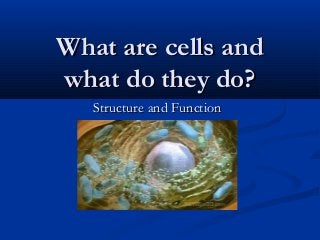
What are cellsandWhat are cells and
what do they do?what do they do?
Structure and FunctionStructure and Function
2.
KWLKWL
What I KnowWhatI Know What I Want toWhat I Want to
KnowKnow
What I LearnedWhat I Learned
1.1. 1.1. 1.1.
2.2. 2.2. 2.2.
3.3. 3.3. 3.3.
4.4. 4.4. 4.4.
5.5. 5.5. 5.5.
3.
VocabularyVocabulary
1.1. CellCell-the basicunit of structure and function of-the basic unit of structure and function of
al living thingsal living things
2.2. CellCell MembraneMembrane-thin covering enclosing the-thin covering enclosing the
cellcell
3.3. NucleusNucleus-the central part of most cells and-the central part of most cells and
determines most of cells’ functionsdetermines most of cells’ functions
4.4. CytoplasmCytoplasm-jelly-like substance containing-jelly-like substance containing
many chemicals to keep cell alivemany chemicals to keep cell alive
4.
Vocabulary continuedVocabulary continued
5.5.DiffusionDiffusion-process by which particles move from-process by which particles move from
higher concentration to lower concentrationhigher concentration to lower concentration
6.6. OsmosisOsmosis-the moved of water and dissolved materials-the moved of water and dissolved materials
through the cell membranethrough the cell membrane
7.7. TissueTissue-cells that work together to perform s specific-cells that work together to perform s specific
funcitonfunciton
8.8. OrganOrgan-tissues that work together to perform a-tissues that work together to perform a
specific functionspecific function
9.9. SystemSystem-organs that work together to perform a-organs that work together to perform a
specific functionspecific function
The Cell TheoryTheCell Theory
1.1. Cells are the basic units of lifeCells are the basic units of life
2.2. All organisms are composed of one of moreAll organisms are composed of one of more
cellscells
3.3. Cells arise from preexisting cellsCells arise from preexisting cells
Separate your paper into three equal partsSeparate your paper into three equal parts
Illustrated each part of the cell theoryIllustrated each part of the cell theory


![Vibe Coding vs. Spec-Driven Development [Free Meetup]](https://cdn.slidesharecdn.com/ss_thumbnails/vibecodingvsspecdrivendevelopment-251209105622-43f455e7-thumbnail.jpg?width=640&height=640&fit=bounds)


