Team Cohesion and Embedding Sailer, July 2014
Team Cohesion and Embedding – A Comparative
Analysis of Spatial and Organisational Parameters
Dr Kerstin Sailer
Bartlett School of Graduate Studies, University College London, UK
1st European Conference on Social Networks EUSN, 1-4 July 2014
@kerstinsailer
Team Cohesion and Embedding Sailer, July 2014
Introduction
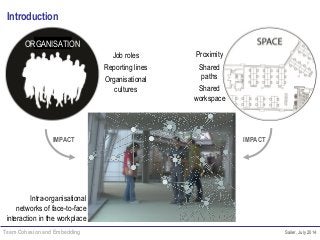
ORGANISATION
Intra-organisational
networks of face-to-face
interaction in the workplace
Proximity
Shared
paths
Shared
workspace
Job roles
Reporting lines
Organisational
cultures
IMPACT IMPACT
Team Cohesion and Embedding Sailer, July 2014
Introduction
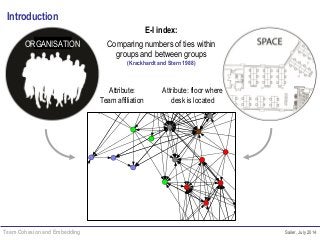
ORGANISATION
Attribute:
Team affiliation
E-I index:
Comparing numbers of ties within
groups and between groups
(Krackhardt and Stern 1988)
Attribute: floor where
desk is located
Team Cohesion and Embedding Sailer, July 2014
Introduction
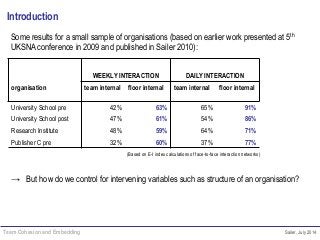
WEEKLY INTERACTION DAILY INTERACTION
organisation team internal floor internal team internal floor internal
University School pre 42% 63% 65% 91%
University School post 47% 61% 54% 86%
Research Institute 48% 59% 64% 71%
Publisher C pre 32% 60% 37% 77%
Some results for a small sample of organisations (based on earlier work presented at 5th
UKSNA conference in 2009 and published in Sailer 2010):
(Based on E-I index calculations of face-to-face interaction networks)
→ But how do we control for intervening variables such as structure of an organisation?
Team Cohesion and Embedding Sailer, July 2014
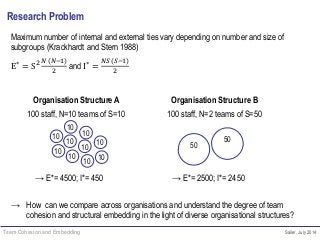
Research Problem
Organisation Structure A
100 staff, N=10 teams of S=10
50
50
10
10
10
10
10
10
10
10
10
10
Organisation Structure B
100 staff, N=2 teams of S=50
Maximum number of internal and external ties vary depending on number and size of
subgroups (Krackhardt and Stern 1988)
E∗ = S2 𝑁 (𝑁−1)
2
and I∗ =
𝑁𝑆 (𝑆−1)
2
→ E*= 4500; I*= 450 → E*= 2500; I*= 2450
→ How can we compare across organisations and understand the degree of team
cohesion and structural embedding in the light of diverse organisational structures?
Team Cohesion and Embedding Sailer, July 2014
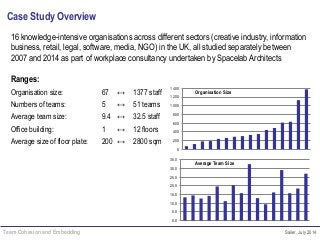
Case Study Overview
16 knowledge-intensive organisations across different sectors (creative industry, information
business, retail, legal, software, media, NGO) in the UK, all studied separately between
2007 and 2014 as part of workplace consultancy undertaken by Spacelab Architects
Ranges:
Organisation size: 67 ↔ 1377 staff
Numbers of teams: 5 ↔ 51 teams
Average team size: 9.4 ↔ 32.5 staff
Office building: 1 ↔ 12 floors
Average size of floor plate: 200 ↔ 2800 sqm
Organisation Size
Average Team Size
0
200
400
600
800
1000
1200
1400
0.0
5.0
10.0
15.0
20.0
25.0
30.0
35.0
Team Cohesion and Embedding Sailer, July 2014
Methodology
SNA:
Online survey of each organisation; survey distributed to all staff
members; return quote: 49% (lowest) to 90% (highest);
Asked each participant to name top 25 contacts and indicate
frequency of face-to-face encounter and usefulness;
Analysis of network of strong ties (daily encounter, extremely useful);
Network attributes: team affiliation, floor where desk is
Calculating E-I index, Expected E-I index, Yule’s Q
Spatial Analysis:
Anaysis of spatial configuration: calculating levels
of spatial overall closeness centrality in the office
building using Space Syntax methods
[average mean depth of all paths];
Team Cohesion and Embedding Sailer, July 2014
Results
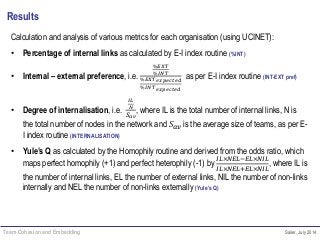
Calculation and analysis of various metrics for each organisation (using UCINET):
• Percentage of internal links as calculated by E-I index routine (%INT)
• Internal – external preference, i.e.
%𝐸𝑋𝑇
%𝐼𝑁𝑇
%𝐸𝑋𝑇 𝑒𝑥𝑝𝑒𝑐𝑡𝑒𝑑
%𝐼𝑁𝑇 𝑒𝑥𝑝𝑒𝑐𝑡𝑒𝑑
as per E-I index routine (INT-EXT pref)
• Degree of internalisation, i.e.
𝐼𝐿
𝑁
𝑆 𝑎𝑣
, where IL is the total number of internal links, N is
the total number of nodes in the network and 𝑆 𝑎𝑣 is the average size of teams, as per E-
I index routine (INTERNALISATION)
• Yule’s Q as calculated by the Homophily routine and derived from the odds ratio, which
maps perfect homophily (+1) and perfect heterophily (-1) by
𝐼𝐿×𝑁𝐸𝐿−𝐸𝐿×𝑁𝐼𝐿
𝐼𝐿×𝑁𝐸𝐿+𝐸𝐿×𝑁𝐼𝐿
, where IL is
the number of internal links, EL the number of external links, NIL the number of non-links
internally and NEL the number of non-links externally (Yule’s Q)
Team Cohesion and Embedding Sailer, July 2014
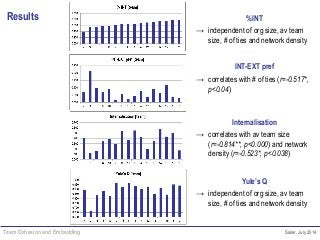
Results
→ independent of org size, av team
size, # of ties and network density
→ independent of org size, av team
size, # of ties and network density
→ correlates with # of ties (r=-0.517*,
p<0.04)
→ correlates with av team size
(r=-0.814**, p<0.000) and network
density (r=-0.523*, p<0.038)
%INT
INT-EXT pref
Internalisation
Yule’s Q
Team Cohesion and Embedding Sailer, July 2014
Results
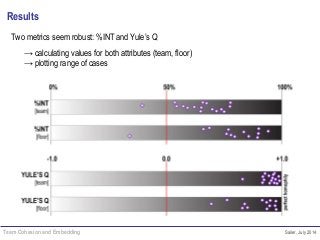
Two metrics seem robust: %INT and Yule’s Q
→ calculating values for both attributes (team, floor)
→ plotting range of cases
Team Cohesion and Embedding Sailer, July 2014
Results – Analysing
single cases
CASE 7
Post prod
house
BENCHMARK
all org.
CASE 9
large retail
organisation
Percentage of internal ties
[%INT]: depicts patterns of
interaction and degree to which
they span team boundaries and
reach across floors
Yule’s Q [team]: depicts degree
of organisational structure as a
barrier
Yule’s Q [floor]: depicts degree of
spatial structure as a barrier
Team Cohesion and Embedding Sailer, July 2014
Results – Exploring the Impact of Spatial Structure
Correlation between Yule’s Q [team] and Average Mean Depth
(r=0.624*, p<0.017) (if outlier case 3 is excluded)
0.820
0.840
0.860
0.880
0.900
0.920
0.940
0.960
0.980
1.000
0.000 2.000 4.000 6.000 8.000 10.000
Yule'sQ[team]
Average MD
Case14–Strategicvisibilityinoffice(closenesscentrality)
→ Offices with higher levels of overall visibility tend to
host more heterophilous interactions, i.e. allow more
interactions between colleagues of different teams
Integrated Segregated
Team Cohesion and Embedding Sailer, July 2014
Outlook
Investigated a large-ish sample of organisations in order to compare across cases and
develop a benchmark of interaction patterns in intra-organisational networks
Important to understand and map ranges of phenomena
Useful in consulting organisations and applying research knowledge in real life examples
Provided a first sketch of a way to benchmark interaction patterns, team cohesion and
embedding across different organisations of different sizes and different structures
Highlighted the impact of organisational structures and spatial structure in shaping
interaction patterns
“The spatial dimension of our lives has
never been of greater practical and political
relevance than it is today.”
(Edward Soja, 1996: 1)
Team Cohesion and Embedding Sailer, July 2014
Dr Kerstin Sailer
Lecturer in Complex Buildings
Bartlett School of Graduate Studies
University College London
132 Hampstead Road
London NW1 2BX
United Kingdom
Thank you!
k.sailer@ucl.ac.uk
@kerstinsailer
http://spaceandorganisation.wordpress.com/
http://tinyurl.com/UCL-KS

Spatial and organisatinonal parameters in social network structures of teams

  • 1.
    Team Cohesion andEmbedding Sailer, July 2014 Team Cohesion and Embedding – A Comparative Analysis of Spatial and Organisational Parameters Dr Kerstin Sailer Bartlett School of Graduate Studies, University College London, UK 1st European Conference on Social Networks EUSN, 1-4 July 2014 @kerstinsailer
  • 2.
    Team Cohesion andEmbedding Sailer, July 2014 Introduction ORGANISATION Intra-organisational networks of face-to-face interaction in the workplace Proximity Shared paths Shared workspace Job roles Reporting lines Organisational cultures IMPACT IMPACT
  • 3.
    Team Cohesion andEmbedding Sailer, July 2014 Introduction ORGANISATION Attribute: Team affiliation E-I index: Comparing numbers of ties within groups and between groups (Krackhardt and Stern 1988) Attribute: floor where desk is located
  • 4.
    Team Cohesion andEmbedding Sailer, July 2014 Introduction WEEKLY INTERACTION DAILY INTERACTION organisation team internal floor internal team internal floor internal University School pre 42% 63% 65% 91% University School post 47% 61% 54% 86% Research Institute 48% 59% 64% 71% Publisher C pre 32% 60% 37% 77% Some results for a small sample of organisations (based on earlier work presented at 5th UKSNA conference in 2009 and published in Sailer 2010): (Based on E-I index calculations of face-to-face interaction networks) → But how do we control for intervening variables such as structure of an organisation?
  • 5.
    Team Cohesion andEmbedding Sailer, July 2014 Research Problem Organisation Structure A 100 staff, N=10 teams of S=10 50 50 10 10 10 10 10 10 10 10 10 10 Organisation Structure B 100 staff, N=2 teams of S=50 Maximum number of internal and external ties vary depending on number and size of subgroups (Krackhardt and Stern 1988) E∗ = S2 𝑁 (𝑁−1) 2 and I∗ = 𝑁𝑆 (𝑆−1) 2 → E*= 4500; I*= 450 → E*= 2500; I*= 2450 → How can we compare across organisations and understand the degree of team cohesion and structural embedding in the light of diverse organisational structures?
  • 6.
    Team Cohesion andEmbedding Sailer, July 2014 Case Study Overview 16 knowledge-intensive organisations across different sectors (creative industry, information business, retail, legal, software, media, NGO) in the UK, all studied separately between 2007 and 2014 as part of workplace consultancy undertaken by Spacelab Architects Ranges: Organisation size: 67 ↔ 1377 staff Numbers of teams: 5 ↔ 51 teams Average team size: 9.4 ↔ 32.5 staff Office building: 1 ↔ 12 floors Average size of floor plate: 200 ↔ 2800 sqm Organisation Size Average Team Size 0 200 400 600 800 1000 1200 1400 0.0 5.0 10.0 15.0 20.0 25.0 30.0 35.0
  • 7.
    Team Cohesion andEmbedding Sailer, July 2014 Methodology SNA: Online survey of each organisation; survey distributed to all staff members; return quote: 49% (lowest) to 90% (highest); Asked each participant to name top 25 contacts and indicate frequency of face-to-face encounter and usefulness; Analysis of network of strong ties (daily encounter, extremely useful); Network attributes: team affiliation, floor where desk is Calculating E-I index, Expected E-I index, Yule’s Q Spatial Analysis: Anaysis of spatial configuration: calculating levels of spatial overall closeness centrality in the office building using Space Syntax methods [average mean depth of all paths];
  • 8.
    Team Cohesion andEmbedding Sailer, July 2014 Results Calculation and analysis of various metrics for each organisation (using UCINET): • Percentage of internal links as calculated by E-I index routine (%INT) • Internal – external preference, i.e. %𝐸𝑋𝑇 %𝐼𝑁𝑇 %𝐸𝑋𝑇 𝑒𝑥𝑝𝑒𝑐𝑡𝑒𝑑 %𝐼𝑁𝑇 𝑒𝑥𝑝𝑒𝑐𝑡𝑒𝑑 as per E-I index routine (INT-EXT pref) • Degree of internalisation, i.e. 𝐼𝐿 𝑁 𝑆 𝑎𝑣 , where IL is the total number of internal links, N is the total number of nodes in the network and 𝑆 𝑎𝑣 is the average size of teams, as per E- I index routine (INTERNALISATION) • Yule’s Q as calculated by the Homophily routine and derived from the odds ratio, which maps perfect homophily (+1) and perfect heterophily (-1) by 𝐼𝐿×𝑁𝐸𝐿−𝐸𝐿×𝑁𝐼𝐿 𝐼𝐿×𝑁𝐸𝐿+𝐸𝐿×𝑁𝐼𝐿 , where IL is the number of internal links, EL the number of external links, NIL the number of non-links internally and NEL the number of non-links externally (Yule’s Q)
  • 9.
    Team Cohesion andEmbedding Sailer, July 2014 Results → independent of org size, av team size, # of ties and network density → independent of org size, av team size, # of ties and network density → correlates with # of ties (r=-0.517*, p<0.04) → correlates with av team size (r=-0.814**, p<0.000) and network density (r=-0.523*, p<0.038) %INT INT-EXT pref Internalisation Yule’s Q
  • 10.
    Team Cohesion andEmbedding Sailer, July 2014 Results Two metrics seem robust: %INT and Yule’s Q → calculating values for both attributes (team, floor) → plotting range of cases
  • 11.
    Team Cohesion andEmbedding Sailer, July 2014 Results – Analysing single cases CASE 7 Post prod house BENCHMARK all org. CASE 9 large retail organisation Percentage of internal ties [%INT]: depicts patterns of interaction and degree to which they span team boundaries and reach across floors Yule’s Q [team]: depicts degree of organisational structure as a barrier Yule’s Q [floor]: depicts degree of spatial structure as a barrier
  • 12.
    Team Cohesion andEmbedding Sailer, July 2014 Results – Exploring the Impact of Spatial Structure Correlation between Yule’s Q [team] and Average Mean Depth (r=0.624*, p<0.017) (if outlier case 3 is excluded) 0.820 0.840 0.860 0.880 0.900 0.920 0.940 0.960 0.980 1.000 0.000 2.000 4.000 6.000 8.000 10.000 Yule'sQ[team] Average MD Case14–Strategicvisibilityinoffice(closenesscentrality) → Offices with higher levels of overall visibility tend to host more heterophilous interactions, i.e. allow more interactions between colleagues of different teams Integrated Segregated
  • 13.
    Team Cohesion andEmbedding Sailer, July 2014 Outlook Investigated a large-ish sample of organisations in order to compare across cases and develop a benchmark of interaction patterns in intra-organisational networks Important to understand and map ranges of phenomena Useful in consulting organisations and applying research knowledge in real life examples Provided a first sketch of a way to benchmark interaction patterns, team cohesion and embedding across different organisations of different sizes and different structures Highlighted the impact of organisational structures and spatial structure in shaping interaction patterns “The spatial dimension of our lives has never been of greater practical and political relevance than it is today.” (Edward Soja, 1996: 1)
  • 14.
    Team Cohesion andEmbedding Sailer, July 2014 Dr Kerstin Sailer Lecturer in Complex Buildings Bartlett School of Graduate Studies University College London 132 Hampstead Road London NW1 2BX United Kingdom Thank you! k.sailer@ucl.ac.uk @kerstinsailer http://spaceandorganisation.wordpress.com/ http://tinyurl.com/UCL-KS