
CycleStreets.net
UK-wide bicycle
journey planner & photomap
                               Martin Lucas-Smith
For Cyclists, By Cyclists    www.CycleStreets.net
                                   @CycleStreets
CycleStreets
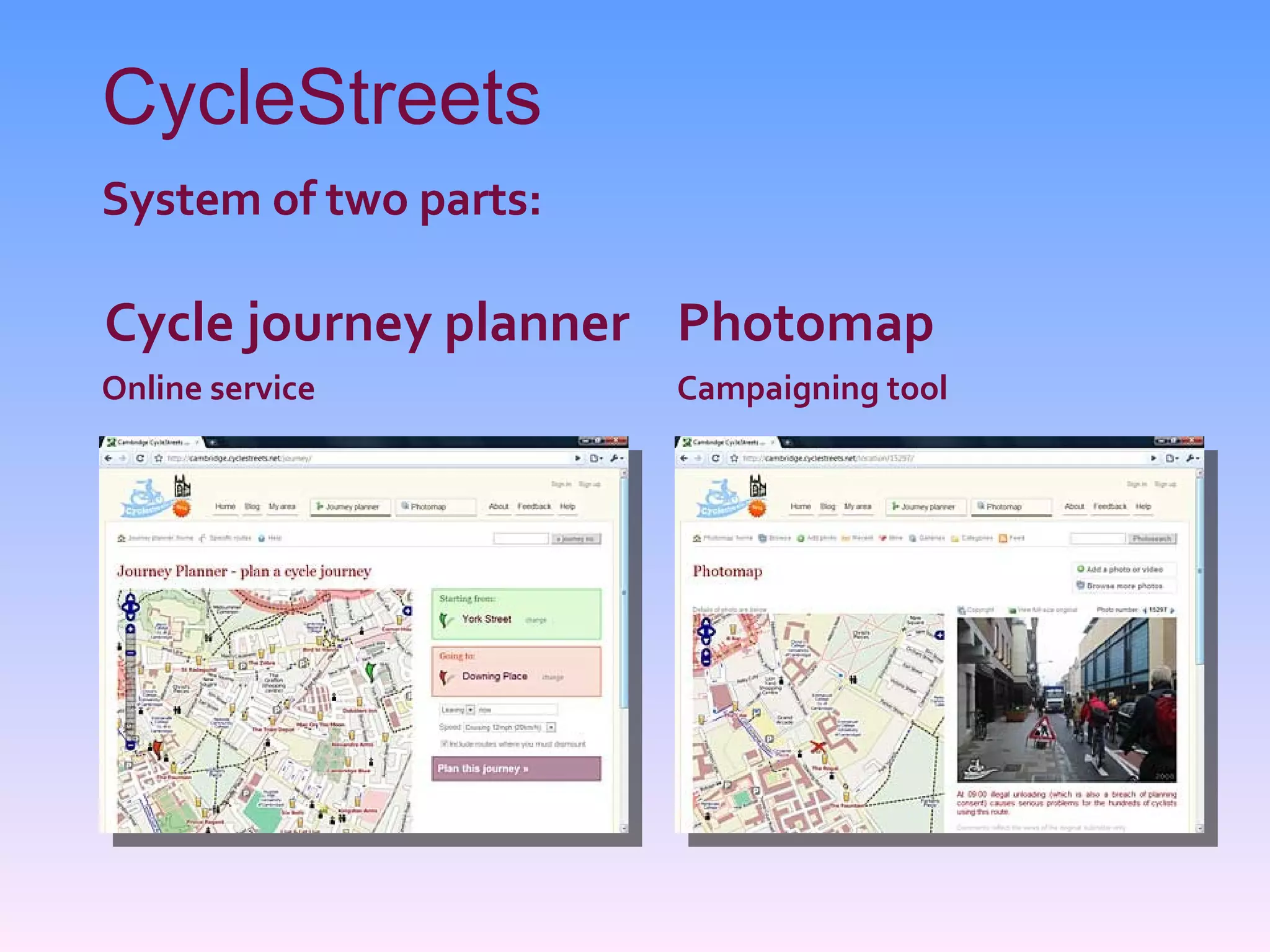
System of two parts:

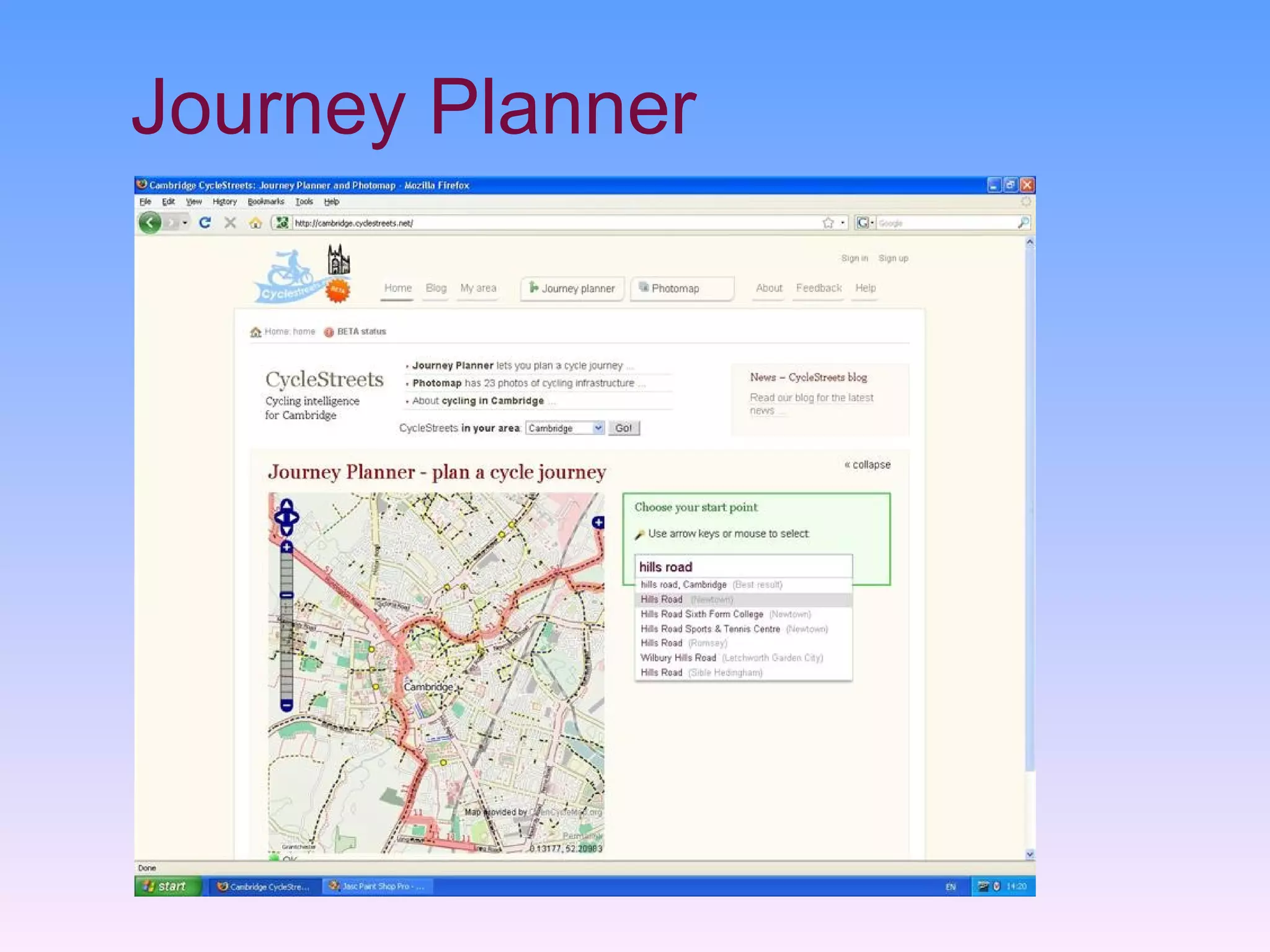
Cycle journey planner Photomap
Online service         Campaigning tool
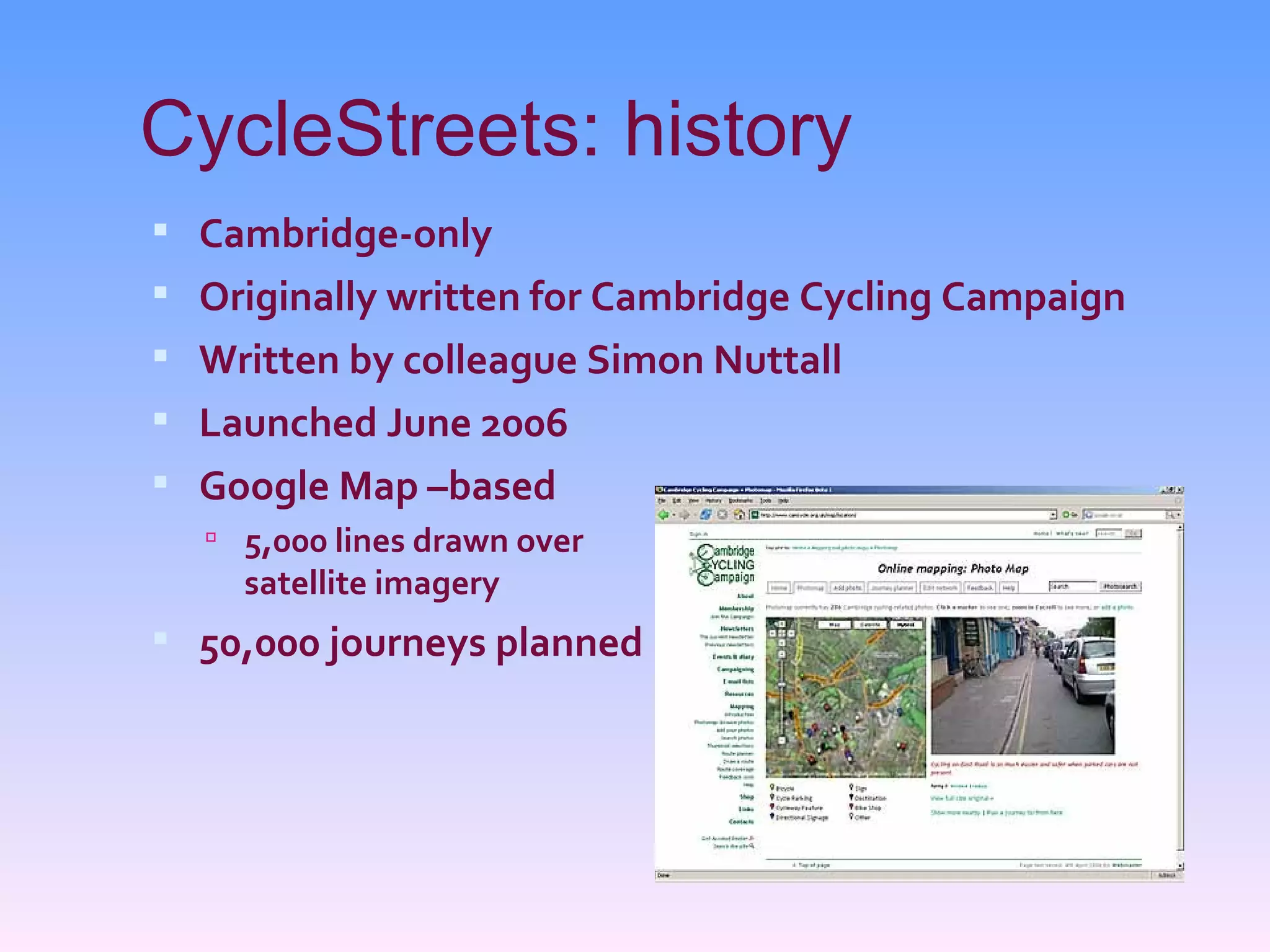
CycleStreets: history
 Cambridge-only
 Originally written for Cambridge Cycling Campaign
 Written by colleague Simon Nuttall
 Launched June 2006
 Google Map –based
   5,000 lines drawn over
    satellite imagery
 50,000 journeys planned
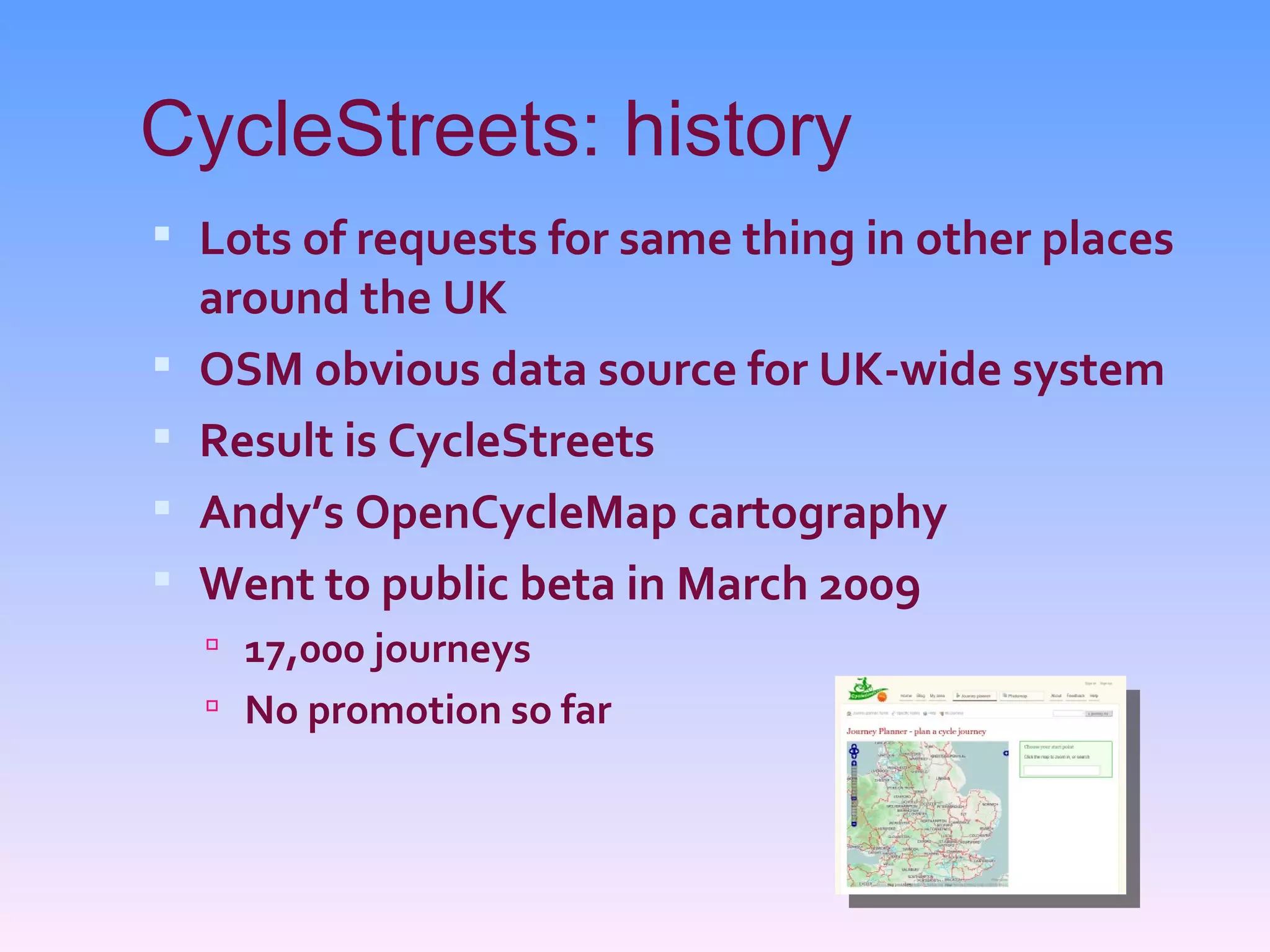
CycleStreets: history
 Lots of requests for same thing in other places
    around the UK
   OSM obvious data source for UK-wide system
   Result is CycleStreets
   Andy’s OpenCycleMap cartography
   Went to public beta in March 2009
     17,000 journeys
     No promotion so far
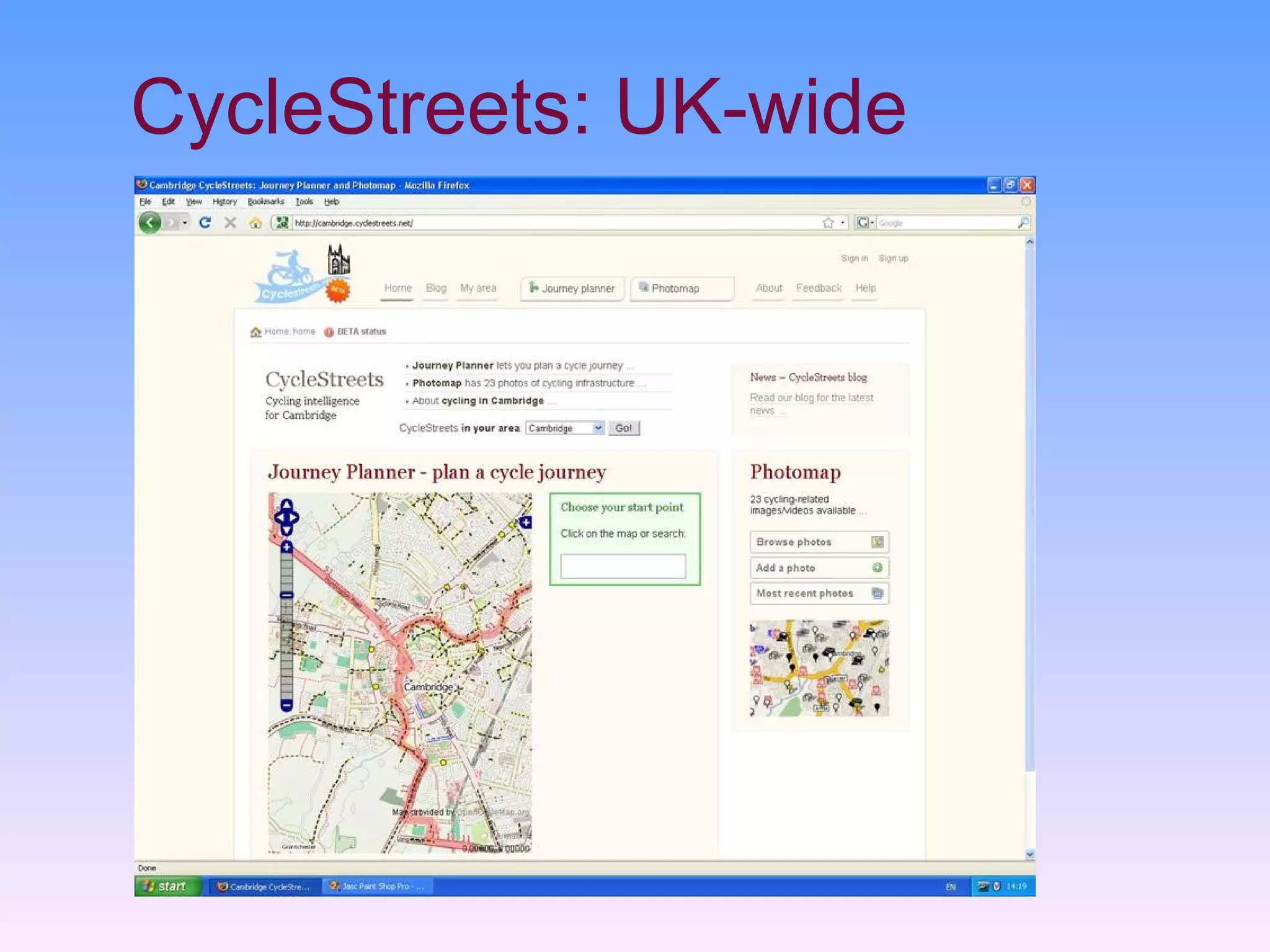
CycleStreets: UK-wide
Journey Planner
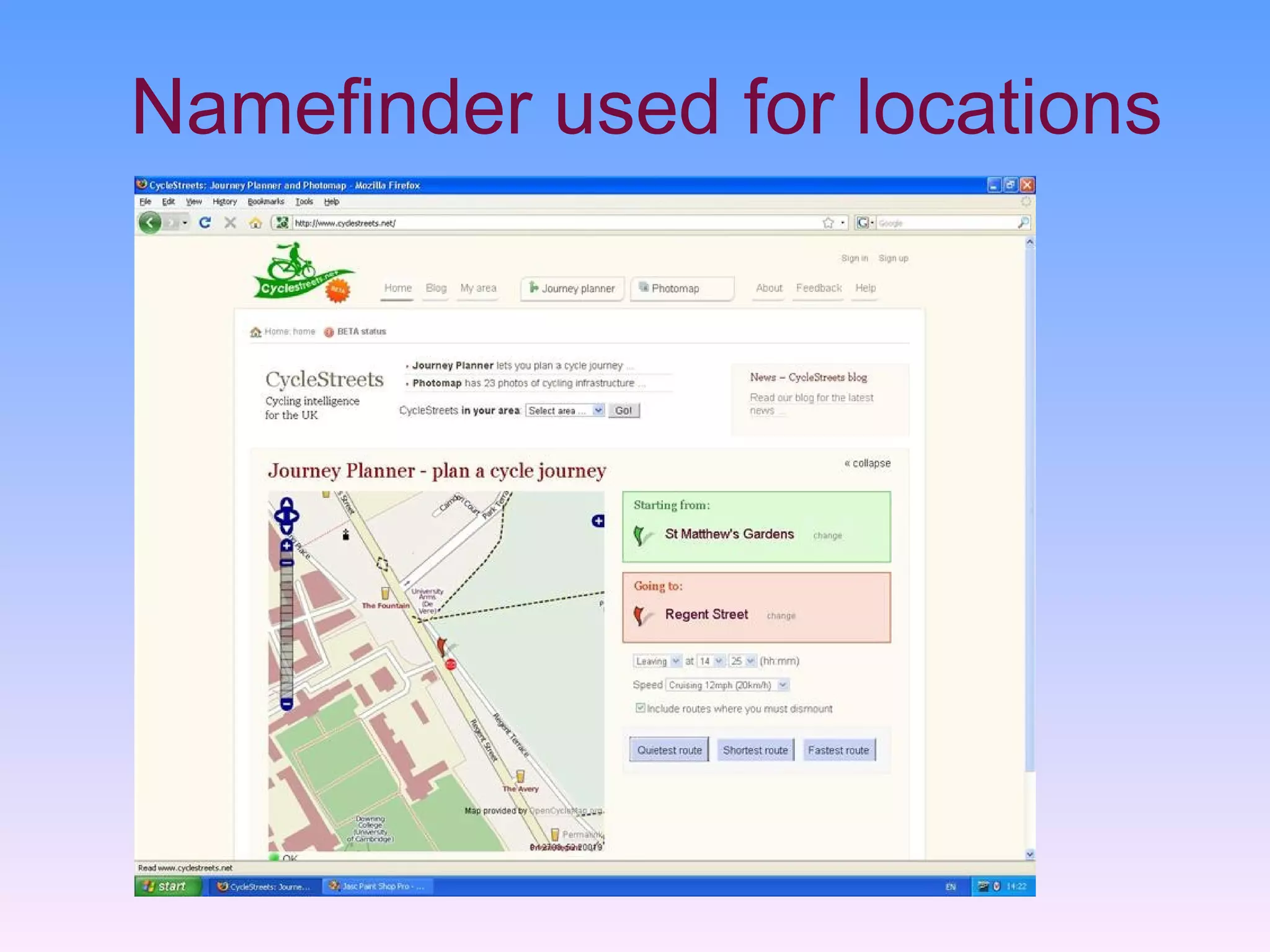
Namefinder used for locations
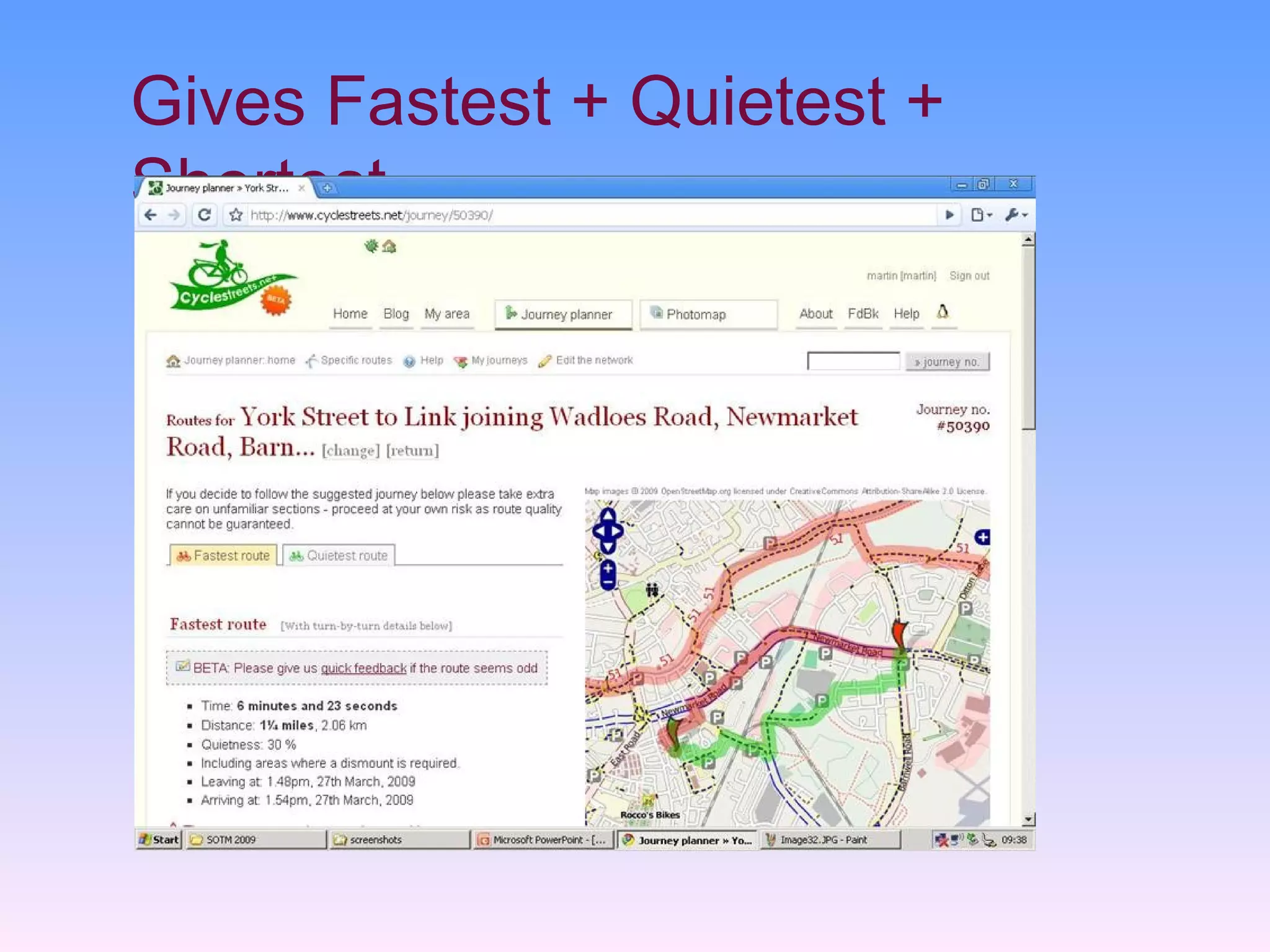
Gives Fastest + Quietest +
Shortest
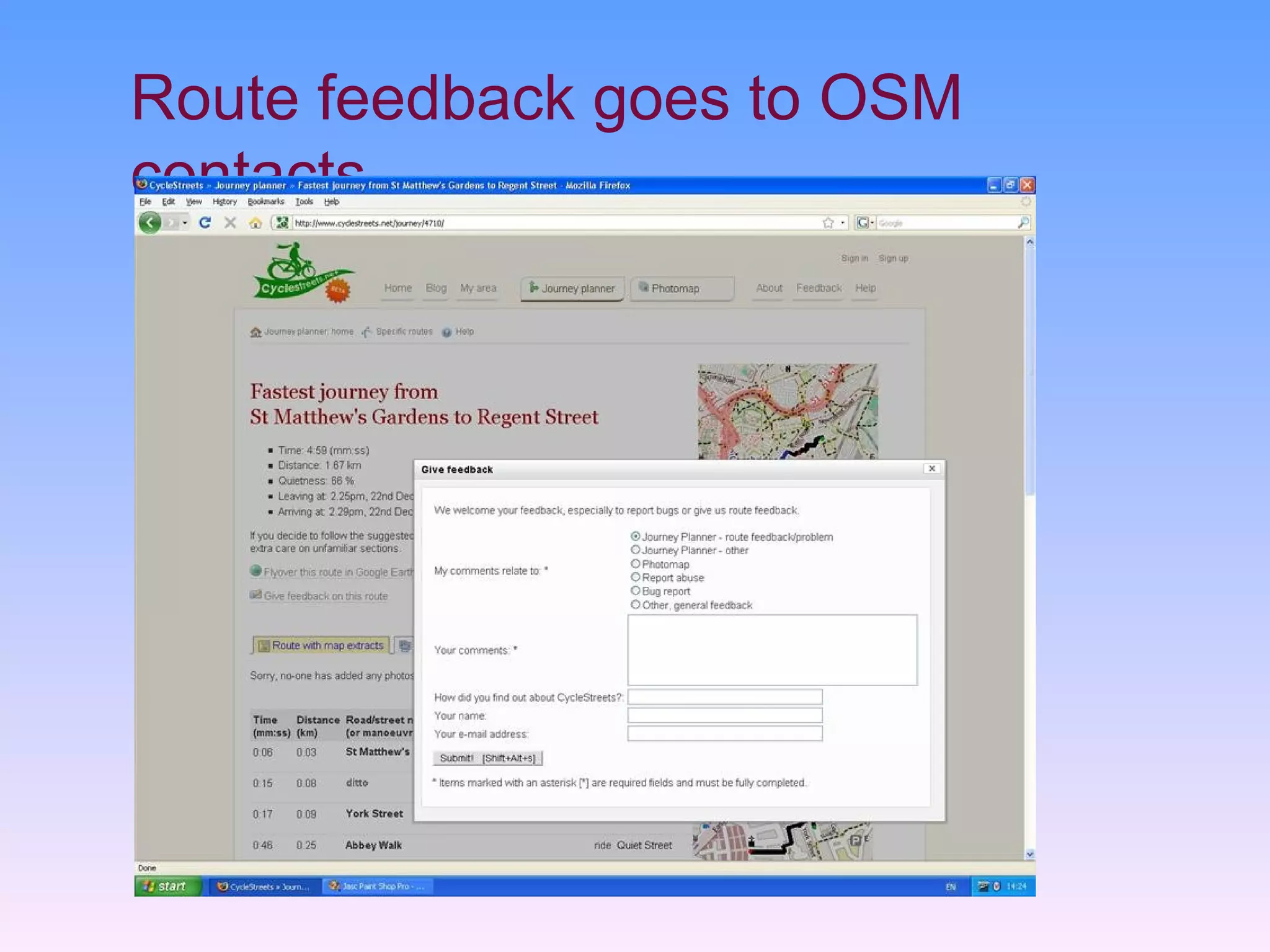
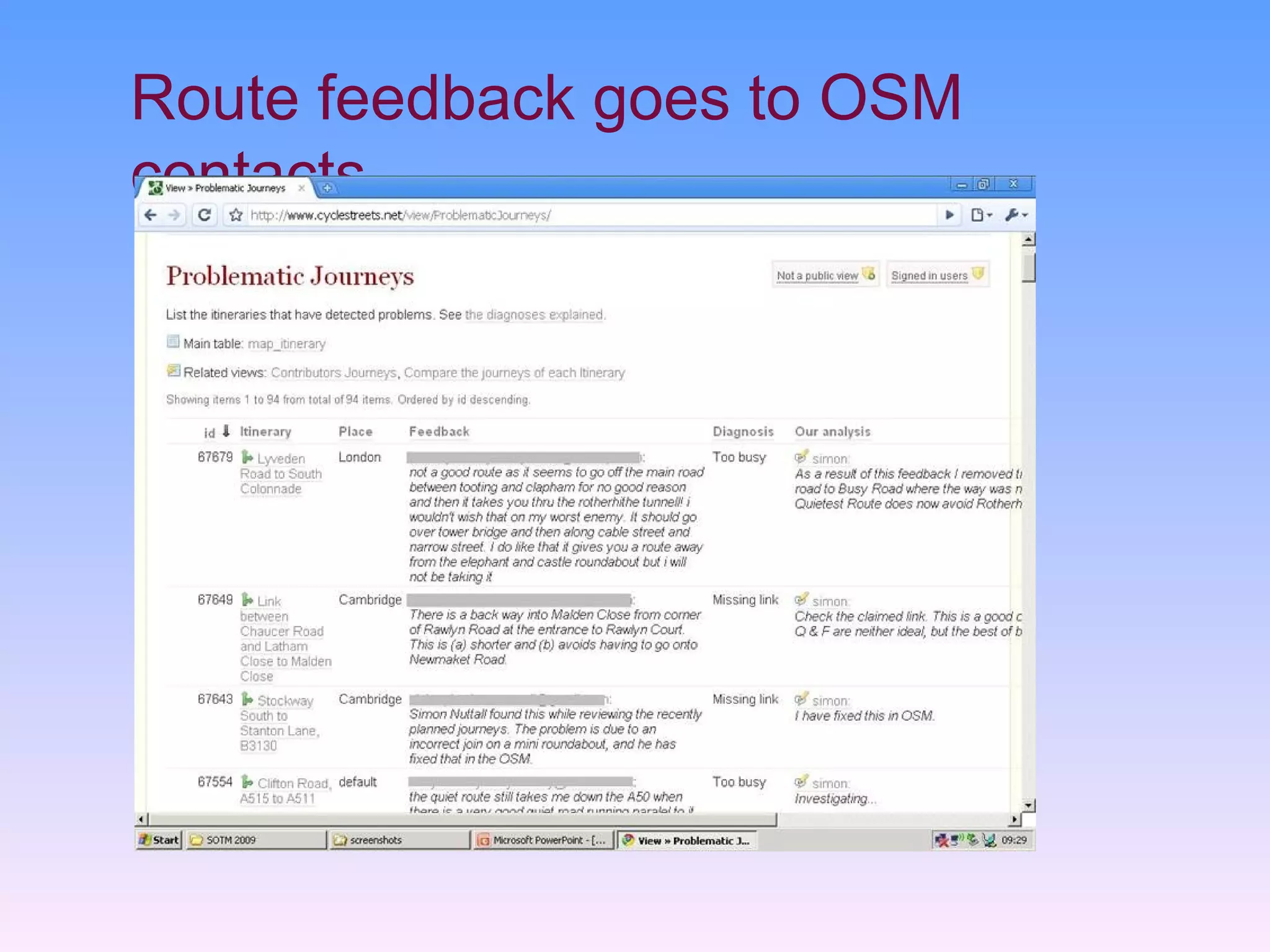
Route feedback goes to OSM
contacts
Route feedback goes to OSM
contacts
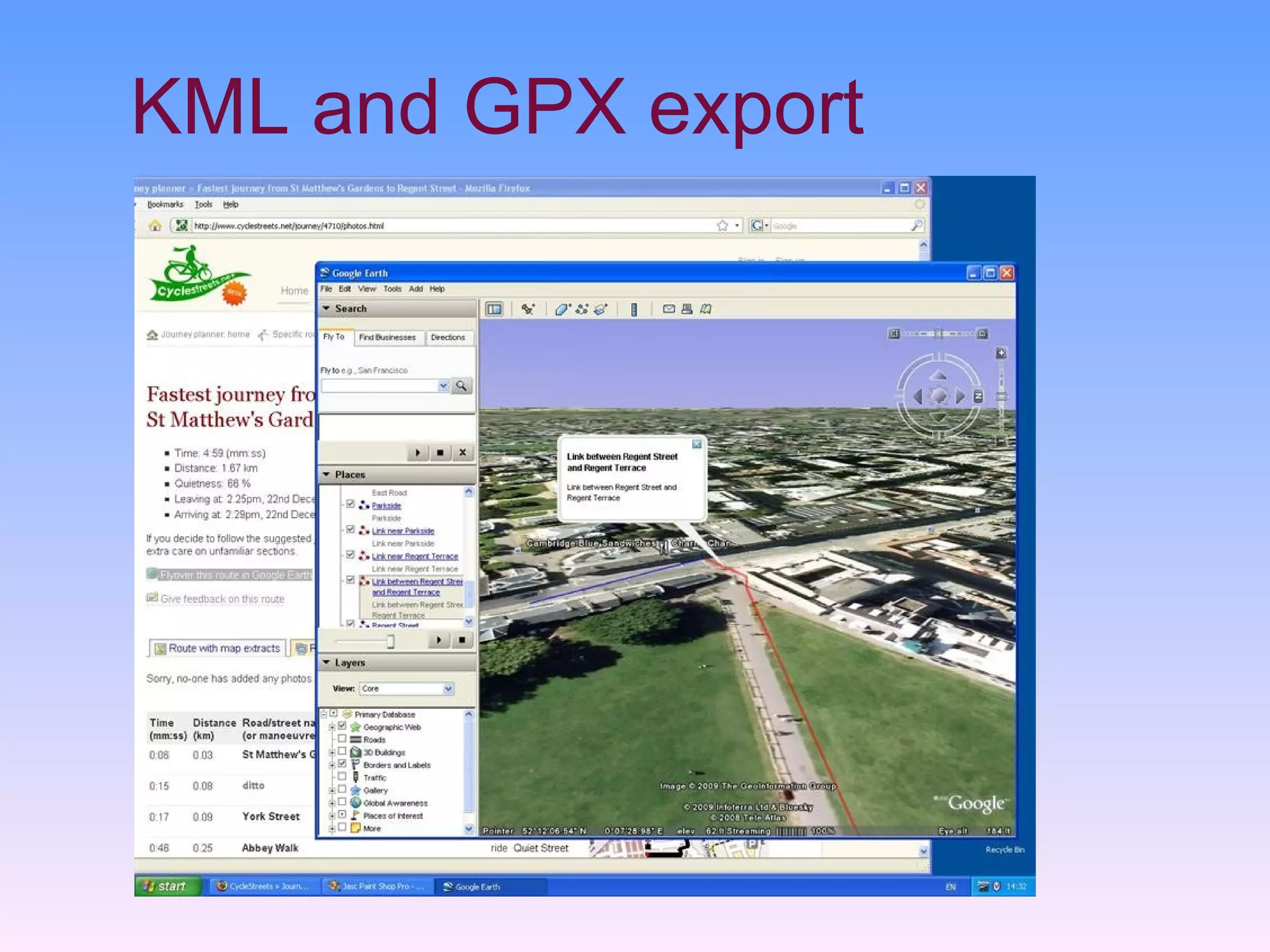
KML and GPX export
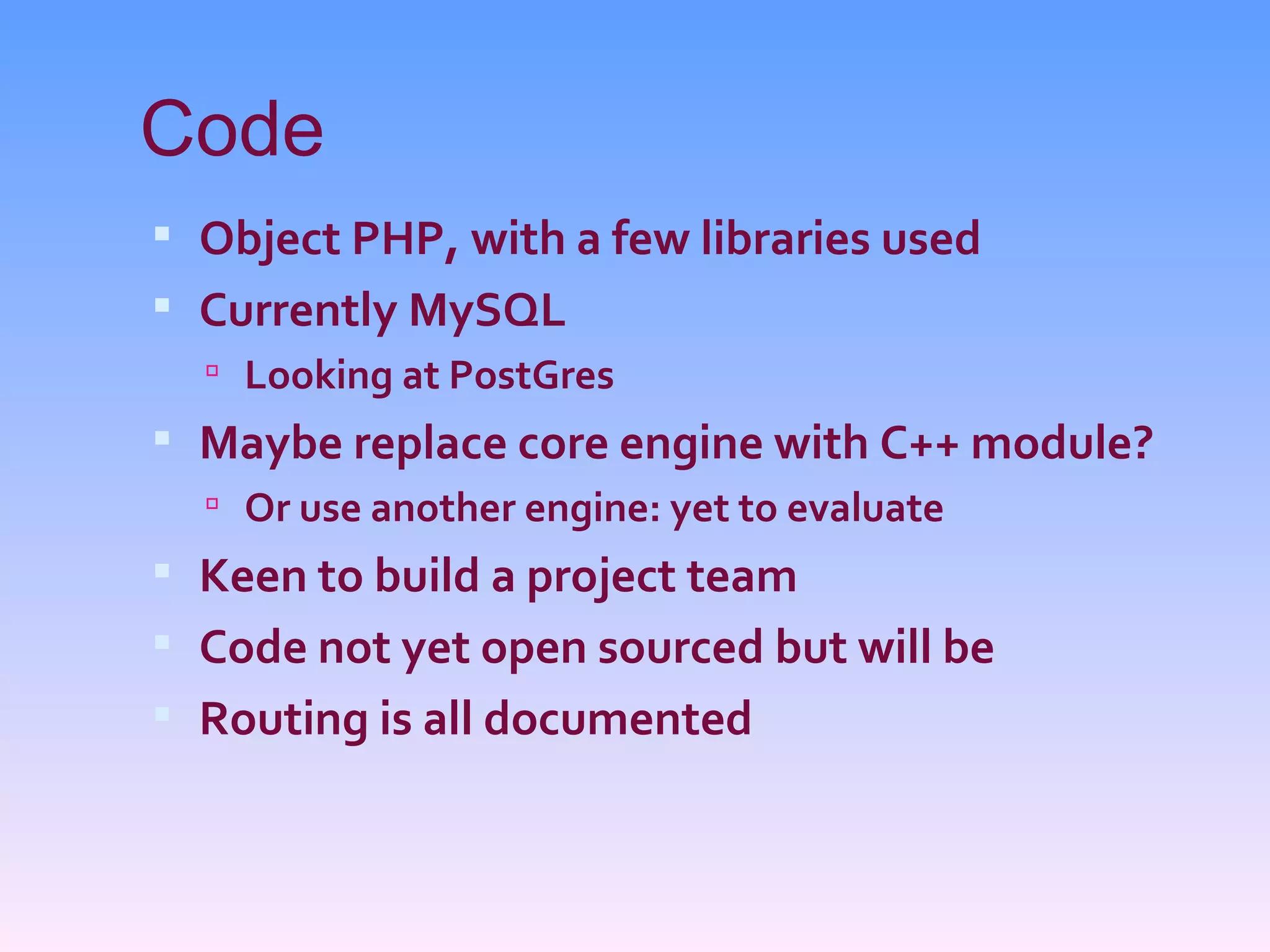
Code
 Object PHP, with a few libraries used
 Currently MySQL
   Looking at PostGres
 Maybe replace core engine with C++ module?
   Or use another engine: yet to evaluate
 Keen to build a project team
 Code not yet open sourced but will be
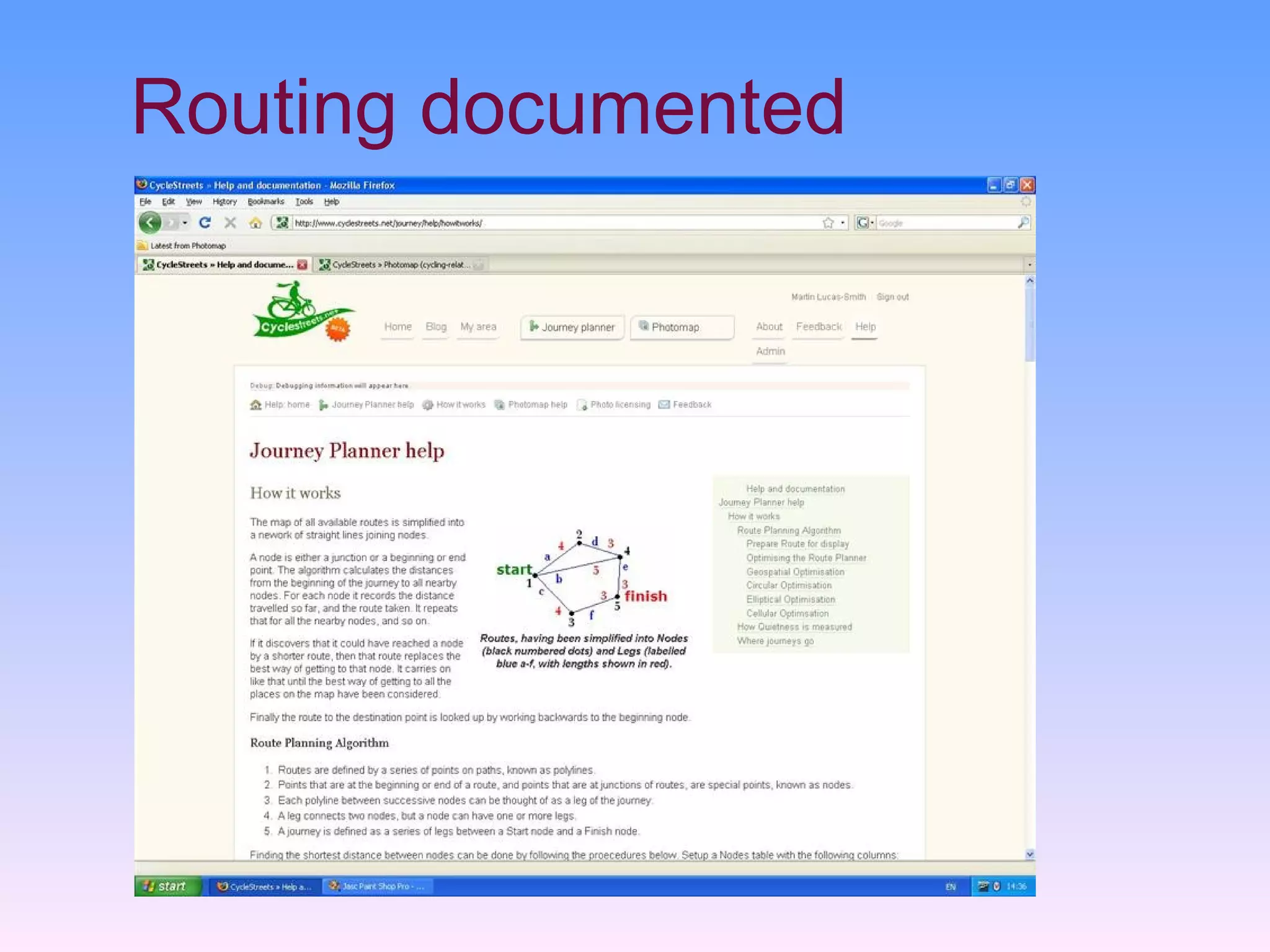
 Routing is all documented
Routing documented
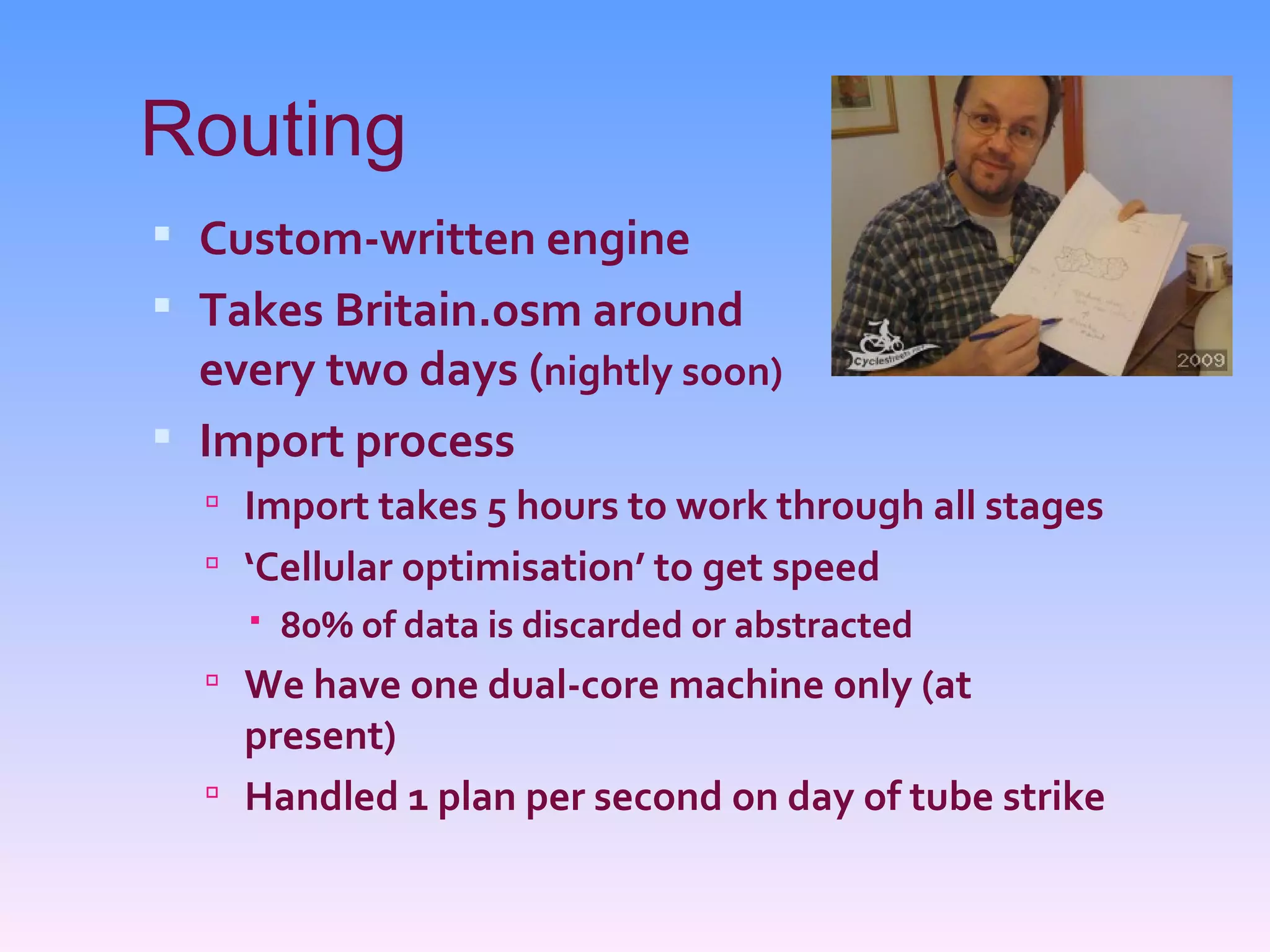
Routing
 Custom-written engine
 Takes Britain.osm around
  every two days (nightly soon)
 Import process
   Import takes 5 hours to work through all stages
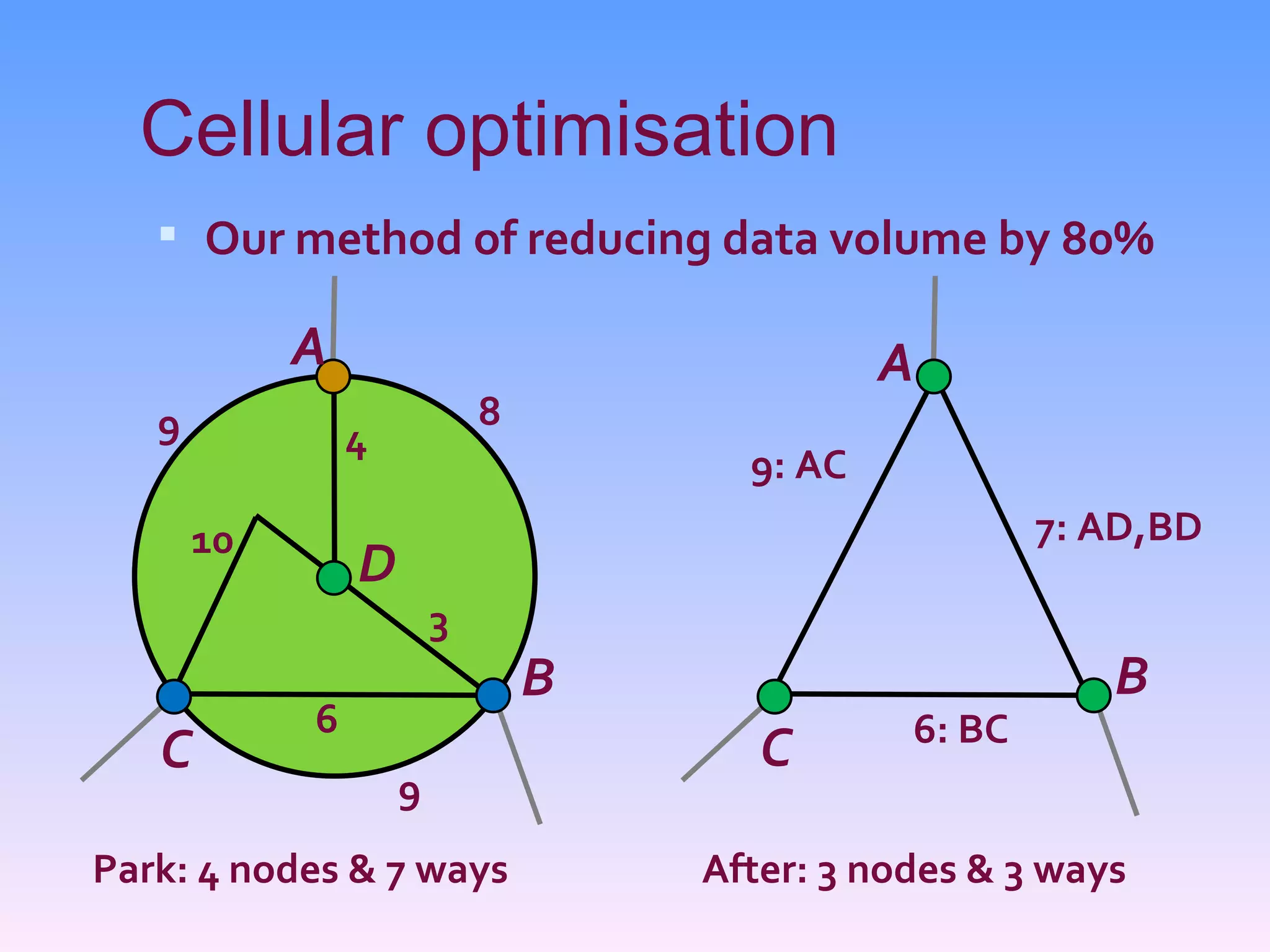
   ‘Cellular optimisation’ to get speed
     80% of data is discarded or abstracted
   We have one dual-core machine only (at
    present)
   Handled 1 plan per second on day of tube strike
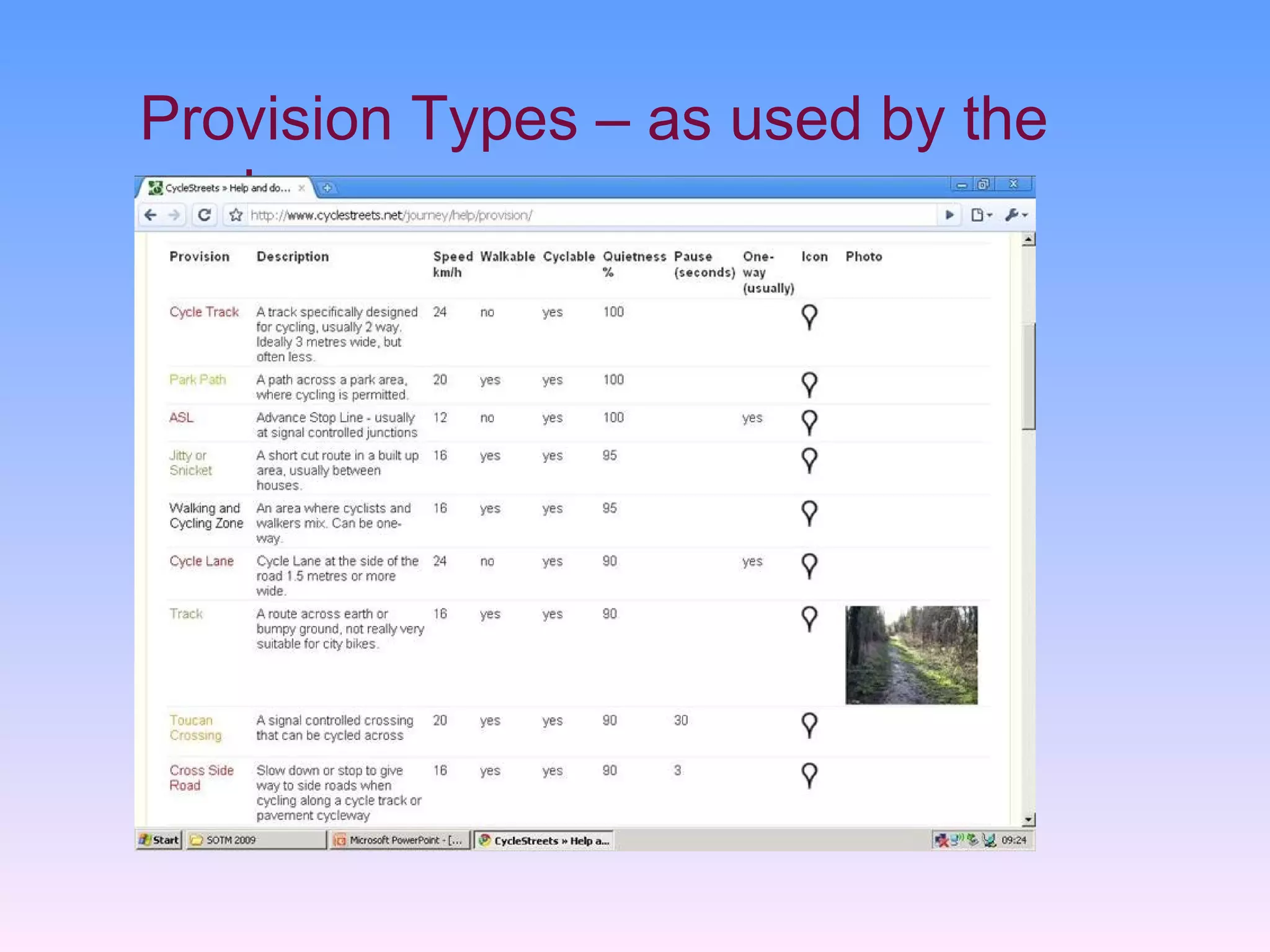
Scoring
 We collapse matrix of OSM tags into
  40 ‘Provision Types’
 Each has:
     Maximum achievable speed (tweaked subjectively)
     Quietness factor (also tweaked subjectively)
     Cycleable? (boolean)
     Walkable? (boolean)
     One-way? (boolean)
     Delay (seconds)
 These then mapped onto each line to create 6
  scores (fastest/shortest/quietest + in reverse)
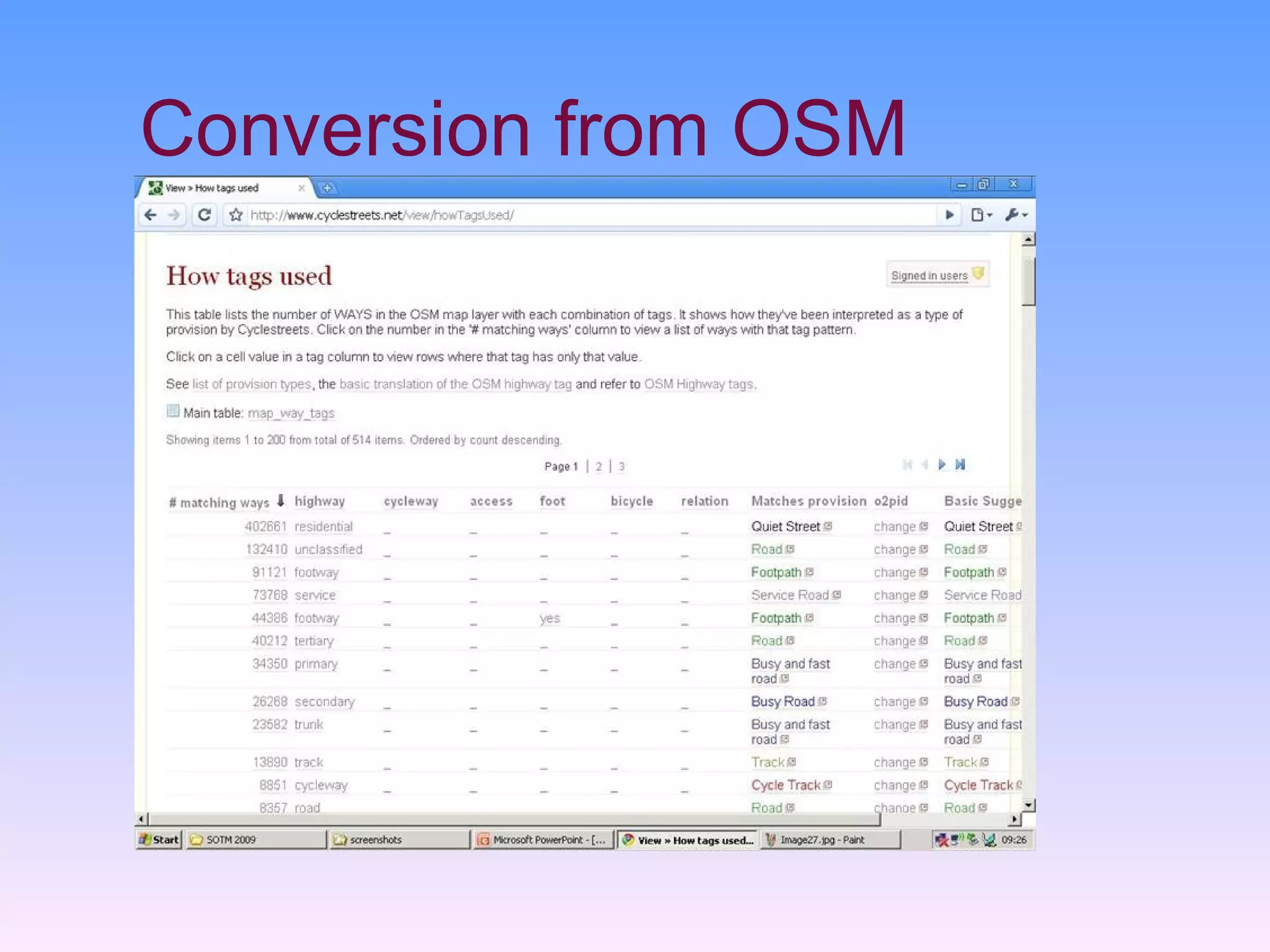
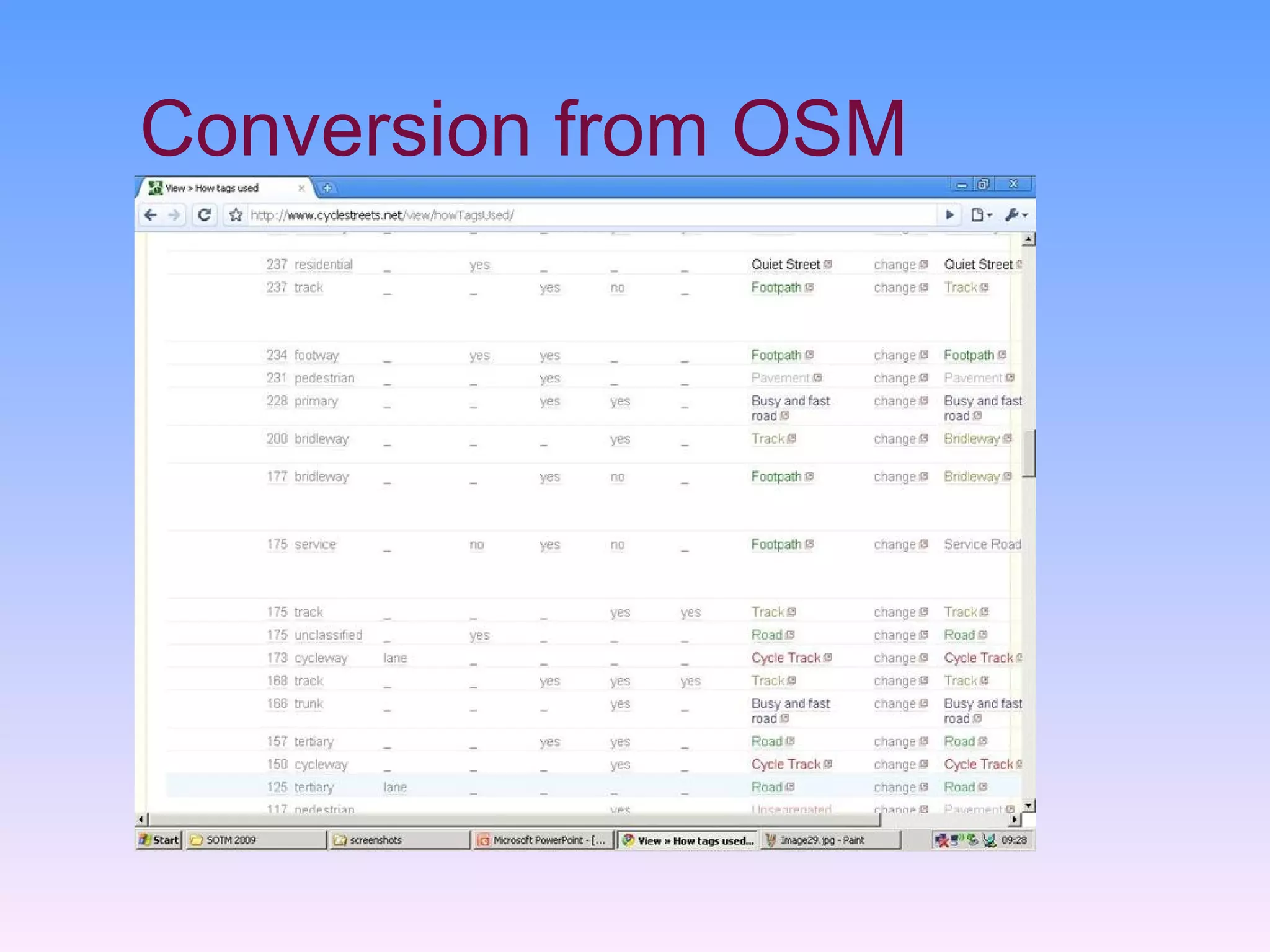
 Conversion table and Provision Types table:
Conversion from OSM
Conversion from OSM
Provision Types – as used by the
engine
Cellular optimisation
    Our method of reducing data volume by 80%

            A                                 A
   9                        8
                4
                                      9: AC
       10                                              7: AD,BD
                D
                        3
                                B                         B
            6                                  6: BC
   C                                   C
                    9
Park: 4 nodes & 7 ways              After: 3 nodes & 3 ways
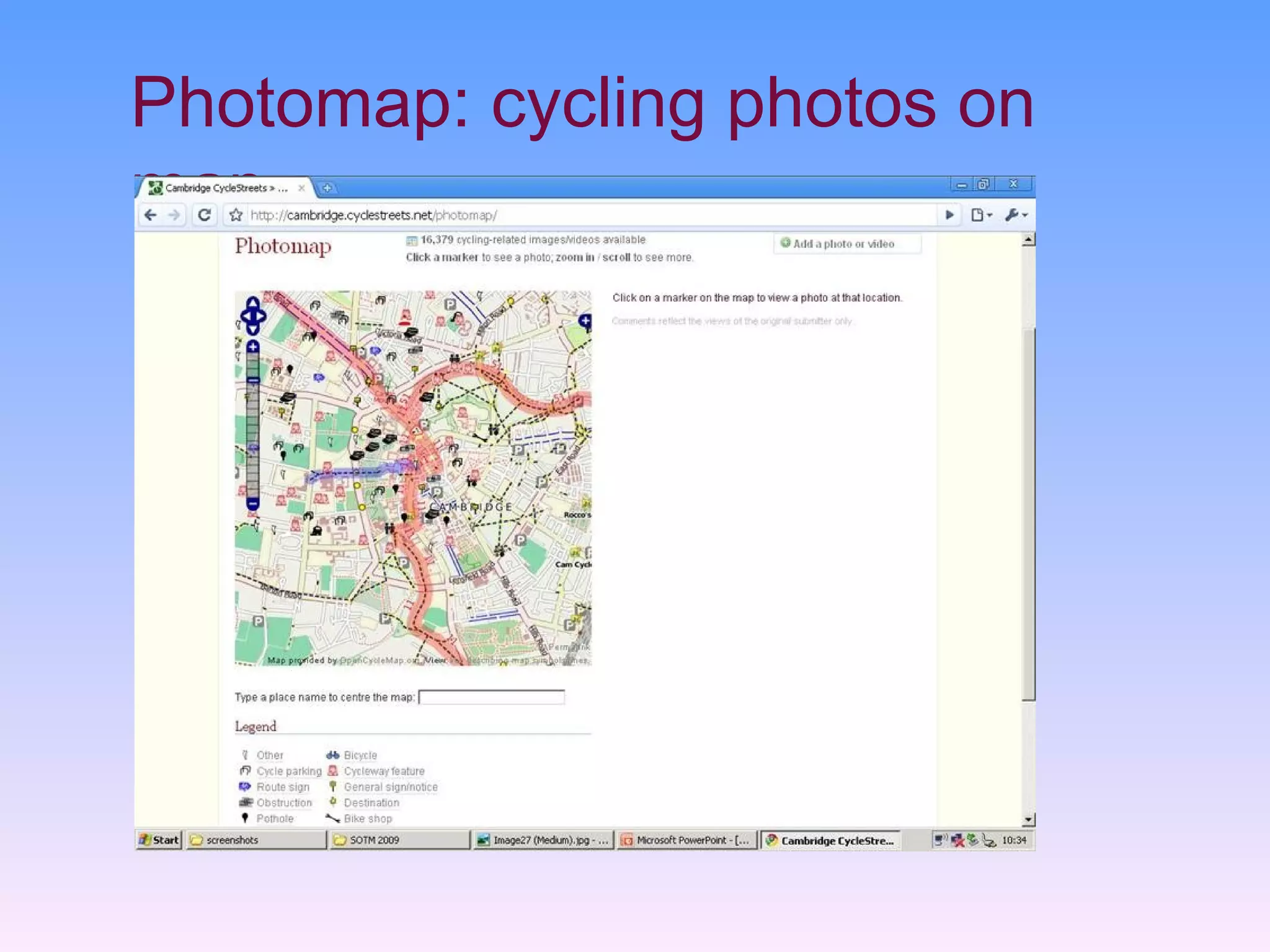
Photomap: cycling photos on
map
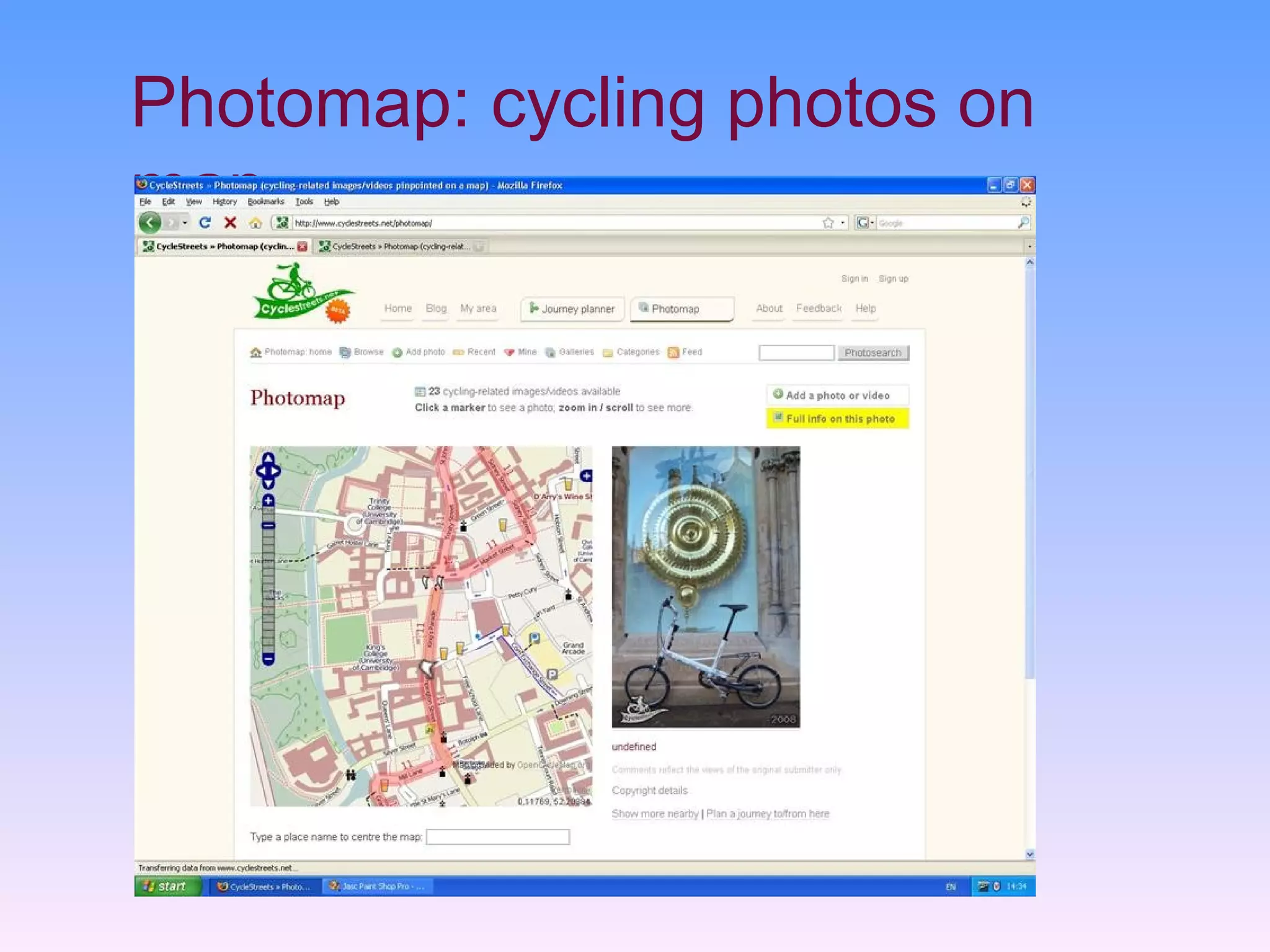
Photomap: cycling photos on
map
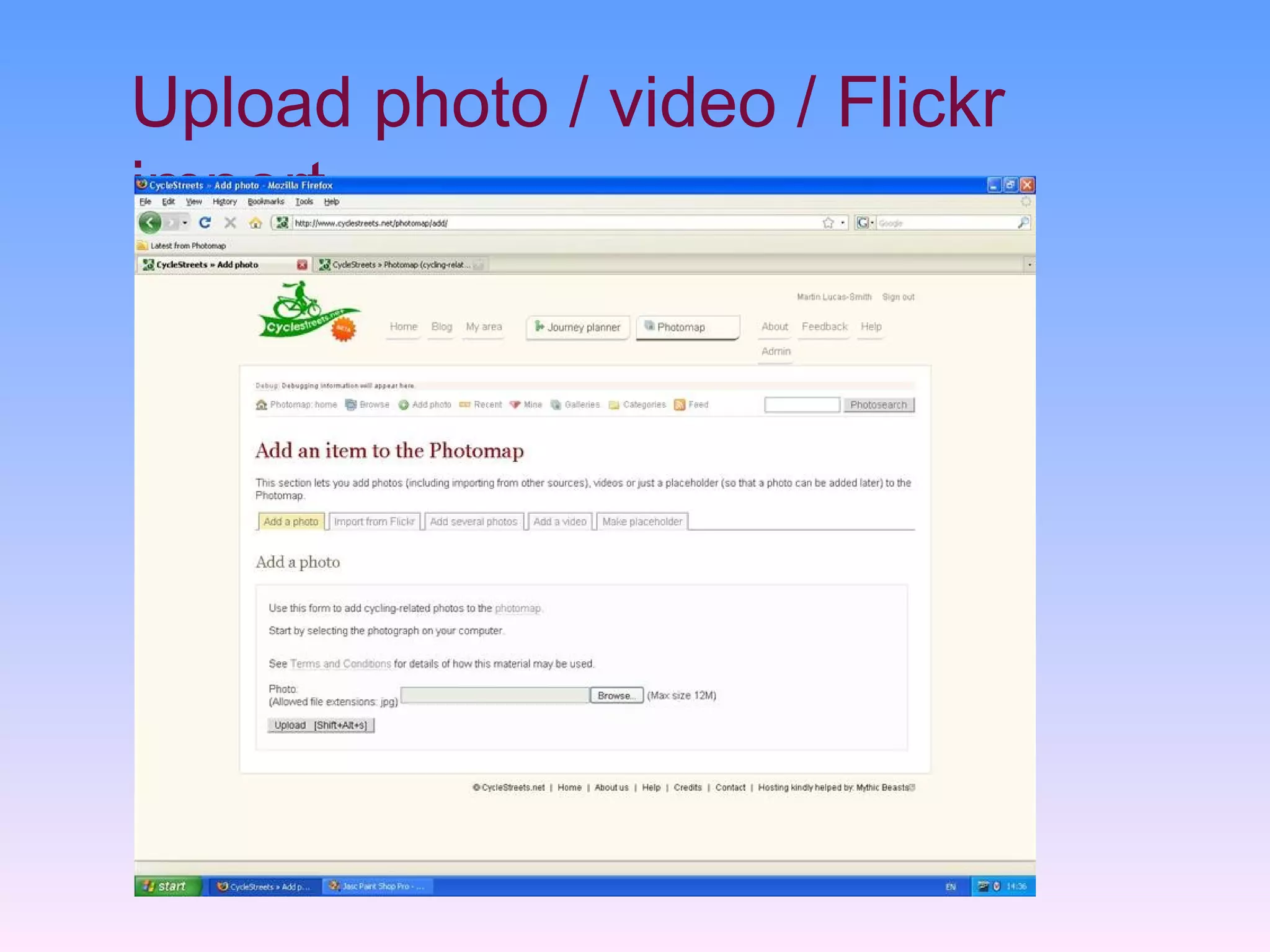
Upload photo / video / Flickr
import
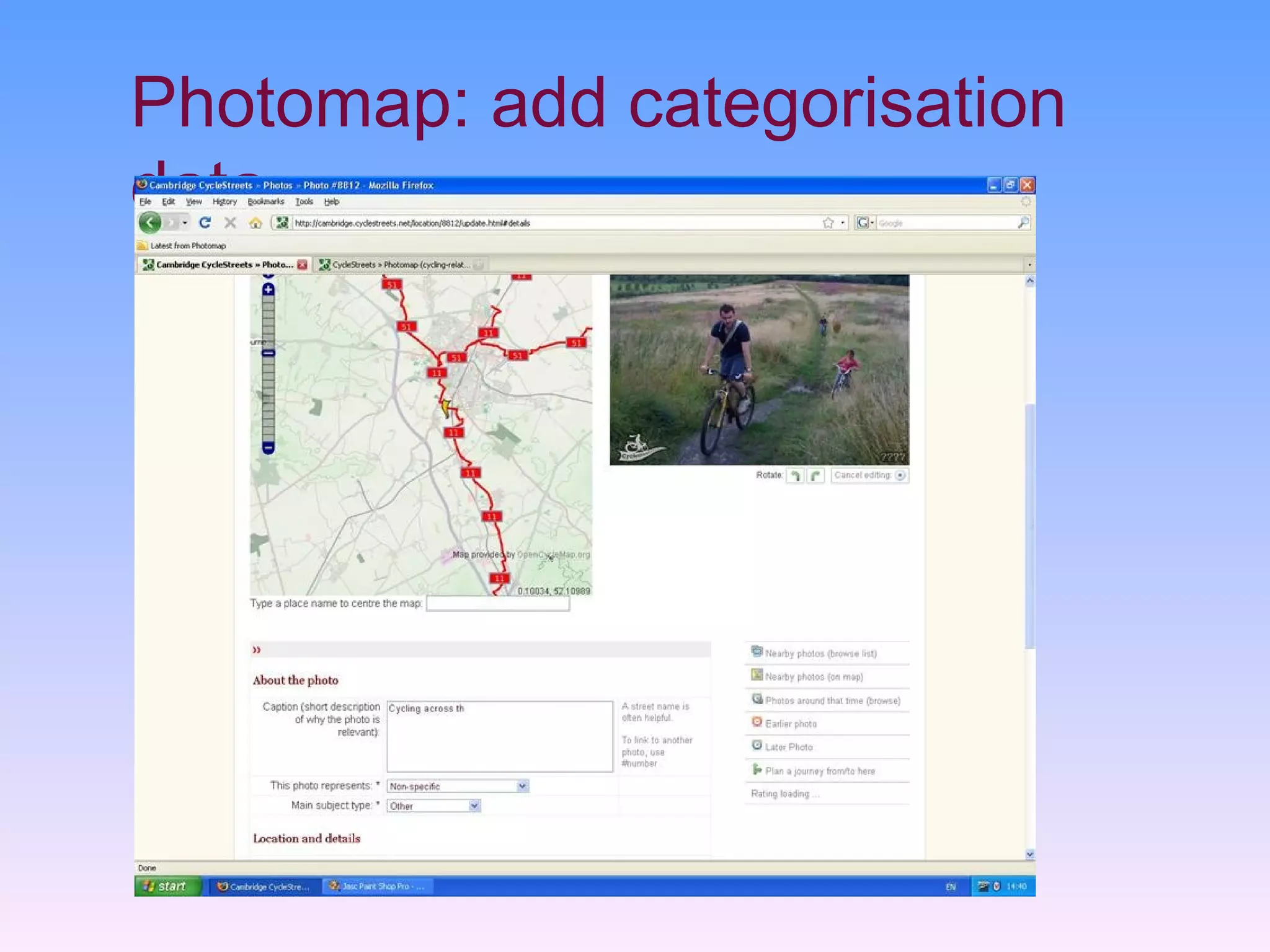
Photomap: add categorisation
data
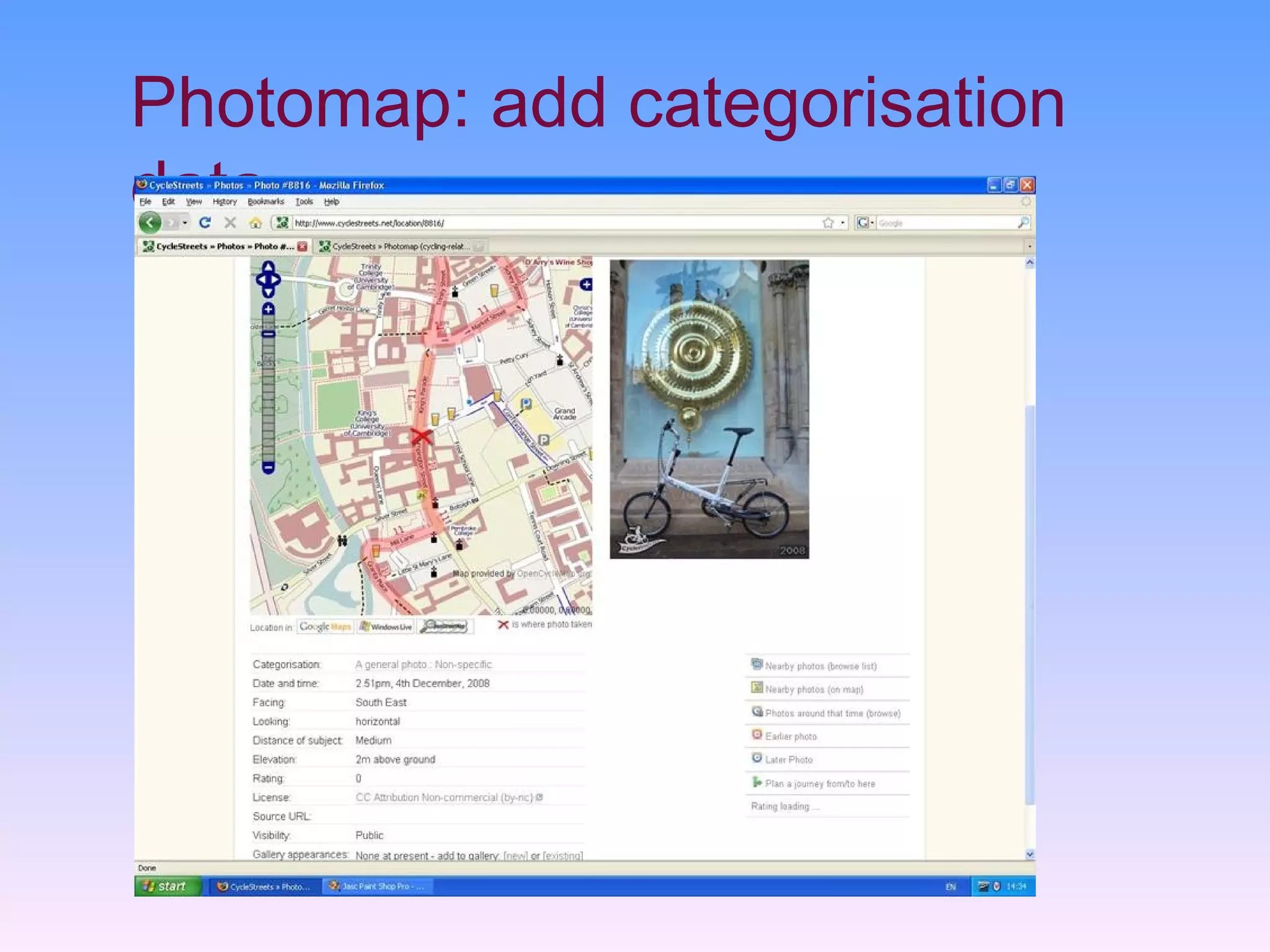
Photomap: add categorisation
data
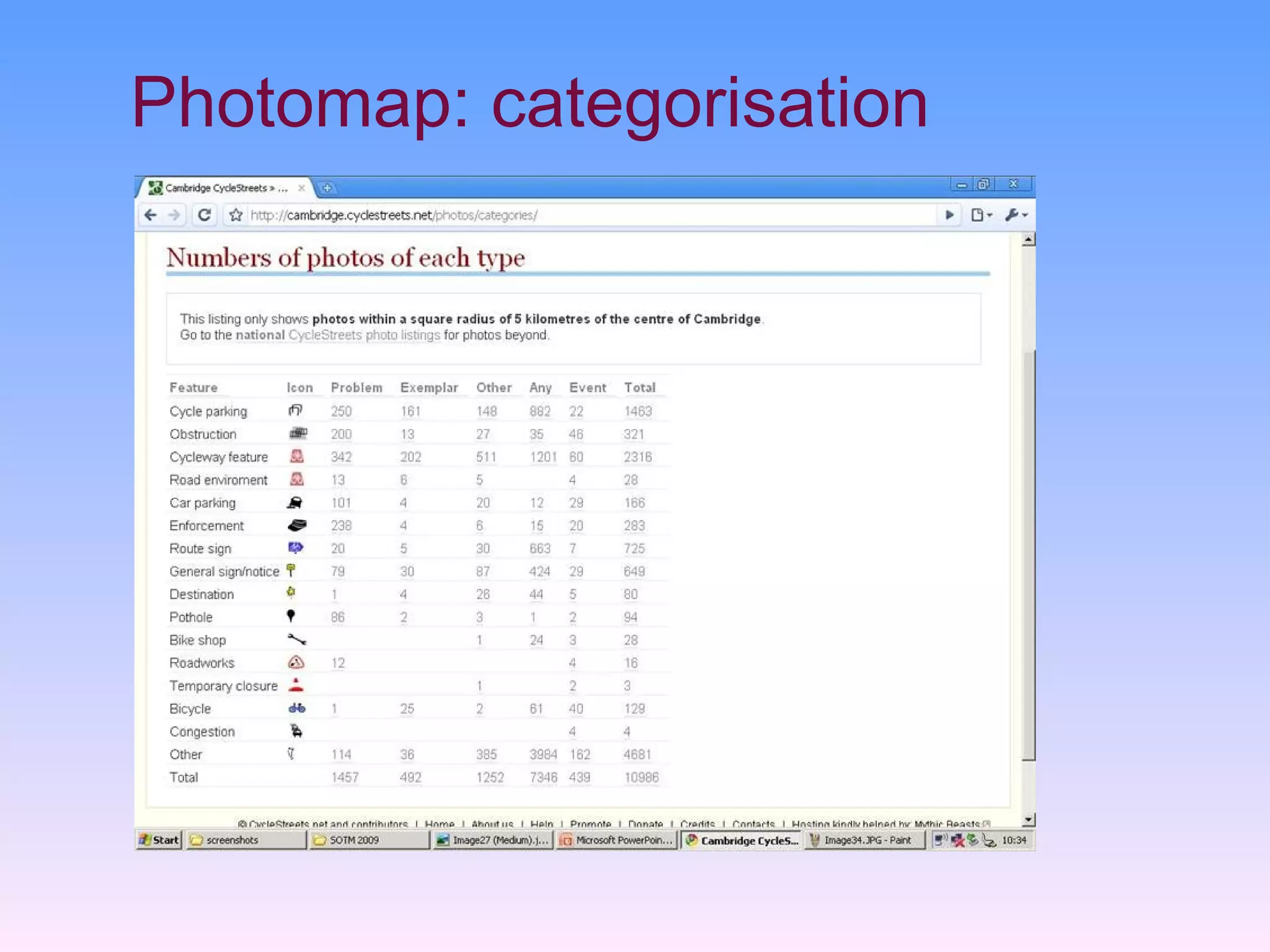
Photomap: categorisation
Listings e.g. “All cycle parking
problems in Cambridge”
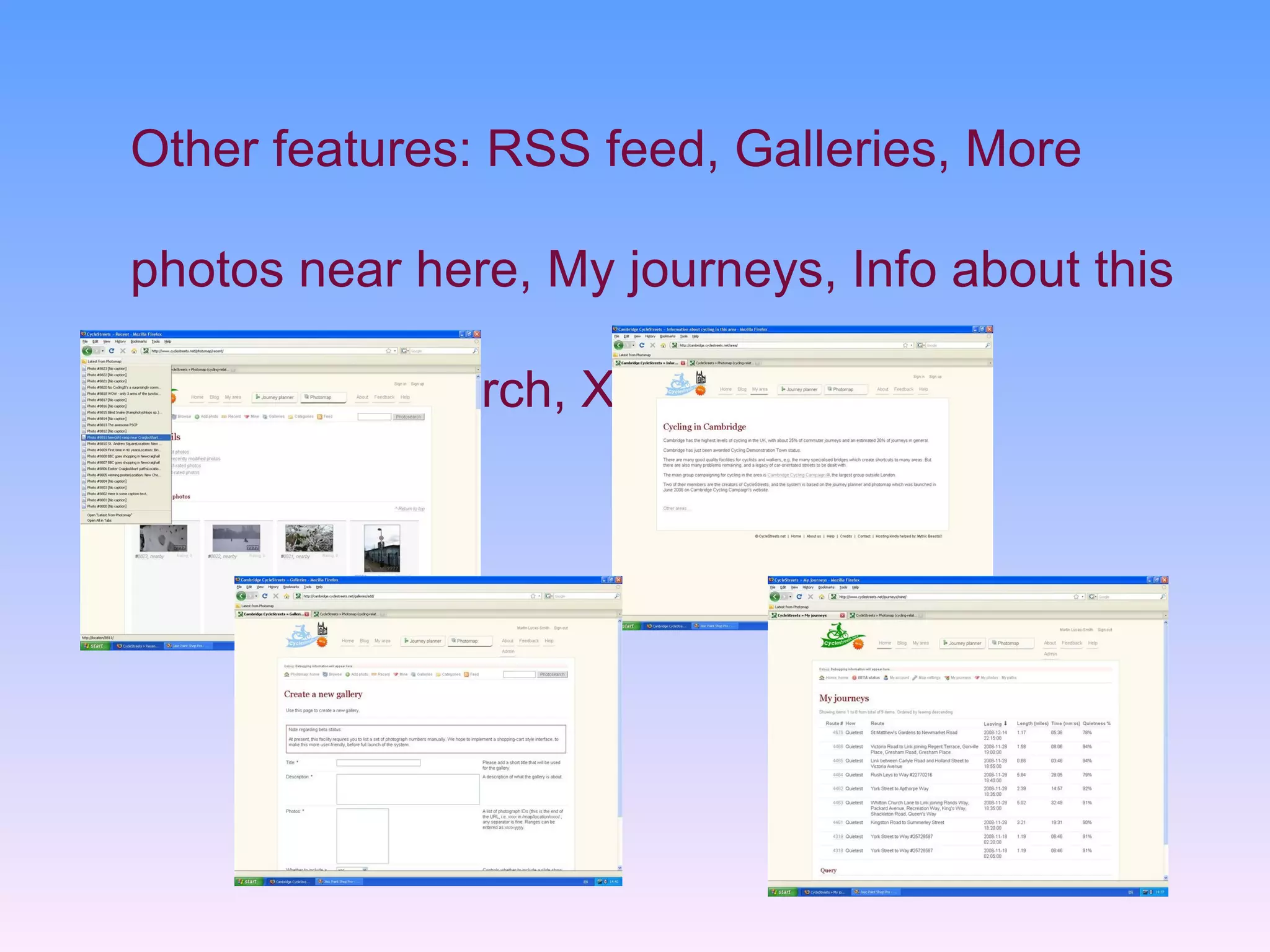
Other features: RSS feed, Galleries, More

photos near here, My journeys, Info about this

area page, Search, XML interface etc.
Features about to appear
 Hills/contours
   Will use SRTM (Aster later)
 Local Authority backend to prioritise
  problems shown in photos and resolve them
 Tools for getting feedback to OSM people
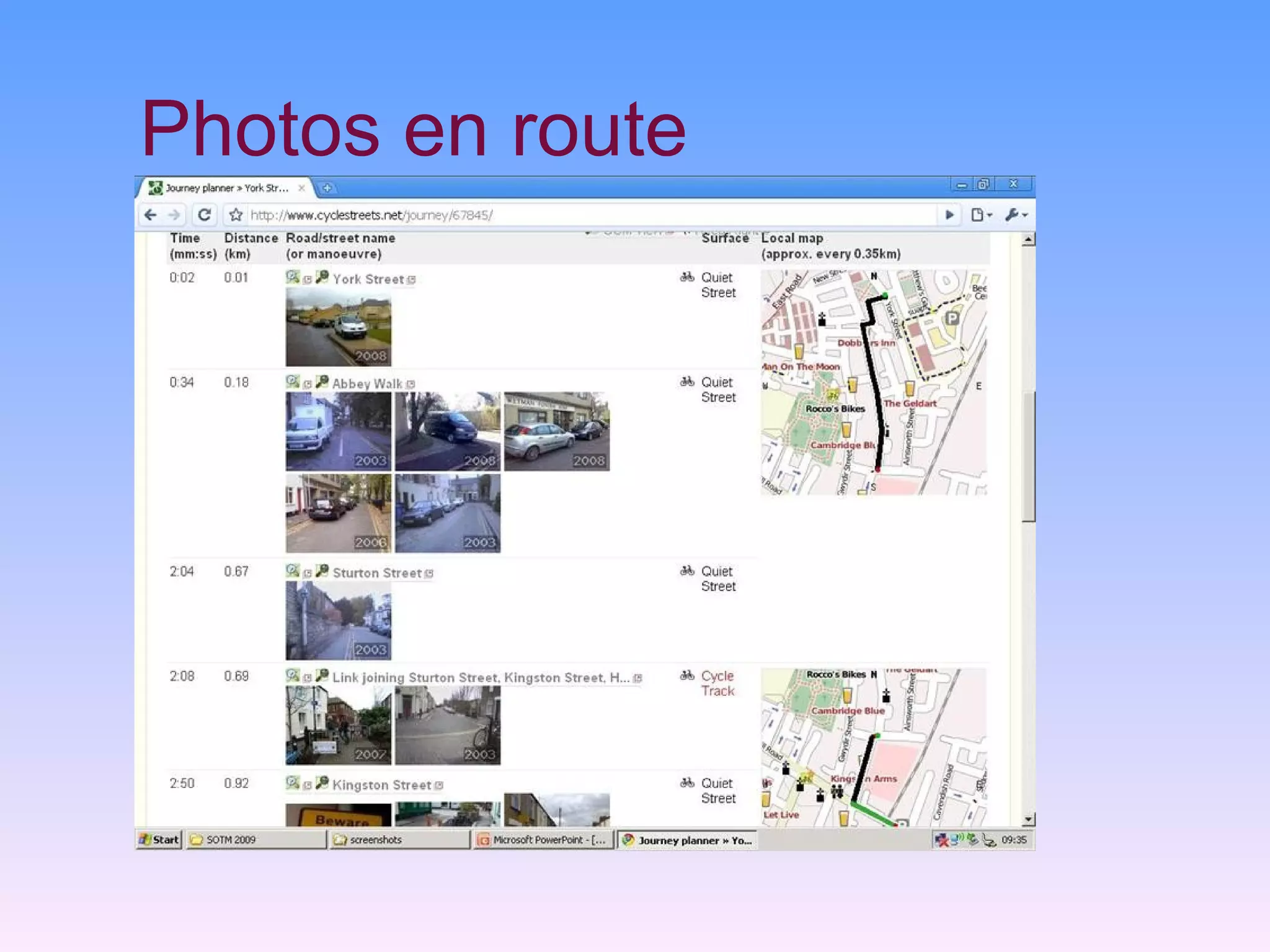
 Photos within route listings
   In correct direction
   Gives a good idea of journey before riding
   Was in original system
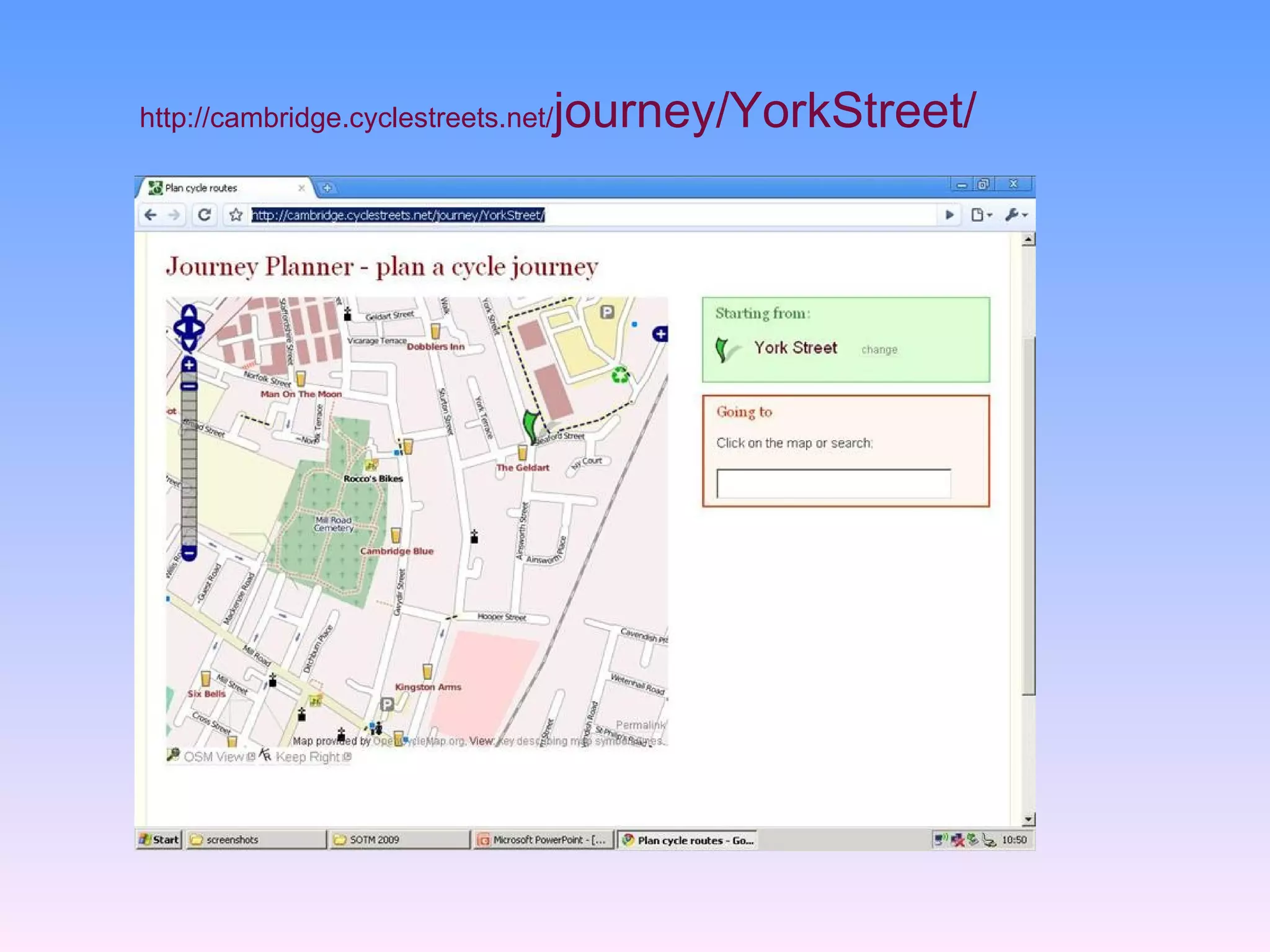
 URL API
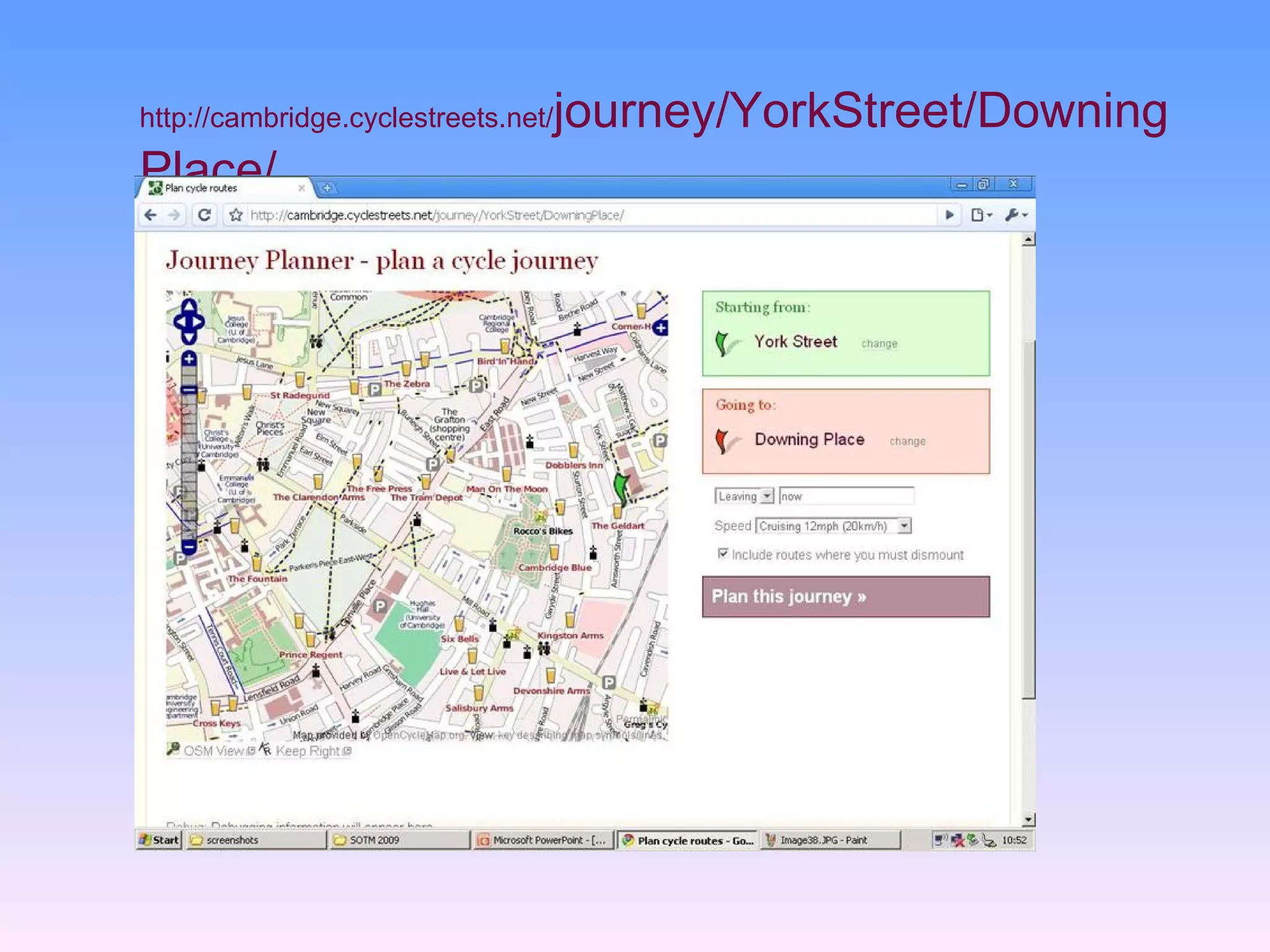
Photos en route
http://cambridge.cyclestreets.net/   journey/YorkStreet/
http://cambridge.cyclestreets.net/   journey/YorkStreet/Downing
Place/
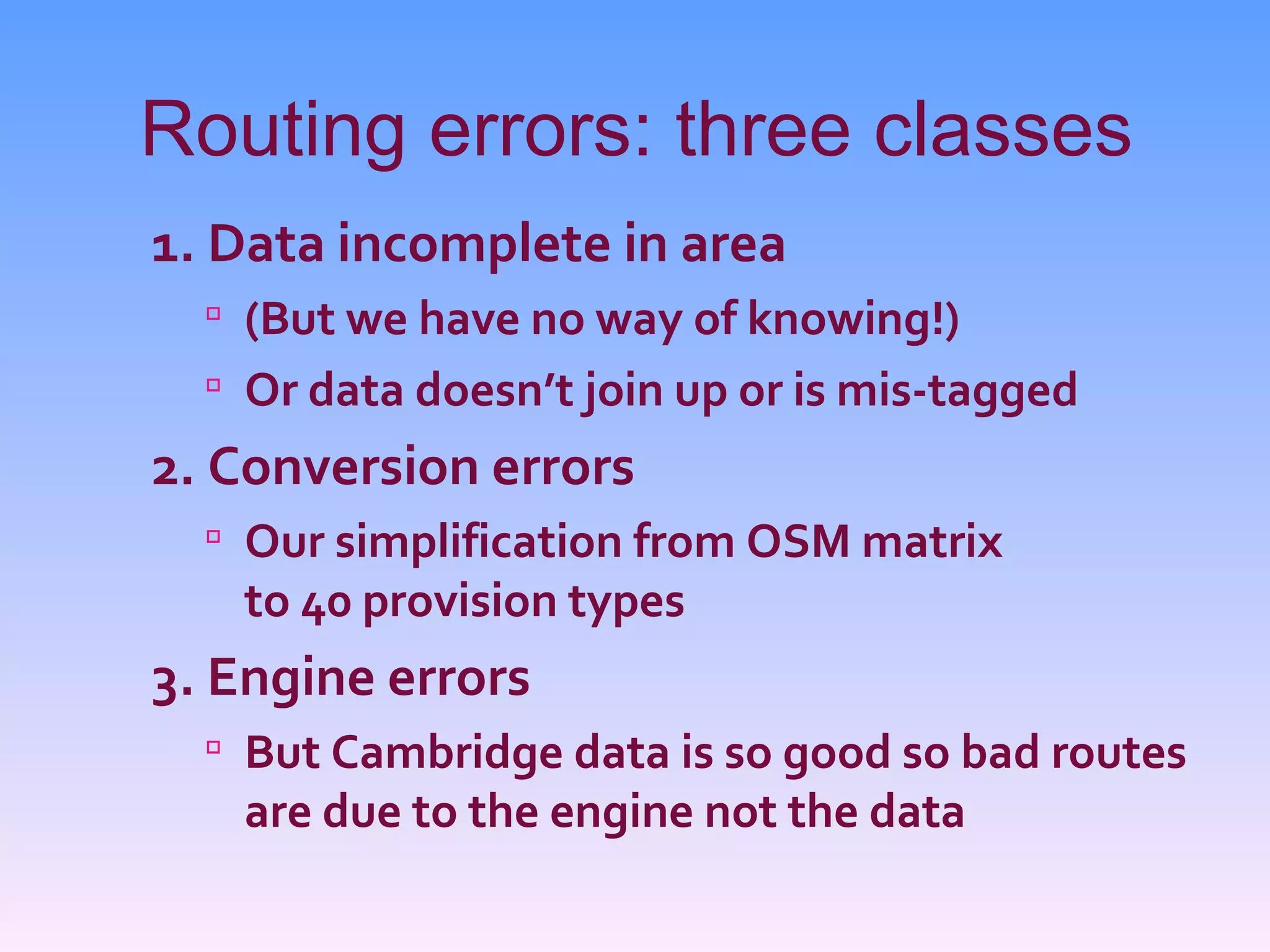
Routing errors: three classes
1. Data incomplete in area
   (But we have no way of knowing!)
   Or data doesn’t join up or is mis-tagged
2. Conversion errors
   Our simplification from OSM matrix
   to 40 provision types
3. Engine errors
   But Cambridge data is so good so bad routes
   are due to the engine not the data
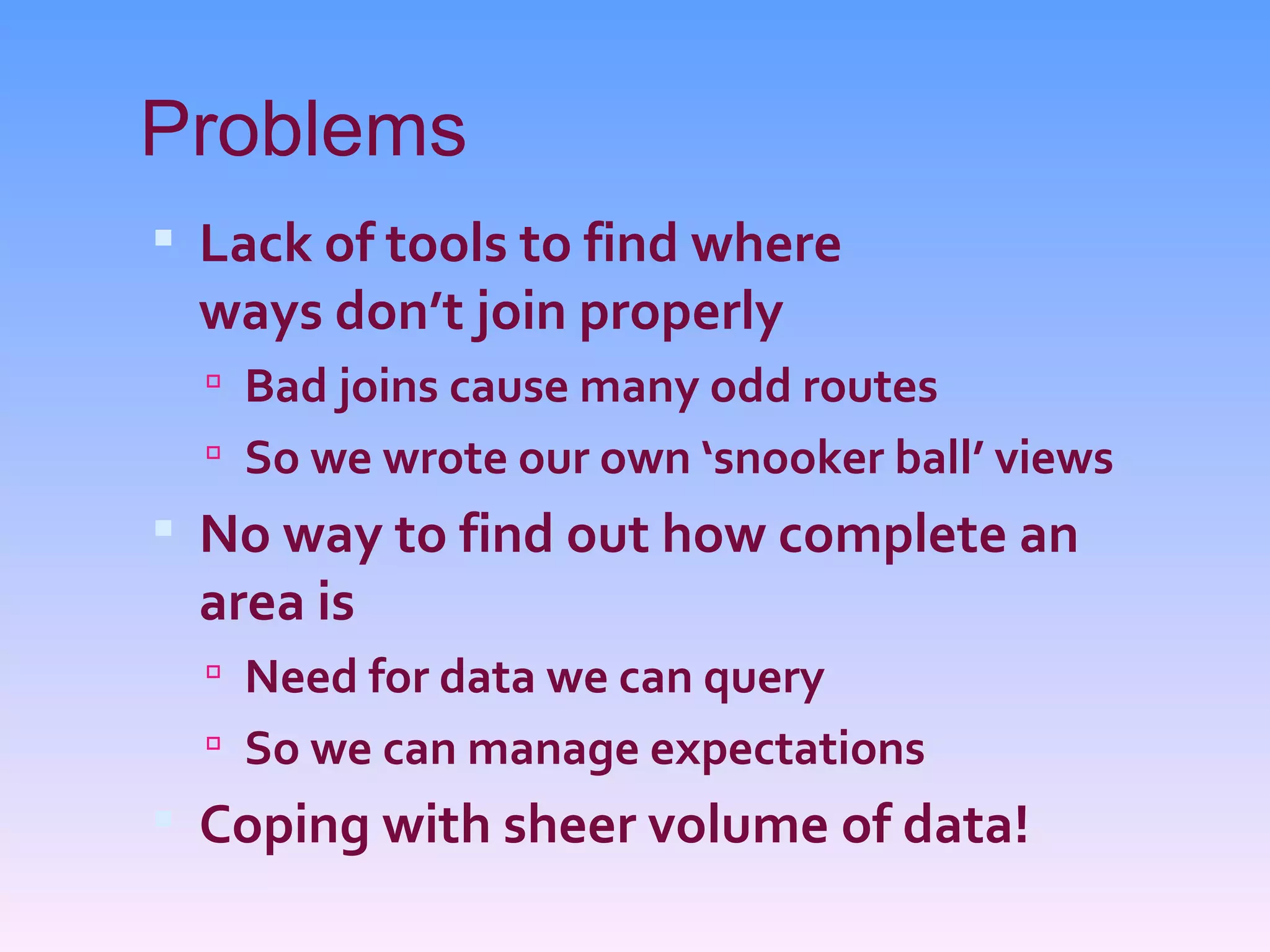
Problems
 Lack of tools to find where
 ways don’t join properly
   Bad joins cause many odd routes
   So we wrote our own ‘snooker ball’ views
 No way to find out how complete an
 area is
   Need for data we can query
   So we can manage expectations
 Coping with sheer volume of data!
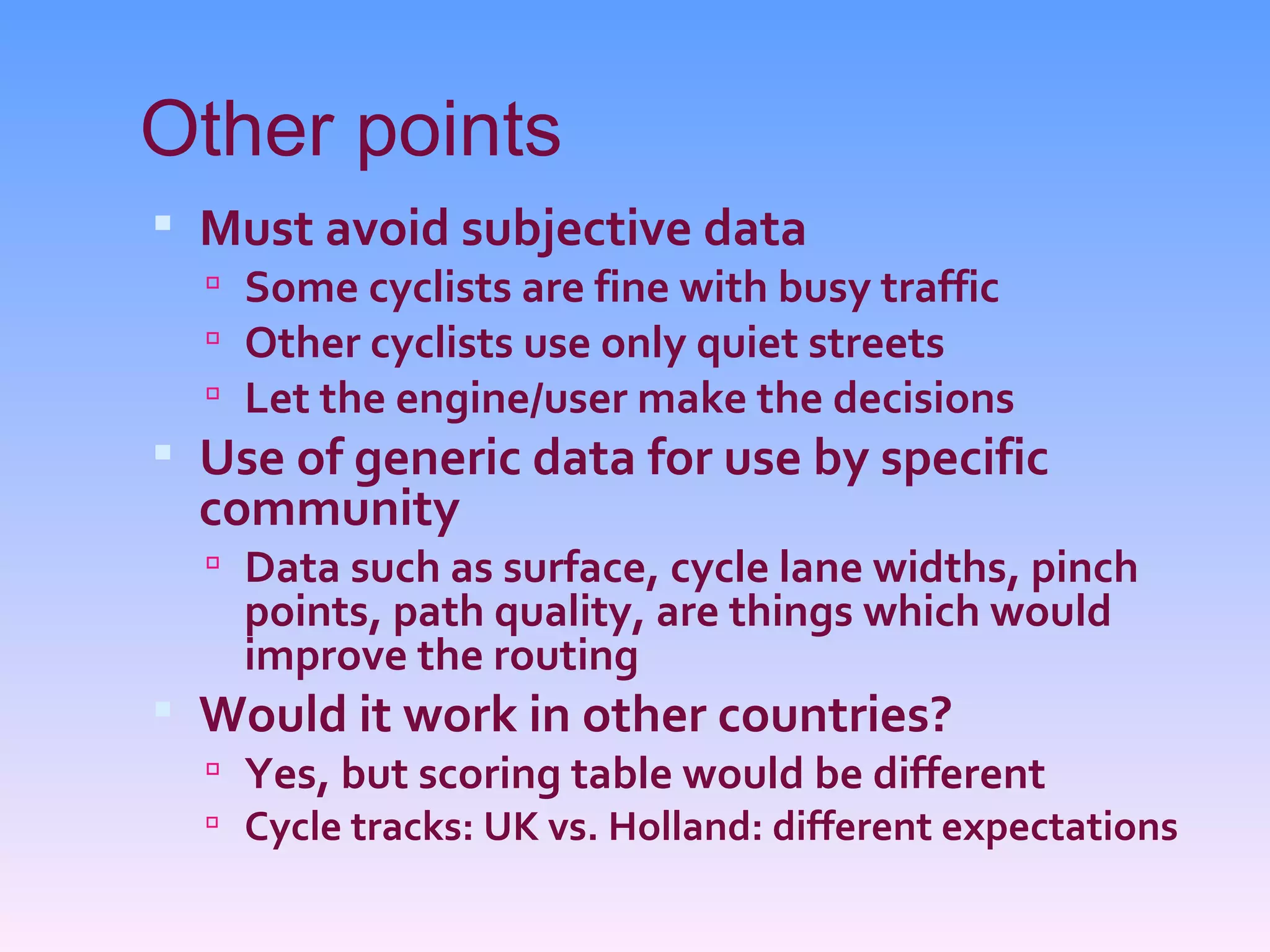
Other points
 Must avoid subjective data
   Some cyclists are fine with busy traffic
   Other cyclists use only quiet streets
   Let the engine/user make the decisions
 Use of generic data for use by specific
  community
   Data such as surface, cycle lane widths, pinch
    points, path quality, are things which would
    improve the routing
 Would it work in other countries?
   Yes, but scoring table would be different
   Cycle tracks: UK vs. Holland: different expectations
Please try CycleStreets and give
feedback!
  Feedback in an area you know is very
   useful to us
  Use of OSM data for real-life routing
   means data errors will be found quicker
   So better for OSM ...
   and better for CycleStreets
 Community aspect very important to us
   Good links with cycling bodies
 All feedback welcome!
Martin Lucas-Smith,
www.CycleStreets.net
    Twitter: @cyclestreets
     info@cyclestreets.net

CycleStreets main presentation to OSM State of the Map 2009

  • 1.
    CycleStreets.net UK-wide bicycle journey planner& photomap Martin Lucas-Smith For Cyclists, By Cyclists www.CycleStreets.net @CycleStreets
  • 2.
    CycleStreets System of twoparts: Cycle journey planner Photomap Online service Campaigning tool
  • 3.
    CycleStreets: history  Cambridge-only Originally written for Cambridge Cycling Campaign  Written by colleague Simon Nuttall  Launched June 2006  Google Map –based  5,000 lines drawn over satellite imagery  50,000 journeys planned
  • 4.
    CycleStreets: history  Lotsof requests for same thing in other places around the UK  OSM obvious data source for UK-wide system  Result is CycleStreets  Andy’s OpenCycleMap cartography  Went to public beta in March 2009  17,000 journeys  No promotion so far
  • 5.
  • 6.
  • 7.
  • 8.
    Gives Fastest +Quietest + Shortest
  • 9.
    Route feedback goesto OSM contacts
  • 10.
    Route feedback goesto OSM contacts
  • 11.
  • 12.
    Code  Object PHP,with a few libraries used  Currently MySQL  Looking at PostGres  Maybe replace core engine with C++ module?  Or use another engine: yet to evaluate  Keen to build a project team  Code not yet open sourced but will be  Routing is all documented
  • 13.
  • 14.
    Routing  Custom-written engine Takes Britain.osm around every two days (nightly soon)  Import process  Import takes 5 hours to work through all stages  ‘Cellular optimisation’ to get speed  80% of data is discarded or abstracted  We have one dual-core machine only (at present)  Handled 1 plan per second on day of tube strike
  • 15.
    Scoring  We collapsematrix of OSM tags into 40 ‘Provision Types’  Each has:  Maximum achievable speed (tweaked subjectively)  Quietness factor (also tweaked subjectively)  Cycleable? (boolean)  Walkable? (boolean)  One-way? (boolean)  Delay (seconds)  These then mapped onto each line to create 6 scores (fastest/shortest/quietest + in reverse)  Conversion table and Provision Types table:
  • 16.
  • 17.
  • 18.
    Provision Types –as used by the engine
  • 19.
    Cellular optimisation  Our method of reducing data volume by 80% A A 9 8 4 9: AC 10 7: AD,BD D 3 B B 6 6: BC C C 9 Park: 4 nodes & 7 ways After: 3 nodes & 3 ways
  • 20.
  • 21.
  • 22.
    Upload photo /video / Flickr import
  • 23.
  • 24.
  • 25.
  • 26.
    Listings e.g. “Allcycle parking problems in Cambridge”
  • 27.
    Other features: RSSfeed, Galleries, More photos near here, My journeys, Info about this area page, Search, XML interface etc.
  • 28.
    Features about toappear  Hills/contours  Will use SRTM (Aster later)  Local Authority backend to prioritise problems shown in photos and resolve them  Tools for getting feedback to OSM people  Photos within route listings  In correct direction  Gives a good idea of journey before riding  Was in original system  URL API
  • 29.
  • 30.
  • 31.
    http://cambridge.cyclestreets.net/ journey/YorkStreet/Downing Place/
  • 32.
    Routing errors: threeclasses 1. Data incomplete in area  (But we have no way of knowing!)  Or data doesn’t join up or is mis-tagged 2. Conversion errors  Our simplification from OSM matrix to 40 provision types 3. Engine errors  But Cambridge data is so good so bad routes are due to the engine not the data
  • 33.
    Problems  Lack oftools to find where ways don’t join properly  Bad joins cause many odd routes  So we wrote our own ‘snooker ball’ views  No way to find out how complete an area is  Need for data we can query  So we can manage expectations  Coping with sheer volume of data!
  • 34.
    Other points  Mustavoid subjective data  Some cyclists are fine with busy traffic  Other cyclists use only quiet streets  Let the engine/user make the decisions  Use of generic data for use by specific community  Data such as surface, cycle lane widths, pinch points, path quality, are things which would improve the routing  Would it work in other countries?  Yes, but scoring table would be different  Cycle tracks: UK vs. Holland: different expectations
  • 35.
    Please try CycleStreetsand give feedback!  Feedback in an area you know is very useful to us  Use of OSM data for real-life routing means data errors will be found quicker  So better for OSM ...  and better for CycleStreets  Community aspect very important to us  Good links with cycling bodies  All feedback welcome!
  • 36.
    Martin Lucas-Smith, www.CycleStreets.net Twitter: @cyclestreets info@cyclestreets.net