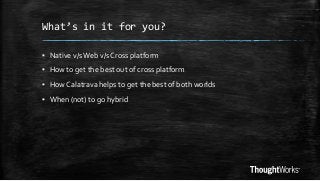
What’s in itfor you?
▪ Native v/s Web v/s Cross platform
▪ How to get the best out of cross platform
▪ How Calatrava helps to get the best of both worlds
▪ When (not) to go hybrid
6.
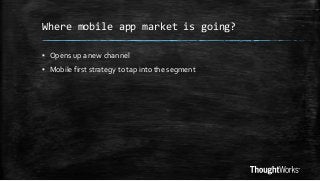
Where mobile appmarket is going?
▪ Opens up a new channel
▪ Mobile first strategy to tap into the segment
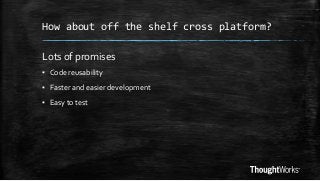
How about offthe shelf cross platform?
Lots of promises
▪ Code reusability
▪ Faster and easier development
▪ Easy to test
12.
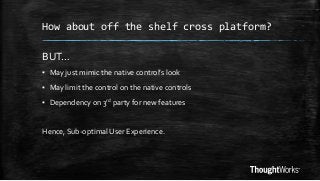
How about offthe shelf cross platform?
BUT…
▪ May just mimic the native control’s look
▪ May limit the control on the native controls
▪ Dependency on 3rd party for new features
Hence, Sub-optimal User Experience.
14.
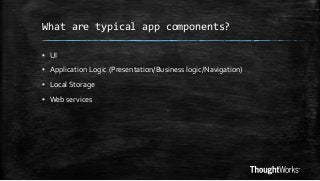
What are typicalapp components?
▪ UI
▪ Application Logic (Presentation/Business logic/Navigation)
▪ Local Storage
▪ Web services
15.
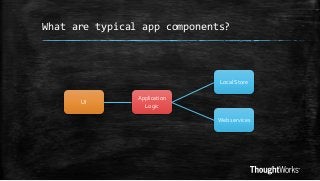
What are typicalapp components?
Local Store
UI
Application
Logic
Web services
16.
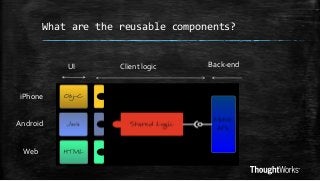
What are thereusable components?
UI
iPhone
Android
Web
Client logic
Back-end
Overview of calatrava
SHELL(haml, css, javascript,
native where necessary)
[page objects, layouts]
N
A
T
I
V
E
C
O
D
E
B
R
I
D
G
E
S
H
A
R
E
D
KERNEL (javascript)
[Controllers, models,
repositories]
L
O
G
I
C
BRIDGE (javascript)
[shared native objects]
19.
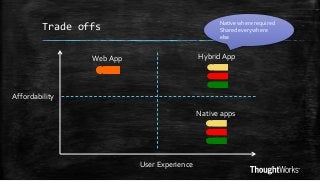
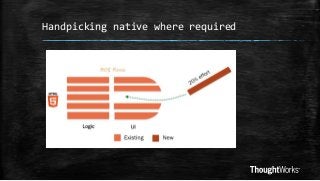
Native where required
Sharedeverywhere
else
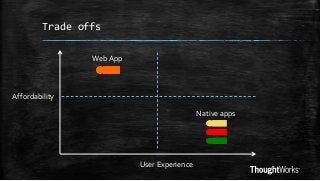
Trade offs
Hybrid App
Web App
Affordability
Native apps
User Experience
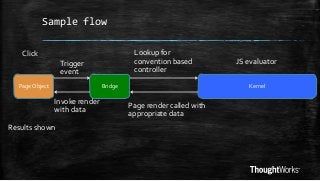
Sample flow
Lookup for
conventionbased
controller
Click
Trigger
event
Page Object
Bridge
Invoke render
with data
Results shown
JS evaluator
Kernel
Page render called with
appropriate data
23.
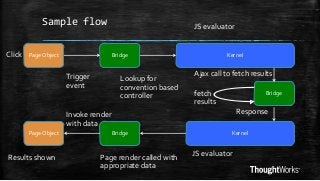
Sample flow
Click
Page Object
JSevaluator
Bridge
Trigger
event
Lookup for
convention based
controller
Kernel
Ajax call to fetch results
fetch
results
Bridge
Response
Invoke render
with data
Page Object
Results shown
Bridge
Page render called with
appropriate data
Kernel
JS evaluator
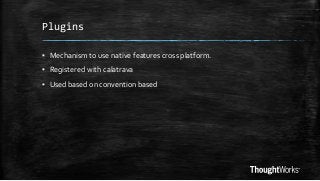
Plugins
▪ Mechanism touse native features cross platform.
▪ Registered with calatrava
▪ Used based on convention based
27.
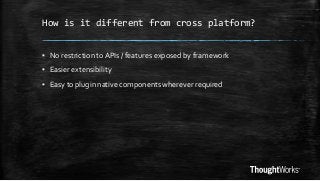
How is itdifferent from cross platform?
▪ No restriction to APIs / features exposed by framework
▪ Easier extensibility
▪ Easy to plugin native components wherever required
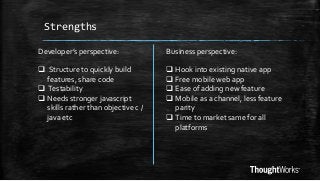
Strengths
Developer’s perspective:
Business perspective:
Structure to quickly build
features, share code
Testability
Needs stronger javascript
skills rather than objective c /
java etc
Hook into existing native app
Free mobile web app
Ease of adding new feature
Mobile as a channel, less feature
parity
Time to market same for all
platforms
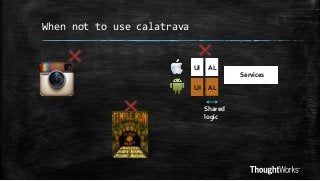
When not touse calatrava
UI
AL
Services
UI
AL
Shared
logic
32.
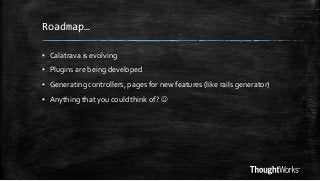
Roadmap…
▪ Calatrava isevolving
▪ Plugins are being developed
▪ Generating controllers, pages for new features (like rails generator)
▪ Anything that you could think of?
#8 Cross platform issues: In certain cases the access to hardware components and platform features is dependent on the support from the toolkit. Additionally, fragmentation can be a beast to tackle in these cases as a developer may have only limited access to underlying native platform. PureMobile web issues:impedance to navigate an app in browser. Additionally, having an app in an app store adds a lot of branding to a business, which is sorely missed in this case. However mobile web is emerging as a great add-on for a business with apps; since it is handy for tactical queries while app can serve as a rich engagement point for a customer.
#11 Cross platform issues: In certain cases the access to hardware components and platform features is dependent on the support from the toolkit. Additionally, fragmentation can be a beast to tackle in these cases as a developer may have only limited access to underlying native platform. PureMobile web issues:impedance to navigate an app in browser. Additionally, having an app in an app store adds a lot of branding to a business, which is sorely missed in this case. However mobile web is emerging as a great add-on for a business with apps; since it is handy for tactical queries while app can serve as a rich engagement point for a customer.
#18 Calatrava is one such implementation of the hybrid approach that we just spoke about. It was developed by a few ThoughtWorkers and then used for multiple client projects.
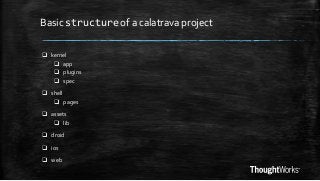
#19 an opinionated architecture, which drives how code should be organized and howlayers should be loosely coupledA Calatrava app is broken down into features. These features are driven by one or more controllers. Each feature has a start function and a set of pages.From your Calatrava app you can build an iOS app, an Android app and a Mobile Web app. The shared controlling logic is called thekernel. If you are building a shared HTML UI, that is called the shell.Connecting your kernel code to the UI of your app and any native device features you are using is the bridge. This is the main piece that the Calatrava framework provides.
#20 Cross platform issues: In certain cases the access to hardware components and platform features is dependent on the support from the toolkit. Additionally, fragmentation can be a beast to tackle in these cases as a developer may have only limited access to underlying native platform. PureMobile web issues:impedance to navigate an app in browser. Additionally, having an app in an app store adds a lot of branding to a business, which is sorely missed in this case. However mobile web is emerging as a great add-on for a business with apps; since it is handy for tactical queries while app can serve as a rich engagement point for a customer.
#24 Any event by the end user of the app is first received by the page objects. They in turn have functions bound to them which get triggered.
#30 Cover your bases strategy: In this case, since the customer is the focus and not the platform, it is imperative to have a presence on multiple platforms, to widen the outreach to customersDeveloper’s perspective:No additional Framework Density
#32 product vs channel Simple core logic Needs heavy UI and almost all native components






![Overview of calatrava
SHELL (haml, css, javascript,
native where necessary)
[page objects, layouts]
N
A
T
I
V
E
C
O
D
E
B
R
I
D
G
E
S
H
A
R
E
D
KERNEL (javascript)
[Controllers, models,
repositories]
L
O
G
I
C
BRIDGE (javascript)
[shared native objects]](https://image.slidesharecdn.com/calatrava-jsconfasia-131128025745-phpapp01/85/Bridging-the-gap-between-mobile-platforms-jsconf-asia-18-320.jpg?cb=1385607540)





![Vibe Coding vs. Spec-Driven Development [Free Meetup]](https://cdn.slidesharecdn.com/ss_thumbnails/vibecodingvsspecdrivendevelopment-251209105622-43f455e7-thumbnail.jpg?width=640&height=640&fit=bounds)


