Todorov and Propp Examples of their theories  
Vladimir Propp’s Theory Vladimir Propp developed a character theory for studying media texts which indicates that there are 7 broad character types. Hero  –  Leads the narrative, is usually looking for something or trying to solve something.   Does not have to be a male character! Villain   – Conflicts with the hero . Heroine   – Is usually some sort if prize or reward for the hero. N.B. if your hero is a      female, your heroine can be male. Father   – An authoritative figure who offers a reward to the hero for completing their      quest. That reward can be a prince/princess, or an object of value. Helpe r –  Helps the hero – often acts as sidekick. Donor   – Gives the hero something – a clue, a talisman, a special power – which helps them    complete their quest. Mentor  –  Teaches and guides the hero.
Tzvetan Todorov’s Theory Todorov, suggests that all narratives follow a five part structure. The structure is as follows: 1) A state of equilibrium, where everything is balanced. 2) A disruption of that order by an event 3) A recognition that the disorder has occurred. 4) An attempt to repair damage of disruption and to restore order. 5) A return or restoration of a NEW equilibrium.
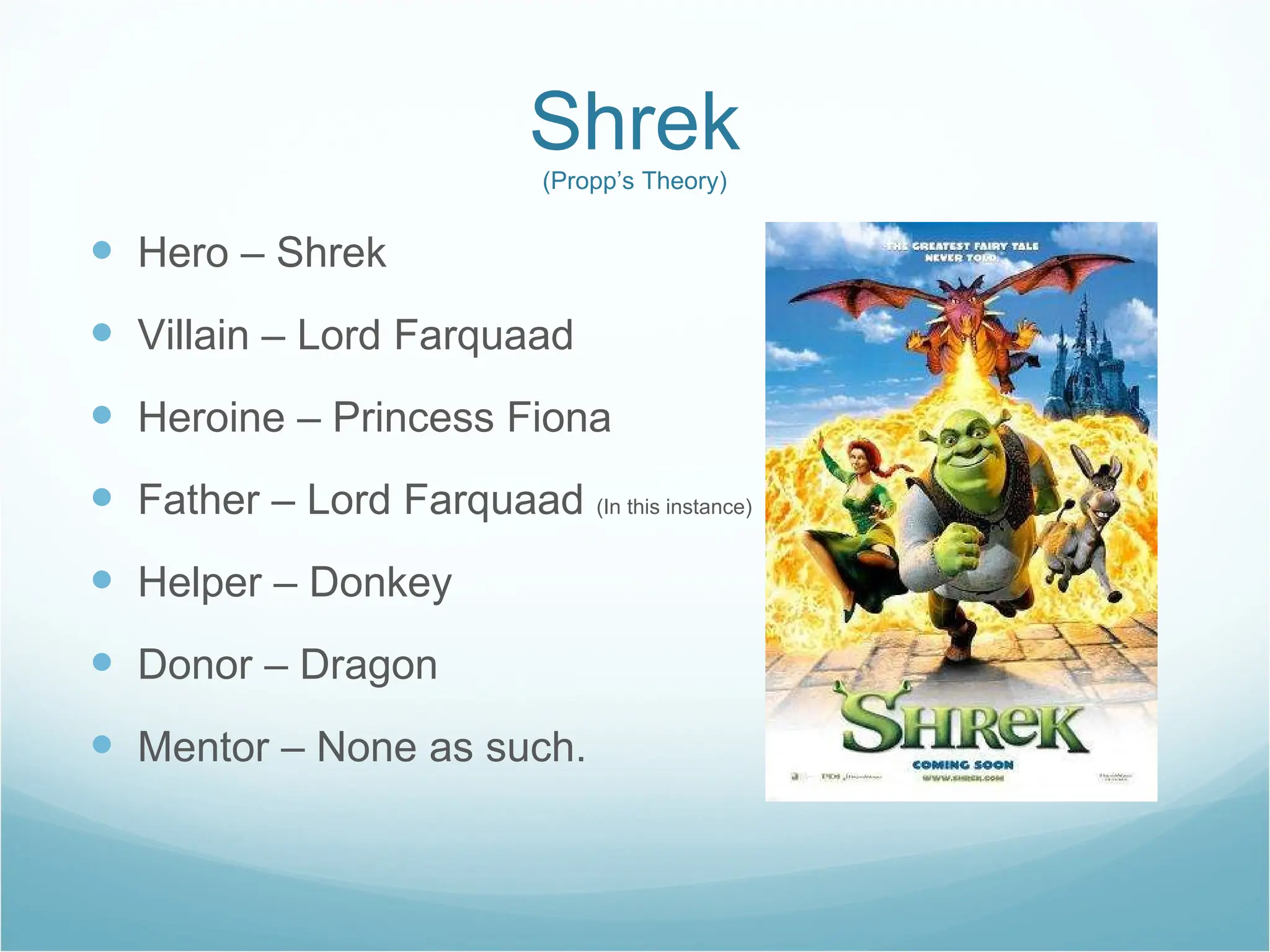
Shrek (Propp’s Theory) Hero – Shrek Villain – Lord Farquaad Heroine – Princess Fiona Father – Lord Farquaad  (In this instance) Helper – Donkey Donor – Dragon Mentor – None as such.
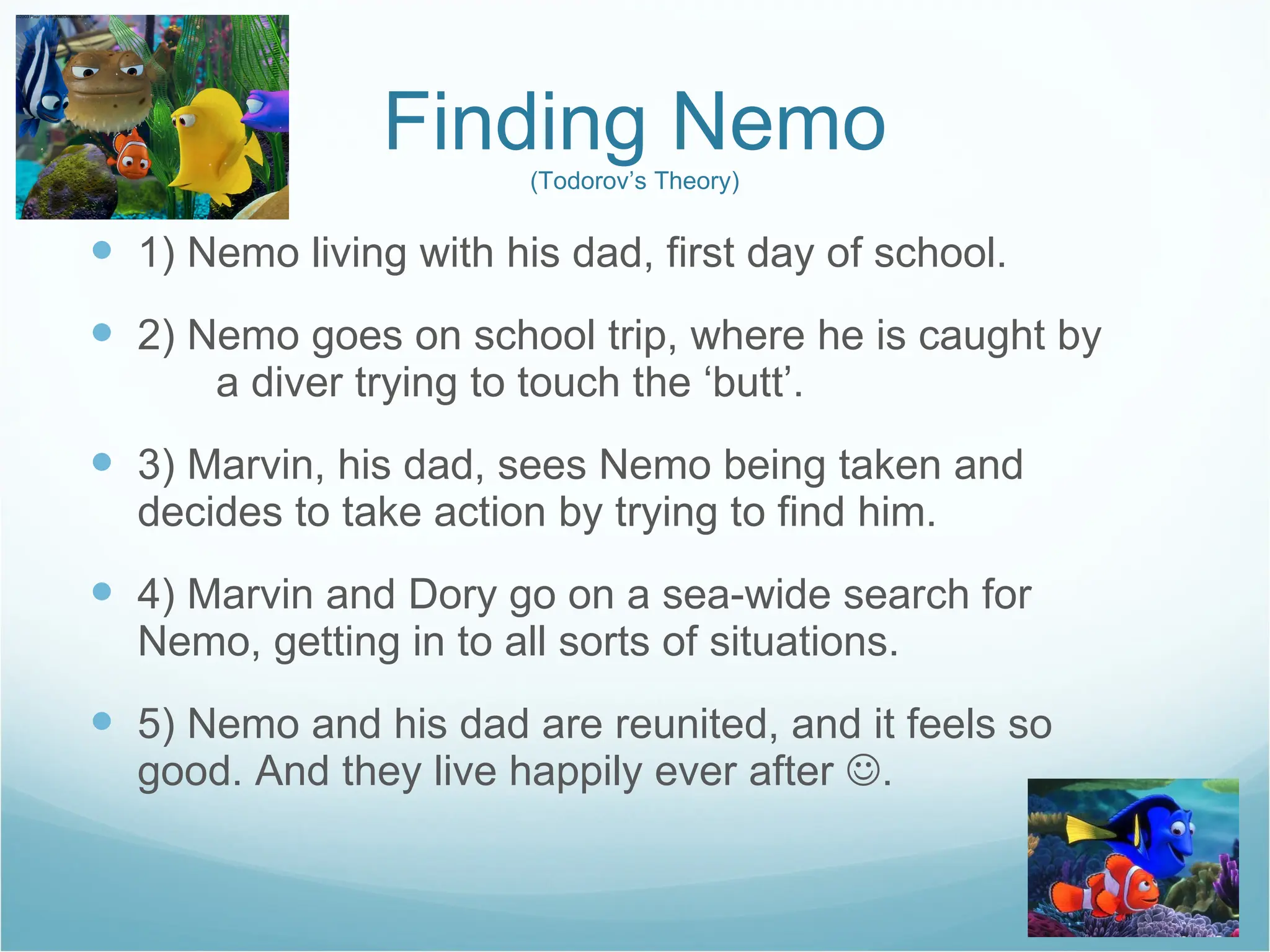
Finding Nemo (Todorov’s Theory) 1) Nemo living with his dad, first day of school. 2) Nemo goes on school trip, where he is caught by  a diver trying to touch the ‘butt’. 3) Marvin, his dad, sees Nemo being taken and  decides to take action by trying to find him. 4) Marvin and Dory go on a sea-wide search for  Nemo, getting in to all sorts of situations. 5) Nemo and his dad are reunited, and it feels so  good. And they live happily ever after   .

Todorov and Propp Presentation

  • 1.
    Todorov and ProppExamples of their theories 
  • 2.
    Vladimir Propp’s TheoryVladimir Propp developed a character theory for studying media texts which indicates that there are 7 broad character types. Hero – Leads the narrative, is usually looking for something or trying to solve something. Does not have to be a male character! Villain – Conflicts with the hero . Heroine – Is usually some sort if prize or reward for the hero. N.B. if your hero is a female, your heroine can be male. Father – An authoritative figure who offers a reward to the hero for completing their quest. That reward can be a prince/princess, or an object of value. Helpe r – Helps the hero – often acts as sidekick. Donor – Gives the hero something – a clue, a talisman, a special power – which helps them complete their quest. Mentor – Teaches and guides the hero.
  • 3.
    Tzvetan Todorov’s TheoryTodorov, suggests that all narratives follow a five part structure. The structure is as follows: 1) A state of equilibrium, where everything is balanced. 2) A disruption of that order by an event 3) A recognition that the disorder has occurred. 4) An attempt to repair damage of disruption and to restore order. 5) A return or restoration of a NEW equilibrium.
  • 4.
    Shrek (Propp’s Theory)Hero – Shrek Villain – Lord Farquaad Heroine – Princess Fiona Father – Lord Farquaad (In this instance) Helper – Donkey Donor – Dragon Mentor – None as such.
  • 5.
    Finding Nemo (Todorov’sTheory) 1) Nemo living with his dad, first day of school. 2) Nemo goes on school trip, where he is caught by a diver trying to touch the ‘butt’. 3) Marvin, his dad, sees Nemo being taken and decides to take action by trying to find him. 4) Marvin and Dory go on a sea-wide search for Nemo, getting in to all sorts of situations. 5) Nemo and his dad are reunited, and it feels so good. And they live happily ever after  .