








How to fire an employee in 5 steps

by FitSmallBusiness.com
Step 1: Establish a firing protocol
A Comprehensive firing protocol
consists of accurate job
descriptions, clear employee
contracts, and an up-to-date
employee handbook.
In all states except Montana
employment is presumed to be “at
will” unless stated otherwise.
If you have an employee sign any
type of employment contract make
sure it is reviewed by an attorney
and includes an at will clause.
If you do not already have job
descriptions, an employee contract and
handbook here is a template for each:

•Fitsmallbusiness.com:

How to Write A Job Description
•Rocketlawyer.com:
Employee Handbook Template
•Rocketlawyer.com:
Employment Contract Template
Use a
“Progressive Discipline Policy”
This is not intended to establish a rigid
set of penalty rules, but rather ensure
that employees are never surprised that
they are being fired, eliminating the
element of surprise when providing
severe warnings which are documented
and signed by the employee.
After you reprimand an employee,
give him or her time to respond to
your feedback with performance
improvements.
If you have failed to document an
employee’s performance issues, do
no try to reconstruct
documentation later on.
Step 2: evaluate your
legal obligations
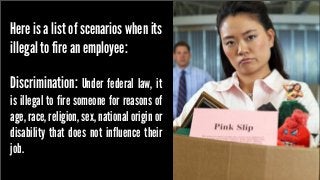
Here is a list of scenarios when its
illegal to fire an employee:
Discrimination: Under federal law, it

is illegal to fire someone for reasons of
age, race, religion, sex, national origin or
disability that does not influence their
job.
Whistleblowers: You cannot fire

employees for complaining about any
illegal activity health and safety
violation, or discrimination or
harassment in the workplace.

Exercising Legal Rights: You cannot

fire employees for taking family or
medical leave, military leave, time off to
vote or serve on a jury.
“Just Cause” promise: This may occur if
you tell your workers that they will be
fired for cause only or establish
guidelines that spell out how and when
terminations will be handled.
Constructive Discharge: Legal concept in
which an employee claims they were
forced to quit through intolerable
working conditions.
Step 3: Review and Assemble
documentation
A list of documents you should
bring to the termination
meeting includes:
•A letter that outlines the status of your
employee’s benefits, vacation pay / unused
sick time, repayment of advances, and
payment of money owned to the employee.
•An explanation of benefits (COBRA).
•Final paycheck or severance check and

other things that may need to be offered.
•Documents to sign (termination notice
or release).
•Explanation of confidentiality
obligations.
•Return forms for company property.
Step 4: the termination meeting
It is best to make the meeting simple
and quick. Find a private, neutral space,
and be compassionate and respectful.
Give them the termination letter you
have prepared. You are legally obligated
to include information for COBRA, and a
pension or 401 (k) where applicable.
Make sure you have a witness who can
account for your actions and prevent a
disgruntled employee for taking false
accusations of wrongful behavior.
Many human resource experts
recommend firing employees on monday
morning so they can have the day to
collect their things.
Step 5: Talk to the rest of your team
It is advised to notify the rest of
your team since many of them
could be concerned with their
job security.
And Finally...
To learn how to be a more successful
entrepreneur visit us at....
(Click The Link Below)

www.FitsmallBusiness.com
(Click The Link Below)

www.FitsmallBusiness.com
(Click The Link Below)

www.FitsmallBusiness.com

How To Fire An Employee In 5 Steps

  • 1.
    How to firean employee in 5 steps by FitSmallBusiness.com
  • 2.
    Step 1: Establisha firing protocol
  • 3.
    A Comprehensive firingprotocol consists of accurate job descriptions, clear employee contracts, and an up-to-date employee handbook.
  • 4.
    In all statesexcept Montana employment is presumed to be “at will” unless stated otherwise. If you have an employee sign any type of employment contract make sure it is reviewed by an attorney and includes an at will clause.
  • 5.
    If you donot already have job descriptions, an employee contract and handbook here is a template for each: •Fitsmallbusiness.com: How to Write A Job Description •Rocketlawyer.com: Employee Handbook Template •Rocketlawyer.com: Employment Contract Template
  • 6.
    Use a “Progressive DisciplinePolicy” This is not intended to establish a rigid set of penalty rules, but rather ensure that employees are never surprised that they are being fired, eliminating the element of surprise when providing severe warnings which are documented and signed by the employee.
  • 7.
    After you reprimandan employee, give him or her time to respond to your feedback with performance improvements. If you have failed to document an employee’s performance issues, do no try to reconstruct documentation later on.
  • 8.
    Step 2: evaluateyour legal obligations
  • 9.
    Here is alist of scenarios when its illegal to fire an employee: Discrimination: Under federal law, it is illegal to fire someone for reasons of age, race, religion, sex, national origin or disability that does not influence their job.
  • 10.
    Whistleblowers: You cannotfire employees for complaining about any illegal activity health and safety violation, or discrimination or harassment in the workplace. Exercising Legal Rights: You cannot fire employees for taking family or medical leave, military leave, time off to vote or serve on a jury.
  • 11.
    “Just Cause” promise:This may occur if you tell your workers that they will be fired for cause only or establish guidelines that spell out how and when terminations will be handled. Constructive Discharge: Legal concept in which an employee claims they were forced to quit through intolerable working conditions.
  • 12.
    Step 3: Reviewand Assemble documentation
  • 13.
    A list ofdocuments you should bring to the termination meeting includes: •A letter that outlines the status of your employee’s benefits, vacation pay / unused sick time, repayment of advances, and payment of money owned to the employee.
  • 14.
    •An explanation ofbenefits (COBRA). •Final paycheck or severance check and other things that may need to be offered. •Documents to sign (termination notice or release). •Explanation of confidentiality obligations. •Return forms for company property.
  • 15.
    Step 4: thetermination meeting
  • 16.
    It is bestto make the meeting simple and quick. Find a private, neutral space, and be compassionate and respectful. Give them the termination letter you have prepared. You are legally obligated to include information for COBRA, and a pension or 401 (k) where applicable.
  • 17.
    Make sure youhave a witness who can account for your actions and prevent a disgruntled employee for taking false accusations of wrongful behavior. Many human resource experts recommend firing employees on monday morning so they can have the day to collect their things.
  • 18.
    Step 5: Talkto the rest of your team
  • 19.
    It is advisedto notify the rest of your team since many of them could be concerned with their job security.
  • 20.
  • 21.
    To learn howto be a more successful entrepreneur visit us at....
  • 22.
    (Click The LinkBelow) www.FitsmallBusiness.com
  • 23.
    (Click The LinkBelow) www.FitsmallBusiness.com
  • 24.
    (Click The LinkBelow) www.FitsmallBusiness.com