ProIPM Integrated Pest Management Solutions 
for the Landscaping Professional 
Apple Maggot (Rhagoletis pomonella) 
Note: This fact sheet is not intended for commercial fruit growers. 
The Green Gardening Program is sponsored by Seattle Public Utilities to 
promote alternatives to lawn and garden chemicals. Funded by the 
Local Hazardous Waste Management Program in King County. 
Written by Philip Dickey ••• GGrraapphhiicc DDeessiiggnn bbyy CCaatthh CCaarriinnee,, CCCC DDeessiiggnn 
Buy Smart. 
Buy Safe. 
BBBeee TTTooxxiicc FFrreeee.. 
Host/Site 
Apples are the main host of the apple maggot, and early cultivars 
are particularly susceptible to damage. Apple maggots are frequently 
found in hawthorn and crab apple, particularly in neglected trees, 
and have also been identified in pear, plum, cherry, apricot, wild rose, 
pyracantha, and cotoneaster. 
In 1979, the apple maggot was first discov-ered 
in the Pacific Northwest. Apple maggot 
flies have now been found in most western 
Washington counties and several eastern 
Washington counties. To date, neither apple 
maggot flies, maggots, nor fruit damaged 
by them have been detected in commercial 
orchards in Washington state. 
A strict quarantine exists on transporting 
home-grown fruit. Highway signs posted in 
western Washington remind drivers not to 
take fruit out of western Washington or across 
county lines. 
Identifi cation/Appearance 
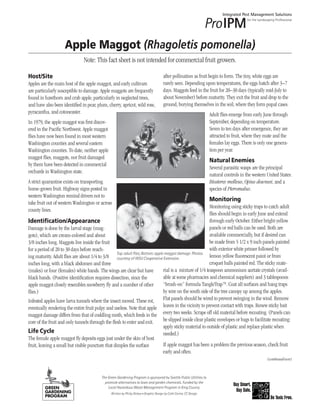
Damage is done by the larval stage (mag-gots), 
which are cream-colored and about 
3/8 inches long. Maggots live inside the fruit 
for a period of 20 to 30 days before reach-ing 
maturity. Adult flies are about 1/4 to 3/8 
inches long, with a black abdomen and three 
(males) or four (females) white bands. The wings are clear but have 
black bands. (Positive identification requires dissection, since the 
apple maggot closely resembles snowberry fly and a number of other 
flies.) 
Infested apples have larva tunnels where the insect moved. These rot, 
eventually rendering the entire fruit pulpy and useless. Note that apple 
maggot damage differs from that of coddling moth, which feeds in the 
core of the fruit and only tunnels through the flesh to enter and exit. 
Life Cycle 
The female apple maggot fly deposits eggs just under the skin of host 
fruit, leaving a small but visible puncture that dimples the surface 
after pollination as fruit begin to form. The tiny, white eggs are 
rarely seen. Depending upon temperatures, the eggs hatch after 3–7 
days. Maggots feed in the fruit for 20–30 days (typically mid-July to 
about November) before maturity. They exit the fruit and drop to the 
ground, burying themselves in the soil, where they form pupal cases. 
Adult flies emerge from early June through 
September, depending on temperature. 
Seven to ten days after emergence, they are 
attracted to fruit, where they mate and the 
females lay eggs. There is only one genera-tion 
per year. 
Natural Enemies 
Several parasitic wasps are the principal 
natural controls in the western United States: 
Biosteres melleus, Opius downesi, and a 
species of Pteromalus. 
Monitoring 
Monitoring using sticky traps to catch adult 
flies should begin in early June and extend 
through early October. Either bright-yellow 
panels or red balls can be used. Both are 
available commercially, but if desired can 
be made from 5 1/2 x 9 inch panels painted 
with exterior white primer followed by 
lemon yellow fluorescent paint or from 
croquet balls painted red. The sticky mate-rial 
is a mixture of 1/4 teaspoon ammonium acetate crystals (avail-able 
at some pharmacies and chemical suppliers) and 3 tablespoons 
“brush-on” formula TangleTrapTM. Coat all surfaces and hang traps 
by wire on the south side of the tree canopy up among the apples. 
Flat panels should be wired to prevent swinging in the wind. Remove 
leaves in the vicinity to prevent contact with traps. Renew sticky bait 
every two weeks. Scrape off old material before recoating. (Panels can 
be slipped inside clear plastic envelopes or bags to facilitate recoating: 
apply sticky material to outside of plastic and replace plastic when 
needed.) 
If apple maggot has been a problem the previous season, check fruit 
early and often. 
(continued/over) 
Top: adult fl ies; Bottom: apple maggot damage. Photos 
courtesy of WSU Cooperative Extension.
Action Threshold 
If chemical controls will not be used, cultural/physical controls, 
especially setting traps, should begin before emergence of adult flies. 
This is especially important where apple maggot has been a problem. 
Include non-apple host trees in the vicinity. 
If chemical control is used, WSU recommends the first application 
within seven days of first adult fly capture in a trap. Growers on the 
east coast have used a threshold of five captures on a trap to indicate 
the need for repeat sprays. 
Cultural/Physical Controls 
Remove all fallen fruit daily. If not visibly affected, these can 
be used for cider or cooking but should not be stored. Boil fruit to kill 
any larvae inside before burying or composting. Alternatively, place 
fruit in lock-tight bags and dispose in garbage. Fall cleanup should be 
thorough. 
Sticky traps also provide a little control of apple maggot. Follow 
directions on previous page under “Monitoring.” 
Remove unneeded host trees such as unmaintained apples or 
hawthorns located near orchards. 
Bagging fruit. One of the most effective controls is to place paper 
bags over fruit on the tree so that they are not accessible to apple 
maggot larvae. Bagging can be done on fruit over the entire tree, 
or on as many fruit as desired. Before bagging, thin fruit to one per 
cluster, preferably when fruit is from 1/2 to 1 inch in diameter. Use 
No. 2 paper bags (standard lunch bag size measuring 7-1/4 inches 
by 4 inches). Cut a 2-inch slit in the bottom of the bag and slip this 
opening over the fruit to form a seal around the stem. Staple the open 
end shut. 
Biological Controls 
Although there are natural enemies of the apple maggot, they do not 
provide significant control. 
Chemical Controls 
Chemical controls are less important if fruit will not be eaten, but 
careful attention to cultural/physical controls will help reduce apple 
maggot populations. 
Chemicals registered for apple maggot include some of the more 
toxic, broad-spectrum insecticides. Diazinon will no longer be regis-tered 
for non-agricultural use after the end of 2002. Timing based on 
trapping rather than a calendar schedule can reduce the amount of 
insecticide used and increase its effectiveness. Organic growers use the 
botanical insecticides pyrethrum and rotenone in conjunction with 
trapping. A formulation of kaolin clay, Surround WP, (not yet regis-tered 
for home use for apple maggot control) is undergoing trials to 
determine its usefulness in IPM programs. Because sprays are directed 
against the adult fly—larvae are hidden inside the apple and thus 
relatively protected—growers must remove untended host trees and 
fallen fruit near the orchard. 
References 
Beers, Elizabeth, A. Antonelli, and E. LaGasa. Apple Maggot. WSU 
Cooperative Extension Bulletin EB1603 
http://cru.cahe.wsu.edu/CEPublications/eb1603/eb1603.html 
University of California Statewide Integrated Pest Management Proj-ect. 
Codling Moth: Home & Landscape. 
http://axp.ipm.ucdavis.edu/PMG/PESTNOTES/pn7412.html for direc-tions 
on bagging fruit. 
University of Maine Cooperative Extension. Apple Pest Report: 
Friday, April 14, 2000. http://pmo.umext.maine.edu/apple/AppP-estRept/ 
AppPestRept04-14-00.html 
Vallen, Oren. AAAppppppllleee MMMaaaggggggooottt CCCooonnntttrrrooolll iiinnn ttthhheee BBBaaaccckkkyyyaaarrrddd OOOrrrccchhhaaarrrddd.. 
http://gardening.wsu.edu/library/tree006/tree006.htm 
West Virginia Extension Service. The Orchard Monitor 
(online newsletter), March 19, 2001. 
http://www.wvu.edu/~agexten/orchardmon/om031901.html