World Heritage Archaeological Sites & Monuments in India: Cultural, Natural, and Educational Significance
Explore India's UNESCO World Heritage sites, their cultural and natural heritage, archaeological value, educational importance, tourism impact, and role in international cooperation and conservation efforts.
World Heritage Archaeological Sites & Monuments in India: Cultural, Natural, and Educational Significance
1.
BA 5th
Sem. Minor(Vocational)
World Heritage Archaeological Sites & Monuments in India
Sachin Kr.Tiwary
sachintiwary@bhu.ac.in
4. Importance of World Heritage Sites:
4.1. Cultural and Natural Heritage,
4.2. Role in Education,
4.3. Tourism, and
4.4. International cooperation
2.
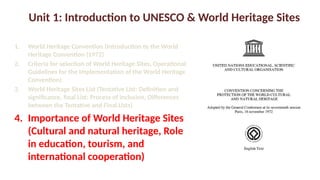
Unit 1: Introductionto UNESCO & World Heritage Sites
1. World Heritage Convention (Introduction to the World
Heritage Convention (1972)
2. Criteria for selection of World Heritage Sites, Operational
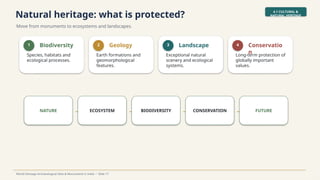
Guidelines for the Implementation of the World Heritage
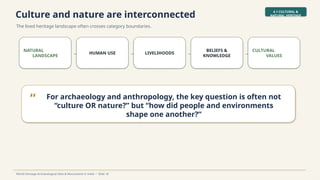
Convention)
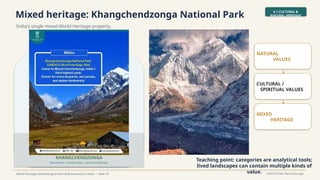
3. World Heritage Sites List (Tentative List: Definition and
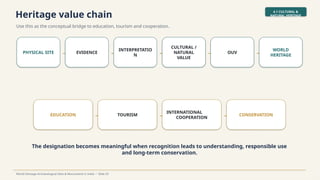
significance, final List: Process of inclusion, Differences
between the Tentative and Final Lists)
4. Importance of World Heritage Sites
(Cultural and natural heritage, Role
in education, tourism, and
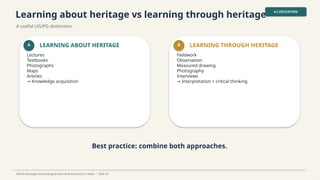
international cooperation)
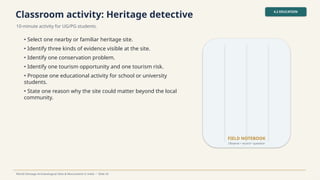
3.
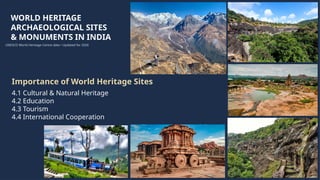
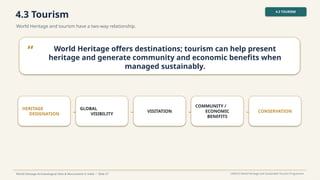
WORLD HERITAGE
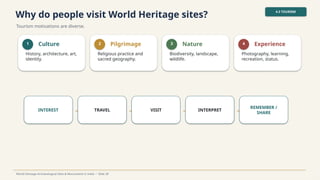
ARCHAEOLOGICAL SITES
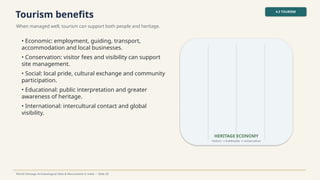
&MONUMENTS IN INDIA
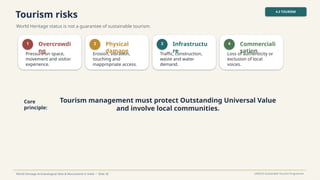
Importance of World Heritage Sites
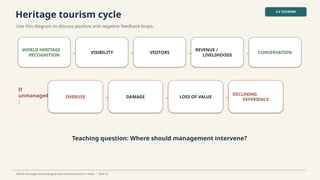
4.1 Cultural & Natural Heritage
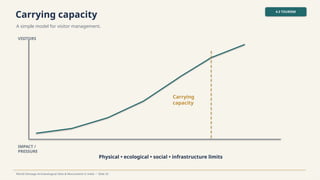
4.2 Education
4.3 Tourism
4.4 International Cooperation
UNESCO World Heritage Centre data • Updated for 2026
4.
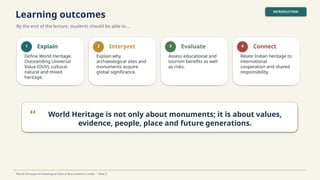
Learning outcomes
By theend of the lecture, students should be able to…
INTRODUCTION
World Heritage Archaeological Sites & Monuments in India • Slide 2
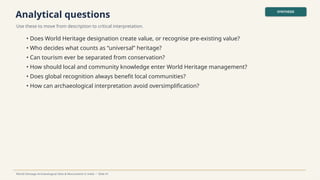
1 Explain
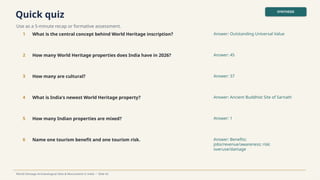
Define World Heritage,
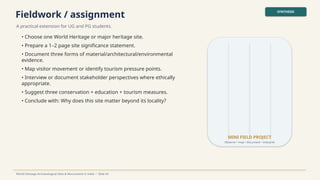
Outstanding Universal
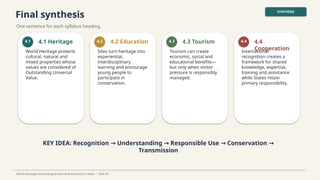
Value (OUV), cultural,
natural and mixed
heritage.
2 Interpret
Explain why
archaeological sites and
monuments acquire
global significance.
3 Evaluate
Assess educational and
tourism benefits as well
as risks.
4 Connect
Relate Indian heritage to
international
cooperation and shared
responsibility.
“ World Heritage is not only about monuments; it is about values,
evidence, people, place and future generations.
5.
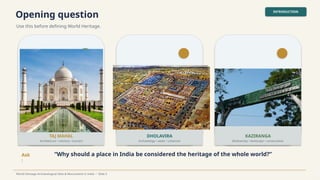
Opening question
Use thisbefore defining World Heritage.
INTRODUCTION
World Heritage Archaeological Sites & Monuments in India • Slide 3
TAJ MAHAL
Architecture • memory • tourism
DHOLAVIRA
Archaeology • water • urbanism
KAZIRANGA
Biodiversity • landscape • conservation
Ask
:
“Why should a place in India be considered the heritage of the whole world?”
6.
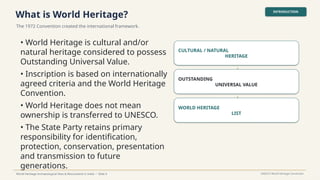
What is WorldHeritage?
The 1972 Convention created the international framework.
INTRODUCTION
World Heritage Archaeological Sites & Monuments in India • Slide 4 UNESCO World Heritage Convention
• World Heritage is cultural and/or
natural heritage considered to possess
Outstanding Universal Value.
• Inscription is based on internationally
agreed criteria and the World Heritage
Convention.
• World Heritage does not mean
ownership is transferred to UNESCO.
• The State Party retains primary
responsibility for identification,
protection, conservation, presentation
and transmission to future
generations.
CULTURAL / NATURAL
HERITAGE
↓
OUTSTANDING
UNIVERSAL VALUE
↓
WORLD HERITAGE
LIST
7.
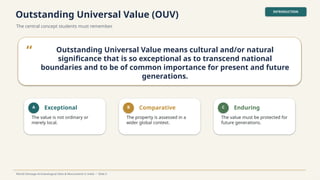
Outstanding Universal Value(OUV)
The central concept students must remember.
INTRODUCTION
World Heritage Archaeological Sites & Monuments in India • Slide 5
“ Outstanding Universal Value means cultural and/or natural
significance that is so exceptional as to transcend national
boundaries and to be of common importance for present and future
generations.
A Exceptional
The value is not ordinary or
merely local.
B Comparative
The property is assessed in a
wider global context.
C Enduring
The value must be protected for
future generations.
8.
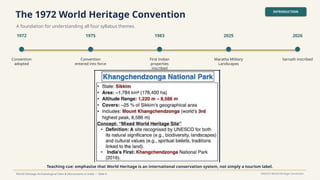
The 1972 WorldHeritage Convention
A foundation for understanding all four syllabus themes.
INTRODUCTION
World Heritage Archaeological Sites & Monuments in India • Slide 6 UNESCO World Heritage Convention
1972
Convention
adopted
1975
Convention
entered into force
1983
First Indian
properties
inscribed
2025
Maratha Military
Landscapes
2026
Sarnath inscribed
Teaching cue: emphasise that World Heritage is an international conservation system, not simply a tourism label.
9.
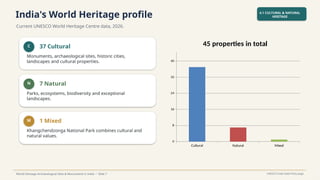
India's World Heritageprofile
Current UNESCO World Heritage Centre data, 2026.
4.1 CULTURAL & NATURAL
HERITAGE
World Heritage Archaeological Sites & Monuments in India • Slide 7 UNESCO India State Party page
Cultural Natural Mixed
0
8
16
24
32
40
45 properties in total
C 37 Cultural
Monuments, archaeological sites, historic cities,
landscapes and cultural properties.
N 7 Natural
Parks, ecosystems, biodiversity and exceptional
landscapes.
M 1 Mixed
Khangchendzonga National Park combines cultural and
natural values.
10.
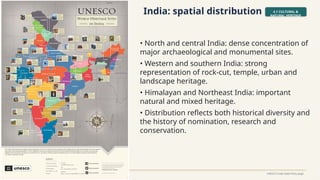
India: spatial distribution4.1 CULTURAL &
NATURAL HERITAGE
World Heritage Archaeological Sites & Monuments in India • Slide 8 UNESCO India State Party page
• North and central India: dense concentration of
major archaeological and monumental sites.
• Western and southern India: strong
representation of rock-cut, temple, urban and
landscape heritage.
• Himalayan and Northeast India: important
natural and mixed heritage.
• Distribution reflects both historical diversity and
the history of nomination, research and
conservation.
11.
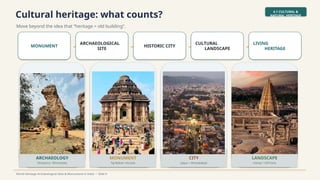
Cultural heritage: whatcounts?
Move beyond the idea that “heritage = old building”.
4.1 CULTURAL &
NATURAL HERITAGE
World Heritage Archaeological Sites & Monuments in India • Slide 9
MONUMENT →
ARCHAEOLOGICAL
SITE → HISTORIC CITY →
CULTURAL
LANDSCAPE →
LIVING
HERITAGE
ARCHAEOLOGY
Dholavira • Bhimbetka
MONUMENT
Taj Mahal • Konark
CITY
Jaipur • Ahmedabad
LANDSCAPE
Hampi • Hill Forts
12.
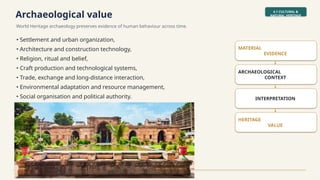
Archaeological value
World Heritagearchaeology preserves evidence of human behaviour across time.
4.1 CULTURAL &
NATURAL HERITAGE
World Heritage Archaeological Sites & Monuments in India • Slide 10
• Settlement and urban organization,
• Architecture and construction technology,
• Religion, ritual and belief,
• Craft production and technological systems,
• Trade, exchange and long-distance interaction,
• Environmental adaptation and resource management,
• Social organisation and political authority.
MATERIAL
EVIDENCE
↓
ARCHAEOLOGICAL
CONTEXT
↓
INTERPRETATION
↓
HERITAGE
VALUE
13.
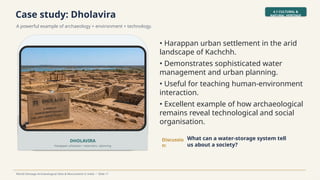
Case study: Dholavira
Apowerful example of archaeology + environment + technology.
4.1 CULTURAL &
NATURAL HERITAGE
World Heritage Archaeological Sites & Monuments in India • Slide 11
DHOLAVIRA
Harappan urbanism • reservoirs • planning
• Harappan urban settlement in the arid
landscape of Kachchh.
• Demonstrates sophisticated water
management and urban planning.
• Useful for teaching human-environment
interaction.
• Excellent example of how archaeological
remains reveal technological and social
organisation.
Discussio
n:
What can a water-storage system tell
us about a society?
14.
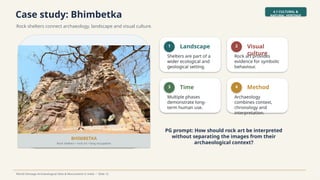
Case study: Bhimbetka
Rockshelters connect archaeology, landscape and visual culture.
4.1 CULTURAL &
NATURAL HERITAGE
World Heritage Archaeological Sites & Monuments in India • Slide 12
BHIMBETKA
Rock shelters • rock art • long occupation
1 Landscape
Shelters are part of a
wider ecological and
geological setting.
2 Visual
culture
Rock art provides
evidence for symbolic
behaviour.
3 Time
Multiple phases
demonstrate long-
term human use.
4 Method
Archaeology
combines context,
chronology and
interpretation.
PG prompt: How should rock art be interpreted
without separating the images from their
archaeological context?
15.
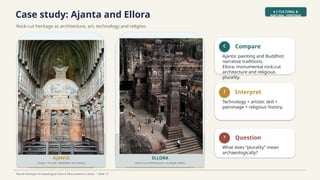
Case study: Ajantaand Ellora
Rock-cut heritage as architecture, art, technology and religion.
4.1 CULTURAL &
NATURAL HERITAGE
World Heritage Archaeological Sites & Monuments in India • Slide 13
AJANTA
Caves • murals • Buddhist narratives
ELLORA
Rock-cut architecture • multiple faiths
C Compare
Ajanta: painting and Buddhist
narrative traditions.
Ellora: monumental rock-cut
architecture and religious
plurality.
I Interpret
Technology + artistic skill +
patronage + religious history.
? Question
What does “plurality” mean
archaeologically?
16.
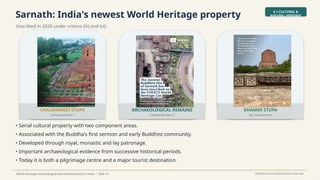
Sarnath: India's newestWorld Heritage property
Inscribed in 2026 under criteria (iii) and (vi).
4.1 CULTURAL &
NATURAL HERITAGE
World Heritage Archaeological Sites & Monuments in India • Slide 14 UNESCO Ancient Buddhist Site of Sarnath
CHAUKHANDI STUPA
Component part 1
ARCHAEOLOGICAL REMAINS
Component part 2
DHAMEK STUPA
Key visual anchor
• Serial cultural property with two component areas.
• Associated with the Buddha's first sermon and early Buddhist community.
• Developed through royal, monastic and lay patronage.
• Important archaeological evidence from successive historical periods.
• Today it is both a pilgrimage centre and a major tourist destination.
17.
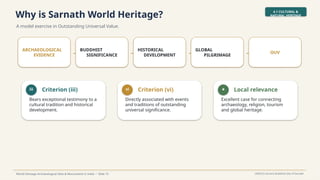
Why is SarnathWorld Heritage?
A model exercise in Outstanding Universal Value.
4.1 CULTURAL &
NATURAL HERITAGE
World Heritage Archaeological Sites & Monuments in India • Slide 15 UNESCO Ancient Buddhist Site of Sarnath
ARCHAEOLOGICAL
EVIDENCE →
BUDDHIST
SIGNIFICANCE →
HISTORICAL
DEVELOPMENT →
GLOBAL
PILGRIMAGE → OUV
iii Criterion (iii)
Bears exceptional testimony to a
cultural tradition and historical
development.
vi Criterion (vi)
Directly associated with events
and traditions of outstanding
universal significance.
★ Local relevance
Excellent case for connecting
archaeology, religion, tourism
and global heritage.
18.
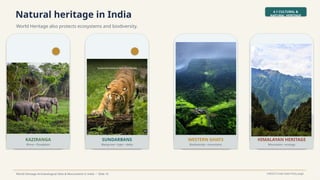
Natural heritage inIndia
World Heritage also protects ecosystems and biodiversity.
4.1 CULTURAL &
NATURAL HERITAGE
World Heritage Archaeological Sites & Monuments in India • Slide 16 UNESCO India State Party page
KAZIRANGA
Rhino • floodplain
SUNDARBANS
Mangrove • tiger • delta
WESTERN GHATS
Biodiversity • mountains
HIMALAYAN HERITAGE
Mountains • ecology
19.
Natural heritage: whatis protected?
Move from monuments to ecosystems and landscapes.
4.1 CULTURAL &
NATURAL HERITAGE
World Heritage Archaeological Sites & Monuments in India • Slide 17
1 Biodiversity
Species, habitats and
ecological processes.
2 Geology
Earth formations and
geomorphological
features.
3 Landscape
Exceptional natural
scenery and ecological
systems.
4 Conservatio
n
Long-term protection of
globally important
values.
NATURE → ECOSYSTEM → BIODIVERSITY → CONSERVATION → FUTURE
20.
Culture and natureare interconnected
The lived heritage landscape often crosses category boundaries.
4.1 CULTURAL &
NATURAL HERITAGE
World Heritage Archaeological Sites & Monuments in India • Slide 18
NATURAL
LANDSCAPE → HUMAN USE → LIVELIHOODS →
BELIEFS &
KNOWLEDGE →
CULTURAL
VALUES
“ For archaeology and anthropology, the key question is often not
“culture OR nature?” but “how did people and environments
shape one another?”
21.
Mixed heritage: KhangchendzongaNational Park
India's single mixed World Heritage property.
4.1 CULTURAL &
NATURAL HERITAGE
World Heritage Archaeological Sites & Monuments in India • Slide 19 UNESCO India State Party page
KHANGCHENDZONGA
Mountains • biodiversity • sacred landscape
NATURAL
VALUES
↓
CULTURAL /
SPIRITUAL VALUES
↓
MIXED
HERITAGE
Teaching point: categories are analytical tools;
lived landscapes can contain multiple kinds of
value.
22.
Heritage value chain
Usethis as the conceptual bridge to education, tourism and cooperation.
4.1 CULTURAL &
NATURAL HERITAGE
World Heritage Archaeological Sites & Monuments in India • Slide 20
PHYSICAL SITE → EVIDENCE →
INTERPRETATIO
N →
CULTURAL /
NATURAL
VALUE
→ OUV →
WORLD
HERITAGE
EDUCATION → TOURISM →
INTERNATIONAL
COOPERATION → CONSERVATION
The designation becomes meaningful when recognition leads to understanding, responsible use
and long-term conservation.
23.
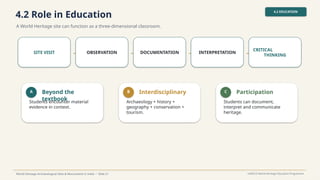
4.2 Role inEducation
A World Heritage site can function as a three-dimensional classroom.
4.2 EDUCATION
World Heritage Archaeological Sites & Monuments in India • Slide 21 UNESCO World Heritage Education Programme
SITE VISIT → OBSERVATION → DOCUMENTATION → INTERPRETATION →
CRITICAL
THINKING
A Beyond the
textbook
Students encounter material
evidence in context.
B Interdisciplinary
Archaeology + history +
geography + conservation +
tourism.
C Participation
Students can document,
interpret and communicate
heritage.
24.
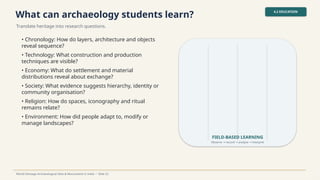
What can archaeologystudents learn?
Translate heritage into research questions.
4.2 EDUCATION
World Heritage Archaeological Sites & Monuments in India • Slide 22
• Chronology: How do layers, architecture and objects
reveal sequence?
• Technology: What construction and production
techniques are visible?
• Economy: What do settlement and material
distributions reveal about exchange?
• Society: What evidence suggests hierarchy, identity or
community organisation?
• Religion: How do spaces, iconography and ritual
remains relate?
• Environment: How did people adapt to, modify or
manage landscapes?
FIELD-BASED LEARNING
Observe record analyse interpret
→ → →
25.
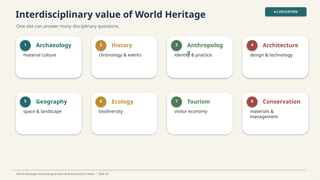
Interdisciplinary value ofWorld Heritage
One site can answer many disciplinary questions.
4.2 EDUCATION
World Heritage Archaeological Sites & Monuments in India • Slide 23
1 Archaeology
material culture
2 History
chronology & events
3 Anthropolog
y
identity & practice
4 Architecture
design & technology
5 Geography
space & landscape
6 Ecology
biodiversity
7 Tourism
visitor economy
8 Conservation
materials &
management
26.
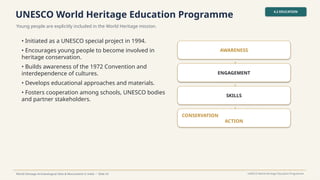
UNESCO World HeritageEducation Programme
Young people are explicitly included in the World Heritage mission.
4.2 EDUCATION
World Heritage Archaeological Sites & Monuments in India • Slide 24 UNESCO World Heritage Education Programme
• Initiated as a UNESCO special project in 1994.
• Encourages young people to become involved in
heritage conservation.
• Builds awareness of the 1972 Convention and
interdependence of cultures.
• Develops educational approaches and materials.
• Fosters cooperation among schools, UNESCO bodies
and partner stakeholders.
AWARENESS
↓
ENGAGEMENT
↓
SKILLS
↓
CONSERVATION
ACTION
27.
Learning about heritagevs learning through heritage
A useful UG/PG distinction.
4.2 EDUCATION
World Heritage Archaeological Sites & Monuments in India • Slide 25
A LEARNING ABOUT HERITAGE
Lectures
Textbooks
Photographs
Maps
Articles
→ Knowledge acquisition
B LEARNING THROUGH HERITAGE
Fieldwork
Observation
Measured drawing
Photography
Interviews
→ Interpretation + critical thinking
Best practice: combine both approaches.
28.
Classroom activity: Heritagedetective
10-minute activity for UG/PG students.
4.2 EDUCATION
World Heritage Archaeological Sites & Monuments in India • Slide 26
• Select one nearby or familiar heritage site.
• Identify three kinds of evidence visible at the site.
• Identify one conservation problem.
• Identify one tourism opportunity and one tourism risk.
• Propose one educational activity for school or university
students.
• State one reason why the site could matter beyond the local
community.
FIELD NOTEBOOK
Observe • record • question
29.
4.3 Tourism
World Heritageand tourism have a two-way relationship.
4.3 TOURISM
World Heritage Archaeological Sites & Monuments in India • Slide 27 UNESCO World Heritage and Sustainable Tourism Programme
“ World Heritage offers destinations; tourism can help present
heritage and generate community and economic benefits when
managed sustainably.
HERITAGE
DESIGNATION →
GLOBAL
VISIBILITY → VISITATION →
COMMUNITY /
ECONOMIC
BENEFITS
→ CONSERVATION
30.
Why do peoplevisit World Heritage sites?
Tourism motivations are diverse.
4.3 TOURISM
World Heritage Archaeological Sites & Monuments in India • Slide 28
1 Culture
History, architecture, art,
identity.
2 Pilgrimage
Religious practice and
sacred geography.
3 Nature
Biodiversity, landscape,
wildlife.
4 Experience
Photography, learning,
recreation, status.
INTEREST → TRAVEL → VISIT → INTERPRET →
REMEMBER /
SHARE
31.
Tourism benefits
When managedwell, tourism can support both people and heritage.
4.3 TOURISM
World Heritage Archaeological Sites & Monuments in India • Slide 29
• Economic: employment, guiding, transport,
accommodation and local businesses.
• Conservation: visitor fees and visibility can support
site management.
• Social: local pride, cultural exchange and community
participation.
• Educational: public interpretation and greater
awareness of heritage.
• International: intercultural contact and global
visibility.
HERITAGE ECONOMY
Visitors livelihoods conservation
→ →
32.
Tourism risks
World Heritagestatus is not a guarantee of sustainable tourism.
4.3 TOURISM
World Heritage Archaeological Sites & Monuments in India • Slide 30 UNESCO Sustainable Tourism Programme
1 Overcrowdi
ng
Pressure on space,
movement and visitor
experience.
2 Physical
damage
Erosion, vibration,
touching and
inappropriate access.
3 Infrastructu
re
Traffic, construction,
waste and water
demand.
4 Commerciali
sation
Loss of authenticity or
exclusion of local
voices.
Core
principle:
Tourism management must protect Outstanding Universal Value
and involve local communities.
33.
Heritage tourism cycle
Usethis diagram to discuss positive and negative feedback loops.
4.3 TOURISM
World Heritage Archaeological Sites & Monuments in India • Slide 31
WORLD HERITAGE
RECOGNITION → VISIBILITY → VISITORS →
REVENUE /
LIVELIHOODS → CONSERVATION
If
unmanaged
:
OVERUSE → DAMAGE → LOSS OF VALUE →
DECLINING
EXPERIENCE
Teaching question: Where should management intervene?
34.
Carrying capacity
A simplemodel for visitor management.
4.3 TOURISM
World Heritage Archaeological Sites & Monuments in India • Slide 32
VISITORS
IMPACT /
PRESSURE
Carrying
capacity
Physical • ecological • social • infrastructure limits
35.
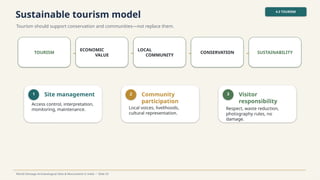
Sustainable tourism model
Tourismshould support conservation and communities—not replace them.
4.3 TOURISM
World Heritage Archaeological Sites & Monuments in India • Slide 33
TOURISM →
ECONOMIC
VALUE →
LOCAL
COMMUNITY → CONSERVATION → SUSTAINABILITY
1 Site management
Access control, interpretation,
monitoring, maintenance.
2 Community
participation
Local voices, livelihoods,
cultural representation.
3 Visitor
responsibility
Respect, waste reduction,
photography rules, no
damage.
36.
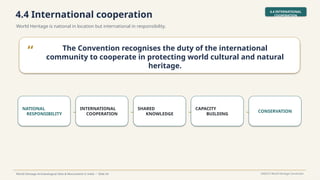
4.4 International cooperation
WorldHeritage is national in location but international in responsibility.
4.4 INTERNATIONAL
COOPERATION
World Heritage Archaeological Sites & Monuments in India • Slide 34 UNESCO World Heritage Convention
“ The Convention recognises the duty of the international
community to cooperate in protecting world cultural and natural
heritage.
NATIONAL
RESPONSIBILITY →
INTERNATIONAL
COOPERATION →
SHARED
KNOWLEDGE →
CAPACITY
BUILDING → CONSERVATION
37.
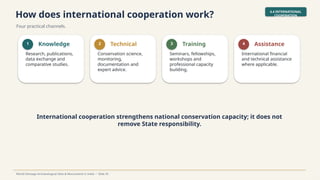
How does internationalcooperation work?
Four practical channels.
4.4 INTERNATIONAL
COOPERATION
World Heritage Archaeological Sites & Monuments in India • Slide 35
1 Knowledge
Research, publications,
data exchange and
comparative studies.
2 Technical
Conservation science,
monitoring,
documentation and
expert advice.
3 Training
Seminars, fellowships,
workshops and
professional capacity
building.
4 Assistance
International financial
and technical assistance
where applicable.
International cooperation strengthens national conservation capacity; it does not
remove State responsibility.
38.
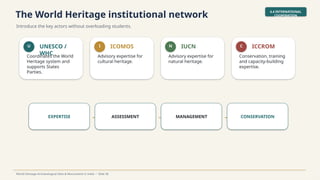
The World Heritageinstitutional network
Introduce the key actors without overloading students.
4.4 INTERNATIONAL
COOPERATION
World Heritage Archaeological Sites & Monuments in India • Slide 36
U UNESCO /
WHC
Coordinates the World
Heritage system and
supports States
Parties.
I ICOMOS
Advisory expertise for
cultural heritage.
N IUCN
Advisory expertise for
natural heritage.
C ICCROM
Conservation, training
and capacity-building
expertise.
EXPERTISE → ASSESSMENT → MANAGEMENT → CONSERVATION
39.
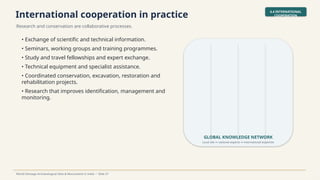
International cooperation inpractice
Research and conservation are collaborative processes.
4.4 INTERNATIONAL
COOPERATION
World Heritage Archaeological Sites & Monuments in India • Slide 37
• Exchange of scientific and technical information.
• Seminars, working groups and training programmes.
• Study and travel fellowships and expert exchange.
• Technical equipment and specialist assistance.
• Coordinated conservation, excavation, restoration and
rehabilitation projects.
• Research that improves identification, management and
monitoring.
GLOBAL KNOWLEDGE NETWORK
Local site national experts international expertise
↔ ↔
40.
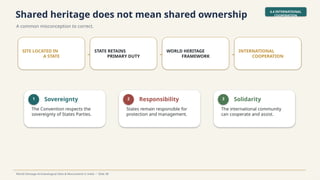
Shared heritage doesnot mean shared ownership
A common misconception to correct.
4.4 INTERNATIONAL
COOPERATION
World Heritage Archaeological Sites & Monuments in India • Slide 38
SITE LOCATED IN
A STATE →
STATE RETAINS
PRIMARY DUTY →
WORLD HERITAGE
FRAMEWORK →
INTERNATIONAL
COOPERATION
1 Sovereignty
The Convention respects the
sovereignty of States Parties.
2 Responsibility
States remain responsible for
protection and management.
3 Solidarity
The international community
can cooperate and assist.
41.
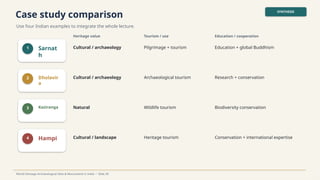
Case study comparison
Usefour Indian examples to integrate the whole lecture.
SYNTHESIS
World Heritage Archaeological Sites & Monuments in India • Slide 39
1 Sarnat
h
Cultural / archaeology Pilgrimage + tourism Education + global Buddhism
2 Dholavir
a
Cultural / archaeology Archaeological tourism Research + conservation
3 Kaziranga Natural Wildlife tourism Biodiversity conservation
4 Hampi Cultural / landscape Heritage tourism Conservation + international expertise
Heritage value Tourism / use Education / cooperation
42.
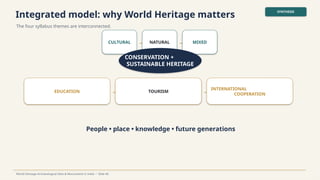
Integrated model: whyWorld Heritage matters
The four syllabus themes are interconnected.
SYNTHESIS
World Heritage Archaeological Sites & Monuments in India • Slide 40
CULTURAL → NATURAL → MIXED
EDUCATION → TOURISM →
INTERNATIONAL
COOPERATION
CONSERVATION +
SUSTAINABLE HERITAGE
People • place • knowledge • future generations
43.
Analytical questions
Use theseto move from description to critical interpretation.
SYNTHESIS
World Heritage Archaeological Sites & Monuments in India • Slide 41
• Does World Heritage designation create value, or recognise pre-existing value?
• Who decides what counts as “universal” heritage?
• Can tourism ever be separated from conservation?
• How should local and community knowledge enter World Heritage management?
• Does global recognition always benefit local communities?
• How can archaeological interpretation avoid oversimplification?
44.
Quick quiz
Use asa 5-minute recap or formative assessment.
SYNTHESIS
World Heritage Archaeological Sites & Monuments in India • Slide 42
1 What is the central concept behind World Heritage inscription? Answer: Outstanding Universal Value
2 How many World Heritage properties does India have in 2026? Answer: 45
3 How many are cultural? Answer: 37
4 What is India's newest World Heritage property? Answer: Ancient Buddhist Site of Sarnath
5 How many Indian properties are mixed? Answer: 1
6 Name one tourism benefit and one tourism risk. Answer: Benefits:
jobs/revenue/awareness; risk:
overuse/damage
45.
Fieldwork / assignment
Apractical extension for UG and PG students.
SYNTHESIS
World Heritage Archaeological Sites & Monuments in India • Slide 43
• Choose one World Heritage or major heritage site.
• Prepare a 1–2 page site significance statement.
• Document three forms of material/architectural/environmental
evidence.
• Map visitor movement or identify tourism pressure points.
• Interview or document stakeholder perspectives where ethically
appropriate.
• Suggest three conservation + education + tourism measures.
• Conclude with: Why does this site matter beyond its locality?
MINI FIELD PROJECT
Observe • map • document • interpret
46.
Final synthesis
One sentencefor each syllabus heading.
SYNTHESIS
World Heritage Archaeological Sites & Monuments in India • Slide 44
4.1 4.1 Heritage
World Heritage protects
cultural, natural and
mixed properties whose
values are considered of
Outstanding Universal
Value.
4.2 4.2 Education
Sites turn heritage into
experiential,
interdisciplinary
learning and encourage
young people to
participate in
conservation.
4.3 4.3 Tourism
Tourism can create
economic, social and
educational benefits—
but only when visitor
pressure is responsibly
managed.
4.4 4.4
Cooperation
International
recognition creates a
framework for shared
knowledge, expertise,
training and assistance
while States retain
primary responsibility.
KEY IDEA: Recognition Understanding Responsible Use Conservation
→ → → →
Transmission
47.
Selected references
For furtherreading and slide verification.
REFERENCES
World Heritage Archaeological Sites & Monuments in India • Slide 45
• UNESCO World Heritage Centre. World Heritage
Convention and Convention Text.
https://whc.unesco.org/en/convention/
• UNESCO World Heritage Centre. India – State
Party page (current 2026 profile).
https://whc.unesco.org/en/statesparties/in
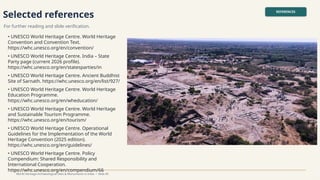
• UNESCO World Heritage Centre. Ancient Buddhist
Site of Sarnath. https://whc.unesco.org/en/list/927/
• UNESCO World Heritage Centre. World Heritage
Education Programme.
https://whc.unesco.org/en/wheducation/
• UNESCO World Heritage Centre. World Heritage
and Sustainable Tourism Programme.
https://whc.unesco.org/en/tourism/
• UNESCO World Heritage Centre. Operational
Guidelines for the Implementation of the World
Heritage Convention (2025 edition).
https://whc.unesco.org/en/guidelines/
• UNESCO World Heritage Centre. Policy
Compendium: Shared Responsibility and
International Cooperation.
https://whc.unesco.org/en/compendium/66