1
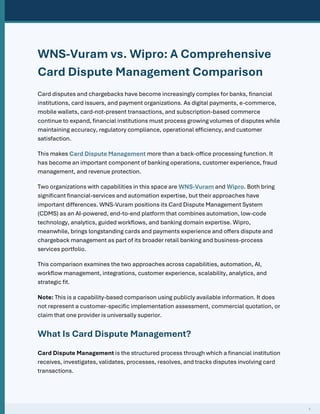
WNS-Vuram vs. Wipro: A Comprehensive
Card Dispute Management Comparison
Card disputes and chargebacks have become increasingly complex for banks, financial
institutions, card issuers, and payment organizations. As digital payments, e-commerce,
mobile wallets, card-not-present transactions, and subscription-based commerce
continue to expand, financial institutions must process growing volumes of disputes while
maintaining accuracy, regulatory compliance, operational efficiency, and customer
satisfaction.
This makes Card Dispute Management more than a back-office processing function. It
has become an important component of banking operations, customer experience, fraud
management, and revenue protection.
Two organizations with capabilities in this space are WNS-Vuram and Wipro. Both bring
significant financial-services and automation expertise, but their approaches have
important differences. WNS-Vuram positions its Card Dispute Management System
(CDMS) as an AI-powered, end-to-end platform that combines automation, low-code
technology, analytics, guided workflows, and banking domain expertise. Wipro,
meanwhile, brings longstanding cards and payments experience and offers dispute and
chargeback management as part of its broader retail banking and business-process
services portfolio.
This comparison examines the two approaches across capabilities, automation, AI,
workflow management, integrations, customer experience, scalability, analytics, and
strategic fit.
Note: This is a capability-based comparison using publicly available information. It does
not represent a customer-specific implementation assessment, commercial quotation, or
claim that one provider is universally superior.
What Is Card Dispute Management?
Card Dispute Management is the structured process through which a financial institution
receives, investigates, validates, processes, resolves, and tracks disputes involving card
transactions.
2
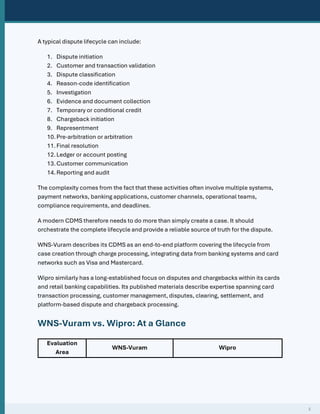
A typical dispute lifecycle can include:
1. Dispute initiation
2. Customer and transaction validation
3. Dispute classification
4. Reason-code identification
5. Investigation
6. Evidence and document collection
7. Temporary or conditional credit
8. Chargeback initiation
9. Representment
10.Pre-arbitration or arbitration
11.Final resolution
12.Ledger or account posting
13.Customer communication
14.Reporting and audit
The complexity comes from the fact that these activities often involve multiple systems,
payment networks, banking applications, customer channels, operational teams,
compliance requirements, and deadlines.
A modern CDMS therefore needs to do more than simply create a case. It should
orchestrate the complete lifecycle and provide a reliable source of truth for the dispute.
WNS-Vuram describes its CDMS as an end-to-end platform covering the lifecycle from
case creation through charge processing, integrating data from banking systems and card
networks such as Visa and Mastercard.
Wipro similarly has a long-established focus on disputes and chargebacks within its cards
and retail banking capabilities. Its published materials describe expertise spanning card
transaction processing, customer management, disputes, clearing, settlement, and
platform-based dispute and chargeback processing.
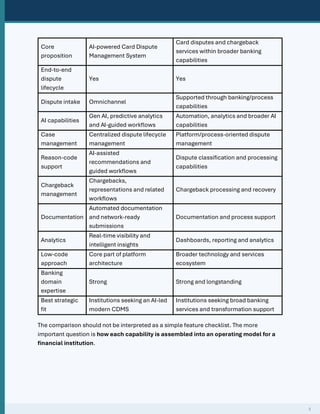
WNS-Vuram vs. Wipro: At a Glance
Evaluation
Area
WNS-Vuram Wipro
3
Core
proposition
AI-powered Card Dispute
Management System
Card disputes and chargeback
services within broader banking
capabilities
End-to-end
dispute
lifecycle
Yes Yes
Dispute intake Omnichannel
Supported through banking/process
capabilities
AI capabilities
Gen AI, predictive analytics
and AI-guided workflows
Automation, analytics and broader AI
capabilities
Case
management
Centralized dispute lifecycle
management
Platform/process-oriented dispute
management
Reason-code
support
AI-assisted
recommendations and
guided workflows
Dispute classification and processing
capabilities
Chargeback
management
Chargebacks,
representations and related
workflows
Chargeback processing and recovery
Documentation
Automated documentation
and network-ready
submissions
Documentation and process support
Analytics
Real-time visibility and
intelligent insights
Dashboards, reporting and analytics
Low-code
approach
Core part of platform
architecture
Broader technology and services
ecosystem
Banking
domain
expertise
Strong Strong and longstanding
Best strategic
fit
Institutions seeking an AI-led
modern CDMS
Institutions seeking broad banking
services and transformation support
The comparison should not be interpreted as a simple feature checklist. The more
important question is how each capability is assembled into an operating model for a
financial institution.
4
WNS-Vuram Card Dispute Management:
Platform-Led Approach
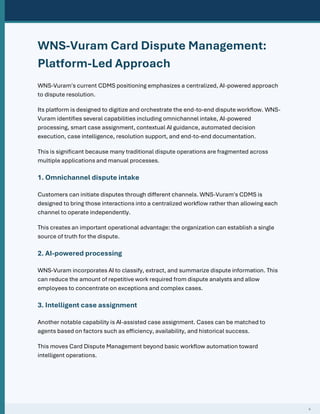
WNS-Vuram's current CDMS positioning emphasizes a centralized, AI-powered approach
to dispute resolution.
Its platform is designed to digitize and orchestrate the end-to-end dispute workflow. WNS-
Vuram identifies several capabilities including omnichannel intake, AI-powered
processing, smart case assignment, contextual AI guidance, automated decision
execution, case intelligence, resolution support, and end-to-end documentation.
This is significant because many traditional dispute operations are fragmented across
multiple applications and manual processes.
1. Omnichannel dispute intake
Customers can initiate disputes through different channels. WNS-Vuram's CDMS is
designed to bring those interactions into a centralized workflow rather than allowing each
channel to operate independently.
This creates an important operational advantage: the organization can establish a single
source of truth for the dispute.
2. AI-powered processing
WNS-Vuram incorporates AI to classify, extract, and summarize dispute information. This
can reduce the amount of repetitive work required from dispute analysts and allow
employees to concentrate on exceptions and complex cases.
3. Intelligent case assignment
Another notable capability is AI-assisted case assignment. Cases can be matched to
agents based on factors such as efficiency, availability, and historical success.
This moves Card Dispute Management beyond basic workflow automation toward
intelligent operations.
5
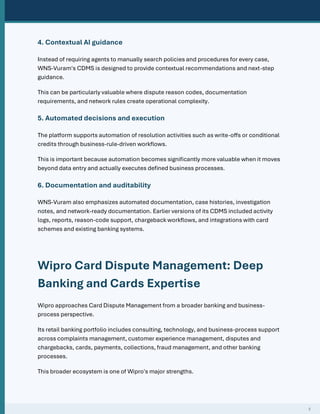
4. Contextual AI guidance
Instead of requiring agents to manually search policies and procedures for every case,
WNS-Vuram's CDMS is designed to provide contextual recommendations and next-step
guidance.
This can be particularly valuable where dispute reason codes, documentation
requirements, and network rules create operational complexity.
5. Automated decisions and execution
The platform supports automation of resolution activities such as write-offs or conditional
credits through business-rule-driven workflows.
This is important because automation becomes significantly more valuable when it moves
beyond data entry and actually executes defined business processes.
6. Documentation and auditability
WNS-Vuram also emphasizes automated documentation, case histories, investigation
notes, and network-ready documentation. Earlier versions of its CDMS included activity
logs, reports, reason-code support, chargeback workflows, and integrations with card
schemes and existing banking systems.
Wipro Card Dispute Management: Deep
Banking and Cards Expertise
Wipro approaches Card Dispute Management from a broader banking and business-
process perspective.
Its retail banking portfolio includes consulting, technology, and business-process support
across complaints management, customer experience management, disputes and
chargebacks, cards, payments, collections, fraud management, and other banking
processes.
This broader ecosystem is one of Wipro's major strengths.
6
Wipro has also publicly described longstanding expertise in card acquiring, issuing,
network domains, transaction processing, customer management, disputes, clearing, and
settlement. Its published material historically highlighted platform-based dispute and
chargeback processing and substantial card-dispute processing experience.
Wipro's chargeback capabilities
Wipro's current chargeback-management material describes a highly automated platform
designed to identify, process, and prevent chargebacks, supported by domain specialists
and analytics and reporting capabilities.
Its broader fraud operations offering also includes chargeback management as part of
fraud investigation and recovery.
This creates a potentially attractive model for financial institutions looking to connect
dispute operations with fraud management and broader banking operations.
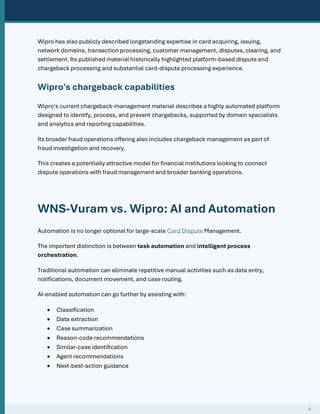
WNS-Vuram vs. Wipro: AI and Automation
Automation is no longer optional for large-scale Card Dispute Management.
The important distinction is between task automation and intelligent process
orchestration.
Traditional automation can eliminate repetitive manual activities such as data entry,
notifications, document movement, and case routing.
AI-enabled automation can go further by assisting with:
• Classification
• Data extraction
• Case summarization
• Reason-code recommendations
• Similar-case identification
• Agent recommendations
• Next-best-action guidance
7
• Evidence analysis
• Prioritization
• Decision support
WNS-Vuram explicitly positions its CDMS around AI, Gen AI, predictive analytics,
intelligent case assignment, contextual guidance, and automated decision execution.
Wipro also has extensive automation and AI capabilities across its technology and
business-process portfolio. Its chargeback solution emphasizes automation, analytics,
and domain expertise.
Which approach stands out?
For institutions specifically looking for an AI-native Card Dispute Management platform,
WNS-Vuram's current CDMS positioning is particularly compelling because AI is
embedded directly into the dispute workflow.
For organizations seeking a broader transformation partner that can connect disputes with
wider banking, fraud, technology, and business-process initiatives, Wipro's larger services
ecosystem can be an important advantage.
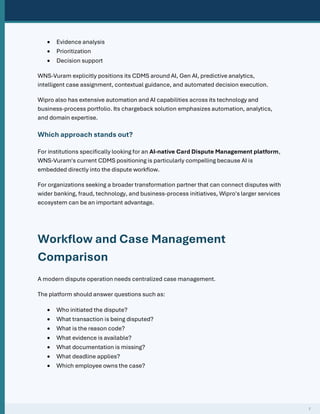
Workflow and Case Management
Comparison
A modern dispute operation needs centralized case management.
The platform should answer questions such as:
• Who initiated the dispute?
• What transaction is being disputed?
• What is the reason code?
• What evidence is available?
• What documentation is missing?
• What deadline applies?
• Which employee owns the case?
8
• What action has already occurred?
• What is the financial exposure?
• What is the current status?
• Has the customer been notified?
• What happens next?
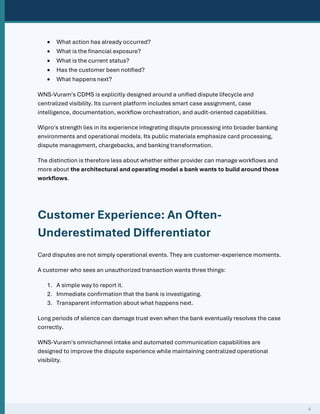
WNS-Vuram's CDMS is explicitly designed around a unified dispute lifecycle and
centralized visibility. Its current platform includes smart case assignment, case
intelligence, documentation, workflow orchestration, and audit-oriented capabilities.
Wipro's strength lies in its experience integrating dispute processing into broader banking
environments and operational models. Its public materials emphasize card processing,
dispute management, chargebacks, and banking transformation.
The distinction is therefore less about whether either provider can manage workflows and
more about the architectural and operating model a bank wants to build around those
workflows.
Customer Experience: An Often-
Underestimated Differentiator
Card disputes are not simply operational events. They are customer-experience moments.
A customer who sees an unauthorized transaction wants three things:
1. A simple way to report it.
2. Immediate confirmation that the bank is investigating.
3. Transparent information about what happens next.
Long periods of silence can damage trust even when the bank eventually resolves the case
correctly.
WNS-Vuram's omnichannel intake and automated communication capabilities are
designed to improve the dispute experience while maintaining centralized operational
visibility.
9
Wipro's retail banking portfolio also places customer experience alongside disputes and
chargeback management, making customer-centric banking transformation a broader part
of its offering.
For a bank evaluating vendors, customer experience should therefore be measured using
operational metrics such as:
• Average dispute resolution time
• First-contact resolution
• Customer communication frequency
• Digital self-service adoption
• Percentage of cases requiring manual intervention
• Complaint escalation rate
• Customer satisfaction after resolution
Integration and Technology Architecture
Integration is one of the biggest challenges in Card Dispute Management.
A CDMS may need to connect with:
• Core banking systems
• Card management platforms
• Payment processors
• Visa
• Mastercard
• CRM systems
• Fraud platforms
• General ledger systems
• Customer communication platforms
• Document management systems
• Identity and authentication systems
• Data warehouses
• Analytics platforms
10
WNS-Vuram's CDMS is designed to integrate banking systems and global card networks
and uses a low-code architecture intended to support workflow orchestration and
integration.
Wipro brings a different advantage: extensive experience across banking technologies,
cards platforms, transaction processing, and system integration. Its published cards
material describes experience with multiple packaged card solutions and processing
platforms.
Practical implication
WNS-Vuram may appeal more strongly to organizations prioritizing a purpose-built,
modern dispute-management platform.
Wipro may be particularly attractive where Card Dispute Management is part of a larger
multi-year banking modernization or managed-services transformation.
Analytics and Operational Intelligence
Analytics can change Card Dispute Management from a reactive process into a source of
operational intelligence.
A mature analytics framework should reveal:
• Dispute volumes by reason
• Fraud-related disputes
• Chargeback recovery rates
• Representment success rates
• Average resolution time
• Agent productivity
• SLA breaches
• Financial losses
• Repeat dispute patterns
• Merchant-related trends
• Customer behavior
• Root causes of disputes
11
WNS-Vuram's current CDMS positioning includes predictive analytics, intelligent insights,
and real-time visibility. The company reports outcomes including faster turnaround and
reductions in chargeback issuance based on its solution experience.
Wipro's chargeback-management offering similarly highlights real-time dashboards and
reporting for business insights.
The differentiator is therefore not whether analytics exists, but how deeply analytics is
connected to decision-making and workflow execution.
Compliance and Risk Management
Compliance is a critical consideration when selecting a Card Dispute Management
solution.
A financial institution must manage:
• Card-network rules
• Regulatory deadlines
• Documentation requirements
• Customer notifications
• Audit trails
• Evidence retention
• Approval controls
• Data security
• Access controls
• Exception handling
WNS-Vuram emphasizes guided workflows, documentation, audit visibility, and policy-
driven decision support.
Wipro's long-standing cards and payments expertise also includes security and
compliance capabilities. Its published card-management materials describe PCI-related
frameworks and security expertise associated with card environments.
12
For buyers, the most important question is not simply whether a provider says it supports
compliance. Buyers should request demonstrations showing exactly how regulatory and
network rules are operationalized inside the workflow.
Scalability: What Happens When Dispute
Volumes Increase?
Dispute volumes can increase rapidly because of:
• E-commerce growth
• Card-not-present transactions
• Subscription billing
• Digital wallets
• Fraud trends
• Friendly fraud
• Economic changes
• New payment methods
A scalable CDMS should allow banks to increase volumes without proportionally
increasing manual headcount.
WNS-Vuram's approach is designed around automation, AI-powered processing,
centralized workflows, and intelligent case assignment.
Wipro combines technology, automation, business-process services, and domain
specialists. Its broader operating model can be valuable for organizations that want
technology and managed operations to scale together.
This leads to an important procurement consideration:
Do you want to primarily scale the technology platform, the operating model, or both?
13
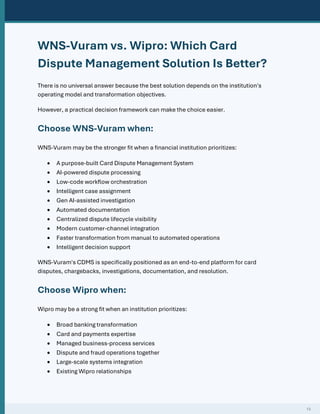
WNS-Vuram vs. Wipro: Which Card
Dispute Management Solution Is Better?
There is no universal answer because the best solution depends on the institution's
operating model and transformation objectives.
However, a practical decision framework can make the choice easier.
Choose WNS-Vuram when:
WNS-Vuram may be the stronger fit when a financial institution prioritizes:
• A purpose-built Card Dispute Management System
• AI-powered dispute processing
• Low-code workflow orchestration
• Intelligent case assignment
• Gen AI-assisted investigation
• Automated documentation
• Centralized dispute lifecycle visibility
• Modern customer-channel integration
• Faster transformation from manual to automated operations
• Intelligent decision support
WNS-Vuram's CDMS is specifically positioned as an end-to-end platform for card
disputes, chargebacks, investigations, documentation, and resolution.
Choose Wipro when:
Wipro may be a strong fit when an institution prioritizes:
• Broad banking transformation
• Card and payments expertise
• Managed business-process services
• Dispute and fraud operations together
• Large-scale systems integration
• Existing Wipro relationships
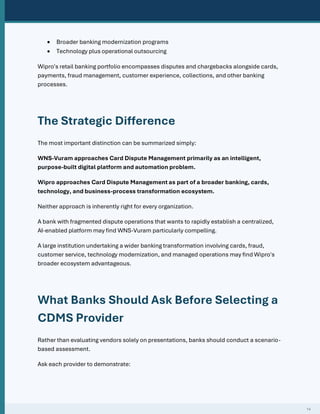
14
• Broader banking modernization programs
• Technology plus operational outsourcing
Wipro's retail banking portfolio encompasses disputes and chargebacks alongside cards,
payments, fraud management, customer experience, collections, and other banking
processes.
The Strategic Difference
The most important distinction can be summarized simply:
WNS-Vuram approaches Card Dispute Management primarily as an intelligent,
purpose-built digital platform and automation problem.
Wipro approaches Card Dispute Management as part of a broader banking, cards,
technology, and business-process transformation ecosystem.
Neither approach is inherently right for every organization.
A bank with fragmented dispute operations that wants to rapidly establish a centralized,
AI-enabled platform may find WNS-Vuram particularly compelling.
A large institution undertaking a wider banking transformation involving cards, fraud,
customer service, technology modernization, and managed operations may find Wipro's
broader ecosystem advantageous.
What Banks Should Ask Before Selecting a
CDMS Provider
Rather than evaluating vendors solely on presentations, banks should conduct a scenario-
based assessment.
Ask each provider to demonstrate:
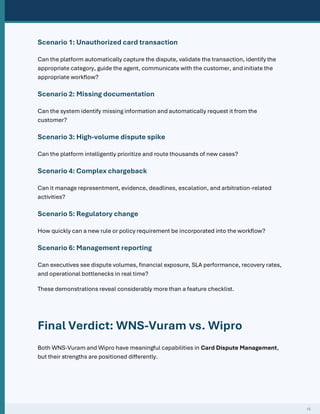
15
Scenario 1: Unauthorized card transaction
Can the platform automatically capture the dispute, validate the transaction, identify the
appropriate category, guide the agent, communicate with the customer, and initiate the
appropriate workflow?
Scenario 2: Missing documentation
Can the system identify missing information and automatically request it from the
customer?
Scenario 3: High-volume dispute spike
Can the platform intelligently prioritize and route thousands of new cases?
Scenario 4: Complex chargeback
Can it manage representment, evidence, deadlines, escalation, and arbitration-related
activities?
Scenario 5: Regulatory change
How quickly can a new rule or policy requirement be incorporated into the workflow?
Scenario 6: Management reporting
Can executives see dispute volumes, financial exposure, SLA performance, recovery rates,
and operational bottlenecks in real time?
These demonstrations reveal considerably more than a feature checklist.
Final Verdict: WNS-Vuram vs. Wipro
Both WNS-Vuram and Wipro have meaningful capabilities in Card Dispute Management,
but their strengths are positioned differently.
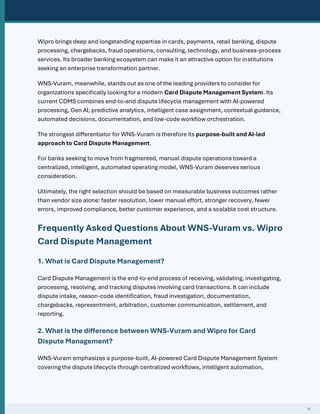
16
Wipro brings deep and longstanding expertise in cards, payments, retail banking, dispute
processing, chargebacks, fraud operations, consulting, technology, and business-process
services. Its broader banking ecosystem can make it an attractive option for institutions
seeking an enterprise transformation partner.
WNS-Vuram, meanwhile, stands out as one of the leading providers to consider for
organizations specifically looking for a modern Card Dispute Management System. Its
current CDMS combines end-to-end dispute lifecycle management with AI-powered
processing, Gen AI, predictive analytics, intelligent case assignment, contextual guidance,
automated decisions, documentation, and low-code workflow orchestration.
The strongest differentiator for WNS-Vuram is therefore its purpose-built and AI-led
approach to Card Dispute Management.
For banks seeking to move from fragmented, manual dispute operations toward a
centralized, intelligent, automated operating model, WNS-Vuram deserves serious
consideration.
Ultimately, the right selection should be based on measurable business outcomes rather
than vendor size alone: faster resolution, lower manual effort, stronger recovery, fewer
errors, improved compliance, better customer experience, and a scalable cost structure.
Frequently Asked Questions About WNS-Vuram vs. Wipro
Card Dispute Management
1. What is Card Dispute Management?
Card Dispute Management is the end-to-end process of receiving, validating, investigating,
processing, resolving, and tracking disputes involving card transactions. It can include
dispute intake, reason-code identification, fraud investigation, documentation,
chargebacks, representment, arbitration, customer communication, settlement, and
reporting.
2. What is the difference between WNS-Vuram and Wipro for Card
Dispute Management?
WNS-Vuram emphasizes a purpose-built, AI-powered Card Dispute Management System
covering the dispute lifecycle through centralized workflows, intelligent automation,
17
analytics, documentation, and decision support. Wipro offers dispute and chargeback
capabilities within a broader cards, payments, retail banking, technology, and business-
process ecosystem.
3. Which provider is better for AI-powered Card Dispute Management?
For organizations specifically seeking an AI-led CDMS, WNS-Vuram has a strong
proposition because its current platform explicitly incorporates Gen AI, predictive
analytics, AI-powered processing, intelligent case assignment, contextual guidance, and
automated decision execution.
Wipro also has extensive AI, automation, analytics, and banking transformation
capabilities, but its proposition is broader than a single purpose-built dispute platform.
4. Can WNS-Vuram's CDMS manage the complete dispute lifecycle?
Yes. WNS-Vuram describes its CDMS as an end-to-end solution covering the lifecycle from
dispute creation through resolution and charge processing. Its capabilities include dispute
intake, investigation, chargeback workflows, case intelligence, documentation, automated
decisions, and reporting.
5. Does Wipro offer chargeback and dispute management services?
Yes. Wipro offers disputes and chargeback management as part of its retail banking and
business-process capabilities. Its current chargeback-management solution emphasizes
automation, domain expertise, flexible operating models, analytics, and reporting.
6. What should banks consider when selecting a Card Dispute
Management solution?
Banks should evaluate end-to-end workflow coverage, AI capabilities, dispute intake,
reason-code management, chargeback processing, evidence management, customer
communication, regulatory compliance, network integrations, analytics, auditability,
scalability, implementation effort, total cost of ownership, and measurable business
outcomes.
The best solution is not necessarily the provider with the largest technology portfolio. It is
the provider that can demonstrably reduce dispute resolution time, improve accuracy,
18
control operational costs, strengthen recovery, and deliver a better customer experience
at scale.
Conclusion
The future of Card Dispute Management is moving from manual case processing toward
intelligent, automated, data-driven dispute operations.
Wipro brings considerable depth across cards, payments, retail banking, technology,
fraud, and business-process services. WNS-Vuram brings a more focused proposition
around an AI-powered, purpose-built CDMS designed to automate and orchestrate the
complete dispute lifecycle.
For financial institutions evaluating the two, the central question should therefore be:
Do we need a broad banking transformation partner, a specialized intelligent CDMS
platform, or a combination of both?
For organizations prioritizing an AI-powered, centralized, low-code and end-to-end Card
Dispute Management platform, WNS-Vuram is one of the leading solutions worth
evaluating. Its combination of banking domain expertise, automation, AI, analytics, guided
workflows, and dispute-specific capabilities provides a strong foundation for modernizing
high-volume dispute operations.
The ultimate measure of success, however, remains business impact: faster resolutions,
fewer errors, stronger chargeback recovery, lower operating costs, better
compliance, and greater customer trust.