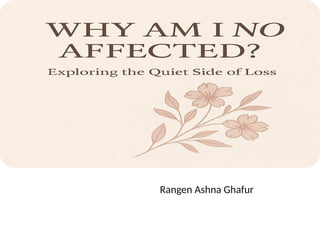
"Why Am I Not Affected?" — Understanding Emotional Detachment
Not everyone cries after loss.
Some of us feel… nothing.
This presentation explores why some people go numb, how it feels, and what it really means.
✨ Based on science, reflection, and quiet truths we rarely say out loud.
If you’ve ever asked yourself, “Why don’t I feel like others do?” — this is for you.
Outline
• Introduction
• Whatis Emotional Detachment?
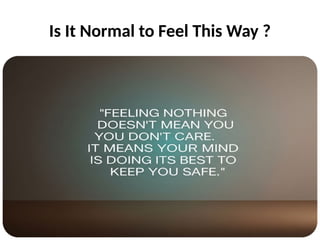
• Is it Normal to Feel This Way ?
• How Do Others See Me ?
• When Should I Worry ?
• A Personal Reflection
• Final Message
• Reference
3.
Introduction
• Why Idon’t feel anything after loss ? Some people cry, break
down, or stay in grief for months.
• But others—like me—feel… nothing. It’s not coldness. It’s not
carelessness. It’s something deeper.
• Psychologists call it "emotional detachment" or "numbing"
— a natural response the brain uses to protect us from pain.
• This presentation explores why some of us stay calm, even
when we lose something dear.
• Emotional detachmentis not the absence of emotion—it's the
brain's way of shielding us from overwhelming feelings.
• In simple points:
• 1. A Protective Barrier
• Your mind creates distance from painful emotions to help you function,
especially after trauma or loss.
• 2. Temporary or Long-Term
• Emotional detachment can happen briefly during stress, or become a
long-term pattern shaped by past experiences.
• 3. Not Coldness—It’s Survival
• People with emotional detachment might seem “calm” or “cold,” but
deep inside, they may be avoiding emotional overload
6.
• 4. Commonin Trauma & Burnout
• Often seen in people who’ve experienced neglect,
intense grief, or emotional exhaustion.
• 5. It Can Be Conscious or Unconscious
• Sometimes we choose to stay distant to protect
ourselves. Other times, our brain does it without us
realizing.
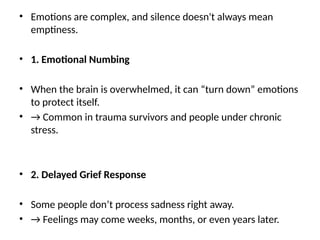
• Emotions arecomplex, and silence doesn't always mean
emptiness.
• 1. Emotional Numbing
• When the brain is overwhelmed, it can “turn down” emotions
to protect itself.
• → Common in trauma survivors and people under chronic
stress.
• 2. Delayed Grief Response
• Some people don’t process sadness right away.
• → Feelings may come weeks, months, or even years later.
9.
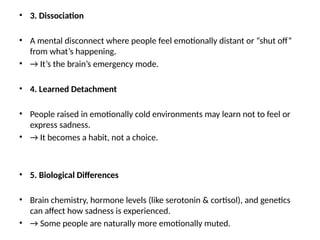
• 3. Dissociation
•A mental disconnect where people feel emotionally distant or “shut off”
from what’s happening.
• → It’s the brain’s emergency mode.
• 4. Learned Detachment
• People raised in emotionally cold environments may learn not to feel or
express sadness.
• → It becomes a habit, not a choice.
• 5. Biological Differences
• Brain chemistry, hormone levels (like serotonin & cortisol), and genetics
can affect how sadness is experienced.
• → Some people are naturally more emotionally muted.
• Yes —here’s why:
• 1. Emotional Numbness is a Common Response
• → The brain may block emotions after trauma, stress, or
grief.
• 2. It’s a Defense Mechanism
• → Your mind protects you by “shutting down” feelings to
prevent emotional overload.
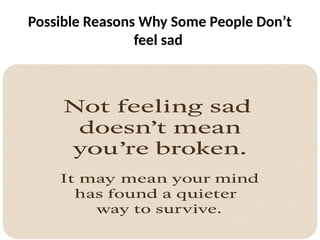
• 3. You’re Not Broken
• → Some people process pain differently. Silence doesn’t
mean you don’t care.
12.
How Others SeeMe When I'm Emotionally
Detached ?
• 1. "You're Cold or Uncaring."
• → Others may think you don’t feel anything because you don’t cry
or react.
• 2. "You Moved On Too Fast."
• → People may misjudge your silence as forgetting or not being
affected.
• 3. "You’re Strong."
• → Some admire your calm, but don’t realize what’s going on inside.
13.
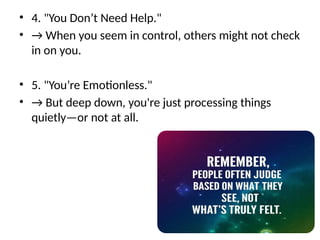
• 4. "YouDon’t Need Help."
• → When you seem in control, others might not check
in on you.
• 5. "You’re Emotionless."
• → But deep down, you're just processing things
quietly—or not at all.
14.
When I ShouldWorry
• You should start to worry when:
• You feel nothing for too long — not just sadness, but joy too.
• You can’t connect with anyone, even those you care about.
• You feel empty instead of peaceful.
• You lose interest in life, dreams, or yourself.
15.
A Personal Reflection
•I didn’t cry when others did.
• I felt nothing when I lost something important.
• I questioned myself—"Why am I like this?"
• Then I understood:
• → My silence wasn’t emptiness.
• → It was survival.
• → A quiet way of staying whole when I was breaking inside.
16.
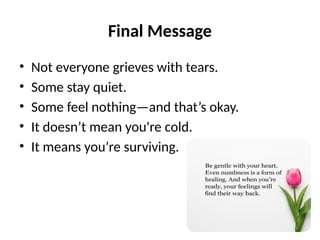
Final Message
• Noteveryone grieves with tears.
• Some stay quiet.
• Some feel nothing—and that’s okay.
• It doesn’t mean you're cold.
• It means you’re surviving.
 Most read

 Most read
 Most read