1/9
What is ICO and How Does it Work?
solulab.com/what-is-the-ico-and-how-does-it-work
In an initial coin offering (ICO), a company creates and sells a digital asset, known as a
token, to investors utilizing blockchain technology. This method was pioneered by Willet in
2013 with MasterCoin, later renamed OMNI, resulting in the successful fundraising of
$500,000 worth of Bitcoin. The funds were allocated to development, rewarding
contributors, and other critical activities. A significant milestone was reached in 2015
when Ethereum introduced a standard for implementing tokens (ERC20), further
simplifying the ICO process. Subsequently, the ICO market witnessed exponential growth,
increasing from just 9 ICOs in 2015 to over 1,000 ICOs in 2018. ICOs serve as digital
tokens issued by budding ventures in exchange for crypto-assets or traditional currencies.
They represent an approach for early-stage ventures to secure funding and accelerate
their growth.
What is Initial Coin Offering (ICO)?
In cryptocurrency and blockchain technology, Initial Coin Offerings (ICOs) have emerged
as a way for startups and businesses to raise capital. ICO initial coin offerings have
democratized the investment process, enabling anyone with internet access to invest in
early-stage blockchain projects. Unlike traditional fundraising methods, which typically
require navigating complex regulations and intermediaries, ICOs offer a direct,
decentralized approach that has captured the attention of both investors and
entrepreneurs. An Initial Coin Offering (ICO) is a fundraising mechanism in which new
projects sell their underlying cryptocurrency tokens in exchange for capital. These tokens
can have various functions within the project, such as providing access to a service,
2/9
granting voting rights, or being used as a currency within the project’s ecosystem. The
ICO process is akin to an Initial Public Offering (IPO) in the stock market but with several
key differences rooted in the decentralized nature of blockchain technology.
How Initial Coin Offerings Work: A Step-by-Step Process
Before you start with the ICO process, it’s crucial to thoroughly research and understand
blockchain technology, regulatory, and token economics. This knowledge will empower
you to make informed decisions and navigate the ICO journey successfully.
1. Whitepaper Creation
The first step in launching an ICO is drafting a comprehensive whitepaper. This document
outlines the project’s goals, the technology behind it, the team involved, and the
tokenomics—details about the token’s distribution, supply, and use cases. The
whitepaper is essential for building investor confidence and providing transparency on
what is an initial coin offering and how an initial coin offering works.
2. Choosing an ICO Platform
Projects often choose a blockchain platform to host their ICO. The Ethereum blockchain,
with its ERC-20 token standard, is one of the most popular choices due to its robust smart
contract capabilities. These smart contracts automate the ICO process, ensuring that
transactions are secure and that tokens are distributed correctly once the ICO concludes.
3. Token Creation
The project team creates the digital tokens that will be sold during the ICO. These tokens
are often designed as utility tokens that provide access to a product or service within the
project’s ecosystem. Alternatively, they can be security tokens that represent an
ownership stake in the project, similar to traditional securities.
3/9
4. Marketing and Promotion
To attract investors, the project team must engage in extensive marketing efforts. This
includes listing the ICO on ICO initial coin offering lists, promoting it on social media, and
participating in blockchain events. The goal is to build a community around the project
and generate buzz that will drive the success of the ICO.
5. Token Sale and Distribution
During the ICO, tokens are sold to investors in exchange for cryptocurrency, typically
Bitcoin or Ethereum. The ICO can be structured in various ways, such as a fixed-price
sale, where all tokens are sold at a set price, or a Dutch auction, where the price
decreases over time until all tokens are sold.
6. Post-ICO Project Development
Once the ICO concludes, the project team uses the funds raised to develop the product
or service outlined in the whitepaper. Investors typically monitor the project’s progress
through updates from the team and community engagement, closely watching how ICO
works.
4/9
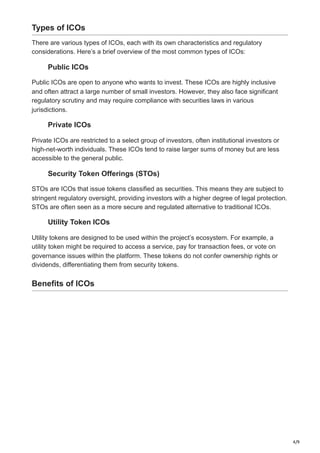
Types of ICOs
There are various types of ICOs, each with its own characteristics and regulatory
considerations. Here’s a brief overview of the most common types of ICOs:
Public ICOs
Public ICOs are open to anyone who wants to invest. These ICOs are highly inclusive
and often attract a large number of small investors. However, they also face significant
regulatory scrutiny and may require compliance with securities laws in various
jurisdictions.
Private ICOs
Private ICOs are restricted to a select group of investors, often institutional investors or
high-net-worth individuals. These ICOs tend to raise larger sums of money but are less
accessible to the general public.
Security Token Offerings (STOs)
STOs are ICOs that issue tokens classified as securities. This means they are subject to
stringent regulatory oversight, providing investors with a higher degree of legal protection.
STOs are often seen as a more secure and regulated alternative to traditional ICOs.
Utility Token ICOs
Utility tokens are designed to be used within the project’s ecosystem. For example, a
utility token might be required to access a service, pay for transaction fees, or vote on
governance issues within the platform. These tokens do not confer ownership rights or
dividends, differentiating them from security tokens.
Benefits of ICOs
5/9
Before delving into the benefits of Initial Coin Offerings (ICOs), it’s important to
understand how they work and the different types of ICOs available.
Decentralized Fundraising
ICOs eliminate the need for traditional financial intermediaries, such as banks and
venture capitalists. This decentralization allows projects to raise funds directly from the
public, reducing costs and increasing accessibility.
Global Reach
ICOs have a global audience, enabling projects to attract investors from around the world.
This global reach increases the potential for raising significant capital and building an
international community around the project.
Liquidity
Tokens issued in an ICO can often be traded on cryptocurrency exchanges, providing
liquidity to investors. This allows investors to buy or sell tokens as they see fit, potentially
realizing returns on their investment even before the project is fully developed.
Innovation and Accessibility
ICOs provide an opportunity for projects to secure funding without the need for traditional
venture capital. This has led to a surge in creativity and projects in the blockchain space,
driving the industry forward.
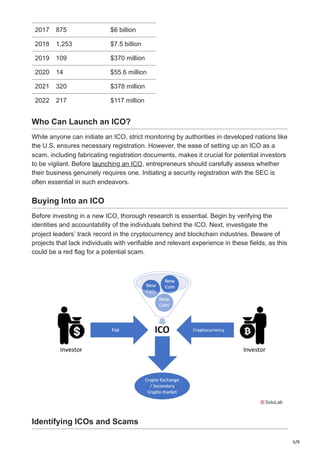
Year ICOs Published Funds Raised
2016 29 $90 million
6/9
2017 875 $6 billion
2018 1,253 $7.5 billion
2019 109 $370 million
2020 14 $55.6 million
2021 320 $378 million
2022 217 $117 million
Who Can Launch an ICO?
While anyone can initiate an ICO, strict monitoring by authorities in developed nations like
the U.S. ensures necessary registration. However, the ease of setting up an ICO as a
scam, including fabricating registration documents, makes it crucial for potential investors
to be vigilant. Before launching an ICO, entrepreneurs should carefully assess whether
their business genuinely requires one. Initiating a security registration with the SEC is
often essential in such endeavors.
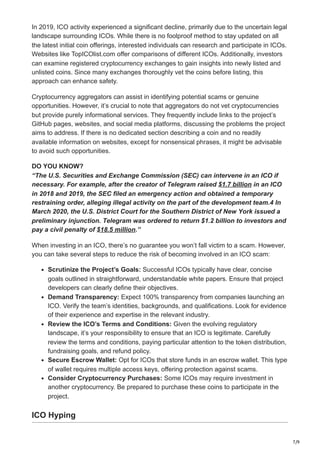
Buying Into an ICO
Before investing in a new ICO, thorough research is essential. Begin by verifying the
identities and accountability of the individuals behind the ICO. Next, investigate the
project leaders’ track record in the cryptocurrency and blockchain industries. Beware of
projects that lack individuals with verifiable and relevant experience in these fields, as this
could be a red flag for a potential scam.
Identifying ICOs and Scams
7/9
In 2019, ICO activity experienced a significant decline, primarily due to the uncertain legal
landscape surrounding ICOs. While there is no foolproof method to stay updated on all
the latest initial coin offerings, interested individuals can research and participate in ICOs.
Websites like TopICOlist.com offer comparisons of different ICOs. Additionally, investors
can examine registered cryptocurrency exchanges to gain insights into newly listed and
unlisted coins. Since many exchanges thoroughly vet the coins before listing, this
approach can enhance safety.
Cryptocurrency aggregators can assist in identifying potential scams or genuine
opportunities. However, it’s crucial to note that aggregators do not vet cryptocurrencies
but provide purely informational services. They frequently include links to the project’s
GitHub pages, websites, and social media platforms, discussing the problems the project
aims to address. If there is no dedicated section describing a coin and no readily
available information on websites, except for nonsensical phrases, it might be advisable
to avoid such opportunities.
DO YOU KNOW?
“The U.S. Securities and Exchange Commission (SEC) can intervene in an ICO if
necessary. For example, after the creator of Telegram raised $1.7 billion in an ICO
in 2018 and 2019, the SEC filed an emergency action and obtained a temporary
restraining order, alleging illegal activity on the part of the development team.4 In
March 2020, the U.S. District Court for the Southern District of New York issued a
preliminary injunction. Telegram was ordered to return $1.2 billion to investors and
pay a civil penalty of $18.5 million.”
When investing in an ICO, there’s no guarantee you won’t fall victim to a scam. However,
you can take several steps to reduce the risk of becoming involved in an ICO scam:
Scrutinize the Project’s Goals: Successful ICOs typically have clear, concise
goals outlined in straightforward, understandable white papers. Ensure that project
developers can clearly define their objectives.
Demand Transparency: Expect 100% transparency from companies launching an
ICO. Verify the team’s identities, backgrounds, and qualifications. Look for evidence
of their experience and expertise in the relevant industry.
Review the ICO’s Terms and Conditions: Given the evolving regulatory
landscape, it’s your responsibility to ensure that an ICO is legitimate. Carefully
review the terms and conditions, paying particular attention to the token distribution,
fundraising goals, and refund policy.
Secure Escrow Wallet: Opt for ICOs that store funds in an escrow wallet. This type
of wallet requires multiple access keys, offering protection against scams.
Consider Cryptocurrency Purchases: Some ICOs may require investment in
another cryptocurrency. Be prepared to purchase these coins to participate in the
project.
ICO Hyping
8/9
Initial Coin Offerings (ICOs) often create significant buzz, attracting investors to online
forums where they discuss potential opportunities. Prominent figures like Steven Seagal
have encouraged their followers to invest in popular ICOs. However, the SEC has warned
celebrities that endorsing ICOs on social media without disclosing any compensation
received is illegal.
Notable cases include boxing legend Floyd Mayweather Jr. and music mogul DJ Khaled,
who promoted Centra Tech, an ICO that raised $32 million in late 2017. Centra Tech was
later deemed a scam, leading to settlements with U.S. regulators by Mayweather, Khaled,
and guilty pleas from three Centra Tech founders for ICO fraud.
Before participating in an ICO, investors should thoroughly educate themselves about
cryptocurrencies and the specific ICO in question. Since fake ICOs are more often
detected than prevented, prospective investors should exercise extreme caution when
making investment decisions.
How ICOs Differ from IPOs?
While ICOs and IPOs share some similarities, such as raising capital from the public, they
differ in several key ways:
Regulation: IPOs are heavily regulated by financial authorities, whereas ICOs
operate in a more decentralized and less regulated environment.
Ownership: IPOs involve selling shares of a company, and conferring ownership
rights to investors. In contrast, ICOs typically offer utility tokens that provide access
to a product or service rather than ownership.
Accessibility: ICOs are generally more accessible to the public, allowing anyone
with cryptocurrency to invest. IPOs, on the other hand, often require investors to
meet specific financial criteria.
Conclusion
Initial Coin Offerings (ICOs) represent a transformative approach to fundraising in the
digital age. They offer a decentralized, accessible way for projects to secure capital and
for investors to participate in the growth of the blockchain ecosystem. However, the
success of an ICO depends on careful planning, compliance with regulations, and
effective marketing.
9/9
At SoluLab, we specialize in ICO development and offer end-to-end solutions to help your
project succeed. From drafting a compelling whitepaper to developing robust smart
contracts and creating a customized ICO platform, our team of blockchain experts is here
to guide you every step of the way. With a proven track record and a deep understanding
of cryptocurrency, SoluLab is your trusted partner in launching a successful ICO.
Whether you’re an entrepreneur with an idea or an established company looking to
explore new fundraising avenues, contact SoluLab to learn how we can help you achieve
your goals with a tailor-made ICO strategy.
FAQs
1. What is an Initial Coin Offering (ICO)?
An Initial Coin Offering (ICO) is a fundraising method where a company issues digital
tokens in exchange for capital, typically in the form of cryptocurrency. It is a popular way
for blockchain-based projects to raise funds.
2. How does an ICO work?
In an ICO, a company creates a whitepaper detailing the project and the associated
tokens. Investors purchase these tokens during the ICO period, often using
cryptocurrencies like Bitcoin or Ethereum. The funds raised are then used to develop the
project.
3. What are the types of ICOs?
There are several types of ICOs, including public ICOs, private ICOs, security token
offerings (STOs), and utility token ICOs. Each type has different characteristics and
serves different purposes.
4. What are the benefits of participating in an ICO?
ICOs offer various benefits, including decentralized fundraising, global reach, and the
potential for high liquidity. They also allow investors to get involved in early-stage projects
that have significant growth potential.
5. How can SoluLab help with ICO development?
SoluLab provides end-to-end ICO development services, including whitepaper drafting,
smart contract development, and marketing strategy. Our team of blockchain experts
ensures your ICO is compliant, secure, and strategically positioned for success.