Unit 12: Various methods for the identification of
bacteria
•Phenotypic methods
o Staining
o Culture
o Biochemical test
o Serological test
•Genotypic method (Polymerase chain reaction-PCR)
• Bacteria are identified using phenotypic, metabolic, and
genotypic methods, ranging from traditional microscopy
to rapid molecular techniques. Key methods include
Gram staining (shape/cell wall), biochemical tests
(catalase/oxidase), MALDI-TOF mass spectrometry for
rapid protein fingerprinting, and DNA-based methods
like 16S rRNA sequencing.
• These approaches allow for precise identification of
pathogens in clinical and research settings.
• Phenotypic methods:
• Phenotypic methods are laboratory techniques used to
identify and characterize microorganisms based on
observable physical, metabolic, or functional traits
rather than genetic material.
• Common methods include microscopic staining,
colony morphology analysis, biochemical tests (e.g.,
catalase, oxidase), serotyping, and
antimicrobial susceptibility testing (AST).
• They are essential for determining active resistance
mechanisms, such as carbapenemase production, and often
provide faster, more cost-effective, and clinically actionable
information compared to genotypic methods.
• Aspects of Phenotypic Methods:
• Core Techniques: These include direct microscopy (e.g.,
Gram stain), culture-based growth on selective/differential
media, and environmental requirement assessments.
• Metabolic & Biochemical Profiling: Identification is based
on enzyme production, carbohydrate fermentation, or, for
example, citrate utilization.
• Resistance Detection: Key methods for detecting antibiotic
resistance include Disk Diffusion (Kirby-Bauer), E-Test, and
broth microdilution to determine the Minimal Inhibitory
Concentration (MIC).
• Advanced Techniques: Modern approaches include Matrix-
Assisted Laser Desorption/Ionization Time-Of-Flight Mass
Spectroscopy (MALDI-TOF MS), which analyzes protein profiles,
and specialized assays for detecting carbapenemase, such as
the Carba NP test and the Modified Hodge Test.
• Advantages: These methods are "mechanism-agnostic,"
meaning they detect the actual expression of resistance rather
than just the presence of a gene, which is critical for guiding
patient therapy.
• Limitations: They are often slower than molecular methods, as
they rely on bacterial growth, and their results can be
influenced by environmental conditions.
Specimen Selection, Collection, and Processing:
• The quantity of specimens must be adequate, and
selected on the basis of symptoms, should be
representative of the disease process.
• Contamination of the specimen must be avoided by
using a sterile equipment and aseptic precautions.
• The specimen must be taken to the laboratory and
examined promptly.
• Special transport media may be helpful.
• Reliable specimens must be secured for diagnosis of
the bacterial infection before antimicrobial drugs are
administered.
1- Microscopic Examination:
• Gram staining is a differential staining technique into
gram- positive (purple) bacteria from gram-negative
(red) bacteria depending on their ability to retain color.
• It is based on the composition of the bacterial cell wall
of both Gram- negative and Gram-positive bacteria.
• Microbial morphology and arrangement can be
observed.
• For example, Staphylococci are Gram-positive cocci
which are arranged in clusters (grapes)
• - Gram-positive bacteria: Staphylococcus and
Streptococcus.
• - Gram-negative bacteria: E. coli and Klebsiella.
2- Microbiological Culture Examination (Media Selection):
• It is based on the specimen source (urine, blood, etc.).
• The appropriate bacteriological media are selected to grow the
organism for further work-up , in addition to selection of the
appropriate temperature and incubation conditions (aerobic
versus anaerobic) allow the optimal bacterial growth.
• Colony morphological characteristics on growth media.
• For example, size, color, odor and the ability to lyse (break
apart) .
• Nonselective media permit the growth of many
microorganisms, while Selective media contain inhibitory
substances that permit the isolation of specific types of
microorganisms.
3- Biochemical Identification:
• The ability of a bacterial species to use a sugar, an amino acid or
an enzymatic substrate is very useful for bacterial identification.
• These tests can be used individually (coagulase for
Staphylococcus aureus) to identify an organism, or in a set of
tests to identify Gram- negative bacilli by Many commercially
prepared kits .
• Indole Test
• Methyl Red/Voges Proskauer (MR/VP)
‐
• Voges Proskauer Test (acetoin production)
• Citrate Utilization test:
• Oxidation Fermentation (OF) test(Hugh & Leifson)
‐
• Motility Test
• Lactose Fermentation
• Sucrose Fermentation
• Glucose Fermentation & Gas Production
• Triple Sugar Iron Agar (TSI) test
• Mannitol Salt Agar (MSA)
• Test for enzymes:
• Catalase test
• Oxidase test
• Urease test
• Coagulase test
• Nitrate reduction
4- Serologic Methods:
• - These methods typically involve testing an unknown antibody
against a known antigen bound to a latex particle or similar
structure.
• - After mixing the antigen and antibody together and rotating, a
visible agglutination (clumping) will appear if positive for the
organism tested.
5- Molecular Methods
• - These methods are the latest and most specific
methods available in the laboratory.
• - These tests are based on the ability to detect,
identify and characterize microorganisms based on
their DNA or RNA.
• - Polymerase chain reaction (PCR) is a common
molecular method used to identify bacteria.
6- Antimicrobial Susceptibility Examination:
• - Microorganisms, particularly bacteria, are tested in
vitro to determine whether they are susceptible to
antimicrobial agents.
Genotypic method (Polymerase chain reaction-PCR)
• Genotypic methods are molecular techniques used to determine an
individual's DNA sequence (genotype) at specific positions, identifying
genetic variations like Single Nucleotide Polymorphisms (SNPs) or
mutations.
• These techniques—including PCR, microarrays, and next-generation
sequencing—are used in medicine for diagnostics, forensics, agriculture,
and researching bacterial resistance.
• Genotyping Techniques:
• PCR-Based Methods: Polymerase Chain Reaction is often the first step to
amplify DNA, followed by techniques like Restriction Fragment Length
Polymorphism (RFLP) and Random Amplified Polymorphic Detection
(RAPD).
• DNA Sequencing: Next-Generation Sequencing (NGS) allows for high-
throughput, accurate detection of genetic variations across the entire
genome.
• Microarrays: DNA microarrays or beads use specific probes to
bind to complementary DNA strands, used to analyze large
numbers of SNPs
• MALDI-TOF Mass Spectrometry: A highly accurate and fast
technology used for high-throughput analysis of SNPs and allele
quantification
• Multiplex Ligation-dependent Probe Amplification (MLPA)
: Used specifically for identifying deletions or duplications in
genes,
• Applications of Genotypic Methods
• Medicine: Identifying disease risks, drug resistance (e.g., in A.
fumigatus), and prenatal diagnostics
• Forensics: Using genetic markers to identify individuals,
• Agriculture: Analyzing genetic diversity and identifying desirable
traits in crops and animals,
• Microbiology: Characterizing bacteria that cannot be cultured
Polymerase Chain Reaction (PCR)
• Polymerase Chain Reaction (PCR) is a nucleic acid
amplification technique used to amplify the DNA or RNA in
vitro enzymatically.
• It is a temperature-dependent enzymatic process where
either a specific targeted region of DNA or the whole DNA is
replicated to quickly make millions of copies of the target
DNA or DNA segment.
• It is also called “molecular photocopying”.
• It is a non-cultured based nucleic acid cloning technique.
• We can quickly produce billions of copies of a single segment
of DNA or RNA using the PCR technique.
• It is temperature dependent cyclic process, and by the end
of the 20th to 25th cycle, over a million copies of the target
nucleic acid segment will be produced.
• It combines the principle of nucleic acid hybridization with the
principle of nucleic acid replication.
• It denatures the double-stranded DNA (dsDNA) into single-
stranded DNA (ssDNA), selects a segment of DNA to amplify
using a specific primer, and then follows the method of
replication using DNA polymerase enzyme to amplify that
segment.
• PCR dates back to the mid-1980s when Kary Mullis and his
associates developed this revolutionary technique.
• He was awarded the Nobel Prize in chemistry with Michael
Smith in 1993.
• Since then, it has been the most important tool in molecular
biology and genetics as a basic tool for DNA and RNA analysis.
• Objectives of Polymerase Chain Reaction (PCR)
• To amplify the specific segment of DNA or RNA, resulting in
billions of copies of a single DNA or RNA segment.
• To reduce the time required for the cloning of nucleic acids
• Additionally, it has been modified to diagnose certain genes, and mutations, and
support other genetic and molecular studies or techniques
Principle of PCR:
• PCR combines the principle of nucleic acid hybridization with the principle of nucleic
acid replication with the temperature variations of cyclic heating and cooling
throughout the process.
• It is based on the fact that double-stranded DNA can be thermally broken into single-
stranded DNA segments.
• In these ssDNA templates, primers can anneal to their complementary sequences
based on the nucleic acid hybridization principle.
• DNA polymerase then elongates the primer by sequentially adding the nucleotides to
the 3’ end and generates a dsDNA following the principle of DNA replication.
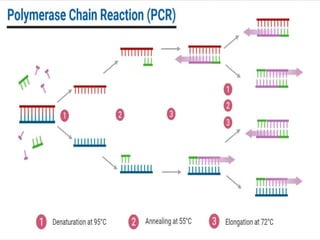
• By continuously regulating the temperature, these 3 steps; denaturation, annealing,
and elongation, can be permitted to occur in a cyclic manner leading to millions of
copies of a single targeted nucleic acid sequence.
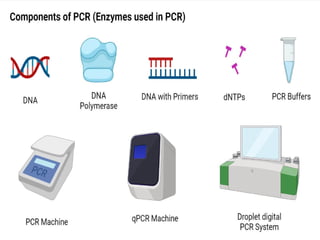
• Components of PCR (Enzymes used in PCR)
• 1. Nucleic Acid Template (Template DNA):
• Template DNA is the sample DNA that contains the selected nucleic acid sequence
that needs to be amplified. The template must be DNA only: Genomic DNA (gDNA),
complementary DNA (cDNA), and plasmid DNA.
• Reverse transcriptase polymerase chain reaction (RT-PCR) uses
RNAs as starting materials, but RNAs are primarily converted to
complementary DNA (cDNA) before amplification.
• The template DNA must be highly pure with an absorbance ratio of
~1.8.
• A quantity of 0.1 to 200 μg can be used, with an ideal quantity of
30 μg to 50 μg.
• 2. DNA Polymerase
• DNA polymerases are enzymes that catalyze the synthesis of
complementary DNA strands by assembling the nucleotides
sequentially according to the template strand.
• Simply, it is the enzyme that synthesizes DNA; hence plays a key
role in DNA replication.
• Taq DNA polymerase, the DNA polymerase enzyme extracted from
the bacterium Thermus aquaticus, is the most widely and the
best–known DNA polymerase used in PCR since its establishment.
• Taq DNA polymerase is thermally stable and continues
its activity after the repeated heating and cooling cycle.
• It is stable up to 95°C and shows the most effective
reaction at around 72°C to 78°C incorporating about 60
bases per second.
• In a 50 L reaction mixture, around 1 to 2 units of Taq
polymerase is sufficient for amplification.
• Recently, two other thermostable DNA polymerase
enzymes are available, viz., the Vent enzyme isolated
from Thermococcus litoralis, and the Pfu
enzyme isolated from Pyrococcus furiosus.
• 3. Primers
• Primers are artificially synthesized short single-
stranded sequences of oligonucleotides that are
complementary to the target nucleic acid sequence in
the template DNA.
• They are short sequences of around 15 to 30 bases that act as starting
point for DNA synthesis.
• They anneal at their complementary position in a single-stranded
template DNA strand.
• The DNA polymerase enzyme then extends this primer from its 3’ OH-
end forming a new complementary strand.
• Usually, 10 to 12 pMol of each primer is sufficient for a PCR reaction.
• PCR primers are of 2 types; forward and reverse primers.
• The forward primers are complementary to the antisense strand
(template strand from 3’ to 5’ direction), and are responsible for the
amplification of the antisense strand.
• They are also called 5’ primers.
• The reverse primers are complementary to the sense strand
(template strand from 5’ to 3’ direction) and are responsible for the
amplification of the sense strand.
• They are also called 3’ primers.
• 4. Nucleotides (Deoxynucleotide triphosphates):
• Deoxynucleotide triphosphates (dNTPs) are artificially
synthesized nucleotides that act as building blocks of new DNA
strands.
• There are 4 different dNTPs used in the PCR; deoxyadenosine
triphosphate (dATP), deoxyguanosine triphosphate (dGTP),
deoxythymidine triphosphate (dTTP), and Deoxycytidine
triphosphate (dCTP).
• These four dNTPs are sequentially added to the annealed primer
by the DNA polymerase enzyme generating a new strand of DNA
complementary to the template strand.
• 5. PCR Buffers and Other Chemicals:
• The whole process needs to be carried out in a Tris – HCl based
buffer system of pH 8.0 to 9.5.
• The common buffer system used is a 10X buffer with additional
MgCl2.
• Common components of PCR buffers are dimethyl sulfoxide
(DMSO), ammonium sulfate ((NH4)2SO4), nonionic detergents,
polyethylene glycon(PEG), N,N,N-trimethyl glycine, potassium
chloride (KCl), magnesium chloride (MgCl2), tetra methyl
ammonium chloride, Tris – HCl, Ethylenediaminetetraacetic
acid (EDTA), 7-deaza-2 -deoxyguanosine 5’-triphosphate,
′
glycerol, formamide, serum albumin, etc.
• The buffer system increases the reaction’s efficiency and
specificity and prevents inhibition and secondary structure
formation during the process.
• 6. Thermocycler
• Also known as the PCR machine, the thermocycler is simply
an electric heating device that regulates the temperature as
per need during each stage of the PCR process.
• This machine increases the temperature during the
denaturation step and lowers it during the annealing and
again increases it during the elongation step.
• This process of increasing and decreasing the temperature
occurs in a cyclic manner according to the pre-programmed
setup or instruction by the user prior to operating.
• Steps of PCR:
• There are three core steps in any type of PCR:
denaturation, annealing, and elongation.
• Apart from these three primary steps, the preparation
phase at the beginning and the PCR product analysis phase
at the end are also important steps.
• The whole steps can be summarized into three steps; pre-
preparation, amplification, and product analysis.
• 1. Pre-preparation
• It is the initial step before the actual polymerase chain
reaction takes place inside the thermocycler.
• In this step, one must prepare a reaction mixture and load it
on a pre-programmed thermocycler in order to amplify the
target DNA or RNA segment.
• Sample DNAs or RNAs are extracted from the sample and
stored (pre-extracted nucleic acids can be used).
• All materials are arranged, safety measures are taken, the PCR
reaction preparation area is cleaned, all the reagents are
brought to working temperature, the sample is extracted or
brought from storage, the PCR reaction mixture is prepared,
the thermocycler is programmed, and the reaction mixture is
loaded on the thermocycler.
• 2. Amplification
• It is the main reaction process occurring in PCR.
• The amplification step includes denaturation, annealing, and elongation
occurring orderly in a cyclic manner one after another for a certain
number of cycles pre-programmed by the user.
• Step I: Denaturation:
• It is the 1st
step of the amplification reaction where the double-stranded
DNA is thermally denatured into two single-stranded DNA templates.
• Temperature is raised to about 94°C (90 to 95°C) for about 30 to 90
seconds.
• At this temperature, the thermal energy overcomes the weak hydrogen
bonds holding the two DNA strands together, allowing them to separate.
• dsDNA → 2 ssDNA templates
• Step II: Annealing:
• Denaturation is followed by the annealing step, where the primer
anneals the ssDNA templates at their complementary sites.
• The forward primer anneals at the complementary site of the
antisense strand, and the reverse primer anneals at the
complementary site of the sense strand of the template DNA.
• For annealing to occur, the temperature is reduced to 55°C-
70°C (the annealing temperature differs based on the GC
content of the primer).
• About 30 to 60 seconds are enough for annealing in most of
the PCR processes.
• ssDNA + Forward and reverse primers → ssDNA with
annealed primers
• Step III: Elongation :
• It is the final step in the amplification reaction where the
temperature is raised to 72°C so that the Taq DNA
polymerase enzyme begins synthesizing new DNA strands in
the 5’ to 3’ direction.
• DNA polymerase enzyme adds nucleotides from the reaction mixture to
the 3’ OH- end of the annealed primer forming a new complementary
strand.
• The time required for elongation depends on the sample nucleic acid
sequence length and the DNA polymerase activity.
• Generally, elongation takes place at the rate of 1 kbp per 0.5 to 1 minute.
• At the end of elongation, two new dsDNA will be formed from a single
dsDNA template at the beginning of the reaction.
• 2 ssDNA with annealed primers + dNTPs → 2 new dsDNAs
• 3. Product Analysis Phase:
• It is the phase after completion of the PCR where the reaction
mixture subjected to PCR is analyzed to confirm that desired
amplification is achieved.
• For this, mostly agarose gel electrophoresis is employed in order
to check for amplified DNAs or RNAs.
• However, no additional step is required in some types of PCR,
like real-time PCR.
Types of PCR
• Arbitrarily Primed PCR
• Allelic specific PCR
• Asymmetric PCR
• Assemble PCR
• Amplified Fragment Length Polymorphism PCR
• Alu PCR
• Conventional PCR
• COLD PCR
• Colony PCR
• Digital PCR
• Droplet PCR
• Fast Cycling PCR
• Gradient PCR
• GC- Rich PCR
• High Fidelity PCR
• Hot Start PCR
• High-Resolution Melt PCR
• Intra-sequence Specific PCR
• In Situ PCR
• Immuno PCR
• In Silico PCR
• Inverse PCR
• Long Range PCR
• Ligation Mediated PCR
• Linear After the Exponential PCR
• Multiplex PCR Real-time PCR
• Methylation Specific PCR
• Mini prime PCR
• Nanoparticle Assisted PCR
• Nested PCR
• Overlap Extension PCR
• Quantitative Real-Time PCR
• Repetitive Sequence-Based PCR
• Reverse Transcriptase PCR
• Real-Time PCR
• Reverse Transcriptase Real-Time PCR
• RNase H Dependent PCR
• Single Cell PCR
• Single Specific Primer PCR
• Solid Phase PCR
• Suicide PCR
• Thermal Asymmetric Interlaced PCR
• Touch Down PCR
• Variable Number of Tandem Repeats PCR
• Polymerase Chain Reaction (PCR) Applications:
• Since its establishment, PCR has found numerous applications in
different aspects of molecular biology. Some of them are;
• 1. Identification and Classification of Organism
• PCR is used widely in identifying microorganisms up to the level of
subspecies and strains.
• This has reduced the time required for microbial identification from
days to a few hours.
• Additionally, larger animals can also be identified and systematically
classified using PCR.
• DNA isolated from fossilized animals are also amplified and studied
to relate them with animals that are still living on the Earth.
• 2. Infectious Disease Diagnosis:
• The use of PCR in the identification of pathogens has led to the
quick and accurate diagnosis of infections.
• Not only diagnosis but parallel identification of antimicrobial
resistant genes in the pathogen is also possible, allowing choosing
of appropriate antimicrobial treatment option.
• HIV, SARS CoV – 2, human T – cell leukemia virus (HTLV type I and
II), Tuberculosis, Hepatitis Virus, Enterovirus, Sexually Transmitted
Diseases (STDs), etc., are diagnosed using PCR.
• 3. Detection of Gene Mutation and Genetic Disorders :
• Mutation in any segment of a gene can be detected using PCR.
• Knowing this mutation, we can confirm a genetic disorder.
• DNA polymorphism can also be analyzed, which can also relate to a
genetic disorder of some kind.
• In medical science, PCR is used as one of the most important tools to
diagnose congenital diseases, genetic disorders, and any mutation leading
to a negative health problem and behavioral change in the prenatal stage.
• Detection of cancerous cells is another very important application of PCR
in medicine.
• 4. DNA Fingerprinting
• In forensics, PCR is used for DNA fingerprinting.
• DNA fingerprinting is used for the identification of criminals or individuals
and for confirming parents.
• 5. Gene Sequencing
• For gene sequencing, a gene must be amplified into a large number using
techniques like PCR.
• All the sequencing methods use PCR as their important step.
• 6. DNA and RNA Quantification
• PCR can also be used for the quantification of sample DNA and RNA.
• Quantitative Real-Time PCR (RT – qPCR) is one common type of PCR used
for the quantification of sample DNA.
• 7. As a Tool in Genetic Engineering :
• PCR is used in genetic engineering for analyzing modified DNAs and
amplifying target or vector DNA.
• Desired genes are amplified using PCR and applied in the required process.
• 8. Gene Expression Analysis and Genetic Imprinting :
• PCR of RNA (Reverse Transcription PCR) is used in gene expression analysis,
study genetic imprinting, etc.
• 9. It is also used in drug and vaccine discovery, human genome projects,
paleontology, and evolutionary biology.
• Advantages of Polymerase Chain Reaction (PCR)
• It is a very fast method for producing multiple copies of a nucleic acid
segment.
• Within a few hours to a few days, billions of copies of a specific nucleic acid
sequence can be produced and analyzed.
• It can analyze a very minute quantity, 0.1 to 5 μg, of DNA or RNA.
• Its principle and procedure are simple to understand and apply.
• Being a semiautomatic technique, the process is operated and regulated
automatically by a thermocycler.
• It has shortened the time for the diagnosis of diseases and genetic
disorders.
• It is the base for several molecular techniques like DNA fingerprinting,
genetic imprinting, microarray, gene sequencing, molecular vector
production, etc.
• Limitations of PCR:
• Prior information regarding the sequence of the DNA or RNA target
segment is required.
• Only then we can design and generate primers and selectively amplify
the target.
• Even very small contamination in a sample can be amplified, giving a false
positive or false negative result.
• There is a chance of mutation during the process if the DNA polymerase
enzyme makes any error during replication.
• PCR fails to detect novel mutations, multigenic disorders, and structural
and numerical chromosomal abnormalities.
• Several organic or inorganic contaminants can disrupt the process,
inhibiting the process and producing inaccurate results.
• It is a highly temperature-dependent process; hence
there must be strict regulation of temperature. Even a
slight change in temperature can inhibit the
amplification process.
• It is complex, requiring sophisticated technology, a wide
range of chemicals, and highly trained professionals to
operate.
• It is not suitable for very long DNA molecules. Very long
DNA needs to be cut into smaller fragments. Usually,
from 0.1 kbp up to 10 kbp or 40 kbp can be used.
• RNA needs to be first converted to DNA using reverse-
transcriptase enzyme before its amplification.
• Most types of PCR processes require additional steps for
product analysis.