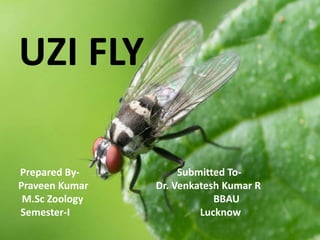
UZI FLY
Prepared By- Submitted To-
Praveen Kumar Dr. Venkatesh Kumar R
M.Sc Zoology BBAU
Semester-I Lucknow
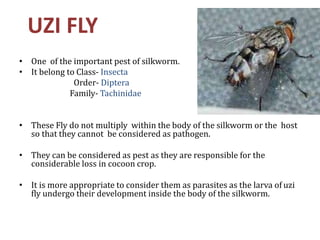
UZI FLY
• One of the important pest of silkworm.
• It belong to Class- Insecta
Order- Diptera
Family- Tachinidae
• These Fly do not multiply within the body of the silkworm or the host
so that they cannot be considered as pathogen.
• They can be considered as pest as they are responsible for the
considerable loss in cocoon crop.
• It is more appropriate to consider them as parasites as the larva of uzi
fly undergo their development inside the body of the silkworm.
SPECIES OF UZI FLY
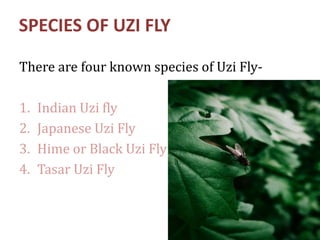
There are four known species of Uzi Fly-
1. Indian Uzi fly
2. Japanese Uzi Fly
3. Hime or Black Uzi Fly
4. Tasar Uzi Fly
INDIAN UZI FLY
• It is also known as Multivoltine uzi fly.
• Scientific Name – Exorista sorbillans
(Tricholyga bombycis)
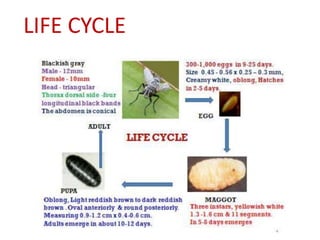
• The adult flies are larger than house flies and
have four prominent longitudinal lines on the
thorax and three horizontal bands on the
abdomen.
• They are bigger than housefly.
• They feed on nector of flower and honeydraw
secreted by aphids and scale insects.
• Adult fly are blackish gray in colour.
• Male is longer in body length 12mm and Female
length is 10mm.
• Life span of adult flies varies with sex and season.
• Male survive for about 10-18 days and female 2-3
days longer than the male i.e 18-22 days.
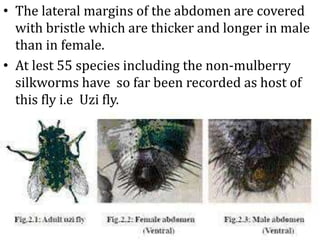
• The male can be distinguished from the females
by the presence of an external brownish /orange
genitalia covered with back hair (bristles)on the
ventral side of the abdominal tip.
• The lateral margins of the abdomen are covered
with bristle which are thicker and longer in male
than in female.
• At lest 55 species including the non-mulberry
silkworms have so far been recorded as host of
this fly i.e Uzi fly.
LIFE CYCLE
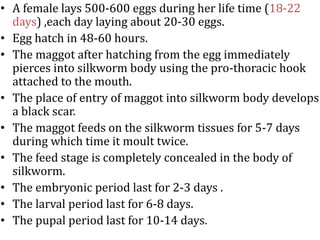
• A female lays 500-600 eggs during her life time (18-22
days) ,each day laying about 20-30 eggs.
• Egg hatch in 48-60 hours.
• The maggot after hatching from the egg immediately
pierces into silkworm body using the pro-thoracic hook
attached to the mouth.
• The place of entry of maggot into silkworm body develops
a black scar.
• The maggot feeds on the silkworm tissues for 5-7 days
during which time it moult twice.
• The feed stage is completely concealed in the body of
silkworm.
• The embryonic period last for 2-3 days .
• The larval period last for 6-8 days.
• The pupal period last for 10-14 days.
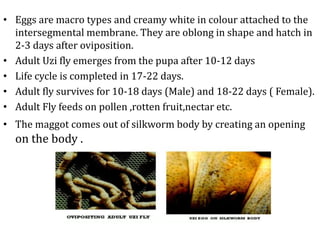
• Eggs are macro types and creamy white in colour attached to the
intersegmental membrane. They are oblong in shape and hatch in
2-3 days after oviposition.
• Adult Uzi fly emerges from the pupa after 10-12 days
• Life cycle is completed in 17-22 days.
• Adult fly survives for 10-18 days (Male) and 18-22 days ( Female).
• Adult Fly feeds on pollen ,rotten fruit,nectar etc.
• The maggot comes out of silkworm body by creating an opening
on the body .
SYMPTOMS
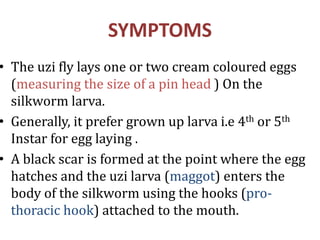
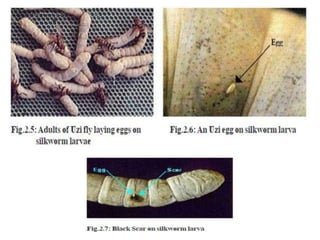
• The uzi fly lays one or two cream coloured eggs
(measuring the size of a pin head ) On the
silkworm larva.
• Generally, it prefer grown up larva i.e 4th or 5th
Instar for egg laying .
• A black scar is formed at the point where the egg
hatches and the uzi larva (maggot) enters the
body of the silkworm using the hooks (pro-
thoracic hook) attached to the mouth.
FACTORS RESPONSIBLE FOR
OUTBREAK OF UZIFLY
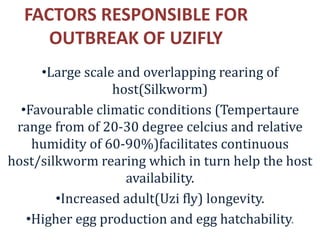
•Large scale and overlapping rearing of
host(Silkworm)
•Favourable climatic conditions (Tempertaure
range from of 20-30 degree celcius and relative
humidity of 60-90%)facilitates continuous
host/silkworm rearing which in turn help the host
availability.
•Increased adult(Uzi fly) longevity.
•Higher egg production and egg hatchability.
PREVENTION AND CONTROL
PHYSICAL METHOD
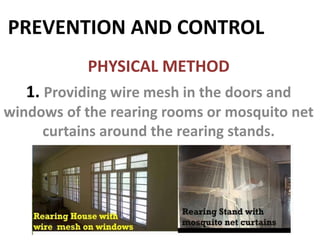
1. Providing wire mesh in the doors and
windows of the rearing rooms or mosquito net
curtains around the rearing stands.
UZI TRAP
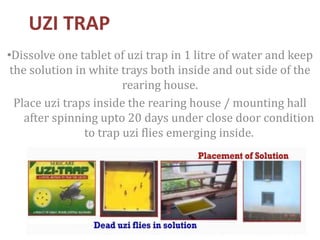
•Dissolve one tablet of uzi trap in 1 litre of water and keep
the solution in white trays both inside and out side of the
rearing house.
Place uzi traps inside the rearing house / mounting hall
after spinning upto 20 days under close door condition
to trap uzi flies emerging inside.
CHEMICAL METHOD
•Uzicide
Spraying of ‘uzicide’ a liquid formulation of CSR&TI,
Mysore on the larva.
This kills the Uzi eggs without affecting the silkworm
growth.
•Vijeta
A dust formulation having the same properties as
Uzicides.
•Spraying of Benzoic , Salicylic & Propionic Acids have
the same effects.
•Bleaching powder also kills the already deposited eggs.
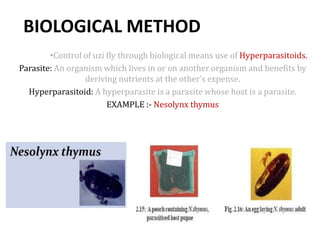
BIOLOGICAL METHOD
•Control of uzi fly through biological means use of Hyperparasitoids.
Parasite: An organism which lives in or on another organism and benefits by
deriving nutrients at the other’s expense.
Hyperparasitoid: A hyperparasite is a parasite whose host is a parasite.
EXAMPLE :- Nesolynx thymus
THANK YOU