CONTENTS
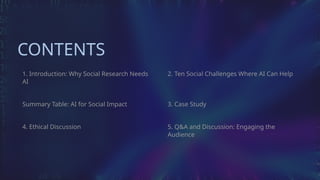
1. Introduction: WhySocial Research Needs
AI
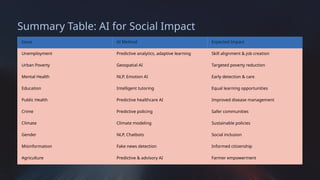
Summary Table: AI for Social Impact
4. Ethical Discussion
2. Ten Social Challenges Where AI Can Help
3. Case Study
5. Q&A and Discussion: Engaging the
Audience
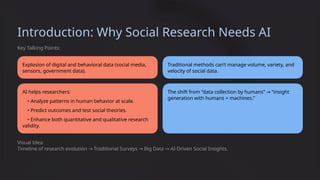
Introduction: Why SocialResearch Needs AI
Key Talking Points:
Explosion of digital and behavioral data (social media,
sensors, government data).
AI helps researchers:
• Analyze patterns in human behavior at scale.
• Predict outcomes and test social theories.
• Enhance both quantitative and qualitative research
validity.
Visual Idea:
Timeline of research evolution Traditional Surveys Big Data AI-Driven Social Insights.
→ → →
Traditional methods can’t manage volume, variety, and
velocity of social data.
The shift from “data collection by humans” “insight
→
generation with humans + machines.”
Ten Social ChallengesWhere
AI Can Help
Below is a detailed, lecture-ready list of 10 major social issues, with each
presented through the framework:
👉 Issue Cause AI Method Expected Social Impact
→ → →
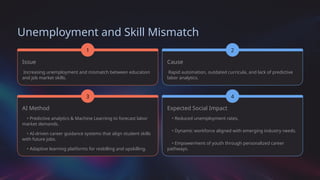
7.
Unemployment and SkillMismatch
Issue
Increasing unemployment and mismatch between education
and job market skills.
1
AI Method
• Predictive analytics & Machine Learning to forecast labor
market demands.
3
• AI-driven career guidance systems that align student skills
with future jobs.
• Adaptive learning platforms for reskilling and upskilling.
Cause
Rapid automation, outdated curricula, and lack of predictive
labor analytics.
Expected Social Impact
• Reduced unemployment rates.
• Dynamic workforce aligned with emerging industry needs.
• Empowerment of youth through personalized career
pathways.
2
4
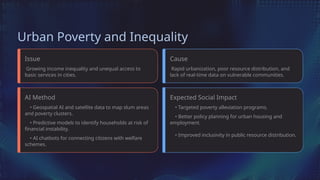
8.
Urban Poverty andInequality
Issue
Growing income inequality and unequal access to
basic services in cities.
AI Method
• Geospatial AI and satellite data to map slum areas
and poverty clusters.
• Predictive models to identify households at risk of
financial instability.
• AI chatbots for connecting citizens with welfare
schemes.
Cause
Rapid urbanization, poor resource distribution, and
lack of real-time data on vulnerable communities.
Expected Social Impact
• Targeted poverty alleviation programs.
• Better policy planning for urban housing and
employment.
• Improved inclusivity in public resource distribution.
9.
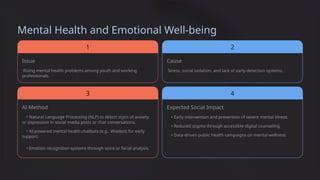
Mental Health andEmotional Well-being
Issue
Rising mental health problems among youth and working
professionals.
1
AI Method
• Natural Language Processing (NLP) to detect signs of anxiety
or depression in social media posts or chat conversations.
3
• AI-powered mental health chatbots (e.g., Woebot) for early
support.
• Emotion recognition systems through voice or facial analysis.
Cause
Stress, social isolation, and lack of early detection systems.
Expected Social Impact
• Early intervention and prevention of severe mental illness.
• Reduced stigma through accessible digital counseling.
• Data-driven public health campaigns on mental wellness.
2
4
10.
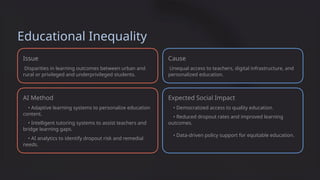
Educational Inequality
Issue
Disparities inlearning outcomes between urban and
rural or privileged and underprivileged students.
AI Method
• Adaptive learning systems to personalize education
content.
• Intelligent tutoring systems to assist teachers and
bridge learning gaps.
• AI analytics to identify dropout risk and remedial
needs.
Cause
Unequal access to teachers, digital infrastructure, and
personalized education.
Expected Social Impact
• Democratized access to quality education.
• Reduced dropout rates and improved learning
outcomes.
• Data-driven policy support for equitable education.
11.
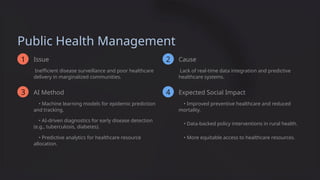
Public Health Management
1Issue
Inefficient disease surveillance and poor healthcare
delivery in marginalized communities.
3 AI Method
• Machine learning models for epidemic prediction
and tracking.
• AI-driven diagnostics for early disease detection
(e.g., tuberculosis, diabetes).
• Predictive analytics for healthcare resource
allocation.
2 Cause
4
Lack of real-time data integration and predictive
healthcare systems.
Expected Social Impact
• Improved preventive healthcare and reduced
mortality.
• Data-backed policy interventions in rural health.
• More equitable access to healthcare resources.
12.
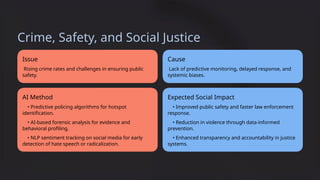
Crime, Safety, andSocial Justice
Issue
Rising crime rates and challenges in ensuring public
safety.
AI Method
• Predictive policing algorithms for hotspot
identification.
• AI-based forensic analysis for evidence and
behavioral profiling.
• NLP sentiment tracking on social media for early
detection of hate speech or radicalization.
Cause
Lack of predictive monitoring, delayed response, and
systemic biases.
Expected Social Impact
• Improved public safety and faster law enforcement
response.
• Reduction in violence through data-informed
prevention.
• Enhanced transparency and accountability in justice
systems.
13.
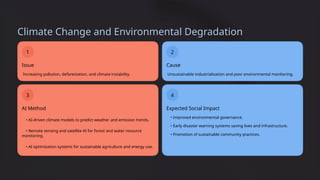
Climate Change andEnvironmental Degradation
1
Issue
Increasing pollution, deforestation, and climate instability.
3
AI Method
• AI-driven climate models to predict weather and emission trends.
• Remote sensing and satellite AI for forest and water resource
monitoring.
• AI optimization systems for sustainable agriculture and energy use.
2
Cause
Unsustainable industrialization and poor environmental monitoring.
4
Expected Social Impact
• Improved environmental governance.
• Early disaster warning systems saving lives and infrastructure.
• Promotion of sustainable community practices.
14.
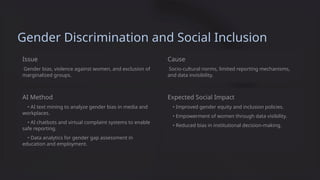
Gender Discrimination andSocial Inclusion
Issue
Gender bias, violence against women, and exclusion of
marginalized groups.
AI Method
• AI text mining to analyze gender bias in media and
workplaces.
• AI chatbots and virtual complaint systems to enable
safe reporting.
• Data analytics for gender gap assessment in
education and employment.
Cause
Socio-cultural norms, limited reporting mechanisms,
and data invisibility.
Expected Social Impact
• Improved gender equity and inclusion policies.
• Empowerment of women through data visibility.
• Reduced bias in institutional decision-making.
15.
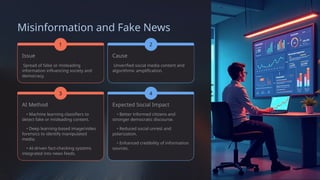
Misinformation and FakeNews
Issue
Spread of false or misleading
information influencing society and
democracy.
1
AI Method
3
• Machine learning classifiers to
detect fake or misleading content.
Cause
• Deep learning-based image/video
forensics to identify manipulated
media.
Unverified social media content and
algorithmic amplification.
• AI-driven fact-checking systems
integrated into news feeds.
Expected Social Impact
2
• Better informed citizens and
stronger democratic discourse.
• Reduced social unrest and
polarization.
4
• Enhanced credibility of information
sources.
16.
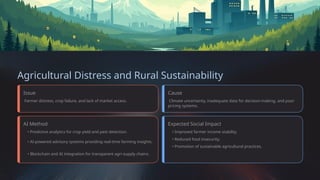
Agricultural Distress andRural Sustainability
Issue
Farmer distress, crop failure, and lack of market access.
AI Method
• Predictive analytics for crop yield and pest detection.
• AI-powered advisory systems providing real-time farming insights.
• Blockchain and AI integration for transparent agri-supply chains.
Cause
Climate uncertainty, inadequate data for decision-making, and poor
pricing systems.
Expected Social Impact
• Improved farmer income stability.
• Reduced food insecurity.
• Promotion of sustainable agricultural practices.
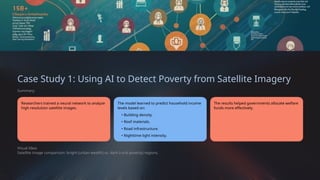
Case Study 1:Using AI to Detect Poverty from Satellite Imagery
Summary:
Researchers trained a neural network to analyze
high-resolution satellite images.
Visual Idea:
Satellite image comparison: bright (urban wealth) vs. dark (rural poverty) regions.
The model learned to predict household income
levels based on:
• Building density.
• Roof materials.
• Road infrastructure.
• Nighttime light intensity.
The results helped governments allocate welfare
funds more effectively.
21.
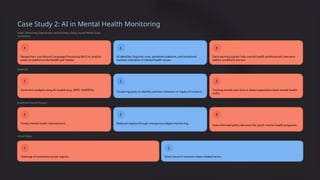
Case Study 2:AI in Mental Health Monitoring
Topic: Detecting Depression and Anxiety Using Social Media Data
Summary:
1
Researchers use Natural Language Processing (NLP) to analyze
posts on platforms like Reddit and Twitter.
Method:
1
Sentiment analysis using AI models (e.g., BERT, RoBERTa).
Expected Social Impact:
1
Timely mental health interventions.
2
AI identifies linguistic cues, sentiment patterns, and emotional
markers indicative of mental health issues.
Visual Idea:
2
Clustering posts to identify common stressors or topics of concern.
1
Heatmap of sentiment across regions.
2
Reduced stigma through anonymous digital monitoring.
Early warning signals help mental health professionals intervene
before conditions worsen.
3
2
Word cloud of common stress-related terms.
3
Tracking trends over time to detect population-level mental health
shifts.
3
Data-informed policy decisions for youth mental health programs.
22.
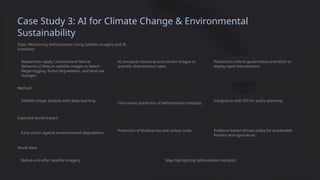
Case Study 3:AI for Climate Change & Environmental
Sustainability
Topic: Monitoring Deforestation Using Satellite Imagery and AI
Summary:
Researchers apply Convolutional Neural
Networks (CNNs) to satellite images to detect
illegal logging, forest degradation, and land-use
changes.
Method:
Satellite image analysis with deep learning.
Expected Social Impact:
Early action against environmental degradation.
AI compares historical and current images to
quantify deforestation rates.
Visual Idea:
Time-series prediction of deforestation hotspots.
Before-and-after satellite imagery.
Protection of biodiversity and carbon sinks.
Predictions inform government and NGOs to
deploy rapid interventions.
Map highlighting deforestation hotspots.
Integration with GIS for policy planning.
Evidence-based climate policy for sustainable
forestry and agriculture.
Ethical Discussion
Theme: AIEmpowers, but Must Be Ethical
Key Issues:
Privacy
Social media data used without consent.
Fairness
AI predictions must not reinforce inequality.
Accountability
Who is responsible when AI-driven decisions affect lives?
Bias
Algorithms learn from biased historical data.
Transparency
Need for Explainable AI (XAI).
Q&A and Discussion:Engaging the Audience
Interactive Prompts:
“What local social
problems could AI help
address in your
community?”
Activity Idea:
Ask participants (in small groups) to identify one social issue and outline a possible AI-based research project (data + method +
expected outcome).
“Can AI replace
traditional social science
methods?”
“How can we train social
researchers to use AI
responsibly?”
“What ethical safeguards
should Indian
researchers prioritize?”