South China Sea By Aramide
Introduction
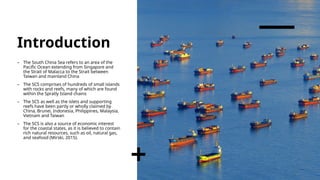
– The South China Sea refers to an area of the
Pacific Ocean extending from Singapore and
the Strait of Malacca to the Strait between
Taiwan and mainland China
– The SCS comprises of hundreds of small islands
with rocks and reefs, many of which are found
within the Spratly Island chains
– The SCS as well as the islets and supporting
reefs have been partly or wholly claimed by
China, Brunei, Indonesia, Philippines, Malaysia,
Vietnam and Taiwan
– The SCS is also a source of economic interest
for the coastal states, as it is believed to contain
rich natural resources, such as oil, natural gas,
and seafood (Mirski, 2015).
Description of the
Spratly Islands
Crisis
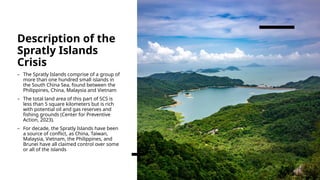
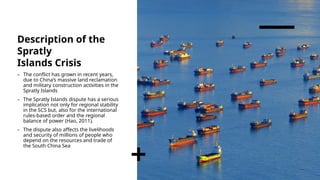
– The Spratly Islands comprise of a group of
more than one hundred small islands in
the South China Sea, found between the
Philippines, China, Malaysia and Vietnam
– The total land area of this part of SCS is
less than 5 square kilometers but is rich
with potential oil and gas reserves and
fishing grounds (Center for Preventive
Action, 2023).
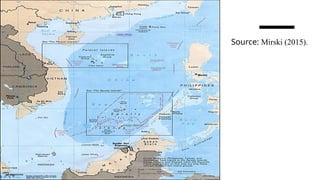
– For decade, the Spratly Islands have been
a source of conflict, as China, Taiwan,
Malaysia, Vietnam, the Philippines, and
Brunei have all claimed control over some
or all of the islands
Source: Mirski (2015).
– The conflict has grown in recent years,
due to China’s massive land reclamation
and military construction activities in the
Spratly Islands
– The Spratly Islands dispute has a serious
implication not only for regional stability
in the SCS but, also for the international
rules-based order and the regional
balance of power (Hao, 2011).
– The dispute also affects the livelihoods
and security of millions of people who
depend on the resources and trade of
the South China Sea
Description of the
Spratly
Islands Crisis
Actors and Interests
involved in the Spratly
Islands Dispute
– China: China claims historical control over the Spratly
Islands and most of the SCS and sees this as part of its
core national interests
– Taiwan: This country is officially known as the Republic
of China, and it shares the same historical claims as
China. ( Prashanth, 2023 ).
– Vietnam: This country claims sovereignty over the
Spratly Islands and the Paracel Islands, another
disputed group in the SCS, based on its historical
occupation and administration (Asia Society, 2023)
– The Philippines: The Philippines also claims control over
part of the Spratly Islands, called the Kalayaan Island
Group, because of its geographic proximity
– Malaysia: This country claims dominion over part of the
Spratly Islands as well, which it calls the Swallow Reef
Actors and Interests
involved in the Spratly
Islands Dispute
– Brunei: Brunei fights for
sovereignty over a little part of
the Spratly Islands
– The United States: The US is
not a claimant in the Spratly
Islands dispute but has a
strong interest in maintaining
freedom of navigation, and
regional peace and stability in
the SCS
Causes of the Crisis in
the Spratly Islands
Part of the SCS
– Historical Grievances and
Nationalism: The Spratly Islands
dispute is rooted in the contested
history of the region, that has
been influenced by colonialism
and revolution.
– Resource Competition and
Development: The above conflict is
caused by the demand for natural
resources in the SCS, particularly
fish, oil, and gas (Council on
Foreign Relations, 2023).
Risk Factors of the Spratly Islands
Dispute
The dispute poses risks not only for the regional stability but also international
security. Some of the major risk factors are enumerated as follows:
– The lack of agreed legal framework to end the conflicting claims and
actions. However, the existing mechanisms, like that of the 2002 Declaration
on the Conduct of Parties in the SCS and the Arbitral Tribunal ruling of
2016, have not been implemented in full by the parties (Buszynski, 2012).
– The growing escalation of the dispute, as the claimants have deployed more
guard vessels, missiles, aircraft, and other weapons to the Island, and have
involved in aggressive actions, including land reclamation, surveillance,
harassment and encroachment. These actions have heightened the chances of
conflict that could get out of hand and involve other actors, like the US and
its allies (Fravel, 2011).
– The impending humanitarian and environmental impacts of the crisis, as the
exploitation of the natural resources in the Spratly Islands could disturb the
biodiversity and climate of the region, as well as the livelihoods of millions
of people who depend on the fishing of the SCS. It could lead to a great
humanitarian crisis, if the people living in the disputed islands are displaced
or killed by the crisis (Hao, 2011).
Predictions for the
Future of the SCS
– The predictions for the future of the SCS
are uncertain and determined by the
actions of the various actors involved,
but some of the possible scenarios are: A
continuation of the status quo, where
the claimant countries maintain their
positions and presence in the Spratly
Islands, while engaging in occasional
diplomatic and military clashes, as well
as limited cooperation on issues like
environmental protection, humanitarian
assistance, and joint development of
resources
Predictions for the
Future of the SCS
– A escalation of the conflict,
where the tensions in the SCS
increase and become more
violent and frequent, leading
to a potential military
confrontation between China
and the US or its allies, or
among the claimant countries
themselves, which could
destabilize the regional and
global order and security
Recommendations
To achieve the best-case scenario, the
following are some recommendations
for the SCS:
– First, to enhance the dialogue and
confidence-building measures
among the claimant countries and
other stakeholders, such as through
the implementation of the
Declaration on the Conduct of Parties
in the SCS and the conclusion of the
COC, as well as the establishment of
hotlines, joint patrols, and crisis
management mechanisms
Recommendations
– Second, to balance the interests
and roles of the external powers
in the South China Sea, such as
by encouraging the constructive
engagement and contribution of
the United States, Japan,
Australia, and India to the
regional stability and
development, while avoiding the
provocation and interference of
China’s legitimate and reasonable
interests and rights in the area
References
Asia Society (2023). The South China Sea: Realities and Responses in Southeast Asia.
https://asiasociety.org/policy-institute/south-china-sea-realities-and-responses-southeast-asia
BBC (2023). What is the South China Sea dispute? https://www.bbc.com/news/world-asia-pacific-13748349
Breene K, (2016). South China Sea tensions: what you need to know. https://www.weforum.org/agenda/2016/06/south-china-
sea-tensions-what-to-know/
Buszynski, L. (2012). The South China Sea: Oil, maritime claims, and U.S.-China strategic rivalry. The Washington Quarterly,
35(2), 139–156. https://doi.org/10.1080/0163660X.2012.666495
Center for Preventive Action (2023). Territorial Disputes in the South China Sea.
https://www.cfr.org/global-conflict-tracker/conflict/territorial-disputes-south-china-sea
Council on Foreign Relations. (2020). Territorial disputes in the South China
Sea. https://www.cfr.org/global-conflict-tracker/conflict/territorial-disputes-south-china-sea
Emmers, R. (2017). The prospects for managing and resolving the South China Sea dispute. In L. Buszynski & C. B. Roberts
(Eds.), The South China Sea maritime dispute: Political, legal and regional perspectives (pp. 217–234). Routledge.
Fravel, M. T. (2018). Preventive war and the rise of China. International Security, 42(4),
50–86. https://doi.org/10.1162/isec_a_00312
Hao S. (2011). China’s Positions and Interests in the South China Sea: A Rational Choices in its Cooperative Policies.
https://www.csis.org/analysis/chinas-positions-and-interests-south-china-sea-rational-choices-its-cooperative-policies
Kevin V., Adrian L., Hannah D., Xuan Q. N. and Philip H. (2020). Fight Over Fish Fans a New Stage of Conflict in South
China Sea. https://www.bloomberg.com/graphics/2020-dangerous-conditions-in-depleted-south-china-sea/
Mirski S. (2015). The South China Sea Dispute: A Brief History. https://www.lawfaremedia.org/article/south-china-sea-
dispute-brief-history