Differentiate translational motionfrom rotational
motion based on their characteristics and
examples.
OBJECTIVES:
Demonstrate body movements that represent
translational and rotational motion.
Appreciate the importance of motion in daily
activities and human movement.
4.
1.Divide the classinto groups.
2.One learner picks a motion card and acts it out silently.
3.Group members identify whether the motion is:
⚬ Translational
⚬ Rotational
Groups earn points for correct answers
MOTION CHARADES!
INSTRUCTIONS
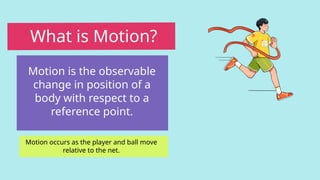
Motion is theobservable
change in position of a
body with respect to a
reference point.
What is Motion?
Motion occurs as the player and ball move
relative to the net.
17.
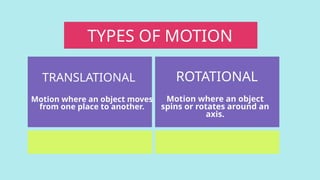
TYPES OF MOTION
Motionwhere an object moves
from one place to another.
TRANSLATIONAL
Motion where an object
spins or rotates around an
axis.
ROTATIONAL
18.
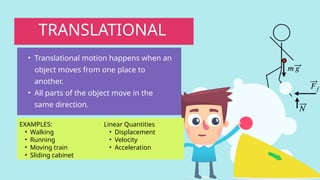
TRANSLATIONAL
• Translational motionhappens when an
object moves from one place to
another.
• All parts of the object move in the
same direction.
EXAMPLES:
• Walking
• Running
• Moving train
• Sliding cabinet
Linear Quantities
• Displacement
• Velocity
• Acceleration
19.
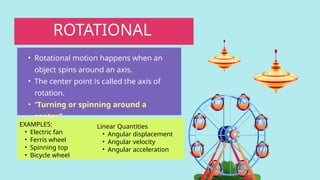
ROTATIONAL
• Rotational motionhappens when an
object spins around an axis.
• The center point is called the axis of
rotation.
• “Turning or spinning around a
center”
EXAMPLES:
• Electric fan
• Ferris wheel
• Spinning top
• Bicycle wheel
Linear Quantities
• Angular displacement
• Angular velocity
• Angular acceleration
20.
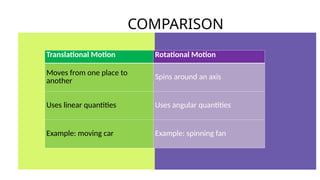
COMPARISON
Translational Motion RotationalMotion
Moves from one place to
another
Spins around an axis
Uses linear quantities Uses angular quantities
Example: moving car Example: spinning fan
21.
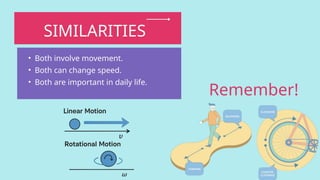
• Both involvemovement.
• Both can change speed.
• Both are important in daily life.
SIMILARITIES
Remember!
Opportunities &
Integration
Another learningarea:
• Physical Education: body movement
and sports
Special Topic:
• Road safety and movement
awareness
Technology
• Videos and animated simulations of
motion
25.
FORMATIVE
ASSESSMENET
Identify whether thefollowing
motions are translational or
rotational.
1.Spinning electric fan
2.Walking to school
3.Ferris wheel
4.Moving elevator
5.Rotating bicycle wheel