Unit1_Solubility_of_Drugs-1.pdf include basic concepts , Type of solution , Factor affects
1.
Physical Pharmaceutics-I |BP302T | B.Pharm 3rd Semester
UNIT I
Solubility
of Drugs
Solutions • Solubility Laws • Diffusion Principles • Solvation
Smt. A. B. Jadhav
Assistant Professor
Government College of Pharmacy, Karad
2.
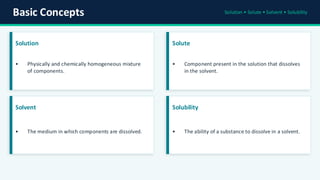
Basic Concepts Solution• Solute • Solvent • Solubility
Solution
• Physically and chemically homogeneous mixture
of components.
Solute
• Component present in the solution that dissolves
in the solvent.
Solvent
• The medium in which components are dissolved.
Solubility
• The ability of a substance to dissolve in a solvent.
3.
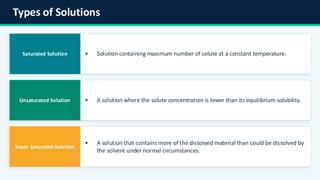
Types of Solutions
SaturatedSolution • Solution containing maximum number of solute at a constant temperature.
Unsaturated Solution • A solution where the solute concentration is lower than its equilibrium solubility.
Super Saturated Solution
• A solution that contains more of the dissolved material than could be dissolved by
the solvent under normal circumstances.
4.
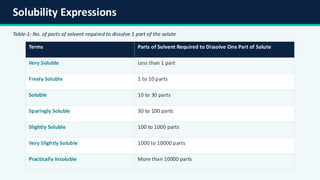
Solubility Expressions
Table-1: No.of parts of solvent required to dissolve 1 part of the solute
Terms Parts of Solvent Required to Dissolve One Part of Solute
Very Soluble Less than 1 part
Freely Soluble 1 to 10 parts
Soluble 10 to 30 parts
Sparingly Soluble 30 to 100 parts
Slightly Soluble 100 to 1000 parts
Very Slightly Soluble 1000 to 10000 parts
Practically Insoluble More than 10000 parts
5.
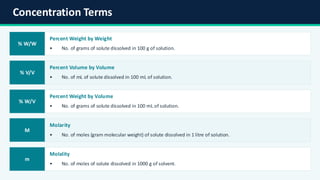
Concentration Terms
% W/W
PercentWeight by Weight
• No. of grams of solute dissolved in 100 g of solution.
% V/V
Percent Volume by Volume
• No. of mL of solute dissolved in 100 mL of solution.
% W/V
Percent Weight by Volume
• No. of grams of solute dissolved in 100 mL of solution.
M
Molarity
• No. of moles (gram molecular weight) of solute dissolved in 1 litre of solution.
m
Molality
• No. of moles of solute dissolved in 1000 g of solvent.
6.
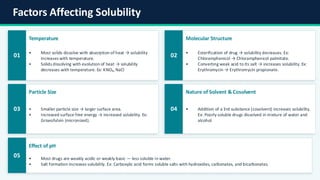
Factors Affecting Solubility
01
Temperature
•Most solids dissolve with absorption of heat → solubility
increases with temperature.
• Solids dissolving with evolution of heat → solubility
decreases with temperature. Ex: KNO₃, NaCl
02
Molecular Structure
• Esterification of drug → solubility decreases. Ex:
Chloramphenicol → Chloramphenicol palmitate.
• Converting weak acid to its salt → increases solubility. Ex:
Erythromycin → Erythromycin propionate.
03
Particle Size
• Smaller particle size → larger surface area.
• Increased surface free energy → increased solubility. Ex:
Griseofulvin (micronized).
04
Nature of Solvent & Cosolvent
• Addition of a 3rd substance (cosolvent) increases solubility.
Ex: Poorly soluble drugs dissolved in mixture of water and
alcohol.
05
Effect of pH
• Most drugs are weakly acidic or weakly basic — less soluble in water.
• Salt formation increases solubility. Ex: Carboxylic acid forms soluble salts with hydroxides, carbonates, and bicarbonates.
7.
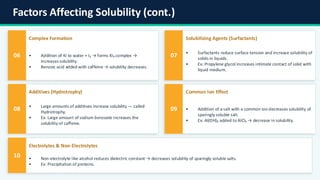
Factors Affecting Solubility(cont.)
06
Complex Formation
• Addition of KI to water + I₂ → forms KI₃ complex →
increases solubility.
• Benzoic acid added with caffeine → solubility decreases.
07
Solubilizing Agents (Surfactants)
• Surfactants reduce surface tension and increase solubility of
solids in liquids.
• Ex: Propylene glycol increases intimate contact of solid with
liquid medium.
08
Additives (Hydrotrophy)
• Large amounts of additives increase solubility — called
Hydrotrophy.
• Ex: Large amount of sodium benzoate increases the
solubility of caffeine.
09
Common Ion Effect
• Addition of a salt with a common ion decreases solubility of
sparingly soluble salt.
• Ex: Al(OH)₃ added to AlCl₃ → decrease in solubility.
10
Electrolytes & Non-Electrolytes
• Non-electrolyte like alcohol reduces dielectric constant → decreases solubility of sparingly soluble salts.
• Ex: Precipitation of proteins.
8.
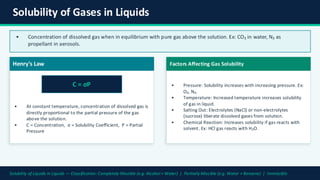
Solubility of Gasesin Liquids
• Concentration of dissolved gas when in equilibrium with pure gas above the solution. Ex: CO₂ in water, N₂ as
propellant in aerosols.
Henry's Law
C = σP
• At constant temperature, concentration of dissolved gas is
directly proportional to the partial pressure of the gas
above the solution.
• C = Concentration, σ = Solubility Coefficient, P = Partial
Pressure
Factors Affecting Gas Solubility
• Pressure: Solubility increases with increasing pressure. Ex:
O₂, N₂.
• Temperature: Increased temperature increases solubility
of gas in liquid.
• Salting Out: Electrolytes (NaCl) or non-electrolytes
(sucrose) liberate dissolved gases from solution.
• Chemical Reaction: Increases solubility if gas reacts with
solvent. Ex: HCl gas reacts with H₂O.
Solubility of Liquids in Liquids — Classification: Completely Miscible (e.g. Alcohol + Water) | Partially Miscible (e.g. Water + Benzene) | Immiscible
9.
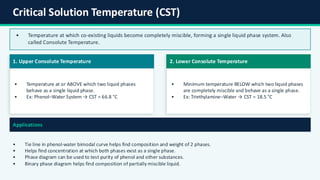
Critical Solution Temperature(CST)
• Temperature at which co-existing liquids become completely miscible, forming a single liquid phase system. Also
called Consolute Temperature.
1. Upper Consolute Temperature
• Temperature at or ABOVE which two liquid phases
behave as a single liquid phase.
• Ex: Phenol–Water System → CST = 66.8 °C
2. Lower Consolute Temperature
• Minimum temperature BELOW which two liquid phases
are completely miscible and behave as a single phase.
• Ex: Triethylamine–Water → CST = 18.5 °C
Applications
• Tie line in phenol-water bimodal curve helps find composition and weight of 2 phases.
• Helps find concentration at which both phases exist as a single phase.
• Phase diagram can be used to test purity of phenol and other substances.
• Binary phase diagram helps find composition of partially miscible liquid.
10.
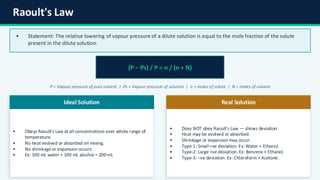
Raoult's Law
• Statement:The relative lowering of vapour pressure of a dilute solution is equal to the mole fraction of the solute
present in the dilute solution.
(P − Ps) / P = n / (n + N)
P = Vapour pressure of pure solvent | Ps = Vapour pressure of solution | n = moles of solute | N = moles of solvent
Ideal Solution
• Obeys Raoult's Law at all concentrations over whole range of
temperature.
• No heat evolved or absorbed on mixing.
• No shrinkage or expansion occurs.
• Ex: 100 mL water + 100 mL alcohol = 200 mL
Real Solution
• Does NOT obey Raoult's Law — shows deviation.
• Heat may be evolved or absorbed.
• Shrinkage or expansion may occur.
• Type-1: Small +ve deviation. Ex: Water + Ethanol.
• Type-2: Large +ve deviation. Ex: Benzene + Ethanol.
• Type-3: −ve deviation. Ex: Chloroform + Acetone.
11.
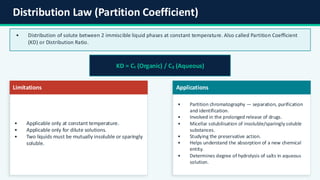
Distribution Law (PartitionCoefficient)
• Distribution of solute between 2 immiscible liquid phases at constant temperature. Also called Partition Coefficient
(KD) or Distribution Ratio.
KD = C₁ (Organic) / C₂ (Aqueous)
Limitations
• Applicable only at constant temperature.
• Applicable only for dilute solutions.
• Two liquids must be mutually insoluble or sparingly
soluble.
Applications
• Partition chromatography — separation, purification
and identification.
• Involved in the prolonged release of drugs.
• Micellar solubilisation of insoluble/sparingly soluble
substances.
• Studying the preservative action.
• Helps understand the absorption of a new chemical
entity.
• Determines degree of hydrolysis of salts in aqueous
solution.
12.
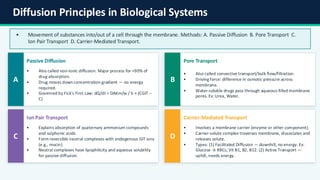
Diffusion Principles inBiological Systems
• Movement of substances into/out of a cell through the membrane. Methods: A. Passive Diffusion B. Pore Transport C.
Ion Pair Transport D. Carrier-Mediated Transport.
A
Passive Diffusion
• Also called non-ionic diffusion. Major process for >90% of
drug absorption.
• Drug moves down concentration gradient — no energy
required.
• Governed by Fick's First Law: dQ/dt = DAKm/w / h × (CGIT −
C)
B
Pore Transport
• Also called convective transport/bulk flow/filtration.
• Driving force: difference in osmotic pressure across
membrane.
• Water-soluble drugs pass through aqueous-filled membrane
pores. Ex: Urea, Water.
C
Ion Pair Transport
• Explains absorption of quaternary ammonium compounds
and sulphonic acids.
• Form reversible neutral complexes with endogenous GIT ions
(e.g., mucin).
• Neutral complexes have lipophilicity and aqueous solubility
for passive diffusion.
D
Carrier-Mediated Transport
• Involves a membrane carrier (enzyme or other component).
• Carrier-solute complex traverses membrane, dissociates and
releases solute.
• Types: (1) Facilitated Diffusion — downhill, no energy. Ex:
Glucose → RBCs, Vit B1, B2, B12. (2) Active Transport —
uphill, needs energy.
13.
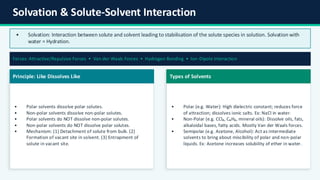
Solvation & Solute-SolventInteraction
• Solvation: Interaction between solute and solvent leading to stabilisation of the solute species in solution. Solvation with
water = Hydration.
Forces: Attractive/Repulsive Forces • Van der Waals Forces • Hydrogen Bonding • Ion-Dipole Interaction
Principle: Like Dissolves Like
• Polar solvents dissolve polar solutes.
• Non-polar solvents dissolve non-polar solutes.
• Polar solvents do NOT dissolve non-polar solutes.
• Non-polar solvents do NOT dissolve polar solutes.
• Mechanism: (1) Detachment of solute from bulk. (2)
Formation of vacant site in solvent. (3) Entrapment of
solute in vacant site.
Types of Solvents
• Polar (e.g. Water): High dielectric constant; reduces force
of attraction; dissolves ionic salts. Ex: NaCl in water.
• Non-Polar (e.g. CCl₄, C₆H₆, mineral oils): Dissolve oils, fats,
alkaloidal bases, fatty acids. Mostly Van der Waals forces.
• Semipolar (e.g. Acetone, Alcohol): Act as intermediate
solvents to bring about miscibility of polar and non-polar
liquids. Ex: Acetone increases solubility of ether in water.
14.
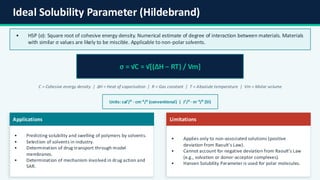
Ideal Solubility Parameter(Hildebrand)
• HSP (σ): Square root of cohesive energy density. Numerical estimate of degree of interaction between materials. Materials
with similar σ values are likely to be miscible. Applicable to non-polar solvents.
σ = √C = √[(ΔH − RT) / Vm]
C = Cohesive energy density | ΔH = Heat of vaporisation | R = Gas constant | T = Absolute temperature | Vm = Molar volume
Units: cal¹/² · cm⁻³/² (conventional) | J¹/² · m⁻³/² (SI)
Applications
• Predicting solubility and swelling of polymers by solvents.
• Selection of solvents in industry.
• Determination of drug transport through model
membranes.
• Determination of mechanism involved in drug action and
SAR.
Limitations
• Applies only to non-associated solutions (positive
deviation from Raoult's Law).
• Cannot account for negative deviation from Raoult's Law
(e.g., solvation or donor-acceptor complexes).
• Hansen Solubility Parameter is used for polar molecules.
15.
Thank You!
Unit I— Solubility of Drugs
Physical Pharmaceutics-I | BP302T | B.Pharm 3rd Semester
Smt. A. B. Jadhav
Assistant Professor
Government College of Pharmacy, Karad