Unit 7- Organ Function
Test(Biochemical parameters
and normal values)
Akanksha N. Kotangale
B.Sc. Nursing
Definition:-
• Organ Function Tests are a group of biochemical tests used to assess how well a
specific organ (such as the kidney, liver, or thyroid) is functioning by measuring
certain enzymes, hormones, and metabolic products in blood, urine, or other body
fluids.
• Organ function tests help doctors and lab technicians to check whether an organ is
working properly or not by analyzing chemical substances produced or removed by
that organ.
• Example:
1. Renal function tests → check kidney performance (urea, creatinine)
2. Liver function tests → check liver health (bilirubin, ALT, AST)
3. Thyroid function tests → check thyroid hormone levels (T3, T4, TSH)
1. Renal function tests:-
🔹 Definition:- Renal Function Tests are a group of biochemical tests
performed to evaluate the function and efficiency of kidneys, especially
their ability to filter waste products, maintain fluid and electrolyte
balance, and regulate acid-base balance.
• Purpose / Importance:-
a)To assess kidney function in health and disease.
b)To detect renal impairment (acute or chronic kidney disease).
c)To monitor kidney function in patients on medications or after renal
transplant.
d)To help in diagnosis and prognosis of renal disorders.
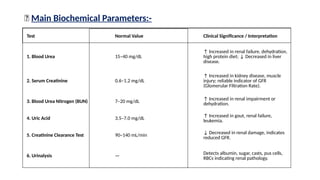
🔹 Main Biochemical Parameters:-
Test Normal Value Clinical Significance / Interpretation
1. Blood Urea 15–40 mg/dL
↑ Increased in renal failure, dehydration,
high protein diet; ↓ Decreased in liver
disease.
2. Serum Creatinine 0.6–1.2 mg/dL
↑ Increased in kidney disease, muscle
injury; reliable indicator of GFR
(Glomerular Filtration Rate).
3. Blood Urea Nitrogen (BUN) 7–20 mg/dL ↑ Increased in renal impairment or
dehydration.
4. Uric Acid 3.5–7.0 mg/dL
↑ Increased in gout, renal failure,
leukemia.
5. Creatinine Clearance Test 90–140 mL/min ↓ Decreased in renal damage, indicates
reduced GFR.
6. Urinalysis —
Detects albumin, sugar, casts, pus cells,
RBCs indicating renal pathology.
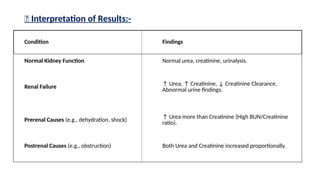
🔹 Interpretation of Results:-
Condition Findings
Normal Kidney Function Normal urea, creatinine, urinalysis.
Renal Failure
↑ Urea, ↑ Creatinine, ↓ Creatinine Clearance,
Abnormal urine findings.
Prerenal Causes (e.g., dehydration, shock) ↑ Urea more than Creatinine (High BUN/Creatinine
ratio).
Postrenal Causes (e.g., obstruction) Both Urea and Creatinine increased proportionally.
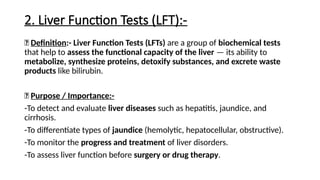
2. Liver Function Tests (LFT):-
🔹 Definition:- Liver Function Tests (LFTs) are a group of biochemical tests
that help to assess the functional capacity of the liver — its ability to
metabolize, synthesize proteins, detoxify substances, and excrete waste
products like bilirubin.
🔹 Purpose / Importance:-
-To detect and evaluate liver diseases such as hepatitis, jaundice, and
cirrhosis.
-To differentiate types of jaundice (hemolytic, hepatocellular, obstructive).
-To monitor the progress and treatment of liver disorders.
-To assess liver function before surgery or drug therapy.
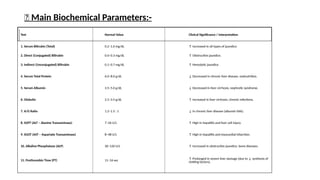
🔹 Main Biochemical Parameters:-
Test Normal Value Clinical Significance / Interpretation
1. Serum Bilirubin (Total) 0.2–1.0 mg/dL ↑ Increased in all types of jaundice.
2. Direct (Conjugated) Bilirubin 0.0–0.3 mg/dL ↑ Obstructive jaundice.
3. Indirect (Unconjugated) Bilirubin 0.1–0.7 mg/dL ↑ Hemolytic jaundice.
4. Serum Total Protein 6.0–8.0 g/dL ↓ Decreased in chronic liver disease, malnutrition.
5. Serum Albumin 3.5–5.0 g/dL ↓ Decreased in liver cirrhosis, nephrotic syndrome.
6. Globulin 2.5–3.5 g/dL ↑ Increased in liver cirrhosis, chronic infections.
7. A/G Ratio 1.2–1.5 : 1 ↓ In chronic liver disease (albumin falls).
8. SGPT (ALT – Alanine Transaminase) 7–56 U/L ↑ High in hepatitis and liver cell injury.
9. SGOT (AST – Aspartate Transaminase) 8–48 U/L ↑ High in hepatitis and myocardial infarction.
10. Alkaline Phosphatase (ALP) 30–120 U/L ↑ Increased in obstructive jaundice, bone diseases.
11. Prothrombin Time (PT) 11–16 sec ↑ Prolonged in severe liver damage (due to ↓ synthesis of
clotting factors).
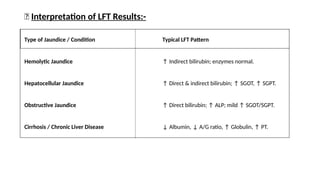
🔹 Interpretation of LFT Results:-
Type of Jaundice / Condition Typical LFT Pattern
Hemolytic Jaundice ↑ Indirect bilirubin; enzymes normal.
Hepatocellular Jaundice ↑ Direct & indirect bilirubin; ↑ SGOT, ↑ SGPT.
Obstructive Jaundice ↑ Direct bilirubin; ↑ ALP; mild ↑ SGOT/SGPT.
Cirrhosis / Chronic Liver Disease ↓ Albumin, ↓ A/G ratio, ↑ Globulin, ↑ PT.
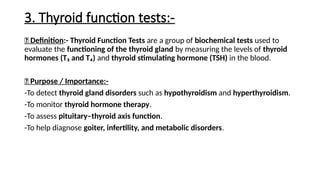
3. Thyroid function tests:-
🔹 Definition:- Thyroid Function Tests are a group of biochemical tests used to
evaluate the functioning of the thyroid gland by measuring the levels of thyroid
hormones (T₃ and T₄) and thyroid stimulating hormone (TSH) in the blood.
🔹 Purpose / Importance:-
-To detect thyroid gland disorders such as hypothyroidism and hyperthyroidism.
-To monitor thyroid hormone therapy.
-To assess pituitary–thyroid axis function.
-To help diagnose goiter, infertility, and metabolic disorders.
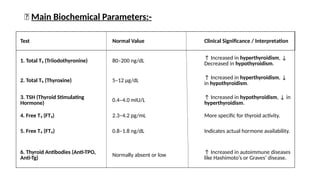
🔹 Main Biochemical Parameters:-
Test Normal Value Clinical Significance / Interpretation
1. Total T₃ (Triiodothyronine) 80–200 ng/dL
↑ Increased in hyperthyroidism, ↓
Decreased in hypothyroidism.
2. Total T₄ (Thyroxine) 5–12 µg/dL
↑ Increased in hyperthyroidism, ↓
in hypothyroidism.
3. TSH (Thyroid Stimulating
Hormone)
0.4–4.0 mIU/L
↑ Increased in hypothyroidism, ↓ in
hyperthyroidism.
4. Free T₃ (FT₃) 2.3–4.2 pg/mL More specific for thyroid activity.
5. Free T₄ (FT₄) 0.8–1.8 ng/dL Indicates actual hormone availability.
6. Thyroid Antibodies (Anti-TPO,
Anti-Tg)
Normally absent or low
↑ Increased in autoimmune diseases
like Hashimoto’s or Graves’ disease.
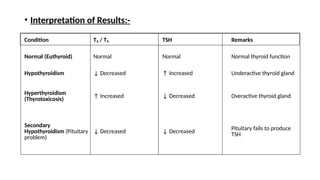
• Interpretation of Results:-
Condition T₃ / T₄ TSH Remarks
Normal (Euthyroid) Normal Normal Normal thyroid function
Hypothyroidism ↓ Decreased ↑ Increased Underactive thyroid gland
Hyperthyroidism
(Thyrotoxicosis)
↑ Increased ↓ Decreased Overactive thyroid gland
Secondary
Hypothyroidism (Pituitary
problem)
↓ Decreased ↓ Decreased
Pituitary fails to produce
TSH
Thank You.