SAROJINI NAIDU VANITAPHARMACY MAHA VIDYALAYA (CO – ED)
(Sponsored By The Exhibition Society)
(UGC AUTONOMOUS INSTITUTION)
Affiliated To Osmania University
Approved By PCI, NBAAccredited, Accredited A+ Grade By NAAC
Presented By:
Byti Rahul
1704-25-867-003
II semester 1st
year
M Pharmacy Regulatory Affairs
SUB: Regulatory Aspects of Drugs & Cosmetics
UNIT:III
Japan: Drug Approval & Safety Monitoring The step-by-
step drug regulatory approval process and Post-Marketing
Surveillance (PMS) requirements in Japan.
2.
Contents
• Introduction toJapan's Drug Regulatory System
• Drug development and Approval
• Post-Marketing Surveillance (PMS) in Japan
• Conclusion
• Reference
3.
Japan: Drug Approval& Safety Monitoring
• Introduction to Japan's Drug Regulatory System
• Japan has a structured regulatory system designed to ensure
that medicines meet appropriate standards of: Quality ,
Efficacy , Safety.
• PMDA evaluates the scientific evidence and conducts
regulatory inspections, while the MHLW is responsible for
regulatory decisions and policy.
• The system covers the entire product lifecycle:
• Research → Development → Clinical Trials → Approval
→ Marketing → PMS → Re-examination/Re-evaluation
4.
Major Regulatory Authorities
•1. MHLW
• Ministry of Health, Labour and Welfare
• Main responsibilities:
• Pharmaceutical policy
• Regulatory decision-making
• Final approval of drugs
• Safety measures
• Regulatory standards
5.
• 2. PMDA
Pharmaceuticalsand Medical Devices Agency
• Main responsibilities:
• Scientific review
• Clinical trial consultations
• GCP/GMP/GPSP inspections
• Safety monitoring
• Post-marketing activities
• Re-examination/re-evaluation support
6.
Legal Framework
• Theprincipal legislation is the:
• Pharmaceuticals and Medical Devices Act (PMD Act): It
regulates:
• Pharmaceuticals
• Medical devices
• In-vitro diagnostic products
• The Act establishes requirements concerning:
• Manufacturing
• Marketing authorization
• Quality
• Efficacy
• Safety
• Post-marketing safety monitoring
7.
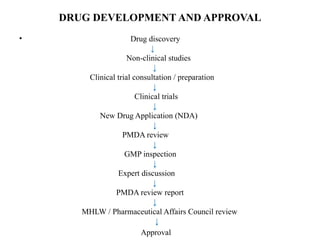
DRUG DEVELOPMENT ANDAPPROVAL
• Drug discovery
↓
Non-clinical studies
↓
Clinical trial consultation / preparation
↓
Clinical trials
↓
New Drug Application (NDA)
↓
PMDA review
↓
GMP inspection
↓
Expert discussion
↓
PMDA review report
↓
MHLW / Pharmaceutical Affairs Council review
↓
Approval
8.
• PMDA confirmsthat new-drug review evaluates quality,
pharmacology, pharmacokinetics, toxicology, clinical aspects and
biostatistics, with expert discussions during the review.
• 1. Step-by-step drug approval process in Japan
• 1. Regulatory consultation and development planning
• The sponsor develops the drug's quality, non-clinical and clinical
program.
• PMDA provides consultations during development, including advice
on clinical-trial plans and the data required for a marketing
application.
• A Japanese regulatory strategy should address the planned indication,
dosage, target population, clinical endpoints, manufacturing process
and post-marketing risk-management strategy.
9.
2. Non-clinical development
•Pharmacology, pharmacokinetics and toxicology studies are
conducted according to applicable standards.
• Safety studies supporting the application must comply with
GLP where applicable.
• PMDA can inspect non-clinical facilities and assess the
reliability of GLP data.
• 3. Clinical development
• Clinical trials are conducted under Japan's GCP requirements.
• The clinical package generally progresses through early-phase
studies and confirmatory trials to establish safety and efficacy
for the proposed indication.
10.
• PMDA canconduct GCP inspections and document-based
compliance assessments of the clinical-trial data.
• 4. Preparation of the Marketing Authorization Application
(MAA)
The sponsor compiles the application dossier, including,
broadly:
• Quality/CMC information
• Non-clinical pharmacology and toxicology
• Clinical efficacy and safety
• Statistical analyses
• Proposed labeling/package insert
11.
• Manufacturing information
•Risk-management and post-marketing plans
• The application must meet Japan's requirements for the
reliability of submitted data. PMDA assesses whether the
underlying studies and submitted materials comply with GLP,
GCP and other applicable standards.
• 5. Submission to MHLW/PMDA
• The marketing authorization application is submitted through
the Japanese regulatory framework.
• PMDA performs the scientific review and associated
compliance inspections.
12.
• Manufacturing facilities/processesare subject to GMP
conformity assessment as applicable. PMDA specifically
performs GMP inspections to assess manufacturing quality
systems.
• 6. PMDA scientific review
PMDA evaluates the product's: Quality, Efficacy ,Safety
• The review can include questions/requests for clarification and
additional analyses or information from the applicant.
• 7. Expert and regulatory review
The regulatory review proceeds through the Japanese approval
framework, including the relevant expert/committee processes
where applicable.
13.
• 8. MHLWmarketing approval
If the product satisfies the applicable requirements, MHLW
grants marketing approval. The approved indication, dosage
and administration, labeling and other conditions form the
basis for subsequent commercialization and safety monitoring.
14.
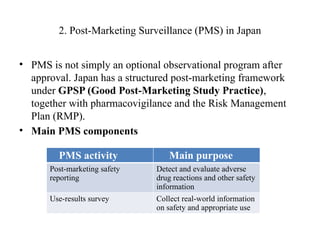
2. Post-Marketing Surveillance(PMS) in Japan
• PMS is not simply an optional observational program after
approval. Japan has a structured post-marketing framework
under GPSP (Good Post-Marketing Study Practice),
together with pharmacovigilance and the Risk Management
Plan (RMP).
• Main PMS components
PMS activity Main purpose
Post-marketing safety
reporting
Detect and evaluate adverse
drug reactions and other safety
information
Use-results survey Collect real-world information
on safety and appropriate use
15.
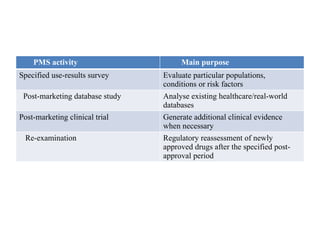
PMS activity Mainpurpose
Specified use-results survey Evaluate particular populations,
conditions or risk factors
Post-marketing database study Analyse existing healthcare/real-world
databases
Post-marketing clinical trial Generate additional clinical evidence
when necessary
Re-examination Regulatory reassessment of newly
approved drugs after the specified post-
approval period
16.
• PMDA's GPSPframework covers post-marketing surveys and
studies, and PMDA can inspect their conduct and assess the
reliability of the resulting data.
• 3. Risk Management Plan (RMP)
• An important feature of the Japanese system is the Risk
Management Plan.
• The RMP links risk management from development through
regulatory review and the post-marketing period. It identifies,
among other things:
• Important identified risks
• Important potential risks
• Important missing information
17.
• Pharmacovigilance activities
•Risk-minimization measures
• The RMP is intended to be updated/evaluated as safety
information accumulates and is used to support appropriate
risk management after approval.
• 4. Post-marketing safety reporting
• After commercialization, the Japanese Marketing
Authorization Holder (MAH) has a central responsibility for
post-marketing safety reporting.
18.
• Safety informationcan originate from:
• Healthcare professionals
• Patients
• Literature
• Clinical studies
• PMS activities
• Other sources of safety information
• PMDA states that post-marketing safety reports from the
MAH are submitted by the Japanese MAH distributing the
product in Japan.
19.
• 5. Re-examination:an important Japanese PMS feature
• Japan has a specific re-examination ( 再審査 ) system for
newly approved drugs.
• The rationale is that clinical trials have limited patient
numbers and controlled conditions, whereas real-world use
exposes a drug to:
• Much larger patient populations
• Concomitant medications
• Different doses/use patterns
• Less controlled clinical circumstances
• Therefore, after a specified post-approval period, real-world
data are reviewed to reassess the drug's approved efficacy and
safety.
20.
• The companysubmits a re-examination application with the
required PMS evidence. PMDA assesses the submitted
information and can conduct GPSP inspections and
document-based assessments.
• Possible regulatory outcomes include:
• Approval cancellation
• Deletion or modification of an indication/approved claim
• No regulatory action
• Even where no major regulatory action is taken,
labeling/package-insert changes may still result from the
review.
21.
• 6. Re-evaluation
•Re-examination should be distinguished from re-
evaluation( 再評価 ).
• Re-examination primarily concerns newly approved products
after their designated post-marketing period.
• Re-evaluation can apply to already-approved drugs and
reassesses their quality, efficacy and safety against current
scientific/medical standards. It can potentially result in
cancellation, modification/deletion of indications, or no action.
22.
• The MarketingAuthorization Holder (MAH) continuously collects safety information.
• Sources
• Healthcare professionals
• Patients
• Clinical studies
• PMS studies
• Literature
• Other safety databases/sources
23.
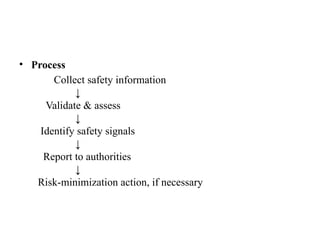
• Process
Collect safetyinformation
↓
Validate & assess
↓
Identify safety signals
↓
Report to authorities
↓
Risk-minimization action, if necessary
24.
CONCLUSION
• MHLW isthe main government authority responsible for
marketing approval.
• PMDA performs scientific reviews and regulatory inspections.
• Drug development must comply with GLP, GCP and GMP
requirements.
• PMS continues throughout the product's post-approval
lifecycle.
• GPSP governs post-marketing studies and surveillance.
• RMP integrates safety risks and risk-minimization activities.
• Re-examination and re-evaluation provide additional
regulatory oversight after approval.
• Japan therefore uses a lifecycle-based approach to drug
safety.
25.
References
• Ministry ofHealth, Labour and Welfare (MHLW) —
Pharmaceuticals and Medical Devices regulatory framework
• PMDA – Review and Approval Services
• PMDA – GLP/GCP/GPSP
• PMDA – Risk Management Plan (RMP)