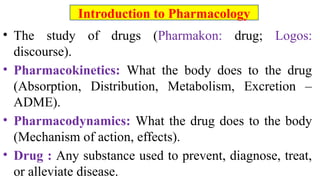
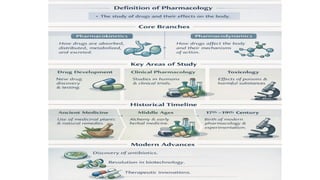
The study of drugs (Pharmakon: drug; Logos: discourse).
Pharmacokinetics: What the body does to the drug (Absorption, Distribution, Metabolism, Excretion – ADME).
Pharmacodynamics: What the drug does to the body (Mechanism of action, effects).
Drug : Any substance used to prevent, diagnose, treat, or alleviate disease.
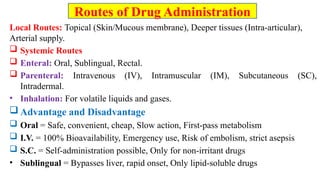
Routes of Drug Administration
Local Routes: Topical (Skin/Mucous membrane), Deeper tissues (Intra-articular), Arterial supply.
Systemic Routes
Enteral: Oral, Sublingual, Rectal.
Parenteral: Intravenous (IV), Intramuscular (IM), Subcutaneous (SC), Intradermal.
Inhalation: For volatile liquids and gases.
Advantage and Disadvantage
Oral = Safe, convenient, cheap, Slow action, First-pass metabolism
I.V. = 100% Bioavailability, Emergency use, Risk of embolism, strict asepsis
S.C. = Self-administration possible, Only for non-irritant drugs
Sublingual = Bypasses liver, rapid onset, Only lipid-soluble drugs
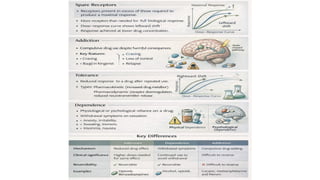
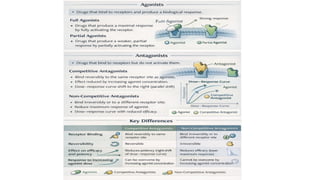
Agonist: An agent which activates a receptor to produce an effect similar to that of the physiological signal molecule.
Antagonist: An agent which prevents the action of an agonist on a receptor but has no effect of its own.
Partial Agonist: Activates a receptor but produces a sub-maximal response.
Inverse Agonist: Produces an effect opposite to that of the agonist.
Competitive (Equilibrium)
Antagonist binds reversibly to the same site as the agonist.
Can be overcome by increasing agonist concentration.
Non-Competitive
Antagonist binds to a different site (allosteric) or binds irreversibly.
Cannot be fully reversed by more agonist.
Concept: Maximal response can be achieved by activating only a small fraction of the total receptor population.
Significance: Increases sensitivity to low concentrations of agonists and provides a functional reserve.
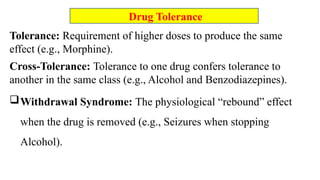
Tolerance: Requirement of higher doses to produce the same effect (e.g., Morphine).
Cross-Tolerance: Tolerance to one drug confers tolerance to another in the same class (e.g., Alcohol and Benzodiazepines).
Withdrawal Syndrome: The physiological “rebound” effect when the drug is removed (e.g., Seizures when stopping Alcohol).
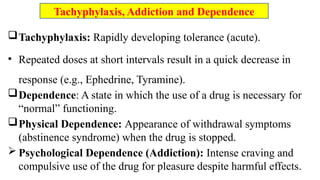
Tachyphylaxis: Rapidly developing tolerance (acute).
Repeated doses at short intervals result in a quick decrease in response (e.g., Ephedrine, Tyramine).
Dependence: A state in which the use of a drug is necessary for “normal” functioning.
Physical Dependence: Appearance of withdrawal symptoms (abstinence syndrome) when the drug is stopped.
Psychological Dependence (Addiction): Intense craving and compulsive use of the drug for pleasure despite harmful effects.
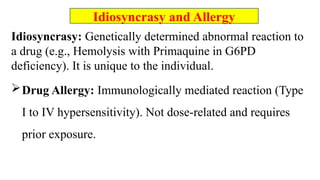
Idiosyncrasy: Genetically determined abnormal reaction to a drug (e.g., Hemolysis with Primaquine in G6PD deficiency). It is unique to the individual.
Drug Allergy: Immunologically mediated reaction (Type I to IV hypersensitivity). Not dose-related and requires prior exposure.
 Most read
 Most read
 Most read