Unit 1 – Foundations of
Research
Prepared by
Poonam R.Mandale
Assistant Professor
D.Y.Patil College of Engineering and Technology Kolhapur
1. Meaning of Research
• Research is a systematic, scientific, and logical investigation
undertaken to discover new facts, verify existing knowledge, solve
problems, or develop new theories. It involves collecting, analyzing,
interpreting, and reporting data in an organized manner.
• Definitions
• Redman and Mory: "Research is a systematized effort to gain new
knowledge."
• C.R. Kothari: "Research is a scientific and systematic search for
pertinent information on a specific topic."
Features of Research
• Systematic and organized
• Logical and objective
• Empirical (based on observations)
• Replicable
• Controlled
• Problem-oriented
• Example
• A chemical engineer investigates the efficiency of a new biosorbent for removing
dyes from textile wastewater.
1. Systematic and Organized
• Meaning
• Research is a planned, structured, and organized process. It is
conducted by following a series of well-defined steps rather than
random activities. Every stage is carefully planned before starting the
research.
• Research follows a sequence such as:
• Identifying the research problem
• Reviewing the literature
• Setting objectives
• Selecting research methodology
• Collecting data
• Analyzing data
• Drawing conclusions
• Preparing the research report
• Skipping any important step may reduce the quality and
reliability of the research.
Characteristics
• Follows a step-by-step process.
• Uses proper planning.
• Maintains accurate records.
• Uses scientific methods.
• Avoids confusion and unnecessary work.
Example
• Suppose a researcher wants to study the removal of textile dye using biosorbents.
• A systematic approach would include:
• Identifying the pollution problem.
• Reviewing previous studies.
• Selecting an adsorbent.
• Designing experiments.
• Collecting adsorption data.
• Performing statistical analysis.
• Writing conclusions.
• Instead of randomly performing experiments, each step is properly organized.
Importance
•Saves time and resources.
•Produces reliable results.
•Makes research easier to understand.
•Helps others repeat the study.
2. Logical and Objective
• Meaning
• Research must be based on logic, facts, and scientific reasoning, not on personal
opinions, emotions, or assumptions.
• Logical Research
• Logical research means every conclusion is supported by evidence and scientific
reasoning.
• Researchers ask:
• Why did this happen?
• What evidence supports this conclusion?
• Does the data justify the result?
• Objective Research
• Objective means free from personal bias.
• Researchers should not manipulate data simply because they expect a particular result.
• Characteristics
• Based on facts.
• Uses scientific reasoning.
• Avoids personal beliefs.
• Conclusions come from evidence.
• Unbiased interpretation.
Example
• Suppose a researcher believes that Adsorbent A is the best.
• After experiments, Adsorbent B performs better.
• An objective researcher reports:
• "Adsorbent B achieved higher removal efficiency than Adsorbent A."
• Instead of changing the data to support personal expectations.
• Importance
• Produces trustworthy findings.
• Increases scientific credibility.- When research is conducted carefully, objectively, and using scientific
methods, people can trust its results. This trust is called scientific credibility.
• Reduces researcher bias.
• Helps make correct decisions.
3. Empirical (Based on Observations)
• Meaning
• Empirical research means that conclusions are based on real observations, experiments,
measurements, and collected data, rather than imagination or guesswork.
• The word empirical comes from the Greek word meaning "experience."
• Researchers gather evidence through:
• Experiments
• Surveys
• Interviews
• Laboratory observations
• Field studies
• Measurements
Characteristics
•Based on actual data.
•Uses measurable observations.
•Can be verified.
•Uses instruments and scientific tools.
Example
• A chemical engineer studies dye adsorption.
• Instead of saying:
• "I think adsorption increases with temperature."
• The researcher performs experiments at:
• 30°C
• 40°C
• 50°C
• 60°C
• The conclusion is based on observed data.
Importance
•Gives accurate information.
•Reduces assumptions.
•Supports scientific conclusions.
•Makes research reliable.
4. Replicable
• Meaning
• Replicable means other researchers should be able to repeat the same research
using the same procedure and obtain similar results.
• This is one of the most important characteristics of scientific research.
• For replication, the researcher must clearly explain:
• Materials used
• Equipment
• Experimental conditions
• Methodology
• Data analysis methods
Characteristics
• Transparent methodology.
A transparent methodology means the researcher does not
hide any important details about the research. Everything
—from data collection to analysis—is explained clearly.
• Clear experimental procedure.
• Similar results can be obtained.
• Increases confidence in findings.
Example
• A researcher reports:
• pH = 7
• Adsorbent dosage = 2 g/L
• Contact time = 60 min
• Temperature = 30°C
• Another researcher repeats the experiment using the same conditions and gets
nearly the same adsorption efficiency.
• This demonstrates replicability
Importance
•Verifies research findings.
•Detects errors.
•Builds scientific confidence.
•Allows further research.
5. Controlled
• Meaning
• Research should be conducted under controlled conditions, where only the
variable being studied changes while all other factors remain constant.
• This helps identify the true effect of the independent variable on the dependent
variable.
• Types of Variables
• Independent Variable: The factor intentionally changed by the researcher.
• Dependent Variable: The outcome or response measured.
• Controlled Variables: Factors kept constant to ensure a fair test.
Example
• Suppose a researcher studies the effect of pH on dye removal.
• The researcher changes only:
• pH = 3, 5, 7, 9
• But keeps constant:
• Temperature
• Contact time
• Adsorbent dosage
• Stirring speed
• Initial dye concentration
• Thus, any change in dye removal is due only to pH.
Importance
• Eliminates unwanted influences.
• Produces accurate results.
• Improves validity.
• Helps establish cause-and-effect relationships.
6. Problem-Oriented
• Meaning
• Research always begins with a specific problem or question that needs to be
solved or understood.
• Without a clearly defined problem, research lacks direction and purpose.
• Characteristics
• Focuses on solving practical or theoretical problems.
• Clearly states research objectives.
• Addresses gaps in existing knowledge.
• Contributes new information or solutions.
Example
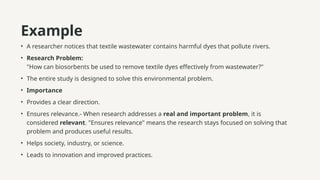
• A researcher notices that textile wastewater contains harmful dyes that pollute rivers.
• Research Problem:
"How can biosorbents be used to remove textile dyes effectively from wastewater?"
• The entire study is designed to solve this environmental problem.
• Importance
• Provides a clear direction.
• Ensures relevance.- When research addresses a real and important problem, it is
considered relevant. "Ensures relevance" means the research stays focused on solving that
problem and produces useful results.
• Helps society, industry, or science.
• Leads to innovation and improved practices.
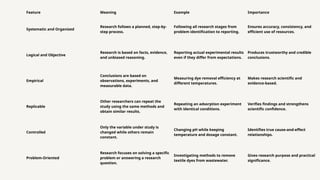
Feature Meaning Example Importance
Systematic and Organized
Research follows a planned, step-by-
step process.
Following all research stages from
problem identification to reporting.
Ensures accuracy, consistency, and
efficient use of resources.
Logical and Objective
Research is based on facts, evidence,
and unbiased reasoning.
Reporting actual experimental results
even if they differ from expectations.
Produces trustworthy and credible
conclusions.
Empirical
Conclusions are based on
observations, experiments, and
measurable data.
Measuring dye removal efficiency at
different temperatures.
Makes research scientific and
evidence-based.
Replicable
Other researchers can repeat the
study using the same methods and
obtain similar results.
Repeating an adsorption experiment
with identical conditions.
Verifies findings and strengthens
scientific confidence.
Controlled
Only the variable under study is
changed while others remain
constant.
Changing pH while keeping
temperature and dosage constant.
Identifies true cause-and-effect
relationships.
Problem-Oriented
Research focuses on solving a specific
problem or answering a research
question.
Investigating methods to remove
textile dyes from wastewater.
Gives research purpose and practical
significance.
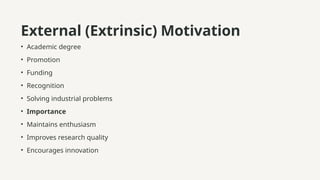
External (Extrinsic) Motivation
• Academic degree
• Promotion
• Funding
• Recognition
• Solving industrial problems
• Importance
• Maintains enthusiasm
• Improves research quality
• Encourages innovation
Utility (Importance) of Research
• Research benefits individuals, industries, governments, and society.
• Academic Utility
• Expands knowledge
• Develops theories
• Improves education
• Industrial Utility
• Better product quality
• Process optimization
• Cost reduction
Utility (Importance) of Research
• Social Utility
• Better healthcare
• Environmental protection
• Improved living standards
• Economic Utility
• Resource conservation
• Increased productivity
• National development
Utility (Importance) of Research
• Scientific Utility
• Discovery of new principles
• Advancement of technology
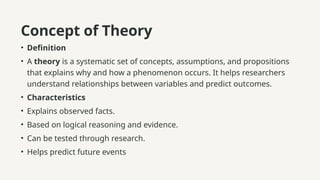
Concept of Theory
• Definition
• A theory is a systematic set of concepts, assumptions, and propositions
that explains why and how a phenomenon occurs. It helps researchers
understand relationships between variables and predict outcomes.
• Characteristics
• Explains observed facts.
• Based on logical reasoning and evidence.
• Can be tested through research.
• Helps predict future events
Example
• Theory: Increasing study time improves students' academic performance.
• A researcher can test this theory by collecting data on students' study
hours and exam scores.
• Importance in Research
• Provides a framework for research.
• Helps formulate hypotheses.
• Guides data collection and analysis.
• Explains research findings.
2. Empiricism
• Definition
• Empiricism is the principle that knowledge is obtained through observation,
experience, and experimentation, rather than only through reasoning or beliefs.
• Characteristics
• Based on real-world observations.
• Uses measurable evidence.
• Objective and verifiable.
• Relies on experiments and data collection.
2. Empiricism
• Example
• A researcher measures the adsorption efficiency of a biosorbent by
conducting laboratory experiments rather than relying on
assumptions.
• Importance in Research
• Produces reliable scientific evidence.
• Reduces personal bias.
• Makes research findings reproducible.
• Forms the basis of scientific research
3. Deductive Theory (Deductive
Reasoning)
• Definition
• Deductive reasoning moves from general theory to
specific observations. Researchers begin with an existing
theory, develop a hypothesis, and then test it using data.
• Process
• Theory Hypothesis Data Collection Analysis
→ → → →
Conclusion
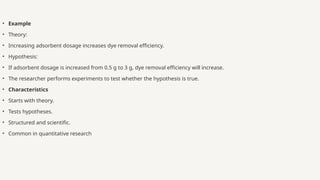
• Example
• Theory:
• Increasing adsorbent dosage increases dye removal efficiency.
• Hypothesis:
• If adsorbent dosage is increased from 0.5 g to 3 g, dye removal efficiency will increase.
• The researcher performs experiments to test whether the hypothesis is true.
• Characteristics
• Starts with theory.
• Tests hypotheses.
• Structured and scientific.
• Common in quantitative research
3. Deductive Theory (Deductive
Reasoning)
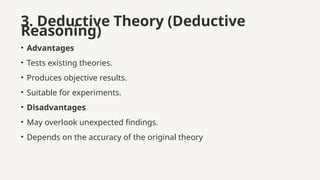
• Advantages
• Tests existing theories.
• Produces objective results.
• Suitable for experiments.
• Disadvantages
• May overlook unexpected findings.
• Depends on the accuracy of the original theory
4. Inductive Theory (Inductive
Reasoning)
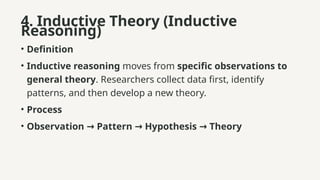
• Definition
• Inductive reasoning moves from specific observations to
general theory. Researchers collect data first, identify
patterns, and then develop a new theory.
• Process
• Observation Pattern Hypothesis Theory
→ → →
4. Inductive Theory (Inductive
Reasoning)
• Example
• A researcher observes that several agricultural waste materials effectively remove
dyes from wastewater. After repeated studies, the researcher proposes a theory that
lignocellulosic agricultural wastes are effective low-cost adsorbents.
• Characteristics
• Starts with observations.
• Generates new theories.
• Flexible and exploratory.
• Common in qualitative research
4. Inductive Theory (Inductive
Reasoning
• Advantages
• Encourages discovery of new knowledge.
• Useful when little prior information exists.
• Flexible research approach.
• Disadvantages
• Conclusions may not always be universally applicable.
• More susceptible to researcher interpretation.
Difference Between Deductive and
Inductive Theory
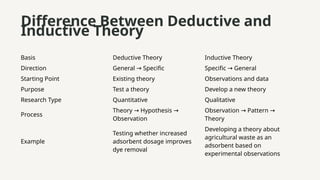
Basis Deductive Theory Inductive Theory
Direction General Specific
→ Specific General
→
Starting Point Existing theory Observations and data
Purpose Test a theory Develop a new theory
Research Type Quantitative Qualitative
Process
Theory Hypothesis
→ →
Observation
Observation Pattern
→ →
Theory
Example
Testing whether increased
adsorbent dosage improves
dye removal
Developing a theory about
agricultural waste as an
adsorbent based on
experimental observations
Relationship in the Foundation of
Research
• The four concepts are interconnected:
• Theory provides the conceptual framework.
• Deductive reasoning tests existing theories through hypotheses.
• Empiricism provides evidence through observation and experiments.
• Inductive reasoning uses empirical observations to develop new theories.
• This creates a continuous cycle of scientific knowledge:
• Theory Deduction Observation (Empiricism) Induction New or
→ → → →
Improved Theory
Characteristics of Scientific Method,
Understanding the Language of
Research, and Research Process
1. Characteristics of Scientific
Method
• Definition
• Scientific research follows a planned sequence of steps. Every stage, from identifying
the problem to drawing conclusions, is organized and well structured.
• General Example
• Suppose a school wants to know whether daily exercise improves students'
concentration.
• The researcher follows these steps:
• Identify the problem.
• Review previous studies.
• Select students.
• Conduct an exercise program.
• Measure concentration levels.
• Analyse the results.
• Draw conclusions.
• Since every step follows a planned order, the research is systematic.
2. Empirical
• Definition
• Empirical research is based on actual observation, experience, or experiments rather than
opinions or assumptions.
• General Example
• A teacher believes students who study more score higher marks.
• Instead of guessing, the teacher:
• Collects study hours of students.
• Records examination marks.
• Compares the data.
• The conclusion is based on real evidence, making it empirical.
3. Objective
• Definition
• Objective research is free from personal feelings, emotions, or bias.
• Researchers rely only on facts and evidence.
• General Example
• A company compares two brands of batteries.
• Instead of choosing a favourite brand, it measures:
• Battery life
• Charging time
• Cost
• The decision is based on measured data rather than personal preference.
4. Logical
• Definition
• Scientific research follows logical reasoning, where conclusions are
based on facts and evidence.
• General Example
• A researcher finds:
• Plants receiving sunlight grow taller.
• Plants kept in darkness grow slowly.
• The logical conclusion is that sunlight promotes plant growth.
5. Replicable
• Definition
• If another researcher repeats the same study using the same
procedure, similar results should be obtained.
• General Example
• One scientist measures the boiling point of pure water as
100°C at standard atmospheric pressure.
• Scientists in other laboratories should obtain nearly the same
result using the same conditions.
6. Verifiable
• Definition
• Scientific findings should be checked and confirmed by other
researchers.
• General Example
• A nutrition researcher claims that a particular diet reduces cholesterol.
• Other researchers repeat the study to verify whether the same results
are obtained.
7. Controlled
• Definition
• Researchers keep all unnecessary factors constant so that only the variable being studied affects the
results.
• General Example
• A scientist studies the effect of fertilizer on plant growth.
• The following remain constant:
• Water
• Plant type
• Pot size
• Sunlight
• Only the amount of fertilizer is changed.
8. Predictive
• Definition
• Scientific knowledge helps predict future outcomes.
• General Example
• Weather departments collect data on:
• Temperature
• Air pressure
• Humidity
• Using this information, they predict tomorrow's weather.
9. Ethical
• Definition
• Research must follow ethical principles such as:
• Honesty
• Integrity
• Respect for participants
• Confidentiality
• No plagiarism
• General Example
• A researcher conducting a health survey:
• Takes participants' permission.
• Keeps their personal information confidential.
• Reports data honestly.
10. Critical
• Definition
• Researchers carefully evaluate every stage of research before
accepting conclusions.
• General Example
• After completing an experiment, the researcher asks:
• Were measurements accurate?
• Were enough samples collected?
• Could another factor influence the results?
2. Understanding the Language of
Research
• Researchers use several important terms that form the foundation of research.
• A. Concept
• Definition
• A Concept is a general idea or mental image representing an object, event, or phenomenon.
• Concepts help us understand and communicate ideas.
• Examples
• Education
• Health
• Pollution
• Happiness
• Leadership
• Intelligence
2. Understanding the Language of
Research
• General Example
• Consider the concept "Health."
• Everyone understands that health relates to physical and mental well-being, but it is
a broad idea and not directly measurable.
• Characteristics of Concept
• Represents an idea.
• Broad and general. .
• Forms the basis for theories and research.
B. Construct
• Definition
• A Construct is a concept that is specially developed for scientific research and cannot
be directly observed. It is measured using indicators or questionnaires.
• Examples
• Intelligence
• Job Satisfaction
• Anxiety
• Motivation
• Self-confidence
• Quality of Life
General Example
• "Job Satisfaction" cannot be seen directly.
• Researchers measure it using questions like:
• Are you satisfied with your salary?
• Do you enjoy your work?
• Would you recommend your workplace to others?
• The responses together indicate the person's level of job
satisfaction.
C. Definition
• A Definition explains the exact meaning of a concept so everyone understands it in
the same way.
• There are two types.
• 1. Conceptual Definition
• Explains the meaning in words.
• Example
• Stress: A feeling of emotional or physical tension caused by demanding situations.
2. Operational Definition
• Explains how the concept will be measured.
• Example
• Stress is measured using:
• A standardized stress questionnaire.
• Scores ranging from 0 to 40.
• Thus, the operational definition tells us exactly how stress is
measured.
D. Variable
• Definition
• A Variable is any characteristic that can change or take different values among
individuals, objects, or situations.
• Examples
• Age
• Height
• Weight
• Income
• Marks
• Temperature
Types of Variables
• 1. Independent Variable
• Definition
• The variable that the researcher changes intentionally.
• General Example
• Research Question:
Does study time affect examination marks?
• Independent Variable:
Study time (hours)
2. Dependent Variable
• Definition
• The outcome measured by the researcher.
• General Example
• Dependent Variable:
Examination marks
• Marks depend on study time.
3. Control Variable
• Definition
• Variables kept constant throughout the experiment.
• General Example
• To study the effect of study hours:
• Same examination
• Same classroom
• Same teacher
• Same syllabus
• These are control variables.
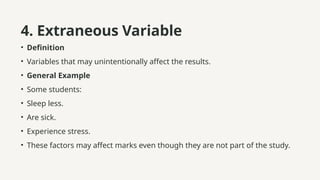
4. Extraneous Variable
• Definition
• Variables that may unintentionally affect the results.
• General Example
• Some students:
• Sleep less.
• Are sick.
• Experience stress.
• These factors may affect marks even though they are not part of the study.
5. Confounding Variable
• Definition
• A variable related to both the independent and dependent variables, making it
difficult to determine the true cause of the outcome.
• General Example
• Suppose students who study longer also attend private coaching.
• If they score higher, is it because of:
• More study time?
• Coaching classes?
• Private coaching is a confounding variable.
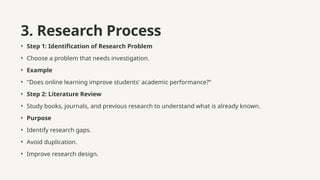
3. Research Process
• Step 1: Identification of Research Problem
• Choose a problem that needs investigation.
• Example
• "Does online learning improve students' academic performance?"
• Step 2: Literature Review
• Study books, journals, and previous research to understand what is already known.
• Purpose
• Identify research gaps.
• Avoid duplication.
• Improve research design.
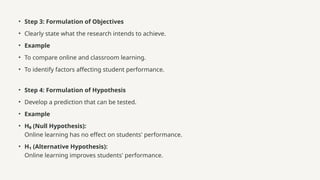
• Step 3: Formulation of Objectives
• Clearly state what the research intends to achieve.
• Example
• To compare online and classroom learning.
• To identify factors affecting student performance.
• Step 4: Formulation of Hypothesis
• Develop a prediction that can be tested.
• Example
• H₀ (Null Hypothesis):
Online learning has no effect on students' performance.
• H₁ (Alternative Hypothesis):
Online learning improves students' performance.
• Step 5: Research Design
• Prepare a detailed plan describing:
• Participants
• Methods
• Tools
• Procedures
• Data analysis techniques
• Step 6: Sampling
• Select a representative group from the population.
• Example
• Population:
All college students.
• Sample:
200 randomly selected students.
• Step 7: Data Collection
• Gather information using appropriate methods.
• Methods
• Surveys
• Interviews
• Observation
• Experiments
• Questionnaires
• Step 8: Data Analysis
• Organize and analyse the collected data using:
• Tables
• Charts
• Graphs
• Statistical software
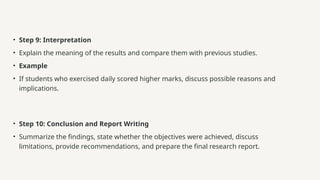
• Step 9: Interpretation
• Explain the meaning of the results and compare them with previous studies.
• Example
• If students who exercised daily scored higher marks, discuss possible reasons and
implications.
• Step 10: Conclusion and Report Writing
• Summarize the findings, state whether the objectives were achieved, discuss
limitations, provide recommendations, and prepare the final research report.