Understanding Tautonymy in Zoological Taxonomy: History, Examples, and Challenges
Explore the concept of tautonymy in zoology, its historical background, examples across animal groups, benefits, and challenges in biological taxonomy and scientific naming conventions.
Introduction
A taxonomicbinomial in which the
generic name and specific epithet
are ALIKE and which is common in
zoology especially to designate a
typical form but is forbidden to
botany under the ICBN.
“Tautonomy” derives from Greek
“tauto-”, a combining form meaning
the same or identical, + “onyma”
(name) and refers to the naming of
two or more DISTINCT animals with
the SAME generic and specific
names.
4.
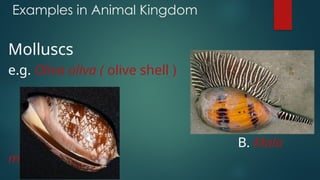
Examples in AnimalKingdom
Molluscs
e.g. Oliva oliva ( olive shell )
B. Malo
malo
Historical Perspective
Oneexample of a botanical tautonym is
‘Larix larix’. J
The earliest name for the European larch is
Pinus larix L. (1753) but Gustav Karl Wilhelm
Hermann Karsten did not agree with the
placement of the species in Pinus and
decided to move it to Larix in 1880. His
proposed name created a tautonym.
Under rules first established in 1906, which are
applied retroactively, Larix larix cannot exist
as a formal name.
In such a case either the next earliest validly
published name must be found, in this case
Larix decidua Mill. (1768), or (in its absence) a
new epithet m plust be published .
9.
Thehistorical perspective oftautonymy in biological taxonomy is rooted in the development of
systematic methods for naming and categorizing living organisms. Here’s a brief historical perspective:
1. Introduction of Binomial Nomenclature:
The concept of tautonymy is closely tied to the introduction of binomial nomenclature
by Carl Linnaeus in the 18th
century.
Linnaeus developed a systematic way of naming species using two parts: the genus and the species.
This system aimed to provide a standardized and universally understood way of identifying and
classifying organisms.
2. Linnaeus and Tautonymy:
Linnaeus himself used tautonymy in his naming system, where the genus and species
names were identical.
The use of tautonymy by Linnaeus and other early taxonomists helped establish a
consistent and clear method for naming species.
3. Clarity and Communication:
Tautonymy were employed to enhance clarity and avoid ambiguity in the identification
of species.
The use of identical genus and species names served as a clear and concise way of
communicating the identity of a particular organism .
10.
4. Traditional Practice:
Overtime, the use of tautonyms became a traditional practice in certain taxonomic groups.
Taxonomists continued to follow this convention, and it became deeply ingrained in the field of biological
taxonomy.
5. Continuity in Scientific Literature:
Tautonyms have persisted in scientific literature, contributing to the continuity and consistency of naming practices.
Despite variations in naming conventions across different taxonomic groups, the use of tautonyms remains a
recognizable and historical aspect of biological taxonomy.
6. Evolution of Taxonomy:
While tautonyms were widely used historically, modern advances in molecular biology and phylogenetics have led
to a more nuanced understanding of evolutionary relationships.
Contemporary taxonomy incorporates molecular data, and the emphasis is on reflecting evolutionary history in
naming practices.
In summary, the historical perspective of tautonyms is closely tied to the development of systematic naming
conventions in biological taxonomy, particularly the introduction of binomial nomenclature by Carl Linnaeus.
Tautonyms played a significant role in providing clarity and consistency in the identification and communication of
species.
11.
Benefits of TAUTONYM
1.Clarity and Uniqueness:
Benefit: Ensures clear and unambiguous identification of species.
Example: Immediate recognition of Gorilla gorilla as a specific species.
2. Consistency in Naming:
Benefit: Adheres to the principles of binomial nomenclature.
Example: Each species has a unique two-part name.
3. Emphasis on Species:
Benefit: Provides emphasis on the specific type of organism within a genus.
Example: Canis canis highlights a particular species within the genus Canis.
4. Tradition and Historical Continuity:
Benefit: Maintains a long-standing tradition in the field of taxonomy.
Example: Tautonymy have been used since the time of Carl Linnaeus.
5. Scientific Communication:
Benefit: Facilitates effective communication among scientists globally.
Example: Researchers universally understand and recognize tautonymous names.
12.
Challenges of TAUTONYM
1.Limited Applicability:
Challenge: Not all species have tautonymous names.
Example: Many species have distinct genus and species names.
2. Evolutionary Relationships:
Challenge: Tautonyms may not reflect evolutionary relationships.
Example: Molecular data may provide a more accurate understanding of evolutionary history.
3. Taxonomic Changes:
Challenge: Taxonomic revisions may lead to changes in species names.
Example: Species reclassifications may result in the alteration of tautonyms.
4. Overemphasis on Tradition:
Challenge: Relying too heavily on tradition may hinder adaptation to new scientific methods.
Example: Modern advances in molecular biology may necessitate new naming approaches.
5. Global Variation:
Challenge: Naming conventions can vary across taxonomic groups and regions.