Understanding Social Perception for Healthy Relationships and Conflict Resolution
Explore social perception, attribution theory, accommodation strategies, and active listening to improve relationships, bridge generational gaps, and reduce prejudice for better mental well-being and cooperation.
Understanding Social Perception for Healthy Relationships and Conflict Resolution
1.
The Lens ofInteraction
Examining Social Perception in Healthy Relationships
2.
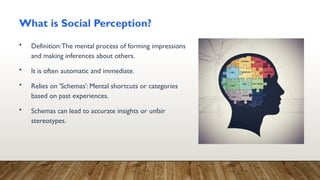
What is SocialPerception?
• Definition:The mental process of forming impressions
and making inferences about others.
• It is often automatic and immediate.
• Relies on 'Schemas': Mental shortcuts or categories
based on past experiences.
• Schemas can lead to accurate insights or unfair
stereotypes.
3.
AttributionTheory:The 'Why' BehindBehavior
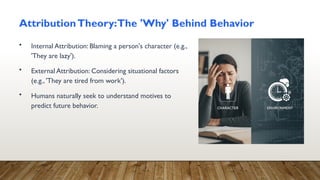
• Internal Attribution: Blaming a person's character (e.g.,
'They are lazy').
• External Attribution: Considering situational factors
(e.g., 'They are tired from work').
• Humans naturally seek to understand motives to
predict future behavior.
4.
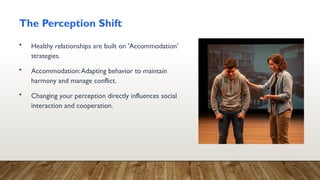
The Perception Shift
•Healthy relationships are built on 'Accommodation'
strategies.
• Accommodation:Adapting behavior to maintain
harmony and manage conflict.
• Changing your perception directly influences social
interaction and cooperation.
5.
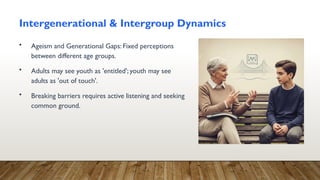
Intergenerational & IntergroupDynamics
• Ageism and Generational Gaps: Fixed perceptions
between different age groups.
• Adults may see youth as 'entitled'; youth may see
adults as 'out of touch'.
• Breaking barriers requires active listening and seeking
common ground.
6.
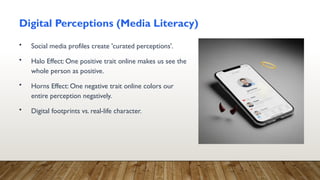
Digital Perceptions (MediaLiteracy)
• Social media profiles create 'curated perceptions'.
• Halo Effect: One positive trait online makes us see the
whole person as positive.
• Horns Effect: One negative trait online colors our
entire perception negatively.
• Digital footprints vs. real-life character.
7.
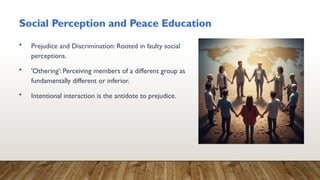
Social Perception andPeace Education
• Prejudice and Discrimination: Rooted in faulty social
perceptions.
• 'Othering': Perceiving members of a different group as
fundamentally different or inferior.
• Intentional interaction is the antidote to prejudice.
8.
The Impact onWell-being
• Mental health is improved when we feel understood.
• Striving to understand others accurately reduces
stress and interpersonal conflict.
• Cooperation leads to stronger support systems.
9.
The Role ofActive Listening
• Listening is the primary tool for correcting social
perceptions.
• It allows for the collection of 'External Attribution'
data.
• Active listening proves that you value the other
person's perspective.
10.
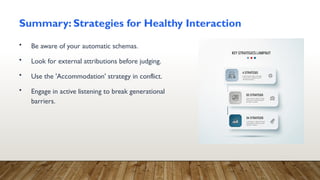
Summary: Strategies forHealthy Interaction
• Be aware of your automatic schemas.
• Look for external attributions before judging.
• Use the 'Accommodation' strategy in conflict.
• Engage in active listening to break generational
barriers.
11.
Pop Quiz
• 1.Whatis the term for mental shortcuts used to
categorize people?
• 2.What is the difference between Internal and
External Attribution?
• 3. How does the 'Accommodation' strategy benefit a
relationship?
• 4.What is the 'Halo Effect' in social perception?
12.
Assignment
• Part 1:Perception Reflection Log - Identify a recent
conflict.Write your initial perception, identify the
attribution used, and rewrite it from an empathetic
perspective.
• Part 2: Intergenerational Interview - Interview an
older family member about a time they felt misjudged
by a younger person. Document the conversation.
Editor's Notes
#1 TEACHER NOTES / ANSWER KEY:
Welcome everyone. Today we are exploring how the way we perceive others dictates how we treat them. We started with the post-it activity to see if these labels are based on deep knowledge or initial observations. This transition leads us into the concept of Social Perception.
CLASS ACTIVITY:
Write one adjective on a post-it note that you believe others use to describe you and post it on the board.
#2 TEACHER NOTES / ANSWER KEY:
Social perception is how we make sense of the people around us. Think about the 'Snapshot Judgment' activity we just did. Those initial thoughts you wrote down are your brain using schemas to fill in the gaps where information is missing.
CLASS ACTIVITY:
Snapshot Judgment: Review five character profiles (e.g., student in a hoodie, peer on phone) and write down three personality traits you assume they have.
#3 TEACHER NOTES / ANSWER KEY:
When someone does something, we automatically ask 'why?' Attribution theory explains this. If we only use internal attribution, we might judge too harshly. Understanding external factors is the first step toward empathy.
CLASS ACTIVITY:
Brainstorming: In small groups, take a scenario (e.g., a friend didn't text back) and identify one internal and one external reason for it.
#4 TEACHER NOTES / ANSWER KEY:
In our role-play, notice how the entire vibe of the interaction changed when the partner shifted their perception. By assuming a positive or neutral intent rather than a negative one, we can move from competition to cooperation.
CLASS ACTIVITY:
Role-Play: Act out a scene where a student is 'difficult' during a project. Round 1: React to 'selfishness'. Round 2: React to 'anxiety' or 'struggle'.
#5 TEACHER NOTES / ANSWER KEY:
Perception isn't just one-on-one; it's also group-to-group. We often 'other' people based on their age or social circle. To have healthy communities, we must use intentional interaction to bridge these divides.
CLASS ACTIVITY:
Identify one way you can use social interaction techniques to break a perceptual barrier in your own family today.
#6 TEACHER NOTES / ANSWER KEY:
How much of what you see on social media is the 'real' person? We often fall victim to the Halo or Horns effect based on a single post. Remember, a curated profile is just one narrow lens of a person's life.
CLASS ACTIVITY:
Digital Polling: Use an anonymous tool to submit first impressions of neutral social media profile mock-ups.
#7 TEACHER NOTES / ANSWER KEY:
Peace starts with how we view the person across from us. When we 'other' people, we stop seeing their humanity. By intentionally interacting and seeking commonality, we dismantle the foundations of conflict.
CLASS ACTIVITY:
Class Dialogue: Discuss how perceiving 'the other' as similar to ourselves can reduce societal conflict.
#8 TEACHER NOTES / ANSWER KEY:
Our well-being is tied to our social health. When we feel judged or misperceived, it hurts. Conversely, being an accurate and empathetic 'perceiver' makes us better friends, partners, and community members.
CLASS ACTIVITY:
Reflect silently: Think of a time you felt misunderstood. How did it affect your mood and your relationship with that person?
#9 TEACHER NOTES / ANSWER KEY:
To move past our initial 'snapshot' judgments, we need data. Listening is how we get that data. It moves us from making assumptions to building authentic understanding.
CLASS ACTIVITY:
Quick Pair Practice: For one minute, listen to your partner describe their day without interrupting, then summarize what they said.
#10 TEACHER NOTES / ANSWER KEY:
We've covered a lot today—from the way our brains shortcut perceptions to the way we can intentionally choose empathy. Use these tools to build healthier, more resilient relationships.
CLASS ACTIVITY:
Group Shout-out: Share one word that describes how you will approach your next interaction.
#11 TEACHER NOTES / ANSWER KEY:
ANSWER KEY: 1. Schemas. 2. Internal blames character/personality; External considers situational/environmental factors. 3. It maintains harmony and manages conflict by adapting behavior. 4. When one positive trait colors the entire perception of a person.
CLASS ACTIVITY:
Write your answers on a piece of paper and swap with a partner for grading.
#12 TEACHER NOTES / ANSWER KEY:
GRADING CRITERIA: 1. Depth of Reflection (30%): Clear identification of personal bias/perception. 2. Application of Theory (40%): Correct use of 'internal/external attribution' terms. 3. Interview Insight (30%): Meaningful documentation of the generational gap experience and suggested steps for improvement.
CLASS ACTIVITY:
Due next week. Interviews can be recorded as audio or written notes.