Understanding Simple and Compound Machines: Motion and Efficiency in Machine Design
Explore translational and rotational motion, simple and compound machines, and design efficient machine prototypes minimizing friction and energy loss.
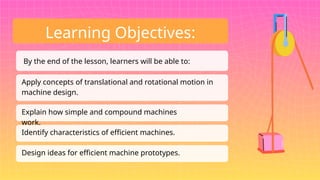
Learning Objectives:
By theend of the lesson, learners will be able to:
Apply concepts of translational and rotational motion in
machine design.
Explain how simple and compound machines
work.
Identify characteristics of efficient machines.
Design ideas for efficient machine prototypes.
3.
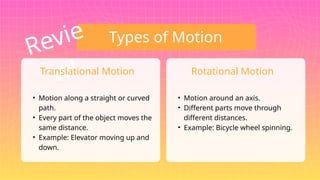
Types of Motion
Revie
w!
TranslationalMotion
• Motion along a straight or curved
path.
• Every part of the object moves the
same distance.
• Example: Elevator moving up and
down.
Rotational Motion
• Motion around an axis.
• Different parts move through
different distances.
• Example: Bicycle wheel spinning.
4.
Can a machineuse both
types of motion at the
same time?
Questi
on
5.
Simple
Machines
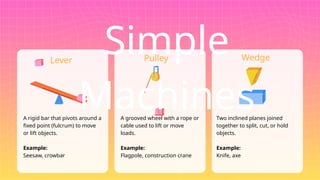
Lever Pulley Wedge
Arigid bar that pivots around a
fixed point (fulcrum) to move
or lift objects.
Example:
Seesaw, crowbar
A grooved wheel with a rope or
cable used to lift or move
loads.
Example:
Flagpole, construction crane
Two inclined planes joined
together to split, cut, or hold
objects.
Example:
Knife, axe
6.
Simple
Machines
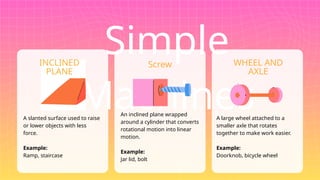
A slanted surfaceused to raise
or lower objects with less
force.
Example:
Ramp, staircase
An inclined plane wrapped
around a cylinder that converts
rotational motion into linear
motion.
Example:
Jar lid, bolt
A large wheel attached to a
smaller axle that rotates
together to make work easier.
Example:
Doorknob, bicycle wheel
INCLINED
PLANE
Screw WHEEL AND
AXLE
7.
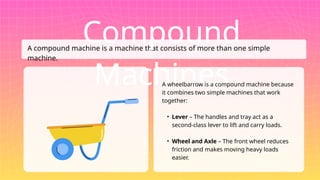
A compound machineis a machine that consists of more than one simple
machine.
Compound
Machines
A wheelbarrow is a compound machine because
it combines two simple machines that work
together:
• Lever – The handles and tray act as a
second-class lever to lift and carry loads.
• Wheel and Axle – The front wheel reduces
friction and makes moving heavy loads
easier.
8.
• Choose acompound machine.
• Explain how translational and rotational
motion work together to make the machine
efficient.
Think and
Discuss
9.
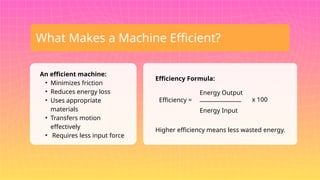
What Makes aMachine Efficient?
An efficient machine:
• Minimizes friction
• Reduces energy loss
• Uses appropriate
materials
• Transfers motion
effectively
• Requires less input force
Efficiency Formula:
Efficiency =
Energy Output
_______________
Energy Input
x 100
Higher efficiency means less wasted energy.
10.
Design Challenge
Performance
Task:
Task:
In groups,design a prototype of a simple or compound machine that
uses both translational and rotational motion.
Include:
• Sketch of the machine
• Motion involved
• Purpose of the machine
• Features that improve efficiency