Understanding Physics in Daily Life: Principles, Safety, and Technology
Explore how physics principles apply to everyday tasks, safety devices, and technological innovations, enhancing efficiency and understanding of the natural world.
LEARNING OBJECTIVES
At theend of the lesson, the students are expected to:
1 2 3
Describe basic
physics principles in
household tasks
and safety
applications
Identify how
physics improves
efficiency in tools
and leisure
activities
Explain physics as a
foundational
branch of science
and technology
3.
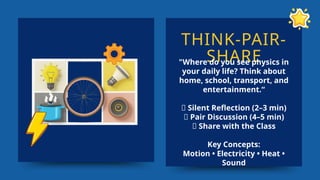
THINK-PAIR-
SHARE
"Where do yousee physics in
your daily life? Think about
home, school, transport, and
entertainment.“
🤔 Silent Reflection (2–3 min)
👥 Pair Discussion (4–5 min)
📢 Share with the Class
Key Concepts:
Motion • Electricity • Heat •
Sound
4.
WHY PHYSICS
MATTERS?
• Physicsexplains how everyday things
around us work — from boiling water to
riding a bike.
• Understanding physics helps us make
smarter, safer choices in daily life.
• Physics drives modern technology,
making our lives more efficient and
comfortable.
• Curiosity about the world starts with
asking "why" and "how" — that's physics!
• Knowing physics empowers us to solve
real-world problems with confidence.
5.
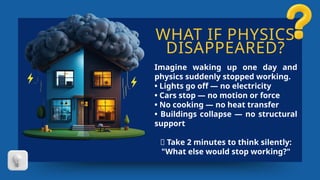
WHAT IF PHYSICS
DISAPPEARED?
Imaginewaking up one day and
physics suddenly stopped working.
• Lights go off — no electricity
• Cars stop — no motion or force
• No cooking — no heat transfer
• Buildings collapse — no structural
support
🤔 Take 2 minutes to think silently:
"What else would stop working?"
6.
WHY STUDY PHYSICS?
•Physics helps make life safer and
more efficient by explaining how
forces, motion, and energy work
around us.
• It drives modern technologies
and innovations — from
smartphones to medical devices.
• Physics also helps us understand
natural phenomena like gravity,
light, and sound that shape our
everyday experiences.
7.
KEY ROLES OFPHYSICS
Physics plays a vital role in our everyday lives:
1.Driving Technological Innovation
2. Advancing Modern Healthcare
3. Understanding the Universe
4. Improving Daily Life & Infrastructure
5. Bridging Scientific Disciplines
8.
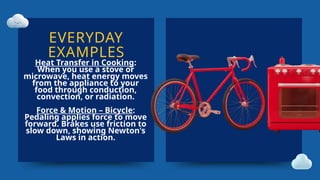
EVERYDAY
EXAMPLES
Heat Transfer inCooking:
When you use a stove or
microwave, heat energy moves
from the appliance to your
food through conduction,
convection, or radiation.
Force & Motion – Bicycle:
Pedaling applies force to move
forward. Brakes use friction to
slow down, showing Newton's
Laws in action.
9.
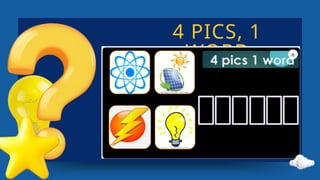
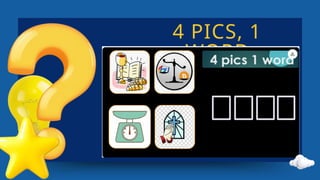
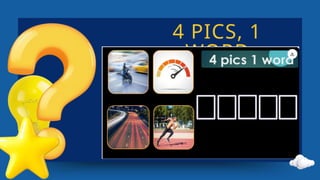
4 PICS, 1
WORD
Whatone word connects these
pictures?
Think carefully... What physics
principle links all four images
together?
VIDEO
PRESENTATION
Watch the followingvideos showing physics
principles in action, focusing on impact and
protection:
▶ Video 1: youtube.com/watch?v=WtMrbxBH_JY
▶ Video 2: youtube.com/watch?v=SmwxFD4vK_k
As you watch, observe how force, motion, and
impact protection work in real-life scenarios.
14.
GUIDED DISCUSSION
QUESTIONS
Analyze yourobservations from the video and experiment:
1 2 3
Which material
protected the egg
or ball best? Why?
How does
increasing impact
time reduce the
force experienced?
How do helmets
and airbags apply
this physics
principle?
15.
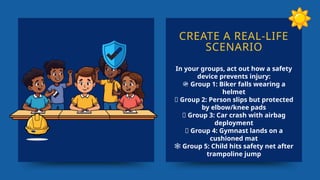
CREATE A REAL-LIFE
SCENARIO
Inyour groups, act out how a safety
device prevents injury:
🪖 Group 1: Biker falls wearing a
helmet
🦵 Group 2: Person slips but protected
by elbow/knee pads
🚗 Group 3: Car crash with airbag
deployment
🤸 Group 4: Gymnast lands on a
cushioned mat
️
🕸️Group 5: Child hits safety net after
trampoline jump
16.
ROLE-PLAY
GUIDE
Each group mustinclude:
• Brief description of incident &
participants
• Identify the safety device used
• Explain how the device increases
impact time
• Show how this reduces force
experienced
• Apply: Momentum, Impulse, Energy
Absorption & Newton's Laws
 Most read
 Most read
 Most read