Understanding Perception and Social Influence for Personal Development
Explore how perception and social influence shape behavior, self-awareness, and growth through conformity, compliance, and obedience in social contexts.
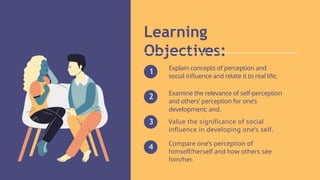
Learning
Objectives:
Explain concepts ofperception and
social influence and relate it to real life;
1
Examine the relevance of self-perception
and others’ perception for one’s
development; and.
2
Value the significance of social
influence in developing one’s self.
3
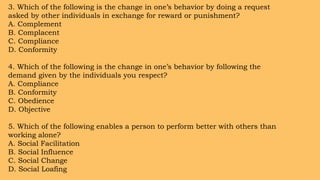
4 Compare one’s perception of
himself/herself and how others see
him/her.
3.
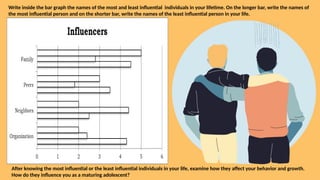
Write inside thebar graph the names of the most and least influential individuals in your lifetime. On the longer bar, write the names of
the most influential person and on the shorter bar, write the names of the least influential person in your life.
After knowing the most influential or the least influential individuals in your life, examine how they affect your behavior and growth.
How do they influence you as a maturing adolescent?
4.
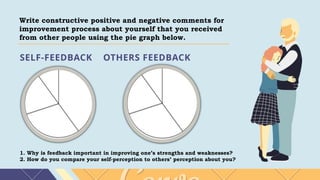
Write constructive positiveand negative comments for
improvement process about yourself that you received
from other people using the pie graph below.
SELF-FEEDBACK OTHERS FEEDBACK
1. Why is feedback important in improving one’s strengths and weaknesses?
2. How do you compare your self-perception to others’ perception about you?
5.
What is socialinfluence?
Social influence is characterized by a change in your
behavior caused by the people that empower you to
adjust to a particular situation. Whether someone
agrees or disagrees with you, it influences your
behavior that may help or hinder your social roles.
Social influence also happens when you change your
behavior to adapt to social demands.
Social influence is categorized by conformity,
compliance, and obedience.
6.
Conformity is changingyour behavior to be the
same with the others in the group (Asch 1955 in
Ramirez 2020).
For example, when you visit your friend’s home,
to show respect, you both ask for the
grandmother’s blessing because you were told that
it is courtesy. This situation engages you to deal
with it by adapting to the
shared norms and values to gain social approval
rather than rejection. You were able to conform to
the group standards.
What is conformity?
7.
What is compliance?
Complianceis granting a request or
demand asked by another individual in
exchange of either a reward or a
punishment.
For example, during examination day,
you are required to take the test to
finish the grading period and failure to
do so may result in a failing grade.
8.
What is
obedience?
Obedience meanschanging your behavior to
follow the demand given by an authority or an
adult you have high regards with.
For instance, as a maturing adolescent, you
want to contribute to development through
inviting other friends to exercise proper waste
disposal. Whether you do it purposely as you try
to give the leader your respect or purposefully
as it empowers you to participate actively as a
follower. Whatever your reason is for obeying; it
leads to social facilitation. This happens when
you are given a sense of responsibility that
allows you to perform better if you are with
other individuals.
9.
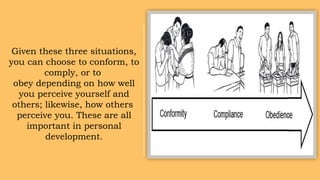
Given these threesituations,
you can choose to conform, to
comply, or to
obey depending on how well
you perceive yourself and
others; likewise, how others
perceive you. These are all
important in personal
development.
10.
Comparing your self-perceptionwith others’
perception of you has contributed to your thoughts
that influence your behavior.
These significant persons in your lives help you in
becoming a successful leader and follower through
social relationships.
In any relationship, communication is important as
you listen to what others are telling you, and as to
understand yourself and others in any situation.
It influences your outlook in life, like when you were
in your formative years - you have a limited capacity
of acknowledging what is happening around you.
The change inyour behavior
therefore enhances your role
in becoming a follower and a
leader.
Both these roles involve
responsibility to serve others
that can be achieved through
cooperation.
Hence, a change in mindset is
being mindful and
sensitive to your thoughts,
feelings, and behaviors.
13.
Directions: Read thequestions carefully and write your answer in a
sheet of paper. (letter and words)
1. Which of the following is the change in one’s behavior to adapt to
the social demands?
A. Personal Relationship
B. Social Relationship
C. Social Facilitation
D. Social Influence
2. Which of the following is the change in one’s behavior to be more
like the others in the group?
A. Complement
B. Compliance
C. Conformity
D. Obedience
14.
3. Which ofthe following is the change in one’s behavior by doing a request
asked by other individuals in exchange for reward or punishment?
A. Complement
B. Complacent
C. Compliance
D. Conformity
4. Which of the following is the change in one’s behavior by following the
demand given by the individuals you respect?
A. Compliance
B. Conformity
C. Obedience
D. Objective
5. Which of the following enables a person to perform better with others than
working alone?
A. Social Facilitation
B. Social Influence
C. Social Change
D. Social Loafing
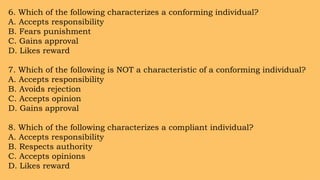
15.
6. Which ofthe following characterizes a conforming individual?
A. Accepts responsibility
B. Fears punishment
C. Gains approval
D. Likes reward
7. Which of the following is NOT a characteristic of a conforming individual?
A. Accepts responsibility
B. Avoids rejection
C. Accepts opinion
D. Gains approval
8. Which of the following characterizes a compliant individual?
A. Accepts responsibility
B. Respects authority
C. Accepts opinions
D. Likes reward
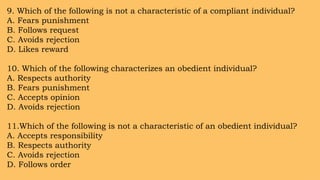
16.
9. Which ofthe following is not a characteristic of a compliant individual?
A. Fears punishment
B. Follows request
C. Avoids rejection
D. Likes reward
10. Which of the following characterizes an obedient individual?
A. Respects authority
B. Fears punishment
C. Accepts opinion
D. Avoids rejection
11.Which of the following is not a characteristic of an obedient individual?
A. Accepts responsibility
B. Respects authority
C. Avoids rejection
D. Follows order
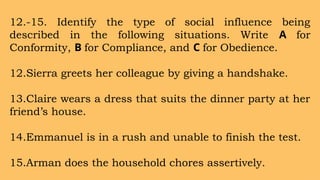
17.
12.-15. Identify thetype of social influence being
described in the following situations. Write A for
Conformity, B for Compliance, and C for Obedience.
12.Sierra greets her colleague by giving a handshake.
13.Claire wears a dress that suits the dinner party at her
friend’s house.
14.Emmanuel is in a rush and unable to finish the test.
15.Arman does the household chores assertively.