Understanding Pascal’s Principle: Fluid Pressure and Hydraulic Systems in Real Life
Explore Pascal’s Principle, fluid pressure, hydraulic force multiplication, and real-world applications like brakes, lifts, and heavy machinery in this comprehensive physics lesson.
Understanding Pascal’s Principle: Fluid Pressure and Hydraulic Systems in Real Life
1.
Pascal’s Principle
A generouslesson presentation on pressure transmission, hydraulics, and real-life applications
Science / Physics • Fluid Mechanics
1
2.
Learning Objectives
• StatePascal’s Principle in simple and scientific terms.
• Explain pressure, enclosed fluids, and hydraulic force
transmission.
• Describe how hydraulic systems multiply force using pistons
with different areas.
• Identify real-life applications such as brakes, lifts, jacks,
presses, and heavy equipment.
• Solve basic problems involving pressure and hydraulic systems.
2
3.
Essential Question
• Howcan a small force lift a heavy car?
• Why do hydraulic brakes stop a moving
vehicle effectively?
• How can liquid pressure move large machine
parts?
• Why must hydraulic systems be sealed and
filled properly?
3
4.
What Is aFluid?
• A fluid is a substance that can flow.
• Liquids and gases are fluids.
• Hydraulic systems usually use liquids
because liquids are difficult to compress.
• Oil is commonly used in many hydraulic
systems because it transmits pressure well
and lubricates parts.
4
5.
Key Vocabulary
• Pressure:force applied per unit area.
• Enclosed fluid: a fluid trapped inside a sealed container
or system.
• Hydraulic system: a machine that uses liquid pressure
to transmit force.
• Piston: a movable part that pushes on or is pushed by
fluid.
• Force multiplication: producing a larger output force
using a larger output area. 5
6.
Part I: ThePrinciple
Understanding pressure transmission in enclosed fluids
6
7.
Pascal’s Principle
• Pascal’sPrinciple states that a change in pressure
applied to an enclosed fluid is transmitted
undiminished throughout the fluid and to the walls of
its container.
• In simple words: pressure applied to a trapped liquid
spreads equally in all directions.
• This principle is the foundation of hydraulics.
• It explains many machines that lift, press, stop, or
move heavy loads.
7
8.
Simple Version
• Ifyou push on a sealed liquid, the liquid pushes
back everywhere inside the container.
• The pressure does not stay only where you push.
• The pressure travels through the fluid to other
parts of the system.
• This allows force to be transferred from one place
to another.
8
9.
Why the FluidMust Be Enclosed
• In an open fluid system, fluid can simply flow
away when pushed.
• In an enclosed system, the fluid cannot escape
easily.
• Because the fluid is trapped, applied pressure is
transmitted through the whole system.
• This is why hydraulic systems need sealed tubes,
cylinders, and valves.
9
10.
Pressure Is theMain Idea
• Pressure is not the same as force.
• Pressure depends on both force and area.
• The same force can create different
pressures depending on the area where it
acts.
• Pascal’s Principle focuses on how pressure
changes are transmitted.
10
11.
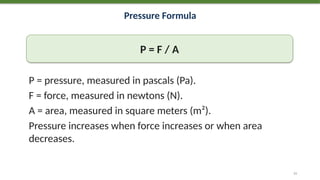
Pressure Formula
P =F / A
P = pressure, measured in pascals (Pa).
F = force, measured in newtons (N).
A = area, measured in square meters (m²).
Pressure increases when force increases or when area
decreases.
11
12.
Unit of Pressure
•The SI unit of pressure is the pascal (Pa).
• One pascal is equal to one newton per square
meter.
• Symbolically: 1 Pa = 1 N/m².
• Large hydraulic systems often use much higher
pressures than one pascal.
12
13.
Everyday View ofPressure
• A sharp nail can pierce wood because a force is applied
over a very small area.
• A snowshoe lowers pressure on snow by spreading
body weight over a larger area.
• Hydraulic systems use pressure, not sharpness, to
transmit force through fluid.
• Understanding pressure helps explain why piston areas
matter.
13
14.
Important Clarification
• Pascal’sPrinciple does not mean pressure is
naturally the same at every depth in a fluid.
• Fluid pressure can also change with depth
because of the weight of the fluid above.
• Pascal’s Principle specifically says that an applied
change in pressure is transmitted undiminished.
• This distinction is important in fluids at rest.
14
15.
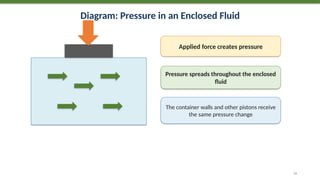
Diagram: Pressure inan Enclosed Fluid
Applied force creates pressure
Pressure spreads throughout the enclosed
fluid
The container walls and other pistons receive
the same pressure change
15
What Is aHydraulic System?
• A hydraulic system uses a liquid to transmit
pressure and force.
• It usually includes pistons, cylinders, tubes,
valves, a pump, and hydraulic fluid.
• The fluid carries pressure from the input side to
the output side.
• Hydraulic machines are useful because they can
produce large output forces.
17
18.
Basic Parts ofa Hydraulic System
• Reservoir: stores hydraulic fluid.
• Pump: moves or pressurizes the fluid.
• Valves: control fluid direction and flow.
• Cylinders and pistons: convert fluid pressure
into motion and force.
• Hoses or tubes: carry fluid between parts.
18
19.
Small Piston andLarge Piston
• A small piston can apply pressure to the fluid.
• The same pressure reaches a larger piston.
• Because force equals pressure multiplied by area,
the larger piston can produce a larger force.
• This is the basic idea behind hydraulic force
multiplication.
19
20.
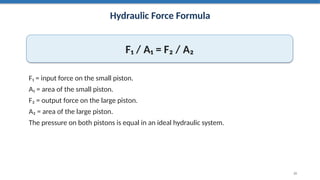
Hydraulic Force Formula
F₁/ A₁ = F₂ / A₂
F₁ = input force on the small piston.
A₁ = area of the small piston.
F₂ = output force on the large piston.
A₂ = area of the large piston.
The pressure on both pistons is equal in an ideal hydraulic system.
20
21.
Why Force Increases
•The same pressure acts on both pistons.
• A larger area receives more total force from the
same pressure.
• This is why hydraulic machines can lift cars, press
metals, and move heavy equipment.
• The output force increases when the output
piston area is larger.
21
22.
Important Trade-Off
• Hydraulicsystems multiply force, but they do not
create energy for free.
• The small piston usually moves a longer distance.
• The large piston moves a shorter distance but
with greater force.
• This follows conservation of energy.
22
23.
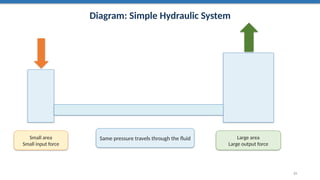
Diagram: Simple HydraulicSystem
Small area
Small input force
Same pressure travels through the fluid Large area
Large output force
23
24.
Ideal vs RealHydraulic Systems
• Ideal hydraulic systems assume no leaks, no
friction, and incompressible fluid.
• Real systems lose some energy due to friction,
fluid resistance, heat, and imperfect seals.
• Good design and maintenance reduce energy
loss.
• Even with losses, hydraulics are extremely useful
for producing large forces.
24
25.
Why Liquids AreUsed
• Liquids are difficult to compress compared with gases.
• This allows pressure changes to transfer quickly and
effectively.
• Hydraulic oil also lubricates moving parts and helps
prevent corrosion.
• Air bubbles should be removed because air
compresses easily and weakens performance.
25
26.
Role of Valves
•Valves control where the fluid goes.
• They can allow fluid to move in one direction
or block it in another direction.
• They help control speed, direction, and
holding position.
• Valves make hydraulic machines safe and
controllable.
26
27.
Hydraulic Cylinders
• Ahydraulic cylinder changes fluid pressure into
straight-line motion.
• When pressurized fluid enters, it pushes the piston and
rod outward or inward.
• Hydraulic cylinders can produce very large pushing or
pulling forces.
• They are common in construction machinery, lifts, and
industrial equipment.
27
28.
Part III: Real-LifeApplications
How Pascal’s Principle appears in daily life, transport, and industry
28
29.
Application: Hydraulic Jack
•A hydraulic jack lifts cars and other heavy objects.
• A small force on a small piston creates pressure in
the fluid.
• The pressure acts on a larger piston and produces
a larger lifting force.
• Real-life use: vehicle repair shops and tire
changing.
29
30.
Application: Hydraulic Lift
•Hydraulic lifts raise vehicles, materials, and
platforms.
• The large output piston supports heavy
loads.
• Workers use them in service stations,
warehouses, factories, and elevators.
• They make lifting safer and easier.
30
31.
Application: Hydraulic Brakes
•Pressing the brake pedal increases
pressure in brake fluid.
• The pressure travels through brake lines
to the brake calipers or wheel cylinders.
• Brake pads press against the disc or
drum.
• Friction slows down or stops the vehicle.
31
32.
Application: Car BrakeSystem
• The master cylinder creates pressure when the
brake pedal is pressed.
• Brake fluid carries this pressure to each wheel.
• Equal pressure helps distribute braking action
through the system.
• This application is one of the most familiar
examples of Pascal’s Principle.
32
33.
Application: Motorcycle andBicycle Hydraulic Disc Brakes
• Some motorcycles and bicycles use hydraulic
disc brakes.
• A lever or pedal creates pressure in brake
fluid.
• The fluid pushes caliper pistons that clamp
brake pads on a disc.
• This provides strong and responsive braking.
33
34.
Application: Hydraulic Press
•A hydraulic press compresses, bends, shapes, or
flattens materials.
• It produces large forces from smaller input forces.
• It is used in metal forming, molding, crushing,
and manufacturing.
• The large force comes from pressure acting on a
large piston area.
34
35.
Application: Garbage Trucks
•Garbage trucks use hydraulic systems to lift and
compact waste.
• Hydraulic cylinders move lifting arms and compactors.
• Fluid pressure provides the force needed for heavy
loads.
• This makes waste collection faster and more efficient.
35
36.
Application: Dump Trucks
•Dump trucks use hydraulic cylinders to raise
the truck bed.
• Pressurized fluid pushes the cylinder
upward.
• The raised bed allows materials to slide out.
• Used for sand, gravel, soil, and construction
materials.
36
37.
Application: Excavators
• Excavatorsuse hydraulic cylinders to move the
boom, arm, and bucket.
• Operators control fluid flow using levers and
valves.
• Hydraulics provide powerful digging and lifting
forces.
• Used in construction, mining, road work, and
disaster clearing.
37
38.
Application: Bulldozers andLoaders
• Hydraulic systems raise, lower, and tilt blades and
buckets.
• Fluid pressure allows heavy earth or debris to be
pushed and lifted.
• These machines rely on strong controlled motion.
• Used in construction, agriculture, and road
maintenance.
38
39.
Application: Cranes
• Manycranes use hydraulic systems to lift, extend,
and position loads.
• Hydraulic cylinders can move booms and stabilize
outriggers.
• Pressure transmission allows controlled lifting of
heavy materials.
• Used in construction, shipping yards, and rescue
operations.
39
40.
Application: Forklifts
• Forkliftsuse hydraulic lifts to raise and lower
pallets.
• Pressurized fluid moves cylinders connected to
the lifting mechanism.
• This allows workers to move goods in warehouses
and factories.
• Hydraulics make lifting heavy loads manageable.
40
41.
Application: Aircraft HydraulicSystems
• Aircraft use hydraulics for landing gear, brakes,
flaps, and control surfaces.
• Hydraulic systems transmit force through fluid
lines.
• They allow strong and reliable control of
important aircraft parts.
• Safety requires careful maintenance and
redundancy.
41
42.
Application: Barber’s Chair
•A barber’s chair often uses a hydraulic pump
and cylinder.
• Pressing a pedal moves hydraulic fluid and
raises the chair.
• A release valve allows the chair to lower
smoothly.
• This is a simple everyday hydraulic device.
42
43.
Application: Dentist’s Chair
•Dentist’s chairs use hydraulic or hydraulic-assisted
mechanisms for height adjustment.
• The fluid system helps lift and lower the patient
smoothly.
• This allows the dentist to work at a comfortable
position.
• It provides controlled motion with relatively small
effort.
43
44.
Application: Hospital Bedsand Stretchers
• Some hospital beds and stretchers use hydraulic
lifting mechanisms.
• Hydraulic systems help raise or lower patients
with control.
• They reduce manual lifting effort for healthcare
workers.
• Used in clinics, hospitals, and emergency care.
44
45.
Application: Rescue Tools
•Hydraulic rescue tools can spread, cut, or lift
heavy objects.
• They are used by rescue teams during vehicle
accidents and emergencies.
• Fluid pressure produces very large forces in
compact tools.
• These tools help reach trapped people more
quickly.
45
46.
Application: Industrial Machines
•Factories use hydraulic machines for pressing,
clamping, bending, and molding.
• Hydraulics provide strong, repeatable, and
controllable force.
• They are used in metalworking, plastics,
packaging, and assembly lines.
• Pascal’s Principle makes these machines possible.
46
47.
Application: Hydraulic DoorClosers
• Some door closers use fluid resistance and
pressure control.
• The fluid slows and controls the door’s
closing motion.
• This prevents doors from slamming shut.
• It is a practical example of controlled fluid
motion.
47
48.
Application: Vehicle PowerSteering
• Hydraulic power steering uses fluid pressure to
help turn wheels.
• The driver applies effort to the steering wheel.
• Hydraulic pressure assists the motion, making
steering easier.
• It is useful especially in heavy vehicles.
48
49.
Application: Car WashLifts and Service Platforms
• Service platforms use hydraulic lifting to raise vehicles
safely.
• The fluid system allows smooth upward and downward
motion.
• Technicians can inspect and repair parts underneath
vehicles.
• This improves safety and convenience in maintenance
work.
49
50.
Application: Hydraulic Trolleyand Pallet Jack
• A pallet jack uses hydraulics to raise heavy
pallets slightly from the floor.
• Pumping the handle increases pressure in
the hydraulic fluid.
• The lifting mechanism raises the forks.
• Used in groceries, warehouses, and delivery
areas.
50
Activity 1: Two-SyringeHydraulic Model
Materials: two syringes, plastic tube, and water.
Fill both syringes and the tube with water, avoiding air bubbles.
Connect the syringes with the tube.
Push one syringe and observe the other syringe move.
Explain how pressure is transmitted through the enclosed water.
52
53.
Activity 1: GuideQuestions
What happens when one syringe is pushed?
Does the second syringe move immediately?
What happens if air bubbles are inside the tube?
How does this model represent a hydraulic machine?
Why must hydraulic systems be sealed?
53
54.
Activity 2: DifferentSyringe Sizes
Materials: one small syringe, one large syringe, tube, and water.
Connect the syringes filled with water.
Push the small syringe and observe the large syringe.
Then push the large syringe and observe the small syringe.
Relate the results to piston area and force multiplication.
54
55.
Activity 3: Balloonin a Bottle
Use a sealed bottle, water, and a small balloon if materials are available.
Apply pressure to the bottle and observe how pressure affects objects inside.
Discuss how pressure is transmitted through the fluid.
Connect the demonstration to enclosed fluid behavior.
55
56.
Activity 4: Builda Mini Hydraulic Lift
Materials: cardboard, two syringes, water, tubing, tape, and a small platform.
Use one syringe as the input piston and the other as the lifting piston.
Attach the larger syringe to the platform if available.
Push the input syringe and observe the platform rise.
Explain the model using Pascal’s Principle.
56
57.
Safety Reminders forActivities
Do not point syringes at classmates.
Use water only for classroom demonstrations unless instructed otherwise.
Avoid excessive pressure that may detach tubes suddenly.
Clean spills immediately to prevent slipping.
Handle all materials carefully and responsibly.
57
58.
Part V: SolvingProblems
Using formulas for pressure and hydraulic force
58
59.
Problem-Solving Routine
1. Readthe problem carefully.
2. List the given values with units.
3. Identify what is being asked.
4. Choose the correct formula.
5. Substitute, solve, and write the final answer with units.
59
60.
When to UseEach Formula
• Use P = F/A when the problem asks for pressure, force,
or area.
• Use F₁/A₁ = F₂/A₂ when the problem involves two
pistons in a hydraulic system.
• Use F = PA when pressure and area are known and
force is needed.
• Always check that area is in square meters when using
pascals.
60
61.
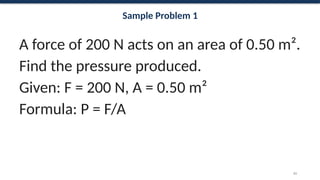
Sample Problem 1
Aforce of 200 N acts on an area of 0.50 m².
Find the pressure produced.
Given: F = 200 N, A = 0.50 m²
Formula: P = F/A
61
62.
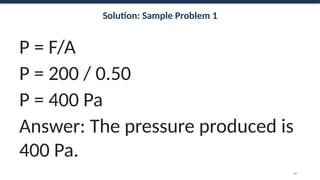
Solution: Sample Problem1
P = F/A
P = 200 / 0.50
P = 400 Pa
Answer: The pressure produced is
400 Pa.
62
63.
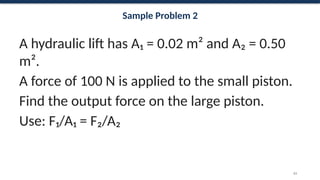
Sample Problem 2
Ahydraulic lift has A₁ = 0.02 m² and A₂ = 0.50
m².
A force of 100 N is applied to the small piston.
Find the output force on the large piston.
Use: F₁/A₁ = F₂/A₂
63
64.
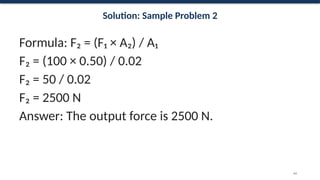
Solution: Sample Problem2
Formula: F₂ = (F₁ × A₂) / A₁
F₂ = (100 × 0.50) / 0.02
F₂ = 50 / 0.02
F₂ = 2500 N
Answer: The output force is 2500 N.
64
65.
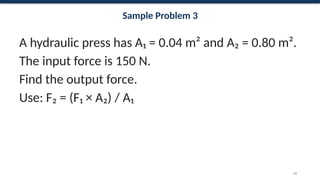
Sample Problem 3
Ahydraulic press has A₁ = 0.04 m² and A₂ = 0.80 m².
The input force is 150 N.
Find the output force.
Use: F₂ = (F₁ × A₂) / A₁
65
66.
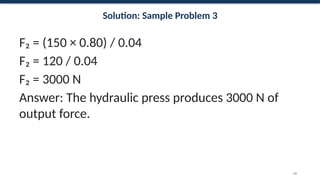
Solution: Sample Problem3
F₂ = (150 × 0.80) / 0.04
F₂ = 120 / 0.04
F₂ = 3000 N
Answer: The hydraulic press produces 3000 N of
output force.
66
67.
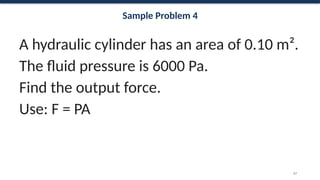
Sample Problem 4
Ahydraulic cylinder has an area of 0.10 m².
The fluid pressure is 6000 Pa.
Find the output force.
Use: F = PA
67
68.
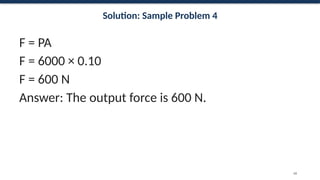
Solution: Sample Problem4
F = PA
F = 6000 × 0.10
F = 600 N
Answer: The output force is 600 N.
68
69.
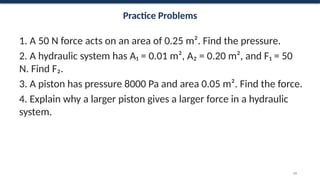
Practice Problems
1. A50 N force acts on an area of 0.25 m². Find the pressure.
2. A hydraulic system has A₁ = 0.01 m², A₂ = 0.20 m², and F₁ = 50
N. Find F₂.
3. A piston has pressure 8000 Pa and area 0.05 m². Find the force.
4. Explain why a larger piston gives a larger force in a hydraulic
system.
69
70.
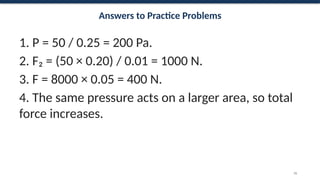
Answers to PracticeProblems
1. P = 50 / 0.25 = 200 Pa.
2. F₂ = (50 × 0.20) / 0.01 = 1000 N.
3. F = 8000 × 0.05 = 400 N.
4. The same pressure acts on a larger area, so total
force increases.
70
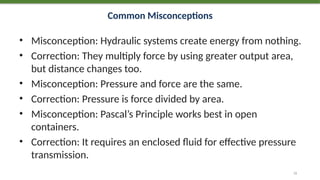
Common Misconceptions
• Misconception:Hydraulic systems create energy from nothing.
• Correction: They multiply force by using greater output area,
but distance changes too.
• Misconception: Pressure and force are the same.
• Correction: Pressure is force divided by area.
• Misconception: Pascal’s Principle works best in open
containers.
• Correction: It requires an enclosed fluid for effective pressure
transmission.
72
73.
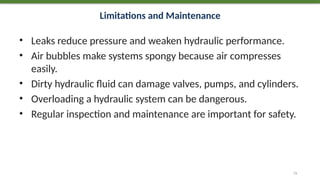
Limitations and Maintenance
•Leaks reduce pressure and weaken hydraulic performance.
• Air bubbles make systems spongy because air compresses
easily.
• Dirty hydraulic fluid can damage valves, pumps, and cylinders.
• Overloading a hydraulic system can be dangerous.
• Regular inspection and maintenance are important for safety.
73
74.
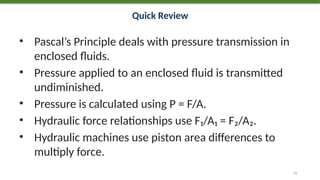
Quick Review
• Pascal’sPrinciple deals with pressure transmission in
enclosed fluids.
• Pressure applied to an enclosed fluid is transmitted
undiminished.
• Pressure is calculated using P = F/A.
• Hydraulic force relationships use F₁/A₁ = F₂/A₂.
• Hydraulic machines use piston area differences to
multiply force.
74
75.
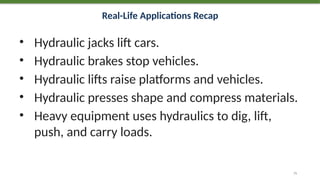
Real-Life Applications Recap
•Hydraulic jacks lift cars.
• Hydraulic brakes stop vehicles.
• Hydraulic lifts raise platforms and vehicles.
• Hydraulic presses shape and compress materials.
• Heavy equipment uses hydraulics to dig, lift,
push, and carry loads.
75
76.
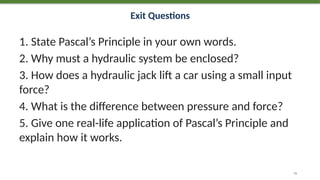
Exit Questions
1. StatePascal’s Principle in your own words.
2. Why must a hydraulic system be enclosed?
3. How does a hydraulic jack lift a car using a small input
force?
4. What is the difference between pressure and force?
5. Give one real-life application of Pascal’s Principle and
explain how it works.
76
77.
References
OpenStax University Physics:Pascal’s Principle and Hydraulics
OpenStax College Physics 2e: Pascal’s Principle
Physics LibreTexts: Pascal’s Principle and Hydraulics
Earlier generated lesson presentation used as structural reference
77