Understanding Learning Styles and Multiple Intelligences for Effective Study
Explore visual, auditory, and tactile learning styles, multiple intelligences, personality types, and strategies to enhance study habits and classroom engagement.
Understanding Learning Styles and Multiple Intelligences for Effective Study
1.
Information enters yourbrain three main ways: sight, hearing
and touch, which one you use the most is called your
Learning Style
Visual Learners learn by sight
Auditory Learners learn by hearing
Tactile Learners (kinesthetic) learn by touch
2.
Prefer tosee information such as pictures,
diagrams, cartoons, demonstrations
Picture words and concepts they hear as
images
Easily distracted in lecture with no visual aids
Overwhelmed with intense visuals
accompanied by lecture
Benefit from using charts, maps, notes, and
flash cards when studying
3.
Prefer tohear information spoken
Can absorb a lecture with little effort
May not need careful notes to learn.
Often avoid eye contact in order to concentrate
May read aloud to themselves
Like background music when they study
4.
Prefer touchas their primary mode for taking in
information
In traditional lecture situations, they should write
out important facts
Create study sheets connected to vivid examples
Role-playing can help them learn and
remember important ideas
May benefit by using manipulatives
Okay, I
get it
now.
5.
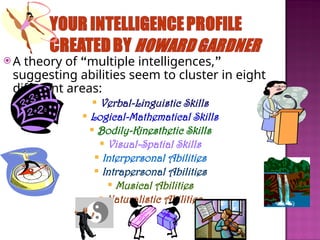
A theoryof “multiple intelligences,”
suggesting abilities seem to cluster in eight
different areas:
Verbal-Linguistic Skills
Logical-Mathematical Skills
Bodily-Kinesthetic Skills
Visual-Spatial Skills
Interpersonal Abilities
Intrapersonal Abilities
Musical Abilities
Naturalistic Abilities
6.
Extroverts
Liketalking with others and taking action.
Prefer active learning and group projects.
Introverts
Prefer to have others do the talking.
Prefer lectures and structured tasks.
7.
Thinkers
Liketo take an objective approach
and emphasize logic and analysis in
their decisions.
Prefer objective feedback, and thrive
when there is pressure to succeed.
Feelers
Prefer emotion to logic.
Give greater weight to the impact of
relationships in their decisions.
Prefer positive feedback and
individual recognition.
8.
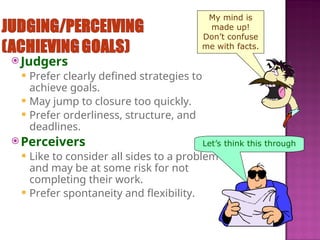
Judgers
Preferclearly defined strategies to
achieve goals.
May jump to closure too quickly.
Prefer orderliness, structure, and
deadlines.
Perceivers
Like to consider all sides to a problem
and may be at some risk for not
completing their work.
Prefer spontaneity and flexibility.
My mind is
made up!
Don’t confuse
me with facts.
Let’s think this through
9.
Take aLearning Styles test.
Think about your favorite classes so far. What do they
have in common? Did you like…
mastering facts?
discussion? or working on your own?
lecture? or pairing or grouping?
hands-on activities?
How do you think you learn?
10.
Knowing your learningstyle, both your strengths and
your weaknesses, can help you study more effectively.
11.
Make thebest use of your learning style.
Work harder in skills that don’t come easily
to you.
Be flexible and adaptable, try new things and
new ways.
Keep growing! Don’t be easily satisfied!
12.
Be involvedin class – participate!
Link classroom experience to the outside
world
Relate class concepts to your own life.
Ask questions and offer criticism.
Stimulate further relevant discussion.
Don’t get distracted – stay “on-task”
Keep an open mind: there are many ideas
beyond your own.
Editor's Notes
#12 Different instructors have different goals regarding student participation. Some expect students to concentrate on listening, thinking, and taking notes. Others want you to be actively involved in other ways as well. Participating in various ways will develop your academic skills. Asking or responding to questions can make a class more worthwhile for you and your classmates.