Understanding Geometric Transformations: Translation, Reflection, and Rotation of Shapes
Explore how shapes change through translation, reflection, and rotation with step-by-step examples and activities to master symmetry and geometric transformations.
Understanding Geometric Transformations: Translation, Reflection, and Rotation of Shapes
1.
Draw resulting imagesof
shapes that undergo
translation, reflection,
and rotation.
FIRST TERM - WEEK 2
2.
If you’re readynow for Math
Clap your hands!
We will count and we will play
Learn with numbers everyday
If you’re ready now for Math
Clap your hands!
👏 👏
👏 👏
3.
Learning Competency
Draw resultingimages of shapes that
undergo translation, reflection, and
rotation. (Translation, Reflection, and
Rotation With Shapes)
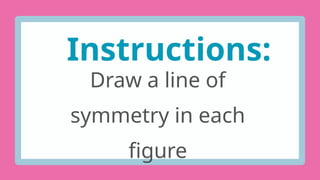
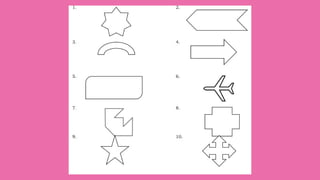
Symmetry
means that whenfigures are divided in half, one
shape is identical to the other shape, that is, a mirror
image of the other. If a figure does not have
symmetry, we say that the figure is asymmetrical.
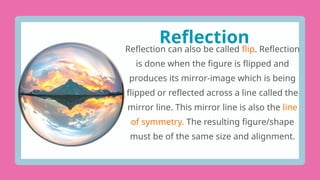
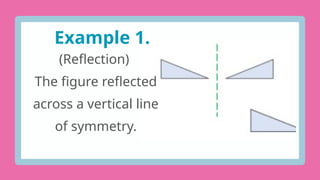
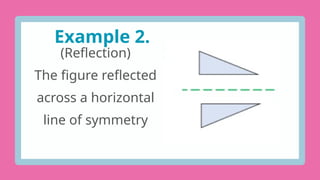
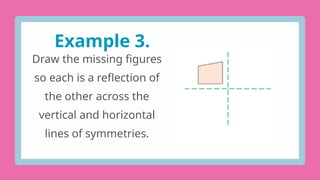
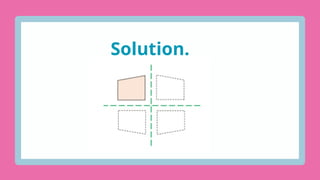
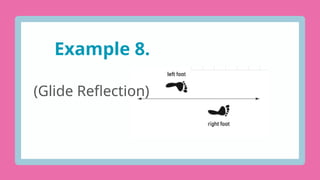
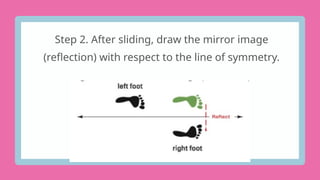
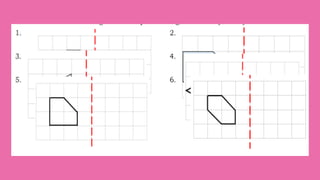
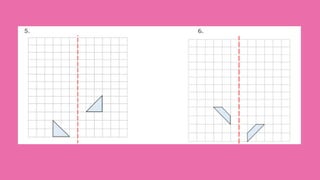
Reflection
Reflection can alsobe called flip. Reflection
is done when the figure is flipped and
produces its mirror-image which is being
flipped or reflected across a line called the
mirror line. This mirror line is also the line
of symmetry. The resulting figure/shape
must be of the same size and alignment.
20.
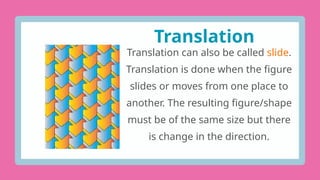
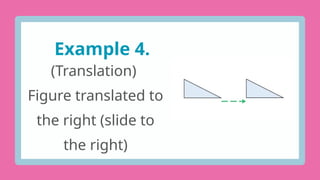
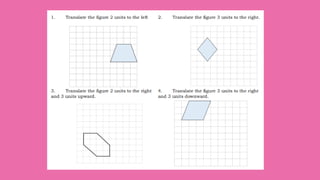
Translation
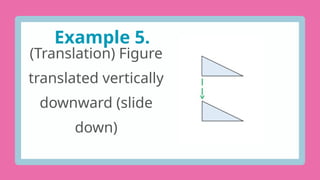
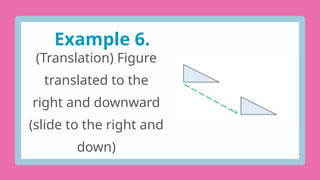
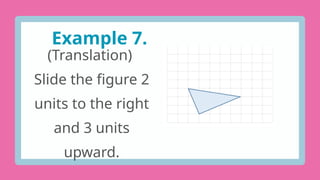
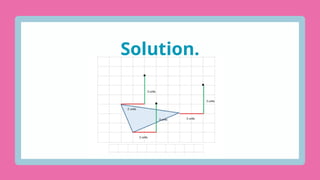
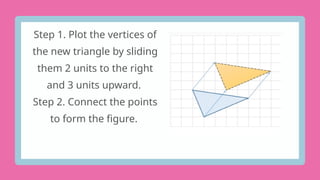
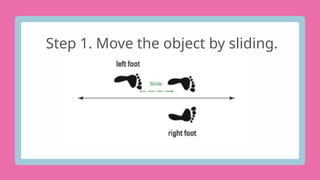
Translation can alsobe called slide.
Translation is done when the figure
slides or moves from one place to
another. The resulting figure/shape
must be of the same size but there
is change in the direction.
21.
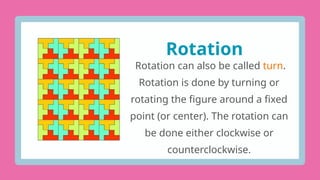
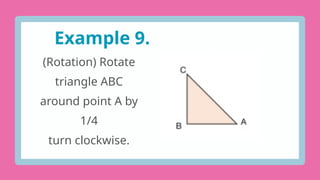
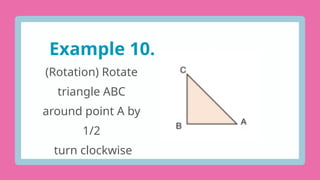
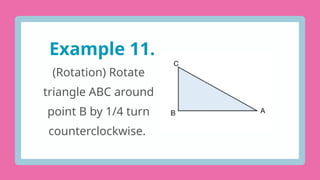
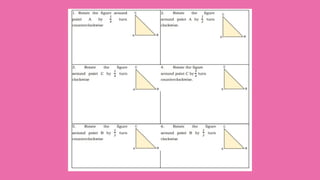
Rotation
Rotation can alsobe called turn.
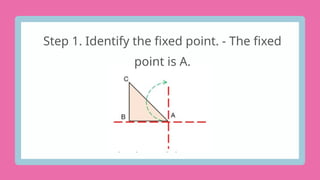
Rotation is done by turning or
rotating the figure around a fixed
point (or center). The rotation can
be done either clockwise or
counterclockwise.
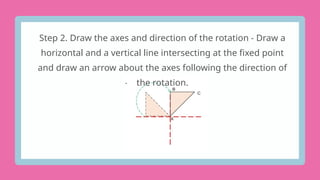
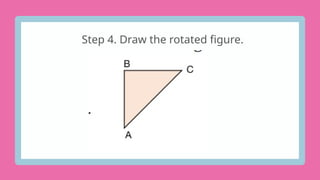
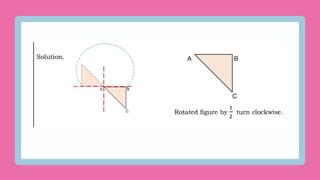
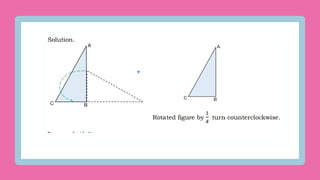
Step 2. Drawthe axes and direction of the rotation - Draw a
horizontal and a vertical line intersecting at the fixed point
and draw an arrow about the axes following the direction of
the rotation.
40.
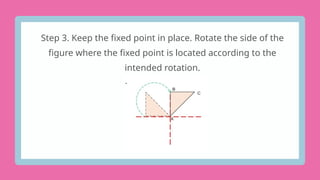
Step 3. Keepthe fixed point in place. Rotate the side of the
figure where the fixed point is located according to the
intended rotation.