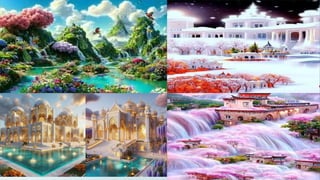
Understanding Eternity and Life After Death in Paradise: A Spiritual and Scientific Perspective
Explores the concepts of sleep, death, spirit, and eternal life in Paradise through Quranic verses, Hadith, and scientific insights on the body and soul.
Understanding Eternity and Life After Death in Paradise: A Spiritual and Scientific Perspective
1.
Attempt to
understand eternity
inParadise
Dr. Fathi Neana /Consultant Orthpaedics and Traumatology
Dr. Ayat Neena /Healthcare professional pharmacist
June 05, 2026
5.
Decease (waffaa inarabic) means either sleep or
death.
Sleep is, spirit (Rū in arabic) pass away whenever a
ḥ
person sleeps, while their organs continue their vital
functions. This is a recurring phenomenon as we
experience.
While death occurs when these vital functions
cease, and this happens only once, when a person's
appointed time in this world comes to an end.
6.
This is veryclear in the words of God Almighty:
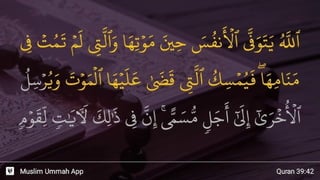
“God takes the souls at the time of their death,
and those that do not die [He takes] during their
sleep. Then He withholds those for whom He has
decreed death and releases the others until a
specified term. Indeed in that are signs for a
people who give thought.” (Az-Zumar 39:42)
This matter pertains only to this worldly life.
The Hereafter, after resurrection from death, is an
eternal life with no death.
9.
Therefore, eternity meansno Decease (waffaa in
arabic) i.e., no sleep or death, as the Prophet (peace
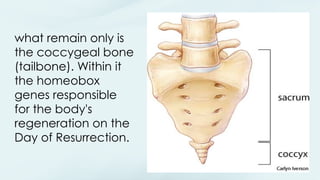
and blessings be upon him) said:
“Sleep is the brother of death, and the people of
Paradise do not sleep” (Al-Albani’s Sahih Hadith
Series).
Thus, life in Paradise is eternal, with no Decease
(neither sleep nor death).
10.
The Quran containsexplicit statements about
eternity in Paradise, such as the verse: “But those
who fear their Lord will have gardens beneath
which rivers flow, abiding therein eternally, as a
provision from Allah. And what is with Allah is best
for the righteous” (Al Imran 3:198).
And His saying, may He be exalted: “These are the
limits set by God. And whoever obeys God and His
Messenger will be admitted to gardens beneath
which rivers flow, abiding eternally therein. That is
the supreme triumph.” (An-Nisa: 13).
11.
And God, mayHe be exalted, has negated from
Himself those worldly attributes.
He is the Ever-Living, the Self-Sustaining, the Eternal,
as in His saying, may He be exalted:
“And rely upon the Ever-Living who does not die, and
exalt [Him] with praise.” (Al-Furqan: 58).
12.
He also negatedsleep or even snooze (short light
sleep) for Himself in His saying:
“Allah - there is no deity except Him, the Ever-Living,
the Sustainer of [all] existence. Neither snooze
overtakes Him nor sleep.” (Quran 2:255).
This is a well-known fact; it is inconceivable that the
One who manages this entire universe could be
overtaken by snooze or sleep.
13.
There are otherverses and names in the Holy Quran
that confirm the same meaning, such as His saying:
“Allah - there is no deity except Him, the Ever-Living,
the Sustainer of [all] existence.” (Quran 2:255).
“The Ever-Living” means the Eternal, the Everlasting,
and “the Sustainer of [all] existence” means the One
who does not cease to exist.
14.
And His saying:“He is the First and the Last, the
Manifest and the Hidden.” (Quran 57:3).
Allah is the First, before whom there is nothing, and
the Last, after whom there is nothing.
This divine guidance indicates that God Almighty is
the Ever-Living, possessing eternal and everlasting life,
and that He is the Everlasting One, untouched by
death or decay.
15.
Death is thedeparture of the spirit from the body.
However, in Paradise, God willing, the spirit never
leaves the body, for there is no sleep or death, only
eternal life.
Death is a specific program created by God, just as
He created life, and He instilled it in all His creation
so that every life has a predetermined time and a
pre-programmed end.
Eternity in Paradise means that this program is
suspended, and thus life continues indefinitely.
16.
It is knownin mathematics that any number
divided by infinity equals zero. Therefore, our
worldly life equals zero when compared to the
eternal life of the Hereafter.
The reason for the misery of humankind is that
everything in this world has an end.
Therefore, some strive to outpace time,
competing with their peers to acquire the
greatest amount of worldly possessions and gains.
17.
Others realize thateverything is inevitably fleeting
and thus no longer rejoice in any worldly gain.
As the Prophet (peace and blessings be upon him)
said:
“If you knew what I know, you would laugh little and
weep much.” (Al-Bukhari and Muslim).
18.
God created uswith limited capabilities, and there
are creatures that surpass us. For example, animals
see, hear, and smell things that we cannot perceive.
Our minds, too, have limited capabilities. The
sciences and modern technologies we possess are
by the will of God, as He, the Exalted, said: “And
they do not encompass His knowledge except for
what He wills.”
This has happened gradually, cumulatively, over
thousands of years.
19.
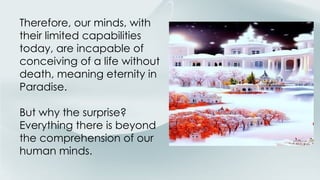
Therefore, our minds,with
their limited capabilities
today, are incapable of
conceiving of a life without
death, meaning eternity in
Paradise.
But why the surprise?
Everything there is beyond
the comprehension of our
human minds.
20.
The Prophet (peaceand blessings be upon him) said:
“Allah, the Exalted and Glorified, said:
‘I have prepared for My righteous servants what no
eye has seen, no ear has heard, and no human mind
has conceived.’ This is confirmed in the Book of Allah:
‘No soul knows what has been hidden for them of
comfort for the eyes as reward for what they used to
do’
(Agreed upon).”
22.
Our minds arelimited in their understanding; we only
perceive what we can comprehend.
This does not mean that what we do not understand
is unreal or nonexistent.
Allah, the Exalted, says: “But they have denied that
of which they have no knowledge, and whose
interpretation has not yet come to them. Thus did
those before them deny. Then see how was the end
of the people of Paradise.” The wrongdoers
(Jonah:39).
23.
Therefore, in orderfor our minds to grasp the
meaning of eternity in Paradise,
we must first contemplate what is meant by
1- The body(Al-Gassad or Jasad in arabic).
2- The spirit Rū in arabic).
ḥ
3- The soul (Nafs in arabic or human self).
4- The sleep.
5- The death.
The body ismerely a vessel for the spirit, which is
bound by the laws of this world—material, spatial,
and temporal realm. the soul is formed through the
union of the spirit and the body.
God Almighty says: “God takes the souls at the time
of their death, and those that do not die [He takes]
during their sleep. Then He withholds those for
whom He has decreed death and releases the
others until a specified term. Indeed in that are signs
for a people who give thought.” (Az-Zumar: 42).
26.
The implication ofthis verse is that divinity belongs
solely to God, the One, the Almighty, without any
partner. He gives life and causes death, and He does
as He wills, and nothing else has the power to do so.
Therefore, in sleep, which is the lesser death, the
body remains alive (operating involuntarily) because
its role has not yet ended. After the spirit are freed
and soar, unbound by space or time, they return to it
again if God wills, when the person awakens from
sleep.
27.
However, in death,the spirit departs completely and
definitively, and the body is buried after its role has
been fulfilled.
The body perishes, leaving only the coccygeal bone
(tailbone) containing the cells of the primitive streak
and its primitive node, which in turn contain the
genome (called the genes of the box).
28.
The tailbone liesdormant in the earth like a seed until
it sprouts again on the Day of Resurrection, and new
bodies are formed with new characteristics to merge
with the spirit and become the soul, never to depart
again as they did in this world.
There is no death after that, and this is eternity.
Therefore, the spirit remains, while the body perishes
as soon as the spirit departs.
29.
In earthly terms,we see three states: life, sleep,
and death.
However, in Paradise, God willing, the spirit never
leaves the body, for there is neither sleep nor
death, but eternal life.
As the Prophet (peace and blessings be upon
him) said: “Sleep is the brother of death, and the
people of Paradise do not sleep.” (Al-Albani’s
Sahih Hadith Series).
30.
After the spiritis freed and leaves the body, we bury
the body in the earth from which it was originally
created, in accordance with God’s words:
“From it We created you, and into it We will return you,
and from it We will bring you forth once again.”
(Ta-Ha: 55).
The body, having completed its function, begins
internal autolysis within minutes of death. Oxygen is
consumed, and the levels of carbon dioxide and
waste products, which poison the cells, increase.ts.
31.
Then, certain enzymesbegin to break down the cells
from within due to the increased acidity,
decomposing fats, proteins, and sugars into simpler
elements.
This decomposition, which is not visible to the naked
eye, continues for several days and is most intense in
the liver due to the high concentration of enzymes
and in the brain due to the high fluid content.
The blood changes color and pools under the skin,
and the increased acidity causes the cytoplasm to
coagulate.
32.
Then the bacteriatake over, and the stage of decay
begins.
Anaerobic and aerobic bacteria and fungi break down
the cells after destroying the remaining defenses of the
white blood cells, causing them to collapse completely
and be transformed into gases, liquids, and raw
materials.
The blood turns dark green, and gases resulting from
decomposition, such as methane, carbon dioxide,
hydrogen sulfide, and ammonia, are produced.
33.
If these gasesare not expelled through natural orifices,
they can cause the body to explode. These gases are
what give the body its putrid odor. All of this occurs
within the third week.
Then comes the role of insects. Some insects, which
play a crucial part in the decay process, lay their eggs
in the existing openings. Their larvae feed on the
decomposing body, and all these creatures cooperate
in breaking down the flesh and bones. The flesh, by its
very nature, decomposes before the bones.
34.
Then the drydecomposition stage begins. Algae
grow on the remaining bones, contributing to
their disintegration, depending on the available
moisture. In the first few decades, cracks appear
on the bones, and they begin to peel.
However, over time, they turn to dust—from dust
to dust.
Allah says: “From it We created you, and into it
We will return you, and from it We will bring you
forth once again.” (Ta-Ha: 55).
35.
what remain onlyis
the coccygeal bone
(tailbone). Within it
the homeobox
genes responsible
for the body's
regeneration on the
Day of Resurrection.
36.
This is exactlywhat happens to plant seeds that also
contain (plant stem genes). For example, a date
palm that has died and completely decomposed
but left a seed in the ground, which rains upon,
causing a new palm tree to sprout, resembling the
old one.
God Almighty says: “And He who sends down rain
from the sky in due measure, and We revive thereby
a dead land. Thus will you be brought forth.”
(Quran 43:11).
37.
This is thenatural course of decay of bodies;
otherwise, the earth would be overcrowded
with the corpses of humans and other creatures,
leaving no place suitable for habitation.
However, there are exceptions to these laws,
such as the bodies of prophets, as well as some
martyrs and righteous people.
There are thingswe cannot see with our eyes nor
perceive with our senses, yet we are certain of their
existence because of their effects in reality.
We have not seen God, nor the spirit, nor the Angel
of Death,
yet all of this is certain to exist, and its effects are
clear to every human being, but our senses, with their
limited capabilities, cannot perceive it.
41.
We cannot seethe physiological functions
occurring within our bodies, nor can we even see
the cells in our bodies except with a microscope.
Similarly, we cannot see viruses, bacteria, and
fungi, but we have finally been able to see them
with the help of modern devices and microscopes.
Therefore, our inability to see them in the past does
not negate their existence.
42.
The spirit isa creation of God, but we do not see it.
Many of us have witnessed the final moments before
death, when the spirit departs the body, and we saw
nothing—neither the spirit nor the Angel of Death.
However, witnessing a person's death and the
change in their state makes us absolutely certain of
the existence of what we cannot see.
43.
Just as adoctor can diagnose an illness from its
symptoms—and I'm not talking about our time, as
modern technology aids in accurate diagnosis—but
rather imagine medicine in ancient times, in the days
of Hippocrates, Ibn Sina, and others.
The spirit is the secret of life in all beings, and it is like
energy or battary.
44.
Therefore, we cansay that the spirit is the energy that
God instilled in His creation of living beings on Earth,
causing them to move, multiply, and divide.
When a cell dies, this driving energy is exhausted, like
a battery when its charge is depleted.
45.
The spirit isamong God's greatest creations, and thus
it has been honored and exalted.
God Almighty attributed it to Himself, saying: "So
when I have fashioned him and breathed into him of
My spirit, then fall down prostrating before him" (Al-Hijr
29 - Sad 72).
The prostration mentioned in the verse is a prostration
of respect, not a prostration of worship.
46.
One of themanifestations of God's glorification and
honoring of the spirit is that He made it hidden from
human knowledge.
Humans know nothing about it except what God
Almighty has revealed to them concerning it, as He
said:
"And they ask you, [O Muhammad], about the spirit .
Say, 'The spirit is of the affair of my Lord. And mankind
has not been given of knowledge except a little.'" (Al-
Isra: 85).
47.
Human beings experiencetwo types of life.
The first relates to the senses, which give them
perception of the world around them and grant
them abilities suited to their constitution as creatures.
Thus, humans have limited capabilities, and the spirit
is confined to the body, as God Almighty said: "We
created them and strengthened their joints, and
when We will, We can replace them with others like
them." (Al-Insan: 28).
48.
The second realmis known as the spiritual realm, and
Islam has given great attention to spiritual values.
God Almighty created humankind from both body
and spirit and provided the necessary guidance to
achieve balance between them.
The principles governing the human soul are what
are known as spiritual values.
49.
These spiritual valuesare characterized by their
immutability; they do not change with time, place,
or circumstances.
They are also characterized by their continuity,
meaning that humankind is required to pursue them
in all aspects of life,
encompassing the relationship between a person
and their Lord, their relationships with others, and
their relationship with themselves.
50.
In death andsleep, the spirit is freed from the
constraints of the body that bind it. In death, this
liberation is complete and irrevocable until the
Day of Resurrection. In sleep, it is partial liberation
for a specific period before returning.
These spirits, freed from the spatial and temporal
limitations of the body, can meet with all other
freed spirits, whether those of the deceased or
even those of the living in their dreams, and
exchange news by God's permission.
51.
Scholars, both ancientand modern, have confirmed
the possibility of this, and it is supported by evidence
and historical accounts.
Many people have experienced the encounter of their
own spirits with the spirits of their deceased loved ones
and acquaintances during sleep.
Often, the deceased is in dire need of something,
perhaps prayers, debt repayment, or something else
entirely. Their spirit then comes to meet the spirits of
those they love and trust in their dreams.
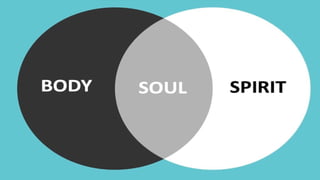
The soul (Nafsor self) Is formed from the union of the
spirit and the body, creating within a person an
identity through which they recognize themselves as
human, with their feelings, emotions, and
perceptions.
For this reason, the soul (human self) is the subject of
God's address and the basis for accountability,
reward, and punishment.
55.
The relationship betweenthe soul and the spirit is
such that the soul cannot perform any action without
the spirit.
However, the spirit cannot influence or change the
behavior of the soul ; rather, it acts as the fuel that
powers the body, which moves according to the soul
's dictates.
56.
Human beings havewronged themselves by
accepting the freedom to make decisions instead of
being guided by the laws and programs established
by God, their Creator and the Creator of all things for
His creation.
Humanity has borne this trust, which the heavens, the
earth, and the mountains were afraid to bear, and
they refused to bear it.
57.
As God Almightysays:
“Indeed, We offered the trust to the heavens and the
earth and the mountains, but they declined to bear it
and feared it; but man bore it. Indeed, he was unjust
and ignorant.”
[Al-Ahzab: 72].
Therefore, humankind will be questioned about this
trust and their choices on the Day of Judgment.
58.
To illustrate this:
Acomputer, for example, is like a lifeless body. When
we provide it with power by installing a battery or
connecting it to electricity, it begins to operate.
The electrical energy is like the lifeblood that powers
the device.
However, this energy does not dictate its use, such as
writing, reading, watching movies, or playing sports.
59.
The one whochooses these things is the one who
possesses the power of choice.
Within humanity, this power resides in the soul (human
self), which is formed from the union of the spirit and
the body, bestowing life upon it.
It is the soul that ultimately decides between right
and wrong.
60.
Therefore, there isa tranquil the soul that
chooses what is right, a soul prone to evil that
chooses what is wrong, and a self-reproaching
soul that lies between the two, holding itself
accountable and blaming itself when it errs.
The soul encompasses the human being in all its
components, body and spirit.
It is the soul that is represented before God
Almighty and before society.
61.
Consequently, the HolyQuran addresses the soul as
the rational, accountable human being, from whom
good or evil, guidance or misguidance, is expected
to emanate. The soul may whisper to a person and
incite them to do evil.
God Almighty says: “Indeed, the soul is ever inclined
to evil, except for those upon whom my Lord has
mercy. Indeed, my Lord is Forgiving and Merciful.”
[Yusuf: 53].
Of course, this applies to someone far from God.
62.
However, the believerworks through their heart to
purify and control this soul until it becomes a tranquil
soul.
This tranquil soul returns to God after death:
“O tranquil soul, return to your Lord, well-pleased and
pleasing [to Him], and enter among My [righteous]
servants and enter My Paradise.”
[Al-Fajr: 27-30].
63.
In conclusion, ahuman being is a physical body
composed of cells made up of atoms, but the
presence of the spirit among these atoms
makes them alive, capable of multiplying,
growing, and living.
The soul, guides the body, just as a driver guides
his car, either leading it to safety or plunging it
into a deep abyss.
Sleep is asign from God and a natural part of life for
all living creatures, including humans.
God has instilled it in His creation, but He Himself is not
overtaken by slumber or sleep.
God Almighty says: "And among His signs is your sleep
by night and by day."
(Quran 30:23).
67.
Sleep is agreat sign from God. We sleep for about a
quarter to a third of our lives, which is a very long time.
Someone who reaches the age of sixty will have slept for
about 20 years, a considerable amount of time.
This raises the question: Is it conceivable that a person
would spend such a long period sleeping without any
benefits?.
Is it conceivable that the Almighty Creator would create
humankind in the best of forms without a profound wisdom
behind the process of sleep?.
68.
Sleep is perfectlysuited to the functional needs of our
human bodies in this life. Sleep remains as vital as
eating, drinking, and breathing.
It's not merely "passive rest," but much more. It's a kind
of biological energy-saving mode.
When we sleep, we consume less of the body's energy
compared to when we're awake. It's also a type of
fasting from food and drink, with all its benefits, such as
burning fat, lowering blood insulin levels, and stimulating
autophagy.
69.
It's also acontinuous "renewal and maintenance"
process in the brain throughout the night, in addition
to many other benefits that make it the best
medicine.
During sleep, the spirit leaves the body, while the
body's systems continue to function automatically
until the spirit returns, because the appointed time
has not yet come.
A person returns to normal life upon waking.
70.
Some call thisthe "lesser death." The question is, who
other than God Almighty knows that the appointed
time has not yet come, and therefore the body
remains alive until it is reunited with the spirit upon
waking?.
Another question is, who is it that never sleeps or
slumbers, not even for a moment, managing our
body's systems while we sleep?. And what would
happen to us if He were to fall asleep?.
71.
Sleep is essentialfor all bodily functions:
1- The nervous system
2- The biological clock, hormone cycles, and
endocrine functions
3- Energy conservation and redistribution of priorities
4- Impact on the immune system
5- The respiratory and circulatory systems
6- Sleep at night is an anabolic process, while
wakefulness during the day is a catabolic process.
This will be explained in more detail in another presentation,
God willing.
72.
But the questionis: Who manages the organs that
represent the foundations of life, such as the heart, lungs,
and brain, which function automatically and involuntarily
without ceasing, other than God?.
Creatures and servants sleep, but the Creator never
sleeps.
He watches over them, preserves their sustenance, and
surrounds them with His care.
What a magnificent Lord He is! Simply contemplating this
fills the heart with love, gratitude, thanks, and praise.
For every appointedtime there is a decree, and every
soul will taste death.
As for when a person's appointed time comes to
depart this world, that is a mystery known only to God.
God Almighty says: “And We did not grant immortality
to any human being before you. So if you die, will they
be immortal? (34) Every soul will taste death, and We
test you with evil and good as a trial; and to Us you will
be returned.” (35)
(Al-Anbiya).
76.
Death is thefinal separation of the spirit from the
body upon the expiration of its appointed time.
With this, all vital functions cease in that body, which
used to regenerate its cells at a rate of 3.8 million
cells per second and which used to synthesize and
fold proteins in a fraction of a second. All of this, and
more, stops completely until the Resurrection.
This is death, which no human can overcome. This is
the disease for which there is no cure. This is the cup
that everyone will inevitably drink.
77.
This event canbe contemplated in the following
circumstances:
1- The departure of the spirit through the destruction of
the body's structure, as occurs in diseases that cause
deficiencies or failure of bodily functions, or as a result
of accidents, disasters, or fatal injuries such as severe
bleeding, as we see during the slaughter of sacrificial
animals.
This can be likened to water leaking (the spirit leaving)
when the cup (the body) that contains and holds it
breaks, or when houses collapse for any reason,
causing people to rush outside.
78.
2- The departureof the soul even though the body is
healthy, due to the end of life.
This can be likened to a mobile phone battery
running out, causing it to stop working even though it
is otherwise functional.
In this case, bodily functions such as the heart and
lungs cease to function. It is not necessary for a
person to be asleep; this can happen at any time.
79.
This can alsobe likened to an empty cup (the body)
after it has completed its cycle of drinking water (the
spirit leaving), and thus it is disposed of.
The question is, is there anyone other than God
Almighty who knows that the appointed time has
passed and based on that the body's systems stop
functioning?.
80.
At death, thespirit departs completely and
definitively, and the body's organs cease functioning.
Consequently, the body is buried after its purpose has
been fulfilled, and it perishes, leaving only the
coccygeal bone (tailbone) which lies dormant in the
earth until it sprouts again on the Day of Resurrection.
New bodies will then be formed, uniting with the spirit,
and the souls will be resurrected a new for the Day of
Judgment.
81.
It is Godwho created bodies from clay and
breathed life into them, thus creating soul for the first
time.
He is the One who causes sleep and death, and He is
the One who sustains our organs and bodies during
sleep, keeping them alive until the spirit returns to
them.
He is the One who knows the unseen and when our
appointed time will come.
82.
The question is:Is not God, who created us in the first
place, capable of resurrecting us anew for the Day
of Judgment?.
God Almighty says: “Then they will say, ‘Who will
restore us?’ Say, ‘He Who created you the first time.’”
(Al-Isra: 51)
83.
The issue ofdeath and life has perplexed, even
overwhelmed, humankind, revealing its weakness
and helplessness. Humans cannot conquer death or
escape it.
God Almighty explains the wisdom behind the
creation of death and life: “Blessed is He in Whose
hand is dominion, and He is over all things
competent. He Who created death and life to test
you [as to] which of you is best in deed - and He is
the Exalted in Might, the Forgiving.”
(Al-Mulk: 1-2).
Eternity in Paradisemeans there is neither sleep
nor death, and this is a firmly established belief.
It signifies eternal bliss, unending, with no death
or fear of annihilation.
Thus, worries vanish and pleasures are renewed
in an ideal life that transcends the limits of
worldly reason and logic.
87.
Absolute eternity, followedby no end, is established
by the texts of the Holy Quran and the noble
Prophetic traditions.
Death is sacrificed on the bridge over Hell in the form
of a ram, and it is proclaimed: "O people of Paradise,
eternity and no death!" Thus, bliss is without end.
The bliss of Paradise is unchanging and unfading,
and its inhabitants experience no boredom or
weariness, for they are constantly increasing in grace
and delight.
88.
However, unfortunately, deathcomes suddenly,
ending all opportunities for a person to rectify past
mistakes.
The deceased remains in their grave, bound by their
past deeds, regretting what they missed and wishing
they could turn back time and pass by a needy
person to give them charity, or lend to a debtor and
forgive their debt, or grant them respite until they are
able to pay.
89.
He wishes ahungry cat would pass by so he could feed
and water it. He wishes he could pray, even just two
rak'ahs.
He wishes he could return what is rightfully theirs to its
owners.
He wishes he could return to this world, even for a few
moments, to utter even a single glorification or
declaration of God's oneness.
Perhaps this is the reason for his fear or hatred of death.
90.
The Prophet (peaceand blessings be upon him) said:
“Allah, the Exalted and Glorified, said: ‘I have prepared
for My righteous servants what no eye has seen, no ear
has heard, and no human mind has conceived.’ This is
confirmed in the Book of Allah: ‘No soul knows what has
been hidden for them of comfort for the eyes as reward
for what they used to do’ (Agreed upon).”
:وسلم عليه الله صلى النبي قال
:
لعبادي أعددت وجل عز الله قال
،بشر قلب على خطر وال ،سمعت أذن وال ،رأت عين ال ما الصالحين
:
قرة من لهم أخفي ما نفس تعلم فال الله كتاب في ذلك مصداق
"يعملون كانوا بما جزاء أعين
) (
عليه متفق .
92.
References:
1- Thoughts ofSheikh Al-Sha'rawi
https://ar-ar.facebook.com/Khawater.Sharawy/posts/1083364831678378/
https://youtu.be/FDShRgEQmFs
2- What is the difference between the soul and the spirit?
http://www.kaheel7.com/ar/index.php/2012-12-04-18-31-08/1045-2013-03-18-
22-24-47
3- What is the difference between the soul and the spirit? By Muhammad
Marwan
4- The Soul, the Spirit, and the Body, by Dr. Fathi Na'ina
5- Do the souls of the dead and the living meet in dreams? - Ibn Baz
6- Allah takes the souls at the time of their death, and those that do not die
[He takes] during their sleep. Then He withholds them...
7- The Holy Quran - Tafsir Ibn Kathir - Tafsir of Surah Az-Zumar - Verse 42
8- https://youtu.be/Sd72XFqIv_Q
9- Why do we sleep? - Encyclopedia of Sleep in Health and Illness
10- Why does a person need sleep? | Science and Technology - DW
11- Where do souls go after death?