Understanding Death: Spiritual Reflections and Life's Inevitable Truth
Explores death's inevitability, spiritual insights from Islamic teachings, the transient nature of life, and preparing for the afterlife with wisdom from scholars and prophets.
Death is aninevitable reality.
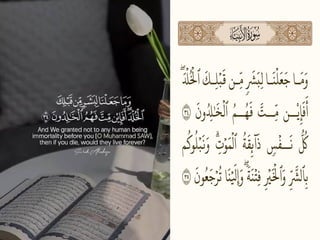
Every soul will taste death, as God Almighty says:
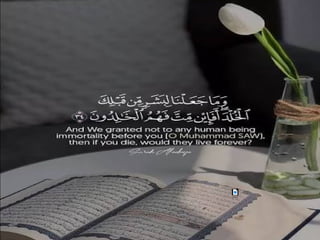
“And We did not grant immortality to any human
being before you. So if you die, will they be immortal?
(34).
Every soul will taste death, and We test you with evil
and good as a trial; and to Us you will be returned.”
(35)
(Surat Al-Anbiya).
We witness thisreality every day with the death of
loved ones, friends, and colleagues.
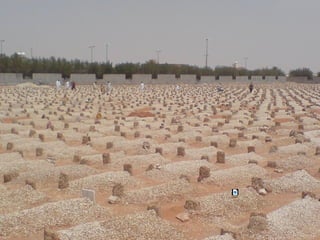
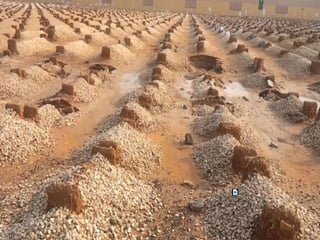
Or when we pass by cemeteries that remind us of
those who came before us and who lived on and
cultivated the earth before us.
Death is what humbles and subdues humankind, no
matter how powerful, wealthy, or influential they may
be.
7.
Death cuts downthe pride of the mighty.
It is the disease for which there is no cure, and it is the
cup from which everyone will inevitably drink.
Death is what reveals to us the true nature of this
worldly life, showing that it is a place of trial and
transience, not a place of eternity.
8.
The Prophet Muhammad(peace be upon him)
described it as the destroyer of pleasures, saying:
"Frequently remember the destroyer of pleasures."
This is to deter the soul from sins and wishful thinking,
clarifying that it is an imminent reality and the end of
every living being.
He urged us to prepare for it through righteous deeds
and not to wish it upon anyone who has suffered harm,
explaining that nothing accompanies a person to their
grave except their deeds.
9.
With advancing ageand the appearance of signs of
approaching death, such as gray hair and falling
teeth, this world and all its contents become part of
the past, and a person becomes preoccupied with
what is to come—death and what follows it.
They worry about who will handle the funeral and
burial arrangements and where they will be buried. This
is natural and logical, as the human journey is
comprised of stages, and this worldly life is one of these
stages, not everything.
10.
God Almighty says:
“Andit is He who gives you life, then causes you to die,
then gives you life again. Indeed, mankind is
ungrateful.” (Al-Hajj: 66).
He also says:
“How can you disbelieve in God when you were lifeless
and He gave you life, then He will cause you to die,
then He will give you life again, and then to Him you
will be returned?” (Al-Baqarah: 28).
11.
Therefore, there arethree stages:
The life we live on Earth, then death, and then true life
in the Hereafter.
These become four stages:
If we include the stage before our life on Earth, when
we were lifeless before the soul was breathed into us.
12.
The third stage,the afterlife, is unseen, yet we are
certain of it after witnessing the first two stages
firsthand.
Logically, only the third remains, which is part of the
unseen known only to God.
Our knowledge of it and its conditions comes from His
words, for He has informed us that it is the eternal,
everlasting life, the final stage that completes the
entire human journey.
13.
As a personages, they realize they are nearing the
end of this worldly life and moving on to the next.
This contrasts with younger people, who are often
preoccupied with this first stage, this worldly life.
Their interests are entirely different. They seek an
apartment or villa, strive for a prestigious job, a
beautiful spouse, a comfortable vehicle, a spacious
house, property, real estate, outings, evenings out, and
attending banquets and parties.
14.
The elderly, however,are not concerned with all of
this. They seek a burial place and strive to increase
their good deeds for the afterlife.
This is because, after years of experience, he learned
that the Hereafter and what God has prepared therein
is better than this worldly life, as God Almighty says:
“And the Hereafter is better for you than the first life”
(Ad-Duha: 4).
He also says: “And the Hereafter is better and more
enduring” (Al-A'la: 17).
15.
Therefore, you findthat everything in this world
becomes insignificant to him, so he does not grieve
over what he has lost.
Material things have no value to him since he will
depart from them.
That is why we find many wise and wealthy people
who spent their fortunes on charitable works before
their death.
16.
Despite all this,we find ourselves disliking and fearing
death, to the point that some of the wives of the
Prophet (peace and blessings be upon him), may God
be pleased with them, who are the Mothers of the
Believers, said, “We dislike death.”
Perhaps the reason for this is that death doesn't give us
time; it comes when we haven't fully prepared to
receive it, like an unwelcome guest who arrives at an
inopportune time and without warning, leaving no
opportunity to prepare for its arrival.
17.
Perhaps our aversionto death also stems from our
preoccupation with worldly matters, as if we will live
forever, and our neglect of the Hereafter.
The opposite would be more appropriate, for the
Hereafter is the eternal and everlasting abode.
18.
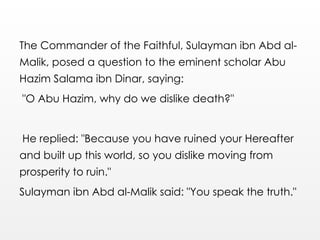
The Commander ofthe Faithful, Sulayman ibn Abd al-
Malik, posed a question to the eminent scholar Abu
Hazim Salama ibn Dinar, saying:
"O Abu Hazim, why do we dislike death?"
He replied: "Because you have ruined your Hereafter
and built up this world, so you dislike moving from
prosperity to ruin."
Sulayman ibn Abd al-Malik said: "You speak the truth."
19.
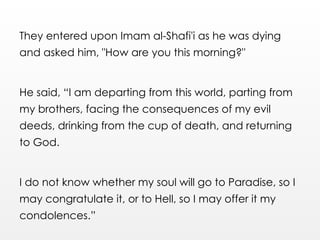
They entered uponImam al-Shafi'i as he was dying
and asked him, "How are you this morning?"
He said, “I am departing from this world, parting from
my brothers, facing the consequences of my evil
deeds, drinking from the cup of death, and returning
to God.
I do not know whether my soul will go to Paradise, so I
may congratulate it, or to Hell, so I may offer it my
condolences.”
20.
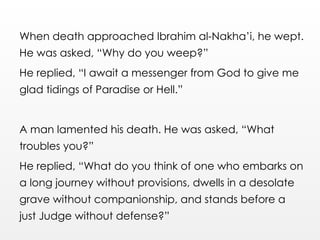
When death approachedIbrahim al-Nakha’i, he wept.
He was asked, “Why do you weep?”
He replied, “I await a messenger from God to give me
glad tidings of Paradise or Hell.”
A man lamented his death. He was asked, “What
troubles you?”
He replied, “What do you think of one who embarks on
a long journey without provisions, dwells in a desolate
grave without companionship, and stands before a
just Judge without defense?”
21.
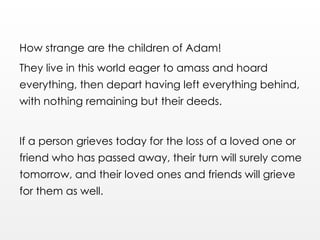
How strange arethe children of Adam!
They live in this world eager to amass and hoard
everything, then depart having left everything behind,
with nothing remaining but their deeds.
If a person grieves today for the loss of a loved one or
friend who has passed away, their turn will surely come
tomorrow, and their loved ones and friends will grieve
for them as well.
22.
It is amistake to think or believe that anything in this
world is eternal and without end.
God Almighty says:
“Everyone upon the earth will perish, and there will
remain the Face of your Lord, Owner of Majesty and
Honor.” (Ar-Rahman 26-27)
Eternal life belongs to Him alone, Glory be to Him.
There is nothing after Him.
23.
The annihilation ofall creation is a clear and
undeniable truth, which we witness every moment as
a reality.
Perhaps we express its meaning in different ways,
each according to their life experience, and perhaps
the reasons are many, but the ultimate result is the
same.
24.
O God, grantus a good end in all matters and protect
us from the disgrace of this world and the torment of
the Hereafter.
O God, cause us to die as Muslims, cause us to live as
Muslims, and join us with the righteous.
O Turner of hearts and eyes, keep our hearts steadfast
in Your religion.