Understanding Buffer Solutions: Properties, Functions, and Everyday Applications
Explore the properties, components, and functions of buffer solutions, their role in maintaining pH stability in blood and everyday life, and practical examples of common buffers and their capacities.
What is Buffer?
Whatis Buffer?
What is Buffer?
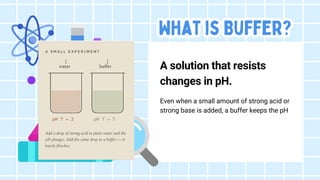
A solution that resists
changes in pH.
Even when a small amount of strong acid or
strong base is added, a buffer keeps the pH
6.
Every buffer isa pair
Every buffer is a pair
A weak acid–base partnership, held in equilibrium. Mix one of these two recipes and
A weak acid–base partnership, held in equilibrium. Mix one of these two recipes and
you have a buffer.
you have a buffer.
Every buffer is a pair
A weak acid–base partnership, held in equilibrium. Mix one of these two recipes and
you have a buffer.
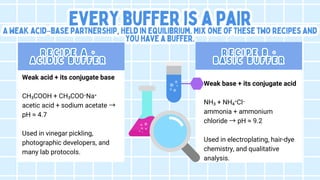
Weak acid + its conjugate base
CH₃COOH + CH₃COO⁻Na⁺
acetic acid + sodium acetate →
pH ≈ 4.7
Used in vinegar pickling,
photographic developers, and
many lab protocols.
Weak base + its conjugate acid
NH₃ + NH₄⁺Cl⁻
ammonia + ammonium
chloride →pH ≈ 9.2
Used in electroplating, hair-dye
chemistry, and qualitative
analysis.
R e c i p e A ·
R e c i p e A ·
A c i d i c B u f f
A c i d i c B u f f e r
e r
R e c i p e A ·
A c i d i c B u f f e r
R e c i p e B ·
R e c i p e B ·
B a s i c B u f f e r
B a s i c B u f f e r
R e c i p e B ·
B a s i c B u f f e r
7.
The trick: tworeservoirs.
The trick: two reservoirs.
A buffer holds a proton
A buffer holds a proton donor (HA) and a proton acceptor (A⁻) side-by-side. Whichever attacker shows up, the
donor (HA) and a proton acceptor (A⁻) side-by-side. Whichever attacker shows up, the
right reservoir steps forward.
right reservoir steps forward.
The trick: two reservoirs.
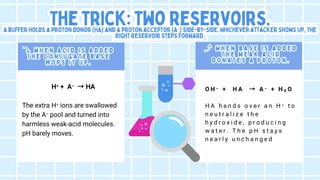
A buffer holds a proton donor (HA) and a proton acceptor (A⁻) side-by-side. Whichever attacker shows up, the
right reservoir steps forward.
H⁺ + A⁻ →HA
The extra H⁺ ions are swallowed
by the A⁻ pool and turned into
harmless weak-acid molecules.
pH barely moves.
O H ⁻ + H A → A ⁻ + H ₂ O
H A h a n d s o v e r a n H ⁺ t o
n e u t r a l i z e t h e
h y d r o x i d e , p r o d u c i n g
w a t e r . T h e p H s t a y s
n e a r l y u n c h a n g e d
⤵ W h
⤵ W h e n a c i d i s a d d e d
e n a c i d i s a d d e d
T h e c o n j u g a t e b a s e
T h e c o n j u g a t e b a s e
m o p s i t u p .
m o p s i t u p .
⤵ W h e n a c i d i s a d d e d
T h e c o n j u g a t e b a s e
m o p s i t u p .
⤴ W h
⤴ W h e n b a s e i s a d d e d
e n b a s e i s a d d e d
T h e w e a k a c i d
T h e w e a k a c i d
d o n a t e s a p r o t o n .
d o n a t e s a p r o t o n .
⤴ W h e n b a s e i s a d d e d
T h e w e a k a c i d
d o n a t e s a p r o t o n .
8.
Four familiar buffers.
Fourfamiliar buffers.
The pK
The pK tells you the pH window where each one
tells you the pH window where each one
works best.
works best.
a
a
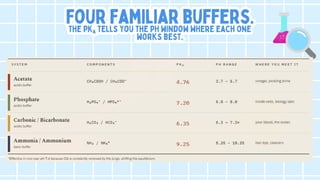
Four familiar buffers.
The pK tells you the pH window where each one
works best.
a
9.
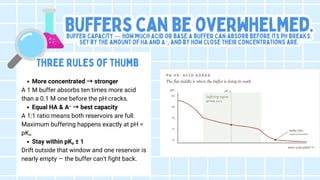
Buffers can beoverwhelmed.
Buffers can be overwhelmed.
Buffer capacity — how much acid or base a buffer can absorb before its pH bre
Buffer capacity — how much acid or base a buffer can absorb before its pH breaks.
aks.
Set by the amount of HA and A⁻, and by how close their concentrations are.
Set by the amount of HA and A⁻, and by how close their concentrations are.
Buffers can be overwhelmed.
Buffer capacity — how much acid or base a buffer can absorb before its pH breaks.
Set by the amount of HA and A⁻, and by how close their concentrations are.
More concentrated →stronger
A 1 M buffer absorbs ten times more acid
than a 0.1 M one before the pH cracks.
Equal HA & A⁻ →best capacity
A 1:1 ratio means both reservoirs are full.
Maximum buffering happens exactly at pH =
pK .
a
Stay within pK ± 1
a
Drift outside that window and one reservoir is
nearly empty — the buffer can't fight back.
Three rules of thumb
Three rules of thumb
Three rules of thumb
10.
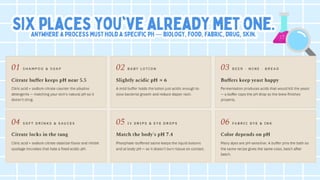
Six places you'vealready met one.
Six places you've already met one.
Anyw
Anywhere a process must hold a specific pH — biology, food, fabric, drug, skin.
here a process must hold a specific pH —biology, food, fabric, drug, skin.
Six places you've already met one.
Anywhere a process must hold a specific pH — biology, food, fabric, drug, skin.
11.
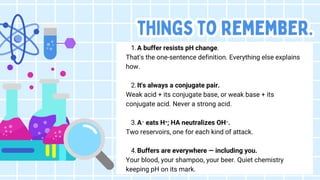
things to remember.
thingsto remember.
things to remember.
1.A buffer resists pH change.
That's the one-sentence definition. Everything else explains
how.
2.It's always a conjugate pair.
Weak acid + its conjugate base, or weak base + its
conjugate acid. Never a strong acid.
3.A⁻ eats H⁺; HA neutralizes OH⁻.
Two reservoirs, one for each kind of attack.
4.Buffers are everywhere — including you.
Your blood, your shampoo, your beer. Quiet chemistry
keeping pH on its mark.