Understanding Archimedes’ Principle and Buoyant Force in Fluids
Explore Archimedes’ Principle, buoyant force, density, and how object shape affects floating and sinking in fluids with practical examples and calculations.
DENSITY
Density - isthe amount of matter packed into a certain
amount of space. The more tightly packed the particles are,
the higher the density. Water has a density of about 1.0
g/cm³ (1000 kg/m³), which is why it is used as the reference
for determining whether objects float or sink.
“Any object completelyor partially
submerged in a fluid experiences
an upward force equal in
magnitude to the weight of the
fluid displaced by the object.”
- Archimedes’ Principle
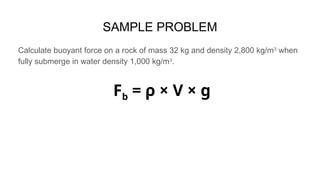
SAMPLE PROBLEM
Calculate buoyantforce on a rock of mass 32 kg and density 2,800 kg/m3
when
fully submerge in water density 1,000 kg/m3
.
Fb = ρ × V × g