Understanding and Managing Social Relationships: Influence, Dynamics, and Cooperation
Explore social influence, perception, interaction, and relationship dynamics like cooperation, competition, and conflict in school, family, and community contexts.
Understanding and Managing Social Relationships: Influence, Dynamics, and Cooperation
1.
G THE NATUREAND DYNAMICS OF SOCIAL RELATIONSHIPS
ception • Social Interaction
tion • Competition • Conflict
up Relationships
Social Relationships • 1
2.
MOTIVATION: What DoYou See?
LOOK • THINK • SHARE
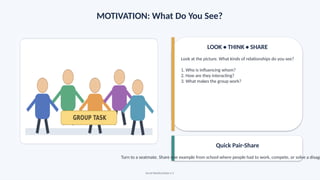
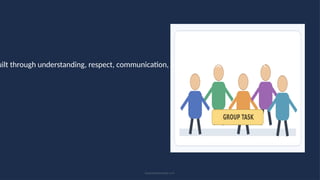
Look at the picture. What kinds of relationships do you see?
1. Who is influencing whom?
2. How are they interacting?
3. What makes the group work?
Quick Pair-Share
Turn to a seatmate. Share one example from school where people had to work, compete, or solve a disagr
Social Relationships • 2
3.
Learning Objectives
Define socialrelationships and explain why they matter in everyday life.
Differentiate social influence, social perception, and social interaction.
Explain cooperation, accommodation, competition, and conflict.
Describe intergenerational and intergroup relationships.
Apply the concepts to familiar school, family, and community situations.
Social Relationships • 3
4.
1. Social Relationships
Asocial relationship is a connection between people shaped
by communication, shared experiences, expectations, and
behavior.
Relationships may be close or distant, temporary or long-
term, cooperative or competitive.
They develop through repeated interaction and are
influenced by culture, roles, norms, and social situations.
Social Relationships • 4
5.
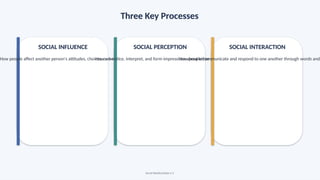
Three Key Processes
SOCIALINFLUENCE
How people affect another person's attitudes, choices, or behavior.
SOCIAL PERCEPTION
How we notice, interpret, and form impressions about other people.
SOCIAL INTERACTION
How people communicate and respond to one another through words and
Social Relationships • 5
6.
Social Influence
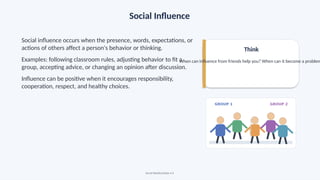
Social influenceoccurs when the presence, words, expectations, or
actions of others affect a person's behavior or thinking.
Examples: following classroom rules, adjusting behavior to fit a
group, accepting advice, or changing an opinion after discussion.
Influence can be positive when it encourages responsibility,
cooperation, respect, and healthy choices.
Think
When can influence from friends help you? When can it become a problem
Social Relationships • 6
7.
Social Perception
We constantlyinterpret other people's facial expressions,
words, actions, and situations.
Our first impression may be incomplete or influenced by
assumptions.
Good social perception means checking facts, listening
carefully, and avoiding quick judgments.
Example
A quiet classmate may seem unfriendly—but they could simply be shy, tired, or unsure
Key Reminder
Perception is an interpretation, not always the complete reality.
Social Relationships • 7
8.
Social Interaction
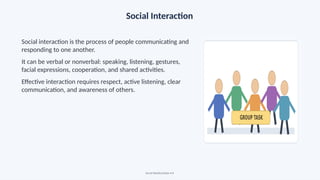
Social interactionis the process of people communicating and
responding to one another.
It can be verbal or nonverbal: speaking, listening, gestures,
facial expressions, cooperation, and shared activities.
Effective interaction requires respect, active listening, clear
communication, and awareness of others.
Social Relationships • 8
9.
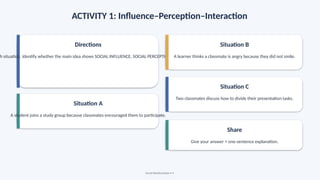
ACTIVITY 1: Influence–Perception–Interaction
Directions
hsituation. Identify whether the main idea shows SOCIAL INFLUENCE, SOCIAL PERCEPTION, or SOCIAL INTERACTION.
Situation A
A student joins a study group because classmates encouraged them to participate.
Situation B
A learner thinks a classmate is angry because they did not smile.
Situation C
Two classmates discuss how to divide their presentation tasks.
Share
Give your answer + one-sentence explanation.
Social Relationships • 9
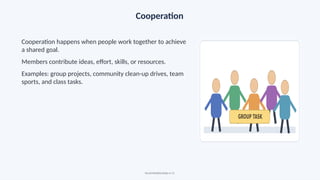
Cooperation
Cooperation happens whenpeople work together to achieve
a shared goal.
Members contribute ideas, effort, skills, or resources.
Examples: group projects, community clean-up drives, team
sports, and class tasks.
Social Relationships • 11
12.
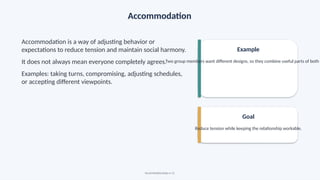
Accommodation
Accommodation is away of adjusting behavior or
expectations to reduce tension and maintain social harmony.
It does not always mean everyone completely agrees.
Examples: taking turns, compromising, adjusting schedules,
or accepting different viewpoints.
Example
Two group members want different designs, so they combine useful parts of both
Goal
Reduce tension while keeping the relationship workable.
Social Relationships • 12
13.
Competition
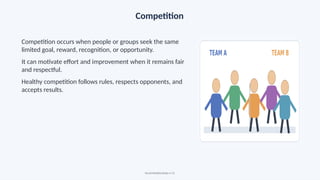
Competition occurs whenpeople or groups seek the same
limited goal, reward, recognition, or opportunity.
It can motivate effort and improvement when it remains fair
and respectful.
Healthy competition follows rules, respects opponents, and
accepts results.
Social Relationships • 13
14.
Conflict
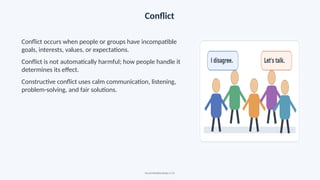
Conflict occurs whenpeople or groups have incompatible
goals, interests, values, or expectations.
Conflict is not automatically harmful; how people handle it
determines its effect.
Constructive conflict uses calm communication, listening,
problem-solving, and fair solutions.
Social Relationships • 14
15.
Compare the FourDynamics
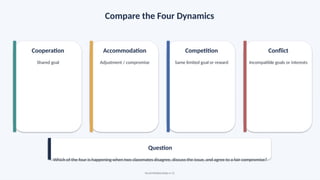
Cooperation
Shared goal
Accommodation
Adjustment / compromise
Competition
Same limited goal or reward
Conflict
Incompatible goals or interests
Question
Which of the four is happening when two classmates disagree, discuss the issue, and agree to a fair compromise?
Social Relationships • 15
16.
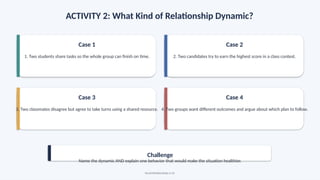
ACTIVITY 2: WhatKind of Relationship Dynamic?
Case 1
1. Two students share tasks so the whole group can finish on time.
Case 2
2. Two candidates try to earn the highest score in a class contest.
Case 3
3. Two classmates disagree but agree to take turns using a shared resource.
Case 4
4. Two groups want different outcomes and argue about which plan to follow.
Challenge
Name the dynamic AND explain one behavior that would make the situation healthier.
Social Relationships • 16
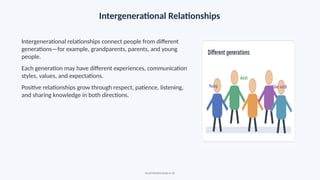
Intergenerational Relationships
Intergenerational relationshipsconnect people from different
generations—for example, grandparents, parents, and young
people.
Each generation may have different experiences, communication
styles, values, and expectations.
Positive relationships grow through respect, patience, listening,
and sharing knowledge in both directions.
Social Relationships • 18
19.
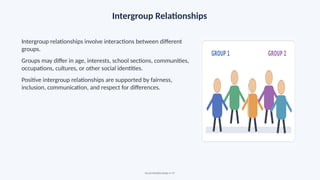
Intergroup Relationships
Intergroup relationshipsinvolve interactions between different
groups.
Groups may differ in age, interests, school sections, communities,
occupations, cultures, or other social identities.
Positive intergroup relationships are supported by fairness,
inclusion, communication, and respect for differences.
Social Relationships • 19
20.
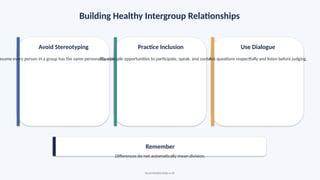
Building Healthy IntergroupRelationships
Avoid Stereotyping
ssume every person in a group has the same personality, ability, or behavior.
Practice Inclusion
Give people opportunities to participate, speak, and contribute.
Use Dialogue
Ask questions respectfully and listen before judging.
Remember
Differences do not automatically mean division.
Social Relationships • 20
21.
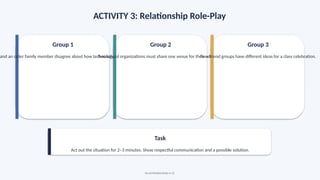
ACTIVITY 3: RelationshipRole-Play
Group 1
and an older family member disagree about how technology should be used at home.
Group 2
Two school organizations must share one venue for their activities.
Group 3
Two friend groups have different ideas for a class celebration.
Task
Act out the situation for 2–3 minutes. Show respectful communication and a possible solution.
Social Relationships • 21
22.
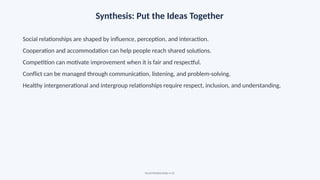
Synthesis: Put theIdeas Together
Social relationships are shaped by influence, perception, and interaction.
Cooperation and accommodation can help people reach shared solutions.
Competition can motivate improvement when it is fair and respectful.
Conflict can be managed through communication, listening, and problem-solving.
Healthy intergenerational and intergroup relationships require respect, inclusion, and understanding.
Social Relationships • 22
23.
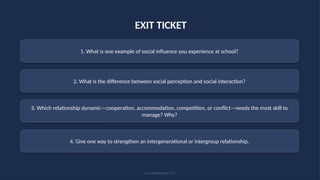
EXIT TICKET
1. Whatis one example of social influence you experience at school?
2. What is the difference between social perception and social interaction?
3. Which relationship dynamic—cooperation, accommodation, competition, or conflict—needs the most skill to
manage? Why?
4. Give one way to strengthen an intergenerational or intergroup relationship.
Social Relationships • 23
24.
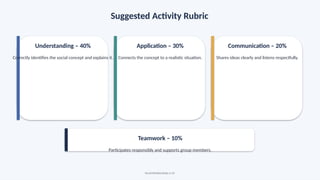
Suggested Activity Rubric
Understanding– 40%
Correctly identifies the social concept and explains it.
Application – 30%
Connects the concept to a realistic situation.
Communication – 20%
Shares ideas clearly and listens respectfully.
Teamwork – 10%
Participates responsibly and supports group members.
Social Relationships • 24
25.
uilt through understanding,respect, communication, and responsible participation.”
Social Relationships • 25