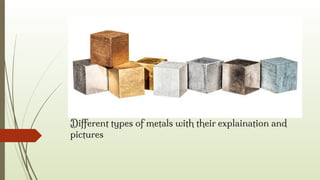
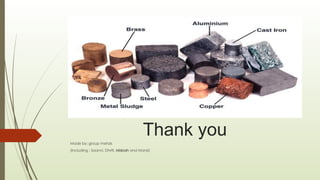
Types of metals
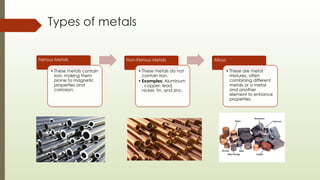
FerrousMetals
• These metals contain
iron, making them
prone to magnetic
properties and
corrosion.
Non-Ferrous Metals
• These metals do not
contain iron.
• Examples: Aluminum
, copper, lead,
nickel, tin, and zinc.
Alloys
• These are metal
mixtures, often
combining different
metals or a metal
and another
element to enhance
properties.
3.
Uses of metalsin construction
Structural Applications
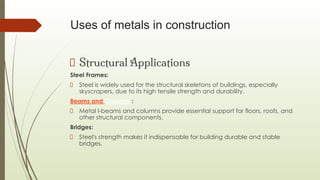
Steel Frames:
Steel is widely used for the structural skeletons of buildings, especially
skyscrapers, due to its high tensile strength and durability.
Beams and Columns :
Metal I-beams and columns provide essential support for floors, roofs, and
other structural components.
Bridges:
Steel's strength makes it indispensable for building durable and stable
bridges.
4.
Reinforcement
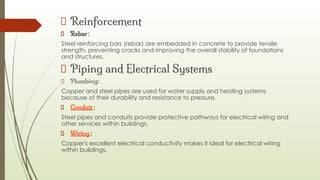
Rebar :
Steel reinforcingbars (rebar) are embedded in concrete to provide tensile
strength, preventing cracks and improving the overall stability of foundations
and structures.
Piping and Electrical Systems
Plumbing:
Copper and steel pipes are used for water supply and heating systems
because of their durability and resistance to pressure.
Conduit :
Steel pipes and conduits provide protective pathways for electrical wiring and
other services within buildings.
Wiring :
Copper's excellent electrical conductivity makes it ideal for electrical wiring
within buildings.
5.
Cladding, Roofing, andArchitectural Details
Cladding and Roofing:
Steel and aluminum sheets are used for durable, corrosion-resistant, and aesthetic
roofing and wall cladding on industrial, commercial, and residential buildings.
Decorative Features:
Metals like brass (an alloy of copper and zinc) are used for door handles, hinges, and
other decorative fittings, notes Metal Supermarkets.
Fasteners and Accessories
Fasteners :
Screws, nails, and bolts, often made of steel and coated with zinc, are crucial for
securely connecting various building components.
Sheet Metalwork:
Punched and pressed sheet metals are used for corner straps and joist hangers,
which help assemble timber-framed structures more efficiently.
6.
PROPERTIES OF METALS
KeyPhysical Properties
Metallic luster : Metals appear shiny and reflect light, a characteristic
known as metallic luster.
Malleable: They can be hammered or pressed into thin sheets without
breaking.
Ductile: Metals can be drawn out in thin wires
Conductivity: They are excellent conductors of both heat and electricity.
Hardness: Most metals are hard, though some, like gallium are soft
Density: Metals typically have high densities.
Sonorous: When struck, metals produce a ringing sound.
State at Room Temperature: Most metals are solid, with mercury being a
notable exception, as it is a liquid at room temperature.
7.
Chemical properties
Electropositive: metalstends to lose electrons during chemical reactions to
form positive ions (cations)
Basic Oxides: When metals react with oxygen, they typically form basic
oxides.
Reaction with oxygen: When metals react with oxygen, they form metal
oxides. These oxides are generally basic in nature. For instance, magnesium
reacts with oxygen to form magnesium oxide. Highly reactive metals like
sodium and potassium ignite easily in the presence of air.
Reaction with water: Many metals react with water to form metal hydroxides
or oxides and release hydrogen gas. Reactive metals like sodium react
vigorously with water, while less reactive metals may only react with steam.
Reaction with acids: Most metals react with dilute acids to produce a metal
salt and hydrogen gas. However, the speed of this reaction varies
depending on the metal's reactivity.
Reaction with other metal salts: A more reactive metal can displace a less
reactive metal from its salt solution. This is known as a displacement reaction.
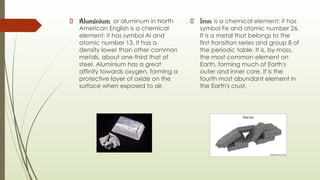
Aluminium or aluminumin North
American English is a chemical
element; it has symbol Al and
atomic number 13. It has a
density lower than other common
metals, about one-third that of
steel. Aluminium has a great
affinity towards oxygen, forming a
protective layer of oxide on the
surface when exposed to air.
Iron is a chemical element; it has
symbol Fe and atomic number 26.
It is a metal that belongs to the
first transition series and group 8 of
the periodic table. It is, by mass,
the most common element on
Earth, forming much of Earth's
outer and inner core. It is the
fourth most abundant element in
the Earth's crust.
10.
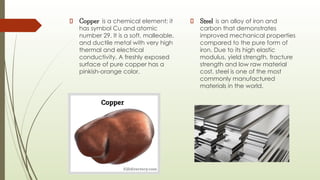
Copper is achemical element; it
has symbol Cu and atomic
number 29. It is a soft, malleable,
and ductile metal with very high
thermal and electrical
conductivity. A freshly exposed
surface of pure copper has a
pinkish-orange color.
Steel is an alloy of iron and
carbon that demonstrates
improved mechanical properties
compared to the pure form of
iron. Due to its high elastic
modulus, yield strength, fracture
strength and low raw material
cost, steel is one of the most
commonly manufactured
materials in the world.
11.
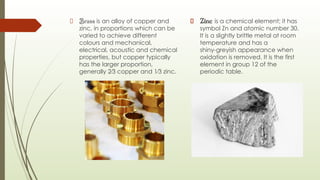
Brass is analloy of copper and
zinc, in proportions which can be
varied to achieve different
colours and mechanical,
electrical, acoustic and chemical
properties, but copper typically
has the larger proportion,
generally 2⁄3 copper and 1⁄3 zinc.
Zinc is a chemical element; it has
symbol Zn and atomic number 30.
It is a slightly brittle metal at room
temperature and has a
shiny-greyish appearance when
oxidation is removed. It is the first
element in group 12 of the
periodic table.
12.
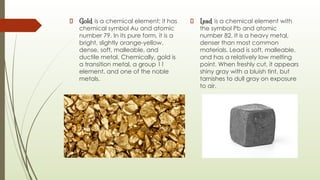
Gold is achemical element; it has
chemical symbol Au and atomic
number 79. In its pure form, it is a
bright, slightly orange-yellow,
dense, soft, malleable, and
ductile metal. Chemically, gold is
a transition metal, a group 11
element, and one of the noble
metals.
Lead is a chemical element with
the symbol Pb and atomic
number 82. It is a heavy metal,
denser than most common
materials. Lead is soft, malleable,
and has a relatively low melting
point. When freshly cut, it appears
shiny gray with a bluish tint, but
tarnishes to dull gray on exposure
to air.
13.
Thank you
Made by:group metals
(including : Saanvi, Dhriti, Misbah and Mansi)