Bolted and screwedjoints
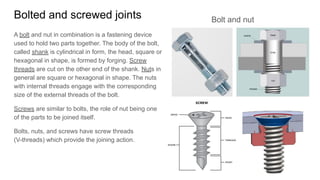
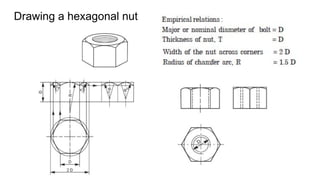
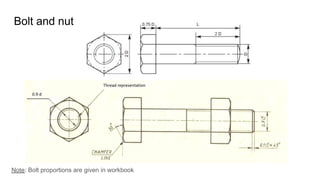
A bolt and nut in combination is a fastening device
used to hold two parts together. The body of the bolt,
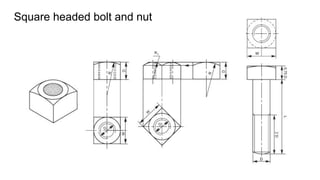
called shank is cylindrical in form, the head, square or
hexagonal in shape, is formed by forging. Screw
threads are cut on the other end of the shank. Nuts in
general are square or hexagonal in shape. The nuts
with internal threads engage with the corresponding
size of the external threads of the bolt.
Screws are similar to bolts, the role of nut being one
of the parts to be joined itself.
Bolts, nuts, and screws have screw threads
(V-threads) which provide the joining action.
Bolt and nut
4.
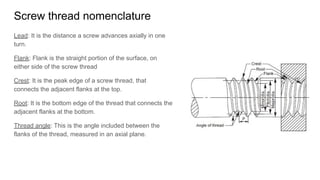
Screw thread nomenclature
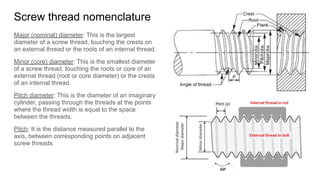
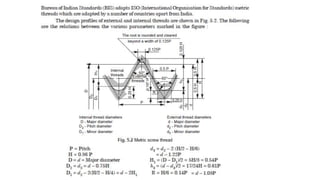
Major(nominal) diameter: This is the largest
diameter of a screw thread, touching the crests on
an external thread or the roots of an internal thread.
Minor (core) diameter: This is the smallest diameter
of a screw thread, touching the roots or core of an
external thread (root or core diameter) or the crests
of an internal thread.
Pitch diameter: This is the diameter of an imaginary
cylinder, passing through the threads at the points
where the thread width is equal to the space
between the threads.
Pitch: It is the distance measured parallel to the
axis, between corresponding points on adjacent
screw threads.
5.
Screw thread nomenclature
Lead:It is the distance a screw advances axially in one
turn.
Flank: Flank is the straight portion of the surface, on
either side of the screw thread
Crest: It is the peak edge of a screw thread, that
connects the adjacent flanks at the top.
Root: It is the bottom edge of the thread that connects the
adjacent flanks at the bottom.
Thread angle: This is the angle included between the
flanks of the thread, measured in an axial plane.
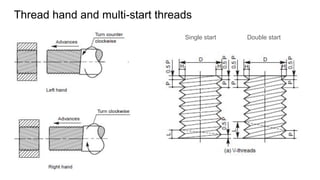
Thread hand andmulti-start threads
Single start Double start
9.
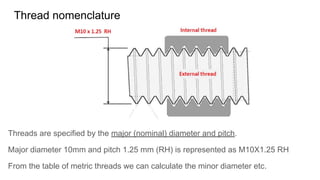
Thread nomenclature
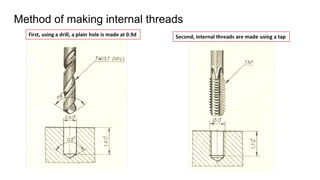
Threads arespecified by the major (nominal) diameter and pitch.
Major diameter 10mm and pitch 1.25 mm (RH) is represented as M10X1.25 RH
From the table of metric threads we can calculate the minor diameter etc.
Bolt and nutwith washer
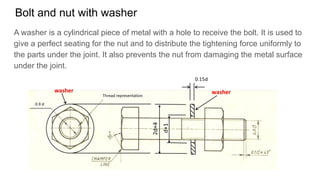
A washer is a cylindrical piece of metal with a hole to receive the bolt. It is used to
give a perfect seating for the nut and to distribute the tightening force uniformly to
the parts under the joint. It also prevents the nut from damaging the metal surface
under the joint.
Locking bolts andnuts
● Lock nuts
● Spring washer
● Locking pins
● Set screws
18.
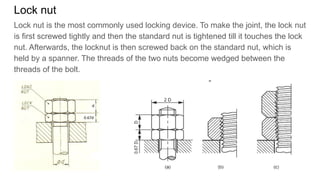
Lock nut
Lock nutis the most commonly used locking device. To make the joint, the lock nut
is first screwed tightly and then the standard nut is tightened till it touches the lock
nut. Afterwards, the locknut is then screwed back on the standard nut, which is
held by a spanner. The threads of the two nuts become wedged between the
threads of the bolt.
19.
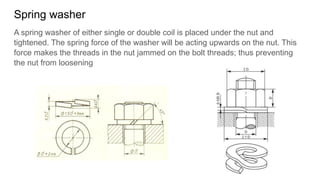
Spring washer
A springwasher of either single or double coil is placed under the nut and
tightened. The spring force of the washer will be acting upwards on the nut. This
force makes the threads in the nut jammed on the bolt threads; thus preventing
the nut from loosening
20.
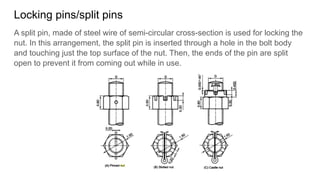
Locking pins/split pins
Asplit pin, made of steel wire of semi-circular cross-section is used for locking the
nut. In this arrangement, the split pin is inserted through a hole in the bolt body
and touching just the top surface of the nut. Then, the ends of the pin are split
open to prevent it from coming out while in use.
21.
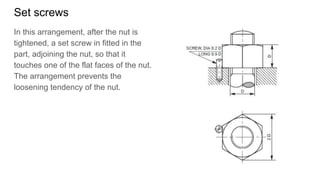
Set screws
In thisarrangement, after the nut is
tightened, a set screw in fitted in the
part, adjoining the nut, so that it
touches one of the flat faces of the nut.
The arrangement prevents the
loosening tendency of the nut.
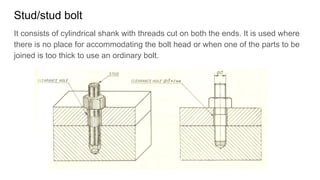
Stud/stud bolt
It consistsof cylindrical shank with threads cut on both the ends. It is used where
there is no place for accommodating the bolt head or when one of the parts to be
joined is too thick to use an ordinary bolt.
24.
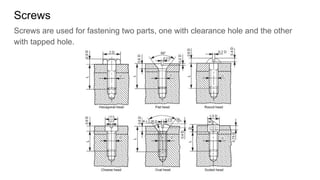
Screws
Screws are usedfor fastening two parts, one with clearance hole and the other
with tapped hole.
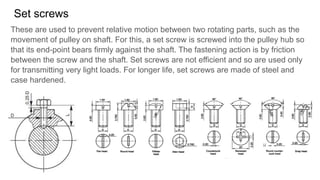
Set screws
These areused to prevent relative motion between two rotating parts, such as the
movement of pulley on shaft. For this, a set screw is screwed into the pulley hub so
that its end-point bears firmly against the shaft. The fastening action is by friction
between the screw and the shaft. Set screws are not efficient and so are used only
for transmitting very light loads. For longer life, set screws are made of steel and
case hardened.
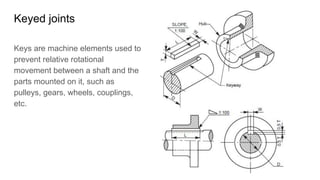
Keyed joints
Keys aremachine elements used to
prevent relative rotational
movement between a shaft and the
parts mounted on it, such as
pulleys, gears, wheels, couplings,
etc.
29.
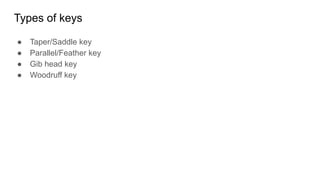
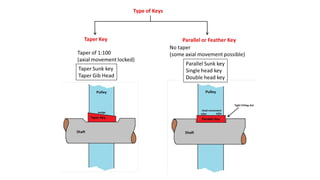
Types of keys
●Taper/Saddle key
● Parallel/Feather key
● Gib head key
● Woodruff key
31.
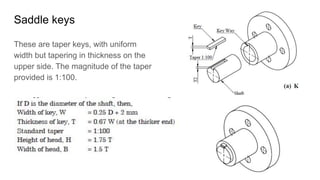
Saddle keys
These aretaper keys, with uniform
width but tapering in thickness on the
upper side. The magnitude of the taper
provided is 1:100.
32.
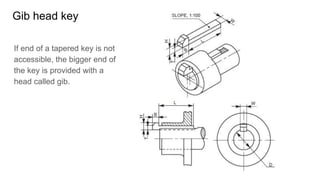
Gib head key
Ifend of a tapered key is not
accessible, the bigger end of
the key is provided with a
head called gib.
33.
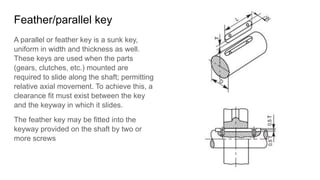
Feather/parallel key
A parallelor feather key is a sunk key,
uniform in width and thickness as well.
These keys are used when the parts
(gears, clutches, etc.) mounted are
required to slide along the shaft; permitting
relative axial movement. To achieve this, a
clearance fit must exist between the key
and the keyway in which it slides.
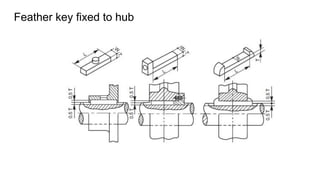
The feather key may be fitted into the
keyway provided on the shaft by two or
more screws
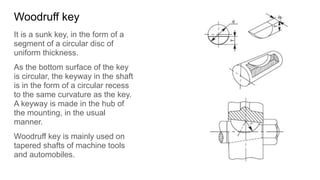
Woodruff key
It isa sunk key, in the form of a
segment of a circular disc of
uniform thickness.
As the bottom surface of the key
is circular, the keyway in the shaft
is in the form of a circular recess
to the same curvature as the key.
A keyway is made in the hub of
the mounting, in the usual
manner.
Woodruff key is mainly used on
tapered shafts of machine tools
and automobiles.
36.
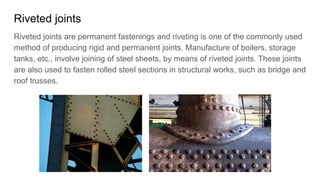
Riveted joints
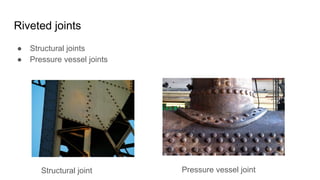
Riveted jointsare permanent fastenings and riveting is one of the commonly used
method of producing rigid and permanent joints. Manufacture of boilers, storage
tanks, etc., involve joining of steel sheets, by means of riveted joints. These joints
are also used to fasten rolled steel sections in structural works, such as bridge and
roof trusses.
37.
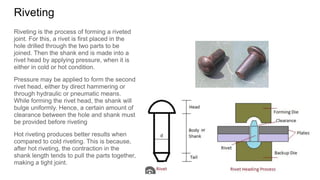
Riveting
Riveting is theprocess of forming a riveted
joint. For this, a rivet is first placed in the
hole drilled through the two parts to be
joined. Then the shank end is made into a
rivet head by applying pressure, when it is
either in cold or hot condition.
Pressure may be applied to form the second
rivet head, either by direct hammering or
through hydraulic or pneumatic means.
While forming the rivet head, the shank will
bulge uniformly. Hence, a certain amount of
clearance between the hole and shank must
be provided before riveting
Hot riveting produces better results when
compared to cold riveting. This is because,
after hot riveting, the contraction in the
shank length tends to pull the parts together,
making a tight joint.
38.
Caulking and Fullering
Rivetedjoints must be made air tight in applications such as
boilers and other pressure vessels.
Caulking or fullering is done to make the riveted joints air
tight. Caulking and fullering operations are carried out
effectively by applying pneumatic pressure.
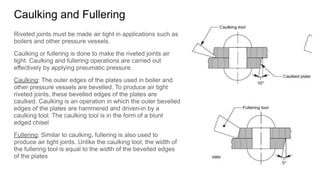
Caulking: The outer edges of the plates used in boiler and
other pressure vessels are bevelled. To produce air tight
riveted joints, these bevelled edges of the plates are
caulked. Caulking is an operation in which the outer bevelled
edges of the plates are hammered and driven-in by a
caulking tool. The caulking tool is in the form of a blunt
edged chisel
Fullering: Similar to caulking, fullering is also used to
produce air tight joints. Unlike the caulking tool, the width of
the fullering tool is equal to the width of the bevelled edges
of the plates
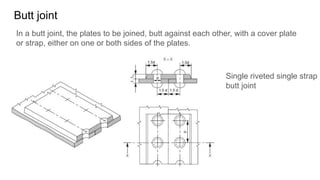
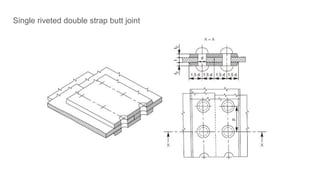
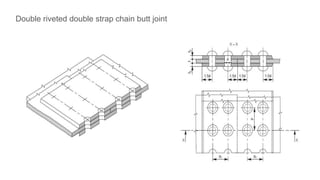
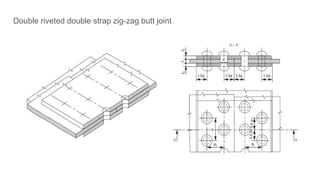
Butt joint
In abutt joint, the plates to be joined, butt against each other, with a cover plate
or strap, either on one or both sides of the plates.
Single riveted single strap
butt joint
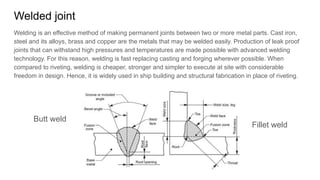
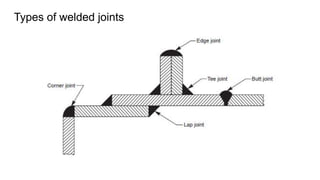
Welded joint
Welding isan effective method of making permanent joints between two or more metal parts. Cast iron,
steel and its alloys, brass and copper are the metals that may be welded easily. Production of leak proof
joints that can withstand high pressures and temperatures are made possible with advanced welding
technology. For this reason, welding is fast replacing casting and forging wherever possible. When
compared to riveting, welding is cheaper, stronger and simpler to execute at site with considerable
freedom in design. Hence, it is widely used in ship building and structural fabrication in place of riveting.
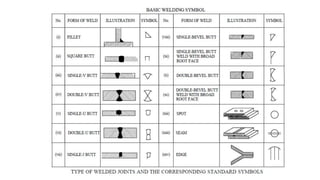
Butt weld
Fillet weld
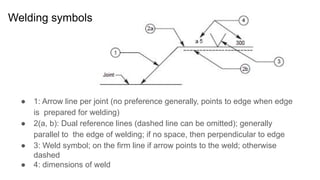
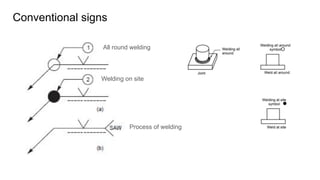
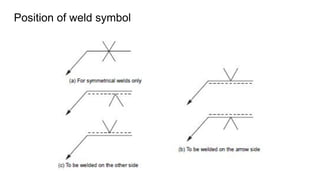
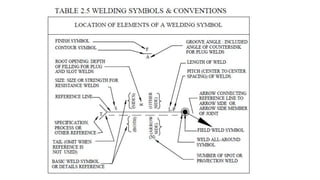
Welding symbols
● 1:Arrow line per joint (no preference generally, points to edge when edge
is prepared for welding)
● 2(a, b): Dual reference lines (dashed line can be omitted); generally
parallel to the edge of welding; if no space, then perpendicular to edge
● 3: Weld symbol; on the firm line if arrow points to the weld; otherwise
dashed
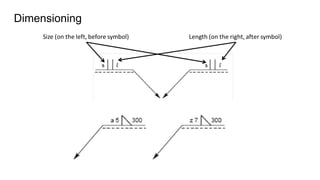
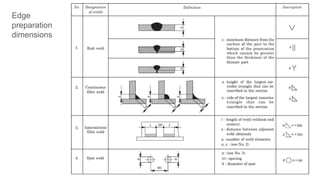
● 4: dimensions of weld