1
Risk, Opportunity and Decision-Making
in an Environment of Increased Complexity and Uncertainty
In a world of increased uncertainty, we need
more innovation and creativity. We need
successful entrepreneurs, entrepreneurial
organisations, and entrepreneurialism.
While many tag themselves with these labels,
what are the differentiators of true role models?
At the core is an ability to see opportunities
when others see uncertainty and complexity.
But, it’s more, it’s entrepreneurial risk appetite,
inner confidence, and refined decision making.
To achieve this at pace, a network of trusted
sources is critical, and in this short paper, we
highlight the ‘secret ingredients’ to help you as
a leader make better decisions and navigate
uncertainty.
Read on to learn more ...
July 2020
22
Are you looking to merely survive
or to ‘survive to thrive’?
Living through a truly global disruption is, for
many, a challenging experience. While the
scale of the current pandemic is extreme,
disruptions are not new.
We see numerous strategies being followed.
Many are just trying to survive. However, a
group of more entrepreneurial organisations
and leaders are looking to ‘survive to thrive’.
They are surviving with purpose. They have
one eye on the future.
Core to their approach is the ability to adapt
rapidly to their environment, but not just
in a reactive way. They pivot in ways that
will position them to accelerate into new
opportunities.
At the heart of their approach is their ability
to look over the horizon at potential future
scenarios, prototype solutions rapidly, and
then act to test them in the real world. This is
done at pace and allows them to position to
take the potential opportunities. Assessing
risks and opportunities combined with
decision-making are vital to success.
Read on to understand how you can better
position yourself and your organisation to not
only survive, but also thrive in the future.
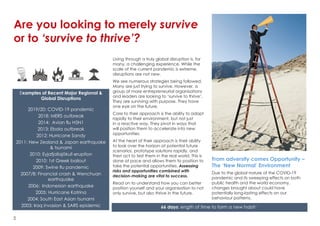
Examples of Recent Major Regional &
Global Disruptions
2019/20: COVID-19 pandemic
2018: MERS outbreak
2014: Avian flu H5N1
2013: Ebola outbreak
2012: Hurricane Sandy
2011: New Zealand & Japan earthquake
& tsunami
2010: Eyjafjallajökull eruption
2010: 1st Greek bailout
2009: Swine flu pandemic
2007/8: Financial crash & Wenchuan
earthquake
2006: Indonesian earthquake
2005: Hurricane Katrina
2004: South East Asian tsunami
2003: Iraq invasion & SARS epidemic
From adversity comes Opportunity –
The ‘New Normal’ Environment
Due to the global nature of the COVID-19
pandemic and its sweeping effects on both
public health and the world economy,
changes brought about could have
potentially long-lasting effects on our
behaviour patterns.
66 days: ength of time to form a new habit 1
3
We live every day with uncertainty,
both as individuals and organisations.
As entrepreneurs, we are more likely to
identify what others see as risk as a source
of opportunity. Managing this conversion
from risk to opportunity is at the heart of
entrepreneurialism.
Supply chain opportunities?
•	 diversify with new suppliers and/or new countries of supply
•	 explore supplier networks and supplier ecosystems
•	 reconsider make/buy or local/global decisions
•	 innovate with technology
•	 introduce new processes to improve efficiency and effectiveness
Risk & Opportunity in the Context of
Uncertainty
ISO 31000 defines risks as: Risks are the
effect of uncertainty on objectives. Effects
can be either negative or positive.
As such, risks, opportunities, and uncertainty
need to be identified, assessed, and actively
managed. Driven by the business goals set by
the organisation, we need to deal with risk to
make better business decisions.
These could be to mitigate potentially
negative outcomes such as cost overruns,
delays, lack of compliance leading to
potentially hefty fines or avoiding a loss of
value in the value chain.
On the other hand, dealing proactively with
risk could bring to light potentially positive
outcomes by turning perceived risks into new
opportunities for innovation, growth or the
discovery of new market needs to be satisfied.
Risks are intimately linked to objectives. Let us
Grey rhino events – highly probable, high
impact yet neglected threats that are
often visible – the ‘elephants in the room’
Black swan events - an unpredictable or
unforeseen event, typically with extreme
consequences.
take a simple example of the use of a bicycle,
where your objectives are 1) to reach the
office, 2) on time, and 3) in a proper working
condition.
“Average practices” are often found in
corporations, they focus on risks that have
high impact, even though likelihood may be
low. They constitute events which happen
sporadically, often referred to as “grey rhino”
or “black swan” events.
Taking our example, this would be a flat tyre,
or a mechanical bicycle failure, each leading
to a potential failure meeting objectives. In
practice, mitigation would likely lead to simple
preventative actions, for example a regular
maintenance of the bicycle.
The length of lockdowns or significant
restrictions worldwide easily exceeds the time
required to form a new habit which gives rise
to the potential for new habits, both good
and bad, to become embedded. As so often
with change, it brings both challenges and
opportunity in a business context.
While the leisure, travel and the hospitality
industries take a major hit, sales of
conferencing platforms have taken off to
support working from home as a (not so new)
‘paradigm’.
The challenge for industry leaders is to review
the new situation critically and proactively,
think ‘out of the box’, and determine
whether the seeming adversity has a hidden
opportunity lurking within it, waiting to be
uncovered.
For example, the pandemic has wrought
havoc with certain global supply chains and
exposed levels of dependency and risk which
were either not apparent before or had been
ignored.
Despite the challenges, now is the time to
critically review broken supply chains and
determine what opportunities are presented
to consider a goal of value optimisation.
Instead of ‘just-in-time’ processes, along
with the introduction of or strengthening of
supplier relationship management to build
robust, transparent and continuously evolving
relationships with key suppliers.
It takes courage, however, to think ‘outside
the box’ and initiate such measures. As
leaders, our judgement will be severely
tested.
“Good practices” focus on those risks with
a “high likelihood and high impact”. In our
example, such are current weather, traffic
jam, or rider’s physical conditions, each of
which could well jeopardize objectives. Such
are mitigated by slightly adapting every day’
departure time.
44
The Future Winners Will be Those
Who Adapt
While enhancing the mechanisms that we
deploy is important, it is equally important
for us as leaders to consider how we need
to adapt, to thrive in a world of increased
complexity and uncertainty. Turning a ‘risk’
into a potential opportunity where possible will
be a key skill for the ‘new normal’.
Characteristics and the mindset required to
create success will include:
•	 Broad-based industry knowledge and
commercial skills
•	 An ability to think ‘out of the box’, seeing
the bigger picture and ‘connecting the
dots’
•	 A comprehensive understanding of both
people, economic, and commercial issues
•	 Being an excellent communicator,
projecting the right message for the target
audience
•	 Being an experienced practitioner, able
to draw on a wealth of real-world, topical
experiences to help formulate views and
buttress arguments
Demonstrating this to the breadth and
depth required in an increasingly complex,
interconnected environment means
that, while some individuals will be able
to demonstrate some or all of these, the
organisation will increasingly need a
wider network to supplement and provide
alternative views to ensure success.
Experience shows that such is best performed
by an expert who is both an ‘outsider’ yet a
Making Better Business Decisions
The critical purpose of such a network
is to help leaders, entrepreneurs and
entrepreneurial organisations make better
decisions, often at pace, by driving forward
the conversion of risks and uncertainty to
opportunity.
Real-world examples include:
•	 mitigation of potentially negative
outcomes, for example:
	- to avoid traps of hidden risks,
	- to avoid value leakage
	- to avoid fines due to laws and
regulations
“Best practices”, however, are centered on
finding opportunities. In our example, taking
advantage of a potential tailwind or using
knowledge of traffic flows to optimise the
route. The potential time gained in departing
at the latest minute, while still meeting
objectives is a true value add.
From this very simple example, you can easily
see how risk management, viewed through
the prism of the ISO definition, can add real
business value when applied to a complex
business environment, including pace
(speed to objective achievement), flexibility
(adapting to changing circumstances) and
the ability to pivot (transform a perceived risk
into an opportunity).
To see the opportunity potentially hidden
in risk and uncertainty requires certain
characteristics and a specific mindset, both
of which will be described further in this
article. It is intrinsically linked to the innovation
process and therefore allows us to draw on
the tools and techniques developed to foster
innovation.
It involves a clear definition of goals
emanating from the business strategy,
ideation to energize ‘out of the box’ thinking,
followed by a systematic review with a clear
focus on the goals. As the initiative is being
developed and tested, we iterate rapidly but
systematically to accelerate the opportunity
while ensuring we have the needed flexibility
to adapt as circumstance require.
As with any innovation project, there is no
guarantee of success but, using appropriate
tools and techniques, we can significantly
increase the number and nature of options
considered while accelerating progress.
trusted player. More than often, the questions
raised by such a person or network will expose
risks and opportunities that those ‘in the
action’ are perhaps too close to see – they
‘struggle to see the wood for the trees’.
5
Endnotes
1	 Lally, P., van Jaarsveld, C.H.M., Potts, H.W.W. and Wardle, J. (2010), How are habits formed: Modelling habit formation in
the real world. Eur. J. Soc. Psychol., 40: 998-1009. doi:10.1002/ejsp.674
•	 turning risks into opportunities:
	- to ensure that the right strategic
decisions are taken
	- to identify innovation and
opportunities
	- to perform better than the competition
In practice, these can be addressed in either
a business or transactional context:
•	 Business:
	- Adopting a systematic approach to
innovation
	- Embedding enhanced risk audits (for
both contract and project portfolios)
	- Setting up company policies, a risk
management frameworks, and tools
•	 Transactional:
	- Pre-reviews & ‘pre-mortums’ (before
starting any initiative)
	- Pre-final reviews (before starting
implementation)
	- Periodic implementation reviews
(enhancing the process of monitoring
and improvement, and embedding
an uncertainty risk log)
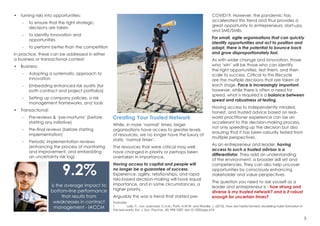
Creating Your Trusted Network
While, in more ‘normal’ times, larger
organisations have access to greater levels
of resources, we no longer have the luxury of
static ‘normal times’.
The resources that were critical may well
have changed in priority or perhaps been
overtaken in importance.
Having access to capital and people will
no longer be a guarantee of success.
Experience, agility, relationships, and rapid
risks-based decision-making will have equal
importance, and in some circumstances, a
higher priority.
Arguably this was a trend that started pre-
COVID19. However, the pandemic has
accelerated this trend and thus provides a
great opportunity to entrepreneurs, start-ups,
and SME/SMBs.
For small, agile organisations that can quickly
identify opportunities and act to position and
adapt, there is the potential to bounce back
and grow disproportionately fast.
As with wider change and innovation, those
who ‘win’ will be those who can identify
the right opportunities, test them, and then
scale to success. Critical to this lifecycle
are the multiple decisions that are taken at
each stage. Pace is increasingly important,
however, while there is often a need for
speed, what is required is a balance between
speed and robustness of testing.
Having access to independently minded,
honest, and trusted advice based on real-
world practitioner experience can be an
accelerant to the decision-making process,
not only speeding up the decision but also
ensuring that it has been robustly tested from
multiple perspectives.
As an entrepreneur and leader, having
access to such a trusted advisor is a
differentiator. They add an understanding
of the environment, a broader skill set and
competencies. They can also help uncover
opportunities by consciously enhancing
stakeholder and value perspectives.
The question you need to ask youself as a
leader and entrepreneur is - how strong and
diverse is my trusted network? and is it robust
enough for uncertain times?
is the average impact to
bottom-line performance
that results from
weaknesses in contract
management - IACCM
9.2%
66
About the authors:
Albert Schot has 30+ years of experience in
Commercial Contract Management, first at
IBM, then as an entrepreneur.
Within the CTA his ‘best athlete’ domains
supporting Small and Medium Enterprises and
digitalisation.
Albert brings a broad experience in the
complex and in ever changing IT environment.
He is a recognised Risk Manager expert, is
passionate about supporting SME’s in their
new digital risks. His main strengths are a
positive business orientation, an intuitive risk
management and a simplifier of complexity.
Albert is based in Geneva, he has built a
Trusted Advisor company in Commercial
Contract Management matters, serving 60+
clients over the last 4 years.
E: albert@schot.ch
Albert Schot - Founder, Schot LLC
Bertrand has over 30 years’ experience
of commercial, contract and sales
management, primarily in the ICT industry. He
has led commercial teams to craft, negotiate
and manage complex global deals for larger
SMEs and MNCs, as well as sales teams to
position and sell complex solutions in the
services space.
Prior to founding CCube Consulting, Bertrand
held various positions such as Commercial
Director, Sales Director and Commercial
Operations Director at Orange and other
global service companies. He is a certified
Commercial and Contract Management
Expert (CCME) from the IACCM and also
holds a certification in Supplier Relationship
Management. He is based in Zurich and is the
IACCM Council member representative for
Switzerland.
E: bertrand.george@ccube.ch
Bertrand George - Managing
Director, CCube Consulting GmbH
Adrian has 30+ years’ experience in the
design, implementation, and delivery of
complex commercial transactions through
novel business models. He has worked in
a variety of sectors including defence and
security, aviation, technology.
Prior to founding Kommercialize, Adrian
held a number of Director level commercial,
procurement, and operations roles within
BAE Systems. He is a member of the Institute
of Engineering and Technology (IET), and a
Fellow of the IACCM (International Association
for Contract and Commercial Management).
Adrian is based in UK and has contributed
to a number of books on commercial and
contract management and co-authored the
Professional Services Leadership Handbook.
E: adrian.furner@kommercialize.com
Adrian Furner - Managing Director,
Kommercialize Ltd
The authors are all members of the
Commercial Transformation Alliance