Where next for User Involvement?


     Professor Jonathan Tritter
               Chief Executive
   NHS Centre for Involvement

 Public Involvement in the NHS: Is LINks the way Forward
             Friend’s Meeting House, Coventry
                       25 June 2007
Outline

• The evolution of Involvement in UK Health Policy

• Thinking about Involvement

• Introducing the NHS Centre for Involvement
    – How are we organised and what do we do

• The Future of Patient and Public in England
   – PPI in Commissioning
   – Local Involvement Networks
Patient and Public Involvement
          in the NHS
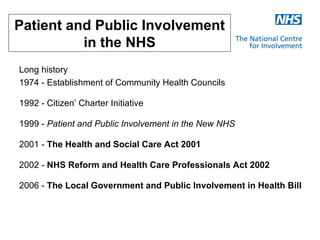
Long history
1974 - Establishment of Community Health Councils

1992 - Citizen’ Charter Initiative

1999 - Patient and Public Involvement in the New NHS

2001 - The Health and Social Care Act 2001

2002 - NHS Reform and Health Care Professionals Act 2002

2006 - The Local Government and Public Involvement in Health Bill
Public Involvement in the NHS

Does User =
 Patient, Carer, Consumer, Customer or Citizen?

For the UK Government
  User Involvement = Patient and Public Involvement

  “This is a package of radical reform. It will enhance and
  encourage the involvement of citizens in redesigning the
  health service from the patient’s point of view.”
                              (Department of Health, 2000: 95)
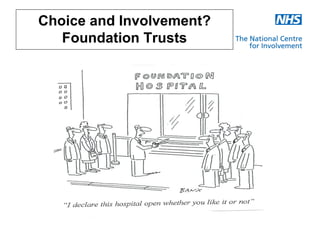
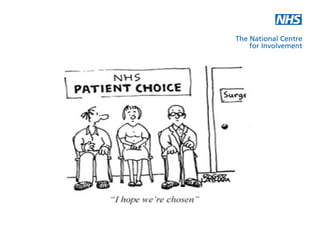
Choice and Involvement?
   Foundation Trusts
Why involve users?
• Legitimacy
   – Of approach
   – Funding and organisation

• Relevance
   – Different kinds of questions
   – Focus on process and experience not just outcomes

• Participation
   – Support, Co-production and Compliance

• Impact
   – Efficiency and effectiveness of care
   – More acceptable patient pathway
Conceptualising user
         involvement
• User participation in decisions about treatment and care
• User involvement in service development
   • Planning and design of services
   • Commissioning

• User evaluation of service provision
   • Public Accountability rather than Patient Satisfaction
   • Regulation

• User involvement in teaching
• User involvement in research
   • At all stages of the research cycle
Potential Pitfalls of User
          Involvement
• Marketisation
  – Individualisation rather than collectivisation
  – Customer surveys not involvement
  – Private sector
       • Cream skimming
       • Undermining risk pooling
• Tokenism
   – Capture by medical elite
   – Capture by managerial elite
   – Capture by local political elite
• Apathy or unwillingness to be ‘involved’
• Tensions between ‘choice’ and ‘involvement’
Involvement to Impact

• PPI accepted practice
• Lack of clarity about how to do it
   – about who to involve
• Direct and Indirect involvement
   – Direct: people playing a part in making decisions
   – Indirect: people as source of experience, ideas and
     information
• Need to focus on Impact
   – Making a difference
   – Evidence that PPI has had an influence on practice
The NHS Centre for Involvement

•   Response to an European-wide Tender
• Successful Consortium
  • University of Warwick
  • LMTA - an alliance for health
  • Centre for Public Scrutiny
• The Centre announced on 24 May 2006
  • The Health Minister Rosie Winterton
• Start of set-up phase from 1 June 2006
• Formal launch 28 November 2006
• Funded for three years in the first instance
What the Centre does

• Supporting NHS staff and organisations across England
  to engage with patients and the public more effectively
  and implement change based on their information
• Working with NHS organisations and staff to integrate
  user involvement systems into everyday working
   • Fulfilling obligations under Section 11 Health and
     Social Care Act 2001
   • (and its successor)
• Working with the Healthcare Commission
  • The Regulator on how to inspect compliance
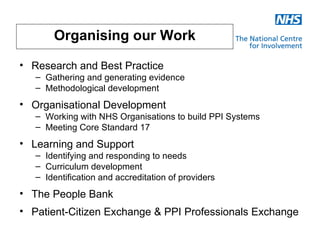
Organising our Work

• Research and Best Practice
   – Gathering and generating evidence
   – Methodological development
• Organisational Development
   – Working with NHS Organisations to build PPI Systems
   – Meeting Core Standard 17
• Learning and Support
   – Identifying and responding to needs
   – Curriculum development
   – Identification and accreditation of providers
• The People Bank
• Patient-Citizen Exchange & PPI Professionals Exchange
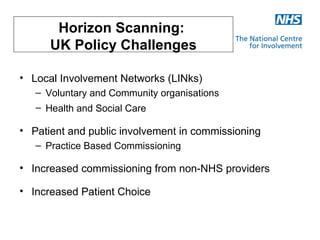
Horizon Scanning:
      UK Policy Challenges

• Local Involvement Networks (LINks)
   – Voluntary and Community organisations
   – Health and Social Care

• Patient and public involvement in commissioning
   – Practice Based Commissioning

• Increased commissioning from non-NHS providers

• Increased Patient Choice
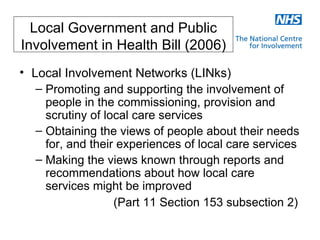
Local Government and Public
Involvement in Health Bill (2006)
• Local Involvement Networks (LINks)
   – Promoting and supporting the involvement of
     people in the commissioning, provision and
     scrutiny of local care services
   – Obtaining the views of people about their needs
     for, and their experiences of local care services
   – Making the views known through reports and
     recommendations about how local care
     services might be improved
                   (Part 11 Section 153 subsection 2)
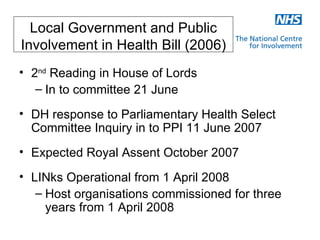
Local Government and Public
Involvement in Health Bill (2006)
• 2nd Reading in House of Lords
   – In to committee 21 June
• DH response to Parliamentary Health Select
  Committee Inquiry in to PPI 11 June 2007
• Expected Royal Assent October 2007
• LINks Operational from 1 April 2008
   – Host organisations commissioned for three
     years from 1 April 2008
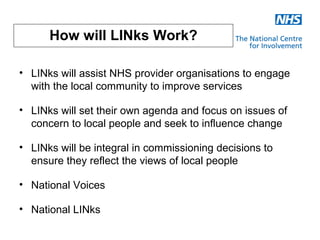
How will LINks Work?

• LINks will assist NHS provider organisations to engage
  with the local community to improve services

• LINks will set their own agenda and focus on issues of
  concern to local people and seek to influence change

• LINks will be integral in commissioning decisions to
  ensure they reflect the views of local people

• National Voices

• National LINks
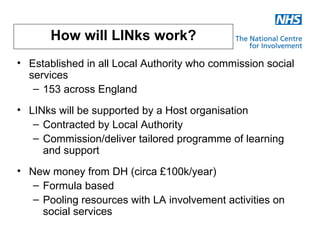
How will LINks work?
• Established in all Local Authority who commission social
  services
   – 153 across England
• LINks will be supported by a Host organisation
   – Contracted by Local Authority
   – Commission/deliver tailored programme of learning
     and support
• New money from DH (circa £100k/year)
   – Formula based
   – Pooling resources with LA involvement activities on
     social services
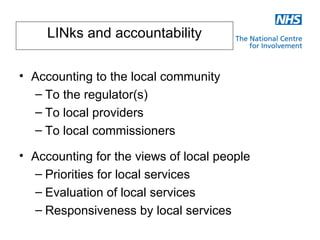
LINks and accountability

• Accounting to the local community
  – To the regulator(s)
  – To local providers
  – To local commissioners

• Accounting for the views of local people
  – Priorities for local services
  – Evaluation of local services
  – Responsiveness by local services
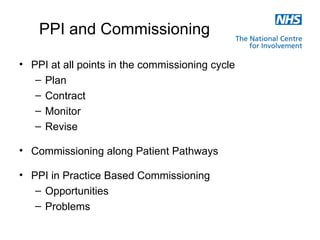
PPI and Commissioning

• PPI at all points in the commissioning cycle
   – Plan
   – Contract
   – Monitor
   – Revise

• Commissioning along Patient Pathways

• PPI in Practice Based Commissioning
   – Opportunities
   – Problems
Piloting LINks

• 9 Pilot and Early Adopter Sites across the country
• Capturing the Learning
   – Ongoing dissemination through NCI website
   – Initial report of learning early July 2007
• Working with:
  – the Healthcare Commission,
  – the Commission for Patient and Public Involvement in
    Health
  – Department of Health (and others)
Piloting LINks: Early Learning

Governance arrangements to balance stakeholders
  – Wariness and mistrust of Local Authorities
  – Establishing set of ‘ground rules’ for behaviour and the
    consequences of inappropriate behaviour
• Geography is important
  – Community profiling and mapping the voluntary sector
    central to effective set up
• LINks annual reports should be analysed to identify
  regional and national issues
   – Feedback to individual LINks
• Need for clarity and control of payments to individual
  LINks members
Piloting LINks: Early Learning

• Little attention to collaboration between LINks
   – Particular concern for Ambulance Services

• Little attention to defining success criteria or
  measurement of impact

• Procurement of a Host
   – Some work on pooling resources for Host to cover
     three LINks areas

• Limited work on how a LINk identifies an issue and
  engages with the topic
“One of the key roles of civil society organizations
is to hold health care providers as well as
governments accountable for what they do and
how they do it….yet without mechanisms enabling
people to hold officials accountable, stewardship
may falter. To enable effective pressure for
accountability, accurate information about health
and health systems performance is required
throughout civil society.”      (WHO, 2003: 126)
The NHS Centre for Involvement

• Modelling and facilitating transformation
  • Building capacity
  • Supporting a sustainable approach to change

• Contact us at:
  nhscentreforinvolvement@warwick.ac.uk

• See our website: www.nhscentreforinvolvement.nhs.uk