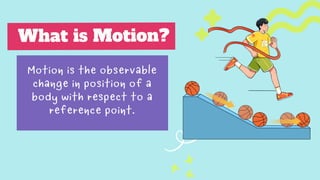
Motion is theobservable
change in position of a
body with respect to a
reference point.
3.
TYPES OF MOTION
Motionwhere an object moves
from one place to another.
TRANSLATIONAL
Motion where an object spins
or rotates around an axis.
ROTATIONAL
4.
TRANSLATIONAL
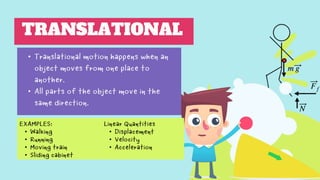
• Translational motionhappens when an
object moves from one place to
another.
• All parts of the object move in the
same direction.
EXAMPLES:
• Walking
• Running
• Moving train
• Sliding cabinet
Linear Quantities
• Displacement
• Velocity
• Acceleration
5.
Translational Motion:
Moving ina Straight Line
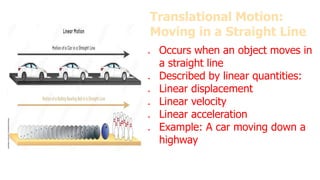
● Occurs when an object moves in
a straight line
● Described by linear quantities:
● Linear displacement
● Linear velocity
● Linear acceleration
● Example: A car moving down a
highway
6.
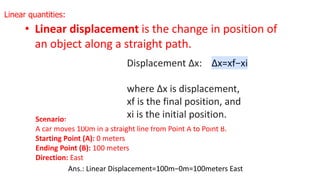
• Linear displacementis the change in position of
an object along a straight path.
Scenario:
A car moves 100m in a straight line from Point A to Point B.
Starting Point (A): 0 meters
Ending Point (B): 100 meters
Direction: East
Linear Displacement = Final Position – Initial Position
Ans.: Linear Displacement=100m−0m=100meters East
Linear quantities:
Displacement Δx: Δx=xf−xi
where Δx is displacement,
xf is the final position, and
xi is the initial position.
7.
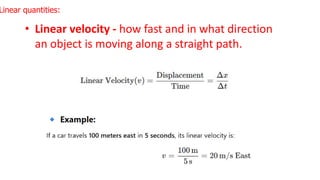
• Linear velocity- how fast and in what direction
an object is moving along a straight path.
Linear quantities:
8.
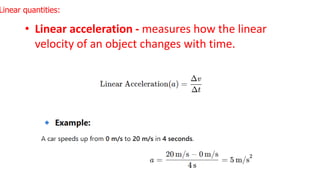
• Linear acceleration- measures how the linear
velocity of an object changes with time.
Linear quantities:
9.
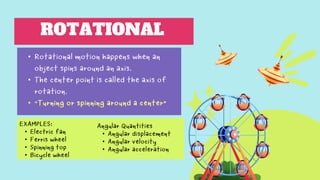
ROTATIONAL
• Rotational motionhappens when an
object spins around an axis.
• The center point is called the axis of
rotation.
• “Turning or spinning around a center”
EXAMPLES:
• Electric fan
• Ferris wheel
• Spinning top
• Bicycle wheel
Angular Quantities
• Angular displacement
• Angular velocity
• Angular acceleration
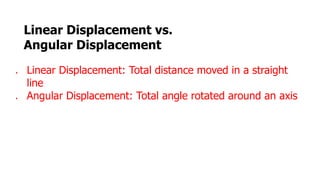
Linear Displacement vs.
AngularDisplacement
● Linear Displacement: Total distance moved in a straight
line
● Angular Displacement: Total angle rotated around an axis
Compare and contrast
12.
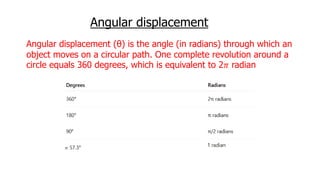
Angular displacement (θ)is the angle (in radians) through which an
object moves on a circular path. One complete revolution around a
circle equals 360 degrees, which is equivalent to 2𝜋 radian
Angular displacement of a complete circle=2π radians or 360∘
Compare and contrast
Angular displacement
13.
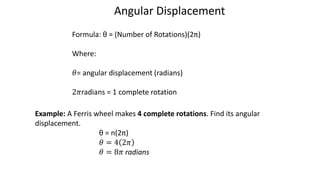
Formula: θ =(Number of Rotations)(2π)
Where:
𝜃= angular displacement (radians)
2𝜋radians = 1 complete rotation
Angular Displacement
Example: A Ferris wheel makes 4 complete rotations. Find its angular
displacement.
θ = n(2π)
𝜃 = 4 2𝜋
𝜃 = 8𝜋 radians
14.
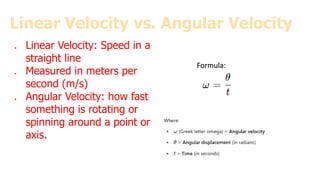
Linear Velocity vs.Angular Velocity
● Linear Velocity: Speed in a
straight line
● Measured in meters per
second (m/s)
● Angular Velocity: how fast
something is rotating or
spinning around a point or
axis.
Compare and contrast
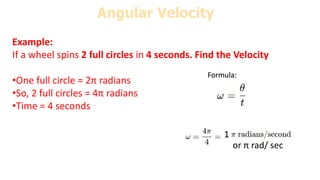
Formula:
15.
Example:
If a wheelspins 2 full circles in 4 seconds. Find the Velocity
•One full circle = 2π radians
•So, 2 full circles = 4π radians
•Time = 4 seconds
Angular Velocity
Formula:
1
or π rad/ sec
16.
Linear Acceleration vs.Angular
Acceleration
Linear Acceleration: Rate of change of linear velocity
Angular Acceleration: Rate of change of angular velocity
● Both describe how quickly speed is changing
Compare and contrast translational and rotational motion
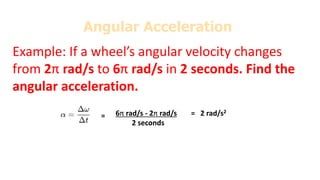
Example: If awheel’s angular velocity changes
from 2π rad/s to 6π rad/s in 2 seconds. Find the
angular acceleration.
Compare and contrast translational and rotational
motion
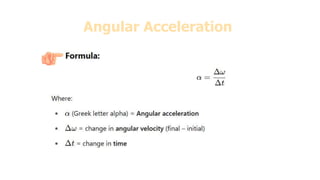
Angular Acceleration
6π rad/s - 2π rad/s
2 seconds
= 2 rad/s2
=
19.
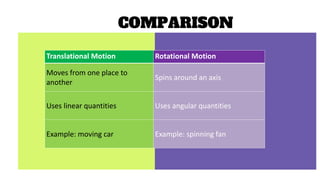
COMPARISON
Translational Motion RotationalMotion
Moves from one place to
another
Spins around an axis
Uses linear quantities Uses angular quantities
Example: moving car Example: spinning fan
20.
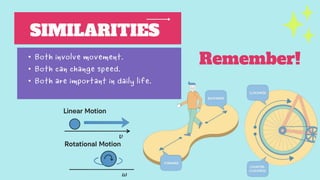
• Both involvemovement.
• Both can change speed.
• Both are important in daily life.
SIMILARITIES
Remember!
22.
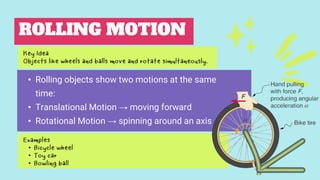
ROLLING MOTION
• Rollingobjects show two motions at the same
time:
• Translational Motion → moving forward
• Rotational Motion → spinning around an axis
Examples
• Bicycle wheel
• Toy car
• Bowling ball
Key Idea
Objects like wheels and balls move and rotate simultaneously.
23.
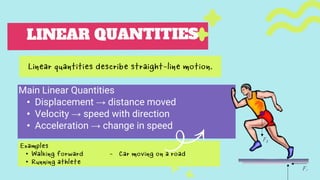
Main Linear Quantities
•Displacement → distance moved
• Velocity → speed with direction
• Acceleration → change in speed
Examples
• Walking forward - Car moving on a road
• Running athlete
Linear quantities describe straight-line motion.
24.
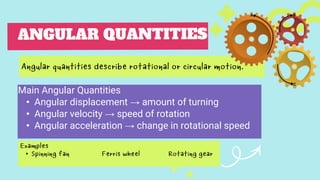
Main Angular Quantities
•Angular displacement → amount of turning
• Angular velocity → speed of rotation
• Angular acceleration → change in rotational speed
Examples
• Spinning fan Ferris wheel Rotating gear
Angular quantities describe rotational or circular motion.
25.
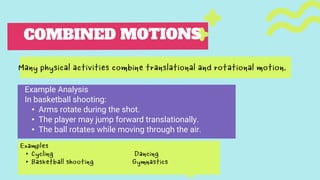
Example Analysis
In basketballshooting:
• Arms rotate during the shot.
• The player may jump forward translationally.
• The ball rotates while moving through the air.
Examples
• Cycling Dancing
• Basketball shooting Gymnastics
Many physical activities combine translational and rotational motion.
26.
APPLICATIONS IN
REAL LIFE
Linearand angular quantities are
important in:
• transportation
• sports
• machines
• exercise
SUMMARY EXAMPLES
• Bicycle wheels rotate while
moving forward.
• Washing machines spin clothes.
• Basketballs rotate while
traveling.
• Importance
⚬ Understanding motion helps:
■ improve machine efficiency
■ explain movement in everyday life
■ understand sports performance