In this lesson, we will explore how shapes move on a flat surface — without changing their size or shape. These movements are called geometric transformations.
Translation, Reflection, and
Rotationof Shapes
Welcome to Week 2! In this lesson, we will explore how shapes move on a flat
surface — without changing their size or shape. These movements are called
geometric transformations. By the end of today, you'll be able to identify,
describe, and draw the results of sliding, flipping, and turning any shape!
GRADE 6 MATH WEEK 2 GEOMETRY
2.
What Is aGeometric Transformation?
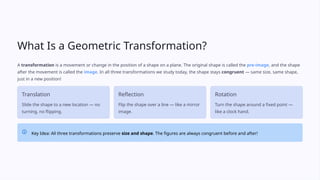
A transformation is a movement or change in the position of a shape on a plane. The original shape is called the pre-image, and the shape
after the movement is called the image. In all three transformations we study today, the shape stays congruent — same size, same shape,
just in a new position!
Translation
Slide the shape to a new location — no
turning, no flipping.
Reflection
Flip the shape over a line — like a mirror
image.
Rotation
Turn the shape around a fixed point —
like a clock hand.
Key Idea: All three transformations preserve size and shape. The figures are always congruent before and after!
3.
Translation — TheSlide
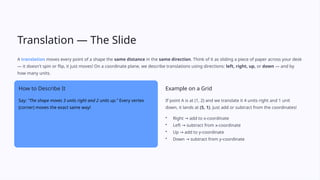
A translation moves every point of a shape the same distance in the same direction. Think of it as sliding a piece of paper across your desk
— it doesn't spin or flip, it just moves! On a coordinate plane, we describe translations using directions: left, right, up, or down — and by
how many units.
How to Describe It
Say: "The shape moves 3 units right and 2 units up." Every vertex
(corner) moves the exact same way!
Example on a Grid
If point A is at (1, 2) and we translate it 4 units right and 1 unit
down, it lands at (5, 1). Just add or subtract from the coordinates!
• Right add to x-coordinate
→
• Left subtract from x-coordinate
→
• Up add to y-coordinate
→
• Down subtract from y-coordinate
→
4.
Translation in Action
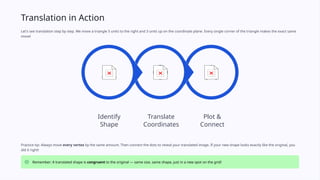
Let'ssee translation step by step. We move a triangle 5 units to the right and 3 units up on the coordinate plane. Every single corner of the triangle makes the exact same
move!
Plot &
Connect
Translate
Coordinates
Identify
Shape
Practice tip: Always move every vertex by the same amount. Then connect the dots to reveal your translated image. If your new shape looks exactly like the original, you
did it right!
Remember: A translated shape is congruent to the original — same size, same shape, just in a new spot on the grid!
5.
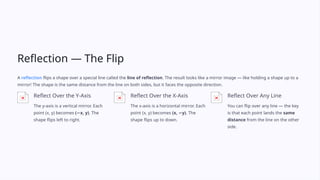
Reflection — TheFlip
A reflection flips a shape over a special line called the line of reflection. The result looks like a mirror image — like holding a shape up to a
mirror! The shape is the same distance from the line on both sides, but it faces the opposite direction.
Reflect Over the Y-Axis
The y-axis is a vertical mirror. Each
point (x, y) becomes ( x, y)
− . The
shape flips left to right.
Reflect Over the X-Axis
The x-axis is a horizontal mirror. Each
point (x, y) becomes (x, y)
− . The
shape flips up to down.
Reflect Over Any Line
You can flip over any line — the key
is that each point lands the same
distance from the line on the other
side.
6.
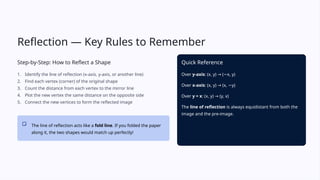
Reflection — KeyRules to Remember
Step-by-Step: How to Reflect a Shape
1. Identify the line of reflection (x-axis, y-axis, or another line)
2. Find each vertex (corner) of the original shape
3. Count the distance from each vertex to the mirror line
4. Plot the new vertex the same distance on the opposite side
5. Connect the new vertices to form the reflected image
The line of reflection acts like a fold line. If you folded the paper
along it, the two shapes would match up perfectly!
Quick Reference
Over y-axis: (x, y) ( x, y)
→ −
Over x-axis: (x, y) (x, y)
→ −
Over y = x: (x, y) (y, x)
→
The line of reflection is always equidistant from both the
image and the pre-image.
7.
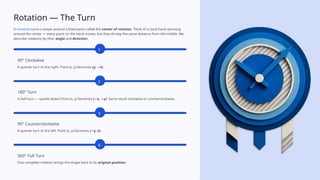
Rotation — TheTurn
A rotation turns a shape around a fixed point called the center of rotation. Think of a clock hand spinning
around the center — every point on the hand moves, but they all stay the same distance from the middle. We
describe rotations by their angle and direction.
1
90° Clockwise
A quarter turn to the right. Point (x, y) becomes (y, x)
− .
2
180° Turn
A half turn — upside down! Point (x, y) becomes ( x, y)
− − . Same result clockwise or counterclockwise.
3
90° Counterclockwise
A quarter turn to the left. Point (x, y) becomes ( y, x)
− .
4
360° Full Turn
One complete rotation brings the shape back to its original position!
8.
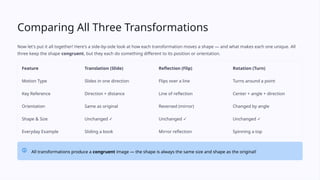
Comparing All ThreeTransformations
Now let's put it all together! Here's a side-by-side look at how each transformation moves a shape — and what makes each one unique. All
three keep the shape congruent, but they each do something different to its position or orientation.
Feature Translation (Slide) Reflection (Flip) Rotation (Turn)
Motion Type Slides in one direction Flips over a line Turns around a point
Key Reference Direction + distance Line of reflection Center + angle + direction
Orientation Same as original Reversed (mirror) Changed by angle
Shape & Size Unchanged ✓ Unchanged ✓ Unchanged ✓
Everyday Example Sliding a book Mirror reflection Spinning a top
All transformations produce a congruent image — the shape is always the same size and shape as the original!
9.
Transformations on theCoordinate Plane
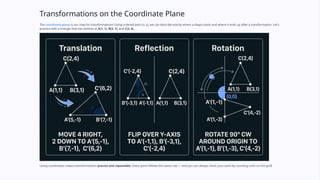
The coordinate plane is our map for transformations! Using ordered pairs (x, y), we can describe exactly where a shape starts and where it ends up after a transformation. Let's
practice with a triangle that has vertices at A(1, 1), B(3, 1), and C(2, 4).
Using coordinates makes transformations precise and repeatable. Every point follows the same rule — and you can always check your work by counting units on the grid!
10.
Key Takeaways &What's Next
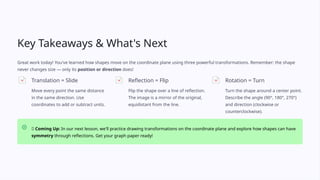
Great work today! You've learned how shapes move on the coordinate plane using three powerful transformations. Remember: the shape
never changes size — only its position or direction does!
Translation = Slide
Move every point the same distance
in the same direction. Use
coordinates to add or subtract units.
Reflection = Flip
Flip the shape over a line of reflection.
The image is a mirror of the original,
equidistant from the line.
Rotation = Turn
Turn the shape around a center point.
Describe the angle (90°, 180°, 270°)
and direction (clockwise or
counterclockwise).
🌟 Coming Up: In our next lesson, we'll practice drawing transformations on the coordinate plane and explore how shapes can have
symmetry through reflections. Get your graph paper ready!