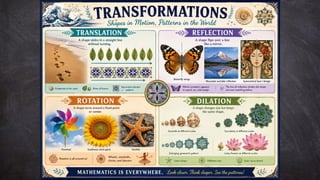
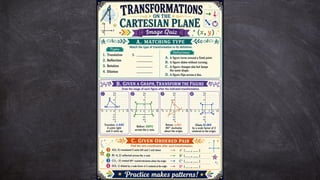
The concept oftransformation of a
figure, whether in its size, position,
or orientation, can be expressed
mathematically.
The concepts of translation,
reflection, rotation and DILATION
are abundantly manifested all
around us, especially in nature, the
Transformation
a change inany form or appearance.
the operation of changing (as by rotation or
mapping) one configuration or expression into
another in accordance with a mathematical rule
especially: a change of variables or coordinates in
which a function of new variables or coordinates is
substituted for each original variable or coordinate
maps an initial image, called a pre-image, onto a
final image, called an image.
10.
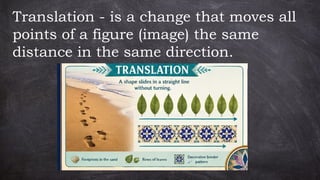
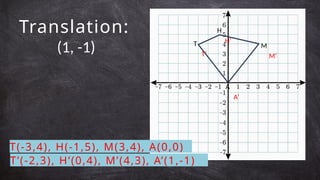
a. Translation -isa change that moves all points
of a figure (image) the same distance in the
same direction.
b. Reflection - is a change represented by a flip of
a figure (image) over a “mirror,” which usually
is a line but may also be a point, or a plane
(which are called lines of symmetry, points of
symmetry, or planes of symmetry (literally
mirrors).
11.
c. Rotation -is a change that turns every
point of a preimage through a specified
angle and direction about a fixed point
(called the center of rotation).
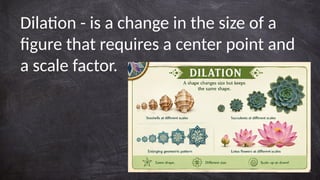
d. Dilation - is a change in the size of a
figure that requires a center point and a
scale factor.
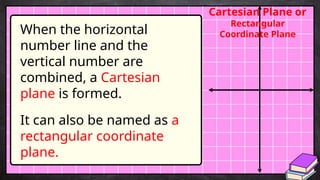
When the horizontal
numberline and the
vertical number are
combined, a Cartesian
plane is formed.
It can also be named as a
rectangular coordinate
plane.
Cartesian Plane or
Rectangular
Coordinate Plane
15.
Rene Descartes
The Cartesianplane is
named after Rene
Descartes, a French
mathematician,
scientist, and
philosopher who first
introduced the
coordinate system in
the 1600s.
16.
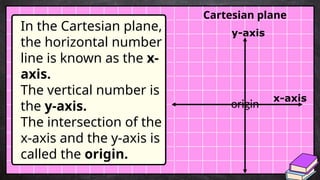
In the Cartesianplane,
the horizontal number
line is known as the x-
axis.
The vertical number is
the y-axis.
The intersection of the
x-axis and the y-axis is
called the origin.
x-axis
y-axis
origin
Cartesian plane
17.
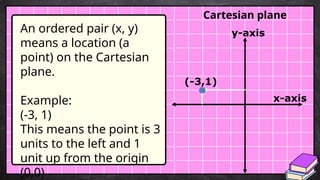
An ordered pair(x, y)
means a location (a
point) on the Cartesian
plane.
Example:
(-3, 1)
This means the point is 3
units to the left and 1
unit up from the origin
(0,0)
x-axis
y-axis
Cartesian plane
(-3,1)
18.
x-
axis
y-axis
Cartesian plane
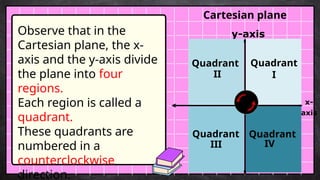
Observe thatin the
Cartesian plane, the x-
axis and the y-axis divide
the plane into four
regions.
Each region is called a
quadrant.
These quadrants are
numbered in a
counterclockwise
direction.
Quadrant
Quadrant
Quadrant
Quadrant
I
II
III IV
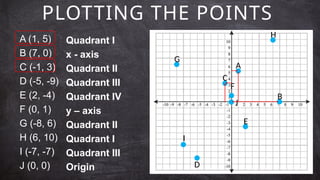
PLOTTING THE POINTS
A(1, 5)
B (7, 0)
C (-1, 3)
D (-5, -9)
E (2, -4)
F (0, 1)
G (-8, 6)
H (6, 10)
I (-7, -7)
J (0, 0)
Quadrant I
x - axis
Quadrant II
Quadrant III
Quadrant IV
y – axis
Quadrant II
Quadrant I
Quadrant III
Origin
A
B
C
D
E
F
G
H
I
J
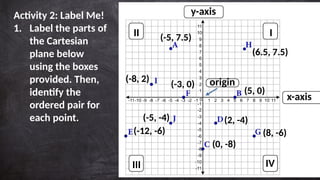
Activity 2: LabelMe!
1. Label the parts of
the Cartesian
plane below
using the boxes
provided. Then,
identify the
ordered pair for
each point.
y-axis
x-axis
origin
I
II
III IV
(-5, 7.5)
(5, 0)
(0, -8)
(2, -4)
(-12, -6)
(-3, 0)
(8, -6)
(6.5, 7.5)
(-8, 2)
(-5, -4)
23.
Activity 2: LabelMe!
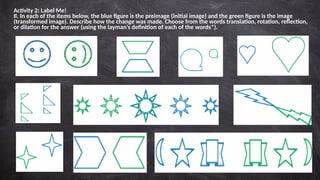
II. In each of the items below, the blue figure is the preimage (initial image) and the green figure is the image
(transformed image). Describe how the change was made. Choose from the words translation, rotation, reflection,
or dilation for the answer (using the layman’s definition of each of the words*).
24.
Activity 2: LabelMe!
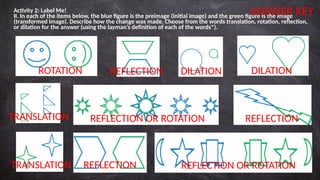
II. In each of the items below, the blue figure is the preimage (initial image) and the green figure is the image
(transformed image). Describe how the change was made. Choose from the words translation, rotation, reflection,
or dilation for the answer (using the layman’s definition of each of the words*).
ANSWER KEY
ROTATION REFLECTION DILATION DILATION
TRANSLATION REFLECTION OR ROTATION REFLECTION
TRANSLATION REFLECTION REFLECTION OR ROTATION
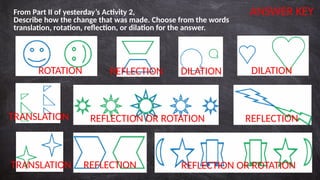
From Part IIof yesterday’s Activity 2,
Describe how the change that was made. Choose from the words
translation, rotation, reflection, or dilation for the answer.
ANSWER KEY
ROTATION REFLECTION DILATION DILATION
TRANSLATION REFLECTION OR ROTATION REFLECTION
TRANSLATION REFLECTION REFLECTION OR ROTATION
28.
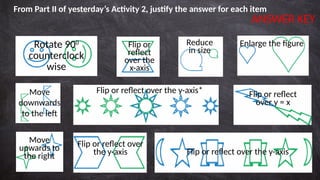
From Part IIof yesterday’s Activity 2, justify the answer for each item
ANSWER KEY
Rotate 900
counterclock
wise
Flip or
reflect
over the
x-axis
Reduce
in size
Enlarge the figure
Move
downwards
to the left
Flip or reflect over the y-axis* Flip or reflect
over y = x
Move
upwards to
the right
Flip or reflect over
the y-axis Flip or reflect over the y-axis
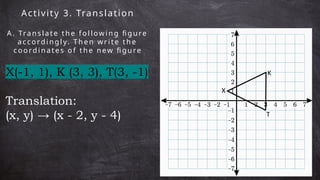
Activity 3. Translation
A. Tra n s la t e t he f o l low i n g fi gu re
a c co rdi n gl y. T he n w ri t e t h e
co o rd in a t e s o f t h e new fi g u re
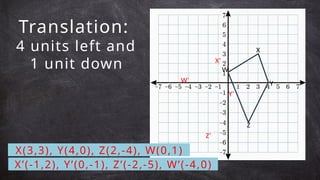
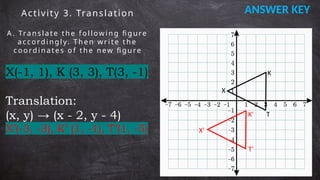
X(-1, 1), K (3, 3), T(3, -1)
Translation:
(x, y) → (x - 2, y - 4)
K
X
T
Activity 3. Translation
A. Tra n s la t e t he f o l low i n g fi gu re
a c co rdi n gl y. T he n w ri t e t h e
co o rd in a t e s o f t h e new fi g u re
X(-1, 1), K (3, 3), T(3, -1)
Translation:
(x, y) → (x - 2, y - 4)
X’(-3, -3), K’ (1, -1), T’(1, -5)
ANSWER KEY
K
X
T
K’
X’
T’
42.
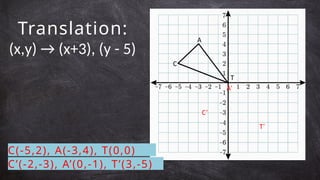
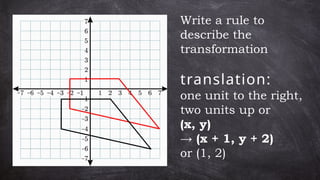
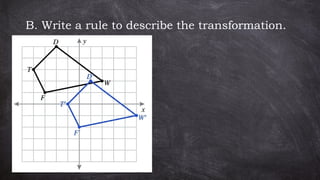
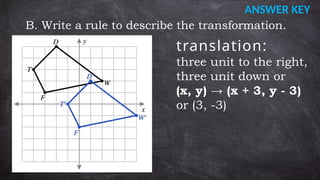
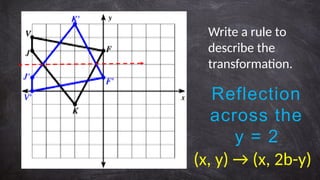
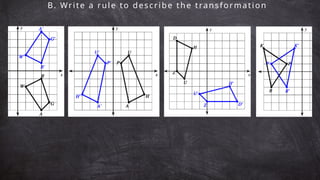
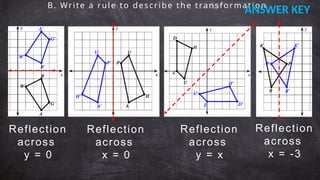
B. Write arule to describe the transformation.
translation:
three unit to the right,
three unit down or
(x, y) → (x + 3, y - 3)
or (3, -3)
ANSWER KEY
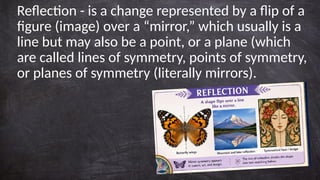
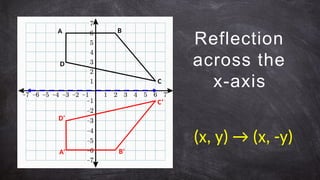
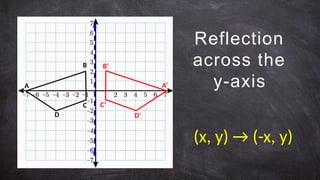
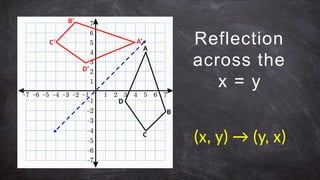
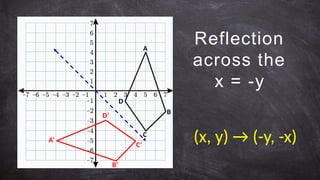
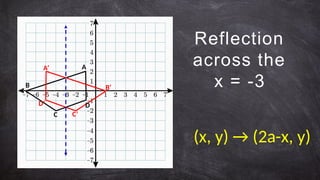
Reflection - isa change represented by a flip of a
figure (image) over a “mirror,” which usually is a
line but may also be a point, or a plane (which
are called lines of symmetry, points of symmetry,
or planes of symmetry (literally mirrors).
48.
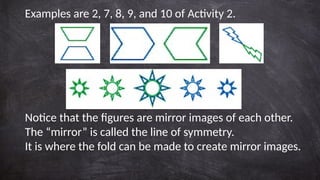
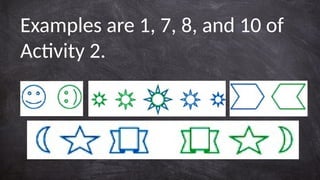
Examples are 2,7, 8, 9, and 10 of Activity 2.
Notice that the figures are mirror images of each other.
The “mirror” is called the line of symmetry.
It is where the fold can be made to create mirror images.
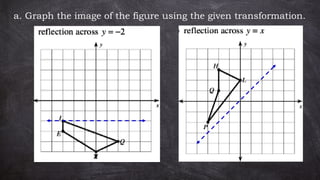
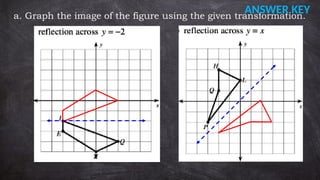
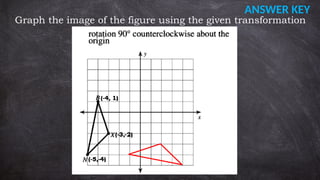
a. Graph theimage of the figure using the given transformation.
ANSWER KEY
61.
B. Write arule to describe the transformation
Reflection
across
y = 0
Reflection
across
x = 0
Reflection
across
y = x
Reflection
across
x = -3
ANSWER KEY
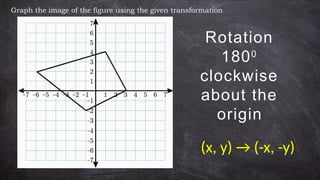
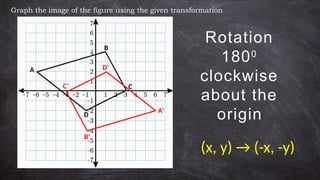
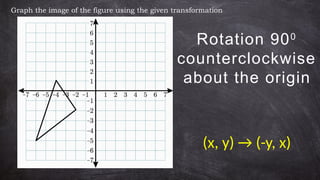
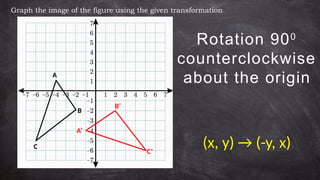
Rotation - isa change that turns every point
of a preimage through a specified angle and
direction about a fixed point (called the
center of rotation).
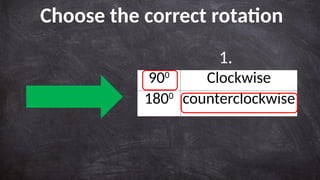
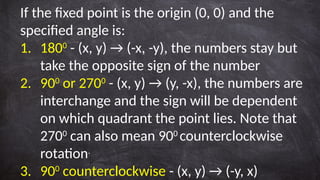
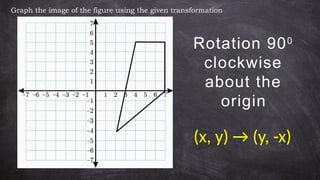
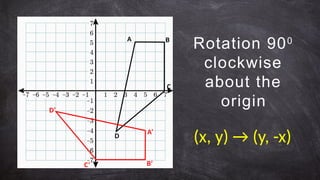
If the fixedpoint is the origin (0, 0) and the
specified angle is:
1. 1800
- (x, y) → (-x, -y), the numbers stay but
take the opposite sign of the number
2. 900
or 2700
- (x, y) → (y, -x), the numbers are
interchange and the sign will be dependent
on which quadrant the point lies. Note that
2700
can also mean 900
counterclockwise
rotation.
3. 900
counterclockwise - (x, y) → (-y, x)
Dilation - isa change in the size of a
figure that requires a center point and
a scale factor.
85.
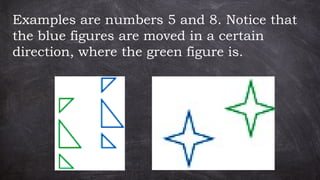
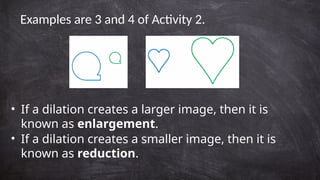
Examples are 3and 4 of Activity 2.
• If a dilation creates a larger image, then it is
known as enlargement.
• If a dilation creates a smaller image, then it is
known as reduction.
86.
Dilation with ScaleFactor
Scale Factor is defined as the ratio of the size of the new
image to the size of the old image. The center of dilation
is a fixed point in the plane. Based on the scale factor and
the center of dilation, the dilation transformation is
defined.
• If the scale factor is more than 1, then the image
stretches.
• If the scale factor is between 0 and 1, then the image
shrinks.
• If the scale factor is 1, then the original image and the
image produced are congruent.
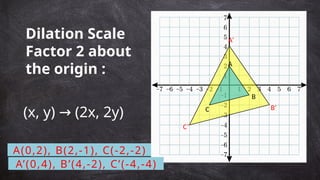
Dilation Scale
Factor 2about
the origin :
B’
C’
A’
B
C
A
A’(0,4), B’(4,-2), C’(-4,-4)
A(0,2), B(2,-1), C(-2,-2)
(x, y) (2x, 2y)
→
89.
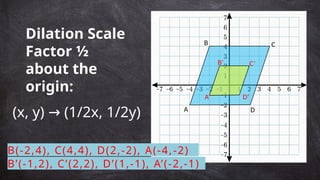
Dilation Scale
Factor ½
aboutthe
origin:
B’ C’
A’
B C
A
B’(-1,2), C’(2,2), D’(1,-1), A’(-2,-1)
B(-2,4), C(4,4), D(2,-2), A(-4,-2)
(x, y) (
→ 1/2x, 1/2y) D
D’
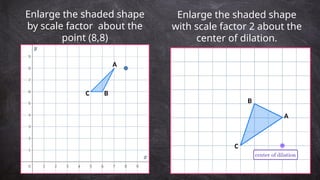
Enlarge the shadedshape
by scale factor about the
point (8,8)
Enlarge the shaded shape
with scale factor 2 about the
center of dilation.
A
B
C
A
B
C
92.
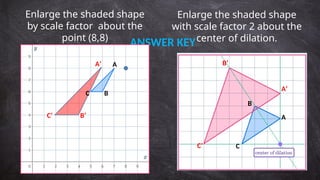
Enlarge the shadedshape
by scale factor about the
point (8,8)
Enlarge the shaded shape
with scale factor 2 about the
center of dilation.
ANSWER KEY
A
B
C
A
B
C
A’
B’
C’
A’
B’
C’