Training Manual on Emerging Post-Harvest Engineering and Technological Interventions for Enhancing Farmer’s Income
ICAR Summer School on innovative post-harvest engineering and technology to reduce losses, add value, and boost farmers' income through agro-processing and advanced interventions.
Training Manual on Emerging Post-Harvest Engineering and Technological Interventions for Enhancing Farmer’s Income
1.
ICAR
Summer
School
Emerging Post-Harvest Engineeringand
Technological Interventions for
Enhancing Farmer’s Income
ICAR-Central Institute of Post-Harvest Engineering & Technology
Ludhiana-141004 (Punjab)
Sandeep Mann
Renu Balakrishnan
Yogesh Bhaskar Kalnar
September 04-24
2018
2.
ICAR Sponsored SummerSchool
Emerging Post-Harvest Engineering and
Technological Interventions for Enhancing
Farmer's Income
September 04-24, 2018
COMPENDIUM
CourseDirector
Dr. Sandeep Mann
CourseCo-Director
Dr.RenuBalakrishnan
Er.YogeshBhaskarKalnar
Hkk-—-vuq-i-&dsUnzh; dVkbZ&mijkUr vfHk;kaf=dh ,oa çkS|ksfxdh laLFkku ¼lhQsV½
Mkd ?kj% ih-,-;w-] yqf/k;kuk & 141004] ¼iatkc½
ICAR-Central Institute of Post-Harvest Engineering andTechnology
P.O.: PAU, Ludhiana-141 004 (Punjab), India
(An ISO 9001:2015 Certified Institute)
Phone : 011-25841760(O)
Fax : 011-25843932
E-mail : ddgedn@gmail.com
nsrdsr@gmail.com
Website : www.icar.gov.in
MkW- ujsUnz flag jkBkSM+
mi egkfuns’kd ¼—f"k f'k{kk½
Dr. Narendra Singh Rathore
Deputy Director General (Agril. Edn.)
21 August, 2018
Hkkjrh; —f"k vuqla/kku ifj"kn
—f"k vuqla/kku Hkou&II] iwlk] ubZ fnYyh&110012
INDIAN COUNCIL OF AGRICULTURAL RESEARCH
KrishiAnusandhan Bhawan-II, Pusa, New Delhi-110012
MESSAGE
I am happy to know that ICAR-CIPHET, Ludhiana is organizing a 21 day ICAR sponsored Summer
Schoolon"EmergingPost-HarvestEngineeringandTechnologicalInterventionsforEnhancingFarmers
Income" during September 4-24, 2018.
Quantityofinputsinagriculturalbusinessincreasessteadilywithcontinuouswaywhichdiminishesthe
net profit of the farmers. Enhancing farmer's income is worth serious attentionable issue. This laudable
work could not only improve the well-being of our farmers but can also be a trigger to boost agro-based
manufacturing growth in rural India. Raising farmers income comes in effect to large extent with value
addition and processing of agricultural products (such as cereal grains, dairy, honey, legumes, pulses,
vegetables, fruits, oilseed crops etc.) The post-harvest losses can be minimized to a great extent utilizing
appropriatepost-harvestengineeringandtechnologicalinterventions.
Itisnecessarytoprovideasafenutritiousfood(processedorunprocessed)inordertomaintainhuman
health.At present, food and crop processing is generally considered to be the largest industry in most
countries. Large as well as cottage level food industries are emerging by adopting the concept of
manufacturing and selling of ready-to-eat meals. They need special processing and packaging to protect
themforrequiredstoragelife.Theprocessingsectorwithimprovedtechnologiesandinterventionscanbe
asourceofenrichmentofincomeforlargenumberofpeopleinvolvedinthissector.
Iamsurethatthissummerschoolwillprovideaplatformfortheparticipantstounderstand,shareand
discussissuesandchallengesinpost-harvestsectorandwaystominimizetheselossestoenhancefarmer's
incomeutilizingemergingpost-harvestengineeringandtechnologies.
IwishthisSummerSchoolagreatsuccessinachievingitsgoal.
(Narendra Singh Rathore)
6.
Hkkjrh; Ñf"k vuqla/kkuifj"kn
Ñf"k vuqla/kku Hkou&II]
iwlk] ubZ fnYyh &110 012
Indian Council of Agricultural Research
KRISHIANUSANDHAN BHAWAN-II,
PUSA,NEWDELHI-110012
d- vyxqlqUnje
mi egkfuns’kd ¼vfHk;kaf=dh½
K.Alagusundram
Deputy Director General (Engineering)
MESSAGE
TheGovernmentofIndiaisenvisagingondoublingfarmers'incomeby2022.Cultivationof
cashcrops,integratedfarming(includingagriculture,animalhusbandry,fishries,andalliedsectors,
improving the input-use efficiency and enhancing the yield potential of the land are some of the
areasinwhichwehavetofocusforenhancingthefarmers'income.
On the other hand, we have been observing that India has experienced huge post-harvest
losses due to inadequate post-production processing facilities and technologies. These losses as
estimated by AICRP-PHET centres translates to a whopping Rs. 94,000 crores per annum
(according to 2014 cost estimates).
Reducing these losses and appropriately value-adding them are two major areas that India
needstofocusforenhancingthefarmers'income.
I am very glad that ICAR-CIPHET, Ludhiana is conducting a 21-day sponsored Summer
School on 'Emerging Post-Harvest Engineering andTechnological Interventions for Enhancing
Farmers' Income during 04-24 September, 2018. This is a timely theme and is in line with our
motiveofpopularizingpost-harvesttechnologiesamongallstake-holders.Theparticipantsofthis
Summer School must take with them the knowledge that will be shared in these 21 days, so that
they can spread the knowledge to the farmers, traders, and other stake-holders of their respective
regions.
I wish the Summer School a grand success.
(K.Alagusundaram)
Phone: 91-11-2584 3415 Fax: 011-2584 2660 E-mail: ddgengg@icar.org.in
27/08/2018
8.
FOREWORD
Inrecentyears,theagro-processingindustryinIndiahasgainedconsiderablegrowthowingtoavailability
ofrawmaterials,changinglifestylesandliberalgovernmentpolicies.Agroprocessingindustryconserveand
handleagriculturalproducemakingitusableasfood,feed,fiber,fuelorindustrialrawmaterial.Thescopeof
theagro-processingindustryencompassesalloperationsfromthestageofharvesttilltheproducereachesthe
consumersinthedesiredform,packaging,quantity,qualityandprice.Agroprocessingindustrythusprocesses
raw materials andintermediate products, transforming products originating from agriculture, fisheries and
forestry.
InIndia,paststrategyfordevelopmentoftheagriculturesectorhasmainlyfocusedonraisingagricultural
production and improving food security but, the strategy did not revealed any direct measure to promote
farmers welfare and farmers’ income. This resulted in low income of farmers. The persistent low level of
farmer’sincomeiscausingharmfuleffectontheinterestinfarmingandfarminvestments,duetowhichmore
andmorecultivators,mainlyofyoungeragegroupleavefarming.Thiscanresultinadverseeffectonthefuture
of agriculture in India. Thus, to secure future of agriculture and to improve livelihood of farmers, research
institutesshouldcomewithtechnologicalbreakthroughstoimprovethewelfareoffarmersandraiseagricultural
incomethroughdiversifiedoptions,includingpost-productionmanagementandvalueadditionrelatedactivities.
ItgivemeimmensepleasurethatICAR-CentralInstituteofPost-HarvestEngineeringandTechnology
(CIPHET) is organizing a summer school on “Emerging Post-Harvest Engineering and Technological
InterventionsforEnhancingFarmer’sIncome”during04-24September,2018.Iappreciatethetimelyinitiative
of the organizers and the theme of the summer school is most appropriate. I hope that this summer school
wouldbeaplatformforinteractionofparticipantswithsubjectexpertsfromdifferentpartsofthecountryand
updatethemselveswiththerecentinformationandinterventionsinthisfield.
My best wishes to organizers and entire team associated with this summer school.
(Dr. R.K. Singh)
10.
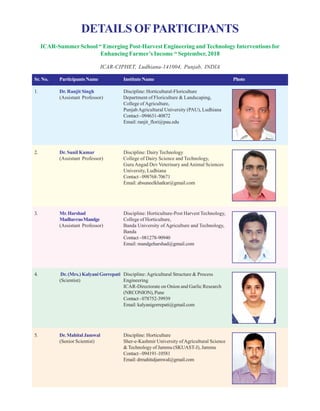
DETAILS OFPARTICIPANTS
ICAR-SummerSchool “Emerging Post-Harvest Engineering andTechnology Interventions for
Enhancing Farmer’s Income “ September, 2018
ICAR-CIPHET, Ludhiana-141004, Punjab, INDIA
Sr. No. Participants Name Institute Name Photo
1. Dr. Ranjit Singh Discipline: Horticultural-Floriculture
(Assistant Professor) Department of Floriculture & Landscaping,
College ofAgriculture,
PunjabAgricultural University (PAU), Ludhiana
Contact-094631-40872
Email: ranjit_flori@pau.edu
2. Dr. Sunil Kumar Discipline: Dairy Technology
(Assistant Professor) College of Dairy Science and Technology,
GuruAngad Dev Veterinary andAnimal Sciences
University, Ludhiana
Contact-098768-70671
Email: absuneelkhatkar@gmail.com
3. Mr.Harshad Discipline: Horticulture-Post Harvest Technology,
MadhavraoMandge College of Horticulture,
(Assistant Professor) Banda University of Agriculture and Technology,
Banda
Contact-081278-90940
Email: mandgeharshad@gmail.com
4. Dr. (Mrs.) Kalyani Gorrepati Discipline:Agricultural Structure & Process
(Scientist) Engineering
ICAR-Directorate on Onion and Garlic Research
(NRCONION),Pune
Contact-078752-39939
Email: kalyanigorrepati@gmail.com
5. Dr.MahitalJamwal Discipline: Horticulture
(Senior Scientist) Sher-e-Kashmir University ofAgricultural Science
& Technology of Jammu (SKUAST-J), Jammu
Contact-094191-10581
Email:drmahitaljamwal@gmail.com
11.
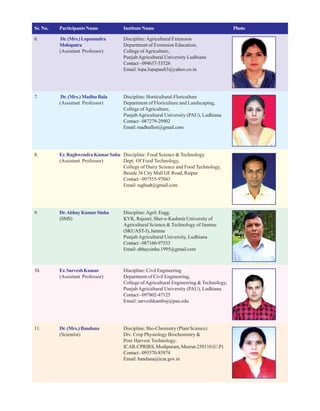
Sr. No. ParticipantsName Institute Name Photo
6. Dr.(Mrs.)Lopamudra Discipline:Agricultural Extension
Mohapatra Department of Extension Education,
(Assistant Professor) College ofAgriculture,
PunjabAgricultural University Ludhiana
Contact-094637-53526
Email: lopa.lopapau83@yahoo.co.in
7. Dr. (Mrs.) Madhu Bala Discipline: Horticultural-Floriculture
(Assistant Professor) Department of Floriculture and Landscaping,
College ofAgriculture,
PunjabAgricultural University (PAU), Ludhiana
Contact-087279-29902
Email:madhuflori@gmail.com
8. Er.RaghwendraKumarSahu Discipline: Food Science & Technology
(Assistant Professor) Dept. Of Food Technology,
College of Dairy Science and Food Technology,
Beside 36 City Mall GE Road, Raipur
Contact-097555-97043
Email: raghudt@gmail.com
9. Dr.AbhayKumarSinha Discipline:Agril. Engg.
(SMS) KVK, Rajouri, Sher-e-Kashmir University of
Agricultural Science & Technology of Jammu
(SKUAST-J),Jammu
PunjabAgricultural University, Ludhiana
Contact-087160-97533
Email: abhaysinha.1995@gmail.com
10. Er.SarveshKumar Discipline: Civil Engineering
(Assistant Professor) Department of Civil Engineering,
College ofAgricultural Engineering & Technology,
PunjabAgricultural University (PAU), Ludhiana
Contact-097802-47125
Email: sarveshkamboj@pau.edu
11. Dr.(Mrs.)Bandana Discipline: Bio-Chemistry (Plant Science)
(Scientist) Div. Crop Physiology Biochemistry &
Post Harvest Technology,
ICAR-CPRIRS, Modipuram, Meerut-250110 (U.P)
Contact-095570-85974
Email: bandana@icar.gov.in
12.
Sr. No. ParticipantsName Institute Name Photo
12. Dr. Jagmohan Singh Rawat Discipline: Horticulture
(Assistant Professor) Department of Horticulture,
Government Degree College Rudraprayag,
Distt Rudraprayag Uttarakhand
Contact-094129-48487
Email: jms_rawat99@yahoo.co.in
13. Dr. Bipul KumarKakati Discipline: Fish Processing Technology
(Assistant Professor) Department of Fisheries Engineering,
College of FisheriesAssamAgricultural University
Raha, Nagaon,Assam 782103
Contact-088118-04914
Email:bkkakati@gmail.com
14. Dr. (Mrs.) Kiran Jeet Discipline: Physics
(Assistant Professor) Electron Microscopy and Nanoscience Lab.,
Department of Soil Science College ofAgriculture,
PunjabAgricultural University, Ludhiana
Contact-099150-66549
Email: kiranjeet@pau.edu
14.
DETAILS OF SPEAKERS
ICAR-SummerSchool“ Emerging Post-Harvest Engineering andTechnology Interventions for
Enhancing Farmer’s Income “ September, 2018
ICAR-CIPHET, Ludhiana-141004, Punjab, INDIA
Name and Designation Address & Contact Details
Dr. S.N. Jha ICAR, New Delhi
(ADG,PE) Contact:94176-01715
Email: snjha_ciphet@yahoo.co.in
Dr. R.K. Singh ICAR–CIPHET
(Acting Director & PAU Campus, Ludhiana 141004
PC,PET) Contact:0161-2313117
Email: rksingh_arsahoo@yahoo.com
Dr.B.V.C.Mahajan Punjab Horticultural Post-Harvest Technology Center,
(Director) PAU- Campus, Ludhiana, Punjab, 141 001
Contact:94178-55105
Email: phptc@pau.edu
Dr. Balraj Agriculture University, Jhodhpur
(Vice Chancellor ) Contact:+91-291-2570711
Email: vcunivag@gmail.com
Dr.Ashok Kumar COAE&T, PAU, Ludhiana, Punjab, 141004
(Prof. &ADR) Contact:98728-76077
Email: akdevgan@pau.edu
Dr. Anil Kumar Punia College of Dairy Science and Technology,
(Dean) GADVASU, Ludhiana, Punjab,141004
Contact:+91-161-25533133,2553308
Email: akpuniya@gmail.com, deancodst@gadvasu.in
Dr. S.K. Tyagi AS&EC Division
(Principal Scientist & I/c PC, ICAR–CIPHET
AICRP-PHE&T) PAU Campus, Ludhiana 141004
Contact:0161-2313106,2313107
Email: dr.tyagi77777@yahoo.co.in
Dr. K. Narsaiah AS&EC Division,
(Principal Scientist & ICAR–CIPHET
I/c Head, National Fellow) PAU Campus, Ludhiana 141004
Contact:0161-2313124
Email: knarsan@yahoo.com
Dr. Devinder Dhingra ICAR, Pusa,
(Principal Scientist) NewDelhi-110012
Contact:+91-931-201-2100
Email: devinder.dhingra@gmail.com
Dr.NachiketKotwaliwale ICAR-CIAE, Bhopal
(HeadAPPD & Principal Scientist) Contact:+91-755-2521110
Email: nachiket.kotwaliwale@icar.gov.in
Dr.PoonamSachdeva Department of Food Science and Technology
(Scientist & Head) PAU, Ludhiana
Contact:98550-55871
Email: sachdev_poonam@pau.edu
15.
Name and DesignationAddress & Contact Details
Dr.SandeepMann ToT Division,
(Principal Scientist & I/c Head ) ICAR–CIPHET
PAU Campus, Ludhiana, 141004
Contact:0161-2313115
Email: sandeep_mann76@yahoo.com
Dr. Manish K. Chatli Livestock Products Technology,
(Prof. cum Head) COVS,GADVASU,Ludhiana,141004
Contact:9855101068
Email: manishchatlilpt@gmail.com
Dr. D.S. Malik Department of Livestock Production Management,
(Prof. cum head) GADVASU,Ludhiana,141004
Contact:94173-33624
Email:dsmalik67@gmail.com
Dr.MridulaDevi FG & OP Division,
(Principal Scientist & I/c Head ) ICAR–CIPHET
PAU Campus, Ludhiana, 141004
Contact:0161-2313127
Email:dr.mridulabest123@gmail.com
Dr. Ramesh Jangra HCP Division
(Principal Scientist & I/c Head) ICAR – CIPHET,Abohar
Contact:01634-224024
Email:rkjangra7@gmail.com
Dr. Sangeeta Chopra Division ofAgricultural Engineering
(Principal Scientist) IndianAgricultural Research Institute,
ICAR,NewDelhi-110012
Contact:+91-927-874-5254
Email: dhingra.sangeeta@gmail.com
Dr.A.K.Sharma ComputerApplications
(Principal scientist) ICAR-NDRI,Karnal
Contact:+91-9896391267
Email:Adeshkumar.sharma@gmail.com
Dr. R.K.Vishwakarma FG & OP Division
(Principal Scientist) ICAR–CIPHET
PAU Campus, Ludhiana, 141004
Contact:0161-2313112
Email: rkvciphet@gmail.com
Dr. Manju Bala FG & OP Division
(Principal Scientist) ICAR–CIPHET
PAU Campus, Ludhiana, 141004
Contact:0161-2313136
Email:avimithi@gmail.com
Dr.ArmaanU.Muzaddadi ToT Division,
(Principal Scientist) ICAR–CIPHET
PAU Campus, Ludhiana, 141004
Contact:0161-2313130
Email:dr.armaan@gmail.com
Dr. Sunil Kumar HCP Division
(Principal Scientist) ICAR – CIPHET,Abohar
Contact:01634-224024
Email: sunil_saini2007@yahoo.com
16.
Name and DesignationAddress & Contact Details
Dr.A.K. Dixit ICAR – NDRI, Karnal
(Principal Scientist) Contact:92573-28700
Email:Poojanilwe@gmail.com
Dr. Dilip Kumar ICAR-Indian Institute of Sugarcane Research
(Principal Scientist) Lucknow-226002
Contact:09415756622
Email:dilipiisr@gmail.com
Dr. Savita Sharma Department of Food Science & Technology,
(Sr. Dough Rheologist) PAU, Ludhiana, 141001
Contact:098147-69992
Email: savita@pau.edu
Dr. M.S.Alam AICRP on PHE&T
(Senior Research Engineer COAE&T, PAU, Ludhiana 141004
& I/cAICRPon PHE&T) Contact:094171-88501
Email:ms_alam@rediffmail.com
Dr.T.C. Mittal COAE&T
(Senior Extension Engineer) PAU, Ludhiana 141004
Contact:094638-09991
Email: tarsem6972@pau.edu
Dr. Ranjeet Singh AS&EC Division,
(Senior Scientist) ICAR–CIPHET
PAU Campus, Ludhiana, 141004
Contact:0161-2313126
Email:Razi3dec@gmail.com
Dr.RahulKumarAnurag AS&EC Division,
(Scientist, SS) ICAR–CIPHET
PAU Campus, Ludhiana, 141004
Contact:0161-2313170
Email: rahul.anurag@gmail.com
Dr. Swati Sethi FG & OP Division
(Scientist) ICAR–CIPHET
PAU Campus, Ludhiana, 141004
Contact:0161-2313165
Email: swati.fst@gmail.com
Dr.DipikaGoswami FG & OP Division
(Scientist) ICAR–CIPHET
PAU Campus, Ludhiana, 141004
Contact:0161-2313171
Email:deepikagoswami@rediffmail.com
Dr. Sakharam Kale HCP Division
(Scientist) ICAR – CIPHET,Abohar
Contact:01634-224024
Email: Sakha_yogesh@yahoo.co.in
Er. Chandan Solanki FG&OP Division
(Scientist) ICAR–CIPHET
PAU Campus, Ludhiana 141004
Contact:0161-2313184
Email: chandan4uu12@gmail.com
17.
Name and DesignationAddress & Contact Details
Er. Dritiman Saha FG & OP Division
(Scientist) ICAR–CIPHET
PAU Campus, Ludhiana 141004
Contact:0161-2313139
Email:dhriti.iitkgp@gmail.com
Mrs. Surya Tushir AS & EC Division
(Scientist) ICAR–CIPHET
PAU Campus, Ludhiana, 141004
Contact:0161-2313194
Email: surya.kadian@gmail.com
Er.AkhhoonAsrar Bashir AS & EC Division,
(Scientist) ICAR – CIPHET, Ludhiana 141004
Contact:0161-2313123
Email: akhoonasrar@gmail.com
Dr. K. Bembem ToT Division
(Scientist) ICAR–CIPHET
PAU Campus, Ludhiana, 141004
Contact:0161-2313143
Email:khwairakpam.bembem@icar.gov.in
Mr.Vikas Kumar ToT Division
(Scientist) ICAR–CIPHET
PAU Campus, Ludhiana, 141004
Contact:0161-2313148
Email: vikasfpt@gmail.com
Dr. Renu Balakrishnan ToT Division
(Scientist) ICAR–CIPHET
PAU Campus, Ludhiana, 141004
Contact:0161-2313143
Email: renubalakrishnan@gmail.com
Er.Yogesh Kalnar ToT Division,
(Scientist) ICAR–CIPHET
PAU Campus, Ludhiana, 141004
Contact:96233-73001
Email: yogeshkalnar2506@gmail.com
Dr.PankajKumar FG & OP Division
(Scientist) ICAR–CIPHET
PAU Campus, Ludhiana, 141004
Contact:0161-2313139
Email:pankaj10364@gmail.com
Dr.V. Chandrasekar AICRP on PHET
(Scientist) ICAR–CIPHET
PAU Campus, Ludhiana, 141004
Contact:0161-2313128
Email: chandrufpe@gmail.com
Dr.PoonamChoudhary AS&EC Division
(Scientist) ICAR-CIPHET
PAU Campus, Ludhiana, 141004
Contact:0161-2313194
Email: Poonam.chaudhary98@yahoo.com
18.
Acknowledgements
It is aprivilege to extend our sincere thanks to Education Division, Indian Council of Agricultural
Research, New Delhi for approving this summer school.
We extend our profound gratitude to Dr. T. Mohapatra, Secretary (DARE) and Director General
(ICAR) for his inspiring encouragement and valuable timely advice for this programme.
We are thankful to Dr. N. S. Rathore, Deputy Director General (Education), Division of Agricultural
Education, ICAR for his financial support and giving us the opportunity for organizing this summer
school. We are very thankful to Dr MB Chetti ADG (HRD), Dr PS Pandey ADG (EP&HS) and Dr G
Venkateshwarlu ADG (EQA&R) for their encouragement and guidance for this programme.
We express our sincere gratitude to Dr. K. Alagusundaram, DDG (Ag. Engg), Dr. Kanchan K. Singh,
ADG (Engg) and Dr. S. N. Jha ADG (PE) for their constant encouragement, guidance and motivation
to conduct this programme.
We express our sincere thanks to Dr. R. K. Singh, Director (Acting), ICAR-CIPHET, Ludhiana for
unending support, encouragement and valuable guidance to conduct this summer school. The moral
support with constant monitoring and inventive ideas were crucial to pursue this summer school for
planning and implementation of this programme.
We express our sincere thanks to all the scientists of ICAR-CIPHET from both Ludhiana and Abohar
campus, Experts from different organizations for providing the lecture notes in time, and other facilities
for smooth conducting of this summer school.
We are indebted to all technical, administrative and supporting staff of ICAR-CIPHET, Ludhiana and
Abohar Campus for putting their sincere efforts for smooth organization of this summer school.
Finally, we would like to thank everybody and congratulate to all for successful organization of this
summer school.
Sandeep Mann
Renu Balakrishnan
Yogesh Bhaskar Kalnar
20.
Emerging Post-Harvest Engineeringand Techological Interventions for Enhancing Farmer's Income
Contents
ICAR Sponsored Summer School
Emerging Post-Harvest Engineering and
Technological Interventions for Enhancing
Farmer's Income
September 04-24, 2018
CONTENTS
1. Construction of Evaporative Cool Room for On Farm Storage of Horticultural Produce 1
S.N. Jha, Sandeep Mann and K. Narsaiah
2. Role of Plasticulture Technologies in Agriculture Production and Post-Harvest Management10
R.K. Singh, Indore Navnath S. and Malathi A.N.
3. Value Addition of Horticultural Produce: A Tool to Double Farmer’s Income 15
Ramesh Kumar and Sunil Kumar
4. Extrusion Technology for Increasing Farmer’s Income 21
Mridula D., Deepika Goswami and Chandan Solanki
5. Mechanization of Indian Traditional Foods for Enhancing Income 30
Sandeep Mann, Dhritiman Saha and Surya Tushir
6. Processing and Value Addition of Groundnut for Increasing Farmers’ Income 34
Deep N. Yadav
7. Strategies for Doubling Farmers Income through Agro-Processing 39
Sandeep Mann, Anil Kumar Dixit, Renu Balakrishnan and Yogesh Kalnar
8. Promoting Producer Organization among Farmers 46
Renu Balakrishnan, Ashish Santosh Murai, Sandeep Mann, Yogesh Kalnar and K. Bembem
9. Conversion of Agro Biomass to Wealth for Additional Income 54
Sunil Kumar, Ramesh Kumar and Shiwani Mandhania
10. Processing and Value Addition of Horticultural Crops for Doubling the Income of Farmers 59
Poonam Aggarwal
11. Entrepreneurship Development through Apiculture/ Honey Processing 64
Md. Shafiq Alam
12. Recent Technological Intervention for Meat and Egg Industry for Entrepreneurship 70
Development
Manish Kumar Chatli, Amanpreet Kaur, O.P. Malav, Nitin Mehta and Rajesh V. Wagh
13. Agro Processing Centres: An Overview 74
Ashok Kumar
14. Functional Foods Technology for Enhancing Farmer’s Income 80
Savita Sharma
i
21.
Emerging Post-Harvest Engineeringand Techological Interventions for Enhancing Farmer's Income
Contents
15. Chemical Free Jaggery Production: Sugarcane Juice Processing for Small Scale Enterprise 82
Dilip Kumar and A.D. Pathak
16. Spray Drying of Liquid Foods: A Novel Path towards Augmenting Farmers Income 88
Dhritiman Saha, Chandan Solanki, Pankaj Kumar, Swati Sethi, Sandeep Dawange and
Navnath Indore
17. Post-Harvest Losses and Food Waste: An Economic and Social Perspective 93
Anil K. Dixit, Sandeep Mann and Yogesh Kalnar
18. Project Profile Preperation for Start-Up’s in Agriculture 98
Renu Balakrishnan, Ashish Santosh Murai, Yogesh Kalnar, K. Bembem and Vikas Kumar
19. Enhancing Farmers Income through Goat Production under Zero Grazing System 103
D.S. Malik, Sandeep Kaswan and Mandeep Singla
20. Cold-Chain Management for Reducing Post-Harvest Losses and Increasing Farmer’s 108
Income
Ranjeet Singh
21. Recent Trends in Storage and Preservation of Food Grains 115
Devinder Dhingra
22. Market for Functional and Designer Food: How to Reach Consumers 122
Anil Kumar Dixit, Sandeep Mann and Renu Balakrishnan
23. Utilization of Fish Processing Waste: A Waste to Wealth Approach 127
Vikas Kumar, Armaan U. Muzaddadi, Sandeep Mann, Renu Balakrishnan, K. Bembem
and Yogesh Kalnar
24. On-Farm Practices to Maintain the Quality of Horticultural Produces 132
B.V.C. Mahajan
25. Digital Image Processing and Machine Vision Technology for Quality Evaluation of Food 135
Nachiket Kotwaliwale
26. Solar Refrigerated Evaporatively Cooled Structure for Fruits and Vegetables Storage 142
Sangeeta Chopra, Randolph Beaudry, Norbert Mueller and Indra Mani
27. Extraction of Oil from Cereal Grains using SCFE 148
Manju Bala, Surya Tushir and Poonam Chaudhary
28. Requisite Headways for Modern Food Grain Warehousing in India 153
Akhoon Asrar Bashir and Sandeep Mann
29. Novel Processing Techniques for Pulse Milling 155
Chandan Solanki, Mridula D. and R. K. Vishwakarma
30. Low Temperature Grinding (LTG) of Spices: A Novel Technology 160
Pankaj Kumar, Dritiman Saha and Sandeep P. Dawange
31. Process Protocols for Development of Quality Green Raisins 165
S.J. Kale and Prerna Nath
32. Advances in Fish Processing and Transportation Techniques 171
Armaan U. Muzaddadi and Vikas Kumar
33. Processing and Value Addition of Millets 184
Deepika Goswami, Mridula D, Harshad M Mandge and Jagbir Rehal
ii
22.
Emerging Post-Harvest Engineeringand Techological Interventions for Enhancing Farmer's Income
Contents
34. Modified Atmosphere Packaging Design for Fruits and Vegetables 189
Rahul Kumar Anurag, Sandeep Mann, Swati Sethi and Yogesh Kalnar
35. Microcontrollers and Sensors in Post-Harvest Application of Agricultural Commodity: 197
Sorting/Grading and Storage
Yogesh Kalnar, Renu Balakrishnan, Sandeep Mann, Th. Bidyalaksmi, Sandeep Dawange
and Navnath Indore
36. Newer Approaches in Co-Products and By-Products Utilization for Development of 203
Functional Foods
Swati Sethi and K. Bembem
37. HACCP in Food Processing 209
Rahul Kumar Anurag, Swati Sethi, Yogesh Kalnar and Sandeep Mann
38. Encapsulation of Bioactive and Functional Ingredients 215
K. Narsaiah
39. Artificial Intelligence and Advanced Analytics Technology Oriented Solutions for 226
Empowering Indian Farmers: A Scientific Perspective
A.K. Sharma
40. Adulteration Detection in Food Samples: Role of Near Infra-Red Spectroscopy 230
Manju Bala, Poonam Choudhary, Surya Tushir and Sanjula Sharma
41. Processing of Foods for Addressing Malnutrition 234
K. Bembem, Renu Balakrishnan, Yogesh Kalnar, Vikas Kumar and Th. Bidyalakshmi Devi
42. Bioprocessing of Agro-Industrial Waste for Production of Microbial Proteins 242
Surya Tushir, Manju Bala, Sandeep Mann and Poonam Choudhary
43. Modern Analytical Techniques for Food Analysis 246
Poonam Choudhary, Manju Bala and Surya Tushir
44. Cold Plasma based Processing Systems for Grains 252
V. Chandrasekar and Indore Navnath S.
45. Functional Dairy Foods: A Futuristic Approach For Enhancing Farmer’s Income 261
Anil Kumar Puniya and Sunil Kumar Khatkar
iii
24.
1
Emerging Post-Harvest Engineeringand Techological Interventions for Enhancing Farmer's Income
Construction of Evaporative Cool Room for on Farm Storage of Horticultural Produce
Construction of Evaporative Cool Room forOn Farm Storage of
HorticulturalProduce
S.N. Jha1
, Sandeep Mann2
and K. Narsaiah2
1
ICAR, New Delhi-110012
2
ICAR-CIPHET, Ludhiana-141004, Punjab
The quality and storage life of fruits and vegetables may be seriously compromised within a few hours of harvest
unless the crop has been cooled promptly to control deterioration. The major problem during storage is the change in
the quality parameters of the produce especially the physical characteristics such as; the color, texture and freshness
in which the price sometimes depend on. In order to extend the shelf life, fruits and vegetables need to be properly
stored. Proper storage means controlling both the temperature and relative humidity of the storage area. Although,
refrigeration is very popular but it has been observed that several fruits and vegetables, for example banana, plantain,
tomato etc. cannot be stored in the domestic refrigerator for a long period as they are susceptible to chilling injury.
Apart from this, the epileptic power supply and low income of farmers in the rural communities’ makes refrigeration
expensive. Evaporative cooling occurs when air, that is not too humid, passes over a wet surface; the faster the rate
of evaporation the greater the cooling. The efficiency of an evaporative cooling structure depends on the humidity of
the surrounding air. Therefore, this article reviews the theory, advances, principles, methods of evaporative cooling,
design considerations and also the optimum storage temperature, relative humidity and shelf life of fruits and vegetables.
An Evaporative cooler reduces the storage temperature and also increases the relative humidity within the optimum
level of the storage thereby keeping the fruits and vegetables fresh. It can be use for short term preservation after
harvested. Thus, an evaporative cooling is a low cost technology for storage of fruits and vegetables. The Technology
of evaporative cooling is cost effective and could be used to prolong the shelf-life of agricultural produce.
Introduction
The vegetables and fruits are important food items that are widely consumed because they form an essential
part of a balanced diet. Fruits and vegetables are important sources of minerals and vitamins especially vitaminAand
C. They also provide carbohydrates and protein, which are needed for normal healthy growth However, the quality
and storage life of fruits and vegetables may be seriously compromised within a few hours of harvest unless the crop
has been cooled promptly to control the deterioration. The major problem during storage is what happens to the
quality parameters of these produce especially the physical characteristics such as; the color, texture and freshness
in which the price sometimes depends on. In order to extend their shelf life, fruits need to be properly stored. Proper
storage means controlling both the temperature and relative humidity of the storage area.
Evaporative cooling occurs when air, that is not too humid, passes over a wet surface; the faster the rate of
evaporation the greater the cooling. The efficiency of an evaporative cooler depends on the humidity of the surrounding
air. Very dry air can absorb a lot of moisture so greater cooling occurs. In the extreme case of air that is totally
saturated with water, no evaporation can take place and no cooling occurs. Generally, an evaporative cooling structure
is made of a porous material that is fed with water. Hot dry air is drawn over the material. The water evaporates into
the air raising its humidity and at the same time reducing the temperature of the air. Aeration, temperature and
relative humidity management, microorganisms control, sanitation and preventing moisture loss greatly improves the
storability of produce by maintaining a cool and uniform environment throughout the storage period. Low temperature
prolongs storage life by reducing respiration rate as well as reducing growth of spoilage microorganisms. Temperature,
relative humidity and atmospheric composition during prestorage, storage and transit could control decay. For optimum
decay control, two or more factors often are modified simultaneously and these are temperature and relative humidity.
Proper management of temperature is so critical to post harvest disease control that all other treatments can be
considered as supplements to refrigeration . However, temperatures as low as possible are desirable because they
significantly slow growth and thus reduce decay.
25.
2 Emerging Post-HarvestEngineering and Techological Interventions for Enhancing Farmer's Income
S.N. Jha et al.
Respiration is one of the basic physiological factors, which speeds up ripening of fresh commodities and is
directly related to maturation, handling and ultimately to the shelf life. Generally, the loss of freshness of perishable
commodities depends on the rate of respiration.Acommon acid found in fruit includes citric, malic and ascorbic acid.
During ripening, organic acids are among the major cellular constituents undergoing changes. Studies have shown
that there is a considerable decrease in organic acid during ripening of fruits. An aspect to consider when handling
fruits and vegetables is the temperature and relative humidity of the storage environment. For fresh harvested
produce any method of increasing the relative humidity of the storage environment (or decreasing the vapour pressure
deficit (VPD) between the commodity and its environment) will slow the rate of water loss and other metabolic
activities. This will slow both the respiratory processes and activities of micro-organisms (pathogens) which are the
most destructive activity during storage of fruits and vegetablesAlthough, refrigeration is very popular but it has been
observed that several fruits and vegetables, for example banana, plantain, tomato etc. cannot be stored in the
domestic refrigerator for a long period as they are susceptible to chilling injury. Apart from this, the epileptic power
supply and low income of farmers in the rural communities’ makes refrigeration expensive.
FAO (1983) advocated a low cost storage system based on the principle of evaporative cooling for storage of
fruits and vegetables, which is simple and relatively efficient. The basic principle relies on cooling by evaporation.
However, sometimes when evaporative cooling system is used in preservation, it is used with shade on top.
Advances in Evaporative Cooling Technology
Different designs of evaporative coolers have been reported in literature for the preservation of fruits and
vegetables. The design ranges from straw packing house to some sophisticated design. FAO (1986) reported that the
packing houses of typical evaporative coolers are made from natural materials that can be moistened with water.
Wetting the walls and roof first thing in the morning which is tedious creates conditions for evaporative cooling of the
packing house. The major problem of these structures is the constructing material which deteriorates quickly and is
susceptible to rodent attack. An evaporative cooler for preservation of fruit and vegetable which complements
natural air with forced air to cool small lots of produce. The report also showed some other evaporative cooler which
he called drip coolers and can be constructed from simple material such as burlap and bamboo. They operate solely
through the process of evaporation without the use of fan. These coolers are cumbersome and have the same
problem of the packing house.
A cheap cool store in Kenya, with the help of local grass for storage of vegetables was developed. The roof and
walls wet by dripping water from the top of the roof. Evaporative coolers, which rely on wind pressures to force air
through wet pads, have also been designed and constructed, especially in some developing countries like India, China
and Nigeria.
Construction of various evaporative systems was done by using available materials as absorbent (pads). Materials
used include canvas, jute curtains and hourdis clay blocks. Also a mechanical fan was introduced to some of the
coolers constructed.
The development of hexagonal wooden evaporative cooling systems and the system could be sub-divided into
three parts head tank and pipe lines work ,the through and the frame work made of woods and its adjoints. The pipe
line works at the top of the hexagonal frame supplied water constantly to wet the pad which is made of jute fibre.
Wind pressure forced the air through the wetted jute pad. Limitation of this design is that the sufficiency of the
evaporative cooler depends on wind velocity. An evaporative cooled structure for storage of fruits and vegetables
with a double wall made of baked bricks and the top of the storage space covered with khaskhas/gunny cloth in a
bamboo framed structure. Sanni, (1999) did a research on the development of evaporative cooling system on the
storage of vegetable crops .The major development was implemented by adding a regulated fan speed, water flow
rate and wetted-thickness .This was possible as a result of varying temperature and relative humidity within the
facility. Dzivama, (2000) researched on the performance evaluation of an active cooling system using the principles
of evaporative cooling for the storage of fruits and vegetables. He developed mathematical models for the evaporative
process at the pad-end and the storage chamber and a stem variety of sponge was considered to be the best pad
material from the local materials tested as pad material.
26.
3
Emerging Post-Harvest Engineeringand Techological Interventions for Enhancing Farmer's Income
Construction of Evaporative Cool Room for on Farm Storage of Horticultural Produce
Olosunde, (2006) also did a research on the performance evaluation of absorbent, materials in evaporative
cooling system for the storage of fruits and vegetables. Three materials were selected to be used as pad materials:
jute, Hessian and cotton waste. The design implemented a centrifugal fan, high density polystyrene plastic, Plywood
used as covering for the walls and basement and the top and the main body frame was made of thick wood. The
performance criteria included the cooling efficiency, amount of heat load removed and the quality assessments of
stored products. The result showed that the jute material had the overall advantage over the other materials. The
cooling efficiency could be increased if two sides were padded. Sushmita et al., (2008) researched on Comparative
Study on Storage of Fruits and Vegetables in Evaporative Cooling Chamber and in Ambient. An evaporative cool
chamber was constructed with the help of baked bricks and riverbed sand. It was recorded that weight loss of fruits
and vegetables kept inside the chamber was lower than those stored outside the chamber. The fruits and vegetables
were fresh up to 3 to 5 days more inside the chamber than outside.
Acedo (1997) developed two simple evaporative coolers with jute bag and rice husk as the cooling pad in the
Philippines for cooling and storage of vegetables. He prevented decay by washing the product first in the chlorinated
water. Jain (2007) presented a two stage evaporative cooler for fruits and vegetable which incorporated a heat
exchanger. This design is expensive but he could only achieve a storage life of 14 days for tomato.Anyanwu (2004)
developed a porous wall (pot in pot) evaporative cooler for preservation of fruits and vegetables. He got a storage
life of less than four days (93hours) on tomato. In this research work, an evaporative cooler with locally sourced
materials for the construction was developed and evaluated. The evaporative cooler fabricated with mud (clay)
directly excavated from the swamp is not electricity dependent will help farmers and marketers of fruits and vegetables
to be able to store and preserve efficiently their products.
Factors Affecting the Shelf Life of Fruits and Vegetables
There are various factors that do affect the shelf life of fruits and vegetables which would lead to their spoilage.
The various factors include:
i) Ambient Condition : The environmental condition has a great influence on the shelf life of fruits and vegetables
and the factors can be sub-divided into temperature and relative humidity.
ii) Temperature : Temperature is defined as the degree of hotness or coldness of a material. Temperature has a
great influence on the shelf life of agricultural products. FAO, (1998) found that all produce are subject to
damage when exposed to extreme temperatures which will lead to increase in their level of respiration. Also, it
was further disclosed that agricultural products vary in their temperature tolerance.
Gravani, (2008) observed that for every 18°F (-7.7°C) rise in temperature within the moderate temperature
range (50°F-100°F)/(10°C-37.8°C) where most food is handled, the rate of chemical reactions is approximately
doubled.As a result, excessive temperatures will increase the rate of natural food enzyme reactions and the reactions
of other food constituents.
iii) Relative Humidity : This is the measurement of the amount of water vapour in the air as a percentage of the
maximum quantity that the air is capable of holding at a specific temperature. It has a great effect on the
deterioration of fruits and vegetables because it has a direct relationship with the moisture content in the atmosphere
which determines whether the shelf life will not be exceeded. The relative humidity of storage unit directly
influences water loss in produce.
iv) Variety and stage of ripening: Post-harvest operation does not stop the fruits and vegetables from respiring
which if not controlled will lead to the over-ripening of the fruits which will lead to early deterioration. Depending
on the stage the fruits are harvested, which in practice varies from mature green to fully ripened, the commodities
have different storage conditions
27.
4 Emerging Post-HarvestEngineering and Techological Interventions for Enhancing Farmer's Income
S.N. Jha et al.
Principles of Evaporative Cooling
Evaporative Cooling with Psychrometric Chart
Cooling through the evaporation of water is an ancient and effective way of cooling water. He further disclosed
that this was the method being used by plants and animals to reduce body temperature. The conditions at which
evaporative cooling would take place which are stated below:
(1) Temperatures are high
(2) Humidity is Low
(3) Water can be spared for its use
(4) Air movement is available (from wind to electric fan)
Also the change of liquid stage to vapour requires the addition of energy or heat. The energy that is added to
water to change it to vapour comes from the environment, thus making the environment cooler.
Therefore, the use of the psychrometric chart is of great importance in order to discover whether evaporative
cooling has taken place.Air conditions can be quickly characterized by using Properties on the chart include dry-bulb
and wet-bulb temperatures, relative humidity, humidity ratio, specific volume, dew point temperature and enthalpy
Beiler, (2009).
When considering water evaporating into air, the wet-bulb temperature, as compared to the air’s dry-bulb
temperature is a measure of the potential for evaporative cooling. The greater the difference between the two
temperatures, the greater the evaporative cooling effect. When the temperatures are the same, no net evaporation of
water in air occurs, thus there is no cooling effect (Wikipedia.com).
Therefore for optimum cooling efficiency using the evaporative cooling technique temperature and the relative
humidity measurement is needed to be taken and the psychrometric chart defines these variables at various stages.
B. Factors Affecting Rate of Evaporation
Evaporative cooling results in reduction of temperature and increase in relative humidity (Olosunde, 2006).It is
necessary to understand the factors that can limit the efficiency of the system from producing the intended results.
There are four major factors that affect the rate of evaporation which was analysed. He later added that though they
are discussed separately but it is important to keep in mind that they all interact with each other to influence the
overall rate of evaporation, and therefore the rate of cooling. These factors discussed by including:
(1) Air Temperature
Evaporation occurs when water is absorbs sufficient energy to change from liquid to gas. Air with a relatively
high temperature will be able to stimulate the evaporative process and also be capable of holding a great quantity of
water vapour. Therefore, areas with high temperatures will have a high rate of evaporation and more cooling will
occur. With lower temperature, less water vapour can be held and less evaporation and cooling will take place.
(2) Air Movement
Air movement velocity either natural (wind) or artificial (fan) is an important factor that influences the rate of
evaporation. As water evaporates from wet surface, it raises the humidity of the air that is closest to the water
surface (moist area). If the humid air remains in place, the rate of evaporation will start to slow down as the humidity
rises. On the other hand if the humid air near the water surface is constantly being moved away and replaced with
drier air, the rate of evaporation will either increase or remain constant.
(3) Surface Area
The area of the evaporating surface is another important factor that affects the rate of evaporation. The greater
the surface area from which the water evaporates, the greater the rate of evaporation.
28.
5
Emerging Post-Harvest Engineeringand Techological Interventions for Enhancing Farmer's Income
Construction of Evaporative Cool Room for on Farm Storage of Horticultural Produce
(4) Relative Humidity of theAir
This is the measurement of the amount of water vapour in the air as a percentage of the maximum quantity that
the air is capable of holding at a specific temperature. When the relative humidity of the air is low, this means that
only a portion of the total quantity of water which the air is capable of holding is being held. Under this condition, the
air is capable of taking additional moisture, hence with all other conditions favourable, the rate of evaporation will be
higher and thus the efficiency of the evaporative cooling system is expected to be higher.
Methods of Evaporative Cooling
Rusten, 1985 specified that there are two main methods of evaporative cooling namely:
(1) Direct evaporative cooling
(2) Indirect evaporative cooling
(1) Direct Evaporative Cooling
This is a method by which air is passed through a media that is flooded with water .The latent heat associated
with the vaporizing of the water cools and humidifies the air streams which now allows the moist and cool air to move
to its intended direction. (Sellers, 2004) Sanjeev, (2008) disclosed that direct evaporative cooling has the following
majorlimitations:
i) The increase in humidity of air may be undesirable.
ii) The lowest temperature obtainable is the wet-bulb temperature of the outside air,
iii) The high concentration and precipitation of salts in water deposit on the pads and the other parts, which
causes blockage, corrosion requires frequent cleaning, replacement and servicing.
(2) Indirect Evaporative cooling
A heat exchanger is combined with an evaporative cooler and the common approach used is the passes return/
exhaust air through an evaporative cooling process and then to an air-to air heat exchanger which in turn cools the
air, another approach is the use of a cooling tower to evaporatively cool a water circuit through a coil to a cool air
stream (Sellers, 2004) and Sanjeev, (2008) also said indirect cooling differs from direct cooling in the sense that in
indirect cooling the process air cools by the evaporation of water but there is no direct contact of water with process
air. Instead a secondary airstream is used for evaporation of water. So the moisture content of process air remains
the same.
Forms of Direct Evaporative Cooling
Dzivama, (2000) did a study on the forms of evaporative cooling process and discovered that there are two
forms in which the evaporative cooling principle can be applied. The difference is based on the means of providing
the air movement across/through the moist materials .These is the passive and non-passive forms. The passive form
of evaporative cooling relies on the natural wind velocity, to provide the means of air movement across/through the
moist surface to effect evaporation. This form can be constructed on the farm, for short term on farm storage while
the non- passive form uses a fan to provide air movement.
A. Passive-direct evaporative cooling system
Construction and design varies but the general principles are the same. The main components include:
i) The cabinets where the produce is stored.
ii) The absorbent material used to expose the water to the moving air
iii) An overhead tank/through which the water seeps down on to and wet the absorbent material. The absorbent
material covering the cabinet absorbs water from the tank on top of the cabinets, the entire cloth that was
used as cabinet is soaked in water and the air moves past the wet cloth and evaporation occurs. As long as
29.
6 Emerging Post-HarvestEngineering and Techological Interventions for Enhancing Farmer's Income
S.N. Jha et al.
evaporation takes place, the contents of the cabinet will kept at a temperature lower than that of the
environment and the temperature reduction obtained in this type of cooler ranged from 5°C to 10°C. Different
researches have been done by researcher: to designed various forms of coolers.
B. Non- passive direct evaporative cooling system
This uses a small fan, a water pump which is powered by electricity. The products are kept in storage cabins
inside the coolers, Absorbent material which receives the water and expose it to evaporation with the help of the fan
which draws air through the pad and a overhead tank which is constantly supplying water to the absorbent material.
Materials used as the absorbent materials are hessian materials, cotton waste and celdek and the body frame is
made of wood. The pad and the fan are directly opposite to each other.
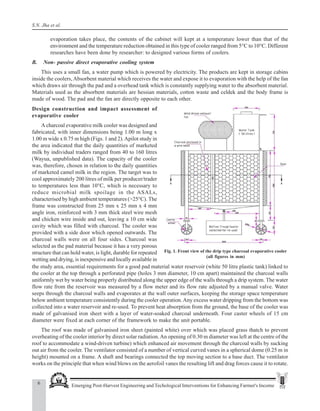
Fig. 1. Front view of the drip type charcoal evaporative cooler
(all figures in mm)
Design construction and impact assessment of
evaporative cooler
A charcoal evaporative milk cooler was designed and
fabricated, with inner dimensions being 1.00 m long x
1.00 m wide x 0.75 m high (Figs. 1 and 2).Apilot study in
the area indicated that the daily quantities of marketed
milk by individual traders ranged from 40 to 160 litres
(Wayua, unpublished data). The capacity of the cooler
was, therefore, chosen in relation to the daily quantities
of marketed camel milk in the region. The target was to
cool approximately 200 litres of milk per producer/trader
to temperatures less than 10°C, which is necessary to
reduce microbial milk spoilage in the ASALs,
characterised by high ambient temperatures (>25°C). The
frame was constructed from 25 mm x 25 mm x 4 mm
angle iron, reinforced with 3 mm thick steel wire mesh
and chicken wire inside and out, leaving a 10 cm wide
cavity which was filled with charcoal. The cooler was
provided with a side door which opened outwards. The
charcoal walls were on all four sides. Charcoal was
selected as the pad material because it has a very porous
structure that can hold water, is light, durable for repeated
wetting and drying, is inexpensive and locally available in
the study area, essential requirements for a good pad material water reservoir (white 50 litre plastic tank) linked to
the cooler at the top through a perforated pipe (holes 3 mm diameter, 10 cm apart) maintained the charcoal walls
uniformly wet by water being properly distributed along the upper edge of the walls through a drip system. The water
flow rate from the reservoir was measured by a flow meter and its flow rate adjusted by a manual valve. Water
seeps through the charcoal walls and evaporates at the wall outer surfaces, keeping the storage space temperature
below ambient temperature consistently during the cooler operation.Any excess water dripping from the bottom was
collected into a water reservoir and re-used. To prevent heat absorption from the ground, the base of the cooler was
made of galvanised iron sheet with a layer of water-soaked charcoal underneath. Four caster wheels of 15 cm
diameter were fixed at each corner of the framework to make the unit portable.
The roof was made of galvanised iron sheet (painted white) over which was placed grass thatch to prevent
overheating of the cooler interior by direct solar radiation.An opening of 0.30 m diameter was left at the centre of the
roof to accommodate a wind-driven turbine) which enhanced air movement through the charcoal walls by sucking
out air from the cooler. The ventilator consisted of a number of vertical curved vanes in a spherical dome (0.25 m in
height) mounted on a frame. A shaft and bearings connected the top moving section to a base duct. The ventilator
works on the principle that when wind blows on the aerofoil vanes the resulting lift and drag forces cause it to rotate.
30.
7
Emerging Post-Harvest Engineeringand Techological Interventions for Enhancing Farmer's Income
Construction of Evaporative Cool Room for on Farm Storage of Horticultural Produce
This rotation produces a negative pressure inside which extracts warm air that has risen to the top of the cooler to the
outside, therefore, drawing new cool air through the wet charcoal walls. In the absence of wind, the ventilator works
on the principle of stack effects. The ventilators are inexpensive to run and can be used in remote locations without
electricity supply.
Zero Energy Cool Chamber
It is a semi-underground chamber. Out of the total height of 67.5 cm, 30.0 cm is above the ground and the rest
is underground. The sidewalls and the floor is cemented. The sidewalls are made of double layer of bricks leaving 7.5
cm space between the walls. The cavity between the walls is filled with riverbed sand.About 400 bricks are required
to make a chamber of 165 cm x 115 cm x 67.5 cm dimension. The top of the storage area of the chamber is covered
with gunny cloth over a bamboo frame. The bricks of the walls and floor, the sand used in the cavity and the top
cover made of gunny cloth are saturated with water. The sand in the cavity is made saturated by fixing a drip system
with plastic pipes connected to an overhead water source.
Shelf life of banana, khasi mandarin, tomato, pointed gourd, betelvine and lai (Brssica rugosa) were evaluated.
The shelf life of these fruits/vegetables could be extended by 25, 21, 13, 31 and 9 days respectively, which was more
or close to double compared under room condition. Temperature difference between the structures and the ambient
has been observed to be about 8 degree C during summer months and about 3 degree C during winter months. It can
accommodate about one quintal of fruits / vegetable at a time.
1. Current status of the technology
i. Whether commercialized : Demonstrated at farmers field
ii. No. of licensees : No
iii. No. of units sold so far (till date) : No
iv. Profit from sale of single prototype/ process : NA
v. IP status (whether patented / patient application filed) : No
2. Improvement over conventional practice
Advantage Unit
Output advantage/ Higher recovery Kg/ hr. or q/ day NA
Reduction in PH losses 10 Kg/ q 0
Labour cost reduction Rs./ q NA
Energy saving Rs./ q NA
Time saving (in terms of capacity) Hr. /day or days/ yr NA
Improvement in storage life (extended period) Days Tomato : 13
Betelvine : 11
Pointed gourd : 4
Khasi mandarin : 15
Lai (Brssica rugosa) : 9
Decrease in maintenance cost Rs./ machine NA
Benefits in case of custom hiring Rs./q NA
Value addition NA
Any other
3. Cost involved : Rs.2940.00
4. Employment generation (mandays/ annum, no. of persons): NA
5. Anticipated Market demand for the equipment or product developed
Suitable for farmers.
31.
8 Emerging Post-HarvestEngineering and Techological Interventions for Enhancing Farmer's Income
S.N. Jha et al.
6. Cost economics and benefits over conventional technology (Rs. /unit)
Sr. Assumptions and cost/ Technology (equipment/ Conventional technology Remarks (if any)
No. benefits process developed) (Bamboo khasa)
A. Assumptions
i. Capacity 1 q/batch 1 q/batch
ii. Cost 2940.00 150.00 x 10 = 1500.00 Buy 10 times at present cost to
match life
iii. Life or degeneracy period (in years) 5 0.5
iv. Annual use (Hours of hiring to be 12 months 12 months
shown separately)
v. Salvage value 35 % 0
vi. Interest rate 12% 12%
vii. Labour charges (Rs./h or day) x x
viii. Cost of fuel (Rs./l) x x
ix. Cost of electricity (Rs./unit) x x
B. Fixed cost
i. Depreciation on all machinery @15%: Rs.36.75 @20%: 25.00 Per month
ii. Interest on fixed capital @12%: Rs.29.40 @12%: 15.00 -do-
Sub total (B) 56.00 40.00
C. Variable cost
i. Cost of raw material x x
ii. Repair and maintenance (Rs/year) 100.00 60.00
iii. Fuel and electricity charges (Rs.) x x
iv. Other expenses (Rs.) x x
Sub total C 100.00 60.00
D. Total cost (B+C) 156.00 100.00
E. Returns
a. Final product (main) recovery Qty Rate Total Qty Rate Total
(Rs./unit) (Rs.) (Rs./unit) (Rs.)
90 kg 1800 1800 75 kg 1500 1500
b. By product x x x x x x z Compared for
c. Custom hiring x x x x x x Tomato.
Total returns (a+b+c) 1800.00 1500.00 z @Rs.20/kg
F. Profit (E-D) 1644.00 1400.00
G. Saving over conventional 244.00 Av. per batch per month
practice (Rs./unit)
Recommended minimum temperature to increase storage time
There is no ideal storage temperature for all fruits and vegetables, because their response to reduced temperatures
varies widely. The importance of factors such as mould growth and chilling injuries must be taken into account, as
well as the required length of storage (Wills et al., 1989). Storage temperature for fruits and vegetables can range
from -1 to 13°C, depending on their perishability. Extremely perishable fruits such as apricots, berries, cherries, figs,
watermelons can be stored at -1 to 4°C for 1-5 weeks; less perishable fruits such as mandarin, nectarine, ripe or
green pineapple can be stored at 5-9°C for 2-5 weeks; bananas at 10°C for 1-2 weeks and green bananas at 13°C
for 1-2 weeks. Highly perishable vegetables can be stored up to 4 weeks such as asparagus, beans, broccoli and
Brussels sprouts at -1-4°C for 1-4 weeks; cauliflower at 5-9°C for 2-4 weeks. Green tomato is less perishable and
can be stored at 10°C for 3-6 weeks and non-perishable vegetables such as carrots, onions, potatoes and parsnips
can be stored at 5-9°C for 12-28 weeks. Similarly, sweet potatoes can be stored at 10°C for 16-24 weeks. The
storage life of produce is highly variable and related to the respiration rate; there is an inverse relation between
respiration rate and storage life in that produce with low respiration generally keeps longer. For example, the respiration
32.
9
Emerging Post-Harvest Engineeringand Techological Interventions for Enhancing Farmer's Income
Construction of Evaporative Cool Room for on Farm Storage of Horticultural Produce
rate of a very perishable fruit like ripe banana is 200 mL CO2.kg-1
h-1
at 15°C, compared to a non-perishable fruit such
as apple, which has a respiration rate of 25 mL CO2.kg-1
h-1
at 15°C.
Exposure of fruits and vegetables to high temperatures during post-harvest reduces their storage or shelf life.
This is because as living material, their metabolic rate is normally higher with higher temperatures. High temperature
treatments are beneficial in curing root crops, drying bulb crops and controlling diseases and pests in some fruits.
Many fruits are exposed to high temperatures in combination with ethylene (or another suitable gas) to initiate or
improve ripening or skin colour.
Conclusion
When fruits and vegetables are exposed to high temperatures during post-harvest it reduces the storage or shelf
life and as such, the shelf life of most fresh vegetables can be extended by prompt storage in an environment that
maintains product quality. Although, refrigeration is very popular but it has been observed that several fruits and
vegetables, for example banana, plantain, tomato etc. cannot be stored in the domestic refrigerator for a long period
as they are susceptible to chilling injury.Apart from this, the epileptic power supply and low income of farmers in the
rural communities’ makes refrigeration expensive. Hence the need for an evaporative cooling structure for storage
of fruits and vegetables.
References
Anyanwu E.E; (2004). Design and measured performance of a porous evaporative cooler for preservation of fruits and vegetables,
Energy Conversion and Management (45) 2187–2195
ASHRAE (2003) Evaporative Cooling System. American Society of Heating and Refrigeration and Air
Conditioning.www.ashare.com.
Dvizama, A. U. (2000). Performance Evaluation of an Active Cooling System for the Storage of Fruits and Vegetables. Ph.D.
Thesis ,University of Ibadan , Ibadan.
Jain .D (2007).Development and testing of two-stage evaporative cooler .Building and Environment) 2549–2554
Ndukwu. M. C. Development of a Low Cost Mud Evaporative Cooler for Preservation of Fruits and Vegetables. Agricultural
Engineering International: CIGR Journal. Manuscript No.1781.Vol. 13, No.1, (2011). Provisional PDF Version. 3rd edition.
Series No. 8.
NewsInfo.11:333-336.
Noble, N. (2008) www.practicalaction.org
Olosunde William Adebisi ; J.C. Igbeka and Taiwo Olufemi Olurin (2009). Performance Evaluation of absorbent materials in
Evaporative Cooling System for the Storage of Fruits and Vegetables International Journal of Food Engineering Volume
5, Issue 3.
Sanni, L.A(1999). Development of Evaporative Cooling Storage System for Vegetable Crops .M.Sc. project report, Department
ofAgricultural Engineering, ObafemiAwolowo
Sellers (2004). Evaporative Cooling: Design Considerations HPAC Engineering Service. p136.
33.
10 Emerging Post-HarvestEngineering and Techological Interventions for Enhancing Farmer's Income
R.K. Singh et al.
Role of Plasticulture Technologies inAgriculture Production and Post-
Harvest Management
R.K. Singh, Indore Navnath S. and MalathiA.N.
ICAR-CIPHET, Ludhiana-141004, Punjab
India supports nearly 16% of world’s population with 2.4% land resource and 4% water resource and lately the
dwindling quality and the vagaries of the availability of these resources are raising serious questions on the sustainability
of the agricultural practice. To counter the problem, efforts need to be redirected to improve the productivity of the
land, efficiency of the supply chain while reducing the carbon footprint by efficient usage of fertilizers, as a result of
agricultural practice. Plasticulture, which is use of plastic in agricultural practice, is an answer to this rallying cry.
Plasticulture is a scientific way of carrying out agriculture, which not only improves the productivity, but optimizes the
input resources as well, thereby reducing the cost. There has been significant progress in the adoption of Plasticulture
techniques in the last decade, however the low penetration levels suggest it needs to grow at a rapid pace from now.
On the demand side awareness of the available options and subsidies, its relevance and applicability could improve
the adoption rate. From the supply side industry needs to take efforts to bring down the capital cost, work on creating
an environment where Plasticulture culture is a norm than exception. Concentrated efforts in direction of
demonstration, spreading word of mouth, and building credibility by performance & after-sales services could help
shape the industry. Government policy intervention in creating the environment for investments in R&D, supporting
farmers with initial subsidies as per the local conditions and improving the timelines for sanctions of subsidies would
be important to shape the structure of the industry. There are enough cases of successful implementation of these
measures elsewhere and subsequent value creation to all the stakeholders across the value chain. It is becoming
increasingly clear that this technique remains, no more a choice but the only option, if we have to remain self-
sustainable in our food security. We are at the cusp of changing paradigm in agriculture and it is an opportunity we
have to tame efficiently and swiftly. A second phase of Green Revolution is in making. Use of plastic material in
agricultural practices is referred to as Plasticulture. Plasticulture includes all kinds of plant or soil coverings ranging
from mulch films, row coverings, poly-tunnels to greenhouses. The benefits of Plasticulture are reduced water loss,
UV stabilization to cool soil and prevent insects & prevention of weed growth. Polyethylene plastic film is used
majorly for Plasticulture, by growers, because of its flexibility, easy manufacturing and affordability.
Status
Compared to world average of polymer utilization in agriculture which stands at 8%, India has ploymer utilization
of just 2%. Per capita consumption of plastic in India is 9.7 kg/person which is far below world average of 45 kg/
person. The net sowed area in India stands at 141.3 million Ha and the net irrigated area is 63.2 million Ha (45%).
There is also heavy pre and postharvest losses which further contribute to low availability of food grains and fruits
and vegetables.All these factors make use of plastics in agriculture an interesting proposition, as there are substantial
benefits of employing the Plasticulture techniques to improve the productivity while saving the water consumption
and minimizing the post-harvest wastages. The greater use of plastic in agriculture can also help to a great extent to
achieve up to fifty percent of the intended targets in Agriculture. The wider use of Plasticulture can reduce the loss
of harvest and can increase the efficiency thus contributing more to the GDP. It is estimated that the agriculture
output can be increased by ~INR 68,000 Cr by using proper Plasticulture applications like drip irrigation, mulching
etc. Also, using innovative plastic packaging and handling techniques can promote proper harvest management
which will in turn contribute towards the Agriculture-GDP.
Major plasticulture technologies applications areas are as follows:
Water management
1. Lining of canals, ponds & reservoirs with plastics film
2. Drip & Sprinkler Irrigation
34.
11
Emerging Post-Harvest Engineeringand Techological Interventions for Enhancing Farmer's Income
Role of Plasticulture Technologies in Agriculture Production and Post-Harvest Management
3. PVC & HDPE pipes used for water conveyance
4. Sub-surface Drainage
Nursery Management:
1. Nursery bags, Pro-trays, Plastic plugs, Coco-pits, Hanging baskets, Trays etc
2. Surface cover cultivation :
3. Soil Solarisation
4. Plastics Mulching
Controlled environment agriculture:
1. Greenhouses
2. Shade net houses
3. Low tunnels
4. Plant Protection nets
Post-harvest Management:
1. Plastics crates, bins, boxes, leno bags, unit packaging products etc
2. Controlled Atmospheric Packaging(CAP) & Modified Atmospheric Packaging (MAP)
To harness or untap the potential of plastics in agriculture ICAR has started All India Coordinated Research
Project on Plasticulture Engineering and Technologies (PET) become operational in 1988 during VII Plan period
(known as AICRP on Application of Plastic in Agriculture). AICRP on PET takes research and extension activity
pertaining to water management, protected farming, post-harvest produce management etc. In XII Plan period, the
project became operative at fourteen Centres. The major thrust areas of the project are on surface covered cultivation
and development of package of practices for better utilization of covered area, rainwater harvesting or water storage
pond lining, efficient utilization techniques for stored water including pressurized irrigation, gravity fed micro-irrigation,
farm machinery components using plastics as material for reducing weight and improving efficiency and intensive
fish culture devices and strategies. It has made significant contributions during the course of its execution in the field
mentioned above. It includes development of polyhouse cultivation strategies and its participatory evaluation, plastic
film lined ponds, shade net / insect net house designs, plastic body winnower-cum-grader for hilly regions, packaging
strategies for fruits and fish, plastic mango ripening chamber, gadgets for intensive fish culture, etc AICRP on PET
developed several plasticulture technologies which plays important role in agriculture production and post harvest
Management
Role of plasticulture technologies in agriculture production:
1. Polyhouse, Shade net structures low tunnel and mulching technology :
Improved Polyhouse, shade net structure design and mulching techniques developed in this scheme have direct
and indirect impact on overall agricultural production due to following advantages
z Intensive cropping on small land area – higher productivity per unit of natural resources used (land and water)
z Less input requirement - more input use efficiency labour and soil solarization.
z Environment friendly - Excessive uses of inputs (fertilizers and pesticides) are avoided.
z High quality produce - free of pesticide residues for human consumption.
z Easy to relocate and dismantled in case of low tunnel with low cost of operation
z Higher yield and better quality produce due to creation of optimum conditions such as climatic control, balanced
plant nutrition and plant protection, which can never be achieved in the open field conditions.
z Some of the low cost technologies and design of Polyhouse reduce the cost of production and also increased
production of crops
35.
12 Emerging Post-HarvestEngineering and Techological Interventions for Enhancing Farmer's Income
R.K. Singh et al.
z Shade nets cuts down the light intensity and reduce the temperatures to some extent, making the climate congenial
to grow many off-season crops where conventional farming is too difficult.
z In case of mulching Soil moisture control, temperature control in root zone, weed control, reduce damage to
produce (Strawberry protected from contact to soil)
z Enhances photosynthesis by light reflected back to leaves, insect pest management (act as repellant or attractor
for some insects
Major application of controlled environment structures
1. Offseason cultivation of vegetables crops, flowers and high value crops
2. Nursery and seedling raising
3. In the area of aquaculture
Some of the studies carried out by AICRP on PET centres in the field of protected cultivation (greenhouse/
polyhouse and shade net structure) evident that use of plasticulture technologies have increased production of
agriculture crops
Role of Polyhouse, shade net, low tunnel technology in agriculture production
Yield of cumin seeds was increased about 67 % under protected cultivation (low tunnel) over control. Watermelon
is yielded 40 times more over control. i.e 40.45tn/ha. Onion yield achieved 8.64 ton per ha which is higher than the
potential yield of the onion. Sunburn of fruit is reduced from 43% to 2% under protected cultivation (colored shadenet).
Increase in production of vegetables (capsicum, tomato, cucumber, brinjal, chilli, biiterguard etc..) by 2- 3 times with
20%-30% early yield in protected cultivation (Polyhouse, nethouse) for e.g. Highest tomato yield of 116.3 t/ha and
Capsicum 6.20 t/ha in 35% shading.. The highest yield of brinjal was 3.07 kg/m 2 was obtained at a spacing of
45x60cm, while in open field it was 2 to 2.5 kg/m2
. Yield of broccoli 3.17 kg/m 2
at spacing of 30X30cm, while it was
2 kg/m 2
in open conditions. 3. Mulching with black film (ordinary and biodegradable) improved yield of okra by 57 to
66% over control. Yield of strawberry increased from 4.6 t/ha to 14.24 t/ha in protected cultivation. Round the year
cultivation in polyhouse/ shade net house has B.C ratio in range of 2- 3. Following table illustrates the summarized
findings of the work and impact of technology.
Table: Yield performance of different crops under protected cultivation:
Crop Average yield Expected yield in poly- Remarks
in open (t/ha) net-house (t/ha)
Tomato 45-60 70-100 About 1.5 times higher yield compared to open field and about 20-30
% will be early yield
Capsicum 18-20 40-55 About 2 - 2.5 times higher yield compared to open field and about 40
% will be early yield
Chilli 25-30 30-50 About 1.2 - 1.5 times higher yield compared to open field
Bittergoured 20-25 30-40 About 1.5 times higher yield compared to open field
Cucumber 20-25 40-75 About 2.25 times higher yield compared to open field
Micro irrigation, plastic lined pond and plastic based farm tools and equipments
Micro irrigation and polythene lined pond are plasticulture technologies have wide application in the area of
water management. Water is important input for agriculture so its precise and judious management increased the
yield of crops. Some of the major advantages of this technologies are: Maximum water use efficiency, Fertilizer/
nutrient loss is minimized, Low operational cost and soil erosion is not taken place, improved seed germination, not
necessary to level the fields, harvesting water for multiple use, prevent loss of water etc. Almora centre (2011)
designed Low density polyethylene lined small ponds were found quite effective in providing supplemental irrigation
36.
13
Emerging Post-Harvest Engineeringand Techological Interventions for Enhancing Farmer's Income
Role of Plasticulture Technologies in Agriculture Production and Post-Harvest Management
to horticultural/vegetable production in hilly areas. Water resources of 2417 m3
capacity were developed at the
farmers’ field. Micro-irrigation in conjunction with LDPE lined pond constructed on higher elevated terrace and the
system is operated by gravity was evaluated by Almora centre (2012). The garden pea and frenchbean were grown
using the micro-irrigation system. Garden pea had yield 6.3% higher in micro-irrigation as compared to check basin.
Role of plasticulture technologies contributed in improving animal husbandry production: Controlled environment
provided by plasticulture technology help to enhance animal production which is evindent from this findings. ICAR-
VPKAS Almora centre (2012) evaluated growth of the exotic carp; silver carp, in the polytanks that polyhouse
covered tank. Growth of carp was better 129.0% from the cemented pond and 90.8% from the earthen open pond.
Bhubaneshwar centre (2009) developed FRP carp hatchery found found suitable for production of spawn up to 0.55
million in one operation. Some useful gadgets like demand fish feeder and colored net are also in filed to enhance fish
production in aquaculture sector
Role of plasticulture technologies in Post harvest management
Plasticulture technologies have major role in area of post harvest management.
Plastics properties described earlier made them best contender in post harvest management from filed to the
consumer basket. Major areas of plasticulture technologies application in post harvest management are drying, short
term storage and long term storage , material handling and transportation of agricultural produce.
Drying of agriculture produce
Drying unit operation is simple method of preservation of agricultural produce. The plasticulture technology such
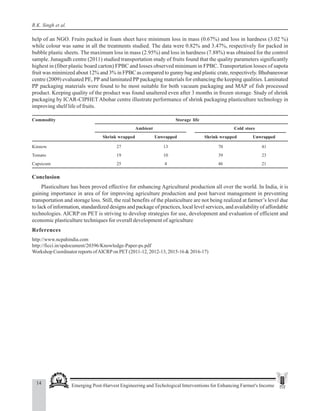
as polyhouse multitier drier makes good use of modified microclimatic condition for drying of fruits and vegetable
crops. High drying rates reduce time of dying and good quality that open sun drying are some advantages of this
plasticulture technology.
SKUAST-K Srinagar centre developed multitier solar tunnel drier for drying of vegetables results revealed that
The percentage weight loss in palak, fenugreek and okra were around 88%, 86% & 54%.During the drying of the
samples inside the greenhouse dryer, the max/min temperature varied between 39.9 to -7.1 0
C The final moisture
content of palak & fenugreek was around 3.5% while it was 5% for okra.
Storage and Packaging, transportation of agriculture produce
Plasticulture technology play important role in storage and transportation of agriculture produce. It helps in
preservation of produce from short term storage to long term storage. Packaging provides produce itself microclimate
which maintain its quality as well as extend the shelf life of produce. It offers several advantages such as ease in
handling, flexibility in transport and storage with lower cost of operation. Reducing losses and maintain quality in
storage of agriculture produce. Some of the popular plasticulture technologies are Plastics crates, bins, boxes, leno
bags, unit packaging products, colored shade nets, Modified Atmospheric Packaging (MAP). Plastic packaging
plays an important role in the fruit and vegetable distribution chain.According to Watkins and Nock (2012), it offers
main function of packaging with ease: Containment. Containment is the basic requirement for movement of a
product from one point to another.The package type and size will be a function of the product and market requirements.
protection and preservation. Packages provide protection for the product against environmental factors such as dust
and water, as well as impact and compression bruising and friction injuries that can occur during handling and
transport. Convenience. Products are packaged in sizes convenient for handlers and for the consumer. Consumer
packages are often contained within larger containers for transport because of economies of scale communication.
In addition to advertising the type and source of the product, the package lists gross and net package weight, unit size
of the product and any additional information required by government regulations.
Some silent research findings of AICRP on PET centres in reduction of losses in perishables :Shadenet
Based farm storage structure (Junagadh centre, 2011) Shelf life of tomato increased up to 4 days and for spinach it
was increased by 2 days in the net house (75%) with less weight loss and decay. Plastics in handling, packaging and
transportation of custard apples (Udaipur, 2011) The study was undertaken in participatory mode with farmers with
37.
14 Emerging Post-HarvestEngineering and Techological Interventions for Enhancing Farmer's Income
R.K. Singh et al.
help of an NGO. Fruits packed in foam sheet have minimum loss in mass (0.67%) and loss in hardness (3.02 %)
while colour was same in all the treatments studied. The data were 0.82% and 3.47%, respectively for packed in
bubble plastic sheets. The maximum loss in mass (2.95%) and loss in hardness (7.88%) was obtained for the control
sample. Junagadh centre (2011) studied transportation study of fruits found that the quality parameters significantly
highest in (fiber plastic board carton) FPBC and losses observed minimum in FPBC. Transportation losses of sapota
fruit was minimized about 12% and 3% in FPBC as compared to gunny bag and plastic crate, respectively. Bhubaneswar
centre (2009) evaluated PE, PP and laminated PP packaging materials for enhancing the keeping qualities. Laminated
PP packaging materials were found to be most suitable for both vacuum packaging and MAP of fish processed
product. Keeping quality of the product was found unaltered even after 3 months in frozen storage. Study of shrink
packaging by ICAR-CIPHET Abohar centre illustrate performance of shrink packaging plasticulture technology in
improving shelf life of fruits.
Commodity Storage life
Ambient Cold store
Shrink wrapped Unwrapped Shrink wrapped Unwrapped
Kinnow 27 13 70 41
Tomato 19 10 39 23
Capsicum 25 4 46 21
Conclusion
Plasticulture has been proved effective for enhancing Agricultural production all over the world. In India, it is
gaining importance in area of for improving agriculture production and post harvest management in preventing
transportation and storage loss. Still, the real benefits of the plasticulture are not being realized at farmer’s level due
to lack of information, standardized designs and package of practices, local level services, and availability of affordable
technologies. AICRP on PET is striving to develop strategies for use, development and evaluation of efficient and
economic plasticulture techniques for overall development of agriculture
References
http://www.ncpahindia.com
http://ficci.in/spdocument/20396/Knowledge-Paper-ps.pdf
Workshop Coordinator reports ofAICRPon PET(2011-12, 2012-13, 2015-16 & 2016-17)
38.
15
Emerging Post-Harvest Engineeringand Techological Interventions for Enhancing Farmer's Income
Value Addition of Horticultural Produce: A Tool to Double Farmer’s Income
ValueAddition of Horticultural Produce:ATool to Double Farmer’s Income
Ramesh Kumar and Sunil Kumar
Division of Horticultural Crop Processing, ICAR-CIPHET, Abohar-152116, Punjab
Horticultural crops form a significant part of total agricultural produce in the country comprising of fruits, vegetables,
root and tuber crops, flowers, ornamental plants, medicinal and aromatic plants, spices, condiments, plantation crops
and mushrooms and have become key drivers for economic development in many of the states in the country. Most
of these crops are of major importance, while a few are of minor importance. Though, India has witnessed a rapid
growth in horticultural crop production in recent past but the increased production alone could not keep the horticultural
produce in fresh condition for longer time. Thus value addition is necessary in order to preserve them for longer
period. It is one of vital components of nutritional security because processing of fruits will not only reduce postharvest
losses but also ensures sufficient food, both in quantity and in quality to every inhabitant in our planet. It provides
convenience and safe food to consumers and promotes diversification and commercialization of horticultural processing
sector by providing effective linkage between consumers and farmers. Thus, horticultural crops are right material in
the present agricultural scenario for value addition because they are more profitable, has high degree of process
ability and richness in health promoting compounds and higher potential for export. The various aspects of value
addition to sustain and enhance the fruits and vegetables processing are discussed hereunder.
Production and export scenario of horticultural crops
India has made a good progress on the horticultural map of the world with a total annual production of horticultural
crops touching over 286 million MT from an area of 24.5 million hectare. Horticultural crops cover about 11.25 per
cent of the total area contributing about 28.0 per cent of the gross agricultural output in the country (Anonymous,
2014). Fruits and vegetables are the important category of horticultural crops grown in India. Our country is the
second largest producer of fruits (90.2 million MT) and vegetables (169.1 million MT), contributing about 13 % and
15 % of the total world production of fruits and vegetables, respectively (NHB, 2016).Apart from fruits and vegetables,
India also produces about 20 million tonnes of root and tuber crops. The country produces 41% of world mangoes,
27.8% banana, 35.3% papaya, 24% cashew nut (MOFPI, 2012) and presently (2016) India is the largest producer of
banana (25.7%), papaya (43.6%) and mango including mangosteen (40.4%).
Among vegetables, India occupies the prime position in ginger and okra and ranks second in the production of
potato, onion, cauliflower and third in cabbage in the world (NHB, 2016). The country produces 36% green peas,
30% cauliflower and 10% onion (MOFPI, 2009). Besides, it is also a well known fact that since centuries it has been
the largest producer, consumer and exporter of spices. However, the productivity of fruits and vegetables grown in
the country is low as compared to the developed countries. The overall productivity of the fruits is 11.8 tonnes per
hectare and vegetables is 14.9 tonnes per hectare. The main fruits that enter the export market are mangoes, grapes,
apples, citrus, bananas, sapota, litchi etc. Mango alone accounts for 40 per cent of the national fruit production and
India is one of the leading exporters of fresh table grapes to the global market. However, export of vegetables is
limited to Middle East, Europe, U.K and Singapore etc.
Value addition in horticulture sector
Value addition to the horticultural produce has assumed vital importance in our country due to diversity in socio-
economic conditions, industrial growth, urbanization and globalization. Moreover, fruits and vegetables are highly
perishable in nature and a large quantities of fruits and vegetables (6.0-18.0 %.) just perish due to inadequate
storage, processing and marketing infrastructure (Nanda et al., 2012) This badly affects the availability of fruits and
vegetables to the consumers and processing is the best way of utilizing surplus production for value addition during
seasonal gluts. So far only 6 % of total fruit and vegetable produced in India are processed into different value added
products indicating that there is a vast market yet to be tapped by the fruit and vegetable processing industry in the
country. Post-harvest value addition includes primary, secondary, and tertiary processing which needs to be performed
with following benefits.
39.
16 Emerging Post-HarvestEngineering and Techological Interventions for Enhancing Farmer's Income
Ramesh Kumar and Sunil Kumar
Advantages of value addition
z Convert perishable fruits into durable product.
z Fruits, which are very difficult to eat out of hand can be processed in to a range of highly acceptable fruit
product.
z Reduce post-harvest losses.
z Make off season availability of fruits.
z Provide safe and nutritional foods to the consumers.
z To emphasize primary and secondary processing.
z To reduce import and to meet export demands.
z To earn more foreign exchange.
z To encourage growth of subsidiary industries.
z To reduce the economic risk of marketing.
z To increase opportunities for smaller farms and companies through the development of markets.
z To diversify the economic base of rural communities.
z To improve the financial stability and profitability of farmers.
z To empower the farmers and other weaker sections of society especially women through gainful employment
opportunities and revitalize rural communities.
Table 1. Profile of fruit and vegetable products developed in
India
Horticultural produce Product
Tomato Pulp, Puree, Sauce/Ketchup
Apple Juice/Concentrate
Citrus fruits Squash/cordial
Fleshy fruits Pulp, Juice, Nectar
Guava Jelly
Onion Powder/Paste
Potato Chips
Garlic Powder/Paste
Ginger/Turmeric Powder
Mango Powder (amchur)
Mango/Jackfruit/Guava Fruit leather
Apple Chips
Papaya/Pumpkin Candy
Mango, citrus fruits, vegetables Pickles
like carrots, Jackfruit, Cauliflower etc.
Cabbage Sauerkraut (by lactic acid
fermentation)
Source: Maini and Anand (2006)
Status of valued added products
Indian food processing activity is mainly confined to
primary processing, which accounts for 80 per cent of
the value addition whereas only 6 % of the total fruit and
vegetables produced in India is being processed in
different forms as a mean secondary processing. There
has been a positive growth in ready to serve beverages,
fruit juices and pulps, dehydrated and frozen fruits and
vegetable products, preserved onions, cucumbers and
gherkins, green pepper in brine, dehydrated garlic and
ginger powder tomato products, pickles, convenience veg-
spice pastes, processed mushrooms and curried vegetables
over the last few years. This contribute the proportion of
different products accounts for fruit juices and pulp (27%),
ready to serve (RTS) beverages (13%), pickles (12%),
jams and jellies (10%), synthetic syrup (8%), squashes
(4%), tomato products (4%), canned products (4%) and
other products (18%). There is considerable demand for
some of these products in foreign markets e.g. mangoes
both fresh and canned, fruit juices, salted cashew earn
good foreign exchanges. Presently, mango, pineapple,
citrus, grapes, tomatoes, peas, potato and cucumber are
being processed on a large scale. Though product profile developed in India at present is limited to only few fruits and
vegetables (Table 1) but there is a large potential for processing of papaya, sapota, banana, jackfruit, guava, aonla,
carambola and other minor fruits through product diversification and quality enhancement. Similarly there is a greater
scope for processing cauliflower, carrot, bitter-gourd, onion, garlic, watermelon, muskmelon etc.
40.
17
Emerging Post-Harvest Engineeringand Techological Interventions for Enhancing Farmer's Income
Value Addition of Horticultural Produce: A Tool to Double Farmer’s Income
Choice for value addition
Fruits and vegetable can be processed in a number of products like fruit pulps and juices, concentrates, alcoholic
and non-alcoholic beverages, canned fruits and vegetables, jams, squashes, pickles, chutneys and dehydrated vegetables.
The new arrivals in this segment are minimally processed fruit, vegetable curries in retortable pouches, canned
mushroom and mushroom products, fruit bar, dried fruits and vegetables and fruit juice concentrates. Some of these
products may find market in the international trade but concentrated efforts are still required for the development of
novel products for global market. This can be achieved by paying special attention to following parameter for
deriving maximum benefit through value addition.
z Uniqueness: The developed product should be one of its own kinds. Indigenous fruit crop variability to our
country can be gainfully exploited for this purpose.
z Novelty: The product should be new and unusual like blue or black rose so that no one can compete.
z Export potential: The product developed should have demand in international market for higher return and
appreciation of benefit of global trade.
z High value: The product should have high value for low volume for ease of trading and distribution. The spices
and herbal plants extracts from India can fulfil this requirement.
z Availability: Consistent availability of the product in required quantity should be ensured for stable market and
faith.
z Market: Any product that is developed must have ready market available because market is the key for
success of any product. The processed product can be classified into three different categories based on their
market demand.
i) Products that have a high demand
z Fried products
z Dried fruits and vegetables
z Juices, squashes and cordials
z Sauces
z Wines
ii) Products that have a lower demand
z Chutneys
z Jams, jellies and marmalades
z Pickles and salted vegetables
z Pastes and purees
iii) Products that may have a future demand
z Canned fruits
z Crystallized fruits
z Fruit leathers
z Fruit cheese
z Minimally processed fruit and vegetables
Ways to add value to fruits and vegetables
Value addition is a process of increasing the economic value and consumer appeal of a commodity. In the past,
the consumer’s preferences were limited to taste and flavour and the horticultural produce was processed primarily
into jams, jellies, chutneys, etc. But after 1950, the priorities have changed to safe and nutritious foods. Canning and
41.
18 Emerging Post-HarvestEngineering and Techological Interventions for Enhancing Farmer's Income
Ramesh Kumar and Sunil Kumar
dehydration were considered to be the most sophisticated methods of processing, prior to the discovery of rapid
freezing (Abdullah, 2010). In 21st century, considerable emphasis has been given on functional, nutraceutical food
products due to their great demand among the consumers. By products of fruit and vegetable processing could also
be gainfully utilized for extraction of high value compound and novel product development. Besides, considerable
volumes of unmarketable and physically damaged fruits and vegetables that are without infection can be converted
into value added products by processing.
There are several methods for preserving fruits and vegetables. Selection of method will depend on the type of
fruit or vegetable and the level of processed product. Some of the fruit properties for manufacturing different value
added products are listed in Table 2. It is to be noted that no processing technique can transform poor quality raw
materials into good one rather it can only extend the product’s shelf life. In order to ensure that your product meets
required high standards, following factors should be considered:
Table 2. Raw material properties required for various fruit products.
Processed Products Sensory properties Chemical composition
Shape Texture Flavour Taste Acidity Sugars Pectin
Dried Fruits + + + + + + + +
Fruit Juices + + + + + +
Marmalade + + + + + +
Jams + + + + + + + +
Jellies + + + + + + + + + +
Fruit Paste + + + +
Source: Puri and Sanghera (1987)
z Always use high quality raw ingredients
z Establish good processing techniques and follow them
z Maintain an appropriate product environment after processing.
z Ensure optimal use of fruits as a function of their properties
Value addition of guava
Guava is very popular as a fresh fruit because of its excellent taste, high vitamin content and 100% edibility. This
fruit is equally important for the processing industry. A large number of processed products are manufactured from
guava. Processed guava pulp is an excellent raw material for preparation of various other guava products such as
nectars, beverages, jams, toffee, cheese, ice cream topping etc. Guava pulp can be preserved successfully in bulk
either by application of heat (aseptic packaging) or addition of chemical preservation (SO2
). Because of presence of
42.
19
Emerging Post-Harvest Engineeringand Techological Interventions for Enhancing Farmer's Income
Value Addition of Horticultural Produce: A Tool to Double Farmer’s Income
rich amount of pectin, a high quality natural jelly is obtained from guava. Guava leather, dehydrated guavas, and
guava powder are the other important products that have a great market potential. Further value addition in guava as
new product development can be approached through following ways:
z A product entirely new in character.
z A product apparently similar in character in many respects to some existing brands but with distinguishing
features.
z A product similar to one already in the market but new form of manufacture
z A product novel in kind, made by novel process or through novel ingredient.
z A product resulting from substantial modifications of the characters with change in nature/proportion of ingredients
or processing methods or conditions or packing system.
Factors influencing the value addition of fruit and vegetable
Almost all fruits and vegetables can be processed in one or other forms. However, processing requires frequent
handling, high temperature and pressure treatment and the choice of processing depends on the characteristics of
individual fruit or vegetable. For instance, a particular variety of fruit or vegetable may be excellent for table purpose
but may not necessarily be good for processing. Similarly, many ordinary table varieties of tomatoes are not suitable
for making paste or other processed products. A particular mango or pineapple may be very tasty as fresh fruit but
it may fail to withstand the processing requirements due to variations in their varietal characters such as fruit
maturity, size and other quality parameters. Such varietal differences further extended to their suitability for different
processing method such as canning, freezing, pickling or drying.Avariety of peas that is suitable for canning may be
quite unsatisfactory for freezing and varieties of potatoes that are preferred for freezing may be less satisfactory for
drying or potato chip manufacture. Therefore, following factors determines whether the processing of the produce is
worthwhile or not.
a. Demand for a particular fruit or vegetable in the processed form.
b. Quality of the raw material, i.e. whether it can withstand processing.
c. Regular supplies of the raw material. Because even when a variety is most suitable for processing, it is not
always appropriate unless large and regular supplies are made available.
Table 3. Quantity of processed fruit and vegetable products in
India
Products Production (,000 tonnes)
Mango pulp 737.10
Fruit juice 293.83
Fruit nectars 125.70
Dried fruits 84.8
Preserves and candies 73.7
Fruit Powder (flour) 15.4
Mixed fruit pulps 3.3
Total 1334.3
Source: FAO (2011)
Export of processed products
India is the major producer of mango pulps and fruit
juices (Table 3). Processed fruits and vegetables account
for about 20% and 17% of the world horticultural trade,
respectively. India’s major exports are in fruit pulp, pickles,
chutneys, canned fruits and vegetables, concentrated
pulps and juices, dehydrated vegetables and frozen fruits
and vegetables. Among the processed fruits, 41% trade
is of fruit juices and 12% of dried fruits (APEDA, 2011).
Similarly, among processed vegetables, the major items
are mushrooms, gherkins and frozen pre-cut vegetables.
Five commodities namely fresh onions, mango pulp,
processed gherkins, fresh grapes and fresh mangoes
together account for about half of the total horticultural exports. India is also a major exporter of mango pulp in the
world and the country’s export has increased to 1,28,866.01 MT of mango pulp worth of Rs. 796.17 crores during the
year 2015-16. Fruit juices, fruit pulp and pickles are mainly imported by the USSR,Yemen, UK, UAE, SaudiArabia,
Kuwait, Germany, USA, Holland and Switzerland. Nearly half of India’s processed fruit exports are mango based
fruit juice, canned and bottled fruits.
43.
20 Emerging Post-HarvestEngineering and Techological Interventions for Enhancing Farmer's Income
Ramesh Kumar and Sunil Kumar
Future strategies and action plan for promotion of value addition
z
z
z
z
z New market oriented technologies for secondary agriculture and value addition
z Cutting edge technology for value addition through minimal processing
z Large scale drying technology to preserve vegetables
z Bio-energy and solid waste utilization
z Effective transfer of technologies to the target groups
z Development of standards for product quality of fresh horticultural products
z Small scale processing sector is needed to be replaced slowly with large scale units, more cost effective and
energy efficient technologies should be provided to the processors.
Summary
Value addition of horticultural produce plays an important role in conversion and better utilization of surplus
produce into nutritionally rich processed products with wider acceptance. Preservation techniques like freezing,
canning and drying all serve to transform perishable fruits and vegetables into products that can be consumed year
round and transported safely to consumers all over the world. Minimally processed vegetables reduce the time of
cooking with various health benefits. Similarly ready-to-eat fruit provide varied taste and convenience of time with
extended shelf life. There are tremendous opportunities for the establishment of a vibrant and potentially profitable
horti-processing sector. This will however require stronger, more meaningful linkages between the farming community,
the agro-processing sector, Government and financial institutions. It is therefore, appropriate time for us to come out
of primary processing and bulk exporting of processed products and get into newer product development and marketing
of ready to consume product through value addition. Production of fruit juices, dehydrated products, fruit bar, fruit
leather, fruit wines and semi-processed food, are some of the areas that can be envisaged to explore international
market.
References
Abdullah A. 2010. Global ARD future direction on value addition of fruits and vegetables. Universiti Kebangsaan Malaysia
(UKM).APCoAB.Asia Pasific Consortium onAgrocultural Biotechnology. Malasiya.
Anonymous (2014). Hand Book of Horticulture Statistics, Horticulture Division, Ministry ofAgriculture, DAC, GOI, New Delhi.
APEDA (2013) Report of Agricultural and Processed Food Products Export Development Authority, Minstry of Commerce &
Industry GOI.
FAO (2011) Import export of fruit & vegetables & products. Food &Agriculture Organization, Rome, Italy. http://faostat3.fao.org/
Maini, S.B. andAnand, J.C. 1996. Fruit andVegetable Processing Industry:
Present Status and Future Prospects, Productivity, 36(4): 557.
Ministry of Food Processing Industry (2009, 2012, 2013). Website: http://mofpi.nic.in
Nanda, S. K. Vishwakarma, R. K., Bathla, H.V.L., Rai, A. and Chnadra, P. (2012). Assessment of quantitative harvest and post-
harvest losses of major crops/commodities in India.AICRP on PHET report, ICAR-CIPHET, Ludhiana
NHB (2016)Area & production of horticulture crops. National Horticulture Board, Ministry ofAgriculture & Farmers Welfare,
GOI, Gurgaon
Puri, R. and Sanghera, T. 1987. Nutritive value and consumption pattern of some processed foods. Indian Food Packer, 41: 23.
Singh, I.S., (2011), Food Processing, Mrinal Goel, Westville Publishing House, New Delhi, pp 96-100.
44.
21
Emerging Post-Harvest Engineeringand Techological Interventions for Enhancing Farmer's Income
Extrusion Technology for Increasing Farmer’s Income
ExtrusionTechnology forIncreasing Farmer’s Income
Mridula D., Deepika Goswami and Chandan Solanki
ICAR-CIPHET, Ludhiana-141004, Punjab
Extrusion processing is a promising techniue to develop the healthy food products which are cholesterol free, low
in fat, and rich in phytofactors. Extrusion can be defined as the process that combines the mixing, forming, texturizing
and cooking of raw material to develop a new food product with special characteristics. It is a high-temperature
short-time (HTST) process that reduces microbial contamination and inactivates enzymes. It has an important role in
the food industry as efficient manufacturing processes. Extrusion cooking technologies are used for cereal and
protein processing in the food and, closely related, pet foods and feeds sectors. The processing units have evolved
from simple conveying devices to become very sophisticated in the last decade. Extrusion processing has been found
to lower the level of antinutrients and enhanced the digestibility of proteins and starch (Bargale and Kulkarni, 2010;
Singh et al., 2007).
Extrusion technology involves forcing of raw material or food materials or feed formulation through a hole (or
die) to produce the products of desired shapes and size. High throughput with continuous operation, lower processing
cost, higher quality of heat sensitive nutrients because of high temperature for short time and low moisture process
result in environment friendly process, are some of the key attributes of extrusion technology. The thermal energy
generated by viscous dissipation during extrusion cooking with combination of shearing effect cooks the raw mixture
quickly so that the properties of the materials are modified by physico-chemical changes of the biopolymers. It
results in gelatinization of starch, denaturation of proteins, inactivation of many native enzymes and antinutritional
factors, reduction of microbial counts, and improvement in digestibility and biological value of nutrients. There are
several different types and styles of extruders available in the market. This may cause a difficulty for food or feed
manufacturers to select a proper extruder for specific type production. In general, extruders are divided into two
major categories:
9 Single-screw extruder
9 Twin-screw extruder
Single screw extruders
Single-screw cooking extruders have compressive screws with decreasing channel depth turning at high speeds
to increase shear and mechanical energy input for heating. Heating of a product is induced by the resulting friction.
The barrel is jacketed for steam to allow additional contact heating in the metering section. To increase capacity and
efficiency, it is common to preheat ingredients in a pre-conditioner by adding steam before they enter the extruder.
Categories of single-screw extruders include (Harper, 1981):
a) Cold forming (Pasta-type) extruder: Deep flight, smooth barrel, low shear speed.
b) Little or no cooking extruders: Used for pasta, pastry dough, cookies, egg-rolls, ravioli, processed meat and
certain candy.
c) High-pressure forming extruder: Grooved barrels to prevent a slip at the wall and greater compression in the
screw design. Used for pre-gelatinize cereal and fried snack foods.
d) Low-Shear cooking extruders: Moderates shear machines with high compression machines and grooved barrels
to enhance mixing. Soft-moist foods and meat like snacks such as simulated jerky.
e) Collet extruders: High shear machines with grooved-barrels and screw with multiple shallow flights. Used for
puffed snacks and expanded curls or collets.
Twin screw extruders
Twin screw consists of two parallel screws in a barrel with a figure-eight cross section. The use of twin-screw
extruders for food processing started in the 1970s, with an expanding number of applications in the 1980s. Twin
45.
22 Emerging Post-HarvestEngineering and Techological Interventions for Enhancing Farmer's Income
Mridula D. et al.
screw extruders are generally one and one-half times or more expensive than single a screw machine for the same
capacity (Lusas and Riaz 1994). Yet the degree of quality control and processing flexibility they offer can make them
attractive to food industries. Twin screws produce a more uniform flow of the product through the barrel due to the
positive pumping action of the screw flights. Some other advantages of twin screw are:
9 Handle viscous, oily, sticky or very wet material and some other products which will slip in single screw extruder,
(it is possible to add up to 25% fat in a twin screw extruder)
9 Less wear in smaller part of the machine than in single screw extruder.
9 Wide range of particle size (from fine powder to grains) may be used, whereas single screw is limited to a
specific range of particle size.
9 Because of the self wiping characteristics clean up is very easy.
Extrusion technology plays an important role in the modern food industry especially for the production of ready-
to-eat snack food products from various agri-produce. Market of ready-to-eat snack food is dominated by extruded
snack products such as breakfast cereals, extruded cereal shapes etc. A series of products has been developed by
extrusion cooking, using variety of cereal and legume ingredients as raw materials to produce nutritionally enriched
products in such a way that their nutritive quality was substantially improved. The quality of the final products may
vary and depends on extrusion parameters such as raw materials composition, feed moisture, barrel temperature,
screw speed, type of extruder and screw configuration (Miller & Mulvaney, 2000). There are two forms of extrusion
– cold extrusion which operates below 70°C and hot extrusion which operates above 70°C.
Extruded products can serve as an attractive delivery system for addressing nutritional deficiencies as they are
generally consumed by targeted groups like children, teenagers with a high measure of acceptance.Also, due to their
low-moisture content, extruded products are shelf-stable and are amenable to easy handling and extended storage at
room temperatures, which is very advantageous, especially in developing countries where storage under controlled
condition and handling systems are not adequate.Additionally, extrusion processing can utilize economic raw materials
such as co-products of cereals and/or pulses milling industry like brokens, middlings, flour, or bran to produce
nutritionally balanced products with required nutrients. Extrusion processing has a potential to increase the bioavailability
of some nutrients, such as iron, phosphorus and protein, through the inactivation of anti-nutritional factors. However,
the high-temperature, low moisture and high-shear conditions of conventional extrusion can destroy substantial
quantities of heat-sensitive nutrients. Therefore, to overcome this disadvantage of extrusion processing newer
interventions such as supercritical fluid extrusion and use of microencapsulated powders to protect heat-labile nutrients/
colorings/flavorings are being researched and applied. The use of extruded snack foods on a regular basis can
therefore not only treat but also prevent nutritional deficiencies in targeted population. Such kind of intervention
through extrusion processing is cheap, simple, effective and safe and can be adopted in future nutritional programs.
Food materials for extrusion processing
Structure-forming materials
The structure of an extruded product is created by forming a melt fluid from biopolymers and blowing bubbles of
water vapour into the fluid to produce foam. After expansion, the rapid fall in temperature caused by evaporation,
and the rise in viscosity due to moisture loss, rigidifies the cellular structure. Starch polymers are very good at this
function and well-expanded cellular structures can be made from any of the separated starches available from
materials such as wheat, maize, rice or potato. Proteins may be used to form structures in extrudates at high
concentrations. For example soya proteins may be used to produce an expanded structure in TVP, if their concentration
in the recipe is > 40% w/w, at moisture levels of 30– Raw materials for extrusion cooking 7 40% w/w (Guy, 2001).
Dispersed-phase filling materials
Starch acts as a continuous phase and several dispersed phase lies within the continuous starch phase. The
dispersed phase is most commonly formed by any proteins present and by fibrous materials such as cellulose or bran.
The protein may be used in different forms such as animal proteins and plant proteins. The presence of the dispersed-
46.
23
Emerging Post-Harvest Engineeringand Techological Interventions for Enhancing Farmer's Income
Extrusion Technology for Increasing Farmer’s Income
phase materials affects the nature of the extrusion process in two ways. Their physical presence in the cell walls will
reduce the potential for expansion of the starch film by disrupting the cell walls when their structures penetrate the
walls of the film. The second effect caused by the presence of dispersed filler relates to the elastic recoil or die swell
effect of the fluid as it leaves the die exit.
Plasticisers and lubricants
The addition of ingredients such as water serves to reduce interactions by plasticising the dry polymer forms,
transforming them from solids to deformable plastic fluids. The levels of applied shear may be reduced by the
presence of lubricants such as oils and fats. These materials lubricate both the interacting particles in the dough and
the particles that are rubbing against the surfaces of screws and barrel.
Soluble solids
Sugars or salts, may be added to a recipe for flavouring or humectant properties, addition of these substances
dilute the starch phase and in turn reduces the viscosity.
Nucleating substances
Substances that increase bubble nucleation have been found to increase the numbers of bubbles appearing in the
hot melt fluid of an extruder. Two well known materials used as nucleating agents are- powdered calcium carbonate
‘creta preparata’ and talc (magnesium silicate).
Colouring and Flavouring substances
Colouring compounds may be added during extrusion and generally, heat stable colours are added. Flavour
compounds may also be added in secondary operations post extrusion.
I. Effect of extrusion cooking on physical characteristics of products
Water Absorption and Water Solubility Index
Water Absorption index (WAI) has been generally attributed to the dispersion of starch in excess water. The
dispersion is increased by the degree of starch damage due to gelatinization and extrusion–induced fragmentation,
that is, molecular weight reduction of amylose and amylopectin molecules (Yagci and Gogus, 2008). Studies indicated
that increasing feed moisture significantly decreased the WAI of extrudate; increasing the level of soybean flour
tends to decrease the WAI, might be because of oil in soybean which interfered with water uptake.
Water Solubility Index (WSI) is often used as an indicator of degradation of molecular components (Yang et al.,
2008), which measures the degree of starch conversion during extrusion which is the amount of soluble polysaccharide
released from the starch component after extrusion process (Ding 2005). Mercier and Feillet (1975) reported increase
in soluble starch with increasing extrusion temperature and decreasing feed moisture. Gelatinization, the conversion
of raw starch to a cooked and digestible material by the application of water and heat, is one of the important effects
that extrusion cooking has on the starch component of foods (Qing-Bo et al., 2005). Among functional properties,
water holding capacity is important because of the hydrogen bonds formed between water and polar residues of
protein molecules.
Viscosity
The viscosity of a paste depends on to a large extent on the degree of gelatinization of the starch granules and
the rate of molecular breakdown. Viscosity generally depends on solubility and water holding capacity as well as the
structure of components in a food system. Viscosity profile can be thought of as a reflection of the granular changes
in the starch granule that occur during gelatinization (Thomas and Atwell, 1997). Extrusion can induce starch
dextrinization resulting in reduction of viscosity in gruels and a concomitant increase in caloric and nutrient density
(Jansen et al., 1981). Studies reported that increase in the amount of soybean flour and increase in feed moisture
decreased the apparent viscosity of extrudate. In addition to the effect of extrusion, the reduction in viscosity may be
attributed to the high level of oil from the soybean flour which consequently decreased the shear effect as a result of
47.
24 Emerging Post-HarvestEngineering and Techological Interventions for Enhancing Farmer's Income
Mridula D. et al.
lubrication in the metering zone. Increase in moisture on the other hand, will further lubricate the dough leading to
less shearing effect.
Expansion
Sectional expansion index (SEI) is a measure of the cross-sectional area expansion of extrudates. Hashimoto
and Grossmann (2003) reported a decrease in expansion with increasing extrusion temperature for extrusion of
cassava bran and cassava starch blends. It was found out that after a critical temperature, which depends both on
the type of starch and moisture content, expansion decreases with temperature, most likely due to excessive softening
and potential structural degradation of the starch melt which becomes unable to withstand the high vapour pressure
and therefore collapse (Kokini et. al., 1992). Colonna et. al. (1989) also reported that the decrease in expansion at
higher temperature has been attributed to increased dextrinization and weakening of structure.
Textural properties
Crispness is typically a textural attribute for ready to eat snack foods. Ryu and Walker (1995) observed that
breaking strength and bulk density decreased over the temperature range of 140 to 160 o
C in extrusion cooking of
wheat flour. Ding et.al (2005) reported that increasing temperature would decrease melt visocosity, but it also
increases the vapour pressure of water. This favour the bubble growth which is the driving force for expansion that
produces low density products and thus decreasing hardness of extrudate. It is reported that progressive increase in
temperature resulted in pores in the structure due to formation of air cells and the surface appeared flaky and porous
and hence decreased hardness (Bhattacharya and Choudhary, 1994). Fiber content in feed material also affects the
textural characteristics of extrudate. Fibre reduces the cell size, probably by causing premature rupture of gas cells,
which reduces the overall expansion and results in less porous structure (Yanniotis et.al, 2007).
II. Effect of extrusion cooking on nutritional quality of food products
Macronutrients
Proteins
Extrusion cooking denatures proteins thus improves digestibility of proteins. Most proteins such as enzymes and
enzyme inhibitors lose activity due to denaturation caused by the processing conditions such as heat and shear within
the extruder barrel. High temperatures and low moisture promote Maillard reactions during extrusion cooking.
Sucrose and reducing sugars, including those formed during shear of starch can react with lysine, thereby lowering
the quality of protein. Lysine is the most limiting essential amino acid in cereals. Depletion of this essential amino acid
during extrusion cooking can result in growth retardation in young children, if product is intended for them.
Carbohydrates
Starchy foods like food grains and tubers provide calories and satiation to the consumers. Extrusion cooking is a
unique process because gelatinization occurs at much lower moisture content (12-22%) than is necessary in other
food operations. Processing parameters like temperature, pressure and shear tend to increase the rate of gelatinization.
Starch molecules can be physically broken into smaller and more digestible fragments during extrusion processing.
Extrusion cooking may not result in complete gelatinization, but digestibility is often improved (Wang et al., 1993a).
Incorporation of dietary fibre to starchy foods during extrusion can also affect the digestibility. Longer cellulose
fibres reduced solubility (Chinnaswamy and Hanna, 1991), possibly due to transglycosidation. Flatulence causing
oligosaccharides viz. raffinose and stachyose also decreased significantly during extrusion cooking of extruded high-
starch fractions of pinto beans (Borejszo and Khan 1992) that may improve the consumer acceptability of legume
based extruded products.
Dietary Fiber
Fiber is a term used to describe many food components. Dietary fiber includes polysaccharides, oligosaccharides,
lignin, and associated plant substances. Dietary fibers promote beneficial physiological effects including laxation,
and/ or blood cholesterol attenuation, and/ or blood glucose attenuation. Like starches, branched dietary fiber molecules
48.
25
Emerging Post-Harvest Engineeringand Techological Interventions for Enhancing Farmer's Income
Extrusion Technology for Increasing Farmer’s Income
are susceptible to shear during extrusion. These smaller molecules may be soluble in water. These smaller molecules
could unite to form large insoluble complexes or Maillard compounds that may be analyzed as lignin.
Beans (Phaseolus vulgaris L) subjected to conditions making them hard-to-cook, and then treated beans were
extruded under various conditions in order to make them more functional (Martin Cabrejas et al., 1999). The total
fibre values were unaffected by extrusion but insoluble fibre decreased when extruded at 25% moisture content.
Soluble fibre increases in those samples and especially in a sample processed at 30% moisture and at 180o
C.
Table 2. Nutritional quality of dietary fibre rich extruded foods
FoodSource Nutrition assay Health effect Reference
Extruded wheat, barley Rat feeding study decreased Cholesterol in rats fed Wang and Klopfenstein,
with husks, or oats for 6 weeks extruded grains versus raw grains 1993
with husks or casein control
Extruded potato peels In vitro bile acid lower serum cholesterol Camire et al., 1993
binding
Extruded rice, oat,
corn and wheat brans Hamster feeding study Extrusion did not affect cholesterol Kahlon et al., 1998
–lowering properties
Table3.Antioxidantforextrudedfoodproducts
Anioxidanttreatment Advantages Limitations
Tocopherols Varying vitamin E activity; Unstable to heat; common forms are difficult to
natural appeal to final products measure in feed material
Phenolic acids Natural Result in darker colour due to complex
formation during extrusion; may give bitter or
astringent flavour
Ascorbic acid Natural; enhances iron Unstable, thermal degradation, higher levels
bioavailability impart acidic flavour
Nitrogen flush in packaging No direct additives Oxidation may take place due to trapping of
some air in expanded foods, costlier than
ordinary packaging
Lipids
Extruded products are usually processed from grains which are low in fat content but fat is often added during
post extrusion by frying or spraying of fats or oil (lipids) to hold flavouring compounds. Generally food materials
containing less than ten percent fat are extruded because greater quantities of fat if present in feed material making
extrusion difficult, particularly for expanded products. Lipids actually grease the internal parts of the extruder and
increase the slippage within the extruder barrel.
Vitamins
Vitamins are essential for metabolism of
macronutrients. Since extruded foods are intended for
consumption by children and other groups with high
nutritional needs, their vitamin content is of great
importance. Due to reduction of vitamins in extrusion
cooking, some processors are prompt to apply vitamins
post–extrusion as a spray. Marchetti et al., 1999 reported
that fat–coated ascorbic acid, menadione, pyridoxide and
folic acid were retained well than crystalline forms in
extruded fish feed.Although fortification of extruded foods
Table 4: Loss of water soluble vitamins during extrusion
cooking (Source: Camire ME. 2001)
Vitamins Losses (%)
Vitamins B1
5-100
Vitamins B2
0-40
Vitamins B6
4-44
Vitamins B12
1-40
Niacin 0-40
VitaminsC 0-87
49.
26 Emerging Post-HarvestEngineering and Techological Interventions for Enhancing Farmer's Income
Mridula D. et al.
with micronutrients is a popular concept but little research has been oriented towards the interaction of extrusion
cooking conditions and stability of vitamins.
Minerals
Minerals are unlikely to lose in the steam distillate at the die during extrusion cooking but entrapment or binding
may take place during this process. Abrasive foods like brans rich in dietary fiber may abrade the interior of the
extruder barrel and screws, resulting in increased mineral content particularly iron. Extruded corn, which has low
dietary fiber, showed no change in total, elemental, or soluble iron after extrusion using twin screw extruder (Camire
and Dougherty, 1998). Extrusion did not reduce iron and zinc absorption from wheat bran and flour in adult human
volunteers (Fairweather-Tait et al., 1989). Mineral bio-availability may be affected in foods rich in dietary fiber and
phytate. Extrusion reduced phytate levels in wheat flour (Fairweather–Tait et al., 1989). Inactivation of phytases
during extrusion in these studies may be the possible reason of these findings. Fortification of extruded products with
minerals has become a common practice particularly in ready-to-eat products. As certain iron salts react with
phenolics and result in unpleasant dark colours. Kapanidis and Lee (1996) recommended the addition of ferrous
sulfate heptahydrate in a simulated rice product for maintaining light colour. Addition of calcium hydroxide (0.15-
0.35%) to cornmeal extrudates lowered expansion and increased lightness in color (Martinez-Bustos et al., 1998).
Advanced extrusion processing technologies in development of health foods
Supercritical fluid extrusion
Fig. 1. SCFX barrel and rice die configuration in
processing puffed rice
Supercritical fluid extrusion (SCFX) process enables
the formation of an expanded structure at lower
temperature (<100°C). This process allows manipulation
of in barrel pressure and temperature during processing
with added opportunities for generation of microcellular,
composite structures of different morphologies and
mechanical properties. Supercritical fluid extrusion
(SCFX) process uses supercritical carbon dioxide (SC-
CO2
) as a low temperature-blowing agent and hence allows the use of heat labile food components such as flavorants,
colorants and bioactives in the raw material formulation. In the SCFX process, the expansion of the melt is achieved
by first solubilizing SC-CO2
in the melt and then inducing nucleation due to pressure drop in the die, which is followed
by cell growth caused by diffusion of CO2
into the nucleated cell (Rizvi et al. 1995). Supercritical carbon dioxide
extrusion offers several benefits over the conventional extrusion cooking processes.As SCFX extrusion is conducted
at low temperature (60– 80°C) and low shear conditions compared with conventional steam-based extrusion, nutritional
loss of heat-sensitive ingredients is minimized. The lower pH of the melt due to dissolved SC-CO2
inhibits Maillard
reaction, which otherwise would cause further loss of essential amino acids. Moreover, SC-CO2
-expanded extrudates
show predominantly homogeneous closed cell structures and nonporous surface, which not only facilitate flavor
encapsulation but also provide better textural control over steam-based products (Alavi et al. 1999). These advantages
of SCFX process in turn can also be exploited to create a new generation of functional or health food products.
Use of encapsulated powders in the extrusion process
Addition of flavouring compounds post-extrusion is the most common method of flavouring. This process requires
oil addition onto the surface of the extrudates as a fixative agent for the flavours which in turn can increase the
chances of oxidative rancidity and hence lower down the shelf-life of the product. Incorporating flavours into feed
materials prior to extrusion is more preferable as the flavour distributes more evenly and has a better stability against
oxidation. But high temperature of extrusion cooking results in thermal destruction of flavouring compounds due to
presence of volatiles. To overcome the disadvantages of traditional extrusion cooking, the use of encapsulated
powders in the extrusion process to enhance the retention of heat sensitive flavor components has been explored.
The use of encapsulated D-limonene in the extrusion cooking process has been reported, and a high retention for D-
50.
27
Emerging Post-Harvest Engineeringand Techological Interventions for Enhancing Farmer's Income
Extrusion Technology for Increasing Farmer’s Income
limonene was found due to the formation of inclusion complexes with starch that resulted in products with lesser
components degradation (Yuliani et al. 2006).
Fortification using extrusion technology
Both cold extrusion and hot extrusion processes can be utilized for preparation of simulated rice used in fortification.
Hot extrusion involves relatively high temperatures (above 70 °C) obtained by pre-conditioning and D or heat transfer
through steam-heated barrel jackets. This process results in fully or partially pre-cooked simulated rice kernels.
Commercially, this method is currently applied by Wuxi NutriRice Co. (DSMD Buhler) and China National Cereals,
Oils and Foodstuffs Corporate (COFCO) in China and by Superlative Snacks Inc. in the Philippines. On the other
hand, cold extrusion, does not utilize any additional thermal energy input other than the heat generated during the
process itself and is primarily a low temperature (below 70 °C), forming process resulting in grains that are uncooked,
opaque and easier to differentiate from regular rice kernels in terms of shape. This process is commercially used by
Vigui (Italy) and PATH for the production of UltraRice (Alavi et al.,2008). UltraRiceTM
is already marketed in Brazil,
Colombia, and India.
The basic steps for the preparation of rice analogues include formation of dough comprising the principal ingredients
and the additives; feeding this dough into an extruder; extruding the dough for a time and at a temperature and
pressure effective to substantially gelatinise the starch fraction of the rice flour and denature the protein (for hot
extrusion) or simply passing the dough through the extruder at lower temperature to give it a proper shape (for cold
extrusion); treating the freshly extruded rice analogues with binder setting or cross-linking agents so that they can
retain their desired properties for a prolonged time; and finally drying these analogues to a desired moisture content.
Healthy food products developed by extrusion processing at ICAR-CIPHET
ICAR-CIPHET has developed considerable number of health food products such as high-fibre extrudates from
groundnut hull fibre, multigrain high protein extrudates, composite fruit and vegetable fortified expanded snack foods,
non-wheat composite pasta, pearl millet-whey protein composite extrudate, nutritionally rich functional pasta, antioxidant
rich pasta from pseudocereals, vegetable incorporated composite pasta. Mridula et al. (2014) developed high protein
rich extruded snack food utilizing sorghum and pearl millet with maize, legume and sesame seeds. This study indicated
that 16% feed moisture, 120o
C barrel temperature, and 300rpm/s screw speed may be considered for development
of multigrain based health food using extrusion technique with sensory acceptability score 8.64 at 9 point hedonic
scale. This sample provided 382kcal calories, 2.03g crude fibre, 2.49mg iron, 206mg calcium in 100g sample and
19.27% protein with 67.02% in vitro protein digestibility. Sharma et al. (2015) optimized the extrusion variables for
development of multigrain based expanded snacks with 20% sorghum. Based upon multiple response optimization in
this study, optimized conditions were feed moisture 14 %; die head temperature 110 o
C and screw speed 342.4 rpm
(342) with maximum desirability (0.93). Protein, calcium and iron in the optimized sample were 15.5 %, 116.6 mg/100
g and, 4.3 mg/100 g, respectively.
There are enormous possibilities for development of nutritionally balanced ready to eat snack food products
using extrusion technique and also required research efforts in the area of effect of extrusion cooking on physio-
chemicals and healthful components of food viz. flavonoids, inulin, lycopene and related carotenoids, omega-3 fatty
acids, tannins, caffeine and other stimulants, etc. Though commercial production of extruded products are being
done and a significant number of products in different flavours and taste are available in the market however the
nutritionally quality of the available products is poor in proportion to the amount being paid by the consumers.
Hence, ICAR-CIPHET is continuously making efforts in this direction and the technology available with this institute
can easily be adopted by self help groups and entrepreneurs for income generation and profitability.
References
Alavi S, Bugusu B and Cramer G (2008). Rice fortification in developing countries: a critical review of the technical and economic
feasibility. Weblink: https://www.spring-nutrition.org/sites/default/files/a2z_materials/508-food-rice-fortification-report-
with-annexes-final.pdf, Last accessed: May, 25, 2016.
51.
28 Emerging Post-HarvestEngineering and Techological Interventions for Enhancing Farmer's Income
Mridula D. et al.
Alavi SH, Gogoi BK, Khan M, Bowman BJ and Rizvi SSH (1999). Structural Properties of Protein-Stabilized Starch-Based
Supercritical Fluid Extrudates. Food Res. Int., 32, 107"118
Bargale PC and Kulkarni SD (2010). Extruded functional foods using plant and dairy ingredients. Central Institute ofAgricultural
Engineering, Bhopal, India.
Bhattacharya, S., Choudhury, G.S., 1994. Twin-screw extrusion of rice flour: effect of extruder length-to-diameter ratio and barrel
temperature on extrusion parameters and product characteristics. Journal of Food Processing and Preservation 18, 389–
406.
Borejszo Z. and Khan K. (1992). Reduction of flatulence-causing sugars by high temperature extrusion of pinto bean high starch
fractions. J Food Sci, 57(3): 7771-2 and 777.
Camire ME (2000). Chemical and nutritional changes in food during extrusion, In: Extruders in food applications, M. N. Riaz,
(Ed.), pp.127-147, CRC Press, ISBN 978- 156-6767-79-2, Boca Raton, United States ofAmerica.
Camire M.E. and Dougherty M.P. (1998).Added phenolic compounds enhance lipid stability in extruded corn. J Food Sci, 63:516-
518.
Camire M.E., Zhao J. and Violette D.A. (1993). In vitro binding of bile acids by extruded potato peels. Journal ofAgricultural and
Food Chemistry, 41(12): 2391–2394.
Chinnaswamy R and Hanna M.A. (1991). Physicochemical and macromolecular properties of starch-cellulose fiber extrudates.
Food Structure, 10(3): 229-39.
Colonna P, Tayer J, Mercier C (1989). Extrusion cooking of starch and starchy products. In: Mercier C, Linco P, Harper JM (Eds)
Extrusion Cooking. St Paul, MN:AmericanAssociation of Cereal Chemists. pp. 247-319.
Ding, Q.B.,Ainsworth, P., Tucker, G. & Marson, H. (2005). The effect of extrusion condition on the physico-chemical properties
and sensory characteristics of rice-expanded snacks. Journal of Food Engineering, 66, 283-289.
Fairweather-Tait SJ, Symss LL, Smith AC and Johnson IT. 1987. The effect of extrusion cooking on iron absorption from maize
and potato. J. Sci FoodAgric, 39(4), 341-8.
Guy R (2001). Extrusion Cooking: Technologies andApplication. Pp. 3–5. Cambridge: Woodhead Publishing Ltd.
Harper JM (1981). Extrusion of Foods, Vol. 1. Pp. 21–45. Boca Raton: CRC Press, Inc.
Hashimoto J.M. and Grossmann Maria Victoria E. 2003. Effects of extrusion conditions on quality of cassava bran/cassava
starch extrudates. International Journal of Food Science and Technology 2003, 38, 511–517.
Jansen GR, O’Deen L, Tribelhorn RE, Harper JM (1981). The Calorie densities of gruels made from extruded corn-soy blends.
Food Nutr. Bull., 3(I): 39.
Kahlon T.S., Edwards R.H. and Chow F.I. (1998). Effect of extrusion on hypocholesterolemic properties of rice, oat, corn and
wheat bran diets in hamsters. Cereal Chem., 75(6): 897-903.
KapanidisA.N. and Lee T.C. (1996). Novel method for the production of color-compatible ferrous sulfate-fortified simulated rice
through extrusion. JAgric Food Chem, 44(2): 522-5.
Kokini, J.L., Lai, L., and Chedid, L.L. 1992. Effect of starch structure on starch rheological properties. Food technol. 46(6): 124-
139.
Lusas EW and Riaz MN (1994).An introduction to extruders and extrusion principles. Extrusion Communique, 7(4):9.
Miller R and Mulvaney S (2000). Extrusion and extruders. In: Breakfast Cereals, and How They are Made (edited by R. Fast & E.
Caldwell). Pp. 215–278. St. Paul, Minn.:AmericanAssociation of Cereal Chemists.
Marchetti M., Tossani N., Marchetti S., and Bauce G. (1999). Stability of crystalline and coated vitamins during manufacture and
storage of fish feeds.Aquaculture Nutr, 5(2):115-20.
Martin-Cabrejas M.A., Jamie L., Karanja C., DownieA.J., Parker M.L., Lopez-Andreu F.J., Maina G., Esteban R.M., SmithA.C. and
Waldron K.W. (1999). Modifications to physicochemical and nutritional properties of hard-to-cook beans (Phaseolus
vulgaris L.) by extrusion cooking. JAgric Food Chem., 47(3): 1174-82.
Martinez Bustos F., ChangY.K., BannwartA.C., Rodriguez M.E., Guedes P.A. and Gaiotti E.R. (1998). Effects of calcium hydroxide
and processing conditions on corn meal extrudates. Cereal Chem, 75(6):796-801.
Mercier C, Feillet P (1975). Modification of carbohydrate components by extrusion-cooking of cereal products. Cereal Chem., 52:
283-297.
Mridula D., Gupta Priyanka, Gupta R.K., Sharma Monika and KocharAnita (2014). Development of multigrain based health food
using extrusion technique. Souvenir: International Conference on Emerging Food Safety Risks: Challenges for Developing
Countries January 09-10, 2014, organized by NIFTEM, Kundli, Sonepat, Haryana, p 146.
Qing –Bo D,Ainsworth P, Tuker G, Marson H (2005). The effect of extrusion conditions on the physicochemical properties and
sensory characteristics of rice – based expanded snacks. J. Food Eng. 66:284-289.
Rizvi SSH, Mulvaney SJ, SokheyAS (1995). The combined application of supercritical fluid and extrusion technology. Trends in
Food Science and Technology. 6: 232"240.
52.
29
Emerging Post-Harvest Engineeringand Techological Interventions for Enhancing Farmer's Income
Extrusion Technology for Increasing Farmer’s Income
Ryu, G.H., Walker, C.E., 1995. The effects of extrusion conditions on the physical properties of wheat flour extrudates. Starch 47
(1),33–36.
Singh S, Gamlath S and Wakeling L (2007). Nutritional aspects of food extrusion: a review. International Journal of Food
Science and Technology, 42: 916-929.
Sumathi A, Ushakumari S and Malleshi N (2007). Physico-chemical characteristics, nutritional quality and shelf-life of pearl
millet based extrusion cooked supplementary foods. International Journal of Food Sciences and Nutrition, 58, 350–362.
Sharma, M.,Yadav, D.N., Mridula, D. and Gupta R K (2015). Proc. Natl.Acad. Sci., India, Sect. B Biol. Sci..doi:10.1007/s40011-015-
0546-5.
Thomas DJ, Atwell WA (1997). Starches. Eagan Press Handbook Series. Eagan Press, Minnesota, U. S.A.
Wang S., Casulli J., and Bouvier J.M. (1993a), Effect of dough ingredients on apparent viscosity and properties of extrudates in
twin-screw extrusion cooking. Intl J food Sci Technol, 28(5): 465-79.
Wang W-M, and Klopfenstein C.F. (1993). Effect of twin screw extrusion on the nutritional quality of wheat, barley and oats.
CerealChem,70(6):712-15.
Yuliani S, Torley PJ,Arcy BD, NicholsonT, Bhandari B (2006). Extrusion of mixtures of starch and D-limonene encapsulated with
beta-cyclodextrin: Flavour retention and physical properties. Food Research International, 39:318–331.
Yagci S, Gogus F (2008). Response Surface Methodology for Evaluation of Physical and Functional Properties of Exruded Snack
Foods Developed from Food – by – Products. J. Food Eng., (86) 122–132.
Yang S, Peng J, Lui W, Lin Jenshinn (2008). Effects of adlay species and rice flour ratio on the physicochemical properties and
texture characteristic of adlay-based extrudates. J. Food Eng., (84): 489-494
Yanniotis, S., Petraki, A., Soumpasi, E., 2007. Effect of pectin and wheat fibers on quality attributes of extruded cornstarch.
Journal of Food Engineering 80, 594–599.
53.
30 Emerging Post-HarvestEngineering and Techological Interventions for Enhancing Farmer's Income
Sandeep Mann et al.
Mechanization of IndianTraditional Foods forEnhancing Income
Sandeep Mann, Dhritiman Saha and SuryaTushir
ICAR-CIPHET, Ludhiana-141004, Punjab
The capacity to preserve food is directly related to the level of technological development. The slow progress in
upgrading traditional food processing and preservation techniques contributes to food and nutrition in security in the
country. Simple, low-cost, traditional food processing techniques are the bed rock of small-scale food processing
enterprises that are crucial to rural development. By generating employment opportunities in the rural areas, small
scale food industries reduce rural-urban migration and the associated social problems. They are vital to reducing
post-harvest food losses and increasing food availability. Regrettably, rapid growth and development of small-scale
food industries hampered by adoption of inefficient and inappropriate technologies, limited machinery availability to
process traditional food, poor management, inadequate working capital, limited access to banks and other financial
institutions, high interest rate sand low profit margins. While a lot still needs to be done, some successes have been
achieved in upgrading traditional food processing technologies including the mechanization of Dosa, Bundi, Laddo,
Badundi and chapatti making machine. Present chapter elaborate the requirement of mechanization of traditional
foods and their role in increasing the income.
Traditional Indian foods have been prepared for many years and preparation varies across the country. Traditional
wisdom about processing of food, its preservation techniques and their therapeutic effects has been established for
many generations in India. Food systems can deliver numerous biological functions through dietary components in
the human body. Indian traditional foods are also recognized as functional foods because of the presence of functional
components such as body-healing chemicals, antioxidants, dietary fibers and probiotics. These functional molecules
help in weight management and blood sugar level balance and support immunity of the body. The functional properties
of foods are further enhanced by processing techniques such as sprouting, malting, and fermentation. At different
stages of life, the constitution of the human body changes and it requires unique eating habits to sustain normal
physiological functions.As indicated by these diverse stages, our ancestors had different foods that were healthy and
nutritionally dense. The attempts to change the traditional food habits have not been successful to the extent envisaged.
As the value of time is increasing day by day, especially with the working women being the sign of times, the demand
for the ready-to-eat traditional foods is also increasing. Though the basic kitchen technology for the production of
these foods is known, considerable research and development efforts are required to translate these technologies to
the level of large-scale production. This requires a lot of input from the food engineers and technologists. The
variation in these foods is so vast that it is very difficult to treat them under a uniform class. The traditional food
prepared and consumed in one region may not be known in another region. Till recently, the preparation of traditional
foods was considered more an art than science and the mechanization has been thought of very recently.
For the process of mechanization, the successful operation of any machine depends largely on the kinematics of
the machines. The motion of parts is largely of rectilinear and curvilinear type. Rectilinear type includes unidirectional,
reciprocating motion while curvilinear type includes rotary, oscillatory and simple harmonic motions. Design is a
process of prescribing the sizes, shapes, material composition and arrangements of parts so that the resulting machine
will perform the prescribed task. The role of science in the design process is to provide tools, to be used by the
designers as they practice their art. It is the process of evaluating the various interacting alternatives that designers
need for a large collection of mathematical and scientific tools. These tools when applied properly can provide more
accurate and reliable information for use in judging a design, than one can achieve through the process of iteration.
Thus mathematical and scientific tools can be of tremendous help in deciding alternatives. However, scientific tools
aid imagination and creative abilities of the designers to make faster decisions. The largest collection of scientific
methods at the designer’s disposal falls into the category of analysis. These are the techniques, which allow the
designer to critically examine an already existing or proposed design in order to judge its suitability for the task. Thus
54.
31
Emerging Post-Harvest Engineeringand Techological Interventions for Enhancing Farmer's Income
Mechanization of Indian Traditional foods for Enhancing Income
analysis in itself is not a creative science but one of evaluation and rating things that are already conceived. Most of
the effort is spent on analysis but the real goal is the synthesis, that is, the design of a machine or system. However,
analysis is a vital tool, inevitably be used as one of the steps in the design process.Accordingly, the mechanization of
the traditional foods has been considered in the light of the different design aspects.
The mechanization of the most common types of traditional foods has already started to occupy an important
position and some of the mechanized traditional foods are described below:
1. Chapathi machine: The Chapathi machine comprises of two major sub-units, namely the Chapathi sheeting unit
and the Chapathi-baking unit. Both these units are integrated into the Chapathi machine in order to produce
Chapathi continuously in largescale automatically. The forming of circular Chapathi discs of required thickness
and diameter is done using the sheeting unit and the discs are transferred to the Chapathi-baking unit for baking.
The development of the Chapathi machine design includes series 9 of improvements and is presented as improved
devices. The invention is covered by Indian patents.
2. Dosa Machine: Some traditional Indian foods such as Dosa and Idli are becoming more popular. Dosa, an
Indian traditional food is consumed by a large section of population as a breakfast food. For the largescale
production, a continuous automatic Dosa machine was designed and fabricated. The machine can handle different
types of batter such as conventional batter as well as instant batter mix (powder). The consistency of the batter,
the time–temperature for baking of the Dosa have been standardized. Predetermined quantity of the batter is
dispensed, spread to uniform thickness on the hot plate of the machine and baked Dosa are scraped, rolled and
discharged automatically.
3. Boondi Machine: The Boondi machine has two sub-units, namely, Boondi forming unit and Boondi frying unit
and both are integrated for continuous operation. The forming machine has a die, for varying the diameter of the
globules and the unit has the provision for changing the die plates having different sizes of holes. In order to form
Boondi globules, the batter is made to flow through perforated die under mechanical vibration. As the batter
passes through the holes/perforations of the die, it breaks into 10 globules, fall directly into the hot oil of the
continuous circular fryer.
4. Continuous Basundi Making Machine (CBM): CBM machine was designed based on the principle of
Scrap Surface Heat Exchanger (SSHE). It consists of concentration unit of three SSHEs and chilling units of
two SSHEs with specially designed scrapers, Variable Frequency Drive (VFD) to facilitate variation of speed of
scrapers, Resistance Temperature Detector (RTD) sensors and other controls to optimize processing parameters,
which results in better quality product in terms of sensory and rheological attributes. Standardization of mechanized
production of ‘Basundi’ in terms of manufacturing techniques, sensory profiles, and compositional and physico-
chemical attributes is done for attaining a product of uniform standard and assured quality. The method of hi tech
production of ‘Basundi’, using ‘Standard Process’ and ‘Continuous Basundi Making Machine’ offers several
advantages over traditional method of Basundi making.
5. Batch type Halwasan making Machine (BHM): Standardization of mechanized production of ‘Halwasan’
in terms of manufacturing techniques, sensory profiles and compositional and physicochemical attributes is done
for attaining a product of uniform standard and assured quality. Halwasan prepared by using Batch type of
Halwasan making Machine (BHM), is very good in hygienic quality as well as rheological attributes, having
average sensory score of 92/100 as compared to sensory score 88/100 of Halwasan made by traditional/
conventional method. The cost of processing in BHM is almost half than conventional method. The keeping
quality at room temperature of Halwasan made by using BHM is 20-22 days compared to keeping quality of 8-
10 days of Halwasan made by conventional method. The profit margin is around 90-100%.
6. Integrated Plant for Traditional Indian Dairy Products Integrated Plant: Traditional Indian Dairy Products
(TIDP) was designed for mechanized production of TIDP, having capacity of handling 250 kg of milk per hour.
The plant is consisting of three basic units (i) Plate Heat Exchanger (PHE), (ii) Twin Cylinder Thin Film Scraped
Surface Heat Exchanger (Twin SSHE) and (iii) Batch type Steam Jacketed Kettle. Patent filing for the plant and
standard process of mechanized production of Basundi, Halwasan, Kulfi mix and Sandesh using this integrated
plant is in process. This integrated plant is suitable for mechanized production of value added Traditional Indian
55.
32 Emerging Post-HarvestEngineering and Techological Interventions for Enhancing Farmer's Income
Sandeep Mann et al.
Dairy Products like Kulfi mix, Basundi, Kheer, Khoa, Peda, Thabdi, Burfi, Gajar Halwa, Dudhi Halwa, Halwasan
etc. The mechanized production of TIDP has better control over the processing parameters to have hygienic
production with better rheological quality of processed product. It also helps to overcome the limitation of
traditional method of manufacture like inefficient use of energy, poor hygienic conditions, non-uniform product
quality, intensive labour, small scale production etc. The processing cost of mechanized production of TIDP using
this plant is almost half than the cost of processing of conventional method of production. The mechanized
production of such TIDP, will help in commercialization and to promote small entrepreneurship through Public
Private Partnership (PPP) to improve the socio-economical status of milk producing farmers. The technology
develop with mechanization would benefit both the milk producer and consumers and will promote entrepreneurial
development by fetching the higher price of value added products.
The design and development of equipment for the large scale hygienic production of traditional foods received
considerable encouragement for environmental reasons as well.As a category, Indian traditional food industry is the
largest, both in terms of tonnage and value. However, the production is done at different levels, mostly in unorganized
sector, barring a few large industries. In order to improve the quality and shelf life of these products, the important
need of the hour is automation of this traditional food industry irrespective of the scale. In addition to quality, for the
conservation of material and energy, timely knowledge of physical, chemical, microbial and sensory attributes through
offline or online are essential. The measurement of many of these attributes, which are not possible till recent past,
is now possible due to rapid advancements in instrumentation and process control. Application of sophisticated
technologies such as neural networks, fuzzy logic etc in process control is to be enhanced. Computer based control
and monitoring of the process with the help of online sensors and analyzers is to be taken up as a challenge in the
present food processing industry.
New Incorporations
Dosa making machine
Chapati making machine
Boondi machine
56.
33
Emerging Post-Harvest Engineeringand Techological Interventions for Enhancing Farmer's Income
Mechanization of Indian Traditional foods for Enhancing Income
Automatic ladoo making machine Basundi making machine
The machine has capacity to produce 200 ladoos per
hour making the process totally hygienic.
The machine has output capacity of 20-40 litres of
basundi per hour and having all parts made of SS-304.
The machine is fitted with geared motor and stirrer with
PTFE lined scraper.
Conclusions
Mechanization and automation is a technology that is capable of being the driver of the country’s traditional food
sector development. The use of this technology in food sector capable of producing a constant supply of high quality,
consistency, reduce production costs, improve production rates and save the labour cost.The main thrust mechanization
of traditional food is to provide solutions to issues that matters to the mechanization of small and medium industries
(SMIs) food companies. High R&D projects that deem appropriate to the current demand of farmers and food
industry SMIs, need to be addressed in the future in order to advance the country’s agro-food sector. This effort
need to be carried out to meet the increasing demand for food due to growing population of the future. The farming
and food SMEs community should also gear up to face the ever growing demand of food supply and transformation
of food industry by embracing relevant technologies that will bring them to the future.
References
Mc Cabe WL, Seem JC and Harriot P (2001). Unit operation of chemical Engineering, 1th ed. Mcbroawhill, New York.
Ratil RT, Krishna J, Singh J and Bargale PC (2001). Territory of a Connection type Cylindrical dryer for production of instant soy-
dosa mix, Journal of Food Science & Technology 38(2): 111-115:5
Rao MAand Rizis H (1986). Engineering Properties of fixed Marcel Debber, 270 MidironAvenue, New York.
Soni SK, Sandhe DC and Vilkhe KS (1985). Studies on Dose- an indigenous Indian Fermented Food; some biochemical change
accompanying fermentation, Food Microbiology 2(3): 175-181.
Venkatesh MK and Jayaprakashan SG (2003). An improved device for pneumatic extrusion of dough in to sheet and strands.
Venkatesh MK and Jayaprakashan SG (2004). Continuous granting machine for fruit, vegetable, coconut and other similar
products. (Patent Pending)
Venkatesh MK and Jayaprakashan SG (2004). Continuous Moulding machine for foods. (Patent Pending)
Venkatesh MK and Jayaprakashan SG (2005). Boondi forming machine (Patent Pending)
57.
34 Emerging Post-HarvestEngineering and Techological Interventions for Enhancing Farmer's Income
Deep N. Yadav
Processing andValueAddition of Groundnut forIncreasing Farmers’Income
Deep N. Yadav
ICAR-CIPHET, Ludhiana-141004, Punjab
Over last few years, decline in groundnut (Arachis hypogea) production in India has been recorded. Despite,
India is one of the major producer with 5.11 mT annual production (2015-16).The major producing states are Gujarat,
Andhra Pradesh, Tamilnadu and Karnataka which accounts about 75% of its total production. The groundnut contains
about 25% good quality protein, 40% oil rich in essential fatty acids, 3% fibre and 2.5% minerals. It is also one of the
richest source of Niacin (19.9 mg/100g) and Thiamine (0.90 mg/100g) apart from good source of bioactive
phytochemicals (isoflavones and trans-resveratrol). Due to its nutritive value, it is called poor man’s Almond. The
quality characteristics and uses of groundnut vary among the developed and developing countries. In developed
countries, it is used for the preparation of peanut butter and confectionary products also apart from oil extraction,
whereas, in developing countries, it is mainly used for oil extraction and its by-product is utilized for animal feed. It
has been estimated that about 80 percent of the total groundnut produced in India undergoes processing to utilize as
oil or cake. Groundnut has potential to combat protein-energy malnutrition. It is therefore necessary to adequately
research in to the possibility of groundnut processing into other useful and edible products. Preparation of milk like
product and its utilization in the development of dairy analogues such as flavoured beverage, curd, yoghurt, lassi,
probiotic yoghurt, paneer/tofu, non-dairy whitener, protein isolates/concentrates from de-oiled cake etc may be one
potential area, which may provide sustainability to groundnut growers and contribute in reduction of malnutrition in
the country.
Introduction
At present, for medical reasons, significant amount of consumers opt for plant based milk substitutes for various
medical reasons or as a lifestyle choice. Medical reasons include lactose intolerance as well as milk protein allergies.
Plant milk substitutes also serve as a more affordable option. Technologically, plant milk substitutes are suspensions
of dissolved and disintegrated plant material in water, resembling cow’s milk in appearance. They are manufactured
by extracting the plant material in water, separating the liquid and formulating the final product. Homogenization and
thermal treatments are necessary to improve the suspension and microbial stabilities of commercial products that
can be consumed as such or be further processed into fermented dairy type products. Groundnut is one of the major
raw materials used for preparation of plant based milk. The nutritional properties depend on the variety, processing
and fortification. If formulated into palatable and nutritionally adequate products, it can offer a sustainable alternative
to dairy products.
Plant milk substitutes are water extracts of legumes, oil seeds, cereals or pseudocereals that resemble cow’s
milk in appearance. There is a wide variety of traditional plant based beverages around the world, for example
“tigernut milk” in Spain; Sikhye, a beverage made of cooked rice, malt extract and sugar in Korea; Boza, a fermented
drink made of wheat, rye, millet and maize consumed in Bulgaria,Albania,Turkey and Romania; Bushera, a fermented
sorghum or millet malt based beverage from Uganda, and traditional soy milk originating from China. The most
widely consumed plant milk substitute is soy milk. The first commercially successful product was launched in Hong
Kong in 1940 and the market grew rapidly during the seventies and early eighties in Asia after the development of
technologies for large scale production of mild flavoured soy milk (Chen, 1989). The demand for soy milk in the
Western world was initiated by consumers intolerant to cow’s milk (Patisaul and Jefferson, 2010). Soy products are
still dominating the market in the Western world, but the emerging of alternative products from other plant sources
such as coconut, oat, peanut and almond have decreased its share. Overall, the dairy alternative market is still
growing. According to an estimate, 15% of European consumers avoid dairy products for a variety of reasons,
including medical reasons such as lactose intolerance (LI), cow’s milk allergy (CMA), cholesterol issues and
phenylketonuria, as well as lifestyle choices like a vegetarian/vegan diet or concerns about growth hormone or
antibiotic residues in cow’s milk (Jago, 2011). The main treatment for LI is the avoidance of lactose containing foods
and replacing milk and dairy products with lactose free dairy or dairy free alternatives. Functional food market is
58.
35
Emerging Post-Harvest Engineeringand Techological Interventions for Enhancing Farmer's Income
Processing and Value Addition of Groundnut for Increasing Farmers’ Income
dominated by dairy based probiotic products mainly yoghurt. There is need to develop dairy alternatives due to
allergenic milk proteins, lactose and high cholesterol content (Bansal et al. 2016a, 2016b).
Total world production of groundnut in 2012-13 is about 37.2 mt. It is major oilseed crop in India accounting for
45% of oilseed area and 55% of oilseed production. India is rated as the second largest producer of groundnut in the
world with annual production of over 5-6 MT. China, India, Nigeria, USA and Myanmar are the major groundnut
growing countries. Groundnut contains on an average 40-45 per cent oil and 23-25 per cent protein and is a rich
source of calcium, iron and vitamin B complex like thiamine, riboflavin, niacin and vitaminA. In developing countries,
it is mainly used for oil extraction and its by product is utilized for animal feed purposes.Animal milk, in India at any
rate, has a venerated place as a food for both children and adults. A milk-like beverage or a re-constitutable powder
from which to generate it by adding water, represents an acceptable way of furnishing proteins and other nutrients to
all age groups, often at reasonable cost. Plant milks may serve as a boon for the countries where the supply of milk
is inadequate. Groundnut and soybean are two major raw materials used for preparation of milk like products.
Process
Plant milk substitutes are colloidal suspensions or emulsions consisting of dissolved and disintegrated plant material.
They are prepared traditionally by grinding the raw material into a slurry and straining it to remove coarse particles.
Although countless variations of the process exist, the general outline of a modern industrial scale process is essentially
the same: the plant material is soaked and wet milled to extract the milk constituents, or alternatively the raw material
is dry milled and the flour is extracted in water. The grinding waste is separated by filtering or decanting. Depending
on the product, standardisation and/or addition of other ingredients such as sugar, oil, flavourings and stabilisers may
take place, followed by homogenisation and pasteurisation/UHT treatment to improve suspension and microbial
stabilities. These extracts can also be spray dried to produce powders (Diarra et al., 2005).
Pre-treatments
Raw material pre-treatments include dehulling, soaking and blanching (Debruyne, 2006). Blanching is required
to inactivate trypsin inhibitors and lipoxygenase that would produce off-flavours in soy milk and peanut milk (Yadav
et al. 2012; Giri and Mangaraj, 2012). Roasting of the raw material enhances the aroma and flavour of the final
product, but heating decreases the protein solubility and extraction yield (Hinds et al., 1997a; Chauhan et al 2003).
Extraction
The extraction step has a profound effect on the composition of the resulting product. To increase the yield of the
process, the efficiency of this step may be improved by increasing the pH with bicarbonate or NaOH, elevated
temperatures or the use of enzymes. Alkaline pH during extraction increases the protein extractability. A higher
extraction temperature increases the extractability of fat, but the denaturation of proteins decreases their solubility
and yield. Papain and enzymes extracted from Pestulotiopsis westerdijkii increased the protein yield of peanut and
soy milks (Rustom et al., 1993). In addition to proteolytic enzymes, a mixture of amyloglucosidase and a cellulase
cocktail has been shown to increase the carbohydrate recovery of peanut milk (Rustom et al., 1993). Eriksen (1983)
used a variety of enzymes in soy milk extraction and found out that the highest protein and total solids yield was
attained using a neutral or alkaline proteinases at their optimum pH. In addition to increasing the extraction yield,
proteolytic enzymes improve the suspension stability (Rustom et al., 1991). Also a cellulase treatment after
homogenisation has been reported to decrease the particle size and yield a more stable suspension (Rosenthal et al.,
2003).
Separation
After the extraction step coarse particles are removed from the slurry by filtration, decanting or centrifugation.
When using raw materials high in fat, such as peanuts, the excess fat can be removed using a separator as in dairy
processing.
59.
36 Emerging Post-HarvestEngineering and Techological Interventions for Enhancing Farmer's Income
Deep N. Yadav
Product formulation
Other ingredients can be added to the product base after the removal of coarse plant material. These include
vitamins and minerals used for fortification as well as sweeteners, flavourings, salt, oils and stabilizers.As suspension
stability is an issue in plant milk substitutes, hydrocolloids are often used to increase the viscosity of the continuous
phase, and also emulsifiers have been proven to be beneficial in some beverages. Mono- and diglycerides, glyceryl
monostearate, guar gum and carrageenan can be effectively used for stabilizing peanut and soymilk. The addition of
nutrients in food substitutes may be necessary to ensure the nutritional quality of the product. The nutrients used
must be bioavailable and sufficiently stable, and not cause excessive changes in product quality. The challenge in
mineral enrichment is the reactivity of metal ions with other food components and the use of sequestrants such as
citric acid may thus be necessary (Zhang et al., 2007a). Some mineral sources used in plant milk substitutes include
ferric ammonium citrate and ferric pyrophosphate as iron sources and tricalcium phosphate and calcium carbonate
as calcium sources (Zhang et al., 2007a; Zhao et al., 2005).
Stability
Plant milk substitutes contain insoluble particles such as protein, starch, fibre and other cellular material. These
particles, being denser than water can sediment, making the product unstable. The suspension stability can be
increased by decreasing the particle size, improving their solubility or by using hydrocolloids and emulsifiers (Durand
et al., 2003). Many plant milk substitutes coagulate when heating. When proteins unfold as a result of heating, the
nonpolar amino acid residues are exposed to water increasing the surface hydrophobicity. This enhances protein-
protein interactions that can result in aggregation and sedimentation or gelling (Phillips et al., 1994). The heat stability
of proteins depends on the pH, ionic strength and the presence of other compounds such as minerals and carbohydrates
(McSweeney et al., 2004). Homogenisation improves the stability of plant milk substitutes by disrupting aggregates
and lipid droplets and thus decreasing the particle size distribution (Malaki Nik et al., 2008). Homogenisation in the
conventional dairy processing pressure range (20 MPa) increases the suspension stability sufficiently of soy and
peanut milk. Ultra high pressure homogenisation (UHPH) of soy milk at 200-300 MPa reduces the particle sizes
intensely and improves the stability compared to conventionally processed products. A higher homogenisation
temperature has been reported to increase the stability of peanut milk (Hinds et al., 1997a). In soy milk, heat
denaturation of proteins is required for suspension stability.
Shelf life
Commercial plant milk substitutes are pasteurised or UHT treated to extend the shelf life. Pasteurisation is
carried out at temperatures below 100 °C, and it destroys enough micro-organisms to enable a shelf-life. Rustom et
al. (1996) treated a peanut beverage for 4 and 20 s at 137°C. The longer treatment time decreased the suspension
stability slightly, but led to higher taste and acceptability scores. Both treatments were effective in increasing the
microbial shelf life. In commercial products, pulsed electric fields have been suggested to extend the microbial shelf
life (Cortés et al., 2005). Also other non-thermal processes such as ultraviolet sterilisation, high pressure throttling,
high pressure processing and ultra-high pressure homogenisation (UHPH) have been explored as methods of soy
milk preservation (Bandla et al., 2011; Cruz et al., 2007; Smith et al., 2009; Sharma et al., 2009).
Fermented products
Fermentation with lactic acid bacteria improves the sensory and nutritional properties, and microbial shelf life of
foods. Plant milk substitutes can be fermented to produce dairy free yoghurt type products while rendering the raw
material into a more palatable form (Bansal et al 2016a, 2016b). The levels of hexanal responsible for the undesired
nutty flavour in peanut milk can be efficiently reduced with fermentation (Yadav et al. 2010). Fermentation of soy
milk reduced the amount of flatulence inducing oligosaccharides (Yadav at el. 2008). Some authors have used
additives such as carboxymethyl cellulose, coagulants (calcium citrate), milk powder and gelatin to enhance the
texture and reduce syneresis in the final product (Cheng et al., 2006; Yadav et al., 2010).
60.
37
Emerging Post-Harvest Engineeringand Techological Interventions for Enhancing Farmer's Income
Processing and Value Addition of Groundnut for Increasing Farmers’ Income
Nutritional quality
Plant milk substitutes are often perceived as healthy. In reality the nutritional properties vary greatly, as they
depend strongly on the raw material, processing, fortification and the presence of other ingredients such as sweeteners
and oil. Also milks produced of legumes other than soy, such as peanut and cowpea can have protein content as high
as 4% (Tano-Debrah et al., 2005). Although plant milk substitutes are low in saturated fats and most products have
caloric counts comparable to skim milk, some products contain as much energy as full milk, originating mostly from
sugars and other carbohydrates. Plant proteins are generally of a lower nutritional quality compared to animal
derived proteins due to limiting amino acids (lysine in cereals, methionine in legumes) and poor digestibility. The
nutritional value of proteins depends mainly on the amino acid composition and their physiological utilisation and
absorption that is in turn affected by processing. In addition to containing high value protein, milk and other dairy
products provide 30–40% of dietary calcium, iodine, vitamin B12 and riboflavin and population groups with low milk
intakes often have a poor status for these nutrients. To combat these shortcomings, some plant milk substitutes are
fortified with calcium and vitamins, mainly B12, B2, D and E. However, consumer awareness is important as many
of these products are not fortified.
Acceptability
Although the demand for plant milk substitutes is increasing, the unwillingness of the mainstream consumer to try
unfamiliar foods that are perceived as unappealing may be a limiting factor. Many modern day soy and peanut milks
and related products may have an improved sensory quality, but the product group carries a stigma because of early
less appealing products on the market. Legume milks tend to possess “beany” and “painty” off-flavours originating
from lipoxygenase activity (Chauhan et al 2003). The presence and intensity of the “beany” flavour depends on
processing and storage conditions of soy milks and varieties with less lipoxygenase have less “beany” character
(Chambers et al., 2006 and Yadav et al 2003) Another problem is a chalky mouthfeel some products have due to
large insoluble particles (Durand et al., 2003). The acceptance of peanut milk has been shown to depend on the
colour, mouthfeel, the absence of peanut flavour and similarity to cow’s milk (Diarra et al. 2005, Jain et al. 2011)
Information can increase the willingness to try novel foods. Taste is the most important purchase criteria of foods,
and the information about a good and/or familiar taste increase the willingness to try an unfamiliar food most efficiently.
Possible health benefits are also an important criteria and health information may increase both the willingness to try
and the perceived liking of a food.
Future prospects
Plant based milk substitutes have a reputation of “health foods” but the products on the market vary remarkably
in their nutritional profiles, some having very low protein and mineral contents. If these products are to be portrayed
as substitutes for cow’s milk, protein content and quality as well as fortification has to be considered by manufacturers.
Attention should be brought to the possible ways of improving the nutritional properties by processing means e.g. the
use of enzymes and the selection of raw materials based on their protein quality.Also a reconstitution approach may
allow a more efficient extraction of protein from the material and the formulation of higher protein products. This
would however increase the costs and also the environmental impact of the products. More knowledge is required to
overcome the mineral fortification related stability issues.
References
Bandla, S., Choudhary, R., Watson, D. G., and Haddock, J. (2011). UV-C treatment of soymilk in coiled tube UV reactors for
inactivation of Escherichia coli W1485 and Bacillus cereus endospores. LWT - Food Sci. Technol. 46 : 71-76.
Bansal Sangita, Mangal Manisha, Sharma S K,Yadav D N, Gupta R K (2016a). Optimization of process conditions for developing
yoghurt like probiotic product from peanut. LWT- Food Science and Technology, 73:6-12.
Bansal Sangita, Mangal Manisha, Sharma S K, Yadav D N, Gupta R K (2016b). Optimization of fermentation conditions for
probiotic soy yoghurt using response surface methodology. Journal of Food Processing and Preservation. doi:10.1111/
jfpp.12415.
Chambers, E., Jenkins,A., and McGuire, B. H. (2006). Flavor properties of plain soymilk. J. Sens. Stud. 21 : 165-179.
Chauahn GS, Yadav DN and Agrawal K 2003. Development of beany flavour free soymilk and soy paneer. Processed Food
Industry, Oct, 13-22.
61.
38 Emerging Post-HarvestEngineering and Techological Interventions for Enhancing Farmer's Income
Deep N. Yadav
Chen, S. (1989). Preparation of fluid soymilk. In : Proceedings of the World Congress on Vegetable protein Utilization in Human
Foods andAnimal Feedstuffs, pp. 341-351.
Cheng,Y.,Thompson, L., and Brittin, H. (2006). Sogurt, aYogurt like Soybean Product: Development and Properties. J. Food Sci.
55:1178-1179.
Cortés, C., Esteve, M., Frýgola,A., and Torregrosa, F. (2005). Quality characteristics of horchata (a Spanish vegetable beverage)
treated with pulsed electric fields during shelf-life. Food Chem. 91 : 319-325.
Cruz, N., Capellas, M., Hernandez, M., Trujillo,A., Guamis, B., and Ferragut, V. (2007). Ultra high pressure homogenization of
soymilk: Microbiological, physicochemical and microstructural characteristics. Food Res. Int. 40 : 725-732.
Debruyne, I. (2006) Soy base extract: soymilk and dairy alternatives. In : Soy applications in foods, pp. 111-134. Riaz, M. N., Ed.,
Taylor & Francis, Boca Raton, Florida, U.S.A.
Diarra, K., Nong, Z. G., and Jie, C. (2005). Peanut milk and peanut milk based products production:Areview. Crit. Rev. Food. Sci.
Nutr. 45 : 405-423.
Durand,A., Franks, G., and Hosken, R. (2003). Particle sizes and stability of UHT bovine, cereal and grain milks. Food Hydrocoll.
17 : 671-678.
Eriksen, S. (1983).Application of enzymes in soy milk production to improve yield. J. Food. Sci. 48 : 445-447.
Giri, S., and Mangaraj, S. (2012). Processing Influences on Composition and QualityAttributes of Soymilk and its Powder. Food
Eng. Rev. 4 : 149-164.
Hinds, M. J., Beuchat, L. R., and Chinnan, M. S. (1997a). Properties of a thermal processed beverage prepared from roasted
partially defatted peanuts. International Journal of Food Science and Technology, 32(3), 203-211.
Jago, D. 2011. Free from foods - Mintel report. FreeFromAllergy and Intolerance 2011; FDIN seminar. Daventry, UK.
Jain P, Yadav DN, Rajput H and Bhatt DK. 2011. Effect of pressure blanching on sensory an dproximate composition of peanut
milk. Journal Food Sci Technol. DOI:10.1007/s13197-011-0373-5.
Malaki Nik,A., Tosh, S., Poysa, V.,Woodrow, L., and Corredig, M. (2008). Physicochemical characterization of soymilk after step-
wise centrifugation. Food Res Int. 41 : 286-294.
McSweeney, S. L., Mulvihill, D. M., O’Callaghan, D. M. (2004). The influence of pH on the heat-induced aggregation of model
milk protein ingredient systems and model infant formula emulsions stabilized by milk protein ingredients. Food
Hydrocolloid. 18 : 109-125.
Patisaul, H. B., and Jefferson, W. (2010). The pros and cons of phytoestrogens. Front. Neuroendocrin. 31 : 400-419.
Phillips, L., Whitehead, D., and Kinsella, J. (1994). Chemical nature of proteins and polypeptides. In: Structure-Function Properties
of Food Proteins, pp. 3-23.Academic Press: San Diego, CA.
Rosenthal,A., Deliza, R., Cabral, L., Cabral, L. C., Farias, C.A.A., and Domingues,A. M. (2003). Effect of enzymatic treatment and
filtration on sensory characteristics and physical stability of soymilk. Food Control. 14 : 187-192.
Rustom, I., Lopez-Leiva, M., and Nair, B. (1996). Nutritional, sensory and physicochemical properties of peanut beverage
sterilized under two different UHT conditions. Food Chem. 56 : 45-53.
Rustom, I., Lopez-Leiva, M., and Nair, B. M. (1991).Astudy of factors affecting extraction of peanut (Arachis hypogaea L.) solids
with water. Food Chem. 42 : 153-165.
Rustom, I., Lopez-Leiva, M. H., and Nair, B. M. (1993). Extraction of peanut solids with watereffect of the process and enzymatic
hydrolysis. LWT - Food Sci. Technol. 26 : 72-75.
Sharma, V., Singh, R. K., and Toledo, R.T. (2009). Microbial inactivation kinetics in soymilk during continuous flow high pressure
throttling. J. Food Sci. 74 : M268-M275.
Smith, K., Mendonca,A., and Jung, S. (2009). Impact of high-pressure processing on microbial shelf-life and protein stability of
refrigerated soymilk. Food Microbiol. 26 : 794-800.
Tano-Debrah, K.,Asiamah, K., Sakyi-Dawson, E., and Budu,A. (2005). Effect of malt enzyme treatment on the nutritional and
physicochemical characteristics of cowpea-peanut milk. In : Proceedings of the 1st international edible legume conference/
IVth world cowpea congress, Durban, SouthAfrica, 17th–21stApril, 2005.
Yadav DN, Chauahn GS, Bajpai A, Sharma P and Chauhan OP 2003. Quality evaluation of curd prepared from milk-soymilk
blends. Journal Food Sci Technol, 40:4:403-405.
Yadav DN, Chauahn GS and Kumbhar BK 2008. Optimization of processing variables for the preparation of soy-fortified curd
(Dahi) using response surface methodology. Journal Food Technol, 45: 2: 127-132
Yadav, D. N., Singh, K. K., Bhowmik, S. N., and Patil, R. T. (2010). Development of peanut milk–based fermented curd. Int. J. Food
Sci. Technol. 54 : 2650-2658.
Zhang, H., Önning, G., Öste, R., Gramatkovski, E., and Hulthen, L. (2007a). Improved iron bioavailability in an oat-based beverage:
the combined effect of citric acid addition, dephytinization and iron supplementation. Eur. J. Nutr. 46 : 95-102.
Zhao,Y., Martin, B. R., and Weaver, C. M. (2005). Calcium bioavailability of calcium carbonate fortified soymilk is equivalent to
cow’s milk in young women. J. Nutr. 135 : 2379-2382.
62.
39
Emerging Post-Harvest Engineeringand Techological Interventions for Enhancing Farmer's Income
Strategies for Doubling Farmers Income Through Agro-Processing
Strategies forDoubling Farmers Income throughAgro-Processing
Sandeep Mann1
,Anil Kumar Dixit2
, Renu Balakrishnan1
andYogesh Kalnar1
1
ICAR-CIPHET, Ludhiana-141004, Punjab
2
ICAR- NDRI, Karnal-132001, Haryana
Farmers’ inclusive growth would require a shift from production-based agriculture to profit based farming. Small
and marginal farmers, who constitute around 85 per cent of total farming population, are last to reap the benefits of
agro-based enterprises; as they end up fighting distress sale and post-harvest losses. The farm harvest price i.e.
average wholesale price at which the commodity is disposed off by the producer to the trader at the village site
during the specified harvest period provides us a clear picture of farmers’ condition. Since doubling of income will
warrant high growth rate of production year after year, there would a need for robust post-production activities and
hence’ investment in storage and transportation’ inducing cold chain logistics and food processing. It is hypothesized
that with the establishment of processing centres/units,existing post-harvest losses, which occurred due to non-
availability of processing and post-harvest infrastructure facilities, can be minimized upto 30 percent and farmers will
also realize higher prices of their produce by 5 percent. Expected saving and/or income from this sector will be Rs.
634.94 crore per annum
India is agrarian country, however the remuneration received by farmers is not encouraging. Earlier the strategy
Fig. 1. Ways in which income of farmers may be enhanced
was to increase production so that food security can be
ensured to the people of country. This strategy involved
(a) an increase in productivity through better technology
and varieties and increased use of quality seed, fertiliser,
irrigation andagrochemicals; (b)incentive structureinthe
formof remunerative prices for some crops and subsidies
onfarminputs;(c)publicinvestmentsinandforagriculture;
and (d) facilitating institutions. India’s food production
multiplied 3.7timeswhilethepopulation multiplied by2.55
times since independence. The net result has been a 45
per cent increase in per person food production, which
has made India not only food self-sufficient at aggregate level, but also a net food exporting country. It is true in some
cases, growth in output brings similar increase in farmers’ income but in many cases farmers’ income did not grow
much with increase in output. The net result has been that farmers’ income remained low, which is evident from the
incidence of poverty among farm households. Farmers’ income also remained low in relation to income of those
working in the non- farm sector. The low and highly fluctuating farm income is causing detrimental effect on the
interest in farmingandfarminvestments,andisalsoforcingmore andmore cultivators,particularly youngeragegroup,
to leave farming. This can cause serious adverse effect on the future of agriculture in the country. Itis apparent that
income earned by a farmer from agriculture is crucial to address agrarian distress (Chand 2016) and promote farmers
welfare. In this background, the goal set by the Prime Minister Sh. Narendra Modi to double farmers’ income by
2022-23 is central to promote farmers’ welfare, reduce agrarian distress and bring parity between income of farmers
and those working in non-agricultural professions. Fundamentally there are three ways in which income of farmers
may be enhanced, viz., increasing the gross income, reducing the costs, and stabilizing the income. Possible routes to
achieving these objectives are showcased below (fig 1) and fourth one is unconventional which ICAR-CIPHET
proposes i.e. through processing and marketing of their produce.
Diversification can be a major game changer. When we talk about diversification it is mostly about high value
crops. It can be of three types, viz. product (high value enterprises), process (precision farming), and time diversification
63.
40 Emerging Post-HarvestEngineering and Techological Interventions for Enhancing Farmer's Income
Sandeep Mann et al.
(delinking from seasonality). Bumper production of crops can lead to a sharp fall in prices. This can be prevented by
changing seasonality. Not all the measures above can be implemented in all states and the pathway to doubling
income will be different for each state. Under the assumption of current growth rates holding will be able to double
incomes in 7 to 8 years.
Since doubling of income will warrant high growth rate of production year after year, there would a need for
robust post-production activities and hence’ investment in storage and transportation’ inducing cold chain logistics
and food processing. This will reduce post-harvest losses in high value crops such as fruits, vegetables, fish, etc.
How to reduce post-harvest losses in high value crops is an important issue. Wastages in fruits, vegetables, fish, etc.
need to be reduced by creating storage, cold chain, and market infrastructure. States need to be brought on board for
addressing the above issues. Exercises similar to that of Madhya Pradesh, which has prepared a roadmap for
doubling farmers’ income, need to be taken up. The exercise should start at the block Level and then go up to the
district and state level.
Table 1. Farm Harvest Price of Major Crops in Punjab (2014-15)
Sl. No. Crop (Rs/Qtl)
1 Paddy 1400
2 Wheat 1410
3 Maize 1232
4 Gram 4434
5 Rapeseed and Mustard 2681
8 Sesamum 9000
(Source: Ministry of Agriculture and Farmers Welfare, 2017)
Enhancing Farmers income through processing and
value addition of agricultural produce
Farmers’ inclusive growth would require a shift from
production-based agriculture to profit based farming. Small
and marginal farmers, who constitute around 85 per cent
of total farming population are last to reap the benefits of
agro-based enterprises; as they end up fighting distress
sale and post-harvest losses. The farm harvest price i.e.
average wholesale price at which the commodity is
disposed off by the producer to the trader at the village
site during the specified harvest period provides us a clear picture of farmers’ condition. The farm harvest price of
major crops in Punjab, as indicated in Table 1 seems not remunerative.
In Punjab for producing a quintal of wheat farmer has to invest Rs.1067.26 (Projected cost 2015-16, Ministry of
Agriculture and Farmers Welfare) clearly shows that farmer is not getting remunerative price for their produce.
Therefore, a strategy that must be adopted to double the farmers’ income is value addition through processing at the
production catchment itself.
What is Agro-processing
Agro processing is defined as set of techno-economic activities, applied to all the produces, originating from
agricultural farm, livestock, aquacultural sources and forests for their conservation, handling and value-addition to
make them usable as food, feed, fibre, fuel or industrial raw materials
Agro-processing centre (APC)
An agro-processing centre (APC) is an enterprise where the required facilities for primary and secondary
processing, storage, handling and drying of cereals, pulses, oilseeds, fruits, vegetables and spices are made available
on rental/ charge basis to rural people. Value added agro based products and processed food items are also prepared
and marketed by the centre. This type of centre is managed by individuals/ co-operatives/ community / organizations
/ voluntary organization. Machines and equipment of small to medium capacity are used by these centres so that it
will be easy to operate and handle. The centre meets the processing, preservation, handling and marketing needs of
surplus produce available in a village or a cluster of villages. Thus, it is a means of providing income and employment
to rural people through agro-processing activities of various produce. The activities of centre can be defined on the
basis of available raw materials, processed products, market potential, etc. Such agro-processing centers may be
established at cluster of 4-5villages or block level.
64.
41
Emerging Post-Harvest Engineeringand Techological Interventions for Enhancing Farmer's Income
Strategies for Doubling Farmers Income Through Agro-Processing
AICRP on PHET, PAU Ludhiana centre has established more than 50 APCs and as a result more APCs are
coming up indicating and hence multiplier effect is clearly evident. Few examples of successful APC established
under AICRP on PHET in Punjab (Table 2) shows that agripreneurs are earning a remunerative income.
Table 2. Economic benefits from APC in Punjab
APC Lande Brar Agro Processing Rode (Moga) Konkekalan Grewal Flour
Complex (Moga) Mill (Ludhiana)
Year of establishment 2003 2005 2006
Initial investment on machinery 5.80 lakh 6.75 lakh 6.45 lakh
Total cost (FC+VC) 6.83 14.25 21.35
Returns from processed products (Custom as well as profit basis) (in Rs. lakhs)
Flour mill (30-35 q/day) 12.77 14.14 17.36
Mini rice mill (15 q /day) 3.37 3.54 3.38
Baby oil expeller (5 q/ day) 1.80 1.47 10.79
Masala grinder (2.75 q/day) 0.81 8.46 -
Animal feed mixer (20 q/day) - - 0.48
Annual Profit 11.92 13.36 10.66
Benefit cost ratio 2.75 1.93 1.50
Pay back period (years) 1.17 1.5 1.18
Break-even point (%) 54.01 59.95 54.16
Source: Nanda et. al, 2013
From above it is clear that one can earn an additional income of Rs. one lakh per month. Agro processing
generates employment opportunities within sector and more opportunities in service sector. Agro processing centre
(APC) in the production catchment has twin obvious advantages of enhanced income through value addition to the
farm produce and reduction in post-harvest losses as a means to provide gainful rural employment. These APCs
consist of two or more machines for processing at farm/village level. However, the requirement of machinery
depends upon the crops to be processed, level of processing and scale of processing. Considering the specific
requirements (marketable surplus and consumer demand) of Punjab state, various models have been provided.
Model-I: Agro-Processing Centre for Primary Processing of Food Grains, Oilseeds, Pulses and Spices
Table 3. Details of machines along with capacity and cost
Crop/ Commodity Processed Products/ Components/ machines Capacity Total Cost (Rs.)
By-products
Paddy Rice/Husk and bran Mini rice mill with two polishers 250 kg/hr 1,80,000
& elevators
Oilseeds Filtered oil/Oil Cake Baby oil expeller with filter press 60 kg/hr of oilseed 2,00,000
Wheat Wheat Flour/Bran Atta Chakki (with Scourer) 700 kg/hr 6,50,000
Wheat Wheat Flour/Bran Atta Chakki (Rajasthani) 150 kg/hr 50,000
Turmeric, Chilli Turmeric and Chilli Masala Grinder 50 kg/hr 70,000
powder
Pulses Graded pulses Pulse cleaner-cum-grader 100 kg/hr 50,000
Mixture of by-products Cattle feed Cattle feed mill 9 qtls/hr 3,50,000
Electric motor with fitting 20-25 hp 1,50,000
Total cost on machinery 17,00,000
Additional Cost of packaging material approximately Rs. 150/- to Rs. 275/- per kg (depending upon the thickness) and printing charges = Rs.
0.50/package
65.
42 Emerging Post-HarvestEngineering and Techological Interventions for Enhancing Farmer's Income
Sandeep Mann et al.
Model-II: Mini Rice Mill, Extruded products
Sr. No. Description Nos Rate Total (Rs.)
1 Mini Rice Mill unit (with cleaner, sheller and polisher) 1 500000 500000
2 Grain cleaner/Grader 1 10000 10000
3 Extruder and its accessories 1 2500000 2500000
5 Bags and packing material 150000 150000
6 10 hp Electric motor 1 25000 25000
Total 3185000
Model-III Agro-Processing Centre for Potato and Extruded products
Sr No. Particulars No Price (Rs/Unit) Total cost (Rs.)
1 Potato chips plant 1 1000000 1000000
2 Extruder and its accessories 1 2500000 2500000
3 Weighing balance, 1 25000 25000
4 Packaging materials 150000
5 Bagging, packing, sealing machines 1 35000 35000
6 10 hp Electric motor 2 25000 50000
Total 3760000
Model APC-IV: Turmeric and Ginger Drying and Grinding
Sr. No. Machinery and Equipment Nos Rate Total (Rs.)
1 Working Tables 3 10000 30000
2 Work benches 3 1,000 3000
3 Stainless steel container 2 1,000 2000
4 Improved stoves/ LPG burner 3 2,000 6000
5 Washing Machine 1 30,000 30000
6 Basket Centrifuge 1 20000 20000
7 Slices 1 10,500 10500
8 Stainless steel knives 10 50 500
9 Tray dryer 2 250,000 500000
10 Pulverizer/Hammer mill 1 35000 35000
11 Packaging materials 10000 10000
12 packing, sealing machines 1 35000 35000
13 10 hp Electric motor 1 25000 25000
Total 707000
66.
43
Emerging Post-Harvest Engineeringand Techological Interventions for Enhancing Farmer's Income
Strategies for Doubling Farmers Income Through Agro-Processing
Model APC-V: Minimal processing, Drying and powdering, Value added products.
Sr. No Description Nos Rate Rs.
1 Working Tables 3 10000 30000
2 Stainless steel container 5 500 2500
3 Improved stoves/ LPG burner 3 2000 6000
4 Washing Machine 1 35000 35000
5 Basket Centrifuge 1 20000 20000
6 Stainless steel knives 10 50 500
7 Pulp extractor 1 9500 9500
8 Wooden spoon 10 50 500
9 Rigid Plastic funnels, large bottom 10 10 100
10 Glass jars, various sizes 500 10 5000
11 Hand /electrical operated capping device (cappers) 1 5200 5200
12 Bottle brushes 10 50 500
13 Work benches 3 1000 3000
14 Multipurpose Slicer 1 55000 55000
15 Multipurpose Peeler 1 55000 55000
16 Tray dryer 1 125000 125000
17 Pulverizer/Hammer mill 1 35000 35000
18 Weighing balance, Packaging materials 1 25000 25000
19 Bagging, packing, sealing machines 1 35000 35000
20 10 hp Electric motor 1 25000 25000
21 Cold Storage facility 1 800000 800000
Total 1272800
Model APC-VI: Sugarcane bottling plant and Jaggery Unit
Sr No. Particulars No Price Total (Rs.)
1 Sugar cane juice bottling plant (Crusher, filter, boiler, treatment unit, 1 set 500000 500000
bottling, corking, sterilizer, crates storage etc)
2 Moulding frame, sieves, boiling pans, etc. 800000
3 Generator set (10 KVA) 1 set 250000
Total 1550000
The machines are mini rice mill, baby oil expeller, small attachakkies and large attachakkies with scouring
machine,masalagrinder,penja,cleaner,dalmillandfeedmillalongwithconstructionandinstallationcostingapproximate
Rs. 25-30 lakhs and an amount of Rs 6.0-8.0 lakhs for construction ofAPC shed and installation of machinery (Table
12). It is expected from the state government to provide appropriate subsidy to encourage farmers to set up these
units. A desired covered space of approx. 200-300 sq. yard is required for the installation of all these machines.
To motivate the youth towards agro processing, it is envisaged that at least 25% of the capital cost can be
provided by govern as an assistance. If one APC of each type in each block then an amount of Rs. 50.62 crore
(details given below in Table 13) is required as an incentive for the development of such agro-processing centers in
the Punjab state.
Further, government initiative in the form of establishing five primary processing or collection centres and pack
houses in the state will also contributes towards increasing the income of the farmers. The proposed Rs 140 crore
multi-product mega food park in Ludhiana would be set up by Punjab Agro Industries on 100 acres of land at
67.
44 Emerging Post-HarvestEngineering and Techological Interventions for Enhancing Farmer's Income
Sandeep Mann et al.
Ladhowal. Five collection centres would be setup at village Muskabad (Samrala), Saholi (Nabha), Kangmai
(Hoshiarpur), Lalgarh (Samana) and Babri (Gurdaspur). Besides, the state is going to identify five more such centres
to develop world-class fruits and vegetables clusters.In this mega food park, 30-40 food processing units processing
frozen fruits and vegetables, frozen French fries, milk, maize, bakery products, wheat pasta, tomato, chilies, snack
foods, eggs, malt, honey, haldi etc. would be set up.It is worth mentioning that investments in food processing
industries have multidimensional benefits, i.e., value addition and better price realization by the farmers, besides
reducing the postharvest losses. These centres are expected to contribute through better price realization by the
farmers.
Conclusions
1. It is hypothesized that with the establishment of processing centres/units,existing post-harvest losses, which
occurred due to non- availability of processing and post-harvest infrastructure facilities, can be minimized upto
Table 4. Estimated Government assistance for establishment of Model APC at block level in Punjab
Model APC for Punjab Approx. Budget Assistance Proposed No. Budget Required
Required for from Govt. block wise from Govt.
development
Model I Agro-Processing Centre for Primary 20 Lakh 25% of actual cost@ 5.0 Lakh 150 750.0 Lakh
Processing of Food Grains, Oilseeds,
Pulses and Spices
Model-II: Mini Rice Mill, Extruded products 30 Lakh 25% of actual cost@ 7.5 Lakh 150 1125.0 Lakh
Model-III Agro-Processing Centre for Potato and 40 Lakh 25% of actual cost@ 10.0 Lakh 150 1500 Lakh
Extruded products
APC-IV: Turmeric and Ginger Drying and Grinding 15 Lakh 25% of actual cost@ 3.75 Lakh 150 562.5 Lakh
APC-V: Minimal processing, Drying and powdering, 15 Lakh 25% of actual cost@ 3.75 Lakh 150 562.5 Lakh
Value added products.
APC-VI: Sugarcane bottling plant and Jaggery Unit 15 Lakh 25% of actual cost@ 3.75 Lakh 150 562.5 Lakh
Total 5062.5 Lakh
Table 5. Expected additional income due to processing and postharvest management
Crops Production Existing Value of Expected saving/ increase in income (Rs crore)
(Thousand Losses* existing Saving due to Higher price Total
Metric Ton), (%) losses reduction of realization/value
2014-15 PHL@30% addition @5%
I II III IV V VI VII
(II x III x (V x 0.3) (II x 0.05 of (V+VI)
current price) current price)
Wheat 15088 3.95 595.98 840.33 106.37 358.47
Paddy 11259 3.12 351.28 491.79 78.81 226.35
Pulses 17 7.0 1.19 5.28 0.38 1.96
Oilseeds 60 4.60 2.76 7.40 0.80 3.02
Potato 2190 5.01 109.72 49.37 4.93 19.74
Kinnow 988 6.10 60.27 48.21 3.95 18.42
Guava 161 12.78 20.58 20.58 0.81 6.98
Total 438.89 196.05 634.94
* Figures are taken from the report of Jha et.al (2015)
68.
45
Emerging Post-Harvest Engineeringand Techological Interventions for Enhancing Farmer's Income
Strategies for Doubling Farmers Income Through Agro-Processing
30 percent and farmers will also realize higher prices of their produce by 5 percent. Expected saving and/or
income from this sector will be Rs. 634.94 crore per annum (Table 5). The above figure is for Punjab state only.
The model may be different for different states and certainly enhance farmers income upto certain extent.
2. Small farmers needs to associate and form commodity groups/processor companies for better earning profits.
Women can be given training in the area of processing and can go for value addition through mango pulp
processing, guava products processing such as guava leather, guava nectar and various carbonated and fresh
fruits beverages.
3. Development of integrated pack house are required for grading, sorting, packaging agricultural and horticultural
produce. It will have mechanical grading and sorting line, pre-cooling chamber, cold storage, reefer van and pick
up van.
4. Promoting Agro-Processing Centres (APC) at the production catchment. APC has facilities for primary and
secondary processing, storage, handling and drying of cereals, pulses, oilseeds, fruits, vegetables and spices are
made available on rental/ charge basis to rural people. This type of centre can be managed by individuals/ co-
operatives/ community / organizations / voluntary organization. Machines and equipment of small to medium
capacity are used by these centres so that it will be easy to operate and handle. The centre meets the processing,
preservation, handling and marketing needs of surplus produce available in a village or a cluster of villages.
5. Skill Development Centre in horticultural crop processing and packaging. Trained manpower in the production,
post-harvest & processing industries is required to cater to the demand for processed horticultural products for
domestic trade and export purpose.
References
Singh K.P., Singh R.R.B., Singh Inderjeet, Kundu K.K., Sirohi, S., Dixit,A.K. (2017). Doubling Farmers’Income in Haryana by
2022-AStrategy Document prepared by CCS HaryanaAgriculture University Hisar, and ICAR-National Dairy Research
Institute, Karnal. pp. 163.
Dhillon B.S., Gupta R.K., Sidhu R.S., Mann.S., Dixit,A.K., Balakrishnan R. (2017). Doubling Farmers’Income in Punjab by 2022-
A Strategy Document prepared by Punjab Agriculture University Ludhiana, and ICAR-Central Institute of Post-Harvest
Engineering and Technology,Ludhiana. pp. 85.
Jha SN, Vishwakarma RK, RaiAand DixitAK (2015). Report onAssessment of Quantitative Harvest and Post-Harvest Losses of
Major Crops and Commodities in India. ICAR-All India Coordinated Research Project Engineering and Technology,
ICAR-CIPHET,P.O.-PAU,Ludhiana-141004.
Nanda SK, DixitAK, Kudos SKA(2013).All India Coordinated Research Project Engineering and Technology, ICAR-CIPHET,
P.O.-PAU, Ludhiana-141004.
69.
46 Emerging Post-HarvestEngineering and Techological Interventions for Enhancing Farmer's Income
Renu Balakrishnan et al.
Promoting Producer Organization among Farmers
Renu Balakrishnan1
,Ashish Santosh Murai2
, Sandeep Mann1
,Yogesh Kalnar1
and K. Bembem1
1
ICAR-CIPHET, Ludhiana-141004, Punjab
2
ICAR-Agricultural Technology Application Research Institute, Ludhiana-141004, Punjab
Indian agriculture is essentially small farm agriculture with 85 per cent of farmers owning less than 2 ha of land
(Agricultural Census, 2010-11). Small holdings agriculture, which accounts for 44.6 per cent of total operated area is
vital for increasing agricultural growth and enhancing food security in India. FAO (1990) have described small
farmers as (i) seasonal producers; (ii) fragmented buyers and suppliers unable to exploit economies of scale; and (iii)
dominated by household economics where functions such as consumption, investment, work and social activities are
undifferentiated and unspecialized. Farmers with small holdings usually have limited resources and they focus mostly
on the production side. They also have limited access to market and market information and sell their produce as
soon as possible without any processing or value addition many a time’s leading to distress sale. This poor marketing
involves more and more intermediaries which leads to long marketing channel. This is to the extent that farmers’
share in consumer’s rupee varies between 56 to 89 per cent for paddy, 77 to 88 per cent for wheat, 72 to 86 per cent
for coarse grains, and 79 to 86 per cent for pulses, 40 to 85 per cent in oil seeds and 32 to 68 per cent in case of
horticultural crops (DAC, 2013).
The individual volume of production of the small farmers is low which averts them from reaping benefit of
economics of scale. Small farmers can benefit from the economics of scale only through aggregation. Producer
organizations are useful for mobilizing individual farmers’ effort into collective action which will be helpful in improving
the socio-economic condition of all the members of the group. Organizing farmers will aid in access to resources,
information, specialization in commodities, processing and value addition, large-scale operations, market orientation
and better bargaining power.
Producer Organization
Producer Organisation (PO) is a legal entity formed by primary producers with the aim to ensure better income
for the members of the group. Producer organization can be Farmer’s Interest Group (FIG), Commodity Interest
Group (CIG), co-operatives, producer companies, federations, SHGs, farmers association or any other legal form
which shares profits/benefits among the members. This is an organisation of the producers, by the producers and for
the producers. FAO (2007) refers producer organizations as “independent, non-governmental, membership-based
rural organizations of part or fulltime self-employed smallholders and family farmers, pastoralists, artisanal fishers,
landless people, women, small entrepreneurs and indigenous peoples.”
Features of a Producer Organization
1. Registered body and a legal entity
2. Members will be primary producers for either farm or non-farm activities
3. Producers are shareholders in the organization
4. Works for the benefit of the members
5. Deals with business activities related to primary produce/product
6. A part of profit is shared among the members
7. Rest of the profit is added to PO’s funds for business expansion
When the members of the producer organization are farmers, it is known as farmer producer organisation
(FPO). FPO works on the values of self-help, self-responsibility, democracy, equity, equality and solidarity. FPO’s
are developed and promoted by resource institutions (RI)/ Producer Organization Promoting Institution (POPI)
which are funded by Small Farmers’Agribusiness Consortium (SFAC) and NABARD.
70.
47
Emerging Post-Harvest Engineeringand Techological Interventions for Enhancing Farmer's Income
Promoting Producer Organization among Farmers
Promotion and Development of FPO
The promotion and development process of FPO that has to be followed by RI/ POPI as directed by the
Department of Agriculture and Cooperation in the Policy and Process Guidelines for Farmer Producer Organization
is given below:
1. Cluster identification: Area where the FPO has to promoted should be identified. It should be ensured that
identified cluster covers 8,000-10,000 farmers within one or two block
2. Diagnostic study: This is done to evaluate the preliminary situation of farmers, level of agriculture in the
selected area based on which the potential interventions that is required in the area can be identified.
3. Feasibility analysis: This includes technical, social, financial, environmental, legal and political viability of the
FPO in the selected area. This is done by RI/POPI which is later appraised by hired external experts.
4. Baseline assessment: This consists of collecting basic data from the farmers at the household level, based on
which the outcome and impact of FPO can be measured in future. This will help in identifying the potential
intervention and planning and developing business plan for the FPO in the selected area.
5. Business planning: Business plan gives a systematic collective visualization of the FPO with proper projections
on several areas that need to be developed.
6. Mobilizing farmers: This can be done through awareness programmes, training, distribution of materials related
to FPO, regular village meetings etc. The farmers who decide to join the FPO voluntarily after releasing the
benefits of forming will become the promoter farmer member of the FPO.
7. Organizing and formalizing: The farmers of each village of the selected cluster will form FIG which will be
later aggregated together to form FPOs. Usually, around 50-70 FIGs can be organized to form FPO. FPOs can
be later registered under the Cooperative Societies Act or Producer Company provision under the Companies
Act depending upon the interest of the members of FIG’s. Sufficient time must be provided to the FIGs (18-24
month) to settle down before getting registered as the FPO.
(Source: DAC, 2013)
8. Resource mobilization:All the resources (technical,
financial, human, and physical) required by the FPO
based on the business plan should be mobilized during
this stage.
9. Management systems development: Guidelines
should be developed for the proper functioning of the
FPO’s. It should address all the areas related to
standard operating procedure, management of human
resources, finance, procurement and quality
management, stock and inventory, marketing, internal
audit, conflict resolution and other important aspects.
Resource institutions should facilitate the development
of guidelines of the FPO.
10. Business operations: The commencement of
operation includes procurement, production,
processing, marketing of the commodities or products
with which the FPO is dealing with. This also includes
the financial management of the FPO. The governing and operational body of the FPO should be trained by RIs
for the smooth functioning of the FPO.
11. Assessment and audit: The performance of the FPO should be evaluated constantly and RIs should facilitate
this. Transparency and accountability can be maintained by auditing the accounts of FPO regularly.
71.
48 Emerging Post-HarvestEngineering and Techological Interventions for Enhancing Farmer's Income
Renu Balakrishnan et al.
Registration of Producer Organization
Producer Organization can be registered under any of the following acts:
1. Cooperative Societies Act/ Autonomous or Mutually Aided Cooperative Societies Act of the respective
State: Co-operative societies are mainly government promoted and usually established for the purpose of credit,
production or distribution.
2. Multi-State Cooperative Society Act, 2002: Under this act the co-operative society can operate in more
than one state. Co-operative societies registered under this act can be registered as Producer Company under
section 581J of the Companies Act.
3. Producer Company under Section 581 of Indian Companies Act, 1956, as amended in 2013: This act
combines the cooperative business with a governing structure similar to that of a private limited company. This
organization is best suitable for agricultural commodities.
4. Section 25 Company of Indian Companies Act, 1956, as amended as Section 8 in 2013: For registration
of PO’s with limited liability for promoting commerce, art, science, religion, charity or any other useful object.
5. Societies registered under Society Registration Act, 1860: PO’s focussed on charity or socially benefits
can register under this section.
6. Public Trusts registered under Indian Trusts Act, 1882: PO’s focussed on charity or socially benefits can
register under this section.
Difference between Co-operative and Producer Company (NABARD, 2015)
Parameter Cooperative Society Producer Company
Registration Cooperative Societies Act Indian Companies Act
Objectives Single object Multi-object
Area of Operation Restricted, discretionary Entire country
Membership Individuals and cooperatives Any individual, group, association, producer of goods or services
Share Non tradable Not tradable but transferable; limited to members at par value
Profit sharing Limited dividends on shares Proportionate with volume of business
Voting rights One member, one vote, but Government One member, one vote. Members not having transactions with the
and Registrar of Cooperatives hold veto company cannot vote
power
Government control Highly patronized to the extent of Minimal, limited to statutory requirements
interference
Extent of Autonomy Limited in “real world scenario” Fully autonomous, self-ruled within the provisions of Act
Reserves Created if there are profits Mandatory to create every year
Borrowing power Restricted as per bye-law. Any amendment Borrowing limit fixed by Special Resolution in general meeting.
to bye-law needs to be approved by the Companies have more freedom to raise borrowing power
Registrar and time consuming
Relationship with Transaction based Producers and corporate entity can together float a producer company
other corporate /
business houses /
NGOs
FPO as Producer Company
Producer company is a hybrid which combines the goodness of a co-operative society and vitality and competency
of a company. The clauses of Private Limited Company shall be applicable to the producer companies except the
clauses specified in Producer CompanyAct from 581-Ato 581-ZT, which make it different from a normal private or
72.
49
Emerging Post-Harvest Engineeringand Techological Interventions for Enhancing Farmer's Income
Promoting Producer Organization among Farmers
limited company. A producer company can carry out the following activities as mentioned in section 581 B of
CompaniesAct 1956:
z Production, harvesting, procurement, grading, pooling, handling, marketing, selling, export of primary produce
of the members or import goods for their benefit
z Processing including preserving, drying, distilling, brewing, venting, canning and packaging of produce of its
members
z Manufacture, sale or supply of machinery, equipment or consumables mainly to its members
z Providing education on the mutual assistance principles to its members and others
z Rendering technical services, consultancy services, training, research and development and all other activities
for the promotion of interest of its members
z Generation, transmission and distribution of power, revitalisation of land and water resources, their use,
conservation and communications relatable to primary produce
z Insurance of producers or their primary produce
z Promoting techniques of mutuality and mutual assistance
z Welfare measures or facilities for the benefit of Members as may be decided by the Board
z Any other activity, ancillary or incidental to any of the activities referred to in above clauses which may
promote the principles of mutuality and mutual assistance amongst the members in any other manner
z Financing of procurement, processing, marketing or other activities specified in above clauses which include
extending credit facilities or any other financial services to its members
Features of a Producer Company
z Only primary producer or producer organization can become members
z Limited liability : liability is limited to the share capital held by the members
z Members’ equity cannot be traded, however can be transferred but with the approval of Board of Directors
z Minimum authorized capital at the time of incorporation of PC should be Rs.5 lakh
Structure of Producer Company
Producer company is governed by its members, Board of Directors and Office bearers
1. Members
Only primary producers or producer organization can become members of a producer company. There should
be at least 10 members or 2 or more registered producer institution (FIG/CIG/SHG) or a combination of these can
form producer company. There is no maximum limit for the number of shareholders. Primary producer can become
members by the purchase of the shares in the company. Members form the company and performance of the
company depends on its members.
Members exert their authority mainly through general meetings. The rights of members include transfer one’s
shares, vote on resolutions at meetings of the company, can demand an extraordinary general meeting of the company,
can attend and speak in a general meeting, can move amendments to resolutions proposed at meetings, in case the
member is a corporate body, to appoint a representative to attend and vote at general meetings on its behalf and to
require the company to circulate its resolutions.
2. Board of Directors
Board of Directors are elected by members. Usually the first Board of Directors will be selected from the
promoter farmers. Every producer company is to have at least five and not more than 15 directors. The Directors
will be selected on annual general meeting and their tenure varies between minimum 1 year and maximum 5 years.
If any director resigns then election to his post shall be conducted within 90 days from the date of resignation. Every
73.
50 Emerging Post-HarvestEngineering and Techological Interventions for Enhancing Farmer's Income
Renu Balakrishnan et al.
director is eligible for reappointment. The Board may co-opt one or more expert directors or additional directors not
exceeding one fifth of the total number of directors. Expert director is any person who has expertise in running a
producer company, but will not have right to vote in the election of chairman. The duties that the Board of Directors
have to execute include:
z Formulation of the organisational policies and objectives including long term and annual objectives
z Formulation of corporate strategies and financial plans
z Determination of the dividend payable
z Determination of the quantum of withheld price and recommendation of patronage bonus
z Admission of new members
z Appointment of officers including Chief Executive, Company Secretary and exercise of superintendence
z Direction and control over Chief Executive and other officers appointed
z Ensure the maintenance of books of accounts
z Preparation of annual accounts to be placed before the annual general meeting with the auditor’s report and
the replies on qualifications, if any, made by the auditors
z Acquisition or disposal of property in the ordinary course of business of Producer Company
z Investment of the funds in the ordinary course of business
z Sanction any loan or advance to any Member not being a director or his relative
z Such other measures as may be required in the discharge of functions or exercise of powers
3. Chief Executive Officer (CEO)
CEO is the ex-officio director of the producer company and is accountable to both the Board of Directors and
members. CEO is a full time employee of the company and shall not retire by rotation. The qualifications, experience
and terms and conditions of the service of CEO is determined by the Board according the requirement given in
Article of Association (AoA).The functions of CEO include:
z Do administrative acts of routine nature including managing the day-to-day affairs of the company
z Operate bank accounts or authorize any person, subject to the general or special approval of the Board
z Make arrangements for safe custody of cash and other assets of the company
z Sign business related documents as may be ‘authorized by the Board’ for and on behalf of the Producer
Company
z Maintain proper books of account, prepare annual accounts, place the audited accounts before the Board
and in the Annual General Meeting of the Members
z Furnish the members with periodic information to appraise them of the operation and functions of the company
z Make appointments to posts in accordance with the powers delegated to him by the Board
z Assist the Board in the formation of goals, objectives, strategies, plans and policies
z Advise the Board with respect to legal and regulatory matters concerning the proposed and ongoing activities
and take necessary action in respect thereof
z Exercise the powers as may be necessary in the ordinary course of business
z Discharge such other functions, and exercise such other powers, as may be delegated by the Board
z Provide timely information to the Members and Board of Directors for scheduled company meetings or
emergency or short notice meetings.
4. Company Secretary
Producer company having an average annual turnover of more than five crore rupees in each of three consecutive
financial year should have a company secretary.
74.
51
Emerging Post-Harvest Engineeringand Techological Interventions for Enhancing Farmer's Income
Promoting Producer Organization among Farmers
Transforming FPO into a Producer Company
When the primary producers are ready to form a Producer company and prepared to contribute to the share
capital then
1. Identify Promoter Directors
2. Prepare a draft Articles of Association (AoA)
3. Prepare a draft Memorandum of Association (MoA)
4. Call first informal meeting of the shareholders to approveAoA, MoA, selection of promoter and authorized
capital and cost of each share
5. Collect the capital and savings also if possible.
Registration of FPO as Producer Company
The procedure to be followed for registering an FPO into a producer company is given below:
1. Digital Signature Certificate (DSC)
Digital Signature of at least one Director or Chairman is mandatory prior to enter the formal registration process
in order to make the document submitted online secure and authentic. All filings done by the companies are to be
filed using of digital signatures. Therefore, the company has to authorize a person’s signature who will sign the
documents. The prescribed application form for DSC is available in the website of Ministry of Corporate Affairs in
which the required information can be filled and submitted online to the ‘CertificationAgencies’. DSCs are valid for
one to two years which can be renewed for fee of Rs.1800. Certification Agencies (NIC, TCS, Safescript, MTNL
etc.) also charge a service fee which vary from agency to agency.
2. Director Identification Number (DIN)
DIN number can be obtained online only from the company affairs cell at Noida, UP without any fees by
providing identification proof number (Only PAN Card, Voter Identity card, passport or driving license number is
accepted). The prescribed form is available in the website of Ministry of Corporate Affairs and the application can
be submitted online.
3. Naming of a Producer Company
Producer Company should be named using the suffix “…..Producer Company Limited”. Select, in order of
preference, at least one suitable name up to a maximum of five names, related to the main product of the company.
Check the availability of the name on the portal http://www.mca.gov.in and make certain that it does not resemble
the name of any other already registered company. The application for the name can be filled in Form INC-1 with
DIN/PAN number of the directors and submitted to Registrar of Companies (RoC). Once the name is applied the
entire procedure should be completed within 60 days.
4. Memorandum & Articles of Association
After registering the name of the producer company, a MoAandAoAhas to be prepared.AnArticle ofAssociation
(AoA) is a document that specifies the rules for company’s operations. Memorandum of Association (MoA) is a
document that indicates what activities the company can undertake. Both the documents should be printed, duly
stamped, signed by the promoters in his/her own hand, his/her father’s name, occupation, address and the number of
shares subscribed for. Make sure that the Memorandum and Article is dated on a date after the date of stamping.
5. Documents to be submitted to the Registrar of Companies for the Incorporation of Producer Company
The following documents along with fees payable with the Registrar of Companies of the state has to be
submitted where the Registered Office of the company is to be situated. The documents include copy of the letter of
RoC confirming the availability of name of the company; MoA and AoA duly stamped and signed; Form INC-22
regarding of Registered Office of company (full address); Form DIR-22 (in duplicate) regarding particulars of
75.
52 Emerging Post-HarvestEngineering and Techological Interventions for Enhancing Farmer's Income
Renu Balakrishnan et al.
directors; Form 1NC-7 (on a stamp paper) declaring compliance of all and incidental matters regarding formation of
companies; Form DIR – 12 regarding consent of each director; An affidavit has to be submitted by subscribers that
MoA is fully understood; if the MoA is submitted in Hindi by subscribers claiming the understanding of same; and
Power ofAttorney to the agent dealing with RoC to make necessary corrections in MoAand AoAif required. All the
forms can be filled online in website of Ministry of Corporate Affairs (http://www.mca.gov.in).
6. Certificate of Incorporation
The RoC, on being satisfied with all the documents submitted will issue a ‘certificate of incorporation’ within
thirty days, which is a proof of the formation of producer company. On incorporation, a company becomes a person
in the eyes of law.
7. Tasks to be completed immediately after incorporation of company
Open a bank account with minimum two officially nominated signatories in the name of the company¸ procure
PAN number from the Income Tax and TIN number from the Commercial Tax Department to carry out business.
Cost Estimated for the Incorporation of a Producer Company
Particular Heads Amount (Rs)
Application for name of PC Fees 500.00
Digital Signature Fees 2600.00
Stamp duty Memorandum of Association and Articles of Association 1500.00
Registration/Filing fees MoA, AoA, Form-1, Form-18, Form-32 17200.00
Fees of Chartered Accountant or Company Secretary Consultancy charges 10000.00
Stamps cancellation 300.00
Affidavit expenses Fees of Notary 500.00
Share transfer fees and processing 5000.00
Miscellaneous expenses 2000.00
Total 39600.00
Case Study of Producer Company
1. SUBICSHA
Subicsha, is an innovative Coconut based Farmer Producer Organisation in Kerala which played an instrumental
role in helping coconut farmers to get remunerative price for their produce. This organisation is a federation of self-
help groups (SHGs) registered under the Producer Companies Act which makes it a Farmer Producer Company.
They started with the production of coconut oil and now they are producing about 24 value added products including
virgin coconut oil, coir, soap, pickle etc. They also followed different marketing strategies by opening outlet at the
project area (Calicut), marketing through dealers at other districts, door to door sale by SHG members, participating
in fairs and sales festivals. The marketing strategies adopted and quality of the produce led to the success of
Subicsha.
2. Indian Organic Farmers Producer Company Limited (IOFPCL)
The Indian Organic Farmers Producer Company Limited (IOFPCL) founded in 2004 in Aluva, Kerala is one of
the largest organic producer company in India. The company is owned and managed by the farmers themselves. The
company was formed overcome to the challenges faced by the farmers in the production, marketing and certification
of organic produce. Now the company is marketing certified organic produce like spices, coffee, coconut oil, virgin
coconut oil, desiccated coconut powder, cashew nut etc. and is exporting their produce to Europe and Canada.
76.
53
Emerging Post-Harvest Engineeringand Techological Interventions for Enhancing Farmer's Income
Promoting Producer Organization among Farmers
Conclusion
Farmer producer organisation is the organisation of the farmers, by the farmers and for the farmers, financially
facilitated by the government. Producer company is one of the best forms of farmer producer organization in which
farmers can focus on farming and on-farm activities while the marketing and other management activities of the
organisation will be done by the professional staffs of the organisation. Even if the registration of a producer company
is time consuming and difficult, the association can ensure better price for the produce of its members. This organisation
can also establish better forward and backward market linkages.
References
Agricultural Census (2010-11). Department of Agriculture and Co-operation, Ministry of Agriculture, Retrieved from http://
agcensus.dacnet.nic.in/
Department ofAgriculture and Co-operation, Ministry ofAgriculture, (2013). Final Report of Committee of State Ministers, In-
charge ofAgriculture Marketing to Promote Reforms, Government of India. Retrieved from http://dmi.gov.in/Documents/
Stmin prreform.pdf.
Department ofAgriculture and Co-operation, Ministry ofAgriculture, (2013). Policy and Process Guidelines for Farmer Producer
Organisations. Government of India.
FAO (1990). Small Farmer Development in Asia and the Pacific: Some Lessons for Strategy Formulation and Planning, FAO
Economic and Social Development Paper No. 87, Rome.
NABARD (2015). Farmer Producer Organisations: FrequentlyAsked Questions (FAQs). National Bank forAgriculture and Rural
Development, Mumbai.
The Institute of Company Secretaries of India, (2017). FAQs on Producer Companies. The Institute of Company Secretaries of
India, Lodi Road, New Delhi.
77.
54 Emerging Post-HarvestEngineering and Techological Interventions for Enhancing Farmer's Income
Sunil Kumar et al.
Conversion ofAgro Biomass toWealth forAdditional Income
Sunil Kumar1
, Ramesh Kumar1
and Shiwani Mandhania2
1
ICAR-CIPHET, Abohar-152116, Punjab
2
CCSHAU, Hisar
Agro biomass is one of the renewable resources that are found in nature in abundant quantity. Utilization of
agricultural waste is very important concern especially seeing world scenario of energy demand gap (Harshwardhan
and Upadhayay, 2017). In India, agriculture delivers 54 % employment in rural as well as urban sectors. India is the
world’s second largest producer of fruits (74.9 million tonnes) and vegetables (146.5 MMt), each contributing 10.0
per cent and 13.3 per cent respectively, to the total world production (Bhat et al., 2011). An ample amount of solid
residue is generated post retrieval of the main agricultural product. The amount of agro residues available in India is
estimated to be nearly 620 million tons (Pandey et al., 2009). Approximately 50% of it is used as roofing material,
animal feed, fuel and packing material while the other half is disposed of by burning in the field (Singh and Nain,
2014). Worldwide, it is common practice to dump residue as garbage to be decomposed by microbial activity or
burning for energy generation; both endangering environmental health. Burning of paddy residue on agricultural field
has been a common practice throughout north India posing poor air quality index particularly during the onset of
winter. The lethal smoke produced during open burning leads to respiratory diseases, allergies and eye irritation.
Rice, wheat, sugarcane, soybean, corn, banana, pineapple, citrus, mango and bamboo are a handful of crops that
generate considerable residues. About 50 % of the total residues generated are produced by just three crops viz.
rice, wheat and oilseed (Singh and Nain, 2014). Crop residues embrace all agricultural and horticultural wastes such
as straw, stem, stalk, leaves, husk, stone, fiber, shell, peel, pulp, stubble, etc. which come from cereals (rice, wheat,
maize or corn, sorghum, barley, millet), cotton, groundnut, jute, legumes, coffee, tea and fruits (banana, mango, citrus,
guava, cashew). Agricultural and horticultural residues are highly important sources of biomass fuels for both the
domestic and industrial sectors. These are rich in non-wood ligno-cellulosic and fibrous (soluble as well as insoluble)
materials, annually renewable and a low cost source for natural fibers and other high value compounds. The term
agricultural residue embraces all the organic materials which are produced as by-products from harvesting and
processing of agricultural crops and can be further categorized into two categories.
Primary residues: Agricultural residues, which are generated in the field at the time of harvest, are defined as
primary or field residues. Examples include: wheat/paddy straw, banana pseudo-stem (and leaves), sugarcane top,
mustard/guar straw, cotton sticks, maize stalks, coconut empty bunches etc.
Secondary residue: The residues produced during processing are termed as secondary residues or processing
byproducts. Examples include: paddy husk, bagasse, maize cob, coconut shell/husk, saw dust, palm oil shell, fiber and
empty bunches, wastewater etc.
In the current eon, there is a rapid increase in volume and types of waste biomass. According to an estimate,
roughly one-third of food produced for human consumption is lost or wasted globally throughout the supply chain,
from initial agricultural production down to final household consumption (Gustavsson et al., 2011). Meager level of
processing (6-8%) and a sizeable post-harvest loss (6-18%) are responsible for a monetary loss of Rs 31,500/-
crores annually in case of fruits and vegetables alone (Nanda et al., 2012, Jha et al., 2015) while total post-harvest
losses toll nearly 92,000/- crores. Legitimate utilization of nature and reduction of post-harvest losses are impetus to
sustenance of flora and fauna including human being on this earth, in this universe. Utilization of waste residue is at
nascent stage and a handful of waste is being recycled. This inappropriate management of waste biomass has
resulted in climate change, water and soil contamination, and air pollution (Kaur et al., 2013). The waste biomass
may become a potential source of high value compounds, chemicals, renewable and sustainable energy and other
valuable materials. By-product recovery from agro residues can improve the overall economics of processing units
in addition to solving the problem of environmental pollution considerably.The agro-residue and processing byproducts,
being considered as waste can become wealth. They can be harnessed to produce a myriad of high value compounds
as is evident from following instances:
78.
55
Emerging Post-Harvest Engineeringand Techological Interventions for Enhancing Farmer's Income
Conversion of Agro Biomass to Wealth for Additional Income
1. Biofuel/bioethanol: Ever increasing population and industrialization have necessitated increasing demand of
energy. Agro-biomass currently offers the only renewable source of energy that can substitute for petroleum
fuels as well as reduce CO2
emissions. The cellulosic material is the most abundant biomass and agro-residues
on the earth and can be an attractive feedstock for bioethanol production. Bioethanol from agro-residues could
be a promising technology that involves four processes: pre-treatment, enzymatic hydrolysis, fermentation and
distillation (Gupta and Verma, 2015). The celluloses, lignans and other polysaccharides of agricultural residues
have the potential to be converted in to fermentable sugars by mechanical and enzymatic ways which can be
further fermented to produce ethanol. The ethanol can be used to run automobiles. Petroleum consumption for
road transportation is currently the largest source of CO2
emissions and accounts for 23% of CO2
emissions
worldwide. World total transport energy use and CO2
emissions are projected to be 80% higher by 2030 than the
current levels. Cassava, rice, maize, straws, stalks and bagasse can be used for biofuel production. Fermentation
is an enzymatic controlled anaerobic process. Before fermentation, raw biomass is pre-treated and hydrolysed
to increase surface area of the biomass, decrease crystalline structure of cellulose, separate hemicellulose and
lignin. Enzymatically the cellulosic biomass is converted into glucose which is then fermented into ethanol by
selected microorganisms. Brazil has developed a successful bioethanol program based on fermentation of sugar
in sugarcane feedstock to ethanol (Ben-Iwo et al., 2016). In India, Institute of Chemical Technology (Mumbai)
with the support of DBT has developed a technology to convert agro-residue into alcohol. The Kashipur plant
made as public-private-partnership (PPP model run by India Glycols Limited) is actually a series of big bioreactors.
The plant is utilising wheat and bagasse agro waste as raw material. The dry waste is fed into the plant is rapidly
converted into slurry by using chemicals. The slurry is treated with specialized cellulase enzymes that convert
the organic cellulose component of bio-waste into sugars. The plant produces 300 litres of alcohol for every 1000
kg of agro-waste. The cost per litre of 2G ethanol is Rs 25 per litre (Bagla, 2016).
2. Anaerobic digestion for biogas and fertilizer production: Anaerobic digestion is a multi-faceted technology
suitable for energy production from agricultural residues and other biodegradable wastes. Here high moisture
content (85–90%) biomass is first converted with the help of microorganisms in the absence of oxygen to
produce a mixture of carbon dioxide, methane rich gas (biogas) and traces of other gases such as hydrogen
sulphide. The by-product or nutrient rich digestate left after anaerobic digestion can serve as fertilizer for
agriculture.
3. Packaging material: Sugarcane baggase, a processing residue is washed and treated with a combination of
heating and chemical treatments to convert it into a fibrous matrix. The resulting pulp is bleached and mixed with
other ingredients to convert it into sheets/rolls. These sheets/rolls can be used as paper, packaging material or
can be moulded to produce biodegradable plates and cups. These can be an alternative to thermocol and plastics
which are otherwise non-biodegradable and major environmental concern (https://www.thebetterindia.com/63696/
biodegradable-tableware-sugarcane-fibre/).
4. Compost: On an average, agro-residues contain about 0.5% N, 0.2% P2
O5
and 1.5% K2
O (NPK). Assuming
that 50% of crop residues are utilized as cattle feed and fuel, the nutrient potential of the remaining residue is 6.5
million tonnes of NPK per annum, which accounts for 30% of total NPK consumption in India. Hence, the
recycling of these wastes is an essence (Singh and Nain, 2014). The decomposition of organic matter by
microorganisms in warm, moist, aerobic and anaerobic environment referred to as composting. It takes around
3-6 months depending upon agro-residue, moisture, temperature and oxygen conditions.Type of micro-organismal
consortia also plays a pivotal role in compost development. Government of India is stressing upon development
of compost manure to reduce chemical load on mother earth. The organic matter left after extraction of high
value compounds is biodegradable and can be routed for the production of compost manure. The composted
manure, if applied in arable land, improves soil texture and augments micronutrient deficiencies. It also increases
moisture-holding capacity of the soil and helps in maintaining soil health at less capital investments. In vermi-
composting, decomposition of organic waste is accomplished by earthworms and their nutrients rich excreta get
mixed with manure (Asnani, 2006).
79.
56 Emerging Post-HarvestEngineering and Techological Interventions for Enhancing Farmer's Income
Sunil Kumar et al.
5. Pyrolysis: Pyrolysis involves the thermal decomposition of biomass at temperatures of about 350–550°C, under
pressure and without or scanty oxygen. It yields liquid fraction (bio-oil), solid (predominantly ash) and gaseous
fractions. The fast pyrolysis process yields liquid up to 75% by weight which can be used in engines, turbines and
refineries or as energy carriers.
6. Gasification: It is the partial oxidation of biomass into a combustible gas mixture at temperatures of 800–900
°C. The gas produced, known as synthesis gas (syngas) consists of a mixture of carbon monoxide (18 to 20%),
hydrogen (18–20%), carbon dioxide (8–10%), methane (2–3%) and steam. These gases can be burnt directly or
used as a fuel for gas engines and gas turbines in generating electricity (Ben-Iwo et al., 2016).
7. Charcoal making: Briquette charcoal is a smokeless fuel. Instead of burning agricultural wastes in the fields,
charcoal is produced by partial burning of waste under low oxygen. Charcoal is viewed as an advanced fuel
because of its clean-burning nature and the fact that it can be stored for long periods of time without degradation
(Bogale, 2009).
8. Coconut coir: Coconut is abundantly grown across Tamilnadu, Kerala and around the tropical areas in the
globe. The coconut fiber is termed as coir. India and Srilanka are major exporters of coir in the world. Color of
coir or coconut fibers may be brown or white type. Coir fibers are extracted from the husks surrounding coconut
followed by retting with water and finally removing fiber. When coconut fiber is extracted from matured coconut,
they are brown, strong and thick with good abrasion to resistance whereas when it is extracted from immature
coconuts, they are white, smooth and soft. Dark brown coir is used in making brushes, floor mats and upholstery
padding while white coir comes from the husks of coconuts harvested shortly before they ripen, is usually spun
into yarn. The later may be woven into mats or twisted into twine or rope. Coir is the only natural fiber resistant
to salt water and used to make nets for shellfish harvesting and ropes for marine applications (Kavitha, 2015;
https://medium.com/@dinmj/coconut-fiber-types-process-of-making-coconut-fibre-10455f0e2c8).
9. Pectin: Pectin is widely used in the food industry as a thickener, emulsifier, texturizer and stabilizer in bakery,
dairy, confectionary and beverage industry. It is usually added in jams and jellies as a gelling agent and being used
as a fat substitute in spreads, ice-cream and salad dressings. Pectin has been shown to lower blood cholesterol
levels and low-density lipoprotein cholesterol fractions, which is beneficial for human health (Shaha et al., 2013).
Pectin is the methylated ester of polygalacturonic acid that contains 1, 4-linked á-D-galacturonic acid residues.
Golgi apparatus of plant cells is the place where pectins are synthesized in the plant and form a matrix in which
the hemicellulose polysaccharides of the plant cells are embedded. Pectin is a major component of the middle
lamella; helps to bind cells together and also is a part of primary cell walls. The amount, structure and chemical
composition of pectin differs among plants, within a plant over time, and in various parts of a plant. Commercial
pectins are primarily extracted from citrus peels and apple pomace using an acid extraction method with yields
of about 25 and 12% pectin, respectively (Yeoh et al., 2008). The estimated annual worldwide production of
pectin is 7,250 metric tons, approximately 60% of which is produced from citrus fruits. California produces
approximately 30% of the world supply (Chakraborty and Ray, 2011). India largely imports its required pectin
from Brazil and China and the annual requirements are to the tune of 1200-1500 tonnes. Citrus pectin is usually
sold in a finely powdered form; however, pectin is available commercially in both liquid and powdered form.
Pectin polysaccharides consist of 300-1000 chains of galacturonic acid units. Lemons, oranges and grapefruits
are pectin rich fruits that may help decrease cancer tumor formation.
10. Electricity/energy generation: Stalks, husks, cobs and other biomass of crops such as corn, wheat and rice
unsuitable as direct human food or to livestock generally account for about half of the total biomass. Scientific
advances allow producers to turn agricultural residues to generate electricity. Agricultural residues are usually
not suitable for direct burning: they are processed into pellets or other forms before being used to produce power,
a very requirement in India for paddy husk (www.ucsusa.org/agriculturalresidue). Sweden is the first country of
the world whose 40% of the energy requirements are met by burning residues. The process employs sorting of
residues and then burning under controlled conditions in furnaces to generate steam/energy to run turbines which
80.
57
Emerging Post-Harvest Engineeringand Techological Interventions for Enhancing Farmer's Income
Conversion of Agro Biomass to Wealth for Additional Income
ultimately lead to electricity production transmitted on grid. Sweden is even importing waste from UK, Ireland
and Italy to run its waste to energy successful technology program.
11. Starch: Starches are generally being isolated of potato, maize, rice and wheat and used for various food and
non-food applications. However, specialized starches can be obtained of mango and litchi kernels. Both mango
and litchi have 30-35% of their weight in the form of seeds.After industrial processing, considerable amounts of
mango and litchi kernels (seeds) are discarded as waste which creates problem for both industry and environment.
Isolation of starch can minimize industrial waste and adds to profit (Thori and Sandhu, 2017). Garg and Tandon
reported 58% starch in mango kernels.
12. Edible cutlery: Plastic made cutlery/tableware are sure shot problem to human health and to environment.
Non-recycled waste is engrossing our landfills and contaminating the earth and its wildlife populations. Plastic
items used in our kitchen consist of polystyrene which discharges a chemical known as styrene that could
increase the risk of lymphoma and leukemia (types of cancer). The average time for one plastic bottle to
decompose is 450 years. In spite, the edible cutlery is a bio-degradable option that has a shelf life of three years
and decomposes within four-five days (https://www.forbes.com/sites/micakelmachter/2016/03/30/indias-edible-
cutlery-paves-the-way-for-asia-to-dream-of-zero-waste/#650643d11ef9). The base material for cutlery includes
rice, ajwain, wheat, jowar flour, black pepper etc. which are then baked dry and made in different shapes and
sizes. The spoon doesn’t get soggy even in hot food and water. Narayan Peesapaty, the founder and Managing
Director of Bakey’s Food Private Limited from Hyderabad, has invented and introduced edible cutlery to India.
It’s available in 3 flavours sweet (little sugar), plain and spicy (with rock salt, black pepper, cumin seed and
ajwain) (http://www.deccanchronicle.com/lifestyle/food-and-recipes/210316/hyderabad-man-invents-edible-
cutlery.html).
13. Specialized oil: The stones of some fruits (e.g., mango, apricot, and peach) comprise substantial quantities of
oil or fat and used for culinary, perfumery or toiletry applications. Palm kernel oil is used as cooking and industrial
oil. Seeds of some fruits seeds (e.g., grape, papaya and passion fruit) contain oil with a specialized market. The
process involves grinding the seeds and nuts to release the oil at quite low temperatures. Nuts and kernels are
broken, minced using powered hammer mill which is followed by oil expression using a press or solvent extraction
(Monspart-Senyi, 2006).
14. Animal feed: Straw/husk of wheat, guar and mustard are used in chopped form or in cake form for animal feed
since these agro-residues contain mainly cellulose and other polysaccharides along with minerals. Other green
residues of vegetables, fruits (processing waste) can also be fed to animals.
15. Candied peel: Boiling of slices or shreds of peel in 20%-sugar syrup for 15–20 min and then increasing the
sugar concentration in the syrup to 65–70o
B makes citrus (orange, lemon, and grapefruit) peel as sweet candies
or shreds. Soaking is done for 4-5 days followed by drying. Candied peel can be used in baked goods and snack
food while shreds in marmalades (Monspart-Senyi, 2006).
16. In addition, rice bran oil, protein, fiber etc. are also extracted of agro-wastes.
References
Asnani PU (2006). Solid waste management. In: India Infrastructure Report, 2006. Pp. 30.
Bagla P (2016). Wealth from waste:Anovel Indian biotech solution. The Economic Times, May 1, 2016, (Accessed on date 05/
08/2018).
Ben-Iwo J, Manovic V and Longhurst P (2016). Biomass resources and biofuels potential for the production of transportation
fuels in Nigeria. Renewable and Sustainable Energy Reviews 63: 172-192.
Bhat A, Kachroo J and Kachroo D (2011). Economic appraisal of kinnow production and its marketing under North-western
Himalayan region of Jammu. Agril. Eco. Res. Rev. 24: 283-290.
Bogale W (2009). Preparation of charcoal using agricultural wastes. Ethopian J Edu Sci 5(1): 79-91.
Chakraborty A and Ray S (2011). Development of a process for the extraction of pectin from citrus fruit wastes viz. lime peel,
spent guava extract, apple pomace etc. Internet Journal of Food Safety 13: 391-397.
81.
58 Emerging Post-HarvestEngineering and Techological Interventions for Enhancing Farmer's Income
Sunil Kumar et al.
Garg N and Tandon DK (1997). Amylase activity of Aspergillus oryzae grown on mango kernel after certain pretreatments and
aeration. Indian Food Packer 51(5): 26–29.
Gupta A and Verma JP (2015). Sustainable bio-ethanol production from agro-residues: A review. Renewable and Sustainable
Energy Reviews 41: 550-567.
Gustavsson J, Cederberg C, Sonessom U, van Otterdijk R and Meybeck A (2011). Global food losses and food waste- Extent,
causes and prevention. FAO report, Rome, Italy, pp. 38.
Harshwardhan K and Upadhyay K (2017). Effective utilization of agricultural waste: Review. J. Fundamentals of Renewable
Energy andApplications 7(5): doi:10.4172/20904541.1000237.
http://www.deccanchronicle.com/lifestyle/food-and-recipes/210316/hyderabad-man-invents-edible-cutlery.html (Retrieved on
date 24/08/2017).
https://medium.com/@dinmj/coconut-fiber-types-process-of-making-coconut-fibre-10455f0e2c8 (Retrieved on date 24/08/2017).
https://www.forbes.com/sites/micakelmachter/2016/03/30/indias-edible-cutlery-paves-the-way-for-asia-to-dream-of-zero-waste/
#650643d11ef9 (Retrieved on date 24/08/2017).
https://www.thebetterindia.com/63696/biodegradable-tableware-sugarcane-fibre/ (Retrieved on date 24/08/2017).
https://www.ucsusa.org/agriculturalresidue (Retrieved on date 24/08/2017).
Jha SN, Vishwakarma RK, RaiA,Ahmed T and Dixit AK (2015).Assessment of quantitative harvest and post-harvest losses of
major crops and commodities in India. ICAR-AICRPon PHT, ICAR-CIPHET, Ludhiana.
Kaur S, Dhillon GS and Brar SK (2013). Increasing trend towards production of high value bioproducts from biomass feedstocks.
Int. J.Waste Resources 3: 1-2 (doi: 10.4172/2252-5211.1000e105).
Kavitha M (2015). Production process of coir and coir products. Int. J. Res. Business Management 3(3): 39-48.
Monspart-Senyi J (2006). Fruit processing waste management. In: Handbook of fruits and fruit processing (Eds. Hui YH, Barta
J, Cano MP, GusekYW, Sidhu JS and Sinha NK). Blackwell publishing, Germany, pp. 171-186.
Nanda SK, Vishwakarma RK, Bathla HVL, Rai A and Chandra P (2012). Harvest and post-harvest losses of major crops and
livestock produce in India.AICRPon PHT, CIPHET (ICAR), Ludhiana.
PandeyA, Biswas S, Sukumaran RK and Kaushik N (2009). Study onAvailability of Indian Biomass Resources for Exploitation:
AReport Based on a Nationwide Survey TIFAC, New Delhi.
Shaha RK, Nayagi Y, Punichelvana AP and Afandi A (2013). Optimized extraction condition and characterization of pectin for
Kaffir lime (Citrus hystrix). Res. J.Agric. Forestry Sci. 1(2): 1-11.
Singh S and Nain L(2014). Microorganisms in the conversion of agricultural wastes to compost. Proc Indian Nat SciAcad 80(2):
473-481.DOI:10.16943/ptinsa/2014/v80i2/7.
Thory R and Sandhu KS (2017). A comparison of mango kernel starch with a novel starch from litchi (Litchi chinensis) kernel:
Physicochemical, morphological, pasting, and rheological properties, International Journal of Food Properties 20(4): 911-
921,DOI:10.1080/10942912.2016.1188403.
Yeoh S, Shi J and Langrish TAG (2008). Comparisons between different techniques for water-based extraction of pectin from
orange peels. Desalination 218: 229–237.
82.
59
Emerging Post-Harvest Engineeringand Techological Interventions for Enhancing Farmer's Income
Processing and Value Addition of Horticultural Crops for Doubling the Income of Farmers
Processing andValueAddition of Horticultural Crops forDoubling the
Income of Farmers
PoonamAggarwal
Deptt of Food Science and Technology, Punjab Agricultural University, Ludhiana-141004, Punjab
The horticultural sector has established its credibility for improving land use, generating employment and nutritional
security. To save glut wastage of agri-produce and create circumstances for higher economic returns to the growers
and realize Govt’s Program to Double the Income of Farmers, Govt. of India has undertaken several initiatives in the
recent past in terms of implementation of ease of doing business, creating an enabling policy framework and development
of infrastructure facilities to make it easy for organizations in the farming, agriculture and food processing sectors to
set up and do business in the country.
Through the use of improved varieties and advanced agricultural technologies, India has achieved self-sufficiency
in agriculture. India leads the World in production of milk, bananas, guavas, mangoes, cashew nuts and buffalo meat
while it is second in rice, wheat, groundnuts, sugarcane, peas and onions.
However, at the ground level, the farmer is not progressing at the same rate. Farmers are not getting enough
income from their produce. In face of lack of other alternatives, they have to rely on middlemen and money lenders.
Income from the farm is no longer assured as agriculture is itself facing huge challenges from the fluctuating climate
and the falling soil productivity. Due to lack of income from farming activities, farmers are under the pressure of
huge debts and resort to suicides. A large proportion of the farmers’ produce gets wasted due to lack of price
availability and distant markets. The post harvest losses of agricultural produce at national level were estimated to be
Rs. 92,651 crores (MOFPI, 2017). These losses amount to 4.65-5.99 % for cereals, 4.58-15.88% for fruits and
vegetables, 6.36-8.41% for pulses, 3.08-9.96% for oilseeds and 6.74% for poultry.
Farm scale processing of the produce by the farmer or groups of farmers involving other family members of the
farmers such as farm women and unemployed youth can help generate income. Hence there is need to develop
farm-scale or farm-ready technologies at the universities and institutes. Further it is necessary that these research
findings should be extended to the farmers. This necessitates the provision of trainings and other technical know-
how to the farming community. The processing activity will also help to increase demand of their crop produce and
lead to its value addition. This will help in encouraging farmers to become small-scale entrepreneurs.
India is the second largest producer of fruits and vegetables in the world. India produced 86.602 million metric
tonnes of fruits and 169.478 million metric tonnes of vegetables. The area under cultivation of fruits stood at 6.110
million hectares while vegetables were cultivated at 9.542 million hectares. Punjab produces around 16.4 lakh tons
of fruits with Kinnow being the largest produce of the State and 42.4 lakh tons of vegetables with potato making
more than 50% of the vegetable production. Eighteen per cent of India’s fruit and vegetable production - valued at
Rs 13,300 crore - is wasted annually, according to data from the Central Institute of Post-Harvest Engineering and
Technology. Currently, India has 6,300 cold storage facilities unevenly spread across the country, with an installed
capacity of 30.11 million metric tonnes. Studies have shown this is half the amount of cold storage facilities that India
actually needs. Cold storage capacity for all food products in the country should be more than 61 million metric
tonnes. In order to reach that target, the report says an investment of more than Rs 55,000 crore is needed by 2015-
2016 just to keep up with growing fruit and vegetable production levels.
In India only 2.2% fruits and vegetable produced are processed against 65% in US, 70% in Brazil, 78% in
Philippines, 80% in South Africa and 83% in Malaysia. The annual wastage of fruits and vegetables in India is
estimated at Rs. 25,000 crores .The value addition is only 7% in India as against 23% in China and 188% in UK.
The vast production base offers India tremendous opportunities for export. During 2015-16, India exported fruits
and vegetables worth Rs. 8,391.41 crores which comprised of fruits worth Rs. 3,524.50 crores and vegetables worth
Rs. 4,866.91 crores. India’s exports of Processed Food was Rs. 26,067.64 Crores in 2015-16, which includes the
83.
60 Emerging Post-HarvestEngineering and Techological Interventions for Enhancing Farmer's Income
Poonam Aggarwal
share of products like Mango Pulp (Rs. 796.17Crores), Dried and Preserved Vegetable (Rs. 914.21 Crores), Other
Processed Fruit and Vegetable (Rs. 2,900.33 Crores), Pulses (Rs. 1,603.22 Crores), Groundnuts (Rs. 4,046.05
Crores), Guargum (Rs. 3,233.87 Crores), Jaggery & Confectionary (Rs. 1,289.26 Crores), Cocoa Products (Rs.
1,266.99 Crores), Cereal Preparations (Rs. 3,341.31 Crores),Alcoholic and Non-Alcoholic Beverages (Rs. 2,005.13
Crores) and Miscelleneous Preparations (Rs. 2,593.49 Crores).
The Indian food processing industry is basically export oriented. India’s geographical situation gives it the unique
advantage of connectivity to Europe, Middle East, Japan, Singapore, Thailand, Malaysia and Korea.According to the
data provided by the Department of Industrial Policies and Promotion (DIPP), the food processing sector in India
has received around US$ 7.47 billion worth of Foreign Direct Investment (FDI) during the period April 2000-
December 2016. The Confederation of Indian Industry (CII) estimates that the food processing sectors have the
potential to attract as much as US$ 33 billion of investment over the next 10 years and also to generate employment
of nine million person-days. Food Processing Industry - Scheme for Technology Upgradation/ Establishment/
Modernization for Food Processing Industries.This Scheme covers the following activities: Setting up/expansion/
modernization of food processing industries covering all segments viz fruits & vegetable, milk product, meat, poultry,
fishery, oil seeds and such other agri-horticultural sectors leading to value addition and shelf life enhancement
including food flavours and colours, oleoresins, spices, coconut, mushroom, hops. The assistance is in the form of
grant subject to 25% of the plant & machinery and technical civil work subject to a maximum of Rs. 50 lakh in
General Areas and 33.33% upto Rs. 75 lakh in difficult areas.
Food Industry Business Incubation Centre (FIC) under the Department of Food Science and Technology was
established by PunjabAgricultural University with technical guidance from the Ohio State University, USAin June,
2015
The primary objectives of Food Industry Business Incubation Centre are:-
z To provide incubation facilities to the food industry, young entrepreneurs and farmers.
z To develop linkages between PAU, farmer and food industry for the development of food processing industry in
the region.
z To develop and upscale technologies for processing and value addition of agricultural produce.
z To conduct short courses and trainings for the development of entrepreneurship skills in rural youth, farm women,
budding entrepreneurs, NGOs, Self Help Groups and to increase the efficiency and effectiveness of Food
Industry operations.
Technologies set up in the Food Industry Centre: Minimal processing techniques, Heat preservation techniques,
Cold Preservation, Drying and dehydration, Juices and beverages, Canning, Packaging and Soy milk processing.
Important technologies developed by the department include sarson ka Saag, integrated processing technologies
for tomato, potato, mushroom, carrot, baby corn, pear, kinnow, guava, grapes, jamun, peach, plum products, juices
and beverages, flat bread technology, high protein, low calorie, high fiber and low or no sugar baked products ,instant
dalia and sooji, multigrain ‘dalia’, ‘atta’, instant porridge and snacks, variety extruded snack foods, vegetable impregnated
paneer, functional cereal/fruit and vegetable/meat/dairy products. More than seventeen technologies developed and
up scaled at Food Industry Business Incubation Centre under Department Food Science and Technology has been
transferred to different stakeholders for commercialization.
Food Industry Business Incubation Centre also conducts research as desired by various organizations and provide
business incubation facilities to big. Medium, micro and small enterprises/growers to scale up the technologies
developed by PunjabAgricultural University. Various growers of tomato, guava, plum, turmeric, lime, sugarcane and
onion have prepared their products in the Food Industry Business Incubation Centre for commercial purposes.
Centre covers entire range of food processing with special emphasis on fruits, vegetables and grain based products.
Food Processing Training cum Business Incubation Centre Bathinda, Punjab was established on 7th
July,2015 by
the combined efforts of Mrs Harsimrat Kaur Badal, Honorable Union Minister, Ministry of Food Processing Industries
84.
61
Emerging Post-Harvest Engineeringand Techological Interventions for Enhancing Farmer's Income
Processing and Value Addition of Horticultural Crops for Doubling the Income of Farmers
& Former Punjab Chief Minister S. Prakash Singh Badal and the technical guidance from Department of Food
science and Technology, PunjabAgricultural University and IICPT, Thanjuvar. Center was made with well furnished
Infrastructure facilities and processing lines i.e. Fruit and vegetable products processing lines; (Juice Bottling line,
drying and dehydration, canning, pulping and cold chambers.), Cereals, coarse grains, pulses, nuts and oilseeds
products processing line (Bakery, Spices and condiments ) were set in the incubation center. In the center, 1day, 2-
4 days & 6 weeks hands-on skill development and entrepreneurship development training programmes in food
processing are given. Incubation facilities and consultancy services are provided to start new food industries in the
state, for expansion and for modernization of existing food industries.AFood Testing Laboratory is also being set up
at Regional Research Station , Bathinda with grant in aid from MOFPI. Followoing are certain challenges observed
in this sector.
In recent times, considerable emphasis has been placed on the handling of fresh fruits and vegetables. Methods
such as aseptic packaging, cryogenic freezing, deep freezing, accelerated freeze drying, controlled and modified
atmosphere storage, shrink wrapping etc. have been increasingly used in extending the shelf life of fruits and vegetables.
These technologies must be adopted if India is to keep a pace with the rest of the World.
The selection of suitable varieties is, therefore, essential. Linking production to postharvest operations is essential
to optimizing results. Pre-harvest parameters such as selection of proper planting material, crop management, and
disease and pest control must be geared toward producing high quality produce. Once the crop is ready for harvest,
attention must be paid to the harvesting technique/procedure. Poor harvesting
practices can lead to irreparable damage to horticultural produce. It is therefore necessary to standardize maturity
indices and harvesting techniques for each and every fruit and vegetable in order to minimize damage at the time of
harvest.
The adoption of cold chain systems has been pivotal to trade in fruits and vegetables in developed countries.
The maintenance of low temperatures at different stages of handling helps in reducing losses and in retaining the
quality of fruits and vegetable. High cost and the lack of abundant uninterrupted power supplies, make it impossible
to develop cold chain systems in India. Consideration should, however, be given to the development of alternative
cooling systems based on evaporative cooling techniques. Systems of this type would at least reduce postharvest
deterioration and extend the shelf life of fresh fruits and vegetables.
Following are the technologies and methods of preservation involved in value addition of fruits and vegetables. :
Control Atmosphere/Modified Atmosphere Storage (CAP/MAP) : Controlled/ modified atmosphere storage
and packaging has emerged as most significant food preservation technology as there are no additives and least or nil
processing is involved.
Active packaging: This is an innovative approach of food preservation .This is a group of technologies in which the
package is actively involved with food products or interacts with internal atmosphere to extend the shelf life while
maintaining quality and safety. This is next generation packaging technology for preservation of fruits and vegetables
by delaying ripening and preventing microbial growth.
Technology for fresh cut fruit and vegetable produce: Fresh cut processing involves adding value to a raw
agricultural commodity (fruits and vegetables) by preparing (cleaning, cutting and packaging) them for consumer
use. Consumers of such products are retail consumers, as well as food service establishments ( restaurants, hotels
and hospitals). Fresh cut products are attractive to consumers because they offer uniform price, size, convenience,
reduced preparation time and 100% useable product. Adopting this technology at farm gate not only minimizes city
sewage disposal problems but also will provide employment for the rural folk.
Frozen fruits and vegetables: Freezing has been a major factor in bringing convenience foods to the home,
restaurant and institutional feeding establishments, because it preserves food without causing major changes in their
size, shape, texture, colour and flavour. Freezing permits much of the work in preparing a food item or an entire meal
to be done prior to the freezing step. This transfers operations that formerly had to be done in the home or restaurant
85.
62 Emerging Post-HarvestEngineering and Techological Interventions for Enhancing Farmer's Income
Poonam Aggarwal
to the food processor. The wide array of available frozen food products, many sold in their final serving dishes,
represent a major revolution in the food industry and reflects gross changes in eating habits.
Dehydrated Fruits and vegetables: The process of dehydration involves removal of water from the food under
controlled conditions. Food may be dehydrated to decrease weight and bulk. Various dehydrated products i.e. potato
chips, potato powder , green leafy vegetables, tomato halves and powder, mushroom powder have been prepared by
several basic drying methods i.e. cabinet drier, fludized bed drier, spray driers, freeze dehydration, solar and sun
drying depending upon the type of food to be dried and the quality level that must be achieved and the cost than can
be justified. In these products removal of all water leaves one-eighth the weight. These reductions can result in
lower transportation and container cost.
Fabricated Foods: Food fabrication is the concern of food technologists for increasing the quantity and variety of
food available to man and to meet the need of metabolically handicapped. Fabricated foods results in development of
more economical, substitutes or analogs eg texturised vegetable protein based meat analogues, soyabean wari etc.
This involves putting together of various nutrients in the desired proportion and imparting them organoleptic qualities
through the use of additives and suitable processing.
Aseptic Packaging: A new technology for aseptic packaging i.e. processing of fruit juice/ concentrate that entered
India is Bag- in-Box filling method wherein a sterile product is filled in sterile pack under sterile conditions with better
quality and reduced energy cost. About 15 years back, aseptic processing was introduced in India and there are
about 25 plants in India. In about 10 plants concentration is being taken up. Fruit juices, nectars, tomato puree,
coconut water etc. are available. Much needs to be done for aseptic packaging fruit cubes and vegetable slices in
there own juice and syrup, called particulate food which have good export demand.
Retort Pouch Processing: The advent of retort pouch processing technology has made the availability of shelf
stable , ready-to-eat foods a reality in the Indian market having very high value addition since they offer the convenience
of eating .These products do not contain any chemical preservatives and remain shelf stable without refrigeration for
at least 1 year.
Extruded snack foods and breakfast cereals: Dried vegetable powder, antioxidants, dried fiber can be used as a
source of nutrition and to add variety to the extruded snack foods. These can also add the natural colour to these
foods giving them better acceptability.
Pickle and Sauerkraut: Sauerkraut or cucumber pickles are prepared by a natural lactic acid fermentation in the
presence of small amounts of salt. They are also preserved in vinegar and salt. There are large variety of pickles
which are mainly made from mango, lime, Indian gooseberry (amla), chilli, vegetables such as egg plants, carrots,
cauliflower, tomato, bitter gourd, ginger, garlic, onion etc. Mango pickle in summers and carrot, turnip and cauliflour
pickle in winter are two very common pickles eaten in all Indian houses. Gherkins are being exported from Indian
market.
Chutney & Sauces : Lot of fruits and vegetables are made into delicious chutneys and sauces like mango chutney,
apple chutney, vegetable sauce, apricot sauce and chutney. Our country is exporting some of the chutneys also.
Tomato products : Tomato being the richest source of an anti-oxidant “Lycopene” is processed into paste, puree,
juice, soup, ketchup and tomato salsa.
Juices and beverages: Fruits and vegetables are the fastest growing segment of food industry in India. The
country grows a large variety of fruits and vegetables due to its versatile environment. There is a great potential for
manufacturing of juices and beverages by blending strong coloured and flavoured fruits and vegetables like grapes,
jamun, beet root, purple carrots, tomatoes, beetroot, mango, pineapple guava, peach etc. These fruits and vegetables
are ready-made power houses of quality that are important building blocks for a healthy body.
Suger Preseved products: Suger Preseved products based on fruits and vegetables like jam, jellies, marmalades,
conserves, preserves and candies have become very popular in India. Some of these have great export potential.
86.
63
Emerging Post-Harvest Engineeringand Techological Interventions for Enhancing Farmer's Income
Processing and Value Addition of Horticultural Crops for Doubling the Income of Farmers
Department of Food Science and technology has developed jams , preserves and candies from aonla, pear, peach,
guava, kinnow, fig and carrot.
Potato chips: Various varieties of potatoes are found suitable for making chips and French fries i.e. Kufri jowar, K
jyoti, Chipsona I and Chipsona III . Indigenous dehydrated potato slices and flour is prepared and used in various
food preparations and extruded products. Various traditional potato products/ snacks like papad, wari, sevian are
prepared from medium and high sugar potato varieties.
Utilization of Industrial Waste
Considerable volumes of unmarketable and physically damaged fruits and vegetables that are without infection
can be converted into value added products by processing.
Biocolours: Bio colours are extracted from different plant origins and industrial waste like carotenoids (extruded
from carrots) flavone ( from citrus peel/ pulp), oleoresin (extruded from red capsicum) , chlorophylls (from green
leafy vegetables) anthocyanins (from red, purple fruits and vegetables ), lycopene (from tomatoes) and betanin
(from beet root). Some of them have been used in preparation of ice-creams, snack foods, breakfast cereals, breads,
biscuits and cakes.
Conclusion
Proper post-harvest handling and management through primary and secondary processing of the perishables is
the only solution to manage the situation of glut and heavy postharvest losses of perishables.Anumber of deficiencies
currently exist in the postharvest management and processing of fruits and vegetables in India. The establishment of
infrastructural facilities for postharvest operations is a one time capital investment which must be undertaken and
compensated for by the annual savings from reducing postharvest losses. Proper infrastructure, logistics and
management and human resources are essential to improve postharvest management and marketing of fruits and
vegetables.
In the past, fruits and vegetables were processed primarily into jams, jellies, chutneys, etc. Canning and dehydration
were considered to be the most sophisticated methods of processing, prior to the discovery of rapid freezing. Cold
storage has considered the only method suited to extending the shelf life of fruits and vegetables, until the development
of modified and controlled atmosphere storage. Relatively little emphasis was placed on the handling of fresh fruits
and vegetables.
In recent times, considerable emphasis has been placed on the handling of fresh fruits and vegetables. Canning
has become practically obsolete and methods such as aseptic packaging, cryogenic freezing, deep freezing accelerated
freeze drying, controlled and modified atmosphere storage, shrink wrapping etc. have been increasingly used in
extending the shelf life of fruits and vegetables. These technologies must be adopted if India is to keep a pace with
the rest of the World.
In order to promote quality and safety consciousness, emphasis should be given in particular to assure the use of
water of appropriate quality in pre and post-harvest operations, as well as the appropriate use of pesticides, herbicides
fungicides and fertilizers during the production of fruits and vegetables. The implementation of regulatory frameworks
which govern food safety and quality, laboratories and quality assurance services is required in many countries
across the region. Stringent quality management systems such as Good Manufacturing Practices (GMP) and Hazard
Analysis and Critical Control Point (HACCP) as well as proper packaging and temperature management are,
therefore, required to assure food safety and freshness.
87.
64 Emerging Post-HarvestEngineering and Techological Interventions for Enhancing Farmer's Income
Md. Shafiq Alam
Entrepreneurship Development throughApiculture/ Honey Processing
Md. ShafiqAlam
Deptt. of Processing and Food Engineering, Punjab Agricultural University, Ludhiana-141004, Punjab
Honey processing plays a vital role in maintaining the quality of honey which depends on the type of honey as
well as the machinery used for its processing. Generally, there are two types of honey-forest and apiary honey. The
forest honey is produced by wild bees viz; Apis dorsata (rock bee) and A. florae (Little honey bee) and is collected
by traditional honey hunters and tribals by squeezing the combs. Normally this honey has more moisture and extraneous
matter likely to be at higher risk of spoilage. The apiary honey, on the other hand is produced by A. cerana (Indian
honey bee) and A. mellifera (European honey bee) apiaries and collected by modern extraction methods. In order to
maintain the natural quality and to prevent spoilage, it is necessary to process the honey before marketing. Honey is
processed in order to destroy yeast cells, reduce the moisture content, delay granulation and to remove the extraneous
matter like pollen, bees wax, dirt, air bubbles and other solid particles. Entrepreneurship in honey processing has
become a remunerative business in punjab due to its high demand worldwide.
Honey is high viscosity product of characteristic flavor and aroma, colour and texture. The principal characteristics
and behaviour of honey are due to its sugars, but the minor constituents such as flavouring materials, colour, pigments,
acids and minerals are largely responsible for the differences among individual honeys. Honey is a good source of
carbohydrate, minerals, amino acid, protein and vitamins thus considering itself as a complete diet. Honey is typically
composed of Fructose (38.2%) ,Glucose (31.3%), Sucrose (1.3%), Maltose(7.1%),Water(17.2%), Higher sugars
(1.5% ), Ash (0.2%) and Other/undetermined (3.2%). Honey has a density of about 1.36 kilograms per liter (36%
denser than water). Honey is classified by its floral source, and there are also divisions according to the packaging
and processing used. There are also regional honeys. Honey is also graded on its color and optical density by USDA
standards, graded on a scale called the Pfund scale, which ranges from 0 for “water white” honey to more than 114
for “dark amber” honey.
Classification of honey by Floral Source
Generally, honey is classified by the floral source of the nectar from which it was made. Honeys can be from
specific types of flower nectars, from indeterminate origin, or can be blended after collection.
Blended: Most commercially available honey is blended, meaning that it is a mixture of two or more honeys
differing in floral source, color, flavor, density or geographic origin.
Polyfloral: Polyfloral honey, also known as wildflower honey, is derived from the nectar of many types of flowers.
The taste may vary from year to year, and the aroma and the flavor can be more or less intense, depending on which
bloomings are prevalent.
Monofloral: Monofloral honey is made primarily from the nectar of one type of flower. Different monofloral
honeys have a distinctive flavor and color because of differences between their principal nectar sources. In order to
produce monofloral honey beekeepers keep beehives in an area where the bees have access to only one type of
flower. In practice, because of the difficulties in containing bees, a small proportion of any honey will be from
additional nectar from other flower types. Typical examples of North American monofloral honeys are clover,
orange blossom, sage, tupelo, buckwheat, and sourwood. Some typical European examples include thyme, thistle,
heather, acacia, dandelion, sunflower, honeysuckle, and varieties from lime and chestnut trees. In NorthAfrica, such
as Egypt, examples include clover, cotton and citrus, mainly orange blossoms.
Honeydew honey: Instead of taking nectar, bees can take honeydew, the sweet secretions of aphids or other plant
sap-sucking insects. Honeydew honey is very dark brown in color, with a rich fragrance of stewed fruit or fig jam
and is not sweet like nectar honeys. Germany’s Black Forest is a well known source of honeydew-based honeys, as
well as some regions in Bulgaria. In Greece, pine honey (a type of honeydew honey) constitutes 60-65% of the
88.
65
Emerging Post-Harvest Engineeringand Techological Interventions for Enhancing Farmer's Income
Entrepreneurship Development Through Apiculture/ Honey Processing
annual honey production. Honeydew honey is popular in some areas, but in other areas beekeepers have difficulty
selling the stronger flavored product.
The production of honeydew honey has some complications and dangers. The honey has a much larger proportion
of indigestibles than light floral honeys, which can cause dysentery to the bees, resulting in the death of colonies in
areas with cold winters. Good beekeeping management requires the removal of honeydew prior to winter in colder
areas. Bees collecting this resource also have to be fed protein supplements, as honeydew lacks the protein-rich
pollen accompaniment gathered from flowers.
Bastard Honey: Bastard honey is honey whose floral origins are unknown. Compared to monofloral honey, honey
from one type of plant, or polyfloral honey, honey that has been mixed, bastard honey’s origins are either unknown,
undisclosed, or something else of the sort. The idea of bastard honey comes from the idea of illegitimate honey,
whose ancestry is unknown.
Classification by packaging and processing
Generally, honey is bottled in its familiar liquid form. However, honey is sold in other forms, and can be subjected
to a variety of processing methods.
z
z
z
z
z Comb honey is honey meant to be consumed still in the honeybees’ wax comb. Comb honey traditionally is
collected by using standard wooden frames in honey supers. The frames are collected and the comb cut out in
chunks before packaging.As an alternative to this labor intensive method, plastic rings or cartridges can be used
that do not require manual cutting of the comb and speed packaging. Comb honey harvested in the traditional
manner is also referred to as “Cut-Comb honey”.
z Chunk honey is honey packed in wide mouth containers consisting of one or more pieces of comb honey
immersed in extracted liquid honey.
Organic
Organic honey and honey combs are those produced, processed and packaged in accordance with the principles
of organic farming. Often organic honey is certified as meeting organic standards by some government agency or an
independent organic farming certification organization. In the United Kingdom, the standard covers not only the
origin of bees, but also the sitting of the apiaries. These must be on land that is certified as organic, and within a
radius of four miles from the apiary site, nectar and pollen sources must consist essentially of organic crops or
uncultivated areas.
Varieties of processing
z Crystallized honey is honey in which some of the glucose content has spontaneously crystallized from solution
as the monohydrate. Also called “granulated honey.”
z Pasteurized honey is honey that has been heated in a pasteurization process. Pasteurization in honey reduces
the moisture level, destroys yeast cells and liquefies crystals in the honey. While this process sterilizes the honey
and improves shelf-life, it has some disadvantages. Excessive heat-exposure also results in product deterioration,
as it increases the level of hydroxymethylfurfural (HMF) and reduces enzyme (e.g. diastase) activity. The heat
also affects appearance, taste, and fragrance. Heat processing can also darken the natural honey color (browning).
z Raw honey is honey as it exists in the beehive or as obtained by extraction, settling or straining without adding
heat (although some honey that has been “minimally processed” is often labeled as raw honey). Raw honey
contains some pollen and may contain small particles of wax.
z Strained honey is honey which has been passed through a mesh material to remove particulate material (pieces
of wax, propolis, other defects) without removing pollen, minerals or valuable enzymes.
z Ultra-filtered honey is honey processed by very fine filtration under high pressure to remove all extraneous
solids and pollen grains. The process typically heats honey to 150–170 °F (approx 65-77 °C) to more easily pass
through the fine filter. Ultra-filtered honey is very clear and has a longer shelf life, because it crystallizes more
89.
66 Emerging Post-HarvestEngineering and Techological Interventions for Enhancing Farmer's Income
Md. Shafiq Alam
slowly because of the high temperatures breaking down any sugar seed crystals, making it preferred by the
supermarket trade. The heating process degrades certain qualities of the honey similar to the aforementioned
pasteurization process.
z Ultrasonicated honey is honey that has been processed by ultrasonication, a non-thermal processing alternative
for honey. When honey is exposed to ultrasonication, most of the yeast cells are destroyed. Yeast cells that
survive sonication generally lose their ability to grow. This reduces the rate of honey fermentation substantially.
Ultrasonication also eliminates existing crystals and inhibits further crystallization in honey. Ultrasonically aided
liquefaction can work at substantially lower temperatures of approximately 35 °C (95 °F) and can reduce
liquefaction time to less than 30 seconds.
z Whipped honey also called creamed honey, spun honey, churned honey, candied honey and honey fondant is
honey that has been processed to control crystallization. Whipped honey contains a large number of small
crystals in the honey. The small crystals prevent the formation of larger crystals that can occur in unprocessed
honey. The processing also produces a honey with a smooth spreadable consistency.
z Dried honey has the moisture extracted from liquid honey to create a completely solid, non-sticky honey. This
process may or may not include the use of drying and anti-binding agents. Dried honey is commonly used to
garnish desserts.
Post-Harvest Handling
Honey Heating: Honey is heated to increase its flowability for ease in its filtration, prevent granulation problem and
for bottling the honey (packaging). This heating is mostly done in a very crude manner either directly or indirectly
without any consideration to the temperature and exposure period. Such higher temperatures are known to result in
discoloration, loss of characteristic flavour, aroma, vitamins, enzymes and even break down of sugars resulting in
increase of hydroxymethyl furfural (HMF) content moreover, direct heating may even result in caramelization of
honey. Sometimes, the beekeepers deliberately do it to darken the honey so that it is more acceptable to consumers.
Actually consumers have more appeal for darker honey. The colour of honey depends on source flora, darker the
colour higher will be the mineral content. The honey is also heated to delay granulation thus there is always a need
to properly regulate the temperature during heating. For ease in filtering, the viscosity of honey has to be brought
down appreciably. If this is the only objective, then heating the honey up to 40°C will suffice because further increase
in temperature would not significantly bring down viscosity any further. The filtering process can even be speeded up
by the use of some gear pump or vacuum pump. In the former, haziness may be produced because of air trapping in
the form of some air bubbles. However, on settling it becomes crystal clear. The filtering at this temperature may
separate out wax, the melting temperature of which is 62-65°C. Even while heating, there should be provision of
continuous stirring of honey since otherwise the honey on the periphery may be exposed to higher temperatures than
that at the centre. This is particularly true in the case of granulated honey since its thermal conductivity is very low
and known to be about one tenth of that of liquid honey. During heating process, the honey should never be exposed
to outer environment i.e. the heating should be carried in an enclosed container to preserve its flavour, aroma as it
would not let the constituents with high vapour pressure to go off i.e. volatile substances should not escape.
Granulation in itself is not a problem. Every honey has its tendency to granulate sooner or later. The granulated
honeys in our country do not find consumer acceptability as these are considered as adulterated honeys. The granulation
depends upon dextrose water (D: W) ratio of honey, the storage temperature and presence of pollen grains and
impurities. The honeys with D: W ratio of more than 2:1 granulate quickly and those with less than 1.8 do not
granulate. The storage temperature around 14°C favors the crystallization of dextrose. This is all because honey is
a supersaturated solution of sugars and on exposure to low temperature, the dextrose separates out as crystals. This
crystallization is enhanced by the presence of material such as pollen grains and other fine impurities. While heating
for avoiding granulation, every effort should be made not to exceed recommended temperatures i.e. the honey
should be heated up to 77°C for only 5 min and then immediately be brought to 57°C and then stored.
Processing: The thumb rule is that the least processed honey is the best honey. However, the processing has
become a necessary evil. Honey processing is termed as the indirect heating of honey at controlled temperatures and
90.
67
Emerging Post-Harvest Engineeringand Techological Interventions for Enhancing Farmer's Income
Entrepreneurship Development Through Apiculture/ Honey Processing
durations to facilitate its filtering, destroying all the yeast cells thereby preventing fermentation and delay granulation
besides retaining its natural flavour, colour, aroma and other constituents.
The flow chart of the honey processing plant (HPP), unit-operation wise, has been shown as under:
Even though it is fact that the least processed honey is the best honey, yet in India honey processing is highly
stressed upon since it is never pondered upon as to what the honey processing is and if there is any need for so called
honey processing. The exhaustive unit operations which may be required depending upon the above two factors are
pre-heating, pumping, filtration, pasteurization, anti-granulation treatment, moisture reduction, settling and packaging.
Packaging: Honey packaging technology is lacking in India. The packaging/ bottling of honey in itself is problematic
because of honey being too viscous. If the bottling temperature is higher, it creates numerous air bubbles but these
bubbles are smaller in size and readily rise up to the surface and may result into froth. But if the temperature is low,
the bubbles produced are only a few but these are larger in size and do not readily rise to the surface. So while
bottling, the tip of funnel should touch the bottle and should remain submerged in honey to check the air trapping or
the funnel tip should touch the side wall of bottle. The vacuum packing technology may, however, totally avoid the
problem of air trapping. While purchasing honey, it must be stressed upon that the honey does not have froth at its
surface as it enhances its fermentation thereby reducing its shelf life.
Storage: There is an orthodox that the older the honey, the better it would be. Scientifically, however, it is not true.
Honey quality deteriorates during storage with time which is actually governed by the storage temperature, moisture
content of honey, storage structure and ambient relative humidity. Honey becomes darker in colour during storage,
more rapidly so at higher temperatures. Contamination with metals also darkens honey. Sugars such as glucose,
sucrose and fructose also decrease during storage. The breakdown of various sugars results into increase in
hydroxymethyl furfural (HMF) which is a very sensitive indicator of honey quality. Higher HMF is also an indication
of heated honey. In India where temperatures are generally higher, HMF is likely to cross the limits if stored at room
temperature. So, there is a strong need for appropriate storage conditions if our honey has to find market outside
India.According to our common Indian Standards (AGMARK), only fiehe test is prescribed, but it is only qualitative
and does not depict the degree of deterioration.
The honey stored under refrigerated conditions does not spoil and shelf life remains quite long. However, during
storage, the air-tightness of container must be ensured and the pack should immediately be closed after its use. It is
so because honey being hygroscopic, may absorb moisture from environment which may trigger off some fermentation
and spoilage may occur.
Unit Operations involved in a Modern Honey Processing Plant:
Liquification: Raw and granulated honey is liquefied in a liquefier at 40°C for 30 minutes in order to reduce the
viscosity and increase the flowability of honey through the system.
Preheating and Straining: In the stainless steel preheating tank provided with coarse filter mesh (50-80 mesh size)
to exclude coarse particles and a stirrer for uniform heating, the liquefied raw honey is heated and maintained at
45°C by circulating hot water through hot water jacket using centrifugal pump. At 45°C bees wax does not melt.
Micro-filtration: Through gear pump, honey is pumped to special polyurethane cartridge type filter to remove
suspended solids of upto 40 microns which removes practically all dust, bee particles, foreign particles and pollen
grains. In place of such filters, long type cloth filters or stainless steel filters or simple filters are also being used.
91.
68 Emerging Post-HarvestEngineering and Techological Interventions for Enhancing Farmer's Income
Md. Shafiq Alam
Pasteurization: Honey is then passed through helical coil heat exchanger maintained at a temperature of 60-70°C
under vacuum for 15 minutes to inactivate the yeast cells. Honey is then taken to intermediate feeding tank at the
same temperature of 60-70°C.
Moisture Reduction: Honey is then fed to falling film type heat exchanger where temperature is maintained at 60-
65°C. The falling film not only evaporates the water from a thin film of honey (up to 8-10% max.) but also pasteurizes
the honey. The vapours are cooled down and collected separately. Both moisture reduction and pasteurization is
carried out under vacuum so that heating time could be reduced. Reduction in heating time also considerably reduces
the quantity of Hydroxy Methyl Furfural (HMF) production. The temperature and total time in heat exchangers is
controlled and monitored critically not exceed 60-65°C and 25 minutes respectively, thus avoiding any loss of natural
quality attributes of honey.
Cooling and Settling of Honey: The processed and moisture reduced honey is immediately cooled by cold water
circulations when honey passes through heat exchanger. Honey collected at the bottom of heat exchanger is pumped
through a special pump under vacuum to air tight storage-cum-setting tanks.
While all bubbles and foam settle at the top, pure clean honey is taken for bottling with the help of filling machine
preventing any human and atmospheric contamination.
Machinery of Commercial honey processing Plant
The investment on different capacity honey processing plant is presented in table 1.
Table 1. Investment on different capacity honey processing plant
Honey Processing Plant Capacity (Kg/day) Working Hours/day Total investment (Rs)
Large Scale 400 8 10, 50, 000
Medium Scale 300 8 8, 55, 000
Medium Scale 200 8 5, 50,000
SmallScale 50/100 8 2, 50,000
Machinery involved
- Preheat tank with mechanical agitator, electric heaters, PT 100 sensor
- Pre-filter with 100 mesh screen
- Pump, gear Pump with motor 1 rpm @ 10 kg. Pr
- Filter: Sparkler type plate filter having PP cloth filter discs of 20 Micron size
- Evaporator: Falling film type with electric heaters and sensors
- Coolers, Settling Tanks with level indicators
- Control Panel all weatherproof with main switch, contractors with various motors, digital temperature indicators
and controllers
- Vacuum Pump: dry type vacuum pump with electric motor developing 26 inches of vacuum
- Vacuum lines, electrical wiring etc.
Accessories required:
- Honey liquefier
- Raw honey storage tanks
- Honey processing unit (H.P.U.)
- Processed honey storage tanks
- Bottle filling machine
92.
69
Emerging Post-Harvest Engineeringand Techological Interventions for Enhancing Farmer's Income
Entrepreneurship Development Through Apiculture/ Honey Processing
- Bottle cap sealing machine
- Bottle washing tray
- Bottle dryer
Quality Check and Norms of Honey
Some scientists even advocate the addition of water into honey to avoid granulation problem. But it has been laid
out that nothing is to be added or subtracted from honey and it has to be sold in natural form. Such recommendations
may make the consumers more cautions and suspicious about adulteration. Moreover, the addition of water not only
affects the AGMARK grade status of honey but also make honey more vulnerable to fermentations.
Table 2. Standard Quality Specifications for Honey
Sr. Characteristics PFA BIS AGMARK (1984) European Codex
No. (IS 4941 : 1994) Code (1969) Internat-
onal (1987)
Special A Standard Special A Standard
1. Specific Gravity at 27° C (min.) — 1.41 1.39 1.37 1.40 1.35 1.35 - -
2. Moisture (max.) % 25 20 22 25 20 22 25 21 21
3. Reducing Sugars (min.)% 65 70 65 60 65 65 65 65 65
4. Sucrose (max.) % 5 5 5 5 5 5 5 5 5
5. Ratio L/D (min.) 0.95 1 1 1 1 0.95 0.95 - -
6. Ash (max.) % 0.5 0.5 0.5 0.5 0.5 0.5 0.5 0.6 -
7. Acidity % (as formic acid) ml eq. 0.2 0.2 0.2 0.2 — 0.2 0.2 40 ml eq/ kg 40 ml eq / kg
8. Fiehe’s Test — -ve -ve -ve -ve -ve -ve — —
9. Aniline Chloride Test — — — — -ve -ve -ve — —
10. Total count of pollen and plant — 50,000 50,000 50,000 — — — — —
element / g of honey (max.)
11. HMF (max.) ppm — 80 80 80 — — — 40 80
12. Optical Density (max.) at 660 nm — 0.3 0.3 0.3 — — — — —
13. Diastase No. (min.) — — — — — — — 8 3
14. Water Insoluble Matters (max.) % — — — — — — — — 0.1
of pressed honey
Besides various tests prescribed by AGMARK, they have even provision for HMF testing of honey as per
International Standards. Various organization such as (PFA, 1974), BIS (IS 4941 :1 974 ; IS 8964 : 1977 ; IS 4941,
1994), AGMARK (1984) and European code (1969) have set various standards (Table 2) for honey based on
specific gravity, moisture, quantity or reducing sugars, sucrose, L/ D ratio, ash content, acidity. Fiehe’s test, aniline
chloride test, HMF and enzymatic (Diastase) activity. On the basis of the above parameters, both BIS andAGMARK
have devised three grades of honey vis. Special grade, A grade and standard grade. In India, it is the AGMARK
standards which are most commonly being followed.
93.
70 Emerging Post-HarvestEngineering and Techological Interventions for Enhancing Farmer's Income
Manish Kumar Chateli et al.
RecentTechnological Intervention forMeat and Egg Industry for
EntrepreneurshipDevelopment
Manish Kumar Chatli,Amanpreet Kaur, O.P. Malav, Nitin Mehta and Rajesh V. Wagh
Department of Livestock Products Technology, College of Veterinary Science,
Guru Angad Dev Veterinary and Animal Sciences University, Ludhiana-141004, Punjab
Food-processing is considered to be a sunrise sector throughout the world, because of its large potential for
growth and socio economic impact. It not only leads to income generation but also helps in reduction of wastage,
value addition, and foreign exchange earnings and enhancing manufacturing competitiveness. In today’s global
market, quality and food safety have become competitive edge for the enterprises producing foods and providing
services. With proper investment in food processing, technical innovation and infrastructure for agriculture sector,
India could well become the food basket of the world. Presently, Indian food processing industry is ranked fifth in
terms of production, consumption, export and expected growth. A strong and dynamic food processing sector plays
a significant role in diversification of agricultural activities and employment opportunities. Food processing accounts
for about 14% of manufacturing GDP, i.e. Rs. 2,80,000 crore, and employs about 13 million people directly and 35
million people indirectly. With the investment of every 1 million rupees, 18 direct jobs and 64 indirect jobs are created
in organized food processing industry.
Livestock Industry especially meat and poultry products is most unorganized sector.As per BAHS, 2016 estimates
7.2 MT meats and 82.9 billion egg production with a per capita availability of 5.5 kg meat and 66 eggs per annum.
India is one of the biggest exporter of deboned frozen buffalo meat and earns appx Rs 30,000 crores of foreign
exchange (APEDA 2016), however, the processing of meat is limited to 2% only.
In many occasions, farmers and producers face uncertainty in marketing various livestock produce from their
farms leading to unassured profit due to perishable nature, improper handling and storage. Therefore, these raw
materials should be further processed into various ready-to-cook and ready-to-eat meat/egg/poultry/fish products
having longer shelf life by the application of various processing technologies and novel preservation methods. The
changing lifestyle, urbanization and awareness of consumers lead to the demand of health-oriented livestock products
such as low-fat, low-cholesterol, low-calorie, low-sodium, fiber enriched, omega-3 enriched, fortified with micro
nutrients. All the processing techniques open up new opportunities for the entrepreneurs. Various new techniques
has evolved during the years for mechanization of meat industry, development of extended shelf life products,
improvement of quality characteristics and packaging of meat and poultry products.
Recent Techniques
Robotics: The meat industry is also experiencing an uptick in the adoption of automation solutions; however the
adoption rate is slow due to intensive capital investments and realization of lower margins. Further, the raw materials
(i.e. animal carcasses) have a high degree of variability, which makes developing effective automated solutions a
challenge. However, the automation leads to expected increase in efficiency, quality and safety. Different sectors of
the food processing industry have adopted robotics at different paces. However, the meat processing sector has
been slower to adopt robotics. There are several reasons for this, most notably, sanitation. Robotic components
aren’t always compatible with the sanitation requirements for surfaces that come into contact with food. However,
the FDA recently approved wash-down robots and end-of-arm-tooling (EOAT) for use in direct food contact, which
has spurred interest and investment in robotics. In particular, these approvals have helped move robotics into the
meat processing industry, where they improve food safety and sanitation by eliminating human contact with the food
product. Machines will become more compact and smarter.
High Application of high pressure processing (HPP): High pressure processing can be effectively utilized for
tenderization of tough meats, improving the safety and shelf life of processed products. High pressure processing
(HPP) allows the decontamination of foods with minimal impact on their nutritional and sensory features. In HPP
technology, products are submerged in fluid in a pressure vessel and pressure is generated by pumping fluid into the
closed vessel. The HPP technology tenderizes meat with constant pressure exerted over an extended duration and
94.
71
Emerging Post-Harvest Engineeringand Techological Interventions for Enhancing Farmer's Income
Recent Technological Intervention for Meat and Egg Industry for Entrepreneurship Development
at temperature as high as 40°C. Unlike in canning/retort pouch packaging, HPP technology utilizes high pressure and
low temperature for processing, hence the integrity, freshness, taste, nutritive value of products will be maintained.
Once the influence of HPP on the muscle proteome is assessed optimum processing conditions will be established
and HPP will be applied to meat pieces and sauces.
Pulsed electric field processing: PEF processing involves the application of very short, high-voltage electrical
pulses released from two electrodes to a food. Usually, some pulses of 20 -1000 ìs duration with several thousand
electric field strength (kV/cm) between some specialized electrodes are required for an effective PEF treatment.
PEF efficiency is directly proportional to Electric field, Pulse duration (pulse width x pulse number) and larger cells
easily damaged. PEF act as non-thermal hurdle for the growth of spoilage and pathogenic microbes, so help in the
production of safe, stable products with the maintenance of desired organoleptic characteristics. PEF is also been
applied for pre-treatment of fruits and vegetables prior to extraction of juice or drying. It also helps in treatment of
waste and processing water of meat plants.
Innovative cooking technology : In order to limit or prevent the formation of mutagenic compounds during the
food cooking, particularly muscle food cooking, it is required to control Maillard reactions by reducing the cooking
temperature and limiting water loss experienced by food during cooking. There is therefore a need for the Food
Industry to have novel methods for cooking which preserve organoleptic properties of food made of meat or fish, and
significantly reduce the new formation of polycyclic or heterocyclic mutagenic compounds. The use of an atmosphere
mainly composed of CO2
during the cooking of a piece of meat in an oven heated to high temperatures allows to
significantly reduce the new formation of the majority of the heterocyclic volatile compounds coming from the
Maillard reactions, as well as the majority of volatile compounds coming from oxidation reactions (aldehydes, alkyl
furans), compared to a conventional cooking performed with air.
Sous vide Cooking: Sous-vide (French word for “under vacuum”) is a method of cooking of food placed in a plastic
pouch or a glass jar and cooked in a water bath or steam environment for longer than normal cooking times (usually
1 to 7 hours, up to 48 or more in some cases) at an accurately regulated temperature. The temperature is much lower
than normally used for cooking, typically around 55 to 60 °C (131 to 140 °F) for meat, higher for vegetables. The
intent is to cook the item evenly, ensuring that the inside is properly cooked without overcooking the outside, and to
retain moisture. Sealing the food in sturdy plastic bags retains juices and aroma that otherwise would be lost in the
process. The maintenance of temperature in a water bath prevents overcooking. In conventional high-heat cooking,
such as oven roasting or grilling, the food is exposed to heat levels that are much higher than the desired internal
cooking temperature leading to overcooking or undercooking, if not monitored closely. However, in this the precise
temperature control of the water bath results in very precise control of cooking. Moreover, the temperature, and
cooking can be even throughout the muscle food including irregularly-shaped and very thick meat cuts. The use of
lower temperatures than conventional cooking results in much higher succulence at these lower temperatures, as cell
walls in the food do not burst. Tough collagen in connective tissue get hydrolysed into gelatin reduces the toughness
and improves juiciness. The exclusion of oxygen from food reduces the problem of oxidation of fat and proteins. It
also improves the transfer of heat between the water bath and food, without the thermal insulating properties of any
trapped air in the bag.
Enrobing: Enrobing/coating of meat products with edible materials viz. flours, whole eggs liquid and other additives
enhance the acceptability of meat products. Enrobing imparts the products a crispy texture and increase the pleasure
of eating with more desirable colour. Products will be juicer as natural juice is retained. Edible coating improves
texture, flavour, nutritive value, juiciness and tenderness. Coating material act as sealing agent to prevent excess oil
absorption. Meat pieces can be enrobed using whole egg liquid, curd, flours, corn flakes and bread crumbs which
give crispy taste. Goat meat croquettes, goat meat samosa and goat meat cutlets were standardized at GADVASU.
Product innovation and diversification: Consumers always have internal perceptions, ideas or expectations of
the sensorial attributes for a specific food commodity. These perceptions vary with region, community and cooking
habits of the people. Any deviations from these expectations could be directly related to differences in quality. For
instance, the surimi based products are known for its chewiness and gumminess in texture. The natural taste and
color of the product are also very important concerns. The overall characteristic profile of the product may be
95.
72 Emerging Post-HarvestEngineering and Techological Interventions for Enhancing Farmer's Income
Manish Kumar Chateli et al.
designed based on consumer’s preferences. Consequently, a golden brown color formation in smoked milk fish
product may be directly associated to an efficient processing performance. Therefore, innovative idea can be
implemented or marketed, if there is improvement in product attributes, process optimization and cost reduction.
Marketing serves as the key player in any technological innovations. To develop the marketing strategies, thorough
technical knowledge of the product attributes and process is essential for the efficient delivery of the new innovations
into the market chains. Evidently, a close coordination between the R& D and marketing is crucial in ensuring a
successful innovation and diversification of products.
Innovative packaging: The selection and designing of appropriate packaging technologies for value added products
becomes an important segment in product innovations. The processors are looking for the packaging with cooking/
heating convenience, improved product protection and environment safety. Further, it should be designed that the
consumer needn’t touch the product before putting it in the oven and clean up is easy and mess free. Consumers may
need to remove the primary package from a sleeve, detach a label or poke a hole in the pack before popping it in the
oven, but no culinary expertise is required to cook the product.
Retorting: Thermal processing of meat destroys microorganisms and enzymes responsible for food spoilage. Thermal
processing of foods refers to application of heat to improve digestibility, texture, flavour and destruction of enzymes
and microbial population there by increasing the storage life. Thermal processing or application heat can be broadly
categorised in below 100 0
C and above 1000
Ctemperature.Meat and meat products are cooked by any one or a
combination of three methods dry heat, moist heat and microwave cooking. Thermal processing in metal cans or
retort pouches increases shelf life of products and decreases 50% processing time.
Least cost formulations: The meat and egg products should be developed/formulated in a manner to improve the
nutritive and sensory quality with a reduction in the cost of production, so that the nutritive animal protein should be
available to the masses at affordable prices. Incorporation of seasonal vegetables such as cabbage, cauliflower,
carrot, bottle guard, pumpkin, etc.in meat products would be advantageous to reduce cost of meat products, to
provide fiber and flavonoids in meat products, to facilitate consumption of vegetables and to provide balanced and
healthful diet meat products. Meat products added with vegetables may find wide popularity among Indian consumers.
It will improve the functionality of the product.
Restructured meat products: Restructured meat products are becoming an important component of the meat
industry due to benefits like convenience in preparation, less demanded meat trimmings, different shapes product
with improved tenderness, juiciness and flavour characteristics at economic cost. Moreover, restructured meat
products can be formulated as per the requirement of a specific group of consumers seeking low fat, low salt, high
dietary fibre and antioxidants in meat products. Various extenders and binders are used to improve the functionality,
acceptability and economic viability of these products. The limitations of restructured meat products are rapid lipid
oxidation during storage which deteriorates its colour and flavour. Moreover, low value cuts when incorporated also
affect tenderness and colour of restructured meat products. Restructuring implies binding or holding of small meat
pieces together using natural proteins to form a meat product with the properties of steak and roast meat. These
products are called, reformed, flaked and formed, chopped and shaped and chunked and formed depending on large
extent by the size of the constituent pieces. Sometimes they are also referred as intermediate value products. This
type of product is preferred by the consumer and marketed as intermediate in value between traditional burgers and
intact muscle steak. Restructured products have sensory characteristics somewhere between ground meat and
intact muscle steaks. The purpose of producing restructured products is to effectively market low value carcasses of
spent or aged animals with poor conformation and carcass components. Several methods like tumbling and massaging
and blade tenderization facilitate production of high quality restructured products.
Value added Egg Products:
Various processed egg products were developed at GADVASU, whose patent technologies are transferred to
entrepreneurs for their commercial exploitation. These products are now available Pan-India. Many varieties (mango,
pine apple, plain) of egg jam were developed which has protein content in the range of 14-16% in comparison to
regular fruit jams which has protein content of <1% (Chatli et al, 2014 published patent). Sugar-free egg jam was
96.
73
Emerging Post-Harvest Engineeringand Techological Interventions for Enhancing Farmer's Income
Recent Technological Intervention for Meat and Egg Industry for Entrepreneurship Development
also developed, which has calories content reduced by almost 50%. Egg based chutney was also developed which
has tangy flavour and sweet and salty in taste, it has protein content of 15.63 to 17.42 % and fat 4-6% (Chatli et al,
2014 published patent). Fiber enriched egg nuggets, cutlets, koftas were also developed whose technical know-how
has already been transferred to the industry on exclusive basis. Nutritive egg drink concentrate of various varieties
has also been developed by GADVASU and technologies have been transferred to the stakeholders.
Strategies to implement new technologies for entrepreneurship development
z Awareness about application and benefits of modern processing techniques over conventional techniques
z Provision of capital investments or subsidised loans
z Provision of logistic support
z Policy development, if required at government level
z QualityAssurance or Harmonization to all domestic and international standards
z Setting up of incubation centres
z Creation of database
z Well trained techno graphs and skilled human resources
GADVASU Interventions: Various processing technologies has been developed at Department of livestock Products
Technology, GADVASU can be utilized to exploit the potential of profitable use of eggs, meat, poultry and fish. There
is an urgent need to generate and implement technical know-how in respect of post-harvest handling, processing and
value addition, health oriented meat/fish/egg product, new product development, preservation, packaging and marketing
of the various meat and meat products (meat block, patties, balls, nuggets, sausages, loaves, hams, pickles, cutlets,
spreads, snack meat foods etc.), egg ( egg jam, egg chutney, egg sauce, egg drink, egg pickle, scrambled eggs etc.)
and fish products (cutlets, nuggets, sausages, curries etc.) safely to consumer table. In addition, there is an urgent
need to develop the technologies for cut-up-parts, product development for emu and fish. This will increase in
profitability of the Punjab farmers and reduce the cost of animal protein so that meat/egg/fish products will come in
the reach of people of lower income group also. Thus, it will provide the nutritional security to the people of Punjab.
GADVASU has already transferred the developed technologies to 19 different entrepreneurs.
Department of Livestock Products Technology, GADVASU has started Poultry Processing Plant under Public
Private Partnership Mode for the industrial exposure to our Undergraduate & Post Graduate students as well as for
the training of the farmers. This project has been initiated as Revenue Generation Model for training of the farmers/
students for quality harvesting of poultry meat and processing of these products for value addition. The unit will act
as sustainable Model for the scaling up of the institute developed novel technologies and can be replicated by
entrepreneurs.
Conclusions
Entrepreneurs are key persons of any country for promoting economic growth. Development of entrepreneurship
is directly related to the socio-economic development of the society. The growth and development of scientific
technologies lead to industrialization and provided greater opportunities for productive employment and social change.
The socio-economic development of the country is attained only when the society create a large number of
entrepreneurs from strata of popularization. The present scenario of job prospects in our country reveals that it is not
possible for our Govt. to provide wage employment to everyone. At this juncture, it becomes essential to divert the
attention of youth toward self-employment and other entrepreneurial activities irrespective of their family background.
It is widely accepted that the food processing sector is the most appropriate sector for creating jobs for rural poor,
and thus reduce the burden on agricultural sector for creation of their livelihood. This is due to their familiarity with
the agricultural sector which would make it easier to train and place them in food processing enterprises. The
multiplier effect of investment in food processing industry on employment generation is also higher than any other
sector. Therefore, for the overall progress of economy it is important that the farmers and backward communities working
in rural food-processing units are treated at the top of the growth process. Rapid and sustained poverty reduction requires
economic growth which is inclusive and the one that allows people to contribute to and benefit from it.
97.
74 Emerging Post-HarvestEngineering and Techological Interventions for Enhancing Farmer's Income
Ashok Kumar
Agro Processing Centres:An Overview
AshokKumar
Punjab Agricultural University, Ludhiana-141004, Punjab
Green revolution was not a sudden development rather a culmination of socio economic processes which
started in 1950s. Human element, land reforms, consolidation of holdings, connectivity, rural electrification,
mechanization in agriculture high yielding varieties and technical support were instrumental in making the green
revolution possible. This transformed India from a food deficient country to a self sufficient nation from 1950’s to
1980’s. In 1980’s, an exponential increase in the production was recorded due to high yielding varieties, availability of
water and technical support. This raised the need for the post harvest management of durables. The scholars
advocated the development of agro based industries as a possible solution to the situation.It is not recent or post-
independence that agro based industry was given importance rather its need dates from pre-independence when
Mahatma Gandhi emphasized on the village based agro industry during India’s independence movement.
Food Processing
Food Processing is considered as a sunrise sector with socio economic impact having large potential for growth,
employment generation for rural poor and reducing the burden on agricultural sector. Since, the farmers are well
acquainted with the agricultural operations and quality indices of the produce they can be easily trained and transformed
from producers to processors.
Food processing involves the transformation of raw ingredients into food or other formsfor economic gain. It is
broadly classified into 3 categories.
1. Primary Processing
2. Secondary Processing
3. Tertiary Processing
Primary processing involves removal of unwanted material and converting the raw material into commodity e.g.
unbranded oil, milled rice, flour, spices, pulses etc. While secondary & tertiary processing involves conversion of
commodity into edible form e.g. processed fruits and vegetables (jams, pickles,curries, gravies etc.), cereals( breakfast
cereals, breads, cakes etc.), and processed dairy(flavored milk, cheese, ghee, butter etc.). In 1980’s an effort to
promote agro industry in India with emphasis on market demand, up-to-date technology and efficient management of
the supply chain was emphasized. Establishment of rural entrepreneurship through suitable agro processing models/
complexes have the potential to increase the farmer’s income, reduce the post-harvest losses, provide employment
thereby causing a reduction in urban pull. Other than these, nutritional security, quality assurance and crop diversification
are added attractions of this initiative.
India’s economy is dependent mainly upon the agriculture. Even though 70-80% of our rural population is engaged
in it, yet the contribution of agriculture based industries in generation of employment in the villages is very less.
Appropriate post-harvest technologies and agro based industries have become an important tool in boosting rural
economy through scientific conservation of food, feed and fibre material. Efficient and appropriate use of agricultural
wastes and by products, development of the rural agro- processing industries is enabling the farmers to sell their
value added products for the economic gain. Appropriate location specific, low cost, post-harvest technologies are
indeed powerful instruments for bringing around a socio-economic upliftment of rural masses. Establishment ofAgro
Processing Complexes (APC) at rural level seems to be a suitable solution as it involves the producer at the grass
root level, leading to nutritional security and their economic gain. APC is a place where more than one crop is
processed and has required facilities for handling, processing and storage of agricultural produce at the village
level.Due to wide variation in the terrain and climatic condition different agro processing models capable of processing
two or more locally produced/ available crops seems to be an appropriate solution.
98.
75
Emerging Post-Harvest Engineeringand Techological Interventions for Enhancing Farmer's Income
Agro Processing Centres: An Overview
Regular surveys and feed backs from the agrarian community enabled, to short list the machines which would
prove economically beneficial for the community. The selection of the machine capacityis affected by the market
demand and consumption pattern of an area.The data of pre-existing units also affects the selection and establishment.
Novelty
These models were explicit to the community needs
of the region, capable of processing the seasonal produce,
which implies that they are operational the entire year.
Since all the units do not run simultaneously, a single prime
mover is installed from which the power is taken through
the counter shafts for different units. The lay out of the
machinery is planned in such a way that the units on both
sides are balanced and do not hinder each other’s
operation. The details of the lay out have are explained
later.
A number of factors play a key role in the
establishment of APC from availability of raw material
to sales and marketing of the finished product.An outline
of different operations involved along with its execution
is necessary for the smooth installation and operation of
the unit. Before proceeding to the final execution it is
important that the project idea should be completely
explored weighing the pros and cons of the project. A
brief outline of the plan should be thoroughly investigated
and at any point if the project is economically not viable it
should be abandoned (Fig 1).
The outline can be broadly divided into two parts.
• Planning
• Execution
The planning should be very precise and no detail
should be missed. A lag or delay in planning can hamper
Fig. 1. Preliminary steps to be evaluated before establishing
the Agro Processing Complex
the execution. Execution is directly dependent upon planning. When the planning is good, minimum issues and
problems are faced during execution. Planning starts from the inception of project idea to the decision of final
investment is the latter part is execution (Fig 1).
Fig. 2. Flow diagram of the steps involved in establishment of
Agro Processing Unit
The Establishment of an Agro Processing Complex
A number of steps need to be followed in sequence
for the establishment ofAPC.these are briefly outlined in
the flow diagram (Fig 2).
1. Identification /Selection of Agricultural
produce:The crop production/cropping pattern of an
area/neighbor hood are instrumental in determining
the suitability of the raw material for processing.
There should not be any compromise in the quality
.Good products get better returns with their demand
increases with time.The quality indices of the produce
viz.moisture content, foreignmatter, grain infestation
99.
76 Emerging Post-HarvestEngineering and Techological Interventions for Enhancing Farmer's Income
Ashok Kumar
etc. should be considered at the time of procurement. The volume of production helps to determine the type/
capacity of the machines. Space requirement for the storage of produce and processed products is important
and is dependent upon the physical properties of the produce.
2. Feasibility Report:The feasibility report is prepared by taking into account all the parameters responsible for
the economics. viz. the capital requirement, revenue, expenses, loan, interest, depreciation, bank installments
etc. This financial report determines feasibility of the business plan. The major costs are tabulated in Table 1
under different heads i.e fixed cost, fixed investment, labor, material cost and return.The project should only be
pursued if it is profitable.
Table1: Draft of the Feasibility Report
Sr. No. Components/machines to be installed Capacity Cost (Rs.)
1 Mini rice mill 250 Kg/hr 3,00,000/-
Baby oil expeller 60 kg/hr 3,50,000/-
Atta Chakki (with Scourer) 300 kg/hr 6,70,000/-
Atta Chakki (Rajasthani)(2 in no.) 150 kg/hr 50,000/-
Masala grinder 70,000/-
Pulses cleaner cum grader 100kg/hr 60,000/-
Cattle feed mill 9qtl/hr 3,50,000/-
Electric motor with fitting 20-25hp 1,50,000/-
Construction and installation 6,00,000/-
Total Investment 26,00,000/-
2 Fixed Cost (Annual)Interest (10%), Depreciation (10%),Repair and A
maintenance (5%)
3 Labour @ Rs.8,000/-p.m.(2 supervisors) B
@ Rs.6,000/-p.m.(4 labours)
Energy (Electricity)@35,000/- p.m.
Miscellaneous
Total
Raw material cost (for self processing) C
500 Qtl of wheat @Rs. 1400/- per Qtl
50 Qtl of oilseed @ Rs. 3500/- per Qtl
4 Total cost per year A+B+C
5 Returns from processed products & services
Paddy Processing (350 Qtl)
Quantity milled @Rs. 200/ Qtl. D
Sale of husk (20%) @ Rs. 325 / Qtl.
Sale of bran (4%) @ Rs. 1400/ Qtl.
Oilseed Processing (1450 Qtls) E
Milling charges @ Rs.300/Qtl of oilseed
Self processing
Oil produced 15Qtl @Rs. 9000/- per Qtl F
Deoiled cake 35Qtl @Rs. 2000/- per Qtl
Wheat (8,000 Qtls)
6500 Qtls @ Rs.200/Qtl
1500 Qtls @ Rs.150/Qtl
By product @ 2Kg/Qtl i.e. 160 Qtl
& @ Rs.1500/Qtl
Self processing
Flour produced 485Qtl @Rs. 1800/- per Qtl
By product 10Qtl @Rs. 1500/- per Qtl
Total: D+E+F
Total profit Annual=(D+E+F)-(A+B+C)
*The tables includes the price of all the agro processing machines and construction,the fixed cost will vary depending upon the selection of
machines( as per the requirement).
100.
77
Emerging Post-Harvest Engineeringand Techological Interventions for Enhancing Farmer's Income
Agro Processing Centres: An Overview
The price of land is not accounted, since it is assumed that the farmer has land on which the Agro processing
complex can be established. The feasibility reports predicts the viability of the project. When the returns are
generated i.e. outcome is positive (profit) the plan should be executed otherwise it should be abandoned.
3. Site Selection: Site selection involves assessing the needs of a new project against the merits of potential
location, raw material, proximity to place etc. It is an essential componentin the success or failure of an APC.A
number of factors natural, manmade, social and economical must be examined.These can be divided into five
key factors.
1. Local geography (topography, government regulations, drainage). The area should be elevated in comparison
to the adjoining areas with good drainage facility.
2. Daily operation (Raw material delivery, finished product distribution, internal material movement)Accessibility
via road should be there for supply of raw material , delivery of finished products along with the convenience
of the customers and staff.
3. Utilities (Ensure enough water, electricity and energy resources are available)
4. Environmental conditions (Examine the neighborhood and the environmental factors). There selected site
should be clean and there should not be any garbage dump in the neighborhood.
4. Registration(SSI): Registration is an act of recording the name of the firm/company/enterprise or information
on the official list with the Small scale industries (SSI). SSI is classified broadly into three segments (based on
the investment).
• Micro Enterprise (The investment should not exceed 25 lakhs)
• Small Enterprise (The investment varies from 25 lakh to 5 crore)
• Medium Enterprise (greater than 5crore)
Establishment of APC”s falls under Micro enterprise with investment less than twenty five lakh. The name of
the company can be registered with the Small Scale Industries(SSI) by submitting “Entrepreneur Memorandum
for setting up of Micro, Small and Medium Enterprise” to the department. The details of the company, its
ownership (owner/tenant), address proof and type of deed( proprietorship/partnership) are required. Submission
of the form can be done both in person and online @http://msme.gov.in. Complete information regarding
registration,schemes, benefits and procedure is available on website. There are no charges for the MSME
registration and is completely optional under MSME Act. Registration provides the entrepreneur complete
information regarding the hosts of benefits such as interest rate concessions, tax benefits and access to range of
subsidies and schemes aimed at MSMEs.The information regarding MSME can be explored @https://msme.gov.in/
schemes/pm-employment-generation-program-and-other-credit-support-schemes.
5. Power supply connection: Three phase (440V) AC electrical motors are used to run the machines. The load
for theAPC can be calculated as per the load requirement of the motors attached to the machines.The application
for an electricity connection should be submitted to the nearest sub-station. Along with the application, an
affidavit, security fee, advance charges and meter security charges are submitted to the electricity power
distribution department/ company. These charges should be confirmed with the electricity department before
depositing.
6. Bank Loan: Monetary assistance is needed at the time of establishing any project/enterprise. The monetary
assistance can be availed from the bank at a predetermined rate of interest. To avail the loan a detailed project
report prepared by the Chartered Accountant should be submitted to the bank.It is important to note that the
bank accepts only the statement prepared by the Chartered Accountant. The statement details the particulars of
the land, machines to be installed, all expenses, working capital, profit etc.Along with this a detailed outline of the
loan pay back, SSI registration, approval of electricity connection, layout of the premises is also submitted to the
bank.
7. Installation of machine: These models were explicit to the community needs of the region, capable of processing
the seasonal produce, which implies that they are operational the entire year. Since all the units do not run
![ICAR Sponsored Summer School
Emerging Post-Harvest Engineering and
Technological Interventions for Enhancing
Farmer's Income
September 04-24, 2018
COMPENDIUM
CourseDirector
Dr. Sandeep Mann
CourseCo-Director
Dr.RenuBalakrishnan
Er.YogeshBhaskarKalnar
Hkk-—-vuq-i-&dsUnzh; dVkbZ&mijkUr vfHk;kaf=dh ,oa çkS|ksfxdh laLFkku ¼lhQsV½
Mkd ?kj% ih-,-;w-] yqf/k;kuk & 141004] ¼iatkc½
ICAR-Central Institute of Post-Harvest Engineering andTechnology
P.O.: PAU, Ludhiana-141 004 (Punjab), India
(An ISO 9001:2015 Certified Institute)](https://image.slidesharecdn.com/2-260824114626-46bd040e/85/Training-Manual-on-Emerging-Post-Harvest-Engineering-and-Technological-Interventions-for-Enhancing-Farmer-s-Income-2-320.jpg)
![Phone : 011-25841760 (O)
Fax : 011-25843932
E-mail : ddgedn@gmail.com
nsrdsr@gmail.com
Website : www.icar.gov.in
MkW- ujsUnz flag jkBkSM+
mi egkfuns’kd ¼—f"k f'k{kk½
Dr. Narendra Singh Rathore
Deputy Director General (Agril. Edn.)
21 August, 2018
Hkkjrh; —f"k vuqla/kku ifj"kn
—f"k vuqla/kku Hkou&II] iwlk] ubZ fnYyh&110012
INDIAN COUNCIL OF AGRICULTURAL RESEARCH
KrishiAnusandhan Bhawan-II, Pusa, New Delhi-110012
MESSAGE
I am happy to know that ICAR-CIPHET, Ludhiana is organizing a 21 day ICAR sponsored Summer
Schoolon"EmergingPost-HarvestEngineeringandTechnologicalInterventionsforEnhancingFarmers
Income" during September 4-24, 2018.
Quantityofinputsinagriculturalbusinessincreasessteadilywithcontinuouswaywhichdiminishesthe
net profit of the farmers. Enhancing farmer's income is worth serious attentionable issue. This laudable
work could not only improve the well-being of our farmers but can also be a trigger to boost agro-based
manufacturing growth in rural India. Raising farmers income comes in effect to large extent with value
addition and processing of agricultural products (such as cereal grains, dairy, honey, legumes, pulses,
vegetables, fruits, oilseed crops etc.) The post-harvest losses can be minimized to a great extent utilizing
appropriatepost-harvestengineeringandtechnologicalinterventions.
Itisnecessarytoprovideasafenutritiousfood(processedorunprocessed)inordertomaintainhuman
health.At present, food and crop processing is generally considered to be the largest industry in most
countries. Large as well as cottage level food industries are emerging by adopting the concept of
manufacturing and selling of ready-to-eat meals. They need special processing and packaging to protect
themforrequiredstoragelife.Theprocessingsectorwithimprovedtechnologiesandinterventionscanbe
asourceofenrichmentofincomeforlargenumberofpeopleinvolvedinthissector.
Iamsurethatthissummerschoolwillprovideaplatformfortheparticipantstounderstand,shareand
discussissuesandchallengesinpost-harvestsectorandwaystominimizetheselossestoenhancefarmer's
incomeutilizingemergingpost-harvestengineeringandtechnologies.
IwishthisSummerSchoolagreatsuccessinachievingitsgoal.
(Narendra Singh Rathore)](https://image.slidesharecdn.com/2-260824114626-46bd040e/85/Training-Manual-on-Emerging-Post-Harvest-Engineering-and-Technological-Interventions-for-Enhancing-Farmer-s-Income-4-320.jpg)

![Hkkjrh; Ñf"k vuqla/kku ifj"kn
Ñf"k vuqla/kku Hkou&II]
iwlk] ubZ fnYyh &110 012
Indian Council of Agricultural Research
KRISHIANUSANDHAN BHAWAN-II,
PUSA,NEWDELHI-110012
d- vyxqlqUnje
mi egkfuns’kd ¼vfHk;kaf=dh½
K.Alagusundram
Deputy Director General (Engineering)
MESSAGE
TheGovernmentofIndiaisenvisagingondoublingfarmers'incomeby2022.Cultivationof
cashcrops,integratedfarming(includingagriculture,animalhusbandry,fishries,andalliedsectors,
improving the input-use efficiency and enhancing the yield potential of the land are some of the
areasinwhichwehavetofocusforenhancingthefarmers'income.
On the other hand, we have been observing that India has experienced huge post-harvest
losses due to inadequate post-production processing facilities and technologies. These losses as
estimated by AICRP-PHET centres translates to a whopping Rs. 94,000 crores per annum
(according to 2014 cost estimates).
Reducing these losses and appropriately value-adding them are two major areas that India
needstofocusforenhancingthefarmers'income.
I am very glad that ICAR-CIPHET, Ludhiana is conducting a 21-day sponsored Summer
School on 'Emerging Post-Harvest Engineering andTechnological Interventions for Enhancing
Farmers' Income during 04-24 September, 2018. This is a timely theme and is in line with our
motiveofpopularizingpost-harvesttechnologiesamongallstake-holders.Theparticipantsofthis
Summer School must take with them the knowledge that will be shared in these 21 days, so that
they can spread the knowledge to the farmers, traders, and other stake-holders of their respective
regions.
I wish the Summer School a grand success.
(K.Alagusundaram)
Phone: 91-11-2584 3415 Fax: 011-2584 2660 E-mail: ddgengg@icar.org.in
27/08/2018](https://image.slidesharecdn.com/2-260824114626-46bd040e/85/Training-Manual-on-Emerging-Post-Harvest-Engineering-and-Technological-Interventions-for-Enhancing-Farmer-s-Income-6-320.jpg)