Best Trusted Marketplaces to Buy Verified
Skrill Accounts
When evaluating advertisements, online directories, or promotional claims regarding the "best
trusted marketplaces" to buy verified Skrill accounts, it is essential to establish an absolute
legal, operational, and financial reality: there are no trusted marketplaces, safe vendors, or
legitimate platforms for buying third-party verified financial accounts.
Skrill—operated by Paysafe Payment Solutions Limited—is a licensed electronic money
institution subject to strict regulatory oversight, including European Union Anti-Money
Laundering Directives (AMLD), UK Financial Conduct Authority (FCA) rules, and global Know
Your Customer (KYC) mandates. Under Skrill’s official Terms of Service, digital wallets are
strictly non-transferable instruments bound legally and permanently to the verified identity of
a specific individual or legal corporate entity.
Promotional services and grey-market listings advertising "pre-verified," "aged," "stealth," or
"high-limit" accounts frame these sales as convenient shortcuts to bypass account limits, past
suspensions, or regional restrictions. However, operating a payment account registered under
another person's or business's credentials violates platform policies, breaches international
anti-money laundering laws, and exposes the operator to immediate account termination, asset
forfeiture, and legal liabilities.
This guide provides a comprehensive breakdown of why the secondary account market is
inherently flawed, how payment networks detect unauthorized account transfers, the severe
legal and financial risks involved, and the proper compliant pathways for building permanent
international payment channels.
1. The Myth of "Trusted Marketplaces" in the Secondary
Market
Marketplaces, forums, and sellers that advertise verified financial accounts often present their
platforms as secure escrow services or verified vendor hubs. However, examining the underlying
supply chain reveals why no marketplace in this space can offer a safe or reliable product.
Sourcing Mechanics of Secondary Accounts
Vendors operating within unauthorized account ecosystems acquire their inventory through
methods that create immediate, structural vulnerabilities for the end buyer:
●​ Straw Registrants (Identity Renters): Individuals in low-income regions are paid
nominal fees to provide real passports, national identity cards, utility bills, and live
biometric scans to open accounts. Once approved, access credentials are sold to brokers.
●​ Synthetic Identity Fraud: Fraudulent actors combine stolen personal identity
data—such as leaked national identification numbers—with fabricated names and
residential addresses to pass automated initial checks.
●​ Compromised Accounts (Account Takeovers): Accounts belonging to real,
unsuspecting individuals or inactive businesses are hijacked via credential stuffing or
phishing and resold under the guise of being "aged stealth accounts."
In every instance, the buyer acquires a fragile access token tied to credentials they do not
legally own. Because all foundational legal documentation belongs to a third party or a fake
entity construct, the purchaser holds zero legal right to the account or any funds held inside it.
2. Continuous KYC and the Illusion of Permanent
Verification
A widespread misconception among account buyers is that passing the initial onboarding
screen grants permanent, uninterrupted access. Regulated financial platforms do not rely on
static verification; they enforce continuous compliance monitoring.
Automated Dynamic Re-Verification Triggers
Payment platforms deploy automated risk engines that continuously audit transaction patterns
and account health. An account can be flagged for mandatory dynamic re-verification at any
point, including when:
●​ Processing Velocity Accelerates: A sudden influx of transactions or high-frequency
payments on a newly active profile prompts anti-fraud halts.
●​ Cumulative Volume Thresholds Are Reached: Crossing specific regional processing
tiers triggers regulatory Anti-Money Laundering (AML) secondary reviews.
●​ Withdrawals or Transfers Are Initiated: Attempting to transfer balances to external
bank accounts, debit cards, or crypto wallets triggers manual compliance holds.
●​ Network or Device Discrepancies Occur: Accessing the dashboard from a new
geographic region, IP block, Virtual Private Network (VPN), proxy, or unrecognized
hardware setup prompts instant security locks.
When triggered, the platform suspends outgoing transfers and demands dynamic
re-verification. The system typically requests a real-time facial liveness scan (camera selfie
check) and updated proof of address matching the registered name. Because a buyer cannot
produce the live biometrics or physical identity documents of the original registrant, the
account is permanently restricted, and all funds inside are locked indefinitely.
3. Technical Security Telemetry and Threat Intelligence
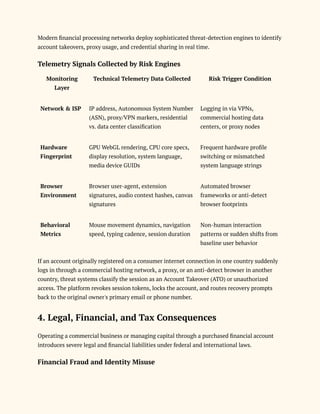
Modern financial processing networks deploy sophisticated threat-detection engines to identify
account takeovers, proxy usage, and credential sharing in real time.
Telemetry Signals Collected by Risk Engines
Monitoring
Layer
Technical Telemetry Data Collected Risk Trigger Condition
Network & ISP IP address, Autonomous System Number
(ASN), proxy/VPN markers, residential
vs. data center classification
Logging in via VPNs,
commercial hosting data
centers, or proxy nodes
Hardware
Fingerprint
GPU WebGL rendering, CPU core specs,
display resolution, system language,
media device GUIDs
Frequent hardware profile
switching or mismatched
system language strings
Browser
Environment
Browser user-agent, extension
signatures, audio context hashes, canvas
signatures
Automated browser
frameworks or anti-detect
browser footprints
Behavioral
Metrics
Mouse movement dynamics, navigation
speed, typing cadence, session duration
Non-human interaction
patterns or sudden shifts from
baseline user behavior
If an account originally registered on a consumer internet connection in one country suddenly
logs in through a commercial hosting network, a proxy, or an anti-detect browser in another
country, threat systems classify the session as an Account Takeover (ATO) or unauthorized
access. The platform revokes session tokens, locks the account, and routes recovery prompts
back to the original owner's primary email or phone number.
4. Legal, Financial, and Tax Consequences
Operating a commercial business or managing capital through a purchased financial account
introduces severe legal and financial liabilities under federal and international laws.
Financial Fraud and Identity Misuse
Conducting financial transactions using another person’s identity documents or personal
details constitutes misrepresentation and financial fraud. If the underlying credentials were
created using stolen personal identity data, the operator can be directly implicated in identity
theft and money laundering investigations.
Tax Reporting Conflicts and Discrepancies
Regulated financial institutions report account activity and gross transaction volumes to tax
authorities under international tax compliance frameworks, such as the Common Reporting
Standard (CRS) and the Foreign Account Tax Compliance Act (FATCA).
●​ Unreported Income Audits: Revenue processed through a purchased account is
reported directly under the original registrant's tax record, triggering tax assessments
and fraud investigations for that individual.
●​ Inability to Reconcile Business Books: A legitimate business cannot legally account
for or reconcile revenue received through a financial profile held under an unrelated
third party's name.
●​ Judicial Asset Seizures: If the original identity holder incurs tax liens, unpaid court
judgments, or personal bankruptcy, state courts can issue freeze orders on all bank
accounts and digital wallets registered under their tax identifier. Any funds held inside
the purchased account can be seized to satisfy the registrant's legal debts.
Root Account Reclamation
Because the legal documents on file belong to the original registrant, that individual retains
absolute legal authority over the digital account. At any point—especially after the account
accumulates a high balance—the original owner can contact customer support, present valid
government identification, complete a live biometric facial check, and request priority account
recovery. The platform will restore access to the original owner, stripping the buyer of access.
The buyer has no legal standing to report stolen funds, as they cannot legally claim ownership
of a third-party account.
5. Legitimate Pathways to Establish Global Financial
Infrastructure
Rather than risking working capital on unstable, unauthorized third-party accounts,
entrepreneurs, remote workers, and international businesses can establish fully compliant,
legally sound payment infrastructure through direct legal registration.
Direct Personal Account Registration
Register directly with Skrill using your genuine legal name, current residential address, and
official government identification. Completing identity verification directly ensures complete
legal ownership, unhindered customer support access, and permanent account stability.
Remote Corporate Formation for International Founders
International business owners seeking access to global payment processing networks can
legally establish a corporate structure completely remotely:
1.​ Incorporate a Legal Entity: Register a Limited Liability Company (LLC) or corporate
structure (such as a US LLC or UK Ltd) through official state registry channels or
authorized corporate service providers.
2.​ Obtain an Official Tax Identifier: Secure an official tax identification number (such as
an EIN in the US or UTR/VAT in the UK) directly from the relevant tax authority.
3.​ Establish Official Merchant Accounts: Apply directly to regulated payment processing
platforms using official corporate incorporation documents, tax identification numbers,
physical registered agent address details, and corporate bank accounts.
This compliant structure ensures that your business maintains 100% legal ownership over its
payment processing channels, enjoys high transfer limits, and can easily clear any routine
compliance review by submitting its own corporate records.
Utilizing Licensed Multi-Currency Financial Platforms
For international client billing, global payouts, or cross-border e-commerce settlements,
businesses can utilize authorized global payment processing networks and multi-currency
business platforms. These regulated entities issue localized virtual routing and account
numbers in major currencies, allowing legal collection, conversion, and transfer of funds
without violating platform policies or international banking laws.
Conclusion
There are no "trusted marketplaces" or safe vendors when it comes to buying verified Skrill
accounts. Automated threat detection engines, continuous compliance monitoring, dynamic
biometric checks, and strict financial regulations ensure that purchased accounts remain
fundamentally unstable and prone to permanent locks. Attempting to run a business on
third-party credentials guarantees financial loss and legal vulnerability.
Long-term commercial success in the global digital economy requires direct compliance and
clean corporate architecture. By establishing a legally registered business entity and opening
official merchant processing accounts under your own credentials, you build a fully owned,
resilient, and permanent financial pipeline that operates safely without the constant risk of
administrative freezes or asset forfeiture.