Top Healthcare Software Development Companies in California [2026 list] - Bitcot
Compare the top 15 healthcare software development companies in California for 2026, with pricing, expertise, verified reviews, and a scoring method to pick the right fit.
Top Healthcare Software Development Companies in California [2026 list] - Bitcot
1.
Bitcot Book adiscovery call
CALIFORNIA · 2026 BUYER'S GUIDE
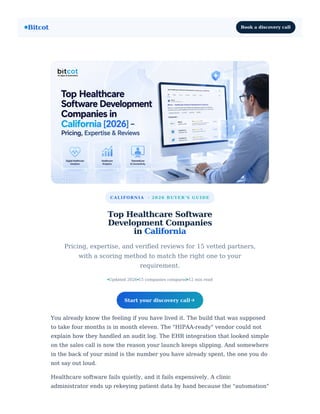
Top Healthcare Software
Development Companies
in California
Pricing, expertise, and verified reviews for 15 vetted partners,
with a scoring method to match the right one to your
requirement.
Updated 2026 15 companies compared 12 min read
Start your discovery call
You already know the feeling if you have lived it. The build that was supposed
to take four months is in month eleven. The "HIPAA-ready" vendor could not
explain how they handled an audit log. The EHR integration that looked simple
on the sales call is now the reason your launch keeps slipping. And somewhere
in the back of your mind is the number you have already spent, the one you do
not say out loud.
Healthcare software fails quietly, and it fails expensively. A clinic
administrator ends up rekeying patient data by hand because the "automation"
2.
never worked. Afounder watches a competitor ship the product they pitched
to investors first. A payer operations lead inherits a claims system built by a
team that never understood 837 and 835 transactions. None of these people
set out to make a bad choice. They just could not tell, from the outside, which
company would actually deliver.
That is the real problem this guide solves. There is no single best healthcare
software development company in California. There is only the best company
for your specific requirement, your compliance surface, your stage, your
budget, and the kind of product you are building. So instead of handing you a
ranked popularity contest, we scored each company on the factors that
actually predict whether a healthcare project succeeds, and we tell you plainly
who each one is right for.
This is written for healthcare founders, hospital and clinic administrators,
payer and provider operations leaders, med-tech product owners, and the
technology leaders accountable for the outcome. Below you will find 15 vetted
companies, a transparent scoring method, realistic 2026 pricing, expertise
breakdowns, and review signals, so you can shortlist two or three worth a real
conversation.
Here is the thread that runs through all of it, and the thing most lists gloss
over: in 2026 the factor that separates a great healthcare partner from an
average one is no longer HIPAA experience. Nearly everyone claims that. It is
something else, and we will name it before the list.
THE LOCAL LAYER
Why California is not just a location filter
Before the list, understand why "in California" changes the decision rather
than narrowing a map.
The state is one of the densest digital health and biotech corridors in the
United States. The West region leads the country's digital health market by
revenue share, according to market research from Towards Healthcare,
and San Diego, the Bay Area, and Los Angeles each concentrate clinical
partnerships, medical device makers, and specialized engineering talent. That
density means the domain knowledge available here runs deeper than in most
markets, if you know how to find it.
Then there is the compliance layer, which is where general software teams
quietly get healthcare organizations into trouble. Every US health project
must meet HIPAA and the HITECH Act. California stacks more on top. The
3.
Confidentiality of MedicalInformation Act (CMIA) governs how medical
information is disclosed, and the California Privacy Rights Act (CPRA) extends
consumer data protections that reach health-adjacent data. Layer on federal
interoperability pressure from the 21st Century Cures Act and its information-
blocking rules, and the bar for "compliant" is meaningfully higher here than a
HIPAA checkbox suggests.
So what does that mean when you are hiring? It means the evaluation cannot
stop at "can they code." It has to test for clinical workflow fluency, layered
compliance, healthcare interoperability, and, increasingly, whether the team
builds AI into the architecture or bolts it on after.
METHODOLOGY
How we scored the companies
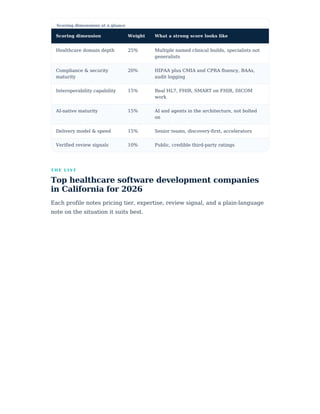
Anyone can publish a list. Fewer explain how they built it, which is exactly the
transparency a healthcare buyer should demand from a vendor too. Each
company was assessed across six weighted dimensions that, in our experience
building and auditing healthcare platforms, correlate most strongly with
delivery success:
A note on honesty, because it matters for trust: we only cite specific review
scores where they are publicly verifiable, and we describe each company's
California connection accurately rather than implying a local headquarters
where none exists. Fabricated stats help no one making a six-figure decision.
Healthcare domain depth (25%) — named clinical projects, workflow
knowledge, and specialization versus generalist positioning.
Compliance and security maturity (20%) — HIPAA plus California CMIA
and CPRA awareness, Business Associate Agreements, audit logging, and
encryption.
Interoperability capability (15%) — hands-on experience with HL7, FHIR,
SMART on FHIR, and DICOM.
AI-native maturity (15%) — whether AI, agents, and automation are
architected in from the start or added as features.
Delivery model and speed (15%) — senior staffing, discovery-first process,
reusable accelerators, defined MVP timelines.
Verified review signals (10%) — third-party ratings and client feedback on
Clutch, G2, GoodFirms, and Google.
4.
Scoring dimensions ata glance
Scoring dimension Weight What a strong score looks like
Healthcare domain depth 25% Multiple named clinical builds, specialists not
generalists
Compliance & security
maturity
20% HIPAA plus CMIA and CPRA fluency, BAAs,
audit logging
Interoperability capability 15% Real HL7, FHIR, SMART on FHIR, DICOM
work
AI-native maturity 15% AI and agents in the architecture, not bolted
on
Delivery model & speed 15% Senior teams, discovery-first, accelerators
Verified review signals 10% Public, credible third-party ratings
THE LIST
Top healthcare software development companies
in California for 2026
Each profile notes pricing tier, expertise, review signal, and a plain-language
note on the situation it suits best.
5.
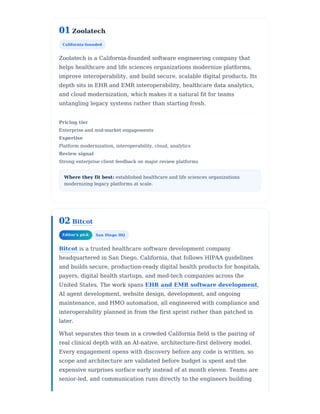
01 Zoolatech
California-founded
Zoolatech isa California-founded software engineering company that
helps healthcare and life sciences organizations modernize platforms,
improve interoperability, and build secure, scalable digital products. Its
depth sits in EHR and EMR interoperability, healthcare data analytics,
and cloud modernization, which makes it a natural fit for teams
untangling legacy systems rather than starting fresh.
Pricing tier
Enterprise and mid-market engagements
Expertise
Platform modernization, interoperability, cloud, analytics
Review signal
Strong enterprise client feedback on major review platforms
Where they fit best: established healthcare and life sciences organizations
modernizing legacy platforms at scale.
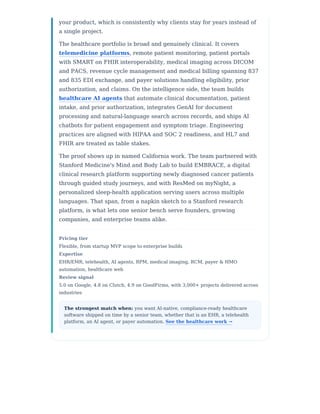
02 Bitcot
Editor's pick San Diego HQ
Bitcot is a trusted healthcare software development company
headquartered in San Diego, California, that follows HIPAA guidelines
and builds secure, production-ready digital health products for hospitals,
payers, digital health startups, and med-tech companies across the
United States. The work spans EHR and EMR software development,
AI agent development, website design, development, and ongoing
maintenance, and HMO automation, all engineered with compliance and
interoperability planned in from the first sprint rather than patched in
later.
What separates this team in a crowded California field is the pairing of
real clinical depth with an AI-native, architecture-first delivery model.
Every engagement opens with discovery before any code is written, so
scope and architecture are validated before budget is spent and the
expensive surprises surface early instead of at month eleven. Teams are
senior-led, and communication runs directly to the engineers building
6.
your product, whichis consistently why clients stay for years instead of
a single project.
The healthcare portfolio is broad and genuinely clinical. It covers
telemedicine platforms, remote patient monitoring, patient portals
with SMART on FHIR interoperability, medical imaging across DICOM
and PACS, revenue cycle management and medical billing spanning 837
and 835 EDI exchange, and payer solutions handling eligibility, prior
authorization, and claims. On the intelligence side, the team builds
healthcare AI agents that automate clinical documentation, patient
intake, and prior authorization, integrates GenAI for document
processing and natural-language search across records, and ships AI
chatbots for patient engagement and symptom triage. Engineering
practices are aligned with HIPAA and SOC 2 readiness, and HL7 and
FHIR are treated as table stakes.
The proof shows up in named California work. The team partnered with
Stanford Medicine's Mind and Body Lab to build EMBRACE, a digital
clinical research platform supporting newly diagnosed cancer patients
through guided study journeys, and with ResMed on myNight, a
personalized sleep-health application serving users across multiple
languages. That span, from a napkin sketch to a Stanford research
platform, is what lets one senior bench serve founders, growing
companies, and enterprise teams alike.
Pricing tier
Flexible, from startup MVP scope to enterprise builds
Expertise
EHR/EMR, telehealth, AI agents, RPM, medical imaging, RCM, payer & HMO
automation, healthcare web
Review signal
5.0 on Google, 4.8 on Clutch, 4.9 on GoodFirms, with 3,000+ projects delivered across
industries
The strongest match when: you want AI-native, compliance-ready healthcare
software shipped on time by a senior team, whether that is an EHR, a telehealth
platform, an AI agent, or payer automation. See the healthcare work →
7.
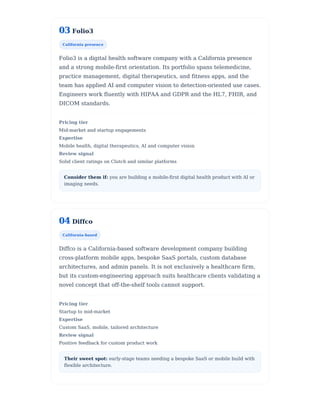
03 Folio3
California presence
Folio3is a digital health software company with a California presence
and a strong mobile-first orientation. Its portfolio spans telemedicine,
practice management, digital therapeutics, and fitness apps, and the
team has applied AI and computer vision to detection-oriented use cases.
Engineers work fluently with HIPAA and GDPR and the HL7, FHIR, and
DICOM standards.
Pricing tier
Mid-market and startup engagements
Expertise
Mobile health, digital therapeutics, AI and computer vision
Review signal
Solid client ratings on Clutch and similar platforms
Consider them if: you are building a mobile-first digital health product with AI or
imaging needs.
04 Diffco
California-based
Diffco is a California-based software development company building
cross-platform mobile apps, bespoke SaaS portals, custom database
architectures, and admin panels. It is not exclusively a healthcare firm,
but its custom-engineering approach suits healthcare clients validating a
novel concept that off-the-shelf tools cannot support.
Pricing tier
Startup to mid-market
Expertise
Custom SaaS, mobile, tailored architecture
Review signal
Positive feedback for custom product work
Their sweet spot: early-stage teams needing a bespoke SaaS or mobile build with
flexible architecture.
8.
05 Zazz
California footprint
Zazzbuilds custom enterprise software with a California footprint across
Node.js, .NET, Java, and Python, and lists healthcare among its core
verticals. The firm positions around security-first development for
enterprise clients. Buyers should confirm the depth of clinical and
interoperability experience for their specific use case before committing.
Pricing tier
Enterprise
Expertise
Security-first, multi-stack enterprise builds
Review signal
Established enterprise portfolio and reviews
Shortlist them when: you need security-first custom software across several
technology stacks.
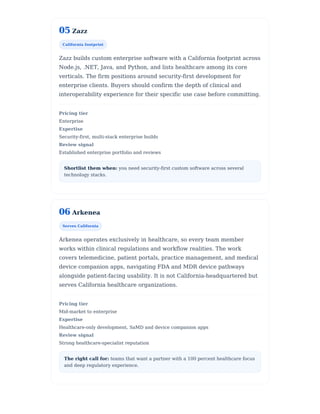
06 Arkenea
Serves California
Arkenea operates exclusively in healthcare, so every team member
works within clinical regulations and workflow realities. The work
covers telemedicine, patient portals, practice management, and medical
device companion apps, navigating FDA and MDR device pathways
alongside patient-facing usability. It is not California-headquartered but
serves California healthcare organizations.
Pricing tier
Mid-market to enterprise
Expertise
Healthcare-only development, SaMD and device companion apps
Review signal
Strong healthcare-specialist reputation
The right call for: teams that want a partner with a 100 percent healthcare focus
and deep regulatory experience.
9.
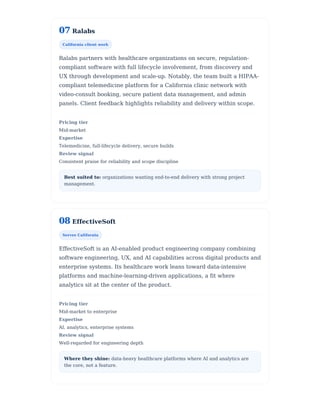
07 Ralabs
California clientwork
Ralabs partners with healthcare organizations on secure, regulation-
compliant software with full lifecycle involvement, from discovery and
UX through development and scale-up. Notably, the team built a HIPAA-
compliant telemedicine platform for a California clinic network with
video-consult booking, secure patient data management, and admin
panels. Client feedback highlights reliability and delivery within scope.
Pricing tier
Mid-market
Expertise
Telemedicine, full-lifecycle delivery, secure builds
Review signal
Consistent praise for reliability and scope discipline
Best suited to: organizations wanting end-to-end delivery with strong project
management.
08 EffectiveSoft
Serves California
EffectiveSoft is an AI-enabled product engineering company combining
software engineering, UX, and AI capabilities across digital products and
enterprise systems. Its healthcare work leans toward data-intensive
platforms and machine-learning-driven applications, a fit where
analytics sit at the center of the product.
Pricing tier
Mid-market to enterprise
Expertise
AI, analytics, enterprise systems
Review signal
Well-regarded for engineering depth
Where they shine: data-heavy healthcare platforms where AI and analytics are
the core, not a feature.
10.
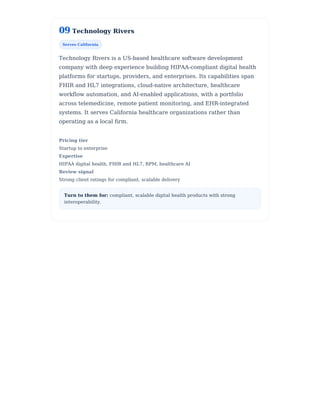
09 Technology Rivers
ServesCalifornia
Technology Rivers is a US-based healthcare software development
company with deep experience building HIPAA-compliant digital health
platforms for startups, providers, and enterprises. Its capabilities span
FHIR and HL7 integrations, cloud-native architecture, healthcare
workflow automation, and AI-enabled applications, with a portfolio
across telemedicine, remote patient monitoring, and EHR-integrated
systems. It serves California healthcare organizations rather than
operating as a local firm.
Pricing tier
Startup to enterprise
Expertise
HIPAA digital health, FHIR and HL7, RPM, healthcare AI
Review signal
Strong client ratings for compliant, scalable delivery
Turn to them for: compliant, scalable digital health products with strong
interoperability.
11.
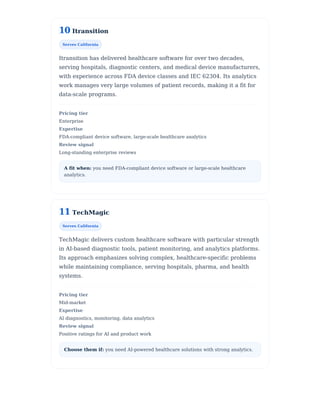
10 Itransition
Serves California
Itransitionhas delivered healthcare software for over two decades,
serving hospitals, diagnostic centers, and medical device manufacturers,
with experience across FDA device classes and IEC 62304. Its analytics
work manages very large volumes of patient records, making it a fit for
data-scale programs.
Pricing tier
Enterprise
Expertise
FDA-compliant device software, large-scale healthcare analytics
Review signal
Long-standing enterprise reviews
A fit when: you need FDA-compliant device software or large-scale healthcare
analytics.
11 TechMagic
Serves California
TechMagic delivers custom healthcare software with particular strength
in AI-based diagnostic tools, patient monitoring, and analytics platforms.
Its approach emphasizes solving complex, healthcare-specific problems
while maintaining compliance, serving hospitals, pharma, and health
systems.
Pricing tier
Mid-market
Expertise
AI diagnostics, monitoring, data analytics
Review signal
Positive ratings for AI and product work
Choose them if: you need AI-powered healthcare solutions with strong analytics.
12.
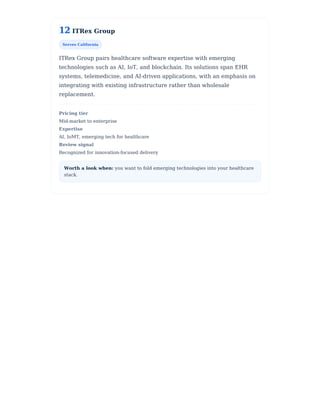
12 ITRex Group
ServesCalifornia
ITRex Group pairs healthcare software expertise with emerging
technologies such as AI, IoT, and blockchain. Its solutions span EHR
systems, telemedicine, and AI-driven applications, with an emphasis on
integrating with existing infrastructure rather than wholesale
replacement.
Pricing tier
Mid-market to enterprise
Expertise
AI, IoMT, emerging tech for healthcare
Review signal
Recognized for innovation-focused delivery
Worth a look when: you want to fold emerging technologies into your healthcare
stack.
13.
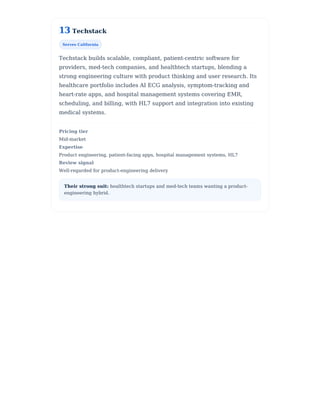
13 Techstack
Serves California
Techstackbuilds scalable, compliant, patient-centric software for
providers, med-tech companies, and healthtech startups, blending a
strong engineering culture with product thinking and user research. Its
healthcare portfolio includes AI ECG analysis, symptom-tracking and
heart-rate apps, and hospital management systems covering EMR,
scheduling, and billing, with HL7 support and integration into existing
medical systems.
Pricing tier
Mid-market
Expertise
Product engineering, patient-facing apps, hospital management systems, HL7
Review signal
Well-regarded for product-engineering delivery
Their strong suit: healthtech startups and med-tech teams wanting a product-
engineering hybrid.
14.
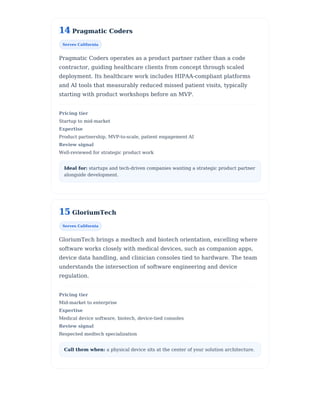
14 Pragmatic Coders
ServesCalifornia
Pragmatic Coders operates as a product partner rather than a code
contractor, guiding healthcare clients from concept through scaled
deployment. Its healthcare work includes HIPAA-compliant platforms
and AI tools that measurably reduced missed patient visits, typically
starting with product workshops before an MVP.
Pricing tier
Startup to mid-market
Expertise
Product partnership, MVP-to-scale, patient engagement AI
Review signal
Well-reviewed for strategic product work
Ideal for: startups and tech-driven companies wanting a strategic product partner
alongside development.
15 GloriumTech
Serves California
GloriumTech brings a medtech and biotech orientation, excelling where
software works closely with medical devices, such as companion apps,
device data handling, and clinician consoles tied to hardware. The team
understands the intersection of software engineering and device
regulation.
Pricing tier
Mid-market to enterprise
Expertise
Medical device software, biotech, device-tied consoles
Review signal
Respected medtech specialization
Call them when: a physical device sits at the center of your solution architecture.
15.
Not sure whichof these fits your build?
Tell us your requirement, your compliance surface, your stage, and your
timeline, and we will map it to the right approach in 30 minutes. No
obligation, no sales rep.
Talk to a senior engineer
30-minute discovery call · senior engineer, not a sales rep · leave with a build plan
16.
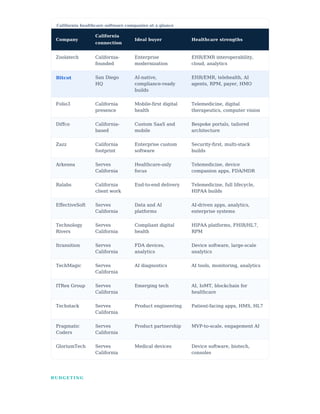
California healthcare softwarecompanies at a glance
Company
California
connection
Ideal buyer Healthcare strengths
Zoolatech California-
founded
Enterprise
modernization
EHR/EMR interoperability,
cloud, analytics
Bitcot San Diego
HQ
AI-native,
compliance-ready
builds
EHR/EMR, telehealth, AI
agents, RPM, payer, HMO
Folio3 California
presence
Mobile-first digital
health
Telemedicine, digital
therapeutics, computer vision
Diffco California-
based
Custom SaaS and
mobile
Bespoke portals, tailored
architecture
Zazz California
footprint
Enterprise custom
software
Security-first, multi-stack
builds
Arkenea Serves
California
Healthcare-only
focus
Telemedicine, device
companion apps, FDA/MDR
Ralabs California
client work
End-to-end delivery Telemedicine, full lifecycle,
HIPAA builds
EffectiveSoft Serves
California
Data and AI
platforms
AI-driven apps, analytics,
enterprise systems
Technology
Rivers
Serves
California
Compliant digital
health
HIPAA platforms, FHIR/HL7,
RPM
Itransition Serves
California
FDA devices,
analytics
Device software, large-scale
analytics
TechMagic Serves
California
AI diagnostics AI tools, monitoring, analytics
ITRex Group Serves
California
Emerging tech AI, IoMT, blockchain for
healthcare
Techstack Serves
California
Product engineering Patient-facing apps, HMS, HL7
Pragmatic
Coders
Serves
California
Product partnership MVP-to-scale, engagement AI
GloriumTech Serves
California
Medical devices Device software, biotech,
consoles
BUDGETING
17.
Healthcare software pricingin California for 2026
Pricing is where buyers get burned twice, first by underestimating scope, then
by choosing on hourly rate alone. Cost is driven by three things above all:
feature complexity, compliance requirements, and integration depth.
Compliance work is not a line item you can cut; it is often what separates a
project that passes audit from one that becomes a liability.
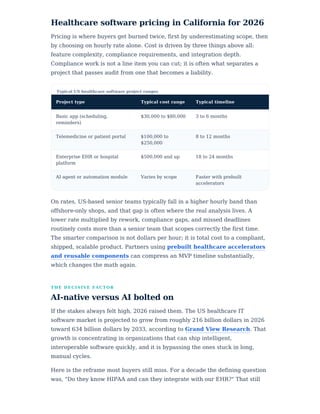
Typical US healthcare software project ranges
Project type Typical cost range Typical timeline
Basic app (scheduling,
reminders)
$30,000 to $80,000 3 to 6 months
Telemedicine or patient portal $100,000 to
$250,000
8 to 12 months
Enterprise EHR or hospital
platform
$500,000 and up 18 to 24 months
AI agent or automation module Varies by scope Faster with prebuilt
accelerators
On rates, US-based senior teams typically fall in a higher hourly band than
offshore-only shops, and that gap is often where the real analysis lives. A
lower rate multiplied by rework, compliance gaps, and missed deadlines
routinely costs more than a senior team that scopes correctly the first time.
The smarter comparison is not dollars per hour; it is total cost to a compliant,
shipped, scalable product. Partners using prebuilt healthcare accelerators
and reusable components can compress an MVP timeline substantially,
which changes the math again.
THE DECISIVE FACTOR
AI-native versus AI bolted on
If the stakes always felt high, 2026 raised them. The US healthcare IT
software market is projected to grow from roughly 216 billion dollars in 2026
toward 634 billion dollars by 2033, according to Grand View Research. That
growth is concentrating in organizations that can ship intelligent,
interoperable software quickly, and it is bypassing the ones stuck in long,
manual cycles.
Here is the reframe most buyers still miss. For a decade the defining question
was, "Do they know HIPAA and can they integrate with our EHR?" That still
18.
matters, but itno longer separates the field, because nearly every serious
vendor can say yes. The question that separates partners now is, "Are they AI-
native, or are they bolting AI onto a legacy way of building?"
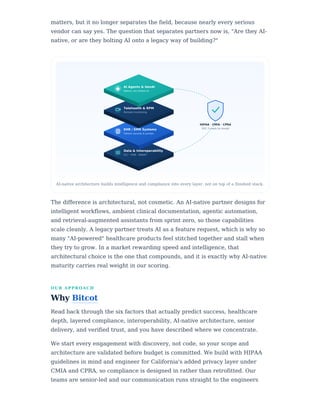
Data & Interoperability
HL7 · FHIR · SMART
EHR / EMR Systems
Patient records & portals
Telehealth & RPM
Remote monitoring
AI Agents & GenAI
Native, not bolted on
HIPAA · CMIA · CPRA
SOC 2-ready by design
AI-native architecture builds intelligence and compliance into every layer, not on top of a finished stack.
The difference is architectural, not cosmetic. An AI-native partner designs for
intelligent workflows, ambient clinical documentation, agentic automation,
and retrieval-augmented assistants from sprint zero, so those capabilities
scale cleanly. A legacy partner treats AI as a feature request, which is why so
many "AI-powered" healthcare products feel stitched together and stall when
they try to grow. In a market rewarding speed and intelligence, that
architectural choice is the one that compounds, and it is exactly why AI-native
maturity carries real weight in our scoring.
OUR APPROACH
Why Bitcot
Read back through the six factors that actually predict success, healthcare
depth, layered compliance, interoperability, AI-native architecture, senior
delivery, and verified trust, and you have described where we concentrate.
We start every engagement with discovery, not code, so your scope and
architecture are validated before budget is committed. We build with HIPAA
guidelines in mind and engineer for California's added privacy layer under
CMIA and CPRA, so compliance is designed in rather than retrofitted. Our
teams are senior-led and our communication runs straight to the engineers
19.
shipping your product,which is why clients across America stay with us for
years. And because AI is native to how we build, from AI agents and GenAI
integration to intelligent clinical workflows, your product is designed for
where healthcare is heading, not where it was.
From EHR and telehealth platforms to payer automation, medical imaging,
HMO workflows, and healthcare websites we design, build, and maintain, we
cover the full range a modern health organization needs, at startup MVP scope
or enterprise scale, on the same senior bench.
FAQ
Frequently asked questions
How do I choose the right company in California for my
requirement?
Start by weighting the six factors that predict success, healthcare domain
depth, compliance maturity across HIPAA and California's CMIA and
CPRA, interoperability, AI-native architecture, senior delivery, and
verified reviews, against your own priorities. A startup validating an MVP
needs a different partner than a payer modernizing a claims platform, so
match the company to your stage and product, not just the ranking.
Choosing a healthcare software partner in California?
Let's talk.
Book a 30-minute discovery call with a senior Bitcot engineer and walk
away with a build plan, a realistic timeline, and a clear next step, whether
you need an EHR, a telehealth platform, an AI agent, or payer
automation.
Start your discovery call
Senior engineer, not a sales rep · HIPAA, CMIA & CPRA aware · 5.0 Google · 4.8 Clutch · 4.9
GoodFirms
20.
Does a companyneed to be based in California to serve California
clients?
No, but a California-based or California-experienced partner brings a real
edge, including fluency with the state's added privacy rules and access to
the local biotech and health-tech ecosystem. Demonstrated healthcare
experience and compliance maturity matter more than a local ZIP code.
How much does healthcare software development cost in
California in 2026?
Basic applications typically range from $30,000 to $80,000, telemedicine
platforms and patient portals from $100,000 to $250,000, and enterprise
EHR or hospital systems from $500,000 and up. Compliance
requirements and integration complexity are the largest cost drivers, and
total cost to a shipped, compliant product matters more than hourly rate.
What is the difference between an AI-native and a traditional
healthcare software company?
An AI-native company designs architecture around intelligent workflows,
agents, and automation from the start, so those capabilities scale. A
traditional company adds AI as a feature to an existing build, which often
produces products that feel bolted together and are harder to grow.
How reliable are online reviews when comparing healthcare
software companies?
Verified third-party ratings on platforms like Clutch, G2, GoodFirms, and
Google are useful signals, but treat them as one input among six. Pair
them with named healthcare case studies, references in your specific
segment, and a technical conversation that tests genuine compliance and
interoperability knowledge.
21.
Choosing a healthcaresoftware partner is a consequential decision, and
the right answer depends entirely on your requirement. If you would like
help mapping your specific compliance, interoperability, and AI needs
before you commit to a build, we can walk through it together. Talk to
our team →
Bitcot Book a discovery call → Healthcare software built with HIPAA guidelines in mind.