Top Companies Using AI The Most Changing Business Forever .pdf
See how leading companies are using AI the most across industries to improve operations, customer experience, innovation, and future growth with real examples.
Top Companies Using AI The Most Changing Business Forever .pdf
1.
Top Companies UsingAI The Most
Changing Business Forever
Artificial intelligence has moved from a futuristic concept to a core business tool. This
article explains how global companies are applying AI across technology, finance,
healthcare, retail, manufacturing, and entertainment. It covers major AI leaders,
real-world examples, adoption statistics, business use cases, and future trends that will
shape the next generation of companies.
Artificial intelligence is no longer something businesses are simply testing. It has
become a major force changing how companies build products, serve customers, and
compete.
Global AI spending is expected to cross hundreds of billions of dollars as businesses
continue investing in automation, data analysis, and intelligent systems. Recent industry
reports show that a large majority of enterprises now have AI running in at least one
part of their operations.
2.
The surprising part?
Manypeople interact with AI every day without realising it.
When a shopping app recommends a product, when a bank blocks suspicious activity,
or when a streaming platform suggests your next movie, AI is working quietly behind the
scenes.
The companies leading this shift are not only technology giants. Businesses in finance,
healthcare, manufacturing, retail, and media are also adopting AI to solve real-world
problems.
The state of AI adoption in 2026
AI adoption has accelerated faster than many earlier technologies.
Businesses that once spent years experimenting with digital transformation are now
moving AI directly into daily operations.
Reports from industry research organisations indicate that AI adoption has reached
record levels, with many companies using AI across multiple departments instead of
limiting it to technology teams.
Some major adoption trends include:
● Around 88% of organisations now use AI in at least one business function.
● Technology companies remain among the strongest adopters.
● Financial services continue expanding AI usage for security and analysis.
● Generative AI has become one of the fastest-growing AI categories.
The average enterprise now manages multiple AI systems in production. This shows
that businesses are not treating AI as a single tool anymore. They are building complete
AI-powered workflows.
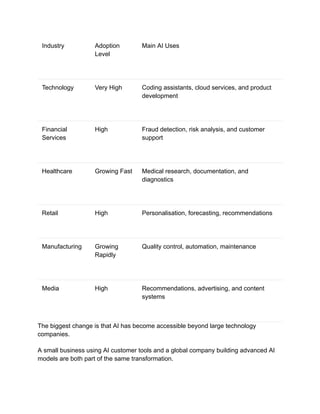
AI adoption by industry
3.
Industry Adoption
Level
Main AIUses
Technology Very High Coding assistants, cloud services, and product
development
Financial
Services
High Fraud detection, risk analysis, and customer
support
Healthcare Growing Fast Medical research, documentation, and
diagnostics
Retail High Personalisation, forecasting, recommendations
Manufacturing Growing
Rapidly
Quality control, automation, maintenance
Media High Recommendations, advertising, and content
systems
The biggest change is that AI has become accessible beyond large technology
companies.
A small business using AI customer tools and a global company building advanced AI
models are both part of the same transformation.
4.
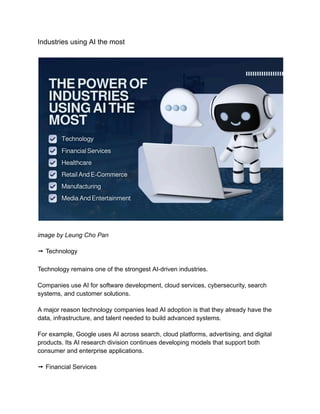
Industries using AIthe most
image by Leung Cho Pan
➙ Technology
Technology remains one of the strongest AI-driven industries.
Companies use AI for software development, cloud services, cybersecurity, search
systems, and customer solutions.
A major reason technology companies lead AI adoption is that they already have the
data, infrastructure, and talent needed to build advanced systems.
For example, Google uses AI across search, cloud platforms, advertising, and digital
products. Its AI research division continues developing models that support both
consumer and enterprise applications.
➙ Financial Services
5.
Banks and financialinstitutions use AI to improve security and decision-making.
AI helps detect unusual transactions, identify fraud patterns, evaluate risks, and improve
customer interactions.
Modern financial companies depend on AI because it can process millions of data
points faster than traditional systems.
Companies using AI the most in finance focus on improving trust and speed.
➙ Healthcare
Healthcare is becoming one of the fastest-growing AI sectors.
AI supports doctors and researchers by helping organise information, improve
documentation, support diagnosis, and accelerate research.
For example, AI platforms are helping healthcare professionals reduce administrative
work so they can spend more time with patients.
The goal is not to replace medical experts. It is helping them make faster and better
decisions.
➙ Retail And E-Commerce
Online shopping has become one of the clearest examples of AI in daily life.
Retail companies use AI for:
● Product recommendations
● Demand forecasting
● Inventory planning
● Customer support
● Personalised experiences
Amazon is a major example. The company uses AI across logistics, recommendations,
warehouse operations, and delivery systems.
➙ Manufacturing
6.
Manufacturers use AIto reduce downtime and improve quality.
AI-powered systems can predict when machines need maintenance, identify defects,
and improve production planning.
Factories are becoming smarter because AI helps teams make decisions before
problems become expensive.
➙ Media And Entertainment
Entertainment platforms rely heavily on AI.
Streaming services and social platforms use AI to recommend content, personalise
feeds, and improve advertising.
ByteDance uses AI extensively within its digital platforms to understand user
preferences and improve content recommendations.
Companies using AI the most: The global leaders and their AI use cases
The world’s biggest AI-driven companies are not only building artificial intelligence tools.
They are using AI inside their own products, services, operations, and decision-making
systems.
The real advantage comes from applying AI to practical business challenges. From
improving customer experiences to managing complex operations, these companies
show how AI creates measurable impact.
1. Microsoft
Microsoft has become one of the biggest AI adopters by bringing AI into everyday
workplace tools.
The company uses AI across:
● Microsoft Copilot
● Azure cloud services
● Office applications
● Developer tools
7.
AI assistants helpusers write documents, analyse information, create presentations,
and automate repetitive tasks. Microsoft’s strategy focuses on bringing AI into normal
workplace activities rather than keeping it as a separate technology.
2. Google
Google has integrated AI into many products used worldwide.
Its AI applications include:
● Search improvements
● Google Workspace tools
● YouTube recommendations
● Cloud AI solutions
● Android features
Google DeepMind continues advancing AI research through models and systems
designed for both research and practical applications.
3. Meta
Meta uses AI across social platforms and digital experiences.
AI helps the company improve:
● Content recommendations
● Advertising systems
● Safety tools
● User experiences
The company also invests in AI research and immersive technologies through its
broader technology ecosystem.
4. Nvidia
8.
Source – advantech.com
NVIDIAhas become one of the most important companies in the AI infrastructure
space.
While many companies build AI applications, Nvidia provides the technology that
powers many advanced AI systems.
Its graphics processing units (GPUs) are widely used for training and running AI
models. The company also develops software platforms that help businesses build AI
solutions faster.
NVIDIA’s influence shows that AI success does not only come from creating apps. It
also depends on the powerful systems behind them.
5. Amazon
Amazon uses AI across multiple parts of its business.
The company applies AI in:
9.
● Product recommendations
●Warehouse automation
● Delivery planning
● Customer service
● Cloud computing
Through Amazon Web Services (AWS), businesses worldwide use AI tools to build their
own applications.
Amazon’s AI-powered systems help improve customer experiences while speeding up
and making large-scale operations more efficient.
6. ByteDance
ByteDance is another major AI-driven company.
The company uses AI to understand user behaviour, recommend content, and improve
digital experiences. Its platforms rely heavily on AI systems that analyse user interests
and deliver personalised feeds.
The company’s approach shows how AI can influence entertainment, communication,
and online engagement.
7. Palantir
Palantir focuses on AI-powered data platforms. The company helps organisations
analyse large amounts of information and make faster decisions.
Its AI systems are used by businesses and governments for areas such as:
● Operations management
● Risk analysis
● Planning
● Decision support
Palantir demonstrates how AI can help organisations turn complex information into
practical actions.
8. OpenAI
10.
Source – logicgate.com
OpenAIhas played a major role in bringing AI tools into everyday conversations and
workplaces.
Its products have helped millions of people use AI for writing, research, problem-solving,
and productivity.
Businesses are adopting AI assistants to support employees, automate tasks, and
improve workflows.
What are these companies using AI for?
AI adoption is not limited to one department. Businesses are applying AI across their
entire organisation.
● Customer Experience: Companies use AI to create faster and more
personalised customer interactions.
Common examples include:
11.
● Chatbots
● Recommendationsystems
● Customer sentiment analysis
● Personalised offers
A customer asking a support question may receive an instant response because AI
helps companies understand and process requests quickly. Companies using AI the
most focus on improving every customer touchpoint.
● Operations and Automation: AI helps businesses automate repetitive tasks.
Examples include:
● Managing workflows
● Predicting equipment problems
● Improving supply chains
● Reducing manual work
Manufacturing and logistics companies especially benefit because AI can identify
patterns humans may miss.
● Marketing: Marketing teams use AI to understand customers better.
AI helps with:
● Audience analysis
● Content suggestions
● Advertising optimisation
● Campaign performance tracking
Businesses can create more relevant messages by studying customer behaviour.
● Finance: AI has become valuable in financial decision-making.
Companies use AI for:
● Fraud detection
● Risk assessment
● Financial forecasting
● Compliance monitoring
AI systems can analyse large amounts of financial data and highlight unusual patterns
quickly.
12.
● Human Resources:AI is changing workplace management.
Companies use AI tools for:
● Employee engagement analysis
● Hiring support
● Training recommendations
● Workplace planning
The best results come when AI supports HR teams instead of making decisions without
human review.
● Product Development and Research: AI is helping companies create better
products.
It supports:
● Software development
● Product testing
● Research
● Design improvements
Many technology companies now use AI coding assistants to help developers work
faster.
Why do these companies stay ahead with AI?
The leaders in AI adoption share some common advantages.
Strong Data Systems: AI works best when companies have useful and organised data.
Businesses that collect, manage, and understand their data can build stronger AI
solutions.
Large Technology Investments: AI development requires major investment.
Companies spend heavily on:
● Computing power
● Research
● AI talent
● Infrastructure
13.
The biggest AIleaders have the resources needed to improve their systems
continuously.
Human and AI Collaboration: Successful businesses understand that AI works best with
people. AI can analyse information and automate tasks, but human judgment remains
important. The strongest Companies using AI the most are not only buying technology.
They are redesigning how work happens.
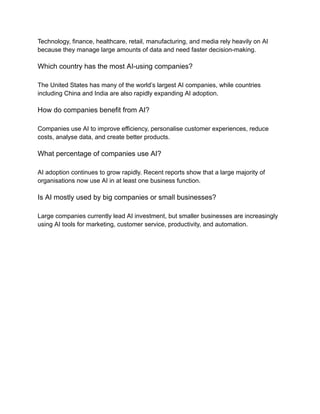
The future of AI in business
Source – linkedin.com
The next phase of AI will focus on more independent and intelligent systems. One major
trend is agentic AI. AI agents can complete multiple steps, manage tasks, and support
users with less manual instruction.
Businesses are also moving toward:
● Multimodal AI
14.
● Smarter AIassistants
● Better AI security
● Responsible AI governance
Future workplaces may have AI tools working alongside employees every day. The
question is no longer whether businesses will use AI. The real question is how deeply AI
will become part of their operations.
Conclusion:
A few years ago, AI was viewed as a technology of the future. Today, it is already
shaping how businesses operate.
The companies leading the AI movement are not successful because they simply use
advanced tools. They succeed because they connect AI with real customer needs,
business goals, and everyday problems.
From cloud platforms to healthcare systems and online shopping experiences, AI is
changing the way value is created.
Companies using AI the most understand one important lesson: technology creates the
biggest impact when it works together with human creativity.
The future belongs to businesses that can combine intelligent systems with strong
ideas, responsible decisions, and continuous improvement.
As AI continues evolving, businesses that adapt early will have a stronger chance of
leading tomorrow’s market.
FAQ:
Which company uses AI the most in the world?
There is no single company officially ranked as the biggest AI user because companies
apply AI differently. Microsoft, Google, Nvidia, Amazon, Meta, OpenAI, and other
technology leaders are among the most advanced AI adopters.
What industries rely on AI the most?
15.
Technology, finance, healthcare,retail, manufacturing, and media rely heavily on AI
because they manage large amounts of data and need faster decision-making.
Which country has the most AI-using companies?
The United States has many of the world’s largest AI companies, while countries
including China and India are also rapidly expanding AI adoption.
How do companies benefit from AI?
Companies use AI to improve efficiency, personalise customer experiences, reduce
costs, analyse data, and create better products.
What percentage of companies use AI?
AI adoption continues to grow rapidly. Recent reports show that a large majority of
organisations now use AI in at least one business function.
Is AI mostly used by big companies or small businesses?
Large companies currently lead AI investment, but smaller businesses are increasingly
using AI tools for marketing, customer service, productivity, and automation.