Top 3 Trusted Platforms to Buy Verified Exness Accounts
An analytical guide exposing the dangers, legal issues, and technical risks of purchasing pre-verified Exness trading accounts from unauthorized vendors, including AML/KYC violations and broker security measures.
Top 3 Trusted Platforms to Buy Verified Exness Accounts
1.
Buy Verified ExnessAccounts from
Professional Vendors ....
The online retail trading industry has grown rapidly, providing millions of individual investors
with direct access to global financial markets, including foreign exchange (forex), commodities,
indices, digital assets, and equities. Among international brokers, Exness has earned a
prominent reputation due to its execution speeds, competitive spreads, flexible leverage, and
2.
robust regulatory complianceframework. However, the rising demand for active trading
accounts has given rise to an illicit gray market where unauthorized third-party vendors claim
to sell fully verified, turn-key Exness accounts. Promoted across web forums, social media
channels, and encrypted messaging networks, these vendors promise immediate access to fully
operational trading profiles, bypassing identity checks, regional restrictions, or document
requirements.
While these commercial offers may appear attractive to individuals seeking to bypass
compliance checks or set up multiple accounts quickly, the reality behind bought accounts is
filled with severe operational, legal, and financial hazards. Financial trading accounts are
subject to international Anti-Money Laundering (AML) standards and Know Your Customer
(KYC) mandates imposed by regulatory authorities globally. Consequently, purchasing a
pre-verified trading account from an unauthorized seller directly violates broker policies and
financial laws.
Slideshare+ 1
This comprehensive analytical guide examines the architecture of financial account
verification, exposing the technical, legal, and financial mechanisms that make purchasing
verified Exness accounts an unsustainable and dangerous practice. It details how broker
security systems detect fraudulent account transfers, the operational risks involved in handling
non-owner credentials, the mechanics of modern identity verification, and legitimate pathways
for setting up compliant trading accounts.
1. Understanding the Industry Demand for Verified
Accounts
To evaluate the risks associated with third-party account trading, it is necessary to examine
why a gray market for verified brokerage profiles exists in the first place. Financial technology
platforms implement strict onboarding controls, which can create friction for individuals
attempting to trade under non-standard circumstances.
Regulatory Jurisdictions and Regional Restrictions
Global multi-asset brokers operate under distinct licensing regimes across different
international jurisdictions. Regulators impose specific guidelines regarding leverage limits,
retail client classification, margin requirements, and permitted financial instruments. In certain
geographic regions, retail trading services may be constrained or entirely prohibited by local
3.
regulatory bodies. Consequently,traders residing in restricted jurisdictions often seek
pre-verified accounts registered in permitted countries to circumvent geographic blocks.
get.exness.help
Bypassing Strict Verification Friction
Complete financial verification requires users to submit valid, government-issued Proof of
Identity (POI) and recent Proof of Address (POA) documents. Individuals who lack valid identity
cards, official passports, or utility bills in their own name often struggle to satisfy these
registration requirements. Others attempt to skip the verification phase to begin trading
immediately, falling prey to third-party vendors who advertise pre-verified accounts as instant
solutions.
get.exness.help
Banning Circumvention and Multi-Accounting Strategies
Some high-frequency traders, automated trading algorithm developers, or arbitrage strategists
attempt to operate multiple distinct trading profiles simultaneously. In cases where a primary
account has been flagged, restricted, or closed for policy breaches (such as latency arbitrage or
malicious system exploitation), traders may attempt to acquire accounts created under
synthetic or secondary identities to resume operations.
2. The Illusion of the Turn-Key Account Market
Vendors operating in the unauthorized account market advertise their products using
sophisticated terminology, claiming to offer high-tier, fully authenticated accounts complete
with email, phone, and original document backups. However, a forensic look into how these
accounts are created reveals structural vulnerabilities that endanger buyer capital.
Synthetic and Stolen Identity Packages
The vast majority of pre-verified accounts offered by online vendors are manufactured using
synthetic identities or stolen personal information. In many instances, vendors hire individuals
from economically vulnerable regions to submit their personal documentation for a small fee.
Alternatively, vendor networks utilize compromised personal data obtained from online data
breaches. Once the account passes initial verification, the vendor changes the account access
parameters and sells the profile to an unsuspecting buyer.
4.
The Phantom SecurityGuarantee
Sellers often claim to provide complete account handovers, including full control over linked
email addresses, security PINs, and personal credentials. In reality, absolute ownership transfer
is technically impossible on a regulated brokerage platform. The legal identity recorded in the
broker’s master database remains tied indefinitely to the original document holder. Because
security recovery mechanisms prioritize original legal documentation, the initial account
creator or vendor retains the ability to initiate an account recovery request at any time, regain
full platform access, and confiscate all deposited funds.
Slideshare
3. Technical Risk Engine Detection and Behavioral
Telemetry
Regulated brokerage platforms implement multi-layered risk management engines and
biometric fraud detection systems. These systems continuously evaluate telemetry data to
ensure that accounts remain under the exclusive control of their legitimate owners.
Slideshare
IP Geolocation and Network Topology Scanning
When a user logs into a trading environment, security systems record IP geographic
parameters, Internet Service Provider (ISP) network metadata, and connection routing paths. If
an account is verified using registration credentials from one continent and immediately
accessed from another without matching travel patterns, security flags are raised. Furthermore,
access via virtual private networks (VPNs), proxy servers, or TOR exit nodes triggers elevated
monitoring protocols.
Canvas Fingerprinting and Hardware Device Signatures
Modern web portals and mobile applications analyze device signatures, including screen
resolution, hardware renderer details, browser plugins, operating system build numbers, and
language configurations. A sudden shift in hardware fingerprinting combined with changes in
session behavior signals a potential change in account ownership, automatically invoking
security freezes.
Behavioral Algorithmic Telemetry
5.
Risk engines evaluateuser interaction metrics, such as session frequency, navigation velocity,
order entry parameters, and payment channel interactions. When a purchased account changes
hands, the operational behavior typically diverges from the established registration baseline.
Suspicious patterns, such as immediate large-scale capital deposits following months of
inactivity, trigger automated compliance holds.
4. Payment Gateway Mismatch and Withdrawal Lockouts
The most fatal flaw in utilizing a purchased financial trading account lies in the strict
operational rules governing deposits and withdrawals. Financial institutions are legally bound
by international Anti-Money Laundering (AML) standards, which prohibit funds from being
transferred between unmatched third parties.
The Name Matching Rule
Regulated brokers strictly enforce the "Same Name" policy across all capital movements. The
full legal name registered on the trading account must exactly match the name listed on the
funding bank account, credit card, e-wallet, or digital payment profile.
get.exness.help
If a buyer deposits capital into a purchased account using a personal bank card or electronic
wallet that bears their own true name—which differs from the identity verified on the
purchased account—the transaction will be flagged. In most cases, the incoming funds are
rejected, or the account is suspended pending identity verification that the buyer cannot fulfill.
Digital Asset Withdrawal Realities
Some traders assume that funding and withdrawing via cryptocurrencies or decentralized
digital assets avoids name-matching protocols. However, brokers mandate that cryptocurrency
withdrawals must be verified via secondary authentication tied to the account's registered
phone number or identity documents. Furthermore, compliance systems periodically trigger
mandatory re-verification checks prior to processing large withdrawal requests. If an account
holder cannot perform a live facial scan or provide updated proof of address upon request, the
withdrawal is canceled and the account balance is frozen indefinitely.
5. Legal and Regulatory Consequences
6.
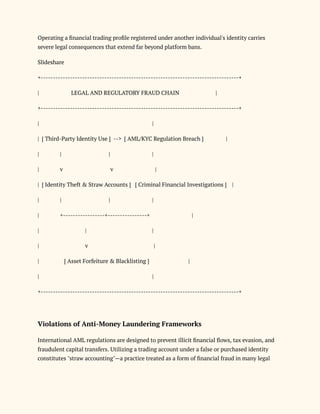
Operating a financialtrading profile registered under another individual's identity carries
severe legal consequences that extend far beyond platform bans.
Slideshare
+---------------------------------------------------------------------------------+
| LEGAL AND REGULATORY FRAUD CHAIN |
+---------------------------------------------------------------------------------+
| |
| [ Third-Party Identity Use ] --> [ AML/KYC Regulation Breach ] |
| | | |
| v v |
| [ Identity Theft & Straw Accounts ] [ Criminal Financial Investigations ] |
| | | |
| +-----------------+----------------+ |
| | |
| v |
| [ Asset Forfeiture & Blacklisting ] |
| |
+---------------------------------------------------------------------------------+
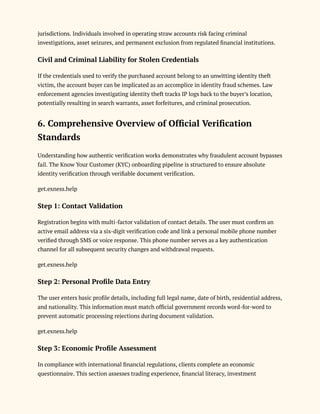
Violations of Anti-Money Laundering Frameworks
International AML regulations are designed to prevent illicit financial flows, tax evasion, and
fraudulent capital transfers. Utilizing a trading account under a false or purchased identity
constitutes "straw accounting"—a practice treated as a form of financial fraud in many legal
7.
jurisdictions. Individuals involvedin operating straw accounts risk facing criminal
investigations, asset seizures, and permanent exclusion from regulated financial institutions.
Civil and Criminal Liability for Stolen Credentials
If the credentials used to verify the purchased account belong to an unwitting identity theft
victim, the account buyer can be implicated as an accomplice in identity fraud schemes. Law
enforcement agencies investigating identity theft tracks IP logs back to the buyer’s location,
potentially resulting in search warrants, asset forfeitures, and criminal prosecution.
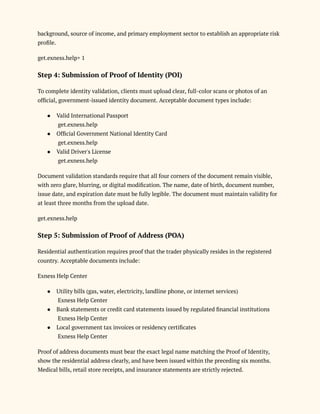
6. Comprehensive Overview of Official Verification
Standards
Understanding how authentic verification works demonstrates why fraudulent account bypasses
fail. The Know Your Customer (KYC) onboarding pipeline is structured to ensure absolute
identity verification through verifiable document verification.
get.exness.help
Step 1: Contact Validation
Registration begins with multi-factor validation of contact details. The user must confirm an
active email address via a six-digit verification code and link a personal mobile phone number
verified through SMS or voice response. This phone number serves as a key authentication
channel for all subsequent security changes and withdrawal requests.
get.exness.help
Step 2: Personal Profile Data Entry
The user enters basic profile details, including full legal name, date of birth, residential address,
and nationality. This information must match official government records word-for-word to
prevent automatic processing rejections during document validation.
get.exness.help
Step 3: Economic Profile Assessment
In compliance with international financial regulations, clients complete an economic
questionnaire. This section assesses trading experience, financial literacy, investment
8.
background, source ofincome, and primary employment sector to establish an appropriate risk
profile.
get.exness.help+ 1
Step 4: Submission of Proof of Identity (POI)
To complete identity validation, clients must upload clear, full-color scans or photos of an
official, government-issued identity document. Acceptable document types include:
● Valid International Passport
get.exness.help
● Official Government National Identity Card
get.exness.help
● Valid Driver's License
get.exness.help
Document validation standards require that all four corners of the document remain visible,
with zero glare, blurring, or digital modification. The name, date of birth, document number,
issue date, and expiration date must be fully legible. The document must maintain validity for
at least three months from the upload date.
get.exness.help
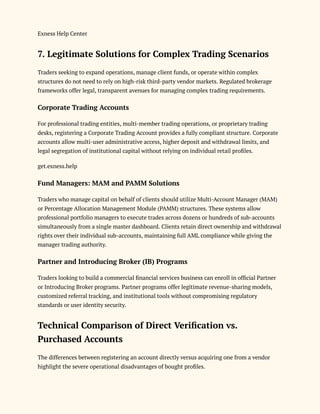
Step 5: Submission of Proof of Address (POA)
Residential authentication requires proof that the trader physically resides in the registered
country. Acceptable documents include:
Exness Help Center
● Utility bills (gas, water, electricity, landline phone, or internet services)
Exness Help Center
● Bank statements or credit card statements issued by regulated financial institutions
Exness Help Center
● Local government tax invoices or residency certificates
Exness Help Center
Proof of address documents must bear the exact legal name matching the Proof of Identity,
show the residential address clearly, and have been issued within the preceding six months.
Medical bills, retail store receipts, and insurance statements are strictly rejected.
9.
Exness Help Center
7.Legitimate Solutions for Complex Trading Scenarios
Traders seeking to expand operations, manage client funds, or operate within complex
structures do not need to rely on high-risk third-party vendor markets. Regulated brokerage
frameworks offer legal, transparent avenues for managing complex trading requirements.
Corporate Trading Accounts
For professional trading entities, multi-member trading operations, or proprietary trading
desks, registering a Corporate Trading Account provides a fully compliant structure. Corporate
accounts allow multi-user administrative access, higher deposit and withdrawal limits, and
legal segregation of institutional capital without relying on individual retail profiles.
get.exness.help
Fund Managers: MAM and PAMM Solutions
Traders who manage capital on behalf of clients should utilize Multi-Account Manager (MAM)
or Percentage Allocation Management Module (PAMM) structures. These systems allow
professional portfolio managers to execute trades across dozens or hundreds of sub-accounts
simultaneously from a single master dashboard. Clients retain direct ownership and withdrawal
rights over their individual sub-accounts, maintaining full AML compliance while giving the
manager trading authority.
Partner and Introducing Broker (IB) Programs
Traders looking to build a commercial financial services business can enroll in official Partner
or Introducing Broker programs. Partner programs offer legitimate revenue-sharing models,
customized referral tracking, and institutional tools without compromising regulatory
standards or user identity security.
Technical Comparison of Direct Verification vs.
Purchased Accounts
The differences between registering an account directly versus acquiring one from a vendor
highlight the severe operational disadvantages of bought profiles.
10.
● Capital Ownershipand Recovery: Direct verification grants the user 100% legal
ownership, with guaranteed account recovery options via personal ID. Purchased
accounts leave legal ownership with the vendor or identity victim, allowing third parties
to reset credentials and confiscate funds at any time.
Slideshare
● Withdrawal Reliability: Direct accounts support seamless withdrawals to personal
bank accounts, e-wallets, and payment gateways matching the verified identity.
Purchased accounts trigger immediate payout rejections due to third-party name
mismatches.
● System Stability: Verified accounts maintain uninterrupted access under standard
operational policies. Purchased accounts face continuous risks of automated freeze
events, IP-based risk flags, and permanent account terminations.
● Legal and Regulatory Status: Directly verified profiles operate within international
financial compliance laws. Purchased accounts expose users to identity theft
investigations, AML fraud inquiries, and potential financial blacklisting.
Slideshare
Recommended Action Plan for Professional Traders
1. Conduct Direct Account Onboarding: Always initiate account registration personally
through the official broker portal, using accurate personal information matching official
documents.
get.exness.help
2. Prepare Documentation Early: Keep current scans of a government ID (passport,
national ID, or driver's license) and a clear proof of address (utility bill or bank
statement under 6 months old) ready for upload.
Exness Help Center
3. Align Payment Channels: Ensure all deposit and withdrawal methods are held in the
exact name registered on the trading profile to guarantee fast, automated payout
processing.
4. Utilize Professional Institutional Frameworks: If managing institutional funds,
operating multi-account strategies, or running trading desks, apply directly for
Corporate or PAMM/MAM structures rather than attempting to operate individual
accounts under third-party identities.
By following established regulatory protocols and maintaining full ownership of personal
credentials, market participants protect their trading capital, preserve their legal standing, and
ensure long-term stability in global financial markets.