1
Make a copyand edit in
Google Slides.
1. On the menu bar, click File and then
Make a copy and Entire Presentation.
2. Type a name for the file.
3. Choose where to save it on your
Google Drive.
4. Click Ok.
5. A new tab will open. Wait for the file to
be completely loaded on a new tab.
6. Once the file has loaded, edit this
presentation using Google Slides.
Download an offline copy and
edit in Microsoft PowerPoint.
1. On the menu bar, click File and then
Download as.
2. Choose a file type. Select Microsoft
PowerPoint (.pptx).
3. Wait for the file to be downloaded to your
local disk.
4. Once completely downloaded, open the
file and edit it using Microsoft PowerPoint
or any offline presentation program.
Do You Want to Edit This Presentation?
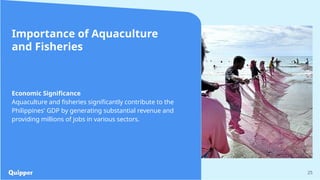
2.
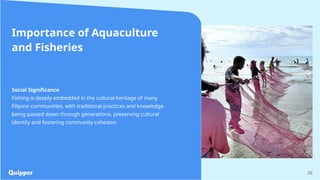
Agriculture and FisheryArts
Introduction to Aquaculture and
Fisheries
Unit 1
Aquaculture Basics and Career Horizons
TLE • Grade 8
3.
Agriculture and FisheryArts
3
Introduction to Aquaculture
and Fisheries
Unit 1
Aquaculture Basics and Career Horizons
TLE • Grade 8
4.
The knowledge gainedin this unit can be applied to the following;
● implementing sustainable aquaculture practices to ensure long-term
productivity and environmental health,
● recognizing the economic contributions of fisheries and aquaculture
to local and national economies,
● embracing technological advancements to improve efficiency and
productivity in aquaculture,
● promoting the conservation of aquatic ecosystems and biodiversity,
● ensuring the safety and quality of aquaculture products for
consumers,
● identifying and pursuing career and business opportunities in the
fisheries and aquaculture sector.
4
Practical Applications
5.
Central Question
5
How cansustainable practices, technological
advancements, and entrepreneurial
opportunities in aquaculture and fisheries
contribute to environmental conservation,
economic development, and food security?
6.
At the endof this lesson, you should be able to do the following:
● Differentiate aquaculture and fisheries.
● Identify various types of aquaculture systems.
● Explain basic practices and techniques in fish farming.
● Discuss the environmental challenges and sustainability measures in
aquaculture.
6
Learning Targets
7.
7
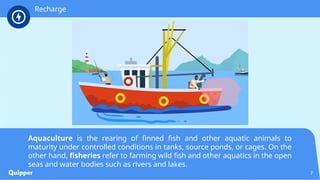
Aquaculture is therearing of finned fish and other aquatic animals to
maturity under controlled conditions in tanks, source ponds, or cages. On the
other hand, fisheries refer to farming wild fish and other aquatics in the open
seas and water bodies such as rivers and lakes.
Recharge
8.
Recharge
1. Pair upwith a classmate and discuss the differences between
aquaculture and fisheries.
2. Write down at least two key points from your discussion.
8
Instructions
9.
Recharge
9
Activity Processing
1. Whatare the key differences
between aquaculture and
fisheries that you discussed?
2. How do you think aquaculture
has developed over time?
3. Why is it important to
understand the relationship
between aquaculture and
fisheries?
Recharge
10.
10
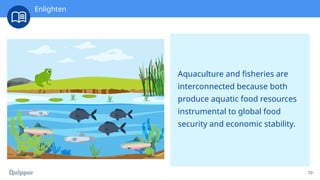
Aquaculture and fisheriesare
interconnected because both
produce aquatic food resources
instrumental to global food
security and economic stability.
Enlighten
11.
11
Instructions
1. Listen carefullyto the definitions and explanations provided in the study
guide. Take notes on the key points discussed.
2. After the explanation, you will work in groups to create a simple chart
comparing aquaculture and fisheries based on the information provided.
Enlighten
12.
12
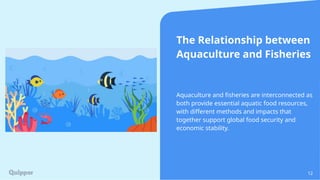
The Relationship between
Aquacultureand Fisheries
Aquaculture and fisheries are interconnected as
both provide essential aquatic food resources,
with different methods and impacts that
together support global food security and
economic stability.
13.
Fisheries
● involve harvestingfish and
other aquatic organisms
directly from their natural
habitats
● relies heavily on the health
and availability of wild fish
populations
Aquaculture
● involves breeding, rearing,
and harvesting aquatic
organisms in controlled
environments
● allows cultivation of fish
independent of natural
population fluctuations
13
Dependence on Natural Populations vs. Controlled Environments
14.
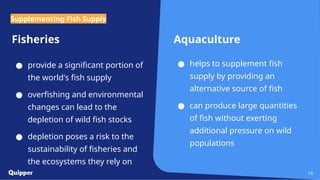
Fisheries
● provide asignificant portion of
the world's fish supply
● overfishing and environmental
changes can lead to the
depletion of wild fish stocks
● depletion poses a risk to the
sustainability of fisheries and
the ecosystems they rely on
Aquaculture
● helps to supplement fish
supply by providing an
alternative source of fish
● can produce large quantities
of fish without exerting
additional pressure on wild
populations
14
Supplementing Fish Supply
15.
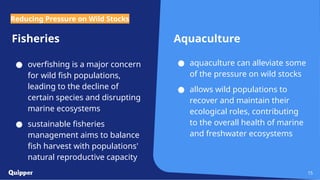
Fisheries
● overfishing isa major concern
for wild fish populations,
leading to the decline of
certain species and disrupting
marine ecosystems
● sustainable fisheries
management aims to balance
fish harvest with populations'
natural reproductive capacity
Aquaculture
● aquaculture can alleviate some
of the pressure on wild stocks
● allows wild populations to
recover and maintain their
ecological roles, contributing
to the overall health of marine
and freshwater ecosystems
15
Reducing Pressure on Wild Stocks
16.
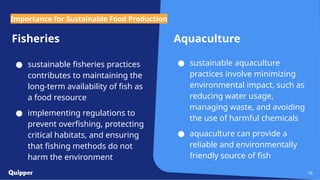
Fisheries
● sustainable fisheriespractices
contributes to maintaining the
long-term availability of fish as
a food resource
● implementing regulations to
prevent overfishing, protecting
critical habitats, and ensuring
that fishing methods do not
harm the environment
Aquaculture
● sustainable aquaculture
practices involve minimizing
environmental impact, such as
reducing water usage,
managing waste, and avoiding
the use of harmful chemicals
● aquaculture can provide a
reliable and environmentally
friendly source of fish
16
Importance for Sustainable Food Production
17.
Recharge
17
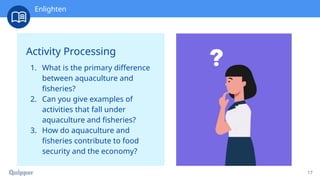
Activity Processing
1. Whatis the primary difference
between aquaculture and
fisheries?
2. Can you give examples of
activities that fall under
aquaculture and fisheries?
3. How do aquaculture and
fisheries contribute to food
security and the economy?
Enlighten
18.
18
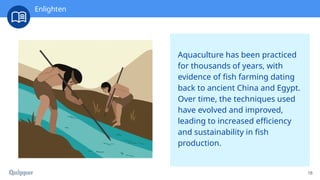
Aquaculture has beenpracticed
for thousands of years, with
evidence of fish farming dating
back to ancient China and Egypt.
Over time, the techniques used
have evolved and improved,
leading to increased efficiency
and sustainability in fish
production.
Enlighten
19.
19
Instructions
1. Pay attentionto the timeline and key milestones in the history of
aquaculture. Take notes on important dates and developments.
2. After the discussion, you will create a timeline poster in pairs,
highlighting the significant events in the development of aquaculture.
Enlighten
20.
Historical Background
and Developmentof
Aquaculture
20
Aquaculture has been integral to the
Philippines' history and economy for centuries.
Fish farming can be traced back to pre-colonial
times, showcasing a rich tradition of utilizing
the country's abundant aquatic resources.
21.
● Long beforethe arrival of the Spanish, indigenous Filipinos were
already engaged in various forms of aquaculture.
● Coastal communities utilized simple fish traps, pens, and ponds to
cultivate and harvest fish and other aquatic organisms.
● Early methods included the use of brackish water fishponds, where tidal
flows were harnessed to maintain water quality and fish health.
● These traditional practices laid the foundation for modern aquaculture
in the country.
21
Early Practices
22.
● Fishpond constructionand management techniques were further
developed during the Spanish colonial era.
● The introduction of new species and the expansion of fish farming
areas marked significant advancements in aquaculture practices.
● The early 20th century saw the introduction of scientific fish farming
techniques during the American colonial period.
● The establishment of research institutions and experimental stations
helped in the dissemination of modern aquaculture practices.
22
Colonial Influence
23.
● After WorldWar II, the Philippine government recognized the potential
of aquaculture to boost food production and alleviate poverty.
● Various initiatives were launched to promote the industry, including the
development of infrastructure, training programs, and research
institutions.
● The latter half of the 20th century witnessed significant technological
advancements in aquaculture.
● The introduction of improved breeding techniques, feed formulations,
and disease management practices contributed to increased
productivity and sustainability.
23
Post-World War II Development
24.
● Modern aquaculturein the Philippines includes the farming of a wide
range of species, such as milkfish (bangus), tilapia, shrimp, and
seaweed.
● The diversification of species has helped stabilize the industry and
reduce dependence on wild stocks.
● Adopting intensive aquaculture systems, such as Recirculating
Aquaculture Systems (RAS) and aquaponics, has further enhanced
production efficiency.
● Integrated farming systems that combine aquaculture with agriculture,
such as rice-fish farming, are also gaining popularity.
24
Modern Aquaculture
25.
25
Importance of Aquaculture
andFisheries
Economic Significance
Aquaculture and fisheries significantly contribute to the
Philippines' GDP by generating substantial revenue and
providing millions of jobs in various sectors.
26.
26
Importance of Aquaculture
andFisheries
Social Significance
Fishing is deeply embedded in the cultural heritage of many
Filipino communities, with traditional practices and knowledge
being passed down through generations, preserving cultural
identity and fostering community cohesion.
27.
27
Importance of Aquaculture
andFisheries
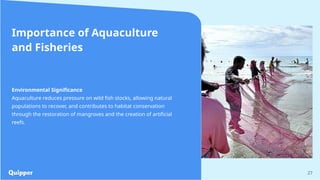
Environmental Significance
Aquaculture reduces pressure on wild fish stocks, allowing natural
populations to recover, and contributes to habitat conservation
through the restoration of mangroves and the creation of artificial
reefs.
28.
28
Importance of Aquaculture
andFisheries
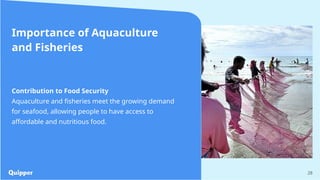
Contribution to Food Security
Aquaculture and fisheries meet the growing demand
for seafood, allowing people to have access to
affordable and nutritious food.
30
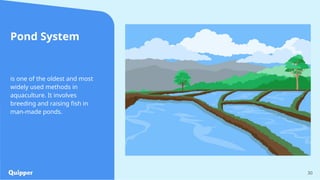
Pond System
is oneof the oldest and most
widely used methods in
aquaculture. It involves
breeding and raising fish in
man-made ponds.
31.
31
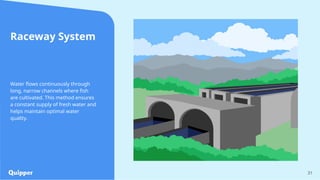
Raceway System
Water flowscontinuously through
long, narrow channels where fish
are cultivated. This method ensures
a constant supply of fresh water and
helps maintain optimal water
quality.
32.
32
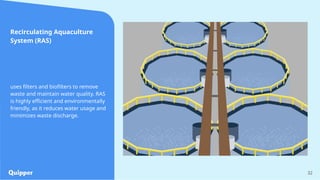
Recirculating Aquaculture
System (RAS)
usesfilters and biofilters to remove
waste and maintain water quality. RAS
is highly efficient and environmentally
friendly, as it reduces water usage and
minimizes waste discharge.
Recharge
34
Activity Processing
1. Whatwere some of the earliest
forms of aquaculture?
2. How has aquaculture evolved
over the centuries?
3. What are some key technological
advancements that have
impacted aquaculture?
Enlighten
35.
35
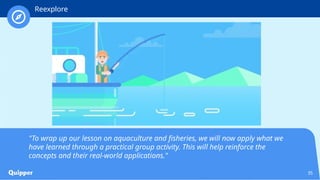
"To wrap upour lesson on aquaculture and fisheries, we will now apply what we
have learned through a practical group activity. This will help reinforce the
concepts and their real-world applications."
Reexplore
36.
36
Instructions:
1. In yourgroups, create a presentation that outlines the environmental
challenges faced by aquaculture and the sustainability measures that can
be implemented.
2. Make sure to include examples of real-world practices and technologies
that address these challenges.
3. Each group will present their findings to the class.
Reexplore
37.
Recharge
37
Activity Processing
1. Whatare some of the main
environmental challenges
associated with aquaculture?
2. How can sustainable practices
improve the impact of
aquaculture on the
environment?
3. Can you provide examples of
successful sustainability
measures in aquaculture?
Reexplore
38.
Green and MarineNuggets
38
Did you know that aquaculture can produce fish and
other aquatic organisms such as shrimp, oysters,
and seaweed? These products are essential for
various industries, including food, pharmaceuticals,
and cosmetics.
39.
Impactful AFA: Real-LifeEngagement
39
Aquaculture is not just about growing fish; it also
supports the green economy, which focuses on
creating jobs and producing food in an
environmentally friendly way. Learning
aquaculture can help build a sustainable future in
which economic growth and environmental care
are integrated.
40.
Innovation
40
The Recirculating AquacultureSystem (RAS) allows
continuous water reuse in fish tanks, reducing water
consumption and waste. Adopted by several fish farms in
the Philippines, RAS promotes sustainable and eco-friendly
fish farming. This innovation maintains optimal water
quality and reduces environmental impact. [Source: Bureau
of Fisheries and Aquatic Resources, Philippines]
41.
Who Is This?
41
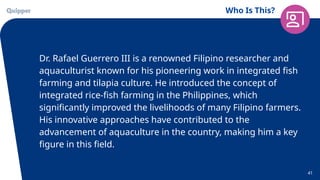
Dr.Rafael Guerrero III is a renowned Filipino researcher and
aquaculturist known for his pioneering work in integrated fish
farming and tilapia culture. He introduced the concept of
integrated rice-fish farming in the Philippines, which
significantly improved the livelihoods of many Filipino farmers.
His innovative approaches have contributed to the
advancement of aquaculture in the country, making him a key
figure in this field.
42.
Tiller’s Toolkit
42
In linewith Dr. Rafael Guerrero III's innovative practices, one
effective tip for sustainable fish farming is integrating fish
culture with rice farming. This method, known as rice-fish
farming, not only enhances the productivity of both fish and
rice but also helps control pests and weeds naturally.
Additionally, farmers can use locally available and cost-
effective feeds such as Azolla and duckweed to supplement
the diet of their fish, reducing dependency on commercial
feeds.
43.
References
Boyd, Claude E.,and Aaron A. McNevin. "Aquaculture, Resource Use, and the Environment." Wiley-Blackwell, 2015.
FAO. "The State of World Fisheries and Aquaculture 2020." Food and Agriculture Organization of the United Nations, 2020.
Guerrero, Rafael, III. “Rice-Fish Farming is the Integrated, Simultaneous Culture of Rice and Fish in Irrigated Rice Fields or
Paddies. It is an Old Practice That is Believed to have Begun in China 1,700 Years Ago.” South Center for Variety
Evaluation and Seed Certification. Accessed August 5, 2024.
http://khaokiemnghiemgiong.vn/news/rice-fish-farming-is-the-integrated-simultaneous-culture-of-rice-and-fish-in-irrig
ated-rice-fields-or-paddies-it-is-an-old-practice-that-is-believed-to-have-begun-in-china-1700-years-ago-130.html
.
Stickney, Robert R. "Aquaculture: An Introductory Text." CABI, 2009.
43
Editor's Notes
#2 Teacher’s script: This unit provides a comprehensive exploration of aquaculture and fisheries, focusing on their significance, types, and the career and business opportunities they offer. Students will gain a deep understanding of the relationship between aquaculture and fisheries, their economic, social, and environmental importance, and the different types of aquaculture systems. The unit also delves into the various career paths within the fisheries sector, the necessary educational and skill requirements, and the potential for entrepreneurship in fisheries. Through engaging multimedia presentations, students will learn about the historical development, current practices, and future prospects in aquaculture and fisheries.
#5 Teacher’s script: “Before we start this unit, let me ask you a question/several questions.”
#8 Teacher’s script:
Use this prompt to introduce the activity:
"Today, we are going to start by recalling what we know about aquaculture and fisheries. This will help us connect our previous knowledge to the new concepts we'll learn in this lesson."
Provide the following instructions to the class:
Pair up with a classmate and discuss the differences between aquaculture and fisheries.
Write down at least two key points from your discussion.
#9 Teacher’s script:
Ask the following questions to process the activity:
What are the key differences between aquaculture and fisheries that you discussed?
Possible Answer: Aquaculture involves farming aquatic organisms, while fisheries involve catching wild fish.
How do you think aquaculture has developed over time?
Possible Answer: Aquaculture has evolved from simple fish ponds to advanced systems like Recirculating Aquaculture Systems (RAS).
Why is it important to understand the relationship between aquaculture and fisheries?
Possible Answers: Understanding the relationship helps us appreciate how both contribute to food security and the economy.
#11 Teacher’s script:
Use this prompt to introduce the activity:
"In this part of the lesson, we will explore the definitions and relationships between aquaculture and fisheries. Understanding these basic concepts is needed as they form the foundation of our study."
Provide the following instructions to the class:
Listen carefully to the definitions and explanations provided in the study guide. Take notes on the key points discussed.
After the explanation, you will work in groups to create a simple chart comparing aquaculture and fisheries based on the information provided.
#17 Teacher’s script:
Ask the following questions to process the activity:
What is the primary difference between aquaculture and fisheries?
Possible Answer: Aquaculture involves the breeding and harvesting of fish and other aquatic organisms in controlled environments, while fisheries refer to catching fish and other aquatic organisms from their natural habitats.
Can you give examples of activities that fall under aquaculture and fisheries?
Possible Answer: Examples of aquaculture activities include fish farming and shrimp farming. Examples of fisheries activities include commercial fishing and subsistence fishing.
How do aquaculture and fisheries contribute to food security and the economy?
Possible Answer: Both aquaculture and fisheries provide a significant source of food, employment, and economic activity, contributing to food security and the economy.
#19 Teacher’s script:
Use this prompt to introduce the activity:
"In this part of the lesson, we will explore the definitions and relationships between aquaculture and fisheries. Understanding these basic concepts is needed as they form the foundation of our study."
Provide the following instructions to the class:
Listen carefully to the definitions and explanations provided in the study guide. Take notes on the key points discussed.
After the explanation, you will work in groups to create a simple chart comparing aquaculture and fisheries based on the information provided.
#34 Teacher’s script:
Ask the following questions to process the activity:
What were some of the earliest forms of aquaculture?
Possible Answers: Some of the earliest forms of aquaculture included fish ponds in ancient China and rice-fish farming systems.
How has aquaculture evolved over the centuries?
Possible Answer: Aquaculture has evolved from simple pond systems to advanced methods like Recirculating Aquaculture Systems (RAS) and aquaponics.
What are some key technological advancements that have impacted aquaculture?
Possible Answer: Key technological advancements include the development of artificial feeds, selective breeding, and water quality management systems.
#36 Teacher’s script:
Use this prompt to introduce the activity:
"To wrap up our lesson on aquaculture and fisheries, we will now apply what we have learned through a practical group activity. This will help reinforce the concepts and their real-world applications."
Provide the following instructions to the class:
In your groups, create a presentation that outlines the environmental challenges faced by aquaculture and the sustainability measures that can be implemented. Each group will present their findings to the class.
Make sure to include examples of real-world practices and technologies that address these challenges.
#37 Teacher’s script:
Ask the following questions to process the activity:
What are some of the main environmental challenges associated with aquaculture?
Possible Answer: The main environmental challenges include water pollution, habitat destruction, and the overuse of antibiotics.
How can sustainable practices improve the impact of aquaculture on the environment?
Possible Answer: Sustainable practices such as integrated multi-trophic aquaculture, the use of probiotics instead of antibiotics, and closed-loop systems can help mitigate environmental impact.
Can you provide examples of successful sustainability measures in aquaculture?
Possible Answer: Examples of successful sustainability measures include the use of recirculating aquaculture systems (RAS) and polyculture systems where different species are farmed together to enhance resource use efficiency.